| Saudis learning the Singapore way of teaching Straits Times Since last October, the National Institute of Education (NIE) has taken leadership trainers from the kingdom under its wing, training them in curriculum … |
| All 300 places at The Straits Times’ first education forum this Sunday taken up Straits Times Mr David Hoe, an undergraduate at the National University of Singapore (NUS), is one of the speakers at the inaugural The Straits Times Education … |
| Singapore Plows Ahead of US With Tech in Schools NBCNews.com In the late 1990s, the Singapore Ministry of Education unveiled its master plan for technology. The first phase was spent building up infrastructure and … |
| Govt mulls more recognition for NSmen in housing, health, education Channel News Asia SINGAPORE: More recognition could be given to National Servicemen (NSmen) in areas such as housing, healthcare and education. Defence … |
| Singapore to beef up nuclear technology expertise Channel News Asia Singapore is beefing up its nuclear technology expertise with a newly-announced programme. The 10-year Nuclear Safety Research and Education … |
| Many turn up at E Plus International Education fair The Hindu The aspirants evinced keen interest in countries like Holland, Singapore, New … Official boards of all the countries presented seminars on education … |
| AWARE’s pushback on more benefits for NSmen ignites debate TODAYonline SINGAPORE — The Government’s plan to enhance housing, healthcare and education benefits for operationally ready national servicemen has … |
Tag: Math
Introduction to Ricci Flow & Poincare Conjecture
This is an interesting introduction to some extremely advanced Math: Ricci Flow & Poincare Conjecture!
Ricci Flow was used to finally crack the Poincaré Conjecture. It was devised by Richard Hamilton but famously employed by Grigori Perelman in his acclaimed proof. It is named after mathematician Gregorio Ricci-Curbastro.
In this video it is discussed by James Isenberg from the University of Oregon (filmed here at MSRI).
The famed Poincaré Conjecture – the only Millennium Problem cracked thus far.
Grigori Perelman’s paper: http://bit.ly/perelmanpaper
E Maths List of Formulae to Memorize (Not in Formula List)
Here is a compilation of the Formulas needed in GCSE O Levels E Maths Exam.
Includes Formulae on Algebra and Numbers, Geometry and Measurement, Statistics and more!
Check it out at https://mathtuition88.com/math-notes-worksheets-sale/
Students in my Maths Tuition class will be taught how to memorize the formulae with understanding, and how to apply them correctly!
Keep calm, and all the best for your mid-year exams.
Math Teachers at Play (MTaP) Blog Carnival: Top Math Blog Posts!
This is the 73rd Edition of the Math Teachers at Play (MTaP) blog carnival!
Some interesting facts about 73 from Wikipedia!:
- Seventy-three is the 21st prime number. The previous is seventy-one, with which it comprises the 8th twin prime. It is also a permutable prime with thirty-seven. 73 is a star number.
- 73 is the largest minimal Primitive root in the first 100000 primes. In other words, if p is one of the first 100000 primes, then at least one of the primes 3, 5, 7, 11, 13, 17, …, 73 is a primitive root modulo p.
- 73 is the smallest prime congruent to 1 modulo 24.
- 73 is an emirp, meaning that the reverse of 73, that is, 37, is also a prime number. Interestingly, 73 is also the 21st prime number while 37 is the 12th prime number.
- Want to find 73 in other bases? Check out the Base Converter: Convert any number into any base!
- Which animal is year 1973 in the Chinese Zodiac? Check out this post on the Mathematics of Chinese Zodiac!
Check out the following awesome blogs!
- Math Strategies
There is such an emphasis on learning math facts that our children do not spend enough time learning strategies that will help them solve math problems. Read about two types of strategies for solving math problems—working left to right and regrouping into what you know.
– Crystal Wagner - Nim Games
This is a game that is generally used to show how math can be involved in game play. I explain the rules of the game as well as the mathematical strategy involved. There is also a script where users can compete against the computer
– Aftermath - Show That Questions
This is a post around the questions that crop up in maths exams where students have to show something. I wrote it after I was surprised to hear some students hate it!
The Straight Lines Debate
This is a post exploring the benefits of the different methods of calculating straight lines.
– Stephen Cavadino - Day 85 – Related Rates
Two separate trucks carrying a very long wind turbine blade need to turn the corner. Describe how their speeds vary throughout the turn. The blog is dedicated to these types of discussion starters, at all levels.
– Curmudgeon - The missing $1 puzzle and more
You can read about that at the actual page it points to, http://www.homeschoolmath.net/online/favorite_challenging_puzzles.php
: )
– Maria - Eggs in the Basket Review Game
This review game can be adapted to almost any level and any topic, yet it consistently provides a really effective way to review Algebra content. It is a great way to review a lot of problems and have students work collaboratively while having fun – I just love hearing them explain their thought process to teammates when playing the game 🙂 With Easter almost here I thought it would be a good post to submit!
– Mary Williams - Decimals in a One Frame
Inspired by Chris Hunter’s blog post about decimals on a ten frame, I thought it would be a great opening number talk for my decimal unit to see where my students were before starting our decimal journey.
– Kristin @MathMinds - Counting Basics
– Bhaskar Lakshman - Circle Grid Designs
This post is part of a series of geometrical design activities in which shapes and patterns were found in grids constructed based on circles.
– Julie - Ten Sticks to Make, Count With, and Play a Game With
Ten sticks created from common items can be just as much fun to make as well as to be used for counting by ones and tens AND to play a game with.
– Margo Gentile - Why I Always Lead with the Punchline
I wrote this after reading another blog about how listing objectives for the day takes the punchline out of the math class. This blog just about my thoughts on sharing the learning objectives for the entire unit with students on the first day.
– Brooke Powers - My Nemesis Maths
This post is about my journey as a teacher, trying to make maths relevant and enjoyable to all students when I myself had issues with enjoying maths as a student.
– Danielle Myburgh - Quotable: Focus on Being Silent
The best way for children to build mathematical fluency is through conversation, especially one-on-one conversation with interested adults. Check out these ideas to encourage discussion-based math.
– Denise Gaskins - 2048 Free Strategy Guide
Stuck at playing the popular and addictive Math game 2048? Do not worry, for after reading this Strategy Guide, your chance of winning will increase tremendously!
Math Teachers at Play is a traveling blog carnival. It moves around from month to month but its home base is http://letsplaymath.net/mtap/. From there you can visit the archives, submit your blog post for inclusion in a future edition, and volunteer to host the site. You can also check out the Carnival of Mathematics. Thanks for visiting!
Subscribe to our free newsletter, for updates on Math, Education and other General Knowledge topics!
Meaningful learning VS rote learning (Featured Post)
This is a featured post by Epigami (a tuition agency).
Source: http://www.epigami.sg/blog/dont-just-learn-understand/
In the last decade, the Singapore educational system has become a global leader in the education field, helping exemplary pupils to be accepted in the worlds best universities. But with the increasing competitiveness of those top tier universities, students are faced with mounting pressure to excel in every aspect which might have an impact on their exams. This has led to the mass implementation of ‘rote learning’ in Asia, where students focus more on memorising knowledge than the full comprehension of the concepts behind it.
What is ‘rote learning’ and what’s wrong with it?
From the earliest days of schooling, rote learning is an essential tool to efficiently memorize educational fundamentals. It is a knowledge acquisition process based on repetition. Simply put, make a child say the alphabet every day for 6 months, and they will remember it ‘forever’. This is of course the most obvious way of learning and no other method could be better suited for the developing mind of an infant, as the concepts taught are simple in nature, and do not require a broader knowledge base.
Though, as one progresses through the ranks and gets shifted through the numerous streams put into place by the MOE, new knowledge starts to build upon old concepts, some aspects converging, others diverging, and all of if defining a complex web of knowledge which requires the student to delve into a deeper state understanding if he is to find any further use to it.
How many of us wonder at one point or another: Why am I learning this?
Read more at: http://www.epigami.sg/blog/dont-just-learn-understand/
![In the last decade, the Singapore educational system has become a global leader in the education field...[read more]](https://i0.wp.com/www.epigami.sg/blog/wp-content/uploads/2014/04/rote-learning-820x400.jpg "In the last decade, the Singapore educational system has become a global leader in the education field...[read more]")
Email Correspondence with Epigami Team:
Dear Mr Wu,
Epigami has recently written an article on meaningful learning as compared to rote learning. Once again, we believe that such an article would be useful and beneficial for your students in Singapore, especially in the subject of Mathematics. You can read more about our article at: http://www.epigami.sg/blog/dont-just-learn-understand/ and we hope that you can share it with your readers on your blog.
Thank you and have a great week ahead! 😀
Best regards,
Sandra @ the Epigami Team
Best Fibonacci Number Videos on Youtube
Math is logical, functional and just … awesome. Mathemagician Arthur Benjamin explores hidden properties of that weird and wonderful set of numbers, the Fibonacci series. (And reminds you that mathematics can be inspiring, too!)
Dr James Grime on the Pisano Period – a seemingly strange property of the Fibonacci Sequence.
Fibonacci Fun: Fascinating Activities With Intriguing Numbers
From “Raising Rabbits” to “Prickly Pinecones”, 24 easy-to-use, reproducible activities and projects introduce students to Fibonacci numbers and the golden ratio. Grades 4-8


Singapore Education Top News (20 April)
| MOE officers recognised for providing holistic education experience Channel News Asia SINGAPORE: A total of 7,103 Ministry of Education (MOE) officers were promoted this year, with some recognised for their contributions at a promotion … |
| Parents should start saving up early for kids’ education Channel News Asia Nearly all Singaporean parents want their children to get a university education — that is what a recent survey “The Value of Education: Springboard … |
| Education in Singapore: When Number 1 is not enough Asian Correspondent Singapore students pass PISA tests with flying colors, but critics say ‘so what?’, writes Zach Isaiah Chia. “Who says Singaporean’s are rote learners? |
| Singapore to train 3000 Saudi school principals Arab News Singapore’s National Institute of Education (NIE) will train 3,000 Saudi school principals over the next few years, Singapore’s Ambassador Lawrence … |
| CET campuses in full operation by second half of 2014 Channel News Asia SINGAPORE: The two national Continuing Education and Training (CET) campuses will be fully operational by the second half of this year, where they … |
| New school-to-work transition programme to help special needs students Channel News Asia This was announced by Education Minister Heng Swee Keat at the official … Students attend a class at a special education school in Singapore. |
| Lee Kuan Yew Fund for Bilingualism supports 5 more projects Channel News Asia The Ministry of Education (MOE) said the fund is sponsoring another five … Brainchild Pictures, YMCA of Singapore, and Saintly Education Centre. |
| Boy who exposed- and fought- the education monster The Independent Singapore News He is Singapore’s role model. He is the boy who fought his way from Normal (Technical) Stream to a place at the National University of Singapore … |
| GBSN & INSEAD organize Edu Technology Summit in Singapore MBAUniverse.com Eminent leaders in business education and industry participated at INSEAD’s Asia campus in Singapore on April 6, 2014 to participate in a summit on … |
| A lesson learnt from Singapore The Australian (blog) Education authorities should be encouraged that the national executive of the Australian Primary Principals Association was impressed after a briefing … |
Amazing Math Magic Video
http://www.ted.com In a lively show, mathemagician Arthur Benjamin races a team of calculators to figure out 3-digit squares, solves another massive mental equation and guesses a few birthdays. How does he do it? He’ll tell you.
TEDTalks is a daily video podcast of the best talks and performances from the TED Conference, where the world’s leading thinkers and doers are invited to give the talk of their lives in 18 minutes — including speakers such as Jill Bolte Taylor, Sir Ken Robinson, Hans Rosling, Al Gore and Arthur Benjamin. TED stands for Technology, Entertainment, and Design, and TEDTalks cover these topics as well as science, business, politics and the arts. Watch the Top 10 TEDTalks on TED.com, at
http://www.ted.com/index.php/talks/top10
Interested to learn more tricks? Check out these two books:
Secrets of Mental Math: The Mathemagician’s Guide to Lightning Calculation and Amazing Math Tricks
Mathemagics: How to Look Like a Genius Without Really Trying


Secrets of Mental Math: The Mathemagician’s Guide to Lightning Calculation and Amazing Math Tricks
These simple math secrets and tricks will forever change how you look at the world of numbers.
Secrets of Mental Math will have you thinking like a math genius in no time. Get ready to amaze your friends—and yourself—with incredible calculations you never thought you could master, as renowned “mathemagician” Arthur Benjamin shares his techniques for lightning-quick calculations and amazing number tricks. This book will teach you to do math in your head faster than you ever thought possible, dramatically improve your memory for numbers, and—maybe for the first time—make mathematics fun.
Yes, even you can learn to do seemingly complex equations in your head; all you need to learn are a few tricks. You’ll be able to quickly multiply and divide triple digits, compute with fractions, and determine squares, cubes, and roots without blinking an eye. No matter what your age or current math ability, Secrets of Mental Math will allow you to perform fantastic feats of the mind effortlessly. This is the math they never taught you in school.
Free Online Math Game for Very Young Kids
http://edu-games.atspace.com/
Help the Gorilla find bananas by adding the numbers correctly!
Suitable for ages 5 and above.
More games:
Math Memo – click on cards to match the correct pairs
Star alphabet – press letters on the keyboard to hear their names
Star numbers – press digits
Amazon Kindle for Reading Math Books
Looking for an alternative to the Ipad? Why not try out the Amazon Kindle?
Are your books taking up too much space and collecting dust? Want to switch to Ebooks in this Electronic Age?
Kindle Fire HDX 7″, HDX Display, Wi-Fi, 32 GB – Includes Special Offers


There are many free or affordable Kindle Math Books online for download/purchase. Other than Math books, the Kindle can also be used for reading other books, and also for playing games and using apps. It is a decent alternative to the Ipad, if you are not a fan of Apple.


|
Unlike tablets, Kindle Paperwhite is designed to deliver the best reading experience
|
|
Here are some very afforadable Kindle Math Books/Apps:
1)
Math BINGO – Kindle Fire (Kindle Tablet Edition)


| Price: | $0.99 |
Math BINGO Kindle Fire Edition!
The object of Math BINGO is to practice math facts while playing BINGO!
Features:
-Choose from 5 games: Addition, Subtraction, Multiplication, Division and Mixed
-Choose from 3 different levels of difficulty: Easy, Medium and Hard
-Create up to 5 player profiles
-Choose from 8 different fun cartoon avatars
-Keep track of number of games played by player profile
-The Scoreboard keeps track of scores for each game and level
-Collect and play with BINGO Bugs when you earn a high score!
-Fun bonus game: BINGO Bug Bungee
2)
Secrets of Mental Math: The Mathemagician’s Guide to Lightning Calculation and Amazing Math Tricks


3)
Preschool and Kindergarten Learning Games Free


FREE Learning Games for Young Children!
Check out this post on Why the Kindle Fire HDX is a far better tablet than the iPad, if you are not convinced.
“I used to think that the iPad was the king of the tablets, but not any more. It’s time to whip the crown away from Apple and give it to its rightful holder – Amazon’s Kindle Fire HDX.”
Check out our Top Posts at Mathtuition88.com
Top Posts for all days ending 2014-04-16 (Summarized)
All Time

Free Math Movies
Want to watch movies about Mathematics? There is a nice website with Free Movies involving Math. It is not the full movie, but the portion of the movie that involves math.
The site is: http://www.math.harvard.edu/~knill/mathmovies/
This is a collection of movie clips in which Mathematics appears. The site is now in HTML5 video and should be accessible by all devices. If not, chose the direct video links. To include a clip into a presentation, chose the quicktime version.
Some interesting examples include: A Blackboard in linear algebra lecture at MIT on Parseval’s identity in Fourier theory. (http://www.math.harvard.edu/~knill/mathmovies/swf/goodwillhunting.html)
Another example: Young Spock learns Math. He memorizes the formula (4pi/3) r3 for the volume of the sphere, the square root of 2396324 and the definition of dimensionality log(n)/log(d). (http://www.math.harvard.edu/~knill/mathmovies/swf/startrek_spock.html)
If you are really interested in Math in the Movies, check out this book:
Math Goes to the Movies


Mel Gibson teaching Euclidean geometry, Meg Ryan and Tim Robbins acting out Zeno’s paradox, Michael Jackson proving in three different ways that 7 x 13 = 28. These are just a few of the intriguing mathematical snippets that occur in hundreds of movies. Burkard Polster and Marty Ross pored through the cinematic calculus to create this thorough and entertaining survey of the quirky, fun, and beautiful mathematics to be found on the big screen.
Math Goes to the Movies is based on the authors’ own collection of more than 700 mathematical movies and their many years using movie clips to inject moments of fun into their courses. With more than 200 illustrations, many of them screenshots from the movies themselves, this book provides an inviting way to explore math, featuring such movies as:
• Good Will Hunting• A Beautiful Mind• Stand and Deliver• Pi• Die Hard• The Mirror Has Two Faces
The authors use these iconic movies to introduce and explain important and famous mathematical ideas: higher dimensions, the golden ratio, infinity, and much more. Not all math in movies makes sense, however, and Polster and Ross talk about Hollywood’s most absurd blunders and outrageous mathematical scenes. Interviews with mathematical consultants to movies round out this engaging journey into the realm of cinematic mathematics.
This fascinating behind-the-scenes look at movie math shows how fun and illuminating equations can be.
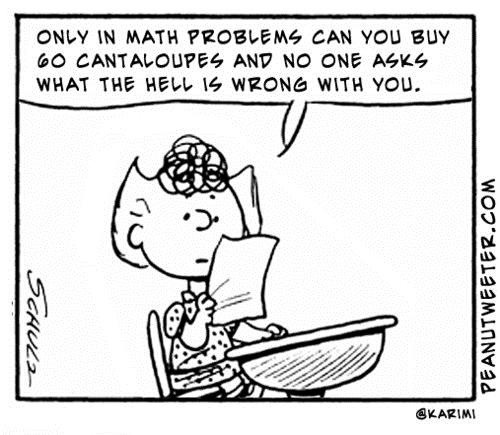
Charlie Brown (Peanuts) Math Cartoons

 Source:
 HCI Confession Page Math Joke
Source: https://www.facebook.com/HwaChongConfessions
“Today I asked the girl I like on FB to help me do math prob
9x-7i>3(3x-7u)
9x-7i>9x-21u
-7i>-3(7u)
-i>-3u
=
i<3u
but she go put the ans as 3u>i ruining my whole plan T.T”
-HCJC Student (M)


Math isn’t hard. Love is.
Currently in its eighteenth printing in Japan, this best-selling novel is available in English at last. Combining mathematical rigor with light romance, Math Girls is a unique introduction to advanced mathematics, delivered through the eyes of three students as they learn to deal with problems seldom found in textbooks. Math Girls has something for everyone, from advanced high school students to math majors and educators.
Praise for Math Girls!
“…the type of book that might inspire teens to realize how much interesting mathematics there is in the world—not just the material that is forced upon them for some standardized test.” “Recommended”
—CHOICE: Current Reviews for Academic Libraries
“Imagine the improbable: high-school students getting together on their own — not in a Math Club or Math Circle, not in preparation for any Math Olympiad or “regular” test, not on the advice of any of their teachers, not as part of any organized program — to talk about pure math, math more interesting than the math found in their textbooks. The three students in this book do that for the sheer love of it. That to me is the beauty and fascination of this novel for young people, mostly young people interested in math.”
—Marion Cohen, Arcadia University, MAA Reviews
“Sometimes the math goes over your head—or at least my head. But that hardly matters. The focus here is the joy of learning, which the book conveys with aplomb.”
—Daniel Pink, NYT and WSJ best-selling author of Drive and A Whole New Mind
“if you have a…teenager who’s really into math, this is a really interesting choice”
—Carol Zall, Public Radio International, The World
“Math Girls provides a fun and engaging way to learn and review mathematical concepts…the characters’ joy as they explore and discover new and old ideas is infectious.” —review, “Experiments in Manga” blog
Reviews from amazon.co.jp
“As a physics major, math has always been a painful tool to use and nothing more. But Math Girls changed the way I look at mathematics. Now I actually find it interesting!”
— “Au”
“Math Girls is a fun read, but I was surprised to find that it’s also a serious math book chock full of careful explanations. I hope that people who think they don’t like math will read it. Even when the formulas go over your head, just following the story gives you a great feel for how fun math can be.”
— “Nyanta”
“I got hooked on this book during summer vacation, and had a great time reading it by the pool. It was so good that I read it twice, the second time while working out the problems on the hotel stationary.”
— “Kei0210”
“Advanced math, explained in a playful way. But it’s not just a textbook, with dry solutions to problems. It’s a bittersweet story, with mathematics telling part of the tale. A brilliant comparison between the uncertainties of youth and the absolute proofs of symbols and numbers.”
— Shiori Oguchi
Paul Erdos’ Proof that there are Infinite Primes
Paul Erdos’ Proof that there are Infinite Primes (with Examples)
Every integer can be uniquely written as 


We can do this by letting 


Now, suppose to the contrary that a finite number k of prime numbers exists. We fix a positive integer 
By the fundamental theorem of arithmetic, there are only 


Hence, the number of integers less than N is at most 


i.e. 
This inequality does not hold for 

Hence, this is a contradiction, and there are infinitely many primes!
An example of how the above argument works: Suppose the only prime numbers are 2, 3, 5. (k=3)
Then, there are only 
For example, if we fix 


The Man Who Loved Only Numbers: The Story of Paul Erdos and the Search for Mathematical Truth


References:
http://en.wikipedia.org/wiki/Euclid’s_theorem#Erd.C5.91s.27s_proof
PAUL ERDOS – N IS A NUMBER
Tuition for All Subjects
If you are looking for tuition for other subjects, be it English Tuition, Social Studies Tuition, Geography Tuition, Physics Tuition, Chemistry Tuition, Biology Tuition, Chinese Tuition, Economics Tuition, GP Tuition or Piano/Violin Lessons …
Check out our page on Other Subjects Tuition!
We have a recommendation of a top tuition agency listed on that page, as well as top tutors in Singapore.
If you are looking for O Level E Maths and A Maths Tuition, …
Check out our page on O Level Group Tuition at Bishan!
April Fools Math!
Check out this video on April Fools Math! The content is about Complex Numbers. Really funny. 🙂 Over a million views!
Also, check out this post on Math Jokes:
https://mathtuition88.com/2014/03/08/math-jokes/
Also, we have a series of Best Fake Proofs on Math Stackexchange:
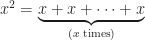
![\displaystyle\frac{d}{dx}x^2=\frac{d}{dx}[\underbrace{x+x+\cdots+x}_{(x\text{ times})}]](https://s0.wp.com/latex.php?latex=%5Cdisplaystyle%5Cfrac%7Bd%7D%7Bdx%7Dx%5E2%3D%5Cfrac%7Bd%7D%7Bdx%7D%5B%5Cunderbrace%7Bx%2Bx%2B%5Ccdots%2Bx%7D_%7B%28x%5Ctext%7B+times%7D%29%7D%5D&bg=ffffff&fg=1a1a1a&s=0&c=20201002)


What went wrong?
Amazing Endless Growing Chocolate! Can you spot the magic?
Math Jokes 4 Mathy Folks


Math Rap Video and How not knowing Math can cost you $15,000
Math Rap covering many Math topics:
- Pythagoras’ Theorem
- Equation of a straight line
- Probability
- Logic
- Truth Tables
“Come to class everyday, and do your homework every night, and everything is going to be alright.” 🙂
If this guy had studied basic Pythagoras’ Theorem, he would have been $15,000 dollars richer! In Math, the “majority” may not be right! 🙂
Math in Nature Video (3 million views!)
Math in Nature Video (3 million views!)
A movie inspired on numbers, geometry and nature, by Cristóbal Vila. One of the most popular Math videos on Youtube.
In this video, you can see how Fibonacci Numbers, the Golden Ratio, and Fractals are often found in nature.
Like the video? Leave your comments below, and share this page with your friends using the Facebook, Twitter sharing buttons below!
Jake: Math prodigy proud of his autism (Video)
At age two, Jake Barnett was diagnosed with autism and his future was unclear. Now at age 13, Jake is a college sophomore and a math and science prodigy. Jake says his autism is key to his success. Morley Safer reports.


“It seems that for success in science or art a dash of autism is essential.” – Hans Asperger
Donate to St Andrew’s Autism Centre at: http://www.saac.org.sg/partnership_opp.html
Singapore Haze Math
Is the Singapore Haze coming back?
The haze is clearly coming back in Singapore, as haze hangs over Singapore on Sunday evening.
Interested how PSI is calculated using Math? Check out this article on The Math of air pollution at: http://www.intmath.com/blog/math-of-air-pollution/8170

Infinite Primes Proof by Euclid
How do we know there are an infinite number of primes?
Dr James Grime explains, with a bit of help from Euclid.
Mr Bean Calculus and Trigonometry Math Exam
For O Levels, we need to be proficient in both Calculus (Differentiation and Integration), AND Trigonometry! Students need to revise early to avoid being like Mr Bean!

How to Offer Encouragement to Someone Who Has Failed an Exam or Test
Source: http://www.wikihow.com/Offer-Encouragement-to-Someone-Who-Has-Failed-an-Exam-or-Test
Read this post to learn how to offer encouragement to someone who has failed an exam or test. Remember, the most important thing is to learn from failure, and use their failures as a stepping stone to success. 失败乃成功之母, failure is the mother of success.
Help the student to create stirring visions for his or her future. Success breeds success and once the student has a good handle on how to study successfully, this habit becomes part of his or her entire educational cycle. Ultimately, learning how to handle failed exams helps the learning process about failure in general; this leads to a better quality life and most importantly gives the person dignity and independence as an individual.

Probability Formula
Formulae for Probability
Works for All Cases:
-
P(A∪B)=P(A)+P(B)-P(A∩B)
-
P(A|B)=
-
P(A’)=1-P(A)

For Mutually Exclusive Events Only:
-
P(A∩B)=0

For Independent Events Only:
-
P(A∩B)=P(A) P(B)
-
P(A|B)=P(A)
-
P(B|A)=P(B)
-
P(A’∩B)=P(A’) P(B)
-
P(A∩B’)=P(A) P(B’)
-
P(A’∩B’)=P(A’) P(B’)
Is the Universe Made of Math?
Source: http://www.scientificamerican.com/article.cfm?id=is-the-universe-made-of-math-excerpt
Our Mathematical Universe: My Quest for the Ultimate Nature of Reality


In this excerpt from his new book, Our Mathematical Universe, M.I.T. professor Max Tegmark explores the possibility that math does not just describe the universe, but makes the universe
By Max Tegmark
What’s the answer to the ultimate question of life, the universe, and everything? In Douglas Adams’ science-fiction spoof “The Hitchhiker’s Guide to the Galaxy”, the answer was found to be 42; the hardest part turned out to be finding the real question. I find it very appropriate that Douglas Adams joked about 42, because mathematics has played a striking role in our growing understanding of our Universe.
The Higgs Boson was predicted with the same tool as the planet Neptune and the radio wave: with mathematics. Galileo famously stated that our Universe is a “grand book” written in the language of mathematics. So why does our universe seem so mathematical, and what does it mean? In my new book “Our Mathematical Universe”, I argue that it means that our universe isn’t just described by math, but that it is math in the sense that we’re all parts of a giant mathematical object, which in turn is part of a multiverse so huge that it makes the other multiverses debated in recent years seem puny in comparison.
Math, math everywhere! But where’s all this math that we’re going on about? Isn’t math all about numbers? If you look around right now, you can probably spot a few numbers here and there, for example the page numbers in your latest copy of Scientific American, but these are just symbols invented and printed by people, so they can hardly be said to reflect our Universe being mathematical in any deep way.
Continue reading at: http://www.scientificamerican.com/article.cfm?id=is-the-universe-made-of-math-excerpt
Maths Challenge
Hi, do feel free to try out our Maths Challenge (Secondary 4 / age 16 difficulty):

Source: Anderson E Maths Prelim 2011
If you have solved the problem, please email your solution to mathtuition88@gmail.com .
(Include your name and school if you wish to be listed in the hall of fame below.)
Students who answer correctly (with workings) will be listed in the hall of fame. 🙂
Hall of Fame (Correct Solutions):
1) Ex Moe Sec Sch Maths teacher Mr Paul Siew
2) Queenstown Secondary School, Maths teacher Mr Desmond Tay
3) Tay Yong Qiang (Waiting to enter University)
4) Ionut-Zaharia Chirila (Ex Lower Danube University, Romania)
The ideal Singapore JC subject combination for applying to Medicine
Why Additional Maths (A Maths) is important for entering Medicine:
Pathway: A Maths (O Level) –> H2 Maths (A Level) –> NUS Medicine
Source: http://sgforums.com/forums/2297/topics/439605
Quote: While NUS and NTU Medicine does not (officially) require H2 Maths (ie. ‘A’ level Maths), some other (overseas) Medical schools might. And not having H2 Maths might (unofficially) disadvantage your chances, even for NUS and NTU.
Therefore (assuming you intend to fight all the way for your ambition), your safest bet would be to (fight for the opportunity) to take both H2 Bio and H2 Math. The ideal Singapore JC subject combination for applying to Medicine (in any University) is :
H2 Chemistry, H2 Biology, H2 Mathematics
Source: http://www.kiasuparents.com/kiasu/forum/viewtopic.php?f=40&t=12228
Quote: pre-requisites for nus medicine will be H2 Chem and H2 bio or physics.
as for what’s best,
H2 math is almost a must since without it you’ll be ruling out a lot of ‘back-up courses’
Singapore math
Source: http://en.wikipedia.org/wiki/Singapore_math
Singapore math (or Singapore maths in British English[1]) is a teaching method based on the national math curriculum used for kindergarten through sixth grade in Singapore.[2][3] It involves teaching students to learn and master fewer mathematical concepts at greater detail as well as having them learn these concepts using a three-step learning process.[2][3] The three steps are concrete, pictorial, and abstract. In the concrete step, students engage in hands-on learning experiences using concrete objects such as chips, dice, or paper clips.[4] This is followed by drawing pictorial representations of mathematical concepts. Students then solve mathematical problems in an abstract way by using numbers and symbols.[5]
The development of Singapore math began in the 1980s when the country’s Ministry of Education developed its own mathematics textbooks that focused on problem solving and heuristic model drawing.[3][6] Outside Singapore, these textbooks were adopted by several schools in the the United States (U.S.) and in other countries such as Canada, Israel, and the United Kingdom.[7][1][8] Early adopters of these textbooks in the U.S. included parents interested in homeschooling as well as a limited number of schools.[3] These textbooks became more popular since the release of scores from the Trends in International Mathematics and Science Study (TIMSS), which showed Singapore at the top of the world three times in fourth and eighth grade mathematics.[9] U.S. editions of these textbooks have since been adopted by a large number of school districts as well as charter and private schools.[3]
Read more at: http://en.wikipedia.org/wiki/Singapore_math

The bar model can be drawn as a comparison model to compare two bars of unequal lengths, which can then be used to solve a subtraction problem.
On the road to make math fun: An army major who quit to become a mathematics teacher
Source: http://www.telegraphindia.com/1120625/jsp/calcutta/story_15629755.jsp#.Uq7JOJVDGDk
On the road to make math fun |
||
| MITA MUKHERJEE | ||
An army major who quit to become a mathematics teacher has embarked on a self-funded tour of the country to promote the subject. Madanlal Baldevraj Ghai, 70, stayed in a dormitory at Howrah station to keep costs down during the three days he spent in Calcutta recently, meeting officials of the primary and secondary board and the school education department to offer suggestions on how to make the study of mathematics more interesting. “India has produced brilliant mathematicians not just in the Vedic and medieval ages but also in modern times. Unfortunately, for quite a few years, not many students have been pursuing the subject at the higher level, which has resulted in a decline in the number of top-quality mathematicians,” the former teacher at PMN College in Rajpura, Punjab, told Metro. “We, the elderly mathematics teachers, need to reach out to students and guardians in every corner of the country to dispel the misconception that mathematics is dry and boring,” added Ghai, who has an MPhil in the subject and is pursuing his PhD at Punjabi University, Patiala. His 50-day tour was also prompted by the Prime Minister declaring 2012 as the year of mathematics as a tribute to Srinivasa Ramanujan, the autodidact mathematician who died in 1920 at the age of 32.
|

Read more at: http://www.telegraphindia.com/1120625/jsp/calcutta/story_15629755.jsp#.Uq7JOJVDGDk
Math is at the heart of physics. (O Level Maths and Physics Tips)
Source: http://www.academictips.org/acad/physic/physics_study_skills.html
Studying and practising Mathematics is one of the most useful things an O level student can do.
Not only are the two Maths (E Maths and A Maths) highly intertwined, studying Maths can actually help the students’ Physics too. There are some topics like Vectors and Kinematics in Physics that are also present in Mathematics.
Math is at the heart of physics. So the better your math, the better you’ll do in physics.
A good working knowledge of algebra and trigonometry is needed for Physics.

Mathematics is not a spectator sport (How to study Maths for Humanities students)
Studying Mathematics is totally different from studying Humanities, this is the reason why humanities students often don’t do well in maths. But with the right studying techniques (i.e. practising doing mathematics), humanities students can be very good at maths. Together with their creativity and good memory, humanities students have the potential to achieve the top grades in maths exams.
I have taught Pure Literature students and found that they definitely have the potential to do well in Maths once they learn the correct method of mathematical studying and thinking, and how to approach solving Maths questions.
One of the top mathematical physicists, Edward Witten, majored in history and minored in linguistics! (http://en.wikipedia.org/wiki/Edward_Witten)
Mathematics is not a spectator sport
Source: http://www.math.umn.edu/~rogness/math1001/syllabus/node20.html
Even if you understand every word in lecture and in the textbook, the only way to really learn mathematics is by doing mathematics. Sometimes this means doing even more than the assigned problems. (See “time committment” above.) This is how to avoid the common pitfall of “understanding everything in class but blanking out on the exams.”
I realize this isn’t welcome advice, and I admit that I haven’t always followed it myself. But in years of teaching (and 20+ years of learning) mathematics I haven’t found any shortcut.
The Simpsons and Their Mathematical Secrets


By Simon Singh
Synopsis: Some have seen philosophy embedded in episodes of The Simpsons; others have detected elements of psychology and religion. Simon Singh, bestselling author of Fermat’s Last Theorem, The Code Book and The Big Bang, instead makes the compelling case that what The Simpsons’ writers are most passionate about is mathematics. He reveals how the writers have drip-fed morsels of number theory into the series over the last twenty-five years; indeed, there are so many mathematical references in The Simpsons, and in its sister program, Futurama, that they could form the basis of an entire university course. Using specific episodes as jumping off points – from ‘Bart the Genius’ to ‘Treehouse of Horror VI’ – Simon Singh brings to life the most intriguing and meaningful mathematical concepts, ranging from pi and the paradox of infinity to the origins of numbers and the most profound outstanding problems that haunt…
View original post 126 more words
Recommended Maths Olympiad Books for Self Learning / Domain Test
Math Olympiad Books are useful for GEP/DSA preparation. It is also useful for the latest type of test called Domain Tests, which is basically a subject test (Math included) for entry into top secondary schools like the Raffles / Hwa Chong family. There are different subject domains (depending on the school), ranging from General domain / Academic domain / CCA domain.
A First Step to Mathematical Olympiad Problems (Mathematical Olympiad Series)


The Art of Problem Solving, Vol. 1: The Basics
The first book is written by Professor Derek Holton. Prof Holton writes a nice column for a Math magazine, which gives out books as prizes to correct solutions.
GEP Math Olympiad Books
If you are searching for GEP Math Olympiad Books to prepare for the GEP Selection Test, you may search for Math Olympiad Books for Elementary School. Note that Math Olympiad Books for IMO (International Mathematics Olympiad) are too difficult even for a gifted 9 year old kid!
A suitable book would be The Original Collection of Math Contest Problems: Elementary and Middle School Math Contest problems

Other Suitable Math Olympiad Books for GEP
These are some books that are very popular and highly rated on Amazon.
Challenging Problems in Algebra (Dover Books on Mathematics)
Challenging Problems in Geometry (Dover Books on Mathematics)
Math Circles for Elementary School Students: Berkeley 2009 and Manhattan 2011 (MSRI Mathematical Circles Library)
My Best Mathematical and Logic Puzzles (Dover Recreational Math)
The Moscow Puzzles: 359 Mathematical Recreations (Dover Recreational Math)
The Stanford Mathematics Problem Book: With Hints and Solutions (Dover Books on Mathematics)
The USSR Olympiad Problem Book: Selected Problems and Theorems of Elementary Mathematics (Dover Books on Mathematics)


Secondary 4 O Level E Maths and A Maths @ Bishan
https://mathtuition88.com/group-tuition/
https://mathtuition88.com/
Maths Tuition @ Bishan starting in 2014.
Secondary 4 O Level E Maths and A Maths.
Patient and Dedicated Maths Tutor (NUS Maths Major 1st Class Honours, Dean’s List, RI Alumni)
Email: mathtuition88@gmail.com
O Level E Maths & A Maths Tuition @ Bishan starting in 2014.
https://mathtuition88.com/group-tuition/ https://mathtuition88.com/
Maths Tuition @ Bishan starting in 2014.
Secondary 4 O Level E Maths and A Maths.
Patient and Dedicated Maths Tutor (NUS Maths Major 1st Class Honours, Dean’s List, RI Alumni)
Email: mathtuition88@gmail.com
Secondary 4 Maths Tuition @ Bishan starting in 2014.
https://mathtuition88.com/group-tuition/
Maths Tuition @ Bishan starting in 2014.
Secondary 4 O Level E Maths and A Maths.
Patient and Dedicated Maths Tutor (NUS Maths Major 1st Class Honours, Dean’s List, RI Alumni)
Email: mathtuition88@gmail.com
Performing well in math is generally a result of hard work, not innate skill
Source: http://www.huffingtonpost.com/jordan-lloyd-bookey/getting-a-d-in-mathand-th_b_4220609.html
Recently, I read this article in The Atlantic about the myth of being innately “bad at math,” and how performing well in math is generally a result of hard work, not innate skill. By all accounts, I should have known this, but it only took that one semester to break down years of confidence in my aptitude. In the article, the author notes several patterns we see that reinforce this myth. The one that resonated most with me was as follows:
“The well-prepared kids, not realizing that the B students were simply unprepared, assume that they are ‘math people,’ and work hard in the future, cementing their advantage.”
And the B students (or in my case D student), well, they assume it’s about skill level and from that point forward it’s a self-fulfilling prophecy.
My mentor convinced me to apply to business school, and when he asked why I wouldn’t apply to Wharton, I said, “too quantitative.” I was scared. But he convinced me to apply, and after a crash course in Calculus, I learned that if I worked hard enough, indeed I could have success… even when my classmates were so-called quant jocks.
For me, it worked out, but for millions of kids in our education system, the ending isn’t so happy. Instead, parents determine at a very young age that a child has or does not have math skills. And, I would argue, they — we — do the same with reading. We decide that it’s one or the other, left or right brain. Instead, we can acknowledge our kids’ struggles with a particular subject, while continuing to encourage and remind them that a consistent effort can make a tremendous difference, but it takes perseverance.
What do I wish my teacher had done? I wish he had told me that I could do everything my classmates were doing, but I lacked the preparation before I ever stepped foot in his classroom. If only he had instilled that confidence in me, that simple knowing that I could do better, who knows what else I might have tackled coming out of high school.
Study Tips for Mathematics
Here are some useful study tips for Mathematics. The key to acing Maths is to understand that practice is key for Mathematics!
Sincerely hope these tips help.
Please do not study Maths like studying History, Literature or Geography, the study method for Maths is totally different and opposite from studying Humanities. Reading a Maths textbook without practicing is not very helpful at all.
Once a student understands the basic theory of a certain topic (usually just one or two pages of information), he or she can move on to practicing actual questions immediately. While practicing, the student will then learn more and more knowledge and question-answering strategies for that Maths topic.
Even if you already know how to do a question, it is useful to practice it to improve on speed and accuracy.
The study strategy for Maths and Physics are kind of similar, hence usually you will find that students who are good in Maths will also be good in Physics, and vice versa.
Students from China usually do very well in Maths exams because they understand the strategy for studying Maths (which works very well up till JC level), namely a lot of practice with understanding. The strategy is called “题海战术” in Chinese, which means “immersing oneself in a sea of questions”.
Source for diagram below: Email from JobsCentral BrightMinds

The Boy Who Loved Math: The Improbable Life of Paul Erdos (Hardcover)
The secret to being good at Maths (or any other subject) is to like it and enjoy it. This would make working hard and practicing Maths easier and more efficient. 2 hours can easily fly past while doing Maths if one is interested in it.
This is a storybook (suitable for young kids) about “The Boy Who Loved Math”, a true story about the Mathematician Paul Erdos.
The Boy Who Loved Math: The Improbable Life of Paul Erdos


Most people think of mathematicians as solitary, working away in isolation. And, it’s true, many of them do. But Paul Erdos never followed the usual path. At the age of four, he could ask you when you were born and then calculate the number of seconds you had been alive in his head. But he didn’t learn to butter his own bread until he turned twenty. Instead, he traveled around the world, from one mathematician to the next, collaborating on an astonishing number of publications. With a simple, lyrical text and richly layered illustrations, this is a beautiful introduction to the world of math and a fascinating look at the unique character traits that made “Uncle Paul” a great man.
In China, all parents know that maths is the number one subject in schools
‘Above all, it is a cultural thing.” Professor Lianghuo Fan is reflecting on the differences he has noticed between maths education in China and Singapore, where he lived and taught for 40 years, and in Britain, where he is now based. “In China, all parents know that maths is the number one subject in schools, and they expect that in a modern society everyone must be comfortable with maths, even if that means they have to work hard at it.“That attitude is passed on to their children. But here in Britain, you can feel students’ attitude about mathematics is different. They feel all right if they say they don’t like mathematics.”
Professor Fan is not alone in highlighting this national phobia of ours about maths. The government has this week shown itself determined to tackle the problem head on with the unveiling of a new “back-to-basics” primary school maths curriculum, with a renewed emphasis on times-tables, mental arithmetic, fractions and rote learning.
Most people over 40 will see the proposals as a return to the classroom practice of their childhood – but in its introductory remarks the Department for Education claimed inspiration from Asian model that Professor Fan knows so well: “I never heard a child in China or Singapore say that they don’t like maths’,” he stresses, “without a sense of embarrassment.”
We are sitting in a café near Southampton University – where 50-year-old Professor Fan has been head of the Mathematics and Science Education Research Centre since 2010 – as we try to decide if anything lies behind the popular stereotype that Asian children are “naturally” better at maths than those in the West. It is, for example, in the core storyline of Safe, the recent Hollywood blockbuster, starring Jason Statham. An 11-year-old girl, Mei (played by Chinese-born actress Catherine Chan), is a maths prodigy who can decode number sequences at a glance – and therefore has to be protected from the baddies.

Chinese Math Students vs English Math Students
Source: http://toshuo.com/2007/chinese-math-students-vs-english-math-students/
This is a recent test used in England:

Here’s a Chinese math test:

Now we know why students from China are so good at Maths!
The Aims of Additional Maths (New Syllabus)
Additional Mathematics is kind of important, if your child is intending to pursue any studies related to Mathematics in university. Business, Accounting, Economics, and of course Engineering and Physics are examples of courses requiring some Mathematics.
Source: http://www.seab.gov.sg/oLevel/2013Syllabus/4038_2013.pdf
AIMS
The syllabus is intended to prepare students adequately for A Level H2 Mathematics and
H3 Mathematics, where a strong foundation in algebraic manipulation skills and
mathematical reasoning skills are required.
The O Level Additional Mathematics syllabus assumes knowledge of O Level Mathematics.
The general aims of the mathematics syllabuses are to enable students to:
• acquire the necessary mathematical concepts and skills for continuous learning in
mathematics and related disciplines, and for applications to the real world
• develop the necessary process skills for the acquisition and application of mathematical
concepts and skills
• develop the mathematical thinking and problem solving skills and apply these skills to
formulate and solve problems
• recognise and use connections among mathematical ideas, and between mathematics
and other disciplines
• develop positive attitudes towards mathematics
• make effective use of a variety of mathematical tools (including information and
communication technology tools) in the learning and application of mathematics
• produce imaginative and creative work arising from mathematical ideas
• develop the abilities to reason logically, to communicate mathematically, and to learn
cooperatively and independently
Arthur Benjamin: The magic of Fibonacci numbers
Math is logical, functional and just … awesome. Mathemagician Arthur Benjamin explores hidden properties of that weird and wonderful set of numbers, the Fibonacci series. (And reminds you that mathematics can be inspiring, too!)
Recommended Calculus Book for Undergraduates


Thomas’ Calculus (12th Edition)
Thomas’ Calculus is the recommended textbook to learn Undergraduate Calculus (necessary for Engineering, Physics and many science majors). It is used by NUS and can be bought at the Coop.
Full of pictures, and many exercises, this book would be a good book to read for anyone looking to learn Calculus in advance.
What is the Difference between H1 Mathematics, H2 Mathematics and H3 Mathematics?
Source: http://www.temasekjc.moe.edu.sg/what-we-do/academic/mathematics-department
Note: Additional Mathematics is very helpful to take H2 Mathematics in JC!
Curriculum
There are three mathematics syllabi, namely H1 Mathematics, H2 Mathematics and H3 Mathematics.
Students who offered Additional Mathematics and passed the subject at the GCE ‘O’ level examination may take up H2 Mathematics. Students posted to the Arts stream and did not offer Additional Mathematics at the GCE ‘O’ level examination are not allowed to take H2 Mathematics but may consider taking up H1 Mathematics. However, students who are posted to the Science stream but did not offer Additional Mathematics at the GCE ‘O’ level examination are advised to offer H2 Mathematics if they intend to pursue Science or Engineering courses at a university. Students who wish to offer H3 Mathematics must offer H2 Mathematics as well.
The use of a Graphing Calculator (GC) without a computer algebra system is expected for these Mathematics syllabi. The examination papers will be set with the assumption that candidates will have access to GCs.
H1 Mathematics
H1 Mathematics provides a foundation in mathematics for students who intend to enrol in university courses such as business, economics and social sciences. The topics covered include Graphs, Calculus and Statistics. A major focus of the syllabus would be the understanding and application of basic concepts and techniques of statistics. This would equip students with the skills to analyse and interpret data, and to make informed decisions.
H2 Mathematics
H2 Mathematics prepares students adequately for university courses including mathematics, physics and engineering, where more mathematics content is required. The topics covered are Functions and Graphs, Sequences and Series, Vectors, Complex Numbers, Calculus, Permutations and Combinations, Probability, Probability Distributions, Sampling, Hypothesis Testing, and Correlation and Regression. Students would learn to analyse, formulate and solve different kinds of problems. They would also learn to work with data and perform statistical analysis.
H3 Mathematics
H3 Mathematics offers students who have a strong aptitude for and are passionate about mathematics a chance to further develop their mathematical modeling and reasoning skills. Opportunities abound for students to explore various theorems, and to read and write mathematical proofs. Students would learn the process of mathematical modeling for real-world problems, which involves making informed assumptions, validation and prediction. Students may choose from the three H3 Mathematics modules, namely the MOE-UCLES module, the NTU Numbers and Matrices module and the NUS Linear Algebra module.
The MOE-UCLES module is conducted by tutors from our Mathematics Department. The three main topics to be investigated are Graph Theory, Combinatorics and Differential Equations. This module would be mounted only if there’s demand.
The NTU Numbers and Matrices module is conducted by lecturers from the Nanyang Technological University (NTU). Students would have to travel to Hwa Chong Institution to attend this module.
The NUS Linear Algebra module is conducted by lecturers at the National University of Singapore (NUS). Students who offer this module would have to attend lessons together with the undergraduates at the university.
Maths Skills to be a Doctor
Doctor and Lawyer are the top two favourite careers in Singapore. Do doctors need to use Maths? Read the below to find out.
Even if Maths is not directly needed, the logical thinking skills learnt in Mathematics will definitely be of great use. 🙂
I am not a medical doctor, but my two younger siblings are medical students, and the Mathematical knowledge and thinking skills have definitely helped them in their medical studies.
Source: http://www.rossu.edu/medical-school/students/Mathematics-in-Medicine-.cfm
Functional numeracy is as essential to an aspiring medical professional as functional literacy. As a physician, perhaps the most important mathematical skills you will need are:
1. Basic mathematical knowledge sufficient to calculate drug doses, concentrations, etc.
2. An understanding of the core statistical concepts most commonly represented in the medical literature.
3. Knowledge of algebra to understand calculations of acid–base status, etc.
4. Ability to appreciate whether or not results are mathematically plausible. (Nusbaum, 2006)
The careful logical reasoning that is necessary for the study of mathematics is an essential element of clinical reasoning. Although you do not need higher mathematics to get through medical school, you will need the ability to manipulate numbers, including fractions, ratios, powers of 10 and logarithms. You will also need a basic understanding of probability, graphs and simple algebra. You will need to rearrange equations and convert between units of measure.
Source: http://everydaylife.globalpost.com/kind-math-work-doctor-know-26082.html
It’s often unclear from your interactions with a doctor how much math she is using in order to treat you. While not all doctors have to use math as directly and frequently as engineers do, all of them must understand the complex mathematical equations that inform different medical treatments in order to administer treatments correctly.
Dosages and Half-Life
One of the most common ways in which doctors use mathematics is in the determination of medicine prescriptions and dosages. Doctors not only have to use basic arithmetic to calculate what dosage of a particular drug will be effective for your height and body type over a specific period of time, they will also have to be aware of the medicine’s cycle through the body and how the dosage of one drug compares with the dosage of a similar type of drug. Sometimes doctors have to use calculus to figure out the right dosage of a drug. Calculus is the study of how changing variables affect a system. In the human body, the kidney processes medicine. However, people’s kidneys are at varying levels of health. Doctors can designate the kidney as a changing function in a calculus equation known as the Cockroft-Gault equation. This equation uses the level of creatine in a patient’s blood to find the level of the kidney’s functioning, which allows the doctor to determine the appropriate dose.
Cancer Treatment
When a doctor administers radiation therapy to a cancer patient, the radiation beams have to cross each other at specific angles, so that they harm the cancerous tumor without harming the surrounding healthy tissue. The precise numbers for these angles must be calculated mathematically. Cancer tends to respond to any drug by mutating so that its DNA is no longer affected by that drug. Oncologists and medical scientists have decided to target cancerous tumors with many different kinds of drugs at once so that the cancer is unable to respond adequately. They use complex mathematical models that plot the speed and timing of the cancer’s different mutations to figure out what combinations and dosages of different drugs should be used.
Medical Images and Tests
Doctors in medical imaging use two-dimensional images of a patient’s body taken from thousands of angles to create a three-dimensional image for analysis. Determining what angles should be used and how they will fit together requires mathematics. Medical researchers who study disease will analyze the mathematical dimensions of these images. Neurologists who run EEGs on patients to measure their brain waves must add and subtract different voltages and use Fourier transforms to filter out signal static. Fourier transforms are used to alter functions in calculus.
Treatment Research
Medical scientists working with cardiologists use differential equations to describe blood flow dynamics. They also build sophisticated computer models to find the ideal size of an artificial aorta and where to place it in an infant pending a heart transplant. Doctors have to read medical journals to keep up on the latest scientific findings for the benefit of their patients. In addition to describing the calculus used to model health conditions, medical journal studies also make heavy use of statistics and probability to describe the health conditions of whole populations and the likelihood that different treatments will be effective.
Sec 4 Maths Tuition
https://mathtuition88.com/group-tuition/
Maths Tuition @ Bishan starting in 2014.
Secondary 4 O Level E Maths and A Maths.
Patient and Dedicated Maths Tutor (NUS Maths Major 1st Class Honours, Dean’s List, RI Alumni)
Email: mathtuition88@gmail.com
O Level Maths Group Tuition
https://mathtuition88.com/group-tuition/
Maths Tuition @ Bishan starting in 2014.
O Level E Maths and A Maths.
Patient and Dedicated Maths Tutor (NUS Maths Major 1st Class Honours, Dean’s List, RI Alumni)
Email: mathtuition88@gmail.com

You can reach for the stars with Jaws, Braille and determination, mathematics whiz Yeo Sze Ling tells HELLEN TAN
Maths Group Tuition starting in 2014!
Counting on her mind
1,248 words 24 May 2005 Digital Life English (c) 2005 Singapore Press Holdings Limited
You can reach for the stars with Jaws, Braille and determination, mathematics whiz Yeo Sze Ling tells HELLEN TAN
Given that multiple degrees are common today, the fact that Miss Yeo Sze Ling has two degrees in mathematics, and is working on her doctorate in the same field, is probably not news.
Until you find out that she is blind.
The 27-year-old who earned her Bachelor’s degree (Honours) and a Master’s degree from National University of Singapore (NUS) is now into research on coding mathematics theories and cryptography.
These are used in computing algorithms to protect passwords or data from being stolen when they are zipped from computer to computer.
The field is an interest she shares with John Nash Jr, a mathematical genius who won a Nobel Prize, portrayed in the Oscar-winning movie, A Beautiful Mind.
Certainly, like Nash, her achievements should mean a lot.
He was a schizophrenic who thought he was doing secret cryptography work for the American government.
She has been blind from the age of about four when glaucoma struck. Glaucoma is a condition that increases pressure within the eyeball causing sight loss.
Technology has come in handy.
On campus, she totes a laptop.
At home in a four-room HDB flat in Bishan, her desktop Compaq PC holds today’s tech staples – e-mail and MSN Messenger for exchanging notes with friends.
The Internet is her source for research as well as for online newspapers or electronic books like A Beautiful Mind.
…
Continue reading at http://ww1.math.nus.edu.sg/News%20Archive/2005,%2024%20May%20-%20Counting%20on%20her%20mind%20-%20Yeo%20Sze%20Ling.htm
 Mathtuition88