5 Ways to get Pi on Calculator without pressing the Pi button:
1) 22/7
22/7 is not an exact value for Pi, but it is a pretty good approximation. 22/7=3.142857143… has just a percentage error of 0.04% compared to the actual value of Pi!
Percentage error is calculated by:
2) 355/113
355/113 is an even better approximation for Pi. 355/113=3.14159292… has merely a percentage error of 0.000008%! This is incredibly accurate for a “relatively” simple fraction like 355/113. 355/113 has a cool Chinese name called “Milü” 密率, given by the ancient Chinese Mathematician astronomerZǔ Chōngzhī (祖沖之) who discovered it.
3) 3.14
Using the simple and straightforward 3.14 (0.05% error) may be sufficient for everyday purposes. 🙂
4) or 2 arcsin(1) (Radian Mode)
This relies on the fact that .
5)
We can let n=180 for convenience, and get . This is a pretty decent approximation for , with just 0.005% error. The approximation gets better as n gets larger.
We all learned that the ratio of the circumference of a circle to its diameter is called pi and that the value of this algebraic symbol is roughly 3.14. What we weren’t told, though, is that behind this seemingly mundane fact is a world of mystery, which has fascinated mathematicians from ancient times to the present. Simply put, pi is weird.
Best way to study abstract math is to use concrete examples, visualizable 2- or 3- dimensional mathematical ‘objects’.
Groups:
(Do not need to search too far…) Best example is the Integer Group (Z) with + operation, denoted as {Z, +}. (Note: Easy to verify it satisfies the group 4 properties: CAN I“.
It has infinite elements (infinite group)
It is a Discrete Group, because it jumps from one integer to another (1,2,3…, in digital sense).
The group of rotation of a round table, which consists of all points on a circle, is an infinite group. We can change the angle of rotation continously between 0 and 360 degrees, rotating around a geometrical shape – a circle. Such shapes are called Manifolds (流形).
All points of a manifold forms a Lie group.
Example: The group of rotations of a sphere around a central…
If you are wondering which tuition agency is the best, look no further. The best tuition agency in Singapore is without a doubt Startutor.
Startutor is highly recommended by our tutor Mr Wu, and he himself is listed there.
For other subjects besides Mathematics, request for a tutor at Startutor! Startutor is Singapore’s most popular online agency, providing tutors to your home. There are no extra costs for making a request. Tutors’ certificates are carefully vetted by Startutor. (Website: http://startutor.sg/request,wwcsmt)
Startutor is suitable for English Tuition, Social Studies Tuition, Geography Tuition, Physics Tuition, Chemistry Tuition, Biology Tuition, Chinese Tuition, Economics Tuition, GP Tuition, Piano Lessons and more!
How can I become excellent at math? It really interests me but when I fail I become demotivated and begin to give up.
EDIT: Could anyone suggest books for someone with a math education that just barely touches on high-school Algebra (got into parabolas, rationalizing, some graphing and functions). This is what I am currently doing: attending high school as a Junior.
Researchers have shown it takes about ten years to develop expertise in any of a wide variety of areas, including chess playing, music composition, telegraph operation, painting, piano playing, swimming, tennis, and research in neuropsychology and topology.
The key is deliberative practice: not just doing it again and again, but challenging yourself with a task that is just beyond your current ability, trying it, analyzing your performance while and after doing it, and correcting any mistakes. Then repeat. And repeat again.
Here is the classic, much-read introduction to the craft and history of mathematics by E.T. Bell, a leading figure in mathematics in America for half a century.Men of Mathematics accessibly explains the major mathematics, from the geometry of the Greeks through Newton’s calculus and on to the laws of probability, symbolic logic, and the fourth dimension. In addition, the book goes beyond pure mathematics to present a series of engrossing biographies of the great mathematicians — an extraordinary number of whom lived bizarre or unusual lives. Finally, Men of Mathematics is also a history of ideas, tracing the majestic development of mathematical thought from ancient times to the twentieth century. This enduring work’s clear, often humorous way of dealing with complex ideas makes it an ideal book for the non-mathematician.
Just to reblog this earlier post on Recommended Singapore Math Books. Ideal for parents living outside Singapore who wish to teach their child the Singapore Math curriculum!
We have compiled a list of Top 5 Best selling and Top rated Singapore Math Books on Amazon. This list is more targeted towards parents and students living outside Singapore, like in the United States. Students in Singapore are already breathing and living Singapore Math!
Hope this list will help you in finding the Best Singapore Math Books for your child. The reviews are from actual customers on Amazon. 1)
This math practice book contains wonderful teaching strategies from the Singapore math program including number bonds and counting on. This would be a good book for homeschooling. We use it as an enrichment tool when we have a little extra time during vacations or on weekends.
I would recommend it to parents who would like to teach their struggling kids math, because it tells you how to teach these concepts.
Most students will encounter the Maclaurin Series (also known as the Taylor’s Series centered at zero) when they are studying JC H2 or College Maths. The formula looks pretty intimidating at the start:
How on earth does one come up with that formula?
However, it turns out it is not that hard to prove the Maclaurin Series informally, or at least to derive the above formula. (The hard part is related to rigorous proof of convergence, etc.)
The idea is to approximate a function by a power series (a kind of infinite polynomial) and then find out what are the coefficients.
So, we assume we can write the function as such:
, where are the coefficients of the polynomial (to be determined).
We also assume that the above equation holds for all .
Then, letting , we get . We have just found the first coefficient!
Next, we differentiate the equation to get:
Letting again, we get: .
Now, differentiating the above equation one more time gives us:
The dimension of a hypersphere inside a n-dimensional space
= $latex boxed {n – 1}$
Examples:
Dim (Circle) in 2-dim plane = 1
As we approach near the neighborhood of the tangential point on the circle, the curvature of the circle disappears, there is no difference between the circle and the tangent line (dim = 1).
Hence, Dim (Circle) = 1
A point on a circle is determined by one independent variable only, which is the polar angle.
Note:
The dimension of the ambient space (2-dim plane) is not relevant to the dimension of the circle itself.
Dim (Sphere) in 3-dim Space = 2
The 2 variables (longitude, latitude) determine a position on the globe. Therefore dimension of a sphere is 2.
Interesting note: Four Dimension Space (x, y, z, t): what we get if the 4th dimension time is fixed (frozen in time) ? We get a…
This is an interesting introduction to some extremely advanced Math: Ricci Flow & Poincare Conjecture!
Ricci Flow was used to finally crack the Poincaré Conjecture. It was devised by Richard Hamilton but famously employed by Grigori Perelman in his acclaimed proof. It is named after mathematician Gregorio Ricci-Curbastro.
In this video it is discussed by James Isenberg from the University of Oregon (filmed here at MSRI).
The famed Poincaré Conjecture – the only Millennium Problem cracked thus far.
Math wrath in Pincher Creek? Pincher Creek Echo
Protesters gather during a rally to support a petition calling for math curriculum reform at the Alberta Legislature Building in Edmonton, Alta., …
Shimura and Tanyama are two Japanese mathematicians first put up the conjecture in 1955, later the French mathematician André Weil re-discovered it in 1967.
The British Andrew Wiles proved the conjecture and used this theorem to prove the 380-year-old Fermat’s Last Theorem (FLT) in 1994.
It is concerning the study of these strange curves called Elliptic Curve with 2 variables cubic equation:
Are you finding Elementary Maths (E Maths) or Additional Maths (A Maths) Difficult?
Do not be discouraged if you find E Maths or A Maths difficult. The main reason why you are finding it to be difficult is that it is new. You have not gotten enough exposure to the type of questions asked. It is like learning to ride a bicycle, at the start it is difficult and you may even fall down. But after you have mastered riding the bicycle, you will be able to ride as fast as you wish. You need to get over the initial difficulty of learning in order to master the art of riding the bicycle.
At our Group Tuition at Bishan, we constantly practice actual exam questions, be it on Trigonometry, Differentiation or Integration (A Maths), or Vectors, Matrices and Probability (E Maths). We learn different methods to check and do the questions. You will find out, at last, that once you master the art of solving O Level questions, all the O Level questions are just repackaging the same questions in different forms. Once you know how to do one question, you will know how to do all similar questions. Expanding your repertoire of questions you know will enable you to get that coveted “A”. Constant practice, as opposed to cramming one month before the O Levels, is absolutely necessary to avoid panic and to consolidate our Mathematical memory.
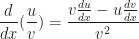
Some Math formulas like the quotient rule, , you will automatically memorize it once you have done enough practice.
In the end, you may even find that E Maths or A Maths is easy!
THE OBSTACLE IN OUR PATH
In ancient times, a king had a boulder placed on a roadway. Then he hid himself and watched to see if anyone would remove the huge rock. Some of the king’s wealthiest merchants and courtiers came by and simply walked around it.
Many loudly blamed the king for not keeping the roads clear, but none did anything about getting the big stone out of the way. Then a peasant came along carrying a load of vegetables. On approaching the boulder, the peasant laid down his burden and tried to move the stone to the side of the road. After much pushing and straining, he finally succeeded. As the peasant picked up his load of vegetables, he noticed a purse lying in the road where the boulder had been. The purse contained many gold coins and a note from the king indicating that the gold was for the person who removed the boulder from the roadway. The peasant learned what many others never understand.
Every obstacle presents an opportunity to improve one’s condition.
73 is the largest minimal Primitive root in the first 100000 primes. In other words, if p is one of the first 100000 primes, then at least one of the primes 3, 5, 7, 11, 13, 17, …, 73 is a primitive root modulo p.
73 is the smallest prime congruent to 1 modulo 24.
73 is an emirp, meaning that the reverse of 73, that is, 37, is also a prime number. Interestingly, 73 is also the 21st prime number while 37 is the 12th prime number.
Want to find 73 in other bases? Check out the Base Converter: Convert any number into any base!
Math Strategies
There is such an emphasis on learning math facts that our children do not spend enough time learning strategies that will help them solve math problems. Read about two types of strategies for solving math problems—working left to right and regrouping into what you know.
– Crystal Wagner
Nim Games
This is a game that is generally used to show how math can be involved in game play. I explain the rules of the game as well as the mathematical strategy involved. There is also a script where users can compete against the computer
– Aftermath
Show That Questions
This is a post around the questions that crop up in maths exams where students have to show something. I wrote it after I was surprised to hear some students hate it! The Straight Lines Debate
This is a post exploring the benefits of the different methods of calculating straight lines.
– Stephen Cavadino
Day 85 – Related Rates Two separate trucks carrying a very long wind turbine blade need to turn the corner. Describe how their speeds vary throughout the turn. The blog is dedicated to these types of discussion starters, at all levels.
– Curmudgeon
Eggs in the Basket Review Game
This review game can be adapted to almost any level and any topic, yet it consistently provides a really effective way to review Algebra content. It is a great way to review a lot of problems and have students work collaboratively while having fun – I just love hearing them explain their thought process to teammates when playing the game 🙂 With Easter almost here I thought it would be a good post to submit!
– Mary Williams
Decimals in a One Frame
Inspired by Chris Hunter’s blog post about decimals on a ten frame, I thought it would be a great opening number talk for my decimal unit to see where my students were before starting our decimal journey.
– Kristin @MathMinds
Circle Grid Designs
This post is part of a series of geometrical design activities in which shapes and patterns were found in grids constructed based on circles.
– Julie
Ten Sticks to Make, Count With, and Play a Game With
Ten sticks created from common items can be just as much fun to make as well as to be used for counting by ones and tens AND to play a game with.
– Margo Gentile
Why I Always Lead with the Punchline
I wrote this after reading another blog about how listing objectives for the day takes the punchline out of the math class. This blog just about my thoughts on sharing the learning objectives for the entire unit with students on the first day.
– Brooke Powers
My Nemesis Maths
This post is about my journey as a teacher, trying to make maths relevant and enjoyable to all students when I myself had issues with enjoying maths as a student.
– Danielle Myburgh
Quotable: Focus on Being Silent
The best way for children to build mathematical fluency is through conversation, especially one-on-one conversation with interested adults. Check out these ideas to encourage discussion-based math.
– Denise Gaskins
2048 Free Strategy Guide
Stuck at playing the popular and addictive Math game 2048? Do not worry, for after reading this Strategy Guide, your chance of winning will increase tremendously!
Math Teachers at Play is a traveling blog carnival. It moves around from month to month but its home base is http://letsplaymath.net/mtap/. From there you can visit the archives, submit your blog post for inclusion in a future edition, and volunteer to host the site. You can also check out the Carnival of Mathematics. Thanks for visiting!
Subscribe to our free newsletter, for updates on Math, Education and other General Knowledge topics!
In the last decade, the Singapore educational system has become a global leader in the education field, helping exemplary pupils to be accepted in the worlds best universities. But with the increasing competitiveness of those top tier universities, students are faced with mounting pressure to excel in every aspect which might have an impact on their exams. This has led to the mass implementation of ‘rote learning’ in Asia, where students focus more on memorising knowledge than the full comprehension of the concepts behind it.
What is ‘rote learning’ and what’s wrong with it?
From the earliest days of schooling, rote learning is an essential tool to efficiently memorize educational fundamentals. It is a knowledge acquisition process based on repetition. Simply put, make a child say the alphabet every day for 6 months, and they will remember it ‘forever’. This is of course the most obvious way of learning and no other method could be better suited for the developing mind of an infant, as the concepts taught are simple in nature, and do not require a broader knowledge base.
Though, as one progresses through the ranks and gets shifted through the numerous streams put into place by the MOE, new knowledge starts to build upon old concepts, some aspects converging, others diverging, and all of if defining a complex web of knowledge which requires the student to delve into a deeper state understanding if he is to find any further use to it.
How many of us wonder at one point or another: Why am I learning this?
Epigami has recently written an article on meaningful learning as compared to rote learning. Once again, we believe that such an article would be useful and beneficial for your students in Singapore, especially in the subject of Mathematics. You can read more about our article at: http://www.epigami.sg/blog/dont-just-learn-understand/ and we hope that you can share it with your readers on your blog.
Math is logical, functional and just … awesome. Mathemagician Arthur Benjamin explores hidden properties of that weird and wonderful set of numbers, the Fibonacci series. (And reminds you that mathematics can be inspiring, too!)
Dr James Grime on the Pisano Period – a seemingly strange property of the Fibonacci Sequence.
A lesson learnt from Singapore The Australian (blog) Education authorities should be encouraged that the national executive of the Australian Primary Principals Association was impressed after a briefing …
Past Year Paper is an established Singapore Home Tuition Agency that brings to you quality private tutors and free exam papers for primary, secondary school to junior college level students.
http://www.ted.com In a lively show, mathemagician Arthur Benjamin races a team of calculators to figure out 3-digit squares, solves another massive mental equation and guesses a few birthdays. How does he do it? He’ll tell you.
TEDTalks is a daily video podcast of the best talks and performances from the TED Conference, where the world’s leading thinkers and doers are invited to give the talk of their lives in 18 minutes — including speakers such as Jill Bolte Taylor, Sir Ken Robinson, Hans Rosling, Al Gore and Arthur Benjamin. TED stands for Technology, Entertainment, and Design, and TEDTalks cover these topics as well as science, business, politics and the arts. Watch the Top 10 TEDTalks on TED.com, at http://www.ted.com/index.php/talks/top10
Secrets of Mental Math: The Mathemagician’s Guide to Lightning Calculation and Amazing Math Tricks
These simple math secrets and tricks will forever change how you look at the world of numbers.
Secrets of Mental Math will have you thinking like a math genius in no time. Get ready to amaze your friends—and yourself—with incredible calculations you never thought you could master, as renowned “mathemagician” Arthur Benjamin shares his techniques for lightning-quick calculations and amazing number tricks. This book will teach you to do math in your head faster than you ever thought possible, dramatically improve your memory for numbers, and—maybe for the first time—make mathematics fun.
Yes, even you can learn to do seemingly complex equations in your head; all you need to learn are a few tricks. You’ll be able to quickly multiply and divide triple digits, compute with fractions, and determine squares, cubes, and roots without blinking an eye. No matter what your age or current math ability, Secrets of Mental Math will allow you to perform fantastic feats of the mind effortlessly. This is the math they never taught you in school.
Students in school are advised to practice their Math! It turns out many of the best jobs in the 21st Century are related to Maths. Even if you are not thinking of becoming a Mathematician, it is good to know your Quadratic Equations well. Math may prove useful when you need it in your job!
Want one of the best jobs in the nation? Then do the math — and do a lot of it. According to a new report, mathematicians, statisticians and actuaries are now three of the four best jobs to be had.
The CareerCast.com report ranks 200 jobs each year based on a number of criteria, including income, outlook, environmental factors, stress and physical demands. Mathematician, this year’s No. 1 job, and statistician, No. 3, both jumped up 17 places from last year’s ranking. Actuary, last year’s winner, fell to No. 4, while tenured university professor took second place on the new list.
Mathematicians came in first because demand for people who can do statistical analysis is growing in all business sectors. That need is expected to lead to a 23 percent increase in demand by 2022. As you might expect, the pay isn’t too bad. Last year, mathematicians earned a median annual salary of $101,360.
“In today’s data-driven economy, math skills unlock a world of career opportunities,” Tony Lee, CareerCast’s publisher said in a statement. “In fact, the outlook for all STEM careers is very positive, as evidenced by many of this year’s best jobs — mathematician, statistician, actuary, software engineer and computer systems analyst.”
Mathematics teaches patience, discipline, and step-by-step problem-solving skills. For those with a substantial background in mathematics, an unlimited number of career opportunuities are available. According to Jobs Rated Almanac , a 1990 publication of World Almanac Books of New York, NY, careers that require a very strong background in mathematics were listed as the five “best” jobs. They were :
Another day, another reason to get better at math.
It’s no secret that quantitative skills are in high demand on the job market—one analytics recruiter recently told The Journal that workers who can’t crunch numbers may ultimately face a “permanent pink slip.”
Now, a new ranking from the job-search website CareerCast.com names mathematician as the best occupation of 2014. “Math skills unlock a world of career opportunities,” publisher Tony Lee said. (Cue the Square One theme, and tune in Mathnet.)
Data whizzes of all stripes fared well in the annual list: Statisticians (No. 3), actuaries (No. 4) and computer systems analysts (No. 8) all landed near the top.
Mathematicians pull in a midlevel income of $101,360, according to CareerCast.com, and the field is expected to grow 23% in the next eight years. Other high earners include actuaries and software engineers, who can expect to earn about a midlevel income of $93,000 per year.
Speaking of math, the list is tallied by scoring 200 types of jobs according to four categories: environment, which rates things like competitiveness; income at low, middle, and high career positions; the outlook for income and employment growth; and stress factors such as travel and deadlines.
Really hate math? Want to change your mindset about Math? Read this award-winning and Top Selling Math Book:
Help the Gorilla find bananas by adding the numbers correctly!
Suitable for ages 5 and above.
More games: Math Memo – click on cards to match the correct pairs Star alphabet – press letters on the keyboard to hear their names Star numbers – press digits
This post is all about finding Vertical and Horizontal asymptotes of graphs.
Vertical Asymptotes
Usually, vertical asymptotes come about when there is a rational function with a numerator and a denominator, for instance, . When the denominator is 0, the function is undefined, and hence there is a vertical asymptote there.
Hence, to find the asymptote, let the denominator be 0. E.g. , so .
Another way vertical asymptotes can come about is via logarithmic graphs, e.g. .
is undefined, so when or , there will be a vertical asymptote at .
Horizontal Asymptote
Horizontal asymptotes usually come about when one of the terms approaches zero as approaches infinity.
To find the Horizontal Asymptote, find the value of y when x approaches infinity (i.e. when x becomes a very big number).
For example, . When x is a very big number, say x=10000, y will be close to 1 since 1/10000 is almost zero. Hence, the horizontal asymptote is .
Another time where Horizontal Asymptotes appear is for Exponential Graphs. For instance, . When x is very large, will be very small, and hence approaches 1. This means that the Horizontal Asymptote will be .
How many times has Good Friday fallen on the 13th? I have looked at
your formulas and don’t seem to find one that fits this question,
since Good Friday doesn’t fall on the same date each year. I’ve looked
at some other sources as well, to no avail.
Thanks for your help on this,
Susan Melanson
Check out the above website for the answer! It turns out that Good Friday will fall on the 13th approximately once in 29 years.
The calculation of the date of Easter is called Computus. It turns out calculating the date of Easter is quite complicated. Even the great Mathematician Gauss made a mistake (see http://en.wikipedia.org/wiki/Date_of_Easter#Gauss_algorithm).
In 1800, the mathematician Carl Friedrich Gauss presented this algorithm for calculating the date of the Julian or Gregorian Easter[38][39] and made corrections to one of the steps in 1816.[40] In 1800 he incorrectly stated p = floor (k/3). In 1807 he replaced the condition (11M + 11) mod 30 < 19 with the simpler a > 10. In 1811 he limited his algorithm to the 18th and 19th centuries only, and stated that 26 April is always replaced with 19 April and 25 April by 18 April. In 1816 he thanked his student Peter Paul Tittel for pointing out that p was wrong in 1800.[41]
There are many free or affordable Kindle Math Books online for download/purchase. Other than Math books, the Kindle can also be used for reading other books, and also for playing games and using apps. It is a decent alternative to the Ipad, if you are not a fan of Apple.
The object of Math BINGO is to practice math facts while playing BINGO!
Features:
-Choose from 5 games: Addition, Subtraction, Multiplication, Division and Mixed
-Choose from 3 different levels of difficulty: Easy, Medium and Hard
-Create up to 5 player profiles
-Choose from 8 different fun cartoon avatars
-Keep track of number of games played by player profile
-The Scoreboard keeps track of scores for each game and level
-Collect and play with BINGO Bugs when you earn a high score!
-Fun bonus game: BINGO Bug Bungee
“I used to think that the iPad was the king of the tablets, but not any more. It’s time to whip the crown away from Apple and give it to its rightful holder – Amazon’s Kindle Fire HDX.”
Want to watch movies about Mathematics? There is a nice website with Free Movies involving Math. It is not the full movie, but the portion of the movie that involves math.
This is a collection of movie clips in which Mathematics appears. The site is now in HTML5 video and should be accessible by all devices. If not, chose the direct video links. To include a clip into a presentation, chose the quicktime version.
If you are really interested in Math in the Movies, check out this book: Math Goes to the Movies
Mel Gibson teaching Euclidean geometry, Meg Ryan and Tim Robbins acting out Zeno’s paradox, Michael Jackson proving in three different ways that 7 x 13 = 28. These are just a few of the intriguing mathematical snippets that occur in hundreds of movies. Burkard Polster and Marty Ross pored through the cinematic calculus to create this thorough and entertaining survey of the quirky, fun, and beautiful mathematics to be found on the big screen.
Math Goes to the Movies is based on the authors’ own collection of more than 700 mathematical movies and their many years using movie clips to inject moments of fun into their courses. With more than 200 illustrations, many of them screenshots from the movies themselves, this book provides an inviting way to explore math, featuring such movies as:
• Good Will Hunting• A Beautiful Mind• Stand and Deliver• Pi• Die Hard• The Mirror Has Two Faces
The authors use these iconic movies to introduce and explain important and famous mathematical ideas: higher dimensions, the golden ratio, infinity, and much more. Not all math in movies makes sense, however, and Polster and Ross talk about Hollywood’s most absurd blunders and outrageous mathematical scenes. Interviews with mathematical consultants to movies round out this engaging journey into the realm of cinematic mathematics.
This fascinating behind-the-scenes look at movie math shows how fun and illuminating equations can be.
Look no further! In this post I will recommend the Top 5 Math Games for kids, on Amazon.com. Amazon is one of the biggest companies in the world, and is a highly trusted and respected online retailer. Sometimes, it is hard to find Math Games in the local area, the internet provides a convenient and hassle-free way to buy Fun Math Games.
Without further ado, these are the Top 5 Math Games for children:
The Math teaching from primary schools to secondary / high schools should begin from the journey of Symmetry.
After all, the Universe is about Symmetry, from flowers to butterflies to our body, and the celestial body of planets. Mathematics is the language of the Universe, hence Math = Symmetry
It was discovered by the 19th century French tragic genius Evariste Galois who, until the eve of his fatal death at 21, wrote about his Mathematical study of ambiguities.
Another French genius of the 20th century, Henri Poincaré, re-discovered this ambiguity which is Symmetry : Group, Differential Equation, etc.
Only in university we study the Group Theory to explore the Symmetry.
Israel Gelfand, the student of Kolmogorov (the Russian equivalent of
Gauss), created in 1964 the famous VZMSh, a national Math Correspondence School.
He wrote: “4 important traits which are common to Math, Music, and
other arts and sciences:
1st Beauty
2nd Simplicity
3rd Precision
4th Crazy ideas.
”
The Russian mathematicians also built special Math-Physics schools:
Moscow School #7, #2, #57 (one of the best high school in the world, http://www.sch57.msk.ru) Leningrad Schools #30, #38, #239 (Perelman studied here)
Rukshin at 15 was a troubled russian kid with drink and violence, then a miracle happened: He fell in love with Math and turned all his creative, aggressive, and competitive energies toward it.
He tried to compete in Math olympiads, but outmatched by peers. Still he believed he knew how to win; he just could not do it himself.
He formed a team of schoolchildren a year younger than he and trained them.
At 19 he became an IMO coach who produced Perelman (Gold IMO & Fields/Clay Poincare Conjecture). In the decades since, his students took 70 IMO, include > 40 Golds.
Rukshin’s thoughts on IMO:
1. IMO is more like a sport. It has its coaches, clubs, practice sessions, competitions.
2. Natural ability is necessary but NOT sufficientfor success: The talented kid needs to have the right coach, the right team, the right kind of family…
2048 is a highly popular Math/Puzzle game that can be played on the computer or on mobile devices. The game is about adding two tiles together until you get the number 2048.
Like most fun games, the concept of 2048 is deceptively simple, even a 5 year old kid could play it. However, it is hard to master it, and getting the coveted “2048” could prove quite tricky. Do not despair, for after reading this strategy guide, you have a much higher chance of winning the game!
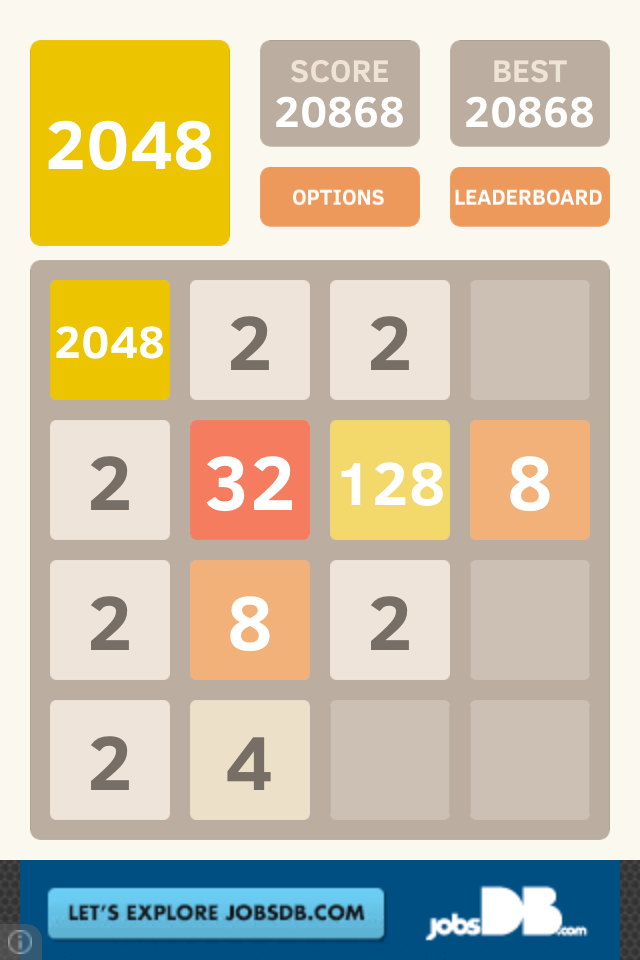
Finally…!!! This is a screenshot of my personal game
Strategy Guide / Walkthrough / FAQ
The 3 Top Priorities for 2048 game:
1) Keep your highest tile in the top left corner of the grid. This is your top priority.
2) Do not let low tiles, especially 2’s or 4’s, clog up the upper two rows. This is your second priority.
3) Keep your top row in the following order, from left to right, . An example would be, 512, 256, 128, 64.
The reason for Priority 1 is that this immensely increases your chances of successful merges of two higher numbers into 1. It synergises with Priority 3 to create a chain-effect. For example, imagine you have 512, 256, 128, 64 on the top row. After merging another 64 with the 64 on the top row, you will have 512, 256, 128, 128. The two 128’s can merge together, making 512, 256, 256. The two 256’s can merge together, making 512, 512. And then, we have a 1024!
The reason for Priority 2 is that letting 2 or 4’s clog up the top rows is very bad. It greatly reduces your mobility (the top 2 rows clogged up with even a single ‘2’ is hard to move). The 2 or 4’s up there have little to no chance to get merged since most of the numbers at the top are high numbers.
Top 3 Guidelines for 2048 game:
1) Press up and left arrows only. Only press right when the upper row is full. Press down only when you have utterly no other choice.
2) Keep the top row filled up, as far as possible.
3) Your general aim is to target the lowest tile on the upper row, to set up the chain effect described above.
Reason for Guideline 1: Pressing right when the upper row is not full has the chance of introducing a new tile on the upper left corner, so now your highest tile is no longer on the upper left corner. This is not good. (Violates Priority 1)
Reason for Guideline 2: Keeping the top row filled up enables you to press “right” without fear of introducing a new tile on the upper left corner.
Reason for Guideline 3: After reaching the late game, we need to think a few steps in advance, and think of which is the best move in accordance to the Top 3 Priorities, and also can target the lowest tile on the upper row to set up a chain effect.
Top 3 Time Saving Quick and Fast Tips for 2048 game
1) The first few steps do not require thinking. Just spam up and left until you get a moderately high number like 128 or 256. There is no harm done about this as the board is uncluttered and there is little chance of losing. You only need to start thinking deeper during the later part of the game, when your highest tile is 512 or more.
2) If Priority 1 is violated, i.e. your highest tile is no longer in the top left corner of the grid, try a few steps to see if you can salvage the situation and get it back to the top left corner. If no, it is better to quit and start a new game to save time. Same for Priority 2, if there is a 2 or 4 clogging the upper row, try a few more steps to see if you can salvage the situation, by merging to make a higher number. If no, we can restart to save time. Priority 3 is less crucial, if the numbers in the top row do not form , no need to restart. But keep it in mind and keep trying your best to achieve the ideal order.
3) When there is only one possible move, make that move without thinking to save time. (No other choice anyway)
This is the best video on youtube about 2048 Strategy. (Note: They put the highest tile on the bottom right instead. Should be no difference due to the symmetry of the board)
Note: Even the expert maker of this video only has a 30% winning rate! 2048 has some element of luck (the tiles arrive randomly). Personally, I took quite some time to beat the game too.
This is the list of Top Weekly Math News around the world. To view more Math News, you can scroll down to the bottom of this website, and there will be more Free Math News for your viewing.
Math Academy expands program in county Shelby Star
The summer program that serves Cleveland County Schools students to enhance their math skills is planning to have a permanent location in Kings …
“People think they don’t understand math, but it’s all about how you explain it to them.
If you ask a drunkard what number is larger , 2/3 or 3/5, he won’t be able to tell you. But if you rephrase the question:
What is better, 2 bottles of vodka for 3 people or 3 bottles of vodka for 5 people, he will tell you right away: 2 bottles for 3 people, of course.”
The Basel Problem is:
$latex displaystyle sum_{k=1}^{infty} frac {1}{k^2} = frac {{pi}^2}{6}$
Euler was 28 years old when he proved that it converged.
The Basel Problem is also called the Riemann Zeta function: ζ(2).
He studied the function sin x which has zeroes,
i.e. sin x= 0 for
$latex x=npi, n = 0,pm1,pm 2, pm 3…$
In other words, we can factor sin x this way:
$latex sin x = x.(1+frac {x}{pi}) .(1-frac {x}{pi}).(1+frac {x}{2pi}). (1-frac {x}{2pi}).(1+frac {x}{3pi}). (1-frac {x}{3pi})…
&s=3$
Note: the right side any factor = 0 when
$latex x=npi, n = 0,pm1,pm 2, pm 3…$
1. Spot the odd magic cube
2. “Drain man” Arithmetics
3. The mental Hanzi (汉字笔画) strokes
4. The ‘Breathing and Smelling’ (气息触觉) cognitive power of a blind.
I found (3) fantastic but the judge Dr. Wei disqualified her for being an “Asperger’s Syndrome” rather than a skill.
Ah Beng was asked to make a sentence using 1, 2, 3, 4, 5, 6, 7, 8, 9,10.
Not only did he do it 1 to 10, he did it again from 10 back to 1. This is what he came up with…..
1 day I go 2 climb a 3 outside a house to peep. But the couple saw me, so I panic and 4 down. The man rushed out and wanted to 5 with me. I ran until I fell 6 and threw up. So I go into 7-eleven and grabbed some 8 to throw at him. Then I took a 9 and try to stab at him. 10 God he run away.
10 I put the 9 back and pay for the 8 and left 7-eleven. Next day I called my boss and told him I was 6. He said 5 , tomorrow also no need to…


 or 2 arcsin(1) (Radian Mode)





















 , where
  are the coefficients of the polynomial (to be determined).
 .
. , we get
  . We have just found the first coefficient!
 to get:
 .
.
 .
. .
.


 ,
, .
.

 , we get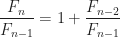
 exists for the time being, and prove it later)
 .
. , we get:


 which is the Golden Ratio!
 converges. This is a bit tricky and requires some algebra.
 , you will automatically memorize it once you have done enough practice.
![In the last decade, the Singapore educational system has become a global leader in the education field...[read more]](https://i0.wp.com/www.epigami.sg/blog/wp-content/uploads/2014/04/rote-learning-820x400.jpg "In the last decade, the Singapore educational system has become a global leader in the education field...[read more]")


 . When the denominator is 0, the function is undefined, and hence there is a vertical asymptote there.
 , so
, so  .
.
 .
. is undefined, so when
  or
or  , there will be a vertical asymptote at
 . When x is a very big number, say x=10000, y will be close to 1 since 1/10000 is almost zero. Hence, the horizontal asymptote is
  .
.
 . When x is very large,
  will be very small, and hence
  approaches 1. This means that the Horizontal Asymptote will be





 . An example would be, 512, 256, 128, 64.


 Source:
 Mathtuition88