Topology application to Physics

Source: https://www.scientificamerican.com/article/the-strange-topology-that-is-reshaping-physics/?W

The Strange Topology That Is Reshaping Physics

Topological effects might be hiding inside perfectly ordinary materials, waiting to reveal bizarre new particles or bolster quantum computing

Charles Kane never thought he would be cavorting with topologists. “I don’t think like a mathematician,” admits Kane, a theoretical physicist who has tended to focus on tangible problems about solid materials. He is not alone. Physicists have typically paid little attention to topology—the mathematical study of shapes and their arrangement in space. But now Kane and other physicists are flocking to the field.

In the past decade, they have found that topology provides unique insight into the physics of materials, such as how some insulators can sneakily conduct electricity along a single-atom layer on their surfaces.

Some of these topological effects were uncovered in the 1980s, but only in the past few years have researchers begun to realize that they could be much more prevalent and bizarre than anyone expected. Topological materials have been “sitting in plain sight, and people didn’t think to look for them”, says Kane, who is at the University of Pennsylvania in Philadelphia.

Now, topological physics is truly exploding: it seems increasingly rare to see a paper on solid-state physics that doesn’t have the word topology in the title. And experimentalists are about to get even busier. A study on page 298 of this week’s Nature unveils an atlas of materials that might host topological effects, giving physicists many more places to go looking for bizarre states of matter such as Weyl fermions or quantum-spin liquids.

Read more at: https://www.scientificamerican.com/article/the-strange-topology-that-is-reshaping-physics/?WT.mc_id=SA_WR_20170726

How to do Proof by Cases in LaTeX

If one searches online, one will find many different methods to do “proof by cases” in LaTeX. The most simple and convenient method in my opinion is to use the description environment.

Something like this:

\begin{proof} Proceed by cases.
\begin{description}
\item[Case 1: This.] And so on.
\item[Case 2: That.] And more.
\end{proof}

Source: Reddit

No additional package is needed. One drawback is there is no auto-numbering, but I am sure that is still ok, unless your proof has many many cases.

(Important Changes) PSLE Math: Arrow -> vs Equal=

Source: Facebook

For those taking PSLE, please take note of this important update regarding the difference between arrow and equal sign. Forward this to your friends taking PSLE!

Basically, I think MOE is trying to instill students to be mathematically correct. (See update below: Marks will not be deducted in most cases but proper usage is highly encouraged.)

E.g. 100%=40 is wrong as 100%=100/100=1 technically. Similarly, 10 men = 40 hours is wrong as the units do not match (nor make sense).

Trying to enforce “units” instead of “u”, and banning “10 units -> 20” is a bit strict though, in my opinion.

Update: (http://mothership.sg/2017/07/moe-clarifies-use-of-%E2%86%92-in-revamped-primary-6-math-syllabus/)

MOE responds

In response to Mothership.sg queries, a Ministry of Education spokesperson clarified that the above information was not provided by the ministry.

The information above was originally sourced from the website of a private tuition centre, whose sources are currently unverified.

While the respective uses of the arrow and equal signs are accurate in the infographic, the MOE spokesperson said full credit will still be awarded to the student even when the signs are used interchangeably, as long as the student demonstrates a full understanding of the question.

Proper use of arrow and equal signs are, nonetheless, encouraged.

Summary: Shapes, radius functions and persistent homology

This is a summary of a talk by Professor Herbert Edelsbrunner, IST Austria. The PDF slides can be found here: persistent homology slides.

Biogeometry (2:51 in video)

We can think of proteins as a geometric object by replacing every atom by a sphere (possibly different radii). Protein is viewed as union of balls in \mathbb{R}^3.

Decompose into Voronoi domains V(x), and take the nerve (Delaunay complex).

Inclusion-Exclusion Theorem: \displaystyle Vol(\bigcup B)=\sum_{Q\in D_r(x)}(-1)^{\dim Q}Vol(\bigcap Q).
Volume of protein (\bigcup B) is alternating sum over all simplices Q in Delaunay complex.

Nerve Theorem: Union of sets have same homotopy type as nerve (stronger than having isomorphic homology groups).

Wrap (14:04 in video)

Collapses: 01 collapse means 0 dimensional and 1 dimensional simplices disappear (something like deformation retract).

Interval: Simplices that are removed in a collapse (always a skeleton of a cube in appropriate dimension)

Generalised Discrete Morse Function (Forman 1998): Generalised discrete vector field = partition into intervals (for acyclic case only)

Critical simplex: The only simplex in an interval (when a critical simplex is added, the homotopy type changes)

Lower set of critical simplex: all the nodes that lead up to the critical simplex.

Wrap complex is the union of lower sets.

Persistence (38:00 in video)

Betti numbers in \mathbb{R}^3: \beta_0: \# components, \beta_1:\# loops, \beta_2: \# voids.

Incremental Algorithm to compute Betti numbers (40:50 in video). [Deffimado, E., 1995]. Every time a simplex is added, either a Betti number goes up (birth) or goes down (death).

\alpha is born when it is not in image of previous homology group.

Stability of persistence: small change in position of points leads to similar persistence diagram.

Bottleneck distance between two diagrams is length of longest edge in minimizing matching. Theorem: \displaystyle W_\infty(Dgm(f),Dgm(g))\leq\|f-g\|_\infty. [Cohen-Steiner, E., Hares 2007]. One of the most important theorems in persistent homology.

Expectation (51:30 in video)

Poisson point process: Like uniform distribution but over entire space. Number of points in region is proportional to size of region. Proportionality constant is density \rho>0.

Paper: Expectations in \mathbb{R}^n. [E., Nikitenko, Reitones, 2016]

Reduces to question (Three points in circle): Given three points in a circle, what is the probability that the triangle (with the 3 points as vertices) contains the center of the circle? Ans: 1/4 [Wendel 1963].

Brain has 11 dimensions

One of the possible applications of algebraic topology is in studying the brain, which is known to be very complicated.

Site: https://www.wired.com/story/the-mind-boggling-math-that-maybe-mapped-the-brain-in-11-dimensions/

If you can call understanding the dynamics of a virtual rat brain a real-world problem. In a multimillion-dollar supercomputer in a building on the same campus where Hess has spent 25 years stretching and shrinking geometric objects in her mind, lives one of the most detailed digital reconstructions of brain tissue ever built. Representing 55 distinct types of neurons and 36 million synapses all firing in a space the size of pinhead, the simulation is the brainchild of Henry Markram.

Markram and Hess met through a mutual researcher friend 12 years ago, right around the time Markram was launching Blue Brain—the Swiss institute’s ambitious bid to build a complete, simulated brain, starting with the rat. Over the next decade, as Markram began feeding terabytes of data into an IBM supercomputer and reconstructing a collection of neurons in the sensory cortex, he and Hess continued to meet and discuss how they might use her specialized knowledge to understand what he was creating. “It became clearer and clearer algebraic topology could help you see things you just can’t see with flat mathematics,” says Markram. But Hess didn’t officially join the project until 2015, when it met (and some would say failed) its first big public test.

In October of that year, Markram led an international team of neuroscientists in unveiling the first Blue Brain results: a simulation of 31,000 connected rat neurons that responded with waves of coordinated electricity in response to an artificial stimulus. The long awaited, 36-page paper published in Cell was not greeted as the unequivocal success Markram expected. Instead, it further polarized a research community already divided by the audacity of his prophesizing and the insane amount of money behind the project.

Two years before, the European Union had awarded Markram $1.3 billion to spend the next decade building a computerized human brain. But not long after, hundreds of EU scientists revolted against that initiative, the Human Brain Project. In the summer of 2015, they penned an open letter questioning the scientific value of the project and threatening to boycott unless it was reformed. Two independent reviews agreed with the critics, and the Human Brain Project downgraded Markram’s involvement. It was into this turbulent atmosphere that Blue Brain announced its modest progress on its bit of simulated rat cortex.

Read more at the link above.

How to explain this math magic trick?

Quite impressive math magic trick, that even impressed the very strict judge Simon Cowell. I am not sure how he did it, other than possible prearranged volunteers. Another possibility is that the calculator is modified.

Site: http://www.usmagazine.com/entertainment/news/americas-got-talent-contestant-performs-crazy-magic-trick-w488672

London had the volunteers give their best guesses to different questions, including how many No. 1-selling artists Cowell has had on his record label, how many millions of records judge Mel B. sold worldwide with the Spice Girls and what year judge Heidi Klum started modeling.

Meanwhile, London asked host Tyra Banks multiply the three answers together using the calculator on her own phone. He then instructed Banks to close her eyes and add a random eight-digit number to the previous calculation. She revealed that the grand total came out to 73,928,547.

Watch the clip to see why that number left the judges and audience members stunned!

Yitang Zhang’s Santa Barbara Beach Walk

Professor Yitang Zhang is a famous Math professor who made important progress in number theory (Twin Prime Conjecture). Most strikingly, he made this progress in his fifties, which is kind of rare in the mathematical world.

Source: Quanta Magazine

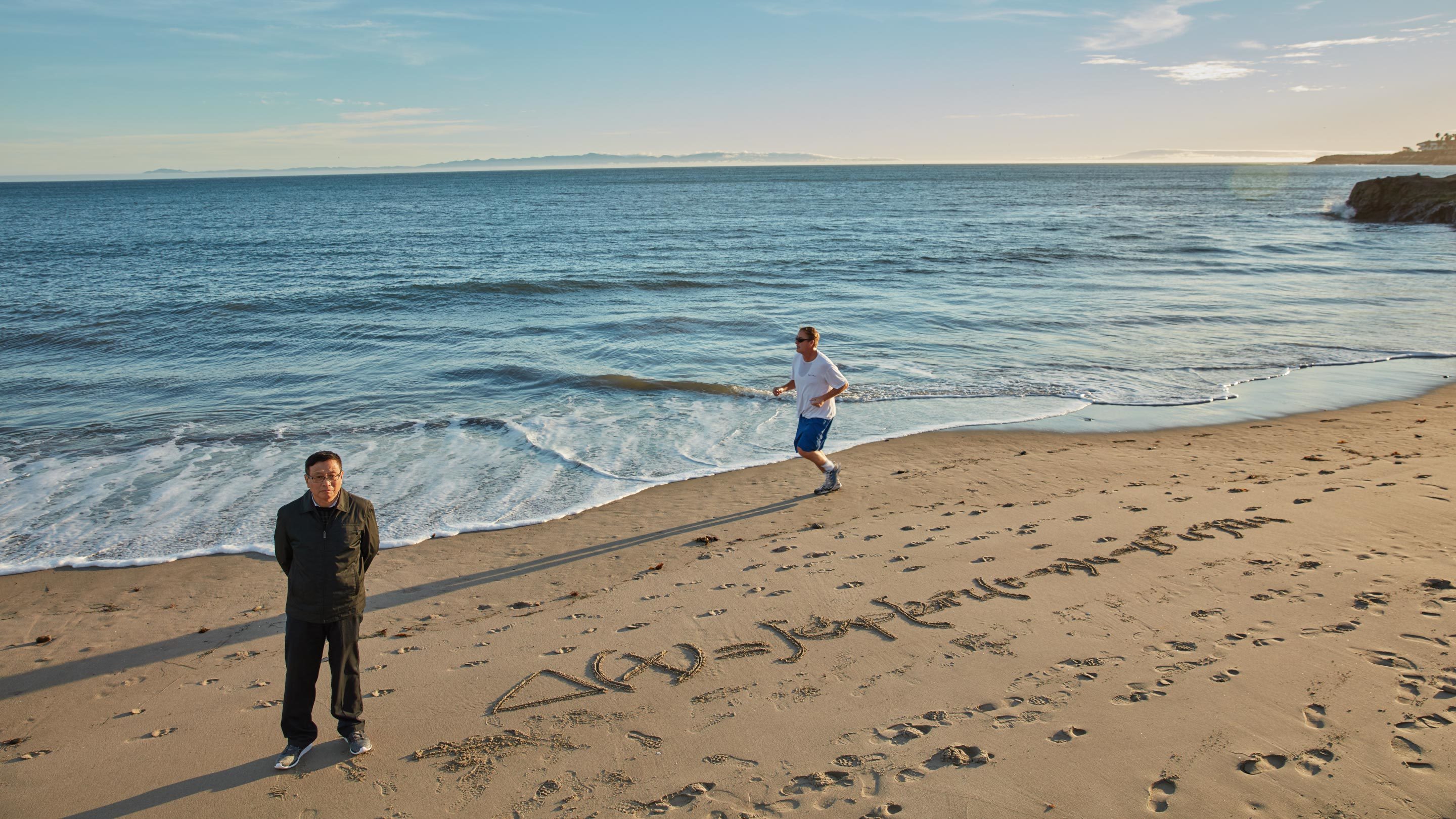
Yitang Zhang on the beach adjoining the University of California, Santa Barbara, after scratching a function in the sand related to his current work on the Landau-Siegel zeros problem.

As an adolescent during the Cultural Revolution in China, Yitang Zhang wasn’t allowed to attend high school. Later, in his 30s, he worked odd jobs in the United States and sometimes slept in his car. But Zhang always believed he would solve a great math problem someday. Still, despite becoming one of China’s top math students and completing his doctorate at Purdue University in Indiana, for seven years Zhang could not find work as a mathematician. At one point, he worked at a friend’s Subway sandwich restaurant to pay the bills.

“I was not lucky,” Zhang, who is both incredibly reserved and self-confident, told Quanta in a 2015 interview.

At 44, after finally being hired to teach math at the University of New Hampshire, he turned his attention to number theory, a subject he had loved since childhood. He analyzed problems in his head during long walks near his home and the university. In his 50s, well past what many mathematicians consider their prime years (indeed, the Fields Medal is awarded to mathematicians under the age of 40), he began trying to prove the twin primes conjecture, which predicts an infinite number of prime number pairs that have a difference of two, such as 5 and 7, 29 and 31, and 191 and 193. No one had been able to prove this in over 150 years, and top number theorists could not even prove the existence of a bounded prime gap of any finite size.

In 2013, at 58, Zhang published his proof of a bounded prime gap below 70 million in one of the world’s most prestigious journals, the Annals of Mathematics. The paper’s referees wrote that Zhang, who had been unknown to established mathematicians, had proved “a landmark theorem in the distribution of prime numbers.”

Read more at: Quanta

Subtle Error in Wikipedia: Dedekind’s number

On Wikipedia (https://en.wikipedia.org/wiki/Dedekind_number), it is stated that the Dedekind’s number M(n) is the the number of abstract simplicial complexes with n elements.

This is incorrect, at least based on the Wikipedia definition of abstract simplicial complex, which does not allow the empty set as a face.

The correct definition is found in another Wikpedia site: https://en.wikipedia.org/wiki/Abstract_simplicial_complex

The number of abstract simplicial complexes on up to n elements is one less than the nth Dedekind number.

Math Tricks found in Chess

Just read this very nice article on Quora, on the relationship between Math and Chess: https://www.quora.com/What-math-tricks-are-hidden-in-chess

Also interesting is this YouTube documentary “My Brilliant Brain” featuring Susan Polgar.

Author:
Tom Boshoff

Math Olympiad Tuition

Maths Olympiad Tuition

Tutor: Mr Wu (Raffles Alumni, NUS Maths Grad)

Email: mathtuition88@gmail.com

Syllabus: Primary / Secondary Maths Olympiad. Includes Number Theory, Geometry, Combinatorics, Sequences, Series, and more. Flexible curriculum tailored to student’s needs. I can provide material, or teach from any preferred material that the student has.

Target audience: For students with strong interest in Maths. Suitable for those preparing for Olympiad competitions, DSA, GEP, or just learning for personal interest.

Location: West / Central Singapore at student’s home

Jurong East Maths Tuition

Maths Tuition

Tutor (Mr Wu):
– Raffles Alumni
– NUS 1st Class Honours in Mathematics

Experience: More than 10 years experience, has taught students from RJC, NJC, ACJC and many other JCs. Also has experience teaching Additional Math (O Level, IP).

Personality: Friendly, patient and good at explaining complicated concepts in a simple manner. Provides tips for how to check for careless mistakes, and tackle challenging problems.

Email: mathtuition88@gmail.com

Areas teaching (West / Central Singapore, including Bukit Batok, Dover, Clementi, Jurong)

Bukit Batok Maths Tuition

Maths Tuition

Tutor (Mr Wu):
– Raffles Alumni
– NUS 1st Class Honours in Mathematics

Experience: More than 10 years experience, has taught students from RJC, NJC, ACJC and many other JCs. Also has experience teaching Additional Math (O Level, IP).

Personality: Friendly, patient and good at explaining complicated concepts in a simple manner. Provides tips for how to check for careless mistakes, and tackle challenging problems.

Email: mathtuition88@gmail.com

Areas teaching (West / Central Singapore, including Bukit Batok, Dover, Clementi, Jurong)

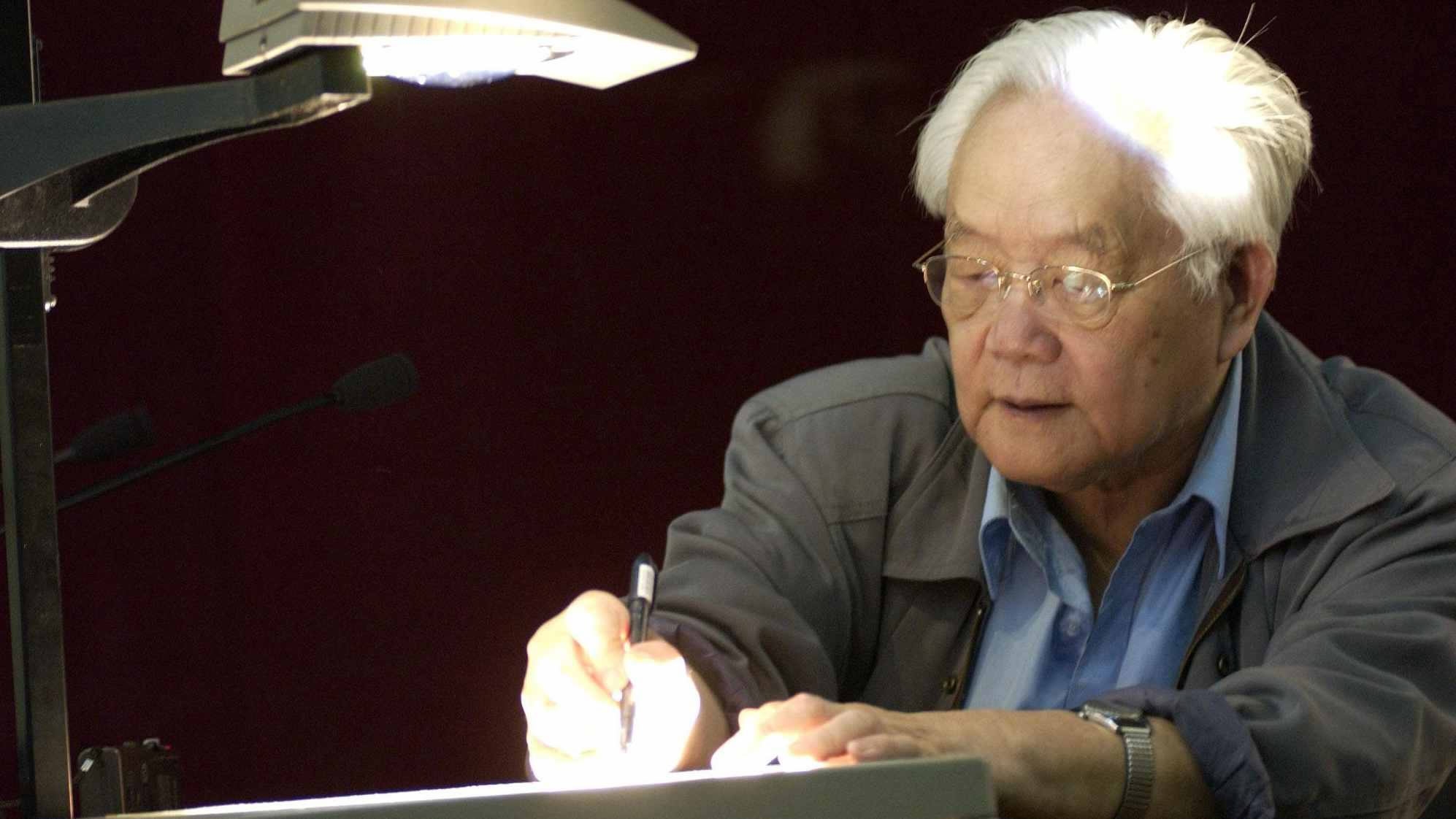
Renowned Chinese mathematician Wu Wenjun dies at 98

Source: https://news.cgtn.com/news/3d517a4e33637a4d/share_p.html

Wu Wenjun, distinguished mathematician, member of the Chinese Academy of Sciences (CAS), and winner of China’s Supreme Scientific and Technological Award winner, died at the age of 98 on Sunday in Beijing, according to the CAS.
Wu was born in Shanghai on May 12, 1919. In 1940, he graduated from Shanghai Jiao Tong University, and received a PhD from the University of Strasbourg, France in 1947.
In 1951, Wu returned to China and served as a math professor at Peking University. He made great contributions to the field of topology by introducing various principles now recognized internationally.
In the field of mathematics mechanization, Wu suggested a computerized method to prove geometrical theorems, known as Wu’s Method in the international community.
He was elected as a member of the CAS in 1957 and as a member of the Third World Academy of Sciences in 1990.
Wu Wenjun was given China’s Supreme Science and Technology Award by the then President Jiang Zemin in 2000, when this highest scientific and technological prize in China began to be awarded.

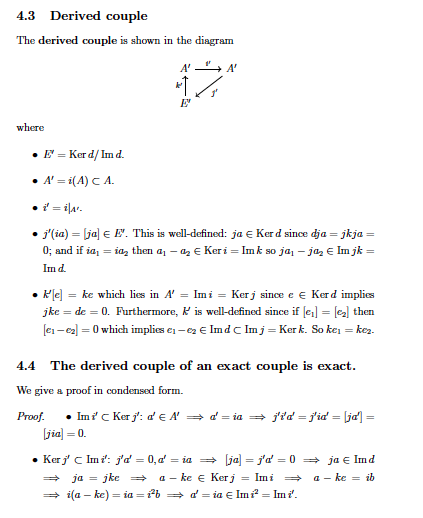
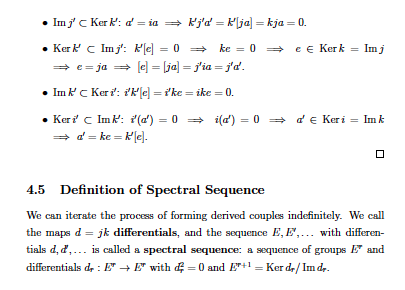
How the Staircase Diagram changes when we pass to derived couple (Spectral Sequence)

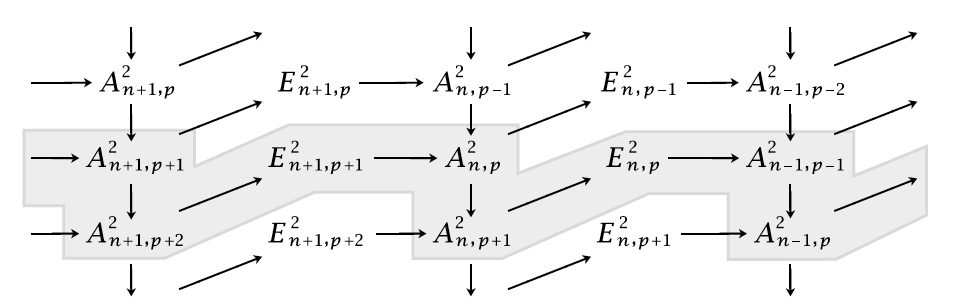
Set A_{n,p}^1=H_n(X_p) and E_{n,p}^1=H_n(X_p,X_{p-1}). The diagram then has the following form:

When we pass to the derived couple, each group A_{n,p}^1 is replaced by a subgroup A_{n,p}^2=\text{Im}\,(i_1: A_{n,p-1}^1\to A_{n,p}^1). The differentials d_1=j_1k_1 go two units to the right, and we replace the term E_{n,p}^1 by the term E_{n,p}^2=\text{Ker}\, d_1/\text{Im}\,d_1, where the d_1‘s refer to the d_1‘s leaving and entering E_{n,p}^1 respectively.

The maps j_2 now go diagonally upward because of the formula j_2(i_1a)=[j_1a]. The maps i_2 and k_2 still go vertically and horizontally, i_2 being a restriction of i_1 and k_2 being induced by k_1.

Relative Homology Groups

Given a space X and a subspace A\subset X, define C_n(X,A):=C_n(X)/C_n(A). Since the boundary map \partial: C_n(X)\to C_{n-1}(X) takes C_n(A) to C_{n-1}(A), it induces a quotient boundary map \partial: C_n(X,A)\to C_{n-1}(X,A).

We have a chain complex \displaystyle \dots\to C_{n+1}(X,A)\xrightarrow{\partial_{n+1}}C_n(X,A)\xrightarrow{\partial_n}C_{n-1}(X,A)\to\dots where \partial^2=0 holds. The relative homology groups H_n(X,A) are the homology groups \text{Ker}\,\partial_n/\text{Im}\,\partial_{n+1} of this chain complex.

Relative cycles
Elements of H_n(X,A) are represented by relative cycles: n– chains \alpha\in C_n(X) such that \partial\alpha\in C_{n-1}(A).

Relative boundary
A relative cycle \alpha is trivial in H_n(X,A) iff it is a relative boundary: \alpha=\partial\beta+\gamma for some \beta\in C_{n+1}(X) and \gamma\in C_n(A).

Long Exact Sequence (Relative Homology)
There is a long exact sequence of homology groups:
\begin{aligned}  \dots\to H_n(A)\xrightarrow{i_*}H_n(X)\xrightarrow{j_*}H_n(X,A)\xrightarrow{\partial}H_{n-1}(A)&\xrightarrow{i_*}H_{n-1}(X)\to\dots\\  &\dots\to H_0(X,A)\to 0.  \end{aligned}

The boundary map \partial:H_n(X,A)\to H_{n-1}(A) is as follows: If a class [\alpha]\in H_n(X,A) is represented by a relative cycle \alpha, then \partial[\alpha] is the class of the cycle \partial\alpha in H_{n-1}(A).

Exact sequence (Quotient space)

Exact sequence (Quotient space)
If X is a space and A is a nonempty closed subspace that is a deformation retract of some neighborhood in X, then there is an exact sequence

\begin{aligned}  \dots\to\widetilde{H}_n(A)\xrightarrow{i_*}\widetilde{H}_n(X)\xrightarrow{j_*}\widetilde{H}_n(X/A)\xrightarrow{\partial}\widetilde{H}_{n-1}(A)&\xrightarrow{i_*}\widetilde{H}_{n-1}(X)\to\dots\\  &\dots\to\widetilde{H}_0(X/A)\to 0  \end{aligned}
where i is the inclusion A\to X and j is the quotient map X\to X/A.

Reduced homology of spheres (Proof)
\widetilde{H}_n(S^n)\cong\mathbb{Z} and \widetilde{H}_i(S^n)=0 for i\neq n.

For n>0 take (X,A)=(D^n,S^{n-1}) so that X/A=S^n. The terms \widetilde{H}_i(D^n) in the long exact sequence are zero since D^n is contractible.

Exactness of the sequence then implies that the maps \widetilde{H}_i(S^n)\xrightarrow{\partial}\widetilde{H}_{i-1}(S^{n-1}) are isomorphisms for i>0 and that \widetilde{H}_0(S^n)=0. Starting with \widetilde{H}_0(S^0)=\mathbb{Z}, \widetilde{H}_i(S^0)=0 for i\neq 0, the result follows by induction on n.

Mayer-Vietoris Sequence applied to Spheres

Mayer-Vietoris Sequence
For a pair of subspaces A,B\subset X such that X=\text{int}(A)\cup\text{int}(B), the exact MV sequence has the form
\begin{aligned}  \dots&\to H_n(A\cap B)\xrightarrow{\Phi}H_n(A)\oplus H_n(B)\xrightarrow{\Psi}H_n(X)\xrightarrow{\partial}H_{n-1}(A\cap B)\\  &\to\dots\to H_0(X)\to 0.  \end{aligned}

Example: S^n
Let X=S^n with A and B the northern and southern hemispheres, so that A\cap B=S^{n-1}. Then in the reduced Mayer-Vietoris sequence the terms \tilde{H}_i(A)\oplus\tilde{H}_i(B) are zero. So from the reduced Mayer-Vietoris sequence \displaystyle \dots\to\tilde{H}_i(A)\oplus\tilde{H}_i(B)\to\tilde{H}_i(X)\to\tilde{H}_{i-1}(A\cap B)\to\tilde{H}_{i-1}(A)\oplus\tilde{H}_{i-1}(B)\to\dots we get the exact sequence \displaystyle 0\to\tilde{H}_i(S^n)\to\tilde{H}_{i-1}(S^{n-1})\to 0.


We obtain isomorphisms \tilde{H}_i(S^n)\cong\tilde{H}_{i-1}(S^{n-1}).

Spectral Sequence

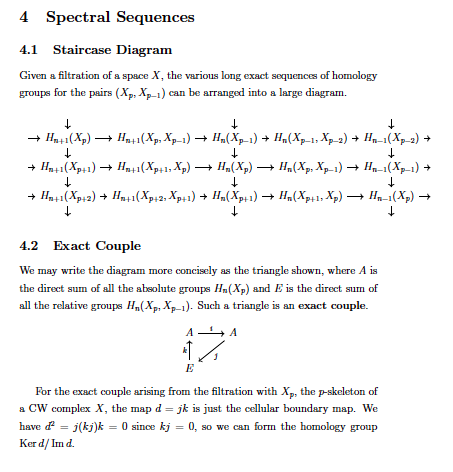
Spectral Sequence is one of the advanced tools in Algebraic Topology. The following definition is from Hatcher’s 5th chapter on Spectral Sequences. The staircase diagram looks particularly impressive and intimidating at the same time.

Unfortunately, my LaTeX to WordPress Converter app can’t handle commutative diagrams well, so I will upload a printscreen instead.

SO(3) diffeomorphic to RP^3

SO(3)\cong\mathbb{R}P^3}

Proof:

We consider SO(3) as the group of all rotations about the origin of \mathbb{R}^3 under the operation of composition. Every non-trivial rotation is determined by its axis of rotation (a line through the origin) and its angle of rotation.

We consider \mathbb{R}P^3 as the unit 3-sphere S^3 with antipodal points identified.

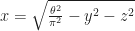
Consider the map from the unit ball D in \mathbb{R}^3 to SO(3), which maps (x,y,z) to the rotation about (x,y,z) through the angle \pi\sqrt{x^2+y^2+z^2} (and maps (0,0,0) to the identity rotation). This mapping is clearly smooth and surjective. Its restriction to the interior of D is injective since on the interior \pi\sqrt{x^2+y^2+z^2}<\pi. On the boundary of D, two rotations through \pi and through -\pi are the same. Hence the mapping induces a smooth bijective map from D/\sim, with antipodal points on the boundary identified, to SO(3). The inverse of this map, \displaystyle ((x,y,z),\pi\sqrt{x^2+y^2+z^2})\mapsto(x,y,z) is also smooth. (To see that the inverse is smooth, write \theta=\pi\sqrt{x^2+y^2+z^2}. Then x=\sqrt{\frac{\theta^2}{\pi^2}-y^2-z^2}, and so \frac{\partial^k x}{\partial\theta^k} exists and is continuous for all orders k. Similar results hold for the variables y and z, and also mixed partials. By multivariable chain rule, one can see that all component functions are indeed smooth, so the inverse is smooth as claimed.)

Hence SO(3)\cong D/\sim, the unit ball D in \mathbb{R}^3 with antipodal points on the boundary identified.

Next, the mapping \displaystyle (x,y,z)\mapsto (x,y,z,\sqrt{1-x^2-y^2-z^2}) is a diffeomorphism between D/\sim and the upper unit hemisphere of S^3 with antipodal points on the equator identified. The latter space is clearly diffeomorphic to \mathbb{R}P^3. Hence, we have shown \displaystyle SO(3)\cong D/\sim\cong\mathbb{R}P^3.

SU(2) diffeomorphic to S^3 (3-sphere)

SU(2)\cong S^3 (diffeomorphic)

Proof:
We have that \displaystyle SU(2)=\left\{\begin{pmatrix}\alpha &-\overline{\beta}\\  \beta &\overline{\alpha}\end{pmatrix}: \alpha, \beta\in\mathbb{C}, |\alpha|^2+|\beta|^2=1\right\}.

Since \mathbb{R}^4\cong\mathbb{C}^2, we may view S^3 as \displaystyle S^3=\{(\alpha,\beta)\in\mathbb{C}^2: |\alpha|^2+|\beta|^2=1\}.

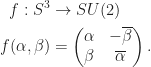
Consider the map
\begin{aligned}f: S^3&\to SU(2)\\  f(\alpha,\beta)&=\begin{pmatrix}\alpha &-\overline{\beta}\\  \beta &\overline{\alpha}\end{pmatrix}.  \end{aligned}

It is clear that f is well-defined since if (\alpha,\beta)\in S^3, then f(\alpha,\beta)\in SU(2).

If f(\alpha_1,\beta_1)=f(\alpha_2,\beta_2), it is clear that (\alpha_1, \beta_1)=(\alpha_2,\beta_2). So f is injective. It is also clear that f is surjective.

Note that SU(2)\subseteq M(2,\mathbb{C})\cong\mathbb{R}^8, where M(2,\mathbb{C}) denotes the set of 2 by 2 complex matrices.

When f is viewed as a function \widetilde{f}: \mathbb{R}^4\to\mathbb{R}^8, it is clear that \widetilde{f} and \widetilde{f}^{-1} are smooth maps since their component functions are of class C^\infty. Since SU(2) and S^3 are submanifolds, the restrictions to these submanifolds (i.e.\ f and f^{-1}) are also smooth.

Hence f is a diffeomorphism.

Persistent Homology Algorithm

Algorithm for Fields
In this section we describe an algorithm for computing persistent homology over a field.

We use the small filtration as an example and compute over \mathbb{Z}_2, although the algorithm works for any field.
A filtered simplicial complex with new simplices added at each stage. The integers on the bottom row corresponds to the degrees of the simplices of the filtration as homogenous elements of the persistence module.

The persistence module corresponds to a \mathbb{Z}_2[t]-module by the correspondence in previous Theorem. In this section we use \{e_j\} and \{\hat{e}_i\} to denote homogeneous bases for C_k and C_{k-1} respectively.

We have \partial_1(ab)=-t\cdot a+t\cdot b=t\cdot a+t\cdot b since we are computing over \mathbb{Z}_2. Then the representation matrix for \partial_1 is
\displaystyle M_1=\begin{bmatrix}[c|ccccc]  &ab &bc &cd &ad &ac\\ \hline  d & 0 & 0 & t & t & 0\\  c & 0 & 1 & t & 0 & t^2\\  b & t & t & 0 & 0 & 0\\  a &t &0 &0 &t^2 &t^3  \end{bmatrix}.

In general, any representation M_k of \partial_k has the following basic property: \displaystyle \deg\hat{e}_i+\deg M_k(i,j)=\deg e_j provided M_k(i,j)\neq 0.

We need to represent \partial_k: C_k\to C_{k-1} relative to the standard basis for C_k and a homogenous basis for Z_{k-1}=\ker\partial_{k-1}. We then reduce the matrix according to the reduction algorithm described previously.

We compute the representations inductively in dimension. Since \partial_0\equiv 0, Z_0=C_0 hence the standard basis may be used to represent \partial_1. Now, suppose we have a matrix representation M_k of \partial_k relative to the standard basis \{e_j\} for C_k and a homogeneous basis \{\hat{e}_i\} for Z_{k-1}.

For the inductive step, we need to compute a homogeneous basis for Z_k and represent \partial_{k+1} relative to C_{k+1} and the homogeneous basis for Z_k. We first sort the basis \hat{e}_i in reverse degree order. Next, we make M_k into the column-echelon form \tilde{M}_k by Gaussian elimination on the columns, using elementary column operations. From linear algebra, we know that rank M_k=rank B_{k-1} is the number of pivots in the echelon form. The basis elements corresponding to non-pivot columns form the desired basis for Z_k.

Source: “Computing Persistent Homology” by Zomorodian & Carlsson

To Live Your Best Life, Do Mathematics

This article is a very good read. 100% Recommended to anyone interested in math.

The ancient Greeks argued that the best life was filled with beauty, truth, justice, play and love. The mathematician Francis Su knows just where to find them.

Source: https://www.quantamagazine.org/20170202-math-and-the-best-life-francis-su-interview/

Math conferences don’t usually feature standing ovations, but Francis Su received one last month in Atlanta. Su, a mathematician at Harvey Mudd College in California and the outgoing president of the Mathematical Association of America (MAA), delivered an emotional farewell address at the Joint Mathematics Meetings of the MAA and the American Mathematical Society in which he challenged the mathematical community to be more inclusive.

Su opened his talk with the story of Christopher, an inmate serving a long sentence for armed robbery who had begun to teach himself math from textbooks he had ordered. After seven years in prison, during which he studied algebra, trigonometry, geometry and calculus, he wrote to Su asking for advice on how to continue his work. After Su told this story, he asked the packed ballroom at the Marriott Marquis, his voice breaking: “When you think of who does mathematics, do you think of Christopher?”

Su grew up in Texas, the son of Chinese parents, in a town that was predominantly white and Latino. He spoke of trying hard to “act white” as a kid. He went to college at the University of Texas, Austin, then to graduate school at Harvard University. In 2015 he became the first person of color to lead the MAA. In his talk he framed mathematics as a pursuit uniquely suited to the achievement of human flourishing, a concept the ancient Greeks called eudaimonia, or a life composed of all the highest goods. Su talked of five basic human desires that are met through the pursuit of mathematics: play, beauty, truth, justice and love.

If mathematics is a medium for human flourishing, it stands to reason that everyone should have a chance to participate in it. But in his talk Su identified what he views as structural barriers in the mathematical community that dictate who gets the opportunity to succeed in the field — from the requirements attached to graduate school admissions to implicit assumptions about who looks the part of a budding mathematician.

When Su finished his talk, the audience rose to its feet and applauded, and many of his fellow mathematicians came up to him afterward to say he had made them cry. A few hours later Quanta Magazine sat down with Su in a quiet room on a lower level of the hotel and asked him why he feels so moved by the experiences of people who find themselves pushed away from math. An edited and condensed version of that conversation and a follow-up conversation follows.

Read more at: https://www.quantamagazine.org/20170202-math-and-the-best-life-francis-su-interview/

viXra vs arXiv

viXra (http://vixra.org/) is the cousin of arXiv (http://arxiv.org/) which are electronic archives where researchers can submit their research before being published on a journal.

The difference is that viXra allows anyone to submit their article, whereas arXiv requires an academic affiliation to recommend before submitting. There are pros and cons to viXra, the pros being freedom of submission open to everyone on the world. The cons is that, naturally, there may be more crackpots who submit nonsense.

There are, however, some serious papers on viXra.

After submitting, the viXra admin will send an email something like this:

Thank you for your submission request to viXra.org

Your submission has now been uploaded and is available at

Please check and let us know is there are any errors. If everything is OK please do not reply to this mail.
If you do not see it on some of the listing pages this may be due to caching in your web browser, please clear the cache and reload
If you need to replace the document you should use the replacement form and enter the viXra number
If you need to make any changes on the abstract page without changing the PDf document (e.g. authors, title, comment, abstract), use the change web form.
Links to the forms are provided at http://vixra.org/submit
please note that viXra.org does not do cross-listings to other subject categories
The search feature on viXra is dependent on Google and will update with changes when they reindex. This may take a few days.

The details of the submission were as follows:

Thank you for using our service at viXra.org
Regards, the viXra admin


Featured book:

An Introduction to the Theory of Numbers

An Introduction to the Theory of Numbers by G. H. Hardy and E. M. Wright is found on the reading list of virtually all elementary number theory courses and is widely regarded as the primary and classic text in elementary number theory. Developed under the guidance of D. R. Heath-Brown, this Sixth Edition of An Introduction to the Theory of Numbers has been extensively revised and updated to guide today’s students through the key milestones and developments in number theory.

Free Math Notes by AMS

Just learnt from Professor Terence Tao’s blog that there is a new series of free math notes by the American Mathematical Society: http://www.ams.org/open-math-notes.

Many of the notes there are of exceptionally high quality (check out “A singular mathematical promenade”, by Étienne Ghys).

Welcome to AMS Open Math Notes, a repository of freely downloadable mathematical works in progress hosted by the American Mathematical Society as a service to researchers, teachers and students.

These draft works include course notes, textbooks, and research expositions in progress. They have not been published elsewhere, and, as works in progress, are subject to significant revision.

Visitors are encouraged to download and use these materials as teaching and research aids, and to send constructive comments and suggestions to the authors.

Recent Interview of Shing-Tung Yau (in Chinese)

Excellent interview of S.T. Yau, Fields Medalist. One mischievous student tried to ask a trick question that is a variant of the Missing Dollar Problem. The interviewer is Sa Beining, who is a famous celebrity in China.

Not much mathematical content though, since it is aimed at the general audience. Nevertheless, it is inspirational, especially for Chinese youth.

The Reason Why Singaporean Students are Top in Maths (PISA)

Quite interesting analysis on how and why Singapore topped the ranking for PISA in Math/Science. One possible reason is the difficulty of PSLE trains students to solve tricky and difficult (for that level) math questions. It is well known that PSLE questions are more difficult (for students of their respective levels) than O Level E Maths questions. The peak difficulty in Singapore Maths Syllabus are at PSLE and then at H2 A Level Maths.

Overall, on average, the average Singaporean student is quite well-prepared in maths. Since PISA is measuring the average capability of students (rather than the top echelon of students), it is no surprise that Singapore would score rather highly in this aspect.

Note that China (Mainland) seems to be missing from the study. If China (especially if restricted to cities like Shanghai and Beijing) are included, they would be a strong contender for No. 1 position too, since it is well known that China Math is just as difficult, or even more so, especially at high school/senior high school level.

Source (in Chinese): http://mp.weixin.qq.com/s/lQx4kmqMwNsZEUlXQbRIzw

最近一个报告,说新加坡学中小学生的数理能力,在全球64个国家中,排名第一!

(阅读提示,本文有点长,没耐心看废话的,直接拉到最后看一下就好。)

引起不少网友的讨论。感觉上,最会算的,不应该是华人尤其是中国人吗?好吧,作为华人咱谦虚一点,犹太人俄罗斯人甚至美国人印度人,都有可能第一啊,数完一个巴掌也轮不到新加坡哇,又没解歌德巴赫猜想,也没研究天体物理出啥成果,出产的程序员不够内需,还要进口外援,凭什么?

一般江湖传说,中国中小学生到了国外,数学都能甩当地同级学生几条街。

我们来看看新加坡的数学题

问:8个1元硬币大概有多重?备选答案 6克; 60克; 600克; 6千克。

或许有人会第一反应,这是奥数题。毕竟要考的点很多,生活常识、逻辑能力……,一般学生可不会碰到这样的考题。

事实上,它是去年新加坡小学离校会考数学题中的一道。

没有答对的读者们,你们小学能毕业吗?(幸灾乐祸脸)

有些孩子不懂怎么做,胡乱猜了一个答案,有些家长(新加坡眼觉得是恼羞成怒)就投诉考题超纲。

新加坡教育部的回应有理有据,考题可是根据教学大纲准备的,到底是大纲的哪一条,都能翻给你看。

说到新加坡的教育大纲,那也是杠杠的。

美国居然也采用新加坡的数理教材!足见根据新加坡大纲编写的教材,相当有章法。

(Translation: America is also using Singapore Math material to teach their students!)

新加坡小学生数理能力第一咋来的

在最近公布的《国际数学与科学趋势研究报告》。

一个国际教育组织,每四年都会随机抽取小学四年级和中学二年级的学生,做国际数学与科学趋势研究(简称TIMSS)。

去年,新加坡各中小学里,共有6500名小四学生和6100中二学生接受了调查,要跟64个国家和城市的学生一比高低。为了拿到更直观和准确的数据,学生们被分为四类:基本、中水平、高水平,优等,进行考察。

先来围观,这份调查是从那些方面着手的?

国际教育成就评估协会以试卷评估学生这些方面:(其实就是参加考试)

  • 对知识的掌握能力;
  • 应用能力;
  • 推理能力。

另外还有学生们对学习的态度等等。

考试的内容在这里~

看成绩~~以中二学生的成绩为例(有兴趣的网友,可以点击文章底部“阅读原文”,查看全报告详情)

科学方面,新加坡597分。第二名是日本,571分,前后相差26分,差距还是不小,第三名是中国台北569分。

点击看大图

数学方面,新加坡621分,第二名韩国606分;第三名中国台北599分;第四名中国香港594分;第五名日本586分。

点击看大图

新加坡人的数理能力,到底强不强,我们听听在籍学生、资深数学补习老师、家有才女的、中国留学生,各方的意见~~

新加坡的资深数学补习老师,孙老师,在中国和新加坡分别有19年和8年的教学经验,教过中国的高中和大学,也在新加坡教过O level、PSLE考生,涉猎高等数学,并编写O Level 数学中英文教材,主要适用中国留学生,被私立学校广泛使用。

这样的排名可以理解。毕竟本地的孩子和家长都非常努力,想不拿第一都难。

1)本地数学题的特点:不出偏怪题,会让那些努力但不聪明的孩子,也有能力取得好成绩,不会失去学习兴趣。

2)新加坡的数学在某种程度上要比其他国家难。尤其是小五小六的数学word problems(相当于中国的应用题),比中国更难,因为不能用方程解,本地学生从小二就开始画model。 只有那些很聪明的孩子才能应付。(这句话真是说到了编辑部某位学妈的心坎里,回想当年陪娃儿读书,明明可以方程解,设个X,一元一次方程,不是很容易搞定吗,硬要从头学起画model,真是郁闷死了),所以本地有不少小五小六学生,会补习数学。毕竟从小五到高中毕业的A水准,要想拿A的话,还是挺有难度的。


传说中的Model,你看得懂吗?

3)至于中学数学,要比中国学得广,但没有中国深。本地更注重解题过程。数学的应用性也比中国强。它的O水准数学考试题目,时间比中国的中考长,难度比中国的也要大些。大概做个比较的话,本地的O水准高等数学一科,相当于中国高三的数学了(编者按:相对于中国高考考三天大概五六门,新加坡的O水准可是要考至少一个月的,而且像数学,也分好多子科目,单看所有科目的编号都是4位数的,就知道名堂特别多。)

今年O水准数学考试的部分列表

4)本地的A水平数学题目,像写论文。所以学生的推理能力必须很强,才能解答。

5)相比中国的数学注重计算,速度以及一题多解,所以中国孩子的基础非常好。如果在中国有经过4年的小学数学训练,再来新加坡的话,基本就不要补习了。尤其那些在中国学霸级的学生来新后,一定还是学霸。

Normal Extension

An algebraic field extension L/K is said to be normal if L is the splitting field of a family of polynomials in K[X].

Equivalent Properties
The normality of L/K is equivalent to either of the following properties. Let K^a be an algebraic closure of K containing L.

1) Every embedding \sigma of L in K^a that restricts to the identity on K, satisfies \sigma(L)=L. In other words, \sigma, is an automorphism of L over K.
2) Every irreducible polynomial in K[X] that has one root in L, has all of its roots in L, that is, it decomposes into linear factors in L[X]. (One says that the polynomial splits in L.)

Some Linear Algebra Theorems

Linear Algebra

Diagonalizable & Minimal Polynomial:
A matrix or linear map is diagonalizable over the field F if and only if its minimal polynomial is a product of distinct linear factors over F.

Characteristic Polynomial:
Let A be an n\times n matrix. The characteristic polynomial of A, denoted by p_A(t), is the polynomial defined by \displaystyle p_A(t)=\det(tI-A).

Cayley-Hamilton Theorem:
Every square matrix over a commutative ring satisfies its own characteristic equation:

If A is an n\times n matrix, p(A)=0 where p(\lambda)=\det(\lambda I_n-A).

Even physicists are ‘afraid’ of mathematics

Interesting news, since it is widely known that physicists are the most mathematically literate out of all the sciences. Perhaps what the research really shows is that huge chunks of equations may obscure the meaning of the research and thus is correspondingly less cited.

Similarly for math, nobody likes to read dry math texts crammed full of equations, theorems, and opaque proofs. Some illustration, explanation and motivation will greatly improve the exposition.

Source: https://www.sciencedaily.com/releases/2016/11/161111132118.htm

Physicists avoid highly mathematical work despite being trained in advanced mathematics, new research suggests.

The study, published in the New Journal of Physics, shows that physicists pay less attention to theories that are crammed with mathematical details. This suggests there are real and widespread barriers to communicating mathematical work, and that this is not because of poor training in mathematical skills, or because there is a social stigma about doing well in mathematics.

Dr Tim Fawcett and Dr Andrew Higginson, from the University of Exeter, found, using statistical analysis of the number of citations to 2000 articles in a leading physics journal, that articles are less likely to be referenced by other physicists if they have lots of mathematical equations on each page.

Dr Higginson said: “We have already showed that biologists are put off by equations but we were surprised by these findings, as physicists are generally skilled in mathematics.

“This is an important issue because it shows there could be a disconnection between mathematical theory and experimental work. This presents a potentially enormous barrier to all kinds of scientific progress.”

The research findings suggest improving the training of science graduates won’t help, because physics students already receive extensive maths training before they graduate. Instead, the researchers think the solution lies in clearer communication of highly technical work, such as taking the time to describe what the equations mean.

Sufficient condition for “Weak Convergence”

This is a sufficient condition for something that resembles “Weak convergence”: \int f_kg\to \int fg for all g\in L^{p'}
Suppose that f_k\to f a.e.\ and that f_k, f\in L^p, 1<p\leq\infty. If \|f_k\|_p\leq M<\infty, we have \int f_kg\to\int fg for all g\in L^{p'}, 1/p+1/p'=1. Note that the result is false if p=1.

Proof:
(Case: |E|<\infty, where E is the domain of integration).

We may assume |E|>0, M>0, \|g\|_{p'}>0 otherwise the result is trivially true. Also, by Fatou’s Lemma, \displaystyle \|f\|_p\leq\liminf_{k\to\infty}\|f_k\|_p\leq M.

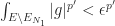
Let \epsilon>0. Since g\in L^{p'}, so g^{p'}\in L^1 and there exists \delta>0 such that for any measurable subset A\subseteq E with |A|<\delta, \int_A |g^{p'}|<\epsilon^{p'}.

Since f_k\to f a.e.\ (f is finite a.e.\ since f\in L^p), by Egorov’s Theorem there exists closed F\subseteq E such that |E\setminus F|<\delta and \{f_k\} converge uniformly to f on F. That is, there exists N(\epsilon) such that for k\geq N, |f_k(x)-f(x)|<\epsilon for all x\in F.

Then for k\geq N,
\begin{aligned}  \left|\int_E f_kg-fg\right|&\leq\int_E|f_k-f||g|\\  &=\int_{E\setminus F}|f_k-f||g|+\int_F|f_k-f||g|\\  &\leq\left(\int_{E\setminus F}|f_k-f|^p\right)^\frac{1}{p}\left(\int_{E\setminus F}|g|^{p'}\right)^\frac{1}{p'}+\epsilon\int_F |g|\\  &<\|f_k-f\|_p(\epsilon)+\epsilon\left(\int_F|g|^{p'}\right)^\frac{1}{p'}\left(\int_F |1|^p\right)^\frac{1}{p}\\  &\leq 2M\epsilon+\epsilon\|g\|_{p'}|E|^\frac{1}{p}\\  &=\epsilon(2M+\|g\|_{p'}|E|^\frac{1}{p}).  \end{aligned}

Since \epsilon>0 is arbitrary, this means \int_E f_g\to \int_E fg.

(Case: |E|=\infty). Error: See correction below.

Define E_N=E\cap B_N(0), where B_N(0) is the ball with radius N centered at the origin. Then |E_N|<\infty, so there exists N_1>0 such that for N\geq N_1, \int_{E_N}|f_k-f||g|<\epsilon.

Since |g|^{p'}\chi_{E_N}\nearrow|g|^{p'} on E, by Monotone Convergence Theorem, \displaystyle \lim_{N\to\infty}\int_{E_N}|g|^{p'}=\int_E |g|^{p'}<\infty.
Thus there exists N_2>0 such that for N\geq N_2, \int_{E\setminus E_N} |g|^{p'}<\epsilon^{p'}.

Then for N\geq\max\{N_1, N_2\},
\begin{aligned}  \int_E |f_kg-fg|&=\int_{E_N}|f_k-f||g|+\int_{E\setminus E_N}|f_k-f||g|\\  &<\epsilon+\left(\int_{E\setminus E_N}|f_k-f|^p\right)^\frac{1}{p}\left(\int_{E\setminus E_N}|g|^{p'}\right)^\frac{1}{p'}\\  &<\epsilon+\|f_k-f\|_p(\epsilon)\\  &\leq\epsilon+2M\epsilon\\  &=\epsilon(1+2M).  \end{aligned}
so that \int_E f_kg\to\int_E fg.

(Show that the result is false if p=1).

Let f_k:=k\chi_{[0,\frac 1k]}. Then f_k\to f a.e., where f\equiv 0. Note that \int_\mathbb{R} |f_k|=1, \int_\mathbb{R} |f|=0 so that f_k, f\in L^1(\mathbb{R}). Similarly, \|f_k\|_1\leq M=1.

However if g\equiv 1\in L^\infty, \int_\mathbb{R} f_kg=1 for all k but \int_\mathbb{R} fg=0.

Correction for the case |E|=\infty:

Define E_N=E\cap B_N(0), where B_N(0) is the ball with radius N centered at the origin.

Since |g|^{p'}\chi_{E_N}\nearrow |g|^{p'} on E, by Monotone Convergence Theorem, \displaystyle \lim_{N\to\infty}\int_{E_N}|g|^{p'}=\int_E|g|^{p'}<\infty.

Thus there exists N_1>0 such that \int_{E\setminus E_{N_1}}|g|^{p'}<\epsilon^{p'}.

Since |E_{N_1}|<\infty, by the finite measure case there exists N_2 such that for k\geq N_2, \displaystyle \int_{E_{N_1}}|f_k-f||g|<\epsilon.

So for k\geq N_2,
\begin{aligned}  \int_E|f_kg-fg|&=\int_{E_{N_1}}|f_k-f||g|+\int_{E\setminus E_{N_1}}|f_k-f||g|\\  &<\epsilon+\left(\int_{E\setminus E_{N_1}}|f_k-f|^p\right)^{1/p}\left(\int_{E\setminus E_{N_1}}|g|^{p'}\right)^{1/p'}\\  &<\epsilon+\|f_k-f\|_p(\epsilon)\\  &\leq\epsilon+2M\epsilon\\  &=\epsilon(1+2M).  \end{aligned}

so that \int_Ef_kg\to\int_E fg.

Relationship between L^p convergence and a.e. convergence

It turns out that convergence in Lp implies that the norms converge. Conversely, a.e. convergence and the fact that norms converge implies Lp convergence. Amazing!

Relationship between L^p convergence and a.e. convergence:
Let f, \{f_k\}\in L^p, 0<p\leq\infty. If \|f-f_k\|_p\to 0, then \|f_k\|_p\to\|f\|_p. Conversely, if f_k\to f a.e.\ and \|f_k\|_p\to\|f\|_p, 0<p<\infty, then \|f-f_k\|_p\to 0. Note that the converse may fail for p=\infty.

Proof:
Assume \|f-f_k\|_p\to 0.

(Case: 0<p<1).
Lemma 1:
If 0<p<1, |a+b|^p\leq|a|^p+|b|^p for all a,b\in\mathbb{R}.
Proof of Lemma 1:
\displaystyle 1=\frac{|a|}{|a|+|b|}+\frac{|b|}{|a|+|b|}\leq\left(\frac{|a|}{|a|+|b|}\right)^p+\left(\frac{|b|}{|a|+|b|}\right)^p=\frac{|a|^p+|b|^p}{(|a|+|b|)^p}.
Hence |a+b|^p\leq(|a|+|b|)^p\leq|a|^p+|b|^p.
End Proof of Lemma 1.
Hence, using |a|^p\leq|a-b|^p+|b|^p and |b|^p\leq|a-b|^p+|a|^p we see that \displaystyle ||a|^p-|b|^p|\leq|a-b|^p.

Thus
\begin{aligned}  \left|\|f_k\|_p^p-\|f\|_p^p\right|&=\left|\int(|f_k|^p-|f|^p)\right|\\  &\leq\int\left||f_k|^p-|f|^p\right|\\  &\leq\int|f_k-f|^p\\  &=\|f-f_k\|_p^p\to 0\ \ \ \text{as}\ k\to\infty.  \end{aligned}

Hence \|f_k\|_p\to\|f\|_p.

(Case: 1\leq p\leq\infty.)

By Minkowski’s inequality, \|f\|_p\leq\|f-f_k\|_p+\|f_k\|_p and \|f_k\|_p\leq\|f-f_k\|_p+\|f\|_p so that \displaystyle \left|\|f_k\|_p-\|f\|_p\right|\leq\|f-f_k\|_p\to 0 as k\to\infty. Done.

Converse:

Assume f_k\to f a.e.\ and \|f_k\|_p\to\|f\|_p, 0<p<\infty.
Lemma 2:
For a,b\in\mathbb{R}, |a+b|^p\leq 2^{p-1}(|a|^p+|b|^p) for 1\leq p<\infty.
Proof of Lemma 2:
By convexity of |x|^p for 1\leq p<\infty, \displaystyle \left|\frac 12 a+\frac 12 b\right|^p\leq\frac 12 |a|^p+\frac 12 |b|^p.
Multiplying throughout by 2^p gives \displaystyle |a+b|^p\leq 2^{p-1}(|a|^p+|b|^p).

Thus together with Lemma 1, for 0<p<\infty we have |f-f_k|^p\leq c(|f|^p+|f_k|^p) with c=\max\{2^{p-1}, 1\}.

Note that |f-f_k|^p\to 0 a.e.\ and \phi_k:=c(|f|^p+|f_k|^p)\to\phi:=2c|f|^p a.e.\ which is integrable. Also, \int\phi_k\to\int\phi since \|f_k\|_p^p\to\|f\|_p^p. By Generalized Lebesgue’s DCT, we have \int |f-f_k|^p\to 0 thus \displaystyle \|f-f_k\|_p\to 0.

(Show that the converse may fail for p=\infty):

Consider f_k=\chi_{[-k,k]}\in L^\infty(\mathbb{R}). Then f_k\to f a.e.\ where f(x)\equiv 1, and \|f_k\|_\infty\to\|f\|_\infty=1. However \|f-f_k\|_\infty=1\not\to 0.

98-Year-Old NASA Mathematician Katherine Johnson: ‘If You Like What You’re Doing, You Will Do Well’

Source: http://people.com/human-interest/nasa-katherine-johnson-mathematician-advice-interview/

Despite her age, Johnson isn’t slowing down anytime soon.

“I like to learn,” she says. “That’s an art and a science. I’m always interested in learning something new.”

As a young girl she’d stop by the library on her home way in the evening and would pick up a book.

“I finally persuaded them to let me look at two books,” she recalls. “I could have read more than that in one night if they had let me.”

Johnson’s life was the inspiration for a nonfiction book titled Hidden Figures: The American Dream and the Untold Story of the Black Women Mathematicians Who Helped Win the Space Race, which is now being turned into a major motion picture coming due theaters this December. (Empire star Taraji P. Henson will play Johnson.)

Johnson, who was given the Presidential Medal of Freedom by President Barack Obama in 2015,  thinks she was able to succeed because she always loved what she did. It’s one piece of advice she has for young girls today.

“Find out what her dream is,” she says, “and work at it because if you like what you’re doing, you will do well.”

Johnson also taught her daughters a few life lessons.

“Don’t accept failure,” says Joylette Goble, who says she has always been in awe of her mother. “If there is a job to be done, you can do it and do it until you finish.”

She adds: “Be aware of people and help them when you can.”

Johnson’s other daughter, Katherine Goble Moore, says her mother has always been her role model.

“I will always be grateful for her,” she says.

Donald Trump’s Answer to Math Question: 2+2=?

Source: http://www.attn.com/stories/6407/george-takei-impersonates-donald-trump

Question: What is 2+2?

Answer:

“I have to say a lot of people have been asking this question. No, really. A lot of people come up to me and they ask me. They say, ‘What’s 2+2’? And I tell them look, we know what 2+2 is. We’ve had almost eight years of the worst kind of math you can imagine. Oh my God, I can’t believe it. Addition and subtraction of the 1s the 2s and the 3s. It’s terrible. It’s just terrible. Look, if you want to know what 2+2 is, do you want to know what 2+2 is? I’ll tell you. First of all the number 2, by the way, I love the number 2. It’s probably my favorite number, no it is my favorite number. You know what, it’s probably more like the number two but with a lot of zeros behind it. A lot. If I’m being honest, I mean, if I’m being honest. I like a lot of zeros. Except for Marco Rubio, now he’s a zero that I don’t like. Though, I probably shouldn’t say that. He’s a nice guy but he’s like, ‘10101000101,’ on and on, like that. He’s like a computer! You know what I mean? He’s like a computer. I don’t know. I mean, you know. So, we have all these numbers, and we can add them and subtract them and add them. TIMES them even. Did you know that? We can times them OR divide them, they don’t tell you that, and I’ll tell you, no one is better at the order of operations than me. You wouldn’t believe it. So, we’re gonna be the best on 2+2, believe me.”

Credit: Original Author Steven Edwards.

Wheeden Zygmund Measure and Integration Solutions

Here are some solutions to exercises in the book: Measure and Integral, An Introduction to Real Analysis by Richard L. Wheeden and Antoni Zygmund.

Chapter 1,2: analysis1

Chapter 3: analysis2

Chapter 4, 5: analysis3

Chapter 5,6: analysis4

Chapter 6,7: analysis5

Chapter 8: analysis6

Chapter 9: analysis7


Measure and Integral: An Introduction to Real Analysis, Second Edition (Chapman & Hall/CRC Pure and Applied Mathematics)

Other than this book by Wheedon, also check out other highly recommended undergraduate/graduate math books.


Books to Transition from Math to Data Science

Graduating  soon and interested to transition to data science (dubbed the sexiest job of the 21st century)? We recommend two books which are very suitable for students with strong math background, but little or no background in data science/ machine learning.

Do check out the following data science / machine learning book (rated 4.5/5 on Amazon) Pattern Recognition and Machine Learning (Information Science and Statistics) which is an in-depth book on the fundamentals of machine learning. The author Christopher M. Bishop has a PhD in theoretical physics, and is the Deputy Director of Microsoft Research Cambridge.

The above book is good for building a solid, theoretical foundation for a data scientist job. The next book Hands-On Machine Learning with Scikit-Learn, Keras, and TensorFlow: Concepts, Tools, and Techniques to Build Intelligent Systems is ideal for learning hands-on practical coding for building machine learning (including deep learning) models. The author Aurélien Géron is a former Googler who was the tech lead for YouTube video classification.


Do you know how to prove sin(1/x)/x is not Lebesgue Integrable on (0,1]?

Also check out other popular Measure Theory exam question topics here:


Try Audible Plus (Free!)

Your free, 30-day trial comes with:

  • The Amazon Audible Plus Catalog of podcasts, audiobooks, guided wellness, and Audible Originals. Listen all you want, no credits needed.
  • Be more productive by listening to audiobooks during your daily commute to school or work!

Absolute Continuity of Lebesgue Integral

The following is a wonderful property of the Lebesgue Integral, also known as absolute continuity of Lebesgue Integral. Basically, it means that whenever the domain of integration has small enough measure, then the integral will be arbitrarily small.

Suppose f is integrable.
Given \epsilon>0, there exists \delta>0 such that for all measurable sets B\subseteq E with |B|<\delta, |\int_B f\,dx|<\epsilon.

Proof:
Define A_k=\{x\in E: \frac 1k\leq|f(x)|<k\} for k\in\mathbb{N}. Each A_k is measurable and A_k\nearrow A:=\bigcup_{k=1}^\infty A_k. Note that \displaystyle \int_E |f|=\int_{\{f=0\}}|f|+\int_A |f|+\int_{\{f=\infty\}}|f|=\int_A |f|.

Let f_k=|f|\chi_{A_k}. Then \{f_k\} is a sequence of non-negative functions such that f_k\nearrow |f|\chi_A. By Monotone Convergence Theorem, \lim_{k\to\infty}\int_E f_k=\int_E |f|\chi_A, that is, \displaystyle \lim_{k\to\infty}\int_{A_k}|f|\,dx=\int_A |f|\,dx=\int_E |f|\,dx.

Let N>0 be sufficiently large such that \int_{E\setminus A_N}|f|\,dx<\epsilon/2.

Let \delta=\frac{\epsilon}{2N}, and suppose |B|<\delta. Then
\begin{aligned}  |\int_B f\,dx|&\leq\int_B |f|\,dx\\  &=\int_{(E\setminus A_N)\cap B}|f|\,dx+\int_{A_N\cap B}|f|\,dx\\  &\leq\int_{E\setminus A_N}|f|\,dx+\int_{A_N\cap B}N\,dx\\  &<\epsilon/2+N\cdot|A_N\cap B|\\  &\leq\epsilon/2+N\cdot|B|\\  &<\epsilon/2+N\cdot\frac{\epsilon}{2N}\\  &=\epsilon.  \end{aligned}

Why Math Education in the U.S. Doesn’t Add Up

The U.S. has some of the best universities in Math (think Harvard, Princeton, MIT), however the state of high school math is subpar and well below other developed nations. The main reason, according to this article, is the curriculum that focuses more on memorization and rote learning rather than understanding.

This book by Jo Boaler (Stanford Professor) sums up what can be done by parents to improve their child’s mathematical skills.

Another way is to consider studying Singapore Math, as Singapore is well known for being good at high school / elementary school math.

Source: https://www.scientificamerican.com/article/why-math-education-in-the-u-s-doesn-t-add-up/

Excerpt:

In December the Program for International Student Assessment (PISA) will announce the latest results from the tests it administers every three years to hundreds of thousands of 15-year-olds around the world. In the last round, the U.S. posted average scores in reading and science but performed well below other developed nations in math, ranking 36 out of 65 countries.

We do not expect this year’s results to be much different. Our nation’s scores have been consistently lackluster. Fortunately, though, the 2012 exam collected a unique set of data on how the world’s students think about math. The insights from that study, combined with important new findings in brain science, reveal a clear strategy to help the U.S. catch up.

The PISA 2012 assessment questioned not only students’ knowledge of mathematics but also their approach to the subject, and their responses reflected three distinct learning styles. Some students relied predominantly on memorization. They indicated that they grasp new topics in math by repeating problems over and over and trying to learn methods “by heart.” Other students tackled new concepts more thoughtfully, saying they tried to relate them to those they already had mastered. A third group followed a so-called self-monitoring approach: they routinely evaluated their own understanding and focused their attention on concepts they had not yet learned.

In every country, the memorizers turned out to be the lowest achievers, and countries with high numbers of them—the U.S. was in the top third—also had the highest proportion of teens doing poorly on the PISA math assessment. Further analysis showed that memorizers were approximately half a year behind students who used relational and self-monitoring strategies. In no country were memorizers in the highest-achieving group, and in some high-achieving economies, the differences between memorizers and other students were substantial. In France and Japan, for example, pupils who combined self-monitoring and relational strategies outscored students using memorization by more than a year’s worth of schooling.

Support

Mathtuition88.com is a Math Education Blog that aims to provide useful Math / Education content that helps people worldwide.

Over the years, Mathtuition88.com has grown to reach 500,000 total views, thanks to support of fans!

If you find our website useful, please consider supporting it in one of the following ways. Thanks!

1) Link back to our page (mathtuition88.com)

Every hyperlink counts! It could be a reblog, tweet, facebook, or a link in your blog. It doesn’t cost a cent, yet it is extremely important to the growth of the website.

2) Patreon

Our patreon page is at: https://www.patreon.com/user?u=4235868

3) Buy yourself a gift at Amazon

Purchase any item at Amazon using this link: Amazon.

4) Buy a Math Resource

Our sales page is here: https://mathtuition88.com/math-notes-worksheets-sale/

5) Advertise on our website

Our advertisement page is here: https://mathtuition88.com/sponsored-post-advertisement/

Thank you once again for your support.

Fatou’s Lemma for Convergence in Measure

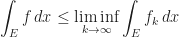
Suppose f_k\to f in measure on a measurable set E such that f_k\geq 0 for all k, then \displaystyle\int_E f\,dx\leq\liminf_{k\to\infty}\int_E f_k\,dx.

The proof is short but slightly tricky:

Suppose to the contrary \int_E f\,dx>\liminf_{k\to\infty}\int_E f_k\,dx. Let \{f_{k_l}\} be a subsequence such that \displaystyle \lim_{l\to\infty}\int f_{k_l}=\liminf_{k\to\infty}\int_E f_k<\int_E f
(using the fact that for any sequence there is a subsequence converging to \liminf).

Since f_{k_l}\xrightarrow{m}f, there exists a further subsequence f_{k_{l_m}}\to f a.e. By Fatou’s Lemma, \displaystyle \int_E f\leq\liminf_{m\to\infty}\int_E f_{k_{l_m}}=\lim_{l\to\infty}\int f_{k_l}<\int_E f, a contradiction.

The last equation above uses the fact that if a sequence converges, all subsequences converge to the same limit.

Lebesgue’s Dominated Convergence Theorem for Convergence in Measure

Lebesgue’s Dominated Convergence Theorem for Convergence in Measure

If \{f_k\} satisfies f_k\xrightarrow{m}f on E and |f_k|\leq\phi\in L(E), then f\in L(E) and \int_E f_k\to\int_E f.

Proof

Let \{f_{k_j}\} be any subsequence of \{f_k\}. Then f_{k_j}\xrightarrow{m}f on E. Thus there is a subsequence f_{k_{j_l}}\to f a.e.\ in E. Clearly |f_{k_{j_l}}|\leq\phi\in L(E).

By the usual Lebesgue’s DCT, f\in L(E) and \int_E f_{k_{j_l}}\to\int_E f.

Since every subsequence of \{\int_E f_k\} has a further subsequence that converges to \int_E f, we have \int_E f_k\to\int_E f.

Basel Problem using Fourier Series

A very famous mathematical problem known as the “Basel Problem” is solved by Euler in 1734. Basically, it asks for the exact value of \sum_{n=1}^\infty\frac{1}{n^2}.

Three hundred years ago, this was considered a very hard problem and even famous mathematicians of the time like Leibniz, De Moivre, and the Bernoullis could not solve it.

Euler showed (using another method different from ours) that \displaystyle \sum_{n=1}^\infty\frac{1}{n^2}=\frac{\pi^2}{6}, bringing him great fame among the mathematical community. It is a beautiful equation; it is surprising that the constant \pi, usually related to circles, appears here.

Squaring the Fourier sine series

Assume that \displaystyle f(x)=\sum_{n=1}^\infty b_n\sin nx.

Then squaring this series formally,
\begin{aligned}  (f(x))^2&=(\sum_{n=1}^\infty b_n\sin nx)^2\\  &=\sum_{n=1}^\infty b_n^2\sin^2 nx+\sum_{n\neq m}b_nb_m\sin nx\sin mx.  \end{aligned}

To see why the above hold, see the following concrete example:
\begin{aligned}  (a_1+a_2+a_3)^2&=(a_1^2+a_2^2+a_3^2)+(a_1a_2+a_1a_3+a_2a_1+a_2a_3+a_3a_1+a_3a_2)\\  &=\sum_{n=1}^3 a_n^2+\sum_{n\neq m}a_na_m.  \end{aligned}

Integrate term by term

We assume that term by term integration is valid.
\displaystyle \frac 1\pi\int_{-\pi}^\pi (f(x))^2\,dx=\frac 1\pi\int_{-\pi}^{\pi}\sum_{n=1}^\infty b_n^2\sin^2{nx}\,dx+\frac{1}{\pi}\int_{-\pi}^\pi\sum_{n\neq m}b_nb_m\sin nx\sin mx\,dx.

Recall that \displaystyle \int_{-\pi}^\pi \sin nx\sin mx\,dx=\begin{cases}0 &\text{if }n\neq m\\  \pi &\text{if }n=m  \end{cases}.

So
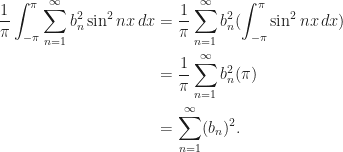
\begin{aligned}  \frac 1\pi\int_{-\pi}^{\pi}\sum_{n=1}^\infty b_n^2\sin^2{nx}\,dx&=\frac 1\pi\sum_{n=1}^\infty b_n^2(\int_{-\pi}^\pi\sin^2 nx\,dx)\\  &=\frac 1\pi\sum_{n=1}^\infty b_n^2 (\pi)\\  &=\sum_{n=1}^\infty (b_n)^2.  \end{aligned}

Similarly
\begin{aligned}  \frac{1}{\pi}\int_{-\pi}^\pi\sum_{n\neq m}b_nb_m\sin nx\sin mx\,dx&=\frac 1\pi\sum_{n\neq m}b_nb_m(\int_{-\pi}^{\pi}\sin nx\sin mx\,dx)\\  &=\frac 1\pi\sum_{n\neq m}b_nb_m(0)\\  &=0.  \end{aligned}

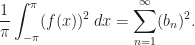
So \displaystyle \frac 1\pi\int_{-\pi}^\pi (f(x))^2\,dx=\sum_{n=1}^\infty (b_n)^2. (Parseval’s Identity)

Apply Parseval’s Identity to f(x)=x

By Parseval’s identity,
\displaystyle \frac{1}{\pi}\int_{-\pi}^\pi x^2\,dx=\sum_{n=1}^\infty(\frac{2(-1)^{n+1}}{n})^2.

Simplifying, we get \displaystyle \frac 1\pi\cdot\left[\frac{x^3}{3}\right]_{-\pi}^\pi=\sum_{n=1}^\infty\frac{4}{n^2}.
\begin{aligned}  \frac 1\pi(\frac{2\pi^3}{3})&=\sum_{n=1}^\infty \frac{4}{n^2}\\  \frac{\pi^2}{6}&=\sum_{n=1}^\infty\frac{1}{n^2}.  \end{aligned}