If 
![f\in K[X]](https://s0.wp.com/latex.php?latex=f%5Cin+K%5BX%5D&bg=ffffff&fg=1a1a1a&s=0&c=20201002)


![[F:K]\leq n!](https://s0.wp.com/latex.php?latex=%5BF%3AK%5D%5Cleq+n%21&bg=ffffff&fg=1a1a1a&s=0&c=20201002)
Proof:
We use induction on 
Base case: If 

![[F:K]=1\leq 1!](https://s0.wp.com/latex.php?latex=%5BF%3AK%5D%3D1%5Cleq+1%21&bg=ffffff&fg=1a1a1a&s=0&c=20201002)
Induction Hypothesis: Assume the statement is true for degree 

If 
![g\in K[X]](https://s0.wp.com/latex.php?latex=g%5Cin+K%5BX%5D&bg=ffffff&fg=1a1a1a&s=0&c=20201002)


![\displaystyle [K(u):K]=\deg g>1.](https://s0.wp.com/latex.php?latex=%5Cdisplaystyle+%5BK%28u%29%3AK%5D%3D%5Cdeg+g%3E1.&bg=ffffff&fg=1a1a1a&s=0&c=20201002)
Write 
![h\in K(u)[X]](https://s0.wp.com/latex.php?latex=h%5Cin+K%28u%29%5BX%5D&bg=ffffff&fg=1a1a1a&s=0&c=20201002)


![[F:K(u)]\leq(n-1)!](https://s0.wp.com/latex.php?latex=%5BF%3AK%28u%29%5D%5Cleq%28n-1%29%21&bg=ffffff&fg=1a1a1a&s=0&c=20201002)
That is, 



This shows

If
Proof:
We use induction on
Base case: If
Induction Hypothesis: Assume the statement is true for degree
If
Write
That is,
This shows
Source: https://www.storyarts.org/library/nutshell/stories/fate.html
A Hebrew Folktale
King Solomon’s servant came breathlessly into the court, “Please! Let me borrow your fastest horse!” he said to the King. “I must be in a town ten miles south of here by nightfall!”
“Why?” asked King Solomon.
“Because,” said his shuddering servant, “I just met Death in the garden! Death looked me in the face! I know for certain I’m to be taken and I don’t want to be around when Death comes to claim me!”
“Very well,” said King Solomon. “My fastest horse has hoofs like wings. TAKE HIM.” Then Solomon walked into the garden. He saw Death sitting there with a perplexed look on its face. “What’s wrong?” asked King Solomon.
Death replied, “Tonight I’m supposed to claim the life of your servant whom I just now saw in your garden. But I’m supposed to claim him in a town ten miles south of here! Unless he had a horse with hooves like wings, I don’t see how he could get there by nightfall . . .”
Let 


Proof:
(Hungerford pg 237, reworded)
Let 


Let 


Thus by Tower Law, 
Hence 
Let 
Q1) If M/K is a normal extension, is L/K a normal extension?
False. Let 

![L=\mathbb{Q}(\sqrt[3]{2})](https://s0.wp.com/latex.php?latex=L%3D%5Cmathbb%7BQ%7D%28%5Csqrt%5B3%5D%7B2%7D%29&bg=ffffff&fg=1a1a1a&s=0&c=20201002)
Then 
![\mathbb{Q}[X]](https://s0.wp.com/latex.php?latex=%5Cmathbb%7BQ%7D%5BX%5D&bg=ffffff&fg=1a1a1a&s=0&c=20201002)
However consider ![X^3-2\in\mathbb{Q}[X]](https://s0.wp.com/latex.php?latex=X%5E3-2%5Cin%5Cmathbb%7BQ%7D%5BX%5D&bg=ffffff&fg=1a1a1a&s=0&c=20201002)
![(\sqrt[3]{2})](https://s0.wp.com/latex.php?latex=%28%5Csqrt%5B3%5D%7B2%7D%29&bg=ffffff&fg=1a1a1a&s=0&c=20201002)
Q2) If M/L and L/K are both normal extensions, is M/K a normal extension? (i.e. is normal extension transitive?)
False. Let 

Let ![M=\mathbb{Q}(\sqrt 2,\sqrt[4]{2})](https://s0.wp.com/latex.php?latex=M%3D%5Cmathbb%7BQ%7D%28%5Csqrt+2%2C%5Csqrt%5B4%5D%7B2%7D%29&bg=ffffff&fg=1a1a1a&s=0&c=20201002)


However, 

![\pm\sqrt[4]{2}](https://s0.wp.com/latex.php?latex=%5Cpm%5Csqrt%5B4%5D%7B2%7D&bg=ffffff&fg=1a1a1a&s=0&c=20201002)
Congratulations to Feng Tianwei for the epic win over World No. 1 Ding Ning in the Chinese Super League, despite being recently axed from the Singapore national team (for unknown reasons).
The Chinese Super League, though not as famous as the Olympics, is obviously much harder and tougher to win than the Olympic Games. The main reason being that the entire platoon of All-Star China Team is playing there, while in the Olympics China is restricted to sending 3 men and 3 women.
So, once again congratulations, and Feng’s perseverance and fighting spirit is very motivating to all.
The top PSLE Score for this year seems to be 286, from RGPS (Raffles Girls Primary School).
Close runners-ups are 283, from NYPS (Nanyang Primary School) and Nanhua.
Source is from https://www.kiasuparents.com/kiasu/t-scores/, which is self-reported by parents. Casting aside the “troll scores” of 299 or 300 which are not believable, this seems to be the most accurate top PSLE score available, since the mainstream media are not allowed to report them.
Congratulations for those who have done well. And for those who have not, do not be discouraged as there is still a long road ahead, and there will be many opportunities to prove yourself.
For those considering tuition, check out StarTutor, which is highly recommended by us. Tutors are screened for their educational qualifications and matched accordingly, with zero administrative fees.
From experience, O Level is a completely new ball game from PSLE. It is possible for relatively weak students in PSLE to do very well in O Levels, and also vice versa; for quite strong PSLE students to do poorly in O Levels. It is a new beginning for students.
2017 Update: Highest PSLE score seems to be 285 from Nanyang Primary. The runner-up position seems to be tied with a few schools such as MGS, ACS, Ai Tong, with 281.
Note that neighborhood schools can produce very strong results too: Alexandra Primary School and Admiralty Primary School both produce 280 scorers. In fact I recall from memory that Rulang Primary School used to consistently produce top scorers that can even rival that of Nanyang Primary School.
“The reality is that if your dream is to accomplish something awesome, it’s not going to be easy. If it were easy, everyone would be doing it. People who go for greatness are going to get knocked down a lot. They’ll have difficult times. They’ll struggle with doubt and uncertainty. People around them will question the wisdom of their quest. The issue is not whether you’ll fail, because you will. It’s whether you’ll get back up and keep going. It’s whether you can sustain your self-confidence and your belief in yourself and keep bouncing back. Failure is only final when you stop striving.” – Bob Rotella
Attached is a proof of the equivalent conditions for a Split Exact Sequence, based on the nice proof in Hungerford using the Short Five Lemma. Very neat proof.
Excellent interview of S.T. Yau, Fields Medalist. One mischievous student tried to ask a trick question that is a variant of the Missing Dollar Problem. The interviewer is Sa Beining, who is a famous celebrity in China.
Not much mathematical content though, since it is aimed at the general audience. Nevertheless, it is inspirational, especially for Chinese youth.
Quite interesting analysis on how and why Singapore topped the ranking for PISA in Math/Science. One possible reason is the difficulty of PSLE trains students to solve tricky and difficult (for that level) math questions. It is well known that PSLE questions are more difficult (for students of their respective levels) than O Level E Maths questions. The peak difficulty in Singapore Maths Syllabus are at PSLE and then at H2 A Level Maths.
Overall, on average, the average Singaporean student is quite well-prepared in maths. Since PISA is measuring the average capability of students (rather than the top echelon of students), it is no surprise that Singapore would score rather highly in this aspect.
Note that China (Mainland) seems to be missing from the study. If China (especially if restricted to cities like Shanghai and Beijing) are included, they would be a strong contender for No. 1 position too, since it is well known that China Math is just as difficult, or even more so, especially at high school/senior high school level.
Source (in Chinese): http://mp.weixin.qq.com/s/lQx4kmqMwNsZEUlXQbRIzw
最近一个报告,说新加坡学中小学生的数理能力,在全球64个国家中,排名第一!
(阅读提示,本文有点长,没耐心看废话的,直接拉到最后看一下就好。)
引起不少网友的讨论。感觉上,最会算的,不应该是华人尤其是中国人吗?好吧,作为华人咱谦虚一点,犹太人俄罗斯人甚至美国人印度人,都有可能第一啊,数完一个巴掌也轮不到新加坡哇,又没解歌德巴赫猜想,也没研究天体物理出啥成果,出产的程序员不够内需,还要进口外援,凭什么?
一般江湖传说,中国中小学生到了国外,数学都能甩当地同级学生几条街。
我们来看看新加坡的数学题
问:8个1元硬币大概有多重?备选答案 6克; 60克; 600克; 6千克。
或许有人会第一反应,这是奥数题。毕竟要考的点很多,生活常识、逻辑能力……,一般学生可不会碰到这样的考题。
事实上,它是去年新加坡小学离校会考数学题中的一道。
没有答对的读者们,你们小学能毕业吗?(幸灾乐祸脸)
有些孩子不懂怎么做,胡乱猜了一个答案,有些家长(新加坡眼觉得是恼羞成怒)就投诉考题超纲。
新加坡教育部的回应有理有据,考题可是根据教学大纲准备的,到底是大纲的哪一条,都能翻给你看。
说到新加坡的教育大纲,那也是杠杠的。
美国居然也采用新加坡的数理教材!足见根据新加坡大纲编写的教材,相当有章法。
(Translation: America is also using Singapore Math material to teach their students!)
新加坡小学生数理能力第一咋来的
在最近公布的《国际数学与科学趋势研究报告》。
一个国际教育组织,每四年都会随机抽取小学四年级和中学二年级的学生,做国际数学与科学趋势研究(简称TIMSS)。
去年,新加坡各中小学里,共有6500名小四学生和6100中二学生接受了调查,要跟64个国家和城市的学生一比高低。为了拿到更直观和准确的数据,学生们被分为四类:基本、中水平、高水平,优等,进行考察。
先来围观,这份调查是从那些方面着手的?
国际教育成就评估协会以试卷评估学生这些方面:(其实就是参加考试)
另外还有学生们对学习的态度等等。
考试的内容在这里~
看成绩~~以中二学生的成绩为例(有兴趣的网友,可以点击文章底部“阅读原文”,查看全报告详情)
科学方面,新加坡597分。第二名是日本,571分,前后相差26分,差距还是不小,第三名是中国台北569分。
点击看大图
数学方面,新加坡621分,第二名韩国606分;第三名中国台北599分;第四名中国香港594分;第五名日本586分。
点击看大图
新加坡人的数理能力,到底强不强,我们听听在籍学生、资深数学补习老师、家有才女的、中国留学生,各方的意见~~
新加坡的资深数学补习老师,孙老师,在中国和新加坡分别有19年和8年的教学经验,教过中国的高中和大学,也在新加坡教过O level、PSLE考生,涉猎高等数学,并编写O Level 数学中英文教材,主要适用中国留学生,被私立学校广泛使用。
这样的排名可以理解。毕竟本地的孩子和家长都非常努力,想不拿第一都难。
1)本地数学题的特点:不出偏怪题,会让那些努力但不聪明的孩子,也有能力取得好成绩,不会失去学习兴趣。
2)新加坡的数学在某种程度上要比其他国家难。尤其是小五小六的数学word problems(相当于中国的应用题),比中国更难,因为不能用方程解,本地学生从小二就开始画model。 只有那些很聪明的孩子才能应付。(这句话真是说到了编辑部某位学妈的心坎里,回想当年陪娃儿读书,明明可以方程解,设个X,一元一次方程,不是很容易搞定吗,硬要从头学起画model,真是郁闷死了),所以本地有不少小五小六学生,会补习数学。毕竟从小五到高中毕业的A水准,要想拿A的话,还是挺有难度的。
传说中的Model,你看得懂吗?
3)至于中学数学,要比中国学得广,但没有中国深。本地更注重解题过程。数学的应用性也比中国强。它的O水准数学考试题目,时间比中国的中考长,难度比中国的也要大些。大概做个比较的话,本地的O水准高等数学一科,相当于中国高三的数学了(编者按:相对于中国高考考三天大概五六门,新加坡的O水准可是要考至少一个月的,而且像数学,也分好多子科目,单看所有科目的编号都是4位数的,就知道名堂特别多。)
今年O水准数学考试的部分列表
4)本地的A水平数学题目,像写论文。所以学生的推理能力必须很强,才能解答。
5)相比中国的数学注重计算,速度以及一题多解,所以中国孩子的基础非常好。如果在中国有经过4年的小学数学训练,再来新加坡的话,基本就不要补习了。尤其那些在中国学霸级的学生来新后,一定还是学霸。
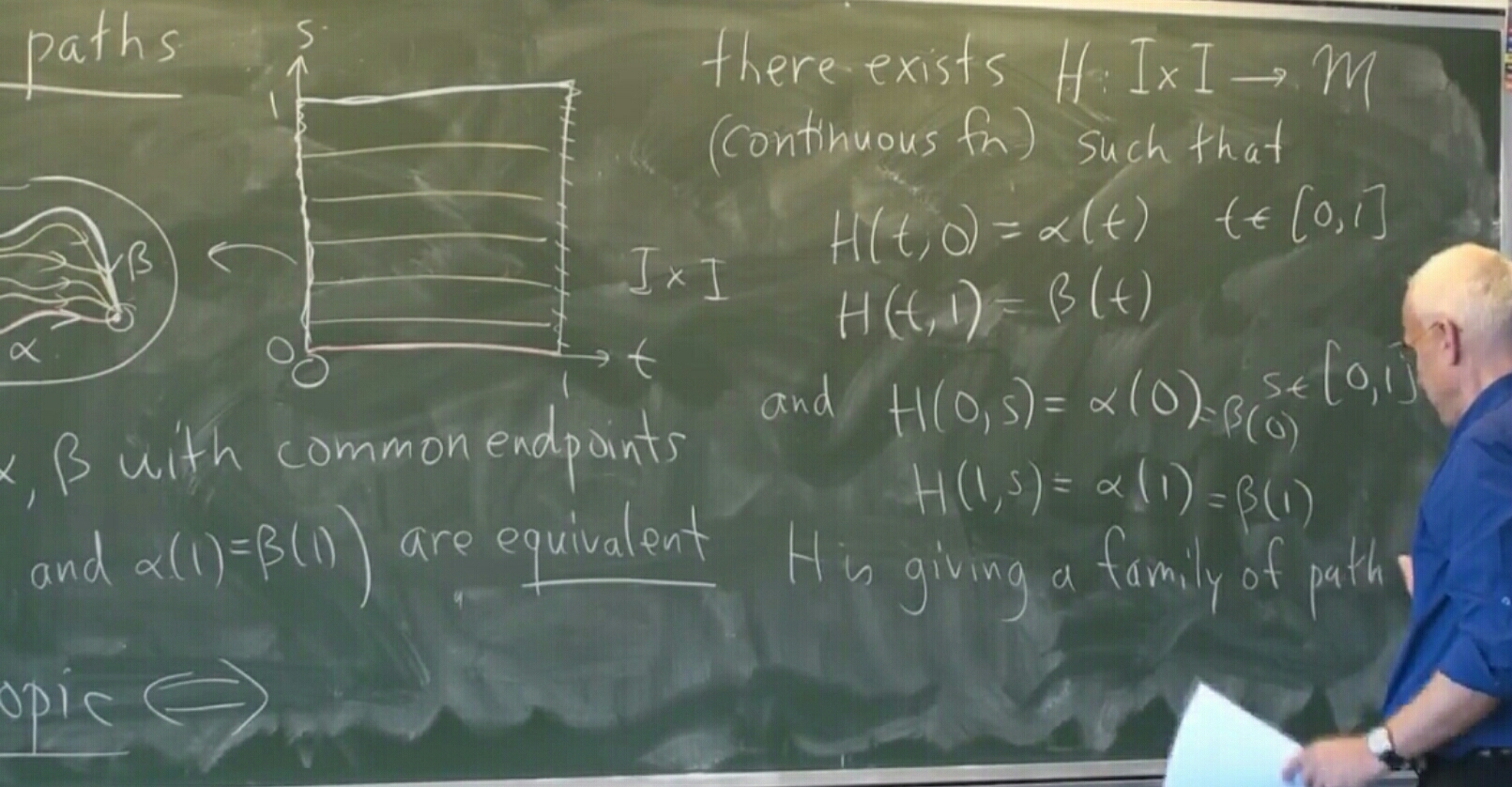
Excellent video for the curious minds! Who cares about Topology such as Torus (aka donut) or Mobius Strip ? They can be used to prove difficult math such as the unsolved problem “Inscribed square/rectangle inside any closed loop”.
To understand the Topology on Loops, please view the lecture here : Homotopyand the fundamental group of surface.
Conditions for 
Let 


Proof
(H pg 146)













If
(i)
(ii) All nonunits of 
(iii) The nonunits of
Proof
(H pg 147)
(i)


(ii)


(iii)


It turns out that there are two types of Lp interpolation: One is called “Lyapunov’s inequality” which is addressed in this previous blog post.
The other one is called Littlewood’s inequality: If 


The proof is here:
Case 1) 


Thus 
Case 2) 


Hence 
NJ Wildberger AlgTop24: The fundamental group

Homotopy 同伦: When playing skip rope, the 2 ends of the rope are held by 2 persons while a 3rd person jumping over the “swings of rope” – these swings at any instant arehomotopic.

The generalized Riemann-Stieltjes integral 


![[a,b]](https://s0.wp.com/latex.php?latex=%5Ba%2Cb%5D&bg=ffffff&fg=1a1a1a&s=0&c=20201002)



![\xi_i\in[x_{i-1},x_i]](https://s0.wp.com/latex.php?latex=%5Cxi_i%5Cin%5Bx_%7Bi-1%7D%2Cx_i%5D&bg=ffffff&fg=1a1a1a&s=0&c=20201002)

We will write 
![f\in \mathcal{R}_\phi[a,b]](https://s0.wp.com/latex.php?latex=f%5Cin+%5Cmathcal%7BR%7D_%5Cphi%5Ba%2Cb%5D&bg=ffffff&fg=1a1a1a&s=0&c=20201002)
1) Row reduction, row-echelon form and reduced row-echelon form

2) Rank of Matrix = Rank (A)
The normalizer of a Sylow p-subgroup is “self-normalizing”, i.e. its normalizer is itself. Something that is quite cool.
If 


Proof
(Adapted from Hungerford pg 95)
Let 


Let 


I have previously proved this at: Advanced Method for Proving Normal Subgroup. This is a neater, slightly shorter proof of the same theorem.
Index of smallest prime dividing 
If 
Proof:
(Hungerford pg 91)
Let 
This induces a homomorphism 



Let 



![|G/K|=[G:K]](https://s0.wp.com/latex.php?latex=%7CG%2FK%7C%3D%5BG%3AK%5D&bg=ffffff&fg=1a1a1a&s=0&c=20201002)
![|G|=|K|[G:K]](https://s0.wp.com/latex.php?latex=%7CG%7C%3D%7CK%7C%5BG%3AK%5D&bg=ffffff&fg=1a1a1a&s=0&c=20201002)


Therefore ![[H:K]=1](https://s0.wp.com/latex.php?latex=%5BH%3AK%5D%3D1&bg=ffffff&fg=1a1a1a&s=0&c=20201002)

An algebraic field extension ![K[X]](https://s0.wp.com/latex.php?latex=K%5BX%5D&bg=ffffff&fg=1a1a1a&s=0&c=20201002)
Equivalent Properties
The normality of 
1) Every embedding 

2) Every irreducible polynomial in ![L[X]](https://s0.wp.com/latex.php?latex=L%5BX%5D&bg=ffffff&fg=1a1a1a&s=0&c=20201002)
Source: http://www.todayonline.com/singapore/kiasuparentcom-co-founder-comes-full-circle-site-launch
Basically to summarize the article above, the co-founder of Kiasuparents’ son scored a respectable 4As and 229 T-score for PSLE. However, as their set target was 250, he did not get the Nintendo DS that was part of the deal for achieving the target of 250. Probably the Nintendo is to play the most recently released Pokemon Sun/Moon. Poor kid! I remember that my highlight of finishing PSLE was to play Pokemon (close to 20 years ago). I still remembered I was playing the Blue version, starting as Bulbasaur.
PSLE can be highly unpredictable (variance of 20-30 marks from usual expected mark is common and expected). This is particularly due to language exams, composition, and also the famous rigid marking scheme of PSLE science, where all the “keywords” must be mentioned in order to get the mark. Mathematics is the more reliable subject here as it is more objective, so try to score as high as possible in it.
Hence DSA becomes increasingly important as a backup plan to act as insurance in the event that something goes wrong in the PSLE. Check out some DSA/GAT/HAST posts here. It is always good to have a “Plan B”.
Also, if you suspect that the child’s school teacher is not that excellent in teaching, e.g. don’t know/emphasize the “keywords” which are necessary to get any marks at all in PSLE science, you may consider engaging a tutor as soon as possible. Check out the most recommended tuition agency in Singapore.
An autobiography of a Chinese PhD student (France, University Paris-11) in Number Theory and Algebraic Geometry.
His journey from 武汉大学 4 years undergrad to Beijing, learn mostly from the French-educated Chinese Math professors (Ecole Normale Superieure, Polytechniques).
来源:梁永祺的日志(转载请注明出处)2012-12-16 06:52
“趁着一丝冲动记下一些经历,也趁着现在还能想起来,写写路途中遇到的人和碰到的一些书。”
http://blog.sina.cn/dpool/blog/s/blog_4ee63ce90102ea2r.html


Ecole Normale Supérieure (Paris) (E.N.S.): 巴黎高等师范大学 (Galois 的母校但他因参加法国革命被开除, 现在是法国/世界 Fields Medals 的摇篮, 出Bourbaki 学派的大师André Weil, Cartan, Dieudoné, …医学细菌发现者 Pasteur是排班上最后一名的劣等生)。E.N.S.训练未来的教授 (文, 数, 理), 每年只收全法国前50位精英学生, 培养成博士。后来演变成研究院, 出了不少 Nobel Prize (Science, Literature) 和Fields Medalists.
Paris University 11 = Paris Sud (Paris South). 欧洲最古老的巴黎大学(Sorbonne 索尔本), 继承十世纪阿拉伯人创办的大学制度 (Bachelor, Licencié, Baccalaureate, “Chair” of department…)。出科学家居里夫人 (Madame Curie)。现在有13分校, 其中第11分校是数学研究的重镇。
Ecole Polytechnique (aka X): 巴黎综合理工大学 (拿破仑建的工程军校, 出很多科学家, 数学家: Hertz, Ampere, Fourier, Cauchy, Poincaré, Louiville,…偏偏天才Galois 入学连续考2年Concours不及格, 学弟 Charles Hermite 入学考最后一名, 第二年又被踢出门)。
新加坡30年来至今有4位数学顶尖学生考进 “X”。最近一位(2012)林恩隆 (公教/南洋GEP小学/ RI 中学/ RJC 高中 / Lycée St. Geneviève @ Versailles )是全法(外国考生 ‘Concours’ 工校”科举”入考)第一名, 他同时也是 E.N.S.全法(纯法国人的Concours)第15名, 后生可畏!! (用法文考数理化和法国哲学, 不公平的竞争, 却难不倒华人学子)!


What is “Motif” (Motive) ?

Recommended Books:
1. Jean-Pierre Serre: 《Cours d’Arithmetique》
“Arithmetic”…
View original post 77 more words
Column Space and Null Space of a matrix
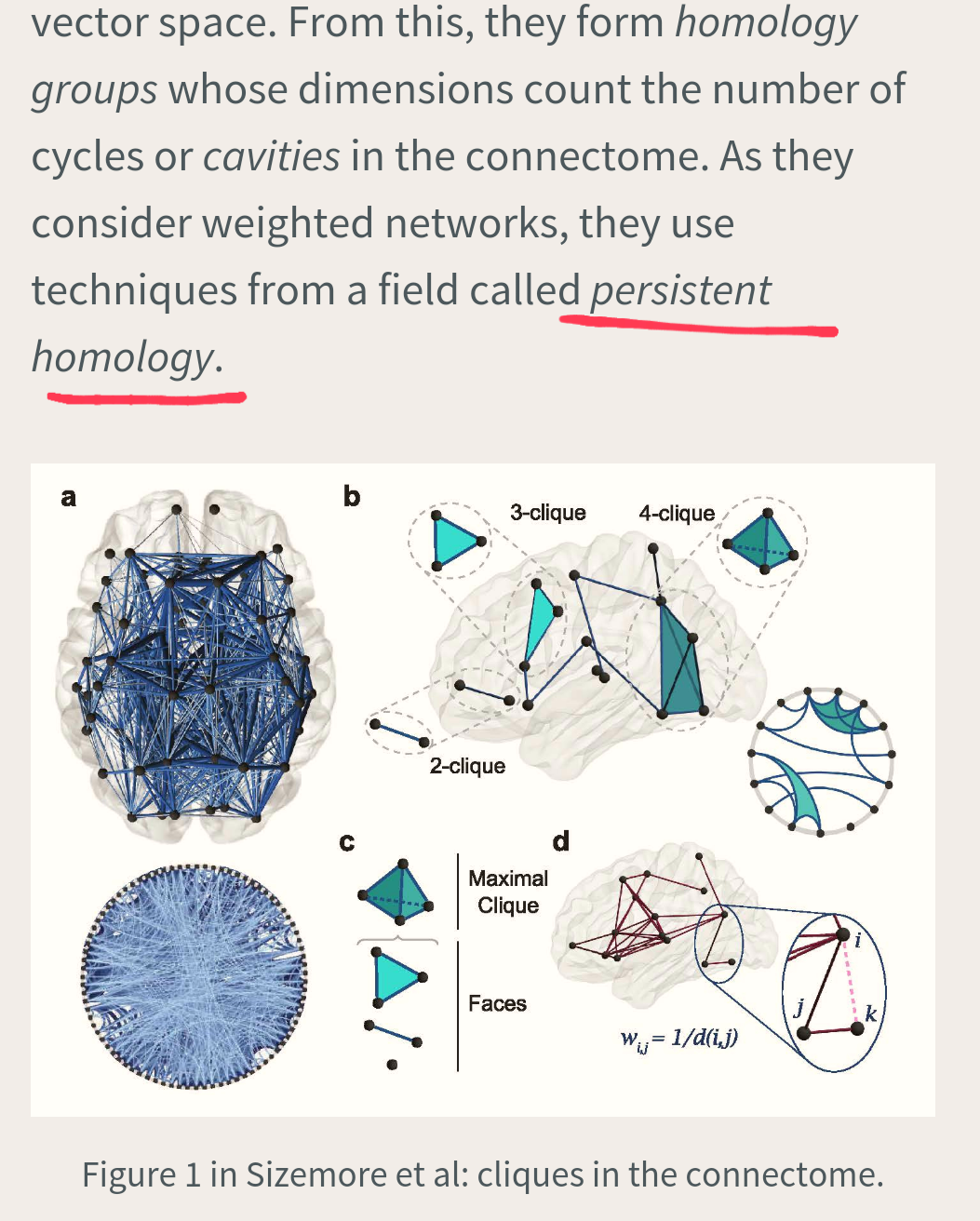
Create your own Homology: (Important lecture in Applied Algebraic Topology)
Linear Algebra
Diagonalizable & Minimal Polynomial:
A matrix or linear map is diagonalizable over the field
Characteristic Polynomial:
Let 


Cayley-Hamilton Theorem:
Every square matrix over a commutative ring satisfies its own characteristic equation:
If 


Euler Characteristicχis an invariant in Topology.
Interesting to note that a tree with no cycle (loop),χ =1
Algebraic Topology Foundation (Lecture 1 to 6). Very easy and helpful to undergrads!

Lecture 3: Modular Arithmetic (easy)https://youtu.be/5YEu-vB2dD8
Lecture 4: Addition and Free Vector Spaceshttps://youtu.be/9qL003DG7Og
Suppose G and H are p-groups, and 
Then for any Sylow p-subgroup P of G, 
Conversely, for any Sylow p-subgroup Q of H, 
Proof:
By the First Isomorphism Theorem, 


Since ![[G:P]](https://s0.wp.com/latex.php?latex=%5BG%3AP%5D&bg=ffffff&fg=1a1a1a&s=0&c=20201002)
![[G:PN]=[G:P]/[PN:P]](https://s0.wp.com/latex.php?latex=%5BG%3APN%5D%3D%5BG%3AP%5D%2F%5BPN%3AP%5D&bg=ffffff&fg=1a1a1a&s=0&c=20201002)
Then ![\displaystyle [H:\phi(P)]=[G/N:PN/N]=[G:PN]](https://s0.wp.com/latex.php?latex=%5Cdisplaystyle+%5BH%3A%5Cphi%28P%29%5D%3D%5BG%2FN%3APN%2FN%5D%3D%5BG%3APN%5D&bg=ffffff&fg=1a1a1a&s=0&c=20201002)

Part 2: Let 


Then, ![[G:K]=[H:Q]](https://s0.wp.com/latex.php?latex=%5BG%3AK%5D%3D%5BH%3AQ%5D&bg=ffffff&fg=1a1a1a&s=0&c=20201002)
Consider 

Interesting news, since it is widely known that physicists are the most mathematically literate out of all the sciences. Perhaps what the research really shows is that huge chunks of equations may obscure the meaning of the research and thus is correspondingly less cited.
Similarly for math, nobody likes to read dry math texts crammed full of equations, theorems, and opaque proofs. Some illustration, explanation and motivation will greatly improve the exposition.
Source: https://www.sciencedaily.com/releases/2016/11/161111132118.htm
Physicists avoid highly mathematical work despite being trained in advanced mathematics, new research suggests.
The study, published in the New Journal of Physics, shows that physicists pay less attention to theories that are crammed with mathematical details. This suggests there are real and widespread barriers to communicating mathematical work, and that this is not because of poor training in mathematical skills, or because there is a social stigma about doing well in mathematics.
Dr Tim Fawcett and Dr Andrew Higginson, from the University of Exeter, found, using statistical analysis of the number of citations to 2000 articles in a leading physics journal, that articles are less likely to be referenced by other physicists if they have lots of mathematical equations on each page.
Dr Higginson said: “We have already showed that biologists are put off by equations but we were surprised by these findings, as physicists are generally skilled in mathematics.
“This is an important issue because it shows there could be a disconnection between mathematical theory and experimental work. This presents a potentially enormous barrier to all kinds of scientific progress.”
The research findings suggest improving the training of science graduates won’t help, because physics students already receive extensive maths training before they graduate. Instead, the researchers think the solution lies in clearer communication of highly technical work, such as taking the time to describe what the equations mean.
The Classe Prépa Math for Grandes Écoles is uniquely French pedagogy – very rigorous based on solid abstract theories.
In this lecture the young French professor demonstrates how to teach students the rigorous Math à la Française:
$latex displaystyle {lim_{ntoinfty} bigl( 1 + frac{1}{n} bigr)^{n} = e}&fg=00bb00&s=3$
This French Classic (8 series lectures) on “Introduction to Modern Maths” made in 1969 is still valid today for Modern Maths students who need to be “initialized” for abstract, rigorous math, different from high-school maths.
Partie 1 : ensembles et parties
Cours math sup, math spé, BCPST.
The French University (engineering) 1st & 2nd year Prépa Math: “Vector Space” (向量空间), aka Linear Algebra (线性代数), used in Google Search Engine. The French treats the subject abstractly, very theoretical, while the USA and UK (except Math majors) are more applied (directly using matrices).
Note: First year French (Engineering) University “Classe Prépa”: Math Sup (superior); 2nd year Math Spéc (special).
Part 2:
Applications Lineaires (Linear Algebra):
This is a sufficient condition for something that resembles “Weak convergence”: 
Suppose that 




Proof:
(Case: 
We may assume 


Let 


Since 




Then for
Since 
(Case: 
Define 


Since 
Thus there exists 


Then for 
so that 
(Show that the result is false if
Let ![f_k:=k\chi_{[0,\frac 1k]}](https://s0.wp.com/latex.php?latex=f_k%3A%3Dk%5Cchi_%7B%5B0%2C%5Cfrac+1k%5D%7D&bg=ffffff&fg=1a1a1a&s=0&c=20201002)


However if 


Correction for the case
Define
Since 
Thus there exists 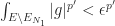
Since 


So for
so that 

![[0,1]](https://s0.wp.com/latex.php?latex=%5B0%2C1%5D&bg=ffffff&fg=1a1a1a&s=0&c=20201002)
Suppose there exists 
![x,y\in [0,1]](https://s0.wp.com/latex.php?latex=x%2Cy%5Cin+%5B0%2C1%5D&bg=ffffff&fg=1a1a1a&s=0&c=20201002)

By Mean Value Theorem, this means that 


However, 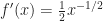
Note however, that 
Let 


Amazing Theorem! If 

It turns out that convergence in Lp implies that the norms converge. Conversely, a.e. convergence and the fact that norms converge implies Lp convergence. Amazing!
Relationship between 
Let 




Proof:
Assume
(Case: 
Lemma 1:
If 

Proof of Lemma 1:
Hence 
End Proof of Lemma 1.
Hence, using 

Thus
Hence
(Case: 
By Minkowski’s inequality, 



Converse:
Assume
Lemma 2:
For 

Proof of Lemma 2:
By convexity of 
Multiplying throughout by 
Thus together with Lemma 1, for 

Note that 




(Show that the converse may fail for
Consider ![f_k=\chi_{[-k,k]}\in L^\infty(\mathbb{R})](https://s0.wp.com/latex.php?latex=f_k%3D%5Cchi_%7B%5B-k%2Ck%5D%7D%5Cin+L%5E%5Cinfty%28%5Cmathbb%7BR%7D%29&bg=ffffff&fg=1a1a1a&s=0&c=20201002)



Source: http://people.com/human-interest/nasa-katherine-johnson-mathematician-advice-interview/
Despite her age, Johnson isn’t slowing down anytime soon.
“I like to learn,” she says. “That’s an art and a science. I’m always interested in learning something new.”
As a young girl she’d stop by the library on her home way in the evening and would pick up a book.
“I finally persuaded them to let me look at two books,” she recalls. “I could have read more than that in one night if they had let me.”
Johnson’s life was the inspiration for a nonfiction book titled Hidden Figures: The American Dream and the Untold Story of the Black Women Mathematicians Who Helped Win the Space Race, which is now being turned into a major motion picture coming due theaters this December. (Empire star Taraji P. Henson will play Johnson.)
Johnson, who was given the Presidential Medal of Freedom by President Barack Obama in 2015, thinks she was able to succeed because she always loved what she did. It’s one piece of advice she has for young girls today.
“Find out what her dream is,” she says, “and work at it because if you like what you’re doing, you will do well.”
Johnson also taught her daughters a few life lessons.
“Don’t accept failure,” says Joylette Goble, who says she has always been in awe of her mother. “If there is a job to be done, you can do it and do it until you finish.”
She adds: “Be aware of people and help them when you can.”
Johnson’s other daughter, Katherine Goble Moore, says her mother has always been her role model.
“I will always be grateful for her,” she says.
Source: http://www.todayonline.com/singapore/youths-viral-video-attack-identified

(Screengrab: Bhai Hafiz Angullia/Facebook)
Just to inform parents of this terrible incident that occurred in Saint Andrew’s Secondary School. Apparently, this is not an isolated incident, it is quite an common occurence, it is even stated in Wikipedia: “After a series of bullying cases attracted attention in 2003, the school stated that the situation at St Andrew’s was no worse than at any other school, adding that bullies receive a stern warning; repeat offenders or those who injure others are caned and, ultimately, expelled.”
Do spread this post and comment on the original facebook page (with video): https://www.facebook.com/bhailaminate/videos/10210995333384134/. Parents who are choosing a secondary school for their child should also take note of this incident.
For this kind of extreme case, there is no need for the school to counsel/discipline the bullies anymore, just send them straight to Boys’ Home is the best thing to do.
#SayNoToBullies

The lower in the score the better : Trump (4.1) beats Hillary (7.7) who beats Sanders (10.1)

Trump defied most expectation from the world to win the 2017 President of the USA. His victory over the much highly educated Ivy-league Yale lawyer-trained Hilary Clinton who speaks sophisticated English is “SIMPLE English”:
1-syllable words mostly: eg.dead, die, point, harm,…
2-syllable words to emphasize: eg.pro-blem, service, root cause, …
3-syllable words to repeat : eg. tre-men-dous

His speech is of Grade-4 level, reaching out to most lower-class blue-collar workers who can resonate with him. That is a powerful political skill of reaching to the mass. Hilary Clinton’s strength of posh English is her ‘fatal’ weakness vis-a-vis connecting to the mass.
In election time, it is common to see candidates who win the heart of voters by using the local dialects of the mass, never mind they are discouraged in…
View original post 6 more words
A survey from the Princeton Election Consortium has found that Hillary Clinton has a 99 per cent chance of winning the election over Donald Trump.
Three days before the election, Ms Clinton has a projected 312 electoral votes, compared to 226 for Mr Trump. A total of 270 electoral votes are needed to win.
The probability statistic was found by the university’s statistical Bayesian model.
The developer of the model, neuro and data scientist Princeton professor Sam Wang, correctly predicted 49 out of 50 states in 2012.
Let 


(We may take 
1. Statistical Mechanics: $latex e^ {- Ht} $
Quantum Mechanics: $latex e^{iHt}$
2. Ramanujian:
$latex 1 +2 + 3 + …+ n = -frac {1}{12} $
Tau Special Function:
$latex boxed {displaystyle sum_{n=1}^{infty}tau (n) x^{n} = x {(1-x)(1-x^{2})(1-x^{3})… }^{24}}$
3. Boolean Algebra: George Boole (1847 in 《The Mathematical Analysis of Logic》) used Symbolic variables (not numbers) for Logic, inspired by Galois (1832 in Groups & Finite Fields), Hamilton’s quaternion algebra (1843),
“AND” $latex boxed {x.y}&fg=00bb00&s=3$
“NOT” $latex boxed {1-x}&fg=00bb00&s=3$
“XOR” $latex boxed {x+y-2x.y}&fg=00bb00&s=3$
“Extra constraints ” $latex boxed {x^{2}=x}&fg=00bb00&s=3$
4. Solomon Golomb, Sol: “Linear Feedback Shift Register” (LFSR) – shift left the first register, fill in the back register with XOR of certain “Taps” (eg.chosen the 1st, 6th, 7th registers)
Maximal Length = The shift register of size n will repeat every $latex 2^{n}-1$ steps (exclude all ‘0’ sequence).
Which arrangement…
View original post 60 more words
Source: http://www.attn.com/stories/6407/george-takei-impersonates-donald-trump
Question: What is 2+2?
Answer:
“I have to say a lot of people have been asking this question. No, really. A lot of people come up to me and they ask me. They say, ‘What’s 2+2’? And I tell them look, we know what 2+2 is. We’ve had almost eight years of the worst kind of math you can imagine. Oh my God, I can’t believe it. Addition and subtraction of the 1s the 2s and the 3s. It’s terrible. It’s just terrible. Look, if you want to know what 2+2 is, do you want to know what 2+2 is? I’ll tell you. First of all the number 2, by the way, I love the number 2. It’s probably my favorite number, no it is my favorite number. You know what, it’s probably more like the number two but with a lot of zeros behind it. A lot. If I’m being honest, I mean, if I’m being honest. I like a lot of zeros. Except for Marco Rubio, now he’s a zero that I don’t like. Though, I probably shouldn’t say that. He’s a nice guy but he’s like, ‘10101000101,’ on and on, like that. He’s like a computer! You know what I mean? He’s like a computer. I don’t know. I mean, you know. So, we have all these numbers, and we can add them and subtract them and add them. TIMES them even. Did you know that? We can times them OR divide them, they don’t tell you that, and I’ll tell you, no one is better at the order of operations than me. You wouldn’t believe it. So, we’re gonna be the best on 2+2, believe me.”
Credit: Original Author Steven Edwards.
Here are some solutions to exercises in the book: Measure and Integral, An Introduction to Real Analysis by Richard L. Wheeden and Antoni Zygmund.
Chapter 1,2: analysis1
Chapter 3: analysis2
Chapter 4, 5: analysis3
Chapter 5,6: analysis4
Chapter 6,7: analysis5
Chapter 8: analysis6
Chapter 9: analysis7
Other than this book by Wheedon, also check out other highly recommended undergraduate/graduate math books.
Graduating soon and interested to transition to data science (dubbed the sexiest job of the 21st century)? We recommend two books which are very suitable for students with strong math background, but little or no background in data science/ machine learning.
Do check out the following data science / machine learning book (rated 4.5/5 on Amazon) Pattern Recognition and Machine Learning (Information Science and Statistics)
The above book is good for building a solid, theoretical foundation for a data scientist job. The next book Hands-On Machine Learning with Scikit-Learn, Keras, and TensorFlow: Concepts, Tools, and Techniques to Build Intelligent Systems
Do you know how to prove sin(1/x)/x is not Lebesgue Integrable on (0,1]?
Also check out other popular Measure Theory exam question topics here:
 (Free!)
Your free, 30-day trial comes with:
The following is a wonderful property of the Lebesgue Integral, also known as absolute continuity of Lebesgue Integral. Basically, it means that whenever the domain of integration has small enough measure, then the integral will be arbitrarily small.
Suppose
Given 


Proof:
Define 


Let 


Let 

Let 
The U.S. has some of the best universities in Math (think Harvard, Princeton, MIT), however the state of high school math is subpar and well below other developed nations. The main reason, according to this article, is the curriculum that focuses more on memorization and rote learning rather than understanding.
This book by Jo Boaler (Stanford Professor) sums up what can be done by parents to improve their child’s mathematical skills.
Another way is to consider studying Singapore Math, as Singapore is well known for being good at high school / elementary school math.
Source: https://www.scientificamerican.com/article/why-math-education-in-the-u-s-doesn-t-add-up/
Excerpt:
In December the Program for International Student Assessment (PISA) will announce the latest results from the tests it administers every three years to hundreds of thousands of 15-year-olds around the world. In the last round, the U.S. posted average scores in reading and science but performed well below other developed nations in math, ranking 36 out of 65 countries.
We do not expect this year’s results to be much different. Our nation’s scores have been consistently lackluster. Fortunately, though, the 2012 exam collected a unique set of data on how the world’s students think about math. The insights from that study, combined with important new findings in brain science, reveal a clear strategy to help the U.S. catch up.
The PISA 2012 assessment questioned not only students’ knowledge of mathematics but also their approach to the subject, and their responses reflected three distinct learning styles. Some students relied predominantly on memorization. They indicated that they grasp new topics in math by repeating problems over and over and trying to learn methods “by heart.” Other students tackled new concepts more thoughtfully, saying they tried to relate them to those they already had mastered. A third group followed a so-called self-monitoring approach: they routinely evaluated their own understanding and focused their attention on concepts they had not yet learned.
In every country, the memorizers turned out to be the lowest achievers, and countries with high numbers of them—the U.S. was in the top third—also had the highest proportion of teens doing poorly on the PISA math assessment. Further analysis showed that memorizers were approximately half a year behind students who used relational and self-monitoring strategies. In no country were memorizers in the highest-achieving group, and in some high-achieving economies, the differences between memorizers and other students were substantial. In France and Japan, for example, pupils who combined self-monitoring and relational strategies outscored students using memorization by more than a year’s worth of schooling.
Inspirational Story of Lifelong learner Wei Sihao, who loves books and learning. After retirement, his favorite spot is the library, and he collects garbage to fund students who can’t afford university. Passed away in 2015 in a car accident. Rest in peace. (Text in Chinese)
之前,一则《杭州图书馆向流浪汉开放,拾荒者借阅前自发洗手》的新闻在网络上迅速传播。
http://js.ifeng.com/humanity/cul/detail_2014_11/24/3194502_0.shtml
而报道中的图片可以看到一位拾荒老人


安静地读书,认真地洗手。
后来,这位老人的真正身份才得以曝光:
韦思浩是原杭州大学(现浙江大学)1957级的学生。
上世纪80年代,韦思浩曾参与过《汉语大词典》杭大编写组工作,后又辗转去宁波教书。
1999年,韦思浩从杭州夏衍中学退休,也是从那一年,韦思浩放弃了他本来轻松的晚年生活,开始他长达十多年的“拾荒”之旅。
2015年11月18日,韦思浩在过马路的时候,被一辆出租车撞倒,12月13日,最终抢救无效离世。
韦思浩是原杭州大学(现浙江大学)1957级的学生。
上世纪80年代,韦思浩曾参与过《汉语大词典》杭大编写组工作,后又辗转去宁波教书。
1999年,韦思浩从杭州夏衍中学退休,也是从那一年,韦思浩放弃了他本来轻松的晚年生活,开始他长达十多年的“拾荒”之旅。
2015年11月18日,韦思浩在过马路的时候,被一辆出租车撞倒,12月13日,最终抢救无效离世。
相关新闻编辑
2014年11月,《杭州图书馆向流浪汉开放,拾荒者“看书前”自发洗手》,曾引起很多人关注。
2014年,因给拾荒者提供阅读空间,杭州图书馆被网友评为“最温暖图书馆”。当时,媒体报道中,一位外貌看似拾荒者的老人因“看书前洗手”的细节感动了不少网友。这位老人名叫韦思浩,是上世纪六十年代老杭州大学中文系的毕业生。
韦思浩老人退休前是中学的一级教师,退休后拿着5600多元的退休金,本可安心养老,但他却选择拾荒“补贴”日子。不过,他“补贴”不是自家生活,而是那些读不起书的孩子们。
2015年11月18日晚上六点,杭州下雨,老人打着一把伞,跟往常拾荒者打扮一样,一根竹竿挑着两个口袋,但就在过斑马线时,被一辆出租车撞上,当场昏迷,被紧急送往附近医院。
老人在重症监护室治疗了二十多天,一直处于深度昏迷。12月13号,虽然经过医院极力抢救,但老人多个器官衰竭,仍然没能挽回生命。[2]
在整理老人遗物时,韦思浩的三个女儿才发现老人拾荒的秘密。
“以前从不知道父亲在拾荒,更没想到他还在帮助其他人。”韦思浩二女儿韦汀坦言,“去年搬过一次家,捐资助学的票据和证书已经不全。但留下来的这些就能看出他一直在匿名捐赠。”
韦汀向记者展示这些捐赠凭据和证书:浙江省社会团体收费专用票据、浙江省希望工程结对救助报名卡、扶贫公益助学金证书……
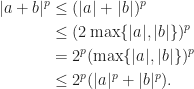
There are some useful inequalities for 
1)
For 
Proof:
2)
If
Proof:
Hence
3)
For
Proof:
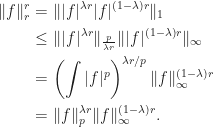
By convexity of
Multiplying throughout by
![\begin{aligned} [F:K]&=[F:K(u)][K(u):K]\\ &\leq (n-1)!(\deg g)\\ &\leq n! \end{aligned}](https://s0.wp.com/latex.php?latex=%5Cbegin%7Baligned%7D++%5BF%3AK%5D%26%3D%5BF%3AK%28u%29%5D%5BK%28u%29%3AK%5D%5C%5C++%26%5Cleq+%28n-1%29%21%28%5Cdeg+g%29%5C%5C++%26%5Cleq+n%21++%5Cend%7Baligned%7D&bg=ffffff&fg=1a1a1a&s=0&c=20201002)



![\displaystyle |G/K|=[G:K]=[G:H][H:K]=p[H:K]\geq p.](https://s0.wp.com/latex.php?latex=%5Cdisplaystyle+%7CG%2FK%7C%3D%5BG%3AK%5D%3D%5BG%3AH%5D%5BH%3AK%5D%3Dp%5BH%3AK%5D%5Cgeq+p.&bg=ffffff&fg=1a1a1a&s=0&c=20201002)