
How to Start a Math Education Blog on WordPress.com: A Practical Walkthrough for Tutors and Teachers
Affiliate disclosure: This article contains affiliate links to WordPress.com. If you sign up through my link, I may receive a commission at no extra cost to you. I only recommend platforms that I have personally tested and that I think may be useful for educators, tutors, bloggers, and small website owners.
Introduction: Why Start a Math Education Blog?
A mathematics blog can be a very useful long-term project.
For a tutor, it can show teaching ability and help parents understand your approach. For a teacher, it can become a place to share notes, reflections, and resources. For a student, it can become a learning portfolio. For an education blogger, it can become a library of explanations that continues helping readers over time.
Mathematics is especially suitable for blogging because many topics are evergreen. A good explanation of fractions, algebra, geometry, probability, calculus, or statistics can remain useful for years.
The difficulty is not usually the idea. Many educators already have plenty of things to write about. The difficulty is starting the website and maintaining it consistently.
That is why I tested WordPress.com from the perspective of someone building a simple education blog. I wanted to see whether a tutor or teacher could use it to create a clear, useful, and professional website without spending too much time on technical setup.
This article is a practical walkthrough. It is not only a general review. I will explain how I would set up a mathematics education blog on WordPress.com, what pages I would create, how I would organize the content, and what trade-offs to consider.
Step 1: Decide the Purpose of the Blog
Before choosing a design or writing the first post, it is important to decide what the blog is for.
A math education blog can have different purposes. It may be:
- A tuition website
- A mathematics resource library
- A teacher’s reflection blog
- A student learning portfolio
- A parent guidance site
- A collection of exam tips
- A personal academic website
The purpose affects the structure.
For example, a tutor’s website should probably have a homepage, About page, contact page, and blog. A student portfolio may need project pages and learning reflections. A teacher’s blog may focus more on resources and classroom ideas.
For Mathtuition88.com-style content, the purpose is educational publishing. The goal is to share useful mathematics and learning content with students, parents, and readers interested in education.
When I tested WordPress.com, I found it helpful to think of the website as a simple learning hub rather than a complicated business system.
The site does not need to do everything at the start. It only needs a clear beginning.
Step 2: Start with a Simple Site Structure
One common mistake is trying to build too many pages immediately.
For an education blog, I would start with five basic sections:
- Homepage
- Blog
- About
- Resources
- Contact
This is enough for most tutors and teachers at the beginning.
The homepage introduces the site and guides readers to the main content.
The blog contains articles and updates.
The About page explains who is behind the site and why readers should trust the content.
The Resources page collects useful links, notes, worksheets, book recommendations, or important posts.
The Contact page allows readers, parents, students, or collaborators to reach out.
Inside WordPress.com, this type of structure is straightforward to create. Pages and posts are separated clearly. Pages are better for stable information, while posts are better for articles.
This distinction is important for education sites.
For example, “About Dr William Wu” should be a page. “How to Avoid Careless Mistakes in Algebra” should be a post.
Step 3: Build a Clear Homepage
The homepage should not be too complicated.
For an education website, clarity is more important than decoration. A visitor should quickly understand what the site offers.
A good homepage for a math education blog can include:
- A short introduction
- The main topics covered
- Links to recent articles
- A short author bio
- A link to resources
- A contact button
When using WordPress.com, the block editor makes it possible to build this page section by section.
For example, the first section can introduce the site:
“Mathtuition88.com shares mathematics explanations, learning resources, exam tips, and reflections on education.”
Then the next section can list the main topics:
- Mathematics explanations
- Study tips
- Exam preparation
- Education technology
- Learning reflections
This kind of homepage is simple but effective.
I would avoid adding too many moving parts. For a student or parent, the site should feel calm and trustworthy. A cluttered homepage may make the site look less serious.
Step 4: Create an About Page That Builds Trust
The About page is very important for education websites.
When readers visit a mathematics or tuition-related site, they want to know who is writing the content. This is especially true for parents and students.
A good About page should include:
- Your name
- Your educational background
- Your teaching or subject experience
- The purpose of the website
- The kind of readers the site is for
- A realistic statement of your teaching philosophy
For example, for Mathtuition88.com, it is relevant to mention my mathematics background, PhD training, teaching experience, and interest in education and technology.
However, the tone should not be arrogant. In education, credibility matters, but humility also matters. A good About page should make readers feel that the author is knowledgeable and sincere.
WordPress.com makes it easy to create this kind of static page. The editor is enough for writing a clean biography, adding sections, and linking to relevant parts of the site.
Step 5: Write the First Educational Blog Post
After the homepage and About page, the most important step is writing the first useful article.
Many people spend too long adjusting design before publishing any content. For an education blog, content is the real value.
A good first post should be specific. Avoid writing something too broad, such as “How to Be Good at Math.” That topic is too general.
Better first-post ideas include:
- Why students make careless mistakes in algebra
- How to revise mathematics effectively before an exam
- Three common mistakes in solving quadratic equations
- Why understanding is better than memorizing formulas
- How to approach difficult word problems
- What students should do after getting a math question wrong
These topics are concrete and useful.
Inside WordPress.com, the post editor is suitable for this type of writing. You can use headings to organize the article, lists to show steps, and images if you want to include diagrams or handwritten working.
For example, an article about careless mistakes could use this structure:
- Introduction
- Mistake 1: Not checking signs
- Mistake 2: Skipping steps mentally
- Mistake 3: Copying the question wrongly
- How to reduce mistakes
- Final advice
This kind of structure is easy to create in WordPress.com.
Step 6: Use Categories Carefully
Categories are important for long-term organization.
When a blog is new, categories may not seem important. But after you have written 50 or 100 articles, poor organization becomes a problem.
For a mathematics education blog, I would begin with broad categories such as:
- Algebra
- Geometry
- Calculus
- Statistics
- Exam Tips
- Study Skills
- Education Reflections
Do not create too many categories too early. It is better to start simple.
Tags can be more specific. For example, a post in the Algebra category can have tags such as quadratic equations, factorisation, simultaneous equations, or careless mistakes.
WordPress.com supports both categories and tags, which is useful for education content. Students may search by topic, while parents may browse by theme.
A clean category structure also helps the site feel more professional.
Step 7: Add a Resources Page
A Resources page is especially useful for an education website.
This page can collect the most helpful materials in one place. It can include:
- Recommended articles
- Topic guides
- Revision tips
- Free worksheets
- Useful books
- External educational links
- Study planning advice
For a math education blog, the Resources page can become a starting point for new readers.
Instead of asking readers to search through all blog posts, you can guide them to the most useful content.
For example, a Resources page could include sections such as:
- Algebra resources
- Calculus resources
- Exam preparation
- Study habits
- Parent guides
Inside WordPress.com, this is easy to build with headings, lists, links, and short descriptions.
The Resources page does not need to be complete from day one. It can grow over time.
Step 8: Think About the Reader
A good education blog should always think about the reader.
For a mathematics site, there may be several types of readers:
- Students who need help with concepts
- Parents who want guidance
- Teachers looking for ideas
- Tutors comparing approaches
- Lifelong learners interested in mathematics
- Students building confidence after struggling
Each reader has different needs.
A student may want a clear example. A parent may want reassurance and practical advice. A teacher may want deeper reflection. A tutor may want teaching strategies.
This affects writing style.
For Mathtuition88.com, I would keep the tone clear, patient, and practical. Mathematics can already feel intimidating to many students. The writing should reduce confusion, not increase it.
WordPress.com helps by giving a clean publishing environment, but the author still needs to write with the reader in mind.
Step 9: Keep the Design Simple
Education websites do not need excessive design.
A good design should make reading easier. It should not compete with the content.
For a math blog, I would prioritize:
- Clear fonts
- Good spacing
- Simple navigation
- Mobile readability
- Fast access to articles
- Easy-to-find About and Contact pages
WordPress.com themes and editor tools make it possible to create a clean site without hiring a designer. The main point is to avoid overcomplication.
For mathematics content, readability is especially important. Long paragraphs can be tiring. Headings, examples, and short sections help readers stay focused.
Students often visit educational sites when they are already confused. A messy website makes the problem worse.
A clean design supports learning.
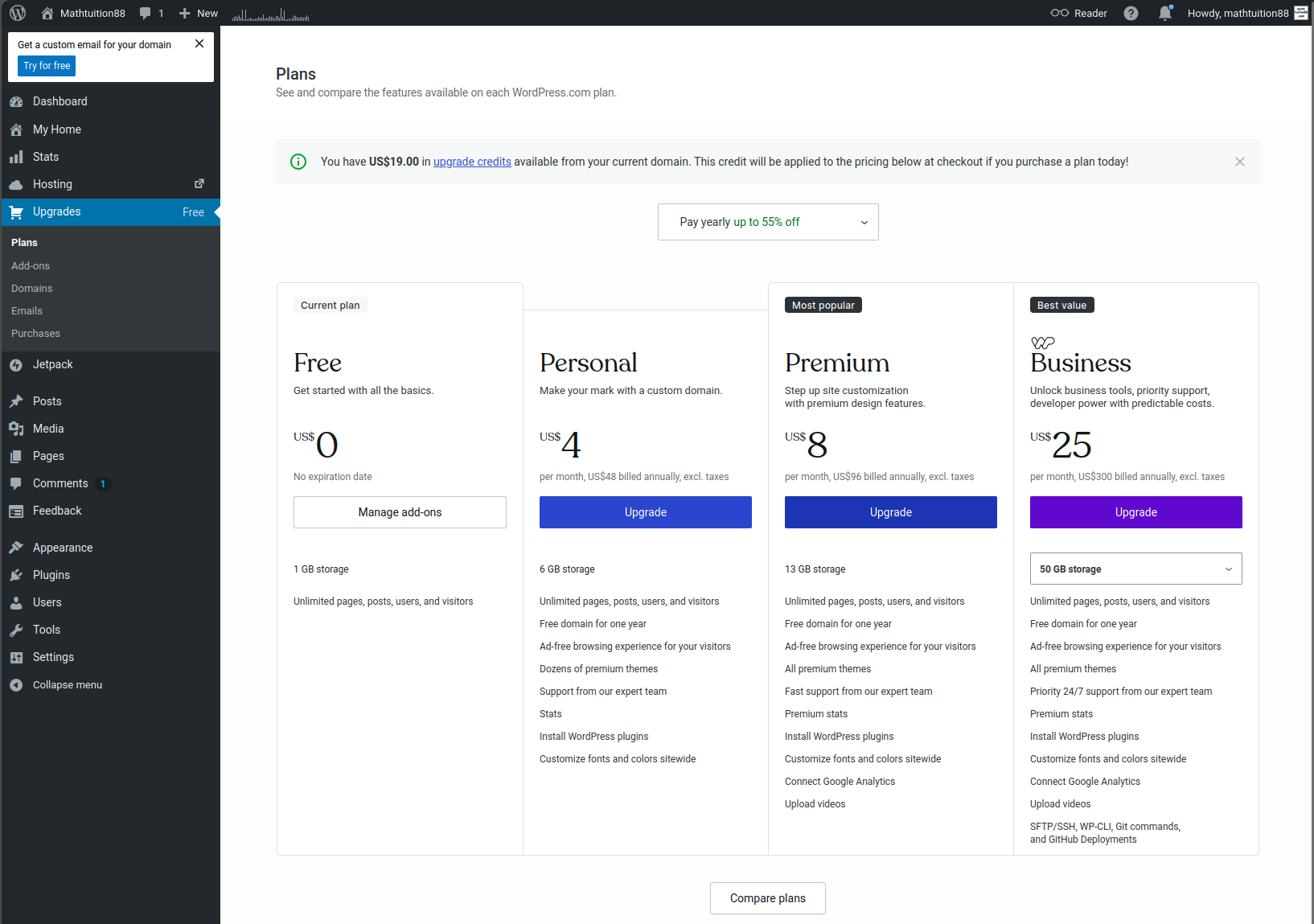
Step 10: Understand the Pricing
According to the campaign brief, the current WordPress.com pricing is:
- Personal: $9/month monthly or $4/month annually
- Premium: $18/month monthly or $8/month annually
- Business: $25/month monthly or $25/month annually
- Commerce: $45/month monthly or $45/month annually
For a simple education blog, I would first consider the Personal plan.
The Personal plan is suitable if you mainly want a custom domain and a professional place to publish articles.
The Premium plan may be useful if you want more design options, monetization features, or a more polished website.
The Business plan may become relevant if the site grows and needs more advanced features.
The Commerce plan is mainly for selling products or services online. A tutor or education blogger may not need this at the beginning unless the site is used to sell courses, worksheets, books, or digital products.
My advice is to choose based on actual needs. A beginning education blog does not need to start with the most expensive plan.
What I Liked About Using WordPress.com
The main thing I liked is that WordPress.com lowers the barrier to publishing.
This is important because many educators have useful knowledge but never turn it into a website. The technical setup becomes a blocker.
WordPress.com helps by handling hosting, updates, and security, so the website owner can focus more on the site itself.
I also liked that posts and pages are organized clearly. For an education blog, this matters because content grows over time.
The editor is also practical for educational writing. Headings, lists, images, and tables are enough for many articles.
Another strength is that the platform suits both beginners and serious bloggers. You can start with a simple site and improve it gradually.
For education, that is often the best approach. Start small, publish consistently, and improve the structure over time.
Limitations and Trade-Offs
WordPress.com is not perfect.
The first limitation is that it is more managed than self-hosted WordPress.org. This is good for simplicity, but users who want full technical control may prefer WordPress.org.
The second limitation is that the editor takes some time to learn. It is easier than building a site manually, but beginners still need to understand blocks, pages, posts, menus, categories, and settings.
The third limitation is that more complex education businesses should check features carefully. A simple blog is easy. A full online learning platform with student logins, memberships, payment systems, or course management may require more advanced planning.
The fourth limitation is that WordPress.com can help you build the site, but it cannot replace the educational quality of the writing. The platform is only the tool. The real value still comes from clear explanations and genuine teaching insight.
A Practical Publishing Plan
For someone starting a math education blog, I would suggest a simple first-month plan.
In the first week, create the homepage, About page, and Contact page.
In the second week, publish two useful articles.
In the third week, create a Resources page and organize your categories.
In the fourth week, publish two more articles and improve internal links between related posts.
This is enough to create momentum.
Do not wait until the website is perfect. Education blogs become valuable through consistent publishing.
A simple site with ten useful articles is better than a beautiful site with no content.
Example Article Ideas for a Math Blog
Here are some topics that would fit a mathematics education blog:
- How to avoid careless mistakes in mathematics
- Why algebra is difficult for many students
- How to revise for mathematics exams
- The difference between understanding and memorizing
- How to use worked examples properly
- Why students should write full solutions
- Common mistakes in differentiation
- How to approach probability questions
- What parents should know about math tuition
- How to build confidence in mathematics
These topics are useful because they come from real educational problems.
A good education blog should not only chase keywords. It should answer real questions from students and parents.
Why Blogging Still Matters in Education
Some people may wonder whether blogging is still useful when social media and short videos are so popular.
I think blogging still matters, especially for education.
A short video can introduce an idea quickly, but a blog post can explain it carefully. A blog post can be searched, bookmarked, linked, updated, and organized.
For mathematics, written explanations are still very powerful. Students can read at their own pace, review steps, and return to the article later.
A blog also gives the educator more control. Social media platforms change their algorithms often. A website is a more stable long-term asset.
WordPress.com is useful because it gives educators a practical way to build that asset without too much technical burden.
Final Verdict
Starting a math education blog does not need to be complicated.
The most important things are clear purpose, useful content, good organization, and consistent publishing.
WordPress.com supports these goals well. It handles much of the technical side, gives you a proper publishing system, and allows you to create pages, posts, categories, and resources in a structured way.
For tutors, teachers, students, and education bloggers, I think WordPress.com is a strong option if the goal is to build a simple and trustworthy education website.
It may not be the best choice for users who want full technical control or complex custom systems. But for a practical education blog, it does the job well.
My main takeaway is this:
A good education blog should make learning clearer. A good website platform should make publishing easier. WordPress.com helps with the second part, so educators can focus more on the first.
Author Bio
William is the founder of Mathtuition88.com, an education and mathematics blog that shares mathematics explanations, learning resources, exam-related content, and reflections on learning. He has experience in teaching, mathematical research, and technical blogging.


