
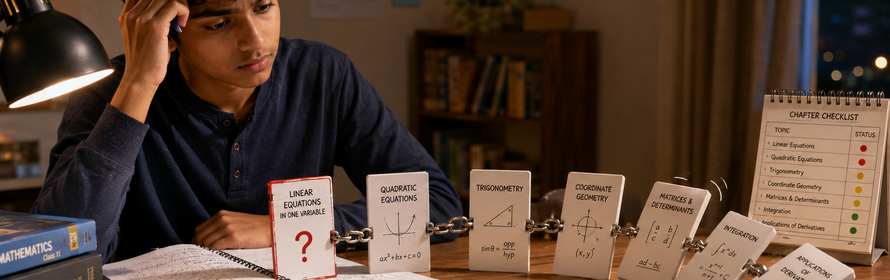
There’s a specific kind of exam failure that has nothing to do with effort. The student studied. They sat at a desk for hours. They covered chapters. But somewhere in the middle of Chapter 6 or Unit 3, they got stuck on a concept and kept going anyway. Then they got stuck again. And again. By the time the exam arrives, they’re not writing answers. They’re writing around gaps.
Doubt Debt: Unresolved conceptual gaps in earlier chapters that undermine understanding and performance in dependent chapters, creating a compounding knowledge deficit.
According to the revised CBSE curriculum framework from 2020 onwards, competency-based questions have increased from 20% to over 40% of board exam content. This requires students to apply concepts dynamically rather than recall them from memory. This macro shift means hidden gaps in your foundational understanding are guaranteed to be exposed on the actual board paper.
This is what I call Doubt Debt and it’s one of the most under-discussed reasons students underperform in mathematics despite genuine preparation. When a student skips over a doubt, they aren’t just leaving one question behind—they are undermining the foundation of the next three chapters. Utilizing Edzy – an AI math tutor for CBSE, solves this bottleneck by dynamically identifying and explaining the exact logic between consecutive problem steps before frustration causes momentum to collapse entirely.
WHY A SINGLE UNRESOLVED DOUBT IN CBSE MATHS CAN COST YOU AN ENTIRE UNIT
In most subjects, doubt is a contained problem. You missed a historical date, you’ll fill it in later. But mathematics is a dependency chain. Coordinate geometry depends on your understanding of linear equations. Trigonometry applications require fluency in basic ratio relationships. In Class 12, integration collapses entirely if differentiation isn’t internalized and Matrices questions have consistently appeared in CBSE board papers in formats that assume Chapter 3 (Matrices) and Chapter 4 (Determinants) are both clean before you touch either.
When a student skips over a doubt in one chapter and proceeds to the next, they’re not just missing one concept, they’re building a structure on a cracked foundation. This is why a student can put in three weeks of sincere study and still score poorly. The work was real. The foundation wasn’t.
The CBSE Class 10 and Class 12 Mathematics syllabi are particularly vulnerable to this pattern. CBSE’s assessment design, revised progressively from 2020 onward, increased the share of case-based and source-based integrated questions multi-step problems that require holding three or four concepts simultaneously. In Class 10, a single case-based question on Triangles or Probability can pull from two or three sub-topics at once. In Class 12, application problems in Integrals regularly require students to correctly identify the method (substitution, by parts, partial fractions) before attempting any calculation. A doubt in one underlying concept doesn’t cost you that question. It costs you the entire problem set built around it.
THE SELF-STUDY DOUBT TRAP: WHY STUDENTS KEEP MOVING FORWARD
A student is working through Quadratic Equations. They understand the factorisation method but get confused on the completing-the-square derivation specifically, why you add and subtract the same term. They can’t resolve it in ten minutes, so they move on.
Two days later, they’re in Arithmetic Progressions. But the algebraic manipulation required there isolating variables, recognising equivalent expressions is the same muscle they never built in Quadratics. The confusion spreads silently.
The trap: there’s no one to ask, and no structured moment to ask it. School teachers move at syllabus pace. Doubt-clearing sessions, where they exist, favour the student who already knows what they don’t know. Most students in the middle of a conceptual muddle can’t even frame the question clearly enough to search for an answer.
THE DOUBT AUDIT: HOW TO MAP YOUR KNOWLEDGE GAPS
Before revising any chapter, run a Doubt Audit a three-step process that takes fifteen minutes and prevents hours of confused re-reading:
Step 1: List every sub-topic in the chapter from the index or chapter summary. Not from memory.
Step 2: Traffic-light each one
- Green: I can solve a problem on this without help
- Yellow: I understand it but can’t reliably apply it under time pressure
- Red: I am not sure what this actually means
Step 3: Resolve every Red before attempting any practice questions. Not after. Before.
The Reds are your Doubt Debt. Every practice question attempted while carrying Red items builds incorrect intuition; you’ll develop workarounds that fail the moment exam pressure removes the option of skipping.
“The goal of revision isn’t to cover content, it’s to close gaps. Covering and closing are not the same thing, and confusing them is how students finish the syllabus and still fail the exam.”
WHAT CLEARING DOUBTS ACTUALLY REQUIRES
The challenge is execution. Identifying your Reds is straightforward once you have the habit. Resolving them is where most students get stuck, because the standard options are slow or unreliable.
Textbook re-reading rarely resolves a doubt; it usually re-presents the same explanation that didn’t work the first time. Searching online for concept explanations returns wildly inconsistent results: some sources are accurate, many aren’t, and almost none are calibrated to the specific curriculum the student is studying.
Instead of relying on static solution books where students passively copy answers, real learning happens through interactive error isolation. Working through Edzy’s step derivation tool, an intelligent CBSE math solver, allows students to test their analytical accuracy, ensuring their foundational calculation layers are entirely clean before the exam even begins. The tool lets students submit a specific doubt like “why does completing the square work algebraically” and returns an explanation scoped to CBSE board exam depth. A generic explanation of completing the square may be mathematically correct but pitched at the wrong level. Edzy’s explanations match board-level expectations: the depth is right, the notation is right, and the worked example looks like what will appear in the paper.
Where Edzy goes further is in connecting doubt resolution to chapter-wise practice. Once a student clears a Red concept, Edzy surfaces practice questions for that specific sub-topic not the whole chapter so the student can immediately verify the doubt is actually gone, not just understood in theory. Many students feel a concept is resolved after reading an explanation, then discover in practice they cannot execute it under time pressure. The practice layer closes that gap before it becomes exam-day panic.
Students use Edzy as a real-time doubt resolver integrated into their revision not a replacement for study, but a check on whether comprehension is real.
HOW TO BUILD THE DOUBT-CLEARING HABIT INTO YOUR CBSE REVISION CYCLE
The most effective CBSE maths revision structure isn’t three hours of continuous practice. It’s a cycle:
- Concept check (20 min): Run the Doubt Audit list every sub-topic, traffic-light each one
- Doubt resolution (15–30 min): Clear every Red before touching the practice set. Use Edzy here, faster than re-reading the textbook, and scoped to what the CBSE board paper actually tests, not a general-purpose explanation
- Chapter-wise practice (45 min): Work in ascending difficulty standard questions first, then case-based and application problems that now account for a significant share of CBSE Class 10 and Class 12 board marks
- Error review (15 min): Classify each wrong answer: concept gap (Red back to doubt resolution), calculation slip, or reading error. Only concept gaps go back to doubt resolution; the others are process issues
This cycle keeps CBSE maths preparation honest. It stops the most common self-study failure: practising on top of unresolved confusion, which produces false confidence and real exam trouble.
WHY CBSE STUDENTS WHO “FINISH THE SYLLABUS” STILL FAIL THE BOARD PAPER
Here is a direct answer to one of the most searched questions among Class 10 and Class 12 students in the weeks before boards:
Why do I understand every chapter but still get stuck on CBSE board exam questions?
Because CBSE board questions do not test chapters, they test your ability to reach into multiple chapters simultaneously, select the right concept, and execute under time pressure, in a context that often looks nothing like the textbook examples. A student who has cleared every doubt chapter-by-chapter can still fail this test if they’ve only ever practised in chapter-isolated mode. The final four to six weeks before CBSE boards must include previous years’ question papers and cross-chapter problems topics like Real Numbers, Triangles, and Probability in Class 10, or Calculus and Vectors in Class 12, rarely appear in isolation on the actual paper.
Doubt-clearing is the prerequisite for every hour of practice to count. Cross-chapter application is the actual exam skill. Most students reverse this order and wonder why the studying didn’t work.
FREQUENTLY ASKED QUESTIONS
Q1. What is Doubt Debt? Doubt Debt refers to the accumulation of unresolved conceptual gaps in earlier mathematical topics. Because math is an absolute dependency chain, these hidden gaps compound over time, undermining your ability to understand subsequent chapters and sinking exam performance.
Q2. How much does one unresolved doubt actually affect your score? In a subject like CBSE Mathematics, a single unresolved gap can wipe out your score for an entire high-weightage unit. For example, a hidden misunderstanding in basic differentiation will completely prevent you from solving problems in applications of derivatives and integration.
Q3. Should I do the Doubt Audit on every single chapter? Yes. The Doubt Audit should be performed on every chapter before you begin solving mock papers or previous years’ questions (PYQs). Doing this ensures you are spending your valuable study hours fixing actual conceptual vulnerabilities rather than mindlessly repeating areas you already know.
Q4. How long does doubt resolution take using interactive tools? Using targeted engines like Stepzy, doubt resolution is immediate. Rather than waiting for the next tuition class or classroom session, a student can isolate a broken equation step and receive a structured, NCERT-mapped conceptual breakdown in under a minute.
Q5. Is the Doubt Audit better than just practicing more questions? Absolutely. Practicing questions on top of unresolved doubts is highly counterproductive. It hard-codes structural mistakes and logical errors into your routine. The Doubt Audit ensures that every hour of practice actually reinforces accurate problem-solving frameworks.


