This is an amazing identity by Abel.
Let and
be two sequences. Then,
This is an amazing identity by Abel.
Let and
be two sequences. Then,
Preparing for your H2 Maths Promo Exams?
Check out this package consisting of Practice Papers (from Actual School Questions), and also a H2 Formula Helpsheet consisting of helpful formula that you need to know in order to do the questions!
URL: Check out out Free Exam Papers page for more updated information on H2 Math Exam Papers.
11 Practice Papers, with Solutions
New Syllabus* (2017 Syllabus / Syllabus 9758)
H2 Helpsheet with formulae ranging from Pure Math to Statistics
*We have crossed out irrelevant questions from the old syllabus, and replaced them with relevant questions from the new syllabus.
Update: Check out the best H2 guidebooks available in the market! Much better than many “elite school” notes which cover too much irrelevant stuff that are not tested!
Consider .
Note that , and
Thus , and
is improper Riemann integrable.
However note that
which diverges as (harmonic series).
Thus is not Lebesgue integrable on
.
If satisfies
on
and
, then
and
.
Let be any subsequence of
. Then
on
. Thus there is a subsequence
a.e.\ in
. Clearly
.
By the usual Lebesgue’s DCT, and
.
Since every subsequence of has a further subsequence that converges to
, we have
.
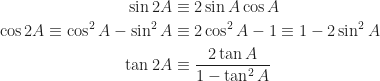
The following formulae will be useful when integrating Trigonometric functions. Taken from the MF15 formula sheet for JC.
Remark: The second identity is useful for integrating and
.
Remark: The factor formulae are useful for integrating ,
, etc.
A very famous mathematical problem known as the “Basel Problem” is solved by Euler in 1734. Basically, it asks for the exact value of .
Three hundred years ago, this was considered a very hard problem and even famous mathematicians of the time like Leibniz, De Moivre, and the Bernoullis could not solve it.
Euler showed (using another method different from ours) that bringing him great fame among the mathematical community. It is a beautiful equation; it is surprising that the constant
, usually related to circles, appears here.
Assume that
Then squaring this series formally,
To see why the above hold, see the following concrete example:
We assume that term by term integration is valid.
Recall that
So
Similarly
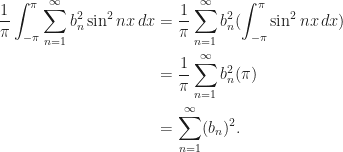
So (Parseval’s Identity)
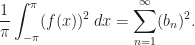
By Parseval’s identity,
Simplifying, we get
Currently, all versions of China Eastern Airlines 东方航空 websites (e.g. http://sg.ceair.com/, hk.ceair, etc) are not working.
I tried searching for a ticket in December and an error message popped out: We apologize that there are insufficient seats on ## segment of your searched flight. Please change the search options. Thank you for your cooperation!
I called the customer service and they confirmed that it is an error (their system shows that there are indeed still plenty of seats). Hope they fix it soon.
Affine Line: $latex {mathbb {A}^1}&s=3$
Six Representations of a Circle: $latex {mathbb {S}^1}&s=3$
1) Euclidean Geometry
Unit Circle : $latex x^2 + y^2 = 1$
2) Curve:
Transcendental Parameterization :
$latex boxed { e(theta) = (cos theta, sin theta) qquad
0 leq theta leq 2pi }&fg=aa0000&s=3
$
Rational Parameterisation :
$latex boxed {
e(h) = left(frac {1-h^2} {1+h^2} : , : frac {2h} {1+h^2}right) quad text { h any number or } infty
} &fg=aa0000&s=2
$
3) Affine Plane $latex {mathbb {A}^2}&s=3$
1-dim sub-Space = Lines thru Origin
5) Identifying Intervals: (closed loop)
6) $latex text {Translation } (tau, {tau}^{-1}) text { on a Line } $ $latex {mathbb {A}^1}&s=3$
$latex boxed {
{mathbb {S}^1} = {mathbb {A}^1 } Big/ { langle tau , {tau}^{-1} rangle}
}&fg=aa0000&s=3
$
$latex {mathbb {S}^1} = text { Space of all orbits} $
Source: http://www.ypzihua.com/product-2793.html
Beautiful calligraphy and meaningful words.
Chinese Characters: 宠辱不惊 闲看庭前花开花落 去留无意 漫随天外云卷云舒
Translation: “Don’t be disturbed by fortune or misfortune. Be relaxed no matter how flowers bloom and wilt. To be or not to be needs no hard decision. Take it natural no matter how clouds flow high and low.” (Source: http://www.en84.com/dianji/minyan/201410/00015499.html)
This key theorem showcases the full power of Lebesgue Integration Theory.
Let and
be sequences of measurable functions on
satisfying
a.e. in
,
a.e. in
, and
a.e. in
. If
and
, then
.
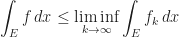
We have . Applying Fatou’s lemma to the non-negative sequence
we get
That is,
Since , we get
. Since
, this implies
.
Simplices:
0-dim (Point) $latex triangle_0 $
1-dim (Line) $latex triangle_1 $
2-dim (Triangle) $latex triangle_2 $
3-dim (Tetrahedron) $latex triangle_3 $
Simplicial Complex: built by various Simplices under some rules.
Definitions of Simplex (S)
Face
Orientation
Boundary ($latex delta $)
$latex displaystyle boxed {
delta(S) = sum_{i=0}^{n} (-1)^i (v_0 …hat v_i …v_n)}&fg=aa0000&s=3
$
Theorem: $latex boxed { delta ^2 (S) = 0}&fg=00bb00&s=4 $
A very nice article against the philosophy of the bell curve, which is a prominent feature of examinations all over the world, including Singapore. I am sure that when Gauss invented the bell curve, he didn’t intend it to be used for examinations!
Excerpts:
The goal is to fight grade inflation, but the forced curve suffers from two serious flaws. One: It arbitrarily limits the number of students who can excel. If your forced curve allows for only seven A’s, but 10 students have mastered the material, three of them will be unfairly punished. (I’ve found a huge variation in overall performance among the classes I teach.)
The more important argument against grade curves is that they create an atmosphere that’s toxic by pitting students against one another. At best, it creates a hypercompetitive culture, and at worst, it sends students the message that the world is a zero-sum game: Your success means my failure.
Exhibit B: I spent a decade studying the careers of “takers,” who aim to come out ahead, and “givers,” who enjoy helping others. In the short run, across jobs in engineering, medicine and sales, the takers were more successful. But as months turned into years, the givers consistently achieved better results.
The results: Their average scores were 2 percent higher than the previous year’s, and not because of the bonus points. We’ve long knownthat one of the best ways to learn something is to teach it. In fact, evidence suggests that this is one of the reasons that firstborns tend to slightly outperform younger siblings on grades and intelligence tests: Firstborns benefit from educating their younger siblings. The psychologists Robert Zajonc and Patricia Mullally noted in a review of the evidence that “the teacher gains more than the learner in the process of teaching.”
Abstract Algebra is scary but not with this pretty lecturer!
1. Group
◇ Definition
◇ Symmetric Group
◇ Cayley Table
2. Linear Groups:
◇ GLn (R)
◇ SLn(R) — Determinant = 1
3. Relationship between Group Structures:
◇ Homomorphism,
◇ Isomorphism,
◇Kernel
4.Ring Definition
5. Field Definition
Suppose where both
and
has order 2. Prove that
is isomorphic to
for some integer
.
Note that since
. Since
is finite,
has a finite order, say
, so that
. We also have
.
We claim that there are no other relations, other than .
Suppose to the contrary . Then
, i.e.
, a contradiction. Similarly if
,
implies
, a contradiction. Inductively,
and
for any
.
Thus
Math teachers / students / Math lovers do sign this petition to stop Leicester university from cutting 20% of their math researchers/lecturers. #mathisimportant
Strangely, this is my second post about Leicester in just a few months, but it’s about something a lot more depressing than the football team’s fairytale winning of the Premier League (but let me quickly offer my congratulations to them for winning their first Champions League match — I won’t offer advice about whether they are worth betting on to win that competition too). News has just filtered through to me that the mathematics department is facing compulsory redundancies.
The structure of the story is wearily familiar after what happened with USS pensions. The authorities declare that there is a financial crisis, and that painful changes are necessary. They offer a consultation. In the consultation their arguments appear to be thoroughly refuted. But this is ignored and the changes go ahead.
Here is a brief summary of the painful changes that are proposed for the Leicester mathematics department. There are…
View original post 393 more words
| Year | Ver | Code Name | Description |
| 1995 | 1.0 | Java | Applets |
| 1977 | 1.1 | Java | Event, Beans, Internationalization |
| Dec 1978 | 1.2 | Java 2 | J2SE, J2EE, J2ME, Java Card |
| 2000 | 1.3 | Java 2 | J2SE 1.3 |
| 2002 | 1.4 | Java 2 | J2SE 1.4 |
| 2004 | 1.5 | Java 5 | J2SE 1.5 |
| Nov 2006 | 6 | Java 6 | Open-Source Java SE 6. “Multithreading” by Doug Lea |
| May 2007 | OpenJDK free software | ||
| 2010 | Oracle acquired Sun | ||
| Jul 2011 | 7 | Java 7 | “Dolphin” |
| Mar 2014 | 8 | Java 8 | Lambda Function |
Javac: Java Compiler
Java Distributions:
1. JDK (Java Developer Kit )
◇JRE & Javac & tools
2. JRE (Java Runtime Environment)
◇ JVM & core class libraries
◇ Windows / Mac / Linux
Java is Object-Oriented Programming (OOP):
1. Class
public class Employee {
public int age;
public double salary;
public Employee () { [<– constructor with no arg]
}
public Employee (int ageValue, double salaryValue) { [<- constructor with args]
age…
View original post 153 more words
The French Emperor Napoleon Bonaparte was himself a Mathematician. He posed a question to his mathematician friends Monge, Laplace, Fourier etc:
How to divide a circle equally in 4 sections using only a compass ?
Note: He was more stringent than the ancient Greeks who allowed a compass and a non-marked ruler.
“Differentiating under the Integral” is a useful trick, and here we describe and prove a sufficient condition where we can use the trick. This is the Measure-Theoretic version, which is more general than the usual version stated in calculus books.
Let be an open subset of
, and
be a measure space. Suppose
satisfies the following conditions:
1) is a Lebesgue-integrable function of
for each
.
2) For almost all , the derivative
exists for all
.
3) There is an integrable function such that
for all
.
Then for all ,
Proof:
By definition,
Let be a sequence tending to 0, and define
It follows that is measurable.
Using the Mean Value Theorem, we have for each
.
Thus for each , by the Dominated Convergence Theorem, we have
which implies
That is,
Very interesting productivity app that resembles a game. Do check it out!
A few months ago, I noticed someone in one of my Facebook groups posting about an interesting app called Habitica. It’s one of a host of time-management and productivity-increasing applications, both web- and mobile-based. What sets it apart, however, is that it turns your efforts at organizing your life into a game. Specifically, it turns your life into something reminiscent of a classic, pixelated, 8-bit RPG.
So no, the title of this post is not a metaphor. You literally get XP (and gold) for doing your tasks in real life.
View original post 2,652 more words
(L’Hopital’s Rule Proof)
This limit is a useful and interesting result to know. Note especially that the method “” is incorrect.
We will prove instead, and this implies
First, we will find the limit .
So .
If you are interested, you can try to prove where
.
The Fundamental Theorem of Galois Theory states that:
Given a field extension that is finite and Galois, there is a one-to-one correspondence between its intermediate fields and subgroups of its Galois group.
1) where
and
is the corresponding fixed field (the set of those elements in
which are fixed by every automorphism in
).
2) where
is an intermediate field of
and
is the set of those automorphisms in
which fix every element of
.
This correspondence is a one-to-one correspondence if and only if is a Galois extension.
As the Zika/Dengue virus has spread to Singapore, I have been researching (in my spare time) on ways to prevent Zika/Dengue. The following are some interesting ways that however eventually do not work (or worse, attract more mosquitoes), so do not waste your money trying these!

In theory, bug zappers that use electricity to kill mosquitoes sound like a great idea. However, the problem comes from the fact that bug zappers use Ultraviolet Light (UV) to attract insects. Mosquitoes are attracted by Carbon Dioxide, not UV light, so you will end up killing 99% other insects, some of which are beneficial insects. See http://insects.about.com/od/StingingBitingInsects/a/Do-Bug-Zappers-Kill-Mosquitoes.htm.
This seems to be complete BS. See http://www.mosquitoreviews.com/ultrasonic-mosquito-app.html

This sounds like a genius idea at first, since Pitcher Plants eat insects, and grow in tropical climates, exactly where Aedes Mosquitoes live. The problem is mosquito larvae can survive very well in Pitcher Plants.
4) P.S. If you have a pond with large koi fish in it, you may want to add smaller fish, since koi fish (and other large fish in general) are known not to eat mosquito larvae. “Koi may be beautiful, but they are generally too large to prey on mosquito larvae and are known for their mellow nature.”
WolframAlpha can compute (simple) Laurent series:
https://www.wolframalpha.com/input/?i=series+sin(z%5E-1)
Series[Sin[z^(-1)], {z, 0, 5}]
1/z-1/(6 z^3)+1/(120 z^5)+O((1/z)^6) (Laurent series) (converges everywhere away from origin)
Unfortunately, more “complex” (pun intended) Laurent series are not possible for WolframAlpha.
provided both and
exist.
provided both and
exist.
provided both and
exist.
provided both limits on the right exist, and .
If then
Source: http://www.androidcentral.com/how-opt-out-sharing-your-information-facebook-whatsapp-android
In 2014, Facebook bought WhatsApp for a whopping $21.8 billion. WhatsApp users everywhere went, “Oh, no. This can’t be good.” That feeling has finally come to fruition in that WhatsApp will now start sharing your information with Facebook –including your phone number.
If you don’t want Facebook getting ahold of your WhatsApp info, you can opt out in one of two ways.
Click on the link above to read the method to opt out.
Source: http://www.straitstimes.com/singapore/education/grades-should-not-define-our-kids
Your grades do not define you,” said Mr Jack Cook.
That was Debbie’s defining moment.
Debbie, a perfectionist, always had the best academic results in her earlier years at school. However, when studying economics at junior college, she was thrown off balance.
Despite putting in more effort – hard work as well as getting extra coaching from her teacher, Mr Cook – Debbie just could not grasp the subject. She could not understand nor accept the poor grades she got for her economics examination. She felt ashamed and guilty, so much so that she avoided her teacher and did not visit the school after graduation.
A few years later, when Debbie heard that Mr Cook was retiring and leaving Singapore, she plucked up the courage to visit and bid him farewell.
Mr Cook greeted Debbie with a big smile and warmly welcomed her. She asked him sheepishly if…
View original post 44 more words
Assume , where
. Consider
Thus
For ,
.
The above set is equal to , so
.
as
. Hence
converges to
everywhere.
Pastor Rick Warren has a gift of applying Christian principles in teaching lessons in real life scenarios. This is one of them.
“Let’s not get tired of doing what is good. At just the right time we will reap a harvest of blessing if we don’t give up” (Galatians 6:9 NLT, second edition).
There are many things that work to keep us from completing our life missions. Over the years, I’ve debated whether the worst enemy is procrastination or discouragement. If Satan can’t get us to put off our life missions, then he’ll try to get us to quit altogether.
The apostle Paul teaches that we need to resist discouragement: “Let’s not get tired of doing what is good. At just the right time we will reap a harvest of blessing if we don’t give up” (Galatians 6:9 NLT, second edition).
Do you ever get tired of doing what’s right? I think we all do. Sometimes it seems easier to do the wrong thing than the right thing.
When we’re discouraged, we become ineffective. When we’re discouraged, we work against our own faith.
When we’re discouraged, we’re saying, “It can’t be done.” That’s the exact opposite of saying, “I know God can do it because he said …”
Ask yourself these questions:
If you’re discouraged, don’t give up without a fight. Nothing worthwhile ever happens without endurance and energy.
When an artist creates a sculpture, he has to keep chipping away. He doesn’t hit the chisel with the hammer once, and suddenly all the excess stone falls away revealing a beautiful masterpiece. He keeps hitting it and hitting it, chipping away at the stone.
And that’s true of life, too. Nothing really worthwhile ever comes easy in life. You keep hitting it and going after it, and little by little your life becomes a masterpiece of God’s grace.
The fact is, great people are really just ordinary people with an extraordinary amount of determination. Great people don’t know how to quit.
By Pastor Rick Warren
This article provides an alternative viewpoint on whether mathematics is useful to society. A good read if you are writing a GP (General Paper) essay on the usefulness of mathematics, to provide both sides of the argument.
Excerpt:
Most people never become mathematicians, but everyone has a stake in mathematics. Almost since the dawn of human civilization, societies have vested special authority in mathematical experts. The question of how and why the public should support elite mathematics remains as pertinent as ever, and in the last five centuries (especially the last two) it has been joined by the related question of what mathematics most members of the public should know.
Why does mathematics matter to society at large? Listen to mathematicians, policymakers, and educators and the answer seems unanimous: mathematics is everywhere, therefore everyone should care about it. Books and articles abound with examples of the math that their authors claim is hidden in every facet of everyday life or unlocks powerful truths and technologies that shape the fates of individuals and nations. Take math professor Jordan Ellenberg, author of the bestselling book How Not to Be Wrong, who asserts “you can find math everywhere you look.”
To be sure, numbers and measurement figure regularly in most people’s lives, but this risks conflating basic numeracy with the kind of math that most affects your life. When we talk about math in public policy, especially the public’s investment in mathematical training and research, we are not talking about simple sums and measures. For most of its history, the mathematics that makes the most difference to society has been the province of the exceptional few. Societies have valued and cultivated math not because it is everywhere and for everyone but because it is difficult and exclusive. Recognizing that math has elitism built into its historical core, rather than pretending it is hidden all around us, furnishes a more realistic understanding of how math fits into society and can help the public demand a more responsible and inclusive discipline.
In the first agricultural societies in the cradle of civilization, math connected the heavens and the earth. Priests used astronomical calculations to mark the seasons and interpret divine will, and their special command of mathematics gave them power and privilege in their societies. As early economies grew larger and more complex, merchants and craftsmen incorporated more and more basic mathematics into their work, but for them mathematics was a trick of the trade rather than a public good. For millennia, advanced math remained the concern of the well-off, as either a philosophical pastime or a means to assert special authority.
The first relatively widespread suggestions that anything beyond simple practical math ought to have a wider reach date to what historians call the Early Modern period, beginning around five centuries ago, when many of our modern social structures and institutions started to take shape. Just as Martin Luther and other early Protestants began to insist that Scripture should be available to the masses in their own languages, scientific writers like Welsh polymath Robert Recorde used the relatively new technology of the printing press to promote math for the people. Recorde’s 1543 English arithmetic textbook began with an argument that “no man can do any thing alone, and much less talk or bargain with another, but he shall still have to do with number” and that numbers’ uses were “unnumerable” (pun intended).
Far more influential and representative of this period, however, was Recorde’s contemporary John Dee, who used his mathematical reputation to gain a powerful position advising Queen Elizabeth I. Dee hewed so closely to the idea of math as a secret and privileged kind of knowledge that his detractors accused him of conjuring and other occult practices. In the seventeenth century’s Scientific Revolution, the new promoters of an experimental science that was (at least in principle) open to any observer were suspicious of mathematical arguments as inaccessible, tending to shut down diverse perspectives with a false sense of certainty. During the eighteenth-century Enlightenment, by contrast, the savants of the French Academy of Sciences parlayed their mastery of difficult mathematics into a special place of authority in public life, weighing in on philosophical debates and civic affairs alike while closing their ranks to women, minorities, and the lower social classes.
Societies across the world were transformed in the nineteenth century by wave after wave of political and economic revolution, but the French model of privileged mathematical expertise in service to the state endured. The difference was in who got to be part of that mathematical elite. Being born into the right family continued to help, but in the wake of the French Revolution successive governments also took a greater interest in primary and secondary education, and strong performance in examinations could help some students rise despite their lower birth. Political and military leaders received a uniform education in advanced mathematics at a few distinguished academies which prepared them to tackle the specialized problems of modern states, and this French model of state involvement in mass education combined with special mathematical training for the very best found imitators across Europe and even across the Atlantic. Even while basic math reached more and more people through mass education, math remained something special that set the elite apart. More people could potentially become elites, but math was definitely not for everyone.
Entering the twentieth century, the system of channeling students through elite training continued to gain importance across the Western world, but mathematics itself became less central to that training. Partly this reflected the changing priorities of government, but partly it was a matter of advanced mathematics leaving the problems of government behind. Where once Enlightenment mathematicians counted practical and technological questions alongside their more philosophical inquiries, later modern mathematicians turned increasingly to forbiddingly abstract theories without the pretense of addressing worldly matters directly.
Source: https://www.newsghana.com.gh/why-every-youth-must-encounter-failure/
You can’t live without failure unless you live cautiously doing nothing. Even on that level, your failure is huge. The fatality of failure depends on the individual. You think failure has no benefit? This piece seeks to shed light on the need to embrace failure, learn from it and get better even after you have a warm encounter with it.
As toddlers strive to achieve their “shared goals” such as learning to walk, they fail 17 times per hour
IMPORTANCE
To start with, failure tells us the steps we need to change in order to attain the glory/crown we are seeking. Failure in its real sense means a slip or missing the mark. The mark here is synonymous to the desired target, glory, crown, et al.
To miss the mark means the processes have not been followed thoroughly or you underestimated the importance of a step. Failing helps you to identify the needed change, process or action that will facilitate your reaching the desired goal.
Furthermore, failure helps us to attain the mental toughness and wisdom we need to succeed. Interestingly, the sensible learn from their failures. Failure helps to toughen our minds, broaden our perspectives and help us acquire some essential nuggets for life.
Many successfully acquired practical wisdom after haven failed once or twice. Failure enhances character formation hence positively affects how you respond to things that didn’t go your way. You have to develop a thick skin to make it through life. Life isn’t easy, it is complicated and has pains no matter your level of blessings. Therefore, we come to terms with this reality especially after our encounter with failure.
In reality, failure teaches you things about yourself you wouldn’t have otherwise known (self-discovery and true relationships). Thus in our failures, we are able to know the loyal friends and family members. There are times we either overestimate or underestimate our strengths. At such points, failure brings us back to a stage of self-discovery. You can’t know yourself and the quality of your relationship unless you have been tested by adversities of which failure is part.
CONCLUSION
Life is a series of detours. We may set our minds on determinations but the detours will show if we did or did not expect it before the destination. One thing we must know is that the world is full of competition and as such extra skills are necessary to strategize and make the best out of every situation.
Most often than not we make up stories to make ourselves feel okay for our failures. We should rather endeavor to focus stories, events, circumstances et al that have the potential to impact on us and cause us to act more positively. Significantly, the detours in life lead us to the destinations.
Being angry at the detours mean you aren’t ready for the destination. Toughen yourself, let us embrace our failures, learn from it and strive hard to apply the valuable lessons we have acquired to write a positive narrative for ourselves and our continent. Let us meet at the top!
By: Bernard Owusu Mensah
President of New Era Africa
Ghana
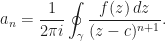
The Laurent series is something like the Taylor series, but with terms with negative exponents, e.g. . The below Laurent Series formula may not be the most practical way to compute the coefficients, usually we will use known formulas, as the example below shows.
The Laurent series for a complex function about a point
is given by:
where
The path of integration is anticlockwise around a closed, rectifiable path containing no self-intersections, enclosing
and lying in an annulus
in which
is holomorphic. The expansion for
will then be valid anywhere inside the annulus.
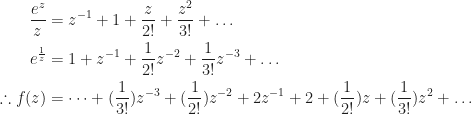
Consider . This function is holomorphic everywhere except at
. Using the Taylor series of the exponential function
we get
Note that the residue (coefficient of ) is 2.
The implicit function theorem is a strong theorem that allows us to express a variable as a function of another variable. For instance, if , can we make
the subject, i.e. write
as a function of
? The implicit function theorem allows us to answer such questions, though like most Pure Math theorems, it only guarantees existence, the theorem does not explicitly tell us how to write out such a function.

The below material are taken from Wikipedia.
Let be a continuously differentiable function, and let
have coordinates
. Fix a point
with
, where
. If the matrix
is invertible, then there exists an open set
containing
, an open set
containing
, and a unique continuously differentiable function
such that
Elaboration:
Abbreviating to
, the Jacobian matrix is
where is the matrix of partial derivatives in the variables
and
is the matrix of partial derivatives in the variables
.
The implicit function theorem says that if is an invertible matrix, then there are
,
, and
as desired.
In this case and
.
Note that is invertible iff
. By the implicit function theorem, we see that we can locally write the circle in the form
for all points where
.
An -dimensional (differentiable) manifold
is a Hausdorff topological space with a countable (topological) basis, together with a maximal differentiable atlas.
This atlas consists of a family of charts where the domains of the charts,
, form an open cover of
, the
are open in
, the charts (local coordinates)
are homeomorphisms, and every change of coordinates
is differentiable on its domain of definition
.
Source: Representations of Compact Lie Groups (Graduate Texts in Mathematics)
One of the best books on Lie Groups is said to be Representations of Compact Lie Groups (Graduate Texts in Mathematics). It is one of the rarer books from the geometric approach, as opposed to the algebraic approach.
A Lie group is a differentiable manifold which is also a group such that the group multiplication
(and the map sending
to
) is a differentiable map.
A homomorphism of Lie groups is a differentiable group homomorphism between Lie groups.
The concept of lim sup and lim inf can be applied to sets too. Here is a nice characterisation of lim sup and lim inf of sets:
For a sequence of sets ,
consists of those points that belong to infinitely many
, and
consists of those points that belong to all

from some
on (i.e. belong to all but finitely many
).
Proof:
Note that
This is great news for NTU alumni.
SINGAPORE – Graduates of Nanyang Technological University (NTU) can look forward to free membership at three new alumni houses.
This year marks the 25th anniversary of NTU’s inauguration as a university, and it announced on Wednesday (Aug 10) that it will open a 10,000 sq ft alumni house – equivalent to nine five-room flats – in Marina Square mall in November.
The second facility will be at NTU’s main campus’ North Spine Plaza, and it will open by the end of this year; the third will be at one-north and will open next year.
Heartiest congratulations to Mr Joseph Schooling, who has achieved the legendary accomplishment of a Gold medal at the Olympics! Good job!
Here is some analysis of factors contributing to Joseph’s Schooling’s success:
Joseph’s height is 1.84 m (close to the ideal height of 1.90 m). In swimming, a tall height is desirable, as that would lead to an instant lead the moment you jump into the water. But this is not basketball, too tall (e.g. over 2 m) is probably not good as that will lead to increased drag and bad aquadynamics. So judging by height of former Olympic swimmers, roughly 1.90 m is the ideal height.
In fact, in 2006, “Schooling’s parents, Colin and May, send him for a bone test – which calculates growth potential – to see how far he can go in the sport. The test reveals that he will hit 1.90 metres, which is an optimum height to excel in the sport at the highest levels.” (http://www.todayonline.com/sports/schooling-story)
This is probably the most important factor. Even when just eight years old, Joseph Schooling woke up his dad at 4.30 am to request to go for swimming training.
Schooling also took training to the highest level by going overseas (to Texas) for his training.
Joseph Schooling also has a motivational poster (see below) to remind himself daily of the times he need to achieve for a podium finish.
Joseph Schooling’s grand-uncle Lloyd Valberg, a former high jumper, was Singapore’s first ever Olympian at the 1948 London Games. He was the one who inspired Joseph to aim for the Olympics, when Joseph was just 6 years old.
“Colin (Joseph’s father) and his wife, May, decided to groom their only son to the best of their ability, going so far as to ensure he had access to swimming facilities to train during every vacation they took during his childhood. This would continue into his formative years, when Joseph was sent first to the famed Bolles School in United States to train under renowned coach Sergio Lopez and now the University of Texas to continue his development at the best possible environment.” (from https://sg.sports.yahoo.com/news/colin-schooling–the-world-has-taken-notice-of-joseph-and-singapore-150934197.html)
In 2012 Olympics, Joseph met with extreme bad luck in the form of his goggles and swim suit not being approved, leading to a last minute change which would affect his timings.
Despite that, Joseph continued to persevere in his training, which led to his fantastic results in 2016.
Joseph Schooling’s coach is Sergio Lopez, “who is a former international top swimmer from Spain, who won the bronze medal in the 200 meters breaststroke at the 1988 Summer Olympics in Seoul” (Wikipedia).
Coach is very important, Michael Phelps credits his success to his legendary coach Bob Bowman, who has written a book The Golden Rules: 10 Steps to World-Class Excellence in Your Life and Work.
The Singapore government has humanely allowed a deferment from National Service (2 year mandatory conscription into the army) for Joseph Schooling. This is a crucial factor as for Olympic athletes, uninterrupted training is of utmost importance.
Finally, here are some cool Joseph Schooling Shirts suitable for his ardent fans. (Note that Red/White are Singapore’s national colors.)
Very interesting article on why you should consider a degree in math if you are interested in math.
Source: http://www.snhu.edu/about-us/news-and-events/2016/08/what-is-a-degree-in-math-and-why-is-it-valuable
Mathematics is the study of quantity, structure, space and change. As abstract as that may seem, math is, at its core, a quest for absolutes, definitive solutions and answers. We may think of long numeric chains, seas of fractions or spreadsheets stacked with figures, but what many don’t realize is that math’s complex equations are in fact roads to simplicity. Believers in better, faster, smarter solutions are often drawn to math.
So, what is a degree in math, exactly? Those that go to college to pursue a mathematics degree find out along the way that numbers are just a fraction of the allure. Math can teach us how to look longer and harder for solutions – a skill applicable to any career and life in general.
We need math. Galileo Galilei used it to explain the universe. Math resolves truths and uncovers errors. It makes our work more credible. Reports, studies and research are all but discounted without quantifiable facts. Math equals proof. Math validates.
The Mathematical Association of America cites a CareerCast report ranking mathematics the best job for 2014 based on factors such as environment, income, outlook, and stress. The job of statistician was ranked third. Actuary was ranked fourth. In addition, a PayScale study reports that the top 15 highest-earning college degrees have mathematics as a common denominator.
But, Psychology Today reports that most of us are in awe of math. It’s slightly mysterious. It makes things look smart, including the mathematician behind the math. What is a degree in math? It’s a professional pathway, and an attractive one for many reasons. It is also a unique way of seeing the world.
Whether you like mathematics or are even very good it, math is around us all the time. When you’re at the department store, balancing your checkbook or doing your taxes, mathematics is a necessary skill. It can even improve your sports game.
“There’s math all over the place in soccer,” Southern New Hampshire University’s mathematics department chairwoman Dr. Pamela Cohen told pro soccer player Calen Carr in this video. From the curve – also known as a “parabola” – of a kicked ball to the rigidness of playing in triangles on the field, math factors into every aspect of the game. What is a math degree to an athlete? A competitive edge on the field.
Many professions, such as engineering, medicine, physics, nurses, computer science and actuarial science, require math proficiency. Virtually all fields benefit from the analytical and problem-solving skills students learn in mathematics. Anyone entering a science, technology, engineering and mathematics (STEM) career is expected to have harnessed basic and advanced math concepts.
Even professions as diverse as chefs or gardeners use math fundamentals when measuring and purchasing supplies. If you are an event planner, math will help you figure per-head costs and inventory. Seamstresses and decorators use math daily, as does anyone who works with measurements and schedules.
Many people believe math talent to be something that is inherited or are born with. Not so, say researchers. Natural ability in math only gets you so far. Hard work and good study habits are far more valuable. As such, students entering college math degree programs aren’t the math-minded geniuses. Some didn’t even like math growing up, says a Quartz article that looks at why some kids excel at math and others don’t. The authors – economy and finance professors – make the case that something said by a grade school teacher years ago could be the reason a child is turned off to math or thinks he or she is bad at it. Some educators and parents also have a bad habit of labeling kids as either math kids or reading kids.
The Fundamental Theorem of Calculus is one of the most amazing and important theorems in analysis. It is a non-trivial result that links the concept of area and gradient, two seemingly unrelated concepts.
The first part deals with the derivative of an antiderivative, while the second part deals with the relationship between antiderivatives and definite integrals.
Let be a continuous real-valued function defined on a closed interval
. Let
be the function defined, for all
in
, by
Then is uniformly continuous on
, differentiable on the open interval
, and
for all
in
.
Let and
be real-valued functions defined on
such that
is continuous and for all
,
If is Riemann integrable on
, then
This amazing theorem is also called the Fundamental Theorem of Calculus for Line Integrals. It is quite a powerful theorem that sometimes allows fast computations of line integrals.
Let be a differentiable curve given by the vector function
,
.
Let be a differentiable function of
variables whose gradient vector
is continuous on
. Then
Every bounded entire function must be constant.
That is, every holomorphic function for which there exists
such that
for all
is constant.
Multivariable calculus is an interesting topic that is often neglected in the curriculum. Furthermore it is hard to learn since the existing textbooks are either too basic/computational (e.g. Multivariable Calculus, 7th Edition by Stewart) or too advanced. Many analysis books skip multivariable calculus altogether and just focus on measure and integration.
If anyone has a good book that covers multivariable calculus (preferably rigorously with proofs), do post it in the comments!
The following is a useful multivariable version of Taylor’s Theorem, using the multi-index notation which is regarded as the most efficient way of writing the formula.
Let be a
times differentiable function at the point
. Then there exists
such that
and
.
Write .
Apple has released a mode called Night Shift for iPhones and iPads. What it does is it reduces blue light from your phone in the evening/night so that one can sleep better. Blue light is known to be unnatural since throughout human history (before Edison), humans have lived in darkness at night. Fire from candles/lantern is Red light, which is considered not as bad as Blue light.
For Mac, there is no such thing as Night Shift (yet), the best alternative is f.lux. I recommend the “classic f.lux” mode over the default, as the default is too extreme (overly red).
Other than improving sleep, another factor it can help with is eye strain.
Pokemon Go has finally arrived in Singapore! Good to see that the company Niantic did not forget about Singapore.
Upon starting the game, however, one would be in for a surprise. The gyms are all dominated by high level Pokemon, just merely hours after the release. (It is humanly impossible to have reached such a level in such a short time.)
For instance, the gyms near my neighbourhood has Gyarados (arguably the best Water Pokemon), Hypnos and Nidoqueen respectively. (See screenshot)
How did these guys get these Pokemon is a good question. The possibilities are either GPS Spoof (E.g. by using VPN to access Pokemon Europe or USA), or that they really caught the Pokemon overseas. Either way, they would have had a headstart since Pokemon Go was released much earlier in USA/Europe/Australia.
Overall, Pokemon Go is a fun and unique game in the sense that it involves walking around in real environments. However, one letdown is that it is not very skill-based (unless one counts flicking Pokeballs as a skill). There is not much strategy involved (both catching or battling) for Pokemon Go.
There is one mathematical part of Pokemon Go: Determining which Pokemon to evolve based on IV (Initial Values). Some websites to help are: Pokeassistant, or TheSilphRoad. The difference between a bad or perfect Pokemon is only 10% though, so it will only make a difference in very close battles.
Pokémon Clip ‘N’ Carry Poké Ball Belt, Styles May Vary
(For those really into the game, may want to check these out while you hunt for Pokemon!)
Flyme Pokemon Go Cap ,Team Valor Team Mystic Team Instinct Baseball Cap Hat (Red)
Yet another motivational sermon by Pastor Rick Warren.
Source: http://rickwarren.org/devotional/english/full-post/what-will-you-do-today-that-requires-faith
“Let us not become weary in doing good, for at the proper time we will reap a harvest if we do not give up” (Galatians 6:9 NIV).
Failure is never final. You’re never a failure until you quit, and it’s always too soon to quit! You don’t determine a person’s greatness by his talent, his wealth, or his education. You determine a person’s greatness by what it takes to discourage him.
So what does it take to discourage you from going after your dream? It may be as simple as a friend or relative or family member telling you, “I don’t think that’s a good idea.”
The Bible says in Galatians 6:9, “Let us not become weary in doing good, for at the proper time we will reap a harvest if we do not give up” (NIV). You want to know how many times I wanted to resign from Saddleback Church? Just every Monday morning when I think, “God, surely somebody could have done a better job than I did yesterday. This thing is too big for any one person.”
God says, “Just keep on keeping on.” I may not be real bright sometimes, but I don’t know how to quit. I don’t know how to give up.
God works in your life according to your faith. The Bible says, “Without faith it’s impossible to please God” and “Whatsoever is not of faith is sin” and “According to your faith it will be done unto you.” So what are you doing in faith? You need to ask yourself every day when you get up, “God, what can I do today that will require faith?” That’s an important question, because that’s what’s going to please God.
There are a lot of things in your life you don’t have control over. You didn’t control who your parents were, when you were born, where you were born, or what your race or nationality is. You didn’t control what gifts and talents you were given. You didn’t decide how you look.
But you do have complete control over how much you choose to believe God. God uses people who expect him to act, who never give up, who take risks in faith, who get his dream and go after it. It’s your choice whether you want to be the kind of person God uses to accomplish his purpose.
Cauchy Product:
The Cauchy product of two infinite series is defined by where
.
The proof of the Pasting Lemma at Wikipedia is correct, but a bit unclear. In particular, it does not clearly show how the hypothesis that X, Y are both closed is being used. It actually has something to do with subspace topology.
I have added some clarifications here:
Let ,
be both closed (or both open) subsets of a topological space
such that
, and let
also be a topological space. If both
and
are continuous, then
is continuous.
Let be a closed subset of
. Then
is closed in
since it is the preimage of
under the function
, which is continuous. Hence
for some set
closed in
. Since
is closed in
,
is closed in
.
Similarly, is closed (in
). Then, their union
is also closed (in
), being a finite union of closed sets.
Quite an inspirational story. Congratulations to these two students who have succeeded despite having a less than ideal start.
“We have to find our interest, put in our best effort and keep trying. After having come so far, it has made me believe that I can still carry on.”
Source: http://www.straitstimes.com/singapore/education/from-normal-stream-to-phd-course
Mr Ernest Tan, 28, a PhD student, never thought he would get this far.
The former EM3 and Normal (Technical) student did not bother studying much as he had no interest in the subjects he was doing.
But it all changed in his two years at the Institute of Technical Education (ITE) as a student in Communications Technology.
He said: “I played a lot of computer games then so I didn’t mind learning more about computers.”
His interest pushed him to believe that he could continue into polytechnic, where he eventually earned a Diploma in Computer Engineering at Singapore Polytechnic (SP).
Continue reading: http://www.straitstimes.com/singapore/education/from-normal-stream-to-phd-course