The Psychology of IB Math Success: Mental Strategies for High Achievement

The Psychology of IB Math Success: Mental Strategies That Transform Struggling Students into High Achievers

Here’s something fascinating: two students can sit in the same IB Mathematics class, receive identical instruction, yet one thrives while the other struggles tremendously. What makes the difference? It’s rarely about raw intelligence or mathematical talent.

The secret often lies in psychology. How students think about maths, approach problems, and handle setbacks can completely transform their academic journey. This insight has revolutionised how we understand mathematical learning, particularly in demanding programmes like the International Baccalaureate.

Why Your Brain Believes Math Ability Can Grow

Students who embrace the idea that mathematical skills develop through effort consistently outperform those who think ability is fixed. This isn’t wishful thinking but solid educational psychology.

When learners view challenges as growth opportunities rather than threats, everything changes. They tackle difficult concepts in both Analysis and Approaches (AA) and Applications and Interpretation (AI) with curiosity instead of fear. The result? Deeper understanding and genuine problem-solving capability.

The Hidden Trap of Mathematical Perfectionism

Many bright IB students unknowingly sabotage themselves through perfectionism. They become so focused on avoiding mistakes that they actually create more problems than they solve.

Think about it: perfectionist students often spend hours agonising over single problems, leaving insufficient time for adequate practice across the syllabus. They develop test anxiety because any error feels catastrophic. Breaking free from this cycle requires conscious effort, but the payoff is enormous.

Smart Students Think Strategically About Exams

Here’s what successful IB Math students do differently during examinations. Instead of working through papers sequentially, they spend the first few minutes scanning all questions. This strategic overview allows them to identify which problems they can solve confidently.

Starting with accessible questions builds momentum and confidence. Students secure marks early, then tackle challenging problems with a calmer mindset. This approach proves particularly valuable given IB’s time constraints and complex question structures.

Building Mathematical Confidence Step by Step

Confidence in mathematics doesn’t appear overnight. It develops through systematic practice that gradually increases in complexity. Students need to experience success with foundational concepts before advancing to sophisticated applications.

This principle works brilliantly with IB’s structured curriculum. Those who truly master core topics like functions and algebra find themselves well-prepared for advanced calculus and statistical analysis. Their confidence grows naturally as competence develops.

Managing Stress for Peak Mathematical Performance

Stress wreaks havoc on the cognitive processes required for mathematical reasoning. Unfortunately, IB students face intense pressure from multiple subjects simultaneously, making stress management absolutely crucial.

Successful students develop practical coping strategies. They practice under timed conditions regularly, so exam pressure feels familiar rather than overwhelming. Simple breathing techniques help maintain focus during challenging moments. Most importantly, they keep perspective on individual assessments within the broader academic journey.

Learning Mathematics Becomes Social

Something magical happens when students discuss mathematical concepts with peers. The isolation that many feel when struggling with complex topics begins to dissolve.

Group study sessions offer multiple benefits beyond content review. Students hear different approaches to problems, identify gaps in their own understanding, and gain confidence through collaborative learning. The psychological benefits include reduced anxiety and increased motivation through shared experiences.

Professional Guidance Makes a Real Difference

Many students find tremendous value in working with experienced tutors who understand both mathematical content and learning psychology. Quality IB Math tuition centres provide comprehensive support that goes beyond teaching formulas and procedures.

These professionals help students develop personalised approaches to time management, confidence building, and sustained motivation. They understand that successful IB performance requires addressing both academic content and psychological factors that influence learning.

Putting Psychology into Daily Practice

Students can immediately begin applying these insights through specific changes to their study routines. Creating structured schedules reduces anxiety by providing predictability and control over learning processes.

Regular self-reflection helps track progress and maintain motivation during particularly challenging periods. Setting achievable short-term goals prevents overwhelm whilst building momentum toward larger objectives. These small changes accumulate into significant improvements over time.

The Real Secret to IB Math Success

Mathematical excellence in the IB programme extends far beyond computational skills or formula memorisation. Students who cultivate growth mindsets, manage stress effectively, and implement strategic learning approaches consistently achieve superior results.

These psychological strategies work alongside technical mathematical knowledge to create a robust foundation for success. Whether pursuing SL or HL courses, understanding and applying these mental frameworks can transform struggling students into confident, capable mathematicians prepared for university-level study and beyond.

Building Mathematical Foundations: Why Number Sense Matters More Than Speed

Building Mathematical Foundations: Why Number Sense Matters More Than Speed

Many parents worry when their child takes longer to solve maths problems compared to classmates. However, rushing through calculations often masks a more significant issue: weak number sense. Understanding this fundamental concept can transform how children approach mathematics throughout their academic journey.

What Is Number Sense?

Number sense refers to a child’s intuitive understanding of numbers and their relationships. It’s the ability to visualise quantities, estimate reasonably, and recognise patterns in mathematical operations. Children with strong number sense can mentally manipulate numbers and understand why mathematical procedures work, not just memorise steps.

This foundation differs vastly from computational speed. A child who quickly recites times tables may struggle with word problems requiring logical reasoning. Conversely, a student with solid number sense approaches unfamiliar problems confidently, even if they work more methodically.

Common Signs of Weak Number Sense

Parents should watch for these indicators that suggest number sense needs strengthening:

  • Difficulty estimating reasonable answers before calculating
  • Confusion when numbers appear in different contexts (fractions, decimals, percentages)
  • Reliance on finger counting for basic operations beyond primary years
  • Struggles with mental mathematics and number relationships
  • Inability to explain their mathematical reasoning

These challenges often persist into secondary mathematics, affecting algebra and geometry comprehension.

Building Strong Number Sense at Home

Parents can support number sense development through everyday activities. Cooking provides excellent opportunities for measurement and proportion discussions. Shopping trips allow estimation practice and percentage calculations through discounts.

Encourage children to explain their thinking process rather than focusing solely on correct answers. Ask questions like “How did you know that?” or “Can you estimate what the answer might be?” This approach builds mathematical confidence and reasoning skills.

Games involving numbers, such as card games requiring mental addition or board games with strategic counting, naturally develop number relationships. These activities feel enjoyable rather than academic, reducing maths anxiety.

The Role of Quality Tuition

While home support proves invaluable, structured guidance from experienced educators can accelerate number sense development. Quality mathematics tuition focuses on conceptual understanding rather than procedural memorisation.

Effective tutors assess individual learning gaps and tailor approaches accordingly. They use visual aids, manipulatives, and real-world connections to make abstract concepts concrete. Small group settings allow personalised attention whilst maintaining peer interaction benefits.

Daniel Maths tuition exemplifies this approach, emphasising foundational understanding through patient, systematic instruction. Their experienced tutors recognise that strong mathematical foundations require time and thoughtful guidance rather than rushed completion of worksheets.

Long-term Benefits of Strong Number Sense

Students with solid number sense approach advanced mathematics with greater confidence. They adapt more readily to new concepts because they understand underlying principles. This flexibility proves crucial in secondary school when mathematical complexity increases significantly.

These students also develop better problem-solving skills applicable beyond mathematics. They learn to break down complex situations, estimate outcomes, and verify their reasoning – valuable life skills extending into professional environments.

Supporting Your Child’s Mathematical Journey

Remember that mathematical development varies among children. Some require more time to build solid foundations, and this investment pays dividends in later academic years. Patience and encouragement matter more than speed or comparison with peers.

Focus on understanding rather than performance pressure. Celebrate moments when your child demonstrates logical reasoning, even if calculations contain minor errors. This approach builds mathematical resilience and genuine confidence.

Moving Forward

Strong number sense forms the bedrock of mathematical success. By prioritising understanding over speed, parents and educators can help children develop genuine mathematical competence. This foundation supports not just academic achievement but also practical problem-solving skills for life.

Investing time in building these fundamentals creates confident, capable mathematicians who approach challenges with curiosity rather than anxiety. The mathematical journey becomes an exploration of patterns and relationships rather than a series of procedures to memorise.

How To Get a Degree in Mathematics: Preparing for the Journey

Pursuing a degree in mathematics can open numerous doors to careers in education, finance, technology, and beyond. Mathematics is the foundation of logical reasoning and quantitative analysis, skills highly sought after in many fields. Before you start on this path, it’s helpful to understand what lies ahead and how to prepare for the academic challenges.

Exploring the Scope of a Mathematics Degree

A mathematics degree isn’t just about learning to solve equations and mathematical problems; it’s about understanding patterns and structures and using this knowledge to solve real-world problems. At the core, you’ll engage in studies ranging from pure mathematics, which explores fundamental theories like number theory and abstract algebra. Additionally, you’ll delve into applied mathematics, focusing on using these theories and analytical skills to solve practical problems in science, business, and engineering.

Academic Preparation

To excel in mathematics, start with a solid foundation in high school mathematics. Subjects such as algebra, geometry, calculus, and statistics are essential. If your school offers advanced placement math courses or dual-enrollment options, taking these can give you a head start. In addition to formal classes, engaging with online resources and video tutorials can enhance your understanding and prepare you for college-level coursework.

Working on personal projects or exploring mathematical software tools can also deepen your practical understanding of mathematical concepts. It’s also beneficial to attend math-related workshops or lectures, which can provide insights into the latest developments in the field and foster a deeper interest in mathematics.

Choosing the Right College

Selecting the right institution is pivotal. Look for colleges with robust mathematics departments that offer a range of courses and specialties. Consider faculty expertise, available research opportunities, and the overall focus of the program—whether it leans more toward theoretical or practical applications of math.

You should also think about the overall environment and support services of the college. Supportive tutoring, mental health services, and academic advising can make a significant difference in your educational experience.

Application Process

When applying to programs, pay attention to the prerequisites required by each university. Ensure your application highlights not only your academic achievements but also your extracurricular involvement in mathematics.

Letters of recommendation are crucial; seek them from math teachers or mentors who can speak directly to your abilities and potential in the field. Craft a personal statement that reflects your passion for mathematics and your long-term career goals, explaining why you are drawn to this area of study.

Financing Your Education

Understanding the financial aspect of your education is essential. Research scholarships, grants, and fellowship opportunities specifically targeted at STEM (science, technology, engineering, and mathematics) students. Many organizations and colleges offer financial aid for students who excel in mathematics because of the critical need for these skills in the workforce.

Additionally, it’s wise to explore work-study programs that allow you to work part-time while studying, often in roles related to your field of study. Many universities also offer teaching assistantships or research assistantships to graduate students, which typically cover tuition and provide a stipend. Applying early for financial aid and continuously searching for funding opportunities can alleviate financial stress and allow you to focus more fully on your studies.

Career Opportunities

Graduating with a degree in mathematics equips you with a versatile skill set. You might choose to pursue careers in education, actuarial science, data analysis, or even in emerging tech fields like machine learning and artificial intelligence. Companies often seek out math graduates for their analytical abilities and problem-solving skills. Beyond these paths, mathematicians are invaluable in government and public policy, aiding in statistical analysis, budgeting, and logistics.

Careers in finance, such as quantitative analysis or risk management, also highly value the precise and logical thinking developed in mathematics studies. Additionally, as technology evolves, the need for mathematicians in fields like cybersecurity, the social sciences, and computational biology continues to grow, offering even more avenues for professional advancement.

Continuing Education

For those looking to delve deeper into mathematics or specialize further, considering postgraduate studies is a wise choice. Master’s and doctoral programs offer opportunities to specialize in areas like cryptography, numerical analysis, or mathematical biology. Advanced degrees can also lead to careers in research or academia. Pursuing these advanced studies enhances your understanding of complex mathematical concepts and opens doors to specialized roles in industries that depend heavily on advanced analytics and problem-solving capabilities.

Additionally, engaging in postgraduate research can contribute to significant advancements in mathematical sciences, impacting technology, science, and engineering fields globally. These programs often provide access to cutting-edge technology and collaborations with leading professionals and researchers, further enriching your educational and professional journey in mathematics.

Final Thoughts

Embarking on a math degree requires careful preparation and commitment. By understanding the academic requirements, choosing the right college, and exploring future career possibilities, you set yourself up for success in a field that values precision and analytical skills. Engage actively in your education journey, and you’ll find that mathematics can offer not just a degree but a lifetime of rewarding challenges and opportunities.

The Role of Technology in Math Education: Tools and Trends

The integration of technology in education has revolutionized the way students learn and interact with mathematical concepts.

As schools and educators embrace these advancements, the demand for teachers proficient in educational technology has grown. This article explores the essential tools and trends in math education, and discusses how schools can target and recruit tech-savvy educators to enhance their teaching workforce.

Tools and Technologies in Math Education

Interactive whiteboards and smart boards have become staple tools in modern classrooms. These technologies allow for dynamic, interactive lessons where teachers can engage students in real-time problem-solving. Tools like SMART Board and Promethean provide visual and hands-on learning experiences that enhance understanding and retention of mathematical concepts.

Educational Software and Apps

Educational software and apps tailored for math instruction are transforming how students learn. Programs like Khan Academy, Mathway, and GeoGebra offer interactive exercises, tutorials, and problem-solving tools that cater to different learning styles. The gamification of learning through apps like Prodigy makes math fun and engaging, while adaptive learning platforms tailor lessons to individual student needs.

Online Tutoring and Virtual Classrooms

The rise of online tutoring platforms and virtual classrooms has made personalized learning more accessible. Services like Tutor.com and Chegg Tutors connect students with expert tutors for one-on-one sessions, providing customized support. Virtual classrooms enable interactive lessons and collaborative learning, bridging geographical gaps and offering flexible learning opportunities.

Data Analytics and AI

Data analytics and artificial intelligence (AI) are increasingly used to track student progress and personalize learning experiences. Tools like DreamBox Learning and ALEKS use data to identify student strengths and weaknesses, offering targeted interventions. AI-driven platforms can adapt content to meet individual learning needs, enhancing the overall educational experience.

Trends in Math Education Technology

Blended learning models, which combine traditional teaching methods with technology, are gaining popularity. This hybrid approach allows for a more flexible and personalized learning experience. Students can benefit from face-to-face instruction while using digital tools to reinforce and expand their understanding.

STEM-Focused Programs

Integrating STEM (Science, Technology, Engineering, Math) into the curriculum is crucial for preparing students for future careers. Technology plays a significant role in STEM education, offering hands-on experiences with coding, robotics, and engineering projects. Programs like Project Lead The Way and Code.org provide resources and curricula to support STEM learning.

Professional Development for Educators

Continuous professional development is essential for educators to stay updated with the latest educational technologies. Schools must invest in training programs that equip teachers with the skills needed to effectively integrate technology into their classrooms. Workshops, online courses, and peer collaboration are vital components of professional development in this area.

Demand for Educators Proficient in Educational Technology

The growing reliance on technology in education has created a demand for teachers skilled in using and integrating these tools. Schools should prioritize candidates with experience in educational technology and familiarity with the latest digital learning platforms. Highlighting the need for tech proficiency in job postings can attract the right talent.

Targeting Candidates in Hiring Process

Crafting detailed job descriptions that emphasize the importance of technology skills and professional development opportunities can help attract tech-savvy educators. Schools should showcase their commitment to innovation and support for continuous learning to appeal to potential candidates.

Leveraging Eastern European Developers

Eastern European developers are known for their strong technical skills and innovative solutions. Schools can collaborate with these developers to create custom educational tools and platforms. This partnership can enhance the technological infrastructure of math education and provide unique learning experiences for students.

IT Recruitment Ukraine:

Ukraine has become a notable hub for IT talent, offering a pool of skilled professionals who can contribute to educational technology. Successful IT recruitment in Ukraine involves identifying candidates with expertise in both technology and education. By leveraging this talent, schools can develop and implement advanced tech solutions that improve math education. For more information check out: https://devsdata.com/ukraine-developers-it-recruitment/

Conclusion

Technology is playing a pivotal role in transforming math education, making it more interactive, personalized, and effective. To stay ahead, schools must recruit educators proficient in educational technology and continuously invest in their professional development. By focusing on innovative recruitment strategies and leveraging talent from regions like Eastern Europe and Ukraine, schools can build a robust teaching workforce capable of delivering high-quality math education. Investing in these areas ensures that students are well-equipped with the skills needed to succeed in a technology-driven world.

The Benefits of One-on-One Mathematics Tutoring for Students

Parents always seek the best alternatives for their children. One of the most critical decisions is the manner to educate their child. The same case applies to their young adulthood and further education. An essential element of education is mathematics. You may want additional support beyond their class lessons for your child to succeed and be more engaged with the subject. One-on-one tutoring is an effective way to do this and boost your child’s confidence levels to tackle mathematics. Here are some reasons why one-on-one tutoring makes a significant difference as a solid foundation for your child’s math skills.

Individualised Attention and Increased Personalisation

“A math tutor near me” is a popular search amongst parents with good reason. You’re guaranteed personalised attention to your child with one-on-one tutoring. Your child is the focus and receives undivided attention to their specific needs in their learning process. A classroom doesn’t take the time to address an individual’s strengths and weaknesses in the subject in the manner one-on-one tutoring would. A private tutor provides long-term focus on their preferences and adjusts to the pace of learning for them to succeed in mathematics. It makes the child more interested in a deeper comprehension of mathematical ideas.

Furthermore, the child is involved in mastery learning where they master a specific topic before moving on to the next. It guarantees that they grasp the concept entirely. A solid mathematics foundation is built on the basics before moving to the more complex concepts.

Instant Feedback and Clarification

One-on-one tutoring involves constant communication between the tutor, learner, and parents. Your child can seek clarification quickly from the tutor to avoid misunderstandings. It enables them to understand the mathematics concept fully. They avoid misinterpretation of concepts that may impede their growth in the subject and take more time to rectify. Tutors explain beyond the answer to a problem by highlighting why a formula is used and why the answer is as it is. The tutor provides regular prompts to support the child, highlight their successes and advise on their challenges.

Additionally, there’s more interaction between the tutor and parents than in a normal classroom. You can schedule engagements with the tutor before and after every session to update on the child’s progress. You may also request regular progress reports to analyse your child’s learning and assist where possible. It simply provides an avenue to be more involved in their learning and understand the strengths and weaknesses of your child in mathematics.

Boosted Confidence

A child often thrives in a safe learning space where they can learn at their pace without distractions or fearing social embarrassment. One-on-one tutoring enables your child to enquire more openly and express their struggles to the teacher. The tutor then offers helpful advice each time. They’re more willing to explore strategies and mathematics formulas while learning from their mistakes. It builds confidence in the process of problem-solving rather than finding the correct answers. The tutor also applauds their efforts which never go unnoticed. This boosts the overall performance in the subject.

Conclusion

One-on-one math tutoring benefits extend beyond academic success. It generally improves your math skills for long-term success in academic and professional careers.

Critical Value: Defined & Explained with Examples

In a statistical hypothesis test, a critical value is a precise point on a probability distribution that marks the border between the area of acceptance and the region of rejection. These tests are intended to determine if a certain population parameter hypothesis should be rejected in favor of a different hypothesis based on the observed data.

The critical value is used to assess if a test statistic falls into the critical region and the null hypothesis is rejected while conducting hypothesis testing. If the test statistic is greater than the threshold number, likely, that the observed data did not occur as predicted by the null hypothesis.

In this article, we will discuss the introduction, its representation, confidence interval, and detailed F critical value. Also, we explained the topic with the help of example.

Critical value and its representation

The critical value is a crucial concept in statistical hypothesis testing, providing a clear boundary that helps us make decisions about the validity of hypotheses and the significance of observed data. It acts as a dividing line between acceptance and rejection regions in various statistical tests.

Represented numerically, a critical value corresponds to a specific point on a probability distribution, often derived from standard tables or statistical software. This point is chosen based on the desired significance level (alpha), which indicates the probability of making a Falsely rejecting a correct null hypothesis is a type I mistake.

In the context of hypothesis testing, here’s how critical values are used:

·      Null Hypothesis ((H0) and Alternative Hypothesis ((Ha)): In any hypothesis test, we start with a null hypothesis that represents a default assumption about a population parameter. The competing theory puts out a different assertion.

·      Significance Level (alpha): The significance level is chosen before conducting the test and represents the probability of rejecting the null hypothesis when it’s true. The usual thresholds for significance are 0.05 (5%) or 0.01 (1%).

·      Test Statistic Calculation: Depending on the test being conducted (e.g., t-test, z-test, chi-square test), a test statistic is calculated from the observed data. This statistic measures how far the observed data deviates from what is expected under the null hypothesis.

·      Critical Value: The critical value is found from statistical tables or calculated using specific distributions (like the standard normal distribution for z-tests) and corresponds to the chosen significance level.

·      Decision: If the test statistic falls in the acceptance region (within the critical value), there isn’t enough evidence to reject the null hypothesis.

Confidence interval

 In this parts we discuss the detailed about confidence interval.

Step 1: Determine the sample mean and sample standard deviation or proportion, depending on the type of test being conducted.

Step 2: Determine the critical value based on the required confidence level and degrees of freedom.

Step 3: The result of multiplying the crucial value by the statistic’s standard error gives the margin of error. The standard error, which is the standard deviation of the sampling distribution of the statistic, is obtained by dividing the sample standard deviation by the square root of the sample size (n) for means or by the square root of the product of the sample proportion and its complement by the sample size for proportions.

Step 4: To determine the lower and upper boundaries of the confidence interval we subtract the margin of error from the sample statistic and add it back.

F-Critical value

The F-test is mostly used to compare two sets where the variance of the two sets is known. F-test results are frequently utilized for regression analysis.

We can find the F critical value given in the following step.

·      Evaluate the value of α.

·      To obtain the value of x subtract one from the first sample size. The first degree of freedom is provided by this method.

·      Similarly, repeat this process for the second sample of size obtain the second df, and give the name of y.

·      The junction of the y row and the x column will yield the f critical value using the f distribution table.

For large samples test statistic: f= σ 21/ σ21

The second sample variance is σ 22, first sample Variance is σ 21

For small samples test statistic: f= s21/ s22

s22 called the variance of the second sample and s21 called the variance of the first sample.

Example section

Example 1:

Assume a one-tailed t-test is being run on data with a sample size of 9 and a significance level of 0.025. Locate the crucial value next.

Solution

Step 1:

Given the data in question

n=9

df=9-1= 8

Step 2:

Using the one-tailed t-distribution table

t(8, 0.025)= -2.896

You can also find the critical t-value with a t value calculator instead of using t-distribution tables.

Example number 2:

Examine the critical value for a two-tailed f test conducted on the sample is given at a α = 0.05

Variance = 100, Sample size = 21

Variance = 90, Sample size = 41

Solution

To find the critical value for a two-tailed F-test, you can follow these steps:

Step 1: From both the nominator and denominator find the df.

For the numerator degrees of freedom (df1), it’s the sample size of the first group minus 1:

df1 = Sample size of Group 1 – 1

   = 21 – 1

   = 20

For the denominator degrees of freedom (df2), it’s the sample size of the second group minus 1:

df2 = Sample size of Group 2 – 1

   = 41 – 1

   = 40

Step 2: Choose the significance level (α).

In your case, α = 0.05.

Step 3: Find the critical value from the F-distribution table or calculator.

The number that leaves 2.5% of the area in the left tail and 2.5% is referred to as the right-tailed F distribution will be the crucial value for a two-tailed F-test at a 0.05 significance level.

You need to find the critical F-value with df1 = 20 and df2 = 40 at the 0.025 significance level (since it’s a two-tailed test).

Using an F-distribution table or calculator, you can find that the critical F-value is approximately 2.535.

So, for the given sample sizes and significance levels:

Critical F-value = 2.535

Maximum asked question

Question number 1:

When doing a statistical test, what does a critical value signify?

Answer:

A critical value marks the point beyond which you would reject the null hypothesis. The observed data may not have occurred under the null hypothesis if the estimated test statistic is greater than the critical value, according to this hypothesis.

Q. Number 2:

What are one-tailed and two-tailed critical values?

 Answer:

One-tailed critical values are used in hypothesis tests where the alternative hypothesis is directional (greater than or less than). Two-tailed critical values are used when the alternative hypothesis is non-directional (not equal to). Two-tailed tests take into account both of the distribution’s extremes.

Question number 3:

Can critical values be found in standard statistical tables?

Answer:

 Yes, critical values for common significance levels can often be found in statistical tables associated with various distributions. Many statistical software packages also provide critical values based on the chosen parameters.

Conclusion

In this article, we have discussed the introduction, confidence interval, its representation and detailed F critical value. Also, we with the help of detailed example we more explained the critical value. After complete understanding, anyone can defend this article easily.

1 to 1 Maths Tuition

One-to-One Maths Tuition

Contact Dr Wu for 1-to-1 Maths Tuition:
98348087 (WhatsApp/SMS)
mathtuition88@gmail.com (Email)

Benefits of 1-to-1 Maths Tuition

1-to-1 Maths Tuition has a range of significant benefits that can greatly enhance a student’s understanding and performance in mathematics. For certain students, 1-to-1 Maths Tuition has the potential to be more effective than tuition in a large group.

Personalised Learning:

In a 1-to-1 setting, the tutor can tailor their teaching approach to match the student’s individual learning style, pace, and abilities. This level of customization ensures that the student gets the most out of each session and can grasp concepts more effectively.

In addition, the tutor can teach according to the student’s school syllabus order (different schools in Singapore tend to teach different topics in different orders). This would better help the student prepare for various tests / exams, whereas in a large group setting the student may be learning topics out of sync with their school.

Individual Attention:

In a traditional classroom, it’s often challenging for teachers to provide individual attention to each student due to large class sizes. In contrast, 1-to-1 math tuition allows the tutor to focus exclusively on the student, addressing their specific questions, concerns, and areas of difficulty.

Flexibility and Adaptability:

Tutors can modify their teaching methods and materials on the spot, based on the student’s immediate needs and responses. This adaptability ensures that the student doesn’t feel rushed or left behind, and the tutor can spend more time on challenging topics while breezing through concepts the student has already mastered.

Confidence Boost:

Struggling with math can lead to a loss of confidence and even math-related anxiety. Having a tutor who provides patient guidance and clear explanations can help boost a student’s confidence in their math abilities. As the student gains a better grasp of the subject, they become more adept at tackling challenging math problems.

Addressing Specific Weaknesses:

Tutors can pinpoint the student’s specific weaknesses and target those areas for improvement. Whether it’s algebra, geometry, calculus, or any other math subtopic, a 1-to-1 tutor can focus on strengthening the student’s understanding and skills where they need it the most.

Online One-to-One Maths Tuition

Maths Tuition can also be effectively taught online using tools such as Zoom, Google Meet, and Microsoft Teams. The student can save traveling time, and can learn from the comfort of their homes.

Note that online one-to-one Maths tuition is more suitable for students who are more self-disciplined and conscientious. As the tutor is unable to physically monitor the student (and what they are doing during class), the effectiveness of the online 1-to-1 Maths tuition depends on whether the student is willing to focus and pay attention.

Best 1-to-1 Math Tuition Singapore

If you are looking for a 1-to-1 Math Tutor in Singapore, you may contact Dr Wu, a experienced, patient and dedicated tutor with over 15 years of tutoring experience.


Contact Dr Wu for 1-to-1 Maths Tuition:
98348087 (WhatsApp/SMS)
mathtuition88@gmail.com (Email)


Source: The Relationship Between Smaller Class Sizes and Better Student Outcomes

The Top 5 British boarding schools for Maths

According to the UK’s Independent Schools Council (ISC) annual census of 2023, over 25,000 international students were boarding in British independent schools during 2022. A good number of these students arrive via Singapore, with many Singaporeans and Singapore-based ex-pats looking to boost their chances of admission into some of the world’s top universities such as Oxford, Cambridge and Imperial College London.  

Maths remains the most popular A-level subject in the UK, with statistics from the UK’s gov. website showing over 80,000 Maths A-level exam entrants in ‘22. Revered as a “facilitating” subject, Maths combines well with almost any other subject and can lead to careers in pretty much every industry.

For students looking to study Maths-related subjects at a top British university, it is essential to get a top Maths grade in A-level or the IB Diploma. So which British boarding schools get the best exam results in Maths? Using data compiled by Top School Guide, a UK-based education consultancy, we’ve prepared the following list of the Top 5 boarding schools in the UK for Maths. The table, which also includes the top independent day schools for Maths, can be viewed in full here.

The data combines A-level, Pre-U and IB Diploma (HL) Mathematic exam results to calculate each school’s percentage of A*-A (or equivalent) grades.  For statistical viability, we’ve only included boarding schools with over 25 exam entrants in the list.

Here are the Top 5 British boarding schools for Maths:

  1. St Paul’s School

Average A*-A in Maths, 2022: 98.04%

One of the most well-known boys’ schools in London and the whole of the UK, St Paul’s only has about 40 boarding beds in a school of 1500 boys aged 13+.

Quite simply, boarding spaces there are rarer than hens’ teeth, but the handful of boarders who do win a place are treated to a prestigious education at the top-ranked boys only school in the UK. A modern, liberal, single-sex education does not get much better than this.

Average A*-A in Maths, 2022: 92.49%

Founded in 1560, this co-ed day and boarding school for students aged 13+ has to be amongst the most famous schools in the world.

Far removed from the stuffy stereotypical English boarding school, Westminster School welcomes a diverse and exceptionally capable cohort of students from around the world. Around 200 boarders are joined by 600 day students to make this one of the most buzzing and aspirational independent schools in the world.

Average A*-A in Maths, 2022: 92.31%

Another single-sex school, St Catherine’s Bramley lies within 30 minutes of Heathrow airport and hosts around 140 girl boarders from age 11+. Around half the boarders are international students (overseas nationals or children of British ex-pats.)

Boarders are joined by over 600 of the brightest girls in the local region, and Maths is the most popular A-level subject in 6th form, with 39 exam entries in 2022.

Average A*-A in Maths, 2022: 91.67%

Radley College in Oxfordshire is another all boys school and is about as boarding a boarding school as you can get – every single one of the 760+ pupils is a full boarder. The school welcome students at age 13+, though it helps if you can begin the application process 3 years in advance. The school is highly academically selective, so its impressive Maths A-level results and university destinations come as no real surprise.

Average A*-A in Maths, 2022: 90.00%

Most parents will be familiar with Brighton College, given its presence in Singapore. The original school welcomes its 440 boarders from age 13, and had 120 Maths A-level entrants in 2022.

The college regularly features as one of the top co-ed boarding schools for A-levels. Facilities are outstanding and the atmosphere is welcoming and progressive.

Applying to British boarding schools

As you’d expect, the top-ranked British boarding schools are the most academically selective, so you need to make sure you are applying to the right academic level of school. Applicants for the top schools for Maths will need to display an ability above and beyond the iGCSE or O-Level curriculum, and remember that these schools are also looking for students with personality, humour, and ambition.

Top School Guide can help you identify the best British boarding schools, and support with making the strongest possible applications.

Unveiling the Best Math Software for College: A Comprehensive Guide

Best Math Software for College

In today’s digital age, mathematics software has revolutionized the way we approach complex problem-solving and data analysis. College students, especially those pursuing STEM fields, greatly benefit from incorporating math software into their academic journey. This comprehensive guide will explore the best math software options available for college students, enabling them to excel in their mathematical endeavors and make the most of their educational experience.

Mathematica

Mathematica, developed by Wolfram Research, is a powerful and versatile software that combines symbolic and numerical computations. It provides a comprehensive range of mathematical capabilities, including calculus, algebra, statistics, and more. Mathematica’s intuitive interface and extensive documentation make it accessible for beginners while offering advanced features for experienced users. With its ability to handle complex mathematical problems, visualize data, and create interactive demonstrations, Mathematica is an excellent choice for college students across various disciplines.

Hands-on Start to Wolfram Mathematica and Programming with the Wolfram Language

MATLAB

MATLAB, short for Matrix Laboratory, is a widely used mathematical software package that offers a robust programming language and a vast collection of toolboxes for various applications. It excels in numerical analysis, data visualization, and algorithm development. MATLAB’s programming environment allows users to write and execute mathematical scripts efficiently. It is particularly popular among engineering and science students due to its ability to handle large datasets, perform complex calculations, and simulate real-world scenarios. MATLAB also supports the integration of external libraries, making it a flexible tool for tackling a wide range of mathematical problems.

MATLAB: A Practical Introduction to Programming and Problem Solving

Maple

Maple is a sophisticated mathematics software that focuses on symbolic computation, making it ideal for tackling complex algebraic problems and differential equations. With its user-friendly interface and extensive mathematical libraries, Maple provides a powerful platform for visualization, modeling, and simulation. Maple’s strength lies in its ability to seamlessly integrate symbolic and numerical approaches, enabling students to gain deeper insights into mathematical concepts. Its interactive plotting capabilities and advanced mathematical solvers make it an excellent choice for students studying advanced mathematics or pursuing research in mathematical fields.

Understanding Maple

GeoGebra

GeoGebra is a dynamic mathematics software that specializes in geometry, algebra, and calculus. It seamlessly combines visual representations with algebraic calculations, fostering a deeper understanding of mathematical concepts. GeoGebra’s interactive interface allows students to explore mathematical relationships, create visualizations, and even develop their own applets. It supports a wide range of mathematical topics, including geometry, algebra, calculus, and statistics, making it suitable for students at various levels, from basic geometry to advanced calculus. GeoGebra’s versatility and user-friendly interface make it an engaging tool for interactive learning and problem-solving.

Exploring Advanced Euclidean Geometry with GeoGebra

R

While primarily known as a statistical programming language, R has gained popularity as a powerful mathematical tool among college students. R offers an extensive library of statistical and mathematical functions, making it an excellent choice for data analysis, hypothesis testing, and visualization. Its flexibility and versatility enable users to perform complex calculations, create high-quality graphics, and develop statistical models. R’s open-source nature and active community ensure continuous updates, new packages, and a wealth of resources for learning and support. It is particularly valuable for students studying statistics, data science, and computational mathematics.

R for Data Science: Import, Tidy, Transform, Visualize, and Model Data

Conclusion

Embracing the right math software can significantly enhance a college student’s mathematical journey, helping them overcome challenges and explore new frontiers. The aforementioned math software options—Mathematica, MATLAB, Maple, GeoGebra, and R—offer an array of powerful tools to suit different needs and preferences. By leveraging these cutting-edge technologies, college students can unlock their full mathematical potential and excel in their academic pursuits. Whether it’s tackling complex equations, visualizing mathematical concepts, or performing data analysis, these math software options empower students with the necessary tools to succeed in their college education and beyond.

How is Math Used in Computer Science

Discover the powerful alliance between mathematics and computer science. Explore how math fuels algorithmic design, data analysis, cryptography, artificial intelligence, and more. Unveil the practical applications of math in the digital landscape and witness its transformative impact on computer science.

The Synergy of Mathematics and Computer Science: Unveiling the Role of Math in the Digital Age

In the digital age, the marriage between mathematics and computer science is stronger than ever. Mathematics serves as the language of computation, providing the foundation for the development of algorithms, data analysis techniques, cryptography, artificial intelligence, and numerous other applications. In this post, we dive into the symbiotic relationship between math and computer science, unveiling the practical applications of mathematics in the digital landscape and its transformative impact on the field.

Algorithm Design: The Power of Mathematical Logic

Mathematics plays a fundamental role in algorithm design, the backbone of computer science. Concepts such as logic, set theory, and graph theory enable computer scientists to create efficient algorithms for problem-solving. Mathematical logic ensures algorithms are sound, complete, and able to provide correct solutions. By leveraging mathematical principles, computer scientists can devise algorithms that optimize resource usage, minimize complexity, and handle large-scale data efficiently.

    Mathematical logic provides a rigorous framework for reasoning about the correctness and efficiency of algorithms. Notions such as truth tables, propositional logic, and predicate logic help computer scientists define algorithmic conditions and make logical deductions. Set theory and graph theory provide the basis for data structures and algorithms, allowing for efficient storage, retrieval, and manipulation of data. By utilizing mathematical logic, computer scientists can ensure the reliability and efficiency of algorithms, leading to optimal problem-solving in various domains.

    Data Analysis: Unveiling Patterns with Statistical Mathematics

    In the era of big data, mathematics provides the tools for extracting insights and patterns from vast datasets. Statistical mathematics equips computer scientists with techniques such as regression analysis, hypothesis testing, and data visualization. These methods enable the identification of trends, correlations, and anomalies in data, facilitating informed decision-making and the development of data-driven solutions. Mathematical foundations in probability theory and linear algebra enhance data analysis techniques like machine learning, enabling accurate predictions and pattern recognition.

      Statistical mathematics provides the means to analyze and interpret data effectively. Techniques such as regression analysis enable computer scientists to model relationships between variables and make predictions based on observed data. Hypothesis testing allows for rigorous evaluation of the significance of results and the validation of assumptions. Mathematical concepts like probability distributions and statistical inference provide the theoretical underpinnings for data analysis, allowing computer scientists to draw meaningful conclusions from data and make informed decisions.

      Additionally, linear algebra plays a vital role in data analysis and machine learning. Techniques such as dimensionality reduction, eigenvalue decomposition, and singular value decomposition enable computer scientists to extract relevant features from high-dimensional datasets, reduce noise, and uncover latent patterns. By leveraging the power of mathematical tools, computer scientists can transform raw data into actionable insights, driving advancements in fields such as marketing, finance, healthcare, and more.

      Cryptography: Securing Data with Number Theory

      Cryptography, the art of secure communication, relies heavily on mathematical principles, particularly number theory. Mathematical concepts such as prime numbers, modular arithmetic, and discrete logarithms form the basis of encryption algorithms and digital signatures. By utilizing mathematical structures and properties, computer scientists can safeguard sensitive information, protect digital transactions, and ensure the confidentiality and integrity of data in a digital world.

        Number theory provides the foundation for many cryptographic algorithms. Prime numbers, for example, serve as the building blocks for public key cryptography systems like the RSA algorithm. Modular arithmetic enables the efficient computation of cryptographic functions, while discrete logarithms form the basis for elliptic curve cryptography, a widely used cryptographic technique. By leveraging the mathematical properties of these concepts, computer scientists can design secure encryption schemes, digital signatures, and secure communication protocols, ensuring the privacy and authenticity of digital information.

        Cryptography plays a critical role in various domains, including e-commerce, financial transactions, secure communication, and data protection. It allows for secure transmission of sensitive information, secure storage of data, and authentication of users in digital systems. The application of mathematical principles in cryptography ensures that data remains confidential, protected from unauthorized access, and resistant to attacks by malicious entities.

        Artificial Intelligence: Mathematical Models of Intelligence

        Artificial intelligence (AI) thrives on mathematical models that mimic human intelligence. Machine learning algorithms, such as neural networks and support vector machines, leverage mathematical frameworks to learn patterns and make predictions. Probability theory, optimization techniques, and linear algebra are integral to developing and training AI models. Mathematics enables the creation of intelligent systems that can recognize speech, analyze images, process natural language, and make autonomous decisions.

          Probability theory plays a crucial role in machine learning algorithms, enabling the quantification of uncertainty and the estimation of probabilities. Bayesian networks utilize probability theory to model complex relationships between variables and perform probabilistic inference. Optimization techniques, such as gradient descent, employ calculus and linear algebra to adjust model parameters and optimize performance. Linear algebra facilitates the manipulation of matrices and vectors, which are essential for tasks like image recognition, natural language processing, and recommendation systems.

          Mathematics provides the theoretical foundations for AI algorithms and enables computer scientists to create intelligent systems that can learn, adapt, and make informed decisions based on data. By harnessing mathematical models of intelligence, computer scientists can build machine learning models capable of solving complex problems, analyzing vast amounts of data, and automating tasks in various domains.

          Computational Science: Simulating Real-World Phenomena

          Mathematics is indispensable in computational science, where computer simulations are used to model and predict real-world phenomena. Differential equations, numerical analysis, and mathematical modeling facilitate accurate simulations of physical, biological, and engineering systems. By converting real-world processes into mathematical equations, computer scientists can simulate and analyze complex systems, aiding scientific research, engineering design, and decision-making processes.

            Differential equations provide a mathematical framework for describing dynamic systems, from the behavior of planets to the spread of diseases. Numerical analysis techniques, such as finite element methods and Monte Carlo simulations, enable the approximation and solution of complex equations, allowing for realistic simulations. Mathematical modeling allows computer scientists to represent real-world systems using mathematical abstractions, facilitating the study of system behavior and the prediction of outcomes.

            Computational science, empowered by mathematics, enables computer scientists to simulate and analyze complex systems that would otherwise be challenging or impossible to study directly. From simulating the behavior of weather patterns to modeling the spread of epidemics, computational science enhances our understanding of the natural world, aids in engineering design, and supports decision-making processes in numerous fields.

            Conclusion

            Mathematics is an essential pillar of computer science, permeating every facet of the field. From algorithm design to data analysis, cryptography, artificial intelligence, and computational science, mathematics plays a central role in shaping the digital landscape. By harnessing the power of mathematical principles, computer scientists can develop efficient algorithms, extract insights from data, ensure data security, build intelligent systems, and simulate real-world phenomena. As technology continues to advance, the synergy between mathematics and computer science will drive transformative innovations, paving the way for a future empowered by intelligent algorithms and data-driven solutions.

            Math Books for Machine Learning

            📚 Best Books for Machine Learning Mathematics 🧠

            Are you ready to embark on an exhilarating journey into the world of machine learning? To truly master this cutting-edge field, you need a solid foundation in mathematics—the language of algorithms and data analysis. Whether you’re a beginner or an experienced data enthusiast, we’ve handpicked a selection of math books that will catapult your machine learning prowess to unprecedented heights! Get ready to dive deep into the numerical realm and elevate your skills to the next level. 🚀

            📖 Book 1: “Mathematics for Machine Learning” by Marc Peter Deisenroth, A. Aldo Faisal, and Cheng Soon Ong 📖

            Mathematics for Machine Learning

            This gem of a book is an absolute must-have for anyone venturing into the realm of machine learning. Seamlessly blending theory and practice, the authors deliver a comprehensive guide to the mathematical foundations essential for success in this field. From linear algebra to calculus and optimization techniques, you’ll gain a profound understanding of the mathematical tools that power machine learning algorithms. This indispensable resource is filled with intuitive explanations, real-world examples, and interactive exercises, ensuring your journey from mathematical novice to machine learning maven is both enlightening and enjoyable!

            📖 Book 2: “Pattern Recognition and Machine Learning” by Christopher M. Bishop 📖

            Pattern Recognition and Machine Learning (Information Science and Statistics)

            Prepare to be captivated by this masterpiece that beautifully marries pattern recognition and machine learning. Bishop’s expertise shines through every chapter as he navigates you through the intricate landscape of statistical inference and probabilistic modeling. With an emphasis on understanding mathematical concepts from a practical standpoint, this book equips you with the skills to tackle complex machine learning challenges head-on. With its accessible writing style, comprehensive coverage, and hands-on exercises, “Pattern Recognition and Machine Learning” will become your trusted companion on your journey to becoming a machine learning maestro!

            📖 Book 3: “Deep Learning” by Ian Goodfellow, Yoshua Bengio, and Aaron Courville 📖

            Deep Learning (Adaptive Computation and Machine Learning series)

            Take a deep breath and prepare to immerse yourself in the world of deep learning—a domain where mathematics meets artificial intelligence in the most extraordinary way. Goodfellow, Bengio, and Courville have created a masterpiece that will unlock the secrets of neural networks and convolutional architectures. By interweaving the theoretical underpinnings with practical insights, this book unravels the mysteries of deep learning, empowering you to build and train your own state-of-the-art models. Embark on an exhilarating journey where calculus, linear algebra, and probability theory converge to reshape the boundaries of what’s possible!

            📖 Book 4: “The Elements of Statistical Learning” by Trevor Hastie, Robert Tibshirani, and Jerome Friedman 📖

            The Elements of Statistical Learning: Data Mining, Inference, and Prediction, Second Edition (Springer Series in Statistics)

            Get ready to delve into the fascinating world of statistical learning—a discipline that underpins the very essence of machine learning. Hastie, Tibshirani, and Friedman provide an in-depth exploration of the statistical principles that drive cutting-edge algorithms. With a treasure trove of illustrative examples and thought-provoking exercises, this book guides you through the intricate tapestry of regression, classification, and clustering techniques. Equip yourself with the tools of the trade and unravel the hidden patterns that lie within vast data sets!

            🔥 Harness the Power of Mathematics and Unleash Your Machine Learning Potential! 🔥

            These four math books are the catalysts that will revolutionize your machine learning journey. By mastering the mathematical foundations, you’ll gain a competitive edge in this rapidly evolving field. Whether you’re a data scientist, a programmer, or an aspiring machine learning enthusiast, these books will become your trusted companions on the road to success.

            The Simple Math of Early Retirement: How to Achieve Financial Independence Sooner

            Achieving early retirement is a goal that many individuals aspire to, allowing them to enjoy financial independence and pursue their passions. While the concept of retiring early may seem daunting, it is not an unattainable dream. By understanding the fundamental mathematical principles and implementing key strategies, anyone can embark on the path to early retirement. In this article, we will explore the simple math behind early retirement and discuss practical steps to make it a reality.

            The Power of Saving

            Saving a significant portion of your income is crucial for early retirement. Let’s consider an example: Suppose your annual expenses are $40,000, and you aim to retire when you have accumulated 25 times your annual expenses, as suggested by the 4% rule (discussed later). In this case, you would need to save $1 million ($40,000 x 25) before you can retire. By saving more each year, you accelerate the accumulation of your retirement savings and bring early retirement closer.

            The 4% Rule

            The 4% rule is a commonly used guideline in retirement planning. It states that if you withdraw 4% of your investment portfolio’s initial value in the first year of retirement and adjust subsequent withdrawals for inflation, your money should last for at least 30 years. To apply this rule, determine your desired annual retirement expenses and multiply that amount by 25. For example, if you want $40,000 in annual expenses, you would need to accumulate $1 million ($40,000 x 25) before retiring. This calculation ensures you have enough saved to sustain your lifestyle throughout retirement.

            The Magic of Compound Interest

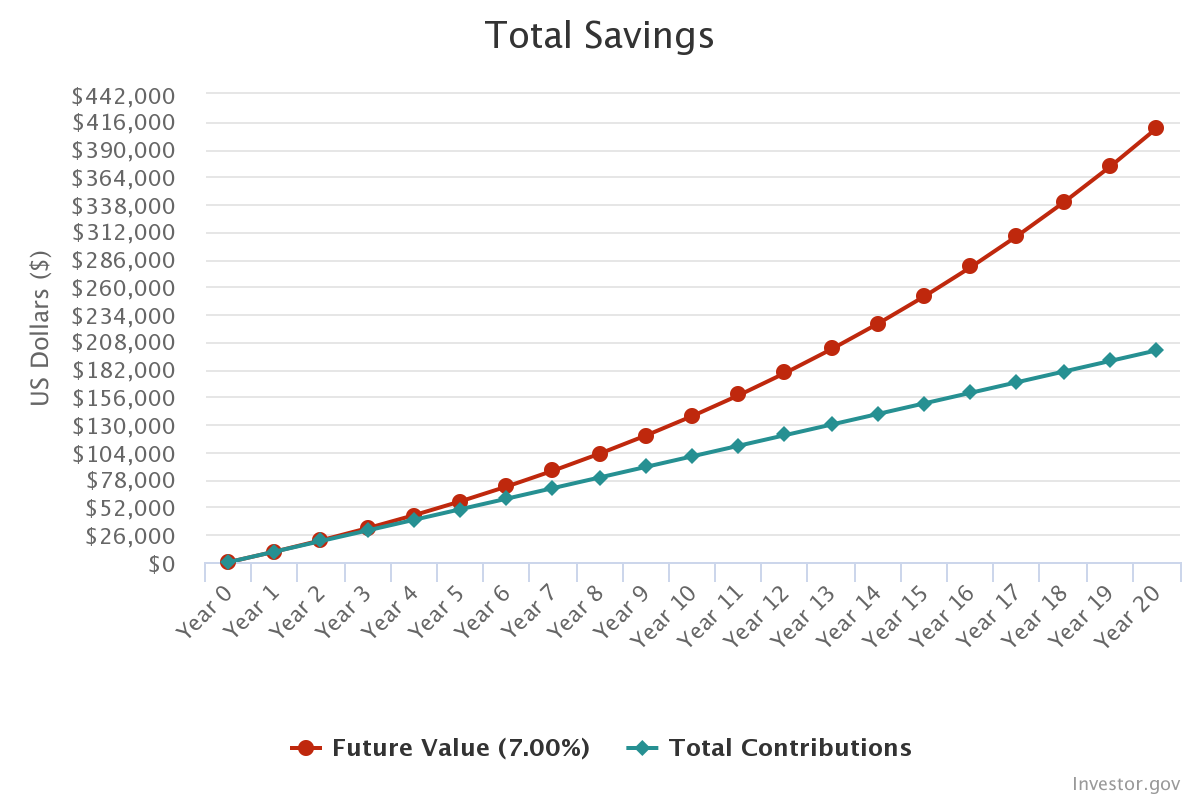
            Compound interest is a powerful force that can significantly impact your savings. Let’s say you start saving $10,000 per year at age 25 and invest it in a retirement account with an average annual return of 7%. By the time you reach age 45, you would have contributed a total of $200,000 ($10,000 per year for 20 years). However, thanks to the compounding effect of interest, your retirement account balance would be approximately $410,000, more than double your total contributions. This example highlights the importance of starting early and letting compound interest work over a long period.

            The Role of Return on Investment

            The return on your investments plays a vital role in determining when you can retire. Consider the following example: Suppose you aim to accumulate $1 million for retirement, and you save $30,000 per year. If your investment portfolio has an average annual return of 5%, it would take approximately 21 years to reach your goal. Here’s how the calculation works: After the first year, you would have saved $30,000, and with a 5% return, your balance would be $31,500. In subsequent years, you save an additional $30,000 and earn a 5% return on your growing balance. By the end of 21 years, your savings would have grown to approximately $1 million. However, with a higher return of 8%, you could achieve the same target in around 17 years. The power of compounding is amplified by higher returns, enabling you to reach your retirement goals sooner.

            The Time vs. Money Trade-Off

            Early retirement requires finding the right balance between saving aggressively and enjoying life along the way. Saving a higher percentage of your income allows for a shorter accumulation phase. Evaluating your priorities and determining the optimal savings rate can help you align your financial and lifestyle objectives.

            Reducing Expenses

            Reducing expenses is a crucial aspect of early retirement. By identifying areas where you can cut back and adopting frugal habits, you can accelerate your savings growth. For example, reducing your annual expenses by $5,000 can save you an additional $125,000 over 25 years. Every dollar saved not only reduces your expenses but also lowers the amount you need to save for retirement.

            Conclusion

            Achieving early retirement is a realistic goal when armed with the knowledge of the simple math behind it. By saving a significant portion of your income, following the 4% rule, harnessing the power of compound interest, and carefully managing your investments, you can pave the way to financial independence sooner than you might have thought possible. Remember to find the right balance between saving and enjoying life along the way, and stay flexible to adapt to changing circumstances. Start crunching the numbers and take the first steps towards the fulfilling and liberating journey of early retirement.

            Best Laptop for Math Majors

            Are you a passionate math aficionado, tirelessly exploring complex equations and unraveling the mysteries of numbers? Introducing the latest and greatest laptops for math majors – a true game-changer that will elevate your studies to unprecedented heights of success!

            As a college math major, you understand the vital role technology plays in your academic journey. From advanced calculus to linear algebra and data analysis, having a powerful and reliable laptop is no longer a luxury but a necessity. That’s where these exceptional laptops come into play, designed to meet the unique needs of math enthusiasts like you.

            Here are the top laptops that will greatly aid your journey throughout your math degree:

            ASUS ROG Zephyrus G14

            This powerful laptop is equipped with an AMD Ryzen 9 processor and a dedicated NVIDIA GeForce RTX graphics card, providing exceptional computational power. The stunning 14-inch WQHD display offers precise visuals for graphing complex equations and exploring mathematical concepts. Its lightweight design and long battery life make it perfect for math majors on the move.

            Asus – ROG Zephyrus 14 WQXGA 120Hz Gaming Laptop

            Lenovo ThinkPad P15

            Designed for demanding computational tasks, the ThinkPad P15 features an Intel Core i7 or i9 processor and a vibrant 15.6-inch 4K UHD display. Its powerful graphics capabilities enable smooth rendering of mathematical visualizations and simulations. With ample storage and memory, you can tackle large datasets and complex mathematical models effortlessly.

            OEM Lenovo ThinkPad P15s Gen 2 15.6” FHD IPS (2022 P16s)

            Dell Precision 5750

            This professional-grade laptop boasts an Intel Xeon processor and a stunning 17-inch UltraSharp 4K display, providing exceptional performance and visual clarity. The NVIDIA Quadro graphics card ensures smooth rendering of complex mathematical visualizations and simulations. With its robust build and advanced cooling system, it can handle intensive mathematical computations with ease.

            Dell Precision 5750 17.3″ Mobile Workstation

            Microsoft Surface Book 3

            Combining versatility and power, the Surface Book 3 features an Intel Core i7 processor and a detachable 13.5 or 15-inch PixelSense display. Its lightweight design and long battery life make it ideal for on-the-go math majors. With its high-resolution touchscreen and support for the Surface Pen, you can effortlessly sketch out mathematical proofs and take handwritten notes.

            NEW Microsoft Surface Book 3 – 15″ Touch-Screen

            HP ZBook Studio G8

            This mobile workstation is a powerhouse, featuring an Intel Core i9 processor and a stunning 15.6-inch 4K UHD display. The NVIDIA RTX graphics card ensures smooth rendering of complex mathematical visualizations and simulations. Its durable build and extensive connectivity options make it a reliable choice for math majors requiring high-performance computing.

            HP ZBook Studio G8 Mobile Workstation 2023


            Best Laptop for Math Software

            Now, let’s talk about the math software that will take your mathematical prowess to new heights:

            • MATLAB: This powerful software is widely used in various math disciplines, such as numerical analysis, linear algebra, and differential equations. With the computational capabilities of these laptops, you can run complex algorithms, perform simulations, and visualize data in MATLAB with remarkable speed and efficiency.
            • Mathematica: Known for its symbolic and numerical computation capabilities, Mathematica is a go-to software for math majors. The high-performance processors and ample memory of these laptops ensure smooth execution of Mathematica, allowing you to explore mathematical concepts, solve equations, and visualize mathematical models effortlessly.

            These laptops are optimized to handle the computational demands of math software like MATLAB and Mathematica. From performing advanced calculus operations to solving complex linear algebra problems, these laptops provide the processing power, memory, and storage needed to tackle any mathematical challenge. The high-resolution displays enable clear visualization of mathematical concepts and graphical representations, enhancing your understanding and analysis.

            Picture yourself immersed in the world of mathematics, armed with the latest and greatest laptops for math majors. From lectures to study groups, from complex calculations to groundbreaking discoveries, these laptops are your reliable partners, unleashing your full potential and propelling your mathematical pursuits to new heights.

            In conclusion, the right laptop can be a transformative tool, enabling you to delve deeper into the realm of mathematics. Embrace the power of technology and equip yourself with the perfect laptop tailored to your needs. Unleash your mathematical genius and soar to unimaginable heights of success with the best laptop for math majors by your side!

            Debunking the Myth: Is Calculus the Hardest Math Class?

            Is calculus truly the toughest math? Discover the truth as we unravel the complexities of calculus while exploring its beauty and accessibility. We’ll also delve into other challenging math subjects that surpass calculus in difficulty.

            Introduction

            Is calculus the hardest math class? This question has intrigued many students and sparked numerous debates. In this article, we will delve into the intricacies of calculus, debunking myths and shedding light on its beauty and accessibility. Additionally, we’ll explore other challenging math subjects that surpass calculus in terms of difficulty.

            The Foundation of Calculus

            Calculus, often regarded as the pinnacle of mathematical achievement, is built upon fundamental principles. It consists of two main branches: differential calculus and integral calculus. Differential calculus focuses on understanding rates of change, while integral calculus deals with the accumulation of quantities. By grasping these foundational concepts, the perceived complexity of calculus can be demystified.

            Practical Applications of Calculus

            One reason calculus has gained a reputation for being challenging is its extensive use in various scientific fields. From physics and engineering to economics and computer science, calculus provides indispensable tools for modeling and solving real-world problems. It allows us to analyze motion, predict outcomes, optimize systems, and understand complex phenomena. By learning to apply calculus to practical situations, the perceived difficulty begins to fade.

            Other Challenging Math Subjects

            While calculus poses its own set of challenges, there are several math subjects that surpass it in terms of difficulty. Here are a few examples:

            1. Advanced Linear Algebra: Building upon the foundational concepts of linear algebra, advanced topics such as eigenvectors, eigenvalues, and matrix factorizations can be highly intricate and abstract.
            2. Abstract Algebra: Abstract algebra deals with algebraic structures such as groups, rings, and fields, which involve complex axioms and abstract concepts, requiring a strong grasp of mathematical logic.
            3. Number Theory: Exploring the properties of integers and prime numbers, number theory involves intricate patterns and challenging proofs, making it a fascinating but demanding branch of mathematics.
            4. Differential Geometry: Bridging calculus and geometry, differential geometry studies smooth curved surfaces and manifolds, requiring a deep understanding of differential equations and tensor calculus.

            A Matter of Perspective

            Is calculus inherently difficult, or does it simply require a shift in perspective? Many students approach calculus with preconceived notions, believing it to be insurmountable. However, understanding the underlying concepts and building a solid foundation through practice can make the subject more approachable. Like any discipline, mastering calculus requires patience, perseverance, and an open mind.

            Conclusion

            Contrary to popular belief, calculus may not necessarily be the hardest math class. While it presents challenges, it also offers profound beauty and practical applications. By debunking the myth surrounding calculus, we hope to inspire students to embrace this fundamental branch of mathematics. Additionally, we’ve explored other challenging math subjects that surpass calculus in difficulty, highlighting the breadth and depth of mathematical exploration.

            So, let go of the notion that calculus is insurmountable, and embark on an exciting journey into the world of mathematics—where complexity meets elegance, and challenges transform into triumphs.

            Best SAT Math Prep Book

            🔥📚 Discover the Best SAT Math Books: Turbocharge Your Scores! 📚🔥

            Attention, aspiring scholars and SAT conquerors! Are you ready to unlock the secrets to mastering the math section of the SAT? Look no further, for we have unearthed a hidden gem that will skyrocket your scores and propel you towards academic triumph! Introducing the following best SAT Math Books – your ultimate weapon for conquering the numbers game and clinching that dream score!

            🚀 The Power of Proven Techniques 🚀

            Don’t settle for mediocre prep materials when you can have access to cutting-edge strategies that guarantee success! Here are some of the best SAT math prep books recommended by experts:

            “The Official SAT Study Guide” by The College Board

            This comprehensive guide is the holy grail of SAT preparation. It includes real SAT questions from past exams, detailed answer explanations, and valuable test-taking strategies. With eight full-length practice tests, targeted practice questions, and a review of math concepts, it provides an authentic SAT experience and helps you track your progress.

            The Official SAT Study Guide

            “PWN the SAT: Math Guide” by Mike McClenathan

            Known for its clear explanations and effective strategies, this book covers all math topics tested on the SAT. It breaks down complex concepts into easily digestible pieces, enabling you to master each topic and maximize your score. With over 350 practice questions and accompanying explanations, this guide offers ample opportunities to practice and reinforce your understanding.

            PWN the SAT: Math Guide

            “Dr. John Chung’s SAT Math” by Dr. John Chung

            Dr. John Chung’s book is renowned for its challenging practice questions and rigorous content. It focuses on building a solid foundation of math concepts and provides in-depth explanations to help you understand the underlying principles. With over 600 practice questions, including those from previous SAT exams, this book offers extensive practice to enhance your problem-solving skills.

            Dr. John Chung’s SAT Math

            “SAT Prep Black Book: The Most Effective SAT Strategies Ever Published” by Mike Barrett

            This book offers a unique approach to SAT preparation, focusing on understanding the SAT’s logic and mindset. It provides comprehensive explanations of SAT questions, strategies for each section, and tips to avoid common traps. With detailed walkthroughs of real SAT questions and a step-by-step guide to creating your own personalized study plan, this book equips you with the tools for success.

            SAT Prep Black Book: The Most Effective SAT Strategies Ever Published

            “The College Panda’s SAT Math: Advanced Guide and Workbook” by Nielson Phu

            Geared towards students aiming for a top-notch score, this book delves into advanced math topics tested on the SAT. It covers challenging concepts such as advanced algebra, coordinate geometry, and trigonometry. With over 500 practice questions and multiple full-length practice tests, this guide helps you master the most difficult math problems and ace the SAT Math section.

            The College Panda’s SAT Math: Advanced Guide and Workbook for the New SAT

            📖 Comprehensive Content, Crystal Clear Explanations 📖

            Let’s face it – SAT math can be daunting. But fear not, for the SAT Math prep books above have got your back! Packed with comprehensive content covering every essential topic, the books cover the essentials of SAT math. Each concept is explained in a crystal-clear manner, allowing you to grasp even the most complex mathematical ideas effortlessly. Say goodbye to confusion and hello to confidence!

            🏆 Unrivaled Practice Makes Perfect 🏆

            We all know that practice makes perfect, and the SAT Math prep books ensure you have ample opportunities to sharpen your skills. Featuring a treasure trove of practice questions and full-length mock exams, the books provide the ideal platform for you to put your newfound knowledge to the test. With each problem you solve, you inch closer to SAT math mastery!

            🎯 The Shortcut to Success 🎯

            Why waste precious time and effort searching for various resources when the ultimate SAT math prep solution is right here, within your grasp? The SAT Math prep books are your shortcut to success! They save students a lot of time by focusing on what is essential and likely to be tested. Imagine the confidence radiating from you as you walk into the SAT exam, armed with unrivaled knowledge and an unbeatable strategy. Success is no longer a dream; it’s a reality waiting to be seized!

            🌟 Turbocharge Your Scores with the SAT Math Prep Books! 🌟

            Time is of the essence! The SAT Math prep books are your ticket to unlocking academic excellence and propelling yourself towards a bright future. Don’t let this opportunity slip through your fingers. Grab your copy now and embark on a transformative journey towards SAT math domination!

            Best GRE Math Prep Book

            Best GRE Quant Prep Book

            Are you ready to conquer the GRE Math (Quantitative) section and leave it trembling in fear? Are you on the hunt for the ultimate weapon to boost your math scores and secure your spot in the top percentile? Look no further! We are about to reveal the best-kept secret that will skyrocket your math prowess: the best GRE Math prep book recommendations handpicked just for you!

            Now, you might be wondering, “What is the best GRE prep book out there?” These are no ordinary textbooks. They are game-changers, formidable weapons forged by the brightest math minds, tailored specifically to tackle the challenging GRE Math Quant section.

            But don’t just take our word for it. Let’s dive into the actual book recommendations that have garnered glowing reviews and transformed countless aspiring test-takers into math champions:

            “5 lb. Book of GRE Practice Problems” by Manhattan Prep

            This behemoth of a book packs a punch with over 1,800 practice problems covering all areas of the GRE, including math. With detailed explanations for every problem, this comprehensive resource will strengthen your math skills and boost your confidence. It’s the perfect companion for those aiming to excel in the GRE Math section.

            5 lb. Book of GRE Practice Problems Problems on All Subjects

            “GRE Math Workbook” by Kaplan Test Prep

            Kaplan is a trusted name in test preparation, and their GRE Math Workbook lives up to the reputation. Packed with targeted practice sets, this workbook hones your skills in the specific math areas tested on the GRE. The step-by-step explanations and test-taking strategies provided will ensure you’re well-prepared for the math challenges that lie ahead.

            GRE Math Workbook: Score Higher with 1,000+ Drills & Practice Questions (Kaplan Test Prep)

            “Official GRE Quantitative Reasoning Practice Questions” by Educational Testing Service (ETS)

            Who better to turn to for GRE preparation than the creators of the exam themselves? ETS offers this official guide that includes real GRE questions to help you familiarize yourself with the test format. The book features hundreds of authentic practice questions, allowing you to gauge your math proficiency and identify areas that need improvement.

            Official GRE Quantitative Reasoning Practice Questions

            “GRE Math Prep Course” by Jeff Kolby

            This comprehensive prep course offers a systematic approach to mastering GRE Math. With clear explanations, worked examples, and practice exercises, it covers all the essential topics and strategies you need to excel. The book also includes tips on how to manage your time effectively during the exam, ensuring you perform your best under pressure.

            GRE Math Prep Course (Nova’s GRE Prep Course)

            “GRE Math Bible” by Jeff Kolby and Derrick Vaughn

            The GRE Math Bible lives up to its name, providing comprehensive coverage of the math concepts and techniques tested on the GRE. It offers a wealth of practice questions with detailed solutions, allowing you to reinforce your understanding and improve your problem-solving skills. With its focused approach, this book will help you unlock your maximum math potential.

            GRE Math Bible


            Remember, success favors the bold! Don’t settle for mediocrity when you can excel in the GRE Math section. Grab one or more of these highly recommended books today and embark on your journey to math mastery!

            P.S. Act now and take advantage of the incredible resources available for GRE Math preparation. Alongside these books, you’ll find valuable tips, study guides, and additional practice materials to enhance your GRE Math preparation. Don’t miss out on this opportunity to skyrocket your math scores and secure your future success. Visit reputable online retailers or local bookstores to get your hands on the best GRE Math prep books today!

            Taylor Swift and Math: Exploring the Fascinating Connections

            Taylor Swift Math

            Taylor Swift, the renowned singer-songwriter, has a curious affinity for numbers that weaves its way into her music and personal life. From her favorite number to the strategic use of numbers in her album titles, let’s delve into the intriguing connections between Taylor Swift and math.

            13: Taylor Swift’s Lucky Number

            One of the most well-known numerical associations with Taylor Swift is her fondness for the number 13. Throughout her career, Swift has expressed her love for this seemingly unconventional choice. Born on December 13th, she considers it her lucky number. In interviews, she has playfully mentioned that 13 has brought her good fortune, and she often incorporates it into her performances and personal choices.

            Albums with Numbers: Symbolism and Chronology

            1989 (CD) Taylor Swift

            Taylor Swift’s discography showcases a distinctive pattern of album titles that feature numbers. These numbers hold personal significance to Swift and often represent specific time periods or themes in her life. Some notable examples include:

            • “1989” (2014): Named after the year of her birth, this album marked a departure from her country roots and embraced a pop sound.
            • “22” (2012): Symbolizing Youthful Joy and Carefree Moments

            Released in 2012, “22” is a track on Taylor Swift’s album “Red”. While the album as a whole explores themes of love and heartbreak, “22” stands out as an anthem celebrating the exuberance of youth. The number 22 holds significance as a representation of carefree moments, wild adventures, and the joyous spirit of being young. The song captures the essence of embracing life’s possibilities and cherishing the freedom that comes with youth.

            “Red” by Taylor Swift

            In the lyrics of “22,” Swift sings, “Everything will be alright if we just keep dancing like we’re 22.” The line encapsulates the youthful energy and optimism that permeate the song. By incorporating the number 22, Swift creates a relatable and universal experience that resonates with her audience, reminding listeners of the joy and spontaneity associated with their own youth.

            Taylor Swift Number

            Taylor Swift’s fascination with numbers provides a captivating lens through which to appreciate her artistry. From her love for the number 13 to the deliberate use of numbers in album titles, Swift infuses her music with personal symbolism and chronicles her journey as an artist. While her connection to math extends beyond numerical patterns, it adds another layer of intrigue to her already captivating persona. Exploring the interplay between Taylor Swift and math reveals the multifaceted nature of her creative expression and further deepens our appreciation for her music.

            Best Calculator for Statistics

            Best Calculator for Probability and Statistics

            When it comes to statistical analysis, having the best calculator by your side is paramount. We have handpicked the top-rated calculators available on Amazon, specifically designed to meet the rigorous demands of statistical computations. These calculators combine advanced statistical functions, intuitive interfaces, and unparalleled precision, making them indispensable for any statistical enthusiast. Say goodbye to manual calculations and unlock your statistical mastery with these extraordinary calculators.

            Best Casio Calculator for Statistics: Casio FX-991EX Scientific Calculator

            The Casio FX-991EX Scientific Calculator is a statistical powerhouse. With over 500 built-in functions, including a wide range of statistical analyses, regression, probability, and hypothesis testing, this calculator offers unrivaled versatility. Its high-resolution display and intuitive interface make it a user-friendly tool for tackling complex statistical problems. Experience the precision and reliability of the Casio FX-991EX Scientific Calculator available on Amazon.

            Casio FX-991EX Engineering/Scientific Calculator

            Texas Instruments TI-34 Multiview Calculator for Statistics

            The Texas Instruments TI-34 Multiview Calculator is an excellent choice for students and professionals looking for a compact yet powerful calculator for statistical analysis. With its four-line display and intuitive interface, this calculator allows for easy entry and review of multiple calculations simultaneously. It offers statistical functions, including mean, standard deviation, and regression, making it a versatile tool for basic to intermediate statistical analyses. Discover the Texas Instruments TI-34 Multiview Calculator on Amazon and simplify your statistical computations.

            Texas Instruments TI-34 MultiView Scientific Calculator

            Texas Instruments TI-84 Plus CE Graphing Calculator

            The Texas Instruments TI-84 Plus CE Graphing Calculator is renowned for its robust graphing capabilities and advanced statistical functions. With its vibrant color display, customizable features, and extensive statistical analysis tools, this calculator is a favorite among students and professionals alike. Whether you need to perform regressions, analyze data sets, or visualize statistical concepts, the TI-84 Plus CE has you covered. Explore the Texas Instruments TI-84 Plus CE Graphing Calculator on Amazon and unlock your statistical prowess.

            Texas Instruments TI-84 Plus CE Color Graphing Calculator

            HP 10BII+ Financial Calculator

            While not strictly a statistical calculator, the HP 10BII+ Financial Calculator is a reliable and affordable option for basic statistical calculations. It offers functions for mean, standard deviation, and linear regression, making it suitable for introductory statistical courses or quick calculations on the go. With its intuitive interface and compact design, the HP 10BII+ is a convenient choice for statistical calculations. Discover the HP 10BII+ Financial Calculator on Amazon and simplify your statistical analyses.

            HP 10bII+ Financial Calculator

            Best Statistical Calculators on the Market

            Statistical enthusiasts, your search for the perfect calculator ends here! Explore our meticulously selected calculators, available on Amazon, and unlock your statistical mastery. Whether you’re a student embarking on statistical coursework, a researcher diving into data analysis, or a professional seeking to make data-driven decisions, these calculators will be your trusted ally. Embrace precision, power, and versatility with the Casio FX-991EX, Texas Instruments TI-84 Plus CE, and HP 10BII+ calculators and unleash your analytical prowess.

            Best Calculator for Engineering

            Best Calculator for Mechanical Engineering

            Mechanical engineering involves intricate calculations, such as solving equations, analyzing forces, determining stresses and strains, and designing mechanical systems. A calculator streamlines these calculations, saving time and ensuring accuracy.

            Texas Instruments TI-Nspire CX CAS: The Engineering Powerhouse

            The Texas Instruments TI-Nspire CX CAS is an engineering marvel. This calculator combines raw power with advanced functionality, including a Computer Algebra System (CAS), enabling you to conquer complex equations with ease. With its vibrant color display, intuitive interface, and extensive graphing capabilities, this calculator is a must-have for any engineering enthusiast. Discover the TI-Nspire CX CAS on Amazon and unlock a world of engineering possibilities.

            Texas Instruments TI-Nspire CX II CAS Color Graphing Calculator with Student Software (PC/Mac)

            Casio FX-115ES PLUS: Precision and Versatility at Your Fingertips

            When precision is paramount, the Casio FX-115ES PLUS shines. This scientific calculator boasts over 280 built-in functions, including advanced engineering calculations, matrices, and equation solving. Its Natural Textbook Display ensures easy comprehension of mathematical expressions, making it a trusted companion for engineering courses and professional endeavors. Explore the Casio FX-115ES PLUS on Amazon and experience the power of precision.

            Casio fx-115ESPLUS2 2nd Edition, Advanced Scientific Calculator

            Best Calculator for Electrical Engineering

            Electrical engineers often deal with complex circuit analysis, involving calculations of voltage, current, resistance, power, and other electrical parameters. Calculators with advanced mathematical functions enable engineers to perform these calculations accurately and efficiently, simplifying circuit analysis and design.

            HP 35s Scientific Calculator: Classic Design, Unparalleled Performance

            Engineers who appreciate the elegance of classic calculators will find solace in the HP 35s Scientific Calculator. With its retro charm and robust functionality, this calculator offers a rich set of features, including engineering notation, 100+ built-in functions, and programmability. Experience the enduring legacy of HP calculators and explore the HP 35s Scientific Calculator on Amazon.

            HP 35s Scientific Calculator

            Sharp EL-W516TBSL Advanced Scientific Calculator: Your Engineering Ally on a Budget

            Looking for affordability without compromising on functionality? Look no further than the Sharp EL-W516TBSL Advanced Scientific Calculator. Packed with features like statistical calculations, complex number operations, and equation solving, this calculator proves that excellence can be accessible to all. Discover the Sharp EL-W516TBSL on Amazon and experience the engineering prowess within your budget.

            Sharp EL-W516TBSL 16-Digit Advanced Scientific Calculator

            Conclusion

            Engineers, your quest for the ultimate calculator ends here! With these meticulously selected Amazon offerings, you can fuel your engineering journey and elevate your mathematical genius to unprecedented heights. Harness the power of precision, versatility, and affordability with these exceptional calculators. Remember, greatness awaits those who dare to engineer their success. Seize this opportunity, explore the provided Amazon links, and claim your calculator companion today. Prepare to engineer a future brimming with triumph and mathematical brilliance!

            Terence Tao Masterclass

            Amazing that Terence Tao is doing a Math Masterclass!

            Terence Tao Teaches Mathematical Thinking

            In this Masterclass, famous Mathematician Terence Tao is going to teach math problem-solving skills to the general audience. In fact, not much math background is necessary! There is also no homework, just relax and learn from the Mozart of Math!

            Professor Terence Tao is a Fields Medallist (Math equivalent of the Nobel Prize). He certainly knows his stuff and is an expert in the field! He also has a knack for explaining abstract mathematical concepts in a very clear and interesting way.

            Masterclass Link: Terence Tao Teaches Mathematical Thinking

            Masterclass usually chooses top talents in their respective fields to give a lecture. For example, previously Garry Kasparov also gave a Masterclass on chess.

            Terence Tao Masterclass Review

            Overall, Terence Tao’s masterclass will be great for students, homeschool parents, and even future mathematicians. It will certainly help to inspire them to have a greater passion in mathematics.

            Mathematics is more about the mindset and the approach, rather than just the answers. The rote learning techniques of math can be learnt by anyone, but it takes a master like Terence Tao to be able to explain and demonstrate the beauty of mathematics.

            If you have any feedback on Terence Tao’s Masterclass, do post it in the comments below!

            Terence Tao Teaches Mathematical Thinking

            H2 Math Tuition 2020

            H2 Math can prove to be quite challenging for many students. Historically, the distinction rate is 50%, meaning that half of the student population will get an ‘A’ grade.

            However, note that those 50% can be heavily represented by the top schools RI, HCI, NJC where almost all students get ‘A’. At the end of the day, the ‘A’ level students are facing heavy competition from the IP cohort (who were absent from the O levels).

            Tough topics in ‘A’ level H2 Math:

            Case study: I tutored a student (from China) studying in NJC for H2 Math. Although she was quite a strong student with good Math foundation (definitely above average), nevertheless the NJC H2 Math paper was set so tough that she only scored 50+ out of 100 in the prelims. Many students in her NJC class outright failed for the prelims (below 50 marks). There were some weaknesses in her H2 Math skills, for example certain topics like Integration and P&C, and also carelessness issues. After several months of tutoring, noticeable improvements were observed. In the end for the actual ‘A’ levels, she managed to score A grade for H2 Math.

            Read more on student testimonials here: Testimonials


            For H2 Math tuition, contact our experienced tutor Mr Wu at:

            Email: mathtuition88@gmail.com

            Online Math Tuition Singapore

            We provide online Math Tuition using Zoom, Skype or Google Hangouts for the following subjects:

            • E Maths (Sec 3 & Sec 4)
            • A Maths (Sec 3 & Sec 4)
            • H2 Maths
            • H3 Maths
            • University Maths (selected modules)
            • Olympiad Math

            Do contact our tutor Mr Wu at:

            Email: mathtuition88@gmail.com

            Phone (WhatsApp/SMS preferred):

            Face-to-face home tuition is also available at West region of Singapore (near Jurong East/ Clementi/ Bukit Batok).

            Homeschool Math Challenging Puzzles

            The questions listed are also very suitable as PSLE Challenging Math Problem Sums.

            Basically, for Grade 2-4, they are very challenging.

            For Grade 6 (Primary 6, 12 year old students), they are challenging math questions.

            Do give it a try and see if your child can solve it!

            mathtuition88's avatarMathtuition88

            Homeschool Math Challenging Questions

            Mathtuition88 will be starting a series of Homeschool Math Challenging Problems, aimed at age 8 to 10 (Grade 2 to 4).

            This series is targeted at kids age 8 to 10 who are strong / gifted at mathematics and wish to further stretch their potential. It is also useful for children who may not be strong in math at the moment, but have a keen interest in math nonetheless.

            In particular, it is very suitable for the following purposes:

            • Homeschooling for gifted kids
            • Preparation for GEP (Gifted Education Programme) screening and selection tests
            • Preparation for Math Olympiad
            • Puzzles for kids interested in math but find school work too easy.
            • PSLE challenging Math problem sums. The questions are also well within the PSLE Math Syllabus, and will be challenging to Primary 6 students as well.

            This series of questions will follow the Singapore Math syllabus for Grade…

            View original post 66 more words

            Homeschool Maths Puzzles with Answers: The “Average” Question

            The average of 5 numbers is 73. When 2 numbers were removed, the average decreased by 3. What is the average of the 2 numbers that were removed?


            This is part of a series on Homeschool Math Challenging Puzzles, suitable for Grades 2-4. (Of course, students of other grades are also welcome to try them out.) The questions are suitable for:

            • Homeschooling for gifted kids
            • Preparation for GEP (Gifted Education Programme) screening and selection tests
            • Preparation for Math Olympiad
            • Puzzles for kids interested in math but find school work too easy.

            Answer:

            This is literally an “average” question. 😛 The word “average” appears 3 times.

            The trick is to focus on the total instead.

            The total of the 5 numbers is: 73×5=365.

            After removing 2 numbers, the average is 73-3=70.

            Hence, the total of the 3 remaining numbers is: 70×3=210.

            We can then conclude that, the total of the 2 removed numbers is:

            365-210=155.

            Hence, the average of the 2 removed numbers is: 155/2=77.5 or 75 1/2.

            Hardest Questions in Additional Mathematics (A Math)

            Additional Mathematics questions can range from standard all the way to super challenging among the secondary schools in Singapore.

            Certain schools (such as IP schools), and also some schools such as Anderson, Chung Cheng High School, are well known for setting hard A Math papers.

            Note that even though top schools set hard A Math papers, it is not often the case that top schools teach or prepare well their students for the tests! Often, the teachers in school teach at a basic level (due to time constraints or other factors), but still test at an advanced level. Hence, many students in top IP schools are not well prepared for their school’s tests (unless they have excellent self study skills or have a parent or tutor to guide them). It is not uncommon for a student in a top IP school to be failing his/her math tests due to the above phenomena (difficult tests which do not match what is taught in school).

            Some of the more difficult types of questions in the A Math syllabus are listed below.

            Algebra

            1. Conditions for ax^2 + bx + c to be always positive (or always negative).
              This type of question has potential to be very tricky. Somehow, many students will assume wrongly that b^2-4ac is always positive as well (where it should be the opposite).
            2. Partial Fractions with Improper Fractions.
              Only top schools tend to test improper partial fractions. Many students will miss out long division or make mistakes along the way.
            3. Binomial Theorem.
              Many students have serious problems with this topic. Also, not many seem to know that {n\choose 2}=\frac{n(n-1)}{2}.

            Logarithm

            Trigonometry

            • Sketching of Tangent graphs.
              90% of all sketching questions are on Sine or Cosine. Only top schools will set tangent sketching questions, and many students will be caught unaware.
            • Half-angle formula sin(x/2) or Quadruple angle formula sin(4x)
              Top schools like to test half-angle formula, many students who have not seen such questions will be stuck.

            Integration

            • Finding area to the left of the curve, i.e. \int x\,dy.
              Most schools kind of brush off this type of questions during teaching. But it is a hot topic for testing among top schools. Hence, students will have a hard time solving it if they lack practice for this type of questions.

            Poll Results: How many marks to get ‘A’ for H2 Math

            Almost 100 people have voted on the poll on “How many marks to get ‘A’ for H2 Math“.

            The results show that the majority (57.6%) of voters think it takes at least 75 marks to get ‘A’ for H2 Math. Notably, a significant percentage (27.17%) think that it takes 80 marks and above to get ‘A’ for H2 Math.

            Students who have taken the H2 Math exam can actually estimate the cut-off point for ‘A’ grade quite well. Basically, the worked solutions are typically released by seniors/tutors, and students can estimate their own marks rather easily. Then, they can compare with their actual grade received.

            Nevertheless, the above is just a poll, it may not be 100% accurate and it also depends on the difficulty of that year’s exam. An easier exam would naturally lead to a higher mark required for ‘A’ grade for H2 Maths.

            Is there bell curve for ‘A’ levels?

            This is a tricky question. The technically correct answer is that there is no bell curve, but there is a similar thing called “grade boundaries”. It is like certain schools saying that they have no Midyear Exam, but there is a “Block Test”. Read more about whether there is bell curve for ‘O’ and ‘A’ levels.

            Key Topics for IP Additional Mathematics

            The following are some of the most important topics for Integrated Programme (IP) Additional Mathematics. Also applicable for the usual ‘O’ level Additional Mathematics.

            Notice that Secondary 3 topics are very important as well, for the final Promo or ‘O’ levels. This can be a major problem for students who only start to study seriously in Secondary 4 — it can be a tough job to catch up with the important Secondary 3 topics.

            Secondary 3 topics

            • Binomial Theorem
            • Indices and Logarithms
            • Coordinate Geometry of Circles
            • Linear Law

            Secondary 4 topics

            • Trigonometry: R formula and Graphs
            • Differentiation and its Applications
            • Integration and its applications (including area under the curve)

            Interesting Linear Algebra Theorems

            Diagonalizable & Minimal Polynomial

            A matrix or linear map is diagonalizable over the field F if and only if its minimal polynomial is a product of distinct linear factors over F.

            Characteristic Polynomial

            Let A be an n\times n matrix. The characteristic polynomial of A, denoted by p_A(t), is the polynomial defined by \displaystyle p_A(t)=\det(tI-A).

            Cayley-Hamilton Theorem

            Every square matrix over a commutative ring satisfies its own characteristic equation:

            If A is an n\times n matrix, p(A)=0 where p(\lambda)=\det(\lambda I_n-A).

            Cool Math Games

            Some games are fun but not educational.

            On the other hand, some games are educational but not fun!

            This very popular website Cool Math Games is a combination of fun and educational!

            Benefit of Cool Math Games

            • Their games are all browser-based, there is no need to download anything. It can be played on your Internet Explorer or Chrome browser.
            • They have a wide range of different games, ranging from Numbers, Logic, Trivia, and Strategy.
            • Their games are kid-friendly and educational.

            Cool Math Games Example

            This games “Swap Sums” is suitable for lower elementary school kids (age 5-10). It starts off easy, but the later stages are actually quite challenging. For example, the stage below actually requires some thinking to get it right.

            This is the Swap Sums game from Cool Math Games.

            Cool Math Games Review

            Children naturally love to play games. When I was a child, my favorite activity was to play computer games. Hours can just fly by when playing games. When playing games that are educational at the same time, it can hugely benefit a child in terms of increasing his/her interest in the subject.

            Hence, parents are encouraged to let their child play educational games, such as Cool Math Games, to relax as well as to learn. Most children learn better when the content is fun and engaging.

            Ex-Actress Evelyn Tan Supports Her Kids Pursuing Entertainment Careers Without A Degree

            Quite interesting, and makes a bit of sense too. In this new age where almost everyone has a degree, not having a degree may in fact stand out (for unique career paths)! It carries risk though, naturally.

            Source: https://mustsharenews.com/evelyn-tan-kids/

            Son planned his career as streamer

            When her son Jairus, 12, said he wanted to be a Twitch streamer, Evelyn was confused. According to Toggle, she did not know about the online streaming platform for gamers.

            She called him a “thinker” — he had told her that if he started his career now, it would be established enough to be profitable by the time he turns 21.

            Her son then pointed out that a degree would be irrelevant to his career, which Evelyn said was fine.

            Evelyn Tan majored in Math in NUS

            Not many people know this, but actress Evelyn Tan once majored in Math in NUS, and graduated successfully. “Upon graduating from the National University of Singapore with a degree in mathematics, Tan joined the fifth edition of Mediacorp’s Star Search in 1997.”

            Read more at: https://mothership.sg/2019/11/evelyn-tan-interview/


            See also (famous actors/ newscasters/ singers who majored in Math):

            Slow and Steady Snail (Homeschool Math Favorite Challenging Puzzles)

            This is a favorite type of homeschool math challenging puzzle — The Snail question.

            Question: An aquarium is 47 cm deep. A snail starts at the bottom of the aquarium. Each day, during the daytime the snail climbs up 8 cm, and during the nighttime the snail slides down 3 cm. How many days will it take for the snail to climb out of the aquarium?


            This is part of a series on Homeschool Math Challenging Puzzles, suitable for Grades 2-4. (Of course, students of other grades are also welcome to try them out.) The questions are suitable for:

            • Homeschooling for gifted kids
            • Preparation for GEP (Gifted Education Programme) screening and selection tests
            • Preparation for Math Olympiad
            • Puzzles for kids interested in math but find school work too easy.

            Solution:

            A tempting answer would be 10 days. This is a trick! Those who get the answer “10 days” reason like this: each day the snail moves a net distance of 8-3=5 cm.

            Hence, 47/5=9 R 2.

            At the end of the 9th day, the snail moved 45 cm. Thus, rounding up will give 10 days as the answer. However, there is a tricky part to the question!

            The correct answer is 9 days.

            We can do a list:

            Day 1 — 5 cm

            Day 2 — 10 cm

            Day 3 — 15 cm

            Day 8 — 40 cm

            Day 9 day time — 40 +8 = 48cm > 47 cm !!!

            The snail is already out of the aquarium on Day 9!

            Fish Math

            How to ensure a pair of male-female for fish & Shrimp

            Given N fishes/shrimp, what is the probabillity of having at least 1 male-female pair?

            Probability = 1 – (Prob. Of all Male)- (Prob. Of all Female)

            If you have 4 fishes, Probability of having a breeding pair = 87.50%

            If you have 5 fishes, Probability of having a breeding pair = 93.75%

            If you have 6 fishes, Probability of having a breeding pair = 96.88%

            If you have 7 fishes, Probability of having a breeding pair = 98.44%

            If you have 8 fishes, Probability of having a breeding pair = 99.22%

            Stickers Math Question

            Abby, Brian, Charles, Dennis and Eason have 50 stickers altogether.

            Abby has the most stickers — she has 12 stickers.

            In second place (tied) are Brian and Charles.

            In third place is Dennis.

            In fourth place is Eason, with 6 stickers.

            How many stickers does Dennis have?


            This is part of a series on Homeschool Math Challenging Puzzles, suitable for Grades 2-4. (Of course, students of other grades are also welcome to try them out.) The questions are suitable for:

            • Homeschooling for gifted kids
            • Preparation for GEP (Gifted Education Programme) screening and selection tests
            • Preparation for Math Olympiad
            • Puzzles for kids interested in math but find school work too easy.

            For this type of questions, the easiest way to do is “trial and error”, also known as “guess and check”.

            Firstly, lets check how many stickers B, C, and D have together:

            50-12-6=32

            B C D Total (B+C+D) Comments
            9 9 14 32 Wrong! Since D is more than A
            10 10 12 32 Wrong! Since D is tied with A
            11 11 10 32 Correct!
            12 12 8 32 Wrong! Since B, C is tied with A

            For guess and check, the most important thing is to be systematic, rather than guess wildly. For instance, we can systematically increase our guesses for B, C.

            We can see that the only logical answer is:

            B= C=11

            D=10

            Answer: Dennis has 10 stickers.

            Marbles Math Question

            Aaron and Bob had some marbles in a box.

            At first, Bob had thrice as many marbles as Aaron.

            Aaron sold 5 marbles and Bob bought another 35 marbles.

            Then, Bob had 5 times as many marbles as Aaron.

            How many marbles were there in the box at first?


            This is part of a series on Homeschool Math Challenging Puzzles, suitable for Grades 2-4. (Of course, students of other grades are also welcome to try them out.) The questions are suitable for:

            • Homeschooling for gifted kids
            • Preparation for GEP (Gifted Education Programme) screening and selection tests
            • Preparation for Math Olympiad
            • Puzzles for kids interested in math but find school work too easy.

            Solution:

            This question can be solved using the “units” method, and “working backwards”.

            At the end, Bob had 5 times as many marbles as Aaron.

            We write:

            Aaron –> 1u

            Bob –> 5u

            Next, we work one step backwards (before Aaron sold 5 marbles and Bob bought another 35 marbles.)

            Aaron –> 1u + 5

            Bob —> 5u – 35

            Now, we calculate what is 3 times of Aaron (thrice of Aaron’s marbles):

            3 times of Aaron –> 3u + 15

            We can conclude that:

            3u+15 = 5u-35

            We may draw the above model, after which we can conclude that:

            2u –> 15+35=50

            1u —> 25

            Hence, Aaron had 1u+5 = 30 marbles at the start.

            Bob had 5u-35 = 90 marbles at the start.

            In total, there are 30+90= 120 marbles at first.

            Ans: 120


            Homeschool Math Challenging Puzzles

            Homeschool Math Challenging Questions

            Mathtuition88 will be starting a series of Homeschool Math Challenging Problems, aimed at age 8 to 10 (Grade 2 to 4).

            This series is targeted at kids age 8 to 10 who are strong / gifted at mathematics and wish to further stretch their potential. It is also useful for children who may not be strong in math at the moment, but have a keen interest in math nonetheless.

            In particular, it is very suitable for the following purposes:

            • Homeschooling for gifted kids
            • Preparation for GEP (Gifted Education Programme) screening and selection tests
            • Preparation for Math Olympiad
            • Puzzles for kids interested in math but find school work too easy.
            • PSLE challenging Math problem sums. The questions are also well within the PSLE Math Syllabus, and will be challenging to Primary 6 students as well.

            This series of questions will follow the Singapore Math syllabus for Grade 3 students, covering the following topics:

            1. Whole Numbers
            2. Fractions
            3. Money
            4. Measurement (Length, Mass, Volume)
            5. Time
            6. Area and Perimeter (rectangle/square)

            Although the syllabus above is elementary, we are choosing the toughest math questions (while still remaining in the framework of the syllabus). Hence, the title of the series is “Homeschool Math Challenging Puzzles for Grades 2-4”!

            As far as possible, the questions will be categorized under: https://mathtuition88.com/category/homeschool-math-challenging-puzzles/

            GEP Test Format

            There is limited information on the GEP Test Format on the official MOE website:

            IDENTIFICATION OF PUPILS FOR THE GEP

            The entry point into the GEP is at Primary 4.

            Pupils are identified for the GEP through a two-stage exercise in Primary 3.

            Stage Month Participants Papers
            Screening August Primary 3 pupils enrolled in government and government-aided schools English Language

            Mathematics

            Selection October Only shortlisted pupils will be invited to the Selection stage English Language

            Mathematics

            General Ability

            For the screening test, the duration for each paper is around 1.5 hours.

            For the selection test, there are traditionally two papers of 2.5 hours each:

            • Paper 1: English paper and a General Ability paper
            • Paper 2: Maths paper and another General Ability paper

            In August every year, the cohort of P3 students is invited to sit for a GEP screening test. The test is not compulsory but all children are encouraged to go for it. The test comprises an English and a Maths paper, about 1½ hours each.

            Out of the cohort of approximately 50,000 kids, some 3,000 pupils (about 6%) are shortlisted for the GEP selection test.

            The selection test takes place over two days in October, the first comprises an English paper and a General Ability paper, about 2½ hours in total. The second consists of a Maths paper and another General Ability paper, also about 2½ hours altogether.

            Source: http://hedgehogcomms.blogspot.com/2008/09/gep-testing-and-kiasu-ism-at-its.html


            GEP Test Syllabus

            Officially, the GEP Test can only test within the Primary 3 syllabus. (This is more relevant for Math than English. For English, it is more open-ended, they can test advanced GEP vocabulary like “cantankerous”.)

            For example, technically they are not supposed to test “speed” questions since that is a Primary 5 topic. Similarly, they are not supposed to test area/perimeter of circle questions, or even area/perimeter of triangle questions.

            Hence, the GEP Math Test Syllabus (according to the official Primary 3 syllabus) includes:

            1. Whole Numbers
            2. Fractions
            3. Money
            4. Measurement (Length, Mass, Volume)
            5. Time
            6. Area and Perimeter (rectangle/square)
            7. Angles (basic concepts of right angle, acute angle)
            8. Perpendicular & Parallel Lines (basic concepts)
            9. Bar graphs

            The above topics may seem deceptively easy. However, even for a simple topic like fractions, it is possible to test a question like the GEP Screening Test Question Sample: The Tap Question, which may stump many secondary school students.


            Related posts:

            The Notorious Collatz conjecture

            Terence Tao has uploaded his slides on the Collatz conjecture (targeted at high school students): https://terrytao.files.wordpress.com/2020/02/collatz.pdf

            A very enjoyable read indeed.

            The best “encyclopedic” reference on the Collatz conjecture is the one listed below, published by the American Math Society. Note that the Collatz conjecture remains unsolved as of today.


            The Ultimate Challenge: The 3x+1 Problem

            Sum of two metrics is a metric

            It is quite straightforward to prove or verify that the sum of two metrics (distance functions) is still a metric.

            Suppose d_1(x,y) and d_2(x,y) are metrics. Define d(x,y)=d_1(x,y)+d_2(x,y).

            Positive-definite

            d(x,y)\geq 0+0=0.

            d(x,y)=0 \iff d_1(x,y)=d_2(x,y)=0 \iff x=y.

            Symmetry

            d(x,y)=d_1(y,x)+d_2(y,x)=d(y,x).

            Triangle Inequality

            \begin{aligned}    d(x,y) &\leq d_1(x,z)+d_1(z,y)+d_2(x,z)+d_2(z,y)\\    &=[d_1(x,z)+d_2(x,z)]+[d_1(z,y)+d_2(z,y)]\\    &=d(x,z)+d(z,y)    \end{aligned}

            Note that it follows by induction that the sum of any finite number of metrics (e.g. three, four or five metrics) is still a metric.

            IP Math Syllabus (Integrated Programme Mathematics)

            Students and parents new to IP (Integrated Programme) may be confused on what is the Mathematics syllabus of IP Math. Indeed, it is very confusing as every school has its own syllabus. In general, the syllabus as a whole is not that different from ‘O’ level Mathematics, but the order in which the school teaches is unique to each school.

            In general, the topics can be divided as follows, following the famous assessment book “Mathematics (Integrated Programme)” by Wong-Ng Siew Hiong who is a teacher at RI. This is one of the very few IP Math books available in local bookstores.

            Secondary 3 IP Math Syllabus

            1. Geometrical Properties of Circles
            2. Solutions to Quadratic Equations
            3. Matrices & Simultaneous Equations
            4. Quadratic Functions, Inequalities & Roots of Equations
            5. Sets
            6. Relations & Functions
            7. Indices & Surds
            8. Exponential, Logarithmic & Modulus Functions
            9. Polynomials & Partial Fractions
            10. Graphical Solutions & Transformations
            11. Circular Measure
            12. Plane Geometry
            13. Coordinate Geometry & Equations of Circles
            14. Linear Law
            15. Trigonometry
            16. Further Trigonometry

            Secondary 4 IP Math Syllabus

            1. Binomial Theorem
            2. Probability
            3. Statistics
            4. Vectors
            5. Differentiation Techniques
            6. Differentiation and its Applications
            7. Integrated Techniques
            8. Applications of Integration
            9. Integration Applications — Area and Kinematics

            Sellfy free account to be discontinued

            Just received some news from Sellfy:

            Hi there,

            We have important news about your Sellfy account and your store https://sellfy.com/mathtuition88

            You have been on our transaction fee only plan (Legacy plan) since you signed up for Sellfy. We are truly thankful for being with us all this time!

            Due to considerable technical adjustments in our platform and supporting services, we are forced to discontinue the Legacy plan on February 1st, 2020 and switch into supporting subscription-based plans only https://sellfy.com/pricing/. We no longer offer Legacy plan for new users since March, 2016.


            Most likely, we won’t be continuing with Sellfy after February 1st, 2020.

            Hence, this is the last 1-2 months to purchases math notes/material from our online store: https://sellfy.com/mathtuition88 if you are interested. Thank you for the support!

            Formula for 3×3 Matrix Inverse

            Let \displaystyle A=\begin{pmatrix}a &b &c\\  d& e& f\\  g& h& i  \end{pmatrix}.

            Then,
            \displaystyle A^{-1}=\frac{1}{\det(A)}\begin{pmatrix}  ei-fh &ch-bi &bf-ce\\  fg-di &ai-cg &cd-af\\  dh-eg &bg-ah &ae-bd  \end{pmatrix}.

            This method is about the same speed as the Gaussian-Elimination method. However, if you have already calculated det(A), using the formula may be slightly faster.

            The formula provides an insight on why A is singular (not invertible) if det(A)=0. (Because, if det(A)=0, in the formula we would be dividing by 0 which is not allowed.)

            RIP Sir Michael Atiyah

            Rest in peace, Sir Michael Atiyah. Many scientists have called Atiyah the best mathematician in Britain since Isaac Newton.

            Read also our previous posts:

            Source: New York Times

            Michael Atiyah, a British mathematician who united mathematics and physics during the 1960s in a way not seen since the days of Isaac Newton, died on Friday. He was 89.

            The Royal Society in London, of which he was president in the 1990s, confirmed the death but gave no details. Dr. Atiyah, who was retired, had been an honorary professor in the School of Mathematics at the University of Edinburgh.

            Dr. Atiyah, who spent many years at Oxford and Cambridge universities, revealed an unforeseen connection between mathematics and physics through a theorem he proved in collaboration with Isadore Singer, one of the most important mathematicians of the last half of the 20th century.

            His work with Dr. Singer, of the Massachusetts Institute of Technology, led to the flowering of string theory and gauge theory as ways to understand the structure and dynamics of the universe, and has provided powerful tools for both mathematicians and theoretical physicists.

            Chinese High School Student “Proves” Goldbach Conjecture

            URL: https://bbs.hupu.com/24931041.html

            According to popular Chinese Social Media, a Chinese teenager from high school has purportedly proven the difficult Goldbach Conjecture, which is that every even integer greater than two is the sum of two prime numbers.

            Update: He has recently realized his mistake and deleted the post. Do check out his proof if you are interested!

            Preschool Math Tuition Books and Toys

            There seems to be an increasing demand for kindergarten Maths tuition for children of ages 2-6. (I have received many such requests lately.) Many parents are worried that their child may lose at the “starting line” which is Primary 1, hence are preparing beforehand during the ages of 2-6.

            Possibly, at this age the best way to learn is through play, that is why Math Toys are very useful.


            Skoolzy Rainbow Counting Bears with Matching Sorting Cups, Bear Counters and Dice Math Toddler Games 70pc Set

            Skoolzy Rainbow Counting Bears Toy is suitable for age 2, 3, 4, 5 or 6 year old preschoolers to learn to add, count, sort & stack.


            Goodnight, Numbers

            Goodnight, Numbers is an award-winning bestselling bedtime story for kids, that help them familiarize with numbers.


            Melissa & Doug Pattern Blocks and Boards – Classic Toy With 120 Solid Wood Shapes and 5 Double-Sided Panels

            The Pattern Blocks and Boards toy is useful for developing pattern recognition and visualization skills; all very useful skills when it comes to the GEP Logic Section at age 9. PSLE has some very tough visualization questions on nets of cubes, only children with strong visualization skills will be able to solve them. It is notoriously hard to train for such questions (though there are some tips and techniques), it is almost like either you see it or you don’t.

            Strong Visualization is needed to solve this type of questions, which appear in both GEP and PSLE. Source: How2become.com


            Times Tables the Fun Way Book for Kids: A Picture Method of Learning the Multiplication Facts

            Times Tables would be the most challenging Math for children of the age group 3-6. Hence, early mastery of this subject will give your child a headstart to learn other more advanced math.


            LeapFrog LeapStart Preschool 4-in-1 Activity Book Bundle with ABC, Shapes & Colors, Math, Animals

            This 4-in-1 book bundle enables your child to learn about the alphabet, shapes, colors, math, as well as animals.


            LEGO Education Set 45008 Math Train

            This LEGO (Duplo) set teaches numbers, basic math skills, and includes fun activity cards. Very educational and fun toy.

            The Hardest H3 Math Question (Combinatorics)

            I think this may be one of the hardest H3 Math Questions in history. It is taken from RI H3 Prelim 2018. It seems that even in top schools like RI, there are less than 50 people taking H3 Maths in any given year. Part (d) is extremely hard to get the formula for general r. In fact during the exam it is probably wise to skip such questions or give partial answers (e.g. the formula for r=3) as it is not worth the time for 3 marks.

            See also our related blog posts:

            Varignon’s Theorem (Surprising Geometry Theorem)

            I first learnt it from Quora:

            “Take any quadrilateral. It doesn’t have to be any special kind of a quadrilateral. Then connect the midpoints of its sides.

            Surprisingly, you will always get a parallelogram!”

            Quite a nice result. Some googling revealed that the name of this theorem is called Varignon’s Theorem.

            An illustration is found here:

            RI vs HCI vs NUSH

            Many excellent P6 students will be spoilt for choice at this stage, as they have been accepted by multiple schools under the DSA. Here are some views on RI versus HCI versus NUS High, which are the top 3 choices for boys strong in math/science:

            RI emphasize “all-rounder” and “leadership” in their culture. My personal experience is that it can get a bit competitive since many people there are literally good in all forms of studies (all subjects in humanities/sciences/languages maybe except Chinese), sports, and music, etc. The culture is similar in RGS. I find that there are some cultural and personality differences between the typical RI/RGS student and the typical HCI/NYGH student.

            The good points are that RI does have a lot of activities and opportunities like overseas school trips, top coaches for most CCAs, etc, that many schools don’t have. Also, many RI students are successful in securing government scholarships for top universities since their portfolio will be built up in a balanced way during their studies; there are many Community Involvement Programmes and other activities to boost the student’s portfolio.

            Certainly NUSH and HCI are very good schools too. Possibly advantages of NUSH is greater focus on science/math and advantage of HCI is greater emphasis on Chinese culture and tradition, which is useful as China is becoming a world power.

            Maybe you can check out this thread on RI vs HCI: https://www.kiasuparents.com/kiasu/forum/viewtopic.php?f=48&t=25209&start=370.

            Sir Michael Atiyah to reveal his awesome proof of the Riemann Hypothesis

            Source: https://twitter.com/HLForum/status/1042670700652318720

            According to the official twitter account of the Heidelberg Laureate Forum, Sir Michael Atiyah will prove the Riemann Hypothesis during the talk on Monday Sept. 25.

            According to him, it is a “simple” proof, based on previous work by von Neumann, Hirzebruch and Dirac. It is likely to have some relation to theoretical physics, since Dirac is a theoretical physicist. It has been rumored for quite some time that the Riemann Hypothesis is related to theoretical physics.

            The Riemann Hypothesis is the most famous and most difficult problem in mathematics. Sir Michael Atiyah is a 89 year old gentleman currently. It will be really groundbreaking if the Riemann Hypothesis is found to be successfully proved.

            Do check out our previous posts on the Riemann Hypothesis: