How Bathroom Faucet Factories Ensure Lead-Free Products
Lead contamination in drinking water has been a growing concern for homeowners worldwide, as prolonged exposure to this toxic metal can lead to serious health issues, including neurological and developmental problems. As awareness of lead-related hazards increases, consumers are demanding safer products for their homes—especially for items like bathroom and kitchen faucets that directly affect water quality.
Bathroom faucet factories play a pivotal role in addressing this concern. By implementing advanced safety protocols, sourcing premium materials, and adhering to stringent international regulations, these manufacturers ensure that their faucets are entirely lead-free while delivering top-notch functionality. In this blog, we will explore the steps and strategies that bathroom faucet factories use to produce lead-free products and maintain high quality standards.
Why Lead-Free Faucets Are Important
The push for lead-free bathroom faucets is more than just a trend; it’s a health imperative. Lead exposure through drinking water, even in trace amounts, poses serious risks. According to the Centers for Disease Control and Prevention (CDC), lead poisoning can cause significant developmental delays, especially in children. Pregnant women are also highly susceptible to lead exposure, which can harm fetal development.
Faucets that are used for drinking water must meet strict safety standards to prevent lead contamination. Therefore, bathroom faucet factories are investing heavily in ensuring their products are safe, durable, and hygienic.
Key Strategies Bathroom Faucet Factories Implement to Ensure Lead-Free Products
1. Sourcing High-Quality Materials
A lead-free faucet begins with safe materials. Leading faucet factories go to great lengths to source premium-quality raw materials that comply with international safety standards. Some of the key materials used are:
Low-Lead or No-Lead Brass: Brass is a widely used material in faucet production due to its durability and corrosion resistance. Bathroom faucet factories now use DZR (Dezincification Resistant) brass, which contains reduced levels of lead (<0.25%) in accordance with regulations like California AB1953 and NSF/ANSI 372 standards.
304 Stainless Steel: Stainless steel is naturally lead-free and has become a preferred material for modern faucet designs. Not only is it corrosion-resistant, but it is also eco-friendly, recyclable, and safe for water contact.
Advanced Polymers and Ceramics: Some faucet factories incorporate food-grade polymers and advanced engineering ceramics into their designs. These non-metal materials further minimize the risk of lead contamination.
Factories also audit their material suppliers regularly to ensure consistent compliance with safety certifications and global regulations.
2. Precision Engineering and Manufacturing Processes
Manufacturing processes play a vital role in eliminating lead risks. Bathroom faucet factories use advanced equipment and techniques to maintain product integrity and ensure adherence to lead-free standards.
Die-Casting and Forging: Using precision casting and forging techniques allows factories to tailor faucets with dense and uniform structures, minimizing the chance of impurities such as lead infiltrating the material.
Lead Isolation Processes: In situations where lead-containing components must be used in non-critical parts (such as outer fixtures), manufacturers create internal barriers. These barriers prevent direct contact between the water and materials that might leach contaminants into the supply.
Surface Coating Techniques: Factories apply innovative surface finishes such as Physical Vapor Deposition (PVD) or electroplating. These coatings provide a protective layer that reduces corrosion while acting as a safeguard against harmful metal leaching.
3. Rigorous Testing Protocols and Quality Assurance
Testing and quality control are integral to ensuring lead-free products. Leading bathroom faucet factories invest in advanced technologies and dedicated teams to inspect every product before it leaves the facility.
Lead Content Testing: Faucet components undergo rigorous laboratory testing to measure lead content using advanced techniques like Inductively Coupled Plasma Mass Spectrometry (ICP-MS). This ensures every product meets stringent safety requirements such as NSF/ANSI 61 standards for drinking water faucets.
Batch Sampling: Factories conduct regular sampling of production batches to detect manufacturing defects or contamination. By testing samples from every production line, factories maintain consistent quality and compliance.
Third-Party Certifications: To guarantee reliability, many factories partner with third-party organizations that offer certifications like WaterMark (Australia), CUPC (US/Canada), and ACS (European Union). These certifications validate that faucets meet international lead-free benchmarks.
4. Adhering to Strict Safety Standards and Regulations
Bathroom faucet factories are required to comply with global safety standards for lead content in plumbing products. Regulations differ between regions, but the shared goal is to reduce exposure to harmful substances in water supplies. Some key standards include:
California AB1953: Passed in 2006, this legislation requires plumbing fixtures sold in California to contain less than 0.25% lead in weighted average calculations. Many manufacturers adopted these requirements nationwide.
NSF/ANSI 61 and NSF/ANSI 372: These certifications are recognized globally as benchmarks for safe drinking water products. They mandate strict limits on material lead content and are commonly sought by reputable factories.
EU’s EcoDesign Directive: In Europe, faucet manufacturers adhere to the directive’s environmental and health-focused requirements, which emphasize reducing toxins like lead.
Keeping abreast of these regulations is crucial for factories aiming to expand internationally.
5. Educating Consumers About Lead-Free Benefits
Leading faucet factories don’t just focus on manufacturing top-quality products—they also educate their customers about lead-free faucets’ benefits and provide guidance for choosing safe options. Transparency builds trust:
Factory websites often share downloadable product certifications and test reports.
Instruction manuals specify compliance information and installation tips to maintain safety standards.
Callouts like “NSF Certified” appear prominently on product packaging to reassure consumers that faucets are made to meet health requirements.
This proactive approach empowers buyers to make informed decisions while showcasing the factory’s commitment to safety and quality.
6. Collaboration with Trusted Suppliers
A reliable faucet factory works closely with suppliers to ensure raw materials consistently meet lead-free requirements. High-quality suppliers will have their own certifications, adhere to industry standards, and provide traceability for all materials sourced. Strong supplier relationships foster smooth operations and ensure dependable product quality.
Challenges in Producing Lead-Free Faucets
While producing lead-free faucets offers immense benefits, it comes with its own challenges:
Cost Implications: Using lead-free metals and advanced manufacturing techniques can increase production costs. However, this is offset by customer demand for health-conscious, high-quality products.
Material Availability: Ensuring a steady supply of certified raw materials while reducing reliance on lead-containing components requires meticulous supply chain management.
Technical Complexity: Precision engineering and surface coating require advanced equipment and skilled labor, which might be a barrier for small-scale manufacturers.
Despite these challenges, reputable factories continue to raise the bar by leveraging innovation and prioritizing customer safety.
The journey to creating lead-free bathroom faucets is a testament to the growing commitment of manufacturers to producing safer, more sustainable products. By sourcing premium materials, implementing cutting-edge production techniques, adhering to rigorous testing protocols, and complying with international regulations, bathroom faucet factories ensure their products are lead-free without compromising on durability and aesthetics.
BMW M8 Carbon Fiber Rear Wing vs Fiberglass: Which Is Better?
The BMW M8 is a true masterpiece of engineering, combining breathtaking aesthetics with blistering performance. For many car enthusiasts, enhancing the M8’s aerodynamics and style is a priority. One of the most popular upgrades is the addition of a rear wing, which not only improves the car’s downforce but also elevates its aggressive appearance.
When deciding on the best BMW M8 Rear Wing, two materials stand out: Carbon Fiber and Fiberglass. Both materials offer unique benefits, but which one is better for your specific needs? In this blog, we’ll compare Carbon Fiber and Fiberglass Rear Wings based on performance, weight, aesthetics, durability, and cost to help you make an informed decision.
What Does a Rear Wing Do for Your BMW M8?
A rear wing is an aerodynamic accessory that plays a significant role in optimizing a car’s performance—particularly at high speeds. Here’s what a rear wing does for your BMW M8:
Increases Downforce: A rear wing presses the rear tires against the road, improving grip and stability during cornering or at high speeds.
Reduces Drag: By managing airflow around the vehicle, it optimizes aerodynamic efficiency.
Styling Enhancement: A well-designed rear wing accentuates the sporty and luxurious profile of the BMW M8.
With these benefits in mind, choosing the right rear wing material—Carbon Fiber or Fiberglass—is crucial for maximizing function and form.
Carbon Fiber vs Fiberglass Rear Wings: A Detailed Comparison
Now, let’s dive into the advantages and disadvantages of Carbon Fiber and Fiberglass rear wings for your BMW M8 across several key factors.
1. Weight
Carbon Fiber:
Carbon Fiber is famous for its ultra-lightweight properties. It significantly reduces the overall weight of your rear wing, which benefits the M8’s performance by improving handling, acceleration, and overall agility.
Fiberglass:
Fiberglass is relatively heavier than Carbon Fiber, but it’s still lighter than metal alternatives. While manageable for casual driving, the added weight of a fiberglass rear wing can slightly hinder performance for track enthusiasts or high-performance driving.
Winner: Carbon Fiber (better weight savings for performance-oriented drivers).
2. Aerodynamic Performance
Carbon Fiber:
The precise construction and rigidity of Carbon Fiber allow manufacturers to design highly aerodynamic shapes with incredible accuracy. This makes Carbon Fiber rear wings ideal for optimizing downforce and minimizing drag during high-speed driving.
Fiberglass:
Fiberglass offers decent aerodynamic capabilities but is typically less precise in its design compared to Carbon Fiber due to its thicker structure. This can result in slightly less efficient aerodynamic performance.
The signature woven pattern of Carbon Fiber adds a luxurious and aggressive look to the BMW M8. Additionally, Carbon Fiber often comes with a high-gloss finish that enhances the sporty aesthetic while making a bold design statement.
Fiberglass:
Fiberglass doesn’t have the premium visual appeal of Carbon Fiber. While it can be painted or finished to mimic Carbon Fiber, it lacks the depth, texture, and glossy sophistication of the real thing.
Winner: Carbon Fiber (more premium and visually striking).
4. Durability
Carbon Fiber:
Carbon Fiber is incredibly strong and resistant to wear, corrosion, and environmental conditions such as UV rays and heat. However, it can be brittle under heavy impact, which may result in cracking.
Fiberglass:
Fiberglass is durable and more flexible than Carbon Fiber, which gives it better resistance to minor impacts (e.g., a small bump). However, over time, fiberglass can be prone to surface wear and may require consistent upkeep.
Winner: Tie (Carbon Fiber for longevity and resistance; Fiberglass for better impact flexibility).
5. Installation
Carbon Fiber:
Carbon Fiber rear wings are precisely manufactured for perfect fitment, making them easy to install when purchased from reputable brands.
Fiberglass:
Fiberglass rear wings might require additional trimming or adjustments for perfect installation, which can add to installation time and cost.
Winner: Carbon Fiber (easier fitment with less adjustment required).
6. Cost and Value
Carbon Fiber:
Carbon Fiber rear wings are more expensive due to the advanced technology and materials used in their manufacturing. While the initial cost is higher, the value provided in terms of performance, durability, and style often justifies the price for BMW M8 enthusiasts.
Fiberglass:
Fiberglass is a more affordable alternative, making it a practical choice for car owners on a budget. However, it doesn’t provide the same long-term benefits and high-performance advantages as Carbon Fiber.
Winner: Fiberglass (best for budget options), but Carbon Fiber is ideal for enthusiasts seeking premium quality.
Which Is Better for Your BMW M8: Carbon Fiber or Fiberglass Rear Wing?
When considering whether to choose a Carbon Fiber or Fiberglass Rear Wing for your BMW M8, it depends on your priorities and how you plan to use your car. Let’s break it down:
Choose Carbon Fiber If:
You prioritize performance and want the best aerodynamic advantage.
You’re looking for a lightweight solution that enhances handling and agility.
You want a premium, high-end design that complements the BMW M8’s luxury status.
You value long-term durability and are willing to invest in a high-quality product.
Choose Fiberglass If:
You’re on a tight budget and want a cost-effective solution.
You want decent styling and performance without the added expense of Carbon Fiber.
You don’t plan to use your car for high-performance driving or racing.
Carbon Fiber Wins for BMW M8 Rear Wing Upgrades
While Fiberglass is a reasonable and budget-friendly option, Carbon Fiber is the superior choice for BMW M8 owners who value performance, style, and durability. The lightweight construction, aerodynamic efficiency, luxurious appearance, and long-term value of Carbon Fiber rear wings make them ideal for a high-performance vehicle like the BMW M8.
Disclosure: This article was created as part of a compensated WordCamp US 2026 affiliate campaign. The views and opinions expressed here are my own.
Artificial intelligence is changing how people build websites, create content and find information online.
AI tools can now help users draft articles, write code, generate images, summarize documents and answer questions. Search engines are also beginning to present AI-generated responses directly, sometimes before users visit the websites that originally provided the information.
For website owners, educators and independent bloggers, these developments create an important question: What role will personal and independently managed websites play in an AI-driven internet?
As a mathematics educator and AI/ML professional who publishes content on a WordPress website, I am particularly interested in this question. AI offers many useful possibilities, but it also makes originality, accuracy and ownership more important.
This is one reason WordCamp US 2026, taking place from August 16 to August 19, 2026, in Phoenix, Arizona, stands out to me. Its programme includes practical discussions about AI-assisted development, content workflows, websites designed for AI agents and the legal and ethical questions surrounding AI.
Readers interested in attending can visit the official WordCamp US 2026 ticket page and use discount code AF26 for $20 off a general admission ticket.
AI Makes Reliable Source Material More Important
It is sometimes suggested that AI-generated answers will make traditional websites less relevant. If users can ask an assistant a question and receive an immediate response, why would they still visit an individual blog?
I believe the opposite may also be true.
AI systems depend on information created and published by people. High-quality websites remain important because they provide the original explanations, evidence, experience and specialist knowledge from which useful answers can be developed.
A mathematics article, for example, is not valuable merely because it contains the final answer to a problem. Its value may come from the way the author chooses an example, explains a difficult step, anticipates a common misconception or compares two possible methods.
Those choices reflect human judgment.
AI can help reorganize or summarize such information, but it does not remove the need for trustworthy source material. In an internet filled with automatically produced text, websites with clear authorship and genuine expertise may become even more valuable.
This is particularly important in education. A mathematical explanation can appear fluent and convincing while still containing a subtle logical mistake. Human review remains essential when an incorrect explanation could confuse students.
A Website Can Be a Source of Truth
Social media platforms are useful for reaching readers, but posts on these platforms are temporary and difficult to organize into a lasting body of work.
A personally managed WordPress website can serve a different purpose. It can become the main source of truth for an individual, educator or organization.
For an education website, this source of truth may contain:
Carefully reviewed lessons and explanations
Information about the author and their qualifications
Updates to older articles when errors are discovered
Links connecting introductory and advanced topics
Original diagrams, examples and teaching materials
Clear publication and revision dates
This structure helps human readers decide whether information is trustworthy. In the future, it may also help AI tools understand where information originated and which version is current.
Website owners should therefore think beyond producing individual articles. They should consider whether their overall website communicates expertise, authorship and context clearly.
WordPress provides the foundation for organizing this information, but website owners still need to make thoughtful decisions about categories, internal links, author pages, metadata and content maintenance.
Preparing Websites for AI Agents
One of the most interesting topics associated with WordCamp US 2026 is the idea of preparing websites for AI agents.
An AI agent is more than a chatbot that produces text. Depending on its design and permissions, an agent may search for information, compare options, interact with digital tools or complete multi-step tasks.
This could change how websites are used.
A traditional website is mainly designed for a person looking at a screen. Its menus, colours, buttons and page layouts help the person understand what to do next.
An AI agent may interact with the same website differently. It may depend more heavily on structured information, consistent page organization and clearly defined data.
This raises practical questions:
Can an AI system identify the author of an article?
Can it distinguish current information from an outdated page?
Can it locate the original source behind a claim?
Can it understand the relationship between related articles?
Can it determine which content is factual and which reflects personal opinion?
Can it access information without ignoring the creator’s terms and intentions?
These are not only technical questions. They also involve trust, attribution and control.
I would be interested in learning how WordPress developers and publishers are approaching this emerging environment. Preparing a website for AI should not simply mean making it easier for automated systems to collect content. It should also involve protecting the meaning, origin and integrity of that content.
Practical AI Workflows Are More Useful Than Hype
Discussions about AI often move between two extremes.
At one extreme, AI is presented as a magical technology that can solve almost every problem. At the other, it is treated as something that should be rejected entirely.
In practice, the most useful approach is usually more specific. Website owners should identify tasks where AI provides a genuine benefit while retaining human review and responsibility.
For a blogger, AI might assist with:
Brainstorming possible article structures
Identifying unclear or repetitive sentences
Suggesting alternative headings
Producing an initial summary of a long draft
Helping diagnose a technical error
Creating draft descriptions or metadata
Comparing different ways to organize information
However, the author should still decide what is worth saying, verify factual claims and rewrite generic material in a personal voice.
For developers, AI-assisted coding may speed up some tasks, but generated code still needs to be tested for correctness, performance and security.
The most useful discussions at technology events are therefore not simply about whether AI is impressive. They examine how it performs in real workflows, where it fails and what safeguards are needed.
The practical AI focus at WordCamp US 2026 is one of the main aspects I would want to explore.
Original Experience Still Matters
The rapid growth of AI-generated content has made first-hand experience more important.
Consider two articles about running an education website.
The first article repeats general advice such as “publish consistently,” “improve your SEO” and “understand your audience.”
The second article explains what happened when the author reorganized hundreds of educational posts, tested a different page layout or corrected mathematical notation that displayed poorly on mobile devices.
The second article is more valuable because it contains information that could only come from actual experience.
AI can help an author communicate that experience, but it cannot substitute for the experience itself.
For my own education website, the most meaningful content usually begins with a real question, a teaching observation, a mathematical problem or something I have learned while managing the site. These concrete details distinguish useful personal publishing from generic content production.
Events such as WordCamp US can help website owners develop the technical and editorial skills needed to present that experience more effectively.
Legal and Ethical Questions Cannot Be Ignored
AI also introduces difficult questions about privacy, copyright, disclosure and accountability.
For example, website owners may need to consider:
Whether sensitive information is being sent to an external AI service
Whether generated images or text can be used legally
Whether readers should be told when AI has assisted with content
Who is responsible when generated information causes harm
Whether automated systems are collecting website content appropriately
How authors and original sources should be credited
The answers may vary between countries, industries and individual situations. Nevertheless, publishers should be aware that using an AI tool is not merely a technical decision.
Education websites have an especially strong responsibility to maintain trust. Students should not be presented with unchecked automated explanations, invented references or fabricated expertise.
I would value discussions that move beyond AI’s capabilities and examine how it can be used responsibly.
Why the Open Web Still Matters
The open web allows individuals and organizations to publish information without relying entirely on a small number of centralized platforms.
WordPress has played a major role in this environment by giving people a practical way to create and manage their own websites.
Ownership does not mean complete independence from every service. A website still requires hosting, software, security and maintenance. However, an open platform gives its users greater choice over how their content is stored, organized and presented.
This matters as AI changes online discovery.
Independent publishers should be able to benefit from new technologies without surrendering control of their work. They should also be able to move their content, preserve archives and maintain direct relationships with their readers.
An open-source community can examine these questions from many perspectives. Developers, designers, publishers, accessibility specialists, educators and business owners may have different priorities, but all contribute to the future of the platform.
What I Would Explore at WordCamp US 2026
At WordCamp US 2026, I would be particularly interested in exploring three areas.
First, I would want to understand how developers are incorporating AI into WordPress workflows without sacrificing quality and security.
Second, I would look for practical ways to make educational content easier for both people and emerging AI systems to understand. This includes clearer site structures, stronger authorship signals and better organization of related material.
Third, I would be interested in the wider discussion about the open web. AI may transform how people access information, but the internet still needs independent creators who publish original, reliable and well-organized knowledge.
WordCamp US is not only for advanced developers. Its programme includes different areas of WordPress, including AI, technical development, accessibility, publishing, design, business and beginner-friendly learning.
The event also brings together people who may approach the same problem from very different professional backgrounds. That exchange of ideas is particularly valuable at a time when the future of online publishing is changing rapidly.
Final Thoughts
AI is likely to become a normal part of website development and content creation. The important question is not simply whether it will be used, but how it will be used.
Will AI encourage more thoughtful and accessible publishing, or will it fill the internet with repetitive material? Will it help independent creators reach readers, or make them more dependent on centralized platforms? Will websites remain visible sources of knowledge, or become hidden suppliers of information to automated systems?
The answers will depend partly on the decisions made by developers, publishers and online communities today.
For educators and independent bloggers, maintaining a trustworthy website remains worthwhile. Original expertise, clear authorship and carefully organized information are not made obsolete by AI. They become more important.
WordCamp US 2026 offers an opportunity to examine these changes within the WordPress community and learn how people are building, publishing and collaborating in this new environment.
WordCamp US 2026 takes place from August 16 to August 19, 2026, at the Phoenix Convention Center in Phoenix, Arizona.
William Wu is a mathematics educator and AI/ML professional who publishes mathematics, education and technology content on Math Tuition 88, a WordPress website.
WordPress.com for Math Tutors and Education Bloggers: A Hands-On Review
Affiliate disclosure: This article contains affiliate links to WordPress.com. If you sign up through my link, I may receive a commission at no extra cost to you. This does not affect the price you pay. I only recommend platforms that I have personally tested and that I think may be useful for educators, tutors, bloggers, or small website owners.
WordPress.com Dashboard Screenshot: Easy Content Management for Bloggers
Why a Math Tutor or Education Blogger Needs a Website
For a mathematics tutor, teacher, or education blogger, a website is more than an online name card.
It can become a long-term library of useful explanations, study tips, exam notes, and learning resources. Unlike social media posts, which disappear quickly into a feed, a good blog post can continue helping students and parents for years.
This is especially true for mathematics. A clear explanation of algebra, calculus, probability, trigonometry, or problem-solving techniques does not become useless after one week. In fact, some of the most valuable education content is evergreen. Students search for the same concepts again and again because the core difficulties remain similar across generations.
That is why I wanted to test WordPress.com from the perspective of an educator.
The question is not simply whether WordPress.com can create a nice-looking website. Many platforms can do that.
The more important question is:
Can WordPress.com help a math tutor, teacher, or education blogger build a trustworthy and useful website without being distracted by too much technical maintenance?
After testing the platform, I think the answer is yes, especially for educators who want to focus on writing and teaching rather than hosting, updates, security, and backend configuration.
What I Tested
For this review, I looked at WordPress.com as if I were setting up a small education website for a math tutor or education blogger.
The site structure I tested was simple and realistic:
A homepage introducing the education site
A blog section for mathematics and study articles
A resources page for students
An About page for author credibility
A Contact page for enquiries
Categories for different education topics
This is the kind of website many tutors, teachers, and education writers actually need. Most do not need a complicated custom web application. They need a clean, reliable publishing platform that can present useful content professionally.
I focused on the parts that matter most for education websites:
How easy it is to create pages
How comfortable the editor feels for writing educational content
Whether posts can be organized clearly
Whether the site can look credible to parents and students
Whether the platform reduces technical burden
What limitations educators should be aware of
First Impression: WordPress.com Feels Designed for Publishing
The first thing I noticed is that WordPress.com still feels like a publishing platform at its core.
This is important.
Some website builders are good at creating attractive landing pages, but they feel less natural when you want to publish many articles over time. For education websites, publishing is usually the main activity.
A tutor may want to write about exam strategies. A teacher may want to share revision notes. A mathematics blogger may want to publish worked examples. A parent-focused education site may want to write articles comparing different learning approaches.
These are not one-page website tasks. They require a content system.
WordPress.com gives you posts, pages, categories, tags, media, menus, and site settings in one place. That makes it suitable for building an education content library.
For example, a math education blog could organize posts into categories such as:
Algebra
Geometry
Calculus
Statistics
Probability
Study Tips
Exam Preparation
Learning Mindset
Education Technology
This is useful because students and parents usually arrive with a specific need. A student may search for probability notes. A parent may search for tuition advice. A teacher may look for teaching resources. Good organization helps each reader find the right content faster.
Creating the Homepage
The homepage of an education website should be clear, calm, and trustworthy.
For a tutoring or mathematics education site, I would avoid making the homepage too flashy. The reader is usually not looking for entertainment. The reader wants confidence.
A good homepage should answer a few basic questions:
What does this site teach?
Who is behind it?
What resources are available?
Is the information reliable?
Where should the reader go next?
In WordPress.com, I tested a simple homepage structure using the block editor. I created sections for an introduction, featured topics, latest articles, and a short author profile.
The block editor made this fairly easy. I could add headings, paragraphs, lists, buttons, and page sections without touching code.
For an education website, this is enough for a strong basic homepage. You do not need an overly complicated design. A clean page with good structure is often better than a visually crowded one.
For example, a math tutor’s homepage could include:
A short introduction to the tutor
The levels or subjects taught
Links to recent articles
A section for free resources
A contact button
A brief explanation of teaching philosophy
For Mathtuition88.com-style content, I would focus on clarity and usefulness. The homepage should guide readers toward mathematics resources, not distract them with unnecessary design effects.
Writing a Mathematics Blog Post
The most important test was writing an educational blog post.
A mathematics blog post is different from a lifestyle blog post. It often needs structure. It may include definitions, formulas, examples, diagrams, step-by-step explanations, and warnings about common mistakes.
In WordPress.com, the editor is based on blocks. At first, this may feel slightly different from writing in a normal document editor, but it becomes natural after some practice.
For an educational post, I found the following blocks most useful:
Headings for organizing ideas
Paragraphs for explanation
Lists for step-by-step methods
Images for diagrams or handwritten workings
Tables for comparison
Quotes for important reminders
Buttons for linking to related resources
A typical mathematics article might be structured like this:
Introduce the topic
Explain why students find it difficult
Give the key formula or idea
Work through an example
Show a common mistake
Give a final summary
This format works well inside the WordPress.com editor.
For example, if I were writing an article on quadratic equations, I could use headings such as:
What is a quadratic equation?
Method 1: Factorisation
Method 2: Completing the square
Method 3: Quadratic formula
Common mistakes
Practice questions
The block editor supports this kind of structured writing. It also makes it easy to preview the post before publishing, which is helpful because educational content should be readable on both desktop and mobile.
Many students now read on phones. A mathematics article that looks fine on a laptop may be unpleasant on a small screen if the paragraphs are too long or the formatting is too dense. WordPress.com’s preview function helps check this before publishing.
Organizing Content for Students and Parents
One of the strengths of WordPress.com is that it gives you a proper content system.
For an education site, organization matters because different readers have different needs.
A student may want:
Short explanations
Worked examples
Exam tips
Practice questions
Topic summaries
A parent may want:
Tuition advice
Information about learning habits
Guidance on choosing resources
Signs that a child may need help
Long-term education planning
A teacher or tutor may want:
Teaching reflections
Resource lists
Curriculum-related notes
Educational technology ideas
If all these articles are mixed together without structure, the site becomes difficult to use.
WordPress.com allows you to use categories and tags to organize content. For example, you can put a post under “Calculus” and tag it with “differentiation,” “exam tips,” and “common mistakes.”
This is very useful for long-term blogging.
A serious education site may eventually have hundreds of posts. Without categories and tags, readers may only see the latest posts and miss older useful articles. With good organization, older articles can remain discoverable.
For a mathematics blog, I would recommend creating a simple category structure early. Do not make too many categories at the start. Begin with broad topics, then use tags for more specific ideas.
For example:
Algebra
Geometry
Calculus
Statistics
Study Skills
Education Reflections
This is enough for a clean start.
Building Trust as an Educator
For education websites, trust is extremely important.
A reader may be a student preparing for exams. A parent may be looking for reliable guidance. A teacher may be checking whether the content is accurate.
WordPress.com helps with the technical side of publishing, but the trust still comes from the author.
That means an education site should include:
A clear author name
A short biography
Relevant qualifications or experience
Transparent contact information
Accurate and updated content
Honest explanations, not exaggerated claims
I think this is especially important for tuition-related websites. Parents are careful, and rightly so. They want to know who is behind the website and whether the person has real experience.
For Mathtuition88.com, an author bio is useful because it explains the background behind the content. A PhD in Mathematics, teaching experience, and long-term educational writing all help establish relevance.
But even without a PhD, an educator can still build trust by writing clearly, giving useful examples, and being honest about what the site provides.
A website should not overpromise. It should not say that every student will improve instantly. Education is more complex than that.
A trustworthy education site should sound calm, helpful, and realistic.
Pricing: Which WordPress.com Plan Makes Sense for Tutors?
According to the campaign brief, the current WordPress.com pricing is:
Personal: $9/month monthly or $4/month annually
Premium: $18/month monthly or $8/month annually
Business: $25/month monthly or $25/month annually
Commerce: $45/month monthly or $45/month annually
For a math tutor or education blogger, I would mainly compare the Personal, Premium, and Business plans.
The Personal plan is suitable for a simple education blog or tutor website. If your main goal is to publish articles, use a custom domain, and maintain a professional online presence, this may be enough to begin.
The Premium plan may be more suitable if you care about more design options, monetization, and a more polished creator-style site.
The Business plan may be worth considering if your education website becomes more serious commercially. For example, if you need more advanced features, plugins, integrations, or business tools, then Business may become relevant.
The Commerce plan is mainly for online selling. A typical tutor probably does not need this immediately unless the site is used to sell courses, digital products, books, worksheets, or other educational materials directly.
My practical advice is simple: do not choose the highest plan just because it sounds better. Choose based on what the site actually needs.
A tutor who only wants a homepage, blog, About page, and Contact page may not need Commerce. A larger education business with products and advanced workflows may need more.
What I Liked About WordPress.com
The first thing I liked is that WordPress.com reduces technical distractions.
For an educator, this is probably the biggest advantage. You do not need to start by comparing hosting providers, installing WordPress manually, configuring SSL, or worrying about basic maintenance.
The second thing I liked is that it supports long-form writing. This matters because education content often requires explanation. A short social media post is not always enough to teach a concept properly.
The third thing I liked is the content organization. Posts, pages, categories, and tags make sense for education websites.
The fourth thing I liked is that the platform is beginner-friendly but not too limited for serious blogging. A tutor can start simply and improve the site over time.
The fifth thing I liked is that WordPress.com is suitable for evergreen content. A good math explanation can remain useful for years, and WordPress.com gives it a stable home.
Limitations and Trade-Offs
WordPress.com is useful, but it is not perfect.
The main limitation is that it is more managed than self-hosted WordPress.org. This is good for simplicity, but it means advanced users may feel some restrictions.
If you want full server control, custom backend logic, complex plugin configurations, or developer-level freedom, self-hosted WordPress.org may be more suitable.
The second limitation is that the editor has a learning curve. It is not very difficult, but a new user still needs to understand blocks, pages, posts, templates, menus, and site settings.
The third limitation is that education businesses with complex needs should plan carefully. For example, if you want student accounts, paid memberships, online course systems, digital downloads, or booking integrations, you should check which WordPress.com plan supports the features you need.
The fourth limitation is that WordPress.com gives you the platform, but it does not create the educational value for you. The quality still depends on the author. A clean website cannot compensate for weak explanations or inaccurate content.
This is an important point. For education sites, content quality matters more than design.
WordPress.com for SEO and Long-Term Education Content
Many education bloggers care about search traffic. This is understandable because students and parents often use Google to search for specific topics.
A mathematics article may get traffic from searches such as:
How to solve quadratic equations
Difference between permutation and combination
How to study for O Level math
Common mistakes in calculus
Why is algebra difficult?
WordPress.com is useful because it gives you a blogging structure that search engines can understand. You can write proper titles, headings, categories, and internal links.
However, SEO should not become the only goal. For education content, the main goal should be helping the reader.
A good education article should be accurate, clear, and useful. It should answer the question better than a generic article. It should include real explanation, not just keywords.
This is where educators have an advantage. A real teacher or tutor understands the mistakes students make. That experience can make the article more helpful.
For example, an SEO-style article may say, “Practice regularly to improve math.” That is true but generic.
A teacher can write something more useful: “Many students lose marks not because they do not know the formula, but because they substitute values before checking the sign carefully.”
That kind of observation comes from real teaching experience. It is more valuable than generic advice.
Practical Use Cases for Tutors
Here are some practical ways a math tutor could use WordPress.com.
A tutor could create a blog explaining common exam topics. Each week, the tutor could publish one article on a specific concept, such as simultaneous equations, vectors, differentiation, or probability.
A tutor could create a parent guide section. These articles could discuss study habits, revision planning, exam stress, and how to support a child without creating too much pressure.
A tutor could create a resource page. This page could link to useful articles, practice materials, recommended books, or downloadable worksheets.
A tutor could create a credibility page. This could include the tutor’s background, teaching philosophy, qualifications, and approach.
A tutor could also use the website as a long-term portfolio. Over time, the blog itself becomes evidence of teaching ability. A tutor who has written 100 useful explanations has already shown commitment and expertise.
Practical Use Cases for Students
WordPress.com is not only useful for tutors. Students can also use it.
A student could create a learning portfolio. This is especially useful for older students, university students, or students applying for scholarships or internships.
For example, a student interested in mathematics, computer science, or AI could publish:
Notes from books
Project summaries
Problem-solving reflections
Competition experiences
Research explanations
Personal learning plans
This helps the student develop writing skills and also creates a visible record of learning.
In education, writing is thinking. When students explain what they learn, they often understand it better.
A simple WordPress.com site can become a learning journal, portfolio, and personal knowledge base.
My Final Verdict
After testing WordPress.com from the perspective of a math tutor and education blogger, I think it is a strong option for people who want to publish useful educational content without too much technical overhead.
Its biggest strength is that it lets you focus on the main task: writing and teaching.
For a math tutor, WordPress.com can support a professional website with articles, resources, an About page, and contact information.
For a teacher, it can become a place to share notes and reflections.
For a student, it can become a learning portfolio.
For an education blogger, it can become a long-term content library.
The platform is not perfect. Advanced users may want more control, and complex education businesses should check plan features carefully. But for many educators, the simplicity is a strength rather than a weakness.
A good education website does not need to be technically complicated. It needs to be clear, useful, trustworthy, and regularly updated.
WordPress.com helps with that.
If you are a tutor, teacher, student, or education blogger who wants to build a serious online presence, WordPress.com is worth considering — especially if your priority is to publish helpful content rather than manage website infrastructure.
Author Bio
William is the founder of Mathtuition88.com, an education and mathematics blog that shares mathematics explanations, learning resources, exam-related content, and reflections on learning. He has experience in teaching, mathematical research, and technical blogging.
Physics formulas are often seen as one of the most challenging aspects of learning Physics. Students are expected to remember multiple equations across topics such as motion, forces, electricity, and energy. However, the real difficulty does not lie in the formulas themselves, it lies in how students approach them. Many learners rely heavily on memorisation without understanding the meaning behind the formulas, which makes it difficult to apply them in exam situations.
In reality, Physics formulas are logical and structured. Each formula represents a relationship between physical quantities and is based on fundamental concepts. When students understand these relationships, formulas become easier to remember and apply. Instead of memorising blindly, students should focus on understanding, visualising, and practising consistently.
With the right strategies, mastering Physics formulas becomes much more manageable. Many students also benefit from structured guidance such as physics tuition singapore, where formulas are explained clearly and reinforced through application. By developing the right approach, students can gain confidence and significantly improve their performance.
H2: Understand the Meaning Behind Each Formula
Understanding is the foundation of mastering any Physics formula.
H3: Focus on Concepts, Not Just Symbols
Every formula represents a concept or relationship.
Identify what each variable stands for
Understand how the variables are connected
Learn the concept behind the formula
Avoid memorising without understanding
Ask questions when unsure
Example: The formula F = ma shows that force depends on mass and acceleration. Understanding this relationship makes the formula easier to remember.
Many physics tuition singapore programmes emphasise conceptual clarity to help students apply formulas confidently.
H2: Break Down Complex Formulas into Smaller Parts
Long or complex formulas can feel overwhelming at first.
H3: Simplify Step by Step
Breaking formulas into parts makes them easier to understand.
Identify each term in the formula
Understand the role of each variable
Analyse how each part contributes to the whole
Study one formula at a time
Avoid trying to memorise everything at once
Example: In the formula s = ut + ½at², students can break it into two parts: motion due to initial velocity and motion due to acceleration.
This method reduces confusion and improves clarity.
H2: Learn How Formulas Are Derived
Understanding how formulas are formed helps students remember them better.
H3: Connect Formulas to Basic Principles
Students should explore the logic behind formulas.
Learn simple derivations where possible
Understand how formulas are built from basic concepts
Relate formulas to definitions
Use diagrams to support understanding
Ask teachers for step-by-step explanations
When students understand the origin of a formula, they are less likely to forget it.
H2: Use Diagrams and Graphs to Visualise Concepts
Visual learning can make abstract formulas more concrete.
H3: Represent Relationships Visually
Students should use diagrams to support learning.
Draw motion graphs such as speed-time graphs
Use free-body diagrams for forces
Label variables clearly
Use arrows to show direction
Create concept maps
Example: A distance-time graph can help students understand how distance changes over time.
Visual tools make formulas easier to interpret and apply.
H2: Relate Formulas to Real-Life Situations
Connecting formulas to everyday experiences improves understanding.
H3: Apply Physics in Daily Life
Students should see how formulas work in real situations.
Motion formulas relate to vehicles and movement
Force formulas apply to pushing and pulling objects
Energy formulas explain daily activities
Electricity formulas relate to appliances
Pressure formulas apply to fluids
Example: Understanding how a car accelerates helps students grasp motion formulas more easily.
Real-life connections make learning meaningful and memorable.
H2: Practise Applying Formulas Regularly
Practice is essential for mastering Physics formulas.
H3: Apply Formulas in Different Contexts
Students should use formulas in various types of questions.
Solve numerical problems regularly
Attempt conceptual and application-based questions
Practise past-year exam papers
Focus on understanding rather than memorisation
Review mistakes carefully
Regular practice helps students become more confident and accurate.
H2: Pay Attention to Units and Dimensions
Units provide important clues about how formulas work.
H3: Use Units as a Learning Tool
Students should treat units as part of the formula.
Learn standard SI units
Check units before and after calculations
Use units to verify answers
Understand how units relate to variables
Avoid mixing different unit systems
Example: The unit of speed (m/s) shows that it involves distance divided by time.
Understanding units strengthens conceptual clarity.
H2: Create Organised Notes and Formula Sheets
Good organisation makes revision easier.
H3: Summarise Formulas Effectively
Students should keep all formulas in one place.
Write formulas topic-wise
Include definitions and explanations
Add examples for better understanding
Highlight key points
Revise regularly
A well-organised formula sheet helps students revise efficiently before exams.
H2: Use Memory Techniques to Reinforce Learning
While understanding is key, some memorisation is still necessary.
H3: Apply Smart Memory Strategies
Students can use effective techniques to remember formulas.
Use mnemonics to remember sequences
Practise active recall
Use spaced repetition
Group similar formulas together
Test yourself regularly
These methods make memorisation easier and more effective.
H2: Avoid Common Mistakes When Using Formulas
Mistakes can lead to confusion and incorrect answers.
H3: Be Careful During Application
Students should watch out for common errors.
Using the wrong formula
Substituting incorrect values
Forgetting to convert units
Misreading the question
Skipping important steps
Avoiding these mistakes improves both accuracy and confidence.
H2: Learn to Identify When to Use Each Formula
Knowing when to use a formula is just as important as knowing the formula itself.
H3: Match Formulas to Question Types
Students should practise identifying the correct formula.
Analyse the question carefully
Identify the concept being tested
Match the question to the relevant formula
Practise different types of problems
Build familiarity through repetition
Many physics tuition singapore classes train students to quickly recognise which formula to use.
H2: Build Confidence Through Gradual Learning
Confidence plays an important role in mastering formulas.
H3: Progress Step by Step
Students should build confidence gradually.
Start with simple formulas
Move to more complex ones over time
Practise regularly
Track improvement
Stay patient and consistent
Confidence helps students apply formulas accurately during exams.
H2: Seek Structured Guidance for Better Results
Guided learning can make understanding formulas much easier.
H3: Benefits of Physics Tuition
Students can benefit from structured support.
Clear explanation of formulas
Step-by-step problem-solving guidance
Practice with exam-style questions
Feedback to identify weak areas
Continuous revision and reinforcement
Parents may consider programmes such as Mavis Tutorial Centre, which offer structured physics tuition singapore to help students understand and apply formulas effectively.
Final Thoughts
Understanding Physics formulas does not have to be difficult. When students focus on concepts, break formulas into smaller parts, and practise regularly, they can make formulas easier to learn and apply. Instead of relying solely on memorisation, students should aim to understand how formulas work and when to use them.
Many learners benefit from structured physics tuition singapore programmes that provide clear explanations and guided practice. Established providers such as Mavis Tutorial Centre offer comprehensive support to help students master Physics formulas and improve their academic performance. With consistent effort and the right strategies, every student can develop confidence and succeed in Physics.
From H2 Probability to “Quant”: What JC Maths Actually Shows Up in Finance
Many Junior College students first hear the word “quant” from university fairs, YouTube, links shared in group chats, or friends already aiming for finance and technology. In everyday speech it is shorthand for quantitative finance: work where mathematics, statistics, and programming meet markets, risk, and pricing. From the perspective of someone staring at this week’s probability tutorial, that world can feel distant or even intimidating.
It is not as distant as it sounds. A large part of the vocabulary is already present in H2 Mathematics, especially the probability and statistics strand. This article offers an honest map of what transfers cleanly, what changes when you leave the exam hall, and how to keep your priorities straight while you explore.
Singapore students are used to a demanding rhythm. Classroom coverage can sit below the difficulty of competitive papers, so disciplined practice matters if you want reliability under time pressure. The same habit serves you when you read optional material about careers. Reading about quant roles should not replace past papers. It can sit beside them as motivation, context, and a reason to take your tutorial work seriously rather than treating it as isolated drill.
What people mean by “quant”
There is no single job titled “quant” everywhere. People use the term for roles that build or use mathematical models. Examples include pricing derivatives, measuring portfolio risk, designing systematic trading signals, stress testing balance sheets, or supporting data-heavy investing and execution. Some quants write production code every day. Others live closer to research, prototyping, and internal tools. Buy-side and sell-side cultures differ, and so do the mixes of mathematics, statistics, software engineering, and communication skills.
What those paths tend to share is comfort with precise reasoning when outcomes are uncertain. That is exactly the skill your better H2 probability questions reward. You define the sample space, assign probabilities consistently, compute summaries, and interpret the result without hand-waving. If you enjoy that clarity, you already understand one reason firms hire mathematical backgrounds even when the financial details come later.
Probability and counting
Combinatorial arguments and finite probability spaces are more than exam staples. They are the grammar of simple models used to compare scenarios and to sanity-check stories that sound plausible until you write them down carefully.
When you enumerate cases, insist probabilities sum to one, check whether events are independent or mutually exclusive, and avoid double counting, you are practising the same discipline that appears in the earliest financial tree models, basic scenario grids, and simple stress tests. You do not need to care about finance to benefit from the reflex that sloppy counting leads to sloppy conclusions.
Conditional probability also deserves a mention. Exam questions train you to update beliefs when new information arrives. In applied settings, people argue about the right conditioning information, but the formal idea that probabilities change when the reference event changes is everywhere once models interact with data feeds, partial observations, and hierarchical risk factors.
Expectation, variance, and how finance borrows the language
Exam papers train you to work with random variables: expectation, variance, linearity of expectation, and rules for sums and scaling. You learn to recognise when a decomposition simplifies a calculation and when independence lets variances add in a clean way.
In finance, people often summarise uncertain returns using related language: expected return and volatility, typically tied to standard deviation in introductory discussions. The distributions are not always the ones in your tutorial, and professionals argue constantly about which model fits which asset class, horizon, and regime.
The transferable lesson is structural. Mean and spread are ways to compress a complicated random outcome into something actionable, provided everyone remembers what was assumed and what was ignored. Your syllabus trains you to compute those summaries. Industry often asks you to argue whether the summary is appropriate, stable out-of-sample, and honest about tail risk. That second step is new, but the mathematical objects are familiar.
Distributions you already know, wearing different clothes
The Binomial distribution is a standard part of JC probability. In introductory mathematical finance, binomial trees reuse the same branching intuition. Each period, the world splits into branches with stated probabilities, and you work backwards from future payoffs to a value today. It is a deliberately simplified picture of option pricing, but it is an excellent example of exam mathematics connecting to a workflow people actually teach in finance courses.
You can view it as a disciplined answer to a question students already understand: if upside and downside moves happen with stated probabilities, how do we aggregate uncertainty across steps and translate a future random payoff into a present value under stated rules? Even if you never study finance, the habit of tracking probability mass through a tree is useful preparation for any field that models sequential uncertainty.
The Normal distribution appears everywhere in introductory statistics and often as an approximation when many small shocks add up. You will hear Normal assumptions in basic models of returns. They are convenient and famously imperfect in crises, when correlation spikes and extreme moves cluster.
Again, the JC skill that carries over is not memorising slogans. It is asking what assumption is being made, what breaks when tails matter more than the bell curve allows, and what data might falsify a comforting model.
Where your syllabus includes inference (confidence intervals, hypothesis tests, basic regression ideas), the transferable habit is statistical humility. A noisy sample is not truth. That caution appears whenever someone backtests a strategy on a short window, reports a risk number from limited history, or treats a statistically significant backtest as automatic proof of edge.
What simulation has to do with your lecture notes
Monte Carlo methods sound fancy, but the core idea is modest. You specify a model, draw random outcomes many times, and summarise the distribution of results. That connects directly to the intuition behind long-run averages, variance as spread, and the fact that estimates stabilise as sample size grows when assumptions hold.
You do not need to implement anything at JC level to benefit from the conceptual link. If you understand why repeated sampling produces stable empirical frequencies in well-behaved settings, you understand why simulation is a standard engineering approach when a closed form is messy but the generative story is clear.
If you want a lightweight interactive illustration, Quantt hosts a Monte Carlo simulator that lets you explore repeated random sampling without committing to a whole textbook side quest.
What H2 does not finish for you
Universities and hiring processes usually expect more than JC core. Typical gaps include programming fluency, linear algebra at a higher level for many routes, time series, numerical methods, optimisation, and domain knowledge about markets, instruments, and conventions. None of that removes the value of H2 probability. It clarifies the division of labour. School gives you a clean conceptual skeleton. Later work adds muscle, messy data, software constraints, and the need to explain assumptions to non-specialists.
There is also a culture gap. Exams reward correct answers under fixed rules. Professional settings reward robustness, documentation, and scepticism about models when incentives push people toward overconfidence. That is not an argument against exams. It is an argument for keeping your mathematical habits intact after grades stop being the only scoreboard.
If you want to see how roles are labelled and what employers discuss in practice, browsing a structured jobs-oriented overview can make the jargon less mysterious. Quantt maintains a quant finance jobs section for that kind of context.
Exploring without derailing A Levels
Curiosity is healthy. Timetable discipline is non-negotiable. Keep your primary effort on mastering the syllabus you will be graded on, especially if you are pushing for competitive papers where speed and accuracy compound.
A practical rule is to treat enrichment like revision spacing. Ten focused minutes after you finish a problem set beats an unfocused hour that interrupts sleep. If you read one external article, write down three precise questions it answered and one precise question it did not. That keeps reading tied to thinking rather than browsing.
When articles mention unfamiliar terms, a short glossary beats guessing from context and accidentally learning the wrong definition. Quantt publishes a glossary of common quant and finance vocabulary.
A note for parents and counsellors
Students exploring careers sometimes receive contradictory advice: specialise early, keep options open, chase prestige, chase passion. Quantitative finance is one pathway among many that reward strong mathematics. It is not the only pathway, and it is not a moral verdict on anyone’s worth if they prefer different fields.
What matters at JC stage is sustainable effort, honest diagnosis of weak topics, and enough sleep to consolidate learning. Optional reading should support those basics, not compete with them.
Closing note
H2 Mathematics exists to train rigorous thinking under explicit rules. Probability becomes powerful when it is treated as a language for uncertainty, not as magic and not as a bundle of formulas to recite under stress. Quantitative finance is one of several directions where that language appears. It is not the only worthwhile destination, and it should never compete with your immediate exam goals. If you want one place that ties careers, tools, and learning resources together, Quantt is aimed at people exploring quantitative finance in a serious way.
Disclosure:This post contains affiliate links. If you click through and make a purchase, I may receive a commission at no additional cost to you. I only recommend tools that provide genuine value to my readers.
For a creative professional, a website is more than just a digital business card; it is a digital gallery. Whether you are a photographer, a graphic designer, or a brand strategist, your site’s aesthetic is the first piece of work a potential client evaluates.
Historically, the challenge with managed platforms was the “template trap.” You could choose a beautiful theme, but the moment you wanted to change a specific font, adjust the exact hex code of a button, or upload a custom layout, you hit a wall—unless you were willing to pay for the highest-tier enterprise plans.
That has officially changed. With WordPress.com’s April 2026 update, full design control is now available on every paid plan. From Global Styles to custom font uploads, the platform has evolved into a high-end design studio.
1. The Power of Global Styles
The “Site Editor” has been a game-changer for WordPress, but its true power is only realized when you have the freedom to manipulate Global Styles.
Available now on all paid tiers, Global Styles allow you to define your site’s visual DNA in one place. Instead of editing every single page, you can set a site-wide palette and typography scale that updates everywhere instantly.
Why this matters for your brand:
Color Harmony: You can input your exact brand hex codes to ensure your “Signature Blue” is consistent from the header to the footer.
Layout Consistency: Define the padding and margins for all your blocks, ensuring a clean, “breathable” design that doesn’t feel cluttered.
The “Vibe” Switch: Want to see how your site looks in “Dark Mode”? You can swap your entire global color palette in two clicks to preview a total aesthetic shift.
2. Typography: The Secret to High-End Feel
Nothing betrays a “basic” website faster than generic system fonts. Typography is the silent ambassador of your brand.
Previously, uploading your own licensed web fonts was a feature locked behind expensive tiers. Now, every paid WordPress.com user can utilize the Font Upload feature. This means if you’ve purchased a professional typeface from a foundry or have a specific brand font, you can integrate it seamlessly.
How to leverage custom fonts:
Hierarchy: Use a bold, unique serif for your H1 headings to grab attention, while keeping a clean, readable sans-serif for your body text.
Emotional Impact: Fonts carry weight. A minimalist portfolio benefits from thin, airy typefaces, while a bold creative agency might opt for heavy, brutalist fonts.
Readability: With access to the full Google Fonts library and custom uploads, you can optimize for legibility across all device sizes.
3. Custom CSS: For the “Pixel-Perfect” Perfectionist
Sometimes, even the best themes don’t do exactly what you want. Maybe you want a specific hover effect on your images, or perhaps you want your navigation bar to have a unique glassmorphism blur effect.
Custom CSS (Cascading Style Sheets) is the tool that bridges the gap between “standard” and “custom-built.” By opening CSS access to all paid plans, WordPress.com allows designers to add those “little touches” that make a site feel expensive.
Pro Tip: You don’t need to be a developer to use CSS. Many designers use simple “snippets” to add custom shadows, unique button animations, or specialized mobile-only styling that makes their portfolio stand out.
4. Design-First Plugins: Your Secret Weapon
Now that every paid plan supports the 50,000+ plugin library, the design possibilities are literally infinite. You are no longer restricted to the blocks that come with your theme.
Plugin
Design Value
Use Case
Spectra
Adds high-performance creative blocks.
Perfect for building unique hero sections and creative layouts without slowing down the site.
Envira Gallery
Professional-grade image displays.
A must-have for photographers who need masonry grids, lightboxes, and watermarking.
Elementor
Total drag-and-drop freedom.
Ideal for designers who want to build complex, multi-layered pages from a blank canvas.
LottieFiles
Lightweight animations.
Add subtle, high-quality vector animations to your site to make it feel interactive and modern.
5. Case Study: The Modern Portfolio
Imagine a freelance photographer building a site on the Explorer Plan.
Before April 2026, they might have been limited to a standard theme with fixed colors. Today, they can:
Upload their unique brand font to the header.
Install a specialized gallery plugin to showcase their work in a custom masonry layout.
Use Custom CSS to add a sleek “fade-in” animation as users scroll down the page.
Utilize Global Styles to ensure their site looks just as elegant on an iPhone as it does on a 27-inch monitor.
This level of control was previously a “premium” luxury. Now, it is the standard for any creative professional on the platform.
Conclusion: Don’t Settle for “Close Enough”
In the creative world, “close enough” isn’t good enough. Your website should be a reflection of your taste, your attention to detail, and your professional standards.
By removing the design barriers across all paid plans, WordPress.com has invited designers back to the platform. You now have the infrastructure of a managed host with the creative freedom of a custom-coded site.
Sometimes, it hides quietly in the most unexpected places — like a bakery window, a promotional poster, or a “limited-time discount” sign that catches your eye while walking home after school.
One afternoon, a secondary school student named Amir was waiting for his parents outside a shopping mall. He noticed a small crowd near a bakery, excitedly discussing a promotion. Some people said the deal was great. Others felt it wasn’t worth it. Amir didn’t buy anything, but a question stayed in his mind: How do people decide whether a promotion is good or not?
The answer, as it turns out, is statistics.
When Math Meets Real Life
Statistics is often taught as a chapter filled with numbers, graphs, and definitions. Many students memorise formulas without understanding why they matter. But in real life, statistics helps us make sense of information, notice patterns, and make smarter decisions.
Every promotion, discount, or special offer we see is actually a piece of data. When many such offers are observed together, they form a dataset. And once we start analysing that data, statistics comes alive.
For example, food promotions — especially bakery deals — appear frequently throughout the year. Some offer percentage discounts, some give bundle pricing, and others promote limited-time specials. By observing these patterns over time, students can learn how to collect, analyse, and interpret data in a meaningful way.
Learning to Observe Like a Statistician
A statistician’s first skill is not calculation. It is observation.
Imagine paying attention to food promotions during your daily routine. You notice how often discounts appear, what type of offers are common, and which days promotions are most frequent. You are not solving equations yet — you are simply noticing patterns.
This habit of observation is something students can develop easily. Instead of seeing promotions as advertisements, they can see them as information waiting to be understood. Over time, these observations help students realise that data is everywhere, not just in exam questions.
From Raw Information to Meaningful Insights
Raw data on its own does not mean much. It becomes useful only when we organise it and ask questions.
For example, after observing food promotions for a few weeks, students may begin to wonder:
Do percentage discounts appear more often than bundle deals?
Are promotions more common on weekends?
Which type of offer appears most frequently?
These questions are the foundation of statistical thinking. They encourage students to move beyond memorisation and into reasoning — a skill that is highly valued in exams and real life alike.
Understanding Trends Without Fear
Many students feel nervous when they hear words like analysis or interpretation. But interpretation simply means explaining what the data is saying.
If one type of promotion appears again and again, it suggests a trend. If another appears rarely, that is also meaningful. Students learn that statistics is not about guessing — it is about explaining patterns logically.
This is where confidence starts to grow. Instead of fearing numbers, students begin to trust them. They realise that data tells a story, and their job is to explain that story clearly.
Mean, Median, and Mode in Daily Context
Concepts like mean, median, and mode often feel abstract to learners. But when applied to real situations, they suddenly make sense.
If a student observes how many promotions appear each week, they can calculate an average. If some weeks are unusually busy, the median may give a more realistic picture. If one type of promotion keeps repeating, it naturally becomes the mode.
These concepts stop being definitions to memorise and start becoming tools to understand the world.
Why Promotions Make Great Learning Examples
Food promotions are familiar, relatable, and easy to understand. Students don’t need special equipment or complex data sources. They simply need curiosity.
Using real examples such as bakery offers or even a kazo sg discount seen online allows students to connect classroom knowledge with everyday experiences. This connection makes learning more memorable and meaningful.
When students see math reflected in real life, they are more likely to engage, ask questions, and retain what they learn.
Statistics as a Life Skill
Beyond exams, statistics teaches critical thinking. It helps people avoid being misled by numbers, exaggerated claims, or attractive offers that may not be as good as they seem.
Students who understand statistics grow into adults who ask better questions:
Is this trend reliable?
Is this offer truly beneficial?
What does the data actually show?
These are valuable skills not only in academics, but also in personal finance, career decisions, and daily life.
A Small Challenge for Curious Learners
Learning statistics does not require special projects or complicated tools. Students can start small.
Pay attention. Observe patterns. Ask questions. Try explaining what you notice in simple words. The goal is not perfection — it is understanding.
When learning feels connected to real experiences, math becomes less intimidating and far more enjoyable.
Final Thoughts
Math is not meant to stay trapped inside worksheets.
It exists in the choices we make, the information we see, and the patterns around us. Statistics, in particular, helps us slow down and think logically about the world.
The next time you notice a food promotion, don’t just walk past it. Pause for a moment. Look at it like a statistician would. You might be surprised how much math is quietly working behind the scenes — and how useful it can be when you learn to see it.
When it comes to Direct-to-Film (DTF) printing, having reliable and high-quality DTF Supplies is essential to achieving vibrant, long-lasting prints. From custom apparel to promotional items, the success of your prints depends on the materials you use. Pairing top-tier DTF Supplies with the DTF Gangsheet Builder can significantly enhance the efficiency and quality of your printing process. In this blog, we will explore the importance of selecting reliable DTF Supplies and how the DTF Gangsheet Builder helps streamline your workflow while ensuring exceptional print results.
Why Choosing High-Quality DTF Supplies is Essential
High-quality DTF Supplies, such as inks, transfer films, powders, and adhesives, are crucial for achieving excellent results in DTF printing. Using premium DTF Supplies ensures that your prints will be vibrant, sharp, and durable. Low-quality supplies, on the other hand, can lead to poor color accuracy, fading prints, and inadequate adhesion. By investing in reliable DTF Supplies, you guarantee that your prints are of the highest quality and that they will stand the test of time. The DTF Gangsheet Builder can further enhance these materials by optimizing the layout of your designs, ensuring that you get the most out of your DTF Supplies while maintaining consistent results.
The Role of DTF Gangsheet Builder in Print Efficiency
The DTF Gangsheet Builder plays a vital role in improving printing efficiency by automating the design layout process. This tool allows you to arrange multiple designs on a single transfer sheet, maximizing the use of your DTF Supplies. By utilizing every inch of transfer film and powder, the DTF Gangsheet Builder reduces material waste, helping you save both time and money. Additionally, this tool ensures that designs are aligned correctly, reducing the risk of errors and misprints. With the DTF Gangsheet Builder, you can print more designs in less time, improving your overall productivity.
Maximizing Material Usage with DTF Gangsheet Builder
The DTF Gangsheet Builder is an efficient tool that helps maximize the use of DTF Supplies by fitting multiple designs onto one transfer sheet. Instead of using several sheets for individual designs, you can combine multiple designs onto one, reducing the number of sheets needed. This not only cuts down on material costs but also decreases the amount of waste generated during the printing process. By optimizing the layout and ensuring that every inch of transfer film is used, the DTF Gangsheet Builder allows you to save on DTF Supplies, making the entire printing process more efficient and cost-effective.
How DTF Gangsheet Builder Improves Print Quality
Print quality is a key factor in the success of any custom printing business, and the DTF Gangsheet Builder plays a crucial role in maintaining consistent print quality. By automating the layout process and ensuring that each design is placed accurately on the transfer sheet, the builder reduces the risk of misalignment and errors that can compromise print quality. Additionally, using premium DTF Supplies such as high-quality inks, transfer films, and powders ensures that your prints are vibrant, sharp, and long-lasting. With the combination of a DTF Gangsheet Builder and reliable DTF Supplies, you can achieve consistent, high-quality prints that meet customer expectations every time.
Increasing Production Speed with DTF Gangsheet Builder
Speed is essential when it comes to custom printing, especially when working with large orders. The DTF Gangsheet Builder can significantly increase your production speed by streamlining the design preparation process. Instead of manually placing designs on each transfer sheet, the builder allows you to arrange multiple designs on one sheet, which reduces the time spent on setup and layout. Paired with fast-drying DTF Supplies, such as quick-drying inks and transfer powders, the DTF Gangsheet Builder helps you complete more print jobs in less time without compromising on quality. This increased speed allows you to meet tight deadlines and fulfill large orders more efficiently.
How DTF Gangsheet Builder Reduces Material Waste
One of the key benefits of the DTF Gangsheet Builder is its ability to reduce material waste. By maximizing the number of designs that can fit on a single transfer sheet, this tool helps you minimize the amount of DTF Supplies used per print job. This reduces the amount of transfer film, ink, and powder required, lowering your production costs. Additionally, by reducing waste, you contribute to a more sustainable printing process, helping your business reduce its environmental impact. The DTF Gangsheet Builder ensures that your DTF Supplies are used efficiently, maximizing output while minimizing waste.
Scaling Your Printing Business with DTF Supplies and Gangsheet Builder
As your printing business grows, you’ll need to find ways to handle larger orders without sacrificing quality or efficiency. The DTF Gangsheet Builder helps you scale your operations by allowing you to efficiently process large batches of prints. By arranging multiple designs on a single sheet, the builder streamlines the process, reducing setup time and improving production speed. When paired with high-quality DTF Supplies, the DTF Gangsheet Builder helps you maintain consistency and quality while handling larger volumes of orders. This combination of tools ensures that your business can grow and meet increasing customer demands without compromising on quality or efficiency.
Conclusion
Combining high-quality DTF Supplies with the DTF Gangsheet Builder is a powerful way to streamline your print process, reduce waste, and improve overall efficiency. By optimizing material usage, speeding up production, and ensuring consistent print quality, these tools help you deliver exceptional results to your customers while maximizing your profitability. Whether you are working on custom t-shirts, promotional items, or other printed products, the DTF Gangsheet Builder and reliable DTF Supplies will enhance every aspect of your print process, allowing you to achieve more in less time.
Frequently Asked Questions
What are DTF Supplies? DTF Supplies include materials like inks, films, powders, and adhesives used for the DTF printing process.
What is a DTF Gangsheet Builder? A DTF Gangsheet Builder is a tool used to arrange multiple designs on a single transfer sheet to optimize material use and reduce waste.
How do DTF Supplies affect print quality? Premium DTF Supplies ensure vibrant colors, sharp details, and long-lasting prints, improving overall print quality.
Can the DTF Gangsheet Builder be used for both small and large print jobs? Yes, the DTF Gangsheet Builder is versatile and can be used for both small and large print jobs, improving efficiency across all projects.
How does the DTF Gangsheet Builder save time? It automates the layout process, reducing setup time and allowing you to print more designs in less time.
What types of designs can be used with the DTF Gangsheet Builder? The DTF Gangsheet Builder is compatible with various design types, including logos, images, and text-based designs.
How does the DTF Gangsheet Builder reduce material waste? By fitting multiple designs on one transfer sheet, it reduces the number of sheets needed, minimizing material waste.
How do DTF Supplies contribute to better print quality? High-quality DTF Supplies ensure better adhesion, vibrant colors, and durability, which all contribute to superior print quality.
Can I reuse the layouts I create with the DTF Gangsheet Builder? Yes, you can save and reuse layouts for future print jobs, saving time and improving efficiency.
How do DTF Supplies and Gangsheet Builder help reduce costs? By maximizing material usage and improving workflow efficiency, these tools reduce waste and lower production costs.
Artificial intelligence (AI) is transforming the way we learn, especially in fields like mathematics, where personalized learning and adaptive assessments can significantly enhance student outcomes. By integrating AI into math education, EdTech companies are creating tools that adapt to individual learning styles, offer immediate feedback, and make complex mathematical concepts more accessible. This shift has not only enhanced learning but also created new career paths for professionals with both AI and education expertise. In this article, we will explore how AI is reshaping math education, the growing demand for skilled professionals in this field, and how recruitment agencies, such as headhunters Calgary, are sourcing talent for math-focused EdTech roles.
The Impact of AI on Math Education
AI-powered tools are revolutionizing math education by offering personalized learning experiences that traditional methods cannot match. Intelligent tutoring systems and adaptive math apps use machine learning algorithms to analyze student performance in real-time, adapting content to suit each learner’s progress and abilities. For example, if a student struggles with a particular concept, the AI system might present additional resources or adjust the difficulty level to help reinforce learning. These advancements make math education more engaging and effective, catering to diverse student needs.
AI also enables predictive analysis, helping teachers identify students who may need extra support before they fall behind. This technology doesn’t just support learners; it empowers educators to make data-driven decisions that enhance the overall learning experience. As the demand for AI-driven educational tools increases, so does the need for professionals who can design, develop, and improve these innovative platforms.
Growing Demand for AI and EdTech Professionals
The rise of AI in education has led to an increased demand for professionals skilled in both technology and instructional design. EdTech companies need AI developers, data scientists, instructional designers, and other tech-savvy professionals to create impactful math-focused tools. These roles require a unique blend of skills, including knowledge of machine learning, data analytics, and an understanding of educational psychology to ensure the AI tools are intuitive and supportive for students.
Recruitment agencies, such as headhunters Calgary, play an essential role in sourcing these specialized professionals for EdTech companies. Finding candidates who understand both the technical and educational aspects of AI-driven tools can be challenging, making recruitment agencies invaluable partners in this growing industry. By identifying talent with a passion for education and expertise in AI, agencies help EdTech companies innovate in ways that make learning math accessible, effective, and engaging.
The Role of Data Analysts in EdTech and Math Education
Data analysts are integral to the development and optimization of AI-driven educational tools, as they interpret large datasets to refine and improve AI models used in math education. By analyzing student performance data, data analysts can identify trends, track progress, and provide insights that help improve the adaptability and accuracy of math-focused learning platforms.
Professionals with skills highlighted in a power bi data analyst resume are particularly valuable in this context, as their expertise in data visualization and trend analysis allows them to make sense of complex educational data. These insights can then inform the development of AI tools that better address students’ learning needs. Data analysts in EdTech help ensure that the AI systems provide accurate feedback, tailor educational content effectively, and ultimately contribute to a more personalized learning experience.
Career Opportunities and Pathways in AI-Driven Math Education
With the rapid growth of AI in EdTech, a range of new career opportunities is emerging for professionals interested in combining technology and education. Roles like AI developers, data scientists, instructional designers, and product managers are essential to creating and maintaining effective AI-powered math learning tools. For professionals looking to enter this field, developing skills in machine learning, data analysis, and educational technology can be highly advantageous.
Recruitment firms play a crucial role in helping EdTech companies find candidates with these specialized skills. Headhunters in cities like Calgary are actively connecting companies with tech-savvy professionals eager to work on educational projects. Agencies identify talent from various fields, including technology, psychology, and education, and match them with EdTech roles where they can make a meaningful impact on students’ learning experiences.
Conclusion
AI is reshaping math education by providing adaptive and personalized learning experiences that meet the diverse needs of students. This transformation has led to new job opportunities in EdTech for those with skills in AI, data analytics, and instructional design. Recruitment agencies, such as headhunters Calgary, are instrumental in connecting EdTech companies with the specialized talent they need to drive innovation in education. For professionals with a background in AI or data analysis, exploring roles in EdTech offers an exciting opportunity to shape the future of math education and make a lasting impact on learners around the world.
In today’s fast-paced digital landscape, businesses need a robust, flexible, and scalable infrastructure to support growth. Serverspace stands out as a global leader in cloud Linux VPS hosting, providing powerful and cost-effective Linux VPS USA solutions. With cloud-based Linux management and advanced configurations, Serverspace makes it easy to buy Linux VPS USA for businesses of all sizes looking for reliable, high-performance hosting.
Why Serverspace for Linux VPS?
Serverspace offers Linux cloud server USA options that deliver exceptional speed, security, and customization. Whether you need to buy VPS Linux USA for web hosting, app development, or data management, Serverspace has solutions tailored to your needs. They specialize in managed Linux VPS plans, allowing users to focus on core projects while their expert team handles monitoring and optimization. Each Linux virtual private server is built on cutting-edge infrastructure and supports high-demand applications, providing the performance and reliability that today’s businesses require.
Affordable and flexible cloud Linux VPS server plans
One of Serverspace’s major advantages is its variety of cloud Linux VPS server plans. Clients can choose from a range of cheap cloud Linux VPS options that offer powerful resources without a hefty price tag. This flexibility allows you to select a plan that aligns with your budget and scalability requirements, whether you’re a startup or a growing enterprise. Their Linux-based VPS solutions come with dedicated resources, easy-to-manage cloud Linux VPS server setups, and full scalability, ensuring that your server grows with your business.
Key features of Serverspace Linux hosting
With Serverspace, clients benefit from Linux server hosting equipped with SSD storage, robust DDoS protection, and full support for complex applications. Their cloud Linux VPS hosting infrastructure is designed for stability, with seamless cloud-based Linux management tools that make it easy to monitor, configure, and manage your server from any location. The cloud servers USA provided by Serverspace are perfect for developers and business owners alike, delivering both the power and flexibility needed to handle any workload.
Best value for cloud Linux VPS servers
Serverspace has a reputation for providing some of the best cheap cloud Linux VPS server plans on the market. Their transparent pricing allows clients to buy Linux VPS USA without hidden costs or surprises. With Linux virtual private server solutions designed for affordability and high performance, businesses can access the resources they need to grow without overspending. These Linux VPS USA plans are especially valuable for companies looking to expand in the U.S. market, providing localized performance and seamless scalability.
Reliable cloud Linux hosting for every application
Whether you’re launching a new website, managing an e-commerce platform, or developing software, Serverspace’s Linux cloud hosting provides a secure and reliable foundation. Each cloud Linux VPS server plan offers dedicated resources and an isolated environment, ensuring optimal performance for every application. With cloud servers USA that can be customized to your exact requirements, Serverspace is an ideal choice for anyone seeking flexibility, security, and control in their Linux server hosting.
Conclusion
Choosing Serverspace means selecting a provider that understands the unique needs of businesses in today’s digital world. From cheap cloud Linux VPS options for startups to fully managed Linux virtual private server plans, Serverspace offers cloud Linux VPS server plans that are tailored to your growth. With a commitment to quality, speed, and service, Serverspace makes it easy to buy VPS Linux USA and gain a reliable, scalable infrastructure that empowers your business.
The growing demand for secure online browsing and data privacy makes virtual private networks (VPNs) an essential tool for personal and professional use. Serverspace, a leading cloud provider, offers reliable VPN services tailored to secure internet access and protect sensitive data. Whether you’re setting up a personal VPN or deploying a VPN for work, Serverspace provides robust options to support your needs with high-performance servers and flexible configurations.
Whether you’re looking to buy VPS Linux USA or explore cheap cloud Linux VPS server options, Serverspace is equipped with solutions for all levels of technical requirements. Their cloud Linux VPS hosting and Linux cloud hosting services offer not only stability and security but also a level of customization ideal for businesses that need a reliable, scalable infrastructure. For those seeking managed Linux VPS options, Serverspace’s support team ensures that your server environment remains optimized, monitored, and secure, allowing you to focus on your core projects.
Flexible cloud Linux VPS server plans
One of the standout features of Serverspace is its variety of cloud Linux VPS server plans. These plans are tailored to fit a wide range of needs, from small startups requiring cheap cloud Linux VPS to larger enterprises in need of more robust configurations. Each Linux-based VPS plan comes with a dedicated share of resources, allowing clients to experience fast speeds, reliable uptime, and the ability to scale as needed. This flexibility makes Serverspace’s Linux VPS USA an excellent choice for businesses looking to grow without the limitations of traditional servers.
Key features of Serverspace Linux VPS
Serverspace’s cloud servers USA are packed with essential features for any business, including high-performance SSD storage, DDoS protection, and robust virtual private server Linux configurations. Additionally, the cloud Linux VPS server setup allows users to quickly deploy and manage servers without the need for extensive technical expertise. With Linux server hosting at the core of its offerings, Serverspace ensures that clients can count on consistent, high-quality service with a suite of management tools, including APIs and cloud-based Linux management for complete control.
Cost-effective solutions for every budget
Serverspace is known for its affordable, high-quality services. The cheap cloud Linux VPS server plans make it possible for businesses on a budget to enjoy the benefits of a VPS without the usual high costs. For clients looking to buy Linux VPS USA, Serverspace provides a seamless purchase and setup process, along with transparent pricing. The Linux virtual private server options at Serverspace are designed to offer competitive pricing without compromising on speed, security, or support.
Cloud Linux VPS hosting for every application
Whether you need a Linux cloud server USA for web hosting, application development, or managing large databases, Serverspace has the cloud Linux VPS hosting setup to meet your needs. Each Linux virtual private server provides a secure, isolated environment with dedicated resources, giving clients full control over configurations and access to advanced tools. This makes Serverspace an ideal provider for developers, businesses, and tech enthusiasts alike who require a dependable Linux VPS USA solution with complete flexibility.
Conclusion
Serverspace is a trusted, global provider that has perfected the art of delivering flexible and reliable Linux server hosting. Their range of cloud Linux VPS server plans enables businesses of all sizes to get exactly what they need, from cheap cloud Linux VPS options for budget-conscious users to premium managed Linux VPS setups for those who need additional support. When you buy VPS Linux USA with Serverspace, you’re investing in a stable, scalable, and customizable server environment that grows with you. With Serverspace, businesses can unlock the full potential of Linux cloud hosting and enjoy the peace of mind that comes with an internationally trusted provider.
The integration of technology in education has revolutionized the way students learn and interact with mathematical concepts.
As schools and educators embrace these advancements, the demand for teachers proficient in educational technology has grown. This article explores the essential tools and trends in math education, and discusses how schools can target and recruit tech-savvy educators to enhance their teaching workforce.
Tools and Technologies in Math Education
Interactive whiteboards and smart boards have become staple tools in modern classrooms. These technologies allow for dynamic, interactive lessons where teachers can engage students in real-time problem-solving. Tools like SMART Board and Promethean provide visual and hands-on learning experiences that enhance understanding and retention of mathematical concepts.
Educational Software and Apps
Educational software and apps tailored for math instruction are transforming how students learn. Programs like Khan Academy, Mathway, and GeoGebra offer interactive exercises, tutorials, and problem-solving tools that cater to different learning styles. The gamification of learning through apps like Prodigy makes math fun and engaging, while adaptive learning platforms tailor lessons to individual student needs.
Online Tutoring and Virtual Classrooms
The rise of online tutoring platforms and virtual classrooms has made personalized learning more accessible. Services like Tutor.com and Chegg Tutors connect students with expert tutors for one-on-one sessions, providing customized support. Virtual classrooms enable interactive lessons and collaborative learning, bridging geographical gaps and offering flexible learning opportunities.
Data Analytics and AI
Data analytics and artificial intelligence (AI) are increasingly used to track student progress and personalize learning experiences. Tools like DreamBox Learning and ALEKS use data to identify student strengths and weaknesses, offering targeted interventions. AI-driven platforms can adapt content to meet individual learning needs, enhancing the overall educational experience.
Trends in Math Education Technology
Blended learning models, which combine traditional teaching methods with technology, are gaining popularity. This hybrid approach allows for a more flexible and personalized learning experience. Students can benefit from face-to-face instruction while using digital tools to reinforce and expand their understanding.
STEM-Focused Programs
Integrating STEM (Science, Technology, Engineering, Math) into the curriculum is crucial for preparing students for future careers. Technology plays a significant role in STEM education, offering hands-on experiences with coding, robotics, and engineering projects. Programs like Project Lead The Way and Code.org provide resources and curricula to support STEM learning.
Professional Development for Educators
Continuous professional development is essential for educators to stay updated with the latest educational technologies. Schools must invest in training programs that equip teachers with the skills needed to effectively integrate technology into their classrooms. Workshops, online courses, and peer collaboration are vital components of professional development in this area.
Demand for Educators Proficient in Educational Technology
The growing reliance on technology in education has created a demand for teachers skilled in using and integrating these tools. Schools should prioritize candidates with experience in educational technology and familiarity with the latest digital learning platforms. Highlighting the need for tech proficiency in job postings can attract the right talent.
Targeting Candidates in Hiring Process
Crafting detailed job descriptions that emphasize the importance of technology skills and professional development opportunities can help attract tech-savvy educators. Schools should showcase their commitment to innovation and support for continuous learning to appeal to potential candidates.
Leveraging Eastern European Developers
Eastern European developers are known for their strong technical skills and innovative solutions. Schools can collaborate with these developers to create custom educational tools and platforms. This partnership can enhance the technological infrastructure of math education and provide unique learning experiences for students.
IT Recruitment Ukraine:
Ukraine has become a notable hub for IT talent, offering a pool of skilled professionals who can contribute to educational technology. Successful IT recruitment in Ukraine involves identifying candidates with expertise in both technology and education. By leveraging this talent, schools can develop and implement advanced tech solutions that improve math education. For more information check out: https://devsdata.com/ukraine-developers-it-recruitment/.
Conclusion
Technology is playing a pivotal role in transforming math education, making it more interactive, personalized, and effective. To stay ahead, schools must recruit educators proficient in educational technology and continuously invest in their professional development. By focusing on innovative recruitment strategies and leveraging talent from regions like Eastern Europe and Ukraine, schools can build a robust teaching workforce capable of delivering high-quality math education. Investing in these areas ensures that students are well-equipped with the skills needed to succeed in a technology-driven world.
In today’s rapidly evolving digital landscape, future-proofing your career is more critical than ever. You’re not just riding the waves of technological change but learning to navigate these waters with agility and foresight. This involves continuously enhancing your digital skills and adapting to emerging trends, ensuring you survive in the digital age and thrive with an edge.
Turning Layoffs into Opportunities
While layoffs are often viewed as a negative occurrence, they can also be seen as opportunities for growth and reinvention. This perspective shift allows professionals to utilize layoff periods to reassess their career paths, acquire new skills, and explore diverse industries.
In the digital age, numerous online platforms offer free or affordable courses in various fields, enabling individuals to broaden their skill set and increase their marketability. Moreover, layoffs can provide the needed push to start a business or pursue freelancing, offering more control over one’s career trajectory. Therefore, while challenging, layoffs can catalyze significant career advancements.
Developing Soft Skills
In addition to enhancing technical skills, developing soft skills is equally crucial in the digital age. Often undervalued, these skills, such as communication, empathy, and leadership, play a significant role in fostering effective collaborations and maintaining strong professional relationships.
Moreover, as automation and artificial intelligence progress, these uniquely human skills are becoming the distinguishing factor between man and machine. Consequently, individuals with strong soft skills can navigate workplace challenges more effectively, create innovative solutions, and build resilient teams. Therefore, in an era of digital disruption, equipping oneself with a balance of technical and soft skills can ensure career longevity and success.
Digital Upskilling
In the face of relentless digital transformation, upskilling in digital technologies has become a necessity rather than an option, to stay relevant and competitive in the marketplace. Here are some things to consider:
Understanding the Impact of Technology
Understanding the impact of technology begins with recognizing how it permeates every aspect of our lives and industries. It alters how we communicate, learn, work, and entertain ourselves. Technology is revolutionizing business processes, enhancing efficiency, and driving innovation in the workplace.
It enables remote work, automates routine tasks, and fosters real-time collaboration between global teams. In addition, advancements such as Artificial Intelligence, Machine Learning, and Blockchain disrupt traditional business models, requiring professionals to stay updated on these trends.
Therefore, grasping the breadth and depth of technology’s impact is beneficial and essential in the digital age. It equips individuals with the foresight to anticipate changes and the agility to adapt and flourish in the digital landscape.
Staving Off AI Displacement
The rise of Artificial Intelligence has raised concerns about job displacement, with machines potentially replacing human roles. While this reality is undeniable in certain sectors, viewing AI as a tool rather than a threat is essential. AI can automate mundane tasks, allowing professionals to focus on complex, creative tasks that add more value.
Furthermore, AI creates new roles and industries, demanding a new skill set. For instance, there is a growing demand for AI ethicists, data scientists, and AI trainers. Hence, professionals should focus on upskilling and reskilling in relevant areas instead of fearing AI displacement.
Embracing lifelong learning and adapting to change can help individuals stay competitive in the AI-driven era. Consequently, AI displacement can be staved off through strategic reinvention and continuous learning.
Taking Career Courses
Career courses, particularly in technology, can remarkably enhance your professional capabilities in the digital age. One prominent example is pursuing an online master’s degree in information technology. This degree can be a game-changer for professionals seeking to deepen their expertise in managing complex IT infrastructures, designing secure networks, and leading technology-driven projects.
A comprehensive curriculum spanning various areas like cybersecurity, data analytics, and software development equips professionals with a broad set of highly sought-after skills in today’s tech-driven job market.
Additionally, the flexibility of an online format allows individuals to balance their studies with their work commitments, enabling them to learn at their own pace without disrupting their career progression. Hence, obtaining an online master’s degree in information technology can strongly position professionals for leadership roles in the evolving digital landscape.
Keeping Abreast of Innovations
Keeping abreast of innovations in the digital landscape is a non-negotiable requirement in today’s competitive job market. Rapid technological advancements mean new tools, platforms, and practices continually emerge, reshaping industries’ operations.
As such, professionals must stay informed about these changes to adopt and adapt new methodologies effectively, ensuring they remain relevant and valuable in their roles. This could involve subscribing to industry-specific publications, attending webinars and conferences, or participating in professional online communities.
The goal is to develop a robust understanding of technology’s current and future state, allowing professionals to leverage these insights in their roles and contribute meaningfully to their organizations. Hence, keeping one’s finger on the pulse of technological innovation can significantly enhance career longevity and success, especially in the face of digital disruption.
In conclusion, future-proofing your career in the digital age requires a commitment to lifelong learning and adaptability. Remember, your career trajectory is in your hands. So, embrace the digital transformation, enhance your skills, and stay ahead of the curve. Your career success is one learning opportunity away. Keep learning and stay relevant!
🔥💻 Unleash Your Potential with the Best Laptop for STEM College Students and Grad Students! 💻🔥
Attention, ambitious minds and future STEM trailblazers! Are you ready to take your academic journey to the next level? Look no further, for we have discovered a technological marvel that will revolutionize your pursuit of knowledge! Introducing the best laptops for STEM majors – your gateway to unparalleled success in the realm of science, technology, engineering, and mathematics!
🚀 Powerhouse Performance, Unrivaled Speed 🚀
Don’t settle for mediocre laptops when you can have a powerhouse that effortlessly handles the demands of complex STEM programs and projects! Let’s explore five exceptional laptop examples that are perfect for STEM college students and grad students:
Dell XPS 15
The Dell XPS 15 boasts a stunning InfinityEdge display with 4K resolution, providing exceptional clarity for STEM majors. Whether you’re a STEM college student or a grad student conducting advanced research, this laptop’s power and performance will excel in coding, data analysis, and design. With its powerful processors, dedicated graphics card, and ample memory, the Dell XPS 15 is the perfect companion for demanding STEM tasks.
Renowned for its reliability and performance, the Apple MacBook Pro is a favorite among STEM college students and grad students alike. Its brilliant Retina display showcases your work in exquisite detail, while its powerful processors and fast storage ensure seamless performance in intensive STEM applications. Whether you’re analyzing complex data sets, conducting simulations, or coding advanced algorithms, the MacBook Pro delivers the computing power you need.
The HP Spectre x360 is a versatile 2-in-1 laptop that caters to the needs of STEM majors. With its touch-enabled display and powerful processors, it allows you to sketch diagrams, take notes, and interact with scientific simulations directly on the screen. Its exceptional performance, long battery life, and portability make it an ideal choice for STEM majors on the go.
Built for durability and reliability, the Lenovo ThinkPad X1 Carbon is a trusted companion for STEM college students. Its robust construction, comfortable keyboard, and stunning display make it an ideal choice for long hours of coding, research, and data analysis. With powerful processors, ample storage, and memory options, this laptop delivers exceptional performance for demanding STEM tasks.
The ASUS ROG Zephyrus G14 combines exceptional gaming capabilities with powerful performance for STEM applications. With its advanced processors and dedicated graphics, it excels in computational tasks, simulations, and data analysis. Its compact design, long battery life, and impressive specifications make it an attractive choice for STEM university students seeking a high-performance laptop.
💡 Which Laptop is Best for Scientific Computing? 💡
When it comes to scientific computing, the above laptops that are considered excellent choices due to their powerful specifications and performance capabilities.
When selecting a laptop for scientific computing, it is crucial to consider the specific requirements of your scientific work, such as software compatibility, storage needs, and connectivity options. It is also advisable to check with your institution or research team for any recommended specifications or software preferences that may influence your decision. For example, some programs may only run on Windows, in which case a MacBook would not be suitable.
✨ Ignite Your Curiosity, Unleash Your Creativity ✨
Imagine a laptop that becomes an extension of your brilliant mind, a tool that seamlessly integrates with your thirst for knowledge and empowers you to explore the depths of your chosen field. Whether you’re a STEM college student or a grad student specializing in STEM majors, the best laptop is precisely what you need! Engineered to fuel your curiosity and unlock your creative potential, a cutting-edge device is the catalyst for your academic triumphs!
🎯 Seize Your Future Today! 🎯
Why waste precious time searching for the perfect laptop when the ultimate solution is within reach? The best laptop for STEM students is your key to unlocking unparalleled success in your academic pursuits. Embrace the power of technology, seize the tools that elevate your capabilities, and become the STEM superstar you were destined to be!
🌟 Ignite Your Passion with the Best Laptop for STEM Students! 🌟
Time is of the essence! The best laptop for STEM majors is your gateway to academic excellence and groundbreaking discoveries. Whether you’re a STEM college student or a grad student pursuing STEM majors, don’t let this opportunity pass you by. Get your hands on the best laptop now and embark on a transformative journey toward becoming a trailblazer in your chosen STEM field!
Certified Architects and developers working in information technology like you are part of LTS Hub. Working knowledge of working in IT from previous years allows us to comprehend the difficulties of locating proper learning and exam material to pass certification exams.
LTS Hub is dedicated to ensuring that everybody has access to learning and is trying to put it at your disposal best. We conduct online and offline courses in Magento, SAP, and mainframes domains.
Courses Providing by LTS Hub
Mock Test – Adobe Commerce
Adobe Commerce [Magento] Certification is an online training course designed to help individuals prepare for Adobe s Magento certification exams. The course provides the most significant challenge and mock test experience available.
These exams can evaluate your Magento system architecture, customization, and administration knowledge. By taking the mock exams, you will understand where you excel and where you need to improve, allowing you to focus your studies accordingly.
Adobe Certified Expert – Adobe Commerce Business Practitioner
You will learn about Magento 2 with PHP and object-oriented programming concepts by beginning with the basics and building your understanding. First, our training will cover all potential areas in which questions arise. Then, by watching videos, you can apply your knowledge with the certainty of why it is necessary.
Mastering Magento 2 will end once you know how to use more advanced PHP and object-oriented programming techniques with Magento 2. We’ll be taking you through everything you’ll need to know for practice in the Magento 2 certification exam with a range of practice questions and immersive learning videos.
Magento – Magento 2 Certified Developer Exam
Magento 2 OOP and PHP concepts will be your foundation in learning about the platform’s basics. We will give you full coverage of all the possible avenues for questions that can come in an examination with in-depth and intuitive teaching via video lessons. We will keep the videos current as new Magento version releases are updated and will continue to add practice tests for the exam.
Why Choose LTS Hub?
Question, Quiz & Course
Each of our training courses includes a detailed quiz and mock test to help you measure where you stand and advance toward the industry standards.
Highly Experienced
Lectures are made by our teachers who have been trained in the subjects they teach. Teaching aids like PC software and hardware are also employed to develop our lessons.
Dedicated Support
Our experts will be available via phone or email to discuss any support tickets you submit. We do our best to respond to tickets within 24 hours.
Conclusion
The LTS Hub offers a variety of courses to develop your abilities in Adobe Commerce, Adobe Certified Expert, and Adobe Commerce JavaScript Development. These courses are perfect for anyone looking to improve their business skills. So, if you’re looking to up your game in today’s competitive market, the LTS Hub is the perfect place to start.
Although Gmail has 15 GB of space, it can run out of space quite fast, especially nowadays many emails contain attachments that can be quite large.
To free up space on Gmail, I usually do the following 4 steps:
1) Search “size:100k older:2018” on Gmail
The above searches for files 100 kilobytes or larger, dated 2018 or earlier.
You can modify your search accordingly, for example “size:1M older:2017” searches for files larger than 1 megabyte, older than 2017.
2) Search “from:facebook.com”
The above searches for all email sent from email address ending with “facebook.com”. This can be quite effective, since many small emails typically end up being larger than 1 single big email.
You can modify your search accordingly, for example “from:twitter.com”, etc.
3) Delete unwanted emails (found using methods above), and clear Trash
Clearing trash is important (otherwise the deleted files will still take up space). Messages that have been in Trash more than 30 days will be automatically deleted though.
Double check before you delete, since once deleted it is not possible to recover the emails.
4) Refresh your browser, and see that you have more space!
Typically, by using the above steps, I can delete up to 1o0 MB of email.

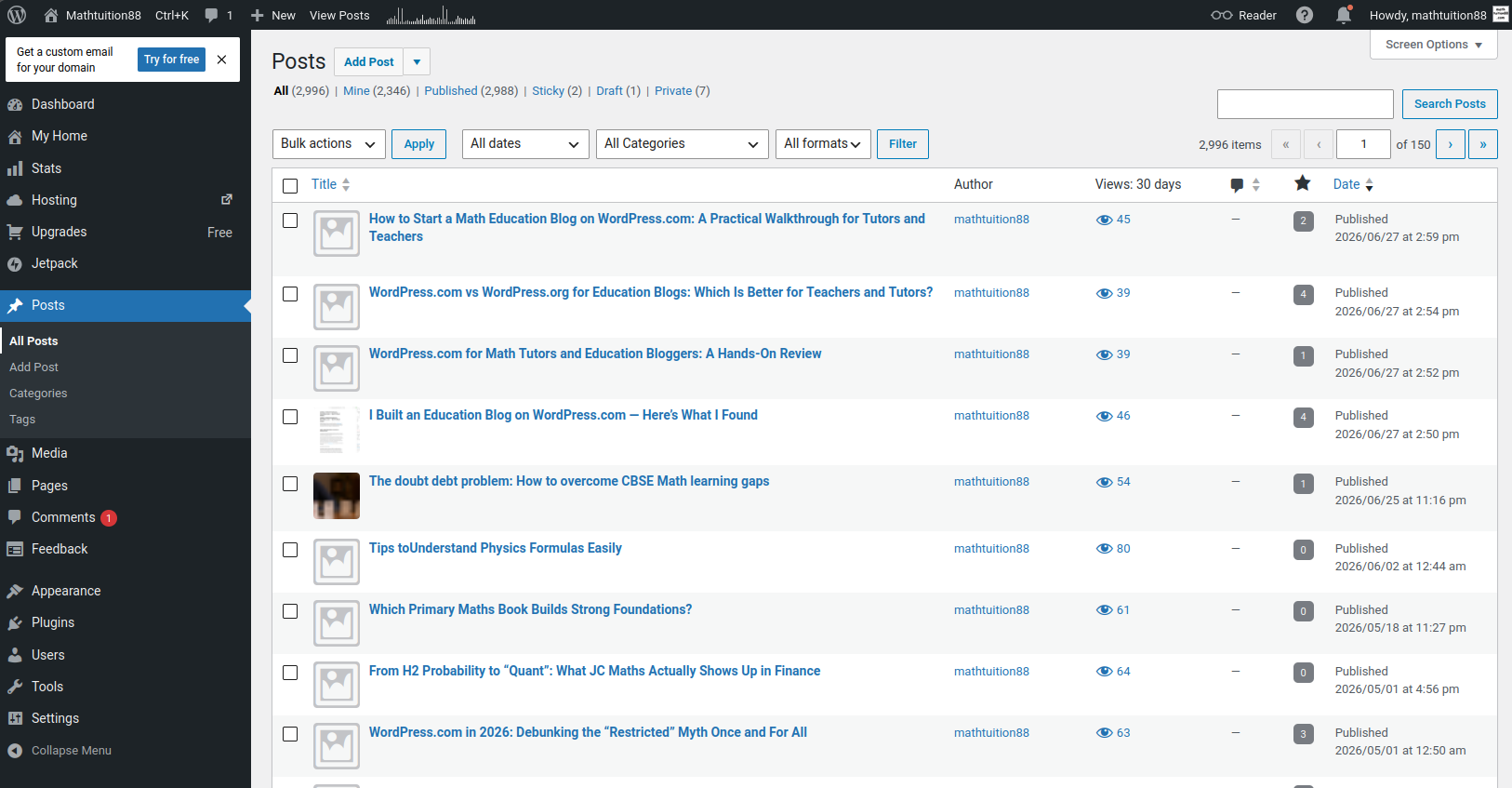









 Mathtuition88