The Psychology of IB Math Success: Mental Strategies for High Achievement

The Psychology of IB Math Success: Mental Strategies That Transform Struggling Students into High Achievers
Here’s something fascinating: two students can sit in the same IB Mathematics class, receive identical instruction, yet one thrives while the other struggles tremendously. What makes the difference? It’s rarely about raw intelligence or mathematical talent.

The secret often lies in psychology. How students think about maths, approach problems, and handle setbacks can completely transform their academic journey. This insight has revolutionised how we understand mathematical learning, particularly in demanding programmes like the International Baccalaureate.

Why Your Brain Believes Math Ability Can Grow

Students who embrace the idea that mathematical skills develop through effort consistently outperform those who think ability is fixed. This isn’t wishful thinking but solid educational psychology.

When learners view challenges as growth opportunities rather than threats, everything changes. They tackle difficult concepts in both Analysis and Approaches (AA) and Applications and Interpretation (AI) with curiosity instead of fear. The result? Deeper understanding and genuine problem-solving capability.

The Hidden Trap of Mathematical Perfectionism

Many bright IB students unknowingly sabotage themselves through perfectionism. They become so focused on avoiding mistakes that they actually create more problems than they solve.

Think about it: perfectionist students often spend hours agonising over single problems, leaving insufficient time for adequate practice across the syllabus. They develop test anxiety because any error feels catastrophic. Breaking free from this cycle requires conscious effort, but the payoff is enormous.

Smart Students Think Strategically About Exams

Here’s what successful IB Math students do differently during examinations. Instead of working through papers sequentially, they spend the first few minutes scanning all questions. This strategic overview allows them to identify which problems they can solve confidently.

Starting with accessible questions builds momentum and confidence. Students secure marks early, then tackle challenging problems with a calmer mindset. This approach proves particularly valuable given IB’s time constraints and complex question structures.

Building Mathematical Confidence Step by Step

Confidence in mathematics doesn’t appear overnight. It develops through systematic practice that gradually increases in complexity. Students need to experience success with foundational concepts before advancing to sophisticated applications.

This principle works brilliantly with IB’s structured curriculum. Those who truly master core topics like functions and algebra find themselves well-prepared for advanced calculus and statistical analysis. Their confidence grows naturally as competence develops.

Managing Stress for Peak Mathematical Performance

Stress wreaks havoc on the cognitive processes required for mathematical reasoning. Unfortunately, IB students face intense pressure from multiple subjects simultaneously, making stress management absolutely crucial.

Successful students develop practical coping strategies. They practice under timed conditions regularly, so exam pressure feels familiar rather than overwhelming. Simple breathing techniques help maintain focus during challenging moments. Most importantly, they keep perspective on individual assessments within the broader academic journey.

Learning Mathematics Becomes Social

Something magical happens when students discuss mathematical concepts with peers. The isolation that many feel when struggling with complex topics begins to dissolve.

Group study sessions offer multiple benefits beyond content review. Students hear different approaches to problems, identify gaps in their own understanding, and gain confidence through collaborative learning. The psychological benefits include reduced anxiety and increased motivation through shared experiences.

Professional Guidance Makes a Real Difference

Many students find tremendous value in working with experienced tutors who understand both mathematical content and learning psychology. Quality IB Math tuition centres provide comprehensive support that goes beyond teaching formulas and procedures.

These professionals help students develop personalised approaches to time management, confidence building, and sustained motivation. They understand that successful IB performance requires addressing both academic content and psychological factors that influence learning.

Putting Psychology into Daily Practice

Students can immediately begin applying these insights through specific changes to their study routines. Creating structured schedules reduces anxiety by providing predictability and control over learning processes.

Regular self-reflection helps track progress and maintain motivation during particularly challenging periods. Setting achievable short-term goals prevents overwhelm whilst building momentum toward larger objectives. These small changes accumulate into significant improvements over time.

The Real Secret to IB Math Success

Mathematical excellence in the IB programme extends far beyond computational skills or formula memorisation. Students who cultivate growth mindsets, manage stress effectively, and implement strategic learning approaches consistently achieve superior results.

These psychological strategies work alongside technical mathematical knowledge to create a robust foundation for success. Whether pursuing SL or HL courses, understanding and applying these mental frameworks can transform struggling students into confident, capable mathematicians prepared for university-level study and beyond.

Building Mathematical Foundations: Why Number Sense Matters More Than Speed

Building Mathematical Foundations: Why Number Sense Matters More Than Speed

Many parents worry when their child takes longer to solve maths problems compared to classmates. However, rushing through calculations often masks a more significant issue: weak number sense. Understanding this fundamental concept can transform how children approach mathematics throughout their academic journey.

What Is Number Sense?

Number sense refers to a child’s intuitive understanding of numbers and their relationships. It’s the ability to visualise quantities, estimate reasonably, and recognise patterns in mathematical operations. Children with strong number sense can mentally manipulate numbers and understand why mathematical procedures work, not just memorise steps.

This foundation differs vastly from computational speed. A child who quickly recites times tables may struggle with word problems requiring logical reasoning. Conversely, a student with solid number sense approaches unfamiliar problems confidently, even if they work more methodically.

Common Signs of Weak Number Sense

Parents should watch for these indicators that suggest number sense needs strengthening:

  • Difficulty estimating reasonable answers before calculating
  • Confusion when numbers appear in different contexts (fractions, decimals, percentages)
  • Reliance on finger counting for basic operations beyond primary years
  • Struggles with mental mathematics and number relationships
  • Inability to explain their mathematical reasoning

These challenges often persist into secondary mathematics, affecting algebra and geometry comprehension.

Building Strong Number Sense at Home

Parents can support number sense development through everyday activities. Cooking provides excellent opportunities for measurement and proportion discussions. Shopping trips allow estimation practice and percentage calculations through discounts.

Encourage children to explain their thinking process rather than focusing solely on correct answers. Ask questions like “How did you know that?” or “Can you estimate what the answer might be?” This approach builds mathematical confidence and reasoning skills.

Games involving numbers, such as card games requiring mental addition or board games with strategic counting, naturally develop number relationships. These activities feel enjoyable rather than academic, reducing maths anxiety.

The Role of Quality Tuition

While home support proves invaluable, structured guidance from experienced educators can accelerate number sense development. Quality mathematics tuition focuses on conceptual understanding rather than procedural memorisation.

Effective tutors assess individual learning gaps and tailor approaches accordingly. They use visual aids, manipulatives, and real-world connections to make abstract concepts concrete. Small group settings allow personalised attention whilst maintaining peer interaction benefits.

Daniel Maths tuition exemplifies this approach, emphasising foundational understanding through patient, systematic instruction. Their experienced tutors recognise that strong mathematical foundations require time and thoughtful guidance rather than rushed completion of worksheets.

Long-term Benefits of Strong Number Sense

Students with solid number sense approach advanced mathematics with greater confidence. They adapt more readily to new concepts because they understand underlying principles. This flexibility proves crucial in secondary school when mathematical complexity increases significantly.

These students also develop better problem-solving skills applicable beyond mathematics. They learn to break down complex situations, estimate outcomes, and verify their reasoning – valuable life skills extending into professional environments.

Supporting Your Child’s Mathematical Journey

Remember that mathematical development varies among children. Some require more time to build solid foundations, and this investment pays dividends in later academic years. Patience and encouragement matter more than speed or comparison with peers.

Focus on understanding rather than performance pressure. Celebrate moments when your child demonstrates logical reasoning, even if calculations contain minor errors. This approach builds mathematical resilience and genuine confidence.

Moving Forward

Strong number sense forms the bedrock of mathematical success. By prioritising understanding over speed, parents and educators can help children develop genuine mathematical competence. This foundation supports not just academic achievement but also practical problem-solving skills for life.

Investing time in building these fundamentals creates confident, capable mathematicians who approach challenges with curiosity rather than anxiety. The mathematical journey becomes an exploration of patterns and relationships rather than a series of procedures to memorise.

How To Get a Degree in Mathematics: Preparing for the Journey

Pursuing a degree in mathematics can open numerous doors to careers in education, finance, technology, and beyond. Mathematics is the foundation of logical reasoning and quantitative analysis, skills highly sought after in many fields. Before you start on this path, it’s helpful to understand what lies ahead and how to prepare for the academic challenges.

Exploring the Scope of a Mathematics Degree

A mathematics degree isn’t just about learning to solve equations and mathematical problems; it’s about understanding patterns and structures and using this knowledge to solve real-world problems. At the core, you’ll engage in studies ranging from pure mathematics, which explores fundamental theories like number theory and abstract algebra. Additionally, you’ll delve into applied mathematics, focusing on using these theories and analytical skills to solve practical problems in science, business, and engineering.

Academic Preparation

To excel in mathematics, start with a solid foundation in high school mathematics. Subjects such as algebra, geometry, calculus, and statistics are essential. If your school offers advanced placement math courses or dual-enrollment options, taking these can give you a head start. In addition to formal classes, engaging with online resources and video tutorials can enhance your understanding and prepare you for college-level coursework.

Working on personal projects or exploring mathematical software tools can also deepen your practical understanding of mathematical concepts. It’s also beneficial to attend math-related workshops or lectures, which can provide insights into the latest developments in the field and foster a deeper interest in mathematics.

Choosing the Right College

Selecting the right institution is pivotal. Look for colleges with robust mathematics departments that offer a range of courses and specialties. Consider faculty expertise, available research opportunities, and the overall focus of the program—whether it leans more toward theoretical or practical applications of math.

You should also think about the overall environment and support services of the college. Supportive tutoring, mental health services, and academic advising can make a significant difference in your educational experience.

Application Process

When applying to programs, pay attention to the prerequisites required by each university. Ensure your application highlights not only your academic achievements but also your extracurricular involvement in mathematics.

Letters of recommendation are crucial; seek them from math teachers or mentors who can speak directly to your abilities and potential in the field. Craft a personal statement that reflects your passion for mathematics and your long-term career goals, explaining why you are drawn to this area of study.

Financing Your Education

Understanding the financial aspect of your education is essential. Research scholarships, grants, and fellowship opportunities specifically targeted at STEM (science, technology, engineering, and mathematics) students. Many organizations and colleges offer financial aid for students who excel in mathematics because of the critical need for these skills in the workforce.

Additionally, it’s wise to explore work-study programs that allow you to work part-time while studying, often in roles related to your field of study. Many universities also offer teaching assistantships or research assistantships to graduate students, which typically cover tuition and provide a stipend. Applying early for financial aid and continuously searching for funding opportunities can alleviate financial stress and allow you to focus more fully on your studies.

Career Opportunities

Graduating with a degree in mathematics equips you with a versatile skill set. You might choose to pursue careers in education, actuarial science, data analysis, or even in emerging tech fields like machine learning and artificial intelligence. Companies often seek out math graduates for their analytical abilities and problem-solving skills. Beyond these paths, mathematicians are invaluable in government and public policy, aiding in statistical analysis, budgeting, and logistics.

Careers in finance, such as quantitative analysis or risk management, also highly value the precise and logical thinking developed in mathematics studies. Additionally, as technology evolves, the need for mathematicians in fields like cybersecurity, the social sciences, and computational biology continues to grow, offering even more avenues for professional advancement.

Continuing Education

For those looking to delve deeper into mathematics or specialize further, considering postgraduate studies is a wise choice. Master’s and doctoral programs offer opportunities to specialize in areas like cryptography, numerical analysis, or mathematical biology. Advanced degrees can also lead to careers in research or academia. Pursuing these advanced studies enhances your understanding of complex mathematical concepts and opens doors to specialized roles in industries that depend heavily on advanced analytics and problem-solving capabilities.

Additionally, engaging in postgraduate research can contribute to significant advancements in mathematical sciences, impacting technology, science, and engineering fields globally. These programs often provide access to cutting-edge technology and collaborations with leading professionals and researchers, further enriching your educational and professional journey in mathematics.

Final Thoughts

Embarking on a math degree requires careful preparation and commitment. By understanding the academic requirements, choosing the right college, and exploring future career possibilities, you set yourself up for success in a field that values precision and analytical skills. Engage actively in your education journey, and you’ll find that mathematics can offer not just a degree but a lifetime of rewarding challenges and opportunities.

Decoding Math Word Problems: A Dual-Language Approach

Math word problems often seem like puzzles, mysterious strings of words that hide numbers and operations within their narratives. For students tackling mathematics in a language that isn’t their first, these problems can double as language comprehension challenges.

The intricate process of solving math word problems requires a firm grasp of language and the ability to decipher numerical information from text. The complexity magnifies for dual-language learners who must navigate these hurdles in both their native language and in English.

Introducing a dual-language approach to decoding math word problems can bridge the gap between language proficiency and mathematical success, making this educational journey more inclusive and effective.

Understand The Language Of Math

Before diving into the strategies for tackling word problems, it’s crucial to build a foundation in the language of mathematics.

Mathematical terms may have different meanings in everyday language. Words like ‘product,’ ‘difference,’ or ‘value’ carry specific mathematical weight, and understanding this particular vocabulary is the first step in solving word problems.

Moreover, you can’t underestimate the power of technology in aiding language comprehension. There are plenty of resources available to support math learning in multiple languages.

If you want to enhance your linguistic skills while mastering math, consider platforms where you can learn Mandarin online. They offer a prime example of how technology can foster an environment for dual-language education.

Identify Key Terms And Phrases

In tackling math word problems, zeroing in on pivotal terms and phrases is essential. These words often signal the mathematical operations you’ll need to employ. For example, cues like ‘total’ may suggest addition, whereas ‘fewer than’ likely pertains to subtraction.

As you go through the problem, think of these terms as signposts guiding you toward the correct path. Your task is to sift through the narrative and identify these markers in mathematical language—numbers and symbols.

Break Down The Problem Step-By-Step

When approaching math word problems, it’s essential to tackle them methodically. Read the problem thoroughly, paying attention to every detail. Next, translate the scenario into your own words, simplifying the information and clarifying the question.

Afterward, list what’s given and pinpoint exactly what you’re solving for. It may help visualize the problem: sketch a diagram or create a table to map the information graphically.

This stepwise breakdown transforms a complex narrative into manageable elements, setting you on a clear path to the solution. Remember, patience and precision are your allies in unraveling the numerical tale before you.

Apply Cross-Language Strategies

Don’t overlook the power of your bilingual abilities. Utilize your native language as a firm scaffold for comprehension. If you encounter complexities in English, translate the problem into your first language to improve your understanding. This translation can illuminate hidden nuances and solidify your grasp of mathematical concepts.

Furthermore, articulating the problem aloud in your native tongue can often clarify confusing aspects, enabling you to return to the English version with a sharper perspective and a strategy ready to be executed. This cross-linguistic technique leverages your existing knowledge, making the path to the solution more accessible.

Check Your Work With Reverse Operations

When you solve a math word problem, put your answer through a verification process using reverse operations. If your solution came from adding two numbers, subtract one from the other to see if it aligns with the original values given in the problem.

This step retraces the process to ensure no detail was overlooked. By working backward, you affirm the accuracy of your solution, solidifying your understanding of the problem’s underlying mathematical principles. It’s a robust method to confirm your results and fosters a habit of meticulousness in your problem-solving routine.

Encourage Collaboration And Discussion

In enhancing your proficiency with math word problems, collaboration and discussion should never be undervalued. Engage in problem-solving discussions with peers, especially those navigating the dual-language learning path.

As you articulate your problem-solving methods and listen to others, you’ll encounter diverse strategies and viewpoints. This exchange not only broadens your mathematical understanding but also enriches your linguistic competence.

Furthermore, active collaboration fosters a dynamic learning environment. Through sharing and debating techniques, each participant contributes to a collective advancement in tackling complex word problems across languages.

Use Technology To Your Advantage

Dive into applications and online platforms that offer a plethora of math word problems in both English and your native language. These tools provide immediate feedback, which is crucial for adjusting strategies and understanding concepts in real-time.

Harness these digital solutions to practice consistently; you’ll soon notice a significant improvement in your dual-language mathematical prowess.

Final Thoughts

Decoding math word problems through a dual-language approach is about developing a more versatile understanding of mathematics. It’s about making connections between languages and concepts, which can lead to a richer educational experience.

With dedication, practice, and the right strategies, you’ll not only become more proficient in math but also in your language abilities. So, take it step-by-step, don’t be afraid to lean on technology, and remember that every challenge is an opportunity to grow.

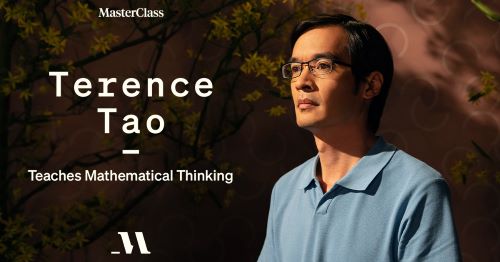
Terence Tao Masterclass

Amazing that Terence Tao is doing a Math Masterclass!

Terence Tao Teaches Mathematical Thinking

In this Masterclass, famous Mathematician Terence Tao is going to teach math problem-solving skills to the general audience. In fact, not much math background is necessary! There is also no homework, just relax and learn from the Mozart of Math!

Professor Terence Tao is a Fields Medallist (Math equivalent of the Nobel Prize). He certainly knows his stuff and is an expert in the field! He also has a knack for explaining abstract mathematical concepts in a very clear and interesting way.

Masterclass Link: Terence Tao Teaches Mathematical Thinking

Masterclass usually chooses top talents in their respective fields to give a lecture. For example, previously Garry Kasparov also gave a Masterclass on chess.

Terence Tao Masterclass Review

Overall, Terence Tao’s masterclass will be great for students, homeschool parents, and even future mathematicians. It will certainly help to inspire them to have a greater passion in mathematics.

Mathematics is more about the mindset and the approach, rather than just the answers. The rote learning techniques of math can be learnt by anyone, but it takes a master like Terence Tao to be able to explain and demonstrate the beauty of mathematics.

If you have any feedback on Terence Tao’s Masterclass, do post it in the comments below!

Terence Tao Teaches Mathematical Thinking

Best Calculator for Linear Algebra and Calculus

Many universities and colleges allow students to use advanced graphical calculators for exams in math courses, including linear algebra, calculus and engineering. Having the appropriate calculator can prove to be a huge advantage in terms of getting the correct answer and saving time. Even if the handwritten manual working is required, a good calculator can help to check the correctness of the answer.

Best Calculator for Linear Algebra

The key calculations in linear algebra include calculating the inverse and determinant of matrices. Additional features that are useful in calculators include the ability to calculate eigenvalues, eigenvectors, and RREF (reduced row echelon form). These features can be great time savers (or at the minimum, useful tools for checking your answer), as matrix operations are often tedious and prone to human error.


Our first choice would be Texas Instruments TI-84 Plus CE Color Graphing Calculator, Black. This is one of the flagship calculators by Texas Instruments. This type of calculator is something like a smart phone, you would need to download free apps that will greatly magnify its power in solving Linear Algebra equations. Some of the linear algebra capabilities of the TI-84 Plus are:

  • Calculate adjoint of a matrix
  • Solve Simultaneous Equations
  • Calculate dot product, cross product of vectors
  • Calculate inverse of matrix (when matrix is invertible)
  • Calculate LDU decomposition, Cholesky factorization
  • Calculate Eigenvalues and plot the characteristic polynomial
  • Compute the Frobenius norm of a matrix
  • Perform Gram Schmidt orthonormalization
  • Calculate null space (kernel) if a matrix
  • and more!

This calculator is good enough up till senior undergraduate level or even graduate level, for computational intensive modules, such as computational physics or any module that requires linear algebra calculations.

For a more budget-friendly version, you may check out the Texas Instruments TI-84 Plus Graphing Calculator, Black which is essentially the black and white version of the TI-84 Plus CE Color.

Or for an even cheaper option, you could opt for the older version Texas Instruments TI-83 Plus Graphing Calculator which still supports the linear algebra apps.

Often, linear algebra courses include applications to differential equations as well, which overlaps with the next topic on Calculus.

Update: For the latest TI-85/86 models, there is a new “Matrix Mode” inbuilt into the calculator that can perform basic matrix operations (including inverse) and other advanced operations such as LU Decompositions, and finding eigenvalues/eigenvectors.

Note that paradoxically, the newer TI calculator models may be cheaper than the older ones.


Texas Instruments TI-86 ViewScreen Calculator

Best Calculator for Calculus

For Calculus, the important features that a calculator should have are the ability to perform numerical differentiation and integration. There are also some amazing apps for TI83/84 that can perform symbolic differentiation, that is, find the derivative of a function in symbols (not just the numerical value at certain values of x).

So once again, the TI-84 Plus CE Color Graphing Calculator, White is a good suggested calculator for Calculus modules.

If your budget (and course requirements) permit, you should definitely check out the Texas Instruments TI-Nspire CX II CAS Color Graphing Calculator with Student Software (PC/Mac). CAS stands for “computer algebra system”, which means that the calculator is capable of producing symbolic results rather than just numerical results.

The TI-Nspire™ CX II features a deSolve wizard function for reducing syntax errors in solving differential equations. The TI-Nspire CX can even do vector calculus. It is a very powerful smart calculator that is essentially a mini-computer.

TI Calculator Alternatives

In my experience as a student and educator, TI (Texas Instruments) calculators dominate the market and are generally considered a good choice. But there are other viable alternatives that can also be considered good for linear algebra, calculus or engineering math.

A popular alternative is Casio calculators, for instance Casio fx-9750GII Graphing Calculator with icon based menu. Color white. An immediate advantage of Casio calculators is their low price.

The Casio fx-9750 (and related series) calculator is able to calculate determinant of matrix as well as basic matrix operations such as multiplying matrices, finding the inverse of matrix, etc.

As mentioned above, the main advantage of Casio graphical calculators is their low price. For advanced features, the TI calculators definitely trump over the Casio calculators.

Another alternative to TI calculators are the HP graphical calculators. Let us check out the most powerful HP calculator, the HP 50g Graphing Calculator.

The HP 50g Graphing Calculator has a “MatrixWriter form” to facilitate the entry of matrices. It is essentially like an Excel spreadsheet. Once the matrix is entered, there is a myriad of functions that can be applied, such as finding the determinant, trace, transpose, and rank of a matrix.

In terms of Calculus, the HP 50g can perform a wide range of calculus functions such as:

  • Limits and derivatives
  • Anti-derivatives and Integrals
  • Calculate the Taylor/Maclaurin series of a function symbolically (up to 4-th order relative power, i.e., the difference between the highest and lowest power in the expansion is 4)
  • Partial Derivatives (Multivariate Calculus)
  • Multiple Integrals such as double integral
  • Vector Calculus such as del, gradient, divergence, curl
  • Differential Equations
  • Fourier series

The list above is quite impressive! Overall, the HP 50g Graphical Calculator is a very strong competitor to the TI series graphical calculators.

Best Calculator for Engineering

Engineers often need to use Linear Algebra, as well as Calculus. Hence, the best calculator for engineering often overlaps with the best calculator for linear algebra or calculus. Do check out our above reviews and pick the calculator that best suits your needs.

In general, we have the below summary.

Best Budget Calculator: Casio graphical calculators, such as Casio fx-9750GII Graphing Calculator with icon based menu. Color white.

Safe choice, all-round best calculator: TI Texas Instruments Calculator, for instance the iconic Texas Instruments TI-84 Plus CE Color Graphing Calculator, Black

Super Powerful Calculator (very advanced and comprehensive features): HP 50g Graphing Calculator

What’s Math Got to Do with It?: How Teachers and Parents Can Transform Mathematics Learning and Inspire Success

Recently, Professor Jo Boaler released her new book What’s Math Got to Do with It?: How Teachers and Parents Can Transform Mathematics Learning and Inspire Success.

The minute it came out, it became an instant best seller on Amazon. Currently, there are some issues on Math education in the United States, due to the very controversial syllabus called Common Core. Professor Jo Boaler attempts to address these controversies and give suggestions and advice to parents.

I totally agree with Professor Jo’s viewpoint that the first step to engage students in math learning is via practical means and showing them how mathematics is useful and relevant to their lives. Next is to always adopt a “growth mindset”, that no matter how weak or strong a child is in math, it is always possible to improve. Just having this mindset makes a huge difference. I took Prof. Jo Boaler’s online course on “How to Learn Math“, and what she said actually makes perfect sense. Hope a new generation appreciative of math will emerge due to new research on how to best learn Math, which Prof. Jo Boaler (PhD in Math Education) is an expert in.

Without further ado, I will link Prof. Jo Boaler’s introduction to her own book:

Hi Everyone,

I wanted you to be the first to know that my new book: What’s Math Got to Do With It:? How Teachers and Parents Can Transform Mathematics Learning and Inspire Success has just hit the bookstores and of course Amazon and other online outlets.

You can now get a copy here: What’s Math Got to Do with It?: How Teachers and Parents Can Transform Mathematics Learning and Inspire Success

The changes from the original book include:

2 new chapters
A focus on mindset
Ideas for the Common Core
An infusion of new research through the book

Why not buy the book for your principal? Or your colleagues? your family? your students’ parents? or others who you think may need to understand the nature of good mathematics teaching? You may need people to know the research evidence behind what you are doing, as well as get some new ideas yourself.

For youcubers in the UK there will be a new edition of The Elephant in the Classroom coming out in the Autumn, we will let you know when, of course.

I also wanted you to know about some book signings that are planned:

Friday April 3 Portsmouth, New Hampshire. The Exeter High School Auditorium 7-8.30pm talk followed by book signing. See:

http://www.seacoastonline.com/article/20150330/NEWS/150339887/101019/NEWS

At NCSM:
Monday April 13th Boston, NCSM Following Jo’s keynote talk

At NCTM:
Thursday April 16th, 11.30 After Jo’s networking session.

We will also be arranging a book signing in the San Francisco bay area soon too.

I hope to see you at one of them. Below is our youcubed team reading the book yesterday 🙂

Viva La Revolution

Jo

Lee Kuan Yew was the Best Student in Mathematics in Raffles College

We sincerely wish our ex-Prime Minister Mr Lee Kuan Yew all the best, and may he have a good recovery.

Many people know that Lee Kuan Yew was a lawyer and politician, but few knew that he liked and was very good at Mathematics as a student. We can know these facts from the book The Singapore Story: Memoirs of Lee Kuan Yew, Vol. 1, which is an interesting book to read.

Mathematical Excerpts from the book (Autobiography, so “I” means Lee Kuan Yew):

  • Each student had to take three subjects. I (Lee Kuan Yew) read English, which was compulsory for all arts students, and concentrated on it to improve my command of the language, and to help me study law later; mathematics, because I liked it and was good at it; and economics.
  • After the first year, a student had to choose one subject as his major field of study. I chose mathematics.
  • At the end of each of the three terms in the academic year there were examinations, and for the first of these I was the best student in mathematics, scoring over 90 marks.
  • I was good at mathematics and the sciences and had a solid grounding in the English language.

These are the quotes from the book that let us know more about the mathematical side of Lee Kuan Yew.

Hence, it is indeed apt and suitable that there is a prestigious award named “Lee Kuan Yew Award for Mathematics and Science” to honor students who have done well in Mathematics and Science subjects.

I hope you are inspired to learn more about Math, since even a famous person like LKY liked Math so much as to major in it. You can read more about Recommended Books for University Math where we list down all the best books for learning University Math.

How to be good in Additional Mathematics

search terms

Recently, I saw that many people searched the following terms on Google and landed on my website:

  1. Why is the mid-year exams difficult and many people fail it?

  2. How to be good in additional mathematics.


Let me try to answer the above questions:

Why is the mid-year exams difficult and many people fail it?

Usually teachers will set the mid-year exams and the prelims at a (much) higher level than the actual O Levels. This is the current trend, which may result in many people failing the mid-year exam. The idea may be to motivate students to study harder and avoid being complacent with their results. Do not be demoralized by failing the exam! On the contrary, do reevaluate your study strategies, and strive to improve your knowledge and technique in mathematics.

How to be good in additional mathematics.

The way to be good at additional mathematics is the same as the way to be good at piano, chess, and virtually any human endeavour. The key to improving is practice! Practice with understanding is the key. Would you imagine to be possible to improve in playing the piano without practicing the song? Improve in badminton without training? Definitely not! Similarly, improving in additional mathematics is not possible without practice. This is why the Ten Year Series is such a popular book: it is indeed the most useful book you can buy for studying Additional Mathematics.

Practicing with understanding helps with Application of Concepts, Increase Speed, Accuracy, which all helps in being good at additional mathematics.

In addition, during the practice sessions, try to practice checking for careless mistakes. It will help tremendously in improving your grades. Practicing with understanding means that we need to understand the method used, to the extent that if the teacher sets a slightly different question we are still able to do it. This is the secret to being good at additional maths. 🙂


Featured book:

Math Doesn’t Suck: How to Survive Middle School Math Without Losing Your Mind or Breaking a Nail

From a well-known actress, math genius and popular contestant on “Dancing With The Stars”—a groundbreaking guide to mathematics for middle school girls, their parents, and educators

Amazing Math Magic Video

http://www.ted.com In a lively show, mathemagician Arthur Benjamin races a team of calculators to figure out 3-digit squares, solves another massive mental equation and guesses a few birthdays. How does he do it? He’ll tell you.

TEDTalks is a daily video podcast of the best talks and performances from the TED Conference, where the world’s leading thinkers and doers are invited to give the talk of their lives in 18 minutes — including speakers such as Jill Bolte Taylor, Sir Ken Robinson, Hans Rosling, Al Gore and Arthur Benjamin. TED stands for Technology, Entertainment, and Design, and TEDTalks cover these topics as well as science, business, politics and the arts. Watch the Top 10 TEDTalks on TED.com, at
http://www.ted.com/index.php/talks/top10


Interested to learn more tricks? Check out these two books:

Secrets of Mental Math: The Mathemagician’s Guide to Lightning Calculation and Amazing Math Tricks

Mathemagics: How to Look Like a Genius Without Really Trying

Secrets of Mental Math: The Mathemagician’s Guide to Lightning Calculation and Amazing Math Tricks

These simple math secrets and tricks will forever change how you look at the world of numbers.
Secrets of Mental Math will have you thinking like a math genius in no time. Get ready to amaze your friends—and yourself—with incredible calculations you never thought you could master, as renowned “mathemagician” Arthur Benjamin shares his techniques for lightning-quick calculations and amazing number tricks. This book will teach you to do math in your head faster than you ever thought possible, dramatically improve your memory for numbers, and—maybe for the first time—make mathematics fun.

Yes, even you can learn to do seemingly complex equations in your head; all you need to learn are a few tricks. You’ll be able to quickly multiply and divide triple digits, compute with fractions, and determine squares, cubes, and roots without blinking an eye. No matter what your age or current math ability, Secrets of Mental Math will allow you to perform fantastic feats of the mind effortlessly. This is the math they never taught you in school.

Free Math Movies

Want to watch movies about Mathematics? There is a nice website with Free Movies involving Math. It is not the full movie, but the portion of the movie that involves math.

The site is: http://www.math.harvard.edu/~knill/mathmovies/

This is a collection of movie clips in which Mathematics appears. The site is now in HTML5 video and should be accessible by all devices. If not, chose the direct video links. To include a clip into a presentation, chose the quicktime version.


Some interesting examples include: A Blackboard in linear algebra lecture at MIT on Parseval’s identity in Fourier theory. (http://www.math.harvard.edu/~knill/mathmovies/swf/goodwillhunting.html)


Another example: Young Spock learns Math. He memorizes the formula (4pi/3) r3 for the volume of the sphere, the square root of 2396324 and the definition of dimensionality log(n)/log(d). (http://www.math.harvard.edu/~knill/mathmovies/swf/startrek_spock.html)


If you are really interested in Math in the Movies, check out this book:

Math Goes to the Movies

Mel Gibson teaching Euclidean geometry, Meg Ryan and Tim Robbins acting out Zeno’s paradox, Michael Jackson proving in three different ways that 7 x 13 = 28. These are just a few of the intriguing mathematical snippets that occur in hundreds of movies. Burkard Polster and Marty Ross pored through the cinematic calculus to create this thorough and entertaining survey of the quirky, fun, and beautiful mathematics to be found on the big screen.

Math Goes to the Movies is based on the authors’ own collection of more than 700 mathematical movies and their many years using movie clips to inject moments of fun into their courses. With more than 200 illustrations, many of them screenshots from the movies themselves, this book provides an inviting way to explore math, featuring such movies as:

Good Will HuntingA Beautiful MindStand and DeliverPiDie HardThe Mirror Has Two Faces

The authors use these iconic movies to introduce and explain important and famous mathematical ideas: higher dimensions, the golden ratio, infinity, and much more. Not all math in movies makes sense, however, and Polster and Ross talk about Hollywood’s most absurd blunders and outrageous mathematical scenes. Interviews with mathematical consultants to movies round out this engaging journey into the realm of cinematic mathematics.

This fascinating behind-the-scenes look at movie math shows how fun and illuminating equations can be.

HCI Confession Page Math Joke

Source: https://www.facebook.com/HwaChongConfessions

“Today I asked the girl I like on FB to help me do math prob
9x-7i>3(3x-7u)
9x-7i>9x-21u
-7i>-3(7u)
-i>-3u
=
i<3u

but she go put the ans as 3u>i ruining my whole plan T.T”
-HCJC Student (M)

hwa chong


Math Girls

Math isn’t hard. Love is.
Currently in its eighteenth printing in Japan, this best-selling novel is available in English at last. Combining mathematical rigor with light romance, Math Girls is a unique introduction to advanced mathematics, delivered through the eyes of three students as they learn to deal with problems seldom found in textbooks. Math Girls has something for everyone, from advanced high school students to math majors and educators.

Praise for Math Girls!

“…the type of book that might inspire teens to realize how much interesting mathematics there is in the world—not just the material that is forced upon them for some standardized test.” “Recommended”
—CHOICE: Current Reviews for Academic Libraries

“Imagine the improbable: high-school students getting together on their own — not in a Math Club or Math Circle, not in preparation for any Math Olympiad or “regular” test, not on the advice of any of their teachers, not as part of any organized program — to talk about pure math, math more interesting than the math found in their textbooks. The three students in this book do that for the sheer love of it. That to me is the beauty and fascination of this novel for young people, mostly young people interested in math.”
—Marion Cohen, Arcadia University, MAA Reviews

“Sometimes the math goes over your head—or at least my head. But that hardly matters. The focus here is the joy of learning, which the book conveys with aplomb.”
—Daniel Pink, NYT and WSJ best-selling author of Drive and A Whole New Mind

“if you have a…teenager who’s really into math, this is a really interesting choice”
—Carol Zall, Public Radio International, The World

“Math Girls provides a fun and engaging way to learn and review mathematical concepts…the characters’ joy as they explore and discover new and old ideas is infectious.” —review, “Experiments in Manga” blog

Reviews from amazon.co.jp

“As a physics major, math has always been a painful tool to use and nothing more. But Math Girls changed the way I look at mathematics. Now I actually find it interesting!”
— “Au”

“Math Girls is a fun read, but I was surprised to find that it’s also a serious math book chock full of careful explanations. I hope that people who think they don’t like math will read it. Even when the formulas go over your head, just following the story gives you a great feel for how fun math can be.”
— “Nyanta”

“I got hooked on this book during summer vacation, and had a great time reading it by the pool. It was so good that I read it twice, the second time while working out the problems on the hotel stationary.”
— “Kei0210”

“Advanced math, explained in a playful way. But it’s not just a textbook, with dry solutions to problems. It’s a bittersweet story, with mathematics telling part of the tale. A brilliant comparison between the uncertainties of youth and the absolute proofs of symbols and numbers.”
— Shiori Oguchi


H1/H2/H3 Maths Formula List/ Formula Sheet

Download H1/H2/H3 Maths Formula List: www.seab.gov.sg/aLevel/2015Syllabus/ListMF15.pdf‎

LIST OF FORMULAE
AND
STATISTICAL TABLES
for
Mathematics
For use from 2010 in all papers for the H1, H2 and H3 Mathematics syllabuses.

Know the Best Math Institutions around the World

This is a guest post by Maria Mcquire:

Know the Best Math Institutions around the World

There are many academic institutions in the world and rankings on certain faculties help determine the best ones in certain fields. Students who are extremely in mathematics will automatically want to enroll and join universities that are highly ranked as far as mathematics is concerned. Year by year, the rankings are released and can be accessed through the internet and various academic public publications. In addition to stellar performance, there are other factors that are considered during the rankings. This article will mention a few of the top mathematics institutions around the world.

The University of Cambridge

This is not only one of the oldest universities in the United Kingdom but also in the world. Its scholarly achievements have made it popular and famous the world over. Its high performance in mathematics and other fields is accredited to research and well trained and knowledgeable faculty tutors. External examiners and bodies such as the Quality Assurance Agency have all endorsed the performance of the university time and again. The University of Cambridge has vast studying resources such as museums, libraries and other collections. Teaching is done by lecturers who are experts and authorities in their field through seminars and lectures making this university the very top of this list.

The University of Toronto

The University of Toronto is one of the best in the world not only in mathematics but when it comes to research. Its research capabilities in all fields are rivaled only by the prestigious Harvard Universities. One thing that makes this institution great in mathematics is its system of graduate supervision and teaching strengths. The university attracts and enrolls professionals, graduates and undergraduates in the mathematical field and they are all taught by the best researchers. It has both on campus and off campus students. International students get to enjoy learning mathematics and visiting come of Canada’s most breathtaking scenic sites.

The Australian National University

This top ranked university was established back in 1946 and has risen over the years to be the top university in Australia and one of the best in the world. Mathematically speaking, the university’s teaching methods and perfectly teacher to student ratio ensure that the mathematical faculty is of international standards. Campus students do not even have to venture outside as the campus has all the social amenities needed. To make it even better, the university is well networked with some of the world’s leading academic institutions and this means that it has access to the latest information in research.

National University of Singapore

Asia is not left behind as far as mathematical prowess is concerned as the National university of Singapore puts it on the global map. One of the things that make it a top institution is its well-structured exchange programs with other universities that are mathematical giants. For this reason, the university’s best students apply for ESTA VISA in order to join other brilliant mathematical minds in other universities. The university also offers joint degree programs with other leading universities. Due to the university’s strength in research, it is affiliated with global research bodies such as International Alliance of Research Universities.

Author: Maria Mcquire


Math Quotes

Famous Math Quotes

  1. If people do not believe that mathematics is simple, it is only because they do not realize how complicated life is.  ~John Louis von Neumann
  2. Pure mathematics is, in its way, the poetry of logical ideas.  ~Albert Einstein
  3. A mathematician is a device for turning coffee into theorems. ~Paul Erdos
  4. Give me a place to stand, and I will move the earth. ~ Archimedes
  5. Mathematics is the door and key to the sciences. ~ Roger Bacon
  6. The essence of mathematics is its freedom. ~ Cantor
  7. A youth who had begun to read geometry with Euclid, when he had learnt the first proposition, inquired, “What do I get by learning these things?” So Euclid called a slave and said “Give him threepence, since he must make a gain out of what he learns.” ~ Euclid
  8. Mathematics is the queen of the sciences and number theory is the queen of mathematics. ~ Gauss
  9. Mathematics knows no races or geographic boundaries; for mathematics, the cultural world is one country. ~ Hilbert
  10. When you can measure what you are talking about and express it in numbers, you know something about it. ~ Kelvin


JC Subject Combination

JC Subject Combination

Check out our posts related to JC Subject Combination:

1) What is the Difference between H1 Mathematics, H2 Mathematics and H3 Mathematics?

2) Maths Skills to be a Good Lawyer

3) Maths Skills to be a Doctor

4) The ideal Singapore JC subject combination for applying to Medicine

Maths Challenge

Hi, do feel free to try out our Maths Challenge (Secondary 4 / age 16 difficulty):

maths challenge

Source: Anderson E Maths Prelim 2011

If you have solved the problem, please email your solution to mathtuition88@gmail.com .

(Include your name and school if you wish to be listed in the hall of fame below.)

Students who answer correctly (with workings) will be listed in the hall of fame. 🙂

Hall of Fame (Correct Solutions):

1) Ex Moe Sec Sch Maths teacher Mr Paul Siew

2) Queenstown Secondary School, Maths teacher Mr Desmond Tay

3) Tay Yong Qiang (Waiting to enter University)

4) Ionut-Zaharia Chirila (Ex Lower Danube University, Romania)

The ideal Singapore JC subject combination for applying to Medicine

Why Additional Maths (A Maths) is important for entering Medicine:

Pathway: A Maths (O Level) –> H2 Maths (A Level) –> NUS Medicine

Source: http://sgforums.com/forums/2297/topics/439605

Quote: While NUS and NTU Medicine does not (officially) require H2 Maths (ie. ‘A’ level Maths), some other (overseas) Medical schools might. And not having H2 Maths might (unofficially) disadvantage your chances, even for NUS and NTU.

Therefore (assuming you intend to fight all the way for your ambition), your safest bet would be to (fight for the opportunity) to take both H2 Bio and H2 Math. The ideal Singapore JC subject combination for applying to Medicine (in any University) is :

H2 Chemistry, H2 Biology, H2 Mathematics

Source: http://www.kiasuparents.com/kiasu/forum/viewtopic.php?f=40&t=12228

Quote: pre-requisites for nus medicine will be H2 Chem and H2 bio or physics.

as for what’s best,
H2 math is almost a must since without it you’ll be ruling out a lot of ‘back-up courses’

Singapore O Level Group Tuition Bishan

O Level E Maths and A Maths Tuition starting next year at Bishan ————————– View Mr Wu’s GEP Testimonial at https://mathtuition88.com/group-tuition/

Despite being in the Gifted Education Programme (GEP), Mr Wu is just an ordinary Singaporean. His secret to academic success is hard work and the Maths Techniques he has discovered by himself while navigating through the education system.

He would like to teach these techniques to students, hence choosing to become a full-time Mathematics tutor. Mr Wu has developed his own methods to check the answer, remember formulas (with understanding), which has helped a lot of students. Many Math questions can be checked easily, leading to the student being 100% confident of his or her answer even before the teacher marks his answer, and reducing the rates of careless mistakes.

Mr Wu’s friendly and humble nature makes him well-liked by students. Many of his students actually request for tuition by themselves! (not the parents) His students also look forward to tuition, instead of dreading tuition.

O Level E Maths and A Maths Tuition starting next year at Bishan, the best location in Central Singapore.

Timings are Monday 7-9pm, Thursday 7-9pm. Perfect for students who have CCA in the afternoon, or students who want to keep their weekends free.

Register with us now by email (mathtuition88@gmail.com). Vacancies will be allocated on a first-come-first-serve basis.

Thanks and wishing all a nice day.

Singapore math

Source: http://en.wikipedia.org/wiki/Singapore_math

Singapore math (or Singapore maths in British English[1]) is a teaching method based on the national math curriculum used for kindergarten through sixth grade in Singapore.[2][3] It involves teaching students to learn and master fewer mathematical concepts at greater detail as well as having them learn these concepts using a three-step learning process.[2][3] The three steps are concrete, pictorial, and abstract. In the concrete step, students engage in hands-on learning experiences using concrete objects such as chips, dice, or paper clips.[4] This is followed by drawing pictorial representations of mathematical concepts. Students then solve mathematical problems in an abstract way by using numbers and symbols.[5]

The development of Singapore math began in the 1980s when the country’s Ministry of Education developed its own mathematics textbooks that focused on problem solving and heuristic model drawing.[3][6] Outside Singapore, these textbooks were adopted by several schools in the the United States (U.S.) and in other countries such as Canada, Israel, and the United Kingdom.[7][1][8] Early adopters of these textbooks in the U.S. included parents interested in homeschooling as well as a limited number of schools.[3] These textbooks became more popular since the release of scores from the Trends in International Mathematics and Science Study (TIMSS), which showed Singapore at the top of the world three times in fourth and eighth grade mathematics.[9] U.S. editions of these textbooks have since been adopted by a large number of school districts as well as charter and private schools.[3]

Read more at: http://en.wikipedia.org/wiki/Singapore_math

The bar model can be drawn as a comparison model to compare two bars of unequal lengths, which can then be used to solve a subtraction problem.


On the road to make math fun: An army major who quit to become a mathematics teacher

Source: http://www.telegraphindia.com/1120625/jsp/calcutta/story_15629755.jsp#.Uq7JOJVDGDk

On the road to make math fun

MITA MUKHERJEE
Madanlal Baldevraj Ghai during the city leg of his tour. Picture by Sayantan Ghosh

An army major who quit to become a mathematics teacher has embarked on a self-funded tour of the country to promote the subject.

Madanlal Baldevraj Ghai, 70, stayed in a dormitory at Howrah station to keep costs down during the three days he spent in Calcutta recently, meeting officials of the primary and secondary board and the school education department to offer suggestions on how to make the study of mathematics more interesting.

“India has produced brilliant mathematicians not just in the Vedic and medieval ages but also in modern times. Unfortunately, for quite a few years, not many students have been pursuing the subject at the higher level, which has resulted in a decline in the number of top-quality mathematicians,” the former teacher at PMN College in Rajpura, Punjab, told Metro.

“We, the elderly mathematics teachers, need to reach out to students and guardians in every corner of the country to dispel the misconception that mathematics is dry and boring,” added Ghai, who has an MPhil in the subject and is pursuing his PhD at Punjabi University, Patiala.

His 50-day tour was also prompted by the Prime Minister declaring 2012 as the year of mathematics as a tribute to Srinivasa Ramanujan, the autodidact mathematician who died in 1920 at the age of 32.

Read more at: http://www.telegraphindia.com/1120625/jsp/calcutta/story_15629755.jsp#.Uq7JOJVDGDk

Maths tutoring adds up for students: OECD study (Singapore PISA tuition effect)

Source: http://www.smh.com.au/data-point/maths-tutoring-adds-up-for-students-oecd-study-20131206-2ywop.html

Many of the world’s most mathematically gifted teenagers come from countries with the most lucrative tutoring industries.

Figures released this week show tutoring in Asia’s powerhouses is widespread, with participation rates more than double those  in Australia, though the extent to which their success is a result of a punishing study schedule is unclear.

In test results released by the OECD, 15-year-olds from Shanghai  topped the mathematics rankings, performing at a level equivalent to three years ahead of students in Australia.
Read more: http://www.smh.com.au/data-point/maths-tutoring-adds-up-for-students-oecd-study-20131206-2ywop.html#ixzz2nXVdY3h0

Math is at the heart of physics. (O Level Maths and Physics Tips)

Source: http://www.academictips.org/acad/physic/physics_study_skills.html

Studying and practising Mathematics is one of the most useful things an O level student can do.

Not only are the two Maths (E Maths and A Maths) highly intertwined, studying Maths can actually help the students’ Physics too. There are some topics like Vectors and Kinematics in Physics that are also present in Mathematics.

Math is at the heart of physics. So the better your math, the better you’ll do in physics.

A good working knowledge of algebra and trigonometry is needed for Physics.

Mnemosyne with a mathematical formula.
Mnemosyne with a mathematical formula. (Photo credit: Wikipedia)

Mathematics is not a spectator sport (How to study Maths for Humanities students)

Studying Mathematics is totally different from studying Humanities, this is the reason why humanities students often don’t do well in maths. But with the right studying techniques (i.e. practising doing mathematics), humanities students can be very good at maths. Together with their creativity and good memory, humanities students have the potential to achieve the top grades in maths exams.

I have taught Pure Literature students and found that they definitely have the potential to do well in Maths once they learn the correct method of mathematical studying and thinking, and how to approach solving Maths questions.

One of the top mathematical physicists, Edward Witten, majored in history and minored in linguistics! (http://en.wikipedia.org/wiki/Edward_Witten)

Mathematics is not a spectator sport

Source: http://www.math.umn.edu/~rogness/math1001/syllabus/node20.html

Even if you understand every word in lecture and in the textbook, the only way to really learn mathematics is by doing mathematics.  Sometimes this means doing even more than the assigned problems.  (See “time committment” above.)  This is how to avoid the common pitfall of “understanding everything in class but blanking out on the exams.

I realize this isn’t welcome advice, and I admit that I haven’t always followed it myself.  But in years of teaching (and 20+ years of learning) mathematics I haven’t found any shortcut.

Small Group Maths Tuition at Bishan (O Level E Maths and A Maths)

Maths Tuition @ Bishan by Patient Tutor, NUS 1st Class Honours,

Ex-RI (GEP)


https://mathtuition88.com/group-tuition/

Location: Block 230 Bishan Street 23 #B1-35 S(570230)

Google Maps: http://goo.gl/maps/chjWB

*Small Group Maths Tuition available in 2014 —

Registration/enquiries open now*

Website: https://mathtuition88.com/

Patient and Dedicated Maths Tutor available for Maths Tuition
(NUS Maths Major 1st Class Honours, Dean’s List, RI Alumni)

Subjects for tuition:
•O level (Secondary): E Maths, A Maths

Tutor is patient, experienced and qualified. (from Raffles

Institution (GEP), NUS Mathematics Dean’s List)

Please email us at mathtuition88@gmail.com for more details.

Website: https://mathtuition88.com/

About Tutor: https://mathtuition88.com/singapore-math-tutor/
Fees & Schedule: https://mathtuition88.com/singapore-math-tuition-fees-schedule/
Contact Us: https://mathtuition88.com/singapore-math-tuition-contact-us/

Maths Tuition Free Exam Papers (Primary, Secondary, O Levels, A Levels) Links

Maths Tuition Centre


https://mathtuition88.com/category/maths-tuition/
https://mathtuition88.com/tag/maths-tuition/
http://mathtuition88.blogspot.sg/

Patient and Dedicated Maths Tutor (NUS Maths Major 1st Class Honours, Dean’s List, RI Alumni)

https://mathtuition88.com/group-tuition/ https://mathtuition88.com/

Maths Tuition @ Bishan starting in 2014.

Secondary 4 O Level E Maths and A Maths.

Patient and Dedicated Maths Tutor (NUS Maths Major 1st Class Honours, Dean’s List, RI Alumni)

Email: mathtuition88@gmail.com

Why are China students so good at Math & Sciences?

Source: http://sgforums.com/forums/8/topics/475066

Quote:

I’m sure many secondary school/Junior College students have know some China scholars in your schools scoring results that are seemingly impossible to reach (90+ for H2 Maths etc.) But when asked what’s their secret to scoring so well, they said they just study & memorize the same way any other student would do before exams. 

I heard from my seniors that China scholars usually study till 2 am every night, but I don’t buy into that. I think they’re just exaggerated rumors to explain their excellent grades. Some of my friends say that China’s education gave them really solid foundation, such that they can grasp concepts much faster than the rest.  

Anybody know their secret to doing so well?

Read more at http://sgforums.com/forums/8/topics/475066

It seems like the secret of the China scholars is “practice makes perfect”!

http://ideas.time.com/2013/08/20/dont-just-practice-over-practice/

The Time magazine even recommends Over-Practicing (http://ideas.time.com/2013/08/20/dont-just-practice-over-practice/)

Over-Practicing Makes Perfect

The brain can get by on less energy when you overlearn a task
Read more: Over-Practicing Makes Perfect | TIME.com http://ideas.time.com/2013/08/20/dont-just-practice-over-practice/#ixzz2mQyatOKF

The Simpsons and Their Mathematical Secrets

George Aranda's avatarScience Book a Day

the-simpsons-and-their-mathematical-secrets
By Simon Singh

Synopsis: Some have seen philosophy embedded in episodes of The Simpsons; others have detected elements of psychology and religion. Simon Singh, bestselling author of Fermat’s Last Theorem, The Code Book and The Big Bang, instead makes the compelling case that what The Simpsons’ writers are most passionate about is mathematics. He reveals how the writers have drip-fed morsels of number theory into the series over the last twenty-five years; indeed, there are so many mathematical references in The Simpsons, and in its sister program, Futurama, that they could form the basis of an entire university course. Using specific episodes as jumping off points – from ‘Bart the Genius’ to ‘Treehouse of Horror VI’ – Simon Singh brings to life the most intriguing and meaningful mathematical concepts, ranging from pi and the paradox of infinity to the origins of numbers and the most profound outstanding problems that haunt…

View original post 126 more words

O Level Maths Tuition (E Maths & A Maths Tuition) at Bishan starting in 2014!

https://mathtuition88.com/

Maths Group Tuition starting in 2014!

https://mathtuition88.com/group-tuition/

O Level Maths Tuition (E Maths & A Maths Tuition) at Bishan starting in 2014!

Location: Block 230 Bishan Street 23 #B1-35 S(570230)

Google Maps: http://goo.gl/maps/chjWB

Mr Wu’s O Level Certificate (with A1 for both Maths). Mr Wu sincerely wishes his students to surpass him and achieve their fullest potential.

Despite being in the Gifted Education Programme (GEP), Mr Wu is just an ordinary Singaporean. His secret to academic success is hard work and the Maths Techniques he has discovered by himself while navigating through the education system.

Directions to Bishan Tuition Centre:

A) Via BISHAN MRT (NS17/CC15)

(10 minutes by foot OR 2 bus stops from Junction 8. From J8, please take bus numbers, 52, 54 or 410 from interchange. The centre is just after Catholic High School, just beside Clover By-The-Park condominium.

Other landmarks are: the bus stop which students alight is in front of Blk 283, where Cheers minimart and Prime supermarket are.)

It’s one street away from Raffles Institution Junior College (RIJC), previously known as Raffles Junior College (RJC). It’s also very convenient for students of Catholic Junior College (CJC), Anderson Junior College (AJC), Yishun Junior College (YJC) and Innova Junior College (IJC).

Other secondary schools located near Bishan are Catholic High School, Kuo Chuan Presbyterian Secondary School, and Raffles Institution (Secondary). Schedule •Monday 7pm-9pm •Thursday 7pm-9pm

(Perfect for students who have CCA in the afternoon, or students who want to keep their weekends free.)

Recommended Maths Olympiad Books for Self Learning / Domain Test

Math Olympiad Books are useful for GEP/DSA preparation. It is also useful for the latest type of test called Domain Tests, which is basically a subject test (Math included) for entry into top secondary schools like the Raffles / Hwa Chong family. There are different subject domains (depending on the school), ranging from General domain / Academic domain / CCA domain.

A First Step to Mathematical Olympiad Problems (Mathematical Olympiad Series)

The Art of Problem Solving, Vol. 1: The Basics

The first book is written by Professor Derek Holton. Prof Holton writes a nice column for a Math magazine, which gives out books as prizes to correct solutions.

GEP Math Olympiad Books

If you are searching for GEP Math Olympiad Books to prepare for the GEP Selection Test, you may search for Math Olympiad Books for Elementary School. Note that Math Olympiad Books for IMO (International Mathematics Olympiad) are too difficult even for a gifted 9 year old kid!

A suitable book would be The Original Collection of Math Contest Problems: Elementary and Middle School Math Contest problems. It covers the areas of Algebra, Geometry, Counting and Probability, and Number Sense, over 500 examples and problems with fully explained solutions.

Other Suitable Math Olympiad Books for GEP

These are some books that are very popular and highly rated on Amazon.


Challenging Problems in Algebra (Dover Books on Mathematics)

Challenging Problems in Geometry (Dover Books on Mathematics)
Math Circles for Elementary School Students: Berkeley 2009 and Manhattan 2011 (MSRI Mathematical Circles Library)

My Best Mathematical and Logic Puzzles (Dover Recreational Math)
The Moscow Puzzles: 359 Mathematical Recreations (Dover Recreational Math)

The Stanford Mathematics Problem Book: With Hints and Solutions (Dover Books on Mathematics)

The USSR Olympiad Problem Book: Selected Problems and Theorems of Elementary Mathematics (Dover Books on Mathematics)

Secondary 4 O Level E Maths and A Maths @ Bishan

https://mathtuition88.com/group-tuition/
https://mathtuition88.com/

Maths Tuition @ Bishan starting in 2014.

Secondary 4 O Level E Maths and A Maths.

Patient and Dedicated Maths Tutor (NUS Maths Major 1st Class Honours, Dean’s List, RI Alumni)

Email: mathtuition88@gmail.com


O Level E Maths & A Maths Tuition @ Bishan starting in 2014.

https://mathtuition88.com/group-tuition/ https://mathtuition88.com/

Maths Tuition @ Bishan starting in 2014.

Secondary 4 O Level E Maths and A Maths.

Patient and Dedicated Maths Tutor (NUS Maths Major 1st Class Honours, Dean’s List, RI Alumni)

Email: mathtuition88@gmail.com

O Level Maths Tuition @ Bishan starting in 2014.

https://mathtuition88.com/group-tuition/ https://mathtuition88.com/

Maths Tuition @ Bishan starting in 2014.

O Level E Maths and A Maths.

Patient and Dedicated Maths Tutor available for Maths Tuition (NUS Maths Major 1st Class Honours, Dean’s List, RI Alumni)

Past students have gone from fail to top in class! Mr Wu is a good mentor, and elder brother to two medical students (one studying in Monash University, Australia, another studying in NUS)

Email: mathtuition88@gmail.com

O Level E Maths and A Maths Tuition starting next year at Bishan

O Level E Maths and A Maths Tuition starting next year at Bishan
————————–
View Mr Wu’s GEP Testimonial at https://mathtuition88.com/group-tuition/

Despite being in the Gifted Education Programme (GEP), Mr Wu is just an ordinary Singaporean. His secret to academic success is hard work and the Maths Techniques he has discovered by himself while navigating through the education system.

He would like to teach these techniques to students, hence choosing to become a full-time Mathematics tutor. Mr Wu has developed his own methods to check the answer, remember formulas (with understanding), which has helped a lot of students. Many Math questions can be checked easily, leading to the student being 100% confident of his or her answer even before the teacher marks his answer, and reducing the rates of careless mistakes.

Mr Wu’s friendly and humble nature makes him well-liked by students. Many of his students actually request for tuition by themselves! (not the parents) His students also look forward to tuition, instead of dreading tuition.

O Level E Maths and A Maths Tuition starting next year at Bishan, the best location in Central Singapore.

Timings are Monday 7-9pm, Thursday 7-9pm. Perfect for students who have CCA in the afternoon, or students who want to keep their weekends free.

Register with us now by email (mathtuition88@gmail.com). Vacancies will be allocated on a first-come-first-serve basis.

Thanks and wishing all a nice day.

Time needed for each O Level E Maths / A Maths Question

E Maths / A Maths: Maximum time per question

Paper 1: 2 hours (120 min) — 80 marks

Max. Time taken per mark: 1.5 min per mark

Paper 2: 2 hours 30 minutes (150 min) — 100 marks

Max. Time taken per mark: 1.5 min per mark

In O Levels Maths, speed and accuracy is very important indeed!

Secondary Four O Level Maths Tuition (E Maths & A Maths Tuition) at Bishan starting in 2014!

Maths Group Tuition starting in 2014!

https://mathtuition88.com/group-tuition/

Secondary Four O Level Maths Tuition (E Maths & A Maths Tuition) at Bishan starting in 2014!

Location: Block 230 Bishan Street 23 #B1-35 S(570230)

Schedule: Monday 7pm-9pm

Thursday 7pm-9pm

(Perfect for students who have CCA in the afternoon, or students who want to keep their weekends free.)

Google Maps: http://goo.gl/maps/chjWB

Email: mathtuition88@gmail.com

Mr Wu’s O Level Certificate (with A1 for both Maths). Mr Wu sincerely wishes his students to surpass him and achieve their fullest potential.

Despite being in the Gifted Education Programme (GEP), Mr Wu is just an ordinary Singaporean. His secret to academic success is hard work and the Maths Techniques he has discovered by himself while navigating through the education system.

Directions to Bishan Tuition Centre:

A) Via BISHAN MRT (NS17/CC15)

(10 minutes by foot OR 2 bus stops from Junction 8. From J8, please take bus numbers, 52, 54 or 410 from interchange. The centre is just after Catholic High School, just beside Clover By-The-Park condominium.

Other landmarks are: the bus stop which students alight is in front of Blk 283, where Cheers minimart and Prime supermarket are.)

It’s one street away from Raffles Institution Junior College (RIJC), previously known as Raffles Junior College (RJC). It’s also very convenient for students of Catholic Junior College (CJC), Anderson Junior College (AJC), Yishun Junior College (YJC) and Innova Junior College (IJC).

Other secondary schools located near Bishan are Catholic High School, Kuo Chuan Presbyterian Secondary School, and Raffles Institution (Secondary).

O Level Maths Tuition Flyer

O Level Group Tuition Flyer
O Level E Maths & A Maths
Tuition at Bishan
碧山数学补习
Location: Block 230 Bishan Street 23 #B1-35 S(570230)
Schedule:
• Monday 7pm-9pm (E Maths)
• Thursday 7pm-9pm (A Maths)
Website: https://mathtuition88.com/group-tuition/
Tutor: Mr Wu
(from RI GEP, NUS Maths 1st Class Honours, Dean’s List)
Class size is limited to 8 students only! (Small Group Tuition)

O Level E Maths and A Maths Tuition @ Bishan by Patient Tutor, NUS 1st Class Honours, Ex-RI (GEP)

Maths Tuition @ Bishan by Patient Tutor, NUS 1st Class Honours, Ex-RI (GEP)
——————————————————————————–
https://mathtuition88.com/group-tuition/

Location: Block 230 Bishan Street 23 #B1-35 S(570230)

Google Maps: http://goo.gl/maps/chjWB

*Small Group Maths Tuition available in 2014 — Registration/enquiries open now*

Website: https://mathtuition88.com/

Patient and Dedicated Maths Tutor available for Maths Tuition
(NUS Maths Major 1st Class Honours, Dean’s List, RI Alumni)

Subjects for tuition:
•O level (Secondary): E Maths, A Maths

Tutor is patient, experienced and qualified. (from Raffles Institution (GEP), NUS Mathematics Dean’s List)

Please email us at mathtuition88@gmail.com for more details.

Website: https://mathtuition88.com/

About Tutor: https://mathtuition88.com/singapore-math-tutor/
Fees & Schedule: https://mathtuition88.com/singapore-math-tuition-fees-schedule/
Contact Us: https://mathtuition88.com/singapore-math-tuition-contact-us/

Maths Tuition Free Exam Papers (Primary, Secondary, O Levels, A Levels) Links

Maths Tuition Centre


https://mathtuition88.com/category/maths-tuition/
https://mathtuition88.com/tag/maths-tuition/

Secondary 4 Maths Tuition @ Bishan starting in 2014.

https://mathtuition88.com/group-tuition/

https://mathtuition88.com/

Maths Tuition @ Bishan starting in 2014.

Secondary 4 O Level E Maths and A Maths.

Patient and Dedicated Maths Tutor (NUS Maths Major 1st Class Honours, Dean’s List, RI Alumni)

Email: mathtuition88@gmail.com

Performing well in math is generally a result of hard work, not innate skill

Source: http://www.huffingtonpost.com/jordan-lloyd-bookey/getting-a-d-in-mathand-th_b_4220609.html

Recently, I read this article in The Atlantic about the myth of being innately “bad at math,” and how performing well in math is generally a result of hard work, not innate skill. By all accounts, I should have known this, but it only took that one semester to break down years of confidence in my aptitude. In the article, the author notes several patterns we see that reinforce this myth. The one that resonated most with me was as follows:

“The well-prepared kids, not realizing that the B students were simply unprepared, assume that they are ‘math people,’ and work hard in the future, cementing their advantage.”

And the B students (or in my case D student), well, they assume it’s about skill level and from that point forward it’s a self-fulfilling prophecy.

My mentor convinced me to apply to business school, and when he asked why I wouldn’t apply to Wharton, I said, “too quantitative.” I was scared. But he convinced me to apply, and after a crash course in Calculus, I learned that if I worked hard enough, indeed I could have success… even when my classmates were so-called quant jocks.

For me, it worked out, but for millions of kids in our education system, the ending isn’t so happy. Instead, parents determine at a very young age that a child has or does not have math skills. And, I would argue, they — we — do the same with reading. We decide that it’s one or the other, left or right brain. Instead, we can acknowledge our kids’ struggles with a particular subject, while continuing to encourage and remind them that a consistent effort can make a tremendous difference, but it takes perseverance.

What do I wish my teacher had done? I wish he had told me that I could do everything my classmates were doing, but I lacked the preparation before I ever stepped foot in his classroom.  If only he had instilled that confidence in me, that simple knowing that I could do better, who knows what else I might have tackled coming out of high school.

Study Tips for Mathematics

Here are some useful study tips for Mathematics. The key to acing Maths is to understand that practice is key for Mathematics!

Sincerely hope these tips help.

Please do not study Maths like studying History, Literature or Geography, the study method for Maths is totally different and opposite from studying Humanities. Reading a Maths textbook without practicing is not very helpful at all.

Once a student understands the basic theory of a certain topic (usually just one or two pages of information), he or she can move on to practicing actual questions immediately. While practicing, the student will then learn more and more knowledge and question-answering strategies for that Maths topic.

Even if you already know how to do a question, it is useful to practice it to improve on speed and accuracy.

The study strategy for Maths and Physics are kind of similar, hence usually you will find that students who are good in Maths will also be good in Physics, and vice versa.

Students from China usually do very well in Maths exams because they understand the strategy for studying Maths (which works very well up till JC level), namely a lot of practice with understanding. The strategy is called “题海战术” in Chinese, which means “immersing oneself in a sea of questions”.

Source for diagram below: Email from JobsCentral BrightMinds

maths mindmap

The Boy Who Loved Math: The Improbable Life of Paul Erdos (Hardcover)

The secret to being good at Maths (or any other subject) is to like it and enjoy it. This would make working hard and practicing Maths easier and more efficient. 2 hours can easily fly past while doing Maths if one is interested in it.

This is a storybook (suitable for young kids) about “The Boy Who Loved Math”, a true story about the Mathematician Paul Erdos.

The Boy Who Loved Math: The Improbable Life of Paul Erdos

Most people think of mathematicians as solitary, working away in isolation. And, it’s true, many of them do. But Paul Erdos never followed the usual path. At the age of four, he could ask you when you were born and then calculate the number of seconds you had been alive in his head. But he didn’t learn to butter his own bread until he turned twenty. Instead, he traveled around the world, from one mathematician to the next, collaborating on an astonishing number of publications. With a simple, lyrical text and richly layered illustrations, this is a beautiful introduction to the world of math and a fascinating look at the unique character traits that made “Uncle Paul” a great man.

In China, all parents know that maths is the number one subject in schools

Source: http://www.telegraph.co.uk/education/maths-reform/9338540/Numeracy-Campaign-What-we-can-learn-from-China.html

‘Above all, it is a cultural thing.” Professor Lianghuo Fan is reflecting on the differences he has noticed between maths education in China and Singapore, where he lived and taught for 40 years, and in Britain, where he is now based. “In China, all parents know that maths is the number one subject in schools, and they expect that in a modern society everyone must be comfortable with maths, even if that means they have to work hard at it.“That attitude is passed on to their children. But here in Britain, you can feel students’ attitude about mathematics is different. They feel all right if they say they don’t like mathematics.”

Professor Fan is not alone in highlighting this national phobia of ours about maths. The government has this week shown itself determined to tackle the problem head on with the unveiling of a new “back-to-basics” primary school maths curriculum, with a renewed emphasis on times-tables, mental arithmetic, fractions and rote learning.

Most people over 40 will see the proposals as a return to the classroom practice of their childhood – but in its introductory remarks the Department for Education claimed inspiration from Asian model that Professor Fan knows so well: “I never heard a child in China or Singapore say that they don’t like maths’,” he stresses, “without a sense of embarrassment.”

We are sitting in a café near Southampton University – where 50-year-old Professor Fan has been head of the Mathematics and Science Education Research Centre since 2010 – as we try to decide if anything lies behind the popular stereotype that Asian children are “naturally” better at maths than those in the West. It is, for example, in the core storyline of Safe, the recent Hollywood blockbuster, starring Jason Statham. An 11-year-old girl, Mei (played by Chinese-born actress Catherine Chan), is a maths prodigy who can decode number sequences at a glance – and therefore has to be protected from the baddies.

Math Mark

Chinese Math Students vs English Math Students

Source: http://toshuo.com/2007/chinese-math-students-vs-english-math-students/

This is a recent test used in England:

a diagnostic math test for first year university students in England

Here’s a Chinese math test:

a math question from a Chinese college entrance test

Now we know why students from China are so good at Maths!

The Aims of Additional Maths (New Syllabus)

Additional Mathematics is kind of important, if your child is intending to pursue any studies related to Mathematics in university. Business, Accounting, Economics, and of course Engineering and Physics are examples of courses requiring some Mathematics.

Source: http://www.seab.gov.sg/oLevel/2013Syllabus/4038_2013.pdf

AIMS
The syllabus is intended to prepare students adequately for A Level H2 Mathematics and
H3 Mathematics, where a strong foundation in algebraic manipulation skills and
mathematical reasoning skills are required.
The O Level Additional Mathematics syllabus assumes knowledge of O Level Mathematics.
The general aims of the mathematics syllabuses are to enable students to:
acquire the necessary mathematical concepts and skills for continuous learning in
mathematics and related disciplines, and for applications to the real world
• develop the necessary process skills for the acquisition and application of mathematical
concepts and skills
develop the mathematical thinking and problem solving skills and apply these skills to
formulate and solve problems
recognise and use connections among mathematical ideas, and between mathematics
and other disciplines
develop positive attitudes towards mathematics
make effective use of a variety of mathematical tools (including information and
communication technology tools) in the learning and application of mathematics
produce imaginative and creative work arising from mathematical ideas
• develop the abilities to reason logically, to communicate mathematically, and to learn
cooperatively and independently

Arthur Benjamin: The magic of Fibonacci numbers

Source: http://www.ted.com/talks/arthur_benjamin_the_magic_of_fibonacci_numbers.html?utm_source=newsletter_weekly_2013-11-09&utm_campaign=newsletter_weekly&utm_medium=email&utm_content=talk_of_the_week_button

Math is logical, functional and just … awesome. Mathemagician Arthur Benjamin explores hidden properties of that weird and wonderful set of numbers, the Fibonacci series. (And reminds you that mathematics can be inspiring, too!)

Watch the video at http://www.ted.com/talks/arthur_benjamin_the_magic_of_fibonacci_numbers.html?utm_source=newsletter_weekly_2013-11-09&utm_campaign=newsletter_weekly&utm_medium=email&utm_content=talk_of_the_week_button

Mathematician gives evidence at the O.J Simpson trial, helped find diamonds and now is determining the cause of cancer.

Who says Mathematics is useless? It can be useful one day in your career, or just for increasing your general knowledge.

Source: http://www.news.com.au/national/mathematician-professor-terry-speed-wins-pms-science-prize/story-fncynjr2-1226749944856

Mathematician Professor Terry Speed wins PM’s science prize


Professor Terry Speed, Head of Bioinformatics at the Walter and Eliza Hall Institute of Medical Research, Melbourne, who has bee

Professor Terry Speed, Head of Bioinformatics at the Walter and Eliza Hall Institute of Medical Research, Melbourne, who has been awarded the Prime Minister’s Award for Science. Picture: Ray Strange Source: News Limited

The man who last night won the Prime Minister’s Science Prize agrees maths is “not sexy” but it saw him give evidence at the O.J Simpson trial, helped find diamonds and now is determining the cause of cancer.

Mathematician Professor Terry Speed was called as an expert witness for O.J. Simpson in the famous 1995 murder trial where he helped explain to the jury how statistics underpinning DNA worked.

Simpson was acquitted after a trial that lasted more than eight months because his lawyers were able to persuade the jurors that there was reasonable doubt about the DNA evidence.

Forty five years ago Professor Speed testified at the trial of Ronald Ryan, the last man to be hanged in Australia.

He had to explain the geometry of the trajectory of bullets in the case.

In an extensive career the 70 year old statistics whiz has helped determine the size and distribution of Argyle diamonds and looked at kangaroo genomics.

Right now he is working at the cutting edge of medical science helping scientists develop statistical tools to understand the huge volumes of information coming from the human genome.

Work he’s done for a company on a thyroid cancer diagnostic test could help prevent thousands of people from having their thyroids removed unnecessarily.

At present some thyroid tests are inconclusive and tumours are removed even though they turn out to be benign leaving the patient taking hormone replacement therapy for the rest of their lives.

Some of his work is in developing tools that find which genes or gene characteristics may cause cancer if they are switched on or off.

Professor Speed says part of the reason so many people don’t want to study maths and science is they don’t see its potential.

He’s spent his life applying mathematical theories to crime, farming, mining and medical science.

Read more at http://www.news.com.au/national/mathematician-professor-terry-speed-wins-pms-science-prize/story-fncynjr2-1226749944856

Recommended Calculus Book for Undergraduates

Thomas’ Calculus (12th Edition)

Thomas’ Calculus is the recommended textbook to learn Undergraduate Calculus (necessary for Engineering, Physics and many science majors). It is used by NUS and can be bought at the Coop.

Full of pictures, and many exercises, this book would be a good book to read for anyone looking to learn Calculus in advance.

What is the Difference between H1 Mathematics, H2 Mathematics and H3 Mathematics?

Source: http://www.temasekjc.moe.edu.sg/what-we-do/academic/mathematics-department

Note: Additional Mathematics is very helpful to take H2 Mathematics in JC!

Curriculum

There are three mathematics syllabi, namely H1 Mathematics, H2 Mathematics and H3 Mathematics.

Students who offered Additional Mathematics and passed the subject at the GCE ‘O’ level examination may take up H2 Mathematics. Students posted to the Arts stream and did not offer Additional Mathematics at the GCE ‘O’ level examination are not allowed to take H2 Mathematics but may consider taking up H1 Mathematics. However, students who are posted to the Science stream but did not offer Additional Mathematics at the GCE ‘O’ level examination are advised to offer H2 Mathematics if they intend to pursue Science or Engineering courses at a university. Students who wish to offer H3 Mathematics must offer H2 Mathematics as well.

The use of a Graphing Calculator (GC) without a computer algebra system is expected for these Mathematics syllabi. The examination papers will be set with the assumption that candidates will have access to GCs.

H1 Mathematics

H1 Mathematics provides a foundation in mathematics for students who intend to enrol in university courses such as business, economics and social sciences. The topics covered include Graphs, Calculus and Statistics. A major focus of the syllabus would be the understanding and application of basic concepts and techniques of statistics. This would equip students with the skills to analyse and interpret data, and to make informed decisions.

H2 Mathematics

H2 Mathematics prepares students adequately for university courses including mathematics, physics and engineering, where more mathematics content is required. The topics covered are Functions and Graphs, Sequences and Series, Vectors, Complex Numbers, Calculus, Permutations and Combinations, Probability, Probability Distributions, Sampling, Hypothesis Testing, and Correlation and Regression. Students would learn to analyse, formulate and solve different kinds of problems. They would also learn to work with data and perform statistical analysis.

H3 Mathematics

H3 Mathematics offers students who have a strong aptitude for and are passionate about mathematics a chance to further develop their mathematical modeling and reasoning skills. Opportunities abound for students to explore various theorems, and to read and write mathematical proofs. Students would learn the process of mathematical modeling for real-world problems, which involves making informed assumptions, validation and prediction. Students may choose from the three H3 Mathematics modules, namely the MOE-UCLES module, the NTU Numbers and Matrices module and the NUS Linear Algebra module.

The MOE-UCLES module is conducted by tutors from our Mathematics Department. The three main topics to be investigated are Graph Theory, Combinatorics and Differential Equations. This module would be mounted only if there’s demand.

The NTU Numbers and Matrices module is conducted by lecturers from the Nanyang Technological University (NTU). Students would have to travel to Hwa Chong Institution to attend this module.

The NUS Linear Algebra module is conducted by lecturers at the National University of Singapore (NUS). Students who offer this module would have to attend lessons together with the undergraduates at the university.