
Category: Uncategorized

Happy Chinese New Year
Happy Chinese New Year to all readers of Mathtuition88.com!
Do check out and follow my Facebook page, where I post interesting news on Math/Education.
Machine Learning is Just Mathematics! Free Machine Learning Resources
Learn NUMPY in 5 minutes – BEST Python Library!
Formula for 3×3 Matrix Inverse
Let
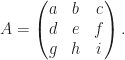
Then,

This method is about the same speed as the Gaussian-Elimination method. However, if you have already calculated det(A), using the formula may be slightly faster.
The formula provides an insight on why A is singular (not invertible) if det(A)=0. (Because, if det(A)=0, in the formula we would be dividing by 0 which is not allowed.)
Men’s wallet with coin compartment Singapore
Despite many cashless initiatives like PayLah, Singapore is not yet a truly cashless country. Coins are still needed to buy coffee or tea at the “Kopitiam”, or to put a $1 coin for pushing a trolley at supermarkets. Even if you carry paper notes, when you receive coins as change you will need a place to put them.
Many wallets do not have coin compartments. On Qoo10, this brand “Arete First” is a Singaporean brand that sells Leather Wallets at a reasonable price, with coin compartment. The quality is good, and it is genuine leather. It can also put a decent number of cards (nine card slots).
Do check it out if you are interested in a wallet with coin compartment.
URL: Arete First Genuine Leather Wallet

WWW.QOO10.SG
Horned Nerite Snails
Some video footage of my new Horned Nerite Snails in the Betta Tank. Really amazing and bright colors.
Taken using Canon PowerShot: Canon Camera and Camera Case Singapore
The fish tank is 5 Gallon: Betta Fish Tank
Imaginary Numbers
FINAL EPISODE – Riemann Complex Plane : 4 dimension but viewed in 3 dimensions
Episode 1 – 9 : History
Episode 10: Complex function
Function : 1 input mapped to 1 output
Multi-function : 1 input mapped to (n > 1 ) output
Math for AI : Gradient Descent
Simplest explanation by Cheh Wu:
(4 Parts Video : auto-play after each part)
Revision: Dot Product of Vectors
Gradient Descent (opposite = Ascent)
Singtel Voucher $100
Singtel Voucher Link: Click here to enter Official Singtel Voucher Website
As most people will know by now, Singtel is cutting down the recontract voucher. Nowadays it is hard to get Singtel recontract voucher, or even if you get one the amount is very little compared to last time.
However, now there is a new deal of a whopping $100 voucher for Singtel Combo plans. It is via referral codes and promo codes. Click on the link on the top of this post (or see the bottom of the post for more details).
Hi, heard you were looking for a new mobile phone? Here’s a Singtel mobile offer just for you. Sign up using my exclusive link below to enjoy an extra $100 OFF on selected phones when you switch to a new Singtel Combo plan. When you’ve switched, I’ll be rewarded too!
https://www.singtel.com/personal/promotions/refer-and-earn/referee?payload=0OjLMNU%2BhTCxKkzI574ZL4GJzhqPYWkKgx4aINzKihoRSYop3vXmuVjzLvzA%2FLMc&campaignID=cK5v4D&promoCode=FRIENDOFST
Sweden: From Safest to Most Dangerous Country in Europe
From young, through news and media my impression of Sweden is that it is a truly 1st world country on par with Switzerland, Norway, Denmark, etc. Also, my impression is that it used to be very safe, possibly one of the safest countries in the world.
But recently, Sweden seems to have risen to the rank of one of the most dangerous country in Europe, and some say the world! It is truly saddening and unbelievable. (I started to research on Sweden as I was searching for some jobs that had overseas travel requirements.)
From the way the online news media are portraying it, Sweden is very dangerous, almost on the level of Iraq/Iran/Afghanistan. I will definitely not dare to visit, let alone work there in the future.
Sources:
- https://www.thetoptens.com/dangerous-countries-europe/ (Ranked top 13 most dangerous in Europe)
“Mass immigration, mass raping mass crimes evil place to live was great now it’s a hell hole”
“STOCKHOLM — Sweden may be known for its popular music, IKEA and a generous welfare state. It is also increasingly associated with a rising number of Islamic State recruits, bombings and hand grenade attacks.”
“The claim: Many young male migrants arrived in Sweden over the past few years, when the country accepted unprecedented numbers of refugees, and there has been a huge rise in sexual crime in Sweden especially in the southern port city of Malmo.”
- Sweden’s deadly problem with hand grenades (2018 News)
“The number of explosions caused by hand grenades has increased in Sweden in recent years. There were fewer than five in 2014 but at least 20 in 2017, and a further 39 grenades were seized by police.”
YouTube video: Some people have started wearing bulletproof vests in Sweden.
No More Recontract Voucher from Singtel? Best Phone to Recontract and Sell
It is an “open secret” last time that if you call the Singtel customer service hotline at 1688, they may give you a recontract voucher for you to get a new phone. In previous times it used to be as high as $100, then over the years it slowly reduced to $50. It seems that the voucher is gone now, for low usage customers (e.g. Combo 2 plan). That is, no more recontract voucher. That was my experience in September 2018. That being said, experiences may differ from user to user, you may still want to phone in to try your luck. The only reason I am still using Singtel is that the rest of my family is on the “Singtel Circle” plan.
Important Update: There is a new form of voucher, called the Singtel Referral Voucher, worth $100! Basically you switch to a new Combo Plan and get $100 off the phone.
Best Phone to Recontract and Sell Off
Traditionally, the best phone to recontract and sell has always been the latest iPhone. This is based on the strong demand for iPhone. For instance, as of now, the most popular seems to be iPhone XS, Gold color, 256 GB. Do take note of the color/storage size as unpopular combinations may fetch a lower price. At the time of writing, recontracting and selling an iPhone may earn as much as $300 or more (buy at $1338 and sell off at $1640).
How to get Singtel Voucher (2019 onwards Method)
Are you still looking for the elusive Singtel Discount Voucher to offset your phone purchase? Do not bother to call 1688 anymore, that is the old-school method that does not work nowadays (you can still try if you want, you will find it hard to even speak to a human Singtel operator).
The new method is to use the Singtel Referral Voucher which is worth $100. Click here to go directly to the official Singtel website where your $100 voucher will be applied automatically.
Free Water Saving Kit (Singapore)
I believe this is not new, but it is the first time I heard of it. Anyway, it is free, so do feel free to request for a sample at the PUB Official Website.
PUB has revamped the packaging of its popular water saving kits featuring its mascot Water Wally. A set of thimbles with three and four holes allows residents to have greater flexibility in regulating their tap’s and showerhead’s flow rates. Water Wally stickers with specific messages are also included in the kit to act as reminders of good water saving habits in homes.
URL: https://www.pub.gov.sg/savewater/requestforwatersavingkit
Happy New Year
Happy New Year to all readers of Mathtuition88.com!
Thanks to your support, Mathtuition88.com has reached 885,060 views! We will continue posting Math and Education posts so please continue to visit the website for updates.
How to win Sir Roger Penrose’s Chess puzzle (that computers can’t solve)
Source: http://www.telegraph.co.uk/science/2017/03/14/can-solve-chess-problem-holds-key-human-consciousness/
Despite chess computers being very highly rated and winning virtually all human grandmasters, there are still certain positions that the computers can’t solve.
Sir Roger Penrose has documented one of them here:
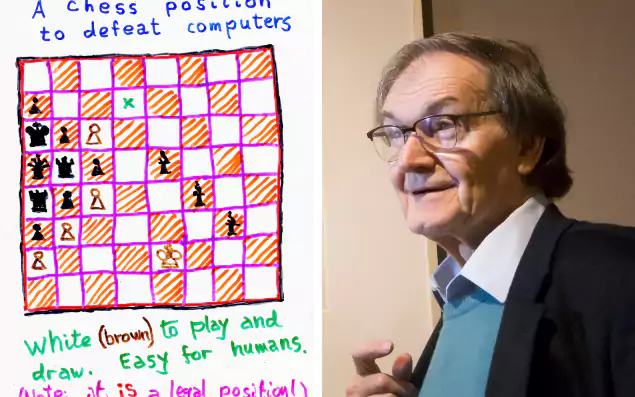
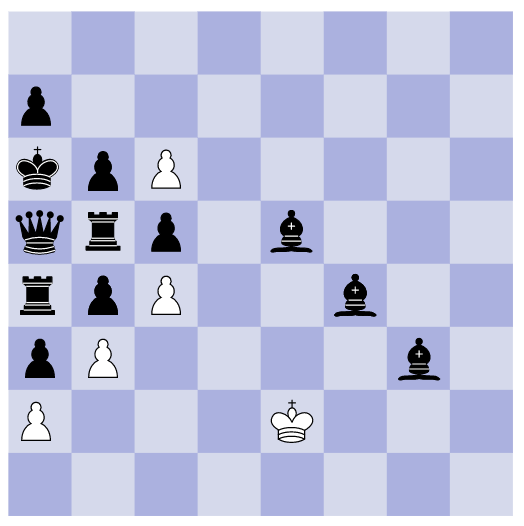
Chess engines will state that black is winning by a large margin, when in fact White can easily draw, or even win!
Drawing should be easy. Just move the king around (without moving the c6 pawn). The only black pieces that can move are the dark-squared bishops, which can’t checkmate your king.
Winning should be only possible if Black plays badly, e.g. Bishops all give up control of the c7 square. Then c7 followed by c8=B or c8=Q is checkmate!
Very nice study by Sir Penrose that illustrates the weakness of computers!
Unique Cars and Parts
There are hundreds if not thousands of Automotive websites to be found on the net, so often it can be a little hit and miss as to finding the best of the best that is out there. Unique Cars and Parts is just one of those sites, one of the best that there is. Well researched and covering almost every automotive topic there is, the site also boasts a mammoth array of various media types, from old auto radio commercials, TV and cinema advertising, car brochures, press releases, car launches and biographies.
Even better is the ability to sell your old car and or parts for free, or even list your auto business if you are in the trade. No cost really does mean no cost – not sure how they do it – but what they have created is brilliant. If you are a car aficionado or even have a simple passing interest in the history of automobiles, from the earliest contraptions found on the roads at the beginning of last century, the the more modern vehicles we drive today – pay this site a visit and we would recommend you bookmark it for future reference.
Click here to go to the Unique Cars and Parts Classic Car Website

Secondary Level Chinese Tuition
Looking for O Level / IP / JC Chinese Tuition?
Ms Gao specializes in teaching secondary level chinese (CL/HCL) tuition in Singapore. Ms Gao has taught students from various schools, including RI (Raffles Institution IP Programme).
Teaches West / Central Area: E.g. Clementi, Jurong East, Bukit Timah, Dover, Bishan, Marymount
Email: chinesetuition88@gmail.com
Website: http://chinesetuition88.com
Princeton Professor Predicts 99% Chance for Hillary Clinton to Win
A survey from the Princeton Election Consortium has found that Hillary Clinton has a 99 per cent chance of winning the election over Donald Trump.
Three days before the election, Ms Clinton has a projected 312 electoral votes, compared to 226 for Mr Trump. A total of 270 electoral votes are needed to win.
The probability statistic was found by the university’s statistical Bayesian model.
The developer of the model, neuro and data scientist Princeton professor Sam Wang, correctly predicted 49 out of 50 states in 2012.
Donald Trump’s Answer to Math Question: 2+2=?
Source: http://www.attn.com/stories/6407/george-takei-impersonates-donald-trump
Question: What is 2+2?
Answer:
“I have to say a lot of people have been asking this question. No, really. A lot of people come up to me and they ask me. They say, ‘What’s 2+2’? And I tell them look, we know what 2+2 is. We’ve had almost eight years of the worst kind of math you can imagine. Oh my God, I can’t believe it. Addition and subtraction of the 1s the 2s and the 3s. It’s terrible. It’s just terrible. Look, if you want to know what 2+2 is, do you want to know what 2+2 is? I’ll tell you. First of all the number 2, by the way, I love the number 2. It’s probably my favorite number, no it is my favorite number. You know what, it’s probably more like the number two but with a lot of zeros behind it. A lot. If I’m being honest, I mean, if I’m being honest. I like a lot of zeros. Except for Marco Rubio, now he’s a zero that I don’t like. Though, I probably shouldn’t say that. He’s a nice guy but he’s like, ‘10101000101,’ on and on, like that. He’s like a computer! You know what I mean? He’s like a computer. I don’t know. I mean, you know. So, we have all these numbers, and we can add them and subtract them and add them. TIMES them even. Did you know that? We can times them OR divide them, they don’t tell you that, and I’ll tell you, no one is better at the order of operations than me. You wouldn’t believe it. So, we’re gonna be the best on 2+2, believe me.”
Credit: Original Author Steven Edwards.
Why Math Education in the U.S. Doesn’t Add Up
The U.S. has some of the best universities in Math (think Harvard, Princeton, MIT), however the state of high school math is subpar and well below other developed nations. The main reason, according to this article, is the curriculum that focuses more on memorization and rote learning rather than understanding.
This book by Jo Boaler (Stanford Professor) sums up what can be done by parents to improve their child’s mathematical skills.
Another way is to consider studying Singapore Math, as Singapore is well known for being good at high school / elementary school math.
Source: https://www.scientificamerican.com/article/why-math-education-in-the-u-s-doesn-t-add-up/
Excerpt:
In December the Program for International Student Assessment (PISA) will announce the latest results from the tests it administers every three years to hundreds of thousands of 15-year-olds around the world. In the last round, the U.S. posted average scores in reading and science but performed well below other developed nations in math, ranking 36 out of 65 countries.
We do not expect this year’s results to be much different. Our nation’s scores have been consistently lackluster. Fortunately, though, the 2012 exam collected a unique set of data on how the world’s students think about math. The insights from that study, combined with important new findings in brain science, reveal a clear strategy to help the U.S. catch up.
The PISA 2012 assessment questioned not only students’ knowledge of mathematics but also their approach to the subject, and their responses reflected three distinct learning styles. Some students relied predominantly on memorization. They indicated that they grasp new topics in math by repeating problems over and over and trying to learn methods “by heart.” Other students tackled new concepts more thoughtfully, saying they tried to relate them to those they already had mastered. A third group followed a so-called self-monitoring approach: they routinely evaluated their own understanding and focused their attention on concepts they had not yet learned.
In every country, the memorizers turned out to be the lowest achievers, and countries with high numbers of them—the U.S. was in the top third—also had the highest proportion of teens doing poorly on the PISA math assessment. Further analysis showed that memorizers were approximately half a year behind students who used relational and self-monitoring strategies. In no country were memorizers in the highest-achieving group, and in some high-achieving economies, the differences between memorizers and other students were substantial. In France and Japan, for example, pupils who combined self-monitoring and relational strategies outscored students using memorization by more than a year’s worth of schooling.
Pokemon Go Singapore Dominated by CP >1000 Pokemon
Pokemon Go has finally arrived in Singapore! Good to see that the company Niantic did not forget about Singapore.
Upon starting the game, however, one would be in for a surprise. The gyms are all dominated by high level Pokemon, just merely hours after the release. (It is humanly impossible to have reached such a level in such a short time.)
For instance, the gyms near my neighbourhood has Gyarados (arguably the best Water Pokemon), Hypnos and Nidoqueen respectively. (See screenshot)


How did these guys get these Pokemon is a good question. The possibilities are either GPS Spoof (E.g. by using VPN to access Pokemon Europe or USA), or that they really caught the Pokemon overseas. Either way, they would have had a headstart since Pokemon Go was released much earlier in USA/Europe/Australia.
Overall, Pokemon Go is a fun and unique game in the sense that it involves walking around in real environments. However, one letdown is that it is not very skill-based (unless one counts flicking Pokeballs as a skill). There is not much strategy involved (both catching or battling) for Pokemon Go.
There is one mathematical part of Pokemon Go: Determining which Pokemon to evolve based on IV (Initial Values). Some websites to help are: Pokeassistant, or TheSilphRoad. The difference between a bad or perfect Pokemon is only 10% though, so it will only make a difference in very close battles.
Pokémon Clip ‘N’ Carry Poké Ball Belt, Styles May Vary


(For those really into the game, may want to check these out while you hunt for Pokemon!)
Flyme Pokemon Go Cap ,Team Valor Team Mystic Team Instinct Baseball Cap Hat (Red)


Fried Golden Cicada
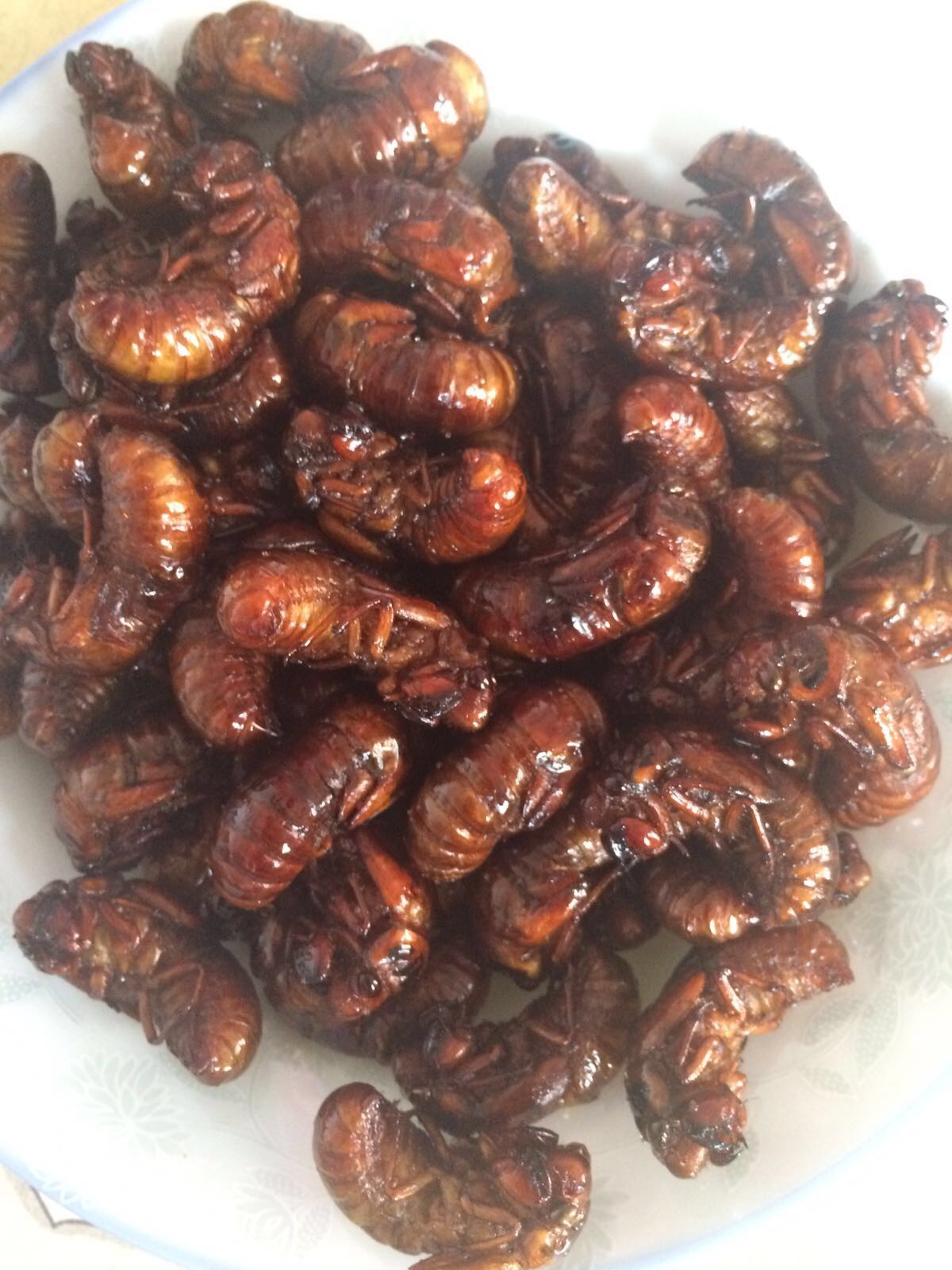 Fried Golden Cicada is a delicacy in Shandong, China.
Direct Sum vs Cartesian Product
Excellent explanation found on Math Stackexchange.
Basically for finite index sets (finite number of factors), the two constructions are the same.
Only when there is an infinite number of factors, the direct sum 


Toddlers prepare for their first big interview
Source: BBC
Getting into good schools or universities is tough in many parts of the world, but in Hong Kong the pressure begins earlier. Often parents try to get children into a good kindergarten – and before that, into a good nursery. So there are now classes preparing toddlers for that all-important nursery interview.
Yoyo Chan is preparing for an important interview that could help her succeed in life. She is one-and-a-half years old.
At two she will start nursery, but competition is fierce in Hong Kong, and some of the most prestigious nurseries are selective. Her parents want her to be well-prepared for her first big test in life.
The best nurseries and kindergartens are seen as a gateway into the best primary schools – which in turn, parents believe, pave the way to the best secondary schools and universities.
So the most renowned of them can receive more than 1,000 applications for just a few dozen places. As a result, enterprising tuition companies are now offering interview training for toddlers.
Reliable Tuition Agency Singapore
Reliable Tuition Agency:
Startutor is Singapore’s most popular online agency, providing tutors to your home. There are no extra costs for making a request. The tutors’ certificates are carefully checked by Startutor.
(Website: http://startutor.sg/request,wwcsmt)
There are many excellent tutors from RI, Hwa Chong, etc. at Startutor, teaching various subjects at all levels.
High calibre scholars from NUS/overseas universities like Stanford are also tutoring at Startutor.
(Website: http://startutor.sg/request,wwcsmt)
(Please use the full link above directly, thanks!)
Fill in the request form in the link above to request for a tutor and our coordinators will attend to you within the day.
You get to enjoy the following:
- Free matching service
- No hidden charges
- Commission is charged from tutor
Super All-rounder
Source: http://qz.com/603267/an-nfl-player-was-just-accepted-to-the-math-phd-program-at-mit/
This guy is the ultimate definition of “All rounded”. Good at both sports and studies. His motivation to play football is a little creepy though: “I play because I love the game. I love hitting people.” Note: American football is the “Upsized” version of the rugby in Singapore schools. Protective helmet and gear are needed.
The National Football League offseason is supposed to be a time for players to relax, recover from the brutality of the prior season, and prepare for the next one.
Not for Baltimore Ravens player John Urschel. The 6’3”, 305-pound offensive lineman will begin a PhD in mathematics at the Massachusetts Institute of Technology this year. The Hulk-like math geek, who graduated from Penn State with a 4.0 grade point average,will study spectral graph theory, numerical linear algebra, and machine learning.
Thallium Poisoning Mystery: Zhu Ling
This is a very old case, but the mystery of Thallium poisoning endures till today. The murderer is still walking scot-free to this day! Do spread this news, as the name “Zhu Ling” is in danger of being forgotten after more than 20 years. Zhu Ling was a very talented student in chemistry, music (she plays the ancient instrument Guqin) and literature.
To learn more or to donate, visit: http://www.helpzhuling.org/english.aspx
From late 1994 to early 1995, 21-year old Zhu Ling 朱令 was poisoned at Tsinghua, Beijing, one of the most prestigious universities in China. Globally, physicians reviewed her symptoms, which were sent to the Internet through a Usenet group after no correct diagnostics availed themselves for months. This world first ever large scale tele-medicine trial suggested thallium poisoning, which was subsequently proven, and its treatment. Her life was ultimately saved, but she suffered serious neurological damage and permanent physical impairment.
Who poisoned this promising and multi-talented young college girl? One of her dormitory roommates with strong political connections was the prime suspect. Yet the police closed the case in 1998 without a definitive conclusion, claimed due to evidences being stolen.
After 19 years, the murderer is still at large. And it may be someone around you, with a changed identity.
Simplicial Sets
A simplicial set 


for each 

We can use deleting-doubling for remembering simplicial identities:

The disk quota for wordpress.com is full
Strangely, I received an error notification that “The disk quota for mathtuition88.wordpress.com is full”, even though I have barely used 5% of my 3 GB storage space under the free plan.
Anyone experienced this?

Seems everything is alright, I can still post. Very strange.
1000 Posts
Finally, reached 1000 posts!
Image of Vertical Strip under Inversion
This is a slight generalisation of Example 3 in Churchill’s Complex Variables and Applications
Consider the infinite vertical strip 


When 



Similarly the line 

Note that as 
Thus, the resultant image is the (open) region between the two circles.
The converse holds too, i.e. the region between two circles will be mapped back to the vertical strip by inversion.
Example
Find an analytic isomorphism from the open region between the two circles 


First, we “shift” the circles to the left by 1 unit via the map 


Composition of all the above functions leads us to the desired transformation 

We will mention an analytic isomorphism of this vertical strip to the upper half plane 
Clash of Clans Math – Using Linear Inequalities to Save Elixir
This is quite a nice video on Clash of Clans and Math. Only got 70 views so far, but it is definitely a well prepared video.
Another video:
Farming in Clash of Clans has just gotten harder, due to nerf on Town Hall not granting shield, and very powerful defenses for TH10 and TH11. Watch these videos and you may gain some idea on a better way to farm.
Definition of Tensor Product: M Tensor N
Let 


Motivation
The tensor product is a construction that, roughly speaking, allows us to take “products” 


Definition
(Following Dummit; there is another equivalent definition using “universal property”, see Wikipedia)


The outcome of the above definition is that the following nice properties hold:


Motivational: Kung Fu Panda 3 Song
The new Kung Fu Panda 3 song lyrics is out!
Very motivational lyrics. The title itself <Try> is very motivational.
“Only those who dare to fail greatly can ever achieve greatly.” ― Robert F. Kennedy
The full lyrics are as follows (includes some Chinese):
Try – 派伟俊/周杰伦
(《功夫熊猫3》电影全球主题曲)
中文词:方文山
英文词:冼佩瑾
曲:派伟俊
小派:You always have to do something
Just to show the world that you exist
So you try
You hope they’ll see
If on this brand new day you’ll look
On the bright side of the same old street
You will see
What you deserve
Jay:Let’s go
我说几华里我送别了过去
他们说人生的结局非常的戏剧
塞外羌笛孤城马蹄
在武侠的世界里谁与谁来为敌
合:La la la la la la la la la
黄沙里用竹笔写下的字叫勇气
Jay:You just have to try
To be who you are
And you ought to fly
Step into the light
小派:And soon you will find
Be yourself
Somewhere deep inside
There’s a universe right there waiting to be unlocked
The key lies in looking into yourself
Jay:Oh Try try try try
Just do what is right
You’ll fly so high
Let go of the brakes
Be who you are
Be yourself ’cause your power is on
合: When you believe in what you’ve got
You know you’re perfect just be who you are
小派:So they don’t see what you’re made of
But I like you and I know they’re wrong
Now it’s time
To show them what you got
Let the blue skies cheer you on
Embrace the wind we’ll ride along
You’re perfect when you’re who you are
Jay:这世界有些事有些人凭感觉
别管他旌旗密布遍野狼烟霜雪
那故事在穿越而我也在翻页
一行行做好准备敏锐而直接
合:La la la la la la la la la
爱不灭真实的一切废话全收回
小派:You just have to try
To be who you are
Jay:And you ought to fly
Step into the light
小派:And soon you will find
Be yourself
Somewhere deep inside
There’s a universe right there waiting to be unlocked
The key lies in looking into yourself
Jay:Oh Try try try try
Just do what is right
You’ll fly so high
Let go of the brakes
合: Be who you are
Be yourself ’cause your power is on
When you believe in what you’ve got
You know you’re perfect just be who you are
小派:You just have to try
To be who you are
Jay:And you ought to fly
Step into the light
小派:And soon you will find
Be yourself
Somewhere deep inside
There’s a universe right there waiting to be unlocked
The key lies in looking into yourself
Jay:Oh Try try try try
Just do what is right
You’ll fly so high
Let go of the brakes
合: Be who you are
Be yourself ’cause your power is on
When you believe in what you’ve got
Chinese Tuition
Chinese Tuition: http://chinesetuition88.com/
Chinese Tuition Singapore
新加坡华文补习老师
Tutor: Ms Gao (高老师)
Ms Gao is a patient tutor, and also effectively bilingual in both Chinese and English.
A native speaker of Mandarin, she speaks clearly with perfect accent and pronunciation. She is also well-versed in Chinese history, idioms and proverbs.
Ms Gao is able to teach Chinese at the Primary and Secondary school level. She will teach in an exam-oriented style, but will also try her best to make the lesson interesting for the student.
Ms Gao graduated from Huaqiao University, which is founded by late Chinese premier Zhou Enlai.
Contact:
Email: chinesetuition88@gmail.com
Website: http://chinesetuition88.com/
(Preferably looking for students staying in the West side of Singapore, e.g. Clementi / Dover / Jurong East / Boon Lay / Queenstown)
CW Approximation
A weak homotopy equivalence is a map 



In other words, Whitehead’s theorem says that a weak homotopy equivalence between CW complexes is a homotopy equivalence. Just to recap, a map 


It turns out that for any space 

Excision for Homotopy Groups
According to Hatcher (Chapter 4.2), the main difficulty of computing homotopy groups (versus homology groups) is the failure of the excision property. However, under certain conditions, excision does hold for homotopy groups:
Theorem (4.23): Let 





Miscellaneous Definitions
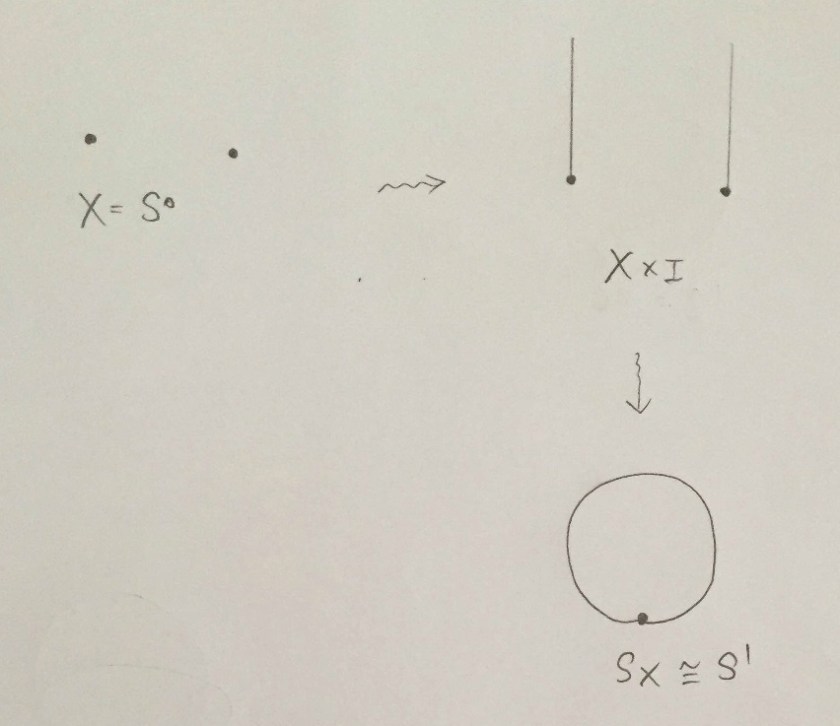
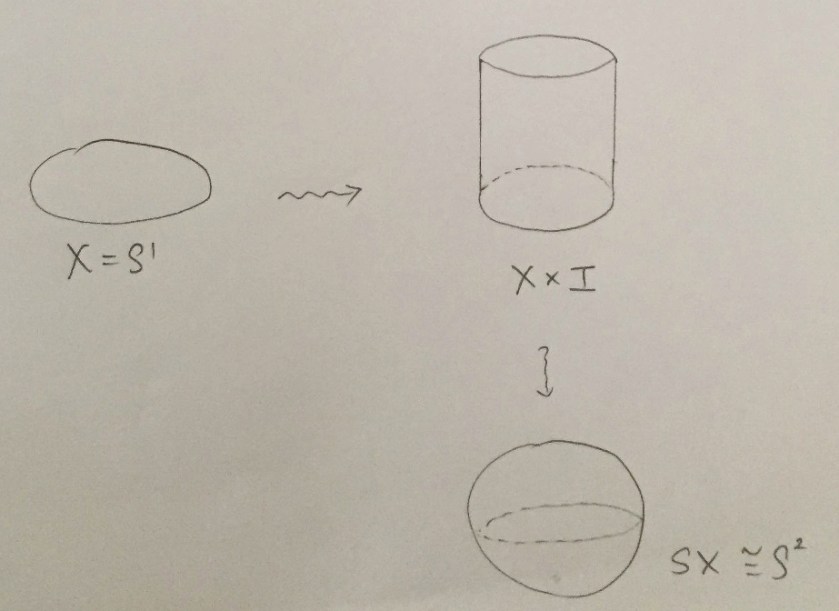
Suspension: Let 


The definition of suspension is similar to that of the cone in the following way. The cone 
The classical example is 


Here are some graphical sketches of the case where
Linear Fractional Transformation (Mobius Transformation)
The transformation 


One key property of linear fractional transformations is that it transforms circles and lines into circles and lines.
Let us find the linear fractional transformation that maps the points 


Solution:

What we have to do is basically solve the three simultaneous equations arising from 


Eventually we can have all the variables in terms of 


Donate to Singapore Charity @ Giving.sg
Just to introduce this website to readers who haven’t heard of it. Donations above $50 are tax deductible, and it also features ways to volunteer for the charity organisations. Do check it out!
Q: What is Giving.sg? (taken from their FAQ page)
A: Giving.sg is Singapore’s very own one-stop portal for empowering all of us on our Giving Journey, whether we are looking to help local non-profit organisations (NPOs) by giving our TIME, by general volunteering; our TALENT, by skills volunteering; or [our] TREASURE, by donations.
Giving.sg brings together its predecessors sggives.org and sgcares.org, both of which have helped raise over S$51 million for more than 350 [local] non-profits, as well as seen over 40,000 volunteers generously gift their time to these [local] non-profits.
News article featuring Giving.sg: http://www.straitstimes.com/singapore/online-platform-among-initiatives-to-promote-giving-in-singapore
Interesting Blog Post on Mathematical Conversations
Source: http://www.theliberatedmathematician.com/2015/12/why-i-do-not-talk-about-math/
A honest opinion on the nature of mathematical conversations, by this blog post author Piper Harron. (Also see our previous blog post on her interesting PhD Thesis) Very interesting read, for those who are in the mathematical community.
Secondary Chinese Tuition
For those interested in Secondary Level (O Level) Chinese Tuition, do check out http://chinesetuition88.com/.
The tutor (Ms Gao) will be taking in a few more students in 2016 for Chinese Tuition. Do check out http://chinesetuition88.com/ for more info!
Cellular Approximation for Pairs
(This is Example 4.11 in Hatcher’s book).
Cellular Approximation for Pairs: Every map 


What “map of CW pairs” mean, is that 


First, we use the ordinary Cellular Approximation Theorem to deform the restriction 
We use this to prove a corollary: A CW pair 


First we note that being n-connected means that the space is non-empty, path-connected, and the first n homotopy groups are trivial, i.e. 

Proof: First, we apply cellular approximation to maps 


Consider the long exact sequence of the pair

Since it is an exact sequence, the image of any map equals the kernel of the next. Thus, 


Star Wars Ball Droid: How is the head attached to the body?
Just watched Star Wars: The Force Awakens, here is my review on it. Overall a good movie, enjoyed watching it. The storyline and lightsaber duels are a bit weak in my opinion. How Rey, an untrained person holding a lightsaber for the first time, managed to defeat Kylo Ren with his crossguard lightsaber remains a mystery to me. My favorite episode remains Episode 1: The Phantom Menace.
Many mysteries remain unanswered, like the identities of Rey and Snoke. Looking forward to the next episode.
Something I find very interesting is the Ball Droid BB-8. Something even more interesting about the droid is that it is not CGI effects, it is a real prop. How the head of BB-8 is being attached to the body seems to be via strong magnets.
The toy-version of BB-8 is being sold on Amazon, a possible gift idea for those who are Star Wars fans. Sphero BB-8 App-Enabled Droid


Cellular Approximation Theorem and Homotopy Groups of Spheres
First we will state another theorem, Whitehead’s Theorem: If a map 

The main theorem discussed in this post is the Cellular Approximation Theorem: Every map 
Corollary: If 

Proof: Consider 

![[f]\in\pi_n(S^k)](https://s0.wp.com/latex.php?latex=%5Bf%5D%5Cin%5Cpi_n%28S%5Ek%29&bg=ffffff&fg=1a1a1a&s=0&c=20201002)

Since
Merry Christmas
Wishing all readers a Merry Christmas and Happy New Year!
For parents looking for an ideal Christmas gift for their child, do consider buying an enrichment book from Recommend Math Books. As a quote goes, “A book is a gift you can open again and again.” – Garrison Keillor
Some other excellent educational books for Christmas gifts are:
Another popular gift idea is the
All-New Kindle Paperwhite, 6″ High-Resolution Display (300 ppi) with Built-in Light, Wi-Fi – Includes Special Offers


Advanced Method for Proving Normal Subgroup
For beginners in Group Theory, the basic method to prove that a subgroup 


This basic method is good for proving basic questions, for example a subgroup of index two is always normal. However, for more advanced questions, the basic method unfortunately seldom works.
A more sophisticated advanced approach to showing that a group is normal, is to show that it is a kernel of a homomorphism, and thus normal. Thus one often has to construct a certain homomorphism and show that the kernel is the desired subgroup.
Example: Let ![[G:H]=p](https://s0.wp.com/latex.php?latex=%5BG%3AH%5D%3Dp&bg=ffffff&fg=1a1a1a&s=0&c=20201002)


The result above is sometimes called “Strong Cayley Theorem”.
Proof: Let 


This is a group action since 

This action induces a homomorphism 


Suppose to the contrary 
![[H:\ker\sigma]>1](https://s0.wp.com/latex.php?latex=%5BH%3A%5Cker%5Csigma%5D%3E1&bg=ffffff&fg=1a1a1a&s=0&c=20201002)

![[H:\ker\sigma]](https://s0.wp.com/latex.php?latex=%5BH%3A%5Cker%5Csigma%5D&bg=ffffff&fg=1a1a1a&s=0&c=20201002)
We also have
![[G:\ker\sigma]=[G:H][H:\ker\sigma]=p[H:\ker\sigma]](https://s0.wp.com/latex.php?latex=%5BG%3A%5Cker%5Csigma%5D%3D%5BG%3AH%5D%5BH%3A%5Cker%5Csigma%5D%3Dp%5BH%3A%5Cker%5Csigma%5D&bg=ffffff&fg=1a1a1a&s=0&c=20201002)
By the First Isomorphism Theorem, 
![[G:\ker\sigma]\mid p!](https://s0.wp.com/latex.php?latex=%5BG%3A%5Cker%5Csigma%5D%5Cmid+p%21&bg=ffffff&fg=1a1a1a&s=0&c=20201002)
![p[H:\ker\sigma]\mid p!](https://s0.wp.com/latex.php?latex=p%5BH%3A%5Cker%5Csigma%5D%5Cmid+p%21&bg=ffffff&fg=1a1a1a&s=0&c=20201002)
![[H:\ker\sigma]\mid(p-1)!](https://s0.wp.com/latex.php?latex=%5BH%3A%5Cker%5Csigma%5D%5Cmid%28p-1%29%21&bg=ffffff&fg=1a1a1a&s=0&c=20201002)


However, ![q\mid [H:\ker\sigma]](https://s0.wp.com/latex.php?latex=q%5Cmid+%5BH%3A%5Cker%5Csigma%5D&bg=ffffff&fg=1a1a1a&s=0&c=20201002)
![q\mid[G:\ker\sigma]=\frac{|G|}{|\ker\sigma|}](https://s0.wp.com/latex.php?latex=q%5Cmid%5BG%3A%5Cker%5Csigma%5D%3D%5Cfrac%7B%7CG%7C%7D%7B%7C%5Cker%5Csigma%7C%7D&bg=ffffff&fg=1a1a1a&s=0&c=20201002)

This is a contradiction that 
This proof is pretty amazing, and hard to think of without any hints.
Star Wars Math Song
I like the first one about Physics, and the last one about Math!
Curiously, they used Darth Maul’s Theme for Physics, and Darth Vader’s Theme for Math. 🙂
How to calculate Homology Groups (Klein Bottle)
This post will be a guide on how to calculate Homology Groups, focusing on the example of the Klein Bottle. Homology groups can be quite difficult to grasp (it took me quite a while to understand it). Hope this post will help readers to get the idea of Homology. Our reference book will be Hatcher’s Algebraic Topology (Chapter 2: Homology). I will elaborate further on the Hatcher’s excellent exposition on Homology.
This is also Exercise 5 in Chapter 2, Section 2.1 of Hatcher.
The first step to compute Homology Groups is to construct a 
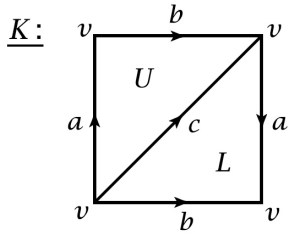
One thing to note for
The key formula for Homology is: 
We have 

Next, we have 

Therefore 
Next, we have 


We then have 


Thus 
To intuitively understand the above working, we need to use the idea that elements in the quotient are “zero”. Hence 


Finally we note that 


In conclusion, we have

Chilli Crab
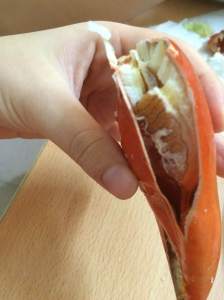
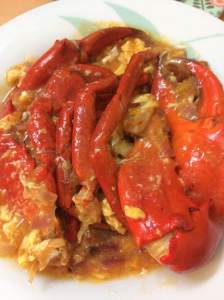
Bought a Mud Crab from Sheng Shiong at $6. The live ones were even cheaper, at $4 each. Much cheaper than ordering crab outside at restaurants, where they would at least cost $30.
My wife then cooked the crab in the “Chilli Crab” style. Yummy!


Every non-empty open set in R is disjoint union of countable collection of open intervals
Question: Prove that every non-empty open set in 
The key things to prove are the disjointness and the countability of such open intervals. Otherwise, if disjointness and countability are not required, we may simply take a small open interval centered at each point in the open set, and their union will be the open set.
Elementary Proof: Let 
Let 


We note that such maximal intervals are equal or disjoint: Suppose 


Each of the maximal open intervals contain a rational number, thus we may write 
There are many other good proofs of this found here (http://math.stackexchange.com/questions/318299/any-open-subset-of-bbb-r-is-a-at-most-countable-union-of-disjoint-open-interv), though some can be quite deep for this simple result.
Useful Theorem in Introductory Ring Theory
Something interesting I realised in my studies in Math is that certain theorems are more “useful” than others. Certain theorems’ sole purpose seem to be an intermediate step to prove another theorem and are never used again. Other theorems seem to be so useful and their usage is everywhere.
One of the most “useful” theorems in basic Ring theory is the following:
Let 
(i) 
(ii)
With this theorem, the following question is solved effortlessly:
Let 

(i) Show that 
(ii) Show that
Sketch of Proof of (i):


(ii) is proved similarly.

