Suppose G and H are p-groups, and 
Then for any Sylow p-subgroup P of G, 
Conversely, for any Sylow p-subgroup Q of H, 
Proof:
By the First Isomorphism Theorem, 


Since 


![[G:P]](https://s0.wp.com/latex.php?latex=%5BG%3AP%5D&bg=ffffff&fg=1a1a1a&s=0&c=20201002)
![[G:PN]=[G:P]/[PN:P]](https://s0.wp.com/latex.php?latex=%5BG%3APN%5D%3D%5BG%3AP%5D%2F%5BPN%3AP%5D&bg=ffffff&fg=1a1a1a&s=0&c=20201002)
Then ![\displaystyle [H:\phi(P)]=[G/N:PN/N]=[G:PN]](https://s0.wp.com/latex.php?latex=%5Cdisplaystyle+%5BH%3A%5Cphi%28P%29%5D%3D%5BG%2FN%3APN%2FN%5D%3D%5BG%3APN%5D&bg=ffffff&fg=1a1a1a&s=0&c=20201002)


Part 2: Let 


Then, ![[G:K]=[H:Q]](https://s0.wp.com/latex.php?latex=%5BG%3AK%5D%3D%5BH%3AQ%5D&bg=ffffff&fg=1a1a1a&s=0&c=20201002)
Consider 


Suppose G and H are p-groups, and
Then for any Sylow p-subgroup P of G,
Conversely, for any Sylow p-subgroup Q of H,
Proof:
By the First Isomorphism Theorem,
Since
Then
Part 2: Let
Then,
Consider
Interesting news, since it is widely known that physicists are the most mathematically literate out of all the sciences. Perhaps what the research really shows is that huge chunks of equations may obscure the meaning of the research and thus is correspondingly less cited.
Similarly for math, nobody likes to read dry math texts crammed full of equations, theorems, and opaque proofs. Some illustration, explanation and motivation will greatly improve the exposition.
Source: https://www.sciencedaily.com/releases/2016/11/161111132118.htm
Physicists avoid highly mathematical work despite being trained in advanced mathematics, new research suggests.
The study, published in the New Journal of Physics, shows that physicists pay less attention to theories that are crammed with mathematical details. This suggests there are real and widespread barriers to communicating mathematical work, and that this is not because of poor training in mathematical skills, or because there is a social stigma about doing well in mathematics.
Dr Tim Fawcett and Dr Andrew Higginson, from the University of Exeter, found, using statistical analysis of the number of citations to 2000 articles in a leading physics journal, that articles are less likely to be referenced by other physicists if they have lots of mathematical equations on each page.
Dr Higginson said: “We have already showed that biologists are put off by equations but we were surprised by these findings, as physicists are generally skilled in mathematics.
“This is an important issue because it shows there could be a disconnection between mathematical theory and experimental work. This presents a potentially enormous barrier to all kinds of scientific progress.”
The research findings suggest improving the training of science graduates won’t help, because physics students already receive extensive maths training before they graduate. Instead, the researchers think the solution lies in clearer communication of highly technical work, such as taking the time to describe what the equations mean.
This is a sufficient condition for something that resembles “Weak convergence”: 
Suppose that 




Proof:
(Case: 

We may assume 


Let 


Since 




Then for
Since 
(Case: 
Define 


Since 
Thus there exists 


Then for 
so that 
(Show that the result is false if
Let ![f_k:=k\chi_{[0,\frac 1k]}](https://s0.wp.com/latex.php?latex=f_k%3A%3Dk%5Cchi_%7B%5B0%2C%5Cfrac+1k%5D%7D&bg=ffffff&fg=1a1a1a&s=0&c=20201002)


However if 


Correction for the case
Define
Since 
Thus there exists 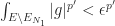
Since 


So for
so that 

![[0,1]](https://s0.wp.com/latex.php?latex=%5B0%2C1%5D&bg=ffffff&fg=1a1a1a&s=0&c=20201002)
Suppose there exists 
![x,y\in [0,1]](https://s0.wp.com/latex.php?latex=x%2Cy%5Cin+%5B0%2C1%5D&bg=ffffff&fg=1a1a1a&s=0&c=20201002)

By Mean Value Theorem, this means that 


However, 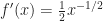
Note however, that 
Let 


Amazing Theorem! If 

It turns out that convergence in Lp implies that the norms converge. Conversely, a.e. convergence and the fact that norms converge implies Lp convergence. Amazing!
Relationship between 
Let 




Proof:
Assume
(Case: 
Lemma 1:
If 

Proof of Lemma 1:
Hence 
End Proof of Lemma 1.
Hence, using 

Thus
Hence
(Case: 
By Minkowski’s inequality, 



Converse:
Assume
Lemma 2:
For 

Proof of Lemma 2:
By convexity of 
Multiplying throughout by 
Thus together with Lemma 1, for 

Note that 




(Show that the converse may fail for
Consider ![f_k=\chi_{[-k,k]}\in L^\infty(\mathbb{R})](https://s0.wp.com/latex.php?latex=f_k%3D%5Cchi_%7B%5B-k%2Ck%5D%7D%5Cin+L%5E%5Cinfty%28%5Cmathbb%7BR%7D%29&bg=ffffff&fg=1a1a1a&s=0&c=20201002)



Source: http://people.com/human-interest/nasa-katherine-johnson-mathematician-advice-interview/
Despite her age, Johnson isn’t slowing down anytime soon.
“I like to learn,” she says. “That’s an art and a science. I’m always interested in learning something new.”
As a young girl she’d stop by the library on her home way in the evening and would pick up a book.
“I finally persuaded them to let me look at two books,” she recalls. “I could have read more than that in one night if they had let me.”
Johnson’s life was the inspiration for a nonfiction book titled Hidden Figures: The American Dream and the Untold Story of the Black Women Mathematicians Who Helped Win the Space Race, which is now being turned into a major motion picture coming due theaters this December. (Empire star Taraji P. Henson will play Johnson.)
Johnson, who was given the Presidential Medal of Freedom by President Barack Obama in 2015, thinks she was able to succeed because she always loved what she did. It’s one piece of advice she has for young girls today.
“Find out what her dream is,” she says, “and work at it because if you like what you’re doing, you will do well.”
Johnson also taught her daughters a few life lessons.
“Don’t accept failure,” says Joylette Goble, who says she has always been in awe of her mother. “If there is a job to be done, you can do it and do it until you finish.”
She adds: “Be aware of people and help them when you can.”
Johnson’s other daughter, Katherine Goble Moore, says her mother has always been her role model.
“I will always be grateful for her,” she says.
Source: http://www.todayonline.com/singapore/youths-viral-video-attack-identified

(Screengrab: Bhai Hafiz Angullia/Facebook)
Just to inform parents of this terrible incident that occurred in Saint Andrew’s Secondary School. Apparently, this is not an isolated incident, it is quite an common occurence, it is even stated in Wikipedia: “After a series of bullying cases attracted attention in 2003, the school stated that the situation at St Andrew’s was no worse than at any other school, adding that bullies receive a stern warning; repeat offenders or those who injure others are caned and, ultimately, expelled.”
Do spread this post and comment on the original facebook page (with video): https://www.facebook.com/bhailaminate/videos/10210995333384134/. Parents who are choosing a secondary school for their child should also take note of this incident.
For this kind of extreme case, there is no need for the school to counsel/discipline the bullies anymore, just send them straight to Boys’ Home is the best thing to do.
#SayNoToBullies
A survey from the Princeton Election Consortium has found that Hillary Clinton has a 99 per cent chance of winning the election over Donald Trump.
Three days before the election, Ms Clinton has a projected 312 electoral votes, compared to 226 for Mr Trump. A total of 270 electoral votes are needed to win.
The probability statistic was found by the university’s statistical Bayesian model.
The developer of the model, neuro and data scientist Princeton professor Sam Wang, correctly predicted 49 out of 50 states in 2012.
Let 


(We may take 
Source: http://www.attn.com/stories/6407/george-takei-impersonates-donald-trump
Question: What is 2+2?
Answer:
“I have to say a lot of people have been asking this question. No, really. A lot of people come up to me and they ask me. They say, ‘What’s 2+2’? And I tell them look, we know what 2+2 is. We’ve had almost eight years of the worst kind of math you can imagine. Oh my God, I can’t believe it. Addition and subtraction of the 1s the 2s and the 3s. It’s terrible. It’s just terrible. Look, if you want to know what 2+2 is, do you want to know what 2+2 is? I’ll tell you. First of all the number 2, by the way, I love the number 2. It’s probably my favorite number, no it is my favorite number. You know what, it’s probably more like the number two but with a lot of zeros behind it. A lot. If I’m being honest, I mean, if I’m being honest. I like a lot of zeros. Except for Marco Rubio, now he’s a zero that I don’t like. Though, I probably shouldn’t say that. He’s a nice guy but he’s like, ‘10101000101,’ on and on, like that. He’s like a computer! You know what I mean? He’s like a computer. I don’t know. I mean, you know. So, we have all these numbers, and we can add them and subtract them and add them. TIMES them even. Did you know that? We can times them OR divide them, they don’t tell you that, and I’ll tell you, no one is better at the order of operations than me. You wouldn’t believe it. So, we’re gonna be the best on 2+2, believe me.”
Credit: Original Author Steven Edwards.
Here are some solutions to exercises in the book: Measure and Integral, An Introduction to Real Analysis by Richard L. Wheeden and Antoni Zygmund.
Chapter 1,2: analysis1
Chapter 3: analysis2
Chapter 4, 5: analysis3
Chapter 5,6: analysis4
Chapter 6,7: analysis5
Chapter 8: analysis6
Chapter 9: analysis7
Other than this book by Wheedon, also check out other highly recommended undergraduate/graduate math books.
Graduating soon and interested to transition to data science (dubbed the sexiest job of the 21st century)? We recommend two books which are very suitable for students with strong math background, but little or no background in data science/ machine learning.
Do check out the following data science / machine learning book (rated 4.5/5 on Amazon) Pattern Recognition and Machine Learning (Information Science and Statistics)
The above book is good for building a solid, theoretical foundation for a data scientist job. The next book Hands-On Machine Learning with Scikit-Learn, Keras, and TensorFlow: Concepts, Tools, and Techniques to Build Intelligent Systems
Do you know how to prove sin(1/x)/x is not Lebesgue Integrable on (0,1]?
Also check out other popular Measure Theory exam question topics here:
 (Free!)
Your free, 30-day trial comes with:
The following is a wonderful property of the Lebesgue Integral, also known as absolute continuity of Lebesgue Integral. Basically, it means that whenever the domain of integration has small enough measure, then the integral will be arbitrarily small.
Suppose
Given 


Proof:
Define 


Let 


Let 

Let 
The U.S. has some of the best universities in Math (think Harvard, Princeton, MIT), however the state of high school math is subpar and well below other developed nations. The main reason, according to this article, is the curriculum that focuses more on memorization and rote learning rather than understanding.
This book by Jo Boaler (Stanford Professor) sums up what can be done by parents to improve their child’s mathematical skills.
Another way is to consider studying Singapore Math, as Singapore is well known for being good at high school / elementary school math.
Source: https://www.scientificamerican.com/article/why-math-education-in-the-u-s-doesn-t-add-up/
Excerpt:
In December the Program for International Student Assessment (PISA) will announce the latest results from the tests it administers every three years to hundreds of thousands of 15-year-olds around the world. In the last round, the U.S. posted average scores in reading and science but performed well below other developed nations in math, ranking 36 out of 65 countries.
We do not expect this year’s results to be much different. Our nation’s scores have been consistently lackluster. Fortunately, though, the 2012 exam collected a unique set of data on how the world’s students think about math. The insights from that study, combined with important new findings in brain science, reveal a clear strategy to help the U.S. catch up.
The PISA 2012 assessment questioned not only students’ knowledge of mathematics but also their approach to the subject, and their responses reflected three distinct learning styles. Some students relied predominantly on memorization. They indicated that they grasp new topics in math by repeating problems over and over and trying to learn methods “by heart.” Other students tackled new concepts more thoughtfully, saying they tried to relate them to those they already had mastered. A third group followed a so-called self-monitoring approach: they routinely evaluated their own understanding and focused their attention on concepts they had not yet learned.
In every country, the memorizers turned out to be the lowest achievers, and countries with high numbers of them—the U.S. was in the top third—also had the highest proportion of teens doing poorly on the PISA math assessment. Further analysis showed that memorizers were approximately half a year behind students who used relational and self-monitoring strategies. In no country were memorizers in the highest-achieving group, and in some high-achieving economies, the differences between memorizers and other students were substantial. In France and Japan, for example, pupils who combined self-monitoring and relational strategies outscored students using memorization by more than a year’s worth of schooling.
Inspirational Story of Lifelong learner Wei Sihao, who loves books and learning. After retirement, his favorite spot is the library, and he collects garbage to fund students who can’t afford university. Passed away in 2015 in a car accident. Rest in peace. (Text in Chinese)
之前,一则《杭州图书馆向流浪汉开放,拾荒者借阅前自发洗手》的新闻在网络上迅速传播。
http://js.ifeng.com/humanity/cul/detail_2014_11/24/3194502_0.shtml
而报道中的图片可以看到一位拾荒老人


安静地读书,认真地洗手。
后来,这位老人的真正身份才得以曝光:
韦思浩是原杭州大学(现浙江大学)1957级的学生。
上世纪80年代,韦思浩曾参与过《汉语大词典》杭大编写组工作,后又辗转去宁波教书。
1999年,韦思浩从杭州夏衍中学退休,也是从那一年,韦思浩放弃了他本来轻松的晚年生活,开始他长达十多年的“拾荒”之旅。
2015年11月18日,韦思浩在过马路的时候,被一辆出租车撞倒,12月13日,最终抢救无效离世。
韦思浩是原杭州大学(现浙江大学)1957级的学生。
上世纪80年代,韦思浩曾参与过《汉语大词典》杭大编写组工作,后又辗转去宁波教书。
1999年,韦思浩从杭州夏衍中学退休,也是从那一年,韦思浩放弃了他本来轻松的晚年生活,开始他长达十多年的“拾荒”之旅。
2015年11月18日,韦思浩在过马路的时候,被一辆出租车撞倒,12月13日,最终抢救无效离世。
相关新闻编辑
2014年11月,《杭州图书馆向流浪汉开放,拾荒者“看书前”自发洗手》,曾引起很多人关注。
2014年,因给拾荒者提供阅读空间,杭州图书馆被网友评为“最温暖图书馆”。当时,媒体报道中,一位外貌看似拾荒者的老人因“看书前洗手”的细节感动了不少网友。这位老人名叫韦思浩,是上世纪六十年代老杭州大学中文系的毕业生。
韦思浩老人退休前是中学的一级教师,退休后拿着5600多元的退休金,本可安心养老,但他却选择拾荒“补贴”日子。不过,他“补贴”不是自家生活,而是那些读不起书的孩子们。
2015年11月18日晚上六点,杭州下雨,老人打着一把伞,跟往常拾荒者打扮一样,一根竹竿挑着两个口袋,但就在过斑马线时,被一辆出租车撞上,当场昏迷,被紧急送往附近医院。
老人在重症监护室治疗了二十多天,一直处于深度昏迷。12月13号,虽然经过医院极力抢救,但老人多个器官衰竭,仍然没能挽回生命。[2]
在整理老人遗物时,韦思浩的三个女儿才发现老人拾荒的秘密。
“以前从不知道父亲在拾荒,更没想到他还在帮助其他人。”韦思浩二女儿韦汀坦言,“去年搬过一次家,捐资助学的票据和证书已经不全。但留下来的这些就能看出他一直在匿名捐赠。”
韦汀向记者展示这些捐赠凭据和证书:浙江省社会团体收费专用票据、浙江省希望工程结对救助报名卡、扶贫公益助学金证书……
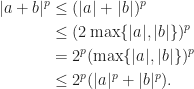
There are some useful inequalities for 
1)
For 
Proof:
2)
If
Proof:
Hence
3)
For
Proof:
By convexity of
Multiplying throughout by
Let G=HK, where H, K are characteristic subgroups of G with trivial intersection, i.e. 

Proof:
Now suppose 





Note that 
Suppose 


For any 

So 
If 


Any 



Thus 




Hence
Mathtuition88.com is a Math Education Blog that aims to provide useful Math / Education content that helps people worldwide.
Over the years, Mathtuition88.com has grown to reach 500,000 total views, thanks to support of fans!
If you find our website useful, please consider supporting it in one of the following ways. Thanks!
Every hyperlink counts! It could be a reblog, tweet, facebook, or a link in your blog. It doesn’t cost a cent, yet it is extremely important to the growth of the website.
Our patreon page is at: https://www.patreon.com/user?u=4235868
Purchase any item at Amazon using this link: Amazon
Our sales page is here: https://mathtuition88.com/math-notes-worksheets-sale/
Our advertisement page is here: https://mathtuition88.com/sponsored-post-advertisement/
Thank you once again for your support.
Vector Space has a total of 8 Axioms, most of which are common-sense, but can still pose a challenge for memorizing by heart.
I created a mnemonic “MAD” which helps to remember them.
M for Multiplicative Axioms:
 (Scalar Multiplication identity)
 (Associativity of Scalar Multiplication)
A for Additive Axioms: (Note that these are precisely the axioms for an abelian group)
 (Commutativity)
 (Associativity for Vector Addition)
 (Existence of Additive Inverse)
 (Additive Identity)
D for Distributive Axioms:
 (Distributivity of vector sums)
 (Distributivity of scalar sums)
There are a total of 10 Axioms for Field, it can be quite a challenge to remember all 10 of them offhand.
I created a mnemonic “ACIDI” to remember the 10 axioms. Unfortunately it is not a real word, but is close to the word “acidic”. A picture to remember is “acidic field”, a grass field polluted by acid rain?! 😛
A: Associativity
C: Commutativity
I: Identity
D: Distributivity
I: Inverse
Each of the properties has two parts – Addition and Multiplication. This table from Wolfram summarizes it perfectly:
| name | addition | multiplication |
| associativity |  |
 |
| commutativity |  |
 |
| distributivity |  |
 |
| identity |  |
 |
| inverses |  |
 |
Do check out this very inspirational post on Quora.
Excerpt:
I was about as under achieving as you could get.
Barely graduated from high school. Suspended, arrested, etc.
Luckily I went to an awesome community college and they turned me around.
The full story is here: https://www.linkedin.com/pulse/2…
Given one of the suggestions, here’s the speech:
Failure is our only option
Have you ever been in one of those moments where you realized that gee, what’s the harm if I take the quick shortcut, who’s going to notice? (of course none of you did anything like that while here at Maryland) Well, I decided to take the opportunity to give myself an edge. As a Silicon Valley tech guy, I decided to use technology and the world to help me prepare for this commencement address. So, I asked people on LinkedIn, Facebook, Twitter, and Quora to figure out what wise words you should be imparted with and also what they remember from their graduation speakers. You know what most people remember? Nothing! Zilch! Nada!
So knowing this, I realized, I can say anything I want! Although, I’m sure someone will post this on YouTube. But seriously, as I got feedback from around the world and wracked my brain about what to say, one theme began to emerge.
On your day of such great accomplishment, I’d like to talk about something we rarely celebrate: failure. And why we are counting on you to fail. Now bear with me, and you’ll see where I’m going.
We’re all products of failure. You don’t remember it, but your parents definitely do. From the first time you rolled over, to your first steps. These successes were a culmination of failures. Need further proof? Make sure to ask them over dinner to recount your potty training.
The funny thing is you can read all about me in the bio or my LinkedIn profile and you’ll see that I received my Ph.D in Applied Math from here 11 years ago. I’ve worked for the Department of Defense and been to Kazakhstan. But you won’t see all the failures that made up the journey. What you can’t see from my Facebook or LinkedIn page are what’s behind the most important moments of success all the failures.
While growing up in California, to simply say I was bad at Math would have been an understatement. My freshman year of high school, I was kicked out of my algebra class and had to spend the summer retaking it. This (unfortunately) would become my regular paradigm for the next few years. By the time high school graduation came around, two things happened to me.
First, I almost didn’t graduate. For the record, I did actually graduate, but it was only because a very kind administrator took pity on me and changed my failing grade in chemistry to a passing one.
Second, I got a girlfriend. Since I didn’t get into any of the colleges I liked, I opted to go to the local Junior College with her. Do you remember that moment when you first got here and tried to figure out what classes you’re supposed to take? Well, I had a winning strategy. I enrolled in all the same classes my she was taking.
One problem, the first class was Calculus. Wow, did I get my ass kicked that first day. It was then I realized that I wasn’t just stupid; I was really stupid.
As I looked around at everyone else nodding along with the instructor (including my girlfriend), it dawned on me, I hadn’t failed because of the teachers or the material. No, I failed because I didn’t try. I didn’t even put my self in a position to fail.
I was fundamentally afraid of being uncomfortable and having to address the failure that comes with it.
To me it was like when you get to the top of the high dive, walk out the edge, looking down that the clear blue water (you can even see the dark lines at the bottom of the pool) everyone telling you to jump, and then running back down the steps. I couldn’t commit.
So what did I do about my Calculus class? I committed. Instead of dropping out (my usual method), I went straight to the local library and checked out all the high school math books I could find. I then spent the next week going through them. And it was awesome. Suddenly I was failing at a problem, figuring out what I did wrong, and then course correcting. This feeling of being able to iterate was very new to me.
Now, five weeks later that same girlfriend asked me one afternoon why I was spending so much time on my math homework. It was then that I uttered the fateful words that I will never forget:
“I don’t know – It’s not like I’m going to become a math major or something”
Much to my great surprise, I ended up becoming a Math major. (Actually, I think my parents are still surprised). Then the same thing happened when I got here to the University of Maryland for my graduate work. I got my ass kicked by everyone, again. I failed my first graduate class and even got the 2 lowest score on my first Ph.D. qualifying exam. (The lowest score was actually by a guy who didn’t even show up.) I really, reallywanted to quit, but that wouldn’t be the uncomfortable path.
So I stayed in the game by failing, getting back up, and continuing to push forward. It was probably one of the toughest and loneliest years of my life. The next time the qualifiers came around, however, I had the highest scores.
The big take away I have from this is that tenacity and failure go hand in hand. Without both, you can’t move forward.
I’m giving you a free ride on the Uber app (up to $10). To accept, use code ‘williamw12849ue‘ to sign up. Enjoy! Details: https://www.uber.com/invite/williamw12849ue
Assume 

Proof:

By Mean Value Theorem, 

Since 

![x\in[0,1]](https://s0.wp.com/latex.php?latex=x%5Cin%5B0%2C1%5D&bg=ffffff&fg=1a1a1a&s=0&c=20201002)
Suppose 
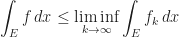
The proof is short but slightly tricky:
Suppose to the contrary 

(using the fact that for any sequence there is a subsequence converging to 
Since 


The last equation above uses the fact that if a sequence converges, all subsequences converge to the same limit.
This is an amazing identity by Abel.
Let 
Preparing for your H2 Maths Promo Exams?
Check out this package consisting of Practice Papers (from Actual School Questions), and also a H2 Formula Helpsheet consisting of helpful formula that you need to know in order to do the questions!
URL: Check out out Free Exam Papers page for more updated information on H2 Math Exam Papers.
11 Practice Papers, with Solutions
New Syllabus* (2017 Syllabus / Syllabus 9758)
H2 Helpsheet with formulae ranging from Pure Math to Statistics
*We have crossed out irrelevant questions from the old syllabus, and replaced them with relevant questions from the new syllabus.
Update: Check out the best H2 guidebooks available in the market! Much better than many “elite school” notes which cover too much irrelevant stuff that are not tested!
Consider 
Note that 
Thus 
However note that
which diverges as 
Thus ![(0,1]](https://s0.wp.com/latex.php?latex=%280%2C1%5D&bg=ffffff&fg=1a1a1a&s=0&c=20201002)
If 


Let 


By the usual Lebesgue’s DCT, 
Since every subsequence of 

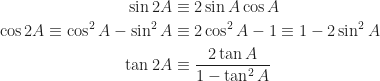
The following formulae will be useful when integrating Trigonometric functions. Taken from the MF15 formula sheet for JC.
Remark: The second identity is useful for integrating 

Remark: The factor formulae are useful for integrating 

A very famous mathematical problem known as the “Basel Problem” is solved by Euler in 1734. Basically, it asks for the exact value of 
Three hundred years ago, this was considered a very hard problem and even famous mathematicians of the time like Leibniz, De Moivre, and the Bernoullis could not solve it.
Euler showed (using another method different from ours) that 

Assume that
Then squaring this series formally,
To see why the above hold, see the following concrete example:
We assume that term by term integration is valid.
Recall that
So
Similarly
So 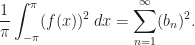

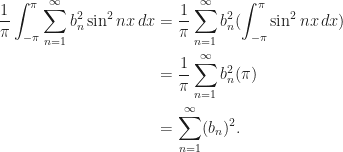
By Parseval’s identity,
Simplifying, we get
Currently, all versions of China Eastern Airlines 东方航空 websites (e.g. http://sg.ceair.com/, hk.ceair, etc) are not working.
I tried searching for a ticket in December and an error message popped out: We apologize that there are insufficient seats on ## segment of your searched flight. Please change the search options. Thank you for your cooperation!
I called the customer service and they confirmed that it is an error (their system shows that there are indeed still plenty of seats). Hope they fix it soon.
Source: http://www.ypzihua.com/product-2793.html

Beautiful calligraphy and meaningful words.
Chinese Characters: 宠辱不惊 闲看庭前花开花落 去留无意 漫随天外云卷云舒
Translation: “Don’t be disturbed by fortune or misfortune. Be relaxed no matter how flowers bloom and wilt. To be or not to be needs no hard decision. Take it natural no matter how clouds flow high and low.” (Source: http://www.en84.com/dianji/minyan/201410/00015499.html)
This key theorem showcases the full power of Lebesgue Integration Theory.
Let 



We have 

That is,
Since 


A very nice article against the philosophy of the bell curve, which is a prominent feature of examinations all over the world, including Singapore. I am sure that when Gauss invented the bell curve, he didn’t intend it to be used for examinations!
Excerpts:
The goal is to fight grade inflation, but the forced curve suffers from two serious flaws. One: It arbitrarily limits the number of students who can excel. If your forced curve allows for only seven A’s, but 10 students have mastered the material, three of them will be unfairly punished. (I’ve found a huge variation in overall performance among the classes I teach.)
The more important argument against grade curves is that they create an atmosphere that’s toxic by pitting students against one another. At best, it creates a hypercompetitive culture, and at worst, it sends students the message that the world is a zero-sum game: Your success means my failure.
Exhibit B: I spent a decade studying the careers of “takers,” who aim to come out ahead, and “givers,” who enjoy helping others. In the short run, across jobs in engineering, medicine and sales, the takers were more successful. But as months turned into years, the givers consistently achieved better results.
The results: Their average scores were 2 percent higher than the previous year’s, and not because of the bonus points. We’ve long knownthat one of the best ways to learn something is to teach it. In fact, evidence suggests that this is one of the reasons that firstborns tend to slightly outperform younger siblings on grades and intelligence tests: Firstborns benefit from educating their younger siblings. The psychologists Robert Zajonc and Patricia Mullally noted in a review of the evidence that “the teacher gains more than the learner in the process of teaching.”
Suppose 


Note that 


![[(st)t]^2=s^2=1](https://s0.wp.com/latex.php?latex=%5B%28st%29t%5D%5E2%3Ds%5E2%3D1&bg=ffffff&fg=1a1a1a&s=0&c=20201002)
We claim that there are no other relations, other than ![(st)^m=t^2=[(st)t]^2=1](https://s0.wp.com/latex.php?latex=%28st%29%5Em%3Dt%5E2%3D%5B%28st%29t%5D%5E2%3D1&bg=ffffff&fg=1a1a1a&s=0&c=20201002)
Suppose to the contrary 


Thus
Math teachers / students / Math lovers do sign this petition to stop Leicester university from cutting 20% of their math researchers/lecturers. #mathisimportant
Strangely, this is my second post about Leicester in just a few months, but it’s about something a lot more depressing than the football team’s fairytale winning of the Premier League (but let me quickly offer my congratulations to them for winning their first Champions League match — I won’t offer advice about whether they are worth betting on to win that competition too). News has just filtered through to me that the mathematics department is facing compulsory redundancies.
The structure of the story is wearily familiar after what happened with USS pensions. The authorities declare that there is a financial crisis, and that painful changes are necessary. They offer a consultation. In the consultation their arguments appear to be thoroughly refuted. But this is ignored and the changes go ahead.
Here is a brief summary of the painful changes that are proposed for the Leicester mathematics department. There are…
View original post 393 more words
“Differentiating under the Integral” is a useful trick, and here we describe and prove a sufficient condition where we can use the trick. This is the Measure-Theoretic version, which is more general than the usual version stated in calculus books.
Let 


1) 


2) For almost all 

3) There is an integrable function 

Then for all
Proof:
By definition,
Let 
It follows that 
Using the Mean Value Theorem, we have 
Thus for each 
That is,
Very interesting productivity app that resembles a game. Do check it out!
A few months ago, I noticed someone in one of my Facebook groups posting about an interesting app called Habitica. It’s one of a host of time-management and productivity-increasing applications, both web- and mobile-based. What sets it apart, however, is that it turns your efforts at organizing your life into a game. Specifically, it turns your life into something reminiscent of a classic, pixelated, 8-bit RPG.
So no, the title of this post is not a metaphor. You literally get XP (and gold) for doing your tasks in real life.
View original post 2,652 more words

This limit is a useful and interesting result to know. Note especially that the method “
We will prove 
First, we will find the limit 
So 
If you are interested, you can try to prove 

The Fundamental Theorem of Galois Theory states that:
Given a field extension 
1) 


2) 


This correspondence is a one-to-one correspondence if and only if
 holds iff the inclusion of fields
  holds. is a subgroup of , then
 ![|H|=[E:E^H]](https://s0.wp.com/latex.php?latex=%7CH%7C%3D%5BE%3AE%5EH%5D&bg=ffffff&fg=1a1a1a&s=0&c=20201002) and
and ![|\text{Gal}(E/F)/H|=[E^H:F]](https://s0.wp.com/latex.php?latex=%7C%5Ctext%7BGal%7D%28E%2FF%29%2FH%7C%3D%5BE%5EH%3AF%5D&bg=ffffff&fg=1a1a1a&s=0&c=20201002) . is a normal extension of (or equivalently, Galois extension, since any subextension of a separable extension is separable) iff is a normal subgroup of .
. is a normal extension of (or equivalently, Galois extension, since any subextension of a separable extension is separable) iff is a normal subgroup of .As the Zika/Dengue virus has spread to Singapore, I have been researching (in my spare time) on ways to prevent Zika/Dengue. The following are some interesting ways that however eventually do not work (or worse, attract more mosquitoes), so do not waste your money trying these!

In theory, bug zappers that use electricity to kill mosquitoes sound like a great idea. However, the problem comes from the fact that bug zappers use Ultraviolet Light (UV) to attract insects. Mosquitoes are attracted by Carbon Dioxide, not UV light, so you will end up killing 99% other insects, some of which are beneficial insects. See http://insects.about.com/od/StingingBitingInsects/a/Do-Bug-Zappers-Kill-Mosquitoes.htm.
This seems to be complete BS. See http://www.mosquitoreviews.com/ultrasonic-mosquito-app.html

This sounds like a genius idea at first, since Pitcher Plants eat insects, and grow in tropical climates, exactly where Aedes Mosquitoes live. The problem is mosquito larvae can survive very well in Pitcher Plants.
4) P.S. If you have a pond with large koi fish in it, you may want to add smaller fish, since koi fish (and other large fish in general) are known not to eat mosquito larvae. “Koi may be beautiful, but they are generally too large to prey on mosquito larvae and are known for their mellow nature.”
WolframAlpha can compute (simple) Laurent series:
https://www.wolframalpha.com/input/?i=series+sin(z%5E-1)
Series[Sin[z^(-1)], {z, 0, 5}]
1/z-1/(6 z^3)+1/(120 z^5)+O((1/z)^6)
(Laurent series)
(converges everywhere away from origin)
Unfortunately, more “complex” (pun intended) Laurent series are not possible for WolframAlpha.
provided both 

provided both
provided both
provided both limits on the right exist, and 
If 
Source: http://www.androidcentral.com/how-opt-out-sharing-your-information-facebook-whatsapp-android
In 2014, Facebook bought WhatsApp for a whopping $21.8 billion. WhatsApp users everywhere went, “Oh, no. This can’t be good.” That feeling has finally come to fruition in that WhatsApp will now start sharing your information with Facebook –including your phone number.
If you don’t want Facebook getting ahold of your WhatsApp info, you can opt out in one of two ways.
Click on the link above to read the method to opt out.
Source: http://www.straitstimes.com/singapore/education/grades-should-not-define-our-kids
Your grades do not define you,” said Mr Jack Cook.
That was Debbie’s defining moment.
Debbie, a perfectionist, always had the best academic results in her earlier years at school. However, when studying economics at junior college, she was thrown off balance.
Despite putting in more effort – hard work as well as getting extra coaching from her teacher, Mr Cook – Debbie just could not grasp the subject. She could not understand nor accept the poor grades she got for her economics examination. She felt ashamed and guilty, so much so that she avoided her teacher and did not visit the school after graduation.
A few years later, when Debbie heard that Mr Cook was retiring and leaving Singapore, she plucked up the courage to visit and bid him farewell.
Mr Cook greeted Debbie with a big smile and warmly welcomed her. She asked him sheepishly if…
View original post 44 more words
Assume 

Thus
For 

The above set is equal to 



Pastor Rick Warren has a gift of applying Christian principles in teaching lessons in real life scenarios. This is one of them.
“Let’s not get tired of doing what is good. At just the right time we will reap a harvest of blessing if we don’t give up” (Galatians 6:9 NLT, second edition).
There are many things that work to keep us from completing our life missions. Over the years, I’ve debated whether the worst enemy is procrastination or discouragement. If Satan can’t get us to put off our life missions, then he’ll try to get us to quit altogether.
The apostle Paul teaches that we need to resist discouragement: “Let’s not get tired of doing what is good. At just the right time we will reap a harvest of blessing if we don’t give up” (Galatians 6:9 NLT, second edition).
Do you ever get tired of doing what’s right? I think we all do. Sometimes it seems easier to do the wrong thing than the right thing.
When we’re discouraged, we become ineffective. When we’re discouraged, we work against our own faith.
When we’re discouraged, we’re saying, “It can’t be done.” That’s the exact opposite of saying, “I know God can do it because he said …”
Ask yourself these questions:
If you’re discouraged, don’t give up without a fight. Nothing worthwhile ever happens without endurance and energy.
When an artist creates a sculpture, he has to keep chipping away. He doesn’t hit the chisel with the hammer once, and suddenly all the excess stone falls away revealing a beautiful masterpiece. He keeps hitting it and hitting it, chipping away at the stone.
And that’s true of life, too. Nothing really worthwhile ever comes easy in life. You keep hitting it and going after it, and little by little your life becomes a masterpiece of God’s grace.
The fact is, great people are really just ordinary people with an extraordinary amount of determination. Great people don’t know how to quit.
By Pastor Rick Warren
This article provides an alternative viewpoint on whether mathematics is useful to society. A good read if you are writing a GP (General Paper) essay on the usefulness of mathematics, to provide both sides of the argument.
Excerpt:
Most people never become mathematicians, but everyone has a stake in mathematics. Almost since the dawn of human civilization, societies have vested special authority in mathematical experts. The question of how and why the public should support elite mathematics remains as pertinent as ever, and in the last five centuries (especially the last two) it has been joined by the related question of what mathematics most members of the public should know.
Why does mathematics matter to society at large? Listen to mathematicians, policymakers, and educators and the answer seems unanimous: mathematics is everywhere, therefore everyone should care about it. Books and articles abound with examples of the math that their authors claim is hidden in every facet of everyday life or unlocks powerful truths and technologies that shape the fates of individuals and nations. Take math professor Jordan Ellenberg, author of the bestselling book How Not to Be Wrong, who asserts “you can find math everywhere you look.”
To be sure, numbers and measurement figure regularly in most people’s lives, but this risks conflating basic numeracy with the kind of math that most affects your life. When we talk about math in public policy, especially the public’s investment in mathematical training and research, we are not talking about simple sums and measures. For most of its history, the mathematics that makes the most difference to society has been the province of the exceptional few. Societies have valued and cultivated math not because it is everywhere and for everyone but because it is difficult and exclusive. Recognizing that math has elitism built into its historical core, rather than pretending it is hidden all around us, furnishes a more realistic understanding of how math fits into society and can help the public demand a more responsible and inclusive discipline.
In the first agricultural societies in the cradle of civilization, math connected the heavens and the earth. Priests used astronomical calculations to mark the seasons and interpret divine will, and their special command of mathematics gave them power and privilege in their societies. As early economies grew larger and more complex, merchants and craftsmen incorporated more and more basic mathematics into their work, but for them mathematics was a trick of the trade rather than a public good. For millennia, advanced math remained the concern of the well-off, as either a philosophical pastime or a means to assert special authority.
The first relatively widespread suggestions that anything beyond simple practical math ought to have a wider reach date to what historians call the Early Modern period, beginning around five centuries ago, when many of our modern social structures and institutions started to take shape. Just as Martin Luther and other early Protestants began to insist that Scripture should be available to the masses in their own languages, scientific writers like Welsh polymath Robert Recorde used the relatively new technology of the printing press to promote math for the people. Recorde’s 1543 English arithmetic textbook began with an argument that “no man can do any thing alone, and much less talk or bargain with another, but he shall still have to do with number” and that numbers’ uses were “unnumerable” (pun intended).
Far more influential and representative of this period, however, was Recorde’s contemporary John Dee, who used his mathematical reputation to gain a powerful position advising Queen Elizabeth I. Dee hewed so closely to the idea of math as a secret and privileged kind of knowledge that his detractors accused him of conjuring and other occult practices. In the seventeenth century’s Scientific Revolution, the new promoters of an experimental science that was (at least in principle) open to any observer were suspicious of mathematical arguments as inaccessible, tending to shut down diverse perspectives with a false sense of certainty. During the eighteenth-century Enlightenment, by contrast, the savants of the French Academy of Sciences parlayed their mastery of difficult mathematics into a special place of authority in public life, weighing in on philosophical debates and civic affairs alike while closing their ranks to women, minorities, and the lower social classes.
Societies across the world were transformed in the nineteenth century by wave after wave of political and economic revolution, but the French model of privileged mathematical expertise in service to the state endured. The difference was in who got to be part of that mathematical elite. Being born into the right family continued to help, but in the wake of the French Revolution successive governments also took a greater interest in primary and secondary education, and strong performance in examinations could help some students rise despite their lower birth. Political and military leaders received a uniform education in advanced mathematics at a few distinguished academies which prepared them to tackle the specialized problems of modern states, and this French model of state involvement in mass education combined with special mathematical training for the very best found imitators across Europe and even across the Atlantic. Even while basic math reached more and more people through mass education, math remained something special that set the elite apart. More people could potentially become elites, but math was definitely not for everyone.
Entering the twentieth century, the system of channeling students through elite training continued to gain importance across the Western world, but mathematics itself became less central to that training. Partly this reflected the changing priorities of government, but partly it was a matter of advanced mathematics leaving the problems of government behind. Where once Enlightenment mathematicians counted practical and technological questions alongside their more philosophical inquiries, later modern mathematicians turned increasingly to forbiddingly abstract theories without the pretense of addressing worldly matters directly.
Source: https://www.newsghana.com.gh/why-every-youth-must-encounter-failure/
You can’t live without failure unless you live cautiously doing nothing. Even on that level, your failure is huge. The fatality of failure depends on the individual. You think failure has no benefit? This piece seeks to shed light on the need to embrace failure, learn from it and get better even after you have a warm encounter with it.
As toddlers strive to achieve their “shared goals” such as learning to walk, they fail 17 times per hour
IMPORTANCE
To start with, failure tells us the steps we need to change in order to attain the glory/crown we are seeking. Failure in its real sense means a slip or missing the mark. The mark here is synonymous to the desired target, glory, crown, et al.
To miss the mark means the processes have not been followed thoroughly or you underestimated the importance of a step. Failing helps you to identify the needed change, process or action that will facilitate your reaching the desired goal.
Furthermore, failure helps us to attain the mental toughness and wisdom we need to succeed. Interestingly, the sensible learn from their failures. Failure helps to toughen our minds, broaden our perspectives and help us acquire some essential nuggets for life.
Many successfully acquired practical wisdom after haven failed once or twice. Failure enhances character formation hence positively affects how you respond to things that didn’t go your way. You have to develop a thick skin to make it through life. Life isn’t easy, it is complicated and has pains no matter your level of blessings. Therefore, we come to terms with this reality especially after our encounter with failure.
In reality, failure teaches you things about yourself you wouldn’t have otherwise known (self-discovery and true relationships). Thus in our failures, we are able to know the loyal friends and family members. There are times we either overestimate or underestimate our strengths. At such points, failure brings us back to a stage of self-discovery. You can’t know yourself and the quality of your relationship unless you have been tested by adversities of which failure is part.
CONCLUSION
Life is a series of detours. We may set our minds on determinations but the detours will show if we did or did not expect it before the destination. One thing we must know is that the world is full of competition and as such extra skills are necessary to strategize and make the best out of every situation.
Most often than not we make up stories to make ourselves feel okay for our failures. We should rather endeavor to focus stories, events, circumstances et al that have the potential to impact on us and cause us to act more positively. Significantly, the detours in life lead us to the destinations.
Being angry at the detours mean you aren’t ready for the destination. Toughen yourself, let us embrace our failures, learn from it and strive hard to apply the valuable lessons we have acquired to write a positive narrative for ourselves and our continent. Let us meet at the top!
By: Bernard Owusu Mensah
President of New Era Africa
Ghana
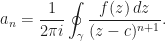
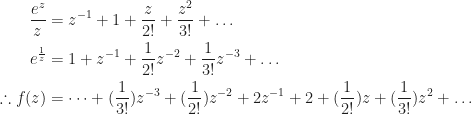
The Laurent series is something like the Taylor series, but with terms with negative exponents, e.g. 
The Laurent series for a complex function 


The path of integration 

Consider 


Note that the residue (coefficient of











![\displaystyle \mathcal{P}=\{P|P:a=x_0<x_1<\dots<x_{N_P}=b\ \text{is a partition of}\ [a,b]\}.](https://s0.wp.com/latex.php?latex=%5Cdisplaystyle+%5Cmathcal%7BP%7D%3D%5C%7BP%7CP%3Aa%3Dx_0%3Cx_1%3C%5Cdots%3Cx_%7BN_P%7D%3Db%5C+%5Ctext%7Bis+a+partition+of%7D%5C+%5Ba%2Cb%5D%5C%7D.&bg=ffffff&fg=1a1a1a&s=0&c=20201002)


![\displaystyle \sum_{k=m}^n f_k(g_{k+1}-g_k)=[f_{n+1}g_{n+1}-f_mg_m]-\sum_{k=m}^n g_{k+1}(f_{k+1}-f_k).](https://s0.wp.com/latex.php?latex=%5Cdisplaystyle+%5Csum_%7Bk%3Dm%7D%5En+f_k%28g_%7Bk%2B1%7D-g_k%29%3D%5Bf_%7Bn%2B1%7Dg_%7Bn%2B1%7D-f_mg_m%5D-%5Csum_%7Bk%3Dm%7D%5En+g_%7Bk%2B1%7D%28f_%7Bk%2B1%7D-f_k%29.&bg=ffffff&fg=1a1a1a&s=0&c=20201002)

![\begin{aligned} \int_1^R\frac{\sin u}{u}\,du&=[\frac{-\cos u}{u}]_1^R+\int_1^R\frac{-\cos u}{u^2}\,du\\ &=\frac{-\cos R}{R}+\frac{\cos 1}{1}-\int_1^R\frac{\cos u}{u^2}\,du. \end{aligned}](https://s0.wp.com/latex.php?latex=%5Cbegin%7Baligned%7D++%5Cint_1%5ER%5Cfrac%7B%5Csin+u%7D%7Bu%7D%5C%2Cdu%26%3D%5B%5Cfrac%7B-%5Ccos+u%7D%7Bu%7D%5D_1%5ER%2B%5Cint_1%5ER%5Cfrac%7B-%5Ccos+u%7D%7Bu%5E2%7D%5C%2Cdu%5C%5C++%26%3D%5Cfrac%7B-%5Ccos+R%7D%7BR%7D%2B%5Cfrac%7B%5Ccos+1%7D%7B1%7D-%5Cint_1%5ER%5Cfrac%7B%5Ccos+u%7D%7Bu%5E2%7D%5C%2Cdu.++%5Cend%7Baligned%7D&bg=ffffff&fg=1a1a1a&s=0&c=20201002)








![\displaystyle \frac 1\pi\cdot\left[\frac{x^3}{3}\right]_{-\pi}^\pi=\sum_{n=1}^\infty\frac{4}{n^2}.](https://s0.wp.com/latex.php?latex=%5Cdisplaystyle+%5Cfrac+1%5Cpi%5Ccdot%5Cleft%5B%5Cfrac%7Bx%5E3%7D%7B3%7D%5Cright%5D_%7B-%5Cpi%7D%5E%5Cpi%3D%5Csum_%7Bn%3D1%7D%5E%5Cinfty%5Cfrac%7B4%7D%7Bn%5E2%7D.&bg=ffffff&fg=1a1a1a&s=0&c=20201002)










 Mathtuition88