Laurent Series with WolframAlpha

WolframAlpha can compute (simple) Laurent series:
https://www.wolframalpha.com/input/?i=series+sin(z%5E-1)

Series[Sin[z^(-1)], {z, 0, 5}]

1/z-1/(6 z^3)+1/(120 z^5)+O((1/z)^6)
(Laurent series)
(converges everywhere away from origin)

Unfortunately, more “complex” (pun intended) Laurent series are not possible for WolframAlpha.

Mathematicians Are Overselling the Idea That “Math Is Everywhere”

This article provides an alternative viewpoint on whether mathematics is useful to society. A good read if you are writing a GP (General Paper) essay on the usefulness of mathematics, to provide both sides of the argument.

Source: http://blogs.scientificamerican.com/guest-blog/mathematicians-are-overselling-the-idea-that-math-is-everywhere/?WT.mc_id=SA_WR_20160817

Excerpt:

Most people never become mathematicians, but everyone has a stake in mathematics. Almost since the dawn of human civilization, societies have vested special authority in mathematical experts. The question of how and why the public should support elite mathematics remains as pertinent as ever, and in the last five centuries (especially the last two) it has been joined by the related question of what mathematics most members of the public should know.

Why does mathematics matter to society at large? Listen to mathematicians, policymakers, and educators and the answer seems unanimous: mathematics is everywhere, therefore everyone should care about it. Books and articles abound with examples of the math that their authors claim is hidden in every facet of everyday life or unlocks powerful truths and technologies that shape the fates of individuals and nations. Take math professor Jordan Ellenberg, author of the bestselling book How Not to Be Wrong, who asserts “you can find math everywhere you look.”

To be sure, numbers and measurement figure regularly in most people’s lives, but this risks conflating basic numeracy with the kind of math that most affects your life. When we talk about math in public policy, especially the public’s investment in mathematical training and research, we are not talking about simple sums and measures. For most of its history, the mathematics that makes the most difference to society has been the province of the exceptional few. Societies have valued and cultivated math not because it is everywhere and for everyone but because it is difficult and exclusive. Recognizing that math has elitism built into its historical core, rather than pretending it is hidden all around us, furnishes a more realistic understanding of how math fits into society and can help the public demand a more responsible and inclusive discipline.

In the first agricultural societies in the cradle of civilization, math connected the heavens and the earth. Priests used astronomical calculations to mark the seasons and interpret divine will, and their special command of mathematics gave them power and privilege in their societies. As early economies grew larger and more complex, merchants and craftsmen incorporated more and more basic mathematics into their work, but for them mathematics was a trick of the trade rather than a public good. For millennia, advanced math remained the concern of the well-off, as either a philosophical pastime or a means to assert special authority.

The first relatively widespread suggestions that anything beyond simple practical math ought to have a wider reach date to what historians call the Early Modern period, beginning around five centuries ago, when many of our modern social structures and institutions started to take shape. Just as Martin Luther and other early Protestants began to insist that Scripture should be available to the masses in their own languages, scientific writers like Welsh polymath Robert Recorde used the relatively new technology of the printing press to promote math for the people. Recorde’s 1543 English arithmetic textbook began with an argument that “no man can do any thing alone, and much less talk or bargain with another, but he shall still have to do with number” and that numbers’ uses were “unnumerable” (pun intended).

Far more influential and representative of this period, however, was Recorde’s contemporary John Dee, who used his mathematical reputation to gain a powerful position advising Queen Elizabeth I. Dee hewed so closely to the idea of math as a secret and privileged kind of knowledge that his detractors accused him of conjuring and other occult practices. In the seventeenth century’s Scientific Revolution, the new promoters of an experimental science that was (at least in principle) open to any observer were suspicious of mathematical arguments as inaccessible, tending to shut down diverse perspectives with a false sense of certainty. During the eighteenth-century Enlightenment, by contrast, the savants of the French Academy of Sciences parlayed their mastery of difficult mathematics into a special place of authority in public life, weighing in on philosophical debates and civic affairs alike while closing their ranks to women, minorities, and the lower social classes.

Societies across the world were transformed in the nineteenth century by wave after wave of political and economic revolution, but the French model of privileged mathematical expertise in service to the state endured. The difference was in who got to be part of that mathematical elite. Being born into the right family continued to help, but in the wake of the French Revolution successive governments also took a greater interest in primary and secondary education, and strong performance in examinations could help some students rise despite their lower birth. Political and military leaders received a uniform education in advanced mathematics at a few distinguished academies which prepared them to tackle the specialized problems of modern states, and this French model of state involvement in mass education combined with special mathematical training for the very best found imitators across Europe and even across the Atlantic. Even while basic math reached more and more people through mass education, math remained something special that set the elite apart. More people could potentially become elites, but math was definitely not for everyone.

Entering the twentieth century, the system of channeling students through elite training continued to gain importance across the Western world, but mathematics itself became less central to that training. Partly this reflected the changing priorities of government, but partly it was a matter of advanced mathematics leaving the problems of government behind. Where once Enlightenment mathematicians counted practical and technological questions alongside their more philosophical inquiries, later modern mathematicians turned increasingly to forbiddingly abstract theories without the pretense of addressing worldly matters directly.

Laurent Series (Example)

The Laurent series is something like the Taylor series, but with terms with negative exponents, e.g. z^{-1}. The below Laurent Series formula may not be the most practical way to compute the coefficients, usually we will use known formulas, as the example below shows.

Laurent Series

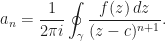
The Laurent series for a complex function f(z) about a point c is given by: \displaystyle f(z)=\sum_{n=-\infty}^\infty a_n(z-c)^n where \displaystyle a_n=\frac{1}{2\pi i}\oint_\gamma\frac{f(z)\, dz}{(z-c)^{n+1}}.

The path of integration \gamma is anticlockwise around a closed, rectifiable path containing no self-intersections, enclosing c and lying in an annulus A in which f(z) is holomorphic. The expansion for f(z) will then be valid anywhere inside the annulus.

Example

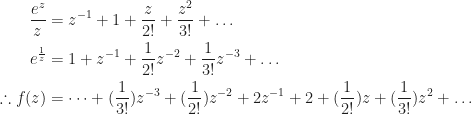
Consider f(z)=\frac{e^z}{z}+e^\frac{1}{z}. This function is holomorphic everywhere except at z=0. Using the Taylor series of the exponential function \displaystyle e^z=\sum_{k=0}^\infty\frac{z^k}{k!}, we get
\begin{aligned}  \frac{e^z}{z}&=z^{-1}+1+\frac{z}{2!}+\frac{z^2}{3!}+\dots\\  e^\frac{1}{z}&=1+z^{-1}+\frac{1}{2!}z^{-2}+\frac{1}{3!}z^{-3}+\dots\\  \therefore f(z)&=\dots+(\frac{1}{3!})z^{-3}+(\frac{1}{2!})z^{-2}+2z^{-1}+2+(\frac{1}{2!})z+(\frac{1}{3!})z^2+\dots  \end{aligned}
Note that the residue (coefficient of z^{-1}) is 2.

Implicit Function Theorem

The implicit function theorem is a strong theorem that allows us to express a variable as a function of another variable. For instance, if x^2y+y^3x+9xy=0, can we make y the subject, i.e. write y as a function of x? The implicit function theorem allows us to answer such questions, though like most Pure Math theorems, it only guarantees existence, the theorem does not explicitly tell us how to write out such a function.

The below material are taken from Wikipedia.

Implicit function theorem

Let f:\mathbb{R}^{n+m}\to\mathbb{R}^m be a continuously differentiable function, and let \mathbb{R}^{n+m} have coordinates (\mathbf{x},\mathbf{y})=(x_1,\dots,x_n,y_1,\dots,y_m). Fix a point (\mathbf{a},\mathbf{b})=(a_1,\dots,a_n,b_1,\dots,b_m) with f(\mathbf{a},\mathbf{b})=\mathbf{c}, where \mathbf{c}\in\mathbb{R}^m. If the matrix \displaystyle [(\partial f_i/\partial y_j)(\mathbf{a},\mathbf{b})] is invertible, then there exists an open set U containing \mathbf{a}, an open set V containing \mathbf{b}, and a unique continuously differentiable function g:U\to V such that \displaystyle \{(\mathbf{x},g(\mathbf{x}))\mid\mathbf{x}\in U\}=\{(\mathbf{x},\mathbf{y})\in U\times V\mid f(\mathbf{x},\mathbf{y})=\mathbf{c}\}.

Elaboration:

Abbreviating (a_1,\dots,a_n,b_1,\dots,b_m) to (\mathbf{a},\mathbf{b}), the Jacobian matrix is
\displaystyle (Df)(\mathbf{a},\mathbf{b})=\begin{pmatrix}  \frac{\partial f_1}{\partial x_1}(\mathbf{a},\mathbf{b}) & \dots &\frac{\partial f_1}{\partial x_n}(\mathbf{a},\mathbf{b}) & \frac{\partial f_1}{\partial y_1}(\mathbf{a},\mathbf{b}) & \dots & \frac{\partial f_1}{\partial y_m}(\mathbf{a},\mathbf{b})\\  \vdots & \ddots &\vdots & \vdots & \ddots &\vdots\\  \frac{\partial f_m}{\partial x_1}(\mathbf{a},\mathbf{b}) & \dots & \frac{\partial f_m}{\partial x_n}(\mathbf{a}, \mathbf{b}) & \frac{\partial f_m}{\partial y_1}(\mathbf{a}, \mathbf{b}) & \dots & \frac{\partial f_m}{\partial y_m}(\mathbf{a}, \mathbf{b})  \end{pmatrix}  =(X\mid Y)
where X is the matrix of partial derivatives in the variables x_i and Y is the matrix of partial derivatives in the variables y_j.

The implicit function theorem says that if Y is an invertible matrix, then there are U, V, and g as desired.

Example (Unit circle)

In this case n=m=1 and f(x,y)=x^2+y^2-1.

\displaystyle (Df)(a,b)=(\frac{\partial f}{\partial x}(a,b)\ \frac{\partial f}{\partial y}(a,b))=(2a\ 2b).

Note that Y=(2b) is invertible iff b\neq 0. By the implicit function theorem, we see that we can locally write the circle in the form y=g(x) for all points where y\neq 0.

Differentiable Manifold

Differentiable manifold

An n-dimensional (differentiable) manifold M^n is a Hausdorff topological space with a countable (topological) basis, together with a maximal differentiable atlas.

This atlas consists of a family of charts \displaystyle h_\lambda: U_\lambda\to U'_\lambda\subset\mathbb{R}^n, where the domains of the charts, \{U_\lambda\}, form an open cover of M^n, the U'_\lambda are open in \mathbb{R}^n, the charts (local coordinates) h_\lambda are homeomorphisms, and every change of coordinates \displaystyle h_{\lambda\mu}=h_\mu\circ h_\lambda^{-1} is differentiable on its domain of definition h_\lambda(U_\lambda\cap U_\mu).

atlas

Source: Representations of Compact Lie Groups (Graduate Texts in Mathematics)

Lie Groups

One of the best books on Lie Groups is said to be Representations of Compact Lie Groups (Graduate Texts in Mathematics). It is one of the rarer books from the geometric approach, as opposed to the algebraic approach.

Lie group

A Lie group is a differentiable manifold G which is also a group such that the group multiplication \displaystyle \mu:G\times G\to G (and the map sending g to g^{-1}) is a differentiable map.

Homomorphism of Lie groups

A homomorphism of Lie groups is a differentiable group homomorphism between Lie groups.

lim sup & lim inf of Sets

The concept of lim sup and lim inf can be applied to sets too. Here is a nice characterisation of lim sup and lim inf of sets:

For a sequence of sets \{E_k\}, \limsup E_k consists of those points that belong to infinitely many E_k, and \liminf E_k consists of those points that belong to all E_k from some k on (i.e. belong to all but finitely many E_k).

Proof:
Note that
\begin{aligned}  x\in\limsup E_k&\iff x\in\bigcup_{k=j}^\infty E_k\ \text{for all}\ j\in\mathbb{N}\\  &\iff\text{For all}\ j\in\mathbb{N}, \text{there exists}\ i\geq j\ \text{such that}\ x\in E_i\\  &\iff x\ \text{belongs to infinitely many}\ E_k.  \end{aligned}
\begin{aligned}  x\in\liminf E_k&\iff x\in\bigcap_{k=j}^\infty E_k\ \text{for some}\ j\in\mathbb{N}\\  &\iff x\in E_k\ \text{for all}\ k\geq j.  \end{aligned}

What is a Degree in Math and Why is it Valuable?

Very interesting article on why you should consider a degree in math if you are interested in math.

Source: http://www.snhu.edu/about-us/news-and-events/2016/08/what-is-a-degree-in-math-and-why-is-it-valuable

Mathematics is the study of quantity, structure, space and change. As abstract as that may seem, math is, at its core, a quest for absolutes, definitive solutions and answers. We may think of long numeric chains, seas of fractions or spreadsheets stacked with figures, but what many don’t realize is that math’s complex equations are in fact roads to simplicity. Believers in better, faster, smarter solutions are often drawn to math.

So, what is a degree in math, exactly? Those that go to college to pursue a mathematics degree find out along the way that numbers are just a fraction of the allure. Math can teach us how to look longer and harder for solutions – a skill applicable to any career and life in general.

We need math. Galileo Galilei used it to explain the universe. Math resolves truths and uncovers errors. It makes our work more credible. Reports, studies and research are all but discounted without quantifiable facts. Math equals proof. Math validates.

The Mathematical Association of America cites a CareerCast report ranking mathematics the best job for 2014 based on factors such as environment, income, outlook, and stress. The job of statistician was ranked third. Actuary was ranked fourth. In addition, a PayScale study reports that the top 15 highest-earning college degrees have mathematics as a common denominator.

But, Psychology Today reports that most of us are in awe of math. It’s slightly mysterious. It makes things look smart, including the mathematician behind the math. What is a degree in math? It’s a professional pathway, and an attractive one for many reasons. It is also a unique way of seeing the world.

Math is All Around Us

Whether you like mathematics or are even very good it, math is around us all the time. When you’re at the department store, balancing your checkbook or doing your taxes, mathematics is a necessary skill. It can even improve your sports game.

“There’s math all over the place in soccer,” Southern New Hampshire University’s mathematics department chairwoman Dr. Pamela Cohen told pro soccer player Calen Carr in this video. From the curve – also known as a “parabola” – of a kicked ball to the rigidness of playing in triangles on the field, math factors into every aspect of the game. What is a math degree to an athlete? A competitive edge on the field.

Many professions, such as engineering, medicine, physics, nurses, computer science and actuarial science, require math proficiency. Virtually all fields benefit from the analytical and problem-solving skills students learn in mathematics. Anyone entering a science, technology, engineering and mathematics (STEM) career is expected to have harnessed basic and advanced math concepts.

Even professions as diverse as chefs or gardeners use math fundamentals when measuring and purchasing supplies. If you are an event planner, math will help you figure per-head costs and inventory. Seamstresses and decorators use math daily, as does anyone who works with measurements and schedules.

You Don’t Have to be a Mathlete

Many people believe math talent to be something that is inherited or are born with. Not so, say researchers. Natural ability in math only gets you so far. Hard work and good study habits are far more valuable. As such, students entering college math degree programs aren’t the math-minded geniuses. Some didn’t even like math growing up, says a Quartz article that looks at why some kids excel at math and others don’t. The authors – economy and finance professors – make the case that something said by a grade school teacher years ago could be the reason a child is turned off to math or thinks he or she is bad at it. Some educators and parents also have a bad habit of labeling kids as either math kids or reading kids.

Fundamental Theorem of Calculus

The Fundamental Theorem of Calculus is one of the most amazing and important theorems in analysis. It is a non-trivial result that links the concept of area and gradient, two seemingly unrelated concepts.

Fundamental Theorem of Calculus

The first part deals with the derivative of an antiderivative, while the second part deals with the relationship between antiderivatives and definite integrals.

First part

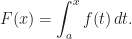
Let f be a continuous real-valued function defined on a closed interval [a,b]. Let F be the function defined, for all x in [a,b], by \displaystyle F(x)=\int_a^x f(t)\,dt.

Then F is uniformly continuous on [a,b], differentiable on the open interval (a,b), and \displaystyle F'(x)=f(x) for all x in (a,b).

Second part

Let f and F be real-valued functions defined on [a,b] such that F is continuous and for all x\in (a,b), \displaystyle F'(x)=f(x).

If f is Riemann integrable on [a,b], then \displaystyle \int_a^b f(x)\,dx=F(b)-F(a).

Gradient Theorem (Proof)

This amazing theorem is also called the Fundamental Theorem of Calculus for Line Integrals. It is quite a powerful theorem that sometimes allows fast computations of line integrals.

Gradient Theorem (Fundamental Theorem of Calculus for Line Integrals)

Let C be a differentiable curve given by the vector function \mathbf{r}(t), a\leq t\leq b.

Let f be a differentiable function of n variables whose gradient vector \nabla f is continuous on C. Then \displaystyle \int_C \nabla f\cdot d\mathbf{r}=f(\mathbf{r}(b))-f(\mathbf{r}(a)).

Proof

\begin{aligned}  \int_C\nabla f\cdot d\mathbf{r}&=\int_a^b\nabla f(\mathbf{r}(t))\cdot \mathbf{r}'(t)\,dt\ \ \ \text{(Definition of line integral)}\\  &=\int_a^b (\frac{\partial f}{\partial x_1}\frac{dx_1}{dt}+\frac{\partial f}{\partial x_2}\frac{dx_2}{dt}+\dots+\frac{\partial f}{\partial x_n}\frac{dx_n}{dt})\,dt\\  &=\int_a^b \frac{d}{dt}f(\mathbf{r}(t))\,dt\ \ \ \text{(by Multivariate Chain Rule)}\\  &=f(\mathbf{r}(b))-f(\mathbf{r}(a))\ \ \ \text{(by Fundamental Theorem of Calculus)}  \end{aligned}

Multivariable Version of Taylor’s Theorem

Multivariable calculus is an interesting topic that is often neglected in the curriculum. Furthermore it is hard to learn since the existing textbooks are either too basic/computational (e.g. Multivariable Calculus, 7th Edition by Stewart) or too advanced. Many analysis books skip multivariable calculus altogether and just focus on measure and integration.

If anyone has a good book that covers multivariable calculus (preferably rigorously with proofs), do post it in the comments!

The following is a useful multivariable version of Taylor’s Theorem, using the multi-index notation which is regarded as the most efficient way of writing the formula.

Multivariable Version of Taylor’s Theorem

Let f:\mathbb{R}^n\to\mathbb{R} be a k times differentiable function at the point \mathbf{a}\in\mathbb{R}^n. Then there exists h_\alpha:\mathbb{R}^n\to\mathbb{R} such that \displaystyle f(\mathbf{x})=\sum_{|\alpha|\leq k}\frac{D^\alpha f(\mathbf{a})}{\alpha!}(\mathbf{x}-\mathbf{a})^\alpha+\sum_{|\alpha|=k}h_\alpha(\mathbf{x})(\mathbf{x}-\mathbf{a})^\alpha, and \lim_{\mathbf{x}\to\mathbf{a}}h_\alpha(\mathbf{x})=0.

Example (n=2, k=1)

Write \mathbf{x}-\mathbf{a}=\mathbf{v}.
\displaystyle f(x,y)=f(\mathbf{a})+\frac{\partial f}{\partial x}(\mathbf{a})v_1+\frac{\partial f}{\partial y}(\mathbf{a})v_2+h_{(1,0)}(x,y)v_1+h_{(0,1)}(x,y)v_2.

Pasting Lemma (Elaboration of Wikipedia’s proof)

The proof of the Pasting Lemma at Wikipedia is correct, but a bit unclear. In particular, it does not clearly show how the hypothesis that X, Y are both closed is being used. It actually has something to do with subspace topology.

I have added some clarifications here:

Pasting Lemma (Statement)

Let X, Y be both closed (or both open) subsets of a topological space A such that A=X\cup Y, and let B also be a topological space. If both f|_X: X\to B and f|_Y: Y\to B are continuous, then f:A \to B is continuous.

Proof:

Let U be a closed subset of B. Then f^{-1}(U)\cap X is closed in X since it is the preimage of U under the function f|_X:X\to B, which is continuous. Hence f^{-1}(U)\cap X=F\cap X for some set F closed in A. Since X is closed in A, f^{-1}(U)\cap X is closed in A.

Similarly, f^{-1}(U)\cap Y is closed (in A). Then, their union f^{-1}(U) is also closed (in A), being a finite union of closed sets.

Maths Tuition – What are the Benefits?

Maths Tuition – What are the Benefits?

Maths tuition brings about many benefits that can be seen for the parent, the teacher and especially the student who is struggling with their mathematics subject in school. For starters, it will have a huge impact for the student because their entire future can depend on their academic performance in PSLE, O-level, and A-level examinations – all of which requires the student to take the math subject.

For young kids, academics and performance in school can be everything. Their self-esteem and pride depends on it and it helps to guide them in the right direction. Performing well in all subjects helps us to determine who they will become in the future and what they wish to achieve. However, this can be difficult to do when the poor child is struggling in school, particularly in mathematics. Having the opportunity to participate in private maths tuition can help a student get back on the right track once again.

Maths tuition can be extremely useful for Singaporean parents as well. While we all try our best to help our students be successful, there are simply some areas where we are not knowledgeable enough to help out very much. A lot of parents are simply not equipped enough in maths to be able to guide our children adequately. There are also many changes to the education system such the newer and harder syllabuses that can hinder our ability to help our kids as well.

However, with a private maths tutor, our kids can learn the proper way to craft mathematics answers, draw models, and solve algebraic questions, developing the tools necessary to help them succeed in their mathematics exam. Doing well in mathematics not only helps students regain their confidence and improve their T-scores, it also helps them in the long-run as they develop into working adults, as mental arithmetic ability is useful in many practical situations. A good maths tutor can use their expertise to help guide students back onto the right path so that all of their goals and dreams can become a reality.

Teachers can also benefit from private tuition as well. Since a teacher has many students that they are required to teach at one time, it is difficult for them to have the time necessary to devote to one struggling student. However, when students in the class engage their own private maths tutor from a maths tuition agency, the teacher will not have to focus too much on that one student, hindering any of the other children in the classroom as well.

With the right tuition agency, parents can engage private maths tuition in any location and there are benefits for everyone involved. Also, if the mathematics tutors are specialized; meaning if your student is struggling in math, a private maths tuition teacher can help to bring their grades up and to catch them up with the remainder of the class.

Maths tutors are great for all age groups and can even be beneficial for those in university as well. Choosing to engage private maths tuition for your child is a great decision, and whether you are a student, parent or teacher, a good maths tutor help to make everyone’s lives a little better.

Lusin’s Theorem and Egorov’s Theorem

Lusin’s Theorem and Egorov’s Theorem are the second and third of Littlewood’s famous Three Principles.

There are many variations and generalisations, the most basic of which I think are found in Royden’s book.

Lusin’s Theorem:

Informally, “every measurable function is nearly continuous.”

(Royden) Let f be a real-valued measurable function on E. Then for each \epsilon>0, there is a continuous function g on \mathbb{R} and a closed set F\subseteq E for which \displaystyle f=g\ \text{on}\ F\ \text{and}\ m(E\setminus F)<\epsilon.

Egorov’s Theorem

Informally, “every convergent sequence of functions is nearly uniformly convergent.”

(Royden) Assume m(E)<\infty. Let \{f_n\} be a sequence of measurable functions on E that converges pointwise on E to the real-valued function f.

Then for each \epsilon>0, there is a closed set F\subseteq E for which \displaystyle f_n\to f\ \text{uniformly on}\ F\ \text{and}\ m(E\setminus F)<\epsilon.

Why Singapore’s kids are so good at maths

Source: http://www.ft.com/cms/s/0/2e4c61f2-4ec8-11e6-8172-e39ecd3b86fc.html

Sie Yu Chuah smiles when asked how his parents would react to a low test score. “My parents are not that strict but they have high expectations of me,” he says. “I have to do well. Excel at my studies. That’s what they expect from me.” The cheerful, slightly built 13-year-old is a pupil at Admiralty, a government secondary school in the northern suburbs of Singapore that opened in 2002.

To learn more about Singapore Math, check out this comprehensive blog post describing what is Singapore Math.

The most Striking Theorem in Real Analysis

Lebesgue’s Theorem (see below) has been called one of the most striking theorems in real analysis. Indeed it is a very surprising result.

Lebesgue’s Theorem (Monotone functions)

If the function f is monotone on the open interval (a,b), then it is differentiable almost everywhere on (a,b).

Absolutely Continuous Functions

Definition

A real-valued function f on a closed, bounded interval [a,b] is said to be absolutely continuous on [a,b] provided for each \epsilon>0, there is a \delta>0 such that for every finite disjoint collection \{(a_k,b_k)\}_{k=1}^n of open intervals in (a,b), if \displaystyle \sum_{k=1}^n(b_k-a_k)<\delta, then \displaystyle \sum_{k=1}^n|f(b_k)-f(a_k)|<\epsilon.

Equivalent Conditions

The following conditions on a real-valued function f on a compact interval [a,b] are equivalent:
(i) f is absolutely continuous;

(ii) f has a derivative f' almost everywhere, the derivative is Lebesgue integrable, and \displaystyle f(x)=f(a)+\int_a^x f'(t)\,dt for all x on [a,b];

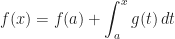
(iii) there exists a Lebesgue integrable function g on [a,b] such that \displaystyle f(x)=f(a)+\int_a^x g(t)\,dt for all x on [a,b].

Equivalence between (i) and (iii) is known as the Fundamental Theorem of Lebesgue integral calculus.

There are two kinds of talented students.

Just read this interesting article. Will the new PSLE system reward students of the first kind or second kind? From my experience as student and tutor, Singapore has many talented students of the first kind, but very few talented students of the second kind.

To be a student of the second kind, one needs to “acquire knowledge beyond the school curriculum”, and “read and look at more advanced material”. Check out this page on Math Olympiad books that are suitable for students of the second kind. Parents should encourage, but never force, children to read more of these kinds of books.

What are the Two Kinds of Talented Students

Source: http://www.math.rutgers.edu/~zeilberg/Opinion0.html

There are two kinds of talented students. One kind is that of “obedient students” that do exactly as ordered by their teachers, and do not attempt to acquire knowledge beyond the school curriculum; learning the material is relatively easy for them, and the pressure from the society, their parents, and their teachers, that tells them that study is the only way to acquire a solid socio-economic status is their only motivation. To that group of students also belong less talented students, that have to study much harder, but the “reward” that awaits them in the future, as well as the immediate rewards promised by the parents (“if you will not fail any subject, you would go to an overseas vacation this summer” etc.) prods them to study.

There is yet another kind of talented students, whose natural curiosity lead them, already from a young age, to read and look at more advanced material, in order to satisfy their natural curiosity.

When such a student enters high school (and in fact, already in the higher grades of elementary school) he sees that the material that he has already studied on his own presented in a different way. The learning is induced through severe disciple (all the system of examinations and grades), and the material is taught the same way as in animal training. The fascinating science of Chemistry turns into a boring list of dry formulas, that he has to learn by heart, and the threats and the incentives practiced in school badly offend him. As though out of spite, he does not listen to the commands of his teachers, but instead studies on his own material that is not included in the curriculum. Obviously, even the most talented student can not learn from just sitting in class, (and even during class he often studies other material), and so starts the “tragedy” described in your article.

小学生厌恶数学写诗:数学是死亡之源

Source: http://news.sina.com.cn/s/2015-02-08/031931495241.shtml

武汉的董女士前天在家帮女儿清理书包,从书包里搜出一张纸,上面赫然写着一首诗:数学是死亡之源,它像入地狱般痛苦。它让孩子想破脑汁,它让家长急得转圈。它让校园死气沉沉,它使生命慢慢离去。生命从数学中走去,一代代死得超快。那是生命的敌人,生命从数学中走去。珍惜宝贵的生命吧,一代代死得超快。数学是死亡之源。

读完这首诗,董女士惊呆了:“没想到她厌恶数学到了这般田地。”

董女士的女儿晶晶,今年10岁,读小学五年级,从进小学开始就特别不喜欢数学,尤其讨厌应用题,只要碰到追及问题和工程问题,晶晶那绝对是“一个脑袋两个大”。这次期末考试晶晶的数学考了70分,全班倒数第七。

在董女士的逼问下,晶晶终于交代,这首诗是和班上另外两个女生一起创作的。她们三个都对数学不感冒,联合创作了此诗,抒发忧伤。

网友们看到这首诗后,也表达了不同的观点。网友“@飞不动的咋咋鸟”说,“很有才的小学生,这搞不好以后是余秀华第二啊!”网友“@左边追寻”则说,“想用自己的血泪史告诉这位妹妹,学好数学很重要!”据《武汉晚报》

(原标题:小学生厌恶数学写诗:数学是死亡之源)

MIT Students Won $8 Million in the Massachusetts Lottery

Old but interesting news. Those students used math to successfully invest in lottery tickets!

Source: http://newsfeed.time.com/2012/08/07/how-mit-students-scammed-the-massachusetts-lottery-for-8-million/

Several years ago, while doing research for a school project, a group of MIT students realized that, for a few days every three months or so, the most reliably lucrative lottery game in the country was Massachusetts’ Cash WinFall, because of a quirk in the way a jackpot was broken down into smaller prizes if there was no big winner. The math whizzes quickly discovered that buying about $100,000 in Cash WinFall tickets on those days would virtually guarantee success. Buying $600,000 worth of tickets would bring a 15%–20% return on investment, according to the New York Daily News.

Critique on the Modern Axiomatic Approach of Mathematics

This video is a rare critique of the axiomatic approach of modern mathematics. Worth viewing, to gain an alternative viewpoint. Very interesting and well-argued!

Quote by Professor Wildberger (PhD Yale):

I believe it was by having a closer look and think about Euclid. What he is doing is so very different from what modern mathematics is up to, that it naturally leads one to suspicions. One can tell that Euclid really honestly meant to start a logical development. The current axiomatics are exactly the opposite–they were tacked on at the end of a long development when all else failed, and clearly are just a backward attempt to keep up a framework for which other more direct supports proved impossible. When in doubt, resort to wishful thinking.

Cauchy-Riemann Equations

Cauchy-Riemann Equations

Let f(x+iy)=u(x,y)+iv(x,y). The Cauchy-Riemann equations are:

\begin{aligned}  u_x&=v_y\\  u_y&=-v_x.  \end{aligned}

Alternative Form (Wirtinger Derivative)

The Cauchy-Riemann equations can be written as a single equation \displaystyle \frac{\partial f}{\partial\bar z}=0 where \displaystyle \frac{\partial}{\partial\bar z}=\frac 12(\frac{\partial}{\partial x}+i\frac{\partial}{\partial y}) is the Wirtinger derivative with respect to the conjugate variable.

Goursat’s Theorem

Suppose f=u+iv is a complex-valued function which is differentiable as a function f:\mathbb{R}^2\to\mathbb{R}^2. Then f is analytic in an open complex domain \Omega iff it satisfies the Cauchy-Riemann equations in the domain.
Mathematics Enrichment Camp 2016

This camp (series of lectures) is suitable for Pre-University students (e.g. JC / NUS High) who are interested in mathematics!

Saturday, 13th August 2016 8.30am to 2.00pm @ Faculty of Science, NUS Lecture Theatre 25

Register by 1st August!

Tea break & lunch will be provided Prizes to be won!

URL: http://ww1.math.nus.edu.sg/events/MathEnrichmentCamp-2016-brochureregistration.pdf

What About Tutoring Instead of Pills?

Just read this interesting article, which is also related to education. Personally, I am highly skeptical of doctors who prescribe expensive pills / surgery for ailments that require neither. Thankfully there is the internet nowadays so one can research personally instead of believing the doctor who may have his own interests in mind, i.e. maximum profit.

SPIEGEL Interview with Jerome Kagan: ‘What About Tutoring Instead of Pills?’

Harvard psychologist Jerome Kagan is one of the world’s leading experts in child development. In a SPIEGEL interview, he offers a scathing critique of the mental-health establishment and pharmaceutical companies, accusing them of incorrectly classifying millions as mentally ill out of self-interest and greed.

Kagan has been studying developmental psychology at Harvard University for his entire professional career. He has spent decades observing how babies and small children grow, measuring them, testing their reactions and, later, once they’ve learned to speak, questioning them over and over again. For him, the major questions are: How does personality emerge? What traits are we born with, and which ones develop over time? What determines whether someone will be happy or mentally ill over the course of his or her life?

Source: http://www.spiegel.de/international/world/child-psychologist-jerome-kagan-on-overprescibing-drugs-to-children-a-847500.html

Study: Kids from affluent families more likely in IP, GEP schools

Source: http://www.straitstimes.com/singapore/education/study-kids-from-affluent-families-more-likely-in-ip-gep-schools

Children from higher socio-economic backgrounds are more likely to attend Integrated Programme (IP) secondary schools and their affiliated primary schools, as well as those that offer the Gifted Education Programme (GEP). – Straits Times

Another related news is Students in IP schools more confident of getting at least a university degree, also published by the Straits Times.

It is like a perpetual virtuous cycle: GEP/IP -> University -> Affluent -> GEP/IP (next generation) -> …, no wonder tuition is so popular in Singapore as no doubt every parent wants their child to get into the virtuous cycle above.

More research needs to be done on how lower-income families can be helped for their children to reach their fullest potential.

“An equation means nothing to me unless it expresses a thought of God. “

Just watched The Man Who Knew Infinity today at Shaw Cinemas @JCube. Very nice and meaningful movie that is different from the typical movie.

One famous quote by Ramanujan is that “An equation means nothing to me unless it expresses a thought of God.”.

Another interesting link online is that Ramanujan did not suffer from tuberculosis, rather he probably had an amoeba infection called amoebiasis.

This parent has hit the nail on the head regarding tuition

Source: http://www.straitstimes.com/forum/letters-on-the-web/tuition-still-effective-for-many

This parent has hit the nail on the head (find exactly the right answer) regarding tuition:

Whether tuition yields results largely depends on pupils’ attitudes towards learning and how motivated they are.

In conclusion, tuition is necessary and can be effective if pupils make full use of it. But parents still need to decide for themselves if tuition is the answer for their children, and not be influenced by societal pressure.

Read the article for the full letter.

Getting a degree in Singapore set to become costlier: Study

Source: http://www.straitstimes.com/singapore/education/getting-a-degree-in-singapore-set-to-become-costlier-study

The cost of a university degree in Singapore is set to rise, according to a new study by the Economist Intelligence Unit (EIU).

Released yesterday, the study projected that a four-year degree will cost 70.2 per cent of an individual’s average yearly income in 2030, up from 53.1 per cent last year.

Since 2010, tuition fees at local universities have gone up every year for most undergraduate courses, mainly due to rising operating costs.

Professor Writing Math Equations Suspected for being Terrorist

This is quite hilarious.

Sample of what the professor Guido Menzio was scribbling.

Source: http://www.dailymail.co.uk/news/article-3578751/Italian-Ivy-League-economist-pulled-flight-seatmate-suspected-terrorist.html

Italian Ivy League economist pulled off flight and interrogated for ‘mysterious’ scribblings flagged up by another passenger… which turned out to be MATH

  • Guido Menzio, 40, was on a flight from Philadelphia to Syacuse 
  • The UPenn professor was solving a differential equation during boarding
  • His seatmate told an American Airlines attendant she was too ill to travel
  • But after she was escorted off the plane, she revealed her suspicious 
  • Menzio was questioned about his ‘cryptic’ notes before he was allowed to get back on the plane, delayed by two hours  
  • While one traveller thought he looked like a terrorist, another person in an airport mistook him for Sean Lennon and asked for an autograph

Read more: http://www.dailymail.co.uk/news/article-3578751/Italian-Ivy-League-economist-pulled-flight-seatmate-suspected-terrorist.html#ixzz488tlHREM
Follow us: @MailOnline on Twitter | DailyMail on Facebook

Harmonic Series minus terms with “9” Converges!

harmonic series

Something interesting I saw on: http://blogs.scientificamerican.com/roots-of-unity/what-the-prime-number-tweetbot-taught-me-about-infinite-sums/?WT.mc_id=SA_WR_20160504

The harmonic series is the infinite sum 1+1/2+1/3+1/4+…, the sum of the reciprocals of every positive integer. Even though the terms get closer and closer to 0, the series goes to infinity, meaning it eventuallygets bigger than any number you can throw at it. (The question is fun to think about, so I won’t spoil it for you, but Wikipedia has an explanation.)

It seems baffling that if we take away 1/9, 1/19, 1/29, and so on, the series converges instead. In fact, it’s less than 90, which is frankly pitiful compared to the infinitude of the harmonic series.

Functional Analysis List of Theorems

This is a list of miscellaneous theorems from Functional Analysis.

Hahn-Banach: Let p be a real-valued function on a normed linear space X with

(i) Positive homogeneity

(ii) Subadditivity

Let Y denote a linear subspace of X on which l(y)\leq p(y) for all y\in Y. Then l can be extended to all of X: l(x)\leq p(x) for all x\in X.

Geometric Hahn-Banach / Hyperplane Separation Theorem: Let K be a nonempty convex subset, K=int(K). Let y be a point outside K. Then there exists a linear functional l (depending on y) such that l(x)<c for all x\in K; l(y)=c.

Riesz Representation Theorem: Let l(x) be a linear functional on a Hilbert space H that is bounded: |l(x)|\leq c\|x\|. Then l(x)=\langle x,y\rangle for some unique y\in H.

Principle of Uniform Boundedness: A weakly convergent sequence \{x_n\} is uniformly bounded in norm.

Open Mapping Principle/Theorem:  Let X, U be Banach spaces. Let M:X\to U be a bounded linear map onto all of U. Then M maps open sets onto open sets.

Closed Graph Theorem: Let X,U be Banach spaces, M:X\to U be a closed linear map. Then M is continuous.

The Lesson of Grace in Teaching

Nice post by Professor Francis Su:

http://mathyawp.blogspot.sg/2013/01/the-lesson-of-grace-in-teaching.html

Excerpt:

And perhaps it will help you frame your own thoughts about teaching.  The beginning of that lesson is this:

Your accomplishments are NOT what make you a worthy human being.

It sounds easy for me to say, especially after having some measure of academic ‘success’ and winning this teaching award.

But twenty years ago, I was a struggling grad student, seeking validation for my mathematical talent but flailing in my research, seeking my identity in my work but discouraged enough to quit.  My advisor had even said to me:

“You don’t have what it takes to be a successful mathematician.”

It was my lowest point.  Weak and weary, with my identity and my pride stripped away and my PhD nearly out of reach, I realized then that my identity and self-worth could NOT rest on whether I succeeded or failed to get my PhD.  So *IF* I were to continue in mathematics, I could not do it for any acclaim that I might receive or for the trappings of what the academic world would call success.  I should only do it because math is beautiful, and I feel drawn to it.  In my quiet moments, with no one watching, I still found math fun to think about.  So I was convinced it was my calling, despite the hurtful thing my advisor had said.

So did I quit?  No.  I just changed advisors.

This time, I chose differently.  Persi Diaconis was an inspiring teacher.  More than that, he had shown me a great kindness a couple of years before.  The semester I took a class from him, my mother died and I needed an extension on my work.  I’ll never forget his response: “I’m really sorry about your mother.  Let me take you to coffee.”

I remember thinking: “I’m just some random student and he’s taking me to coffee?” But I really needed that talk.  We pondered life and its burdens, and he shared some of his own journey.  For me, in a challenging academic environment, with enormous family struggles, to connect with my professor on a deeper level was a great comfort.  Yes, Persi was an inspiring teacher, but this simple act of kindness—of authentic humanness—gave me a greater capacity and motivation to learn from him, because we had entered into authentic community with each other, as teacher and student, who were real people to each other.

So when the time came to change advisors, I decided to work with Persi, even though it meant completely starting over in a new area.  Only in hindsight did I realize why I had gravitated to him.  It’s because he showed me grace.

GRACE: good things you didn’t earn or deserve, but you’re getting them anyway.

By taking me to coffee, he had shown me he valued me as a human being, independent of my academic record.  And having my worthiness separated from my performance gave me great freedom! I could truly enjoy learning again.  Whether I succeeded or failed would not affect my worthiness as a human being.  Because even if I failed, I knew: I am still worth having coffee with!

Knowing my new advisor had grace for me meant that he could give me honest feedback on my dissertation work, even if it was hard to do, without completely destroying my identity.  Because, as I was learning, my worthiness does NOT come from my accomplishments.  I call this

The Lesson of GRACE:

  •      Your accomplishments are NOT what make you a worthy human being.
  •      You learn this lesson when someone shows you GRACE: good things you didn’t earn or deserve, but you’re getting them anyway.

How Does a Mathematician’s Brain Differ from That of a Mere Mortal?

Source: http://www.scientificamerican.com/article/how-does-a-mathematician-s-brain-differ-from-that-of-a-mere-mortal/?WT.mc_id=SA_WR_20160420

Interesting article!

The main question I am curious is, how do the differences in brain structure come about? Is it cause or effect, i.e. does difference in brain lead to becoming a mathematician, or does working on mathematics lead to a change in brain structure?

Also read: How I Learned the Art of Math [Excerpt]

Coping with maths anxiety

Source: http://www.straitstimes.com/singapore/coping-with-maths-anxiety

This is an article on the Straits Times on children who experience difficulty learning mathematics.

The highlight of the article are the words of Dr Mighton, who is an expert on math learning and has a PhD in Mathematics from the University of Toronto.

This is a highly recommended book that he wrote:

The Myth of Ability: Nurturing Mathematical Talent in Every Child

The following is from the Straits Times (see link above):

I knew we were in trouble when my son looked uncomprehendingly at me, then nodded slowly.

I had been trying for several futile minutes to explain, in growing decibels, the solution to a maths problem sum. Finally, I snapped in frustration: “So do you get it or not?”

He obviously did not, but was scared of admitting it lest it fuelled my irritation.

The most reassuring words come from Dr John Mighton, a former maths tutor in Toronto who went on to develop Jump (Junior Undiscovered Math Prodigies) Math as a charity in 2001. Its website offers free teaching guides and lesson plans for educators and parents.

Everyone, he says, can learn maths at a very high level, to the point where they can do university-level maths courses.

His Jump Math curriculum, based on breaking things down into minute steps to slowly build confidence, bears this out. It has yielded impressive results in some Canadian and British schools, which adopted the programme for students who struggled the most with maths.

Dr Mighton, who is also a playwright and author, designed Jump Math based on his own experience. He nearly failed his first-year calculus course, but trained himself to break down complicated tasks and practise them until he got the hang of things. He went on to do a PhD in mathematics at the University of Toronto.

New Math Recommended Book: Mathematics without Apologies: Portrait of a Problematic Vocation (Science Essentials)

Mathematics without Apologies: Portrait of a Problematic Vocation (Science Essentials)

What do pure mathematicians do, and why do they do it? Looking beyond the conventional answers–for the sake of truth, beauty, and practical applications–this book offers an eclectic panorama of the lives and values and hopes and fears of mathematicians in the twenty-first century, assembling material from a startlingly diverse assortment of scholarly, journalistic, and pop culture sources.

Drawing on his personal experiences and obsessions as well as the thoughts and opinions of mathematicians from Archimedes and Omar Khayyám to such contemporary giants as Alexander Grothendieck and Robert Langlands, Michael Harris reveals the charisma and romance of mathematics as well as its darker side. In this portrait of mathematics as a community united around a set of common intellectual, ethical, and existential challenges, he touches on a wide variety of questions, such as: Are mathematicians to blame for the 2008 financial crisis? How can we talk about the ideas we were born too soon to understand? And how should you react if you are asked to explain number theory at a dinner party?

Disarmingly candid, relentlessly intelligent, and richly entertaining,Mathematics without Apologies takes readers on an unapologetic guided tour of the mathematical life, from the philosophy and sociology of mathematics to its reflections in film and popular music, with detours through the mathematical and mystical traditions of Russia, India, medieval Islam, the Bronx, and beyond.

Congrats to Professor Andrew Wiles

http://www.telegraph.co.uk/news/science/science-news/12195189/Oxford-professor-wins-500000-for-solving-300-year-old-mathematical-mystery.html

Oxford professor wins £500,000 for solving 300-year-old mathematical mystery

Sir Andrew Wiles’ proof of Fermat’s Last Theorem has been described as ‘an epochal moment for mathematics’

An Oxford University professor has won a £500,000 prize for solving a three-century-old mathematical mystery that was described as an “epochal moment” for academics.

Sir Andrew Wiles, 62, has been awarded the Abel Prize by the Norwegian Academy of Science and Letters – and almost half a million pounds – for his proof of Fermat’s Last Theorem, which he published in 1994.

Interview of Michael Atiyah (aged 86!)

Source: https://www.quantamagazine.org/20160303-michael-atiyahs-mathematical-dreams/

Inspirational interview by Michael Atiyah, winner of both Fields Medal and Abel Prize, currently age 86!

Excerpt from the interview:

Is there one big question that has always guided you? 

I always want to try to understand why things work. I’m not interested in getting a formula without knowing what it means. I always try to dig behind the scenes, so if I have a formula, I understand why it’s there. And understanding is a very difficult notion.

People think mathematics begins when you write down a theorem followed by a proof. That’s not the beginning, that’s the end. For me the creative place in mathematics comes before you start to put things down on paper, before you try to write a formula. You picture various things, you turn them over in your mind. You’re trying to create, just as a musician is trying to create music, or a poet. There are no rules laid down. You have to do it your own way. But at the end, just as a composer has to put it down on paper, you have to write things down. But the most important stage is understanding. A proof by itself doesn’t give you understanding. You can have a long proof and no idea at the end of why it works. But to understand why it works, you have to have a kind of gut reaction to the thing. You’ve got to feel it.

Interesting comment that “A proof by itself doesn’t give you understanding. You can have a long proof and no idea at the end of why it works.”. Sometimes, intuitive understanding is needed, along with formal proof.

One example in high school mathematics is proving \displaystyle \sum_{i=1}^n i^2=\frac 16n(n+1)(2n+1). It is possible to prove it by induction without actually understanding how the formula comes about!

Advice to a Young Mathematician

The official preview is available here at: http://press.princeton.edu/chapters/gowers/gowers_VIII_6.pdf

Excerpt:

The most important thing that a young mathematician needs to learn is of course mathematics. However, it can also be very valuable to learn from the experiences of other mathematicians. The five contributors to this article were asked to draw on their experiences of mathematical life and research, and to offer advice that they might have liked to receive when they were just setting out on their careers. (The title of this entry is a nod to Sir Peter Medawar’s well-known book, Advice to a Young Scientist.) The resulting contributions were every bit as interesting as we had expected; what was more surprising was that there was remarkably little overlap between the contributions. So here they are, five gems intended for young mathematicians but surely destined to be read and enjoyed by mathematicians of all ages.

The full book can be bought on Amazon:

The Princeton Companion to Mathematics

Is it safe to say that anyone with a doctorate in math was probably a math prodigy when he/she was growing up?

Read more at: https://www.quora.com/Is-it-safe-to-say-that-anyone-with-a-doctorate-in-math-was-probably-a-math-prodigy-when-he-she-was-growing-up/answer/Senia-Sheydvasser

My second grade teacher was convinced that I had a learning disability. Now I am in my third year at Yale, working on a PhD degree in mathematics (I’m into analytic number theory, if you are curious).

“Prodigy” describes neither me nor anyone that I know. I think that it is a word that is far too overused, abused, and misused. My experience tells me that (with possibly a few, singular exceptions that we don’t yet understand well enough to properly gauge) people don’t become experts in something by being innately good at it, but by putting in the 10,000 hours necessary to make the subject an inherent part of their make-up.

I have told this to students before—there is no shame in not studying higher math because you think your time would be better used elsewhere. But for the love of God, don’t quit just because you feel like you aren’t good enough.

Motivation of Simplicial Sets

A simplicial set is a purely algebraic model representing topological spaces that can be built up from simplices and their incidence relations. This is similar to the method of CW complexes to modeling topological spaces, with the critical difference that simplicial sets are purely algebraic and do not carry any actual topology.

To return back to topological spaces, there is a geometric realization functor which turns simplicial sets into compactly generated Hausdorff spaces. A topological space X is said to be compactly generated if it satisfies the condition: A subspace A is closed in X if and only if A\cap K is closed in K for all compact subspaces K\subseteq X. A compactly generated Hausdorff space is a compactly generated space which is also Hausdorff.

Tips on giving (Math) Talks

Here are some tips on how to give (Math) Talks. Talks on other scientific topics should be similar.

Source 1: http://www.math.wisc.edu/~ellenber/mntcg/TalkTipSheet.pdf

One tip I found very useful is this: For long talks (1 hour) and above, it is better to use the whiteboard / blackboard. As this will give you “the flexibility to add or omit material as you see fit, and it forces you not to go to fast.”

For shorter talks, it is better to use slides. “A good rule of thumb: you should allow between 30 seconds and 1 minute per slide.” So if you are preparing for a 30 minute talk, around 30-60 slides would be ideal.

Source 2: https://faculty.washington.edu/heagerty/Courses/b572/public/HalmosHowToTalk.pdf

This is advice by the legendary Paul Halmos. His first advice is to “Make it simple, and you won’t go wrong.”

Simplicial Map and n-simplex

A simplicial map f:X\to Y is a family of functions f:X_n\to Y_n that commutes with d_i and s_i. If each X_n is a subset of Y_n such that the inclusions X_n\hookrightarrow Y_n is a simplicial map, then X is said to be a simplicial subset of Y.

The n-simplex \Delta[n] is defined as follows:
\Delta[n]_k:=\{(i_0,i_1,\dots,i_k)\mid 0\leq i_0\leq i_1\leq\dots\leq i_k\leq n\}
where k\leq n.
The face d_j:\Delta[n]_k\to\Delta[n]_{k-1} is defined by d_j(i_0,i_1,\dots,i_k)=(i_0,i_1,\dots\i_{j-1},i_{j+1},\dots,i_k), i.e. deleting i_j. The degeneracy s_j:\Delta[n]_k\to\Delta[n]_{k+1} is given by s_j(i_0,i_1,\dots,i_k)=(i_0,i_1,\dots,i_j,i_j,\dots,i_k), i.e. repeating i_j. Let \sigma_n=(0,1,\dots,n)\in\Delta[n]_n. Any element in \Delta[n] can be written as iterated compositions of faces and degeneracies of \sigma_n.

Interesting Blog Post on Mathematical Conversations

Source: http://www.theliberatedmathematician.com/2015/12/why-i-do-not-talk-about-math/

A honest opinion on the nature of mathematical conversations, by this blog post author Piper Harron. (Also see our previous blog post on her interesting PhD Thesis) Very interesting read, for those who are in the mathematical community.

Rouche’s Theorem and Applications

This blog post is on Rouche’s Theorem and some applications, namely counting the number of zeroes in an annulus, and the fundamental theorem of algebra.

Rouche’s Theorem: Let f(z), g(z) be holomorphic inside and on a simple closed contour K, such that |g(z)|<|f(z)| on K. Then f and f+g have the same number of zeroes (counting multiplicities) inside K.

Rouche’s Theorem is useful for scenarios like this: Determine the number of zeroes, counting multiplicities, of the polynomial f(z)=2z^5-6z^2-z+1=0 in the annulus 1\leq |z|\leq 2.

Solution:

Let K_1 be the unit circle |z|=1. We have

\begin{aligned}|2z^5-z+1|&\leq |2z^5|+|z|+|1|\\    &=2+1+1\\    &=4\\    &<6\\    &=|-6z^2|    \end{aligned}

on K_1.

Since -6z^2 has 2 zeroes in K_1, therefore f has 2 zeroes inside K_1, by Rouche’s Theorem.

Let K_2 be the circle |z|=2

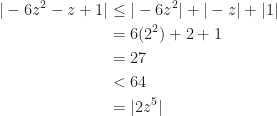
\begin{aligned}    |-6z^2-z+1|&\leq |-6z^2|+|-z|+|1|\\    &=6(2^2)+2+1\\    &=27\\    &<64\\    &=|2z^5|    \end{aligned}

on K_2. Therefore f has 5 zeroes inside K_2.

Therefore f has 5-2=3 zeroes inside the annulus.

We do a computer check using Wolfram Alpha (http://www.wolframalpha.com/input/?i=2z%5E5-6z%5E2-z%2B1%3D0). The moduli of the five roots are (to 3 significant figures): 0.489, 0.335, 1.46, 1.45, 1.45. This confirms that 3 of the zeroes are in the given annulus.

Fundamental Theorem of Algebra Using Rouche’s Theorem

Rouche’s Theorem provides a rather short proof of the Fundamental Theorem of Algebra: Every degree n polynomial with complex coefficients has exactly n roots, counting multiplicities.

Proof: Let f(z)=a_0+a_1z+a_2z^2+\dots+a_nz^n. Chose R\gg 1 sufficiently large so that on the circle |z|=R,

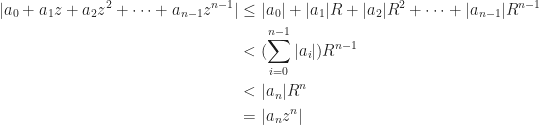
\begin{aligned} |a_0+a_1z+a_2z^2+\dots+a_{n-1}z^{n-1}|&\leq|a_0|+|a_1|R+|a_2|R^2+\dots+|a_{n-1}|R^{n-1}\\    &<(\sum_{i=0}^{n-1}|a_i|)R^{n-1}\\    &<|a_n|R^n\\    &=|a_nz^n|    \end{aligned}

Since a_nz^n has n roots inside the circle, f also has n roots in the circle, by Rouche’s Theorem. Since R can be arbitrarily large, this proves the Fundamental Theorem of Algebra.