Math Blog

Singapore Haze & Subgroup of Smallest Prime Index

Recently, the Singapore Haze is getting quite bad, crossing the 200 PSI Mark on several occasions. Do consider purchasing a Air Purifier, or some N95 Masks, as the haze problem is probably staying for at least a month. Personally, I use Nasal Irrigation (Neilmed Sinus Rinse), which has tremendously helped my nose during this haze period. It can help clear out dust and mucus trapped in the nose.

[S$89.90][Clean Air]2015 Air Purifier Singapore brand and 1 year warranty with HEPA Activated Carbon UV-C germicidal killer lamp silent operation and high efficiency etc

WWW.QOO10.SG

[S$19.90]Haze Prevention~ Nasal Rinse™- Flush out mucous~germs~bacteria~and dirt internally. Clear blocked nose and very soothing.

WWW.QOO10.SG

Previously, we proved that any subgroup of index 2 is normal. It turns out that there is a generalisation of this theorem. Let p be the smallest prime divisor of a group G. Then, any subgroup H\leq G of index p is normal in G.

Proof: Let H be a subgroup of G of index p. Let G act on the left cosets of H by left multiplication: \forall x\in G, x\cdot gH=xgH.

This group action induces a group homomorphism \phi:G\to S_p.

Let K=\ker \phi. If x\in K, then xgH=gH for all g\in G. In particular when g=1, xH=H, i.e. x\in H.

Thus K\subseteq H. In particular, K\trianglelefteq H, since \ker\phi is a normal subgroup of G.

We have G/K\cong \phi(G)\leq S_p. Thus |G/K|\mid p!.

Also note that |G|=|G/K||K|. Note that |G/K|\neq 1 since |G/K|=[G:H][H:K]=p[H:K]\geq p.

Let q be a prime divisor of |G/K|. Then q\leq p since |G/K|\mid p!. Also, q\mid |G|. Since p is the smallest prime divisor of |G|, p\leq q. Therefore, p=q, i.e. |G/K|=p.

Then p=p[H:K] \implies [H:K]=1, i.e. H=K. Thus, H is normal in G.

Proof of Wilson’s Theorem using Sylow’s Theorem

Wilson’s theorem (p-1)!\equiv -1 \pmod p is a useful theorem in Number Theory, and may be proved in several different ways. One of the interesting proofs is to prove it using Sylow’s Third Theorem.

Let G=S_p, the symmetric group on p elements, where p is a prime.

|G|=p!=p(p-1)!

By Sylow’s Third Theorem, we have n_p\equiv 1\pmod p. The Sylow p-subgroups of S_p have p-1 p-cycles each.

There are a total of (p-1)! different p-cycles (cyclic permutations of p elements).

Thus, we have n_p (p-1)=(p-1)!, which implies that n_p=(p-2)!

Thus (p-2)!\equiv 1\pmod p, and multiplying by p-1 gives us (p-1)!\equiv p-1\equiv -1\pmod p which is precisely Wilson’s Theorem. 🙂

If you are interested in reading some Math textbooks, do check out our recommended list of Math texts for undergraduates.

You may also want to check out Match Wits With Mensa: The Complete Quiz Book, which is our most popular recommended book on this website.

Tips to write the start of composition (argumentative essay) 议论文的开头如何入手(一)

chinesetuition88's avatarChinese Tuition Singapore

写议论文有个“万能公式”,我们称为“三段论”。就是把文章分为三个部分:开头(提出论点),中间(将论点分为几个部分加以概括并运用论据进行阐述),结尾(总结,进一步深化论点)。

都说“良好的开头是成功的一半”,所以一篇作文写出一个好的开头是十分有必要的。

有学生很苦恼,不知道该怎么写议论文的开头。如果套用“三段论”,他们往往在开头用一句话就结束了。其实议论文的开头有很多种写法。

我们以“怎样才算是一个幸福的家庭”这个题目来探讨议论文开头的写法。

这个题目的意思就是让学生阐述构成幸福家庭的条件。有一个学生认为,幸福家庭的必备条件是“父母爱护孩子,孩子孝顺父母,兄弟姐妹之间互相关心”。那我们就利用这个观点来写。

本文先介绍比较常用的几种开头方式:

1. 开门见山式。come straight to the point

这种方式的特点是在开头就将文章的论点摆出开,直截了当,一看便知文章的主旨。

例:人从一出生开始首先面对的“小社会”便是家庭。家庭的幸福与否关系到一个人的幸福与否。当然,一个幸福的家庭是需要每个家庭成员来共同努力维护的。父母爱护孩子,孩子孝顺父母,兄弟姐妹之间互相关心,这样才算是一个幸福的家庭。
2. 设问句式。(rhetorical question)

就议论的问题提出疑问,在回答问题的过程中提出自己的观点。

例:家庭与每个人的成长和生活是密不可分的。家庭环境甚至可以影响一个人的人生。人人都希望生活在幸福的家庭中,那么什么样的家庭才算是幸福的呢?幸福的家庭是需要家庭成员之间互相关怀照顾的。父母爱护孩子,孩子孝顺父母,兄弟姐妹之间互相关心,这样的家庭才会幸福。

View original post

Zmn/Zm isomorphic to Zn

The following is a simple proof of why \mathbb{Z}_{mn}/\mathbb{Z}_m\cong\mathbb{Z}_n.

For instance \mathbb{Z}_6/\mathbb{Z}_2\cong\mathbb{Z}_3. Note that the tricky part is that \mathbb{Z}_2 is not actually the usual {0,1}, but rather {0,3} (considered as part of \mathbb{Z}_6). Hence the elements of \mathbb{Z}_6/\mathbb{Z}_2 are {0,3}, {1, 4}, {2, 5}, which can be seen to be isomorphic to \mathbb{Z}_3.

A sketch of a proof is as follows. Consider \phi:\mathbb{Z}_{mn}/\mathbb{Z}_m\to \mathbb{Z}_n, where \mathbb{Z}_m=\{0,n,2n,\dots,(m-1)n\}, defined by \phi (a+\mathbb{Z}_m)=a.

We may check that it is well-defined since if a+\mathbb{Z}_m=a'+\mathbb{Z}_m, then a\equiv a' \pmod n, and thus \phi (a+\mathbb{Z}_m)=\phi (a'+\mathbb{Z}_m).

It is a fairly straightforward to check it is a homomorphism, \begin{aligned}\phi (a+\mathbb{Z}_m+a'+\mathbb{Z}_m)&=\phi (a+a'+\mathbb{Z}_m)\\    &=a+a'\\    &=\phi (a+\mathbb{Z}_m)+\phi(a'+\mathbb{Z}_m)    \end{aligned}

Injectivity is clear since \ker \phi=0+\mathbb{Z}_m, and surjectivity is quite clear too.

Hence, this ends the proof. 🙂

Do check out some Recommended Books on Undergraduate Mathematics, and also download the free SG50 Scientific Pioneers Ebook, if you haven’t already.

Free Ebook: Singapore’s Scientific Pioneers

Source: http://www.asianscientist.com/pioneers/

The non-commercial book Singapore’s Scientific Pioneers, sponsored by grants from the SG50 Celebration Fund and Nanyang Technological University, is dedicated to all scientists in Singapore, past, present and, most of all, aspiring. Read more from Asian Scientist Magazine at: http://www.asianscientist.com/pioneers/

The free downloadable book also includes a Mathematician from National University of Singapore, Professor Louis Chen, one of the discoverers of the Chen-Stein method.

To download the ebook, click here to download (official mirror).

The Chen-Stein method is part of the branch of Mathematics known as Probability. Advanced probability requires a lot of Measure Theory, another type of Math classified under Analysis.

In the book, Professor Chen mentioned one of his favourite books is “One Two Three . . . Infinity: Facts and Speculations of Science (Dover Books on Mathematics)“.

It turns out that this book is very inspiring, and many reviewers on Amazon said that after they read this book during their childhood, they became inspired to become mathematicians/scientists!

Sample review (from Amazon): “It seems that almost all the reviewers had the same experience: we read this book at an early age, and it was so fascinating, so inspiring, and so magical that it directed us into math and science for the rest of our lives. In my case the book was loaned to me when I was about 12, by my best friend’s father.”

Hence, if you are looking for a Math/Science book for your child, this book may be one of the top choices. 🙂

Geometric n-simplex is convex

Given the definition of a geometric n-simplex:

\displaystyle\sigma^n=\{x=\sum_{i=0}^{n}t_i a^i \mid t_i\geq 0\ \text{and }\sum_{i=0}^{n}=1\}\subseteq\mathbb{R}^n

where \{a^0,\dots, a^n\} are geometrically independent, we can show that the n-simplex is convex (i.e. given any two points, the line connecting them lies in the simplex).

Write x=\sum_{i=0}^n t_i a^i, y=\sum_{i=0}^n s_i a^i.

Consider the line from x to y: \{ty+(1-t)x\mid 0\leq t\leq 1\}.

\begin{aligned}    ty+(1-t)x&=t\sum_{i=0}^n s_i a^i+(1-t)\sum_{i=0}^n t_i a^i\\    &=\sum_{i=0}^n (s_i t+t_i-tt_i)a_i\\    s_it+t_i-tt_i&=s_i t+t_i (1-t)\\    &\geq 0(0)+(0)(1-1)\\    &=0\\    \sum_{i=0}^n s_i t+t_i-tt_i &=t\sum_{i=0}^n s_i+\sum_{i=0}^n t_i -t\sum_{i=0}^n t_i\\    &=t(1)+(1)-t(1)\\    &=1    \end{aligned}

Thus the line lies inside the simplex, and thus the simplex is convex.


Recommended Books for Math Majors


Life Algebra

tomcircle's avatarMath Online Tom Circle

image

How to solve this ‘Life’ Algebra ?

The simultatneous inequality equation with 3 unknowns (t, e, m).

It has no solution but we can get the BEST approximation :
Retire after 55 before 60, then you get optimized {e, t, m} — still have good energy (e) with plenty of time (t) and sufficient pension money (m) in CPF & investment saving.

Beyond 60 if continuing to work, the solution of {e, t, m} -> {0, 0, 0}.

View original post

Tiger Mom Amy Chua Sets Up Tuition Center in Singapore

Source: http://www.cnbc.com/2015/08/20/queen-of-the-tiger-moms-takes-on-singapore.html

“Tiger Mom” Amy Chua has started a Tuition Center in Singapore. Amy Chua is the famous author of Battle Hymn of the Tiger Mother, which is an interesting book which has both supporters and critics.

The Tuition Centre is called Keys Academy, located in North Bridge Road, Singapore.

Do check it out, and more importantly do read the book Battle Hymn of the Tiger Mother to see if you agree with the author! Amy Chua does have some good points to be made, as many of the top students in Western countries are Asians. Do check out her book to read about her method.


Some other books written by Amy Chua are:

The Triple Package: How Three Unlikely Traits Explain the Rise and Fall of Cultural Groups in America

Day of Empire: How Hyperpowers Rise to Global Dominance–and Why They Fall

World on Fire: How Exporting Free Market Democracy Breeds Ethnic Hatred and Global Instability

Cycle Decomposition of Permutations is Unique

Cycle decomposition of Permutations into disjoint cycles is unique (up to reordering of cycles).

A proof can be found here.

The condition of disjoint is crucial. For example, the permutation (1 3 2) can be factored into (2 3)(1 2), where the two cycles are not disjoint. (1 3 2)=(1 2)(1 3) is also another decomposition, the two cycles are also not disjoint.

Wolframalpha can calculate permutations, a useful tool to replace manual calculations. Take note though that Wolframalpha’s convention is multiplying permutations from left to right, while most books follow the convention of multiplying right to left.


Recommended Math Books from Amazon

“偷得浮生半日闲”诗句分析—出现于中三课文《乌敏岛》

chinesetuition88's avatarChinese Tuition Singapore

在中三下华文课本中,有一篇题目为《乌敏岛》的课文。课文介绍了乌敏岛的自然风光和纯朴的人文环境。在文章的最后,作者写道“如果能’偷得浮生半日闲’,何不暂时摆脱现实的束缚,和三五好友到乌敏岛游玩呢?”。

“偷得浮生半日闲”出自于唐代诗人李涉的七言绝句《题鹤林寺僧舍》。全文如下:

终日昏昏醉梦间,忽闻春尽强登山。

因过竹院逢僧话,偷得浮生半日闲。

大意是:作者整日昏昏沉沉处于醉梦之中,消磨人生。忽然有一天才意识到春天就要过去了,于是勉强去爬山。在游览寺院的时候碰到一位高僧,便与其闲聊,难得在这纷纷扰扰的世事中获得片刻的清闲。

这首诗的创作背景是李涉官途不顺,被皇帝贬官后又流放到南方,所以其情绪消极终日昏昏沉沉。而在一次偶然机会,登山之时偶遇高僧,闲聊之中,不料解开了苦闷的心结,化解了世俗的烦扰,使得自己心情得以放松。

再回到课文《乌敏岛》,从课文的开始,作者就强调“踏上乌敏岛,映入眼帘的是一幅和繁忙市区截然不同的景象”。市区的人们熙熙攘攘,为生活而忙于奔走,有很多世事的烦扰。而乌敏岛却是一个别样的世界,这里没有喧嚣,人们的生活简单平静而又质朴。来到这里,看看美不胜收的风景,体验淳朴宁静的生活,相信你也会暂时忘记现实生活的烦恼和忧愁。

“偷得浮生半日闲”,人生漂浮不定,难得半日的清闲。

View original post

Weierstrass M-test Proof and Special Case of Abel’s Theorem

First, let us recap what is Weierstrass M-test:

Weierstrass M-test:

Let \{f_n\} be a sequence of real (or complex)-valued functions defined on a set A, and let \{M_n\} be a sequence satisfying \forall n\in\mathbb{N}, \forall x\in A

|f_n (x)|\leq M_n, and also \sum_{n=1}^\infty M_n=M<\infty.

Then, \sum_{n=1}^\infty f_n(x) converges uniformly on A (to a function f).

Proof:

Let \epsilon >0. \exists N\in\mathbb{N} such that m\geq N implies |M-\sum_{n=1}^m M_n|<\epsilon.

For m\geq N, \forall x\in A,

\begin{aligned}    |f(x)-\sum_{n=1}^m f_n(x)|&=|\sum_{n=m+1}^\infty f_n (x)|\\    &\leq\sum_{n=m+1}^\infty |f_n (x)|\\    &\leq \sum_{n=m+1}^\infty M_n\\    &=|M-\sum_{n=1}^m M_n|\\    &<\epsilon    \end{aligned}

Thus, \sum_{n=1}^\infty f_n (x) converges uniformly.

Application to prove Abel’s Theorem (Special Case):

Consider the special case of Abel’s Theorem where all the coefficients a_i are of the same sign (e.g. all positive or all negative).

Then, for x\in [0,1],

|a_n x^n|\leq |a_n|:=M_n

Then by Weierstrass M-test, \sum_{n=1}^\infty a_n x^n converges uniformly on [0,1] and thus \lim_{x\to 1^-} \sum_{n=1}^\infty a_n x^n=\sum_{n=1}^\infty a_n.


Check out some books suitable for Math Majors here!


If Ratio Test Limit exists, then Root Test Limit exists, and both are equal

The limit for ratio test is \lim_{n\to\infty} \frac{|a_{n+1}|}{|a_n|}, while the limit for root test is \lim_{n\to\infty}|a_n|^{1/n}. Something special about these two limits is that if the former exists, the latter also exists and they are equal!

Proof:

Let \lim_{n\to\infty}|\frac{a_{n+1}}{a_n}|=L. There exists N\in\mathbb{N} such that n\geq N \implies ||\frac{a_{n+1}}{a_n}|-L|<\epsilon.

i.e. L-\epsilon<|\frac{a_{n+1}}{a_n}|<L+\epsilon

For n>N,

|a_n|=\frac{|a_n|}{|a_{n-1}|}\cdot \frac{|a_{n-1}|}{|a_{n-2}|}\cdots \frac{|a_{N+1}|}{|a_N|}\cdot |a_N| < (L+\epsilon)^{n-N}\cdot |a_N|.

Taking nth roots,

|a_n|^{1/n}<(L+\epsilon)^\frac{n-N}{n}\cdot |a_N|^{\frac{1}{n}}

Taking limits,

\lim_{n\to\infty}|a_n|^{\frac{1}{n}}\leq (L+\epsilon)

Since \epsilon is arbitrary, \lim_{n\to\infty}|a_n|^{\frac{1}{n}}\leq L.

Similarly, we can show \lim_{n\to\infty}|a_n|^\frac{1}{n}\geq L.

Thus, \lim_{n\to\infty}|a_n|^\frac{1}{n}=L.

This is considered a rather tricky (though not that difficult) proof, hope it helps whoever is searching for it!

Note that the converse is false, we can see that by considering the “rearranged” geometric series: 1/2,1, 1/8, 1/4, 1/32, … (source: https://www.maa.org/sites/default/files/0025570×33450.di021200.02p0190s.pdf)

where the ratio alternates from 2 to 1/8 and hence does not exist.

However, the root test limit of the first 2n terms is defined:

\begin{aligned}    |a_{2n}|&=\frac{|a_{2n}|}{a_{2n-1}}\cdot \frac{|a_{2n-1}|}{|a_{2n-2}|}\cdot \frac{|a_2|}{|a_1|}\cdot |a_1|\\    &=2\cdot \frac{1}{8}\cdot 2 \cdot \frac{1}{8} \cdots 2 \cdot \frac{1}{2}\\    &=2^n \cdot (\frac{1}{8})^{n-1}\cdot \frac{1}{2}\\    &=(\frac{1}{4})^{n-1}    \end{aligned}

Thus, |a_{2n}|^\frac{1}{2n}=\frac{1}{4}^{\frac{n-1}{2n}}\to \frac{1}{2}.


To learn more about epsilon-delta proofs, check out one of the Recommended Analysis Books for Undergraduates.


Z[Sqrt(-2)] is a Principal Ideal Domain Proof

It turns out that to prove \mathbb{Z}[\sqrt{-2}] is a Principal Ideal Domain, it is easier to prove that it is a Euclidean domain, and hence a PID.

(Any readers who have a direct proof that \mathbb{Z}[\sqrt{-2}] is a PID, please comment below, as it would be very interesting to know such a proof. 🙂 )

Proof:

As mentioned above, we will prove that it is a Euclidean domain.

Let a, b\in\mathbb{Z}[\sqrt{-2}], b\neq 0.

We need to show: \exists q, r\in \mathbb{Z}[\sqrt{-2}] such that a=bq+r, with N(r)<N(b).

Consider \frac{a}{b}=c_1+c_2 \sqrt{-2} \in \mathbb{Q}[\sqrt{-2}]. Define q=q_1+q_2 \sqrt{-2} where q_1, q_2 are the integers closest to c_1, c_2 respectively.

Then, \frac{a}{b}=q+\alpha, where \alpha=\alpha_1+\alpha_2 \sqrt{-2}.

a=bq+b\alpha.

Take r=b\alpha.

\begin{aligned}    N(r)&=N(b\alpha)\\    &=N(b)\cdot N(\alpha)\\    &=N(b)\cdot (\alpha_1^2+2\alpha_2^2)\\    &\leq N(b)\cdot ({\frac{1}{2}}^2+2(\frac{1}{2})^2)\\    &=N(b)\cdot (\frac{3}{4})\\    &<N(b)    \end{aligned}


Check out recommended Abstract Algebra books: Recommended Books for Math Undergraduates


Is Z[x] a Principal Ideal Domain?

In the previous post, we showed that a Euclidean domain is a Principal Ideal Domain (PID).

Consider the Polynomial Ring \mathbb{Z}[x]. We can show that it is not a PID and hence also not a Euclidean domain.

Proof: Consider the ideal <2,x>=\{ 2f(x)+xg(x)\vert f(x), g(x) \in \mathbb{Z} [x]\}.

Suppose to the contrary <2,x>=<p(x)>=\{ f(x)p(x)\vert f(x)\in \mathbb{Z}[x]\}.

Note that 2\in <2,x>, hence 2\in <p(x)>.

2=f(x)p(x)

p(x)=2 or -2.

<p(x)>=<2>

However, x\in <2,x> but x\notin <2>. (contradiction!)


Check out this page for Recommended Singapore Math books!


Proof that a Euclidean Domain is a PID (Principal Ideal Domain)

Previously, we defined what is a Euclidean Domain and what is a PID. Now, we will prove that in fact a Euclidean Domain is always a PID (Principal Ideal Domain). This proof will be elaborated, it can be shortened if necessary.

Proof:

Let R be a Euclidean domain.

Let I be a nonzero ideal of R. (If I is a zero ideal, then I=(0) )

Choose b\in I, b\neq 0 such that d(b)=\min \{ d(i): i\in I\}, where d is the Euclidean function. By the well-ordering principle, every non-empty set of positive integers contains a least element, hence b exists.

Let a\in I be any element in I. \exists q,r \in R such that a=bq+r, with either r=0, or d(r)<d(b). (This is the property of Euclidean domain.)

We can’t have d(r)<d(b) as that will contradict minimality of d(b). Thus, r=0, and a=bq. Hence every element in the ideal is a multiple of b, i.e. I=(b). Thus R is a PID (Principal Ideal Domain).


Check out other pages on our blog:


Definition of Euclidean Domain and Principal Ideal Domain (PID)

A Euclidean domain is an integral domain R with a function d:R\setminus \{0\}\to \mathbb{N} satisfying the following:

(1) d(a)\leq d(ab) for all nonzero a,b in R.

(2) for all a,b \in R, b\neq 0, \exists q, r, \in R such that a=bq+r, with either r=0 or d(r)<d(b).

(d is known as the Euclidean function)

On the other hand, a Principal ideal domain (PID) is an integral domain in which every ideal is principal (can be generated by a single element).


Recommended Math Books for University students


Proof that any subgroup of index 2 is normal

Let H\leq G be a subgroup of index 2.

Let g\in G and h\in H.

If g\in H, then gH=H, and Hg=H, hence left coset equals to right coset.

If g\notin H, then gH=G\setminus H (set minus), and also Hg=G\setminus H, thus left coset also equals to right coset.

Tip: For this question, using the equivalent definition of ghg^{-1}\in H to prove will be quite tricky and convoluted, as seen here.

Recommended Page: Check out the following Recommended Math Books for Undergrads!

Aut(Z_n): Automorphism Group of Z_n

Do check out our list of Recommended Undergraduate Math Books!

We prove that Aut(\mathbb{Z}_n)\cong (\mathbb{Z}/n\mathbb{Z})^*, also known as U(n) (easier to type).

Define \Psi: Aut(\mathbb{Z}_n)\to U(n) by \Psi(\phi)=\phi (1).

First we show that it is a homomorphism:

\begin{aligned}\Psi(\phi_1 \circ \phi_2)&=\phi_1(\phi_2(1))\\    &=\phi_1 (1+1+\cdots +1)\ \ \ (\phi_2 (1) \text{ times})\\    &=\phi_1 (1)+\phi_1 (1)+\cdots +\phi_1 (1)\ \ \ (\phi_2 (1) \text{ times})\\    &=\phi_2 (1) \cdot \phi_1 (1)\\    &=\Psi (\phi_2)\cdot \Psi (\phi_1)\\    &=\Psi (\phi_1) \cdot \Psi (\phi_2)\ \ \ \text{since} (\mathbb{Z}/n\mathbb{Z})^* \text{ is abelian.}    \end{aligned}

Next we show that it is injective:

\Psi (\phi) =1

Thus, \phi (1)=1.

Let x\in \mathbb{Z}_n.

\phi (x)=x\phi (1)=x\cdot 1=x.

Thus, the only automorphism that maps to 1 is the identity.

Thus, \ker \Psi is trivial.

Finally, we show that it is surjective.

Let x\in (\mathbb{Z}/n\mathbb{Z})^*. Consider \phi such that \phi (0)=0, \phi (1)=x, \phi (i)=ix, …, \phi (n-1)=(n-1)x.

We claim that \phi is an automorphism of \mathbb{Z}_n.

Firstly, we need to show that \{0,1,2,\cdots, n-1\}=x\{0, 1, 2, \cdots, n-1\}. This is because \gcd (x,n)=1. Hence if q is the order of x, i.e. qx\equiv 0 \pmod n, then n\vert qx, which implies that n\vert q which implies that q is at least n. Since the order of x is also at most n, q=n.

Finally, we have \phi(a+b)=(a+b)x=ax+bx=\phi (a)+\phi (b) and thus we may take \phi as the preimage of x.

Hence \Psi is surjective.

This is a detailed explanation of the proof, it can be made more concise to fit in a few paragraphs!

Related posts: Recommended Books for Math Students

Egg Mathematics

tomcircle's avatarMath Online Tom Circle

I highly recommend this Harvard Online Course “Science & Cooking” for food and Math lover:

http://online-learning.harvard.edu/course/science-and-cooking

Example of the Course :

How much boiled water you need to cook a perfect egg ?

By conservation of heat (energy), the heat (Q) of boiled water is transferred to the egg (assume no loss of heat to the environment: container, air, etc).

Secondary school Physics :

Q = m.C. (T’-T)
m = mass
C=Specific Heat
T’= Final Température
T= Initial Temperature

image

Chef’s tip: a perfect egg cooked at around 64 C.

image

View original post

Chinese Tuition (West Side of Singapore)

If you live near the West side of Singapore (e.g. Buona Vista, Dover, Clementi, Jurong), and are looking for a patient and dedicated Chinese Tutor, do check out:

ChineseTuition88.com

Chinese Tuition Singapore

新加坡华文补习老师

Tutor: Ms Gao (高老师)

Ms Gao is a patient tutor, and also effectively bilingual in both Chinese and English.

A native speaker of Mandarin, she speaks clearly with perfect accent and pronunciation. She is also well-versed in Chinese history, idioms and proverbs.

Ms Gao is able to teach Chinese at the Primary and Secondary school level. She will teach in an exam-oriented style, but will also try her best to make the lesson interesting for the student.

Ms Gao graduated from Huaqiao University from Fujian, China.

Contact:

Email: chinesetuition88@gmail.com

(Preferably looking for students staying in the West side of Singapore)

Video on Simplices and Simplicial Complexes

Professor Wildberger is extremely kind to upload his videos which would be very useful to any Math student studying Topology. Simplices / Simplicial Complexes are usually the first chapter in a Algebraic Topology book.

Check out also Professor Wildberger’s book on Rational Trigonometry, something that is quite novel and a new approach to the subject of Trigonometry. For instance, it can be used for rational parametrisation of a circle.

#SG50 Singapore’s Birthday (National Day Song)

This year’s national day song is being sung by JJ Lin, a very famous Singaporean songwriter and artiste who has become famous in China and Taiwan.

Hope you enjoy the song and music video! JJ Lin’s vocals are indeed very good, and for him to sing the national day song is really a good thing.

From an educational perspective, one thing special about Singapore is Singapore Math. I have written a very long article on what is Singapore Math, and the benefits of Singapore Math, and also some key books that exemplify the techniques of Singapore Math.

Hope that more and more people can appreciate and utilise Singapore Math for the benefit of their students and children! Singapore Math is the key secret that has led Singapore to progress up in the educational rankings, especially in early education stages. Students and parents all over the world, including the United States, have been using Singapore Math syllabus to great success.

For readers who are interested to learn more about Singapore Math, do check out some of my earlier blog posts on Singapore Math:

SG50 Happy Birthday + Qoo10 Best Offers

Wishing Singapore a very happy SG50 birthday this weekend!

Do check out some of the SG50 sales at Qoo10, many of the items are going at half price! Definitely cheaper than buying at retail stores.

[S$599.00][LG Electronics]2015 New LG Robot Vacuum Cleaner VR6470LVM VR6471LVM Ccordless/ Dual Eye Cleaner Hombot Support English Chinese

WWW.QOO10.SG

[S$499.00][1DAY Super Big Deal!]Canon EOS 100D 1855 Lens Kit Save $500! 50% SALE!!

WWW.QOO10.SG

Also check out my previous posts on Best Deals at Qoo10!

MacBook Air for Math Students

Tired of “blue screens of death” that are so common in Windows? Don’t want to wait 10 minutes for Windows to “start up”? Switch to Mac OS!

My old computer (ASUS) has lasted me 5 years, but has recently gotten to the point that it slows down to a crawl. Booting up Windows takes up to 15 minutes, and “blue screens of death” occurs extremely frequently. It hasn’t spoiled completely yet, I still use it for printing documents.

I have since switched to MacBook Air, and so far it has been a great experience.

Tips for Math Students using MacBook Air / Pro

For Math students, some apps that you may want to install are MacTeX. It is the LaTeX Mac version. The initial download is over 2 GB, so it might take a while. I downloaded the installer from the main website, it took around one hour.

Another app is Google Chrome, which works very well on Mac. WordPress.com runs better on Chrome, for instance the LaTeX expressions are rendered better on the Chrome browser versus the Safari browser.

MacBook Air is one of the lightest notebooks around. The downside is that it does not have a few features, for example Ethernet Adapter and Optical Drive. Not to worry, one can purchase add-ons to remedy the problem. (Listed below)


Thunderbolt to Gigabit Ethernet Adapter


Aluminum External USB DVD+RW,-RW Super Drive for Apple–MacBook Air, Pro, iMac, Mini

MacBook takes some time to get used to, hence it is good to play around with it to discover the hidden shortcuts. For instance, Copy on Mac is command-C instead of control-C.

If you have any tips for using the MacBook, do feel free to share it in the comments section below!

The Fundamental Group

Source: Topology (2nd Economy Edition)

If we pick a point x_0 of the space X to serve as a “base point” and consider only those paths that begin and end at x_0, the set of these path-homotopy classes does form a group under *. It will be called the fundamental group of X.

The important thing about the fundamental group is that it is a topological invariant of the space X, and it will be crucial in studying homeomorphism problems.

Definition of fundamental group:
Let X be a space; let x_0 be a point of X. A path in X that begins and ends at x_0 is called a loop based at x_0. The set of path homotopy classes of loops based at x_0, with operation *, is defined as the fundamental group of X relative to the base point x_0. It is denoted by \pi_1 (X,x_0).

Previously, we have shown that the operation * satisfies the axioms for a group. (See our earlier blog posts on the associativity properties and other groupoid properties of the operation.

This group is called the first homotopy group of X. There is also a second homotopy group, and even groups \pi_n (X,x_0) for all n\in \mathbb{Z}^+.

An example of a fundamental group:

\pi_1 (\mathbb{R}^n,x_0) is the trivial group (the group consisting of just the identity). This is because if f is a loop in \mathbb{R}^n based at x_0, the straight line homotopy is a path homotopy between f and the constant path at x_0.

An interesting question (discussed in the next upcoming blog posts) would be how the group depends on the base point x_0.

Things to Make and Do in the Fourth Dimension: A Mathematician’s Journey through Narcissistic Numbers, Optimal Dating Algorithms, at Least Two Kinds of Infinity, and More, by Matt Parker

Check out the latest new Math book on the Fourth Dimension! The Fourth Dimension is the mysterious dimension which cannot be seen. Check out also our previous post on the Fourth Dimension Explained.


Things to Make and Do in the Fourth Dimension: A Mathematician’s Journey Through Narcissistic Numbers, Optimal Dating Algorithms, at Least Two Kinds of Infinity, and More

Mathematics popularizer Matt Parker, an Australian based in England, is a self-proclaimed “standup mathematician” perhaps best known for his numerous contributions to the Numberphile YouTube channel. He is also the Public Engagement in Mathematics Fellow at Queen Mary, University of London, and his new book, Things to Make and Do in the Fourth Dimension, is an ambitious and delightful addition to the current age’s plethora of high-quality volumes on recreational mathematics—even if most of the material he covers is focused on 2-D and 3-D. Like the extensive writings of legendaryScientific American columnist Martin Gardner this book seeks to make mathematics come alive for an intelligent and curious audience by engaging the reader in a lively informal style, and with irresistible invocations to roll up one’s sleeve and experiment. Parker also enlivens his chapters with numerous surprises.

Source: http://www.scientificamerican.com/article/how-to-get-to-the-fourth-dimension/?WT.mc_id=SA_WR_20150805

GEP Test Dates 2015

Source: http://www.moe.gov.sg/education/programmes/gifted-education-programme/faq/gep-pupils/

Just a gentle reminder that the dates for 2015 GEP Test would be as follows:

Schedule for 2015

  1. GEP Screening Test: 28 Aug 2015
  2. GEP Selection Test: 20 and 21 Oct 2015
  3. Invitation to join GEP: Early November 2015

(Do check the website above for updates)

Students interested to buy books relevant to GEP can check out one of my most popular blog posts on Recommended Books for GEP Screening / Selection Test. The truth is that at age 9 there is little difference between normal and gifted kids, i.e. normal kids with some training and excellent family support / learning environment can easily be on par with gifted students. Gifted students are nothing really special, they do have more training and good family learning background, but normal students with additional exposure and training can be as good as gifted students.

Singapore’s educational experts and professors have recently called for Singapore as a nation to read more books, posted prominently in Straits Times. The correct choice of books is critical, as reading books meant for entertainment like Harry Potter or Twilight is unlikely to benefit students a great deal. Worse still is reading FaceBook or Twitter, as they are often in broken English. Singaporeans are notoriously known for reading very few books, leading to bookstores like Borders and PageOne completely shutting down in Singapore. Students who wish to enter GEP would need to read even more books, as GEP would require a broad knowledge base, which is tested in the vocabulary and logic section of the screening tests.

In my earlier post on Recommended GEP Books, I recommended some books to tackle the notoriously difficult GEP Screening Test, including the Vocabulary Section, Math Section, and Logic Section. Children with weaker English levels would definitely need to brush up on their vocabulary, as words like “gregarious“, “amicable“, “cantankerous” would pop up in GEP tests, leading to students being “flabbergasted“.

For the Math section, the harder GEP Screening Math questions are undoubtedly of a Math Olympiad style that would flounder all but those who are trained in the art of Math Olympiad. It is a truth that a P3 student scoring 100 marks in normal Math, most likely cannot solve a P3 Math Olympiad problem due to lack of training. However, once he/she is trained, Math Olympiad is just a trick and will be easily solved. Check out some Recommended Books for Math Olympiad Self-learning.

Finally, remember the Cheryl Birthday Puzzle that went viral? This is an example of a logic puzzle. Logic is not taught anywhere in the syllabus, and hence students would need to self learn to master the art of logic puzzles. This skill will be critical again for DSA / GAT / HAST, as they will be testing the similar logic puzzles again for P6 DSA.

To all students taking the GEP test, all the best. Keep calm and good luck!

Measure Theory: What does a.e. (almost everywhere) mean

Source: Elements of Integration by Professor Bartle

Students studying Mathematical Analysis, Advanced Calculus, or probability would sooner or later come across the term a.e. or “almost everywhere”.

In layman’s terms, it means that the proposition (in the given context) holds for all cases except for a certain subset which is very small. For instance, if f(x)=0 for all x, and g(x)=0 for all nonzero x, but g(0)=1, the function f and g would be equal almost everywhere.

For formally, a certain proposition holds \mu-almost everywhere if there exists a subset N\in \mathbf{X} with \mu (N)=0 such that the proposition holds on the complement of N. \mu is a measure defined on the measure space \mathbf{X}, which is discussed in a previous blog post: What is a Measure.

Two functions f, g are said to be equal \mu-almost everywhere when f(x)=g(x) when x\notin N, for some N\in X with \mu (N)=0. In this case we would often write f=g, \mu-a.e.

Similarly, this notation can be used in the case of convergence, for example f=\lim f_n, \mu-a.e.

The idea of “almost everywhere” is useful in the theory of integration, as there is a famous Theorem called “Lebesgue criterion for Riemann integrability”.

(From Wikipedia)

A function on a compact interval [ab] is Riemann integrable if and only if it is bounded and continuous almost everywhere (the set of its points of discontinuity has measure zero, in the sense of Lebesgue measure). This is known as the Lebesgue’s integrability condition or Lebesgue’s criterion for Riemann integrability or the Riemann—Lebesgue theorem.[4] The criterion has nothing to do with the Lebesgue integral. It is due to Lebesgue and uses his measure zero, but makes use of neither Lebesgue’s general measure or integral.

Reference book:

Post-Modern Algebra

Trigonometry in abstract algebra Group Theory… this is a new look of Elementary Math (E. Math) from a higher level (Abstract Algebra : Group Theory) — just as the Tang Poem said “欲穷千里目, 更上一层楼” (To see further distance away, just climb up to higher level).

tomcircle's avatarMath Online Tom Circle

Modern Algebra: Based on the 1931 influential book “Modern Algebra” written by Van de Waerden (the student of E. Noether). Pioneered by the 20th century german Göttingen school of mathematicians, it deals with Mathematics in an abstract, axiomatic approach of mathematical structures such as Group, Ring, Vector Space, Module and Linear Algebra. It differs from the computational Algebra in 19th century dealing with Matrices and Polynomial equations.

This phase of Modern Algebra emphasises on the algebraization of Number Theory: {N, Z, Q, R, C}

Post-Modern Algebra: The axiomatic, abstract treatment of Algebra is viewed as boring and difficult. There is a renewed interest in explicite computation, reviving the 19th century invariant theory. Also the structural coverage (Group, Ring, Fields, etc) in Modern Algebra is too narrow. There is emphasis on other structures beyond Number Theory, such as Ordered Set, Monoid, Quasigroup, Category, etc.

Example:
The non-abelian Group S3 (order…

View original post 30 more words

Analysis -> (Topology) -> Algebra

tomcircle's avatarMath Online Tom Circle

Mathematics is divided into 2 major branches:
1. Analysis (Continuity, alculus)
2. Algebra (Set, Discrete numbers, Structure)

In between the two branches, Poincaré invented in 1900s the Topology (拓扑学) – which studies the ‘holes’ (disconnected) in-between, or ‘neighborhood’.

Topology specialised in
–  ‘local knowledge’ = Point-Set Topology.
– ”global knowledge’ = Algebraic Topology.

Example:
The local data of consumer behavior uses ‘Point-Set Topology’; the global one is ‘BIG Data’ using Algebraic Topology.

View original post

IMO 2015 USA beat China after 20 Years

tomcircle's avatarMath Online Tom Circle

image

The result is not surprising to China but to USA:
♢Recently China government bans IMO training in schools.
♢Obama was surprised that the USA IMO team consists of predominantly Chinese American students.

IMO Math is like ‘Acrobatics’ to real ‘Kung-fu’, it is not real Math education, but special ‘cute’ techniques to solve tough ‘known’ solution problems. Real Math is long R&D solving problems with UNKNOWN solution (eg. Fermat’s Last Theorem, Riemann Conjecture,…)

2 types of Math: Algorithmic or Deductive (演绎). Chinese long traditional ‘abacus’ mindset, procedural computational Math is Algorithmic, applied to special cases (eg. astronomy, calendar, agriculture, architecture, commerce,…). European Greek’s Euclid deductive, step-by-step axiom-based proofing, is theoretical, generalized in all cases (Geometry, Abstract Algebra,…)

Look at the Fields Medal (aka ‘Nobel Prize’ of Math) super-power – France – which has produced 1/3 of the Fields Medalists, but performing so-so in IMO. In contrast, China has ZERO Fields…

View original post 53 more words

Cheapest Digital Piano Singapore

Cheap Digital Piano Singapore

Click this URL to view more Digital Pianos: http://list.qoo10.sg/sp/7452?jaehu_cust_no=7NCxGWDWWM132kSlYY7/rw==#53572

Is your child beginning in trying out learning piano? Buying an actual upright piano would cost a few thousand dollars, and may not be a good idea, as many children may stop learning after a few months. Practicing piano is an excellent way to improve musical skills and even Math skills, as music has been found to be linked to math. Unfortunately practicing piano requires a lot of patience and perseverance (e.g. 1 hour practice every day), in order to reach a decent level like Grade 8 Piano. Hence, many children understandably cannot sustain the necessary practice required, and stop learning, and the money buying the piano (and space in the house) would be wasted.

Research has found that music helps children learn maths! Listening to music in maths lessons can dramatically improve children’s ability in the subject and help them score up to 40 per cent higher in examinations, a new study has found. Source: http://www.telegraph.co.uk/education/9159802/Music-helps-children-learn-maths.html

Buying a keyboard (non-weighted) is also not a good idea, as classical piano requires dynamics (e.g. forte and piano) which means loud and soft contrasts, which is not achievable using a non-weighted keyboard.

The perfect solution is to purchase a digital piano first, and then upgrade to a upright piano if the child maintains interest after a few years. A very good brand for starters would be Yamaha, a Japanese music brand. An added advantage of digital pianos is the ability to use earphones, which would enable one to practice late at night without disturbing the neighbor.

If the child is interested to pursue MEP (Music Elective Programme), this digital piano would come in handy for musical composition in MIDI, and it would have orchestral sounds like Strings, Brass, Drums, etc. Definitely a very useful instrument to have for serious music students as well as the amateur.

[S$1,150.00][YAMAHA][8% OFF – MID YEAR SALE!] Yamaha P-115 Digital Piano (Weighted Piano Keyboard)

WWW.QOO10.SG

Click here for even more choices for Digital Pianoshttp://list.qoo10.sg/sp/7452?jaehu_cust_no=7NCxGWDWWM132kSlYY7/rw==#53572

P-115 Digital Piano Overview

US First Place in International Math Olympiad! China Drops to Second (Related to Banning of Math Olympiad?)

Congratulations to USA for their First Position in the IMO, a position traditionally held by China! China has been holding the 1st position in the IMO for 21 years.

News: Indian-Origin Students Help US Win Math Olympiad After 21 Years

Indian-Origin Students Help US Win Math Olympiad After 21 Years

Washington:  Two Indian-origin students have helped the US win the prestigious International Mathematical
Olympiad after more than two decades.

Shyam Narayanan, 17, and Yang Liu Patil, 18, were part of the six-member US team that won the renowned award after a gap of 21 years. India was ranked 37th in the competition.

Some provinces in China, e.g. Beijing, Chengdu have curiously banned Math Olympiad, and one may wonder does this have an effect in China’s drop in ranking? Having a state wide ban on Math Olympiad would have the result of lowering the number of students taking Math Olympiad, shrinking the talent pool, as well as giving Math Olympiad a stigma and a bad reputation. Students in China are known to be very talented in Math Olympiad, but with such a severe ban, they may forgo Math Olympiad altogether.

Source: http://english.cri.cn/7146/2012/01/20/2702s677257.htm

In 2005, the Ministry of Education issued a regulation forbidding state-run primary and junior middle schools from offering Olympic math courses. It later cancelled the policy of including Olympic math on school entrance examinations. Likewise in 2010, the ministry cancelled a regulation that the winners of Mathematics Olympiads could be recommended for admission to junior middle schools to remove some of the heavy study burden from students.

The Chengdu government has achieved a huge success since it issued harsh regulations banning Olympic math training in 2009. Local authorities prohibit state-run schoolteachers from working part-time to teach Olympic math and have removed school headmasters who give weight to Olympic math performance in student admissions.

For most primary students in Chengdu, this came as a huge relief.

“I feel like a caged bird been set free.”

“I have more time to do physical exercises and have fun. And I can cultivate my own hobbies.”

The students’ parents were also relieved.

This banning of Math Olympiad is indeed very harmful. Instead, Math Olympiad should be made optional so that students who are interested in it can still participate in it, while students who are not interested can learn something else. Banning learning, Math Olympiad, or tuition simply does not make sense! Countries who are interested in promoting STEM (Science, Technology, Engineering, Math) should be actively promoting Math Olympiad instead of banning it. Hopefully China may reverse its ban for Math Olympiad, as China’s huge talent pool and surplus of brilliant students makes it naturally easy to get 1st in Math Olympiad, provided students are given an incentive to pursue Math Olympiad.

Singapore Math Olympiad Results

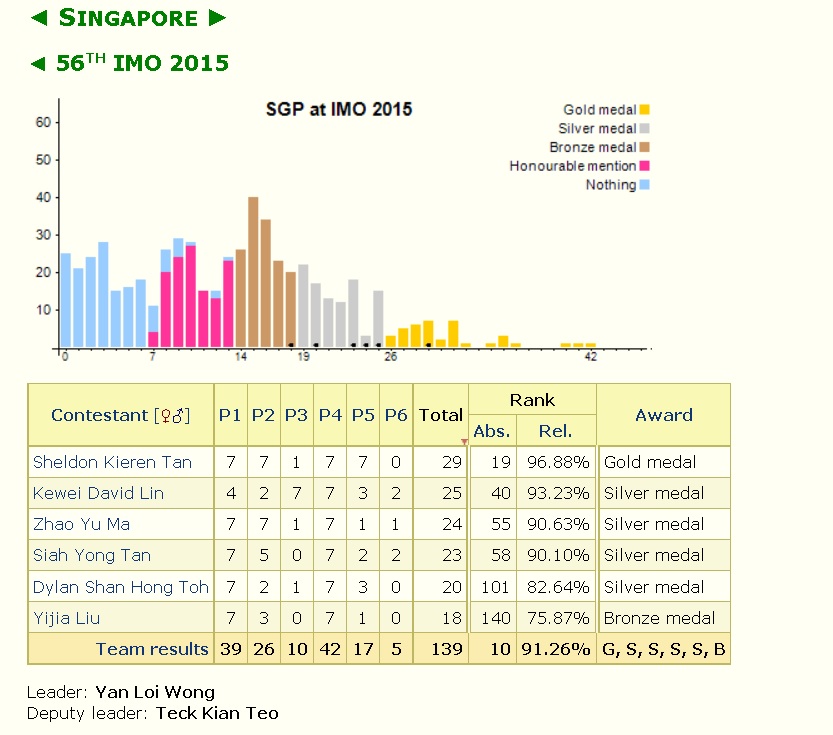
Source: https://www.imo-official.org/team_r.aspx?code=SGP&year=2015

Singapore did relatively well also, with one gold, 4 silver, and 1 bronze, with an overall 10th position. Congratulations Singapore!

singapore imo


To learn more about Math Olympiad, read my earlier blog post on Recommended Maths Olympiad Books for Self Learning.


Count Down: The Race for Beautiful Solutions at the International Mathematical Olympiad

Each summer, hundreds of seemingly average teens from around the world gather for the International Mathematical Olympiad, a chance to race the clock and one another in the quest for elegant mathematical solutions. In Count Down, the National Book Award finalist Steve Olson sets out to crack the secret of what makes these students such nimble problem solvers. He follows the six U.S. contestants from their free-time games of Ultimate Frisbee to the high-pressure rounds of the competition. In each he finds a potent mix of inspiration, insight, competitiveness, talent, creativity, experience, and, perhaps most important, an enduring sense of wonder. As he observes the Olympians, Olson delves into common questions about math culture and education, exploring why many American students dread geometry, why so few girls pursue competitive math, and whether each of us might have a bit of genius waiting to be nurtured.

Allot more time for exam papers (Straits Times Forum)

Source: http://www.straitstimes.com/forum/letters-on-the-web/allot-more-time-for-exam-papers

This reader has called for allotting more time for exam papers. He/she has made a very valid point:

The time allotted for some papers, such as mathematics, is so limited that the opportunity cost of stopping for just a few minutes to think about how to solve a problem may result in one being unable to complete the paper.

For essay papers in subjects such as economics, it becomes a test of how fast one can write, as opposed to the quality of one’s answers.

This is very true, the reader is being 100% honest and not exaggerating at all! For O Levels and A Levels Maths, the student can only spend 1.5min per mark. That means, for a 5 mark long question, he can only spend 7.5 min at the maximum or risk not being able to finish the paper. To have ample time to check the paper, the student needs to do even faster than the minimum of 1.5 min per mark.

Yoda’s quote “Do. Or do not. There is no try.” holds true for Mathematics exam papers in Singapore. There is simply no time to “try” out questions in O Level or A Level Maths. Once a student looks at the question, his fate is sealed, he/she either knows the method how to do it, or does not. There is no time to try!

do_or_do_not_1920x1080_1923565073

Hence, exam time management skills and speed in Math are essential. (I have written a previous post about it.) Nowadays, questions are not arranged in order of difficulty. This means that Question 5 may be much harder than Question 10. Sometimes, it is better to skip Question 5, rather than get stuck on it and never reach Question 10. Getting 100% is not necessary for getting an A for Math. In fact, getting 100% for Math after Primary 6 is a rare occurrence. Getting 70 for Math in H2 Math is a very decent score, and getting 80 more or less guarantees an A even with a bell curve.

Also, knowledge of the essential formulas are extremely important. Yes, it is possible to derive the quadratic formula by completing the square, but there is no time for that during the exam. Time is of essence. Formula for AP/GP, Vectors need to be known by heart. Spending 1 min to recall or derive them may lead to severe time pressure later on. Recalling the wrong formula leads to disaster, and potentially zero marks for the entire question, as “error carry forward” is only applicable for limited scenarios. Students may need a Formula Helpsheet containing all the essential formulas for easy memorization.

Lastly, the most important thing the night before the exam is have a good night’s sleep. A previous blog post discusses the importance of sleep, and how Good night’s sleep adds up to better exam results – especially in maths. Also, have a good rest after the Math paper, the 3 hour H2 paper is mentally exhausting, and the 2.5 hour A Maths paper is not a stroll in the park either. After the long Maths paper, your brain deserves a good rest.

Singapore Tuition Forum News Compilation

Compilation of Interesting Articles on Tuition

Recently, there have been many news on the Straits Times Forum / other newspapers / internet on the phenomenon of tuition in Singapore. There are many mixed opinions on tuition, which are discussed in depth in those articles. I have picked the most interesting articles on the subject of tuition, which would be a familiar topic in Singapore, as 70% or more of Singaporean students have tuition. The links are found near the bottom of the post.

Personally, I think of tutors like a sports coach, like a swimming coach or a badminton coach. Sports coaches help their students to play the sport better. Tuition teachers help their students to perform in the exams better. There are great similarities between their roles. Currently, almost all top athletes would have a coach, it would be unthinkable for an athlete at the international level not to have a coach.

Tuition has also been around since thousands of years ago. Alexander the Great’s father hired Aristotle as a tutor for his son. The Imperial Tutor in ancient China is an extremely prestigious post and is often awarded only to the top scholar in the imperial exams. His job is to tutor the future emperor or other princes / princesses. (See this example of an Imperial Tutor in China). In the past, only the rich and wealthy could afford tutors. However, due to the prosperity in many first world countries like Singapore and South Korea, affording tuition is becoming increasingly possible even for the middle class.


Note: I am currently not giving tuition at the moment, but I have a good recommendation for a very good tuition agency. Interested readers can email me at mathtuition88@gmail.com.


 Links of Top 10 News Articles on Tuition

  1. 7 in 10 parents send their children for tuition: ST poll
  2. Does tuition help or hinder? (Straits Times)
  3. Tuition is popular due to education system issues (ST)
  4. Tuition is comforting for some parents, kids (ST)
  5. Tuition has become an educational arms race (ST)
  6. Tuition a necessary evil (ST)
  7. He goes for tuition …and he’s in poly (ST)
  8. Tuition In Singapore: Is It Necessarily Bad? (Blog)
  9. Singapore’s Young School Children Are Burdened With Excessive Private Tuition (Blog)
  10. The Tuition Dilemma (NTU)

As a former tutor, I don’t really think that tuition (in moderation) can be harmful, like what some of the articles claim. Back to the analogy of sports coaches, it is illogical to suppose that a sport student’s badminton skills can worsen and deteriorate after practice with a qualified coach. That would simply make no sense! Similarly, as long as the tutor is competent and not teaching the wrong thing, it would simply be illogical to say that tuition can harm academic performance. It would be really strange if a student becomes worse at math after more practice.

The key to successful life is balance. A role model for children would be Jeremy Lin, the Asian American basketball player. Highly intelligent and an excellent student, he has been admitted and graduated successfully from Harvard. He is also a professional basketball player in the NBA, and at the peak of physical fitness. He is also a humble and devout Christian. He is one guy that all students should take as a role model.

Book on Jeremy Lin:


Jeremy Lin: The Reason for the Linsanity

Inspiration of the Day: Nine-year-old Filipino pictured studying in the light of a McDonald’s

Nine-year-old Filipino pictured studying in the light of a McDonald's

Source: http://www.dailymail.co.uk/news/article-3155858/Hard-work-determination-DOES-pay-Nine-year-old-Filipino-pictured-studying-light-McDonald-s-swamped-donations-picture-goes-viral.html

Hard work and determination DOES pay off! Nine-year-old Filipino pictured studying in the light of a McDonald’s is swamped with donations after the picture goes viral

  • Daniel Cabrera, 9, now has a college scholarship from the donations
  • His mother and sibling have also received lifechanging financial support
  • The young student only has one pencil and dreams of becoming a doctor or a policeman when he is older

This boy has inspired and motivated many. Despite having only one pencil, he is studying hard at night by the light of McDonald’s instead of playing. Everyone hopes that he will fulfill his dream of being a policeman and having a good education. He definitely deserves it 100%.

Motivation is very important for studying. Self motivation is key, as the child needs to know the importance of education. In Singapore, almost every child is blessed with good financial resources, and definitely have more than one pencil. Studying environment is also quite good, most children will have a comfy chair and table, not to mention electronic learning devices like iPad or computer. However, all these material things are not as important as motivation. Without the motivation to study, all the fanciful stationery and computers would be no use. It is unfortunate, that in Singapore and other developed countries, sometimes the resources (money, stationary, computer, books, tuition, enrichment) are all present, but the motivation to study is absent!

Motivation can either come from a person, or from books. Countless people have been motivated by motivational books. Do check out these motivational books for the student if you are interested.

The original facebook link is here! The university student, Joyce Gilos Torrefranca, who posted it is also to be commended. Do give it a like! Link: https://www.facebook.com/joyce.torrefranca/posts/1010235928995791

Proof of Associativity of Operation * on Path-homotopy Classes

(Continued from https://mathtuition88.com/2015/06/25/the-groupoid-properties-of-operation-on-path-homotopy-classes-proof/)

Earlier we have proved the properties (2) Right and left identities, (3) Inverse, leaving us with (1) Associativity to prove.

For this proof, it will be convenient to describe the product f*g in the language of positive linear maps.

First we will need to define what is a positive linear map. We will elaborate more on this since Munkres’ books only discusses it briefly.

Definition: If [a,b] and [c,d] are two intervals in \mathbb{R}, there is a unique map p:[a,b]\to [c.d] of the form p(x)=mx+k that maps a to c and b to d. This is called the positive linear map of [a,b] to [c,d] because its graph is a straight line with positive slope.

Why is it a positive slope? (Not mentioned in the book) It turns out to be because we have:

p(a) = ma+k=c

p(b) = mb+k=d

Hence, d-c = mb-ma = m(b-a)

Thus, m=(d-c)/(b-a), which is positive since d-c and b-a are all positive quantities.

Note that the inverse of a positive linear map is also a positive linear map, and the composite of two such maps is also a positive linear map.

Now, we can show that the product f*g can be described as follows: On [0,1/2], it is the positive linear map of [0,1/2] to [0,1], followed by f; and on [1/2,1] it equals the positive linear map of [1/2,1] to [0,1], followed by g.

Let’s see why this is true. The positive linear map of [0,1/2] to [0,1] is p(x)=2x. fp(x) = f(2x).

The positive linear map of [1/2,1] to [0,1] is p(x)=2x-1. gp(x)=g(2x-1).

If we look back at the earlier definition of f*g, that is precisely it!

Now, given paths, f, g, and h in X, the products f*(g*h) and (f*g)*h are defined if and only if f(1)=g(0) and g(1)=h(0), i.e. the end point of f = start point of g, and the end point of g = start point of h. If we assume that these two conditions hold, we can also define a triple product of the paths f, g, and h as follows:

Choose points a and b of I so that 0<a<b<1. Define a path k_{a,b} in X as follows: On [0,a] it equals the positive linear map of [0,a] to I=[0,1] followed by f; on [a,b] it equals the positive linear map of [a,b] to I followed by g; on [b,1] it equals the positive linear map of [b,1] to I followed by h. This path k_{a,b} depends on the choice of the values of a and b, but its path-homotopy class turns out to be independent of a and b.

We can show that if c and d are another pair of points of I with 0<c<d<1, then k_{c,d} is path homotopic to k_{a,b}.

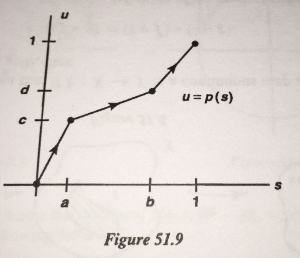
Let p:I\to I be the map whose graph is pictured in Figure 51.9 (taken from Munkre’s Book)
algebraic topology

On the intervals [0,a], [a,b], [b,1], it equals the positive linear maps of these intervals onto [0,c],[c,d],[d,1] respectively. It follows that k_{c,d} \circ p = k_{a,b}. Let’s see why this is so.

On [0,a] k_{c,d}\circ p is the positive linear map of [0,a] to [0,c], followed by the positive linear map of [0,c] to I, followed by f. This equals the positive linear map of [0,a] to I, followed by f, which is precisely k_{a,b}. Similar logic holds for the intervals [a,b] and [b,1].

p is a path in I from 0 to 1, and so is the identity map i: I\to I. Since I is convex, there is a path homotopy P in I between p and i. Then, k_{c,d}\circ P is a path homotopy in X between k_{a,b} and k_{c.d}.

Now the question many will be asking is: What has this got to do with associativity. According to the author Munkres, “a great deal”! We check that the product f*(g*h) is exactly the triple product k_{a,b} in the case where a=1/2 and b=3/4.

By definition,

(g*h)(s)=\begin{cases}    g(2s)\ &\text{for }s\in [0,\frac{1}{2}]\\    h(2s-1)\ &\text{for }s\in [\frac{1}{2},1]    \end{cases}

Thus, f*(g*h)(s)=\begin{cases}    f(2s)\ &\text{for }s\in [0,\frac{1}{2}]\\    (g*h)(2s-1)\ &\text{for }s\in [\frac{1}{2},1]    \end{cases}    =\begin{cases}    f(2s)\ &\text{for }s\in [0,\frac{1}{2}]\\    g(4s-2)\ &\text{for }s\in [\frac{1}{2},\frac{3}{4}]\\    h(4s-3) &\text{for }s\in [\frac{3}{4},1]    \end{cases}

We can also check in a very similar way that (f*g)*h)=k_{c,d} when c=1/4 and d=1/2. Thus, the these two products are path homotopic, and we have finally proven the associativity of *.

Reference:

Topology (2nd Economy Edition)

How to Study in Extreme Noisy Environment (+ Math of Decibel System)

[S$54.90][3M][STOCK IN SG] 3M Peltor H10A Optime 105 Earmuff Ear Muff Ear Protection Head Set. Noise Reduction Rating of 30dB

WWW.QOO10.SG

The exams are coming, but your neighbor decides to do a major renovation? Neighbor has loud music blasting/ very noisy children? An urgent and drastic measure must be taken, as scientific research has shown that loud background noises reduce children’s test scores!  Recent research in London (UK) has shown that high levels of environmental noise outside schools reduce children’s scores in standardised nationwide academic tests.

This is hardly surprising, as it is very hard to do any studying in the presence of very loud noises. The source of noises, in Singapore context, may come from the following:

  • Neighbor’s heavy renovation (Drilling, Hammering, etc.) Singaporeans are big fans of renovation and like to renovate their houses every couple of years! Unfortunately, as long as the neighbors stay within the guidelines, there is nothing the neighbors, NEA,  or even the police can do anything about it, even if they renovate their house for over a year.
  • Construction Work from building MRT / roads
  • Neighbor’s dog barking
  • Seventh month Getai / Funeral / Wedding
  • Neighbor’s Karaoke / Disco Music
  • Heavy Traffic from Expressway
  • Frequent Airplane Noises (for those living near airport)
  • Noisy children

Since Singapore is an urban and densely populated country, it would be quite common to have one of the above situations which causes noise pollution.

How to Study in Noisy Places

  1. Sun Tzu’s 36th Strategy says, “If all else fails, retreat.” One obvious way is to avoid the source of noise, by studying in the library. However, if one visits the library after 3pm, one will soon realize it is hard to find a study table due to many students also utilizing the library.
  2. A Chinese Proverb says,  “Fight poison with poison”. Blasting loud music in headphones may help in the short term to distract from the noise, but in the long term may obviously cause ear damage since one is adding more noise to the existing noise.
  3. Note that “getting used to noise” is a terrible myth, there is no such thing as getting used to noise. The only reason people seem to “get used to noise” is because they are becoming deaf! (Source: Medscape: It is important to remember to counsel patients that ears do not get used to loud noise. As the League for the Hard of Hearing notes-they get deaf.)
  4. Use Earmuffs / Earplugs to minimize the noise.

Buy 3M Peltor Earmuffs

Peltor Earmuffs are available on Qoo10 for people who live in Singapore, and also Amazon, for people who live in the USA / worldwide.
Qoo10 (Singapore):

[S$54.90][3M][STOCK IN SG] 3M Peltor H10A Optime 105 Earmuff Ear Muff Ear Protection Head Set. Noise Reduction Rating of 30dB

WWW.QOO10.SG

[S$39.90][3M][STOCK IN SG] 3M Peltor Optime 98 Earmuff Ear muff Ear Plug. Noise Reduction Rating of 25 dB.

WWW.QOO10.SG

[S$17.90][3M][STOCK IN SG] 3M Peltor Tri-Flange Safety Ear Plugs Earplugs – Pack of 3 Ear Plugs with Storage Case. Noise Reduction Rating 26dB

WWW.QOO10.SG

Amazon (Worldwide):

3M Peltor H10A Optime 105 Earmuff

Whether the situation calls for a earmuff / earplug would be up to a case by case basis. However, if one is desperately looking for a earmuff / earplug (not easy to find in Singapore shops), the above 3M Peltor earmuffs would do a good job. Do choose a earmuff / earplug with at least 20dB NRR (Noise Reduction Rating). Any lower wouldn’t be of any help at all.

I personally bought the 3M Peltor 98 earmuffs as my neighbor is doing a very prolonged renovation which is estimated to last till the end of this year. Drilling and even a crane was involved. It managed to cut down the noise to a more manageable level.

Amazon Peltor Earmuff Review:

Pretty Practical Earmuffs
By Nino Brown on January 20, 2008
Verified Purchase

I got them so that I could better focus on work at home – there can be many distracting noises that obstruct serious thought. While they do not cancel everything out – they drastically reduce noise. If someone directly in front of me starts talking to me, I will hear what they are saying, albeit at a reduced noise level. However, when I went into a connected room, and asked my mom and my sister to have a conversation in the room I was initially in, I couldn’t hear what they were saying.

The really bring me a sense of inner peace and centeredness – I can focus on my work without worrying about becoming distracted with random noises in the house. It allows you to get into your own world. I would advise people, however, to notify their house mates when they are going to use them to tune out – it would be horrible if something happened at the other end of the house and one remained unaware because one could not hear the noise.

The Math of Decibel

The decibel is one excellent application of the logarithm.  The formula of the intensity of noise (I) in decibels is:

\boxed{I (dB) = 10\log_{10}\frac{I}{I_0}}, where I_0 is the threshold of hearing, which is the smallest sound a human can hear.

Reference: http://hyperphysics.phy-astr.gsu.edu/hbase/sound/db.html

The Math of NBA Basketball (+ Humorous Jeremy Lin Video)

Many people think Math is useless, but here is irrefutable evidence that Math can be useful for many things, including even basketball!

Basketball is a game of tactics, not just brute force, hence other than being physically fit the mental agility of the players and the strategy of the coach is very important. Using the math software described in the above video would definitely help NBA players like Jeremy Lin reach the next highest level and contribute 100% to the team.

Funny Jeremy Lin Math Video

This is just for humor!

Jeremy Lin: The Reason for the Linsanity

Jeremy Lin is probably the smartest NBA basketball player in history, graduating from Harvard university! Harvard graduate Jeremy Lin recently became a New York Knicks phenomenon and he’s the NBA’s first American-born player of Taiwanese descent. The book will chronicle Lin’s high school, college and early career in the NBA with particular emphasis on the media explosion surrounding his success as starting point guard with the Knicks. It will explore how Jeremy’s Christian faith, family, education and cultural inheritance have contributed to his success. The book will also include interviews with basketball experts on Jeremy’s future in the NBA, Asian-American thought leaders on the role of race in Jeremy’s rise to stardom, and renowned Christian athletes and pastors on the potent combination of faith and sports.

How to get into Harvard (5 Step Process by Jeremy Lin)

Ambitious JC students who wish to try their luck for Harvard may wish to take these 5 steps into consideration!

H2 Maths Distinction Rate (Percentage of As)

H2 Mathematics has one of the highest distinction rates of all subjects (around 50% each year). This means that around half of all Singaporean A level candidates score an A for H2 Maths!

H2 A Level Distinction Rates Compilation (National Average)

(For year 2010)

H2 Mathematics Distinction Rate:  51.9%
H2 Biology Distinction Rate: 43.7%
H2 Economics Distinction Rate: 33.8%

H1 Mathematics Distinction Rate: 33.1%
H1 Economics Distinction Rate: 33.8%

Literature Distinction Rate: 30.1%
History Distinction Rate: 23.7%
Geography Distinction Rate: 28.3%

Source: http://ajc.edu.sg/pdf/aj_broadcast/newsroom/news_archives/linkaj_may_2011.pdf


 H2 Maths Notes and Resources

Check out the highly summarized and condensed H2 Maths Notes here! (Comes with Free H2 Math Exam Papers.)


 Is H2 Maths the easiest H2 subject to get A?

Answer: Yes, provided the student does study conscientiously and not lag behind too much. Based on the statistics above, one can easily see that based on probability alone, H2 Maths is the easiest H2 subject to get A. Since more than 50% of students get A for H2 Maths, in a sense it is easier to get A for H2 Maths than flipping a heads on a coin!

However… (Please Read)

H2 Maths is also the easiest to fail! Without sufficient practice and effort to understand the subject material, sub-30 (below 30/100) marks are extremely common for H2 Maths. Last minute cramming will simply not work, and if a student lags too far behind in terms of syllabus, it will take extra effort to just even catch up.

In Depth Analysis of H2 Maths Distinction Rate

The 50% National Distinction Rate for H2 Maths can be quite misleading to think that every student has 50% chance of getting A for H2 Maths. The truth is that H2 Maths Distinction Rate varies a lot from school to school.

For example, AJC’s H2 Maths Distinction Rate is 62.7%, which is very much higher than the 50% average National Distinction Rate.

Raffles Institution (RI/RJC) Distinction Rate hovers around 70% to 80%!

Victoria JC (VJC)’s H2 Maths Distinction Rate is around 66.6%.

Hwa Chong (HCI) H2 Maths Distinction Rate is around 80% (8 out of 10 students scored an A for H2 Maths in HCI for three consecutive years).

Upon some thinking, one will quickly realize that if so many schools have Distinction Rate significantly above 50%, there has to be many schools with Distinction Rate significantly below 50%, in order for the National Distinction Rate to be around 50%!

The only people who know the exact Distinction Rate for the above mentioned JCs would be the internal staff and students, since the school website will probably not publish the statistics for obvious reasons.

The Best Time to Study H2 Maths is Now!

For students who are in schools with super high H2 Maths Distinction Rate, congratulations, your chances of getting A for H2 Maths are very good. However, do not be complacent till the very last day, as the race is not over yet.

For students who are in schools with very low H2 Maths Distinction Rate, the odds are unfortunately stacked against the student. However, do not lose heart, as anything is possible if one puts one’s heart and mind into it.

Good luck!


H2 Maths Notes and Resources

Check out the highly summarized and condensed H2 Maths Notes here! (Comes with Free H2 Math Exam Papers.)


H2 Math Tuition

https://mathtuition88.com/