Just to share a very inspiring motivational video from YouTube. Not sure which movie it is from. (any readers know, please comment below as I would be interested)
Highly suitable for students (and their parents) who have just completed their PSLE, whether their PSLE 2015 results are good or not, it is now a good time to reflect on their dreams and the next step to take in the next year 2016.
There are various methods of computing fundamental groups, for example one method using maximal trees of a simplicial complex (considered a slow method). There is one “trick” using van Kampen’s Theorem that makes it relatively fast to compute the fundamental group.
This “trick” doesn’t seem to be explicitly written in books, I had to search online to learn about it.
Fundamental Group of Torus
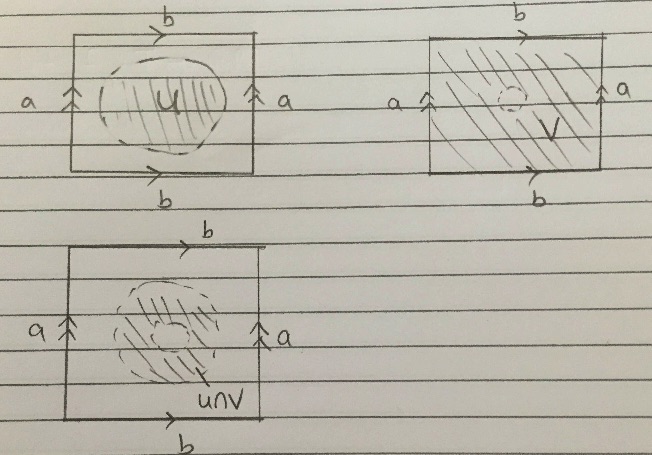
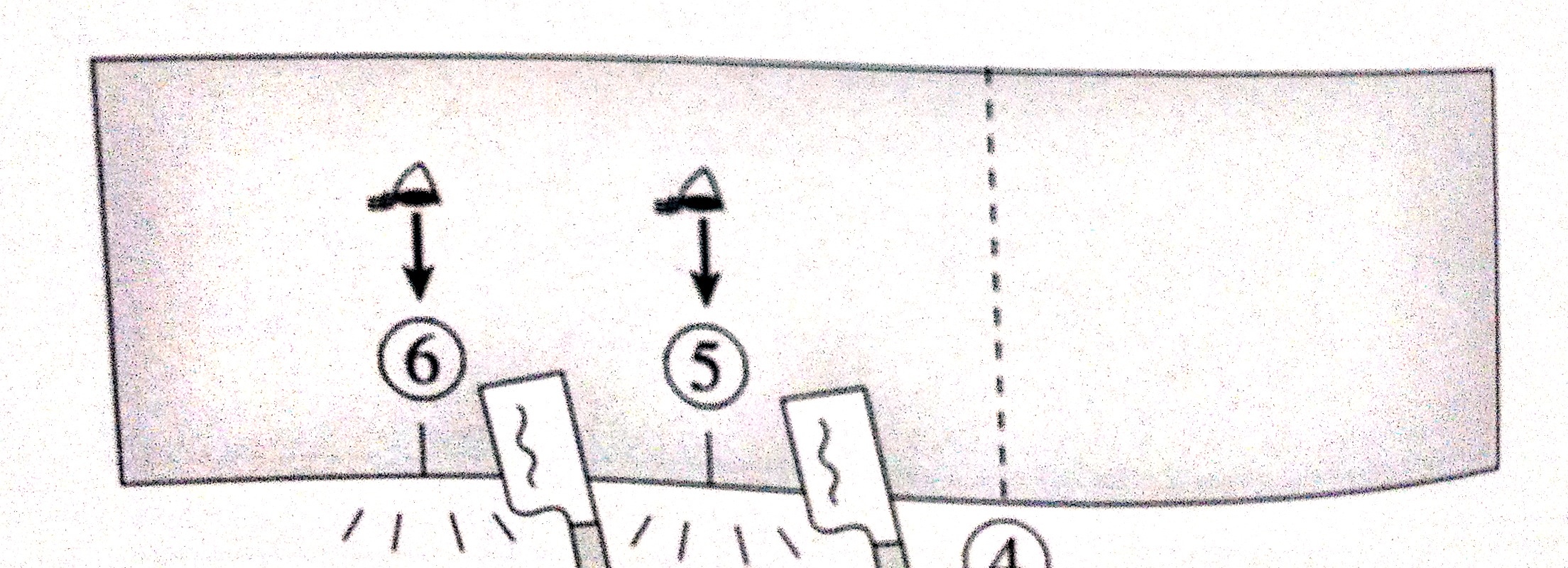
First we let and be open subsets of the torus (denoted as )as shown in the diagram below. is an open disk, while is the entire space with a small punctured hole. We are using the fundamental polygon representation of the torus. This trick can work for many spaces, not just the torus.
is contractible, thus . has as a deformation retract, thus . We note that and is path-connected. These are the necessary conditions to apply van Kampen’s Theorem.
Then, by Seifert-van Kampen Theorem, , the free product of and with amalgamation.
Let be the generator in . We have and . ( and are the inclusions. )
Question: Let belong to both and , with . Show that for all .
There is a pretty neat trick to do this question, known as the “interpolation technique”. The proof is as follows.
For , there exists such that . This is the key “interpolation step”. Once we have this, everything flows smoothly with the help of Holder’s inequality.
Thus .
Note that the magical thing about the interpolation technique is that and are Holder conjugates, since is easily verified.
This post is about how to prove that , where and are finite subgroups of a group .
A tempting thing to do is to use the “Second Isomorphism Theorem”, . However that would be a serious mistake since the conditions for the Second Isomorphism Theorem are not met. In fact may not even be a group.
The correct way is to note that .
Therefore . For , we have:
Therefore , i.e. the number of distinct cosets . Since is a subgroup of , applying Lagrange’s Theorem gives the number of distinct cosets to be .
Recently, there is a “latex path not specified” WordPress LaTeX bug, it is very weird. Some LaTeX expressions will get rendered and some will not. Will have to postpone my math blogging till it is fixed. Worst case scenario is I have to abandon this blog and move to Blogger (http://mathtuition88.blogspot.com) if the issue remains unfixed.
Testing: , , , .
Hope this bug gets fixed soon. If anyone knows the solution to solve this bug, please inform me in the comments below!
Note: Thanks to Professor Terence Tao who has replied in the comments below and shown us a link where there is ongoing discussion about the highly mysterious “latex path not specified” issue.
Instead of committing to regular tuition sessions throughout the year, some students who need academic help are choosing to attend such classes on an “ad-hoc” basis.. Read more at straitstimes.com.
Just heard from a reliable source (cousin who is in the school) that SAJC’s tentative retention rate for 2015 is around 10%. On average, for a class of 25, around 2 or 3 are retained, after the Promos (Promotional Exams) in JC 1.
This is an estimate, intended to give information to those seeking it, hope it helps. By today’ s standards, 10% retention rate is considered “moderate”, considering official statistics from MOE shows that “The two JCs with the highest retention rates at JC1 averaged around 15% over the past three years.”
Side note: Some of those “retained” in SAJC are given a second chance to take another exam, upon passing they can be promoted. Hence the actual retain rate will be less than 10%, which is considered quite ok (compared to other JCs).
Success consists of going from failure to failure without loss of enthusiasm.
Actually JC life is difficult for students, they have to wake up at 6am everyday, and go home at around 6-7 pm or later (due to CCA). After reaching home, it is just the beginning and they have to revise / do homework / go for tuition. It is much tougher than even the typical adult’s job of 8-5pm work. And JC students have to repeat the schedule daily for two years. The problem is that too much stuff is being crammed into two years.
Apparently, the retain rate / retention rate of JCs is a source of concern for many. Some official statistics has been released by MOE. The statistics given are “over the last three years, approximately 6% of first year JC students in each cohort failed some subjects in their promotional exams and were retained.” “The two JCs with the highest retention rates at JC1 averaged around 15% over the past three years.”
As a student who has gone through the system, rumours of JCs like MJC having 50% retain rate (most likely exaggerated, but having some basis of truth, since there is no smoke without fire) do cause some concern. Currently the JC system works by setting extremely tough internal exams, including promos and prelims (compared to the A levels), such that a D or E in the prelims in top JCs (e.g. RI/HCI/NJC) is very likely equivalent to an A in the eventual A levels. This works for some students to spur them to study harder, but may be overly demoralising for many students. For retention rate, common sense and logic would tell that a high retention rate would boost the school’s eventual A level results (one extra year of study is a lot), however that is at the expense of the student spending one extra year in JC. Since the retention rate is entirely up to the school’s decision (i.e. not regulated by MOE), each JC has different retain rate.
Students choosing a JC should check out their retention rate from reliable seniors / relatives / teachers (there is no official source released online for individual retention rate for JCs).
If you are looking for quality Math textbooks to study from (including Linear Algebra and Calculus, the two most popular Math courses), check out my page on Recommended Math Books for students!
This applies especially to students in higher education (e.g. Junior Colleges in Singapore), where it is quite common to “fail” an exam by getting below 50%. Do not despair, and continue to study hard, and you will achieve success eventually.
2)
“There is nothing noble in being superior to your fellow man; true nobility is being superior to your former self.”
― Ernest Hemingway
Do not compare yourself with your classmates, everyone is unique. Focus on improving yourself day by day.
3)
Kirby tried his qualifying exam again, on the same two topics. “This time, they said, ‘You passed,’” he says. “They didn’t say it with any enthusiasm, but they said, ‘You passed.’” His committee recommended that Kirby move into some other field than topology.
But Kirby was not one to be deterred by discouragement from his teachers. He waited until their backs were turned, so to speak, and identified a topologist — Eldon Dyer — who had been away when Kirby took his qualifying exam. Kirby kept going to Dyer with questions, and “at some point it sort of became obvious that I was his student,” Kirby says. “And he told somebody later on that he realized at some point or other he was stuck with me.”
Inspirational story from Rob Kirby (famous mathematician) on how to ignore discouragement, even from teachers. This is applicable to students in Singapore who are sometimes told by teachers / school to drop certain subjects (e.g. drop Higher Chinese / drop A Maths), where the motive may not be purely in the student’s interest. Sometimes the reason that the school wants the student to drop the subject is to protect the school’s ranking in the exams / boost principal’s KPI etc. In this case, the student should follow his own judgement on whether to drop the subject.
4)
“Everyone is No. 1” Motivational Song by Andy Lau.
4 Don’t compare yourself with others. Just look at your own work to see if you have done anything to be proud of.5 You must each accept the responsibilities that are yours.
This inequality often appears in Analysis: , for , and . It does seem quite tricky to prove, and using Binomial Theorem leads to a mess and doesn’t work!
It turns out that the key is to use convexity, and we can even prove a stronger version of the above, namely .
Proof: Consider which is convex on . Let . By convexity, we have for .
Question: What is , the center of the dihedral group ?
Algebraically, the dihedral group may be viewed as a group with two generators and , i.e. with , .
Answer:
.
For ,
Proof: For , which is abelian. Thus, .
For , , the Klein four-group, which is also abelian. Thus, .
Let , . Clearly elements in commute with each other.
Let be an element in . (). Let be an element in . ()
I.e. the only element in (other than 1) that is in the center is , which is only possible if is even.
Let , be two distinct elements in . ()
By earlier analysis, this is true iff . Each is not in the center since we may consider , i.e. . Then . (since ). also does not commute with for the same reason.
Just heard from some sources that AJC (Anderson Junior College) Math papers are considered the most difficult of all JCs, beating RI/HCI in terms of difficulty.
H2 Maths this year was quite easy for both paper 1 & 2. It is definitely no where of the standard of AJC Maths Exam Papers, which are famously known for very challenging questions.
André Weil, the French mathematician, when still a student in University at Ecole Normale Superieur before WW 2, started the “Bourbaki” Club with the intention to change all Math Teaching using modern math from Set Theory.
Shimura was the Japanese mathematician, together with Taniyama, discovered the conjecture upon which Fermat’s Last Theorem was finally proved by Andrew Wiles in 1993/4.
André Weil told the Japanese professor Goro Shimura that Prof GH Hardy talked nonsense, mathematics is not necessary for young men below 35.
Recent math breakthroughs are accomplished by men above 40, because Math needs “Logic as well as Intuition” – both take lengthy research, perseverance and team efforts by other pioneers, as illustrated below:
On April 17, 2013, a paper arrived in the inbox of Annals of Mathematics, one of the discipline’s preeminent journals. Written by a mathematician virtually unknown to the experts in his field — a 50-something lecturer at the University of New Hampshire named Yitang Zhang — the paper claimed to have taken a huge step forward in understanding one of mathematics’ oldest problems, the twin primes conjecture.
Editors of prominent mathematics journals are used to fielding grandiose claims from obscure authors, but this paper was different. Written with crystalline clarity and a total command of the topic’s current state of the art, it was evidently a serious piece of work, and the Annals editors decided to put it on the fast track.
Yitang Zhang (Photo: University of New Hampshire)
Just three weeks later — a blink of an eye compared to the usual pace of mathematics journals — Zhang…
Today, we’re excited to introduce you to a new WordAds. On the front end, it’s a simpler and more streamlined experience like never before. On the back-end we have launched a real-time bidding platform to maximize earnings and ad creative control. Say hello to WordAds 2.0!
WordAds 2.0 is now fully integrated where you control the rest of your blog, in WordPress.com’s main Settings interface. You can also view your Earnings reports here and manage your payout information.
Existing WordAds users aren’t the only ones to benefit from the changes in WordAds 2.0. For new users, we have done away with the separate application process. Any family friendly WordPress.com blog with minimal page views will be considered for immediate admission to WordAds.
Bigger changes are now live in our real time bidding environment. We have dozens of ad agencies and buyers bidding in real time on each of our global…
The above video describes the real projective plane ().
The projective space can be defined as the quotient space of by the equivalence relation for .
Notation: For , we write for the corresponding point in . Let be the maps defined by and .
How do we construct an explicit homotopy between and ? A common mistake is to try the “straight-homotopy”, e.g. . This is a mistake as it passes through the point [0,0,0] which is not part of the projective plane.
The National Taiwan University is holding the first ever Calculus World Cup (CWC) in February 2016. It’s the first time students from global top universities will be able to compete over Calculus in e-sports. The competition will be held on PaGamO – a social online gaming platform for education. The top 12 teams will be invited to Taiwan for the final round, and great prizes with a value of over $70,000 await the finalists!
Official website: http://cwc.pagamo.com.tw
Recall that a space Y is contractible if the identity map is homotopic to a constant map. Let Y be contractible space and let X be any space. Then, for any maps , .
Proof: Let Y be a contractible space and let X be any space. , where is a constant map. There exists a map such that , for . for some point .
Just chanced upon this video on YouTube, really made a lot of sense and is very uplifting. Dream big, and don’t set any limits on yourself and what you can do.
Just came across this neat beginner’s Lebesgue Theory question. As students of analysis know, just to show a set is measurable is no easy feat. The usual way is to use the Caratheodory definition, where a set E is said to be measurable if for any set A, . This can be quite tedious.
Question: Suppose E is a Lebesgue measurable set and let F be any subset of such that (Symmetric Difference is Zero). Show that F is measurable.
The short way to do this is to note that implies , and . This in turn (using a lemma that any set with outer measure zero is measurable) implies the measurability of and .
Next comes the critical observation: . Using the fact that the collection of measurable sets is a -algebra, we can conclude is measurable.
Thus is the union of two measurable sets and thus is measurable.
Quite true! A Math student will understand this at the university level and beyond, where Math has no more numbers and is full of symbols and jargon! Although even the most abstract Math has applications, the applications are only discovered years later, hence Pure Math is indeed one of the most pure subjects around.
For H2 (or H1) Maths students who are getting low marks for internal school exams, do not be overly discouraged. The current trend for schools is to set very tough internal exams (i.e. Promos and Prelims) to spur students to study hard, and (hopefully) ace the eventual final A level exams. If you look at the actual A Level Ten Year Series, you will find that the standard of questions is much easier than Prelim level.
A rule of thumb is that the eventual A level grade is 2 grades above the internal school grade. E.g., in internal exams a student getting D for H2 Maths is most likely equivalent to a B in the final A levels, provided the student continues to study hard.
Jumping from E to A grade has been done by many seniors. Do not give up, continue to believe in yourself, and keep calm while constantly revising.
Do check out this highly condensed H2 Math Notes (comes with free exam papers). The key thing to do before exams is to remember Math formulas (many students forget the AP/GP formulae for instance, and lost some free marks). Constant practice and exposure to questions is also a must.
To all the J1 and J2 kids who are struggling with math, let me share with you my personal experience. I took H2 math by the way, and refused to drop to H1 when people started dropping.
J1 CT 1: Math: U
J1 promos: Math: S
J2 CT1: Math S
J2 CT2: Math S
J2 Prelims: Math E
A levels: Math A.
The moral of the story is simple: It can be done. My math teacher used to motivate us with stories of seniors who have also flunked their way through math in the 2 years and clinched an A at the end. I didnt really believed it could happen, but I guess I chose to believe it anyways.
Today we will discuss Fermat’s Two Squares Theorem using the approach of Gaussian Integers, the set of numbers of the form a+bi, where a, b are integers. This theorem is also called Fermat’s Christmas Theorem, presumably because it is proven during Christmas.
Have you ever wondered why , can be expressed as a sum of two squares, while not every prime can be? This is no coincidence, as we will learn from the theorem below.
Theorem: An odd prime p is the sum of two squares, i.e. where a, b are integers if and only if .
(=>) The forward direction is the easier one. Note that if a is even, and if a is odd. Similar for b. Hence can only be congruent to 0, 1 or 2 (mod 4). Since p is odd, this means .
(<=) Conversely, assume , where p is a prime. p=4k+1 for some integer k.
First we prove a lemma called Lagrange’s Lemma: If is prime, then for some integer n.
Proof: By Wilson’s Theorem, . . We may see this by observing that , , …, . Thus and hence , where .
Then . However since . Similarly, . Therefore is not a Gaussian prime, and it is thus not irreducible.
with and . , which means . Thus we may conclude , .
Let . Then and we are done.
This proof is pretty amazing, and shows the connection between number theory and ring theory.
James H. Simons, the Jewish mathematician who made $14 billion using Math modelling for Hedge Fund.
[Watch from 31:00 mins to 35 mins]. He told the Nobel Physicist Frank Yang (杨振宁) that the Math “Gauge Theory on Fiber Bundles(纤维丛)” which Yang was developing already existed 30 yrs ago in “Differential Geometry” by SS Chern (陈省身) from Berkeley.
“James H. Simons: Mathematics, Common Sense and Good Luck”
[Video 54:00 mins]
After being billionaire, at old age Simons went back to Math in 2004 to take refuge of sadness of the loss of a son.
He beat the German mathematicians in Differential Co-homology (Topology).
5 Guiding Principles of Success:
1) Don’t run with the pack – be original
2) Choose wonderful partner(s) in research, business…
3) Guided by Beauty
4) Don’t give up !
5) Have good luck.
Jim Simons | TED Talks “A Rare Interview with the Mathematician Who…
If one has a sequence $latex {x_1, x_2, x_3, ldots in {bf R}}&fg=000000$ of real numbers $latex {x_n}&fg=000000$, it is unambiguous what it means for that sequence to converge to a limit $latex {x in {bf R}}&fg=000000$: it means that for every $latex {epsilon > 0}&fg=000000$, there exists an $latex {N}&fg=000000$ such that $latex {|x_n-x| leq epsilon}&fg=000000$ for all $latex {n > N}&fg=000000$. Similarly for a sequence $latex {z_1, z_2, z_3, ldots in {bf C}}&fg=000000$ of complex numbers $latex {z_n}&fg=000000$ converging to a limit $latex {z in {bf C}}&fg=000000$.
More generally, if one has a sequence $latex {v_1, v_2, v_3, ldots}&fg=000000$ of $latex {d}&fg=000000$-dimensional vectors $latex {v_n}&fg=000000$ in a real vector space $latex {{bf R}^d}&fg=000000$ or complex vector space $latex {{bf C}^d}&fg=000000$, it is also unambiguous what it means for that sequence to converge to a limit $latex {v in {bf R}^d}&fg=000000$ or $latex {v in {bf C}^d}&fg=000000$; it means…
Let be a finite, non-negative, finitely additive set function on a measurable space . Show that is countably additive if and only if it satisfies the Axiom of Continuity: For .
(=>) Assume is countably additive. Let , . Then,
.
Suppose . Then implies .
(<=) Assume satisfies Axiom of Continuity. Let be mutually disjoint sets. Define .
Let be a measure space, and let be a measurable function. Define the map , , where denotes the characteristic function of .
(a) Show that is a measure and that it is absolutely continuous with respect to .
(b) Show that for any measurable function , one has in .
Proof: For part (a), we routinely check that is indeed a measure.
. Let be mutually disjoiint measurable sets.
If , then a.e., thus . Therefore .
(b) We note that when is a characteristic function, i.e. ,
Hence the equation holds. By linearity, we can see that the equation holds for all simple functions. Let be a sequence of simple functions such that . Then by the Monotone Convergence Theorem, .
Note that , thus by MCT, . Note that . Hence, , and we are done.
In the French Classe Préparatoire 1st year “Mathematiques Supérieures”, we wanted to test our admired Math Prof whom we think was a “super know-all” mathematician. We asked him the above question. He immediately scolded us in the unique French mathematics rigor:
“L’intégration n’a pas de sense!
Quelle-est la domaine de définition?”
(The integration has no meaning! What is the domain of definition ?)
He was right! Under the British Math education, we lack the rigor of mathematics. We are skillful in applying many tricks to integrate whatever functions, but it is meaningless without specifying the domain (interval) in which the function is defined ! Bear in mind Integration of a function f (curve) is to calculate the Area under the curve f within an interval (or Domain, D). If f is not defined in D, then it is meaningless to integrate f because there won’t be…
PSLE is “Primary School Leaving Exams” for 11~12 year-old children sitting at the end of 6-year primary education. The result is used as selection criteria to enter the secondary school of choice.
Hint: Without seeing or feeling the weight of the $1 coin, you still can guess the answer. This is the essence of “Singapore Math” — using “Guesstimation“.
Many people have feedback to me that the Career Quiz Personality Test is surprisingly accurate. E.g. people with peaceful personality ended up as Harmonizer, those who are business-minded ended up as Entrepreneur. Do give it a try at https://mathtuition88.com/free-career-quiz/. Please help to do, thanks a lot!
Markov inequality is a useful inequality that gives a rough upper bound of the measure of a set in terms of an integral. The precise statement is: Let be a nonnegative measurable function on . The Markov inequality states that for all , .
The results of this Personality Test is quite surprisingly accurate, do give it a try to see if you are a Careerist, Entrepreneur, Harmonizer, Idealist, Hunter, Internationalist or Leader?
The results of this Personality Test is quite surprisingly accurate, do give it a try to see if you are a Careerist, Entrepreneur, Harmonizer, Idealist, Hunter, Internationalist or Leader?
There are seven distinct career types based on career preferences, goals and personality. Get to know yours! (My result: Harmonizer)
Take part in the annual Universum survey and win prizes!
Let be a finite measure space. Suppose that is a measurable function on . Let for each . Show that is integrable if and only if .
This proof has a cute solution that is potentially very short. We will elaborate more on this proof. Other approaches include using Markov’s Inequality / Chebyshev’s inequality.
Proof: Consider .
Note that for each on , , while . Therefore on .
Integrating with respect to , we get .
(=>) Now assuming f is integrable, i.e. , we have . . Therefore .
(<=) Conversely, if , then .
We are done.
Note: For a more rigorous proof of we can use MCT (Monotone Convergence Theorem).
2. Limit: $latex displaystylelim_{xto a}f(x) = L$ ; x≠a
|x-a|≠0 and always >0
hence
$latex displaystylelim_{xto a}f(x) = L$
$latex iff $
For all ε >0, there exists δ >0 such that
$latex boxed{0<|x-a|<delta}$
$latex implies |f(x)-L|< epsilon$
3. Continuity: f(x) continuous at x=a
Case x=a: |x-a|=0
=> |f(a)-f(a)|= 0 <ε (automatically)
So by default we can remove (x=a) case.
Also from 1) it is understood: |x-a|>0
Hence suffice to write only:
$latex |x-a|<delta$
f(x) is continuous at point x = a
$latex iff $
For all ε >0, there exists δ >0 such that
$latex boxed{|x-a|<delta}$
$latex implies |f(x)-f(a)|< epsilon$



 and
and  be open subsets of the torus (denoted as
  )as shown in the diagram below.
  .
.  has
has  as a deformation retract, thus
  . We note that
  and
and  , the free product of
  and
and  with amalgamation.
 be the generator in
  and
and  . (
. ( and
and  are the inclusions. )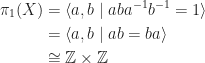
 belong to both
  and
and  , with
  . Show that
  for all
  .
. , there exists
  such that
  . This is the key “interpolation step”. Once we have this, everything flows smoothly with the help of Holder’s inequality.
 and
and  are Holder conjugates, since
  is easily verified.
 , where
  and
and  are finite subgroups of a group
  .
. . However that would be a serious mistake since the conditions for the Second Isomorphism Theorem are not met. In fact
  may not even be a group.
 .
. . For
. For  , we have:
 , i.e. the number of distinct cosets
  . Since
  is a subgroup of
  .
. .
. ,
,  ,
,  ,
,  .
. be a measure space. Let
  . Prove that there exists a set
  with
with  , such that
  .
. be a simple function such that
  .
. . Note that
  . Hence each nonzero value of
  can only be on a set of finite measure. Since
 . Assume that
  has finite order
  . Find the order of
  where
where  is an integer.
 , where
  .
. is the least smallest integer such that
  .
. . Note that
  is an integer and thus a valid power.
 such that
  .
. , which leads to
  . Note that
  and
and  are relatively prime.
 , which implies that
  which is a contradiction. This proves our result. 🙂
 , for
, for  , and
, and  . It does seem quite tricky to prove, and using Binomial Theorem leads to a mess and doesn’t work!
 .
. which is convex on
  . Let
. Let  for
for  .
. . Then we have
  , which implies
  .
.
 , the center of the dihedral group
  ?
? , i.e.
  with
with  ,
,  .
.
 .
. ,
, 
 ,
,  which is abelian. Thus,
  ,
,  , the Klein four-group, which is also abelian. Thus,
  ,
,  . Clearly elements in
  commute with each other.
 ). Let
  be an element in
  . (
. ( )
)
 , which is only possible if
  ,
,  )
)
 . Each
  is not in the center since we may consider
  , i.e.
  . Then
  . (since
  also does not commute with
  for the same reason.



 ).
). can be defined as the quotient space of
  by the equivalence relation
  for
for  .
. , we write
 ![[x_1, x_2,\dots, x_{n+1}]](https://s0.wp.com/latex.php?latex=%5Bx_1%2C+x_2%2C%5Cdots%2C+x_%7Bn%2B1%7D%5D&bg=ffffff&fg=1a1a1a&s=0&c=20201002) for the corresponding point in
for the corresponding point in  be the maps defined by
 ![f[x,y]=[x,y,0]](https://s0.wp.com/latex.php?latex=f%5Bx%2Cy%5D%3D%5Bx%2Cy%2C0%5D&bg=ffffff&fg=1a1a1a&s=0&c=20201002) and
and ![g[x,y]=[x,-y,0]](https://s0.wp.com/latex.php?latex=g%5Bx%2Cy%5D%3D%5Bx%2C-y%2C0%5D&bg=ffffff&fg=1a1a1a&s=0&c=20201002) .
. ? A common mistake is to try the “straight-homotopy”, e.g.
 ![F([x,y],t)=[x,(1-2t)y,0]](https://s0.wp.com/latex.php?latex=F%28%5Bx%2Cy%5D%2Ct%29%3D%5Bx%2C%281-2t%29y%2C0%5D&bg=ffffff&fg=1a1a1a&s=0&c=20201002) . This is a mistake as it passes through the point [0,0,0] which is not part of the projective plane.
. This is a mistake as it passes through the point [0,0,0] which is not part of the projective plane. , defined by
 ![\boxed{F([x,y],t)=[x,(\cos\pi t)y, (\sin\pi t)y]}](https://s0.wp.com/latex.php?latex=%5Cboxed%7BF%28%5Bx%2Cy%5D%2Ct%29%3D%5Bx%2C%28%5Ccos%5Cpi+t%29y%2C+%28%5Csin%5Cpi+t%29y%5D%7D&bg=ffffff&fg=1a1a1a&s=0&c=20201002) .
. , then
 ![x^2+[(\cos\pi t)y]^2+[(\sin\pi t)y]^2=x^2+y^2=1](https://s0.wp.com/latex.php?latex=x%5E2%2B%5B%28%5Ccos%5Cpi+t%29y%5D%5E2%2B%5B%28%5Csin%5Cpi+t%29y%5D%5E2%3Dx%5E2%2By%5E2%3D1&bg=ffffff&fg=1a1a1a&s=0&c=20201002) .
.![F([x,y],0)=[x,y,0]](https://s0.wp.com/latex.php?latex=F%28%5Bx%2Cy%5D%2C0%29%3D%5Bx%2Cy%2C0%5D&bg=ffffff&fg=1a1a1a&s=0&c=20201002)
![F([x,y],1)=[x,-y,0]](https://s0.wp.com/latex.php?latex=F%28%5Bx%2Cy%5D%2C1%29%3D%5Bx%2C-y%2C0%5D&bg=ffffff&fg=1a1a1a&s=0&c=20201002)

 is homotopic to a constant map. Let Y be contractible space and let X be any space. Then, for any maps
  ,
,  .
. , where
  is a constant map. There exists a map
 ![F: Y\times [0,1]\to Y](https://s0.wp.com/latex.php?latex=F%3A+Y%5Ctimes+%5B0%2C1%5D%5Cto+Y&bg=ffffff&fg=1a1a1a&s=0&c=20201002) such that
such that  , for
, for  .
.  for some point
  .
.![G:X\times [0,1]\to Y](https://s0.wp.com/latex.php?latex=G%3AX%5Ctimes+%5B0%2C1%5D%5Cto+Y&bg=ffffff&fg=1a1a1a&s=0&c=20201002) where
where 
 ,
,  ,
,  . Therefore G is cts.
 ,
, .
.


 . This can be quite tedious.
 (Symmetric Difference is Zero). Show that F is measurable.
 , and
, and  . This in turn (using a lemma that any set with outer measure zero is measurable) implies the measurability of
  and
and  .
. . Using the fact that the collection of measurable sets is a
  -algebra, we can conclude
  is measurable.
 is the union of two measurable sets and thus is measurable.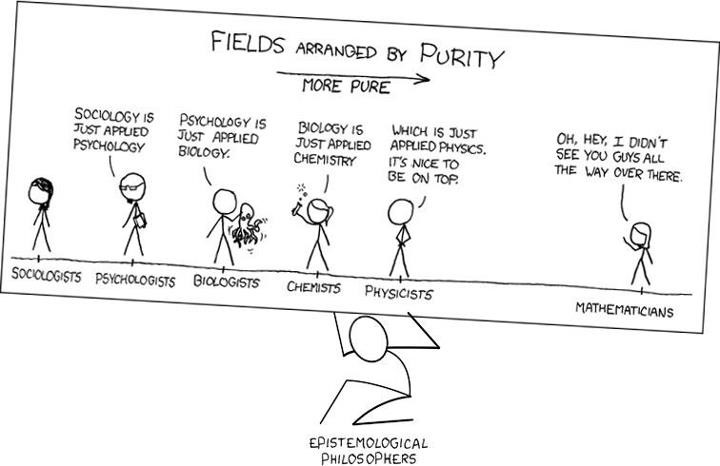
 ,
,  can be expressed as a sum of two squares, while not every prime can be? This is no coincidence, as we will learn from the theorem below.
 where a, b are integers if and only if
  .
. if a is even, and
  if a is odd. Similar for b. Hence
  .
. for some integer n.
 .
. ![(4k)!\equiv [(2k)!]^2\equiv -1\pmod p](https://s0.wp.com/latex.php?latex=%284k%29%21%5Cequiv+%5B%282k%29%21%5D%5E2%5Cequiv+-1%5Cpmod+p&bg=ffffff&fg=1a1a1a&s=0&c=20201002) . We may see this by observing that
. We may see this by observing that  ,
,  , …,
, …,  . Thus
 ![[(2k)!]^2+1\equiv 0\pmod p](https://s0.wp.com/latex.php?latex=%5B%282k%29%21%5D%5E2%2B1%5Cequiv+0%5Cpmod+p&bg=ffffff&fg=1a1a1a&s=0&c=20201002) and hence
and hence  , where
  .
. . However
  since
since  . Similarly,
  . Therefore
  is not a Gaussian prime, and it is thus not irreducible.
 with
with  and
and  .
.  , which means
  . Thus we may conclude
  ,
,  .
. . Then
  and
and  . Prove that if
  in
in  such that if
  , then
  .
.
 as
as  .
. .
.
 be a finite, non-negative, finitely additive set function on a measurable space
  . Show that
  .
. ,
,  . Then,
 .
. . Then
  implies
  .
. be mutually disjoint sets. Define
  .
. ,
,  .
.  .
.
 be a measure space, and let
 ![f:X\to [0,\infty]](https://s0.wp.com/latex.php?latex=f%3AX%5Cto+%5B0%2C%5Cinfty%5D&bg=ffffff&fg=1a1a1a&s=0&c=20201002) be a measurable function. Define the map
be a measurable function. Define the map ![\lambda:\mathcal{M}\to[0,\infty]](https://s0.wp.com/latex.php?latex=%5Clambda%3A%5Cmathcal%7BM%7D%5Cto%5B0%2C%5Cinfty%5D&bg=ffffff&fg=1a1a1a&s=0&c=20201002) ,
,  , where
  denotes the characteristic function of
  .
. is a measure and that it is absolutely continuous with respect to
 ![g:X\to[0,\infty]](https://s0.wp.com/latex.php?latex=g%3AX%5Cto%5B0%2C%5Cinfty%5D&bg=ffffff&fg=1a1a1a&s=0&c=20201002) , one has
, one has  in
in ![[0,\infty]](https://s0.wp.com/latex.php?latex=%5B0%2C%5Cinfty%5D&bg=ffffff&fg=1a1a1a&s=0&c=20201002) .
. . Let
. Let  be mutually disjoiint measurable sets.
 , then
  a.e., thus
  . Therefore
  .
. ,
,
 be a sequence of simple functions such that
  . Then by the Monotone Convergence Theorem,
  .
. , thus by MCT,
  . Note that
  . Hence,
  , and we are done.


 .
. is of
is of  is
is  , where
  . Denote
  .
. , and
, and  . (Markov Inequality!)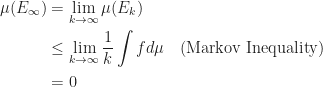
 .
. ,
, 
 , and we have expressed the set as a countable union of measurable sets of finite measure.
 . The Markov inequality states that for all
  ,
,  .
. Then,
Then,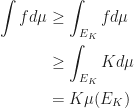
 .
.
 be a finite measure space. Suppose that
  is a measurable function on
  for each
  . Show that
  .
. .
. on
on  ,
,  , while
  . Therefore
  on
on  .
.
 , we have
  .
.  . Therefore
  .
. , then
  .
. we can use MCT (Monotone Convergence Theorem).
 . Then
  . By MCT,
  .
.
