Math Blog

Cheapest Digital Piano Singapore

Cheap Digital Piano Singapore

Click this URL to view more Digital Pianos: http://list.qoo10.sg/sp/7452?jaehu_cust_no=7NCxGWDWWM132kSlYY7/rw==#53572

Is your child beginning in trying out learning piano? Buying an actual upright piano would cost a few thousand dollars, and may not be a good idea, as many children may stop learning after a few months. Practicing piano is an excellent way to improve musical skills and even Math skills, as music has been found to be linked to math. Unfortunately practicing piano requires a lot of patience and perseverance (e.g. 1 hour practice every day), in order to reach a decent level like Grade 8 Piano. Hence, many children understandably cannot sustain the necessary practice required, and stop learning, and the money buying the piano (and space in the house) would be wasted.

Research has found that music helps children learn maths! Listening to music in maths lessons can dramatically improve children’s ability in the subject and help them score up to 40 per cent higher in examinations, a new study has found. Source: http://www.telegraph.co.uk/education/9159802/Music-helps-children-learn-maths.html

Buying a keyboard (non-weighted) is also not a good idea, as classical piano requires dynamics (e.g. forte and piano) which means loud and soft contrasts, which is not achievable using a non-weighted keyboard.

The perfect solution is to purchase a digital piano first, and then upgrade to a upright piano if the child maintains interest after a few years. A very good brand for starters would be Yamaha, a Japanese music brand. An added advantage of digital pianos is the ability to use earphones, which would enable one to practice late at night without disturbing the neighbor.

If the child is interested to pursue MEP (Music Elective Programme), this digital piano would come in handy for musical composition in MIDI, and it would have orchestral sounds like Strings, Brass, Drums, etc. Definitely a very useful instrument to have for serious music students as well as the amateur.

[S$1,150.00][YAMAHA][8% OFF – MID YEAR SALE!] Yamaha P-115 Digital Piano (Weighted Piano Keyboard)

WWW.QOO10.SG

Click here for even more choices for Digital Pianoshttp://list.qoo10.sg/sp/7452?jaehu_cust_no=7NCxGWDWWM132kSlYY7/rw==#53572

P-115 Digital Piano Overview

US First Place in International Math Olympiad! China Drops to Second (Related to Banning of Math Olympiad?)

Congratulations to USA for their First Position in the IMO, a position traditionally held by China! China has been holding the 1st position in the IMO for 21 years.

News: Indian-Origin Students Help US Win Math Olympiad After 21 Years

Indian-Origin Students Help US Win Math Olympiad After 21 Years

Washington:  Two Indian-origin students have helped the US win the prestigious International Mathematical
Olympiad after more than two decades.

Shyam Narayanan, 17, and Yang Liu Patil, 18, were part of the six-member US team that won the renowned award after a gap of 21 years. India was ranked 37th in the competition.

Some provinces in China, e.g. Beijing, Chengdu have curiously banned Math Olympiad, and one may wonder does this have an effect in China’s drop in ranking? Having a state wide ban on Math Olympiad would have the result of lowering the number of students taking Math Olympiad, shrinking the talent pool, as well as giving Math Olympiad a stigma and a bad reputation. Students in China are known to be very talented in Math Olympiad, but with such a severe ban, they may forgo Math Olympiad altogether.

Source: http://english.cri.cn/7146/2012/01/20/2702s677257.htm

In 2005, the Ministry of Education issued a regulation forbidding state-run primary and junior middle schools from offering Olympic math courses. It later cancelled the policy of including Olympic math on school entrance examinations. Likewise in 2010, the ministry cancelled a regulation that the winners of Mathematics Olympiads could be recommended for admission to junior middle schools to remove some of the heavy study burden from students.

The Chengdu government has achieved a huge success since it issued harsh regulations banning Olympic math training in 2009. Local authorities prohibit state-run schoolteachers from working part-time to teach Olympic math and have removed school headmasters who give weight to Olympic math performance in student admissions.

For most primary students in Chengdu, this came as a huge relief.

“I feel like a caged bird been set free.”

“I have more time to do physical exercises and have fun. And I can cultivate my own hobbies.”

The students’ parents were also relieved.

This banning of Math Olympiad is indeed very harmful. Instead, Math Olympiad should be made optional so that students who are interested in it can still participate in it, while students who are not interested can learn something else. Banning learning, Math Olympiad, or tuition simply does not make sense! Countries who are interested in promoting STEM (Science, Technology, Engineering, Math) should be actively promoting Math Olympiad instead of banning it. Hopefully China may reverse its ban for Math Olympiad, as China’s huge talent pool and surplus of brilliant students makes it naturally easy to get 1st in Math Olympiad, provided students are given an incentive to pursue Math Olympiad.

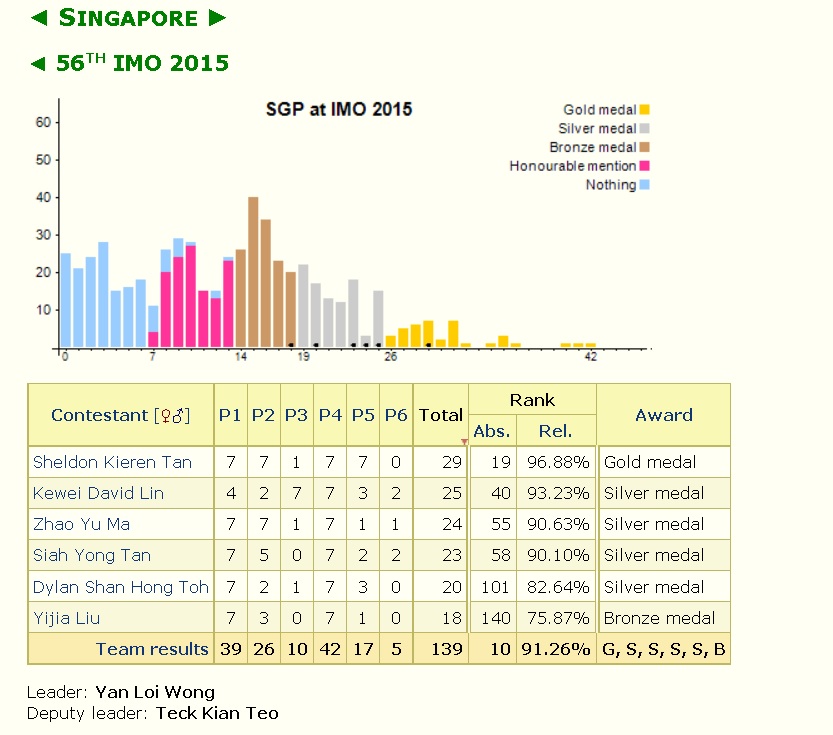
Singapore Math Olympiad Results

Source: https://www.imo-official.org/team_r.aspx?code=SGP&year=2015

Singapore did relatively well also, with one gold, 4 silver, and 1 bronze, with an overall 10th position. Congratulations Singapore!

singapore imo


To learn more about Math Olympiad, read my earlier blog post on Recommended Maths Olympiad Books for Self Learning.


Count Down: The Race for Beautiful Solutions at the International Mathematical Olympiad

Each summer, hundreds of seemingly average teens from around the world gather for the International Mathematical Olympiad, a chance to race the clock and one another in the quest for elegant mathematical solutions. In Count Down, the National Book Award finalist Steve Olson sets out to crack the secret of what makes these students such nimble problem solvers. He follows the six U.S. contestants from their free-time games of Ultimate Frisbee to the high-pressure rounds of the competition. In each he finds a potent mix of inspiration, insight, competitiveness, talent, creativity, experience, and, perhaps most important, an enduring sense of wonder. As he observes the Olympians, Olson delves into common questions about math culture and education, exploring why many American students dread geometry, why so few girls pursue competitive math, and whether each of us might have a bit of genius waiting to be nurtured.

Allot more time for exam papers (Straits Times Forum)

Source: http://www.straitstimes.com/forum/letters-on-the-web/allot-more-time-for-exam-papers

This reader has called for allotting more time for exam papers. He/she has made a very valid point:

The time allotted for some papers, such as mathematics, is so limited that the opportunity cost of stopping for just a few minutes to think about how to solve a problem may result in one being unable to complete the paper.

For essay papers in subjects such as economics, it becomes a test of how fast one can write, as opposed to the quality of one’s answers.

This is very true, the reader is being 100% honest and not exaggerating at all! For O Levels and A Levels Maths, the student can only spend 1.5min per mark. That means, for a 5 mark long question, he can only spend 7.5 min at the maximum or risk not being able to finish the paper. To have ample time to check the paper, the student needs to do even faster than the minimum of 1.5 min per mark.

Yoda’s quote “Do. Or do not. There is no try.” holds true for Mathematics exam papers in Singapore. There is simply no time to “try” out questions in O Level or A Level Maths. Once a student looks at the question, his fate is sealed, he/she either knows the method how to do it, or does not. There is no time to try!

do_or_do_not_1920x1080_1923565073

Hence, exam time management skills and speed in Math are essential. (I have written a previous post about it.) Nowadays, questions are not arranged in order of difficulty. This means that Question 5 may be much harder than Question 10. Sometimes, it is better to skip Question 5, rather than get stuck on it and never reach Question 10. Getting 100% is not necessary for getting an A for Math. In fact, getting 100% for Math after Primary 6 is a rare occurrence. Getting 70 for Math in H2 Math is a very decent score, and getting 80 more or less guarantees an A even with a bell curve.

Also, knowledge of the essential formulas are extremely important. Yes, it is possible to derive the quadratic formula by completing the square, but there is no time for that during the exam. Time is of essence. Formula for AP/GP, Vectors need to be known by heart. Spending 1 min to recall or derive them may lead to severe time pressure later on. Recalling the wrong formula leads to disaster, and potentially zero marks for the entire question, as “error carry forward” is only applicable for limited scenarios. Students may need a Formula Helpsheet containing all the essential formulas for easy memorization.

Lastly, the most important thing the night before the exam is have a good night’s sleep. A previous blog post discusses the importance of sleep, and how Good night’s sleep adds up to better exam results – especially in maths. Also, have a good rest after the Math paper, the 3 hour H2 paper is mentally exhausting, and the 2.5 hour A Maths paper is not a stroll in the park either. After the long Maths paper, your brain deserves a good rest.

Singapore Tuition Forum News Compilation

Compilation of Interesting Articles on Tuition

Recently, there have been many news on the Straits Times Forum / other newspapers / internet on the phenomenon of tuition in Singapore. There are many mixed opinions on tuition, which are discussed in depth in those articles. I have picked the most interesting articles on the subject of tuition, which would be a familiar topic in Singapore, as 70% or more of Singaporean students have tuition. The links are found near the bottom of the post.

Personally, I think of tutors like a sports coach, like a swimming coach or a badminton coach. Sports coaches help their students to play the sport better. Tuition teachers help their students to perform in the exams better. There are great similarities between their roles. Currently, almost all top athletes would have a coach, it would be unthinkable for an athlete at the international level not to have a coach.

Tuition has also been around since thousands of years ago. Alexander the Great’s father hired Aristotle as a tutor for his son. The Imperial Tutor in ancient China is an extremely prestigious post and is often awarded only to the top scholar in the imperial exams. His job is to tutor the future emperor or other princes / princesses. (See this example of an Imperial Tutor in China). In the past, only the rich and wealthy could afford tutors. However, due to the prosperity in many first world countries like Singapore and South Korea, affording tuition is becoming increasingly possible even for the middle class.


Note: I am currently not giving tuition at the moment, but I have a good recommendation for a very good tuition agency. Interested readers can email me at mathtuition88@gmail.com.


 Links of Top 10 News Articles on Tuition

  1. 7 in 10 parents send their children for tuition: ST poll
  2. Does tuition help or hinder? (Straits Times)
  3. Tuition is popular due to education system issues (ST)
  4. Tuition is comforting for some parents, kids (ST)
  5. Tuition has become an educational arms race (ST)
  6. Tuition a necessary evil (ST)
  7. He goes for tuition …and he’s in poly (ST)
  8. Tuition In Singapore: Is It Necessarily Bad? (Blog)
  9. Singapore’s Young School Children Are Burdened With Excessive Private Tuition (Blog)
  10. The Tuition Dilemma (NTU)

As a former tutor, I don’t really think that tuition (in moderation) can be harmful, like what some of the articles claim. Back to the analogy of sports coaches, it is illogical to suppose that a sport student’s badminton skills can worsen and deteriorate after practice with a qualified coach. That would simply make no sense! Similarly, as long as the tutor is competent and not teaching the wrong thing, it would simply be illogical to say that tuition can harm academic performance. It would be really strange if a student becomes worse at math after more practice.

The key to successful life is balance. A role model for children would be Jeremy Lin, the Asian American basketball player. Highly intelligent and an excellent student, he has been admitted and graduated successfully from Harvard. He is also a professional basketball player in the NBA, and at the peak of physical fitness. He is also a humble and devout Christian. He is one guy that all students should take as a role model.

Book on Jeremy Lin:


Jeremy Lin: The Reason for the Linsanity

Inspiration of the Day: Nine-year-old Filipino pictured studying in the light of a McDonald’s

Nine-year-old Filipino pictured studying in the light of a McDonald's

Source: http://www.dailymail.co.uk/news/article-3155858/Hard-work-determination-DOES-pay-Nine-year-old-Filipino-pictured-studying-light-McDonald-s-swamped-donations-picture-goes-viral.html

Hard work and determination DOES pay off! Nine-year-old Filipino pictured studying in the light of a McDonald’s is swamped with donations after the picture goes viral

  • Daniel Cabrera, 9, now has a college scholarship from the donations
  • His mother and sibling have also received lifechanging financial support
  • The young student only has one pencil and dreams of becoming a doctor or a policeman when he is older

This boy has inspired and motivated many. Despite having only one pencil, he is studying hard at night by the light of McDonald’s instead of playing. Everyone hopes that he will fulfill his dream of being a policeman and having a good education. He definitely deserves it 100%.

Motivation is very important for studying. Self motivation is key, as the child needs to know the importance of education. In Singapore, almost every child is blessed with good financial resources, and definitely have more than one pencil. Studying environment is also quite good, most children will have a comfy chair and table, not to mention electronic learning devices like iPad or computer. However, all these material things are not as important as motivation. Without the motivation to study, all the fanciful stationery and computers would be no use. It is unfortunate, that in Singapore and other developed countries, sometimes the resources (money, stationary, computer, books, tuition, enrichment) are all present, but the motivation to study is absent!

Motivation can either come from a person, or from books. Countless people have been motivated by motivational books. Do check out these motivational books for the student if you are interested.

The original facebook link is here! The university student, Joyce Gilos Torrefranca, who posted it is also to be commended. Do give it a like! Link: https://www.facebook.com/joyce.torrefranca/posts/1010235928995791

Proof of Associativity of Operation * on Path-homotopy Classes

(Continued from https://mathtuition88.com/2015/06/25/the-groupoid-properties-of-operation-on-path-homotopy-classes-proof/)

Earlier we have proved the properties (2) Right and left identities, (3) Inverse, leaving us with (1) Associativity to prove.

For this proof, it will be convenient to describe the product f*g in the language of positive linear maps.

First we will need to define what is a positive linear map. We will elaborate more on this since Munkres’ books only discusses it briefly.

Definition: If [a,b] and [c,d] are two intervals in \mathbb{R}, there is a unique map p:[a,b]\to [c.d] of the form p(x)=mx+k that maps a to c and b to d. This is called the positive linear map of [a,b] to [c,d] because its graph is a straight line with positive slope.

Why is it a positive slope? (Not mentioned in the book) It turns out to be because we have:

p(a) = ma+k=c

p(b) = mb+k=d

Hence, d-c = mb-ma = m(b-a)

Thus, m=(d-c)/(b-a), which is positive since d-c and b-a are all positive quantities.

Note that the inverse of a positive linear map is also a positive linear map, and the composite of two such maps is also a positive linear map.

Now, we can show that the product f*g can be described as follows: On [0,1/2], it is the positive linear map of [0,1/2] to [0,1], followed by f; and on [1/2,1] it equals the positive linear map of [1/2,1] to [0,1], followed by g.

Let’s see why this is true. The positive linear map of [0,1/2] to [0,1] is p(x)=2x. fp(x) = f(2x).

The positive linear map of [1/2,1] to [0,1] is p(x)=2x-1. gp(x)=g(2x-1).

If we look back at the earlier definition of f*g, that is precisely it!

Now, given paths, f, g, and h in X, the products f*(g*h) and (f*g)*h are defined if and only if f(1)=g(0) and g(1)=h(0), i.e. the end point of f = start point of g, and the end point of g = start point of h. If we assume that these two conditions hold, we can also define a triple product of the paths f, g, and h as follows:

Choose points a and b of I so that 0<a<b<1. Define a path k_{a,b} in X as follows: On [0,a] it equals the positive linear map of [0,a] to I=[0,1] followed by f; on [a,b] it equals the positive linear map of [a,b] to I followed by g; on [b,1] it equals the positive linear map of [b,1] to I followed by h. This path k_{a,b} depends on the choice of the values of a and b, but its path-homotopy class turns out to be independent of a and b.

We can show that if c and d are another pair of points of I with 0<c<d<1, then k_{c,d} is path homotopic to k_{a,b}.

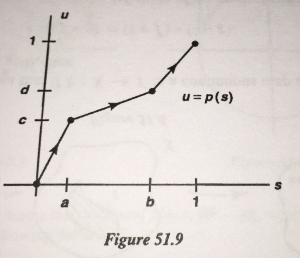
Let p:I\to I be the map whose graph is pictured in Figure 51.9 (taken from Munkre’s Book)
algebraic topology

On the intervals [0,a], [a,b], [b,1], it equals the positive linear maps of these intervals onto [0,c],[c,d],[d,1] respectively. It follows that k_{c,d} \circ p = k_{a,b}. Let’s see why this is so.

On [0,a] k_{c,d}\circ p is the positive linear map of [0,a] to [0,c], followed by the positive linear map of [0,c] to I, followed by f. This equals the positive linear map of [0,a] to I, followed by f, which is precisely k_{a,b}. Similar logic holds for the intervals [a,b] and [b,1].

p is a path in I from 0 to 1, and so is the identity map i: I\to I. Since I is convex, there is a path homotopy P in I between p and i. Then, k_{c,d}\circ P is a path homotopy in X between k_{a,b} and k_{c.d}.

Now the question many will be asking is: What has this got to do with associativity. According to the author Munkres, “a great deal”! We check that the product f*(g*h) is exactly the triple product k_{a,b} in the case where a=1/2 and b=3/4.

By definition,

(g*h)(s)=\begin{cases}    g(2s)\ &\text{for }s\in [0,\frac{1}{2}]\\    h(2s-1)\ &\text{for }s\in [\frac{1}{2},1]    \end{cases}

Thus, f*(g*h)(s)=\begin{cases}    f(2s)\ &\text{for }s\in [0,\frac{1}{2}]\\    (g*h)(2s-1)\ &\text{for }s\in [\frac{1}{2},1]    \end{cases}    =\begin{cases}    f(2s)\ &\text{for }s\in [0,\frac{1}{2}]\\    g(4s-2)\ &\text{for }s\in [\frac{1}{2},\frac{3}{4}]\\    h(4s-3) &\text{for }s\in [\frac{3}{4},1]    \end{cases}

We can also check in a very similar way that (f*g)*h)=k_{c,d} when c=1/4 and d=1/2. Thus, the these two products are path homotopic, and we have finally proven the associativity of *.

Reference:

Topology (2nd Economy Edition)

How to Study in Extreme Noisy Environment (+ Math of Decibel System)

[S$54.90][3M][STOCK IN SG] 3M Peltor H10A Optime 105 Earmuff Ear Muff Ear Protection Head Set. Noise Reduction Rating of 30dB

WWW.QOO10.SG

The exams are coming, but your neighbor decides to do a major renovation? Neighbor has loud music blasting/ very noisy children? An urgent and drastic measure must be taken, as scientific research has shown that loud background noises reduce children’s test scores!  Recent research in London (UK) has shown that high levels of environmental noise outside schools reduce children’s scores in standardised nationwide academic tests.

This is hardly surprising, as it is very hard to do any studying in the presence of very loud noises. The source of noises, in Singapore context, may come from the following:

  • Neighbor’s heavy renovation (Drilling, Hammering, etc.) Singaporeans are big fans of renovation and like to renovate their houses every couple of years! Unfortunately, as long as the neighbors stay within the guidelines, there is nothing the neighbors, NEA,  or even the police can do anything about it, even if they renovate their house for over a year.
  • Construction Work from building MRT / roads
  • Neighbor’s dog barking
  • Seventh month Getai / Funeral / Wedding
  • Neighbor’s Karaoke / Disco Music
  • Heavy Traffic from Expressway
  • Frequent Airplane Noises (for those living near airport)
  • Noisy children

Since Singapore is an urban and densely populated country, it would be quite common to have one of the above situations which causes noise pollution.

How to Study in Noisy Places

  1. Sun Tzu’s 36th Strategy says, “If all else fails, retreat.” One obvious way is to avoid the source of noise, by studying in the library. However, if one visits the library after 3pm, one will soon realize it is hard to find a study table due to many students also utilizing the library.
  2. A Chinese Proverb says,  “Fight poison with poison”. Blasting loud music in headphones may help in the short term to distract from the noise, but in the long term may obviously cause ear damage since one is adding more noise to the existing noise.
  3. Note that “getting used to noise” is a terrible myth, there is no such thing as getting used to noise. The only reason people seem to “get used to noise” is because they are becoming deaf! (Source: Medscape: It is important to remember to counsel patients that ears do not get used to loud noise. As the League for the Hard of Hearing notes-they get deaf.)
  4. Use Earmuffs / Earplugs to minimize the noise.

Buy 3M Peltor Earmuffs

Peltor Earmuffs are available on Qoo10 for people who live in Singapore, and also Amazon, for people who live in the USA / worldwide.
Qoo10 (Singapore):

[S$54.90][3M][STOCK IN SG] 3M Peltor H10A Optime 105 Earmuff Ear Muff Ear Protection Head Set. Noise Reduction Rating of 30dB

WWW.QOO10.SG

[S$39.90][3M][STOCK IN SG] 3M Peltor Optime 98 Earmuff Ear muff Ear Plug. Noise Reduction Rating of 25 dB.

WWW.QOO10.SG

[S$17.90][3M][STOCK IN SG] 3M Peltor Tri-Flange Safety Ear Plugs Earplugs – Pack of 3 Ear Plugs with Storage Case. Noise Reduction Rating 26dB

WWW.QOO10.SG

Amazon (Worldwide):

3M Peltor H10A Optime 105 Earmuff

Whether the situation calls for a earmuff / earplug would be up to a case by case basis. However, if one is desperately looking for a earmuff / earplug (not easy to find in Singapore shops), the above 3M Peltor earmuffs would do a good job. Do choose a earmuff / earplug with at least 20dB NRR (Noise Reduction Rating). Any lower wouldn’t be of any help at all.

I personally bought the 3M Peltor 98 earmuffs as my neighbor is doing a very prolonged renovation which is estimated to last till the end of this year. Drilling and even a crane was involved. It managed to cut down the noise to a more manageable level.

Amazon Peltor Earmuff Review:

Pretty Practical Earmuffs
By Nino Brown on January 20, 2008
Verified Purchase

I got them so that I could better focus on work at home – there can be many distracting noises that obstruct serious thought. While they do not cancel everything out – they drastically reduce noise. If someone directly in front of me starts talking to me, I will hear what they are saying, albeit at a reduced noise level. However, when I went into a connected room, and asked my mom and my sister to have a conversation in the room I was initially in, I couldn’t hear what they were saying.

The really bring me a sense of inner peace and centeredness – I can focus on my work without worrying about becoming distracted with random noises in the house. It allows you to get into your own world. I would advise people, however, to notify their house mates when they are going to use them to tune out – it would be horrible if something happened at the other end of the house and one remained unaware because one could not hear the noise.

The Math of Decibel

The decibel is one excellent application of the logarithm.  The formula of the intensity of noise (I) in decibels is:

\boxed{I (dB) = 10\log_{10}\frac{I}{I_0}}, where I_0 is the threshold of hearing, which is the smallest sound a human can hear.

Reference: http://hyperphysics.phy-astr.gsu.edu/hbase/sound/db.html

The Math of NBA Basketball (+ Humorous Jeremy Lin Video)

Many people think Math is useless, but here is irrefutable evidence that Math can be useful for many things, including even basketball!

Basketball is a game of tactics, not just brute force, hence other than being physically fit the mental agility of the players and the strategy of the coach is very important. Using the math software described in the above video would definitely help NBA players like Jeremy Lin reach the next highest level and contribute 100% to the team.

Funny Jeremy Lin Math Video

This is just for humor!

Jeremy Lin: The Reason for the Linsanity

Jeremy Lin is probably the smartest NBA basketball player in history, graduating from Harvard university! Harvard graduate Jeremy Lin recently became a New York Knicks phenomenon and he’s the NBA’s first American-born player of Taiwanese descent. The book will chronicle Lin’s high school, college and early career in the NBA with particular emphasis on the media explosion surrounding his success as starting point guard with the Knicks. It will explore how Jeremy’s Christian faith, family, education and cultural inheritance have contributed to his success. The book will also include interviews with basketball experts on Jeremy’s future in the NBA, Asian-American thought leaders on the role of race in Jeremy’s rise to stardom, and renowned Christian athletes and pastors on the potent combination of faith and sports.

How to get into Harvard (5 Step Process by Jeremy Lin)

Ambitious JC students who wish to try their luck for Harvard may wish to take these 5 steps into consideration!

H2 Maths Distinction Rate (Percentage of As)

H2 Mathematics has one of the highest distinction rates of all subjects (around 50% each year). This means that around half of all Singaporean A level candidates score an A for H2 Maths!

H2 A Level Distinction Rates Compilation (National Average)

(For year 2010)

H2 Mathematics Distinction Rate:  51.9%
H2 Biology Distinction Rate: 43.7%
H2 Economics Distinction Rate: 33.8%

H1 Mathematics Distinction Rate: 33.1%
H1 Economics Distinction Rate: 33.8%

Literature Distinction Rate: 30.1%
History Distinction Rate: 23.7%
Geography Distinction Rate: 28.3%

Source: http://ajc.edu.sg/pdf/aj_broadcast/newsroom/news_archives/linkaj_may_2011.pdf


 H2 Maths Notes and Resources

Check out the highly summarized and condensed H2 Maths Notes here! (Comes with Free H2 Math Exam Papers.)


 Is H2 Maths the easiest H2 subject to get A?

Answer: Yes, provided the student does study conscientiously and not lag behind too much. Based on the statistics above, one can easily see that based on probability alone, H2 Maths is the easiest H2 subject to get A. Since more than 50% of students get A for H2 Maths, in a sense it is easier to get A for H2 Maths than flipping a heads on a coin!

However… (Please Read)

H2 Maths is also the easiest to fail! Without sufficient practice and effort to understand the subject material, sub-30 (below 30/100) marks are extremely common for H2 Maths. Last minute cramming will simply not work, and if a student lags too far behind in terms of syllabus, it will take extra effort to just even catch up.

In Depth Analysis of H2 Maths Distinction Rate

The 50% National Distinction Rate for H2 Maths can be quite misleading to think that every student has 50% chance of getting A for H2 Maths. The truth is that H2 Maths Distinction Rate varies a lot from school to school.

For example, AJC’s H2 Maths Distinction Rate is 62.7%, which is very much higher than the 50% average National Distinction Rate.

Raffles Institution (RI/RJC) Distinction Rate hovers around 70% to 80%!

Victoria JC (VJC)’s H2 Maths Distinction Rate is around 66.6%.

Hwa Chong (HCI) H2 Maths Distinction Rate is around 80% (8 out of 10 students scored an A for H2 Maths in HCI for three consecutive years).

Upon some thinking, one will quickly realize that if so many schools have Distinction Rate significantly above 50%, there has to be many schools with Distinction Rate significantly below 50%, in order for the National Distinction Rate to be around 50%!

The only people who know the exact Distinction Rate for the above mentioned JCs would be the internal staff and students, since the school website will probably not publish the statistics for obvious reasons.

The Best Time to Study H2 Maths is Now!

For students who are in schools with super high H2 Maths Distinction Rate, congratulations, your chances of getting A for H2 Maths are very good. However, do not be complacent till the very last day, as the race is not over yet.

For students who are in schools with very low H2 Maths Distinction Rate, the odds are unfortunately stacked against the student. However, do not lose heart, as anything is possible if one puts one’s heart and mind into it.

Good luck!


H2 Maths Notes and Resources

Check out the highly summarized and condensed H2 Maths Notes here! (Comes with Free H2 Math Exam Papers.)


H2 Math Tuition

https://mathtuition88.com/

The Brain of John Conway (Gifted Mathematician’s Brain)

The book mentioned in the video can be found here:

Genius At Play: The Curious Mind of John Horton Conway

Many scientists and research has revealed that the true source of genius comes from both nature and nurture.

Talent is Overrated: What Really Separates World-Class Performers from Everybody Else

GEP Test Dates (August)

In August, Primary 3 pupils in Singapore schools have the opportunity to take the GEP Screening Test, comprising 2 papers: English Language and Mathematics.

Check out the Recommended Books for GEP Test here!

IQ is based on both nature (inheritance of genes), and more importantly nurture (habits, family background, books read as a child, …), hence a logical way to prepare for the GEP is to read some books relevant to the GEP test. Some preparation is always better than zero preparation, as authors of many self-help books have researched and concluded.

It would be a huge advantage for students to be familiar with basic logic quizzes that are found in IQ tests. Seeing this type of question for the first time in the GEP test would not be very conducive as it may lead to nervousness which would affect the logical thinking.

circle-traingle-puzzle-iq-test
To do well in the time based GEP test, it would be a great advantage to have seen such questions before. (Found in the Recommended Books for GEP link above)

“I LOVE YOU” Math Graph

This is how to plot “I LOVE YOU” using Math Graphs (many piecewise functions plotted together).

Interesting? Share it using the buttons below this post!

Source: Found it on Weibo (China’s version of Facebook)

i love you graph


Love and Math: The Heart of Hidden Reality

What if you had to take an art class in which you were only taught how to paint a fence? What if you were never shown the paintings of van Gogh and Picasso, weren’t even told they existed? Alas, this is how math is taught, and so for most of us it becomes the intellectual equivalent of watching paint dry.

In Love and Math, renowned mathematician Edward Frenkel reveals a side of math we’ve never seen, suffused with all the beauty and elegance of a work of art. In this heartfelt and passionate book, Frenkel shows that mathematics, far from occupying a specialist niche, goes to the heart of all matter, uniting us across cultures, time, and space.

BMAT Book Recommendations for NTU Medicine

Recommended BMAT Books

#1 Recommended BMAT Book

How to Master the BMAT: Unbeatable Preparation for Success in the BioMedical Admissions Test

Thinking of applying to the new Medical School at NTU?

NTU’s application requires the BMAT (Biomedical Admissions Test). Applicants will have to register for the Biomedical Admissions Test (BMAT) and take the BMAT as part of the criteria for entry to the LKCMedicine MBBS programme.
Source: http://www.lkcmedicine.ntu.edu.sg/admissions/Pages/Entry-Requirements-And-Selection-Criteria.aspx

BMAT is useful for applying to Britain’s medical schools too.

NTU only takes in 50-150 students per year, out of Singapore’s entire population! Hence, one can imagine it is definitely not easy to get into NTU medicine.

How to get into NTU Medicine

According to this article by Straits Times, “the final 54 chosen medical students – all Singaporeans – had almost perfect scores in the interviews and also aced their BioMedical Admissions Test (BMAT).”

Getting 4 As is too extremely common in top JCs like RJC or HCI (pick any random guy from the top JCs and he/she is likely to have 4As), hence the distinguishing factor would be your BMAT score.

The BMAT is set by the British, and hence unlike anything students have seen in Singapore. In particular the format and style are different from the standard Singaporean style of testing.

Currently the acceptance rate for NTU medicine is 54/800 (6.75% acceptance rate), which means that getting into NTU medicine is as hard as getting into Ivy League Universities like Harvard / Princeton!!! (Harvard = 5.9% Acceptance Rate, Princeton = 7.4% Acceptance Rate)

Singaporeans are known to be extremely keen when it comes to studying Medicine / Law, and hence competition is definitely going to increase, and a good BMAT book will help you rise above the competition.

TOP BMAT Books in the Market

#1 Recommended BMAT Book

How to Master the BMAT: Unbeatable Preparation for Success in the BioMedical Admissions Test

#2 Recommended BMAT Book

The Ultimate BMAT Guide – 600 Practice Questions: Fully Worked Solutions, Time Saving Techniques, Score Boosting Strategies, 10 Annotated Essays, 2016 Entry Book (BioMedical Admissions Test)

#3 Recommended BMAT Book

Passing the UKCAT and BMAT: Advice, Guidance and Over 650 Questions for Revision and Practice (Student Guides to University Entrance Series)

#4 Recommended BMAT Book

How to Master the BMAT: Unbeatable Preparation for Success in the BioMedical Admissions Test

#5 Recommended BMAT Book

BMAT Secrets Study Guide: BMAT Exam Review for the BioMedical Admissions Test

NTU Medicine Interview (Does NTU Medicine need interview?)

Yes, NTU Medicine does have interview, in fact it has Eight Interviews.

Many top scorers (4As, perfect score, perfect portfolio) have unfortunately been weeded out at the interview if they are not adept at interviews or verbally expressing themselves. This is very unfortunate for those who have studied so hard, but yet got eliminated at the interview stage, and have to go to Australia to study Medicine (costs half a million SGD!!!) or even abandon their dream of being a doctor.

Fortunately, Medicine Interview is something that you can prepare for. Do be prepared for an answer to the question “Why do you want to study Medicine?”. The interviewers are looking for compassionate doctors, not money-minded individuals who want to fatten their bank account.

The interview would be a bit difficult for quiet / introverted people, which is a pity, since introverts can be very good doctors too. Interviews tend to favor extroverts, or those who are adept at self-promotion (do be humble though). Hence, if you are more of an introvert, you would need to work doubly hard to prepare for the interview.

Recommended Medicine Interview Books (Suitable for NTU / NUS Medicine Interview)

#1 Medicine Interview Book

Medicine Interview questions and answers with full explanations: The comprehensive guide to the medicine interview for 2013-2014 applicants

#2 Medicine Interview Book

Why Medicine?: And 500 Other Questions for the Medical School and Residency Interviews

#3 Medicine Interview Book

The Medical School Interview: Secrets and a System for Success

#4 Medicine Interview Book

The Medical School Interview: Winning Strategies from Admissions Faculty

#5 Medicine Interview Book

The Medical School Interview: From preparation to thank you notes: Empowering advice to help you succeed

Good luck and all the best!

Hunt for the Elusive 4th Klein Bottle – Numberphile

Look through this video to discover the 4 types of Klein Bottles!

Math Geek: From Klein Bottles to Chaos Theory, a Guide to the Nerdiest Math Facts, Theorems, and Equations

Where to Buy Klein Bottles

If you are fascinated by Klein Bottles, you can check out the website mentioned in the video: http://www.kleinbottle.com/

The website sells Klein Bottles under the name Acme Klein Bottles, made by Cliff Stohl.

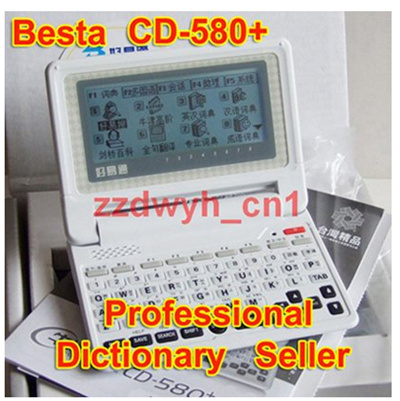
Free Shipping+ have Back Lighting BESTA CD-580+ English Chinese Electronic Dictionary Translator

mathtuition88's avatarChinese Tuition Singapore

[S$139.00]Free Shipping have Back Lighting BESTA CD-580 English Chinese Electronic Dictionary Translator

WWW.QOO10.SG

Just to share a recommendation for BESTA English Chinese Electronic Dictionary Translator, sold online at Qoo10.

Free Shipping+ have Back Lighting BESTA CD-580+ English Chinese Electronic Dictionary Translator

BESTA

ITS AN ENCYCLOPAEDIA, OXFORD DICTIONARY,

SPELLCHECKER & THESAURUS IN ONE!

BESTA CD-580+ English-Chinese Electronic Dictionary have Back Lighting

(Note:2  AAA batteries are not included)

(Voice: Mandarin/English)

Chinese and English Operation Menu

Click Link Below to Buy!

[S$139.00]Free Shipping have Back Lighting BESTA CD-580 English Chinese Electronic Dictionary Translator

WWW.QOO10.SG

View original post

Lemma on Measure of Increasing Sequences in X

(Continued from https://mathtuition88.com/2015/06/20/what-is-a-measure-measure-theory/)

Lemma: Let \mu be a measure defined on a \sigma-algebra X.

(a) If (E_n) is an increasing sequence in X, then

\mu (\bigcup_{n=1}^\infty E_n )=\lim \mu (E_n)

(b) If F_n) is a decreasing sequence in X and if \mu (F_1)<\infty, then

\mu (\bigcap_{n=1}^\infty F_n )=\lim \mu (F_n )

Note: An increasing sequence of sets (E_n) means that for all natural numbers n, E_n \subseteq E_{n+1}. A decreasing sequence means the opposite, i.e. E_n \supseteq E_{n+1}.

Proof: (Elaboration of the proof given in Bartle’s book)

(a) First we note that if \mu (E_n) = \infty for some n, then both sides of the equation are \infty, and inequality holds. Henceforth, we can just consider the case \mu (E_n)<\infty for all n.

Let A_1 = E_1 and A_n=E_n \setminus E_{n-1} for n>1. Then (A_n) is a disjoint sequence of sets in X such that

E_n=\bigcup_{j=1}^n A_j, \bigcup_{n=1}^\infty E_n = \bigcup_{n=1}^\infty A_n

Since \mu is countably additive,

\mu (\bigcap_{n=1}^\infty E_n) = \sum_{n=1}^\infty \mu (A_n) (since (A_n) is a disjoint sequence of sets)

=\lim_{m\to\infty} \sum_{n=1}^m \mu (A_n)

By an earlier lemma \mu (F\setminus E)=\mu (F)-\mu (E), we have that \mu (A_n)=\mu (E_n)-\mu (E_{n-1}) for n>1, so the finite series on the right side telescopes to become

\sum_{n=1}^m \mu (A_n)=\mu (E_m)

Thus, we indeed have proved (a).

For part (b),  let E_n=F_1 \setminus F_n, so that (E_n) is an increasing sequence of sets in X.

We can then apply the results of part (a).

\begin{aligned}    \mu (\bigcup_{n=1}^\infty E_n) &=\lim \mu (E_n)\\    &=\lim [\mu (F_1)-\mu (F_n)]\\    &=\mu (F_1) -\lim \mu (F_n)    \end{aligned}

Since we have \bigcup_{n=1}^\infty E_n =F_1 \setminus \bigcap_{n=1}^{\infty} F_n, it follows that

\mu (\bigcup_{n=1}^\infty E_n) =\mu (F_1)-\mu (\bigcap_{n=1}^\infty F_n)

Comparing the above two equations, we get our desired result, i.e. \mu (\bigcap_{n=1}^\infty F_n) = \lim \mu (F_n).

Reference:

The Elements of Integration and Lebesgue Measure

What does it mean to be smart in mathematics?

teachmathculture's avatarteaching/math/culture

In the last two posts, I discussed the idea of status. First, I talked about why status matters, then I talked about how teachers can see it in the classroom.

Sometimes, after I have explained how status plays out in the classroom, somebody will push back by saying, “Yeah, but status is going to happen. Some kids are just smarter than others.”

I am not naive: I do not believe that everybody is the same or has the same abilities. I do not even think this would be desirable. However, I do think that too many kids have gifts that are not recognized or valued in school — especially in mathematics class.

Let me elaborate. In schools, the most valued kind of mathematical competence is typically quick and accurate calculation. There is nothing wrong with being a fast and accurate calculator: a facility with numbers and algorithms no…

View original post 589 more words

The Groupoid Properties of Operation * on Path-homotopy Classes (Proof)

(Continued from https://mathtuition88.com/2015/06/18/the-groupoid-properties-of-on-path-homotopy-classes/)

Theorem: The operation * has the following properties:

(1) (Associativity) [f]*([g]*[h])=([f]*[g])*[h], i.e. it doesn’t matter where we place the brackets.

(2) (Right and left identities) Given x\in X, let e_x denote the constant path e_x: I\to X mpping all of I to the point x. If f is a path in X from x_0 to x_1, then [f]*[e_{x_1}]=[f] and [e_{x_0}]*[f]=[f].

(3) (Inverse) Given the path f in X from x_0 to x_1, let \bar{f} be the path defined by \bar{f}=f(1-s). \bar{f} is called the reverse of f. Then, [f]*[\bar{f}]=[e_{x_0}] and [\bar{f}]*[f]=[e_{x_1}].

We will prove the above statements, of which (1) Associativity is actually the trickiest.

Proof:

We shall prove two elementary lemmas first. (This part is not proved in the book by Munkres).

Lemma 1: If k: X\to Y is a continuous map, and if F is a path homotopy in X between the paths f and f’, then k\circ F is a path homotopy in Y between the paths k\circ f and k\circ f'.

Proof of Lemma 1: Since F is a path homotopy in X between paths f and f’, we have by definition that F(s,0)=f(s), F(s,1)=f'(s), F(0,t)=x_0, F(1,t)=x_1.

Then, k F(s,0)=kf(s), kF(s,1)=kf'(s), kF(0,t)=k(x_0), kF(1,t)=k(x_1). Since kF is continuous (composition of two continuous functions), kF is inded a path homotopy in Y between he paths kf and kf’.

Lemma 2: If k:X\to Y is a continuous map and if f and g are paths in X with f(1)=g(0), then

k\circ (f*g)=(k\circ f)*(k \circ g)

Proof of Lemma 2:

k(f*g)(s)=kh(s), where h=f*g as defined previously.

(kf)*(kg)(s)=kh(s).

We will first verify property (2) on Right and Left Identities. Let e_{x_0} denote the constant path in I at 0, and we let i: I\to I denote the identity map, which is a path in I from 0 to 1. Then e_0 * i is also a path in I from 0 to 1.

Because I is convex, there is a path homotopy G in I between i and e_0 *i (Straight-line homotopy) Then f\circ G is a path homotopy in X between the paths f\circ i=f and f\circ (e_0 *i) (Lemma 1). Furthermore by Lemma 2, f\circ (e_0 *i) = (f \circ e_0) * (f \circ i) which is equivalent to e_{x_0} *f.

A similar argument, using the fact that if e_1 denotes the constant path at 1, then i*e_i is path homotopic in I to the path i, shows that [f]*[e_{x_1}]=[f].

To prove (3) (Inverse), we note that the reverse of i is \bar{i}(s)=1-s. Then i*\bar{i} is a path in I beginning and ending at 0. The constant path e_0 is also beginning and ending at 0. Again, because I is convex, there is a path homotopy H in I between e_0 and i*\bar{i} (straight-line homotopy). Then, using lemma 1 and 2, f\circ H is path homotopy between f\circ e_0=e_{x_0} and f\circ (i*\bar{i})=(f\circ i)*(f\circ\bar{i})=f*\bar{f}. Very similarly, we can use the fact that \bar{i}*i is path homotopic  in I to e_1 to show that [\bar{f}]*[f]=[e_{x_1}].

We will continue the proof of associativity (which is longer) in the next blog post.

Source: Topology (2nd Economy Edition)

Recommended Maths Olympiad Books for Self Learning / Domain Test

I have added more Math Olympiad books suitable for students training for GEP Math / DSA Math.
These are books actually bought by a viewer of my website through my Amazon affiliate link.
Just to share, and hope it is helpful!

mathtuition88's avatarMathtuition88

A First Step to Mathematical Olympiad Problems (Mathematical Olympiad Series)The Art of Problem Solving, Vol. 1: The Basics

The first book is written by Professor Derek Holton. Prof Holton writes a nice column for a Math magazine, which gives out books as prizes to correct solutions. I tried some of the problems here: Maths Olympiad Magazine Problems.

GEP Math Olympiad Books

If you are searching for GEP Math Olympiad Books to prepare for the GEP Selection Test, you may search for Math Olympiad Books for Elementary School. Note that Math Olympiad Books for IMO (International Mathematics Olympiad) are too difficult even for a gifted 9 year old kid!

A suitable book would be The Original Collection of Math Contest Problems: Elementary and Middle School Math Contest problems. It covers the areas of Algebra, Geometry, Counting and Probability, and Number Sense, over 500 examples and problems with fully explained solutions.

View original post 98 more words

Langrands Program & Weil’s Rosetta stone

tomcircle's avatarMath Online Tom Circle

Weil’s Rosetta stone (or Conjecture):

Number Theory (1) | Curves over Finite Fields (2) | Riemann Surfaces (3)

Weil wanted to link up these 3 distinct Maths, as in the Langands Program.

Langrands’ original idea on the Left Column (1) Number Theory & the Middle Column (2):
1. He related :
representations of the Galois groups of number fields (objects studied in number theory)
to:
automorphic functions (objects in harmonic analysis).

2. The middle column (2):
Galois group relevant to curves over finite fields.
Also there exists a branch of harmonic analysis for automorphic functions.

3. How to translate column (3) Riemann Surfaces ?
We have to find geometric analogues of the Galois groups and automorphic functions in the theory of Riemann surfaces.

Next we have to find suitable analogues of the automorphic functions ?

It was a mystery until 1980 solved by the Russian Vladimir Drinfeld (Fields medalist for…

View original post 72 more words

Langlands’ Program

tomcircle's avatarMath Online Tom Circle

Langlands’ Program:

Langland wrote to André Weil in 1967:
Analysis & Algebra linked up by L-function, which converts algebraic data from Galois theory into Analytic functions in complex numbers.

He goes beyong Modular Form to the Automorphic Forms (complex functions whose symmetries are described by larger matrices).

Key concepts on Algebra marry up with those from Analysis.

View original post

Qoo10 (Singapore’s Cheapest Online Shopping Mall)

Just to share with my Singaporean readers on 5 ways to save money while shopping!

1) Universal Studios Ticket

This is a very good bargain, Qoo10 is selling the Universal Studios Singapore Ticket at half the retail price. Normal price is $74. If you haven’t visited USS yet, this June holidays is a good time.

[S$35.99][Holiday Special]Universal Studio Singapore Ticket USS One day Pass 新加坡环球影城 / Christmas Celebration.Best Price Guaranteed! / RESORTS WORLD SENTOSA

WWW.QOO10.SG

2) Cheap and good iPhone Cable

Everyone knows that the official Apple cable is very expensive, overpriced in fact. Most people just need a basic iPhone cable that can charge and connect to computer. I personally bought this cable, at $3.70 it is extreme value for money. So far so good, it charges and transfer data well.  I don’t think you can find another place with such low price for a cable.

[S$3.70]Aluminum Steel Wire mesh/Nylon Fabric Lightning cable for iPhone6/6 Plus/5/5S/5C/iPad 4/iPad Air/iPad Mini/Mini2(Support IOS8)

WWW.QOO10.SG

3) Amazon Kindle

At $99, it is one of the cheapest electronic items out there (as compared to iPhone, iPad, etc.) Also, Kindle is ideal as a gift to students as it is very education oriented, and has less games than the iPad (a upside for children).

[S$99.00][Kindle]★Amazon Kindle 2015 with Free eBooks! (2015 KINDLE 7th Gen/ Kindle Paperwhite 2015)- 7000 eBooks Free with Cover or Slip Case Purchased! Best Amazon Kindle Paperwhite Voyage Reader Tablet! ★

WWW.QOO10.SG

4) Cheapest Computer in Singapore

This notebook (from HP) would be a good choice if you need a basic laptop for school work. There are other brands (Asus, Lenovo) at similar prices at Qoo10. Very few physical shops have computers at this price.

[S$299.00][HP]*** GSS Special Price *** HP 250 14inch Dual Core Notebook / Intel N2840 Processor / 2GB Ram / 500GB HDD / Windows 8.1 / Intel HD Graphics / Only 1.9Kg / 1 Year Limited International HP Warranty

WWW.QOO10.SG

5) Cat6 Ethernet Cable

Many households (including myself, until recently) are still using Cat5 / Cat5e old cables which would impact your internet speed. No point subscribing to the best internet plan, and have it all slowed down by an outdated Cat5 cable. This Cat6 Ethernet Cable may be what you need to boost your internet connection.

[S$3.90]Cat6 Ethernet Network Patch Cable – UTP BCC Stranded FLUKE® Tested | 0.5m to 3m | UTP BCC | Blue

WWW.QOO10.SG

What is a Measure? (Measure Theory)

In layman’s terms, “measures” are functions that are intended to represent ideas of length, area, mass, etc. The inputs for the measure functions would be sets, and the output would be a real value, possibly including infinity.

It would be desirable to attach the value 0 to the empty set \emptyset and measures should be additive over disjoint sets in X.

Definition (from Bartle): A measure is an extended real-valued function \mu defined on a \sigma-algebra X of subsets of X such that
(i) \mu (\emptyset)=0
(ii) \mu (E) \geq 0 for all E\in \mathbf{X}
(iii) \mu is countably additive in the sense that if (E_n) is any disjoint sequence (E_n \cap E_m =\emptyset\ \text{if }n\neq m) of sets in X, then

\displaystyle \mu(\bigcup_{n=1}^\infty E_n )=\sum_{n=1}^\infty \mu (E_n).

If a measure does not take on +\infty, we say it is finite. More generally,  if there exists a sequence (E_n) of sets in X with X=\cup E_n and such that \mu (E_n) <+\infty for all n, then we say that \mu is \sigma-finite. We see that if a measure is finite implies it is \sigma-finite, but not necessarily the other way around.

Examples of measures

(a) Let X be any nonempty set and let X be the \sigma-algebra of all subsets of X. Let \mu_1 be definied on X by \mu_1 (E)=0, for all E\in\mathbf{X}. We can see that \mu_1 is finite and thus also \sigma-finite.

Let \mu_2 be defined by \mu_2 (\emptyset) =0, \mu_2 (E)=+\infty if E\neq \emptyset. \mu_2 is an example of a measure that is neither finite nor \sigma-finite.

The most famous measure is definitely the Lebesgue measure. If X=R, and X=B, the Borel algebra, then (shown in Bartle’s Chapter 9) there exists a unique measure \lambda defined on B which coincides with length on open intervals. I.e. if E is the nonempty interval (a,b), then \lambda (E)=b-a. This measure is usually called Lebesgue measure (or sometimes Borel measure). It is not a finite measure since \lambda (\mathbb{R})=\infty. But it is \sigma-finite since any interval can be broken down into a sequence of sets (E_n) such that \mu (E_n)<\infty for all n.

Source: The Elements of Integration and Lebesgue Measure

Math Will Rock Your World

tomcircle's avatarMath Online Tom Circle

Today’s world is Big Data,  with explosive unstructured data from Internet, Mobile phones, tablets, soon the IoT (Internet of Things), ie devices such as car, fridge, oven, washing machines…equipped with wireless Wi-Fi connectivity to Internet…

Top Mathematicians will be the global elites of the D.T. (Data Technology) Age — as the Alibaba.com Chairman Jack Ma predicts.

http://www.bloomberg.com/bw/stories/2006-01-22/math-will-rock-your-world

View original post

Primary One registration for 2016 to open on July 2

Source: http://www.todayonline.com/singapore/primary-one-registration-2016-open-july-2

SINGAPORE — The Primary One registration exercise for next year’s intake will open from July 2 to Aug 27, the Ministry of Education (MOE) said today (June 18).

Three new schools — Oasis Primary, Punggol Cove Primary and Waterway Primary — will be open for P1 registration and will be taking in students from next year.

“The cohort size for 2016 is similar to that of 2015. There will be sufficient school places for all eligible P1 students on a regional and nationwide basis,” said the MOE.

More information on the list of primary schools and vacancies available as well as a list of registration centres for new schools can be found on the P1 registration website at http://www.moe.gov.sg/education/admissions/primary-one-registration/

Prepare Early Beforehand for GEP / DSA / PSLE

Join the Kiasuparents 2020 PSLE Discussion Group

This is the ultimate uniquely Singapore “Kiasuparents” 2020 PSLE Discussion Group: http://www.kiasuparents.com/kiasu/forum/viewtopic.php?f=69&t=81381


The Smartest Kids in the World: And How They Got That Way

This book is the #1 Best Seller on Amazon (in the Gifted Education section)! Learn about the secret of the smartest kids in the world, and how you can be one of them.

The Groupoid Properties of * on Path-homotopy Classes

This is one of the first instances where algebra starts to appear in Topology. We will continue our discussion of material found in Topology (2nd Economy Edition) by James R. Munkres.

First, we need to define the binary operation *, that will later make * satisfy properties that are very similar to axioms for a group.

Definition: If f is a path in X from x_0 to x_1, and if g is a path in X from x_1 to x_2, we define the product f*g of f and g to be he path h given by the equations

h(s)=\begin{cases}f(2s) &\text{for }s\in [0,\frac{1}{2}], \\ g(2s-1)& \text{for }s\in[\frac{1}{2}, 1]\end{cases}

Well-defined: The function h is well-defined, at s=1/2, f(1)=x_1, g(0)=x_1.

Continuity: h is also continuous by the pasting lemma.

h is a path in X from x_0 to x_2. We think of h as the path whose first half is the path f and whose second half is the path g.

We will verify that the product operation on paths induces a well-defined operation on path-homotopy classes, defined by the equation [f]*[g]=[f*g]

Let F be a path homotopy between f and f’, and let G be a path homotopy between g and g’.

i.e. we have F(s,0)=f(s), F(s,1)=f'(s)
F(0,t)=x_0, F(1,t)=x_1
G(s,0)=g(s), G(s,1)=g'(s)
G(0,t)=x_1, G(1,t)=x_2

We can define:

H(s,t)=\begin{cases}F(2s,t) &\text{for }s\in[0,\frac{1}{2}],\\ G(2s-1,t)&\text{for }s\in[\frac{1}{2},1]\end{cases}.

We can check that F(1,t)=x_1=G(0,t) for all t, hence the map H is well-defined. H is continuous by the pasting lemma.

Let’s check that H is the required path homotopy between f*g and f’*g’.

For s in [0,1/2],

H(s,0) = F(2s,0) =f(2s)=h(s)

H(s,1) = F(2s,1) =f'(2s)=h'(s)
h’ := f’ * g’

H(0,t) = F(0,t) = x_0

s in [1/2,1] works fine too:

H(s,0) = G(2s-1,0) = g(2s-1)=h(s)

H(s,1) = G(2s-1,1)= g'(2s-1) = h'(s)

H(1,t) = G(1,t)= x_2

Thus, H is indeed the required path homotopy between f*g and f’*g’. * is almost like a binary operation for a group. The only difference is that [f]*[g] is not defined for every pair of classes, but only for those pairs [f], [g] for which f(1) = g(0), i.e. the end point of f is the starting point of g.

杨澜访谈录 杨振宁翁帆来做客

Chinoiseries2014's avatarChinoiseries 《汉瀚》[中/英/日/韩/法]

1957, 35岁第一个华人诺贝尔奖。
2004, 82岁娶28岁。
2015, 93岁牵39岁的夫妻。

翁帆(28)从敬仰伟人而爱杨振宁(82)。

三大科学贡献:
1. 宇恒不对称 : nuclei weakforce (弱力)不对称
2. Yang-Baxter Law (Proved by Quantum Group Mathematics)
3. Yang-Mills Conjecture (Clay Prize US $1 million, 7 Millennium Unsolved Math Problems)
如果3)被证明, 可能杨振宁得第二个诺贝尔奖。

image

父亲杨武之是”庚子赔款”留美的中国第一位数学博士(Chicago University), 把现代代数(Modern Algebra)介绍进中国。儿子杨振宁15岁就教儿子群论(Group Theory) — 后来证明”宇恒不对称” — 用的就是他美国恩师 Dickson的名著。

View original post

Match Algorithm

tomcircle's avatarMath Online Tom Circle

1962 two American economists David Gale & Lloyd Shipley designed The “Stable Marriage Problem” aka “The Match“.

Note: ‘Stable’ means nobody would be unhappy or breakup after the match.

Applications:
1. Matching couples
2. Matching hospitals & doctor graduates
3. Match schools to students
4. Match HDB house to families
5. …

Scenario: An island with 4 men (m1, m2, m3, m4) and 4 women (w1, w2, w3, w4). You are to match 4 couples of opposite sex.

Each man would propose to a woman. However both men and women could list down their preferences with ranking, the higher ranked person would be given the choice.

Suppose the women preferences are (Table 1):

Choices1st 2nd 3rd 4th
w1m1 m2m3m4
w2m2 m4m1m3
w3m3 m4m1m2
w4m4 m3m2m1

Suppose the men preferences are (Table 2):

Choices

View original post 363 more words

Functions between Measurable Spaces

Sometimes, it is  desirable to define measurability for a function f from one measurable space (X,X) into another measurable space (Y,Y). In this case one can define f to be measurable if and only if the set f^{-1} (E)=\{x\in X: f(x) \in E\} belongs to X for every set E belonging to Y.

This definition of measurability appears to differ from Definition 2.3 (earlier in the book), but Definition 2.3 is in fact equivalent to this definition in the case that Y=R and Y=B.

First, lets recap what is Definition 2.3:

A function f on X to R is said to be X-measurable (or simply measurable) if for every real number \alpha the set \{x\in X:f(x)>\alpha\} belongs to X.

Let (X,X) be a measurable space and f be a real-valued function defined on X. Then f is X-measurable if and only if f^{-1 }(E)\in X for every Borel set E.

Thus there is a close analogy between the measurable functions on a measurable space and continuous functions on a topological space.

Source:

The Elements of Integration and Lebesgue Measure

Homotopy of Paths

For this post we will explain what is a homotopy of paths.

Source: Topology (2nd Economy Edition)

The book above is a nice introductory book on Topology, which includes a section of introductory Algebraic Topology.

Definition: If f and f’ are continuous maps of the space X into the space Y, we say that f is homotopic to f’ if there is a continuous F: X x I -> Y such that

F(x, 0)=f(x) and F(x,1) = f'(x)

for each x. The map F is called a homotopy between f and f’. If f is homotopic to f’, we write f \simeq f'.

If f and f’ are two paths in X, there is a stronger relation, called path homotopy, which requires that the end points of the path remain fixed during the deformation. We write f \simeq_p f' if f and f’ are path homotopic.

Next, we will prove that the relations \simeq and \simeq_p are equivalence relations.

If f is a path, we shall denote its path-homotopy equivalence class by [f].

Proof: We shall verify the properties of an equivalence relation, namely reflexivity, symmetry and transitivity.

Reflexivity:

Given f, it is rather easy to see that f \simeq f. The map F(x,t) is the required homotopy.

F(x,0)=f(x) and F(x,1)=f(x) is clearly satisfied.

If f is a path, then F is certainly a path homotopy, since f and f itself has the same initial point and final point.

Symmetry:

Next we shall show that given f \simeq f', we have f' \simeq f. Let F be a homotopy between f and f’. We can then verify that G(x,t) = F(x, 1-t) is a homotopy between f’ and f.

G(x,0) = F(x, 1)=f’ (x)

G(x,1) = F(x, 0) = f(x)

Furthermore, if F is a path homotopy, so is G.

G(0,t)=F(0, 1-t) = x_0

G(1,t)=F(1,1-t) = x_1

Transitivity:

Next, suppose that f \simeq f' and f' \simeq f'', we show that f \simeq f''. Let F be a homotopy between f and f’, and let F’ be a homotopy between f’ and f”. This time, we need to define a slightly more complicated homotopy G: X x I -> Y by the equation

G(x,t) = \begin{cases} F(x,2t) &\text{for }t\in [0,\frac{1}{2}],\\ F'(x, 2t-1) &\text{for } t\in [\frac{1}{2}, 1].\end{cases}

First, we need to check if the map G is well defined at t=1/2. When t=1/2, we have F(x,2t) = F(x,1)=f'(x) = F'(x,2t-1).

Because G is continuous on the two closed subsets X x [0, 1/2] and X x [1/2, 1] of XxI, it is continuous on all of X x I, by the pasting lemma.

Thus, we may see that G is the required homotopy between f and f”.

G(x,0)=F(x,0) = f(x)

G(x,1) = F’ (x, 1) = f”(x)

We can also check that if F and F’ are path homotopies, so is G.

G(0,t) = F(0, 2t) = x_0

G(1, t)=F'(1, 2t-1) = x_1

A math question has been stumping thousands of British students

Many people have the notion that UK British GCSE is very easy, but there seems to be a very tough Probability question that has appeared!

Here’s the question on the test, which was set by the British education and examination board Edexcel

There are n sweets in a bag. Six of the sweets are orange. The rest of the sweets are yellow. Hannah takes a random sweet from the bag. She eats the sweet. Hannah then takes at random another sweet from the bag. She eats the sweet. The probability that Hannah eats two orange sweets is 1/3. Show that n²-n-90=0.

Source: http://mashable.com/2015/06/05/math-exam-gcse-question/

This is really one tough question for 15, 16 year old kids.

Do try it out, and if you are stuck you can check out the solution by Professor Ian Dryden, the head of mathematical sciences at the University of Nottingham, at the link above.

Probability Demystified 2/E

Check out this book to get enlightened on the mysterious topic of probability.

Our Daily Story #8: The Rigorous Mathematician with epsilon-delta

tomcircle's avatarMath Online Tom Circle

image

http://en.m.wikipedia.org/wiki/Augustin-Louis_Cauchy

We mentioned Augustin Louis Cauchy in the tragic stories of Galois and Abel. Had Cauchy been more generous and kind enough to submit the two young mathematicians’ papers to the French Academy of Sciences, their fates would have been different and they would not have died so young.

Cauchy was excellent in language. He was the 2nd most prolific writer (of Math papers) after Euler in history. When he was a math prodigy, his neighbor — the great French mathematician and scientist Pierre-Simon Laplace — advised Cauchy’s father to focus the boy on language before touching mathematics. (Teachers / Parents take note of the importance of language in Math education.)

Cauchy’s language education made him very rigorous in micro-details. This was the man who developed the most rigorous epsilon-delta Advanced Calculus (called Analysis) after Newton / Lebniz had invented the non-rigorous Calculus (why?).

Rigorous epsilon-delta…

View original post 173 more words

Real Life Applications of Algebraic Topology (Big Data)

Big Data: A Revolution That Will Transform How We Live, Work, and Think

What is Algebraic Topology:

Algebraic topology is a branch of mathematics that uses tools from abstract algebra to study topological spaces. The basic goal is to find algebraic invariants that classify topological spaces up to homeomorphism, though usually most classify up to homotopy equivalence. (Wikpedia)

What is Big Data:

Big data is a broad term for data sets so large or complex that traditional data processing applications are inadequate. Challenges include analysis, capture, data curation, search, sharing, storage, transfer, visualization, and information privacy. The term often refers simply to the use of predictive analytics or other certain advanced methods to extract value from data, and seldom to a particular size of data set. Accuracy in big data may lead to more confident decision making. And better decisions can mean greater operational efficiency, cost reductions and reduced risk. (Wikipedia)


Big Data is said to be the next biggest scientific advance since the internet. Algebraic Topology is one branch of Mathematics that is directly related to Big Data.

Topological data analysis (TDA) is a new area of study aimed at having applications in areas such as data mining and computer vision. The main problems are:

  1. how one infers high-dimensional structure from low-dimensional representations; and
  2. how one assembles discrete points into global structure.

The human brain can easily extract global structure from representations in a strictly lower dimension, e.g. we infer a 3D environment from a 2D image from each eye. The inference of global structure also occurs when converting discrete data into continuous images, e.g. dot-matrix printers and televisions communicate images via arrays of discrete points.

The main method used by topological data analysis is:

  1. Replace a set of data points with a family of simplicial complexes, indexed by a proximity parameter.
  2. Analyse these topological complexes via algebraic topology — specifically, via the theory of persistent homology.[1]
  3. Encode the persistent homology of a data set in the form of a parameterized version of a Betti number which is called a persistence diagram or barcode.[1]

Source: Wikipedia


Very interesting!

A nonnegative function f in M(X,X) is the limit of a monotone increasing sequence in M(X,X)

We will elaborate on a lemma in the book The Elements of Integration and Lebesgue Measure.

Lemma: If f is a nonnegative function in M(X,X), then there exists a sequence (\phi_n) in M(X,X) such that:

(a) 0\leq \phi_n (x) \leq \phi_{n+1} (x) for x\in X, n\in\mathbb{N}.

(b) f(x) =\lim \phi_n (x) for each x\in X.

(c) Each \phi_n has only a finite number of real values.

Proof:

Let n be a fixed natural number. If k=0, 1, 2, …, n 2^n -1, let E_{kn} be the set

E_{kn}=\{ x\in X: k2^{-n} \leq f(x)<(k+1)2^{-n}\}.

If k=n2^n, let E_{kn}=\{x\in X: f(x) \geq n\}.

We note that the sets \{E_{kn}: k=0, 1,\ldots, n2^n\} are disjoint.

The sets also belong to X, and have union equal to X.

Thus, if we define \phi_n= k2^{-n} on E_{kn}, then \phi_n belongs to M(X,X).

We can see that the properties (a), (b), (c) hold.

(a): 0\leq k2^{-n}\leq k2^{-n-1} is true.

(I just noticed there is some typo in Bartle’s book, as the above inequality does not hold. I think n is supposed to be fixed, while k is increased instead.)

(b): As n tends to infinity, on k2^{-n} \leq f(x) <(k+1)2^{-n}, i.e. \phi_n (x) \leq f(x) < \phi_n (x)+2^{-n}, thus f(x)=\lim \phi_n (x) for each x\in X.

(c): Clearly true!

Source:

See also: Recommended Undergraduate Books

Error-Detecting and Error-Correcting Codes

Today’s post is a bit about coding theory, and how a good code can detect and even correct errors from transmission.

Theorem 1

A code is k-error-detecting if and only if the minimum Hamming distance between code words is at least k+1.

Theorem 2

A code is k-error-correcting if and only if the minimum Hamming distance between code words is at least 2k+1.

Hamming distance is the number of bits in which the code words differ. For instance, the Hamming distance between 1000 and 1001 is 1 since they only defer in the last bit.

Proof of Theorem 1

Lets assume a code is k-error-detecting. Suppose to the contrary the there is a pair of code words c_1 and c_2 with Hamming distance k or less. Then, given the code word c_2, we don’t know if it is a valid code word, or it arose from c_1 due to errors in k-bits. This contradicts the fact that the code is k-error-detecting.

If the minimum Hamming distance is at least k+1, then given a code that differs from a code word by k bits, we know that it is not a valid code word, and hence we have detected a error!

Proof of Theorem 2

Assume the code is k-error-correcting. Suppose to the contrary there is a pair of code words c_1 and c_2 whose Hamming distance is 2k or less. Then if there is a code word whose Hamming distance is k from c_1 and c_2, then it is equally likely to have arose from c_1 or c_2, hence we can’t correct the error!

If the Hamming distance is 2k+1 or more, then any code word with Hamming distance of k (or less) will be closer to one of the code words, and hence has higher probability of having arose from that code word.


The Imitation Game

During the winter of 1952, British authorities entered the home of mathematician, cryptanalyst and war hero Alan Turing (Benedict Cumberbatch) to investigate a reported burglary. They instead ended up arresting Turing himself on charges of ‘gross indecency’, an accusation that would lead to his devastating conviction for the criminal offense of homosexuality – little did officials know, they were actually incriminating the pioneer of modern-day computing. Famously leading a motley group of scholars, linguists, chess champions and intelligence officers, he was credited with cracking the so-called unbreakable codes of Germany’s World War II Enigma machine. An intense and haunting portrayal of a brilliant, complicated man, The Imitation Game a genius who under nail-biting pressure helped to shorten the war and, in turn, save thousands of lives.

Measurability of product fg

In the previous chapters, Bartle showed that that if f is in M(X,X), then the functions cf, f^2, |f|, f^+, f^- are also in M(X,X).

The case of the measurability of the product fg when f, g belong to M(X,X) is a little bit more tricky. If n\in\mathbb{N}, let f_n be the “truncation of f” defined by f_n (x)=\begin{cases}f(x), &\text{if }|f(x)|\leq n, \\ n, &\text{if } f(x)>n,\\ -n, &\text{if }f(x)<-n\end{cases}

Let g_m be defined similarly. We will work out the proof that f_n and g_m are measurable (Bartle left it as Exercise 2.K).

Proof:

Each f_n is a function on X to \mathbb{R}.

\{x\in X:f_n (x) >\alpha\}=\begin{cases}\{x \in X: f(x)>\alpha\}, &\text{if }-n<\alpha <n,\\ \emptyset, &\text{if }\alpha\geq n,\\X, &\text{if }\alpha\leq -n \end{cases}

All of the above sets are in X.

Thus, we may use an earlier Lemma 2.6 to show that the product f_n g_m is measurable.

We also have f(x)g_m (x)=\lim_n f_n (x)g_m (x), and using an earlier corollary that says that if a sequence (f_n) is in M(X,X) converges to f on X, then f is also in M(X,X), we have that f(x)g_m (x) belongs to M(X,X).

Finally, (fg)(x)=f(x)g(x)=\lim_m f(x)g_m (x), and hence fg also belongs to M(X,X).

This is a very powerful result of Lebesgue integration, since we can see that the theory includes extended real-valued functions, and prepares us to integrate functions that can reach infinite values!

Source: The Elements of Integration and Lebesgue Measure

Borel Measurable

This is a continuation of the study of the book The Elements of Integration and Lebesgue Measure by Bartle, listing a few examples of functions that are measurable. Bartle is a very good author, he tries his very best to make this difficult subject accessible to undergraduates.

Example:

If X is the set R of real numbers, and X is the Borel algebra B, then any monotone function is Borel measurable.

Proof:

Suppose that f is monotone increasing, i.e. x\leq x' implies f(x)\leq f(x').

Then, \{x\in\mathbb{R}:f(x)>\alpha\} consists of a half-line which is either of the form \{x\in\mathbb{R}:x>a\} or the form \{x\in\mathbb{R}:x\geq a\}. (We will show later that both cases can occur.) Thus,  the set will belong to the Borel algebra B which is the \sigma-algebra generated by all open intervals (a,b) in R.

Both cases can indeed occur. For example, if f(x)=x, then the set will be of the form \{x\in\mathbb{R}:x>a\}. More interestingly, if the set is the step function f(x)=\begin{cases}-1, &\text{if }x<0\\1, &\text{if }x\geq 0\end{cases}, then when \alpha=0, the set will be \{x\in\mathbb{R}:x\geq 0\}.


Lemma: An extended real-valued function f is measurable if and only if the sets A=\{x\in X:f(x)=+\infty\}, B=\{x\in X:f(x)=-\infty\} belong to X and the real-valued function f_1 defined by f_1 (x)= \begin{cases} f(x), &\text{if }x\notin A\cup B,\\ 0, &\text{if }x\in A\cup B,\end{cases} is measurable.

This lemma is often useful when dealing with extended real-valued functions.

Proof: If f is in M(X,X), it is proven earlier in the book by Bartle that A and B belong to X. Let \alpha\in\mathbb{R} and \alpha\geq 0, then we have that \{ x\in X:f_1 (x)>\alpha\}=\{ x\in X:f(x)>\alpha\}\setminus A which is in X since it is the complement of the union of A and X\setminus \{x\in X:f(x)>\alpha\}.

If \alpha<0, then \{ x\in X:f_1 (x)>\alpha \}=\{ x\in X:f(x)>\alpha \}\cup B, which is a union of two sets in X and hence also in X.

Hence, f_1 is measurable.

Conversely, if A, B\in \mathbf{X} and f_1 is measurable, then \{x\in X:f(x)>\alpha\}=\{ x\in X: f_1 (x) >\alpha \}\cup A when \alpha \geq 0, and \{x\in X:f(x)>\alpha\}=\{x \in X:f_1 (x)>\alpha\}\setminus B when \alpha <0, due to a similar reason as above. Therefore f is measurable!

Definitions for measurable functions

I am currently proceeding on a self-guided study of the book The Elements of Integration and Lebesgue Measure, will post some updates and elaborations of the proofs in the book. Every book is constrained by the number of pages the publisher allows, hence some authors will write rather terse and concise proofs, the worst example of which is simply “Proof: Trivial”. Bartle is a very good author, he does provide details of proofs 90% of the time.

Definition: A function f on X to R is said to be X-measurable (or simply measurable) if for every real number \alpha the set \{x\in X: f(x)>\alpha\} belongs to X.

This definition of measurability is not unique, there are other possible forms which are discussed in the lemma below.

Lemma: The following statements are equivalent for a function f on X to R:

((X,X) is a measurable space where X is a set and X is a \sigma-algebra of subsets of X.)

(a) For every \alpha\in\mathbb{R}, the set A_\alpha = \{x\in X: f(x)>\alpha \} belongs to X,

(b) For every \alpha\in\mathbb{R}, the set B_\alpha = \{x\in X: f(x)\leq\alpha \} belongs to X,

(c) For every \alpha\in\mathbb{R}, the set C_\alpha = \{x\in X: f(x)\geq\alpha \} belongs to X,

(d) For every \alpha\in\mathbb{R}, the set D_\alpha = \{x\in X: f(x)<\alpha \} belongs to X,

Proof:

Note that B_\alpha and A_\alpha are complements of each other, hence statement (a) is equivalent to statement (b). This is due to one of the properties of \sigma-algebra, namely that if A belongs to X, then the complement X\A also belongs to X.

Similarly, statements (c) and (d) are equivalent. We will prove that (a) is equivalent to (c).

Assume (a) holds, we can say that A_{\alpha-1/n} belongs to X for each n.

And since C_\alpha=\cap_{n=1}^{\infty}{A_{\alpha-1/n}}, it follows that C_\alpha\in\mathbf{ X}. Thus, (a) implies (c).

We also have A_\alpha =\cup_{n=1}^{\infty} C_{\alpha+1/n}, and hence if (c) is true, each C_{\alpha +1/n} is in X, and the union of them is also in X (definition for \sigma-algebra). It thus follows that (c) implies (a).

What this lemma says is that there is nothing special about the “>” in the definition of measurability. It could very well have been “\leq, or even “<” and nothing would change!

‘Beautiful Mind’ mathematician John Nash killed in US car crash

Very sad news…. Rest in peace, Professor John Nash.

Source: https://sg.news.yahoo.com/beautiful-mind-mathematician-john-nash-killed-us-police-143603056.html

Nobel Prize-winning US mathematician John Nash, who inspired the film “A Beautiful Mind,” was killed with his wife in a New Jersey car crash.

Nash, 86, and his 82-year-old wife Alicia were riding in a taxi on Saturday when the accident took place, State Police Sergeant Gregory Williams told AFP.

“The taxi passengers were ejected,” Williams said, adding that they were both killed.

The Princeton University and Massachusetts Institute of Technology (MIT) mathematician is best known for his contribution to game theory — the study of decision-making — which won him the Nobel economics prize in 1994.

His life story formed the basis of the Oscar-winning 2001 film “A Beautiful Mind” in which actor Russell Crowe played the genius, who struggled with mental illness.

“Stunned… my heart goes out to John & Alicia & family. An amazing partnership. Beautiful minds, beautiful hearts,” Crowe said on Twitter.

A Beautiful Mind

Synopsis: “HOW COULD YOU, A MATHEMATICIAN, BELIEVE THAT EXTRATERRESTRIALS WERE SENDING YOU MESSAGES?” the visitor from Harvard asked the West Virginian with the movie-star looks and Olympian manner. “Because the ideas I had about supernatural beings came to me the same way my mathematical ideas did,” came the answer. “So I took them seriously.”

Thus begins the true story of John Nash, the mathematical genius who was a legend by age thirty when he slipped into madness, and who—thanks to the selflessness of a beautiful woman and the loyalty of the mathematics community—emerged after decades of ghostlike existence to win a Nobel Prize for triggering the game theory revolution. The inspiration for an Academy Award–winning movie, Sylvia Nasar’s now-classic biography is a drama about the mystery of the human mind, triumph over adversity, and the healing power of love.

Measure and Integration Recommended Book

I have added a new addition to the Recommended Books for Undergraduate Math, which is one of my most popular posts!

The new book is The Elements of Integration and Lebesgue Measure, an advanced text on the theory of integration. At the high school level, students are exposed to integration, but merely the rules of integration. At university, students learn the Riemann theory of integration (Riemann sums), which is a good theory, but not the best. There are some functions which we would like to integrate, but do not fit nicely into the theory of Riemann Integration.

I am personally reading this book as well, as I didn’t manage to study it in university, but it is a key component for graduate level analysis. Students interested in advanced Probability (see this post on Coursera Probability course) would be needing Lebesgue theory too!


Time Management Tips for Students (What to do if fail JC Test / Promo Exam?)

Do you wish there is a method to improve your grades? How do you improve your grades after failing a Common Test for Secondary School or JC?

The Four Quadrant Method is an ideal method for students (especially higher level students like O Level or A Level students) to plan their study schedule and revision time table.

Many students do ok in primary school, but start to falter and fail in secondary school or JC. This may be due to many factors, some of which can be remedied using effective time management.

According to this model, which comes from the book First Things First by Stephen Covey (Highly recommended to read), there are four types of activities:

Quadrant 1) Important and Urgent (crises, deadline-driven projects)
Quadrant 2) Important, Not Urgent (preparation, prevention, planning, relationships)
Quadrant 3) Urgent, Not Important (interruptions, many pressing matters)
Quadrant 4) Not Urgent, Not Important (trivia, time wasters)

The key to doing well in school and exams is actually Quadrant 2! It is highly related to human psychology. Most people would think Quadrant 1 is more important, but actually Quadrant 2 is the most important type of activity for students.

Quadrant 1 activities (in the Singapore context) are activities like assignment due next day, test next day, exam the next day, and so on. They are important and also urgent. The thing is, these things are usually done by most people since there is a time pressure factor to it. Most students will actually do and complete Quadrant 1 activities. However, as you would know by now, just doing the homework the teacher assigns is not enough to do well for the test / exam under the Singapore syllabus. Firstly, the work that the teacher assigns may be basic material, while in Singapore, the school tests and exams all contain advanced and challenging material.

Quadrant 2 activities are long-ranged planning and strategies, like preparing for a test that is 3 months later, preparing for the Promo Exam that is half a year later. Since these activities are not urgent, most people skip them altogether. However, it is highly important to do Quadrant 2 activities everyday. Stephen R. Covey is a genius for discovering that Quadrant 2 is the secret to time management. Students should set aside some time everyday to do long-ranged preparation, e.g. preparing for a test that is a few months into the future.

Quadrant 3 activities are things that are urgent but not important. Examples are checking Email, checking Whatsapp for class group notifications. Yes, checking email and Whatsapp is compulsory nowadays, but it is not considered an important activity in the grand scheme of things. One should set a minimum amount of them for these activities. CCA may also be classified under this category. This Quadrant is highly deceptive, and a huge time sink, but in the end the activities in Quadrant 3 rank very low in importance.

Quadrant 4 activities are things that are not urgent and not important. Examples are checking Facebook, playing computer games, and so on. These activities should be kept to a bare minimum, and only during scheduled breaks for destressing.

The Four Quadrant technique can be coupled with the Pomodoro Technique which is another good technique for time management.

Hope it helps! This method is for parents to teach their child about Time Management, provided their child is motivated and wishes to improve. For children that are not motivated to study / not interested in learning, parents should check out these Motivational books to motivate students instead.

5-21-1471

Albrecht Durer, the German painter and engraver who studied mathematics and applied it to his art, was born in Nuremberg on this day.

More information about:

Albrecht Durer

from On This Day http://ift.tt/1HiQ6Mx
via IFTTT

Recommended Tuition Agency:

Startutor is Singapore’s most popular online agency, providing tutors to your home. There are no extra costs for making a request. The tutors’ certificates are carefully checked by Startutor. (Website: http://ift.tt/1HiQ33b) There are many excellent tutors from RI, Hwa Chong, etc. at Startutor, teaching various subjects at all levels. High calibre scholars from NUS/overseas universities are also tutoring at Startutor. (Website: http://ift.tt/1HiQ33b) (Please use the full link above directly, thanks!)


Chinese Tuition: http://ift.tt/1JvQvA2


Math Resources / Short, Summarized Math Notes for Sale: http://ift.tt/1HiQ0oa 10% Discount on all products (Free Exam Papers from Top Schools to accompany each Math Resource.) Recommended Books for GEP: http://ift.tt/1HiQ0Eo Singapore Math Books: http://ift.tt/1OpA3mw

5-21-1923

Armand Borel born in Switzerland. He worked on Lie groups, algebraic groups, and arithmetic groups, helping transform many areas of mathematics, including algebraic topology, differential geometry, algebraic geometry, and number theory.

More information about:

Armand Borel

from On This Day http://ift.tt/1HiQ3QS
via IFTTT

Recommended Tuition Agency:

Startutor is Singapore’s most popular online agency, providing tutors to your home. There are no extra costs for making a request. The tutors’ certificates are carefully checked by Startutor. (Website: http://ift.tt/1HiQ33b) There are many excellent tutors from RI, Hwa Chong, etc. at Startutor, teaching various subjects at all levels. High calibre scholars from NUS/overseas universities are also tutoring at Startutor. (Website: http://ift.tt/1HiQ33b) (Please use the full link above directly, thanks!)


Chinese Tuition: http://ift.tt/1JvQvA2


Math Resources / Short, Summarized Math Notes for Sale: http://ift.tt/1HiQ0oa 10% Discount on all products (Free Exam Papers from Top Schools to accompany each Math Resource.) Recommended Books for GEP: http://ift.tt/1HiQ0Eo Singapore Math Books: http://ift.tt/1OpA3mw