The Big Internet Math-Off, Round 1 – James Tanton v Nira Chamberlain | The Aperiodical
http://aperiodical.com/2018/07/the-big-internet-math-off-round-1-james-tanton-v-nira-chamberlain/

The Big Internet Math-Off, Round 1 – James Tanton v Nira Chamberlain | The Aperiodical
http://aperiodical.com/2018/07/the-big-internet-math-off-round-1-james-tanton-v-nira-chamberlain/
My favorite mathematician is German Leibniz, who co-invented Calculus with Newton.
Today we thank Leibniz for his elegant Calculus symbols:
$latex boxed {frac{dy}{dx}}&s=3&fg=aa0000$
$latex boxed{int_{0}^{infty}x^{n}e^{-x}dx}&s=3&fg=aa0000$
Leibniz also invented 01 binary algebra, which he later found it was already in the 3,000-year-old Chinese “Yin-Yang” (阴阳 八卦), so impressed that he recommended to the most powerful western (French) king Louis XIV (14th) to use Chinese as the Universal Language of the world.
The rich Newton sued Leibniz for plagiarism of Calculus, until Leibniz died poor in bankruptcy, buried in a common unknown grave.
The war between Newton & Leibniz extended & lasted 100 years between UK Math Community and Continental Europe Math Community. As a result UK lost its math leadership after Newton, France (Lagrange, Fourier, Cauchy, Galois… ) followed by Germany (Felix Klein, Gauss, Hilbert, Riemann …) took over as the world…
View original post 27 more words
If you log in to Google today, you will see a doodle of binary numbers that celebrates Leibniz’s development of the binary system. Leibniz is very honest and generous to credit Chinese books for his inspiration behind developing the binary numbers.
See also:
Leibniz Integral Rule (Differentiating under Integral) + Proof
Quote: Leibniz also developed the binary system, whose notation of zeroes and ones is the basis of modern computer languages. His book, Explication de l’Arithmétique Binaire, credited the ancient Chinese divination manual, the I Ching, with inspiring the binary system of zeroes and ones, since the I Ching’s hexagrams use a very similar notation to record numbers. In an age of European ethnocentrism, Leibniz still recognized China’s long-standing mathematical advancement.
In Singapore, having 5 kids is so rare that even the newspaper reports it!
Another related video is about raising 7 kids in modern Singapore:
This YouTube video is only a short excerpt, for those who want to watch the full series, it is available on Toggle, under the title of “Full House”.
Source 1: Starting a family of 7 in Singapore at the age of 21 (Family of 7 in this case means 5 kids and 2 adults apparently, not 7 kids.)
Source 2: Raising 7 children on under S$3,000 a month in Singapore
(These are two separate stories, the first is about a family with 5 kids, the second is with 7 children.)
It seems that the biggest worry for most families (be it big or small) is still their children’s education.
Quote:
Her husband’s absence or his relationship with their children, however, is not her biggest concern. “My greatest worry is Bryan. His PSLE,” she declared.
Her Primary 6 son seems to be more interested in playing – or fighting – with his siblings than in his coming examinations.
Said his mother: “He doesn’t really bother about his studies, but I can’t push him … because the more you push him, the more he doesn’t want (to listen).”
Growing up dyslexic and recently diagnosed with hearing difficulties, Bryan has been struggling in school. And in a family of seven, it has been hard to devote attention and resources to just one child.
“We did try giving them tuition. It did help, but it’s quite costly, so we cut down,” Mrs Lim said. “Nick and I are still … working out with teachers – taking (their) advice – how to handle him.
“But he’s a very stubborn boy, and he keeps everything to himself, so it’s kind of hard to get him to open up.”
His parents only want him to pass his subjects, but in his recent report card, he passed only his English out of three subjects.
“I did try, but … I always end up with only a few more marks (needed) to pass,” said the 12-year-old, who had to then promise his parents that he would do better or else they would take away his phone.
Keywords:
Notes: Do not confuse Prof Andrew Wiles (proved FLT) with (French/American) Prof André Weil (Founder of Bourbaki School of Modern Math in POST-WW2 universities worldwide) who proved (4) laying the ground work for FLT.
Singapore universities should look beyond international rankings: Panel
Read more at https://www.channelnewsasia.com/news/singapore/singapore-universities-should-look-beyond-international-rankings-10484568.
Singaporean students are quite lucky that 2 of Asia’s top universities NUS, NTU are located here. I think that there should be room for even more universities to be built here, to cater to those students whose grades are decent but not good enough to enter NUS, NTU, SMU.
Ranking wise, I think maintaining current ranking should be good enough. In practice, there should not be any big difference in say a Top 5 or Top 20 university in the world. (Currently NUS is around 12th in the world, compared to say Yale which is 25th in the world, for Natural Sciences.) There should not be a need for a deliberate push to be top in the world, at expense of other factors.
Do check out the following books on the Math (and Economics) of the World Cup Soccer Match. The second book “Soccernomics” has a very interesting title, it predicts that one day Japan, Iraq, and the United States will become World Cup Soccer champions?
Soccermatics: Mathematical Adventures in the Beautiful Game Pro-Edition (Bloomsbury Sigma)
Science Friday: How Abstract Math Can Analyze Social Injustice.
Dr. Eugenia Cheng
 https://www.sciencefriday.com/segments/how-abstract-math-can-analyze-social-injustice/
[Sound]:
https://m.soundcloud.com/scifri/how-abstract-math-can-analyze-social-injustice
 Interview: Yoneda Lemma

Football played with Math strategy !
Worldcup 2018
Surprising Result:
World No.1 (Germany) Lost to World No.59 (Korea) – why ?
Reason: Math !
For weak Korea to win, the best strategy is to keep the goals number as low as possible with strongest defence.
Note : 2017 International Math Olympiad (IMO) World Champion Team was Korea.
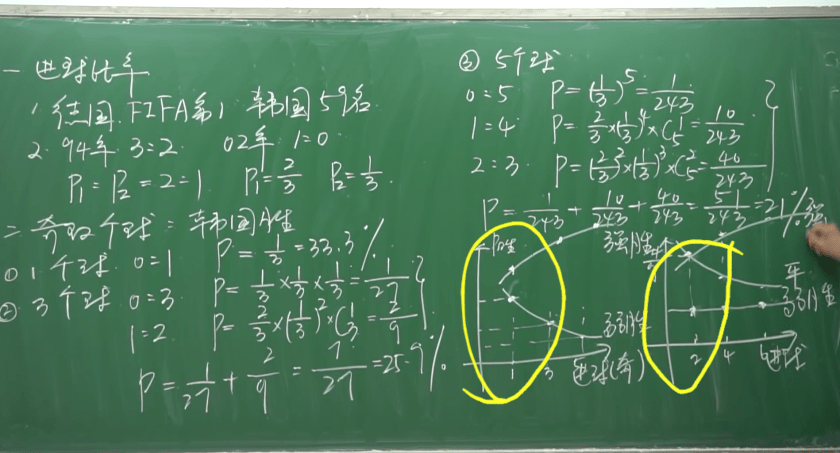
The actual Game proved the Korean “Math” strategy was right: (2:0)
Just read this article by a researcher at MIT. Students and parents especially should read this as it affects cognition and alertness levels. Students in Singapore typically have preciously little time (usually less than 8 hours) to sleep, hence the quality of sleep is very important.
Basically to summarize, sleeping in a closed bedroom (without ventilation, with windows and door closed) leads to high carbon dioxide levels that can possibly affect the brain in negative ways (decreased cognitive function). Switching on air conditioner should be fine as essentially fresh air is introduced from the outside.
The solution can be as easy as opening the door/window. Open window is said to be better than open door. However in Singapore, light pollution is another potential problem, most likely there is some form of light shining through the window at night. Singapore’s doors and windows are not as airtight as those in winter countries, but it seems there is still some cause for concern.
A scientific paper for those who want to read in greater detail: https://onlinelibrary.wiley.com/doi/pdf/10.1111/ina.12254.
I was searching for digital piano brands when I stumbled upon the Korg G1 Air. Korg is relatively unknown compared to Yamaha/Kawai etc, but it makes excellent digital pianos. Do check out the video above, it features Fantaisie-Impromptu by Chopin, one of my favorite piano pieces.
According to many reviews (see AZ Piano Reviews, Pianodreamers), Korg G1 Air is one of the best digital pianos in its price range. I went to the showroom and tested it out, it is indeed good. The weighted keys do feel like an actual acoustic piano. Touch of keys is very important for classical pianists. The 3 piano sounds are supposedly sampled from Steinway, Bosendorfer and Yamaha respectively. It also has bluetooth audio, so you can stream your music from your phone through the piano’s speaker systems.
The price is surprisingly affordable too, it is around S$1800 (Singapore dollars). According to many reviews online, it is equal or better than many other digital pianos in a much higher price range! I do agree, I have tried Yamaha’s Clavinova (higher priced than Korg G1), the Korg does not lose out to it in terms of sound and touch. Korg is fully made in Japan. Richard Clayderman endorses the Korg digital pianos:
There is another even cheaper model Korg C1 Air (priced at around S$1400), which many also say that it is quite good.
International buyers may want to check the Korg G1 out on Amazon:
Korg G1 AIR Digital Piano Black
For Singapore, the Korg G1 is available on Qoo10: Korg G1 Air. (comes with bench and headphone)
I think in Singapore especially, having a digital piano is a good idea if you want to practice at night (e.g. after 10pm) without disturbing the neighbors. Its design is quite space-saving too, it can fit into the smallest of homes without any problem.
Interesting news. It seems that the ancient builders are wiser and more mathematically advanced than previously thought.
Source: Aleteia
At every great ancient monument visitors often marvel at the ingenuity of our early ancestors. The most common question when it comes to Stonehenge is how they raised such large pillars without modern tools. Those with engineering know-how, however, may ponder the precision of design achieved by its Neolithic builders.
A new book, Megalith, suggests that the builders of Stonehenge and other such Neolithic sites may have known more about construction than we ever could have guessed. In Megalith, Robin Heath, a megalithic expert, claims that the presence of Pythagorean triangles found in the sites are evidence that these builders had discovered the Pythagorean theorem 2,000 years before the birth of Pythagoras.
Quora: https://www.quora.com/What-is-it-like-to-study-at-Raffles-Junior-College
Quite a few interesting answers can be found there. It is highly recommended that students read it before choosing to study at Raffles Junior College.
Also check out: Which JC is the best in Singapore?
Selected Quotes:
- “Not pleasant,” would be my answer.Like some other posters, I wasn’t from the Raffles family in any capacity before JC, though I had a few (distant) friends who were Rafflesians. Being in the GEP also served as an insulating factor- gifted kids hung out with other gifted kids, and mainstream kids saw us as aloof. It was a self-fulfilling prophecy that turned itself into a vicious cycle, like a snake swallowing its own tail. Singapore society tends to be stratified like that.So when I got there, there was no in-built friend base waiting for me as a safety net. JC was a pretty shallow place, as far as I can remember.
- Honestly? Nothing special.Resources aside (or perhaps more importantly, even with the Resources), Raffles is very much a stereotypical high school. Even though students are touted as the “cream of the cream” in a detestably common turn of phrase or the “top 3% of Singapore“, and everyone probably achieved above 265/300 in their examinations at the age of 12, or topped their secondary schools…it doesn’t mean that everyone is a genius, or a notoriously self-disciplined hard worker. In the words of Mean Girls, there are “preps, jocks, Asian nerds, cool Asians, varsity jocks…” so on and so forth. Everyone’s human, and no one’s flawless. I expected cutthroat competition at every turn, and impossibly well-put-together teenagers, but I’m glad I was wrong.
- Academic Rigour
The archetypal RJC student will not score above D in common tests right up to prelims – but, come A levels, he/she will score straight As. It will be drilled into you for 2 years that you only possess a modicum on intelligence. You get frustrated, then you study hard and you study smart. When you get your result slip, your first instinct would be to walk up to your GP teacher and tell her,”You told me for 2 years straight I wouldn’t make it in life with my current grades. I got all As… including GP. Take that lah.” Then she knowingly smiles and congratulates you, like that was part of the plan all along. That’s how ‘cutthroat’ the teachers in RJC are.- Leader. Leadership is emphasized and celebrated in the institution. Student leaders are mostly hand-picked by peers and are then trained by the school to hone their leadership skills. Based on high levels of self-motivation, these leaders end up organizing events that demand a high level of coordination and huge amounts of time and effort. They provide tremendous inspiration to their juniors, especially those aspiring to be student leaders as well.
Chinese Tuition Singapore
新加坡华文补习老师
Tutor: Ms Gao (高老师)
Ms Gao is a patient tutor, and also effectively bilingual in both Chinese and English.
A native speaker of Mandarin, she speaks clearly with perfect accent and pronunciation. She is also well-versed in Chinese history, idioms and proverbs.
Ms Gao is able to teach Chinese at the Secondary school level (Chinese and Higher Chinese). She will teach in an exam-oriented style, but will also try her best to make the lesson interesting for the student.
Ms Gao has taught students from: Nanyang Girls’ High (NYGH), RGS, RI, and other schools.
Contact:
Email: chinesetuition88@gmail.com
Website : https://chinesetuition88.com/
(Preferably looking for students staying in the West side of Singapore)
Thank you all readers of mathtuition88.com!
Mathtuition88.com has achieved 1 million views (currently 1,002,090 views)!
I find that the Pareto principle is quite true, even for blog views. The Pareto principle states that roughly 80% of the effects come from 20% of the causes.
For 2017, Mathtuition88.com had 267,859 views. The top 10 posts (out of around 2000 posts) alone accounted for 136,587 views, or around 50% of the views!
Check out the below catchy song about “1 Million”:
If you feel that your little child is spending more time watching TV or other electronic gaming devices, then you have a number of reasons to find something interesting and exciting over the next few lines. As the child starts going to school, he or she will have to spend some time doing the home tasks or learning what has been taught in the school. While it is applicable to all subjects, there are reasons to believe that math is a subject in which many students struggle a lot. You could even think of putting your child into the neighborhood tuition center to brush up his or her knowledge of math.
While there are reasons to believe that such tuition centers may not be the best thing going forward though it could help the skill sets of the child to a certain extent. It will not be long before you find that boredom creeping into the child. Should that happen it is just a matter of time before he or she starts developing a hatred for subject and once this happens things could be very difficult to mend and put back on track. Hence, as parents we need to find out a more interesting and enticing way in which math can be taught to the students. It is here that have a math tutor app perhaps could be useful in more ways than one. There are obviously a number of advantages and benefits and we will look at a few of them over the next few lines. Experts in teaching methods and child psychology believe that this could be the way forward and therefore as parents you must know something more about it.
They Are Very Convenient
In today’s world where time could be a constraint for many, having these math tutors could be convenient both for you as a parent and also for the child. Instead of putting your child in the math tuition center and perhaps waiting outside as the child goes through the grind, would it not be better to use this tutor app and teach what the child wants. It is fun to learn while on the move and this is what makes it quite different from other options.
They Support Better Engagement
While some students love doing math, there are others who are not very favorably inclined towards the subject. We also have many children who outright detest being with math subject and they are allergic to it. In such cases when you spend some time and choose the right app for math you can be sure that you will be giving them something which they will be happy with and something which will help them to be more engaged and interested in the subject.
Immediate Feedback Is Possible
Getting the right instruction and feedback as the child learns is something which makes it much more engaging and interesting for the child. There is no denying the fact that when you choose the right math apps you will be in a position to get immediate and meaningful feedback which will be helpful in more ways than one.
It Has A Rewarding And Points System
When you choose an app based tutoring and learning system, you can be sure that it will come with some of the best rewarding and points systems and this certainly makes it very interesting and exciting for children. This is often referred to as massaging the ego of the child and psychologically it has been found out to be extremely interesting for the children who have a special dislike and allergy towards math. This positive reinforcement will certainly encourage students to find quite a bit of interest towards math and even those who are allergic to the subject will certainly fall in line over a period of time.
Portability Is A Big Advantage
Since many parents and their wards are always on the move it is quite possible that you may not have time to teach their wards in their homes. Hence, having a math app for tutoring could be the best solutions for teaching the children while on the move. The app is something which can be downloaded on your computer and then you can start teaching your child even when you are traveling in a car or any other means of transport.
Improve Your Grades to Perfection: 5 Benefits of a College GPA Calculator
If you’re hoping to improve your grades, you can do this by using a college GPA calculator. There are a few different ways to do this. This can leave you with a handful of benefits and help you out with your college success. Let’s look at a few of the benefits that you can get from using a GPA calculator.
When you use a GPA calculator, you will be able to figure out your expected GPA at all times. You won’t need to wait until the end of the semester to calculate your academic standing. You also won’t have to get in touch with your professor or advisor in order to check in on your grades.
This can be helpful in making sure that you are able to stay in your selected program as some majors have GPA requirements. Additionally, you will know if you need to raise your grade at all. It’s better to be aware of your GPA before it’s too late to make a change in your study habits.
You can use a GPA calculator to determine your final grade. This is helpful at all points in the semester so that you can see how you’re doing. This can be applied to multiple classes so you can see your overall GPA too.
As mentioned before, it’s important to know exactly where you stand as you move through the semester. If there is a problem with your grades or your GPA, you should resolve these issues immediately.
Calculating your final grade will show you whether or not you need to seek out a tutor or get additional help. This can give a peace of mind if you are a little bit worried as well.
There are formulas for calculating your GPA or grade on your own. These work, of course, but they can be time-consuming. It’s much easier to plug the information into a GPA calculator.
If you’re not skilled at math or get lost easily, even simple formulas can be confusing. This can be frustrating and can cause minor errors. In addition, you will be less likely to make a mistake by using a calculator. We can all mess up while working out formulas by hand.
A GPA calculator can save you time and energy! Plus, the results will be instant.
If you decide to use a GPA calculator, you will be able to see your GPA right away. You will also be able to calculate it and view it at any time. You don’t have to wait until the end of the semester.
By calculating your GPA, you can see if you will need any help with your grades. If you notice that one of your grades is bringing your GPA down, you can get help.
Some universities have tutoring centers where you can get free study help. You can also meet with your professor to go over any confusing content. Making these efforts to raise your grades can be effective long-term!
GPA calculators have very straightforward directions. Nearly anyone can figure out how to use them. They are definitely easier to use than formulas!
There are also countless GPA calculators that you can use online, so you should be able to access them. You don’t have to spend a lot of time searching for them.
As you can see, there are plenty of easy ways to raise your grade by using a GPA calculator. Take a few minutes to figure out your GPA before it’s too late to get help and get better grades in your classes!
The GPA Calculator: What? Why? How?
As a student, having a high GPA (grade point average) is pretty important. It’s based on a student’s letter grade and the number of credit hours each course is. The final answer is the GPA, which has a lot of weight tied to it. A high or low GPA can be very meaningful to a student’s status at a university.
Many colleges will not allow students to be at their school if they do not maintain a high enough GPA. Certain majors require a specific GPA in order to be a part of that program. This can be scary for a student who doesn’t know exactly what their GPA is.
If a student is not keeping track of their GPA, they could be falling behind without even noticing it. This could lead to the student being removed from their program or being dismissed from the college. This is why students must be monitoring their GPA at all times. If a student isn’t aware of how low their GPA is, they could suffer the consequences.
Students can take advantage of a GPA calculator as they work through their courses. A GPA calculator allows students to plug in their grades and the number of credit hours for each course. The calculator then gives them their GPA. There are many different GPA calculators available online.
These GPA calculators are essential for students. They help students to keep track of their GPA before the end of the semester. When students monitor their GPA, they can see how their GPA might turn out at the end of the semester. This can show the student if they might need additional help in certain subjects in order to bring their GPA up.
Many colleges will have an online system set up where students can view their grades and their GPA. This usually isn’t updated throughout the semester though. It’s only changed at the end of the term. While it’s useful to see a GPA at the end of the semester, it’s better to know what it is earlier than that. Students can actually make a change when it counts if they know what their GPA is as they progress.
If students use GPA calculators, they can see their current grades. This can show them if they are doing enough or not. It can also help them see If they can keep putting in the same efforts that they have been and maintain a good academic standing. Some students will need to seek out tutoring or additional assistance from a professor if they are concerned about their GPA.
Aside from being able to stay in the school or the particular program, students can also receive scholarships for high GPAs. If a student knows what their GPA is, they can be applying for additional scholarships. Keep in mind that a low GPA can mean losing a scholarship that has already been received.
As students move through college, they need to be knowledgeable about the GPA requirements for their university, major, any scholarships, and financial aid they might be receiving. GPA calculators are a quick and easy way to check on a GPA at any time.
By knowing their GPA, students can seek out additional help or try to raise their grades. Raising their marks would then increase their final grade, which is the goal. It’s important for students to know what’s going on with their GPA and academic standing at all times! This will help them to be the most successful that they can be throughout their college career!
The “war” of OOP vs FP is akin to Applied Math vs Pure Math.
The formers (OOP & Applied Math) are not “rigourous” but practical, compared to the laters (FP & Pure Math) which are elegant but too abstract for popular usage.
OOP: SmallTalk and its followers – C++, C#, Objective-C, Java…
FP: LISP and its followers – Haskell, Clojure, …
The “hybrid” (OOP&FP): Scala, Kotlin (Google: Java ‘cousin’), Swift (Apple: Objective -C ‘cousin’), F# (MicroSoft)
The “cons” of OOP, which are bad for concurrency / parallel computing in multi-cored CPU:
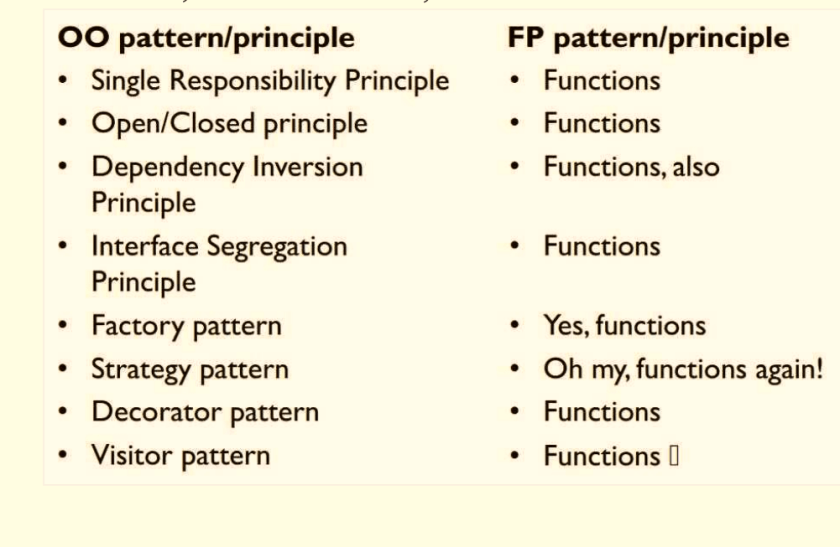 https://blog.cleancoder.com/uncle-bob/2014/11/24/FPvsOO.html
Landau’s book “Symmetry” explains it as follow:
Automorphism = Congruence= 叠合 has
1). Proper 真叠合 (symmetry: left= left, right = right)
2). Improper 非真叠合 (non-symmetry: reflection: left changed to right, vice-versa).
Congruence => preserve size / length
=> Movement 运动 (translation 平移, rotation about O )
= Proper congruence (Symmetry)
In Space S, the Automorphism that preserves the structure of S forms a Group Aut(G).
=> Group Aut(G) describes the Symmetry of Space S.
Hence Group is the language to describe Symmetry.
Symmetry (hence Group) explains :
1. Conservation of Energy;
2. Conservation of Angular Momentum;
3. Periodic Table;
4. Laws of Thermodynamic.
Emmy Noether Theorem (1918): Conservation Laws owes to Symmetry :
1. In Linear motion
=> Conservation of Momentum
2. In Angular movement
=> Conservation of Angular Momentum
3. In Time
=> Conservation of Energy
It is not only owed to the Ecole Normale Superieure where the 11 Fields medalists were educated, but the prominent “Math Culture” in French society.
This is similar to the International Math Olympiad (IMO) “craze” in China since 1980s till today, where the parents send their primary school kids to drill in IMO boot- camps, because that is a “direct-entry” gateway to enter top university, bypassing the highly competitive “Gao-kao” 高考 (High-school College Entrance Exams for 500,000 places among 7 million students each year).
https://www.theguardian.com/world/2012/may/31/europa-french-maths-ecoles-normales-superieures
Quora: read how this middle-age (48) French recounts his “French Math” education since 6 to 15 years old:
The curriculum was designed in the late 60s in part by a group of real mathematicians, the Bourbaki. It was very abstract. I learned about basic set theory when I was 6. I did learn about the basic operators but not before I was able to perform…
View original post 97 more words
中国剩余定理CRT (Chinese Remainder Theorem)
X ≡ 2 (mod 3)
X ≡ 3 (mod 5)
X ≡ 2 (mod 7)
Solve X?
明. 程大位 “算法统宗” (1593)
3人同行70稀
5树梅花21支
7子团圆半个月(15)
除百零五(105)便得知
Let remainders:
$Latex r_3=2, r_5=3, r_7=2$
$Latex r= r_3.70+ r_5.21 + r_7.15 (mod 3.5.7)$
r= 2.70 +3.21 +2.15 (mod 105)
r= 140 +63 +30 (mod 105)
r= 233 (mod 105)
$latex r= 23 = x_{min}$
or X= 23 +105Z (23 + multiples of 105)
——————————————-
CRT: Why 3:70, 5:21, 7:15
X ≡ 2 (mod 3)
X ≡ 3 (mod 5)
X ≡ 2 (mod 7)
1) Find A such that
A ≡ 1 (mod 3)
A ≡ 0 (mod 5)
A ≡ 0 (mod 7)
=> 5|A, 7|A => 35 |A
View original post 181 more words
Chinese Remainder Theorem (CRT): 韩信点兵 (中国剩余定理)
南北朝 《孙子算经》(4 AD)
Problem:
The Orchestra conductor has been asked to conduct a series of concert for 2 consecutive months.
The Orchestra has to play few pieces of classical music with the following conditions requested by the organising committee:
1) Play at least 1 piece of music a day;
2) Avoid playing exactly the same music in 2 consecutive days (although partially is allowed)
3) Due to resource constraint, it is impossible to play all pieces of music within a single day.
Question:
At least how many (N) pieces of music the conductor has to prepare in order to fulfill these conditions?
Solution:
Using Yijing (易经)notation:
* a piece of music being played in a day is denoted by
__ (solid line);
while not being played is denoted by
– – (broken line)
* 2 consecutive months in any year have maximum 62 (= 31+31) days.
* A bagua (8…
View original post 141 more words
The wonderful iMac is a “long life” machine able to last more than 10 years, but it has an annoying weakness : the frequent spinning “beachball” which slows down or freezes the computer.
Below is a very simple trick to fix the problem.

Note: to get the “Force Quit Application” Screen: press 《Command + Option + Esc》3 keys simultaneously.


According to this article by Channel News Asia, there are four “constraints” for why the PSLE cannot be scrapped. I call it the “四不能除“, named after a saying “四不能战” regarding a general Feng Zicai which I recently learnt about after watching the movie “The War Of Loong“.
It is quite logical actually, I encourage readers to read the article, which is written by a student yet to enter university.
Point 1 and 2 are sort of self-explanatory; just think realistically how many kids will study hard if there is no PSLE exam? Even if there is an internal school exam, if its importance is not high, it may not cause students to study.
Point 3 needs some explanation on why scrapping the PSLE may actually increase stress:
Earlier this year, during the Ministry of Education’s Committee of Supply debate, then- Minister for Education (Schools) Ng Chee Meng remarked that “removing the PSLE and having a through train will only transfer the stress on parents and students elsewhere, such as at the P1 registration”.
He also emphasised that “it will make the O-Level and N-Level exams most stressful – a single exam in the whole career of a child’s life.”
- Source: Channel News Asia
Basically, if PSLE were to be scrapped, the focus and stress will be shifted to P1 registration and O Levels. P1 registration is based on where you stay and your parent’s alumni, in this respect PSLE is actually fairer and more meritocratic as it is based more on the child’s academic ability.
Nonetheless, despite the four reasons not to scrap PSLE, one thing that strikes me is the example of Finland. Despite Finland having no exams until the age of 16, it is well known that Finland’s education system is top in the world. There must be some secret to Finland’s education system, but the question is whether it can work and be applicable to other countries.
General Feng Zicai actually said something that is very wise and applicable to PSLE: “光绪二十九年(1903年)临终前,冯子材为子孙留下遗训:“读书不求官,服官不要钱,违者不孝。” (http://www.qzlz.gov.cn/Item/251.aspx)
Translated: “The main goal for studying is not for becoming an official; Becoming an official is not for gaining money for oneself; Whoever disobeys is unfilial (he said this to his descendants).”
Also read our previous post on PSLE:
Key Points:
https://www.wired.com/story/a-classical-math-problem-gets-pulled-into-self-driving-cars/amp
Explain:
Sum of 2 Squares <=> always non-negative ( ≥0)
$latex 13 = 4 + 9 = 2^{2} + 3^{2} $
$latex P (x) = 5x^2+16x+13 = (x+2)^{2} + (2x+3)^{2} geq 0 $
Self – driving Car: Trajectory = P (x)
P(x) < 0 where the car’s position in the trajectory;
Obstacles are positions where P (x) ≥ 0.

I believe this is not new, but it is the first time I heard of it. Anyway, it is free, so do feel free to request for a sample at the PUB Official Website.
PUB has revamped the packaging of its popular water saving kits featuring its mascot Water Wally. A set of thimbles with three and four holes allows residents to have greater flexibility in regulating their tap’s and showerhead’s flow rates. Water Wally stickers with specific messages are also included in the kit to act as reminders of good water saving habits in homes.
URL: https://www.pub.gov.sg/savewater/requestforwatersavingkit
This workshop should be useful to students aiming to be a medical doctor. (Note the ticket prices, this event requires ticket for admission.)
Interested students may also check out our previous blog post on BMAT Book Recommendations for NTU Medicine.
Source: https://www.facebook.com/events/1714853475261989/
Date: 21 July 2018 (Saturday)
Time: 9:30am to 12:30pm (F&B at tea break)
Venue: NUS Shaw Foundation Alumni House, 11 Kent Ridge Drive, Singapore 119244
Calling all IP, JC, polytechnic and university students!
Join us at So You Want To Be a Doctor?, a half-day medical seminar on Saturday, 21 July 2018, from 9:30am to 12:30pm, featuring panel discussions, inspiring keynotes and networking opportunities.
Our seminar provides a unique opportunity for prospective medical students to hear from clinical professors, network with doctors who’ve gone onto diverse careers, and learn about the many job options available in healthcare.
This seminar is targeted at IP, JC, polytechnic and university students, as well as anyone interested in pursuing careers in healthcare, such as biomedical research, allied health, entrepreneurship, technology in medicine, public health and humanitarian projects.
So You Want To Be a Doctor? covers topics such as:
– How will doctors practice in the future?
– Is medicine for me?
– Is clinical research for me?
– The path less wandered: A chat with Dr. Benjamin Seet
————-
Agenda
————-
09:30 AM: Keynote – “How will doctors practice in the future?”
Professor Wong Tien Yin, Medical Director, Singapore National Eye Centre
09:50 AM: Panel #1 – “Is medicine for me?”
Assistant Professor Isaac Liu Desheng, National University of Singapore
Dr. Tiah Ling, Emergency Medicine Physician, Changi General Hospital
Dr. Kumaran Rasappan, Senior Orthopedic Surgical Resident, Tan Tock Seng Hospital
10:30 AM: Panel #2 – “Is clinical research for me?”
Assistant Professor Swaine Chen, National University of Singapore
Assistant Professor Chester Drum, National University of Singapore
11:10 AM: Tea break
11:40 AM: The path less wandered: A chat with Dr. Benjamin Seet
Dr. Benjamin Seet, Executive Director, Biomedical Research Council, Agency for Science, Technology and Research
12:20 PM: Closing note
————-
Speakers
————-
Professor Wong Tien Yin (keynote talk)
Prof. Wong Tien Yin is medical director of the Singapore National Eye Centre (SNEC). He is also deputy group CEO (Research & Education) of SingHealth and academic chair of the Ophthalmology and Visual Sciences Academic Clinical Programme at Duke-NUS Medical School. Prof. Wong completed medical school at the National University of Singapore as a 1987 President’s Scholar. He studied on fellowships at the University of Wisconsin-Madison, US, and the University of Sydney, Australia. He obtained his MPH and PhD degrees from the Johns Hopkins University, US.
Dr. Benjamin Seet (keynote talk)
Dr. Benjamin Seet is executive director of the Biomedical Research Council (BMRC) at the Agency for Science, Technology and Research (A*STAR). Prior to joining A*STAR, he served as chief medical officer of the United Nations (UN) Department of Peacekeeping Operations in New York. He oversaw medical support for UN personnel in 16 post-conflict countries. Dr. Seet also served with the Singapore Armed Forces (SAF) for more than 20 years before retiring as chief of the SAF Medical Corps at the rank of Brigadier-General.
Assistant Professor Isaac Liu Desheng (panel #1)
Asst. Prof. Isaac Liu Desheng is a pediatric nephrologist who specializes in dialysis and renal transplantation. In addition to his research on kidney disease, Asst. Prof. Liu is the chief doctor of the Shaw-National Kidney Foundation Children’s Kidney Centre Annual Camp. He is currently an assistant professor (clinician investigator) at the Yong Loo Lin School of Medicine. For his achievements, he was awarded the 2017 Singapore Youth Award, the nation’s highest accolade for youth.
Dr. Tiah Ling (panel #1)
Dr. Tiah Ling is an emergency medical physician consultant in the accident and emergency department at Changi General Hospital. Prior to joining Changi General Hospital, Dr. Tiah participated in the METASHARP project, where she provided technical support, monitoring and evaluation of health facilities in Afghanistan. In 2009, she spent three months in Ghana as a program coordinator in the ‘Systems Improvement at District Hospitals and Regional Training of Emergency Care’ program (sidHARTe). Dr. Tiah received her Masters in Public Health (MPH) degree from the Johns Hopkins University, US.
Dr. Kumaran Rasappan (panel #1)
Dr. Kumaran Rasappan is a senior orthopedic surgical resident with Tan Tock Seng Hospital. In 2012, he became the first Singaporean to scale the summit of Mount Everest for a charitable cause, raising over S$40,000 for needy patients. Since then, Dr. Kumaran has scaled the heights of K2 and Makalu, the second and fifth highest peaks in the world respectively, in an effort to raise funds for the Home Nursing Foundation’s program which aims to address the psycho-social and emotional needs of caregivers. His fundraising effort is titled “No Mountain Too High.”
Assistant Professor Swaine Chen (panel #2)
Asst. Prof. Swaine Chen is an assistant professor of medicine at the National University of Singapore and a senior research scientist at the Genome Institute of Singapore. His research interests include the application of genomics to understanding molecular mechanisms of urinary tract infection, particularly those caused by Escherichia coli. He received a Bachelor’s degree in chemistry and mathematics from Harvard University, US, and an MD-PhD degree from the Stanford University School of Medicine, US.
Assistant Professor Chester Drum (panel #2)
Asst. Prof. Chester Drum is an assistant professor at the National University of Singapore, a consultant cardiologist at the National University Hospital and director of the Clinical Trial Innovation Lab at the Agency for Science, Technology and Research. He received his MD-PhD degree from the University of Chicago, US, and trained at the University of California, San Diego, US, and Harvard Medical School, US. Asst. Prof. Drum has over 20 years of clinical experience in managed care, private, public and academic healthcare settings and holds multiple patents.
————————-
About the organizer
————————-
Combining savvy communication with technical rigor, Wildtype Media Group is Asia’s leading STEM-focused media company, spanning digital, print, custom publishing and events.
Brands under Wildtype Media Group include the flagship Asian Scientist Magazine and Supercomputing Asia, award-winning titles available in print and online. Through its Asian Scientist Intelligence consulting division, Wildtype Media Group provides a full suite of marketing and communication services to industry and academic clients hoping to engage Asia.
Facebook page: https://www.facebook.com/events/1714853475261989/
Peatix page: https://doctalks.peatix.com/
Cultivating Confidence in Students to Excel Academically
Students who struggle academically may lack the self-confidence to continue to learn actively and get their point across during lesson. Educators have a huge influence on their students and hence there is an onus on them to instil confidence in the students and help them to feel confident enough to overcome any obstacles in their path to success despite any initial struggles.
When students possess more confidence in their ability, they will be more willing and ready to study and will put in more efforts to work harder as compared to when they doubt their academic ability due to struggles faced. Hence, self-confidence is extremely important in motivating students to excel academically.

Here are some tips that should be taught to students who struggle with their studies so as to provide them with a proper structure to follow when they are at a loss and also to enable them to regain confidence and guide them to the path of success. The tips can also be used by educators who use them to guide and encourage their students.
As students, be sure to set goals that are realistic and attainable and this is one way where you will be able to see growth and improvement as compared to setting an unrealistic goal that is too hard to reach. As educators, remember to guide your students in their goal settings and do not impose too high expectations on them, as it will only cause them to falter. Ensure that the goals are what the student wants to attain while also making sure that they are realistic. When learning is goal-oriented, there is more intrinsic motivation to be able to want to attain their goals and hence more confidence in pursuing the academics.
Practice makes perfect and that is often the case. When studying for quantitative subjects like mathematics, remember that practice is the key to success! But of course you practice when you understand the concepts behind questions and not blindly do questions without any understanding. For more qualitative subjects, one way to practice is to come up with a skeletal / point form answer for the question so as to test your understanding of the subject. For educators, remember to remind your students to practice for topics that they are unfamiliar with in order to familiarise themselves with the chapter.
If long chunky words don’t interest you and deter you from studying, use visual aids to help you study better! Research has shown that students study better with visual aids such as mind maps and flow charts. So students, sketch those mind maps out to better understand difficult concepts! Similarly when teaching, it is better for educators to use visual aids which capture the attention of their students. Do not include large chunks of works on your notes and presentation slides when teaching, as such chunks deter students from reading and understanding the content.
When in doubt, do not hesitate to seek help! It is better to clarify a misunderstanding or something that you do not know at the start. Your teachers and tutors will definitely make themselves available whenever possible. Educators, do not chide your students who seek help from you and instead help them to the best of your abilities when they approach you with questions! Questions are a sign that one is learning.
A Japanese proverb goes, “fall down seven times and get up eight”. The meaning behind this is to not be discouraged by any mistakes and failures as it is bound to happen. Remember to always pick yourself after making a mistake and that making mistakes are normal and fine as no one is perfect. Educators should always remind their students of this and be there for students to reach to when students face a failure or a mistake.
More for the educators, remember to be a source of encouragement to your students and constantly praise them for whatever progress or good work that has been done! If constructive feedback or criticism needs to be given, it might be better to do it when one on one with the student so that he or she does not feel embarrassed in front of the class. Research about people management has also shown that the “Sandwich Method” works best when one wants to give constructive feedback. How the “Sandwich Method” works is that you begin your feedback with something good as the bread before going into the criticisms and finally ending with encouragement again. These various layers form the “sandwich”.
Enthusiasm is extremely important in facilitating interest and confidence in the subject. Try your best to be enthusiastic when learning and it really makes a difference rather than looking at the subject as one that is dreary and boring. The enthusiasm of the educators also matters as an enthusiastic teacher helps students to model after the teacher’s enthusiasm for the subject and hence gain confidence.
Last but not least, a positive learning environment is extremely important! Find friends who are willing to help and not those who hate studying and form a study group! Such friends will definitely motivate you to work harder and can also be of aid when help is needed to understand a concept. For educator, a classroom that has a positive environment is one where students feel safe to express themselves and have the desire to learn. These develop confidence in the students.
Hopefully with all these tips, educators will be able to help students to cultivate confidence in order to excel academically and that students themselves will be able to orientate themselves into a structure, which enables them to gain confidence.
“Self-confidence is like a super power, once you believe in yourself, magic starts happening.”
Making Sense Chemistry Tuition instils confidence in students. To find out more about Making Sense Chemistry tuition, click here: https://www.makingsense-sg.com/free-trial/
George Boole [2/11/ 1815 – 8/12/ 1864]: 《The Laws of Thought》: symbolic logic representation of thought.
Let x = class of sheep’s
y = white
=> white sheep = xy = yx = sheep white
then Commutativity Law:
$latex boxed {xy = yx}&fg=aa0000&s=3 $
Let x= rivers, y = estuaries河口, z= navigable 通航
then, AssociativityLaw:
$latex boxed {(xy)z= x(yz)}&fg=aa0000&s=3 $
A sheep is a sheep,
$latex boxed {xx = x^{2} = x}&fg=aa0000&s=3 $
Note: x = 0 or 1 fulfills the above equation.
If x = class of men
y = class of women
z = class of adults (either men or women)
$latex boxed {z = x + y}&fg=aa0000&s=3 $
w = European
then Distributive Law:
$latex boxed {w(x+y) = wx + wy}&fg=aa0000&s=3 $
If t = Chinese
then all non-Chinese men = {x – t}
If s = Singaporean,
then
$latex boxed {s(x – t…
View original post 6 more words
https://simple.m.wikipedia.org/wiki/Zipf%27s_law
Example:
In English, 3 most common words:
=> “the” is 2x occurs more often than the 2nd “of“, 3x than the 3rd “and” …
Zipf’s Law : the frequency of the nth ranked word is proportional to 1/n.
Reference:
Hadamard estimated that :
About 90% of mathematicians thinkvisually, 10% think formally.
Usually, they think in steps:
Source: [NLB #510.922]
“A mathematician is a machine for turning coffee into theorems.”
– Alfréd Rényi
It’s a pun in German, where the word Satz means both ‘theorem’ and ‘(coffee) grounds‘ [咖啡渣].

How likely is it that a mathematics student can’t solve IMO problems?
Is there a fear of embarrassment in being a math Ph.D. who can’t solve problems that high-school students can? by Cornelius Goh
Problem A3
A function f is defined on the positive integers by:
for all positive integers n,
$latex f(1) = 1 $
$latex f(3) = 3$
$latex f(2n) = f(n)$
$latex f(4n + 1) = 2f(2n + 1) – f(n) $
$latex f(4n + 3) = 3f(2n + 1) – 2f(n) $
Determine the number of positive integers n less than or equal to 1988 for which f(n) = n.
What is the explanation of the solution of problem 3 from IMO 1988? by Alon Amit
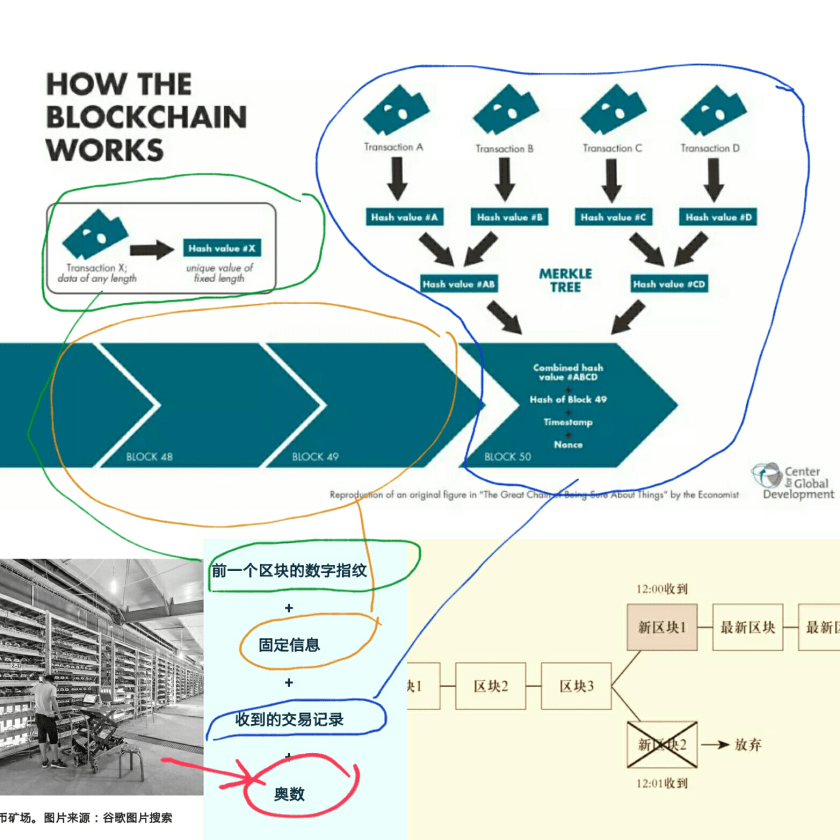
Encryption & Decryption: ECC (Elliptic Curve Cryptography):

Sending End: Encryption
1) SHA algorithm generates “Digital Signature” ;
2) Generate random “Private Key”.
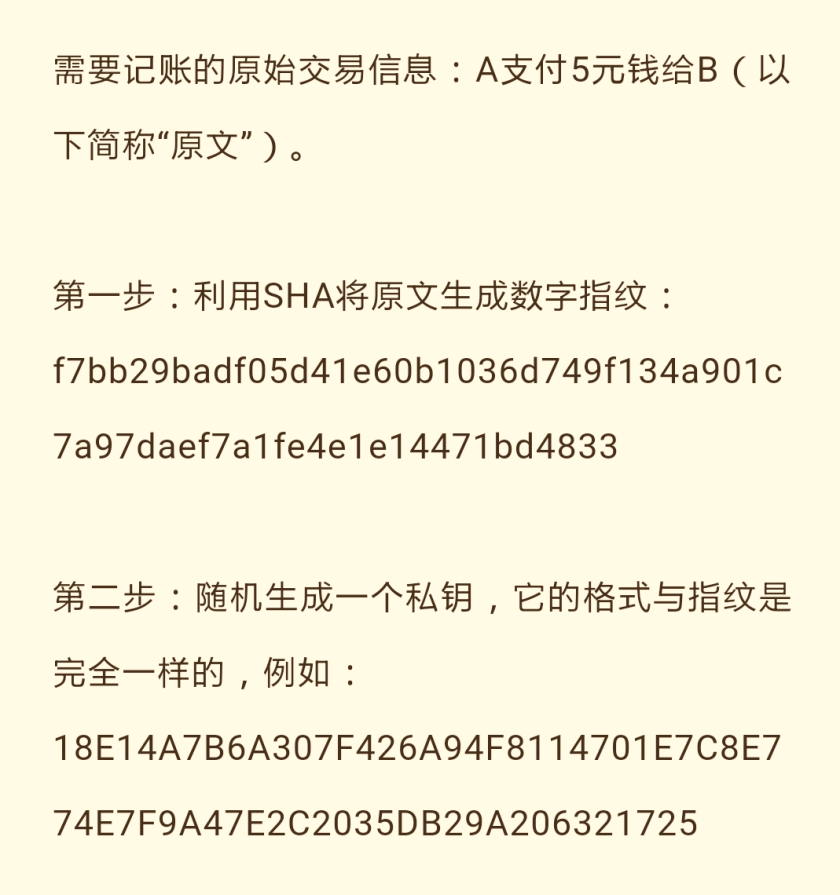
第3-6步骤:
3) ECC encrypts the text with “Private Key”;
4) From the Private Key generates a “Public Key”;
5) Send out the “original message” and the “Public Key” with the “encrypted message” from 3);

Receiving End: Decryption
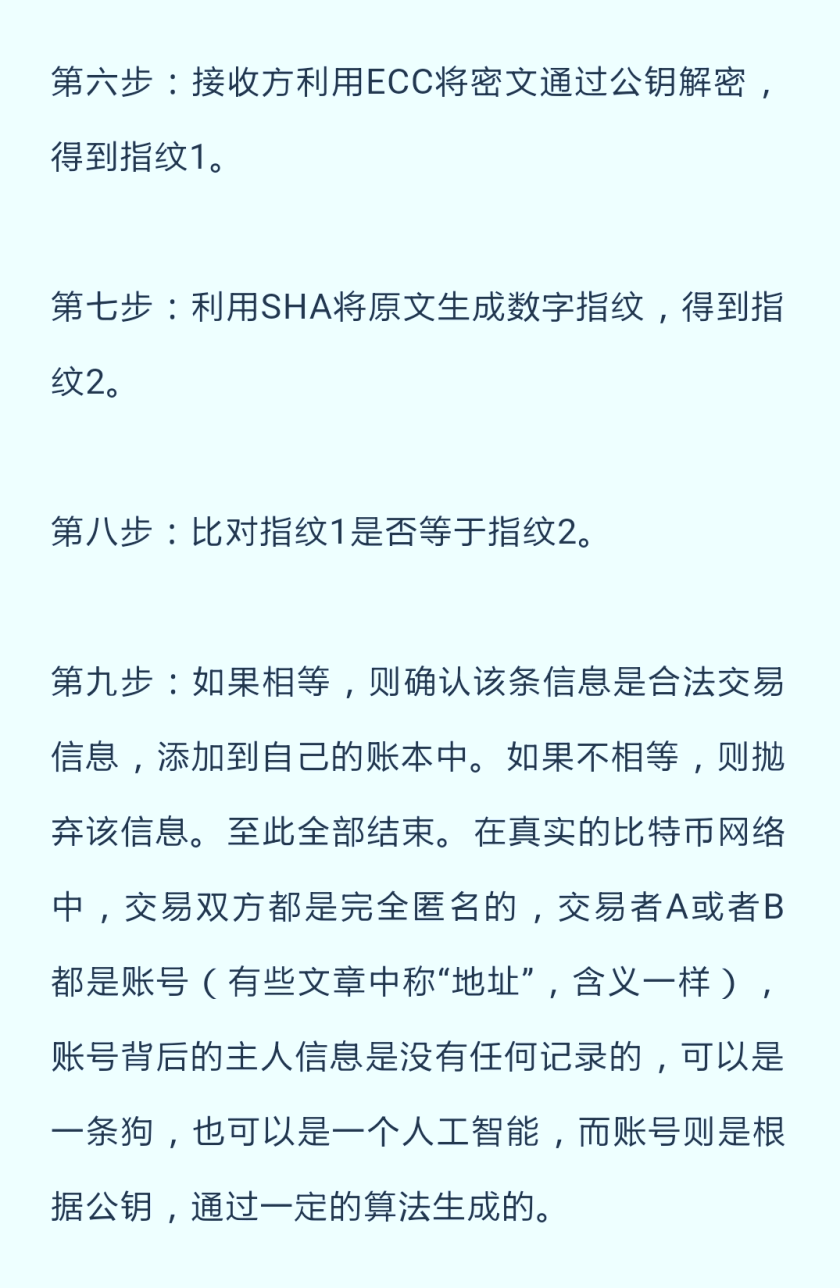
6) ECC with Public Key generates Digital Signature 1 (S1);
7) Use SHA algorithm on the original message generates Digital Signature 2 (S2);
8) If S1 = S2, then accept transaction, otherwise reject.
Those who are acquainted with IMO (International Math Olympiad) would know that it is extremely tough to get a gold medal (in fact any medal at all) in the IMO. Fu Yunhao, from China, scored 42/42 perfect score twice in a row. His record can be viewed here. IMO’s difficulty varies from year to year. Fu Yunhao’s two attempts were during “difficult” years, hence he may be one of the best Math Olympians in the history.
However, his life story is quite unique in the sense that after his IMO triumph, things did not go quite smoothly. The below interview (unfortunately only in Chinese) describes it: http://news.ifeng.com/a/20180504/58096549_0.shtml.
Google Translate of interview: English Translation
Excerpt:
“The two-time Olympic champion” – although not accurate enough, it also summed up the highest achievements in the first 33 years of Fu Yunsheng’s life: he was the IMO (International Mathematical Olympiad) 2002 and 2003 two consecutive years of full-time gold medalist . In the 30-year history of the Chinese national team, only three players have achieved this result. IMO has the difficulty of being “relatively difficult” and “relatively simple.” Fu Yunyi is the only Chinese player who has competed for two “relatively difficult” matches. The Education Authority of China, Zhu Huawei, commented on Fu Yunxi: “He is a symbol of the Chinese mathematical community.”
To some extent, young people who are qualified to embark on the battlefield of IMO can represent the most outstanding mathematics mind of the generation. Professor Yakovlev, a former communications academy of the Soviet Academy of Sciences and a former chairman of the two-year IMO, made famous assertions: “Now the participating students will become the laborers who hold the golden key of knowledge and wisdom in the world 10 years later. they.”
Most of the IMO contestants will continue to engage in mathematics research in their adulthood. Among the 14 winners of the Fields Prize (recognized as the “Nobel Prize in mathematics”) since 2000, at least 8 of them have IMO’s record. But Fu Yunjun, the much-anticipated Olympic genius who once occupied the high point of IMO, unexpectedly disappeared in academia for the next fifteen years.
Some netizens came up with an old post titled “Fu Yunyi, First Class Cowman”, and asked for advice on the status quo of Fu Yunyi. Like igniting curiosity, those who have heard of their reputation have asked each other in the bottom: where is Fu Yunyi going?
(“Cowman” 牛人 means someone who is really good and excels in doing something.)
(Due to some translational errors, different spelling versions of Fu Yunhao’s name appear. They are all the same person, Fu Yunhao.)
However, the published interview does not reflect the full story. Fu himself posted a follow-up post here: http://news.ifeng.com/a/20180504/58096623_0.shtml. Basically, Fu argues that not following the traditional path of becoming a top mathematician does not mean that it is a failure; on the contrary his chosen path (lecturer at teacher’s college) benefits society by producing more good teachers to teach more students.
Google Translate of Fu’s follow-up post: English Translation
Excerpt: The third reaction: Incomprehension of the values conveyed by the report. According to the author of the article, the point is: Excellent people are engaged in basic work and it is a very shameful thing. Those who have won the imo championship are, if nothing else, their journey must be the sea of higher mathematics instead of teaching a group of “second normal school students” to teach junior high school mathematics knowledge. Two of the normal students who lectured said that the genius had fallen. Although I denied that I was a genius, I still thanked Wu for collecting my example of genius. He is very hardworking and commendable. However, the negative energy brought by his values has forced me to vocalize. I didn’t speak for self-explanatory innocence. I just sang for the positive energy development. First of all, for the Wu students who wrote such values, I expressed my understanding that the author, as a senior student who has not completely taken the ivory tower, has such an idea that it is normal. In his cognitive system, academic research is the top grade, ordinary work is relatively low, and lectures are given to two normal students, and it is even closer to the center of the earth. If a once successful genius did not make achievements in heaven and earth, but lived aliciously, it was failure! In Wu’s report to me, this tendency was obvious during the interview. In an interview on April 1st, I even put forward an example of Mr. Zhang Yitang to mention him. At the same time, I mentioned that many researchers have strong academic abilities, but they always go the wrong way, and they have never been able to conquer their life. Want to overcome the problem, but they are still happy and fulfilling. Those things that I spent 10 days and a half wanting to understand may not be of great value, but how many are some interesting conclusions. Moreover, aside from the results of the research, the process of research itself is a happy thing. Although the author did not ignore this paragraph, I mentioned it slightly at the end of the article, but in his eyes, I would like to give this example in order to balance my talent from the genius champion to the teacher of the “Second Normal School” in front of the interviewer. Heart drop it. However, I do not have such a psychological gap. Young people experienced academic crackdowns, and there were some gaps during the very decadent period, but these have been resolved. For so many years of work and life, I learned that there is a vast world beyond the University’s ivory tower and there are so many things waiting for people to practice. If you have a halo above your head and you are in a high tower, you may be able to refer to the country and spur words, but only if your feet are implemented and everything is done well, you can accumulate less and contribute more to the community. Two of my teammates who were with me in 2003, two of them are still swimming in the sea of mathematics, and the other three are involved in the financial industry, which I mentioned in the interview. Each of them did not regret his choice, nor did I.
If you are interested in Olympiad books, check out Recommended Maths Olympiad Books for Self Learning / Domain Test.
Let N = 2n > 6
哥德巴赫猜想 Conjecture “1+1”: N = p1 + p2 (pj all primes)
陈景润 Chen Theorem “1+2”: N = p1+ p2.p3
The 7 Fields Medalists are:
2014 – Maryam Mirzakhani (1977-2017) – 1st lady Fields medalist
2010 – Cédric Villani (1973- )
2006 – Grigori Perelman (1966- ) – 1st declined the award
1998 – Andrew Wiles (1953- ) [silver plaque] – Fermat’s Last Theorem
1990 – Edward Witten (1951- ) – Physicist won Fields medal
1982 – Alain Connes (1947- ) – Quantum Theory
1966 – Alexander Grothendieck (1928-2014) – Hermit mathematician
http://www.thecrimson.com/article/2018/4/27/bill-gates-event/
Bill Gates, a top Math student at Harvard entrance exams, recalled his first year Harvard “Math55” Course (Advanced Calculus & Linear Algebra) – the toughest at his time because 4 years of Math coursewares condensed into 1 year (2 semesters) !
Note: Harvard “Math55” is even tougher than the “notorious” French Classe Préparatoire, which is a 3-year Math undergraduate courseware squeezed in 2 years : 1st year (code-name “un-demi” or “1/2”) Mathématiques Supérieures; 2nd year (“trois-demi” or “3/2”) Mathématiques Spéciales.
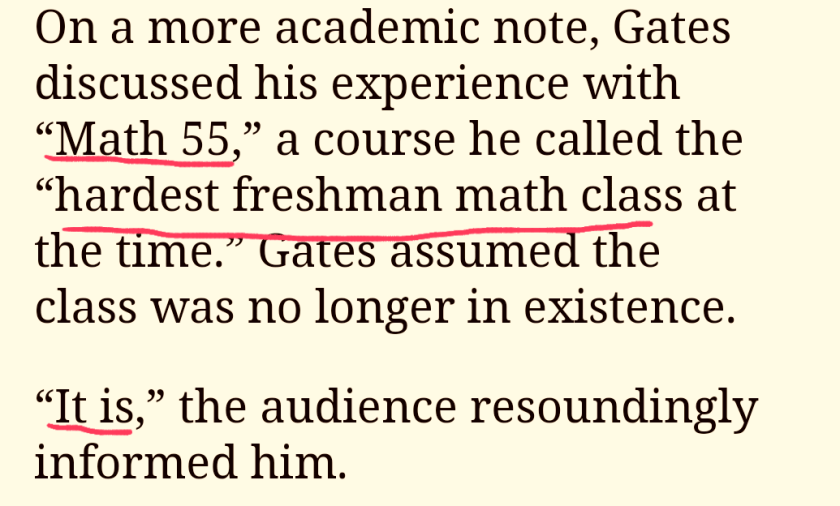
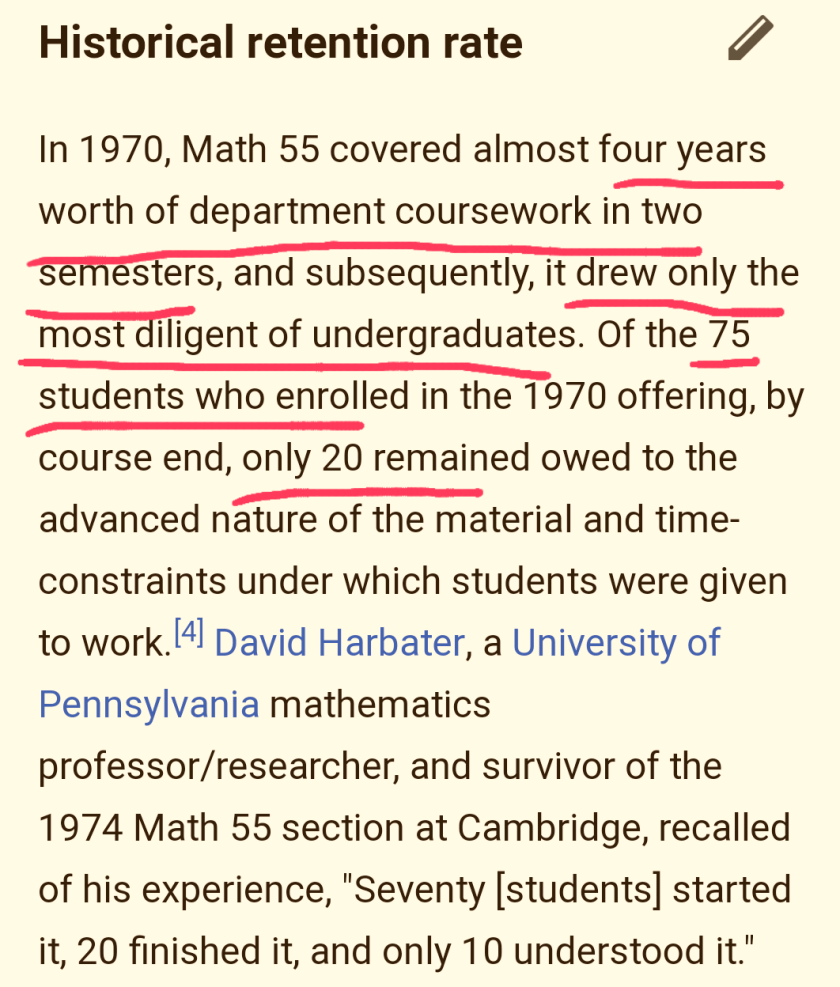
Math55 Syllabus:
Though Math 55 bore the official title “Honors Advanced Calculus and Linear Algebra”, advanced topics in complex analysis, point set topology, group theory, and/or differential geometry could be covered in depth at the discretion of the instructor, in addition to single and multivariable real analysis and abstract linear algebra. In 1970, for example, students studied thedifferential geometryofBanach…
View original post 88 more words
After 40 years of learning Abstract Algebra (aka Modern Math yet it is a 200-year-old Math since 19CE Galois invented Group Theory), through the axioms and theorems in math textbooks and lectures, then there is an Eureka “AHA!” revelation when one studies later the “Category Theory” (aka “Abstract Nonsense”) invented only in 1950s by 2 Harvard professors.
A good Abstract Math teacher is best to be a “non-mathematician” , who would be able to use ordinary common-sense concrete examples to explain the abstract concepts: …
Let me explain my points with the 4 Pillars of Abstract Algebra :
$latex boxed {text {(1) Field (2) Ring (3) Group (4) Vector Space}}&fg=aa0000&s=3$
Note: the above “1-2-3 & 4″ sequence is a natural intuitive learning sequence, but the didactical / pedagogical sequence is “3-2-1 & 4″, that explains why most students could not grasp the philosophical essence of Abstract Algebra…
View original post 383 more words
Just updated the book review on Munkres’ Topology book.
This book is the best introductory book on Topology, an upper undergraduate/graduate course taken in university. I have written a short book review on it.
Excerpt:
Book Review: Topology
Book’s Author: James R. Munkres
Title: Topology
Prentice Hall, Second Edition, 2000
It is often said that one must not judge a book by its cover. The book with a plain cover, simply titled “Topology”, is truly a rare gem and in a class of its own among Topology books.
One striking aspect of the book is that it is almost entirely self-contained. As stated in the preface, there are no formal subject matter prerequisites for studying most of the book. The author begins with a chapter on Set Theory and Logic which covers necessary concepts like DeMorgan’s laws, Countable and Uncountable Sets, and the Axiom of Choice.
The first part of the book is on General…
View original post 940 more words
This petition is important to save future lives. The traffic rules should be machine controlled, i.e. clearly dictated by traffic lights whether to turn or not. In this way, there will be less error due to human judgement.
Quote: “Two accidents involving fatalities this week have prompted this petition. Roads have been widened significantly in recent years, with new lanes added and as such it is difficult to have field of vision of so many lanes, pedestrians, mobility devices, and fast moving oncoming cars all at once to make an informed and safe judgement.
Requesting LTA to determine if it is still safe to keep to discretionary turning on green given the growth in sizes of junctions (such as the Commonwealth Ave West/Clementi Road and Upper Bukit Timah/Jln Anak Bukit junctions) and to work on improving the safety of all road users.
Thank you”
“Form” : Function with special properties – eg.
1. Non-Euclidean Geometry
1.1 Hyperbolic Plane : is the Upper-Half in Complex plane H (positive imaginary part) where :
 1.2 Group of Non-Euclidean Motions:
$latex f: H rightarrow H$
View original post 741 more words