Even physicists are ‘afraid’ of mathematics

Interesting news, since it is widely known that physicists are the most mathematically literate out of all the sciences. Perhaps what the research really shows is that huge chunks of equations may obscure the meaning of the research and thus is correspondingly less cited.

Similarly for math, nobody likes to read dry math texts crammed full of equations, theorems, and opaque proofs. Some illustration, explanation and motivation will greatly improve the exposition.

Source: https://www.sciencedaily.com/releases/2016/11/161111132118.htm

Physicists avoid highly mathematical work despite being trained in advanced mathematics, new research suggests.

The study, published in the New Journal of Physics, shows that physicists pay less attention to theories that are crammed with mathematical details. This suggests there are real and widespread barriers to communicating mathematical work, and that this is not because of poor training in mathematical skills, or because there is a social stigma about doing well in mathematics.

Dr Tim Fawcett and Dr Andrew Higginson, from the University of Exeter, found, using statistical analysis of the number of citations to 2000 articles in a leading physics journal, that articles are less likely to be referenced by other physicists if they have lots of mathematical equations on each page.

Dr Higginson said: “We have already showed that biologists are put off by equations but we were surprised by these findings, as physicists are generally skilled in mathematics.

“This is an important issue because it shows there could be a disconnection between mathematical theory and experimental work. This presents a potentially enormous barrier to all kinds of scientific progress.”

The research findings suggest improving the training of science graduates won’t help, because physics students already receive extensive maths training before they graduate. Instead, the researchers think the solution lies in clearer communication of highly technical work, such as taking the time to describe what the equations mean.

Rigorous Prépa Math Pedagogy

tomcircle's avatarMath Online Tom Circle

The Classe Prépa Math for Grandes Écoles is uniquely French pedagogy – very rigorous based on solid abstract theories.

In this lecture the young French professor demonstrates how to teach students the rigorous Math à la Française:

$latex displaystyle {lim_{ntoinfty} bigl( 1 + frac{1}{n} bigr)^{n} = e}&fg=00bb00&s=3$

View original post

Espaces Vectoriels

ChefCouscous's avatarMath Online Tom Circle

Cours math sup, math spé, BCPST.

The French University (engineering) 1st & 2nd year Prépa Math: “Vector Space” (向量空间), aka Linear Algebra (线性代数), used in Google Search Engine. The French treats the subject abstractly, very theoretical, while the USA and UK (except Math majors) are more applied (directly using matrices).

Note: First year French (Engineering) University “Classe Prépa”: Math Sup (superior); 2nd year Math Spéc (special).

Part 2:

Applications Lineaires (Linear Algebra):

View original post

Sufficient condition for “Weak Convergence”

This is a sufficient condition for something that resembles “Weak convergence”: \int f_kg\to \int fg for all g\in L^{p'}
Suppose that f_k\to f a.e.\ and that f_k, f\in L^p, 1<p\leq\infty. If \|f_k\|_p\leq M<\infty, we have \int f_kg\to\int fg for all g\in L^{p'}, 1/p+1/p'=1. Note that the result is false if p=1.

Proof:
(Case: |E|<\infty, where E is the domain of integration).

We may assume |E|>0, M>0, \|g\|_{p'}>0 otherwise the result is trivially true. Also, by Fatou’s Lemma, \displaystyle \|f\|_p\leq\liminf_{k\to\infty}\|f_k\|_p\leq M.

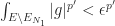
Let \epsilon>0. Since g\in L^{p'}, so g^{p'}\in L^1 and there exists \delta>0 such that for any measurable subset A\subseteq E with |A|<\delta, \int_A |g^{p'}|<\epsilon^{p'}.

Since f_k\to f a.e.\ (f is finite a.e.\ since f\in L^p), by Egorov’s Theorem there exists closed F\subseteq E such that |E\setminus F|<\delta and \{f_k\} converge uniformly to f on F. That is, there exists N(\epsilon) such that for k\geq N, |f_k(x)-f(x)|<\epsilon for all x\in F.

Then for k\geq N,
\begin{aligned}  \left|\int_E f_kg-fg\right|&\leq\int_E|f_k-f||g|\\  &=\int_{E\setminus F}|f_k-f||g|+\int_F|f_k-f||g|\\  &\leq\left(\int_{E\setminus F}|f_k-f|^p\right)^\frac{1}{p}\left(\int_{E\setminus F}|g|^{p'}\right)^\frac{1}{p'}+\epsilon\int_F |g|\\  &<\|f_k-f\|_p(\epsilon)+\epsilon\left(\int_F|g|^{p'}\right)^\frac{1}{p'}\left(\int_F |1|^p\right)^\frac{1}{p}\\  &\leq 2M\epsilon+\epsilon\|g\|_{p'}|E|^\frac{1}{p}\\  &=\epsilon(2M+\|g\|_{p'}|E|^\frac{1}{p}).  \end{aligned}

Since \epsilon>0 is arbitrary, this means \int_E f_g\to \int_E fg.

(Case: |E|=\infty). Error: See correction below.

Define E_N=E\cap B_N(0), where B_N(0) is the ball with radius N centered at the origin. Then |E_N|<\infty, so there exists N_1>0 such that for N\geq N_1, \int_{E_N}|f_k-f||g|<\epsilon.

Since |g|^{p'}\chi_{E_N}\nearrow|g|^{p'} on E, by Monotone Convergence Theorem, \displaystyle \lim_{N\to\infty}\int_{E_N}|g|^{p'}=\int_E |g|^{p'}<\infty.
Thus there exists N_2>0 such that for N\geq N_2, \int_{E\setminus E_N} |g|^{p'}<\epsilon^{p'}.

Then for N\geq\max\{N_1, N_2\},
\begin{aligned}  \int_E |f_kg-fg|&=\int_{E_N}|f_k-f||g|+\int_{E\setminus E_N}|f_k-f||g|\\  &<\epsilon+\left(\int_{E\setminus E_N}|f_k-f|^p\right)^\frac{1}{p}\left(\int_{E\setminus E_N}|g|^{p'}\right)^\frac{1}{p'}\\  &<\epsilon+\|f_k-f\|_p(\epsilon)\\  &\leq\epsilon+2M\epsilon\\  &=\epsilon(1+2M).  \end{aligned}
so that \int_E f_kg\to\int_E fg.

(Show that the result is false if p=1).

Let f_k:=k\chi_{[0,\frac 1k]}. Then f_k\to f a.e., where f\equiv 0. Note that \int_\mathbb{R} |f_k|=1, \int_\mathbb{R} |f|=0 so that f_k, f\in L^1(\mathbb{R}). Similarly, \|f_k\|_1\leq M=1.

However if g\equiv 1\in L^\infty, \int_\mathbb{R} f_kg=1 for all k but \int_\mathbb{R} fg=0.

Correction for the case |E|=\infty:

Define E_N=E\cap B_N(0), where B_N(0) is the ball with radius N centered at the origin.

Since |g|^{p'}\chi_{E_N}\nearrow |g|^{p'} on E, by Monotone Convergence Theorem, \displaystyle \lim_{N\to\infty}\int_{E_N}|g|^{p'}=\int_E|g|^{p'}<\infty.

Thus there exists N_1>0 such that \int_{E\setminus E_{N_1}}|g|^{p'}<\epsilon^{p'}.

Since |E_{N_1}|<\infty, by the finite measure case there exists N_2 such that for k\geq N_2, \displaystyle \int_{E_{N_1}}|f_k-f||g|<\epsilon.

So for k\geq N_2,
\begin{aligned}  \int_E|f_kg-fg|&=\int_{E_{N_1}}|f_k-f||g|+\int_{E\setminus E_{N_1}}|f_k-f||g|\\  &<\epsilon+\left(\int_{E\setminus E_{N_1}}|f_k-f|^p\right)^{1/p}\left(\int_{E\setminus E_{N_1}}|g|^{p'}\right)^{1/p'}\\  &<\epsilon+\|f_k-f\|_p(\epsilon)\\  &\leq\epsilon+2M\epsilon\\  &=\epsilon(1+2M).  \end{aligned}

so that \int_Ef_kg\to\int_E fg.

Relationship between L^p convergence and a.e. convergence

It turns out that convergence in Lp implies that the norms converge. Conversely, a.e. convergence and the fact that norms converge implies Lp convergence. Amazing!

Relationship between L^p convergence and a.e. convergence:
Let f, \{f_k\}\in L^p, 0<p\leq\infty. If \|f-f_k\|_p\to 0, then \|f_k\|_p\to\|f\|_p. Conversely, if f_k\to f a.e.\ and \|f_k\|_p\to\|f\|_p, 0<p<\infty, then \|f-f_k\|_p\to 0. Note that the converse may fail for p=\infty.

Proof:
Assume \|f-f_k\|_p\to 0.

(Case: 0<p<1).
Lemma 1:
If 0<p<1, |a+b|^p\leq|a|^p+|b|^p for all a,b\in\mathbb{R}.
Proof of Lemma 1:
\displaystyle 1=\frac{|a|}{|a|+|b|}+\frac{|b|}{|a|+|b|}\leq\left(\frac{|a|}{|a|+|b|}\right)^p+\left(\frac{|b|}{|a|+|b|}\right)^p=\frac{|a|^p+|b|^p}{(|a|+|b|)^p}.
Hence |a+b|^p\leq(|a|+|b|)^p\leq|a|^p+|b|^p.
End Proof of Lemma 1.
Hence, using |a|^p\leq|a-b|^p+|b|^p and |b|^p\leq|a-b|^p+|a|^p we see that \displaystyle ||a|^p-|b|^p|\leq|a-b|^p.

Thus
\begin{aligned}  \left|\|f_k\|_p^p-\|f\|_p^p\right|&=\left|\int(|f_k|^p-|f|^p)\right|\\  &\leq\int\left||f_k|^p-|f|^p\right|\\  &\leq\int|f_k-f|^p\\  &=\|f-f_k\|_p^p\to 0\ \ \ \text{as}\ k\to\infty.  \end{aligned}

Hence \|f_k\|_p\to\|f\|_p.

(Case: 1\leq p\leq\infty.)

By Minkowski’s inequality, \|f\|_p\leq\|f-f_k\|_p+\|f_k\|_p and \|f_k\|_p\leq\|f-f_k\|_p+\|f\|_p so that \displaystyle \left|\|f_k\|_p-\|f\|_p\right|\leq\|f-f_k\|_p\to 0 as k\to\infty. Done.

Converse:

Assume f_k\to f a.e.\ and \|f_k\|_p\to\|f\|_p, 0<p<\infty.
Lemma 2:
For a,b\in\mathbb{R}, |a+b|^p\leq 2^{p-1}(|a|^p+|b|^p) for 1\leq p<\infty.
Proof of Lemma 2:
By convexity of |x|^p for 1\leq p<\infty, \displaystyle \left|\frac 12 a+\frac 12 b\right|^p\leq\frac 12 |a|^p+\frac 12 |b|^p.
Multiplying throughout by 2^p gives \displaystyle |a+b|^p\leq 2^{p-1}(|a|^p+|b|^p).

Thus together with Lemma 1, for 0<p<\infty we have |f-f_k|^p\leq c(|f|^p+|f_k|^p) with c=\max\{2^{p-1}, 1\}.

Note that |f-f_k|^p\to 0 a.e.\ and \phi_k:=c(|f|^p+|f_k|^p)\to\phi:=2c|f|^p a.e.\ which is integrable. Also, \int\phi_k\to\int\phi since \|f_k\|_p^p\to\|f\|_p^p. By Generalized Lebesgue’s DCT, we have \int |f-f_k|^p\to 0 thus \displaystyle \|f-f_k\|_p\to 0.

(Show that the converse may fail for p=\infty):

Consider f_k=\chi_{[-k,k]}\in L^\infty(\mathbb{R}). Then f_k\to f a.e.\ where f(x)\equiv 1, and \|f_k\|_\infty\to\|f\|_\infty=1. However \|f-f_k\|_\infty=1\not\to 0.

98-Year-Old NASA Mathematician Katherine Johnson: ‘If You Like What You’re Doing, You Will Do Well’

Source: http://people.com/human-interest/nasa-katherine-johnson-mathematician-advice-interview/

Despite her age, Johnson isn’t slowing down anytime soon.

“I like to learn,” she says. “That’s an art and a science. I’m always interested in learning something new.”

As a young girl she’d stop by the library on her home way in the evening and would pick up a book.

“I finally persuaded them to let me look at two books,” she recalls. “I could have read more than that in one night if they had let me.”

Johnson’s life was the inspiration for a nonfiction book titled Hidden Figures: The American Dream and the Untold Story of the Black Women Mathematicians Who Helped Win the Space Race, which is now being turned into a major motion picture coming due theaters this December. (Empire star Taraji P. Henson will play Johnson.)

Johnson, who was given the Presidential Medal of Freedom by President Barack Obama in 2015,  thinks she was able to succeed because she always loved what she did. It’s one piece of advice she has for young girls today.

“Find out what her dream is,” she says, “and work at it because if you like what you’re doing, you will do well.”

Johnson also taught her daughters a few life lessons.

“Don’t accept failure,” says Joylette Goble, who says she has always been in awe of her mother. “If there is a job to be done, you can do it and do it until you finish.”

She adds: “Be aware of people and help them when you can.”

Johnson’s other daughter, Katherine Goble Moore, says her mother has always been her role model.

“I will always be grateful for her,” she says.

Bullies from St Andrew’s Secondary School

Source: http://www.todayonline.com/singapore/youths-viral-video-attack-identified

st_andrew_bully

(Screengrab: Bhai Hafiz Angullia/Facebook)

Just to inform parents of this terrible incident that occurred in Saint Andrew’s Secondary School. Apparently, this is not an isolated incident, it is quite an common occurence, it is even stated in Wikipedia: “After a series of bullying cases attracted attention in 2003, the school stated that the situation at St Andrew’s was no worse than at any other school, adding that bullies receive a stern warning; repeat offenders or those who injure others are caned and, ultimately, expelled.”

Do spread this post and comment on the original facebook page (with video): https://www.facebook.com/bhailaminate/videos/10210995333384134/. Parents who are choosing a secondary school for their child should also take note of this incident.

For this kind of extreme case, there is no need for the school to counsel/discipline the bullies anymore, just send them straight to Boys’ Home is the best thing to do.

#SayNoToBullies

Trump’s Speaking Math Formula

ChefCouscous's avatarMath Online Tom Circle

The lower in the score the better : Trump (4.1) beats Hillary (7.7) who beats Sanders (10.1)

Trump defied most expectation from the world to win the 2017 President of the USA. His victory over the much highly educated Ivy-league Yale lawyer-trained Hilary Clinton who speaks sophisticated English is “SIMPLE English”:
1-syllable words mostly: eg.dead, die, point, harm,…

2-syllable words to emphasize: eg.pro-blem, service, root cause, …

3-syllable words to repeat : eg. tre-men-dous

His speech is of Grade-4 level, reaching out to most lower-class blue-collar workers who can resonate with him. That is a powerful political skill of reaching to the mass. Hilary Clinton’s strength of posh English is her ‘fatal’ weakness vis-a-vis connecting to the mass.

In election time, it is common to see candidates who win the heart of voters by using the local dialects of the mass, never mind they are discouraged in…

View original post 6 more words

Curious Thoughts in Math & Science 

ChefCouscous's avatarMath Online Tom Circle

1. Statistical Mechanics: $latex e^ {- Ht} $

Quantum Mechanics: $latex e^{iHt}$

2. Ramanujian:

$latex 1 +2 + 3 + …+ n = -frac {1}{12} $

Tau Special Function:

$latex boxed {displaystyle sum_{n=1}^{infty}tau (n) x^{n} = x {(1-x)(1-x^{2})(1-x^{3})… }^{24}}$

3. Boolean Algebra: George Boole (1847 in 《The Mathematical Analysis of Logic》) used Symbolic variables (not numbers) for Logic, inspired by Galois (1832 in Groups & Finite Fields), Hamilton’s quaternion algebra (1843),

AND” $latex boxed {x.y}&fg=00bb00&s=3$

NOT” $latex boxed {1-x}&fg=00bb00&s=3$

XOR” $latex boxed {x+y-2x.y}&fg=00bb00&s=3$

Extra constraints ” $latex boxed {x^{2}=x}&fg=00bb00&s=3$

4. Solomon Golomb, Sol: “Linear Feedback Shift Register” (LFSR) – shift left the first register, fill in the back register with XOR of certain “Taps” (eg.chosen the 1st, 6th, 7th registers)

Maximal Length = The shift register of size n will repeat every $latex 2^{n}-1$ steps (exclude all ‘0’ sequence).

Which arrangement…

View original post 60 more words

Wheeden Zygmund Measure and Integration Solutions

Here are some solutions to exercises in the book: Measure and Integral, An Introduction to Real Analysis by Richard L. Wheeden and Antoni Zygmund.

Chapter 1,2: analysis1

Chapter 3: analysis2

Chapter 4, 5: analysis3

Chapter 5,6: analysis4

Chapter 6,7: analysis5

Chapter 8: analysis6

Chapter 9: analysis7


Measure and Integral: An Introduction to Real Analysis, Second Edition (Chapman & Hall/CRC Pure and Applied Mathematics)

Other than this book by Wheedon, also check out other highly recommended undergraduate/graduate math books.


Books to Transition from Math to Data Science

Graduating  soon and interested to transition to data science (dubbed the sexiest job of the 21st century)? We recommend two books which are very suitable for students with strong math background, but little or no background in data science/ machine learning.

Do check out the following data science / machine learning book (rated 4.5/5 on Amazon) Pattern Recognition and Machine Learning (Information Science and Statistics) which is an in-depth book on the fundamentals of machine learning. The author Christopher M. Bishop has a PhD in theoretical physics, and is the Deputy Director of Microsoft Research Cambridge.

The above book is good for building a solid, theoretical foundation for a data scientist job. The next book Hands-On Machine Learning with Scikit-Learn, Keras, and TensorFlow: Concepts, Tools, and Techniques to Build Intelligent Systems is ideal for learning hands-on practical coding for building machine learning (including deep learning) models. The author Aurélien Géron is a former Googler who was the tech lead for YouTube video classification.


Do you know how to prove sin(1/x)/x is not Lebesgue Integrable on (0,1]?

Also check out other popular Measure Theory exam question topics here:


Try Audible Plus (Free!)

Your free, 30-day trial comes with:

  • The Amazon Audible Plus Catalog of podcasts, audiobooks, guided wellness, and Audible Originals. Listen all you want, no credits needed.
  • Be more productive by listening to audiobooks during your daily commute to school or work!

Absolute Continuity of Lebesgue Integral

The following is a wonderful property of the Lebesgue Integral, also known as absolute continuity of Lebesgue Integral. Basically, it means that whenever the domain of integration has small enough measure, then the integral will be arbitrarily small.

Suppose f is integrable.
Given \epsilon>0, there exists \delta>0 such that for all measurable sets B\subseteq E with |B|<\delta, |\int_B f\,dx|<\epsilon.

Proof:
Define A_k=\{x\in E: \frac 1k\leq|f(x)|<k\} for k\in\mathbb{N}. Each A_k is measurable and A_k\nearrow A:=\bigcup_{k=1}^\infty A_k. Note that \displaystyle \int_E |f|=\int_{\{f=0\}}|f|+\int_A |f|+\int_{\{f=\infty\}}|f|=\int_A |f|.

Let f_k=|f|\chi_{A_k}. Then \{f_k\} is a sequence of non-negative functions such that f_k\nearrow |f|\chi_A. By Monotone Convergence Theorem, \lim_{k\to\infty}\int_E f_k=\int_E |f|\chi_A, that is, \displaystyle \lim_{k\to\infty}\int_{A_k}|f|\,dx=\int_A |f|\,dx=\int_E |f|\,dx.

Let N>0 be sufficiently large such that \int_{E\setminus A_N}|f|\,dx<\epsilon/2.

Let \delta=\frac{\epsilon}{2N}, and suppose |B|<\delta. Then
\begin{aligned}  |\int_B f\,dx|&\leq\int_B |f|\,dx\\  &=\int_{(E\setminus A_N)\cap B}|f|\,dx+\int_{A_N\cap B}|f|\,dx\\  &\leq\int_{E\setminus A_N}|f|\,dx+\int_{A_N\cap B}N\,dx\\  &<\epsilon/2+N\cdot|A_N\cap B|\\  &\leq\epsilon/2+N\cdot|B|\\  &<\epsilon/2+N\cdot\frac{\epsilon}{2N}\\  &=\epsilon.  \end{aligned}

感动中国的“拾荒老人”–韦思浩

Inspirational Story of Lifelong learner Wei Sihao, who loves books and learning. After retirement, his favorite spot is the library, and he collects garbage to fund students who can’t afford university. Passed away in 2015 in a car accident. Rest in peace. (Text in Chinese)

chinesetuition88's avatarChinese Tuition Singapore

之前,一则《杭州图书馆向流浪汉开放,拾荒者借阅前自发洗手》的新闻在网络上迅速传播。

http://js.ifeng.com/humanity/cul/detail_2014_11/24/3194502_0.shtml

而报道中的图片可以看到一位拾荒老人


安静地读书,认真地洗手。

后来,这位老人的真正身份才得以曝光:
韦思浩是原杭州大学(现浙江大学)1957级的学生。

上世纪80年代,韦思浩曾参与过《汉语大词典》杭大编写组工作,后又辗转去宁波教书。

1999年,韦思浩从杭州夏衍中学退休,也是从那一年,韦思浩放弃了他本来轻松的晚年生活,开始他长达十多年的“拾荒”之旅。

2015年11月18日,韦思浩在过马路的时候,被一辆出租车撞倒,12月13日,最终抢救无效离世。
韦思浩是原杭州大学(现浙江大学)1957级的学生。

上世纪80年代,韦思浩曾参与过《汉语大词典》杭大编写组工作,后又辗转去宁波教书。

1999年,韦思浩从杭州夏衍中学退休,也是从那一年,韦思浩放弃了他本来轻松的晚年生活,开始他长达十多年的“拾荒”之旅。

2015年11月18日,韦思浩在过马路的时候,被一辆出租车撞倒,12月13日,最终抢救无效离世。

相关新闻编辑

2014年11月,《杭州图书馆向流浪汉开放,拾荒者“看书前”自发洗手》,曾引起很多人关注。

2014年,因给拾荒者提供阅读空间,杭州图书馆被网友评为“最温暖图书馆”。当时,媒体报道中,一位外貌看似拾荒者的老人因“看书前洗手”的细节感动了不少网友。这位老人名叫韦思浩,是上世纪六十年代老杭州大学中文系的毕业生。

韦思浩老人退休前是中学的一级教师,退休后拿着5600多元的退休金,本可安心养老,但他却选择拾荒“补贴”日子。不过,他“补贴”不是自家生活,而是那些读不起书的孩子们。

2015年11月18日晚上六点,杭州下雨,老人打着一把伞,跟往常拾荒者打扮一样,一根竹竿挑着两个口袋,但就在过斑马线时,被一辆出租车撞上,当场昏迷,被紧急送往附近医院。

老人在重症监护室治疗了二十多天,一直处于深度昏迷。12月13号,虽然经过医院极力抢救,但老人多个器官衰竭,仍然没能挽回生命。[2]

在整理老人遗物时,韦思浩的三个女儿才发现老人拾荒的秘密。

“以前从不知道父亲在拾荒,更没想到他还在帮助其他人。”韦思浩二女儿韦汀坦言,“去年搬过一次家,捐资助学的票据和证书已经不全。但留下来的这些就能看出他一直在匿名捐赠。”

韦汀向记者展示这些捐赠凭据和证书:浙江省社会团体收费专用票据、浙江省希望工程结对救助报名卡、扶贫公益助学金证书……

http://baike.baidu.com/link?url=-ijjs3QFeFnJX22sHS7aGhaVLqGuOLQy-XTcvH4Cb86aTscYlSIWDx4RSfAxu-KeL66-keKUokXt63vu_xmibEfqKEE1jPKWIdt0ZKmisdksxLB7GVf7svVngQJxfhx6

View original post

Inequalities for pth powers, where 0<p<infinity

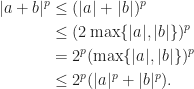
There are some useful inequalities for |x+y|^p, where p is a number ranging from 0 to infinity. These are the top 3 useful inequalities (note some of them only work for p less than 1, or p greater than 1).

1)
For a,b\in\mathbb{R}, |a+b|^p\leq 2^p(|a|^p+|b|^p), where 0<p<\infty.

Proof:
\begin{aligned}  |a+b|^p&\leq(|a|+|b|)^p\\  &\leq(2\max\{|a|,|b|\})^p\\  &=2^p(\max\{|a|,|b|\})^p\\  &\leq 2^p(|a|^p+|b|^p).  \end{aligned}

2)
If 0<p<1, |a+b|^p\leq|a|^p+|b|^p for all a,b\in\mathbb{R}.

Proof:
\displaystyle 1=\frac{|a|}{|a|+|b|}+\frac{|b|}{|a|+|b|}\leq\left(\frac{|a|}{|a|+|b|}\right)^p+\left(\frac{|b|}{|a|+|b|}\right)^p=\frac{|a|^p+|b|^p}{(|a|+|b|)^p}.
Hence |a+b|^p\leq(|a|+|b|)^p\leq|a|^p+|b|^p.

3)
For a,b\in\mathbb{R}, |a+b|^p\leq 2^{p-1}(|a|^p+|b|^p) for 1\leq p<\infty.

Proof:
By convexity of |x|^p for 1\leq p<\infty, \displaystyle \left|\frac 12 a+\frac 12 b\right|^p\leq\frac 12 |a|^p+\frac 12 |b|^p.
Multiplying throughout by 2^p gives \displaystyle |a+b|^p\leq 2^{p-1}(|a|^p+|b|^p).

Category Theory for Functional Programming

tomcircle's avatarMath Online Tom Circle

image

Key Motivations for Category Theory 范畴 :
1. Programming is Math.
2. Object-Oriented is based on Set Theory which has 2 weaknesses:
◇ Set has contradiction: The “Russell’s Paradox”.
Data Immutability for Concurrent Processing : OO can’t control the mutable state of objects, making debugging impossible.

Category (“cat“) has 3 properties:
1. Objects
eg. Set, List, Group, anything…
2. Arrows (“Morphism”, between Objects) which are Associative
eg. functions etc
3. Identity Object

Note: If the Identity is “0” or “Nothing”, then it is called Free Category.

Extensions :
1. “Cat” = Category of categories, is also a category.
2. Functor 函子 = Arrows between Categories.
3. Monoid = A Category with ONLY 1 Object.

image

image

Monoid (么半群) is a very powerful concept (used in Natural Language Processing) — basically it is a Group with No Inverse (Mo‘No‘-‘I‘-d)

image

image

View original post

Mathematics: The Next Generation

tomcircle's avatarMath Online Tom Circle

Math has been taught wrongly since young, either is boring, or scary, or mechanically (calculating). This lecture by Queen Mary College (U. London) Prof Cameron is one of the rare Mathematician changing that pedagogy. Math is a “Universal Language of Truths” with unambiguous, logical syntax which transcends over eternity.

I like the brilliant idea of making the rigorous Math foundation compulsory for all S.T.E.M. (Science, Technology, Engineering, Math) undergraduate students. Prof S.S. Chern (Wolf Prize) after retirement in Nankai University (China) also made basic “Abstract Algebra” course compulsory for all Chinese S.T.E.M. undergraduates.

The foundations Prof Cameron teaches are centered around 4 Math Objects:

1. SETS
– Founding block of the 20th century modern math, made into world’s university textbooks which were influenced by the French “Bourbaki” school after WW1.

2. FUNCTIONS
– A vision first proposed by the German Gottingen School’s greatest Math Educator Felix Klein, who said Function…

View original post 82 more words

Aut(G)=Aut(H)xAut(K), where H, K are characteristic subgroups of G with trivial intersection

Let G=HK, where H, K are characteristic subgroups of G with trivial intersection, i.e. H\cap K=\{e\}. Then, Aut(G)=Aut(H)\times Aut(K).

Proof:

Now suppose G=HK, where H and K are characteristic subgroups of G with H\cap K=\{e\}. Define \Psi:\text{Aut}(G)\to\text{Aut}(H)\times\text{Aut}(K) by \displaystyle \Psi(\sigma)=(\sigma|_H, \sigma|_K).

\sigma|_H:H\to H is a homomorphism, and bijective since \sigma|_H(H)=H. Thus \sigma|_H\in\text{Aut}(H) and similarly, \sigma|_K\in\text{Aut}(K) so that \Psi is well-defined.

Note that \displaystyle \Psi(\sigma_1\sigma_2)=((\sigma_1\sigma_2)|_H, (\sigma_1\sigma_2)|_K)=(\sigma_1|_H,\sigma_1|_K)(\sigma_2|_H,\sigma_2|_K)=\Psi(\sigma_1)\Psi(\sigma_2) so \Psi is a homomorphism.

Suppose \sigma\in\ker\Psi. Then \Psi(\sigma)=(\sigma|_H,\sigma|_K)=(\text{id}_H,\text{id}_K). Then for hk\in G, \sigma(hk)=\sigma(h)\sigma(k)=hk so that \sigma=\text{id}_G. Thus \Psi is injective.

For any (\phi, \psi)\in\text{Aut}(H)\times\text{Aut}(K), define \sigma(hk)=\phi(h)\psi(k). Then
\begin{aligned}  \sigma(h_1k_1h_2k_2)&=\sigma(h_1h_2k_1k_2)\\  &\text{(}H, K\ \text{normal and}\ H\cap K=\{e\}\ \text{implies elements of}\ H, K\ \text{commute)}\\  &=\phi(h_1h_2)\psi(k_1k_2)\\  &=\phi(h_1)\phi(h_2)\psi(k_1)\psi(k_2)\\  &=\phi(h_1)\psi(k_1)\phi(h_2)\psi(k_2)\\  &=\sigma(h_1k_1)\sigma(h_2k_2).  \end{aligned}
So \sigma is a homomorphism.

If hk\in\ker\sigma, then \phi(h)\psi(k)=e, so that \phi(h)=(\psi(k))^{-1}. Then since H\cap K=\{e\}, so \phi(h)=\psi(k)=e, so that h=k=e. Thus \ker\sigma=\{e\} and \sigma is injective.

Any h\in H can be written as \phi(h') since \phi is bijective. Similarly, any k\in K can be written as \psi(k'). Then \sigma(h'k')=\phi(h')\psi(k')=hk so \sigma is surjective.

Thus \sigma\in\text{Aut}(G). Note that \sigma|_H=\phi since \sigma|_H(h)=\sigma(h\cdot 1)=\phi(h)\psi(1)=\phi(h). Similarly, \sigma|_K=\psi. So \Psi(\sigma)=(\phi,\psi) and \Psi is surjective.

Hence \Psi is an isomorphism.

Support

Mathtuition88.com is a Math Education Blog that aims to provide useful Math / Education content that helps people worldwide.

Over the years, Mathtuition88.com has grown to reach 500,000 total views, thanks to support of fans!

If you find our website useful, please consider supporting it in one of the following ways. Thanks!

1) Link back to our page (mathtuition88.com)

Every hyperlink counts! It could be a reblog, tweet, facebook, or a link in your blog. It doesn’t cost a cent, yet it is extremely important to the growth of the website.

2) Patreon

Our patreon page is at: https://www.patreon.com/user?u=4235868

3) Buy yourself a gift at Amazon

Purchase any item at Amazon using this link: Amazon.

4) Buy a Math Resource

Our sales page is here: https://mathtuition88.com/math-notes-worksheets-sale/

5) Advertise on our website

Our advertisement page is here: https://mathtuition88.com/sponsored-post-advertisement/

Thank you once again for your support.

How to Remember the 8 Vector Space Axioms

Vector Space has a total of 8 Axioms, most of which are common-sense, but can still pose a challenge for memorizing by heart.

I created a mnemonic “MAD” which helps to remember them.

M for Multiplicative Axioms:

  1. 1x=x (Scalar Multiplication identity)
  2. (ab)x=a(bx) (Associativity of Scalar Multiplication)

A for Additive Axioms: (Note that these are precisely the axioms for an abelian group)

  1. x+y=y+x (Commutativity)
  2. (x+y)+z=x+(y+z) (Associativity for Vector Addition)
  3. x+(-x)=0 (Existence of Additive Inverse)
  4. x+0=0+x=0 (Additive Identity)

D for Distributive Axioms:

  1. a(x+y)=ax+ay (Distributivity of vector sums)
  2. (a+b)x=ax+bx (Distributivity of scalar sums)

How to Remember the 10 Field Axioms

There are a total of 10 Axioms for Field, it can be quite a challenge to remember all 10 of them offhand.

I created a mnemonic “ACIDI” to remember the 10 axioms. Unfortunately it is not a real word, but is close to the word “acidic”. A picture to remember is “acidic field”, a grass field polluted by acid rain?! 😛

A: Associativity
C: Commutativity
I: Identity
D: Distributivity
I: Inverse

Each of the properties has two parts – Addition and Multiplication. This table from Wolfram summarizes it perfectly:

name addition multiplication
associativity (a+b)+c=a+(b+c) (ab)c=a(bc)
commutativity a+b=b+a ab=ba
distributivity a(b+c)=ab+ac (a+b)c=ac+bc
identity a+0=a=0+a a·1=a=1·a
inverses a+(-a)=0=(-a)+a aa^(-1)=1=a^(-1)a if a!=0

What exactly is a Limit ?

tomcircle's avatarMath Online Tom Circle

$latex displaystylelim_{xto a}f(x) = L
iff$
$latex forall varepsilon >0, exists delta >0 $ such that
$latex boxed{0<|x-a|<delta}
implies |f(x)-L|< varepsilon $

The above scary ‘epsilon-delta’ definition of “Limit” by the French mathematician Cauchy in 19th century is the standard rigorous definition in today’s Analysis textbooks.

It was not taught in my Cambridge GCE A-Level Pure Math in 1970s (still true today), but every French Baccalaureate Math student (Terminale,  equivalent to JC 2 or Pre-U 2) knows it by heart. A Cornel University Math Dean recalled how he was told by his high-school teacher to memorise it — even though he did not fully understand — the “epsilon-delta” definition by “chanting”:

“for all epsilon, there is a delta ….”

(French: Quelque soit epsilon, il existe un delta …)

In this video, I am glad someone like Prof N. Wildberger recognised its “flaws”  albeit rigorous, by suggesting another more intuitive…

View original post 64 more words

Inspirational: How can someone who has underachieved for years change their course and exceed their potential?

Source: https://www.quora.com/How-can-someone-who-has-underachieved-for-years-change-their-course-and-exceed-their-potential

Do check out this very inspirational post on Quora.

Excerpt:

I was about as under achieving as you could get.

Barely graduated from high school. Suspended, arrested, etc.

Luckily I went to an awesome community college and they turned me around.

The full story is here: https://www.linkedin.com/pulse/2…

Given one of the suggestions, here’s the speech:

Failure is our only option

Have you ever been in one of those moments where you realized that gee, what’s the harm if I take the quick shortcut, who’s going to notice? (of course none of you did anything like that while here at Maryland) Well, I decided to take the opportunity to give myself an edge. As a Silicon Valley tech guy, I decided to use technology and the world to help me prepare for this commencement address. So, I asked people on LinkedIn, Facebook, Twitter, and Quora to figure out what wise words you should be imparted with and also what they remember from their graduation speakers. You know what most people remember? Nothing! Zilch! Nada!

So knowing this, I realized, I can say anything I want! Although, I’m sure someone will post this on YouTube. But seriously, as I got feedback from around the world and wracked my brain about what to say, one theme began to emerge.

On your day of such great accomplishment, I’d like to talk about something we rarely celebrate: failure. And why we are counting on you to fail. Now bear with me, and you’ll see where I’m going.

We’re all products of failure. You don’t remember it, but your parents definitely do. From the first time you rolled over, to your first steps. These successes were a culmination of failures. Need further proof? Make sure to ask them over dinner to recount your potty training.

The funny thing is you can read all about me in the bio or my LinkedIn profile and you’ll see that I received my Ph.D in Applied Math from here 11 years ago. I’ve worked for the Department of Defense and been to Kazakhstan. But you won’t see all the failures that made up the journey. What you can’t see from my Facebook or LinkedIn page are what’s behind the most important moments of success all the failures.

While growing up in California, to simply say I was bad at Math would have been an understatement. My freshman year of high school, I was kicked out of my algebra class and had to spend the summer retaking it. This (unfortunately) would become my regular paradigm for the next few years. By the time high school graduation came around, two things happened to me.

First, I almost didn’t graduate. For the record, I did actually graduate, but it was only because a very kind administrator took pity on me and changed my failing grade in chemistry to a passing one.

Second, I got a girlfriend. Since I didn’t get into any of the colleges I liked, I opted to go to the local Junior College with her. Do you remember that moment when you first got here and tried to figure out what classes you’re supposed to take? Well, I had a winning strategy. I enrolled in all the same classes my she was taking.

One problem, the first class was Calculus. Wow, did I get my ass kicked that first day. It was then I realized that I wasn’t just stupid; I was really stupid.

As I looked around at everyone else nodding along with the instructor (including my girlfriend), it dawned on me, I hadn’t failed because of the teachers or the material. No, I failed because I didn’t try. I didn’t even put my self in a position to fail.

I was fundamentally afraid of being uncomfortable and having to address the failure that comes with it.

To me it was like when you get to the top of the high dive, walk out the edge, looking down that the clear blue water (you can even see the dark lines at the bottom of the pool) everyone telling you to jump, and then running back down the steps. I couldn’t commit.

So what did I do about my Calculus class? I committed. Instead of dropping out (my usual method), I went straight to the local library and checked out all the high school math books I could find. I then spent the next week going through them. And it was awesome. Suddenly I was failing at a problem, figuring out what I did wrong, and then course correcting. This feeling of being able to iterate was very new to me.

Now, five weeks later that same girlfriend asked me one afternoon why I was spending so much time on my math homework. It was then that I uttered the fateful words that I will never forget:

“I don’t know – It’s not like I’m going to become a math major or something”

Much to my great surprise, I ended up becoming a Math major. (Actually, I think my parents are still surprised). Then the same thing happened when I got here to the University of Maryland for my graduate work. I got my ass kicked by everyone, again. I failed my first graduate class and even got the 2 lowest score on my first Ph.D. qualifying exam. (The lowest score was actually by a guy who didn’t even show up.) I really, reallywanted to quit, but that wouldn’t be the uncomfortable path.

So I stayed in the game by failing, getting back up, and continuing to push forward. It was probably one of the toughest and loneliest years of my life. The next time the qualifiers came around, however, I had the highest scores.

The big take away I have from this is that tenacity and failure go hand in hand. Without both, you can’t move forward.

Math Foundations

tomcircle's avatarMath Online Tom Circle

MathFoundations (all videos): http://www.youtube.com/playlist?list=PL5A714C94D40392AB

All the Math we learn are taught as such by teachers and professors, but why so? what are the foundations ? These 200 videos answer them !

Good for students to appreciate Math and, hopefully, they will love the Math subject after viewing most of these 200 great videos.

Video 1: Natural Number This should be taught in kindergartens to 3-year-old kids.

◇ What is number ? (strings of 1s),
◇ Equal, bigger, smaller concepts are “pairing up” (1-to-1 mapping) two strings of 1s.
◇ Don’t teach the kids how to write first 12345…, without prior building these mathematical foundational concepts.
.
.
.
Video 106: What is a Limit ?

$latex displaystylelim_{xto a}f(x) = L
iff$
$latex forall varepsilon >0, exists delta >0 $ such that
$latex boxed{0<|x-a|<delta}
implies |f(x)-L|< varepsilon $

The above scary ‘epsilon-delta’ definition of “Limit” by the French mathematician Cauchy in…

View original post 115 more words

Composition of Continuously Differentiable Function and Function of Bounded Variation

Assume \phi is a continuously differentiable function on \mathbb{R} and f is a function of bounded variation on [0,1]. Then \phi(f) is also a function of bounded variation on [0,1].

Proof:

\displaystyle V_a^b(\phi(f))=\sup_{P\in\mathcal{P}}\sum_{i=0}^{N_P-1}|\phi(f(x_{i+1}))-\phi(f(x_i))| where \displaystyle \mathcal{P}=\{P|P:a=x_0<x_1<\dots<x_{N_P}=b\ \text{is a partition of}\ [a,b]\}.

By Mean Value Theorem, \displaystyle |\phi(f(x_{i+1}))-\phi(f(x_i))|=|f(x_{i+1})-f(x_i)||\phi'(c)| for some c\in(x_i, x_{i+1}).

Since \phi' is continuous, it is bounded on [0,1], say |\phi'(x)|\leq K for all x\in[0,1]. Thus
\begin{aligned}  V_a^b(\phi(f))&=\sup_{P\in\mathcal{P}}\sum_{i=0}^{N_P-1}|\phi(f(x_{i+1}))-\phi(f(x_i))|\\  &\leq K\sup_{P\in\mathcal{P}}\sum_{i=0}^{N_P-1}|f(x_{i+1})-f(x_i)|\\  &=KV_a^b(f)\\  &<\infty.  \end{aligned}

Fatou’s Lemma for Convergence in Measure

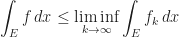
Suppose f_k\to f in measure on a measurable set E such that f_k\geq 0 for all k, then \displaystyle\int_E f\,dx\leq\liminf_{k\to\infty}\int_E f_k\,dx.

The proof is short but slightly tricky:

Suppose to the contrary \int_E f\,dx>\liminf_{k\to\infty}\int_E f_k\,dx. Let \{f_{k_l}\} be a subsequence such that \displaystyle \lim_{l\to\infty}\int f_{k_l}=\liminf_{k\to\infty}\int_E f_k<\int_E f
(using the fact that for any sequence there is a subsequence converging to \liminf).

Since f_{k_l}\xrightarrow{m}f, there exists a further subsequence f_{k_{l_m}}\to f a.e. By Fatou’s Lemma, \displaystyle \int_E f\leq\liminf_{m\to\infty}\int_E f_{k_{l_m}}=\lim_{l\to\infty}\int f_{k_l}<\int_E f, a contradiction.

The last equation above uses the fact that if a sequence converges, all subsequences converge to the same limit.

H2 Math Promo Practice Papers (from Actual School Papers) + H2 Formula Helpsheet

Preparing for your H2 Maths Promo Exams?

Check out this package consisting of Practice Papers (from Actual School Questions), and also a H2 Formula Helpsheet consisting of helpful formula that you need to know in order to do the questions!

URL: Check out out Free Exam Papers page for more updated information on H2 Math Exam Papers.

11 Practice Papers, with Solutions
New Syllabus* (2017 Syllabus / Syllabus 9758)
H2 Helpsheet with formulae ranging from Pure Math to Statistics

*We have crossed out irrelevant questions from the old syllabus, and replaced them with relevant questions from the new syllabus.


Update: Check out the best H2 guidebooks available in the market! Much better than many “elite school” notes which cover too much irrelevant stuff that are not tested!

URL: Recommended A-Level H2 Assessment Books and Guidebooks

Lebesgue’s Dominated Convergence Theorem for Convergence in Measure

Lebesgue’s Dominated Convergence Theorem for Convergence in Measure

If \{f_k\} satisfies f_k\xrightarrow{m}f on E and |f_k|\leq\phi\in L(E), then f\in L(E) and \int_E f_k\to\int_E f.

Proof

Let \{f_{k_j}\} be any subsequence of \{f_k\}. Then f_{k_j}\xrightarrow{m}f on E. Thus there is a subsequence f_{k_{j_l}}\to f a.e.\ in E. Clearly |f_{k_{j_l}}|\leq\phi\in L(E).

By the usual Lebesgue’s DCT, f\in L(E) and \int_E f_{k_{j_l}}\to\int_E f.

Since every subsequence of \{\int_E f_k\} has a further subsequence that converges to \int_E f, we have \int_E f_k\to\int_E f.

Basel Problem using Fourier Series

A very famous mathematical problem known as the “Basel Problem” is solved by Euler in 1734. Basically, it asks for the exact value of \sum_{n=1}^\infty\frac{1}{n^2}.

Three hundred years ago, this was considered a very hard problem and even famous mathematicians of the time like Leibniz, De Moivre, and the Bernoullis could not solve it.

Euler showed (using another method different from ours) that \displaystyle \sum_{n=1}^\infty\frac{1}{n^2}=\frac{\pi^2}{6}, bringing him great fame among the mathematical community. It is a beautiful equation; it is surprising that the constant \pi, usually related to circles, appears here.

Squaring the Fourier sine series

Assume that \displaystyle f(x)=\sum_{n=1}^\infty b_n\sin nx.

Then squaring this series formally,
\begin{aligned}  (f(x))^2&=(\sum_{n=1}^\infty b_n\sin nx)^2\\  &=\sum_{n=1}^\infty b_n^2\sin^2 nx+\sum_{n\neq m}b_nb_m\sin nx\sin mx.  \end{aligned}

To see why the above hold, see the following concrete example:
\begin{aligned}  (a_1+a_2+a_3)^2&=(a_1^2+a_2^2+a_3^2)+(a_1a_2+a_1a_3+a_2a_1+a_2a_3+a_3a_1+a_3a_2)\\  &=\sum_{n=1}^3 a_n^2+\sum_{n\neq m}a_na_m.  \end{aligned}

Integrate term by term

We assume that term by term integration is valid.
\displaystyle \frac 1\pi\int_{-\pi}^\pi (f(x))^2\,dx=\frac 1\pi\int_{-\pi}^{\pi}\sum_{n=1}^\infty b_n^2\sin^2{nx}\,dx+\frac{1}{\pi}\int_{-\pi}^\pi\sum_{n\neq m}b_nb_m\sin nx\sin mx\,dx.

Recall that \displaystyle \int_{-\pi}^\pi \sin nx\sin mx\,dx=\begin{cases}0 &\text{if }n\neq m\\  \pi &\text{if }n=m  \end{cases}.

So
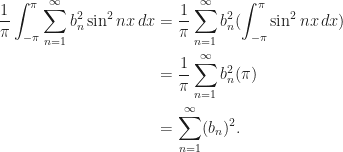
\begin{aligned}  \frac 1\pi\int_{-\pi}^{\pi}\sum_{n=1}^\infty b_n^2\sin^2{nx}\,dx&=\frac 1\pi\sum_{n=1}^\infty b_n^2(\int_{-\pi}^\pi\sin^2 nx\,dx)\\  &=\frac 1\pi\sum_{n=1}^\infty b_n^2 (\pi)\\  &=\sum_{n=1}^\infty (b_n)^2.  \end{aligned}

Similarly
\begin{aligned}  \frac{1}{\pi}\int_{-\pi}^\pi\sum_{n\neq m}b_nb_m\sin nx\sin mx\,dx&=\frac 1\pi\sum_{n\neq m}b_nb_m(\int_{-\pi}^{\pi}\sin nx\sin mx\,dx)\\  &=\frac 1\pi\sum_{n\neq m}b_nb_m(0)\\  &=0.  \end{aligned}

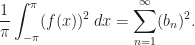
So \displaystyle \frac 1\pi\int_{-\pi}^\pi (f(x))^2\,dx=\sum_{n=1}^\infty (b_n)^2. (Parseval’s Identity)

Apply Parseval’s Identity to f(x)=x

By Parseval’s identity,
\displaystyle \frac{1}{\pi}\int_{-\pi}^\pi x^2\,dx=\sum_{n=1}^\infty(\frac{2(-1)^{n+1}}{n})^2.

Simplifying, we get \displaystyle \frac 1\pi\cdot\left[\frac{x^3}{3}\right]_{-\pi}^\pi=\sum_{n=1}^\infty\frac{4}{n^2}.
\begin{aligned}  \frac 1\pi(\frac{2\pi^3}{3})&=\sum_{n=1}^\infty \frac{4}{n^2}\\  \frac{\pi^2}{6}&=\sum_{n=1}^\infty\frac{1}{n^2}.  \end{aligned}

China Eastern website not working

Currently, all versions of China Eastern Airlines 东方航空 websites (e.g. http://sg.ceair.com/, hk.ceair, etc) are not working.

I tried searching for a ticket in December and an error message popped out: We apologize that there are insufficient seats on ## segment of your searched flight. Please change the search options. Thank you for your cooperation!

I called the customer service and they confirmed that it is an error (their system shows that there are indeed still plenty of seats). Hope they fix it soon.

Circle in Different Representations

tomcircle's avatarMath Online Tom Circle

Affine Line: $latex {mathbb {A}^1}&s=3$

Six Representations of a Circle: $latex {mathbb {S}^1}&s=3$
1) Euclidean Geometry
Unit Circle : $latex x^2 + y^2 = 1$

2) Curve:
Transcendental Parameterization :
$latex boxed { e(theta) = (cos theta, sin theta) qquad
0 leq theta leq 2pi }&fg=aa0000&s=3
$

Rational Parameterisation :
$latex boxed {
e(h) = left(frac {1-h^2} {1+h^2} : , : frac {2h} {1+h^2}right) quad text { h any number or } infty
} &fg=aa0000&s=2
$

image

3) Affine Plane $latex {mathbb {A}^2}&s=3$
1-dim sub-Space = Lines thru Origin

image
4) Polygonal Representation

5) Identifying Intervals: (closed loop)
image

6) $latex text {Translation } (tau, {tau}^{-1}) text { on a Line } $ $latex {mathbb {A}^1}&s=3$

$latex boxed {
{mathbb {S}^1} = {mathbb {A}^1 } Big/ { langle tau , {tau}^{-1} rangle}
}&fg=aa0000&s=3
$
$latex {mathbb {S}^1} = text { Space of all orbits} $

image

View original post

Inspirational Chinese Phrase 宠辱不惊

Source: http://www.ypzihua.com/product-2793.html

chongrubujing

Beautiful calligraphy and meaningful words.

Chinese Characters: 宠辱不惊 闲看庭前花开花落 去留无意 漫随天外云卷云舒

Translation: “Don’t be disturbed by fortune or misfortune. Be relaxed no matter how flowers bloom and wilt. To be or not to be needs no hard decision. Take it natural no matter how clouds flow high and low.” (Source: http://www.en84.com/dianji/minyan/201410/00015499.html)

Generalized Lebesgue Dominated Convergence Theorem Proof

This key theorem showcases the full power of Lebesgue Integration Theory.

Generalized Lebesgue Dominated Convergence Theorem

Let \{f_k\} and \{\phi_k\} be sequences of measurable functions on E satisfying f_k\to f a.e. in E, \phi_k\to \phi a.e. in E, and |f_k|\leq\phi_k a.e. in E. If \phi\in L(E) and \int_E \phi_k\to\int_E \phi, then \int_E |f_k-f|\to 0.

Proof

We have |f_k-f|\leq|f_k|+|f|\leq\phi_k+\phi. Applying Fatou’s lemma to the non-negative sequence \displaystyle h_k=\phi_k+\phi-|f_k-f|, we get \displaystyle 2\int_E\phi\leq\liminf_{k\to\infty}\int_E (\phi_k+\phi-|f_k-f|).
That is, \displaystyle 2\int_E \phi\leq2\int_E\phi-\limsup_{k\to\infty}\int_E |f_k-f|.

Since \int_E\phi<\infty, we get \limsup_{k\to\infty}\int_E |f_k-f|\leq 0. Since \liminf_{k\to\infty}\int_E |f_k-f|\geq 0, this implies \lim_{k\to\infty}\int_E |f_k-f|=0.

Simplicial Complex

tomcircle's avatarMath Online Tom Circle

Simplices:
0-dim (Point) $latex triangle_0 $
1-dim (Line) $latex triangle_1 $
2-dim (Triangle) $latex triangle_2 $
3-dim (Tetrahedron) $latex triangle_3 $

Simplicial Complex: built by various Simplices under some rules.

Definitions of Simplex (S)
Face
Orientation
Boundary ($latex delta $)
$latex displaystyle boxed {
delta(S) = sum_{i=0}^{n} (-1)^i (v_0 …hat v_i …v_n)}&fg=aa0000&s=3
$

image

Theorem: $latex boxed { delta ^2 (S) = 0}&fg=00bb00&s=4 $

View original post

Why We Should Stop Grading Students on a Curve

A very nice article against the philosophy of the bell curve, which is a prominent feature of examinations all over the world, including Singapore. I am sure that when Gauss invented the bell curve, he didn’t intend it to be used for examinations!

Source: http://www.nytimes.com/2016/09/11/opinion/sunday/why-we-should-stop-grading-students-on-a-curve.html?_r=0

Excerpts:

The goal is to fight grade inflation, but the forced curve suffers from two serious flaws. One: It arbitrarily limits the number of students who can excel. If your forced curve allows for only seven A’s, but 10 students have mastered the material, three of them will be unfairly punished. (I’ve found a huge variation in overall performance among the classes I teach.)

The more important argument against grade curves is that they create an atmosphere that’s toxic by pitting students against one another. At best, it creates a hypercompetitive culture, and at worst, it sends students the message that the world is a zero-sum game: Your success means my failure.

Exhibit B: I spent a decade studying the careers of “takers,” who aim to come out ahead, and “givers,” who enjoy helping others. In the short run, across jobs in engineering, medicine and sales, the takers were more successful. But as months turned into years, the givers consistently achieved better results.

The results: Their average scores were 2 percent higher than the previous year’s, and not because of the bonus points. We’ve long knownthat one of the best ways to learn something is to teach it. In fact, evidence suggests that this is one of the reasons that firstborns tend to slightly outperform younger siblings on grades and intelligence tests: Firstborns benefit from educating their younger siblings. The psychologists Robert Zajonc and Patricia Mullally noted in a review of the evidence that “the teacher gains more than the learner in the process of teaching.

Finite group generated by two elements of order 2 is isomorphic to Dihedral Group

Suppose G=\langle s,t\rangle where both s and t has order 2. Prove that G is isomorphic to D_{2m} for some integer m.


Note that G=\langle st, t\rangle since (st)t=s. Since G is finite, st has a finite order, say m, so that (st)^m=1_G. We also have [(st)t]^2=s^2=1.

We claim that there are no other relations, other than (st)^m=t^2=[(st)t]^2=1.

Suppose to the contrary sts=1. Then sstss=ss, i.e. t=1, a contradiction. Similarly if ststs=1, tsststsst=tsst implies s=1, a contradiction. Inductively, (st)^ks\neq 1 and (ts)^kt\neq 1 for any k\geq 1.

Thus \displaystyle G\cong D_{2m}=\langle a,b|a^m=b^2=(ab)^2=1\rangle.

In case you haven’t heard what’s going on in Leicester …

Math teachers / students / Math lovers do sign this petition to stop Leicester university from cutting 20% of their math researchers/lecturers. #mathisimportant

gowers's avatarGowers's Weblog

Strangely, this is my second post about Leicester in just a few months, but it’s about something a lot more depressing than the football team’s fairytale winning of the Premier League (but let me quickly offer my congratulations to them for winning their first Champions League match — I won’t offer advice about whether they are worth betting on to win that competition too). News has just filtered through to me that the mathematics department is facing compulsory redundancies.

The structure of the story is wearily familiar after what happened with USS pensions. The authorities declare that there is a financial crisis, and that painful changes are necessary. They offer a consultation. In the consultation their arguments appear to be thoroughly refuted. But this is ignored and the changes go ahead.

Here is a brief summary of the painful changes that are proposed for the Leicester mathematics department. There are…

View original post 393 more words

Java Family

tomcircle's avatarMath Online Tom Circle

YearVerCode NameDescription
19951.0 Java Applets
1977 1.1JavaEvent, Beans, Internationalization
Dec 19781.2Java 2J2SE, J2EE, J2ME, Java Card
2000 1.3Java 2J2SE 1.3
2002 1.4Java 2J2SE 1.4
2004 1.5Java 5J2SE 1.5
Nov 2006 6Java 6Open-Source Java SE 6. “Multithreading” by Doug Lea
May 2007OpenJDK free software
2010Oracle acquired Sun
Jul 20117Java 7“Dolphin”
Mar 20148Java 8Lambda Function

Javac: Java Compiler

Java Distributions:

1. JDK (Java Developer Kit )
◇JRE & Javac & tools

2. JRE (Java Runtime Environment)
◇ JVM & core class libraries
◇ Windows / Mac / Linux

Java is Object-Oriented Programming (OOP):
1. Class
public class Employee {

public int age;
public double salary;

public Employee () { [<– constructor with no arg]
}

public Employee (int ageValue, double salaryValue) { [<- constructor with args]

age…

View original post 153 more words

Leibniz Integral Rule (Differentiating under Integral) + Proof

“Differentiating under the Integral” is a useful trick, and here we describe and prove a sufficient condition where we can use the trick. This is the Measure-Theoretic version, which is more general than the usual version stated in calculus books.

Let X be an open subset of \mathbb{R}, and \Omega be a measure space. Suppose f:X\times\Omega\to\mathbb{R} satisfies the following conditions:
1) f(x,\omega) is a Lebesgue-integrable function of \omega for each x\in X.
2) For almost all w\in\Omega, the derivative \frac{\partial f}{\partial x}(x,\omega) exists for all x\in X.
3) There is an integrable function \Theta: \Omega\to\mathbb{R} such that \displaystyle \left|\frac{\partial f}{\partial x}(x,\omega)\right|\leq\Theta(\omega) for all x\in X.

Then for all x\in X, \displaystyle \frac{d}{dx}\int_\Omega f(x,\omega)\,d\omega=\int_\Omega\frac{\partial}{\partial x} f(x,\omega)\,d\omega.

Proof:
By definition, \displaystyle \frac{\partial f}{\partial x}(x,\omega)=\lim_{h\to 0}\frac{f(x+h,\omega)-f(x,\omega)}{h}.

Let h_n be a sequence tending to 0, and define \displaystyle \phi_n(x,\omega)=\frac{f(x+h_n,\omega)-f(x,\omega)}{h_n}.

It follows that \displaystyle \frac{\partial f}{\partial x}(x,\omega)=\lim_{n\to\infty}\phi_n(x,\omega) is measurable.

Using the Mean Value Theorem, we have \displaystyle |\phi_n(x,\omega)|\leq\sup_{x\in X}|\frac{\partial f}{\partial x}(x,\omega)|\leq\Theta(w) for each x\in X.

Thus for each x\in X, by the Dominated Convergence Theorem, we have \displaystyle \lim_{n\to\infty}\int_\Omega \phi_n(x,\omega)\,d\omega=\int_\Omega\lim_{n\to\infty}\phi_n(x,\omega)\,dw which implies \displaystyle \lim_{h_n\to 0}\frac{\int_\Omega f(x+h_n,\omega)\,d\omega-\int_\Omega f(x,\omega)\,d\omega}{h_n}=\int_\Omega \frac{\partial f}{\partial x}(x,\omega)\,d\omega.

That is, \displaystyle \frac{d}{dx}\int_\Omega f(x,\omega)\,d\omega=\int_\Omega \frac{\partial}{\partial x}f(x,\omega)\,d\omega.