Author: mathtuition88
Sergey Brin, co-founder of Google, studied Mathematics!
Maths Group Tuition to start in 2014!
Source: http://en.wikipedia.org/wiki/Sergey_Brin
Sergey Mikhaylovich Brin (Russian: Сергей Михайлович Брин; born August 21, 1973) is an American computer scientist and Internet entrepreneur who, with Larry Page, co-founded Google, one of the most profitable Internet companies.[4] As of 2013, his personal wealth was estimated to be $22.8billion.[2] Together, Brin and Page own about 16 percent of the company.
Brin immigrated to the United States with his family from the Soviet Union at the age of six. He earned his undergraduate degree at the University of Maryland, following in his father’s and grandfather’s footsteps by studying mathematics, as well as computer science. After graduation, he moved to Stanford University to acquire a Ph.D. in computer science. There he met Larry Page, with whom he later became friends. They crammed their dormitory room with inexpensive computers and applied Brin’s data mining system to build a superior search engine. The program became popular at Stanford and they suspended their PhD studies to start up Google in a rented garage.
The Economist newspaper referred to Brin as an “Enlightenment Man“, and someone who believes that “knowledge is always good, and certainly always better than ignorance”, a philosophy that is summed up by Google’s motto “Organize the world’s information and make it universally accessible and useful”[5][6] and “Don’t be evil“.
Education in the United States
Brin attended grade school at Paint Branch Montessori School in Adelphi, Maryland, but he received further education at home; his father, a professor in the department of mathematics at the University of Maryland, encouraged him to learn mathematics and his family helped him retain his Russian-language skills. In September 1990 Brin enrolled in the University of Maryland to study computer science and mathematics, where he received his Bachelor of Science in May 1993 with honors.[14]
![]()
Undergraduate Study in Mathematics (NUS)
Maths Group Tuition to start in 2014!
If you are interested in Mathematics, do consider to study Mathematics at NUS!
Source: http://ww1.math.nus.edu.sg/undergrad.aspx
Quote:
Undergraduate Study in Mathematics (NUS)
Overview
The Department of Mathematics at NUS is the largest department in the Faculty of Science. We offer a wide range of modules catered to specialists contemplating careers in mathematical science research as well as to those interested in applications of advanced mathematics to science, technology and commerce. The curriculum strives to maintain a balance between mathematical rigour and applications to other disciplines.
We offer a variety of major and minor programmes, covering different areas of mathematical sciences, for students pursuing full-time undergraduate studies. Those keen in multidisciplinary studies would also find learning opportunities in special combinations such as double degree, double major and interdisciplinary programmes.
Honours graduates may further their studies with the Graduate Programme in Mathematics by Research leading to M.Sc. or Ph.D. degree, or with the M.Sc. Programme in Mathematics by Course Work.
Studying at NUS Mathematics Department
Maths Group Tuition to start in 2014!
Source: http://ww1.math.nus.edu.sg/
The history of the Department of Mathematics at NUS traces back to 1929, when science education began in Singapore with the opening of Raffles College with less than five students enrolled in mathematics. Today it is one of the largest departments in NUS, with about 70 faculty members and teaching staff supported by 13 administrative and IT staff. The Department offers a wide selection of courses (called modules) covering wide areas of mathematical sciences with about 6,000 students enrolling in each semester. Apart from offering B.Sc. programmes in Mathematics, Applied Mathematics and Quantitative Finance, the Department also participates actively in major interdisciplinary programs, including the double degree programme in Mathematics/Applied Mathematics and Computer Science, the double major programmes in Mathematics and Economics as well as with other subjects, and the Computational Biology programme. Another example of the Department’s student centric educational philosophy is the Special Programme in Mathematics (SPM), which is specially designed for a select group of students who have a strong passion and aptitude for mathematics. The aim is to enable these students to build a solid foundation for a future career in mathematical research or state-of-the-art applications of mathematics in industry.
The Department is ranked among the best in Asia in mathematical research. It offers a diverse and vibrant program in graduate studies, in fundamental as well as applied mathematics. It promotes interdisciplinary applications of mathematics in science, engineering and commerce. Faculty members’ research covers all major areas of contemporary mathematics. For more information, please see research overview, selected publications, and research awards.
Academic grading in Singapore: How many marks to get A in Maths for PSLE, O Levels, A Levels
Maths Group Tuition
Source: http://en.wikipedia.org/wiki/Academic_grading_in_Singapore
Singapore‘s grading system in schools is differentiated by the existence of many types of institutions with different education foci and systems. The grading systems that are used at Primary, Secondary, and Junior College levels are the most fundamental to the local system used.
Featured book:
“If you’ve ever said ‘I’m no good at numbers,’ this book can change your life.” (Gloria Steinem)
Primary 5 to 6 standard stream
- A*: 91% and above
- A: 75% to 90%
- B: 60% to 74%
- C: 50% to 59%
- D: 35% to 49%
- E: 20% to 34%
- U: Below 20%
Overall grade (Secondary schools)
- A1: 75% and above
- A2: 70% to 74%
- B3: 65% to 69%
- B4: 60% to 64%
- C5: 55% to 59%
- C6: 50% to 54%
- D7: 45% to 49%
- E8: 40% to 44%
- F9: Below 40%
The GPA table for Raffles Girls’ School and Raffles Institution (Secondary) is as below:
| Grade | Percentage | Grade point |
|---|---|---|
| A+ | 80-100 | 4.0 |
| A | 70-79 | 3.6 |
| B+ | 65-69 | 3.2 |
| B | 60-64 | 2.8 |
| C+ | 55-59 | 2.4 |
| C | 50-54 | 2.0 |
| D | 45-49 | 1.6 |
| E | 40-44 | 1.2 |
| F | <40 | 0.8 |
The GPA table differs from school to school, with schools like Dunman High School excluding the grades “C+” and “B+”(meaning grades 50-59 is counted a C, vice-versa) However, in other secondary schools like Hwa Chong Institution and Victoria School, there is also a system called MSG (mean subject grade) which is similar to GPA that is used.
| Grade | Percentage | Grade point |
|---|---|---|
| A1 | 75-100 | 1 |
| A2 | 70-74 | 2 |
| B3 | 65-69 | 3 |
| B4 | 60-64 | 4 |
| C5 | 55-59 | 5 |
| C6 | 50-54 | 6 |
| D7 | 45-49 | 7 |
| E8 | 40-44 | 8 |
| F9 | <40 | 9 |
The mean subject grade is calculated by adding the points together, then divided by the number of subjects. For example, if a student got A1 for math and B3 for English, his MSG would be (1+3)/2 = 2.
O levels grades
- A1: 75% and above
- A2: 70% to 74%
- B3: 65% to 69%
- B4: 60% to 64%
- C5: 55% to 59%
- C6: 50% to 54%
- D7: 45% to 49%
- E8: 40% to 44%
- F9: Below 40%
The results also depends on the bell curve.
Junior college level (GCE A and AO levels)
- A: 70% and above
- B: 60% to 69%
- C: 55% to 59%
- D: 50% to 54%
- E: 45% to 49% (passing grade)
- S: 40% to 44% (denotes standard is at AO level only), grade N in the British A Levels.
- U: Below 39%
Featured Mathematician of the Day: Shing-Tung Yau
Maths Group Tuition starting in 2014!
Source: http://en.wikipedia.org/wiki/Shing-Tung_Yau
Shing-Tung Yau (Chinese: 丘成桐; pinyin: Qiū Chéngtóng; Cantonese Yale: Yāu Sìngtùng; born April 4, 1949) is a Chinese-born American mathematician. He won the Fields Medal in 1982.
Yau’s work is mainly in differential geometry, especially in geometric analysis. His contributions have had an influence on both physics and mathematics and he has been active at the interface between geometry and theoretical physics. His proof of the positive energy theorem in general relativity demonstrated—sixty years after its discovery—that Einstein‘s theory is consistent and stable. His proof of the Calabi conjecture allowed physicists—using Calabi–Yau compactification—to show that string theory is a viable candidate for a unified theory of nature. Calabi–Yau manifolds are among the ‘standard toolkit’ for string theorists today.
Yau was born in Shantou, Guangdong Province, China with an ancestry in Jiaoling (also in Guangdong) in a family of eight children. When he was only a few months old, his family emigrated to Hong Kong, where they lived first in Yuen Long and then 5 years later in Shatin. When Yau was fourteen, his father Chiou Chenying, a philosophy professor, died.
After graduating from Pui Ching Middle School, he studied mathematics at the Chinese University of Hong Kong from 1966 to 1969. Yau went to the University of California, Berkeley in the fall of 1969. At the age of 22, Yau was awarded the Ph.D. degree under the supervision of Shiing-Shen Chern at Berkeley in two years. He spent a year as a member of the Institute for Advanced Study, Princeton, New Jersey, and two years at the State University of New York at Stony Brook. Then he went to Stanford University.
Since 1987, he has been at Harvard University,[1] where he has had numerous Ph.D. students. He is also involved in the activities of research institutes in Hong Kong and China. He takes an interest in the state of K-12 mathematics education in China, and his criticisms of the Chinese education system, corruption in the academic world in China, and the quality of mathematical research and education, have been widely publicized.

Stanford University Research: The most important aspect of a student’s ideal relationship with mathematics
Prime Minister Lee Hsien Loong Truly Outstanding Mathematics Student
Just to share an inspirational story about studying Mathematics, and our very own Prime Minister Lee Hsien Loong. 🙂
Source: http://www2.ims.nus.edu.sg/imprints/interviews/BelaBollobas.pdf
(page 8/8)
Interview of Professor Béla Bollobás, Professor and teacher of our Prime Minister Lee Hsien Loong
I: Interviewer Y.K. Leong
B: Professor Béla Bollobás
I: I understand that you have taught our present Prime
Minister Lee Hsien Loong.
B: I certainly taught him more than anybody else in
Cambridge. I can truthfully say that he was an exceptionally
good student. I’m not sure that this is really known in
Singapore. “Because he’s now the Prime Minister,” people
may say, “oh, you would say he was good.” No, he was truly
outstanding: he was head and shoulders above the rest of
the students. He was not only the first, but the gap between
him and the man who came second was huge.
I: I believe he did double honors in mathematics and computer science.
B: I think that he did computer science (after mathematics) mostly because his father didn’t want him to stay in pure mathematics. Loong was not only hardworking, conscientious and professional, but he was also very inventive. All the signs indicated that he would have been a world-class research mathematician. I’m sure his father never realized how exceptional Loong was. He thought Loong was very good. No, Loong was much better than that. When I tried to tell Lee Kuan Yew, “Look, your son is phenomenally good: you should encourage him to do mathematics,” then he implied that that was impossible, since as a top-flight professional mathematician Loong would leave Singapore for Princeton, Harvard or Cambridge, and that would send the wrong signal to the people in Singapore. And I have to agree that this was a very good point indeed. Now I am even more impressed by Lee Hsien Loong than I was all those years ago, and I am very proud that I taught him; he seems to be doing very well. I have come round to thinking that it was indeed good for him to go into politics; he can certainly make an awful lot of difference.
H2 Maths 2012 A Level Solution Paper 2 Q6; H2 Maths Group Tuition
6(i)
(ii)
For the null hypothesis not to be rejected,
(use GC invNorm function!)
(3 s.f.)
(iii) Since is out of the set
, the null hypothesis would be rejected. There is sufficient evidence that the squirrels on the island do not have the same mean tail length as the species known to her.
(technique: put in words what says!)
Geometry and Abraham Lincoln; O Level Maths Tuition Group
Source: http://www.mathopenref.com/euclid.html
At age forty, Abraham Lincoln studied Euclid for training in reasoning, and as a traveling lawyer on horseback, kept a copy of Euclid’s Elements in his saddlebag. In his biography of Lincoln, his law partner Billy Herndon tells how late at night Lincoln would lie on the floor studying Euclid’s geometry by lamplight. Lincoln’s logical speeches and some of his phrases such as “dedicated to the proposition” in the Gettysburg address are attributed to his reading of Euclid.
Lincoln explains why he was motivated to read Euclid:
I consulted Webster’s Dictionary. They told of ‘certain proof,’ ‘proof beyond the possibility of doubt’; but I could form no idea of what sort of proof that was. I thought a great many things were proved beyond the possibility of doubt, without recourse to any such extraordinary process of reasoning as I understood demonstration to be. I consulted all the dictionaries and books of reference I could find, but with no better results. You might as well have defined blue to a blind man.
At last I said,- Lincoln, you never can make a lawyer if you do not understand what demonstrate means; and I left my situation in Springfield, went home to my father’s house, and stayed there till I could give any proposition in the six books of Euclid at sight. I then found out what demonstrate means, and went back to my law studies.”
Synthetic Division; O Level A Maths Tuition
Source: http://www.youtube.com/watch?v=bZoMz1Cy1T4
Synthetic Division – This video shows how you can use synthetic division to divide a polynomial by a linear expression. It also shows how synthetic division can be used to evaluate polynomials!
NUS Top in Asia according to latest QS World University Rankings by Subject
Source: http://newshub.nus.edu.sg/headlines/1305/qs_08May13.php
Top in Asia according to latest QS World University Rankings by Subject
08 May 2013
NUS is the best-performing university in Asia in the 2013 QS World University Rankings by Subject. With 12 subjects ranked top 10, NUS has secured the 8th position among universities globally in this subject ranking.
On the results, NUS Deputy President (Academic Affairs) and Provost Professor Tan Eng Chye said: “This is a strong international recognition of NUS’ strengths in humanities and languages, engineering and technology, sciences, medicine and social sciences.”
Prof Tan noted that the rankings served as an acknowledgement of the exceptional work carried out by faculty and staff in education and research.
NUS fared well, ranking among the world’s top 10 universities for 12 subjects namely Statistics, Mathematics, Material Sciences, Pharmacy & Pharmacology, Communication & Media Studies, Geography, Politics & International Studies, Modern Languages, Computer Science & Information Systems and Engineering (mechanical, aeronautical, manufacturing, electrical & electronic, chemical).
Continue reading at: http://newshub.nus.edu.sg/headlines/1305/qs_08May13.php
The Legendre Symbol
Prove
$latex x^{2} \equiv 3411 \mod 3457 $
has no solution?
Legendre Symbol:
$latex \displaystyle
x^{2} \equiv a \mod p
\iff
\boxed{
\left( \frac {a}{p} \right)
= \begin{cases}
-1, & \text{if 0 solution} \\
0 , & \text{if 1 solution} \\
1, & \text{if 2 solutions} \\
\end{cases}
}
$
Hint: prove $latex \left( \frac{3411}{3457} \right) = -1$
Using the Law of Quadratic Reciprocity, without computations, we can prove there is no solution for this equation.
Solution:
1.
3411 = 3 x 3 x 379 = 9 x 379
$Latex \displaystyle
\boxed{
\left(\frac{a}{p}\right)
\left(\frac{b}{p} \right)=
\left(\frac{ab}{p}\right)
}
$
$latex \displaystyle
\left(\frac{3411}{3457} \right)=
\left(\frac{9}{3457} \right).\left(\frac{379}{3457} \right)=
\left(\frac{379}{3457} \right)
$
since
$latex \displaystyle\left(\frac{9}{3457} \right)=1 $
because 9 is a perfect square, 3457 is prime.
2. By Quadratic Reciprocity,
$latex \displaystyle
\boxed{
\text{If p or q or both are } \equiv 1 \mod 4 \implies
\left(\frac{p}{q} \right)=
\left(\frac{q}{p} \right)}
$
Since
$latex…
View original post 212 more words
Singapore matematika kuliah
Kami penuh waktu Matematika guru, Mr Wu (Citizen Singapura), memiliki pengalaman yang luas (lebih dari 7 tahun) di les matematika. Mr Wu telah mengajar matematika sejak tahun 2006.
Mr Wu adalah pasien dengan siswa, dan akan menjelaskan konsep jelas kepada mereka. Dia mendorong untuk siswa lemah, sedangkan siswa yang lebih kuat tidak akan merasa bosan karena Mr Wu akan memberikan latihan yang cukup menantang bagi mereka untuk belajar lebih banyak. Singkatnya, setiap siswa harus mengalami perbaikan setelah kuliah.
Mr Wu lulus dengan B.Sc. (First Class Honours) dengan Mayor di Matematika (National University of Singapore).
Kami sangat percaya bahwa kepribadian dan karakter guru adalah sama pentingnya dengan kualifikasi akademik. Untuk Matematika Tutor, kesabaran ketika menjelaskan kepada siswa mutlak diperlukan.
Tutor Kualifikasi:
NUS: B.Sc. (First Class Honours) dengan Mayor di Matematika, Daftar Dean (Top 5% dari seluruh Fakultas Ilmu)
A Level: Matematika (A), Fisika (A), Kimia (A), Biologi (A), General Paper (A1)
O Tingkat: (Raffles Institution)
Bahasa Inggris (A1), Gabungan Humaniora (A1), Geografi (A1), Matematika (A1), Matematika Tambahan (A1), Fisika (A1), Kimia (A1), Biologi (A1), Bahasa Cina lebih tinggi (A2)
PSLE: (Nanyang Primer) 281, Lee Hsien Loong Excellence Award
Bahasa Inggris (A *), Bahasa Cina (A *), Matematika (A *), Sains (A *), Bahasa Cina Tinggi (Distinction), Ilmu Sosial (Distinction)
Apakah dalam Program PMP dari Pratama ke tingkat sekunder.
Terdaftar dengan MOE sebagai Guru Bantuan
(Orang tua yang ingin melihat sertifikat Mr Wu silahkan email kami. Orang tua juga dapat melihat profil StarTutor Mr Wu pada http://startutor.sg/23561, dengan sertifikat diverifikasi.)
Meskipun kualifikasi akademik Mr Wu, ia tetap seorang guru yang rendah hati dan sabar. Juga, orang tua dapat yakin bahwa Mr Wu mengajar pada tingkat yang siswa dapat sepenuhnya mengerti. Untuk A Level, kami akan mencoba untuk mengajarkannya dengan cara yang jelas dan sederhana sehingga bahkan Sec 3/4 siswa dapat mengerti. Untuk O Levels, kita akan mengajarkannya sedemikian rupa sehingga bahkan Sec 1/2 siswa dapat memahami, dan sebagainya.
Mr Wu hanyalah orang biasa yang telah menguasai keterampilan dan teknik yang diperlukan untuk unggul dalam matematika di Singapura. Dia ingin mengajarkan teknik ini untuk siswa, maka memilih untuk menjadi Matematika penuh waktu guru. Mr Wu telah mengembangkan metode sendiri untuk memeriksa jawaban, mengingat rumus (dengan pemahaman), yang telah membantu banyak siswa. Banyak pertanyaan Math dapat diperiksa dengan mudah, menyebabkan siswa menjadi 100% yakin nya atau jawabannya bahkan sebelum guru menandai jawabannya, dan mengurangi tingkat kesalahan ceroboh.
Mr Wu juga kakak dari dua mahasiswa kedokteran. Adiknya sedang belajar Kedokteran di Universitas Monash, dan adiknya sedang belajar Kedokteran di Yong Loo Lin School of Medicine, NUS.
Tujuan Pengajaran:
Tujuan pengajaran adalah untuk memungkinkan siswa untuk memahami konsep-konsep dalam silabus, meningkatkan minat pada pelajaran, dan untuk menjelaskan dengan jelas metode untuk memecahkan masalah matematika. Matematika adalah subjek yang sangat kumulatif, dasar yang kuat diperlukan untuk maju ke tingkat berikutnya. Kami sangat berharap dapat membantu lebih banyak siswa membangun fondasi yang kuat di Matematika.
Untuk Matematika, kami percaya bahwa cara terbaik untuk maju adalah melalui praktek dan pemahaman. Teknik untuk memeriksa jawaban dan metode singkat untuk menjawab pertanyaan lebih cepat berguna. Ketekunan sangat penting dalam Matematika, yang penting adalah untuk tidak menyerah, dan terus mencoba!
Untuk individu Matematika kuliah, tutor dapat melakukan perjalanan ke rumah siswa.
“Didiklah anak di jalan yang patut baginya: dan ketika dia sudah tua, dia tidak akan menyimpang dari itu.”
– Amsal 22:6

Математика Групповые занятия класса, чтобы начать в следующем году, 2014 году.
Математика Обучение центр
Maths Gruppenunterricht Klasse im nächsten Jahr beginnen 2014.
Maths Tuition Centre
Maths Class Group scolarité pour commencer l’année prochaine, 2014.
Maths Tuition Centre
คณิตศาสตร์ชั้นเรียนกลุ่มที่จะเริ่มต้นในปีหน้า 2014
ศูนย์คณิตศาสตร์เล่าเรียน
H2 Maths A Level 2012 Solution, Paper 2 Q5; H2 Maths Tuition
5(i)(a)
(b)
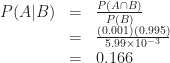
Let A=patient has disease
Let B=result of test is positive
Note that the probability is surprisingly quite low! (This is called the False positive paradox, a statistical result where false positive tests are more probable than true positive tests, occurring when the overall population has a low incidence of a condition and the incidence rate is lower than the false positive rate. See http://en.wikipedia.org/wiki/False_positive_paradox)
(ii)
By GC, (6 d.p.)
H2 Maths 2012 A Level Paper 2 Q4 Solution; H2 Maths Tuition
(i)
1 Jan 2001 –> $100
1 Feb 2001 —> $110
1 Mar 2001 –> $120
Notice that this is an AP with ;
From GC,
(months)
This is inclusive of 1 Jan 2001!!!
Thus, 1 Jan 2001 + 23 months —> 1 Dec 2002
(ii)
1 Jan 2001 –> 100
end of Jan 2001 –> 1.005(100)
1 Feb 2001 –> 1.005(100)+100
end of Feb 2001 –> 1.005[1.005(100)+100]=
From the pattern, we can see that
$5000-$100=$4900
From GC,
So months (inclusive of Jan 2001 !!!)
1 Jan 2001+36 months —> 1 Jan 2004
1 Jan 2004+7 months —> 1 Aug 2004
Then on 1 Sep 2004, Mr B will deposit another $100, making the amount greater than $5000.
Hence, answer is 1 Sep 2004.
(iii)
Let the interest rate be x %.
Note that from Jan 2001 to Nov 2003 is 35 months. (Jan 2001 to Dec 2001 is 12 months, Jan 2002 to Dec 2002 is 12 months, Jan 2003 to Nov 2003 is 11 months :))
$5000-$100=$4900
Modifying our formula in part ii, we get
Setting and using GC, we get
Hence, the interest rate is 1.80%.
A Level H2 Maths 2012 Paper 2 Q3 Solution; H2 Maths Tuition
List of JCs in Singapore; H2 Maths Tuition
Source: http://en.wikipedia.org/wiki/List_of_schools_in_Singapore#Junior_Colleges_.28JC.29
Junior Colleges (JC)
These offer two-year courses leading to the GCE A-level examination.
| Code | Zone | College Name | Established | Address | Type | Special Programmes | ||
|---|---|---|---|---|---|---|---|---|
| English | Chinese | Abb. | ||||||
| 0705 | North | Anderson Junior College | 安德逊初级学院 | AJC | 1984 | 4500 Ang Mo Kio Avenue 6 | Government | |
| 7001 | West | Anglo-Chinese School (Independent) IB World School | 英华中学 (自主) | ACS(I)-IBDP | 2004 (IBDP) | 121 Dover Road | Independent | IP, MEP |
| 0803 | West | Anglo-Chinese Junior College | 英华初级学院 | ACJC | 1977 | 25 Dover Close East | Government-Aided | MEP, DEP(TSD), LEP (EL) |
| 0802 | South | Catholic Junior College | 公教初级学院 | CJC | 1975 | 129 Whitley Road | Government-Aided | LEP (EL) |
| 3101 | East | Dunman High School | 德明政府中学 | DHS | 2005 – IP | 10 Tanjong Rhu Road | Autonomous | IP, MEP, BSP, LEP (CL), AEP |
| 0806 | Central | Hwa Chong Institution | 华侨中学 | HCI | 1974 | 661 Bukit Timah Road | Independent | IP, HP, LEP (CL), AEP, BSP |
| 0713 | North | Innova Junior College | 星烁初级学院 | IJC | 2005 | 21 Champions Way | Government | LEP (ML) |
| 0703 | West | Jurong Junior College | 裕廊初级学院 | JJC | 1981 | 800 Corporation Road | Government | LEP (CL) |
| 0712 | East | Meridian Junior College | 美廉初级学院 | MJC | 2003 | 21 Pasir Ris Street 71 | Government | |
| 0908 | West | Millennia Institute | 励仁高级中学 | MI | 2004 | 60 Bukit Batok West Avenue 8 | Government | DTP |
| 0805 | North | Nanyang Junior College | 南洋初级学院 | NYJC | 1978 | 128 Serangoon Avenue 3 | Government-Aided | LEP (CL), AEP |
| 0712 | Central | National Junior College | 国家初级学院 | NJC | 1969 | 37 Hillcrest Road | Government | IP, HP, AEP, MEP, STaR |
| 7801 | West | NUS High School of Mathematics and Science | 新加坡国立大学附属数理中学 | NUSHS | 2005 | 20 Clementi Ave 1 | Independent | IP, DIP |
| 0711 | West | Pioneer Junior College | 先驱初级学院 | PJC | 1999 | 21 Teck Whye Walk | Government | |
| 0704 | South | Raffles Institution | 莱佛士初级学院 | RI | 1826 | 10 Bishan Street 21 | Independent | IP, HP, LEP (JL), LEP (EL), MEP, TSD |
| 3103 | West | River Valley High School | 立化中学 | RVHS | 1956 2006 – IP | 6 Boon Lay Avenue | Autonomous | IP, BSP |
| 0710 | North | Serangoon Junior College | 实龙岗初级学院 | SRJC | 1988 | 1033 Upper Serangoon Road | Government | |
| 0804 | South | Saint Andrew’s Junior College | 圣安德烈初级学院 | SAJC | 1978 | 55 Potong Pasir Avenue 1 | Government-Aided | |
| 0709 | East | Tampines Junior College | 淡滨尼初级学院 | TPJC | 1986 | 2 Tampines Avenue 9 | Government | LEP (ML), TSD |
| 0702 | East | Temasek Junior College | 淡马锡初级学院 | TJC | 1977 | 22 Bedok South Road | Government | IP, HP, LEP (CL), MEP |
| 0706 | East | Victoria Junior College | 维多利亚初级学院 | VJC | 1984 | 20 Marine Vista | Government | IP, HP, TSD, NAV |
| 0708 | North | Yishun Junior College | 义顺初级学院 | YJC | 1986 | 3 Yishun Ring Road | Government | |
Centralised Institutes (CI)
The only centralised institute is Millennia Institute (MI), which offers a three-year course leading to the GCE A-level examination in arts, science, and commerce.[3]
List of Secondary Schools in Singapore; A Maths Tuition
Source: http://en.wikipedia.org/wiki/List_of_secondary_schools_in_Singapore
Mainstream schools
Japanese Math Professor Excellent Optical Illusionist
Source: http://www.youtube.com/watch?v=Wx4yi5m8IfI
Uploaded on Mar 8, 2011
Japanese mathematics professor Kokichi Sugihara spends much of his time in a world where up is down and three dimensions are really only two. Professor Sugihara is one of the world’s leading exponents of optical illusion, a mathematical art-form that he says could have application in the real world.
For more news and videos visit ☛ http://ntd.tv Follow us on Twitter ☛ http://twitter.com/NTDTelevision Add us on Facebook ☛ http://on.fb.me/s5KV2C
Three sloped ramps are aligned along three of the four sides of a square. Each ramp appears to be sloped in the same direction but when a marble is placed at one end of the ramp it seems to defy gravity.
It’s called an “anti-gravity slide”. Only when the the entire structure is turned 180 degrees, is the illusion revealed.
Japanese mathematics professor Kokichi Sugihara from the Meiji Institute near Tokyo, has made a career of creating optical illusions. He’s devised and built more than a hundred of them, like this one called “Perches and a Ring”.
[Kokichi Sugihara, Meiji University Professor]: “Among these models, there are those which are reproductions of optical illusions, and others that seem like normal models, but when you add movement to them, they show movement that should be impossible in real life. This is done by using the same trick, and I call them ‘impossible motions’.”
Professor Sugihara’s “impossible motions” have been recognized around the world. He won first prize in an international competition last year with this one, called “Magnet-Like Slopes”.
Sugihara says the success of his illusions is tied to human perception. Because humans have the capacity to perceive two-dimensional objects as being three-dimensional, they can be fooled into believing that something “impossible” is taking place during the course of the illusion.
For Sugiraha the illusions aren’t just for amusement. He says they have real world application. For example, he says misjudgments made by drivers on steeply curved roads could be mitigated by changing their perceptions of the immediate environment.
[Kokichi Sugihara, Meiji University Professor]: “If we can find how drivers misjudge an incline, we would be able to construct roads where these incidents are less likely to happen. In other cases, we could also reorganize the surrounding environment so that drivers could more easily see the difference between an ascending and descending road, and it could lead to reducing traffic jams.”
Sugihara says says his dream is to create playground amusements – even buildings with his models. More immediately though he has plans for an “impossible object exhibition”, a venue to demonstrate that seeing really is believing.
Youngest NUS graduates for 2012 – 08Jul2012
Source: http://www.youtube.com/watch?v=q-53rIy7RGg
Published on Jul 9, 2012
SINGAPORE – Douglas Tan was only seven years old when he discovered a knack for solving mathematical problems, tackling sums meant for the upper primary and secondary levels.
He went on to join the Gifted Programme in Rosyth Primary School and, in 2006, enrolled in the National University of Singapore High School of Math and Science (NUSHS). At 15, he was offered a place at the National University of Singapore (NUS) Faculty of Science to study mathematics.
Tomorrow, the 19-year-old will be this year’s youngest graduate at NUS, receiving his Mathematics degree with a First Class Honours. This puts him almost six years ahead of those his age.
Douglas, who is currently serving his National Service (NS), said the thought of going to prestigious universities overseas never occurred to him. “I was just happy doing what I was doing – solving math problems,” he said.
In every class he took, Douglas was the youngest but it was neither “awkward nor tough to fit in”, he said. In fact, his age was a good conversation starter and his classmates, who were typically three to five years older, would take care of him.
Seeing that he could complete his degree before he entered NS, Douglas took on three modules a semester and completed the four-year course in just two and a half years.
The longest he had ever spent on a math problem was 10 hours over a few days. “I’m a perfectionist. When I do a problem, I try to do it with 100 per cent,” he noted.
Douglas aspires to be a mathematician and is looking into a Masters degree but he has yet to decide if he wants to do it here or overseas.
Another young outstanding graduate this year is 20-year-old Carmen Cheh, who received her degree in Computer Science last Friday with a First Class Honours and was on the dean’s list every academic year of the four-year course.
Offered a place at the NUS School of Computing after three and a half years in NUSHS, Carmen was then the youngest undergraduate of the programme at 16.
She was introduced to computer science and concept programming at 11 by her father, a doctor who also challenged her to solve puzzles he created. Her inability to solve them spurred her interest in the subject.
Carmen, who is from Perak in Malaysia, said she decided to study for her degree in Singapore as she wanted to study in a country she felt “comfortable” in. At the same time, she was awarded an ASEAN scholarship to study in the Republic.
Next month, Carmen will begin her doctoral programme in Computer Science with a research assistantship at the University of Illinois at Urbana-Champaign.
The youngest ever to enrol into the NUS undergraduate programme is Abigail Sin, who entered the Yong Siew Toh Conservatory of Music at 14. She graduated in 2010 at age 18 with First Class Honours. She also received the Lee Kuan Yew gold medal.
This week, NUS celebrates the graduation of 9,913 students, its largest cohort in six years.
http://www.todayonline.com/Singapore/EDC120709-0000039/Theyre-ahead-of-the-class
The Singapore Math
The famous Singapore Math for children in primary schools is based on visual models.
The Singapore Ministry of Education has published a new 2013 Math syllabus for primary and secondary schools, which will roll out in examinations within 4 to 6 years. Todate only Primary 1 and Secondary 1 Math syllabuses are published here:
Algebra vs Singapore Math
Who wins?
This comic video illustrates Singapore Math’s Arithmetics Polya-style problem solving process vs Algebra’s mechanical method.
The problem is as follow:
R is 3 times older than S two years ago. From now 2 years later, their total age is 32. How old is R now ?
See my previous blog (search “Monkey”) the Nobel Physicist Paul Dirac’s problem “The Monkeys and Coconuts“, 3 methods are used: 2 adanced modern math (by Sequence, eigenvector & eigenvalue), and the easiest & intuitive method (by Singapore Modelling Math). High-school Algebra method is impossible, if not cumbersome, to solve the Monkey problem !
St Gabriel’s Secondary School Mathematics Syllabus
Source: https://sites.google.com/a/moe.edu.sg/st-gabriel-s-secondary-school-maths-dept/syllabuses
“I hear, I forget. I see, I remember. I do, I understand.” (Chinese proverb that was a favorite of Moore’s. Quoted in Halmos, P.R. (1985) I want to be a mathematician: an automathography. Springer-Verlag: 258)
The Moore method is a deductive manner of instruction used in advanced mathematics courses. It is named after Robert Lee Moore, a famous topologist who first used a stronger version of the method at the University of Pennsylvania when he began teaching there in 1911.
Information about Mathematics Department Courses (Nanyang JC)
Source: http://nanyangjc.org/index.php/staff/organisation-chart/mathematics-department/
H1 Mathematics
H1 Mathematics provides a foundation in mathematics for students who intend to enrol in university courses such as business, economics and social sciences. The syllabus aims to develop mathematical thinking and problem solving skills in students. A major focus of the syllabus will be the understanding and application of basic concepts and techniques of statistics. This will equip students with the skills to analyse and interpret data, and to make informed decisions. The use of graphic calculator is expected.
H2 Mathematics
H2 Mathematics prepares students adequately for university courses including mathematics, physics and engineering, where more mathematics content is required. The syllabus aims to develop mathematical thinking and problem solving skills in students. Students will learn to analyse, formulate and solve different types of problems. They will also learn to work with data and perform statistical analyses. The use of graphic calculator is expected.
This subject assumes the knowledge of O-Level Additional Mathematics.
Continue reading at http://nanyangjc.org/index.php/staff/organisation-chart/mathematics-department/
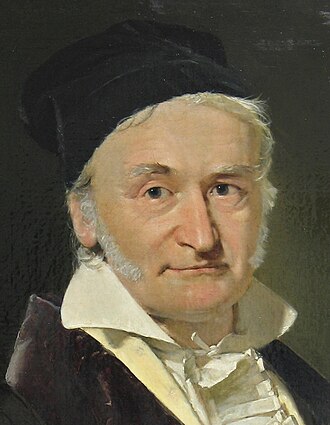
Carl Friedrich Gauss
Source: http://en.wikipedia.org/wiki/Carl_Friedrich_Gauss
Johann Carl Friedrich Gauss (/ɡaʊs/; German: Gauß, pronounced [ɡaʊs] (
listen); Latin: Carolus Fridericus Gauss) (30 April 1777 – 23 February 1855) was a German mathematician and physical scientist who contributed significantly to many fields, including number theory, algebra, statistics, analysis, differential geometry, geodesy, geophysics, electrostatics, astronomy and optics.
Sometimes referred to as the Princeps mathematicorum[1] (Latin, “the Prince of Mathematicians” or “the foremost of mathematicians”) and “greatest mathematician since antiquity“, Gauss had a remarkable influence in many fields of mathematics and science and is ranked as one of history’s most influential mathematicians.[2]
![]()
Continue reading at http://en.wikipedia.org/wiki/Carl_Friedrich_Gauss
Toán Nhóm Học phí lớp để bắt đầu vào năm tới, năm 2014.
Toán học phí Trung tâm
내년에 시작하는 수학 그룹 수업료 클래스 2014.
수학 수업료 센터
Matematika Kelompok Kelas Belajar mulai tahun depan, 2014.
Matematika Pusat Belajar
अगले साल शुरू करने के लिए गणित समूह ट्यूशन क्लास, 2014.
गणित शिक्षण केंद्र
Matematika Group Class pagtuturo upang simulan ang susunod na taon, 2014.
Matematika pagtuturo Centre
数学组补习班,明年开班,2014年。
数学组补习班,明年开班,2014年。
数学补习中心
Maths Group Tuition Class to start next year, 2014.
Maths Tuition Centre
Gotthold Eisenstein (Mathematician)
*Not Einstein!
Ferdinand Gotthold Max Eisenstein (16 April 1823 – 11 October 1852) was a German mathematician. He specialized in number theory and analysis, and proved several results that eluded even Gauss. Like Galois and Abel before him, Eisenstein died before the age of 30. He was born and died in Berlin, Prussia.
Gauss … in conversation once remarked that, there had been only three epoch-making mathematicians: Archimedes, Newton, and Eisenstein.
Source: http://en.wikipedia.org/wiki/Gotthold_Eisenstein
![]()
Number Theory Notes – Art of Problem Solving
Source: http://www.artofproblemsolving.com/Resources/Papers/SatoNT.pdf
Excellent notes on Olympiad Number Theory!
Preface:
This set of notes on number theory was originally written in 1995 for students
at the IMO level. It covers the basic background material that an IMO
student should be familiar with. This text is meant to be a reference, and
not a replacement but rather a supplement to a number theory textbook;
several are given at the back. Proofs are given when appropriate, or when
they illustrate some insight or important idea. The problems are culled from
various sources, many from actual contests and olympiads, and in general
are very difficult. The author welcomes any corrections or suggestions.
Khan Academy
I find Khan Linear Algebra video excellent. The founder / teacher Sal Khan has the genius to explain this not-so-easy topic in modular videos steps by steps, from 2-dimensional vectors to 3-dimensional, working with you by hand to compute eigenvalues and eigenvectors, and show you what they mean in graphic views.
If you are taking Linear Algebra course in university, or revising it, just go through all the Khan’s short (5-20 mins) videos on Linear Algebra here:
In 138 lessons sequence:
http://theopenacademy.com/content/linear-algebra-khan-academy
or random revision:
Advice to Students
Source: http://www.math.union.edu/~dpvc/courses/advice/welcome.html
Advice to Students:
Over the years, I have collected some information that I hope will help students, particularly beginning math students, to improve their study and learning habits. An important part of what you learn at college is how to learn, so that you can carry that on for the rest of your life. Find out what works for you and what doesn’t.
These observations are centered around first-year calculus courses, so not everything may apply to you, but even more advanced students can benefit from some of them.
As you develop your own learning habits, please think carefully about the following topics:
Continue reading at http://www.math.union.edu/~dpvc/courses/advice/welcome.html
Singapore Maths Tuition Class
Keywords (for Google):
Singapore Maths Tuition Class
新加坡数学补习班
Singapore Matematik Kelas Tuisyen
சிங்கப்பூர் கணிதம் பயிற்சி வகுப்பு
Singapura Matematika Kelas Belajar
सिंगापुर मैथ्स ट्यूशन क्लास
싱가포르 수학 수업료 클래스
シンガポールの数学の授業クラス
Singapore matematika pagtuturo Class
Singapore Toán Học Lớp
Student Advice: Comments on Perseverance
Source: http://www.math.union.edu/~dpvc/courses/advice/perseverance.html
Comments on Perseverance:
One source of confusion for students when they reach college and begin to do college-level mathematics is this: in high school, it is usually pretty apparent what formula or technique needs to be applied, as much of the material in high school is computational or procedural. In college, however, mathematics becomes more conceptual, and it is much harder to know what to do when you first start a problem. As a consequence of this, many students give up on a problem too early.
If you don’t immediately know how to attack a problem, this doesn’t mean you are stupid,
If you already know how to do it, it’s not really a problem.
or that you don’t understand what’s going on; that’s just how real problems work. After all, if you already know how to do it, it’s not really a problem, is it? You should expect to be confused at first. There’s no way you can know ahead of time how to solve every problem that you will face in life. You’re only hope, and therefore your goal as a student, is to get experience with working through hard problems on your own. That way, you will continue to be able to do so once you leave college.
One of the first steps in this is to realize that not knowing how, and the frustration that accompanies that, is part of the process. Then you have to start to figure out the questions that you can ask to help you to break down the problem, so that you can figure out how it really works. What’s really important in it? What is the central concept? What roles do the definitions play? How is this related to other things I know?
Continue reading at http://www.math.union.edu/~dpvc/courses/advice/perseverance.html
Relationship-Mapping-Inverse (RMI)
(invented by Prof Xu Lizhi 徐利治 中国数学家 http://baike.baidu.com/view/6383.htm)
Find Z = a*b
By RMI Technique:
Let f Homomorphism: f(a*b) = f(a)+f(b)
Let f = log
log: R+ –> R
=> log (a*b) = log a + log b
1. Calculate log a (=X), log b (=Y)
2. X+Y = log (a*b)
3. Find Inverse log (a*b)
4. ANSWER: Z = a*b
Prove:
$latex \sqrt{2}^{\sqrt{2}^{\sqrt{2}}}= 2$
1. Take f = log for Mapping:
$latex \log\sqrt{2}^{\sqrt{2}^{\sqrt{2}}} $
$latex = \sqrt{2}\log\sqrt{2}^{\sqrt{2}}$
$latex = \sqrt{2}\sqrt{2}\log\sqrt{2} $
$latex = 2\log\sqrt{2} $
$latex = \log (\sqrt{2})^2 $
$latex = \log 2$
2. Inverse of log (bijective):
$latex \log \sqrt{2}^{\sqrt{2}^{\sqrt{2}}}= \log 2$
$latex \sqrt{2}^{\sqrt{2}^{\sqrt{2}}}= 2$
Famous Nonmathematicians who studied Mathematics
This is a list of Famous Nonmathematicians who studied Mathematics, featuring Singapore’s Prime Minister, Lee Hsien Loong, with first class honours in mathematics from Trinity College, University of Cambridge.
Source: http://www.math.uh.edu/~tomforde/famous.html
We often tell our students that there are many things besides teaching and actuarial work that they can do with a degree in mathematics, but they often don’t believe us. Here is a list of well-known people who were math majors (or some equivalent in other countries and times), although not all of them completed their degrees.
THE PUBLIC REALM
•Ralph Abernathy, civil rights leader and Martin Luther King’s closest aide.
•Corazon Aquino, former President of the Philippines. She was a math minor at the College of Mt. St. Vincent.
•Harry Blackmun, Associate Justice of the US Supreme Court, AB summa cum laude in mathematics at Harvard.
•Simeon DeWitt, was the first math major at Rutgers. He became General George Washington’s Chief Geographer in the Revolutionary War. His maps of Yorktown helped win the final battle of that war. Afterwards (1784-1834) he was the Surveyor General for New York State; he helped to plan the Erie Canal, and to develop the grid system of streets and avenues in New York City, among other things.
•David Dinkins, Mayor of New York, BA in mathematics from Howard.
•Alberto Fujimori, President of Peru, MS in mathematics from the University of Wisconsin-Milwaukee.
•Ira Glasser, Executive Director of the American Civil Liberties Union, both a BS and an MA.
•Lee Hsien Loong, Deputy Prime Minister of Singapore, a Bachelor’s from Cambridge.
Read more at http://www.math.uh.edu/~tomforde/famous.html
Prof Su Buqing Problem
Prof Su 苏步青, the founding pioneer Math professor of the China’s top universities (Zhejiang 浙江大学 and Fudan 复旦大学), was one of the few mathematicians who had longevity above 100 years old (the other was French Mathematician Hadammard).
http://en.m.wikipedia.org/wiki/Su_Buqing
Two men A and B are 100 km apart, walking towards each other, A at speed 6 km/hour and B at 4 km/hour.
A brings a dog which runs at 10 km/hour between them, starting from A towards B, upon reaching B it runs back to reach A, then back to B again, and so on…
Find total distance the dog has covered when A and B finally meet ?
学好数理化,走遍天下都不怕。
Study mathematics, physics, and chemistry well. Then no matter where you go, you will fear nothing!
Ancient Chinese Proverb
Source: http://www.liuxue86.com/a/1133118.html
美国留学打工 “学好数理化,走遍天下都不怕。”在美国一样适用
美国人口普查局的最新报告显示:同样是学士学位,按工作40年计算,工程专业的毕业生比教育学的毕业生多赚160万美元。真可谓是“男怕入错行,女怕嫁错郎。”
根据美国人口普查局最新发布的2011年社区调查报告,美国具有学士学位的大学毕业证全职工作的人每年中位薪资收入是64396美元,这些人既包括新毕业的大学生,也包括那也干的一辈子最高学位是学士的全职工作者。其中工程专业的薪资最高,平均每年高达91611美元,电脑与数学专业排第二位,年均80180美元,物理、化学、医学等自然科学专业薪水也不错,以80037美元排第三位。在另一个极端视觉和表演艺术专业薪水最低,平均一年只有50484美元,教育专业只有50902美元,心理学专业为55509美元,列倒数前三名,由此可以推算出来从事工程专业工作的人平均每年比从事表演艺术专业的人多挣4万美元,以一个人工作40年计算整个职业生涯收入平均相差160万美元,差距还是很惊人的。
The Riemann hypothesis in various settings
[Note: the content of this post is standard number theoretic material that can be found in many textbooks (I am relying principally here on Iwaniec and Kowalski); I am not claiming any new progress on any version of the Riemann hypothesis here, but am simply arranging existing facts together.]
The Riemann hypothesis is arguably the most important and famous unsolved problem in number theory. It is usually phrased in terms of the Riemann zeta function $latex {\zeta}&fg=000000$, defined by
$latex \displaystyle \zeta(s) = \sum_{n=1}^\infty \frac{1}{n^s}&fg=000000$
for $latex {\hbox{Re}(s)>1}&fg=000000$ and extended meromorphically to other values of $latex {s}&fg=000000$, and asserts that the only zeroes of $latex {\zeta}&fg=000000$ in the critical strip $latex {\{ s: 0 \leq \hbox{Re}(s) \leq 1 \}}&fg=000000$ lie on the critical line $latex {\{ s: \hbox{Re}(s)=\frac{1}{2} \}}&fg=000000$.
One of the main reasons that the Riemann hypothesis is so important to number theory is that the zeroes of…
View original post 12,730 more words
Does one have to be a genius to do maths?
Source: http://terrytao.wordpress.com/career-advice/does-one-have-to-be-a-genius-to-do-maths/
Better beware of notions like genius and inspiration; they are a sort of magic wand and should be used sparingly by anybody who wants to see things clearly. (José Ortega y Gasset, “Notes on the novel”)
Does one have to be a genius to do mathematics?
The answer is an emphatic NO. In order to make good and useful contributions to mathematics, one does need to work hard, learn one’s field well, learn other fields and tools, ask questions, talk to other mathematicians, and think about the “big picture”. And yes, a reasonable amount of intelligence, patience, and maturity is also required. But one does not need some sort of magic “genius gene” that spontaneously generates ex nihilo deep insights, unexpected solutions to problems, or other supernatural abilities.
Continue reading at http://terrytao.wordpress.com/career-advice/does-one-have-to-be-a-genius-to-do-maths/