How the Staircase Diagram changes when we pass to derived couple (Spectral Sequence)

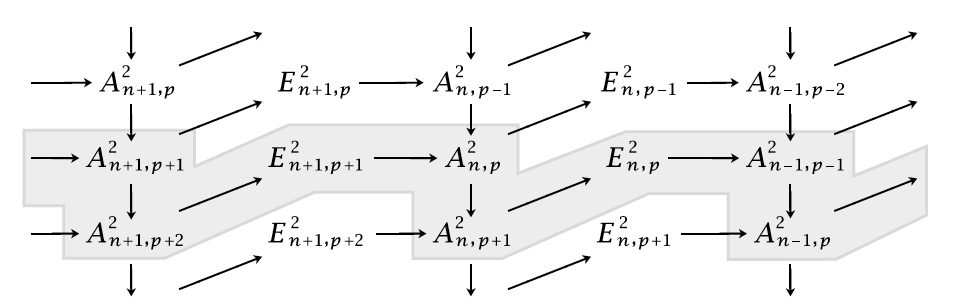
Set A_{n,p}^1=H_n(X_p) and E_{n,p}^1=H_n(X_p,X_{p-1}). The diagram then has the following form:

When we pass to the derived couple, each group A_{n,p}^1 is replaced by a subgroup A_{n,p}^2=\text{Im}\,(i_1: A_{n,p-1}^1\to A_{n,p}^1). The differentials d_1=j_1k_1 go two units to the right, and we replace the term E_{n,p}^1 by the term E_{n,p}^2=\text{Ker}\, d_1/\text{Im}\,d_1, where the d_1‘s refer to the d_1‘s leaving and entering E_{n,p}^1 respectively.

The maps j_2 now go diagonally upward because of the formula j_2(i_1a)=[j_1a]. The maps i_2 and k_2 still go vertically and horizontally, i_2 being a restriction of i_1 and k_2 being induced by k_1.

How do you overcome the fear of the future? Pope Francis provides the keys

Source: http://aleteia.org/2017/04/26/how-do-you-overcome-the-fear-of-the-future-pope-francis-provides-the-keys/

Have you ever been gripped by a fear of the future that left you walking in circles or paralyzed from moving forward? Today, Pope Francis provided a deeper answer to this common human fear, urging Christians to remember that faith is the anchor that keeps our lives moored to the heart of God, amid every storm and difficulty.

Speaking to faithful and pilgrims at today’s general audience in St. Peter’s Square, the pope reminded them that, wherever we go, God’s love goes before us.

“There will never be a day in our lives when we will cease being a concern for the heart of God,” he said, as he continued his series on Christian hope.

“I am with you”

Reflecting on St. Matthew’s Gospel, Pope Francis observed that it begins with the birth of Jesus as Emmanuel — “God is with us” — and concludes with the Risen Lord’s promise to his disciples: “I am with you always, even to the end of the age” (Mt 28:20). He said:

The whole gospel is enclosed in these two quotations, words that communicate the mystery of a God whose name, whose identity is ‘to be with,’ in particular, to be with us, with the human creature. Ours is not an absent God … He is a God who is “passionately” in love with man, and so tender a lover that he is incapable of separating Himself from him. We humans are able to break bonds and bridges. He is not. If our heart cools, his remains incandescent. Our God always accompanies us, even if we unfortunately forgot about Him. […] Christians especially do not feel abandoned, because Jesus promises not to only wait for us at the end of our long journey, but to accompany us during each of our days.

Relative Homology Groups

Given a space X and a subspace A\subset X, define C_n(X,A):=C_n(X)/C_n(A). Since the boundary map \partial: C_n(X)\to C_{n-1}(X) takes C_n(A) to C_{n-1}(A), it induces a quotient boundary map \partial: C_n(X,A)\to C_{n-1}(X,A).

We have a chain complex \displaystyle \dots\to C_{n+1}(X,A)\xrightarrow{\partial_{n+1}}C_n(X,A)\xrightarrow{\partial_n}C_{n-1}(X,A)\to\dots where \partial^2=0 holds. The relative homology groups H_n(X,A) are the homology groups \text{Ker}\,\partial_n/\text{Im}\,\partial_{n+1} of this chain complex.

Relative cycles
Elements of H_n(X,A) are represented by relative cycles: n– chains \alpha\in C_n(X) such that \partial\alpha\in C_{n-1}(A).

Relative boundary
A relative cycle \alpha is trivial in H_n(X,A) iff it is a relative boundary: \alpha=\partial\beta+\gamma for some \beta\in C_{n+1}(X) and \gamma\in C_n(A).

Long Exact Sequence (Relative Homology)
There is a long exact sequence of homology groups:
\begin{aligned}  \dots\to H_n(A)\xrightarrow{i_*}H_n(X)\xrightarrow{j_*}H_n(X,A)\xrightarrow{\partial}H_{n-1}(A)&\xrightarrow{i_*}H_{n-1}(X)\to\dots\\  &\dots\to H_0(X,A)\to 0.  \end{aligned}

The boundary map \partial:H_n(X,A)\to H_{n-1}(A) is as follows: If a class [\alpha]\in H_n(X,A) is represented by a relative cycle \alpha, then \partial[\alpha] is the class of the cycle \partial\alpha in H_{n-1}(A).

Prayer of St Thomas Aquinas for Students (English and Latin)

Source: http://www.aquinascollege.edu/prayer-before-study-exams-spring-2013/

A Prayer Before Study

Ineffable Creator,
Who, from the treasures of Your wisdom,
have established three hierarchies of angels,
have arrayed them in marvelous order
above the fiery heavens,
and have marshaled the regions
of the universe with such artful skill,

You are proclaimed
the true font of light and wisdom,
and the primal origin
raised high beyond all things.

Pour forth a ray of Your brightness
into the darkened places of my mind;
disperse from my soul
the twofold darkness
into which I was born:
sin and ignorance.

You make eloquent the tongues of infants.
refine my speech
and pour forth upon my lips
The goodness of Your blessing.

Grant to me
keenness of mind,
capacity to remember,
skill in learning,
subtlety to interpret,
and eloquence in speech.

May You
guide the beginning of my work,
direct its progress,
and bring it to completion.

You Who are true God and true Man,
who live and reign, world without end.

Amen.

Ante Studium

Creator ineffabilis,
qui de thesauris sapientiae tuae
tres Angelorum hierarchias designasti,
et eas super caelum empyreum
miro ordine collocasti,
atque universi partes elegantissime disposuisti,

tu inquam qui
verus fons
luminis et sapientiae diceris
ac supereminens principium

infundere digneris
super intellectus mei tenebras
tuae radium claritatis,
duplices in quibus natus sum
a me removens tenebras,
peccatum scilicet et ignorantiam.

Tu, qui linguas infantium facis disertas,
linguam meam erudias
atque in labiis meis gratiam
tuae benedictionis infundas.

Da mihi
intelligendi acumen,
retinendi capacitatem,
addiscendi modum et facilitatem,
interpretandi subtilitatem,
loquendi gratiam copiosam.

Ingressum instruas,
progressum dirigas,
egressum compleas.

Tu, qui es verus Deus et homo,
qui vivis et regnas in saecula saeculorum.

Amen.

Exact sequence (Quotient space)

Exact sequence (Quotient space)
If X is a space and A is a nonempty closed subspace that is a deformation retract of some neighborhood in X, then there is an exact sequence
\begin{aligned}  \dots\to\widetilde{H}_n(A)\xrightarrow{i_*}\widetilde{H}_n(X)\xrightarrow{j_*}\widetilde{H}_n(X/A)\xrightarrow{\partial}\widetilde{H}_{n-1}(A)&\xrightarrow{i_*}\widetilde{H}_{n-1}(X)\to\dots\\  &\dots\to\widetilde{H}_0(X/A)\to 0  \end{aligned}
where i is the inclusion A\to X and j is the quotient map X\to X/A.

Reduced homology of spheres (Proof)
\widetilde{H}_n(S^n)\cong\mathbb{Z} and \widetilde{H}_i(S^n)=0 for i\neq n.

For n>0 take (X,A)=(D^n,S^{n-1}) so that X/A=S^n. The terms \widetilde{H}_i(D^n) in the long exact sequence are zero since D^n is contractible.

Exactness of the sequence then implies that the maps \widetilde{H}_i(S^n)\xrightarrow{\partial}\widetilde{H}_{i-1}(S^{n-1}) are isomorphisms for i>0 and that \widetilde{H}_0(S^n)=0. Starting with \widetilde{H}_0(S^0)=\mathbb{Z}, \widetilde{H}_i(S^0)=0 for i\neq 0, the result follows by induction on n.

8 JCs to merge (i.e. 4 JCs to close down)

The latest education news in Singapore is that 4 pairs of JCs to merge as student numbers shrink; 14 primary and 6 secondary schools also affected.

The effect on the primary and secondary schools is not that significant, due to the large number of primary and secondary schools. However, there are only around 20 JCs in Singapore, the effect is quite big for JCs.

8 JCs merging is just a nice way of saying 4 JCs to be shut down permanently. RIP Serangoon, Tampines, Innova and Jurong JCs.

The most affected would be O level students in the next 5 years. Yes, there is declining birthrate but that is gradual. So for the next 5 years, there is approximately the same number of students competing for 4 less JCs.

So by “Demand and Supply” logic, we have:
– similar demand for JCs (approx. same number of students in the next 5 years)
– lower supply of JCs (due to the 4 axed JCs)

By Economic Theory: If supply decreases and demand is unchanged, then it leads to a higher equilibrium price.

Hence the logical conclusion is that the “price” will rise, that is, cutoff points for JCs may become lower. To add on to that, the 4 axed JCs cater mainly to the 13-20 pointers. So students falling in that L1R5 range will be especially affected.


Also check out: Which JC is good?

Mayer-Vietoris Sequence applied to Spheres

Mayer-Vietoris Sequence
For a pair of subspaces A,B\subset X such that X=\text{int}(A)\cup\text{int}(B), the exact MV sequence has the form
\begin{aligned}  \dots&\to H_n(A\cap B)\xrightarrow{\Phi}H_n(A)\oplus H_n(B)\xrightarrow{\Psi}H_n(X)\xrightarrow{\partial}H_{n-1}(A\cap B)\\  &\to\dots\to H_0(X)\to 0.  \end{aligned}

Example: S^n
Let X=S^n with A and B the northern and southern hemispheres, so that A\cap B=S^{n-1}. Then in the reduced Mayer-Vietoris sequence the terms \tilde{H}_i(A)\oplus\tilde{H}_i(B) are zero. So from the reduced Mayer-Vietoris sequence \displaystyle \dots\to\tilde{H}_i(A)\oplus\tilde{H}_i(B)\to\tilde{H}_i(X)\to\tilde{H}_{i-1}(A\cap B)\to\tilde{H}_{i-1}(A)\oplus\tilde{H}_{i-1}(B)\to\dots we get the exact sequence \displaystyle 0\to\tilde{H}_i(S^n)\to\tilde{H}_{i-1}(S^{n-1})\to 0.
We obtain isomorphisms \tilde{H}_i(S^n)\cong\tilde{H}_{i-1}(S^{n-1}).

Spectral Sequence

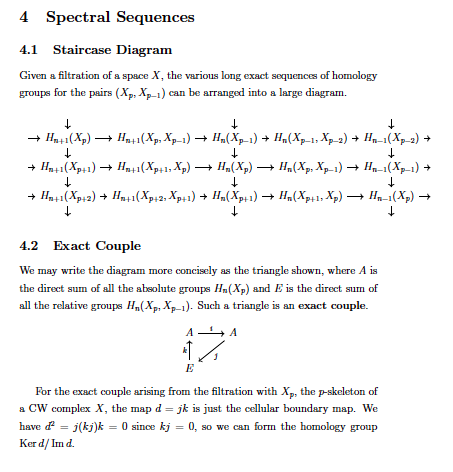
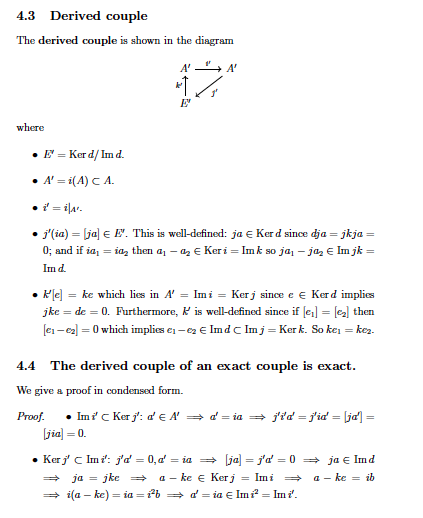
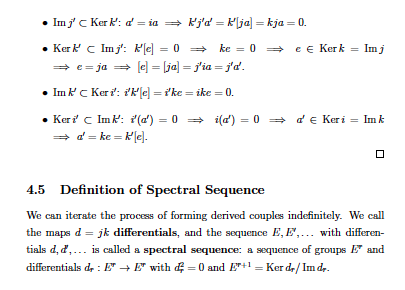
Spectral Sequence is one of the advanced tools in Algebraic Topology. The following definition is from Hatcher’s 5th chapter on Spectral Sequences. The staircase diagram looks particularly impressive and intimidating at the same time.

Unfortunately, my LaTeX to WordPress Converter app can’t handle commutative diagrams well, so I will upload a printscreen instead.

Love Jesus in all who suffer, pope says on Palm Sunday

Source: https://cnstopstories.com/2017/04/09/love-jesus-in-all-who-suffer-pope-says-on-palm-sunday/

By Carol Glatz
Catholic News Service

VATICAN CITY (CNS) — Jesus does not ask that people only contemplate his image, but that they also recognize and love him concretely in all people who suffer like he did, Pope Francis said.

Jesus is “present in our many brothers and sisters who today endure sufferings like his own — they suffer from slave labor, from family tragedies, from diseases. They suffer from wars and terrorism, from interests that are armed and ready to strike,” the pope said April 9 as he celebrated the Palm Sunday Mass of the Lord’s Passion.

In his noon Angelus address, the pope also decried recent terrorist attacks in Sweden and Egypt, calling on “those who sow terror, violence and death,” including arms’ manufacturers and dealers, to change their ways.

In his prayers for those affected by the attacks, the pope also expressed his deepest condolences to “my dear brother, His Holiness Pope Tawadros, the Coptic church and the entire beloved Egyptian nation,” which the pope was scheduled to visit April 28-29.

At least 15 people were killed and dozens more injured April 9 in an Orthodox church north of Cairo as Coptic Christians gathered for Palm Sunday Mass; the attack in Sweden occurred two days earlier when a truck ran through a crowd outside a busy department store in central Stockholm, killing four and injuring 15 others.

The pope also prayed for all people affected by war, which he called, a “disgrace of humanity.”

Tens of thousands of people carrying palms and olive branches joined the pope during a solemn procession in St. Peter’s Square under a bright, warm sun for the beginning of Holy Week.

OneKey Token Out of Battery — What to do?

It seems like the OneKey Token (used for 2 factor authentication) runs out of battery quite fast. I have barely used mine (usually use SMS), yet its battery has died surprisingly soon, compared to my other bank tokens.

What should one do in this case? Please comment below if you have other options.

Once the battery goes to zero, it appears that there are only two options:

Option 1)

Go to their office PSA Building (Alexandra Road) or International Plaza (Anson Road), to get free** replacement (**provided still within the warranty period of 1 year).

Waiting time is estimated 40-50 minutes. (and “free” may not be guaranteed, depends on whether you meet their requirement of warranty period, etc.)

Disclaimer: I have not tried this method myself. This is based on the Hardwarezone post linked below.

Option 2)

Go to this OneKey Assurity site https://portal.assurity.sg/naf-web/public/index.do to purchase a new token at $15. (Quite expensive 😦 )

Source: http://forums.hardwarezone.com.sg/money-mind-210/one-key-token-low-battery-5593102.html

I have no idea why the battery runs out so fast. Even my cheap Casio watch’s battery (which is running 24 hours a day) lasts longer than this token’s (which I have pressed less than 10 times).

SO(3) diffeomorphic to RP^3

SO(3)\cong\mathbb{R}P^3}

Proof:

We consider SO(3) as the group of all rotations about the origin of \mathbb{R}^3 under the operation of composition. Every non-trivial rotation is determined by its axis of rotation (a line through the origin) and its angle of rotation.

We consider \mathbb{R}P^3 as the unit 3-sphere S^3 with antipodal points identified.

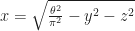
Consider the map from the unit ball D in \mathbb{R}^3 to SO(3), which maps (x,y,z) to the rotation about (x,y,z) through the angle \pi\sqrt{x^2+y^2+z^2} (and maps (0,0,0) to the identity rotation). This mapping is clearly smooth and surjective. Its restriction to the interior of D is injective since on the interior \pi\sqrt{x^2+y^2+z^2}<\pi. On the boundary of D, two rotations through \pi and through -\pi are the same. Hence the mapping induces a smooth bijective map from D/\sim, with antipodal points on the boundary identified, to SO(3). The inverse of this map, \displaystyle ((x,y,z),\pi\sqrt{x^2+y^2+z^2})\mapsto(x,y,z) is also smooth. (To see that the inverse is smooth, write \theta=\pi\sqrt{x^2+y^2+z^2}. Then x=\sqrt{\frac{\theta^2}{\pi^2}-y^2-z^2}, and so \frac{\partial^k x}{\partial\theta^k} exists and is continuous for all orders k. Similar results hold for the variables y and z, and also mixed partials. By multivariable chain rule, one can see that all component functions are indeed smooth, so the inverse is smooth as claimed.)

Hence SO(3)\cong D/\sim, the unit ball D in \mathbb{R}^3 with antipodal points on the boundary identified.

Next, the mapping \displaystyle (x,y,z)\mapsto (x,y,z,\sqrt{1-x^2-y^2-z^2}) is a diffeomorphism between D/\sim and the upper unit hemisphere of S^3 with antipodal points on the equator identified. The latter space is clearly diffeomorphic to \mathbb{R}P^3. Hence, we have shown \displaystyle SO(3)\cong D/\sim\cong\mathbb{R}P^3.

SU(2) diffeomorphic to S^3 (3-sphere)

SU(2)\cong S^3 (diffeomorphic)

Proof:
We have that \displaystyle SU(2)=\left\{\begin{pmatrix}\alpha &-\overline{\beta}\\  \beta &\overline{\alpha}\end{pmatrix}: \alpha, \beta\in\mathbb{C}, |\alpha|^2+|\beta|^2=1\right\}.

Since \mathbb{R}^4\cong\mathbb{C}^2, we may view S^3 as \displaystyle S^3=\{(\alpha,\beta)\in\mathbb{C}^2: |\alpha|^2+|\beta|^2=1\}.

Consider the map
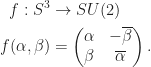
\begin{aligned}f: S^3&\to SU(2)\\  f(\alpha,\beta)&=\begin{pmatrix}\alpha &-\overline{\beta}\\  \beta &\overline{\alpha}\end{pmatrix}.  \end{aligned}

It is clear that f is well-defined since if (\alpha,\beta)\in S^3, then f(\alpha,\beta)\in SU(2).

If f(\alpha_1,\beta_1)=f(\alpha_2,\beta_2), it is clear that (\alpha_1, \beta_1)=(\alpha_2,\beta_2). So f is injective. It is also clear that f is surjective.

Note that SU(2)\subseteq M(2,\mathbb{C})\cong\mathbb{R}^8, where M(2,\mathbb{C}) denotes the set of 2 by 2 complex matrices.

When f is viewed as a function \widetilde{f}: \mathbb{R}^4\to\mathbb{R}^8, it is clear that \widetilde{f} and \widetilde{f}^{-1} are smooth maps since their component functions are of class C^\infty. Since SU(2) and S^3 are submanifolds, the restrictions to these submanifolds (i.e.\ f and f^{-1}) are also smooth.

Hence f is a diffeomorphism.

Echelon Form Lemma (Column Echelon vs Smith Normal Form)

The pivots in column-echelon form are the same as the diagonal elements in (Smith) normal form. Moreover, the degree of the basis elements on pivot rows is the same in both forms.

Proof:
Due to the initial sort, the degree of row basis elements \hat{e}_i is monotonically decreasing from the top row down. For each fixed column j, \deg e_j is a constant. We have, \deg M_k(i,j)=\deg e_j-\deg \hat{e}_i. Hence, the degree of the elements in each column is monotonically increasing with row. That is, for fixed j, \deg M_k(i,j) is monotonically increasing as i increases.

We may then eliminate non-zero elements below pivots using row operations that do not change the pivot elements or the degrees of the row basis elements. Finally, we place the matrix in (Smith) normal form with row and column swaps.

Persistent Homology Algorithm

Algorithm for Fields
In this section we describe an algorithm for computing persistent homology over a field.

We use the small filtration as an example and compute over \mathbb{Z}_2, although the algorithm works for any field.
A filtered simplicial complex with new simplices added at each stage. The integers on the bottom row corresponds to the degrees of the simplices of the filtration as homogenous elements of the persistence module.

The persistence module corresponds to a \mathbb{Z}_2[t]-module by the correspondence in previous Theorem. In this section we use \{e_j\} and \{\hat{e}_i\} to denote homogeneous bases for C_k and C_{k-1} respectively.

We have \partial_1(ab)=-t\cdot a+t\cdot b=t\cdot a+t\cdot b since we are computing over \mathbb{Z}_2. Then the representation matrix for \partial_1 is
\displaystyle M_1=\begin{bmatrix}[c|ccccc]  &ab &bc &cd &ad &ac\\ \hline  d & 0 & 0 & t & t & 0\\  c & 0 & 1 & t & 0 & t^2\\  b & t & t & 0 & 0 & 0\\  a &t &0 &0 &t^2 &t^3  \end{bmatrix}.

In general, any representation M_k of \partial_k has the following basic property: \displaystyle \deg\hat{e}_i+\deg M_k(i,j)=\deg e_j provided M_k(i,j)\neq 0.

We need to represent \partial_k: C_k\to C_{k-1} relative to the standard basis for C_k and a homogenous basis for Z_{k-1}=\ker\partial_{k-1}. We then reduce the matrix according to the reduction algorithm described previously.

We compute the representations inductively in dimension. Since \partial_0\equiv 0, Z_0=C_0 hence the standard basis may be used to represent \partial_1. Now, suppose we have a matrix representation M_k of \partial_k relative to the standard basis \{e_j\} for C_k and a homogeneous basis \{\hat{e}_i\} for Z_{k-1}.

For the inductive step, we need to compute a homogeneous basis for Z_k and represent \partial_{k+1} relative to C_{k+1} and the homogeneous basis for Z_k. We first sort the basis \hat{e}_i in reverse degree order. Next, we make M_k into the column-echelon form \tilde{M}_k by Gaussian elimination on the columns, using elementary column operations. From linear algebra, we know that rank M_k=rank B_{k-1} is the number of pivots in the echelon form. The basis elements corresponding to non-pivot columns form the desired basis for Z_k.

Source: “Computing Persistent Homology” by Zomorodian & Carlsson

Everyone’s Unique Timezone (Motivational)

Relax. Take a deep breath. Don’t compare yourself with others. The world is full of all kinds of people – those who get successful early in life and those who do later. There are those who get married at 25 but divorced at 30, and there are also those who find love at 40, never to part with them again. Henry Ford was 45 when he designed his revolutionary Model T car. A simple WhatsApp forward message makes so much sense here:

“You are unique, don’t compare yourself to others.

Someone graduated at the age of 22, yet waited 5 years before securing a good job; and there is another who graduated at 27 and secured employment immediately!

Someone became CEO at 25 and died at 50 while another became a CEO at 50 and lived to 90 years.

Everyone works based on their ‘Time Zone’. People can have things worked out only according to their pace.

Work in your “time zone”. Your Colleagues, friends, younger ones might “seem” to go ahead of you. May be some might “seem” behind you. Everyone is in this world running their own race on their own lane in their own time. God has a different plan for everybody. Time is the difference.

Obama retires at 55, Trump resumes at 70. Don’t envy them or mock them, it’s their ‘Time Zone.’ You are in yours!” 

Source: http://www.mensxp.com/special-features/today/34993-if-you-think-you-are-going-nowhere-in-life-take-a-deep-breath-and-read-this.html

De Rham Cohomology

De Rham Cohomology is a very cool sounding term in advanced math. This blog post is a short introduction on how it is defined.

Also, do check out our presentation on the relation between De Rham Cohomology and physics: De Rham Cohomology.

Definition:
A differential form \omega on a manifold M is said to be closed if d\omega=0, and exact if \omega=d\tau for some \tau of degree one less.

Corollary:
Since d^2=0, every exact form is closed.

Definition:
Let Z^k(M) be the vector space of all closed k-forms on M.

Let B^k(M) be the vector space of all exact k-forms on M.

Since every exact form is closed, hence B^k(M)\subseteq Z^k(M).

The de Rham cohomology of M in degree k is defined as the quotient vector space \displaystyle H^k(M):=Z^k(M)/B^k(M).

The quotient vector space construction induces an equivalence relation on Z^k(M):

w'\sim w in Z^k(M) iff w'-w\in B^k(M) iff w'=w+d\tau for some exact form d\tau.

The equivalence class of a closed form \omega is called its cohomology class and denoted by [\omega].

Mapping Cone Theorem

Mapping cone
Let f:(X,x_0)\to (Y,y_0) be a map in \mathscr{PT}. We construct the mapping cone Y\cup_f CX=Y\vee CX/\sim, where [1,x]\in CX is identified with f(x)\in Y for all x\in X.

Proposition:
For any map g: (Y,y_0)\to (Z,z_0) we have g\circ f\simeq z_0 if and only if g has an extension h: (Y\cup_f CX,*)\to(Z,z_0) to Y\cup_f CX.

Proof:
By an earlier proposition (2.32 in \cite{Switzer2002}), g\circ f\simeq z_0 iff g\circ f has an extension \psi: (CX,*)\to (Z,z_0).

(\implies) If g\circ f\simeq z_0, define \tilde{h}: Y\vee CX\to Z by \tilde{h}(y_0,[t,x])=\psi[t,x], \tilde{h}(y,[0,x])=g(y). Note that \tilde{h}(y_0,[0,x])=\psi[0,x]=g(y_0)=z_0. Since \displaystyle \tilde{h}(y_0,[1,x])=\psi[1,x]=gf(x)=\tilde{h}(f(x),[0,x]), \tilde{h} induces a map h: Y\cup_f CX\to Z which satisfies h[y,[0,x]]=\tilde{h}(y,[0,x])=g(y). That is h|_Y=g.

(\impliedby) If g has an extension h: (Y\cup_f CX,*)\to (Z,z_0), then define \psi: CX\to Z by \psi([t,x])=h[y_0,[t,x]]. We have \psi([0,x])=h[y_0,[0,x]]=z_0. Then \displaystyle \psi([1,x])=h[y_0,[1,x]]=h[f(x),[0,x]]=gf(x). That is, \psi|_X=g\circ f.

记叙文开头的几种方式 How to Write The Start of Narrative Composition

chinesetuition88's avatarChinese Tuition Singapore

记叙文是以记人,叙事,写景,状物(描绘事物)为主,主要内容是人物的经历和事物的发展变化。

记叙文有五种主要表达方式:叙述,描写,议论,抒情,说明。而记叙文的开头主要有以下几种形式:

一,叙述

把人物的经历和事物的发展变化过程表现出来。用简单的话说,就是,这件事怎么发生的,过程是什么,结果怎么样。当然,如果用这种方式开头,就不需要把整个事情的过程交代清楚,一般只要把事情的起因表述清楚即可。过程和结果可以在正文中体现。

比如:

1. 描写母爱——上幼儿园的时候,妈妈给我买了一把可爱的小花伞。伞的大小对我来说刚刚好,因为正好能遮住我小小的身体。妈妈说,自从我有了小花伞,就特别喜欢下雨天。只要一下雨,我就会把小花伞找出来,拉着妈妈往外跑。妈妈就撑起一把大伞来遮住我的小伞,陪着我在雨里玩。

2. 描写一次难忘的经历——清晨,大街上异常忙碌,人来人往,像一条畅流的小溪。忽然,两辆自行车撞在一起,像一块石头横挡在小溪中间,小溪变得流动缓慢,渐渐停止了。

3. 描写一次闯祸——在故事发生时,他还是个七八岁的孩子,他常常做些让大人们意想不到的恶作剧。但是,因为他还只是个孩子,所以大人们除了偶尔斥责几句之外,都不把他做的那些调皮捣蛋的事放在心上。就这样,他的胆子越来越大,闯的祸也越来越大。

作文开头交代了事情的起因,下面就可以直接写事情的经过。
二, 描写

主要是对人物的外貌,动作,心理,事物的形态,样貌等具体的刻画。通常对人物的这种描写会从侧面反映出人物的性格特点。

例如:

1. 描写邻居——我有一位小邻居,她的名字叫小红,今年九岁。她远远的小脑袋上扎着两条小辫子,有着一双水灵灵的大眼睛。她的耳朵粉红小巧,像贝壳一样。红嘟嘟的小嘴整天叽叽喳喳不知疲倦。

2. 描写亲人——我弟弟很可爱,他那圆圆的小脸蛋上嵌着一双水灵灵的大眼睛。嘴唇薄薄的,一笑小嘴一咧,眼睛一眯,还生出一堆小酒窝,非常可爱。要是谁惹他生气了,他就会瞪大眼睛,撅起小嘴。

如果作文中需要写关于某个人的事情,那在作文的一开始就告诉读者这个人的性格特点,将会为作文的正文做好铺垫。
三, 抒情

通过文中要描写的人或事来表达自己内心的情感。

例如:

描写母爱——如果说我有向全世界的人宣布一件事情的权力的的话,我一定会说,我要感谢那个赋予我生命,教会我勇敢,关爱我成长的,我心中最漂亮的女人-妈妈。

如果作文题目是关于“后悔”,“感激”,“难过”等对一个人或一件事的心情,在作文开头就表现出这种情感是一个很好的选择。
四, 回忆

通常用于写时间比较久的事情,比如,童年,几年前,几个月前,等发生的事情。

例如:

1. 描写童年——在偌大的世界上,人人都有一个栖息之地—家庭。有的家庭富丽堂皇,有的家庭美满甜蜜。对无忧无虑的小孩子来说,这是一块充满慈爱和乐趣的生命之地。然而,我是个不幸的孤儿,从小失去了父母,跟姐姐住在外婆家。回忆起自己在外婆家度过的那几年,我的泪水就像断了线的珠子。

2. 描写父爱——在我的记忆中,爸爸的背是温暖的。
五,开门见山

这是最常见的一种开头。也是最直接的一种方式。

例如:

描写一次难忘的回忆——在我的人生中,有许许多多的人生第一次,令我终身难忘的是第一次游泳。
六,悬念

作文的开头通过描写事情发展中最精彩的部分,即人物的动作或者语言,来引起读者的兴趣。

例如:

“这样的事做不得!”看着背影远去的小明,我从心中发出一声呼唤。当时,我真的应该阻止他的。

View original post

CP1 and S^2 are smooth manifolds and diffeomorphic (proof)

Proposition: \mathbb{C}P^1 is a smooth manifold.

Proof:
Define U_1=\{[z^1, z^2]\mid z^1\neq 0\} and U_2=\{[z^1, z^2]\mid z^2\neq 0\}. Also define g_i: U_i\to\mathbb{C} by g_1([z^1, z^2])=\frac{z^2}{z^1} and g_2([z^1, z^2])=\frac{\overline{z^1}}{\overline{z^2}}.

Let f:\mathbb{C}\to\mathbb{R}^2 be the homeomorphism from \mathbb{C} to \mathbb{R}^2 defined by f(x+iy)=(x,y) and define \phi_i: U_i\to\mathbb{R}^2 by \phi_i=f\circ g_i.

Note that \{U_1, U_2\} is an open cover of \mathbb{C}P^1, and \phi_i are well-defined homeomorphisms (from U_i onto an open set in \mathbb{R}^2). Then \{(U_1,\phi_1), (U_2,\phi_2)\} is an atlas of \mathbb{C}P^1.

The transition function \displaystyle \phi_2\circ\phi_1^{-1}: \phi_1(U_1\cap U_2)\to\mathbb{R}^2,
\begin{aligned}  \phi_2\phi_1^{-1}(x,y)&=\phi_2 g_1^{-1}(x+iy)\\  &=\phi_2([1,x+iy])\\  &=f(\frac{1}{x-iy})\\  &=f(\frac{x+iy}{x^2+y^2})\\  &=(\frac{x}{x^2+y^2},\frac{y}{x^2+y^2})  \end{aligned}
is differentiable of class C^\infty. Similarly, \phi_1\circ\phi_2^{-1}:\phi_2(U_1\cap U_2)\to\mathbb{R}^2 is of class C^\infty. Hence \mathbb{C}P^1 is a smooth manifold.

Proposition:
S^2 is a smooth manifold.

Proof:
Define V_1=S^2\setminus\{(0,0,1)\} and V_2=S^2\setminus\{(0,0,-1)\}. Then \{V_1, V_2\} is an open cover of S^2.

Define \psi_1: V_1\to\mathbb{R}^2 by \psi_1(x,y,z)=(\frac{x}{1-z},\frac{y}{1-z}) and \psi_2: V_2\to\mathbb{R}^2 by \psi_2(x,y,z)=(\frac{x}{1+z},\frac{y}{1+z}).

We can check that \psi_1^{-1}(x,y)=(\frac{2x}{1+x^2+y^2},\frac{2y}{1+x^2+y^2},\frac{-1+x^2+y^2}{1+x^2+y^2}). Hence \psi_1 is a homeomorphism from V_1 onto an open set in \mathbb{R}^2. Similarly, \psi_2 is a homeomorphism from V_2 onto an open set in \mathbb{R}^2. Thus \{V_1,V_2\} is an atlas for S^2.

The composite \psi_2\circ\psi_1^{-1}: \psi_1(V_1\cap V_2)\to\mathbb{R}^2 is differentiable of class C^\infty since both \psi_2, \psi_1^{-1} are of class C^\infty. Similarly, \psi_1\circ\psi_2^{-1} is of class C^\infty. Thus S^2 is a smooth manifold.

We can also compute the transition function explicitly:
\displaystyle  \psi_2\psi_1^{-1}(x,y)=(\frac{x}{x^2+y^2},\frac{y}{x^2+y^2}).
Note that \psi_2\psi_1^{-1}=\phi_2\phi_1^{-1}.

Define h:\mathbb{C}P^1\to S^2 by h(\phi_1^{-1}(x,y))=\psi_1^{-1}(x,y) and h(\phi_2^{-1}(x,y))=\psi_2^{-1}(x,y).

We see that h is well-defined since if \phi_1^{-1}(x,y)=\phi_2^{-1}(u,v) then \displaystyle (u,v)=\phi_2\phi_1^{-1}(x,y)=\psi_2\psi_1^{-1}(x,y) so that \psi_2^{-1}(u,v)=\psi_1^{-1}(x,y).

Similarly, we have a well-defined inverse h^{-1}: S^2\to\mathbb{C}P^1 defined by h^{-1}(\psi_1^{-1}(x,y))=\phi_1^{-1}(x,y) and h^{-1}(\psi_2^{-1}(x,y))=\phi_2^{-1}(x,y).

We check that (from our previous workings)
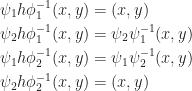
\begin{aligned}  \psi_1 h\phi_1^{-1}(x,y)&=(x,y)\\  \psi_2 h\phi_1^{-1}(x,y)&=\psi_2\psi_1^{-1}(x,y)\\  \psi_1 h\phi_2^{-1}(x,y)&=\psi_1\psi_2^{-1}(x,y)\\  \psi_2 h\phi_2^{-1}(x,y)&=(x,y)  \end{aligned}
are of class C^\infty. So h is a smooth map. Similarly, h^{-1} is smooth. Hence h is a diffeomorphism.

Looking for Home Tutors?

If you are looking for home tutors (any subject, e.g. Mathematics, Chinese, English, Science, etc.) contact us at:

Email: mathtuition88@gmail.com

We are able to recommend you highly qualified tutors, free of charge, no obligations.

Note that usually tutors’ slots will start to fill up as the year progresses, so by mid year May/June it is going to be very hard to find a good tutor.

Secondary Chinese Tuition (IP / O Level)

Ms Gao specializes in tutoring Secondary Level Chinese. Can teach composition, comprehension, etc, according to student’s weaknesses.

Has taught students from RI (IP Programme), MGS, and more. Familiar with IP and O Level (HCL/CL) Chinese syllabus.

Website: https://chinesetuition88.com/

Email: chinesetuition88@gmail.com

Summary of Persistent Homology

We summarize the work so far and relate it to previous results. Our input is a filtered complex K and we wish to find its kth homology H_k. In each dimension the homology of complex K^i becomes a vector space over a field, described fully by its rank \beta_k^i. (Over a field F, H_k is a F-module which is a vector space.)

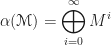
We need to choose compatible bases across the filtration (compatible bases for H_k^i and H_k^{i+p}) in order to compute persistent homology for the entire filtration. Hence, we form the persistence module \mathscr{M} corresponding to K, which is a direct sum of these vector spaces (\alpha(\mathscr{M})=\bigoplus M^i). By the structure theorem, a basis exists for this module that provides compatible bases for all the vector spaces.

Specifically, each \mathcal{P}-interval (i,j) describes a basis element for the homology vector spaces starting at time i until time j-1. This element is a k-cycle e that is completed at time i, forming a new homology class. It also remains non-bounding until time j, at which time it joins the boundary group B_k^j.

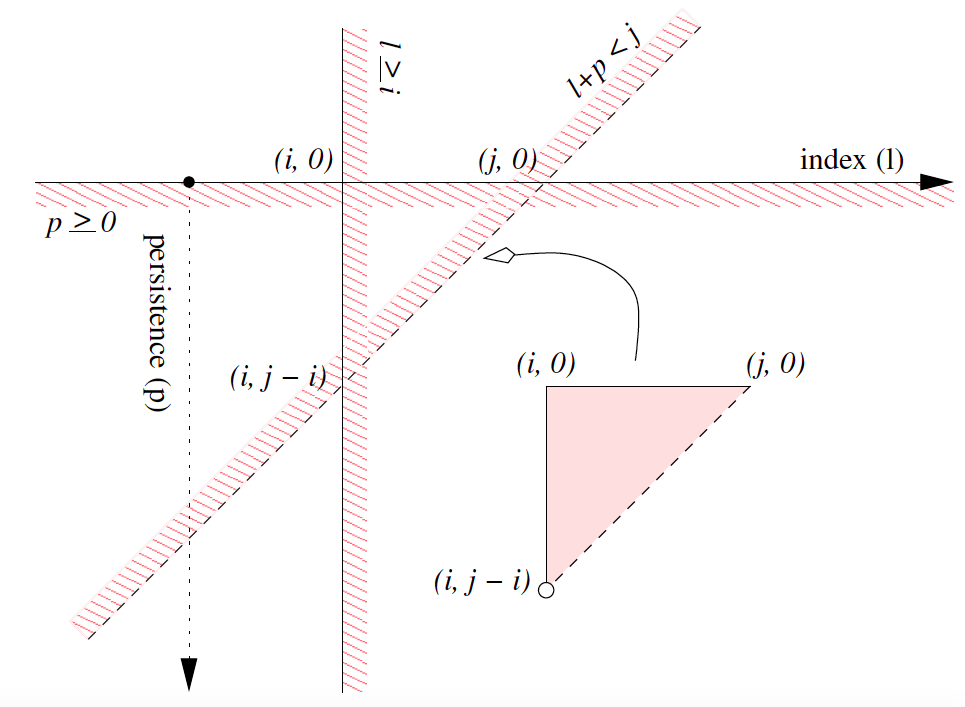
A natural question is to ask when e+B_k^l is a basis element for the persistent groups H_k^{l,p}. Recall the equation \displaystyle H_k^{i,p}=Z_k^i/(B_k^{i+p}\cap Z_k^i). Since e\notin B_k^l for all l<j, hence e\notin B_k^{l+p} for l+p<j. The three inequalities \displaystyle l+p<j,\ l\geq i,\ p\geq 0 define a triangular region in the index-persistence plane, as shown in Figure below.

triangle

The triangular region gives us the values for which the k-cycle e is a basis element for H_k^{l,p}. This is known as the k-triangle Lemma:

Let \mathcal{T} be the set of triangles defined by \mathcal{P}-intervals for the k-dimensional persistence module. The rank \beta_k^{l,p} of H_k^{l,p} is the number of triangles in \mathcal{T} containing the point (l,p).

Hence, computing persistent homology over a field is equivalent to finding the corresponding set of \mathcal{P}-intervals.

Source: “Computing Persistent Homology” by Zomorodian and Carlsson

Cast Iron Pan Singapore Review

Recently bought a cast iron pan/skillet for home cooking. Cast iron is an ancient technology that has several benefits over the more modern non-stick technology. It is supposed to be cheap (just US$15 in America Lodge L8SK3 Cast Iron Skillet, Pre-Seasoned, 10.25-inch), but in Singapore it is quite expensive probably due to import fees.

I bought the mid-range USA brand Lodge 10.25-inch skillet (around $60 SGD). It can be found in Qoo10:

Where to buy Cast Iron Pan/Pot/Skillet Singapore

Lodge Pre-Seasoned 8-inch Cast Iron Skillet: http://www.qoo10.sg/su/412118339/Q100000595

Lodge Pre-Seasoned Cast Iron Skillet 10.25-inch: http://www.qoo10.sg/su/412118386/Q100000595

Lodge Cast Iron Skillet (Midrange, affordable)

The high-end brands include Le Creuset, Staub. These are very expensive (at least $100 SGD).

Le Creuset Skillet (High-end, Super Expensive)

Benefits of Cast Iron Cookware vs Non-stick:

  • Non-stick Teflon, even with extreme care, tends to flake off and end up in food. Also it is released as fumes during cooking. It has dubious, unknown effects on humans, but is scientifically proven to be toxic to birds and rats.
  • Adds iron supplementation to cooked food. Iron is essential for human health to make hemoglobin in blood.
  • Technically lasts forever, as it is very durable. Save cost in the long run, as you don’t have to keep replacing the pan.

Also, other benefits include:

  • Works with induction cookers. (Iron is magnetic.)
  • It is moderately non-stick, almost as non-stick as Teflon. If anything sticks, just boil with water. Also, the more you use and season it, the more non-stick it becomes.

Downsides include: Heavy weight, needs seasoning (wipe dry and coat with oil) after cooking otherwise it can rust.

The third popular alternative, Aluminum pans, are definitely not good as it may be linked to Alzheimer’s and dementia.

Inspirational Scientist: Dan Shechtman

Source: https://www.theguardian.com/science/2013/jan/06/dan-shechtman-nobel-prize-chemistry-interview

To stand your ground in the face of relentless criticism from a double Nobel prize-winning scientist takes a lot of guts. For engineer and materials scientist Dan Shechtman, however, years of self-belief in the face of the eminent Linus Pauling‘s criticisms led him to the ultimate accolade: his own Nobel prize.

The atoms in a solid material are arranged in an orderly fashion and that order is usually periodic and will have a particular rotational symmetry. A square arrangement, for example, has four-fold rotational symmetry – turn the atoms through 90 degrees and it will look the same. Do this four times and you get back to its start point. Three-fold symmetry means an arrangement can be turned through 120 degrees and it will look the same. There is also one-fold symmetry (turn through 360 degrees), two-fold (turn through 180 degrees) and six-fold symmetry (turn through 60 degrees). Five-fold symmetry is not allowed in periodic crystals and nothing beyond six, purely for geometric reasons.

Shechtman’s results were so out of the ordinary that, even after he had checked his findings several times, it took two years for his work to get published in a peer-reviewed journal. Once it appeared, he says, “all hell broke loose”.

Many scientists thought that Shechtman had not been careful enough in his experiments and that he had simply made a mistake. “The bad reaction was the head of my laboratory, who came to my office one day and, smiling sheepishly, put a book on x-ray diffraction on my desk and said, ‘Danny, please read this book and you will understand that what you are saying cannot be.’ And I told him, you know, I don’t need to read this book, I teach at the Technion, and I know this book, and I’m telling you my material is not in the book.

“He came back a couple of days later and said to me, ‘Danny, you are a disgrace to my group. I cannot be with you in the same group.’ So I left the group and found another group that adopted a scientific orphan.”

He says that the experience was not as traumatic as it sounded. Scientists around the world had quickly replicated Shechtman’s discovery and, in 1992, the International Union of Crystallography accepted that quasi-periodic materials must exist and altered its definition of what a crystal is from “a substance in which the constituent atoms, molecules or ions are packed in a regularly ordered, repeating three-dimensional pattern” to the broader “any solid having an essentially discrete diffraction diagram”.

That should have been the end of the story were it not for Linus Pauling, a two-time Nobel laureate, once for chemistry and a second time for peace. Shechtman explains that at a science conference in front of an audience of hundreds Pauling claimed, “Danny Shechtman is talking nonsense, there are no quasi-crystals, just quasi-scientists.”

Pauling told everyone who would listen that Shechtman had made a mistake. He proposed his own explanations for the observed five-fold symmetry and stuck to his guns, despite repeated rebuttals. “Everything he did was wrong and wrong and wrong and wrong; eventually, he couldn’t publish his papers and they were rejected before they were published,” says Shechtman. “But he was very insistent, was very sure of himself when he spoke; he was a flamboyant speaker.”

Structure Theorem for finitely generated (graded) modules over a PID

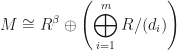
If R is a PID, then every finitely generated module M over R is isomorphic to a direct sum of cyclic R-modules. That is, there is a unique decreasing sequence of proper ideals (d_1)\supseteq(d_2)\supseteq\dots\supseteq(d_m) such that \displaystyle M\cong R^\beta\oplus\left(\bigoplus_{i=1}^m R/(d_i)\right) where d_i\in R, and \beta\in\mathbb{Z}.

Similarly, every graded module M over a graded PID R decomposes uniquely into the form \displaystyle M\cong\left(\bigoplus_{i=1}^n\Sigma^{\alpha_i}R\right)\oplus\left(\bigoplus_{j=1}^m\Sigma^{\gamma_j}R/(d_j)\right) where d_j\in R are homogenous elements such that (d_1)\supseteq(d_2)\supseteq\dots\supseteq(d_m), \alpha_i, \gamma_j\in\mathbb{Z}, and \Sigma^\alpha denotes an \alpha-shift upward in grading.

Secondary Level Chinese Tuition

Looking for O Level / IP / JC Chinese Tuition?

Ms Gao specializes in teaching secondary level chinese (CL/HCL) tuition in Singapore. Ms Gao has taught students from various schools, including RI (Raffles Institution IP Programme).

Teaches West / Central Area: E.g. Clementi, Jurong East, Bukit Timah, Dover, Bishan, Marymount

Email: chinesetuition88@gmail.com
Website: http://chinesetuition88.com

Persistence Interval

Next, we want to parametrize the isomorphism classes of the F[t]-modules by suitable objects.

A \mathcal{P}-interval is an ordered pair (i,j) with 0\leq i<j\in\mathbb{Z}^\infty=\mathbb{Z}\cup\{+\infty\}.

We may associate a graded F[t]-module to a set \mathcal{S} of \mathcal{P}-intervals via a bijection Q. We define \displaystyle Q(i,j)=\Sigma^i F[t]/(t^{j-i}) for a \mathcal{P}-interval (i,j). When j=+\infty, we have Q(i,+\infty)=\Sigma^iF[t].

For a set of \mathcal{P}-intervals \mathcal{S}=\{(i_1,j_1),(i_2,j_2),\dots,(i_n,j_n)\}, we define \displaystyle Q(\mathcal{S})=\bigoplus_{k=1}^n Q(i_k, j_k).

We may now restate the correspondence as follows.

The correspondence \mathcal{S}\to Q(\mathcal{S}) defines a bijection between the finite sets of \mathcal{P}-intervals and the finitely generated graded modules over the graded ring F[t].

Hence, the isomorphism classes of persistence modules of finite type over F are in bijective correspondence with the finite sets of \mathcal{P}-intervals.

Homogenous / Graded Ideal

Let A=\bigoplus_{i=0}^\infty A_i be a graded ring. An ideal I\subset A is homogenous (also called graded) if for every element x\in I, its homogenous components also belong to I.

An ideal in a graded ring is homogenous if and only if it is a graded submodule. The intersections of a homogenous ideal I with the A_i are called the homogenous parts of I. A homogenous ideal I is the direct sum of its homogenous parts, that is, \displaystyle I=\bigoplus_{i=0}^\infty (I\cap A_i).

Donate to help Stray Dogs in Singapore

URL: https://give.asia/movement/run_for_exclusively_mongrels

3 Singaporeans – Dr Gan, A Dentist, Dr Herman, A Doctor, and Mr Ariffin, a Law Undergraduate will be taking on the Borneo Ultra Trail Marathon on Feb 18th 2017 to raise 30k for Exclusively Mongrels Ltd; a welfare group set up for Mongrels in Singapore. (https://www.facebook.com/exclusivelymongrels/)

Do support them in their cause, if you can. And share this story so as to spread the word (maintenance and upkeep of the dogs can be a huge cost). Mongrels are actually highly intelligent, and can be more healthy and robust as compared to pedigrees, which may have hereditary diseases. For example, the popular Golden Retriever breed is prone to hip dysplasia.

A story told by Dr Gan summarizes everything — The state and welfare of stray dogs in Singapore, supposedly a first-world country, is actually worse than jungle dogs in Borneo. The Orang Asli, primitive junglers in Sabah, apparently treat dogs better than the average layperson in Singapore:

When Dr Gan, an EM member, was running through the trails of Sabah in Oct 2016, he stumbled upon a stray dog.

Being an avid dog lover and the proud father to three rescued Mongrels, he had to stop in his tracks. He fed the dog and it even ran alongside him for a mile or two. Further along the route, he encountered more stray dogs too.

All of the stray dogs he encountered seemed well-fed and were very approachable. They all displayed no aggression, despite being in the middle of a jungle. To Dr Gan, this was a tell-tale sign that the Orang Asli, who lived in villages in these jungles, took care of the dogs by feeding them. The fact that these Orang Aslis were living in harmony with these strays was indeed very commendable in his eyes.

These thoughts stuck with him throughout the run, and on the journey home too.

He couldn’t help but compare the Orang Asli’s hospitality to how a Singaporean layperson would react upon encountering a stray dog. More often than not, even in the absence of aggressive behaviour, a Singaporean who sees a stray dog would view it as no more than a pest and would either chase it away or even, call the authorities. As it so often is when the latter option is exercised, the authorities would have a hard time rehoming the dog and EM has to step in to ‘bail’ the dog out before the authorities euthanize it.

It is strange, he remarked, how the Orang Asli from the jungle can treat these strays with reverence while many Singaporeans would report a stray to the authorities without the slightest hesitation.

“Would the situation end up the same way if, instead of a stray mongrel, there was a stray pedigree dog?”

Armed with the notion that more needs to be done not just for these dogs but also to empower and educate the general public in Singapore about the plight of these strays and what can be done to help them, he then called on his two running buddies to undertake this journey with him.

It was going to be a journey that united his two passions – running and dogs; a journey back to the jungles where he first encountered the strays; back to where he first witnessed the hospitality of the Orang Asli; back to where where the spark was first ignited. He, and his Team, hope to bash through the jungles of Borneo, all in the hopes of blazing a new trail for Mongrels back home, in Singapore.

Smooth/Differentiable Manifold

Smooth Manifold
A smooth manifold is a pair (M,\mathcal{A}), where M is a topological manifold and \mathcal{A} is a smooth structure on M.

Topological Manifold
A topological n-manifold M is a topological space such that:
1) M is Hausdorff: For every distinct pair of points p,q\in M, there are disjoint open subsets U,V\subset M such that p\in U and q\in V.
2) M is second countable: There exists a countable basis for the topology of M.
3) M is locally Euclidean of dimension n: Every point of M has a neighborhood that is homeomorphic to an open subset of \mathbb{R}^n. For each p\in M, there exists:
– an open set U\subset M containing p;
– an open set \widetilde{U}\subset\mathbb{R}^n; and
– a homeomorphism \varphi: U\to\widetilde{U}.

Smooth structure
A smooth structure \mathcal{A} on a topological n-manifold M is a maximal smooth atlas.

Smooth Atlas
\mathcal{A}=\{(U_\alpha,\varphi_\alpha)\}_{\alpha\in J} is called a smooth atlas if M=\bigcup_{\alpha\in J}U_\alpha and for any two charts (U,\varphi), (V,\psi) in \mathcal{A} (such that U\cap V\neq\emptyset), the transition map \displaystyle \psi\circ\varphi^{-1}:\varphi(U\cap V)\to\psi(U\cap V) is a diffeomorphism.

Source:
Introduction to Smooth Manifolds (Graduate Texts in Mathematics, Vol. 218) by John Lee

Differentiable Manifolds (Modern Birkhäuser Classics) by Lawrence Conlon

These two books are highly recommended books for Differentiable Manifolds. John Lee’s book has almost become the standard book. Its style is similar to Hatcher’s Algebraic Topology, it can be wordy but it has detailed description and explanation of the ideas, so it is good for those learning the material for the first time.

Lawrence Conlon’s book is more concise, and has specialized chapters that link to Algebraic Topology.

Persistence module and Graded Module

We show that the persistent homology of a filtered simplicial complex is the standard homology of a particular graded module over a polynomial ring.

First we review some definitions.

A graded ring is a ring R=\bigoplus_i R_i (a direct sum of abelian groups R_i) such that R_iR_j\subset R_{i+j} for all i, j.

A graded ring R is called non-negatively graded if R_n=0 for all n\leq 0. Elements of any factor R_n of the decomposition are called homogenous elements of degree n.

Polynomial ring with standard grading:
We may grade the polynomial ring R[t] non-negatively with the standard grading R_n=Rt^n for all n\geq 0.

Graded module:
A graded module is a left module M over a graded ring R such that M=\bigoplus_i M_i and R_iM_j\subseteq M_{i+j}.

Let R be a commutative ring with unity. Let \mathscr{M}=\{M^i,\varphi^i\}_{i\geq 0} be a persistence module over R.

We now equip R[t] with the standard grading and define a graded module over R[t] by \displaystyle \alpha(\mathscr{M})=\bigoplus_{i=0}^\infty M^i where the R-module structure is the sum of the structures on the individual components. That is, for all r\in R, \displaystyle r\cdot (m^0,m^1,m^2,\dots)=(rm^0,rm^1,rm^2,\dots).

The action of t is given by \displaystyle t\cdot (m^0, m^1, m^2,\dots)=(0,\varphi^0(m^0),\varphi^1(m^1),\varphi^2(m^2),\dots).
That is, t shifts elements of the module up in the gradation.

Source: “Computing Persistent Homology” by Zomorodian and Carlsson.

GEP Selection Test Review and Experience

The following is a parent’s review and experience of the GEP Selection Test (2016). Original text (in Chinese) at: http://mp.weixin.qq.com/s/xQpLynFWpZ6QNpI_vlw4cw

Interested readers may also want to check out Recommended Books for GEP Selection Test.


Translation:

One day in September 2016 afternoon, read the son of the third son as usual time to go home, after the door looked calmly handed me a letter ~ OMG! A letter from the MOE to inform the son passed the GEP first round Examination, will be held on October 18 to participate in the second round of selection.

The son of the school in Singapore ranked 100 +, the third grade a total of seven classes, a total of about 280 students, he is in the best class. According to him, almost all the classmates participated in the first round of examinations, only through the eight individuals, including him. Later learned that, in fact, the school also 8 individuals to participate in the second round of their selection. Due to the small number of schools will not send people to pick up. Examination place in a subway station, never been to the school. The original quiet life, because to send test and upset, and finally have the opportunity to close feeling the legendary GEP.

A. Parents around the campus export was packed, looking at the eagerly a pair of eyes, I immediately think of China’s college entrance examination. Originally even sent too lazy to send his son to the exam, that is only an examination only, did not expect her husband told me to pick up the road, I began to excitement.

B. Carefully observed the son of the school to take the exam students, are not usually learn top-notch, but not usually take the scholarship. Such as the son of English is poor, but also through the first round.

Further, GEP study focus on learning with the usual very different. Also confirmed the rivers and lakes in the legendary: GEP will try to reduce the impact of language on the selection, so that truly talented children to stand out, and as much as possible without interference. Nevertheless, English is actually bad or affected. I asked the four students, all of the questions are difficult to answer the most difficult IQ, and the son of English that is better than IQ difficult, but there are several IQ questions did not understand, because the word does not know, of. In this case,

C. There are eight children in the class reference, thought that there will be a few other classes, did not think the day before the collection know that their school also their 8 classes. In fact, before the class this year, his son was assigned to other classes of students, there are several aspects of the results are good. Why the last one did not pass the GEP first round?

I think the first is the environment, in improving class, the teacher will be strict a lot of the other classes are not necessarily. Son is after almost a year, only to adapt to such a fast-paced and strict requirements.

Second, the amount of information provided is different. I remember the beginning of the beginning of his son’s class soon, on a large number of additional courses, including Mathematical Olympiad, Science Olympiad, Chinese writing, the second foreign language (Malay), plus a day CCA and school normal plus lesson. . .

Never had a tutorial managed son plus a lesson, home every day at least 4 points, and sometimes 6 points, as well as the violin and Chinese Orchestra, once tired and round and round all day shouting hungry. Home do not want to do anything, followed by his brother to play, to think of homework to do quickly, the next day and get up.

After six months, tired not, but the results plummeted. I have wanted his son not to learn these extra lessons, and his son said that these classes only their classes have, and other classes will not notice the information plus lesson, or learn it!

It now appears that the school had great efforts to catch them this class, the son is still helpful, and sometimes really forced a force, hold on, or there will be harvest. At least the son did not spend extra effort to improve classes, but also an improvement! This also fully shows that folklore, the small three-class is how important and tragic. I also know it!

From the test finished out of the children’s face, you can guess the state of the exam!

D. Elite is the elite schools, such as the son of this little-known school, a school had only a few people in the first round. The elite is the school charter to pick up, as well as teachers to accompany. Because the reference is really many people, a car also sat down, opened a few.

Nanyang Primary School is said to have 120 reference. People usually test and this test is almost, not just like to play like a try test chant. In this case,

E. When the son, met a lot of acquaintances. Parents who have children’s kindergarten students, parents who have attended the parents’ meeting, parents who have written classes, parents who have Chinese orchestra help, parents who have neighbors playmates, friends who have friends with God, and my fellow villagers and husband colleagues Even though the children in different schools, but the emphasis on education, parents, will eventually meet ~ to wait for the child to test this way to meet, quite special.

F. From the parents of the ratio can be inferred: the Chinese to the absolute high rate of reference, a small amount of Indian, a small amount of Malay, did not see Europe and the United States. Chinese like to test, but also good at the test, really reflected most vividly. After my visual, the number of boys more than girls. Take the son school, for example, 8 people have only 1 girl. I guess half of half a far cry. After all, his son son school class first, almost the girls occupied. Impression in the class last year, single scholarship, only the son of a boy.

G. GEP ultimately can be admitted to the rare, most parents are holding try to see the idea of the problem, let the children participate in, do not need all the energy on the GEP, but no need to focus on depletion in the primary three. Son of a classmate did not apply for GEP, heard there are not admitted to the second round, and some even admitted to the elite do not read.

Have seen a documentary article, his children’s classmates, the results are very good score is also high, can enter the first-class university, but eventually chose to read poly, because that read enough, never want to read!


Summary

Although most of the parents of the GEP rush, often the results are unsatisfactory. If the child has the ability to have a high degree of quality into the GEP selected elite, of course, is very good!

But if it is to further test, in order to further fight, one year or even several years earlier to the child overweight, premature energy consumption in reading this matter, the child’s desire to pursue knowledge and innovation, personal opinion, for the long And a variety of life, it is not worth!

I am a student of English in the workplace, said her daughter through the GEP test class children to go, now mixed very general.

Postscript

Participating in GEP is a good experience. No matter what the outcome, are worth a try Oh!

In addition, the son of GEP in the second round of the examination notice, the accident received three years to transfer the success of the phone in the fourth grade to go home only 5 minutes away from the school, and is directly assigned to the best classes to This ended his last three years, 5-15 minutes a day, take a 15-minute bus, but also to go some way to learn the experience.

Attached: GEP introduction of Singapore

GEP History

In 1984, the Ministry of Education of Singapore launched the Gifted Class, which aims to foster gifted students and give full play to their talents so as to better serve the community in the future.

The nine schools that provide talent education are: Anglo-Chinese School (Primary), Catholic High School (Primary), Henry Park Primary School, Nan Hua Primary School (Nan Hua Primary School) ), Nanyang Primary School, Raffles Girls’ Primary School, Rosyth School, St. Hilda’s Primary School and Tao Primary School. Nan School).

GEP screening process

All primary school students have the opportunity to participate in the first round of screening tests, voluntary, not mandatory. The first round of screening tests, including English and mathematics, usually in late August each year (the specific test location and time to the Ministry of Education notice).

In the first round, only 5% of students will be selected to participate in the second round of the selection test (usually the examination time in mid-October each year). Usually only 1% of the students will be selected last year, from the fourth grade, more than 9 schools to enter the genius classes.

Genius classes differ from ordinary students in their curricula.

On the basis of the general curriculum, intensive classes will be arranged for the Gifted students to explore and expand the capacity of gifted students to stimulate their more personalized and profound learning.

(Text: Tao Ying)

Persistence module and Finite type

A persistence module \mathcal{M}=\{M^i,\varphi^i\}_{i\geq 0} is a family of R-modules M^i, together with homomorphisms \varphi^i: M^i\to M^{i+1}.

For example, the homology of a persistence complex is a persistence module, where \varphi^i maps a homology class to the one that contains it.

A persistence complex \{C_*^i, f^i\} (resp.\ persistence module \{M^i, \varphi^i\}) is of finite type if each component complex (resp.\ module) is a finitely generated R-module, and if the maps f^i (resp.\ \varphi^i) are isomorphisms for i\geq m for some integer m.

If K is a finite filtered simplicial complex, then it generates a persistence complex \mathscr{C} of finite type, whose homology is a persistence module \mathcal{M} of finite type.

To Live Your Best Life, Do Mathematics

This article is a very good read. 100% Recommended to anyone interested in math.

The ancient Greeks argued that the best life was filled with beauty, truth, justice, play and love. The mathematician Francis Su knows just where to find them.

Source: https://www.quantamagazine.org/20170202-math-and-the-best-life-francis-su-interview/

Math conferences don’t usually feature standing ovations, but Francis Su received one last month in Atlanta. Su, a mathematician at Harvey Mudd College in California and the outgoing president of the Mathematical Association of America (MAA), delivered an emotional farewell address at the Joint Mathematics Meetings of the MAA and the American Mathematical Society in which he challenged the mathematical community to be more inclusive.

Su opened his talk with the story of Christopher, an inmate serving a long sentence for armed robbery who had begun to teach himself math from textbooks he had ordered. After seven years in prison, during which he studied algebra, trigonometry, geometry and calculus, he wrote to Su asking for advice on how to continue his work. After Su told this story, he asked the packed ballroom at the Marriott Marquis, his voice breaking: “When you think of who does mathematics, do you think of Christopher?”

Su grew up in Texas, the son of Chinese parents, in a town that was predominantly white and Latino. He spoke of trying hard to “act white” as a kid. He went to college at the University of Texas, Austin, then to graduate school at Harvard University. In 2015 he became the first person of color to lead the MAA. In his talk he framed mathematics as a pursuit uniquely suited to the achievement of human flourishing, a concept the ancient Greeks called eudaimonia, or a life composed of all the highest goods. Su talked of five basic human desires that are met through the pursuit of mathematics: play, beauty, truth, justice and love.

If mathematics is a medium for human flourishing, it stands to reason that everyone should have a chance to participate in it. But in his talk Su identified what he views as structural barriers in the mathematical community that dictate who gets the opportunity to succeed in the field — from the requirements attached to graduate school admissions to implicit assumptions about who looks the part of a budding mathematician.

When Su finished his talk, the audience rose to its feet and applauded, and many of his fellow mathematicians came up to him afterward to say he had made them cry. A few hours later Quanta Magazine sat down with Su in a quiet room on a lower level of the hotel and asked him why he feels so moved by the experiences of people who find themselves pushed away from math. An edited and condensed version of that conversation and a follow-up conversation follows.

Read more at: https://www.quantamagazine.org/20170202-math-and-the-best-life-francis-su-interview/

Homotopy for Maps vs Paths

Homotopy (of maps)

A homotopy is a family of maps f_t: X\to Y, t\in I, such that the associated map F:X\times I\to Y given by F(x,t)=f_t(x) is continuous. Two maps f_0, f_1:X\to Y are called homotopic, denoted f_0\simeq f_1, if there exists a homotopy f_t connecting them.

Homotopy of paths

A homotopy of paths in a space X is a family f_t: I\to X, 0\leq t\leq 1, such that

(i) The endpoints f_t(0)=x_0 and f_t(1)=x_1 are independent of t.
(ii) The associated map F:I\times I\to X defined by F(s,t)=f_t(s) is continuous.

When two paths f_0 and f_1 are connected in this way by a homotopy f_t, they are said to be homotopic. The notation for this is f_0\simeq f_1.


The above two definitions are related, since a path is a special kind of map f: I\to X.

Universal Property of Quotient Groups (Hungerford)

If f:G\to H is a homomorphism and N is a normal subgroup of G contained in the kernel of f, then f “factors through” the quotient G/N uniquely.Universal Property of Quotient

This can be used to prove the following proposition:
A chain map f_\bullet between chain complexes (A_\bullet, \partial_{A, \bullet}) and (B_\bullet, \partial_{B,\bullet}) induces homomorphisms between the homology groups of the two complexes.

Proof:
The relation \partial f=f\partial implies that f takes cycles to cycles since \partial\alpha=0 implies \partial(f\alpha)=f(\partial\alpha)=0. Also f takes boundaries to boundaries since f(\partial\beta)=\partial(f\beta). Hence f_\bullet induces a homomorphism (f_\bullet)_*: H_\bullet (A_\bullet)\to H_\bullet (B_\bullet), by universal property of quotient groups.

For \beta\in\text{Im} \partial_{A,n+1}, we have \pi_{B,n}f_n(\beta)=\text{Im}\partial_{B,n+1}. Therefore \text{Im}\partial_{A,n+1}\subseteq\ker(\pi_{B,n}\circ f_n).