This is a great introduction to LaTeX, a mathematical typesetting language that can be used to write Math equations. LaTeX can be used on WordPress too!
What happens if light slows down – A Beginner’s Guide to Relativity and Light
In the beginning God created the heavens and the earth. And God said, “Let there be light,” and there was light. Light is one of the most ubiquitous things that we see, and it is also one of the oldest – it existed since the beginning of mankind. However, light is also mysterious in that no one really understands what it is and how it is rectilinearly propagated. Nevertheless, the speed of light plays an important part in physics, and it is one of the more often quoted constant. What will happen then, if the speed of light suddenly changes from 300000000m/s to a fraction of its original self –3000 m/s? (It is theoretically possible to slow down light to such a speed, by shining a beam of light through a medium with a refractive index of 100,000.)
It’s a numbers song for children and adults. Count from 0 to 100 and from a hundred to a trillion.
This song was written and performed by A.J. Jenkins. Video by KidsTV123.
A catchy and educational song for kids to count big numbers.
Australian authorities have announced that satellite images taken of a stretch of ocean 1,550 miles southwest of Perth, Australia, are believed to show floating debris that could be part of missing Malaysia Airlines Flight 370. “It is probably the best lead we have right now,” said John Young, a spokesman for the Australian Maritime Safety Authority. Confirmation of the material’s provenance will likely have to wait, however. While a merchant vessel has arrived in the area to help with the search, poor visibility has prevented search aircraft from locating the debris, and the nearest Australian Navy ship is several days’ sail away.
The search for Air France 447 offers a useful template for how investigators can whittle away at the seemingly unsolvable mystery of a midocean airliner disappearance. After the Airbus A330 went missing over the middle of the equatorial Atlantic in 2009, search aircraft took just one day to locate the first pieces of floating wreckage. The recovery of the black box, however, took another painstaking two years, and a full assessment of its implications another year after that.
The first step after determining the debris’ location is to call in the mathematicians. Based on all the data available—the aircraft’s last known position, route of flight, altitude, prevailing winds, sea currents, ocean depth, and so on—a probability is assigned to each variable, and a distribution map of probable locations on the sea floor is generated. Searchers can then deploy their underwater assets to scour the vastness of the deep, working back and forth along grid lines laid out in the areas of maximum probability.
There’s a deep problem inherent in this approach, however, and it’s that the probabilities are themselves only guesses. Searchers are uncertain even as to the extent of their own uncertainty. In the case of Air France 447, the set of base-set assumptions turned out to be wrong, and the first two search seasons scoured thousands of square miles in vain.
What turned the tide for AF447 searchers, in the end, was better math and better undersea technology. A recalculation of the location probabilities using a different mathematical approach led to the redrawing of the search grids much closer to the site of the plane’s disappearance. And a new type of autonomous undersea vehicle—a robot sub, in other words—became available for the first time. Called Remus 6000, these subs were able to navigate on their own along precise grid lines, ascending and diving to match the contours of the undersea terrain. On April 3, 2011, less than a week after the refined search began, one of the three submersibles deployed in the search returned to its mother ship bearing images of a debris field scattered across an abyssal plain. AF447 had been found. A month later another type of unmanned submersible brought the black boxes to the surface.
Given a quadratic equation with roots and , we have:
How do we prove this? It is actually due to the quadratic formula!
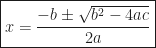
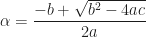
Recall that the quadratic formula gives the roots of the quadratic equation as:
Now, we can let
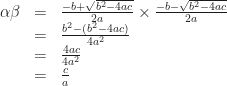
Hence,
In the above proof, we made use of the identity
The above formulas are also known as Vieta’s formulas (for quadratic). There we have it, this is how we prove the formula for the sum and product of roots!
If we were to choose only 3 greatest scientists in the entire human history, who excelled in every field of science and mathematics, they are:
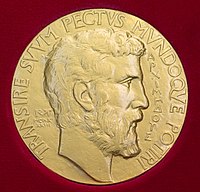
1) Archimedes
2) Issac Newton
3) Carl Friedrich Gauss
Let’s see how Gauss became a great scientist in his formative years in the university, it would give us a clue by knowing what kind of books did he read ?
Carl Friedrich Gauss was awarded a 3-year ‘overseas’ scholarship to study in Göttingen University (located in the neighboring state Hanover) by his own state sponsor the Duke of Brunswick.
Gauss chose Göttingen University because of its rich collection of books.
During the 3 years, he read very widely on average 8 books in a month.
Below was his student days’ library records:
1795-1796 (1st semister): total 35 books
Math (M) :1 ,
Astrology (A):2,
History/Philosophy (H): 1,
Literature/ Language (L): 15,
Science Journal (S): 16
Recent years, there are more newly created “Nobel” Prizes with much bigger prize amounts than the Nobel prize:
BREAKTHROUGH PRIZE IN LIFE SCIENCE (2013)
Donated by: Yuri Milner (Russian Internet Billionaire)
Mark Zuckerberg (Facebook Founder)
Sergey Brin (Google co-founder)
US$ 3 million
Award Frequency: Every year
Status: 9 scientists had been awarded
FUNDAMENTAL PHYSCIS PRIZE (2012)
Donated by Yuri Milner
US$ 3 million
TANG PRIZE 唐奨 (2013)
Donated by Samual Yin 尹衍梁 (Taiwan Property Tycoon) for Asian countries.
US$ 1.675 million
Frequency: Every 2 years
QUEEN ELIZABETH ENGINEERING PRIZE (2013)
US$ 1.5 million
NOBEL PRIZE (1901)
US$ 1.2 million
SHAW PRIZE 邵逸夫奨 (2004)
Donated by Run Run Shaw (Hong Kong Movie Producer Billionaire)
US$ 1 million
LASKER AWARD (1946)
US$ 250,000
BLAVATNIK YOUNG SCIENTIST AWARD (2013)
Donated by Len Blavatnik (Billionaire Investor)
US$ 250,000
I find Khan Linear Algebra video excellent. The founder / teacher Sal Khan has the genius to explain this not-so-easy topic in modular videos steps by steps, from 2-dimensional vectors to 3-dimensional, working with you by hand to compute eigenvalues and eigenvectors, and show you what they mean in graphic views.
If you are taking Linear Algebra course in university, or revising it, just go through all the Khan’s short (5-20 mins) videos on Linear Algebra here:
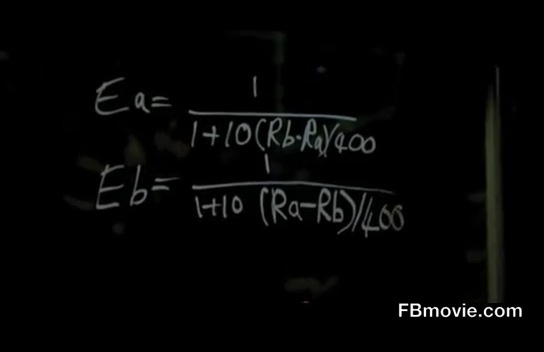
Eduardo Saverin (now a Singaporean billionaire investor) gave the wrong Elo formula to his Facebook co-founder Mark Zuckerburg, both of them became ‘accidental’ billionaire. Watch the video clip in the movie “Social Network”:
The Elo formula is based on the theory of Normal Distribution with Logarithm function, from base of exponential e to base of 10.
The correct Elo Formula should be :
$Latex boxed
{
E_a =frac{1}
{1+ frac{1}{400}.Huge 10^{(R_b – R_a)}
}
}$
Math Chants make learning Math formulas or Math properties fun and easy for memory . Some of them we learned in secondary school stay in the brain for whole life, even after leaving schools for decades.
Math chant is particularly easy in Chinese language because of its single syllable sound with 4 musical tones (like do-rei-mi-fa) – which may explain why Chinese students are good in Math, as shown in the International Math Olympiad championships frequently won by China and Singapore school students.
1. A crude example is the quadratic formula which people may remember as a little chant:
“ex equals minus bee plus or minus the square root of bee squared minus four ay see all over two ay.”
$latex boxed{
x = frac{-b pm sqrt{b^{2}-4ac}}
{2a}
}$
2. $latex mathbb{NZQRC}$ Nine Zulu Queens Rule China
Check out the following interesting comic books explaining Math (Calculus, Linear Algebra, and Statistics) in a fun and enjoyable way.
In The Manga Guide to Calculus, you’ll follow along with Noriko as she learns that calculus is more than just a class designed to weed out would-be science majors. You’ll see that calculus is a useful way to understand the patterns in physics, economics, and the world around us, with help from real-world examples like probability, supply and demand curves, the economics of pollution, and the density of Shochu (a Japanese liquor).
Mr. Seki teaches Noriko how to:
Use differentiation to understand a function’s rate of change
Apply the fundamental theorem of calculus, and grasp the relationship between a function’s derivative and its integral
Integrate and differentiate trigonometric and other complicated functions
Use multivariate calculus and partial differentiation to deal with tricky functions
Use Taylor Expansions to accurately imitate difficult functions with polynomials
Whether you’re struggling through a calculus course for the first time or you just need a painless refresher, you’ll find what you’re looking for in The Manga Guide to Calculus.
Follow along in The Manga Guide to Linear Algebra as Reiji takes Misa from the absolute basics of this tricky subject through mind-bending operations like performing linear transformations, calculating determinants, and finding eigenvectors and eigenvalues. With memorable examples like miniature golf games and karate tournaments, Reiji transforms abstract concepts into something concrete, understandable, and even fun.
As you follow Misa through her linear algebra crash course, you’ll learn about:
Basic vector and matrix operations such as addition, subtraction, and multiplication
Linear dependence, independence, and bases
Using Gaussian elimination to calculate inverse matrices
Subspaces, dimension, and linear span
Practical applications of linear algebra in fields like computer graphics, cryptography, and engineering
But Misa’s brother may get more than he bargained for as sparks start to fly between student and tutor. Will Reiji end up with the girl—or just a pummeling from her oversized brother? Real math, real romance, and real action come together like never before in The Manga Guide to Linear Algebra.
The Manga Guide to Statistics
This manga textbook is written for those interested in understanding principles of statistics. Each of the seven chapters is organized into four sections: a cartoon, a text explanation to supplement the cartoon, an exercise that includes the answer, and a summary. Readers can learn much about the subject by just reading the cartoon, but they will gain a more thorough understanding by working through the other three sections in each chapter. Yamamoto provides Rui with easy-to-understand examples and graphic illustrations, making the subject less intimidating.
If you are interested to write for us and submit a guest post, please contact us at mathtuition88@gmail.com, or drop us a message in the comments below! 🙂
Axiom
(
Greek
): meant
request
. The reader is requested to accept the axioms unquestioningly as the rules of the game.
Euclid’s “Element” built the whole Geometry with only 5 axioms.
The 5th axiom “Parallel line” was not challenged for 3,000 years until 19th CE Gauss & Riemann developed the Non-Euclidian Geometry.
What it means a curve (function) is :
1. Continuous = not broken curve
2. Differentiable = no pointed ‘V’ or ‘W’ shape curve
3. Integrable: can compute the area under the (unbroken) curve.
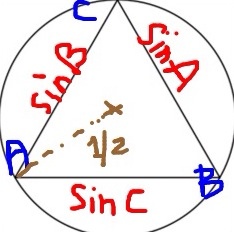
1. Draw a circle (diameter 1)
2. Connect any 3 points on the circle to form a triangle of angles A, B, C.
3. The length of sides opposite A, B, C are sin A, sin B, sin C, respectively.
Proof:
By Sine Rule:
$latex frac{a}{sin A} = frac{b}{sin B} =frac{c}{sin C} = 2R = 1$
where sides a,b,c opposite angles A, B, C respectively.
a = sin A
b = sin B
c = sin C
1. No complexity of Analytical Geometry
2. Remove the astute dotted (helping) line in Geometry
3. No need diagram: Use only 2 vector properties: Head- to-Tail:
$latex vec{AC}=vec{AB}+vec {BC}$ Closed Loop:
$latex vec{DE}+vec{EF}+vec{FD}=0$
4. Enable Computer automated proof of Geometry via Algebra.
Example: 任意四边形 Quadrilateral ABCD with M,N midpoints of AB, CD, resp.
Prove: MN=1/2(BC+AD)
Proof: (by vector):
Consider MBCN:
MN=MB+ BC+ CN..(1)
Consider MADN:
MN=MA+ AD+ DN..(2)
(1) +(2):
2MN=(MB +MA) +
(BC +AD) +(CN +DN)
but (MB +MA) =0,
(CN +DN) =0 [same magnitude but different direction cancelled out ]
=> MN=1/2 (BC +AD)
Special cases:
1. A = B (=M)
=> triangle ACD
AN = 1/2 (AC +AD)
2. BC // AD
=> Trapezium ABCD
MN=1/2 (BC +AD)
=> MN // BC // AD
Bharati Krishna Tirthaji @ early 19xx, a former Indian child prodigy graduating in Sanskrit, Philosophy, English, Math, History & Science at age 20.
16 sutras (aphorisms):
1. By one more than the one before
2. All from 9 and the last from 10
3. Vertically and cross-wise
4. Transpose and Apply
5. If the Samuccaya is the same it is Zero
6. If One is in Ratio the Other is Zero
7. By + and by –
8. By the Completion or Non-Completion
9. Differential Calculus
10. By the Deficiency
11. Specific and General
12. The Remainders by the Last Digit
13. The Ultimate and Twice the Penultimate
14. By One Less than the One Before
15. The Product of the Sum
16. All the Multipliers
Solve
$latex (x+7)^4+(x+5)^4=706$
Let y = x + 6 = average of (x+5, x+7)
$latex (y+1)^4+(y-1)^4=706$
Cancel terms y, y³:
$latex 2y^4+12y^2+2=706$
$latex y^4+6y^2-352=0$
$latex y^2=16$ or
$latex y^2=-22$
y= ±4 or ±$latex sqrt{-22}$
y=x+6
x=-2, -10, ± $latex sqrt{-22}-6$
1. Amateur is at liberty to study only those things he likes.
2. Professional must also study what he doesn’t like.
3. Conclusion: Most famous theorems are found by Amateurs.
An old man had 11 horses. When he died, his will stated the following distribution to his 3 sons:
1/2 gives to the eldest son,
1/4 for 2nd son,
1/6 for 3rd son.
Find: how many horses each son gets ?
There are 2 methods to solve: first using simple arithmetic trick without knowing the theory behind; the second method will explain the first method “from an advanced standpoint” – Number Theory (Felix Klein’s Vision )
1) Arithmetic trick:
11 is odd, not divisible by 2, 4 and 6.
Loan 1 horse to the old man:
11+1 = 12
1st son gets: 12/2 = 6 horses
2nd son gets:12/4 = 3 horses
3rd son gets: 12/6 = 2 horses
Total = 6+3+2=11 horses
Up to you if you want the old man to return the 1 loan horse 🙂
The French method of drawing curves is very systematic:
“Pratique de l’etude d’une fonction”
Let f be the function represented by the curve C
Steps:
1. Simplify f(x). Determine the Domain of definition (D) of f;
2. Determine the sub-domain E of D, taking into account of the periodicity (eg. cos, sin, etc) and symmetry of f;
3. Study the Continuity of f;
4. Study the derivative of fand determine f'(x);
5. Find the limits of fwithin the boundary of the intervals in E;
6. Construct the Table of Variation;
7. Study the infinite branches;
8. Study the remarkable points: point of inflection, intersection points with the X and Y axes;
9. Draw the representative curve C.
Example:
$latex displaystyletext{f: } x mapsto frac{2x^{3}+27}{2x^2}$ Step 1: Determine the Domain of Definition D D = R* = R –…
Donald Knuth (Great Computer Mathematician, Stanford University, LaTex inventor) noted the Bible uses a phrase like:
“as my Father is to me, I am to you”
=> F= Father = line AB
I (or me) = AC
U = You = CB
=> F/I = I/U = Φ
Note: Φ = 1.61803 = – 2 sin 666°
Related Links: Find sites that are similar to the site you are visiting.
Wayback: See how a site looked in the past.
Hot Pages & Searches: See what’s popular on the web right now.
Alexa Internet, Inc. is a California-based subsidiary company of Amazon.com which provides commercial web traffic data. Founded as an independent company in 1996, Alexa was acquired by Amazon in 1999. Its toolbar collects data on browsing behavior and transmits it to the Alexa website, where it is stored and analyzed, forming the basis for the company’s web traffic reporting. As of 2013, Alexa provides traffic data, global rankings and other information on 30 million websites,[3] and its website is visited by over 8.5 million people monthly. (Wikipedia)
This post is a review on Right brain training, and also a list of resources that one can research on regarding to the popular method of Right brain training.
When it comes to New Year’s resolutions, getting your body in shape often tops the list. But what about your brain?
Top Seller on Amazon.com on Right brain training
If your left or right brain is feeling a little flabby, there’s a wide range of books, teaching programs, and even a Nintendo DS game, purporting to train your left and/or right brain. Indeed, if you Google “right brain training”, you’ll score 53,900,000 hits.
These products are based on the belief that the left and right hemispheres are polar opposites. The left brain is often characterised as your intelligent side: rational, logical and analytic. In contrast the right brain is stereotyped as the “touchy-feely” hemisphere, viewed as artistic, creative, and emotive.
Such left and right brain stereotypes have led theorists to suggest that people can be classified according to their “hemisphericity”. If you’re a logical, rational scientist, for instance, you’re left-brained. But creative types, from artists to writers, are right-brained.
Based on my teaching experience, I do find that left-handers (right-brained) students tend to be very creative and usually excel at arts and humanities. However, their math skills can be good too, especially with practice. This shows that the human brain is like a muscle, it gets better with practice and use.
Did you know our Prime Minister Lee Hsien Loong is left-handed too? Barack Obama is also left-handed. Prime Minister Lee Hsien Loong is very good at math, so this should dispel any myths that left-handed students are not good at math.
Understanding the Myth of Left Brain and Right Brain Dominance
The Right Brain
According to the left-brain, right-brain dominance theory, the right side of the brain is best at expressive and creative tasks. Some of the abilities that are popularly associated with the right side of the brain include:
Recognizing faces
Expressing emotions
Music
Reading emotions
Color
Images
Intuition
Creativity
The Left Brain
The left-side of the brain is considered to be adept at tasks that involve logic, language and analytical thinking. The left-brain is often described as being better at:
Language
Logic
Critical thinking
Numbers
Reasoning
Also, check out the above Youtube video to check if you are a right-brained or left-brained person!
The Right Brain vs Left Brain test … do you see the dancer turning clockwise or anti-clockwise?
If clockwise, then you use more of the right side of the brain and vice versa.
Most of us would see the dancer turning anti-clockwise though you can try to focus and change the direction; see if you can do it.
LEFT BRAIN FUNCTIONS
uses logic
detail oriented
facts rule
words and language
present and past
math and science
can comprehend
knowing
acknowledges
order/pattern perception
knows object name
reality based
forms strategies
practical
safe
RIGHT BRAIN FUNCTIONS
uses feeling
“big picture” oriented
imagination rules
symbols and images
present and future
philosophy & religion
can “get it” (i.e. meaning)
believes
appreciates
spatial perception
knows object function
fantasy based
presents possibilities
impetuous
risk taking
Right Brain Training Test
Take the test to see if you are right-brained or left-brained!
Any comments or websites about Right brain training to share? Leave your comments below!
Right Brain Training Video
Watch this free brain training video and follow the instructions to increase your brain power. This is an online “game” that really works to improve brain function. You can actually feel it work!
Brain Training can increase your brain power just like weight training can increase your strength. Use this exercise to work out your brain. Bookmark this video and come back and practice with variations on the basics as discussed in the video.
Recently, I added the Maths Blog to the Teach100 website. Glad to know that the blog has been approved!
“Thank you for submitting Singapore Maths Tuition to the Teach100! Your blog has been approved and is currently ranked at #427 of 601 blogs. Congratulations! We recently reached our 500th blog, and are excited to add your blog to our growing community!”
$Latex i^{i } = 0.207879576…$
$latex i = sqrt{-1}$
If a is algebraic and b is algebraic but irrational then $latex a^b $ is transcendental. (Gelfond-Schneider Theorem)
Since i is algebraic but irrational, the theorem applies.
1. We know
$latex e^{ix}= cos x + i sin x$
Let $latex x = pi/2 $
2. $latex e^{i pi/2} = cos pi/2 + i sin pi/2 $
$latex cos pi/2 = cos 90^circ = 0 $
$latex sin 90^circ = 1 $
$latex i sin 90^circ = (i)*(1) = i $
3. Therefore
$latex e^{ipi/2} = i$
4. Take the ith power of both sides, the right side being $latex i^i $ and the left side =
$latex (e^{ipi/2})^{i}= e^{-pi/2} $
5. Therefore
$latex i^{i} = e^{-pi/2} = .207879576…$
National Pi Day is actually a U.S. holiday. The House of Representatives passed House Resolution 224 in 2009, designating March 14 as National Pi Day. The resolution “encourages schools and educators to observe the day with appropriate activities that teach students about Pi and engage them about the study of mathematics.” (Source: http://www.usatoday.com/story/tech/2014/03/13/pi-day-friday-31415/6369483/)
Do you wish Pi day was a national holiday in your country? I sure do! Leave your comments below!
There are many academic institutions in the world and rankings on certain faculties help determine the best ones in certain fields. Students who are extremely in mathematics will automatically want to enroll and join universities that are highly ranked as far as mathematics is concerned. Year by year, the rankings are released and can be accessed through the internet and various academic public publications. In addition to stellar performance, there are other factors that are considered during the rankings. This article will mention a few of the top mathematics institutions around the world.
The University of Cambridge
This is not only one of the oldest universities in the United Kingdom but also in the world. Its scholarly achievements have made it popular and famous the world over. Its high performance in mathematics and other fields is accredited to research and well trained and knowledgeable faculty tutors. External examiners and bodies such as the Quality Assurance Agency have all endorsed the performance of the university time and again. The University of Cambridge has vast studying resources such as museums, libraries and other collections. Teaching is done by lecturers who are experts and authorities in their field through seminars and lectures making this university the very top of this list.
The University of Toronto
The University of Toronto is one of the best in the world not only in mathematics but when it comes to research. Its research capabilities in all fields are rivaled only by the prestigious Harvard Universities. One thing that makes this institution great in mathematics is its system of graduate supervision and teaching strengths. The university attracts and enrolls professionals, graduates and undergraduates in the mathematical field and they are all taught by the best researchers. It has both on campus and off campus students. International students get to enjoy learning mathematics and visiting come of Canada’s most breathtaking scenic sites.
The Australian National University
This top ranked university was established back in 1946 and has risen over the years to be the top university in Australia and one of the best in the world. Mathematically speaking, the university’s teaching methods and perfectly teacher to student ratio ensure that the mathematical faculty is of international standards. Campus students do not even have to venture outside as the campus has all the social amenities needed. To make it even better, the university is well networked with some of the world’s leading academic institutions and this means that it has access to the latest information in research.
National University of Singapore
Asia is not left behind as far as mathematical prowess is concerned as the National university of Singapore puts it on the global map. One of the things that make it a top institution is its well-structured exchange programs with other universities that are mathematical giants. For this reason, the university’s best students apply for ESTA VISA in order to join other brilliant mathematical minds in other universities. The university also offers joint degree programs with other leading universities. Due to the university’s strength in research, it is affiliated with global research bodies such as International Alliance of Research Universities.
A Maths Paper 2:
29/10/2014 (Wednesday)
08:00-10:30
The schedule for the first few weeks seems to be quite tight, for instance on 28/10/2014 students would have to handle A Maths Paper 1, and Chemistry Paper 2. (A Maths Paper 1 would be quite exhausting for students on its own)
After the major papers are over, students will have plenty of time to study for their Science Paper 1 (MCQ), with Biology Paper 1 being one of the last papers on 13/11/2014.





 with roots
  and
and  , we have:







 ? Leave your comments below!
 Alexa Traffic Rank: See how popular a website is.
 Related Links: Find sites that are similar to the site you are visiting.
 Wayback: See how a site looked in the past.
 Hot Pages & Searches: See what’s popular on the web right now.


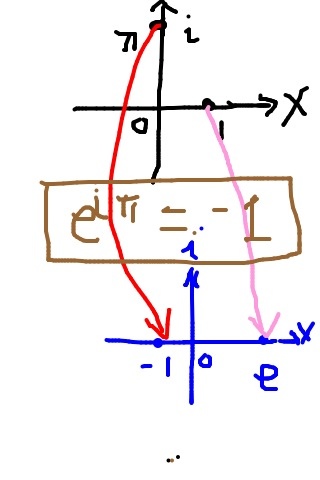
 , you have entered the mysterious world of complex numbers.
 is a real number! Let us explain it here:
 . This has been voted as the most beautiful equation in mathematics by many people.



 Mathtuition88