Habitica: Productivity that Grants XP

Very interesting productivity app that resembles a game. Do check it out!

Matthew Bowman's avatarThe Catholic Geeks

A few months ago, I noticed someone in one of my Facebook groups posting about an interesting app called Habitica. It’s one of a host of time-management and productivity-increasing applications, both web- and mobile-based. What sets it apart, however, is that it turns your efforts at organizing your life into a game. Specifically, it turns your life into something reminiscent of a classic, pixelated, 8-bit RPG.

So no, the title of this post is not a metaphor. You literally get XP (and gold) for doing your tasks in real life. 

View original post 2,652 more words

Three Properties of Galois Correspondence

The Fundamental Theorem of Galois Theory states that:

Given a field extension E/F that is finite and Galois, there is a one-to-one correspondence between its intermediate fields and subgroups of its Galois group.
1) H\leftrightarrow E^H where H\leq\text{Gal}(E/F) and E^H is the corresponding fixed field (the set of those elements in E which are fixed by every automorphism in H).
2) K\leftrightarrow\text{Aut}(E/K) where K is an intermediate field of E/F and \text{Aut}(E/K) is the set of those automorphisms in \text{Gal}(E/F) which fix every element of K.

This correspondence is a one-to-one correspondence if and only if E/F is a Galois extension.

Three Properties of the Galois Correspondence

  1. It is inclusing-reversing. The inclusion of subgroups H_1\subseteq H_2 holds iff the inclusion of fields E^{H_2}\subseteq E^{H_1} holds.
  2. If H is a subgroup of \text{Gal}(E/F), then |H|=[E:E^H] and |\text{Gal}(E/F)/H|=[E^H:F].
  3. The field E^H is a normal extension of F (or equivalently, Galois extension, since any subextension of a separable extension is separable) iff H is a normal subgroup of \text{Gal}(E/F).

3 Zika Methods that do NOT work #Zika

As the Zika/Dengue virus has spread to Singapore, I have been researching (in my spare time) on ways to prevent Zika/Dengue. The following are some interesting ways that however eventually do not work (or worse, attract more mosquitoes), so do not waste your money trying these!

1) Bug Zappers that use Ultraviolet Light as a Lure

In theory, bug zappers that use electricity to kill mosquitoes sound like a great idea. However, the problem comes from the fact that bug zappers use Ultraviolet Light (UV) to attract insects. Mosquitoes are attracted by Carbon Dioxide, not UV light, so you will end up killing 99% other insects, some of which are beneficial insects. See http://insects.about.com/od/StingingBitingInsects/a/Do-Bug-Zappers-Kill-Mosquitoes.htm.

2) Ultrasonic Buzzing devices that sound like Male Mosquitoes, since Female Mosquitoes with fertilized eggs actively avoid Male Mosquitoes

This seems to be complete BS. See http://www.mosquitoreviews.com/ultrasonic-mosquito-app.html

3) Pitcher Plants to eat Mosquitoes

This sounds like a genius idea at first, since Pitcher Plants eat insects, and grow in tropical climates, exactly where Aedes Mosquitoes live. The problem is mosquito larvae can survive very well in Pitcher Plants.

4) P.S. If you have a pond with large koi fish in it, you may want to add smaller fish, since koi fish (and other large fish in general) are known not to eat mosquito larvae. “Koi may be beautiful, but they are generally too large to prey on mosquito larvae and are known for their mellow nature.”

Laurent Series with WolframAlpha

WolframAlpha can compute (simple) Laurent series:
https://www.wolframalpha.com/input/?i=series+sin(z%5E-1)

Series[Sin[z^(-1)], {z, 0, 5}]

1/z-1/(6 z^3)+1/(120 z^5)+O((1/z)^6)
(Laurent series)
(converges everywhere away from origin)

Unfortunately, more “complex” (pun intended) Laurent series are not possible for WolframAlpha.

How to opt out of WhatsApp sharing your information with Facebook

Source: http://www.androidcentral.com/how-opt-out-sharing-your-information-facebook-whatsapp-android

In 2014, Facebook bought WhatsApp for a whopping $21.8 billion. WhatsApp users everywhere went, “Oh, no. This can’t be good.” That feeling has finally come to fruition in that WhatsApp will now start sharing your information with Facebookincluding your phone number.

If you don’t want Facebook getting ahold of your WhatsApp info, you can opt out in one of two ways.

Click on the link above to read the method to opt out.

Grades should not define our kids

mathtuition88's avatarTuition Database Singapore

Source: http://www.straitstimes.com/singapore/education/grades-should-not-define-our-kids

Your grades do not define you,” said Mr Jack Cook.

That was Debbie’s defining moment.

Debbie, a perfectionist, always had the best academic results in her earlier years at school. However, when studying economics at junior college, she was thrown off balance.

Despite putting in more effort – hard work as well as getting extra coaching from her teacher, Mr Cook – Debbie just could not grasp the subject. She could not understand nor accept the poor grades she got for her economics examination. She felt ashamed and guilty, so much so that she avoided her teacher and did not visit the school after graduation.

A few years later, when Debbie heard that Mr Cook was retiring and leaving Singapore, she plucked up the courage to visit and bid him farewell.

Mr Cook greeted Debbie with a big smile and warmly welcomed her. She asked him sheepishly if…

View original post 44 more words

Nothing Worthwhile Is Ever Easy

Pastor Rick Warren has a gift of applying Christian principles in teaching lessons in real life scenarios. This is one of them.

Source: http://rickwarren.org/devotional/english%2fnothing-worthwhile-is-ever-easy1?roi=echo7-27662529651-48607434-ac7d2bec278bdcfcc6c26fe1a409387d&

“Let’s not get tired of doing what is good. At just the right time we will reap a harvest of blessing if we don’t give up” (Galatians 6:9 NLT, second edition).

There are many things that work to keep us from completing our life missions. Over the years, I’ve debated whether the worst enemy is procrastination or discouragement. If Satan can’t get us to put off our life missions, then he’ll try to get us to quit altogether.

The apostle Paul teaches that we need to resist discouragement: “Let’s not get tired of doing what is good. At just the right time we will reap a harvest of blessing if we don’t give up” (Galatians 6:9 NLT, second edition).

Do you ever get tired of doing what’s right? I think we all do. Sometimes it seems easier to do the wrong thing than the right thing.

When we’re discouraged, we become ineffective. When we’re discouraged, we work against our own faith.

When we’re discouraged, we’re saying, “It can’t be done.” That’s the exact opposite of saying, “I know God can do it because he said …”

Ask yourself these questions:

  • How do I handle failure?
  • When things don’t go my way, do I get grumpy?
  • When things don’t go my way, do I get frustrated?
  • When things don’t go my way, do I start complaining?
  • Do I finish what I start?
  • How would I rate on persistence?

If you’re discouraged, don’t give up without a fight. Nothing worthwhile ever happens without endurance and energy.

When an artist creates a sculpture, he has to keep chipping away. He doesn’t hit the chisel with the hammer once, and suddenly all the excess stone falls away revealing a beautiful masterpiece. He keeps hitting it and hitting it, chipping away at the stone.

And that’s true of life, too. Nothing really worthwhile ever comes easy in life. You keep hitting it and going after it, and little by little your life becomes a masterpiece of God’s grace.

The fact is, great people are really just ordinary people with an extraordinary amount of determination. Great people don’t know how to quit.

By Pastor Rick Warren

Mathematicians Are Overselling the Idea That “Math Is Everywhere”

This article provides an alternative viewpoint on whether mathematics is useful to society. A good read if you are writing a GP (General Paper) essay on the usefulness of mathematics, to provide both sides of the argument.

Source: http://blogs.scientificamerican.com/guest-blog/mathematicians-are-overselling-the-idea-that-math-is-everywhere/?WT.mc_id=SA_WR_20160817

Excerpt:

Most people never become mathematicians, but everyone has a stake in mathematics. Almost since the dawn of human civilization, societies have vested special authority in mathematical experts. The question of how and why the public should support elite mathematics remains as pertinent as ever, and in the last five centuries (especially the last two) it has been joined by the related question of what mathematics most members of the public should know.

Why does mathematics matter to society at large? Listen to mathematicians, policymakers, and educators and the answer seems unanimous: mathematics is everywhere, therefore everyone should care about it. Books and articles abound with examples of the math that their authors claim is hidden in every facet of everyday life or unlocks powerful truths and technologies that shape the fates of individuals and nations. Take math professor Jordan Ellenberg, author of the bestselling book How Not to Be Wrong, who asserts “you can find math everywhere you look.”

To be sure, numbers and measurement figure regularly in most people’s lives, but this risks conflating basic numeracy with the kind of math that most affects your life. When we talk about math in public policy, especially the public’s investment in mathematical training and research, we are not talking about simple sums and measures. For most of its history, the mathematics that makes the most difference to society has been the province of the exceptional few. Societies have valued and cultivated math not because it is everywhere and for everyone but because it is difficult and exclusive. Recognizing that math has elitism built into its historical core, rather than pretending it is hidden all around us, furnishes a more realistic understanding of how math fits into society and can help the public demand a more responsible and inclusive discipline.

In the first agricultural societies in the cradle of civilization, math connected the heavens and the earth. Priests used astronomical calculations to mark the seasons and interpret divine will, and their special command of mathematics gave them power and privilege in their societies. As early economies grew larger and more complex, merchants and craftsmen incorporated more and more basic mathematics into their work, but for them mathematics was a trick of the trade rather than a public good. For millennia, advanced math remained the concern of the well-off, as either a philosophical pastime or a means to assert special authority.

The first relatively widespread suggestions that anything beyond simple practical math ought to have a wider reach date to what historians call the Early Modern period, beginning around five centuries ago, when many of our modern social structures and institutions started to take shape. Just as Martin Luther and other early Protestants began to insist that Scripture should be available to the masses in their own languages, scientific writers like Welsh polymath Robert Recorde used the relatively new technology of the printing press to promote math for the people. Recorde’s 1543 English arithmetic textbook began with an argument that “no man can do any thing alone, and much less talk or bargain with another, but he shall still have to do with number” and that numbers’ uses were “unnumerable” (pun intended).

Far more influential and representative of this period, however, was Recorde’s contemporary John Dee, who used his mathematical reputation to gain a powerful position advising Queen Elizabeth I. Dee hewed so closely to the idea of math as a secret and privileged kind of knowledge that his detractors accused him of conjuring and other occult practices. In the seventeenth century’s Scientific Revolution, the new promoters of an experimental science that was (at least in principle) open to any observer were suspicious of mathematical arguments as inaccessible, tending to shut down diverse perspectives with a false sense of certainty. During the eighteenth-century Enlightenment, by contrast, the savants of the French Academy of Sciences parlayed their mastery of difficult mathematics into a special place of authority in public life, weighing in on philosophical debates and civic affairs alike while closing their ranks to women, minorities, and the lower social classes.

Societies across the world were transformed in the nineteenth century by wave after wave of political and economic revolution, but the French model of privileged mathematical expertise in service to the state endured. The difference was in who got to be part of that mathematical elite. Being born into the right family continued to help, but in the wake of the French Revolution successive governments also took a greater interest in primary and secondary education, and strong performance in examinations could help some students rise despite their lower birth. Political and military leaders received a uniform education in advanced mathematics at a few distinguished academies which prepared them to tackle the specialized problems of modern states, and this French model of state involvement in mass education combined with special mathematical training for the very best found imitators across Europe and even across the Atlantic. Even while basic math reached more and more people through mass education, math remained something special that set the elite apart. More people could potentially become elites, but math was definitely not for everyone.

Entering the twentieth century, the system of channeling students through elite training continued to gain importance across the Western world, but mathematics itself became less central to that training. Partly this reflected the changing priorities of government, but partly it was a matter of advanced mathematics leaving the problems of government behind. Where once Enlightenment mathematicians counted practical and technological questions alongside their more philosophical inquiries, later modern mathematicians turned increasingly to forbiddingly abstract theories without the pretense of addressing worldly matters directly.

Why every youth must encounter failure…

Source: https://www.newsghana.com.gh/why-every-youth-must-encounter-failure/

You can’t live without failure unless you live cautiously doing nothing. Even on that level, your failure is huge. The fatality of failure depends on the individual. You think failure has no benefit? This piece seeks to shed light on the need to embrace failure, learn from it and get better even after you have a warm encounter with it.

As toddlers strive to achieve their “shared goals” such as learning to walk, they fail 17 times per hour
IMPORTANCE

To start with, failure tells us the steps we need to change in order to attain the glory/crown we are seeking. Failure in its real sense means a slip or missing the mark. The mark here is synonymous to the desired target, glory, crown, et al.

To miss the mark means the processes have not been followed thoroughly or you underestimated the importance of a step. Failing helps you to identify the needed change, process or action that will facilitate your reaching the desired goal.

Furthermore, failure helps us to attain the mental toughness and wisdom we need to succeed. Interestingly, the sensible learn from their failures. Failure helps to toughen our minds, broaden our perspectives and help us acquire some essential nuggets for life.

Many successfully acquired practical wisdom after haven failed once or twice. Failure enhances character formation hence positively affects how you respond to things that didn’t go your way. You have to develop a thick skin to make it through life. Life isn’t easy, it is complicated and has pains no matter your level of blessings. Therefore, we come to terms with this reality especially after our encounter with failure.

In reality, failure teaches you things about yourself you wouldn’t have otherwise known (self-discovery and true relationships). Thus in our failures, we are able to know the loyal friends and family members. There are times we either overestimate or underestimate our strengths. At such points, failure brings us back to a stage of self-discovery. You can’t know yourself and the quality of your relationship unless you have been tested by adversities of which failure is part.

CONCLUSION
Life is a series of detours. We may set our minds on determinations but the detours will show if we did or did not expect it before the destination. One thing we must know is that the world is full of competition and as such extra skills are necessary to strategize and make the best out of every situation.

Most often than not we make up stories to make ourselves feel okay for our failures. We should rather endeavor to focus stories, events, circumstances et al that have the potential to impact on us and cause us to act more positively. Significantly, the detours in life lead us to the destinations.

Being angry at the detours mean you aren’t ready for the destination. Toughen yourself, let us embrace our failures, learn from it and strive hard to apply the valuable lessons we have acquired to write a positive narrative for ourselves and our continent. Let us meet at the top!

By: Bernard Owusu Mensah
President of New Era Africa
Ghana

Laurent Series (Example)

The Laurent series is something like the Taylor series, but with terms with negative exponents, e.g. z^{-1}. The below Laurent Series formula may not be the most practical way to compute the coefficients, usually we will use known formulas, as the example below shows.

Laurent Series

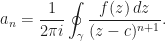
The Laurent series for a complex function f(z) about a point c is given by: \displaystyle f(z)=\sum_{n=-\infty}^\infty a_n(z-c)^n where \displaystyle a_n=\frac{1}{2\pi i}\oint_\gamma\frac{f(z)\, dz}{(z-c)^{n+1}}.

The path of integration \gamma is anticlockwise around a closed, rectifiable path containing no self-intersections, enclosing c and lying in an annulus A in which f(z) is holomorphic. The expansion for f(z) will then be valid anywhere inside the annulus.

Example

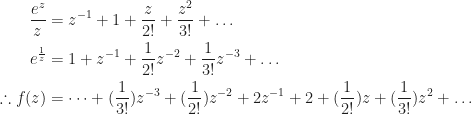
Consider f(z)=\frac{e^z}{z}+e^\frac{1}{z}. This function is holomorphic everywhere except at z=0. Using the Taylor series of the exponential function \displaystyle e^z=\sum_{k=0}^\infty\frac{z^k}{k!}, we get
\begin{aligned}  \frac{e^z}{z}&=z^{-1}+1+\frac{z}{2!}+\frac{z^2}{3!}+\dots\\  e^\frac{1}{z}&=1+z^{-1}+\frac{1}{2!}z^{-2}+\frac{1}{3!}z^{-3}+\dots\\  \therefore f(z)&=\dots+(\frac{1}{3!})z^{-3}+(\frac{1}{2!})z^{-2}+2z^{-1}+2+(\frac{1}{2!})z+(\frac{1}{3!})z^2+\dots  \end{aligned}
Note that the residue (coefficient of z^{-1}) is 2.

Implicit Function Theorem

The implicit function theorem is a strong theorem that allows us to express a variable as a function of another variable. For instance, if x^2y+y^3x+9xy=0, can we make y the subject, i.e. write y as a function of x? The implicit function theorem allows us to answer such questions, though like most Pure Math theorems, it only guarantees existence, the theorem does not explicitly tell us how to write out such a function.

The below material are taken from Wikipedia.

Implicit function theorem

Let f:\mathbb{R}^{n+m}\to\mathbb{R}^m be a continuously differentiable function, and let \mathbb{R}^{n+m} have coordinates (\mathbf{x},\mathbf{y})=(x_1,\dots,x_n,y_1,\dots,y_m). Fix a point (\mathbf{a},\mathbf{b})=(a_1,\dots,a_n,b_1,\dots,b_m) with f(\mathbf{a},\mathbf{b})=\mathbf{c}, where \mathbf{c}\in\mathbb{R}^m. If the matrix \displaystyle [(\partial f_i/\partial y_j)(\mathbf{a},\mathbf{b})] is invertible, then there exists an open set U containing \mathbf{a}, an open set V containing \mathbf{b}, and a unique continuously differentiable function g:U\to V such that \displaystyle \{(\mathbf{x},g(\mathbf{x}))\mid\mathbf{x}\in U\}=\{(\mathbf{x},\mathbf{y})\in U\times V\mid f(\mathbf{x},\mathbf{y})=\mathbf{c}\}.

Elaboration:

Abbreviating (a_1,\dots,a_n,b_1,\dots,b_m) to (\mathbf{a},\mathbf{b}), the Jacobian matrix is
\displaystyle (Df)(\mathbf{a},\mathbf{b})=\begin{pmatrix}  \frac{\partial f_1}{\partial x_1}(\mathbf{a},\mathbf{b}) & \dots &\frac{\partial f_1}{\partial x_n}(\mathbf{a},\mathbf{b}) & \frac{\partial f_1}{\partial y_1}(\mathbf{a},\mathbf{b}) & \dots & \frac{\partial f_1}{\partial y_m}(\mathbf{a},\mathbf{b})\\  \vdots & \ddots &\vdots & \vdots & \ddots &\vdots\\  \frac{\partial f_m}{\partial x_1}(\mathbf{a},\mathbf{b}) & \dots & \frac{\partial f_m}{\partial x_n}(\mathbf{a}, \mathbf{b}) & \frac{\partial f_m}{\partial y_1}(\mathbf{a}, \mathbf{b}) & \dots & \frac{\partial f_m}{\partial y_m}(\mathbf{a}, \mathbf{b})  \end{pmatrix}  =(X\mid Y)
where X is the matrix of partial derivatives in the variables x_i and Y is the matrix of partial derivatives in the variables y_j.

The implicit function theorem says that if Y is an invertible matrix, then there are U, V, and g as desired.

Example (Unit circle)

In this case n=m=1 and f(x,y)=x^2+y^2-1.

\displaystyle (Df)(a,b)=(\frac{\partial f}{\partial x}(a,b)\ \frac{\partial f}{\partial y}(a,b))=(2a\ 2b).

Note that Y=(2b) is invertible iff b\neq 0. By the implicit function theorem, we see that we can locally write the circle in the form y=g(x) for all points where y\neq 0.

Differentiable Manifold

Differentiable manifold

An n-dimensional (differentiable) manifold M^n is a Hausdorff topological space with a countable (topological) basis, together with a maximal differentiable atlas.

This atlas consists of a family of charts \displaystyle h_\lambda: U_\lambda\to U'_\lambda\subset\mathbb{R}^n, where the domains of the charts, \{U_\lambda\}, form an open cover of M^n, the U'_\lambda are open in \mathbb{R}^n, the charts (local coordinates) h_\lambda are homeomorphisms, and every change of coordinates \displaystyle h_{\lambda\mu}=h_\mu\circ h_\lambda^{-1} is differentiable on its domain of definition h_\lambda(U_\lambda\cap U_\mu).

atlas

Source: Representations of Compact Lie Groups (Graduate Texts in Mathematics)

Lie Groups

One of the best books on Lie Groups is said to be Representations of Compact Lie Groups (Graduate Texts in Mathematics). It is one of the rarer books from the geometric approach, as opposed to the algebraic approach.

Lie group

A Lie group is a differentiable manifold G which is also a group such that the group multiplication \displaystyle \mu:G\times G\to G (and the map sending g to g^{-1}) is a differentiable map.

Homomorphism of Lie groups

A homomorphism of Lie groups is a differentiable group homomorphism between Lie groups.

lim sup & lim inf of Sets

The concept of lim sup and lim inf can be applied to sets too. Here is a nice characterisation of lim sup and lim inf of sets:

For a sequence of sets \{E_k\}, \limsup E_k consists of those points that belong to infinitely many E_k, and \liminf E_k consists of those points that belong to all E_k from some k on (i.e. belong to all but finitely many E_k).

Proof:
Note that
\begin{aligned}  x\in\limsup E_k&\iff x\in\bigcup_{k=j}^\infty E_k\ \text{for all}\ j\in\mathbb{N}\\  &\iff\text{For all}\ j\in\mathbb{N}, \text{there exists}\ i\geq j\ \text{such that}\ x\in E_i\\  &\iff x\ \text{belongs to infinitely many}\ E_k.  \end{aligned}
\begin{aligned}  x\in\liminf E_k&\iff x\in\bigcap_{k=j}^\infty E_k\ \text{for some}\ j\in\mathbb{N}\\  &\iff x\in E_k\ \text{for all}\ k\geq j.  \end{aligned}

NTU to open three new alumni houses with free membership for graduates

This is great news for NTU alumni.

(Source: http://www.straitstimes.com/singapore/education/ntu-to-open-three-new-alumni-houses-with-free-membership-for-graduates)

SINGAPORE – Graduates of Nanyang Technological University (NTU) can look forward to free membership at three new alumni houses.

This year marks the 25th anniversary of NTU’s inauguration as a university, and it announced on Wednesday (Aug 10) that it will open a 10,000 sq ft alumni house – equivalent to nine five-room flats – in Marina Square mall in November.

The second facility will be at NTU’s main campus’ North Spine Plaza, and it will open by the end of this year; the third will be at one-north and will open next year.

Congratulations to Joseph Schooling for Gold!

Heartiest congratulations to Mr Joseph Schooling, who has achieved the legendary accomplishment of a Gold medal at the Olympics! Good job!

Here is some analysis of factors contributing to Joseph’s Schooling’s success:

Height

Joseph’s height is 1.84 m (close to the ideal height of 1.90 m). In swimming, a tall height is desirable, as that would lead to an instant lead the moment you jump into the water. But this is not basketball, too tall (e.g. over 2 m) is probably not good as that will lead to increased drag and bad aquadynamics. So judging by height of former Olympic swimmers, roughly 1.90 m is the ideal height.

In fact, in 2006, “Schooling’s parents, Colin and May, send him for a bone test – which calculates growth potential – to see how far he can go in the sport. The test reveals that he will hit 1.90 metres, which is an optimum height to excel in the sport at the highest levels.” (http://www.todayonline.com/sports/schooling-story)

Motivation / Training Hard

This is probably the most important factor. Even when just eight years old, Joseph Schooling woke up his dad at 4.30 am to request to go for swimming training.

Schooling also took training to the highest level by going overseas (to Texas) for his training.

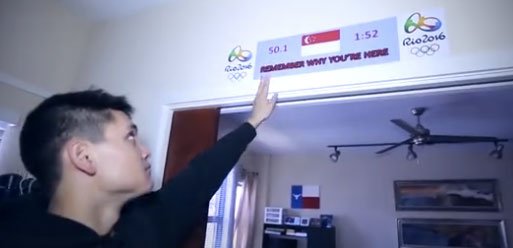
Joseph Schooling also has a motivational poster (see below) to remind himself daily of the times he need to achieve for a podium finish.

schooling photo

Supportive Parents (and relatives)

Joseph Schooling’s grand-uncle Lloyd Valberg, a former high jumper, was Singapore’s first ever Olympian at the 1948 London Games. He was the one who inspired Joseph to aim for the Olympics, when Joseph was just 6 years old.

“Colin (Joseph’s father) and his wife, May, decided to groom their only son to the best of their ability, going so far as to ensure he had access to swimming facilities to train during every vacation they took during his childhood. This would continue into his formative years, when Joseph was sent first to the famed Bolles School in United States to train under renowned coach Sergio Lopez and now the University of Texas to continue his development at the best possible environment.” (from https://sg.sports.yahoo.com/news/colin-schooling–the-world-has-taken-notice-of-joseph-and-singapore-150934197.html)

Bounceback from Adversity

In 2012 Olympics, Joseph met with extreme bad luck in the form of his goggles and swim suit not being approved, leading to a last minute change which would affect his timings.

Despite that, Joseph continued to persevere in his training, which led to his fantastic results in 2016.

Excellent Coach

Joseph Schooling’s coach is Sergio Lopez, “who is a former international top swimmer from Spain, who won the bronze medal in the 200 meters breaststroke at the 1988 Summer Olympics in Seoul” (Wikipedia).

Coach is very important, Michael Phelps credits his success to his legendary coach Bob Bowman, who has written a book The Golden Rules: 10 Steps to World-Class Excellence in Your Life and Work.

Government Support

The Singapore government has humanely allowed a deferment from National Service (2 year mandatory conscription into the army) for Joseph Schooling. This is a crucial factor as for Olympic athletes, uninterrupted training is of utmost importance.

Joseph Schooling T-shirts

Finally, here are some cool Joseph Schooling Shirts suitable for his ardent fans. (Note that Red/White are Singapore’s national colors.)

What is a Degree in Math and Why is it Valuable?

Very interesting article on why you should consider a degree in math if you are interested in math.

Source: http://www.snhu.edu/about-us/news-and-events/2016/08/what-is-a-degree-in-math-and-why-is-it-valuable

Mathematics is the study of quantity, structure, space and change. As abstract as that may seem, math is, at its core, a quest for absolutes, definitive solutions and answers. We may think of long numeric chains, seas of fractions or spreadsheets stacked with figures, but what many don’t realize is that math’s complex equations are in fact roads to simplicity. Believers in better, faster, smarter solutions are often drawn to math.

So, what is a degree in math, exactly? Those that go to college to pursue a mathematics degree find out along the way that numbers are just a fraction of the allure. Math can teach us how to look longer and harder for solutions – a skill applicable to any career and life in general.

We need math. Galileo Galilei used it to explain the universe. Math resolves truths and uncovers errors. It makes our work more credible. Reports, studies and research are all but discounted without quantifiable facts. Math equals proof. Math validates.

The Mathematical Association of America cites a CareerCast report ranking mathematics the best job for 2014 based on factors such as environment, income, outlook, and stress. The job of statistician was ranked third. Actuary was ranked fourth. In addition, a PayScale study reports that the top 15 highest-earning college degrees have mathematics as a common denominator.

But, Psychology Today reports that most of us are in awe of math. It’s slightly mysterious. It makes things look smart, including the mathematician behind the math. What is a degree in math? It’s a professional pathway, and an attractive one for many reasons. It is also a unique way of seeing the world.

Math is All Around Us

Whether you like mathematics or are even very good it, math is around us all the time. When you’re at the department store, balancing your checkbook or doing your taxes, mathematics is a necessary skill. It can even improve your sports game.

“There’s math all over the place in soccer,” Southern New Hampshire University’s mathematics department chairwoman Dr. Pamela Cohen told pro soccer player Calen Carr in this video. From the curve – also known as a “parabola” – of a kicked ball to the rigidness of playing in triangles on the field, math factors into every aspect of the game. What is a math degree to an athlete? A competitive edge on the field.

Many professions, such as engineering, medicine, physics, nurses, computer science and actuarial science, require math proficiency. Virtually all fields benefit from the analytical and problem-solving skills students learn in mathematics. Anyone entering a science, technology, engineering and mathematics (STEM) career is expected to have harnessed basic and advanced math concepts.

Even professions as diverse as chefs or gardeners use math fundamentals when measuring and purchasing supplies. If you are an event planner, math will help you figure per-head costs and inventory. Seamstresses and decorators use math daily, as does anyone who works with measurements and schedules.

You Don’t Have to be a Mathlete

Many people believe math talent to be something that is inherited or are born with. Not so, say researchers. Natural ability in math only gets you so far. Hard work and good study habits are far more valuable. As such, students entering college math degree programs aren’t the math-minded geniuses. Some didn’t even like math growing up, says a Quartz article that looks at why some kids excel at math and others don’t. The authors – economy and finance professors – make the case that something said by a grade school teacher years ago could be the reason a child is turned off to math or thinks he or she is bad at it. Some educators and parents also have a bad habit of labeling kids as either math kids or reading kids.

Fundamental Theorem of Calculus

The Fundamental Theorem of Calculus is one of the most amazing and important theorems in analysis. It is a non-trivial result that links the concept of area and gradient, two seemingly unrelated concepts.

Fundamental Theorem of Calculus

The first part deals with the derivative of an antiderivative, while the second part deals with the relationship between antiderivatives and definite integrals.

First part

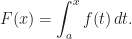
Let f be a continuous real-valued function defined on a closed interval [a,b]. Let F be the function defined, for all x in [a,b], by \displaystyle F(x)=\int_a^x f(t)\,dt.

Then F is uniformly continuous on [a,b], differentiable on the open interval (a,b), and \displaystyle F'(x)=f(x) for all x in (a,b).

Second part

Let f and F be real-valued functions defined on [a,b] such that F is continuous and for all x\in (a,b), \displaystyle F'(x)=f(x).

If f is Riemann integrable on [a,b], then \displaystyle \int_a^b f(x)\,dx=F(b)-F(a).

Gradient Theorem (Proof)

This amazing theorem is also called the Fundamental Theorem of Calculus for Line Integrals. It is quite a powerful theorem that sometimes allows fast computations of line integrals.

Gradient Theorem (Fundamental Theorem of Calculus for Line Integrals)

Let C be a differentiable curve given by the vector function \mathbf{r}(t), a\leq t\leq b.

Let f be a differentiable function of n variables whose gradient vector \nabla f is continuous on C. Then \displaystyle \int_C \nabla f\cdot d\mathbf{r}=f(\mathbf{r}(b))-f(\mathbf{r}(a)).

Proof

\begin{aligned}  \int_C\nabla f\cdot d\mathbf{r}&=\int_a^b\nabla f(\mathbf{r}(t))\cdot \mathbf{r}'(t)\,dt\ \ \ \text{(Definition of line integral)}\\  &=\int_a^b (\frac{\partial f}{\partial x_1}\frac{dx_1}{dt}+\frac{\partial f}{\partial x_2}\frac{dx_2}{dt}+\dots+\frac{\partial f}{\partial x_n}\frac{dx_n}{dt})\,dt\\  &=\int_a^b \frac{d}{dt}f(\mathbf{r}(t))\,dt\ \ \ \text{(by Multivariate Chain Rule)}\\  &=f(\mathbf{r}(b))-f(\mathbf{r}(a))\ \ \ \text{(by Fundamental Theorem of Calculus)}  \end{aligned}

Multivariable Version of Taylor’s Theorem

Multivariable calculus is an interesting topic that is often neglected in the curriculum. Furthermore it is hard to learn since the existing textbooks are either too basic/computational (e.g. Multivariable Calculus, 7th Edition by Stewart) or too advanced. Many analysis books skip multivariable calculus altogether and just focus on measure and integration.

If anyone has a good book that covers multivariable calculus (preferably rigorously with proofs), do post it in the comments!

The following is a useful multivariable version of Taylor’s Theorem, using the multi-index notation which is regarded as the most efficient way of writing the formula.

Multivariable Version of Taylor’s Theorem

Let f:\mathbb{R}^n\to\mathbb{R} be a k times differentiable function at the point \mathbf{a}\in\mathbb{R}^n. Then there exists h_\alpha:\mathbb{R}^n\to\mathbb{R} such that \displaystyle f(\mathbf{x})=\sum_{|\alpha|\leq k}\frac{D^\alpha f(\mathbf{a})}{\alpha!}(\mathbf{x}-\mathbf{a})^\alpha+\sum_{|\alpha|=k}h_\alpha(\mathbf{x})(\mathbf{x}-\mathbf{a})^\alpha, and \lim_{\mathbf{x}\to\mathbf{a}}h_\alpha(\mathbf{x})=0.

Example (n=2, k=1)

Write \mathbf{x}-\mathbf{a}=\mathbf{v}.
\displaystyle f(x,y)=f(\mathbf{a})+\frac{\partial f}{\partial x}(\mathbf{a})v_1+\frac{\partial f}{\partial y}(\mathbf{a})v_2+h_{(1,0)}(x,y)v_1+h_{(0,1)}(x,y)v_2.

Night Mode for Mac

Apple has released a mode called Night Shift for iPhones and iPads. What it does is it reduces blue light from your phone in the evening/night so that one can sleep better. Blue light is known to be unnatural since throughout human history (before Edison), humans have lived in darkness at night. Fire from candles/lantern is Red light, which is considered not as bad as Blue light.

For Mac, there is no such thing as Night Shift (yet), the best alternative is f.lux. I recommend the “classic f.lux” mode over the default, as the default is too extreme (overly red).

Other than improving sleep, another factor it can help with is eye strain.

Motivational: Failure is never final. You’re never a failure until you quit, and it’s always too soon to quit!

Yet another motivational sermon by Pastor Rick Warren.

Source: http://rickwarren.org/devotional/english/full-post/what-will-you-do-today-that-requires-faith

“Let us not become weary in doing good, for at the proper time we will reap a harvest if we do not give up” (Galatians 6:9 NIV).

Failure is never final. You’re never a failure until you quit, and it’s always too soon to quit! You don’t determine a person’s greatness by his talent, his wealth, or his education. You determine a person’s greatness by what it takes to discourage him.

So what does it take to discourage you from going after your dream? It may be as simple as a friend or relative or family member telling you, “I don’t think that’s a good idea.”

The Bible says in Galatians 6:9, “Let us not become weary in doing good, for at the proper time we will reap a harvest if we do not give up” (NIV). You want to know how many times I wanted to resign from Saddleback Church? Just every Monday morning when I think, “God, surely somebody could have done a better job than I did yesterday. This thing is too big for any one person.”

God says, “Just keep on keeping on.” I may not be real bright sometimes, but I don’t know how to quit. I don’t know how to give up.

God works in your life according to your faith. The Bible says, “Without faith it’s impossible to please God” and “Whatsoever is not of faith is sin” and “According to your faith it will be done unto you.” So what are you doing in faith? You need to ask yourself every day when you get up, “God, what can I do today that will require faith?” That’s an important question, because that’s what’s going to please God.

There are a lot of things in your life you don’t have control over. You didn’t control who your parents were, when you were born, where you were born, or what your race or nationality is. You didn’t control what gifts and talents you were given. You didn’t decide how you look.

But you do have complete control over how much you choose to believe God. God uses people who expect him to act, who never give up, who take risks in faith, who get his dream and go after it. It’s your choice whether you want to be the kind of person God uses to accomplish his purpose.

Pasting Lemma (Elaboration of Wikipedia’s proof)

The proof of the Pasting Lemma at Wikipedia is correct, but a bit unclear. In particular, it does not clearly show how the hypothesis that X, Y are both closed is being used. It actually has something to do with subspace topology.

I have added some clarifications here:

Pasting Lemma (Statement)

Let X, Y be both closed (or both open) subsets of a topological space A such that A=X\cup Y, and let B also be a topological space. If both f|_X: X\to B and f|_Y: Y\to B are continuous, then f:A \to B is continuous.

Proof:

Let U be a closed subset of B. Then f^{-1}(U)\cap X is closed in X since it is the preimage of U under the function f|_X:X\to B, which is continuous. Hence f^{-1}(U)\cap X=F\cap X for some set F closed in A. Since X is closed in A, f^{-1}(U)\cap X is closed in A.

Similarly, f^{-1}(U)\cap Y is closed (in A). Then, their union f^{-1}(U) is also closed (in A), being a finite union of closed sets.

Inspirational story: From EM3 and Normal (Technical) to PhD

Quite an inspirational story. Congratulations to these two students who have succeeded despite having a less than ideal start.

“We have to find our interest, put in our best effort and keep trying. After having come so far, it has made me believe that I can still carry on.”


Source: http://www.straitstimes.com/singapore/education/from-normal-stream-to-phd-course

Mr Ernest Tan, 28, a PhD student, never thought he would get this far.

The former EM3 and Normal (Technical) student did not bother studying much as he had no interest in the subjects he was doing.

But it all changed in his two years at the Institute of Technical Education (ITE) as a student in Communications Technology.

He said: “I played a lot of computer games then so I didn’t mind learning more about computers.”

His interest pushed him to believe that he could continue into polytechnic, where he eventually earned a Diploma in Computer Engineering at Singapore Polytechnic (SP).

Continue reading: http://www.straitstimes.com/singapore/education/from-normal-stream-to-phd-course

It’s Time to Redefine Failure BY RICK WARREN

Excellent sermon by Pastor Rick Warren.

Source: http://rickwarren.org/devotional/english%2fit-s-time-to-redefine-failure1?roi=echo7-27381882358-48417402-f0ce079160f08ffc23a2aef23c6680d7&

“Fear of man will prove to be a snare, but whoever trusts in the Lord is kept safe”(Proverbs 29:25 NIV).

Satan’s favorite tool to diminish your faith is the fear of failure. But you cannot serve God and be constantly worried about what other people think. You have to move forward. Proverbs 29:25 says, “Fear of man will prove to be a snare, but whoever trusts in the Lord is kept safe” (NIV).

So how do you get rid of the fear of failure?

One way is to redefine failure. What is failure? Failure is not failing to reach your goal. Failure is not having a goal. Failure is not failing to hit your target. Failure is not having a target. Failure is not falling down. Failure is refusing to get back up. You’re never a failure until you quit. So if you’re attempting something for the glory of God, that’s a good thing. Failure is not trying and not accomplishing anything. Failure is failing to try.

Another way to get rid of the fear of failure is to never compare yourself to anybody else. You’re always going to find somebody who’s doing a better job, and you get discouraged. And, you’re always going to find somebody who’s not doing as good a job as you are, and you become full of pride. Both of them will mess up your life. Discouragement and pride will keep you from serving God’s purpose for your life.

The Bible says in Galatians 6:4, “Each of you must examine your own actions. Then you can be proud of your own accomplishments without comparing yourself to others” (GW)

Did you notice that the Bible says there is a legitimate pride? There’s a good kind of pride and there’s a bad kind of pride. The bad kind of pride is comparing: “I’m better than so and so!” The good kind of pride is, “God, I’m proud of what you’re doing in my family, my business, my life, my walk of faith.” That’s the good kind of pride.

When you get to Heaven, God isn’t going to say, “Why weren’t you more like so and so?” He’s going to say, “Why weren’t you who I made you to be?”

Let go of your fear of failure, because anything you’re attempting for God in faith is a good thing, regardless of the results.

Characterization of Galois Extensions

Characterization of Galois Extensions

For a finite extension E/F, each of the following statements is equivalent to the statement that E/F is Galois:

1) E/F is a normal extension and a separable extension.
2) Every irreducible polynomial in F[x] with at least one root in E splits over E and is separable.
3) E is a splitting field of a separable polynomial with coefficients in F.
4) |\text{Aut}(E/F)|=[E:F], that is, the number of automorphisms equals the degree of the extension.
5) F is the fixed field of \text{Aut}(E/F).

Fundamental Theorem of Galois Theory

Given a field extension E/F that is finite and Galois, there is a one-to-one correspondence between its intermediate fields and subgroups of its Galois group.
H\leftrightarrow E^H

where H\leq\text{Gal}(E/F) and E^H is the corresponding fixed field (the set of those elements in E which are fixed by every automorphism in H).
K\leftrightarrow\text{Aut}(E/K)

where K is an intermediate field of E/F and \text{Aut}(E/K) is the set of those automorphisms in \text{Gal}(E/F) which fix every element of K.

This correspondence is a one-to-one correspondence if and only if E/F is a Galois extension.

Examples
1) E\leftrightarrow\{\text{id}_E\}, the trivial subgroup of \text{Gal}(E/F).
2) F\leftrightarrow\text{Gal}(E/F).

Cook One Fish in Two Ways (一鱼两吃)

Bought this fish from Giant (Vivocity). Seabass, 2 for $8.40. Very delicious!

chinesetuition88's avatarChinese Tuition Singapore

Compared to fried fish in western countries, Chinese people always choose to cook fish in different ways, like fish soup, braised fish in brown sauce, or steamed fish.


I bought this sea bass from supermarket. Yet, I found it too big and we didn’t have a pan big enough to cook it. So I decided to divided it into two parts. Fish head for the soup. Fish body and tail for the braised one.

Fish head soup is very popular in China, since many people think this dish is very good for health. Nutritious elements in fish will be contained in the soup.

在中国,鱼头汤是一道很受欢迎的菜。很多人认为鱼头汤对身体很补,鱼里面的营养物质会融合到汤里面去。

It is not difficult to make fish soup.

1. Heat the oil in the pan, and fry two sides of the fish head. When the color turns a little brown, pour in the hot water.

锅内热油,将鱼头两面煎黄,然后加入热水没过鱼头。

2. Add two or three ginger slices, salt and green…

View original post 210 more words

To Reduce Your Fear of Failure, Redefine It

This is a post by Rick Warren, author of “The Purpose Driven Life: What on Earth Am I Here For?“. He is a very good author of Christian books.

(Source: http://rickwarren.org/devotional/english/to-reduce-your-fear-of-failure-redefine-it)


“No matter how often honest people fall, they always get up again.” (Proverbs 24:16a TEV)

Never forget this truth: Failure probably won’t kill you.

We vastly exaggerate the effects of failure. We blow the prospects of failing all out of proportion. Failing is not the end of the world. The fear of failure is far more damaging than failure.

Proverbs 24:16 says, “No matter how often honest people fall, they always get up again” (TEV). Even good guys stumble. They make mistakes, blow it, and stub their toes.

Successful people are not people who never fail. They’re people who get up again and keep going. Successful people just don’t know how to quit.

Ever heard of these famous failures?

  • George Washington lost two-thirds of all the battles he fought. But he won the Revolutionary War and later became the first U.S. president.
  • Napoleon graduated 42nd in a class of 43. Then he went out and conquered Europe!
  • In 21 years Babe Ruth hit 714 home runs, but he struck out 1,330 times. He struck out nearly twice as often as he hit a home run.
  • The famous novelist John Creasey received 753 rejection slips before he published 564 books.
  • Rowland Hussey Macy failed seven times at retailing before starting Macy’s department store.

Great people are simply ordinary people who have an extraordinary amount of determination. They just keep on going. They realize they’re never a failure until they quit.

That’s how you reduce your fear of failure. You redefine it.

You don’t fail by not reaching a specific goal. Instead, failure is not having a goal. Failure is refusing to get back up again once you fall. It’s refusing to try.

On the first day of kindergarten, I got in the wrong line and then into the wrong classroom. Can you imagine me going home to my mom and dad and saying, “I’m a failure at education! This school thing just doesn’t work”? Of course not.

You keep going. If at first you don’t succeed, it’s no big deal. You’re never a failure until you give up.

Class Equation of a Group

The class equation of a group is something that looks difficult at first sight, but is actually very straightforward once you understand it. An amazing equation…

Class Equation of a Group (Proof)

Suppose G is a finite group, Z(G) is the center of G, and c_1, c_2, \dots, c_r are all the conjugacy classes in G comprising the elements outside the center. Let g_i be an element in c_i for each 1\leq i\leq r. Then we have: \displaystyle |G|=|Z(G)|+\sum_{i=1}^r[G:C_G(g_i)].

Proof:

Let G act on itself by conjugation. The orbits of G partition G. Note that each conjugacy class c_i is actually \text{Orb}(g_i).

Let x\in Z(G). Then gxg^{-1}=xgg^{-1}=x for all g\in G. Hence \text{Orb}(x) consists of a single element x itself.

Let g_i\in c_i. Then
\begin{aligned}  \text{Stab}(g_i)&=\{h\in G\mid hg_ih^{-1}=g_i\}\\  &=\{h\in G\mid hg_i=g_ih\}\\  &=C_G(g_i).  \end{aligned}
By Orbit-Stabilizer Theorem, \displaystyle |\text{Orb}(g_i)|=[G:\text{Stab}(g_i)]=[G:C_G(g_i)].

Therefore, \displaystyle |G|=|Z(G)|+\sum_{i=1}^r[G:C_G(g_i)].

Very Motivational: Billionaire Sara Blakely’s Secret of Success and her Favorite Motivational Author

Just read an amazing article about self-made billionaire Sara Blakely.

First amazing story is this.

Early in his own career Sara’s father learned that failure is part of success. That in order to be successful at anything in life, you were going to experience some failures along the way. Sara’s father went to great lengths to instill this simple success principle in the lives and minds of his children.

Once or twice a week at the dinner table the elder Blakely would ask his children what they failed at that week. He would stress that if they had not failed at something it meant that had not tried or attempted something new. This instilled a deep belief in Sara’s mind that failure is not the outcome; the real failure was in not trying.

Being able to see failure as just another stepping stone to success would play a big part in Sara Blakely’s struggles later in life as she began to build her company, SPANX.

This is really interesting. This is one good thing about American culture, which explains why Americans are willing to take risks. How many parents in Asia will ask the same thing? Not many, I would estimate.

Second amazing story is this, the power of motivational books. Most people would think that motivational books are hype, or “BS”, to put it mildly. True, 90% of them may be nonsense, but the top tier ones are good, and possibly life-changing.

Over a relatively short period of time a series of events occurred in young Sara Blakely’s life that would set most young people back in a dramatic way.

Recognizing that his daughter was going through very tough times, the elder Mr. Blakely gave his daughter a set of tapes by Dr. Wayne Dyer titled How to Be a No-Limit Person.

Today, Sara Blakely gives almost all of the credit for her success in life to the success principles she learned as a teenager from that one set of motivational tapes by Dr. Wayne Dyer.


Your Erroneous Zones: Step-by-Step Advice for Escaping the Trap of Negative Thinking and Taking Control of Your Life

This is the top-selling and most popular Wayne Dyer book of all time. Also check out this post on Motivational Books for students.

Sara Blakely on failure:

Mertens’ Theorem

Mertens’ Theorem

Let (a_n) and (b_n) be real or complex sequences.

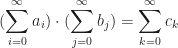
If the series \sum_{n=0}^\infty a_n converges to A and \sum_{n=0}^\infty b_n converges to B, and at least one of them converges absolutely, then their Cauchy product converges to AB.


An immediate corollary of Mertens’ Theorem is that if a power series f(x)=\sum a_kx^k has radius of convergence R_a, and another power series g(x)=\sum b_kx^k has radius of convergence R_b, then their Cauchy product converges to f\cdot g and has radius of convergence at least the minimum of R_a, R_b.

Note that a power series converges absolutely within its radius of convergence so Mertens’ Theorem applies.

Tietze Extension Theorem and Pasting Lemma

Tietze Extension Theorem

If X is a normal topological space and \displaystyle f:A\to\mathbb{R} is a continuous map from a closed subset A\subseteq X, then there exists a continuous map \displaystyle F:X\to\mathbb{R} with F(a)=f(a) for all a in A.

Moreover, F may be chosen such that \sup\{|f(a)|:a\in A\}=\sup\{|F(x)|:x\in X\}, i.e., if f is bounded, F may be chosen to be bounded (with the same bound as f). F is called a continuous extension of f.

Pasting Lemma

Let X, Y be both closed (or both open) subsets of a topological space A such that A=X\cup Y, and let B also be a topological space. If both f|_X: X\to B and f|_Y: Y\to B are continuous, then f is continuous.

Proof:

Let U be a closed subset of B. Then f^{-1}(U)\cap X is closed since it is the preimage of U under the function f|_X:X\to B, which is continuous. Similarly, f^{-1}(U)\cap Y is closed. Then, their union f^{-1}(U) is also closed, being a finite union of closed sets.

Maths Tuition – What are the Benefits?

Maths Tuition – What are the Benefits?

Maths tuition brings about many benefits that can be seen for the parent, the teacher and especially the student who is struggling with their mathematics subject in school. For starters, it will have a huge impact for the student because their entire future can depend on their academic performance in PSLE, O-level, and A-level examinations – all of which requires the student to take the math subject.

For young kids, academics and performance in school can be everything. Their self-esteem and pride depends on it and it helps to guide them in the right direction. Performing well in all subjects helps us to determine who they will become in the future and what they wish to achieve. However, this can be difficult to do when the poor child is struggling in school, particularly in mathematics. Having the opportunity to participate in private maths tuition can help a student get back on the right track once again.

Maths tuition can be extremely useful for Singaporean parents as well. While we all try our best to help our students be successful, there are simply some areas where we are not knowledgeable enough to help out very much. A lot of parents are simply not equipped enough in maths to be able to guide our children adequately. There are also many changes to the education system such the newer and harder syllabuses that can hinder our ability to help our kids as well.

However, with a private maths tutor, our kids can learn the proper way to craft mathematics answers, draw models, and solve algebraic questions, developing the tools necessary to help them succeed in their mathematics exam. Doing well in mathematics not only helps students regain their confidence and improve their T-scores, it also helps them in the long-run as they develop into working adults, as mental arithmetic ability is useful in many practical situations. A good maths tutor can use their expertise to help guide students back onto the right path so that all of their goals and dreams can become a reality.

Teachers can also benefit from private tuition as well. Since a teacher has many students that they are required to teach at one time, it is difficult for them to have the time necessary to devote to one struggling student. However, when students in the class engage their own private maths tutor from a maths tuition agency, the teacher will not have to focus too much on that one student, hindering any of the other children in the classroom as well.

With the right tuition agency, parents can engage private maths tuition in any location and there are benefits for everyone involved. Also, if the mathematics tutors are specialized; meaning if your student is struggling in math, a private maths tuition teacher can help to bring their grades up and to catch them up with the remainder of the class.

Maths tutors are great for all age groups and can even be beneficial for those in university as well. Choosing to engage private maths tuition for your child is a great decision, and whether you are a student, parent or teacher, a good maths tutor help to make everyone’s lives a little better.

Topological Monster: Alexander horned sphere

Very interesting object indeed. Also see this previous video on How to Unlock Interlocked Fingers Topologically?

The horned sphere, together with its inside, is a topological 3-ball, the Alexander horned ball, and so is simply connected; i.e., every loop can be shrunk to a point while staying inside. The exterior is not simply connected, unlike the exterior of the usual round sphere; a loop linking a torus in the above construction cannot be shrunk to a point without touching the horned sphere. (Wikipedia)

Lusin’s Theorem and Egorov’s Theorem

Lusin’s Theorem and Egorov’s Theorem are the second and third of Littlewood’s famous Three Principles.

There are many variations and generalisations, the most basic of which I think are found in Royden’s book.

Lusin’s Theorem:

Informally, “every measurable function is nearly continuous.”

(Royden) Let f be a real-valued measurable function on E. Then for each \epsilon>0, there is a continuous function g on \mathbb{R} and a closed set F\subseteq E for which \displaystyle f=g\ \text{on}\ F\ \text{and}\ m(E\setminus F)<\epsilon.

Egorov’s Theorem

Informally, “every convergent sequence of functions is nearly uniformly convergent.”

(Royden) Assume m(E)<\infty. Let \{f_n\} be a sequence of measurable functions on E that converges pointwise on E to the real-valued function f.

Then for each \epsilon>0, there is a closed set F\subseteq E for which \displaystyle f_n\to f\ \text{uniformly on}\ F\ \text{and}\ m(E\setminus F)<\epsilon.

A holomorphic and injective function has nonzero derivative

This post proves that if f:U\to V is a function that is holomorphic (analytic) and injective, then f'(z)\neq 0 for all z in U. The condition of having nonzero derivative is equivalent to the condition of conformal (preserves angles). Hence, this result can be stated as “A holomoprhic and injective function is conformal.”

(Proof modified from Stein-Shakarchi Complex Analysis)

We prove by contradiction. Suppose to the contrary f'(z_0)=0 for some z_0\in D. Using Taylor series, \displaystyle f(z)=f(z_0)+f'(z_0)(z-z_0)+\frac{f''(z_0)}{2!}(z-z_0)^2+\dots

Since f'(z_0)=0, \displaystyle f(z)-f(z_0)=a(z-z_0)^k+G(z) for all z near z_0, with a\neq 0, k\geq 2 and G(z)=(z-z_0)^{k+1}H(z) where H is analytic.

For sufficiently small w\neq 0, we write \displaystyle f(z)-f(z_0)-w=F(z)+G(z), where F(z)=a(z-z_0)^k-w.

Since |G(z)|<|F(z)| on a small circle centered at z_0, and F has at least two zeroes inside that circle, Rouche’s theorem implies that f(z)-f(z_0)-w has at least two zeroes there.

Since the zeroes of a non-constant holomorphic function are isolated, f'(z)\neq 0 for all z\neq z_0 but sufficiently close to z_0.

Let z_1, z_2 be the two roots of f(z)-f(z_0)-w. Note that since w\neq 0, z_1\neq z_0, z_2\neq z_0. If z_1=z_2, then f(z)-f(z_0)-w=(z-z_1)^2h(z) for some analytic function h. This means f'(z_0)=0 which is a contradiction.

Thus z_1\neq z_2, which implies that f is not injective.

Blueberry pancake (蓝莓松饼)

chinesetuition88's avatarChinese Tuition Singapore

Original recipe :

http://m.xiachufang.com/recipe/100460858/

It’s a special way to make pancake, because oven is used instead of pan.
I made some change according to the original recipe above:


Since I don’t have any weighing machine, I am not sure the accurate weight of all the ingredients I used.

Part A:

Flour around 80g

Sugar around 30g

Baking soda 1 tsp

Salt 1/8 tsp

Mix all of them well.


Part B:

Egg 1

Milk around 150g

Yogurt around 25g

Oil ( I used canola oil) around 25g

Vanilla esscence 1 tsp

Mix them well.


Pour Part B into Part A. Stir till no flour can be seen.

Add some blueberries. Stir again.


Preheat oven with 190 degree.

Before put into the oven, spread some blueberries on the surface of batter.

Bake for 45 minutes.

Blueberries will burst and the house is full of fragrance.


You can spread some icing sugar if…

View original post 9 more words

Why Singapore’s kids are so good at maths

Source: http://www.ft.com/cms/s/0/2e4c61f2-4ec8-11e6-8172-e39ecd3b86fc.html

Sie Yu Chuah smiles when asked how his parents would react to a low test score. “My parents are not that strict but they have high expectations of me,” he says. “I have to do well. Excel at my studies. That’s what they expect from me.” The cheerful, slightly built 13-year-old is a pupil at Admiralty, a government secondary school in the northern suburbs of Singapore that opened in 2002.

To learn more about Singapore Math, check out this comprehensive blog post describing what is Singapore Math.