Inspirational Story of Sir John Gurdon, Nobel Prize winner

Source: http://www.telegraph.co.uk/news/science/science-news/9594351/Sir-John-Gurdon-Nobel-Prize-winner-was-too-stupid-for-science-at-school.html

A British scientist whose schoolmasters told him he was too stupid to study the subject has been awarded the Nobel Prize in medicine or physiology for his pioneering work on cloning.

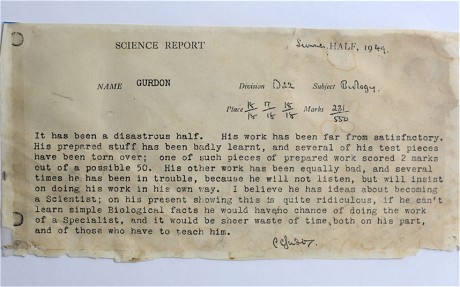
At the age of 15, Prof Sir John Gurdon ranked last out of the 250 boys in his Eton year group at biology, and was in the bottom set in every other science subject. Sixty-four years later he has been recognised as one of the finest minds of his generation after being awarded the £750,000 annual prize, which he shares with Japanese stem cell researcher Shinya Yamanaka. Speaking after learning of his award in London on Monday, Sir John revealed that his school report still sits above his desk at the Gurdon Institute in Cambridge, which is named in his honour.

nobel-gurdon_2363595c

Moral of the story: Teachers may not be always right!

Congrats to Professor Andrew Wiles

http://www.telegraph.co.uk/news/science/science-news/12195189/Oxford-professor-wins-500000-for-solving-300-year-old-mathematical-mystery.html

Oxford professor wins £500,000 for solving 300-year-old mathematical mystery

Sir Andrew Wiles’ proof of Fermat’s Last Theorem has been described as ‘an epochal moment for mathematics’

An Oxford University professor has won a £500,000 prize for solving a three-century-old mathematical mystery that was described as an “epochal moment” for academics.

Sir Andrew Wiles, 62, has been awarded the Abel Prize by the Norwegian Academy of Science and Letters – and almost half a million pounds – for his proof of Fermat’s Last Theorem, which he published in 1994.

Do your best without comparing yourself to others and without fear or failure

Recently, the A Level results just came out, 93.1% score at least 3 H2 passes, best results since curriculum change in 2006. However, as most students know, 3 H2 passes (low pass e.g. 3 C’s) is far from enough to enter the 3 local universities. For those looking for a rank point calculator, check out my post on how to calculate JC Rank Points.

Just to share some motivational advice for those who may not have done as well for A levels. Source: http://www.kuenselonline.com/do-your-best-without-comparing-yourself-to-others-and-without-fear-or-failure/

In reality, the purpose of education should be to open your mind, gain life skills and help you develop your human qualities. It should not merely be considered as a gateway to a job.

Even if your main reason for studying is motivated by your future career, you still need to first consider what you really want to do before proceeding with your education plans. If, for example, you have a passion for cooking, then it might be better to enter a chef training programme rather than spend two more years in school. On the other hand, if you want to be a teacher then class 12 will be your route to achieve your goal.

Anyway, whatever you do, you should do it to the best of your ability. At the same time, you should have no expectations about the result.

Maybe this example will be helpful: Think of the seeds of a sunflower and a violet. A sunflower seed will produce a large, bright yellow flower, while the seed of a violet will produce a small, dark purple bloom. A violet seed can never produce a sunflower blossom no matter how hard it tries. Likewise, a sunflower seed cannot produce the flower of a violet. Neither flower is better or worse than the other. They are just different. However, it is important that the flowers open fully and are not ashamed whether they are small or large, bright or dark.

In the same way, you might discover that you are great at studies or you might find that you are not so great. Like the seeds, you cannot change your natural inclinations, but like the flowers you have to open fully. This means that you try your very best in every situation.

Practically, to do your best means that whatever assignment you are given, you aim to do it beautifully – not to get high grades, but for your own satisfaction. If you have to compose an essay, for example, write each letter and word clearly and in a way that is easy for others to read. Do the same with a math or science or any other assignment. Make each page of your notebook a work of art.

Most importantly is to have tried your very best. Very nice article!

Tough at home but teen perseveres and scores at A-level exams

Source: http://www.straitstimes.com/singapore/tough-at-home-but-teen-perseveres-and-scores-at-a-level-exams

Very inspirational!

Excerpt:

Richmond Tan does not have a study table in the one-room rental flat that he shares with his father, grandfather and brother.

There were times when he did not even have a roof over his head, after his family was temporarily chased out of the Queenstown flat as a result of spats between his father and the landlord.

Richmond had to sleep in void decks or at Changi Airport.

He said what motivated him to do well in his studies was his role model, Han Xin, one of the heroes of the early Han dynasty in China.

He learnt of Han after reading The Art Of War by Sun Tzu, which inspired him to take China Studies for his A levels.

“Han Xin was so poor he had to beg for food. His circumstances were even worse than mine, but he studied hard and became a capable minister,” he added.

Han Xin was also a mathematician, and one of the earliest to discover the secret of the Chinese Remainder Theorem, a key result in Number Theory. According to legend, he used it to calculate the number of soldiers in his army. See this post for more details: http://chinesetuition88.com/2015/04/25/chinese-remainder-theorem-history-%E9%9F%A9%E4%BF%A1%E7%82%B9%E5%85%B5/

Interview of Michael Atiyah (aged 86!)

Source: https://www.quantamagazine.org/20160303-michael-atiyahs-mathematical-dreams/

Inspirational interview by Michael Atiyah, winner of both Fields Medal and Abel Prize, currently age 86!

Excerpt from the interview:

Is there one big question that has always guided you? 

I always want to try to understand why things work. I’m not interested in getting a formula without knowing what it means. I always try to dig behind the scenes, so if I have a formula, I understand why it’s there. And understanding is a very difficult notion.

People think mathematics begins when you write down a theorem followed by a proof. That’s not the beginning, that’s the end. For me the creative place in mathematics comes before you start to put things down on paper, before you try to write a formula. You picture various things, you turn them over in your mind. You’re trying to create, just as a musician is trying to create music, or a poet. There are no rules laid down. You have to do it your own way. But at the end, just as a composer has to put it down on paper, you have to write things down. But the most important stage is understanding. A proof by itself doesn’t give you understanding. You can have a long proof and no idea at the end of why it works. But to understand why it works, you have to have a kind of gut reaction to the thing. You’ve got to feel it.

Interesting comment that “A proof by itself doesn’t give you understanding. You can have a long proof and no idea at the end of why it works.”. Sometimes, intuitive understanding is needed, along with formal proof.

One example in high school mathematics is proving \displaystyle \sum_{i=1}^n i^2=\frac 16n(n+1)(2n+1). It is possible to prove it by induction without actually understanding how the formula comes about!

Artin-Whaples Theorem

There seems to be another version of Artin-Whaples Theorem, called the Artin-Whaples Approximation theorem.

The theorem stated here is Artin-Whaples Theorem for central simple algebras.

Artin-Whaples Theorem: Let A be a central simple algebra over a field F. Let a_1,\dots,a_n\in A be linearly independent over F and let b_1,\dots,b_n be any elements in A. Then there exists a_i',a_i''\in A for i=1,\dots,m such that the F-linear map f:A\to A defined by f(x)=\sum_{r=1}^m a_r'xa_r'' satisfies f(a_j)=b_j for all j=1,\dots,n.

Very nice and useful theorem.

Simple Algebra does not imply Semisimple Algebra

The terminology “semisimple” algebra suggests a generalization of simple algebras, but in fact not all simple algebras are semisimple! (Exercises 1 & 5 in Richard Pierce’s book contain examples)

A simple module is a semisimple module is true though.

Proposition: For a simple algebra A, the following conditions are equivalent:

(i) A is semisimple;

(ii) A is right Artinian;

(iii) A has a minimal right ideal.

Thus to find a algebra that is simple but not semisimple, one can look for an example that is not right Artinian.

Amazon Associates / Affiliates Payment Options (Outside US)

For those using Amazon Associates (or other US based affiliate programs) but are outside USA, there is now an option to transfer the earnings directly to your bank account. Works in Singapore, and most other countries.

The way to do it is through Payoneer. (Direct link: https://share.payoneer.com/nav/FdReUzoZLHa355a95CrNv8uVU528u1dPTojBD2lcYbYvHYFDYT0WxkdmgqlJSsjRs75isVLfZi9fhax47Braxw2)

The other option of receiving cheque from Amazon is bad since the administrative fees are quite expensive (around 20 USD if I remember correctly).

Amazon Associates is quite a good affiliate program. If your blog has just around 100 visits per day, it can already translate to around $20 USD or more per month earnings depending on what you are promoting. This will most likely to cover the cost of hosting your blog. People with extremely popular blogs (see here) have earned more than half a million USD from Amazon Associates.

For those thinking of signing up Payoneer please sign up using the link above. It is a special “Refer a Friend” program where both you and I will get $25 USD upon you signing up. (* After your friend signs up and receives a total of $100, you both earn a $25 reward.)

Advice to a Young Mathematician

The official preview is available here at: http://press.princeton.edu/chapters/gowers/gowers_VIII_6.pdf

Excerpt:

The most important thing that a young mathematician needs to learn is of course mathematics. However, it can also be very valuable to learn from the experiences of other mathematicians. The five contributors to this article were asked to draw on their experiences of mathematical life and research, and to offer advice that they might have liked to receive when they were just setting out on their careers. (The title of this entry is a nod to Sir Peter Medawar’s well-known book, Advice to a Young Scientist.) The resulting contributions were every bit as interesting as we had expected; what was more surprising was that there was remarkably little overlap between the contributions. So here they are, five gems intended for young mathematicians but surely destined to be read and enjoyed by mathematicians of all ages.

The full book can be bought on Amazon:

The Princeton Companion to Mathematics

Toddlers prepare for their first big interview

Source: BBC

Getting into good schools or universities is tough in many parts of the world, but in Hong Kong the pressure begins earlier. Often parents try to get children into a good kindergarten – and before that, into a good nursery. So there are now classes preparing toddlers for that all-important nursery interview.

Yoyo Chan is preparing for an important interview that could help her succeed in life. She is one-and-a-half years old.

At two she will start nursery, but competition is fierce in Hong Kong, and some of the most prestigious nurseries are selective. Her parents want her to be well-prepared for her first big test in life.

The best nurseries and kindergartens are seen as a gateway into the best primary schools – which in turn, parents believe, pave the way to the best secondary schools and universities.

So the most renowned of them can receive more than 1,000 applications for just a few dozen places. As a result, enterprising tuition companies are now offering interview training for toddlers.

Reliable Tuition Agency Singapore

Reliable Tuition Agency:

Startutor is Singapore’s most popular online agency, providing tutors to your home. There are no extra costs for making a request. The tutors’ certificates are carefully checked by Startutor.

(Website: http://startutor.sg/request,wwcsmt)

There are many excellent tutors from RI, Hwa Chong, etc. at Startutor, teaching various subjects at all levels.

High calibre scholars from NUS/overseas universities like Stanford are also tutoring at Startutor.

(Website: http://startutor.sg/request,wwcsmt)

(Please use the full link above directly, thanks!)

Fill in the request form in the link above to request for a tutor and our coordinators will attend to you within the day.

You get to enjoy the following:

  • Free matching service
  • No hidden charges
  • Commission is charged from tutor

How to use Kenzo (Algebraic Topology CAS) on Clozure CL

After some trials, finally got Kenzo to run on Mac:

First download it from (https://github.com/gheber/kenzo). Quicklisp needs to be installed and loaded first.

Type:

(ql:quickload :kenzo)

followed by

(in-package “CAT”)

followed by any Kenzo commands.

Screenshot:

Screen Shot 2016-02-18 at 10.28.28 AM

How to optimise your brain’s waste disposal system

Source: https://www.theguardian.com/science/neurophilosophy/2015/aug/22/how-to-optimise-your-brains-waste-disposal-system

Summary: Sleeping on the side seems to clear brain’s waste most efficiently.

New research suggests that body posture during sleep may affect the efficiency of the brain’s self-cleaning process

The human brain can be compared to something like a big, bustling city. It has workers, the neurons and glial cells which co-operate with each other to process information; it has offices, the clusters of cells that work together to achieve specific tasks; it has highways, the fibre bundles that transfer information across long distances; and it has centralised hubs, the densely interconnected nodes that integrate information from its distributed networks.

Like any big city, the brain also produces large amounts of waste products, which have to be cleared away so that they do not clog up its delicate moving parts. Until very recently, though, we knew very little about how this happens. The brain’s waste disposal system has now been identified. We now know that it operates while we sleep at night, just like the waste collectors in most big cities, and the latest research suggests that certain sleeping positions might make it more efficient.

阅读理解中常见典故解说—”千里马”和”伯乐” Common Literary Quotation In Reading Comprehension

chinesetuition88's avatarChinese Tuition Singapore

千里马指日行千里,善跑的骏马。

伯乐本名孙阳,是古代春秋时期秦穆公时人。他擅长相马,对马很有研究。

唐代文学家韩愈写过一篇文章《马说》。文章中写道”世有伯乐,然后有千里马。千里马常有,而伯乐不常有。”意思是:世界上有了伯乐才会有千里马。千里马经常会有,但是伯乐却很少。”

现在的”千里马”通常用来比喻人才,而”伯乐”则是用来比喻发现,推荐,培养和使用人才的人。

“千里马”,即人才有很多,但是能够赏识人才的”伯乐”却很少。如果人才不被发现和重用,那就和普通人没有区别。只有当伯乐发掘了他们,他们的价值才会被体现出来,才会发挥一个人才的价值。所以先有伯乐,才有千里马。

View original post

Install Common Lisp on Mac

I am intending to install Common Lisp on Mac. Installing Lisp is quite troublesome, for normal users who are used to installing everything in one click.

Clozure CL (App for Mac) seems to be the easiest option. However, I have been faced with Clozure CL App error: “Unknown Error” message, followed by “We Could not complete your request”. This error appears when I click on install the app.

The next method I am trying is http://www.jonathanfischer.net/modern-common-lisp-on-osx/. Currently at the step of installing Aquamacs, everything seems to be going smoothly so far.

Update: The above website’s method is not as easy as it looks. http://www.yellosoft.us/installing-common-lisp may be another easier option.

Some interesting Lisp books:


ANSI Common LISP

GEP / DSA Pattern Recognition Book


Visual Discrimination, Grades 2 – 8

Some readers of my blog has bought this book on Amazon. Upon closer inspection, I realised this is actually an excellent book for preparing for pattern recognition (visual discrimination) which is tested in GEP / DSA under the logic portion.

Screen Shot 2016-02-10 at 6.09.39 PM

The above is a sample of what the book teaches. If you are familiar with the GEP / DSA test, this is exactly what the logic part of the test is about. Not just the GEP / DSA tests use this, basically any IQ test worldwide will test something like this.

Getting familiar with such tests will obviously be an advantage. No harm giving it some practice rather than seeing such tests the first time in the GEP / DSA test.

Pattern recognition is a skill that can be learnt, and one can argue that many intellectual activities like chess / math are just advanced forms of pattern recognition!

Further Maths Versus H2 Maths

Source: http://www.seab.gov.sg/content/syllabus/alevel/2017Syllabus/9649_2017.pdf

Related posts: What is the difference between H1, H2, H3 Maths

From the syllabus, it looks like Further Maths has some overlap with H2 Maths. This is a good thing, since students can reinforce their knowledge by learning it twice. It is also like killing two birds with one stone!

Some new things in Further Math:

  • Conic sections in Polar Form
  • Arc length of curves
  • Integrating factor (Differential Equations)
  • Second order recurrence relations
  • Matrices and Linear Spaces (This in my opinion is one of the biggest difference between Further Maths and H2 Maths)
  • Numerical methods
  • Geometric Distribution
  • Uniform and exponential distribution
  • Non-parametric tests

Further Math is a good subject to take for those intending to enter physical science or engineering in university, since it will cover many of the topics learnt in the first year of university.

Overall, there are quite a lot of advanced topics crammed into Further Math, so I doubt the teachers have time to teach everything in depth in two years. Matrices and Linear Spaces (Linear Algebra) alone will take half a year to teach it properly. Most likely it will be a touch-and-go event and students will get to see the tip of the iceberg. Students wishing to learn more can read up some undergraduate math books listed here.

Minimal Simplicial Sets

Let X be a space. We can have a fibrant simplicial set, namely the singular simplicial set S_*(X), where S_n(x) is the set of all continuous maps from the n-simplex to X. However S_*(X) seems too large as there are uncountably many elements in each S_n(X). On the other hand, we need the fibrant assumption to have simplicial homotopy groups. This means that the simplicial model for a given space cannot be too small. We wish to have a smallest fibrant simplicial set which will be the idea behind minimal simplicial sets.

Let X be a fibrant simplicial set. For x,y\in X_n we say that x\simeq y if the representing maps f_x and f_y are homotopic relative to \partial\Delta[n].

A fibrant simplicial set is said to be minimal if it has the property that x\simeq y implies x=y.

Let X be a fibrant simplicial set. X is minimal iff for any 0\leq k\leq n+1, v,w\in X_{n+1} such that d_iv=d_iw for all i\neq k implies d_kv=d_kw.

In other words, it means that a fibrant simplicial set is minimal iff for any two elements with all faces but one the same, then the missed face must be the same.

Higher Homotopy Groups

We can generalise the idea to higher homotopy groups as follows.

Let X be a pointed fibrant simplicial set. The fundamental group \pi_n(X) is the quotient set of the spherical elements in X_n subject to the relation generated by x\sim x' if there exists w\in X_{n+1} such that d_0w=x, d_1w=x' and d_jw=* for j>1.

The product structure in \pi_n(X) is given by: [x]+[x']=[d_1w], where w\in X_{n+1} such that d_0w=x', d_2w=x and d_jw=* for j>2. Furthermore, the map |\cdot|:\pi_n(X)\to\pi_n(|X|) preserves the product structure.

Simplicial objects and higher categories, part I

Very nice!

Sanath Devalapurkar's avatarErdosNinth

Hi all! Today I’ll introduce simplicial sets, and talk about how they relate to higher categories. Simplicial sets are basically combinatorial models for topological things; in fact, a particular kind of simplicial set (a Kan complex) is essentially equivalent to a topological space! So more general kinds of simplicial sets should model something more general than a topological space. Exploring this will be the topic of this post. The reader should note that these are directly from the (rather terse) notes I took while preparing for the Intel International Science and Engineering Fair last year (so this blog post is currently also serving as the notes for preparing for the Intel Science Talent Institute), so there may be small errors.

We will begin by talking about some combinatorial constructions. Let $latex [n]&s=1$ denote the set $latex {0,…,n}&s=1$ equipped with the linear ordering. Define $latex mathbf{Delta}&s=1$ to be the category whose objects are the sets $latex…

View original post 1,357 more words

Is it safe to say that anyone with a doctorate in math was probably a math prodigy when he/she was growing up?

Read more at: https://www.quora.com/Is-it-safe-to-say-that-anyone-with-a-doctorate-in-math-was-probably-a-math-prodigy-when-he-she-was-growing-up/answer/Senia-Sheydvasser

My second grade teacher was convinced that I had a learning disability. Now I am in my third year at Yale, working on a PhD degree in mathematics (I’m into analytic number theory, if you are curious).

“Prodigy” describes neither me nor anyone that I know. I think that it is a word that is far too overused, abused, and misused. My experience tells me that (with possibly a few, singular exceptions that we don’t yet understand well enough to properly gauge) people don’t become experts in something by being innately good at it, but by putting in the 10,000 hours necessary to make the subject an inherent part of their make-up.

I have told this to students before—there is no shame in not studying higher math because you think your time would be better used elsewhere. But for the love of God, don’t quit just because you feel like you aren’t good enough.

Think You Stink at Math? Amazon Wants to Change That.

Read more at: http://recode.net/2016/02/02/think-you-stink-at-math-amazon-wants-to-change-that/

“I stink at math.”

If you have kids, you’ve probably heard that phrase — or maybe you’ve even uttered some variant of it yourself. But in a world where good jobs increasingly require good math skills, that mind-set should no longer be acceptable, according to Rohit Agarwal, general manager of Amazon’s Education business unit.

“We believe that the attitude that it’s okay not to be good at math is just becoming too common,” Agarwal said in an interview. “Developing good math skills is essential to success at life.”

Motivational: The Bible tells us that there is no use in avoiding failure because we have already failed!

Soure: http://www.christiantoday.com/article/the.bible.says.that.youre.going.to.fail/78603.htm

Interesting perspective on faith!

We look at society and the things around us and it’s obvious that most of the things around us teach us to be afraid of failure. We were taught not to get “F’s” in school because it’s a bad thing to fail. We try not to look clumsy and fail socially because people would laugh at us. We were told maybe once or twice by our parents not to make a fuss because we’ll embarrass them (and if you’re a parent who’s done that, don’t worry, I’ve done it too!)

Psychologists claim that every human being has a certain amount of fear towards failure. As a result of this fear of failure that we have adopted, we try to avoid it as much as we can. However, the Bible tells us that there is no use in avoiding failure because we have already failed.

Romans 3:23 puts it this way: “for all have sinned and fall short of the glory of God.” We have all failed God, and as a result we have failed so miserably at the one thing we were created to do, which is to bring glory and honour to God. There’s not one person except Jesus who has succeeded at living life the way it should be lived, and everyone else has just failed.

And here’s the thing, we’re going to continue to fail. We’ll try and try and sometimes we may do one or two things right, but sooner or later everything is just going to go south on us. It’s a given for us to fail.

However, there is good news. Even when we fail, we’re still going to win because God has already won the battle for us. It’s like we’re in a game of basketball and we’re shooting 0 out of 100 baskets and it doesn’t matter because God is scoring where we’re failing. Psalm 73:26 tells us, “My flesh and my heart may fail, but God is the strength of my heart and my portion forever.”

The 7 Habits of Highly Effective People

Highly recommend parents to consider letting their child read this book, especially those going for interviews like scholarship, Medicine, Law interviews. Inside this book describe 7 habits that, if followed, will make one a highly effective person. This book is especially good for those who want to learn leadership and interpersonal skills, which will be essential for scholarship interviews and in competitive interviews like Medicine / Law where the interview is the only thing that separates one from the rest of the perfect scorers with 4As!


The 7 Habits of Highly Effective People: Powerful Lessons in Personal Change

Younger students can consider reading the equally good “teen” version:


The 7 Habits of Highly Effective Teens

Associativity and Path Inverse for Fundamental Groupoids

Continued from Path product and fundamental groupoids

(Associativity). Let X be a fibrant simplicial set and let \lambda_1, \lambda_2 and \lambda_3 be paths in X such that \lambda_1(1)=\lambda_2(0) and \lambda_2(1)=\lambda_3(0). Then (\lambda_1*\lambda_2)*\lambda_3\simeq\lambda_1*(\lambda_2*\lambda_3)\ \text{rel}\ \partial\Delta[1]

Let y\in Y_0 be a point. Denote \epsilon_y:X\to Y as the constant simplicial map \epsilon(x)=s_0^n(y) for x\in X_n.

(Path Inverse). Let X be a fibrant simplicial set and let \lambda be a path in X. Then there exists a path \lambda^{-1} such that \lambda*\lambda^{-1}\simeq\epsilon_{\lambda(0)}\ \text{rel}\ \partial\Delta[1].

Evaluation of Improper Integral via Complex Analysis

We are following the notation in Complex Variables and Applications (Brown and Churchill).

The method of using complex analysis to evaluate integrals is to consider a very large semicircular region’s boundary, which consists of the segment of the real axis from z=-R to z=R and the top half of the circle |z|=R positively oriented is denoted by C_R.

\int_{-R}^R f(x)\,dx+\int_{C_R}f(z)\,dz=2\pi i\sum_{k=1}^n\text{Res}_{z=z_k}f(z). If \lim_{R\to\infty}\int_{C_R}f(z)\,dz=0, then P.V.\int_{-\infty}^\infty f(x)\,dx=2\pi i\sum_{k=1}^n\text{Res}_{z=z_k}f(z). Furthermore if f is even, then \int_0^\infty f(x)\,dx=\pi i\sum_{k=1}^n\text{Res}_{z=z_k}f(z).

Useful Theorem

Let two functions p and q be analytic at a point z_0. If p(z_0)\neq 0, q(z_0)=0, and q'(z_0)\neq 0, then z_0 is a simple pole of the quotient p(z)/q(z) and \text{Res}_{z=z_0}\frac{p(z)}{q(z)}=\frac{p(z_0)}{q'(z_0)}.

Homotopy Groups

Let X be a pointed fibrant simplicial set. The homotopy group \pi_n(X), as a set, is defined by \pi_n(X)=[S^n,X], i.e.  the set of the pointed homotopy classes of all pointed simplicial maps from S^n to X. \pi_n(X)=\pi_n(|X|) as sets.

An element x\in X_n is said to be spherical if d_i x=* for all 0\leq i\leq n.

Given a spherical element x\in X_n, then its representing map f_x:\Delta[n]\to X factors through the simplicial quotient set S^n=\Delta[n]/\partial\Delta[n]. Conversely, any simplicial map f:S^n\to X gives a spherical element f(\sigma_n)\in X_n, where \sigma_n is the nondegenerate element in S^n_n. This gives a one-to-one correspondence from the set of spherical elements in X_n to the set of simplicial maps S^n\to X.

Path product and fundamental groupoids
Let \sigma_1=(0,1)\in\Delta[1]_1. A path is a simplicial map \lambda:\Delta[1]\to X.

Mindset: The New Psychology of Success

In my spare time, I am intending to read this psychology book: Mindset: The New Psychology of Success. This book has rocketed to one of the top books on Amazon, and it must have a good reason. Parents and educators should read this groundbreaking book. The book asserts that a subtle change in mindset can have a great difference.

Dweck explains why it’s not just our abilities and talent that bring us success—but whether we approach them with a fixed or growth mindset. She makes clear why praising intelligence and ability doesn’t foster self-esteem and lead to accomplishment, but may actually jeopardize success. With the right mindset, we can motivate our kids and help them to raise their grades, as well as reach our own goals—personal and professional. Dweck reveals what all great parents, teachers, CEOs, and athletes already know: how a simple idea about the brain can create a love of learning and a resilience that is the basis of great accomplishment in every area.

Wedderburn’s Structure Theorem

In abstract algebra, the Artin–Wedderburn theorem is a classification theorem for semisimple rings and semisimple algebras. The theorem states that an (Artinian) [1] semisimple ring R is isomorphic to a product of finitely many ni-by-ni matrix rings over division rings Di, for some integers ni, both of which are uniquely determined up to permutation of the index i. In particular, any simple left or right Artinian ring is isomorphic to an n-by-nmatrix ring over a division ring D, where both n and D are uniquely determined. (Wikipedia)

This is quite a powerful theorem, as it allows semisimple rings/algebras to be “represented” by a finite direct sum of matrix rings over division rings. This is in the spirit of Representation theory, which tries to convert algebraic objects into objects in linear algebra, which is relatively well understood.

Wedderburn’s Structure Theorem

Let A be a semisimple R-algebra.

(i) A\cong M_{n_1}(D_1)\oplus\dots\oplus M_{n_r}(D_r) for some natural numbers n_1,\dots,n_r and R-division algebras D_1,\dots,D_r.

(ii) The pair (n_i,D_i) is unique up to isomorphism and order of arrangement.

(iii) Conversely, suppose A=M_{n_1}(D_1)\oplus\dots\oplus M_{n_r}(D_r), then A is a right (and left) semisimple R-algebra.

Some Notes

The definition of a semisimple R-algebra is: An R-algebra A is semisimple if A is semisimple as a right A-module.

Example: R=\mathbb{R} and A=M_2(\mathbb{R})\oplus M_2(\mathbb{R}). Then A is semisimple by Wedderburn’s theorem.

Super All-rounder

Source: http://qz.com/603267/an-nfl-player-was-just-accepted-to-the-math-phd-program-at-mit/

This guy is the ultimate definition of “All rounded”. Good at both sports and studies. His motivation to play football is a little creepy though: “I play because I love the game. I love hitting people.” Note: American football is the “Upsized” version of the rugby in Singapore schools. Protective helmet and gear are needed.

The National Football League offseason is supposed to be a time for players to relax, recover from the brutality of the prior season, and prepare for the next one.

Not for Baltimore Ravens player John Urschel. The 6’3”, 305-pound offensive lineman will begin a PhD in mathematics at the Massachusetts Institute of Technology this year. The Hulk-like math geek, who graduated from Penn State with a 4.0 grade point average,will study spectral graph theory, numerical linear algebra, and machine learning.

JC Cut Off Points

Source: http://www.straitstimes.com/singapore/education/little-change-in-junior-college-entry-scores-this-year

Despite the latest O-level results being the best in decades, there was little change in the minimum entry requirements for most junior colleges this year.

Students (future batches) thinking of which JC to enter should read this book by Malcolm Gladwell: David and Goliath: Underdogs, Misfits, and the Art of Battling Giants

In it he discusses whether it is better to be a big fish in a small pond or small fish in big pond at early stage of life. Also read: http://news.bitofnews.com/malcom-gladwells-mindblowing-theory-on-why-its-better-to-be-a-big-fish-in-a-small-pond/. This is very true, as entering an elite JC can be quite demoralizing, not to mention not a good fit as the lectures progress too fast, leading to students requiring either tuition or very intensive self-revision at home. The final result may be that the student may do better in ‘A’ levels in a mid-tier JC than in the elite JC’s like RI or HCI.

Hence, students and parents who are undecided and asking the question “Should I go to X JC” should read the above book. If you decide to go to the elite JCs, do not be demoralised if you are not at the top of the cohort. In fact, even if you are in the bottom half of the cohort, you do still have a good chance in doing well in the ‘A’ levels. It is all about the mindset, which is discussed in the above excellent book. The bottomline is that it may not be the best idea to enter the JC with the “lowest” cut-off point, some decision may be required.

st_20160129_amcutoff29_2027059

Geometrical Meaning of Matching Faces

Let X be a simplicial set. The elements x_0,\dots,x_{i-1},x_{i+1},\dots,x_n\in X_{n-1} are said to be matching faces with respect to i if d_jx_k=d_kx_{j+1} for j\geq k and k,j+1\neq i.

Geometrically, matching faces are faces that “match” along lower-dimensional faces. In other words, they are “adjacent”.
2-simplex
In the 2-simplex, let x_0=v_1v_2, x_1=v_0v_2, x_2=v_0v_1. Then x_0, x_2 are matching faces with respect to 1, since d_1x_0=v_1=d_0x_2.
3-simplex
In the 3-simplex, let x_0=v_1v_2v_3, x_1=v_0v_1v_2, x_2=v_0v_1v_3, x_3=v_0v_1v_2. Then x_0, x_2, x_3 are matching faces with respect to 1, since the following hold:
\begin{aligned}  d_1x_0&=v_1v_3=d_0x_2\\  d_2x_0&=v_1v_2=d_0x_3\\  d_2x_2&=v_0v_1=d_2x_3  \end{aligned}

Thallium Poisoning Mystery: Zhu Ling

This is a very old case, but the mystery of Thallium poisoning endures till today. The murderer is still walking scot-free to this day! Do spread this news, as the name “Zhu Ling” is in danger of being forgotten after more than 20 years. Zhu Ling was a very talented student in chemistry, music (she plays the ancient instrument Guqin) and literature.

To learn more or to donate, visit: http://www.helpzhuling.org/english.aspx

From late 1994 to early 1995, 21-year old Zhu Ling 朱令 was poisoned at Tsinghua, Beijing, one of the most prestigious universities in China. Globally, physicians reviewed her symptoms, which were sent to the Internet through a Usenet group after no correct diagnostics availed themselves for months. This world first ever large scale tele-medicine trial suggested thallium poisoning, which was subsequently proven, and its treatment. Her life was ultimately saved, but she suffered serious neurological damage and permanent physical impairment.

Who poisoned this promising and multi-talented young college girl? One of her dormitory roommates with strong political connections was the prime suspect. Yet the police closed the case in 1998 without a definitive conclusion, claimed due to evidences being stolen.

After 19 years, the murderer is still at large. And it may be someone around you, with a changed identity.

Fibrant Simplicial Set

Let X be a simplicial set. Then X is fibrant if and only if every simplicial map f:\Lambda^i[n]\to X has an extension for each i.

Assume that X is fibrant. Let f:\Lambda^i[n]\to X. The elements f(d_0\sigma_n),f(d_1\sigma_n),\dots,f(d_{i-1}\sigma_n),f(d_{i+1}\sigma_n),\dots,f(d_n\sigma_n) are matching faces with respect to i. This is because for j\geq k and k,j+1\neq i,

\begin{aligned}  d_jf(d_k\sigma_n)&=f(d_jd_k\sigma_n)\\  &=f(d_kd_{j+1}\sigma_n)\\  &=d_kf(d_{j+1}\sigma_n)  \end{aligned}
Thus, since X is fibrant, there exists an element w\in X_n such that d_jw=f(d_j\sigma_n) for j\neq i. Then, the representing map g=f_w:\Delta[n]\to X, f_w(\sigma_n)=w, is an extension of f.

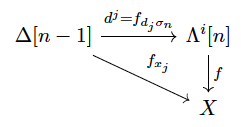
Conversely let x_0,\dots,x_{i-1},x_{i+1},\dots,x_n\in X_{n-1} be any elements that are matching faces with respect to i. Then the representing maps f_{x_j}:\Delta[n-1]\to X for j\neq i defines a simplicial map f:\Lambda^i [n]\to X such that the diagram

Screen Shot 2016-01-26 at 11.21.11 PM
commutes for each j.

By the assumption, there exists an extension g:\Delta[n]\to X such that g|_{\Lambda^i[n]}=f. Let w=g(\sigma_n). Then d_jw=d_jg(\sigma_n)=g(d_j\sigma_n)=f(d_j\sigma_n)=x_j for j\neq i. Thus X is fibrant.

Motivation of Simplicial Sets

A simplicial set is a purely algebraic model representing topological spaces that can be built up from simplices and their incidence relations. This is similar to the method of CW complexes to modeling topological spaces, with the critical difference that simplicial sets are purely algebraic and do not carry any actual topology.

To return back to topological spaces, there is a geometric realization functor which turns simplicial sets into compactly generated Hausdorff spaces. A topological space X is said to be compactly generated if it satisfies the condition: A subspace A is closed in X if and only if A\cap K is closed in K for all compact subspaces K\subseteq X. A compactly generated Hausdorff space is a compactly generated space which is also Hausdorff.

Tips on giving (Math) Talks

Here are some tips on how to give (Math) Talks. Talks on other scientific topics should be similar.

Source 1: http://www.math.wisc.edu/~ellenber/mntcg/TalkTipSheet.pdf

One tip I found very useful is this: For long talks (1 hour) and above, it is better to use the whiteboard / blackboard. As this will give you “the flexibility to add or omit material as you see fit, and it forces you not to go to fast.”

For shorter talks, it is better to use slides. “A good rule of thumb: you should allow between 30 seconds and 1 minute per slide.” So if you are preparing for a 30 minute talk, around 30-60 slides would be ideal.

Source 2: https://faculty.washington.edu/heagerty/Courses/b572/public/HalmosHowToTalk.pdf

This is advice by the legendary Paul Halmos. His first advice is to “Make it simple, and you won’t go wrong.”

Evaluating Integrals using Complex Analysis

Our next few posts on complex analysis will focus on evaluating real integrals like \displaystyle\int_0^\infty \frac{1}{x^2+1}\,dx using residue theory from Complex Analysis. This is something amazing about Complex Analysis, it can be used to solve integrals in real numbers, something which is not immediately obvious.

To calculate those real integrals, the first step is to study the theory of residues and poles. This can be found in Chapter 6 of Churchill’s book Complex Variables and Applications (Brown and Churchill).

The extremely powerful theorem that one first needs to know is called Cauchy’s Residue Theorem:

Let C be a simple closed positively oriented contour. If a function f is analytic inside and on C except for a finite number of singular points z_k (k=1,2,\dots,n) inside C, then \displaystyle \int_Cf(z)\,dz=2\pi i\sum_{k=1}^n\text{Res}_{z=z_k}\,f(z).

A Summary of the 3 types of Isolated Singular Points:

  1. Pole of order m. The coefficients b_n of the Laurent series contain a finite (nonzero) number of nonzero terms, i.e. b_n eventually becomes zero after a certain number. i.e. \displaystyle f(z)=\sum_{n=0}^\infty a_n(z-z_0)^n+\frac{b_1}{z-z_0}+\frac{b_2}{(z-z_0)^n}+\dots+\frac{b_m}{(z-z_0)^m}.
  2. Removable singular point. Every b_n is zero.
  3. Essential singular point. An infinite number of the coefficients b_n in the principal part are nonzero.

Shortcut for calculating Residues at Poles

Theorem: An isolated singular point z_0 of a function f is a pole of order m if and only if f(z) can be written in the form f(z)=\frac{\phi(z)}{(z-z_0)^m} where \phi(z) is analytic and nonzero at z_0. Moreover \text{Res}_{z=z_0}f(z)=\phi(z_0) if m=1 and \text{Res}_{z=z_0}f(z)=\frac{\phi^(m-1)(z_0)}{(m-1)!}. if m\geq 2.

This is a very short crash course on the theorems needed. The next blog post on complex analysis will go into calculating some actual integrals.