1) Success consists of going from failure to failure without loss of enthusiasm.
2) Success is not final, failure is not fatal: it is the courage to continue that counts.

1) Success consists of going from failure to failure without loss of enthusiasm.
2) Success is not final, failure is not fatal: it is the courage to continue that counts.
The implicit function theorem is a strong theorem that allows us to express a variable as a function of another variable. For instance, if 


The below material are taken from Wikipedia.
Let 





![\displaystyle [(\partial f_i/\partial y_j)(\mathbf{a},\mathbf{b})]](https://s0.wp.com/latex.php?latex=%5Cdisplaystyle+%5B%28%5Cpartial+f_i%2F%5Cpartial+y_j%29%28%5Cmathbf%7Ba%7D%2C%5Cmathbf%7Bb%7D%29%5D&bg=ffffff&fg=1a1a1a&s=0&c=20201002)


Elaboration:
Abbreviating 

where 


The implicit function theorem says that if 
In this case 

Note that 


An 

This atlas consists of a family of charts 


Source: Representations of Compact Lie Groups (Graduate Texts in Mathematics)
One of the best books on Lie Groups is said to be Representations of Compact Lie Groups (Graduate Texts in Mathematics)
A Lie group is a differentiable manifold 


A homomorphism of Lie groups is a differentiable group homomorphism between Lie groups.
The concept of lim sup and lim inf can be applied to sets too. Here is a nice characterisation of lim sup and lim inf of sets:
For a sequence of sets 


Proof:
Note that
This is great news for NTU alumni.
SINGAPORE – Graduates of Nanyang Technological University (NTU) can look forward to free membership at three new alumni houses.
This year marks the 25th anniversary of NTU’s inauguration as a university, and it announced on Wednesday (Aug 10) that it will open a 10,000 sq ft alumni house – equivalent to nine five-room flats – in Marina Square mall in November.
The second facility will be at NTU’s main campus’ North Spine Plaza, and it will open by the end of this year; the third will be at one-north and will open next year.
Heartiest congratulations to Mr Joseph Schooling, who has achieved the legendary accomplishment of a Gold medal at the Olympics! Good job!
Here is some analysis of factors contributing to Joseph’s Schooling’s success:
Joseph’s height is 1.84 m (close to the ideal height of 1.90 m). In swimming, a tall height is desirable, as that would lead to an instant lead the moment you jump into the water. But this is not basketball, too tall (e.g. over 2 m) is probably not good as that will lead to increased drag and bad aquadynamics. So judging by height of former Olympic swimmers, roughly 1.90 m is the ideal height.
In fact, in 2006, “Schooling’s parents, Colin and May, send him for a bone test – which calculates growth potential – to see how far he can go in the sport. The test reveals that he will hit 1.90 metres, which is an optimum height to excel in the sport at the highest levels.” (http://www.todayonline.com/sports/schooling-story)
This is probably the most important factor. Even when just eight years old, Joseph Schooling woke up his dad at 4.30 am to request to go for swimming training.
Schooling also took training to the highest level by going overseas (to Texas) for his training.
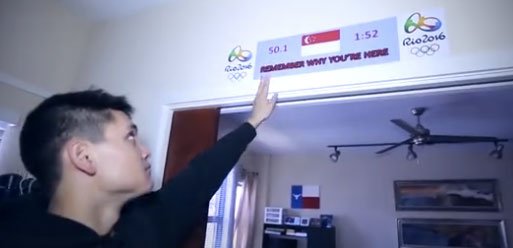
Joseph Schooling also has a motivational poster (see below) to remind himself daily of the times he need to achieve for a podium finish.
Joseph Schooling’s grand-uncle Lloyd Valberg, a former high jumper, was Singapore’s first ever Olympian at the 1948 London Games. He was the one who inspired Joseph to aim for the Olympics, when Joseph was just 6 years old.
“Colin (Joseph’s father) and his wife, May, decided to groom their only son to the best of their ability, going so far as to ensure he had access to swimming facilities to train during every vacation they took during his childhood. This would continue into his formative years, when Joseph was sent first to the famed Bolles School in United States to train under renowned coach Sergio Lopez and now the University of Texas to continue his development at the best possible environment.” (from https://sg.sports.yahoo.com/news/colin-schooling–the-world-has-taken-notice-of-joseph-and-singapore-150934197.html)
In 2012 Olympics, Joseph met with extreme bad luck in the form of his goggles and swim suit not being approved, leading to a last minute change which would affect his timings.
Despite that, Joseph continued to persevere in his training, which led to his fantastic results in 2016.
Joseph Schooling’s coach is Sergio Lopez, “who is a former international top swimmer from Spain, who won the bronze medal in the 200 meters breaststroke at the 1988 Summer Olympics in Seoul” (Wikipedia).
Coach is very important, Michael Phelps credits his success to his legendary coach Bob Bowman, who has written a book The Golden Rules: 10 Steps to World-Class Excellence in Your Life and Work
The Singapore government has humanely allowed a deferment from National Service (2 year mandatory conscription into the army) for Joseph Schooling. This is a crucial factor as for Olympic athletes, uninterrupted training is of utmost importance.
Finally, here are some cool Joseph Schooling Shirts suitable for his ardent fans. (Note that Red/White are Singapore’s national colors.)
Very interesting article on why you should consider a degree in math if you are interested in math.
Source: http://www.snhu.edu/about-us/news-and-events/2016/08/what-is-a-degree-in-math-and-why-is-it-valuable
Mathematics is the study of quantity, structure, space and change. As abstract as that may seem, math is, at its core, a quest for absolutes, definitive solutions and answers. We may think of long numeric chains, seas of fractions or spreadsheets stacked with figures, but what many don’t realize is that math’s complex equations are in fact roads to simplicity. Believers in better, faster, smarter solutions are often drawn to math.
So, what is a degree in math, exactly? Those that go to college to pursue a mathematics degree find out along the way that numbers are just a fraction of the allure. Math can teach us how to look longer and harder for solutions – a skill applicable to any career and life in general.
We need math. Galileo Galilei used it to explain the universe. Math resolves truths and uncovers errors. It makes our work more credible. Reports, studies and research are all but discounted without quantifiable facts. Math equals proof. Math validates.
The Mathematical Association of America cites a CareerCast report ranking mathematics the best job for 2014 based on factors such as environment, income, outlook, and stress. The job of statistician was ranked third. Actuary was ranked fourth. In addition, a PayScale study reports that the top 15 highest-earning college degrees have mathematics as a common denominator.
But, Psychology Today reports that most of us are in awe of math. It’s slightly mysterious. It makes things look smart, including the mathematician behind the math. What is a degree in math? It’s a professional pathway, and an attractive one for many reasons. It is also a unique way of seeing the world.
Whether you like mathematics or are even very good it, math is around us all the time. When you’re at the department store, balancing your checkbook or doing your taxes, mathematics is a necessary skill. It can even improve your sports game.
“There’s math all over the place in soccer,” Southern New Hampshire University’s mathematics department chairwoman Dr. Pamela Cohen told pro soccer player Calen Carr in this video. From the curve – also known as a “parabola” – of a kicked ball to the rigidness of playing in triangles on the field, math factors into every aspect of the game. What is a math degree to an athlete? A competitive edge on the field.
Many professions, such as engineering, medicine, physics, nurses, computer science and actuarial science, require math proficiency. Virtually all fields benefit from the analytical and problem-solving skills students learn in mathematics. Anyone entering a science, technology, engineering and mathematics (STEM) career is expected to have harnessed basic and advanced math concepts.
Even professions as diverse as chefs or gardeners use math fundamentals when measuring and purchasing supplies. If you are an event planner, math will help you figure per-head costs and inventory. Seamstresses and decorators use math daily, as does anyone who works with measurements and schedules.
Many people believe math talent to be something that is inherited or are born with. Not so, say researchers. Natural ability in math only gets you so far. Hard work and good study habits are far more valuable. As such, students entering college math degree programs aren’t the math-minded geniuses. Some didn’t even like math growing up, says a Quartz article that looks at why some kids excel at math and others don’t. The authors – economy and finance professors – make the case that something said by a grade school teacher years ago could be the reason a child is turned off to math or thinks he or she is bad at it. Some educators and parents also have a bad habit of labeling kids as either math kids or reading kids.
The Fundamental Theorem of Calculus is one of the most amazing and important theorems in analysis. It is a non-trivial result that links the concept of area and gradient, two seemingly unrelated concepts.
The first part deals with the derivative of an antiderivative, while the second part deals with the relationship between antiderivatives and definite integrals.
Let 
![[a,b]](https://s0.wp.com/latex.php?latex=%5Ba%2Cb%5D&bg=ffffff&fg=1a1a1a&s=0&c=20201002)

Then 

Let 
If
This amazing theorem is also called the Fundamental Theorem of Calculus for Line Integrals. It is quite a powerful theorem that sometimes allows fast computations of line integrals.
Let 


Let 
Every bounded entire function must be constant.
That is, every holomorphic function 


Multivariable calculus is an interesting topic that is often neglected in the curriculum. Furthermore it is hard to learn since the existing textbooks are either too basic/computational (e.g. Multivariable Calculus, 7th Edition
If anyone has a good book that covers multivariable calculus (preferably rigorously with proofs), do post it in the comments!
The following is a useful multivariable version of Taylor’s Theorem, using the multi-index notation which is regarded as the most efficient way of writing the formula.
Let 




 ,
,  )
)Write 
Apple has released a mode called Night Shift for iPhones and iPads. What it does is it reduces blue light from your phone in the evening/night so that one can sleep better. Blue light is known to be unnatural since throughout human history (before Edison), humans have lived in darkness at night. Fire from candles/lantern is Red light, which is considered not as bad as Blue light.
For Mac, there is no such thing as Night Shift (yet), the best alternative is f.lux. I recommend the “classic f.lux” mode over the default, as the default is too extreme (overly red).
Other than improving sleep, another factor it can help with is eye strain.
Pokemon Go has finally arrived in Singapore! Good to see that the company Niantic did not forget about Singapore.
Upon starting the game, however, one would be in for a surprise. The gyms are all dominated by high level Pokemon, just merely hours after the release. (It is humanly impossible to have reached such a level in such a short time.)
For instance, the gyms near my neighbourhood has Gyarados (arguably the best Water Pokemon), Hypnos and Nidoqueen respectively. (See screenshot)


How did these guys get these Pokemon is a good question. The possibilities are either GPS Spoof (E.g. by using VPN to access Pokemon Europe or USA), or that they really caught the Pokemon overseas. Either way, they would have had a headstart since Pokemon Go was released much earlier in USA/Europe/Australia.
Overall, Pokemon Go is a fun and unique game in the sense that it involves walking around in real environments. However, one letdown is that it is not very skill-based (unless one counts flicking Pokeballs as a skill). There is not much strategy involved (both catching or battling) for Pokemon Go.
There is one mathematical part of Pokemon Go: Determining which Pokemon to evolve based on IV (Initial Values). Some websites to help are: Pokeassistant, or TheSilphRoad. The difference between a bad or perfect Pokemon is only 10% though, so it will only make a difference in very close battles.
Pokémon Clip ‘N’ Carry Poké Ball Belt, Styles May Vary
(For those really into the game, may want to check these out while you hunt for Pokemon!)
Flyme Pokemon Go Cap ,Team Valor Team Mystic Team Instinct Baseball Cap Hat (Red)
Yet another motivational sermon by Pastor Rick Warren.
Source: http://rickwarren.org/devotional/english/full-post/what-will-you-do-today-that-requires-faith
“Let us not become weary in doing good, for at the proper time we will reap a harvest if we do not give up” (Galatians 6:9 NIV).
Failure is never final. You’re never a failure until you quit, and it’s always too soon to quit! You don’t determine a person’s greatness by his talent, his wealth, or his education. You determine a person’s greatness by what it takes to discourage him.
So what does it take to discourage you from going after your dream? It may be as simple as a friend or relative or family member telling you, “I don’t think that’s a good idea.”
The Bible says in Galatians 6:9, “Let us not become weary in doing good, for at the proper time we will reap a harvest if we do not give up” (NIV). You want to know how many times I wanted to resign from Saddleback Church? Just every Monday morning when I think, “God, surely somebody could have done a better job than I did yesterday. This thing is too big for any one person.”
God says, “Just keep on keeping on.” I may not be real bright sometimes, but I don’t know how to quit. I don’t know how to give up.
God works in your life according to your faith. The Bible says, “Without faith it’s impossible to please God” and “Whatsoever is not of faith is sin” and “According to your faith it will be done unto you.” So what are you doing in faith? You need to ask yourself every day when you get up, “God, what can I do today that will require faith?” That’s an important question, because that’s what’s going to please God.
There are a lot of things in your life you don’t have control over. You didn’t control who your parents were, when you were born, where you were born, or what your race or nationality is. You didn’t control what gifts and talents you were given. You didn’t decide how you look.
But you do have complete control over how much you choose to believe God. God uses people who expect him to act, who never give up, who take risks in faith, who get his dream and go after it. It’s your choice whether you want to be the kind of person God uses to accomplish his purpose.
Cauchy Product:
The Cauchy product of two infinite series is defined by 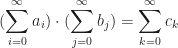

The proof of the Pasting Lemma at Wikipedia is correct, but a bit unclear. In particular, it does not clearly show how the hypothesis that X, Y are both closed is being used. It actually has something to do with subspace topology.
I have added some clarifications here:
Let 


Let 


Similarly, 

Quite an inspirational story. Congratulations to these two students who have succeeded despite having a less than ideal start.
“We have to find our interest, put in our best effort and keep trying. After having come so far, it has made me believe that I can still carry on.”
Source: http://www.straitstimes.com/singapore/education/from-normal-stream-to-phd-course
Mr Ernest Tan, 28, a PhD student, never thought he would get this far.
The former EM3 and Normal (Technical) student did not bother studying much as he had no interest in the subjects he was doing.
But it all changed in his two years at the Institute of Technical Education (ITE) as a student in Communications Technology.
He said: “I played a lot of computer games then so I didn’t mind learning more about computers.”
His interest pushed him to believe that he could continue into polytechnic, where he eventually earned a Diploma in Computer Engineering at Singapore Polytechnic (SP).
Continue reading: http://www.straitstimes.com/singapore/education/from-normal-stream-to-phd-course
Very good singer and inspirational song. Potential champion of this series.
Excellent sermon by Pastor Rick Warren.
“Fear of man will prove to be a snare, but whoever trusts in the Lord is kept safe”(Proverbs 29:25 NIV).
Satan’s favorite tool to diminish your faith is the fear of failure. But you cannot serve God and be constantly worried about what other people think. You have to move forward. Proverbs 29:25 says, “Fear of man will prove to be a snare, but whoever trusts in the Lord is kept safe” (NIV).
So how do you get rid of the fear of failure?
One way is to redefine failure. What is failure? Failure is not failing to reach your goal. Failure is not having a goal. Failure is not failing to hit your target. Failure is not having a target. Failure is not falling down. Failure is refusing to get back up. You’re never a failure until you quit. So if you’re attempting something for the glory of God, that’s a good thing. Failure is not trying and not accomplishing anything. Failure is failing to try.
Another way to get rid of the fear of failure is to never compare yourself to anybody else. You’re always going to find somebody who’s doing a better job, and you get discouraged. And, you’re always going to find somebody who’s not doing as good a job as you are, and you become full of pride. Both of them will mess up your life. Discouragement and pride will keep you from serving God’s purpose for your life.
The Bible says in Galatians 6:4, “Each of you must examine your own actions. Then you can be proud of your own accomplishments without comparing yourself to others” (GW)
Did you notice that the Bible says there is a legitimate pride? There’s a good kind of pride and there’s a bad kind of pride. The bad kind of pride is comparing: “I’m better than so and so!” The good kind of pride is, “God, I’m proud of what you’re doing in my family, my business, my life, my walk of faith.” That’s the good kind of pride.
When you get to Heaven, God isn’t going to say, “Why weren’t you more like so and so?” He’s going to say, “Why weren’t you who I made you to be?”
Let go of your fear of failure, because anything you’re attempting for God in faith is a good thing, regardless of the results.
For a finite extension 
1)
2) Every irreducible polynomial in ![F[x]](https://s0.wp.com/latex.php?latex=F%5Bx%5D&bg=ffffff&fg=1a1a1a&s=0&c=20201002)

3)
4) ![|\text{Aut}(E/F)|=[E:F]](https://s0.wp.com/latex.php?latex=%7C%5Ctext%7BAut%7D%28E%2FF%29%7C%3D%5BE%3AF%5D&bg=ffffff&fg=1a1a1a&s=0&c=20201002)
5) 
Given a field extension
where 


where 


This correspondence is a one-to-one correspondence if and only if
Examples
1) 
2) 
Let 


Note that 


Bought this fish from Giant (Vivocity). Seabass, 2 for $8.40. Very delicious!
Compared to fried fish in western countries, Chinese people always choose to cook fish in different ways, like fish soup, braised fish in brown sauce, or steamed fish.

I bought this sea bass from supermarket. Yet, I found it too big and we didn’t have a pan big enough to cook it. So I decided to divided it into two parts. Fish head for the soup. Fish body and tail for the braised one.
Fish head soup is very popular in China, since many people think this dish is very good for health. Nutritious elements in fish will be contained in the soup.
在中国,鱼头汤是一道很受欢迎的菜。很多人认为鱼头汤对身体很补,鱼里面的营养物质会融合到汤里面去。
It is not difficult to make fish soup.
1. Heat the oil in the pan, and fry two sides of the fish head. When the color turns a little brown, pour in the hot water.
锅内热油,将鱼头两面煎黄,然后加入热水没过鱼头。
2. Add two or three ginger slices, salt and green…
View original post 210 more words
Offhand, it is hard to think of a function that does not have even a one-sided limit. This video shows one!
This is one of the more illuminating videos on Convolution. I believe after watching it, many will have a better understanding of what is the convolution.
This is a post by Rick Warren, author of “The Purpose Driven Life: What on Earth Am I Here For?
(Source: http://rickwarren.org/devotional/english/to-reduce-your-fear-of-failure-redefine-it)
“No matter how often honest people fall, they always get up again.” (Proverbs 24:16a TEV)
Never forget this truth: Failure probably won’t kill you.
We vastly exaggerate the effects of failure. We blow the prospects of failing all out of proportion. Failing is not the end of the world. The fear of failure is far more damaging than failure.
Proverbs 24:16 says, “No matter how often honest people fall, they always get up again” (TEV). Even good guys stumble. They make mistakes, blow it, and stub their toes.
Successful people are not people who never fail. They’re people who get up again and keep going. Successful people just don’t know how to quit.
Ever heard of these famous failures?
Great people are simply ordinary people who have an extraordinary amount of determination. They just keep on going. They realize they’re never a failure until they quit.
That’s how you reduce your fear of failure. You redefine it.
You don’t fail by not reaching a specific goal. Instead, failure is not having a goal. Failure is refusing to get back up again once you fall. It’s refusing to try.
On the first day of kindergarten, I got in the wrong line and then into the wrong classroom. Can you imagine me going home to my mom and dad and saying, “I’m a failure at education! This school thing just doesn’t work”? Of course not.
You keep going. If at first you don’t succeed, it’s no big deal. You’re never a failure until you give up.
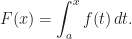
The class equation of a group is something that looks difficult at first sight, but is actually very straightforward once you understand it. An amazing equation…
Suppose 


Let 
Let 


Let 
By Orbit-Stabilizer Theorem,
Therefore,
The following are two lists of useful algebra and analysis theorems that are covered during university.
Just noticed that there are some new header images for the “Twenty Ten Theme” by WordPress.
Some examples include flower, beach, lights, kitchen table. The old images are still there.
Just read an amazing article about self-made billionaire Sara Blakely.
First amazing story is this.
Early in his own career Sara’s father learned that failure is part of success. That in order to be successful at anything in life, you were going to experience some failures along the way. Sara’s father went to great lengths to instill this simple success principle in the lives and minds of his children.
Once or twice a week at the dinner table the elder Blakely would ask his children what they failed at that week. He would stress that if they had not failed at something it meant that had not tried or attempted something new. This instilled a deep belief in Sara’s mind that failure is not the outcome; the real failure was in not trying.
Being able to see failure as just another stepping stone to success would play a big part in Sara Blakely’s struggles later in life as she began to build her company, SPANX.
This is really interesting. This is one good thing about American culture, which explains why Americans are willing to take risks. How many parents in Asia will ask the same thing? Not many, I would estimate.
Second amazing story is this, the power of motivational books. Most people would think that motivational books are hype, or “BS”, to put it mildly. True, 90% of them may be nonsense, but the top tier ones are good, and possibly life-changing.
Over a relatively short period of time a series of events occurred in young Sara Blakely’s life that would set most young people back in a dramatic way.
Recognizing that his daughter was going through very tough times, the elder Mr. Blakely gave his daughter a set of tapes by Dr. Wayne Dyer titled How to Be a No-Limit Person.
Today, Sara Blakely gives almost all of the credit for her success in life to the success principles she learned as a teenager from that one set of motivational tapes by Dr. Wayne Dyer.
This is the top-selling and most popular Wayne Dyer book of all time. Also check out this post on Motivational Books for students.
Sara Blakely on failure:
Let 

If the series 


An immediate corollary of Mertens’ Theorem is that if a power series 


Note that a power series converges absolutely within its radius of convergence so Mertens’ Theorem applies.
If 


Moreover, 
Let
Let
Maths Tuition – What are the Benefits?
Maths tuition brings about many benefits that can be seen for the parent, the teacher and especially the student who is struggling with their mathematics subject in school. For starters, it will have a huge impact for the student because their entire future can depend on their academic performance in PSLE, O-level, and A-level examinations – all of which requires the student to take the math subject.
For young kids, academics and performance in school can be everything. Their self-esteem and pride depends on it and it helps to guide them in the right direction. Performing well in all subjects helps us to determine who they will become in the future and what they wish to achieve. However, this can be difficult to do when the poor child is struggling in school, particularly in mathematics. Having the opportunity to participate in private maths tuition can help a student get back on the right track once again.
Maths tuition can be extremely useful for Singaporean parents as well. While we all try our best to help our students be successful, there are simply some areas where we are not knowledgeable enough to help out very much. A lot of parents are simply not equipped enough in maths to be able to guide our children adequately. There are also many changes to the education system such the newer and harder syllabuses that can hinder our ability to help our kids as well.
However, with a private maths tutor, our kids can learn the proper way to craft mathematics answers, draw models, and solve algebraic questions, developing the tools necessary to help them succeed in their mathematics exam. Doing well in mathematics not only helps students regain their confidence and improve their T-scores, it also helps them in the long-run as they develop into working adults, as mental arithmetic ability is useful in many practical situations. A good maths tutor can use their expertise to help guide students back onto the right path so that all of their goals and dreams can become a reality.
Teachers can also benefit from private tuition as well. Since a teacher has many students that they are required to teach at one time, it is difficult for them to have the time necessary to devote to one struggling student. However, when students in the class engage their own private maths tutor from a maths tuition agency, the teacher will not have to focus too much on that one student, hindering any of the other children in the classroom as well.
With the right tuition agency, parents can engage private maths tuition in any location and there are benefits for everyone involved. Also, if the mathematics tutors are specialized; meaning if your student is struggling in math, a private maths tuition teacher can help to bring their grades up and to catch them up with the remainder of the class.
Maths tutors are great for all age groups and can even be beneficial for those in university as well. Choosing to engage private maths tuition for your child is a great decision, and whether you are a student, parent or teacher, a good maths tutor help to make everyone’s lives a little better.
Very interesting object indeed. Also see this previous video on How to Unlock Interlocked Fingers Topologically?
The horned sphere, together with its inside, is a topological 3-ball, the Alexander horned ball, and so is simply connected; i.e., every loop can be shrunk to a point while staying inside. The exterior is not simply connected, unlike the exterior of the usual round sphere; a loop linking a torus in the above construction cannot be shrunk to a point without touching the horned sphere. (Wikipedia)
Lusin’s Theorem and Egorov’s Theorem are the second and third of Littlewood’s famous Three Principles.
There are many variations and generalisations, the most basic of which I think are found in Royden’s book.
Informally, “every measurable function is nearly continuous.”
(Royden) Let 


Informally, “every convergent sequence of functions is nearly uniformly convergent.”
(Royden) Assume 

Then for each
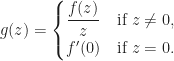
This post proves that if 


(Proof modified from Stein-Shakarchi Complex Analysis)
We prove by contradiction. Suppose to the contrary 

Since 


For sufficiently small 


Since 

Since the zeroes of a non-constant holomorphic function are isolated, 
Let 




Thus 
Original recipe :
http://m.xiachufang.com/recipe/100460858/
It’s a special way to make pancake, because oven is used instead of pan.
I made some change according to the original recipe above:

Since I don’t have any weighing machine, I am not sure the accurate weight of all the ingredients I used.
Part A:
Flour around 80g
Sugar around 30g
Baking soda 1 tsp
Salt 1/8 tsp
Mix all of them well.

Part B:
Egg 1
Milk around 150g
Yogurt around 25g
Oil ( I used canola oil) around 25g
Vanilla esscence 1 tsp
Mix them well.

Pour Part B into Part A. Stir till no flour can be seen.
Add some blueberries. Stir again.

Preheat oven with 190 degree.
Before put into the oven, spread some blueberries on the surface of batter.
Bake for 45 minutes.
Blueberries will burst and the house is full of fragrance.

You can spread some icing sugar if…
View original post 9 more words
Source: http://www.ft.com/cms/s/0/2e4c61f2-4ec8-11e6-8172-e39ecd3b86fc.html
Sie Yu Chuah smiles when asked how his parents would react to a low test score. “My parents are not that strict but they have high expectations of me,” he says. “I have to do well. Excel at my studies. That’s what they expect from me.” The cheerful, slightly built 13-year-old is a pupil at Admiralty, a government secondary school in the northern suburbs of Singapore that opened in 2002.
To learn more about Singapore Math, check out this comprehensive blog post describing what is Singapore Math.
Source: http://edition.cnn.com/2016/07/23/europe/germany-munich-shooting/
(CNN) The teen gunman who killed nine people in a shooting rampage in Munich on Friday was a mentally troubled individual who had extensively researched spree killings and had no apparent links to ISIS, police said.
Condolences to the victims of the Munich shooting.
The next generation of shooting prevention technology lies in psychology, to detect such shooters before they even act. According to Wikipedia, Gun legislation in Germany is considered among the strictest gun control in the world, yet the attacker (Ali Sonboly) managed to get hold of a gun (this fact seemed yet to be explained in the news).
Dr Peter Langman, the world expert on this matter, has written such a book: Why Kids Kill: Inside the Minds of School Shooters
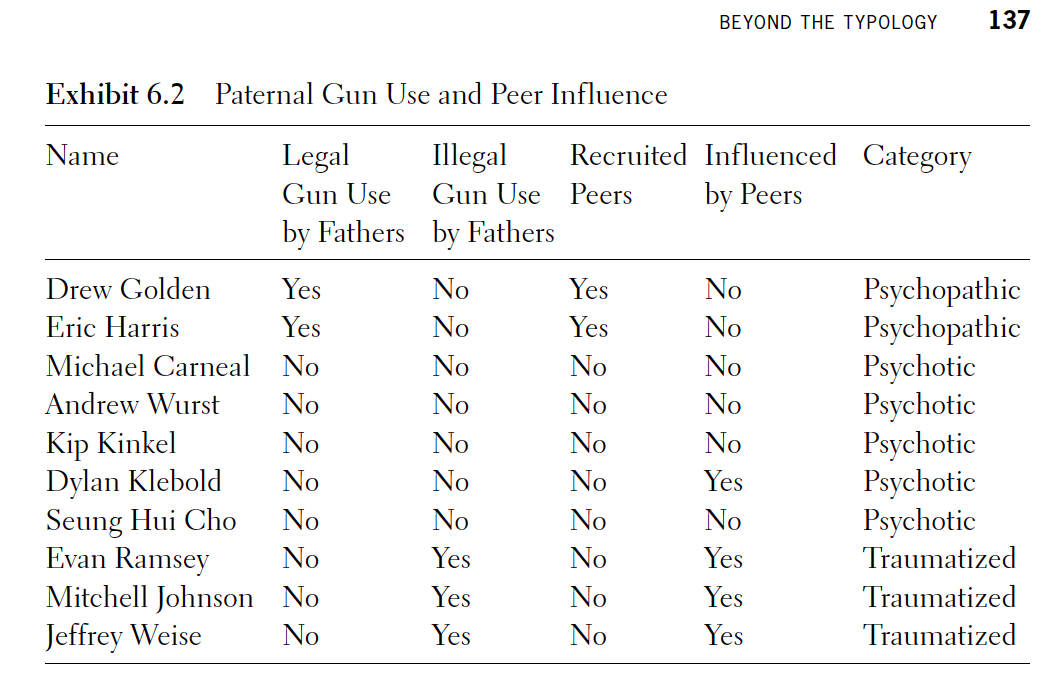
According to Dr Langman, “The end of the book will not present anything like: A + B + C = School Shooter. The subject is too complicated for that, and there is much that we do not know. Nonetheless, I believe this book will shed light on a phenomenon that, despite massive media coverage, has remained mysterious.”.
Another interesting fact found in Dr Langman’s book is that attackers are not typically loners, unlike what mainstream media usually claims. Dr Langman states that, “A popular sound-bite view of school shooters is that they are loners, a status seen as a contributing factor in their rampages. This is inaccurate. Whereas 9 out of 10 of the shooters we discuss were depressed, only 1 out of 10 was a loner. The others all had friends and acquaintances with whom they engaged in a variety of social activities.”
Overall, review of Dr Langman’s book is highly positive. Definitely useful for teachers in USA to read.
Check out this post by my wife on how to cook Pork / Beef Wellington. All photos taken are original!
My husband wanted to have beef steak, but we didn’t have any at home. So I cooked Pork Wellington using the recipe of Beef Wellington.
The result was surprisingly good. Pork tested very tender and juicy.
The following is an easy way to cook pork in this way:
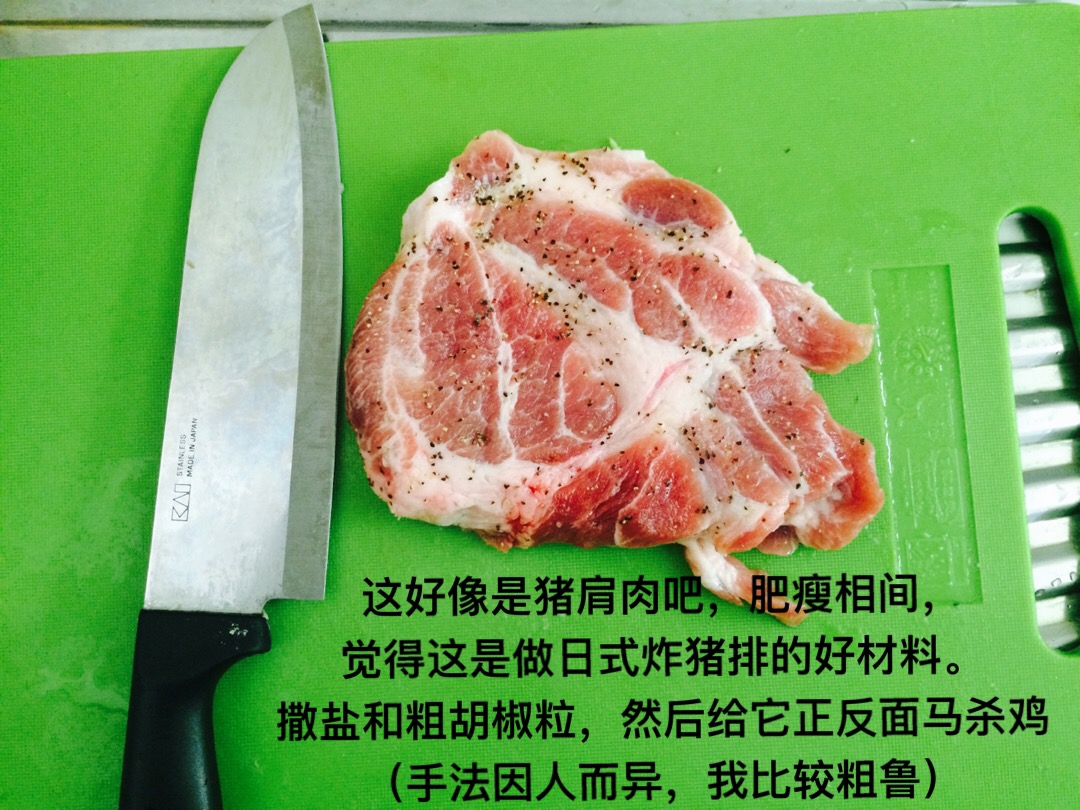
1. Season the pork with salt and black pepper.

2. Since the thick steak tests better, I used kitchen twine.

3. Heat some butter in a pan.

4. Put the pork in when the butter is heated. And fry every side of the pork.

5. Frying is done.

6. Stir fry chopped onion, mushroom, and garlic. Add some salt and black pepper powder. ( I don’t have other spices or wine.)

7. Bacon at the bottom, mixture of mushroom and onion in the middle, pork on the top. Do remember to take the kitchen twine off.

8. Roll the pork with bacon…
View original post 86 more words
The Schwarz Lemma is a relatively basic lemma in Complex Analysis, that can be said to be of greater importance that it seems. There is a whole article written on it.
The conditions and results of Schwarz Lemma are rather difficult to memorize offhand, some tips I gathered from the net on how to memorize the Schwarz Lemma are:
Conditions: 
Result 1: 

Result 2: If 


If you have other tips on how to remember or intuitively understand Schwarz Lemma, please let me know by posting in the comments below.
Finally, we proceed to prove the Schwarz Lemma.
Let 


Then, 

Moreover, if 

Consider
Since 


Let 


As 

Moreover, if 

Let
Define 
Well-defined:
Note that 




Surjective:
Injective:
If 

By Lagrange’s Theorem,
Field Medallist Prof. Gowers has also written a nice post on the Orbit -Stabilizer Theorem and various proofs.
In this post, we will classify groups of order pq, where p and q are primes with p<q. It turns out there are only two isomorphism classes of such groups, one being a cyclic group the other being a semidirect product.
Let 
Case 1: 

By Sylow’s Third Theorem, we have 


Since 


Let 


Case 2:
From previous arguments, 





Let 


If 

If 


Dear readers of Mathtuition88,
I am pleased to announce that Udemy (famous online course provider) has contacted me to offer readers a special promotion on courses. These are all WDA approved Skills Future Courses and Singaporean citizens can use their Skills Future Credit to reimburse for them.
These courses would be useful for DSA students learning to improve their interview skills, and also parents seeking to improve their career related skills.
Promocode: SINGAPOREMATHS
Discount: 30%
Udemy Homepage
Udemy Homepage
All Skills Future Courses
All Skills Future Courses
The Complete Innovator Guide to Spark Creative Thinking
The Complete Innovator Guide to Spark Creative Thinking
Career Hacking: Resume/CV, LinkedIn, Interviewing, +More
Career Hacking: Resume/CV, LinkedIn, Interviewing, +More
Win Any Job Interview – TOP Strategies For Job Interviews
Win Any Job Interview – TOP Strategies For Job Interviews
Communication Skills: Become A Superstar Communicator
Communication Skills: Become A Superstar Communicator
The Art of Leadership & Coaching
The Art of Leadership & Coaching
Double Your Social Skills and Instantly Connect With People
Double Your Social Skills and Instantly Connect With People
If the complex-valued functions 

Consider the polynomial 



for every 
Then
The new PSLE system clearly favors “all-rounders” over “specialists”.
Imagine a Math/Science-whiz with
Math:100 (AL 1)
Science: 98 (AL 1)
English: 84 (AL 3)
Chinese: 84 (AL 3)Total marks: 366 (Approx. 275 T-score)
Total AL: 8
With a “all-rounder”:
Math: 90 (AL 1)
Science: 90 (AL 1)
English: 90 (AL 1)
Chinese: 90 (AL 1)Total marks: 360 (Approx. 270 T-score)
Total AL: 4
The Math/Science whiz (total AL 8) will be getting double the score of the “all-rounder” (total AL 4), effectively eliminating his chance of entering the top schools. The irony is that the total marks of the Math/Science Whiz is a considerable 6 marks more than the “all-rounder”.
Under the old system, both are likely to get around the same T-score (approx. 270+), with the Math/Science whiz having a higher T-score.
This scenario is even worse.
Imagine an intelligent English-Educated Kid (with parents who can’t speak Chinese). After a lot of hard work with Chinese enrichment, etc, he manages to pass Chinese, with a score of:
Math:100 (AL 1)
Science: 98 (AL 1)
English: 95 (AL 1)
Chinese: 64 (AL 6)Total marks: 357 (Approx. 268 T-score)
Total AL: 9
Under the old system, this child is probably one that qualifies to enter any school, including RI/HCI, etc. His T-score will probably be on par with the All-Rounder at around 270, or at most slightly lower. Under the new system, his total AL is almost 10. Really a big difference.
In fact, the O-Levels, A-Levels are also favoring the all-rounders. Only at university (and beyond), do the specialists finally get a chance to shine. That’s why it is common to see top students in universities who were not previously from the top JCs or secondary schools.
My followup post on Kiasuparents:
My concern as Math educator is that students extremely talented in Mathematics/Science but slightly weak in languages will be disadvantaged in the new PSLE system.
To quote from my own blog entry titled “New PSLE System favors “All Rounders” over “Specialists””:
Imagine a Math/Science-whiz with
Math:100 (AL 1)
Science: 98 (AL 1)
English: 84 (AL 3)
Chinese: 84 (AL 3)
Total marks: 366 (Approx. 275 T-score)
Total AL: 8
Previously such a student’s score is more than sufficient to enter the top schools like RI/HCI. But under the new system, his score of 8, chances of entering the top schools are slim.
It is not about the prestige, but rather the resources and enrichment programmes that top schools provides that other schools may not. Some examples include Olympiad training, Laboratory sessions, etc.
For these kind of students, the PSLE score of 100 is not enough to capture their ability in Math/Science, they would score 150/100 if there is such a thing. Hence, their calibre is well above the “All-Rounders” who score 90 for each subject and get 4 points.
Unfortunately, the new PSLE system does not bode well for these students…
ChiefKiasu’s (founder of Kiasuparents) comments:
This is a good analysis. The new system does demand excellence in every subject, which in my opinion will increase stress more than it reduces. And for those who say that it is good because there is no need to count decimal points, consider the fact that Secondary schools will still have COPs. So it is now getting 4 points vs getting above 255 t-scores. Which measure would you consider to be more narrow?
My feeling is that the new system will actually intensify the cookie-cutter education culture and create more average joes than truly outstanding individuals.
Lebesgue’s Theorem (see below) has been called one of the most striking theorems in real analysis. Indeed it is a very surprising result.
If the function
A real-valued function 


The following conditions on a real-valued function
(i)
(ii) 

(iii) there exists a Lebesgue integrable function 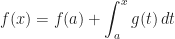
Equivalence between (i) and (iii) is known as the Fundamental Theorem of Lebesgue integral calculus.
This is a wonderful prayer attributed to theologian Reinhold Neibuhr:
The Serenity Prayer
God grant me the serenity
To accept the things I cannot change;
Courage to change the things I can;
And wisdom to know the difference.
Living one day at a time;
Enjoying one moment at a time;
Accepting hardships as the pathway to peace;
Taking, as He did, this sinful world
As it is, not as I would have it;
Trusting that He will make all things right
If I surrender to His Will;
So that I may be reasonably happy in this life
And supremely happy with Him
Forever and ever in the next.
Amen.
PDF File that can be printed (A4 size): the_serenity_prayer
Taken from http://www.lords-prayer-words.com/famous_prayers/god_grant_me_the_serenity.html
Image (JPEG): 
This theorem is pretty basic, but it is useful to construct non-abelian groups. Basically, once you have either group to be non-abelian, or the homomorphism to be trivial, the end result is non-abelian!
Theorem: The semidirect product 


Proof:
Assume 

This implies 
Consider the case 


Consider the case where 

(
This direction is clear.
Just read this interesting article. Will the new PSLE system reward students of the first kind or second kind? From my experience as student and tutor, Singapore has many talented students of the first kind, but very few talented students of the second kind.
To be a student of the second kind, one needs to “acquire knowledge beyond the school curriculum”, and “read and look at more advanced material”. Check out this page on Math Olympiad books that are suitable for students of the second kind. Parents should encourage, but never force, children to read more of these kinds of books.
Source: http://www.math.rutgers.edu/~zeilberg/Opinion0.html
There are two kinds of talented students. One kind is that of “obedient students” that do exactly as ordered by their teachers, and do not attempt to acquire knowledge beyond the school curriculum; learning the material is relatively easy for them, and the pressure from the society, their parents, and their teachers, that tells them that study is the only way to acquire a solid socio-economic status is their only motivation. To that group of students also belong less talented students, that have to study much harder, but the “reward” that awaits them in the future, as well as the immediate rewards promised by the parents (“if you will not fail any subject, you would go to an overseas vacation this summer” etc.) prods them to study.
There is yet another kind of talented students, whose natural curiosity lead them, already from a young age, to read and look at more advanced material, in order to satisfy their natural curiosity.
When such a student enters high school (and in fact, already in the higher grades of elementary school) he sees that the material that he has already studied on his own presented in a different way. The learning is induced through severe disciple (all the system of examinations and grades), and the material is taught the same way as in animal training. The fascinating science of Chemistry turns into a boring list of dry formulas, that he has to learn by heart, and the threats and the incentives practiced in school badly offend him. As though out of spite, he does not listen to the commands of his teachers, but instead studies on his own material that is not included in the curriculum. Obviously, even the most talented student can not learn from just sitting in class, (and even during class he often studies other material), and so starts the “tragedy” described in your article.












![\displaystyle |G|=|Z(G)|+\sum_{i=1}^r[G:C_G(g_i)].](https://s0.wp.com/latex.php?latex=%5Cdisplaystyle+%7CG%7C%3D%7CZ%28G%29%7C%2B%5Csum_%7Bi%3D1%7D%5Er%5BG%3AC_G%28g_i%29%5D.&bg=ffffff&fg=1a1a1a&s=0&c=20201002)

![\displaystyle |\text{Orb}(g_i)|=[G:\text{Stab}(g_i)]=[G:C_G(g_i)].](https://s0.wp.com/latex.php?latex=%5Cdisplaystyle+%7C%5Ctext%7BOrb%7D%28g_i%29%7C%3D%5BG%3A%5Ctext%7BStab%7D%28g_i%29%5D%3D%5BG%3AC_G%28g_i%29%5D.&bg=ffffff&fg=1a1a1a&s=0&c=20201002)







![\displaystyle |\text{Orb}(x)|=[G:\text{Stab}(x)]=\frac{|G|}{|\text{Stab}(x)|}.](https://s0.wp.com/latex.php?latex=%5Cdisplaystyle+%7C%5Ctext%7BOrb%7D%28x%29%7C%3D%5BG%3A%5Ctext%7BStab%7D%28x%29%5D%3D%5Cfrac%7B%7CG%7C%7D%7B%7C%5Ctext%7BStab%7D%28x%29%7C%7D.&bg=ffffff&fg=1a1a1a&s=0&c=20201002)



 Mathtuition88