Part 3 群的线性表示和例

ChefCouscous's avatarMath Online Tom Circle

[Part 1 引言 : 温习]
[Part 2 群的基础概念 : 温习]

北大: 丘维声

Part 1 & 2 : 本科班 (Undergraduate) 数学 温习

Part 3 开始: 研究班 (Graduate) 数学

第一课 群表示 Group Representation

Φ: Group homomorphism 群同态
V: Linear Space 线性空间 (K 域上 Over Field K) => 表示空间

有限 V => deg (Φ) : 次数 / 维数

无限 V => 无限维

$latex boxed {text {Group Representation : }(phi, V)}&fg=aa0000&s=3$

群表示: 通过研究 1)Φ 同态 2) 像 = 线性空间3)Φ核 = Normal Subgroup => 了解 群

KerΦ = {e} =>Φinjective =>ΦFaithful 忠实表示

KerΦ = G =>Φ平凡表示 (全部G 都映射到 零, 平凡)

若 平方表示Φ 是一次的 ( 即V 是 1 维) => 主表示 (或 单位表示)

$latex boxed {GL(V) cong GL_{n} (K)}&fg=aa0000&s=2$ 可逆矩阵

$latex boxed { Phi : G to GL_{n} (K)}&fg=aa0000&s=2 $ G…

View original post 241 more words

Cast Iron Pan Singapore Review

Recently bought a cast iron pan/skillet for home cooking. Cast iron is an ancient technology that has several benefits over the more modern non-stick technology. It is supposed to be cheap (just US$15 in America Lodge L8SK3 Cast Iron Skillet, Pre-Seasoned, 10.25-inch), but in Singapore it is quite expensive probably due to import fees.

I bought the mid-range USA brand Lodge 10.25-inch skillet (around $60 SGD). It can be found in Qoo10:

Where to buy Cast Iron Pan/Pot/Skillet Singapore

Lodge Pre-Seasoned 8-inch Cast Iron Skillet: http://www.qoo10.sg/su/412118339/Q100000595

Lodge Pre-Seasoned Cast Iron Skillet 10.25-inch: http://www.qoo10.sg/su/412118386/Q100000595

Lodge Cast Iron Skillet (Midrange, affordable)

The high-end brands include Le Creuset, Staub. These are very expensive (at least $100 SGD).

Le Creuset Skillet (High-end, Super Expensive)

Benefits of Cast Iron Cookware vs Non-stick:

  • Non-stick Teflon, even with extreme care, tends to flake off and end up in food. Also it is released as fumes during cooking. It has dubious, unknown effects on humans, but is scientifically proven to be toxic to birds and rats.
  • Adds iron supplementation to cooked food. Iron is essential for human health to make hemoglobin in blood.
  • Technically lasts forever, as it is very durable. Save cost in the long run, as you don’t have to keep replacing the pan.

Also, other benefits include:

  • Works with induction cookers. (Iron is magnetic.)
  • It is moderately non-stick, almost as non-stick as Teflon. If anything sticks, just boil with water. Also, the more you use and season it, the more non-stick it becomes.

Downsides include: Heavy weight, needs seasoning (wipe dry and coat with oil) after cooking otherwise it can rust.

The third popular alternative, Aluminum pans, are definitely not good as it may be linked to Alzheimer’s and dementia.

Part 2:   群表示论的基本概念和Abel群的表示

tomcircle's avatarMath Online Tom Circle

[引言 : Part 1 温习]

第一课:映射(f) 集合A,B

$latex f: A to B$
$latex f: a mapsto b , a in A, b in B$
$latex f(A) = { f(a) | a in A } subseteq B$ (f的值域, Im f)

A : 象域 domain:
B : 陪域 co-domain: 唯一
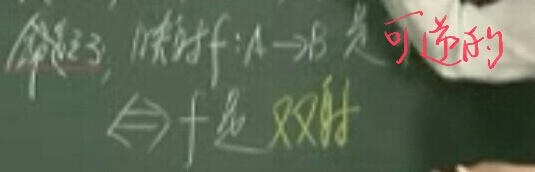
满射 Surjective, 单射 Injective , 双射 Bijective

第二课: 线性空间, 线性变化, 同态

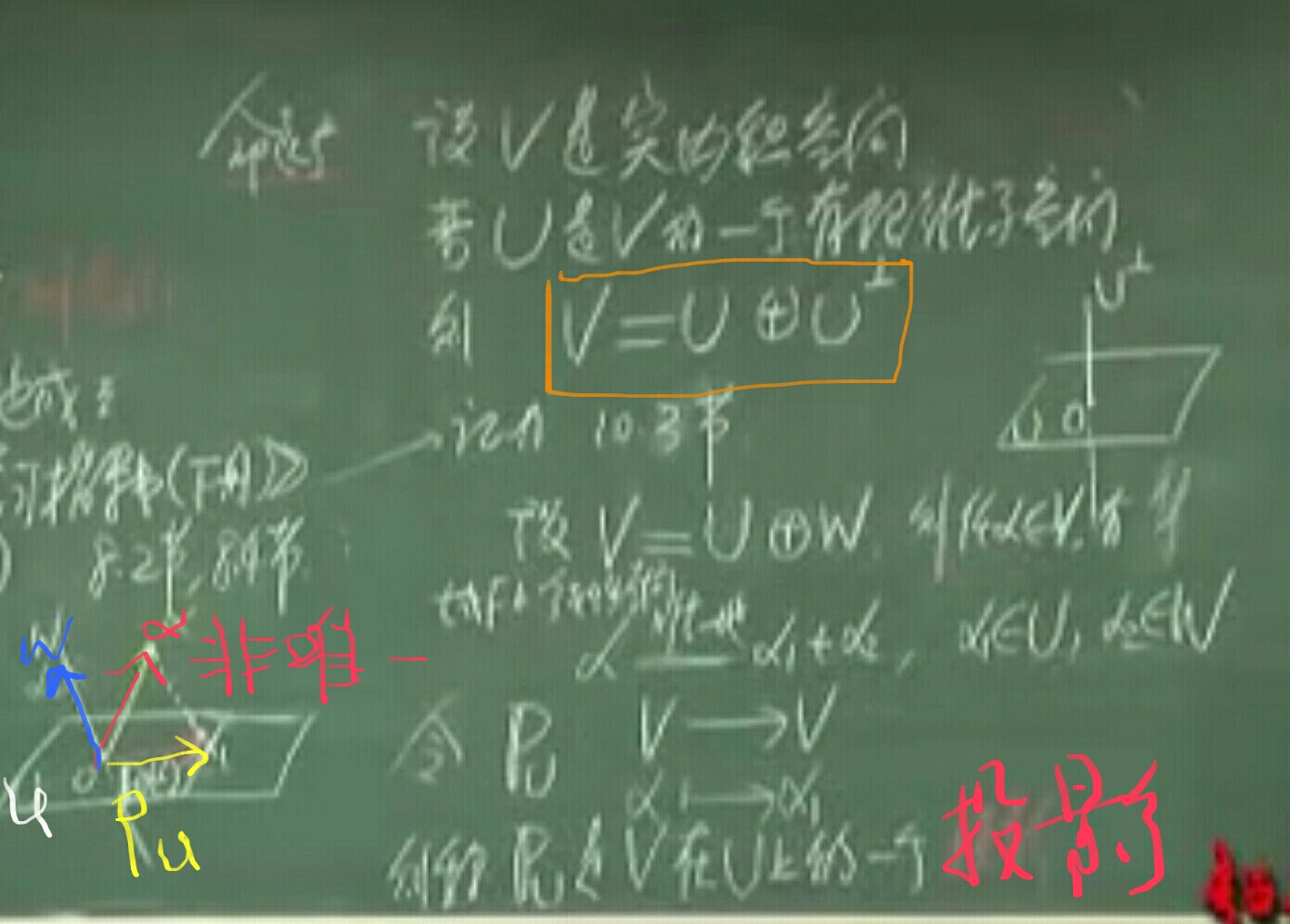
Projection 投影 $latex P_{U} implies $ 线性变化

$latex V = U oplus W$ , W non-unique

$latex V = U oplus U^{perp}$

北大 丘维声的 “群论” List of All Videos:http://www.youtube.com/playlist?list=PLwzFfIxhEkcxvU7-c8rPBbPLHUeacPIpa

View original post

Pure Mathematicians versus Applied Mathematicians

ChefCouscous's avatarMath Online Tom Circle

“A pure mathematician, when stuck on the problem under study, often decides to narrow the problem further and so avoid the obstruction. An applied mathematician interprets being stuck as an indication that it is time to learn more mathematics and find better tools”

Distinguished differential geometer EugenioCalabi

Ref:

View original post

Inspirational Scientist: Dan Shechtman

Source: https://www.theguardian.com/science/2013/jan/06/dan-shechtman-nobel-prize-chemistry-interview

To stand your ground in the face of relentless criticism from a double Nobel prize-winning scientist takes a lot of guts. For engineer and materials scientist Dan Shechtman, however, years of self-belief in the face of the eminent Linus Pauling‘s criticisms led him to the ultimate accolade: his own Nobel prize.

The atoms in a solid material are arranged in an orderly fashion and that order is usually periodic and will have a particular rotational symmetry. A square arrangement, for example, has four-fold rotational symmetry – turn the atoms through 90 degrees and it will look the same. Do this four times and you get back to its start point. Three-fold symmetry means an arrangement can be turned through 120 degrees and it will look the same. There is also one-fold symmetry (turn through 360 degrees), two-fold (turn through 180 degrees) and six-fold symmetry (turn through 60 degrees). Five-fold symmetry is not allowed in periodic crystals and nothing beyond six, purely for geometric reasons.

Shechtman’s results were so out of the ordinary that, even after he had checked his findings several times, it took two years for his work to get published in a peer-reviewed journal. Once it appeared, he says, “all hell broke loose”.

Many scientists thought that Shechtman had not been careful enough in his experiments and that he had simply made a mistake. “The bad reaction was the head of my laboratory, who came to my office one day and, smiling sheepishly, put a book on x-ray diffraction on my desk and said, ‘Danny, please read this book and you will understand that what you are saying cannot be.’ And I told him, you know, I don’t need to read this book, I teach at the Technion, and I know this book, and I’m telling you my material is not in the book.

“He came back a couple of days later and said to me, ‘Danny, you are a disgrace to my group. I cannot be with you in the same group.’ So I left the group and found another group that adopted a scientific orphan.”

He says that the experience was not as traumatic as it sounded. Scientists around the world had quickly replicated Shechtman’s discovery and, in 1992, the International Union of Crystallography accepted that quasi-periodic materials must exist and altered its definition of what a crystal is from “a substance in which the constituent atoms, molecules or ions are packed in a regularly ordered, repeating three-dimensional pattern” to the broader “any solid having an essentially discrete diffraction diagram”.

That should have been the end of the story were it not for Linus Pauling, a two-time Nobel laureate, once for chemistry and a second time for peace. Shechtman explains that at a science conference in front of an audience of hundreds Pauling claimed, “Danny Shechtman is talking nonsense, there are no quasi-crystals, just quasi-scientists.”

Pauling told everyone who would listen that Shechtman had made a mistake. He proposed his own explanations for the observed five-fold symmetry and stuck to his guns, despite repeated rebuttals. “Everything he did was wrong and wrong and wrong and wrong; eventually, he couldn’t publish his papers and they were rejected before they were published,” says Shechtman. “But he was very insistent, was very sure of himself when he spoke; he was a flamboyant speaker.”

数学是什么 ? What is Mathematics? 

tomcircle's avatarMath Online Tom Circle

北京大学:丘维声教授

第1讲 数学的思维方式

3000 年前 希腊,巴比伦,中国,印度, 10世纪阿拉伯, 16世纪欧洲文艺复兴 数学 – 经典数学

1830 年 数学的革命 – 近代数学: 法国天才少年 伽瓦罗 (Evariste Galois 1811 – 1832)

观察 (Observe): 客观现象
$latex downarrow$
抽象 (Abstraction) : 概念, 建立 模型 (Model)
$latex downarrow$
探索 (Explore): 自觉 (Intuition), 解剖 , 类比(Analogy), 归纳 (Induction), 联想, 推理 (Deduction) 等…
$latex downarrow$
猜测 (Conjecture) : eg. Riemann Conjecture (unsolved)
$latex downarrow$
论证 (Prove): 只能用公理 (Axioms)(以知的共识), 定义 (概念), 已经证明的定理 (Theorems), 进行逻辑推理并计算.
$latex downarrow$
揭示 (Reveal): 事物的内在规律 (井然有序)

View original post

2016 Nobel-Prize Winning Physics Explained Through Pastry 

ChefCouscous's avatarMath Online Tom Circle

2016 Nobel Prize Physics is Mathematics (Topology) applied in SuperConductor and SuperFluid to explain the Phase Transitions and Phase matters.

Phase matters: Solid, Liquid, Gas

Phase Transition: Solid -> Liquid -> Gas

Superconductor below Tc (critical temperature) : zero resistance.

Superfluid below Tc : zero viscosity.

Reason explained by Mathematics : Topological invariance increased step-wise.

Eg. Disk (0 hole), Circle (1 hole), Donut (2 holes), Coffee Cup (2 holes)… XYZ (n holes). [n increased by steps from 0, 1, 2, 3… ]

We say donut and coffee cup are homeomorphic (同胚) because they have the same topological invariant 拓扑不变量(2 holes).

View original post

Structure Theorem for finitely generated (graded) modules over a PID

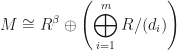
If R is a PID, then every finitely generated module M over R is isomorphic to a direct sum of cyclic R-modules. That is, there is a unique decreasing sequence of proper ideals (d_1)\supseteq(d_2)\supseteq\dots\supseteq(d_m) such that \displaystyle M\cong R^\beta\oplus\left(\bigoplus_{i=1}^m R/(d_i)\right) where d_i\in R, and \beta\in\mathbb{Z}.

Similarly, every graded module M over a graded PID R decomposes uniquely into the form \displaystyle M\cong\left(\bigoplus_{i=1}^n\Sigma^{\alpha_i}R\right)\oplus\left(\bigoplus_{j=1}^m\Sigma^{\gamma_j}R/(d_j)\right) where d_j\in R are homogenous elements such that (d_1)\supseteq(d_2)\supseteq\dots\supseteq(d_m), \alpha_i, \gamma_j\in\mathbb{Z}, and \Sigma^\alpha denotes an \alpha-shift upward in grading.

Persistence Interval

Next, we want to parametrize the isomorphism classes of the F[t]-modules by suitable objects.

A \mathcal{P}-interval is an ordered pair (i,j) with 0\leq i<j\in\mathbb{Z}^\infty=\mathbb{Z}\cup\{+\infty\}.

We may associate a graded F[t]-module to a set \mathcal{S} of \mathcal{P}-intervals via a bijection Q. We define \displaystyle Q(i,j)=\Sigma^i F[t]/(t^{j-i}) for a \mathcal{P}-interval (i,j). When j=+\infty, we have Q(i,+\infty)=\Sigma^iF[t].

For a set of \mathcal{P}-intervals \mathcal{S}=\{(i_1,j_1),(i_2,j_2),\dots,(i_n,j_n)\}, we define \displaystyle Q(\mathcal{S})=\bigoplus_{k=1}^n Q(i_k, j_k).

We may now restate the correspondence as follows.

The correspondence \mathcal{S}\to Q(\mathcal{S}) defines a bijection between the finite sets of \mathcal{P}-intervals and the finitely generated graded modules over the graded ring F[t].

Hence, the isomorphism classes of persistence modules of finite type over F are in bijective correspondence with the finite sets of \mathcal{P}-intervals.

Homogenous / Graded Ideal

Let A=\bigoplus_{i=0}^\infty A_i be a graded ring. An ideal I\subset A is homogenous (also called graded) if for every element x\in I, its homogenous components also belong to I.

An ideal in a graded ring is homogenous if and only if it is a graded submodule. The intersections of a homogenous ideal I with the A_i are called the homogenous parts of I. A homogenous ideal I is the direct sum of its homogenous parts, that is, \displaystyle I=\bigoplus_{i=0}^\infty (I\cap A_i).

Donate to help Stray Dogs in Singapore

URL: https://give.asia/movement/run_for_exclusively_mongrels

3 Singaporeans – Dr Gan, A Dentist, Dr Herman, A Doctor, and Mr Ariffin, a Law Undergraduate will be taking on the Borneo Ultra Trail Marathon on Feb 18th 2017 to raise 30k for Exclusively Mongrels Ltd; a welfare group set up for Mongrels in Singapore. (https://www.facebook.com/exclusivelymongrels/)

Do support them in their cause, if you can. And share this story so as to spread the word (maintenance and upkeep of the dogs can be a huge cost). Mongrels are actually highly intelligent, and can be more healthy and robust as compared to pedigrees, which may have hereditary diseases. For example, the popular Golden Retriever breed is prone to hip dysplasia.

A story told by Dr Gan summarizes everything — The state and welfare of stray dogs in Singapore, supposedly a first-world country, is actually worse than jungle dogs in Borneo. The Orang Asli, primitive junglers in Sabah, apparently treat dogs better than the average layperson in Singapore:

When Dr Gan, an EM member, was running through the trails of Sabah in Oct 2016, he stumbled upon a stray dog.

Being an avid dog lover and the proud father to three rescued Mongrels, he had to stop in his tracks. He fed the dog and it even ran alongside him for a mile or two. Further along the route, he encountered more stray dogs too.

All of the stray dogs he encountered seemed well-fed and were very approachable. They all displayed no aggression, despite being in the middle of a jungle. To Dr Gan, this was a tell-tale sign that the Orang Asli, who lived in villages in these jungles, took care of the dogs by feeding them. The fact that these Orang Aslis were living in harmony with these strays was indeed very commendable in his eyes.

These thoughts stuck with him throughout the run, and on the journey home too.

He couldn’t help but compare the Orang Asli’s hospitality to how a Singaporean layperson would react upon encountering a stray dog. More often than not, even in the absence of aggressive behaviour, a Singaporean who sees a stray dog would view it as no more than a pest and would either chase it away or even, call the authorities. As it so often is when the latter option is exercised, the authorities would have a hard time rehoming the dog and EM has to step in to ‘bail’ the dog out before the authorities euthanize it.

It is strange, he remarked, how the Orang Asli from the jungle can treat these strays with reverence while many Singaporeans would report a stray to the authorities without the slightest hesitation.

“Would the situation end up the same way if, instead of a stray mongrel, there was a stray pedigree dog?”

Armed with the notion that more needs to be done not just for these dogs but also to empower and educate the general public in Singapore about the plight of these strays and what can be done to help them, he then called on his two running buddies to undertake this journey with him.

It was going to be a journey that united his two passions – running and dogs; a journey back to the jungles where he first encountered the strays; back to where he first witnessed the hospitality of the Orang Asli; back to where where the spark was first ignited. He, and his Team, hope to bash through the jungles of Borneo, all in the hopes of blazing a new trail for Mongrels back home, in Singapore.

群表示论引言 Introduction to Group Representation

ChefCouscous's avatarMath Online Tom Circle

北京大学数学系 丘维声 教授

引言: 基本数学强化班 — 深入浅出介绍

  • 群表示论 是什么?
  • 有何用 ?

第一课:Ring
丘教授 不愧是大师, 也和一些良师一样, 认同 “数”的(代数)结构先从“环” (Ring)开始教起, 再域, 后群 : 美国/法国/英国 都从 “群”(Group)开始, 然后 “环”, “域” (Field) , 是错误的教法, 好比先穿鞋后穿袜, 本末倒置!

精彩的”环” (Ring) 引出 6 条 axioms 公理:

4条 ” + ” 法:

Commutative 交换律, Associative 结合律, Neutral element ” 0″ 零元, Inverse (-) 逆元

2 条 “x ” 法: (exclude ”1″ Unit, WHY ?)

Associative 结合律, Distributive (wrt “+”) 分配律

如果:

环 + 交换 = 交换环 (Commutative Ring)

环 + 单位 ‘1’ =单位环 (Unit Ring)

第二课: 域 Field

星期: 子集的划分 Partitions

$latex mathbb {Z} _7 =
{ bar {0} , bar {1} , bar {2} , bar {3} , bar {4} , bar {5} , bar {6} } $

模m剩余类 : Mod m
$latex mathbb {Z} _ m =
{ bar {0} , bar {1} , bar…

View original post 239 more words

Smooth/Differentiable Manifold

Smooth Manifold
A smooth manifold is a pair (M,\mathcal{A}), where M is a topological manifold and \mathcal{A} is a smooth structure on M.

Topological Manifold
A topological n-manifold M is a topological space such that:
1) M is Hausdorff: For every distinct pair of points p,q\in M, there are disjoint open subsets U,V\subset M such that p\in U and q\in V.
2) M is second countable: There exists a countable basis for the topology of M.
3) M is locally Euclidean of dimension n: Every point of M has a neighborhood that is homeomorphic to an open subset of \mathbb{R}^n. For each p\in M, there exists:
– an open set U\subset M containing p;
– an open set \widetilde{U}\subset\mathbb{R}^n; and
– a homeomorphism \varphi: U\to\widetilde{U}.

Smooth structure
A smooth structure \mathcal{A} on a topological n-manifold M is a maximal smooth atlas.

Smooth Atlas
\mathcal{A}=\{(U_\alpha,\varphi_\alpha)\}_{\alpha\in J} is called a smooth atlas if M=\bigcup_{\alpha\in J}U_\alpha and for any two charts (U,\varphi), (V,\psi) in \mathcal{A} (such that U\cap V\neq\emptyset), the transition map \displaystyle \psi\circ\varphi^{-1}:\varphi(U\cap V)\to\psi(U\cap V) is a diffeomorphism.

Source:
Introduction to Smooth Manifolds (Graduate Texts in Mathematics, Vol. 218) by John Lee

Differentiable Manifolds (Modern Birkhäuser Classics) by Lawrence Conlon

These two books are highly recommended books for Differentiable Manifolds. John Lee’s book has almost become the standard book. Its style is similar to Hatcher’s Algebraic Topology, it can be wordy but it has detailed description and explanation of the ideas, so it is good for those learning the material for the first time.

Lawrence Conlon’s book is more concise, and has specialized chapters that link to Algebraic Topology.

Persistence module and Graded Module

We show that the persistent homology of a filtered simplicial complex is the standard homology of a particular graded module over a polynomial ring.

First we review some definitions.

A graded ring is a ring R=\bigoplus_i R_i (a direct sum of abelian groups R_i) such that R_iR_j\subset R_{i+j} for all i, j.

A graded ring R is called non-negatively graded if R_n=0 for all n\leq 0. Elements of any factor R_n of the decomposition are called homogenous elements of degree n.

Polynomial ring with standard grading:
We may grade the polynomial ring R[t] non-negatively with the standard grading R_n=Rt^n for all n\geq 0.

Graded module:
A graded module is a left module M over a graded ring R such that M=\bigoplus_i M_i and R_iM_j\subseteq M_{i+j}.

Let R be a commutative ring with unity. Let \mathscr{M}=\{M^i,\varphi^i\}_{i\geq 0} be a persistence module over R.

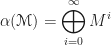
We now equip R[t] with the standard grading and define a graded module over R[t] by \displaystyle \alpha(\mathscr{M})=\bigoplus_{i=0}^\infty M^i where the R-module structure is the sum of the structures on the individual components. That is, for all r\in R, \displaystyle r\cdot (m^0,m^1,m^2,\dots)=(rm^0,rm^1,rm^2,\dots).

The action of t is given by \displaystyle t\cdot (m^0, m^1, m^2,\dots)=(0,\varphi^0(m^0),\varphi^1(m^1),\varphi^2(m^2),\dots).
That is, t shifts elements of the module up in the gradation.

Source: “Computing Persistent Homology” by Zomorodian and Carlsson.

GEP Selection Test Review and Experience

The following is a parent’s review and experience of the GEP Selection Test (2016). Original text (in Chinese) at: http://mp.weixin.qq.com/s/xQpLynFWpZ6QNpI_vlw4cw

Interested readers may also want to check out Recommended Books for GEP Selection Test.


Translation:

One day in September 2016 afternoon, read the son of the third son as usual time to go home, after the door looked calmly handed me a letter ~ OMG! A letter from the MOE to inform the son passed the GEP first round Examination, will be held on October 18 to participate in the second round of selection.

The son of the school in Singapore ranked 100 +, the third grade a total of seven classes, a total of about 280 students, he is in the best class. According to him, almost all the classmates participated in the first round of examinations, only through the eight individuals, including him. Later learned that, in fact, the school also 8 individuals to participate in the second round of their selection. Due to the small number of schools will not send people to pick up. Examination place in a subway station, never been to the school. The original quiet life, because to send test and upset, and finally have the opportunity to close feeling the legendary GEP.

A. Parents around the campus export was packed, looking at the eagerly a pair of eyes, I immediately think of China’s college entrance examination. Originally even sent too lazy to send his son to the exam, that is only an examination only, did not expect her husband told me to pick up the road, I began to excitement.

B. Carefully observed the son of the school to take the exam students, are not usually learn top-notch, but not usually take the scholarship. Such as the son of English is poor, but also through the first round.

Further, GEP study focus on learning with the usual very different. Also confirmed the rivers and lakes in the legendary: GEP will try to reduce the impact of language on the selection, so that truly talented children to stand out, and as much as possible without interference. Nevertheless, English is actually bad or affected. I asked the four students, all of the questions are difficult to answer the most difficult IQ, and the son of English that is better than IQ difficult, but there are several IQ questions did not understand, because the word does not know, of. In this case,

C. There are eight children in the class reference, thought that there will be a few other classes, did not think the day before the collection know that their school also their 8 classes. In fact, before the class this year, his son was assigned to other classes of students, there are several aspects of the results are good. Why the last one did not pass the GEP first round?

I think the first is the environment, in improving class, the teacher will be strict a lot of the other classes are not necessarily. Son is after almost a year, only to adapt to such a fast-paced and strict requirements.

Second, the amount of information provided is different. I remember the beginning of the beginning of his son’s class soon, on a large number of additional courses, including Mathematical Olympiad, Science Olympiad, Chinese writing, the second foreign language (Malay), plus a day CCA and school normal plus lesson. . .

Never had a tutorial managed son plus a lesson, home every day at least 4 points, and sometimes 6 points, as well as the violin and Chinese Orchestra, once tired and round and round all day shouting hungry. Home do not want to do anything, followed by his brother to play, to think of homework to do quickly, the next day and get up.

After six months, tired not, but the results plummeted. I have wanted his son not to learn these extra lessons, and his son said that these classes only their classes have, and other classes will not notice the information plus lesson, or learn it!

It now appears that the school had great efforts to catch them this class, the son is still helpful, and sometimes really forced a force, hold on, or there will be harvest. At least the son did not spend extra effort to improve classes, but also an improvement! This also fully shows that folklore, the small three-class is how important and tragic. I also know it!

From the test finished out of the children’s face, you can guess the state of the exam!

D. Elite is the elite schools, such as the son of this little-known school, a school had only a few people in the first round. The elite is the school charter to pick up, as well as teachers to accompany. Because the reference is really many people, a car also sat down, opened a few.

Nanyang Primary School is said to have 120 reference. People usually test and this test is almost, not just like to play like a try test chant. In this case,

E. When the son, met a lot of acquaintances. Parents who have children’s kindergarten students, parents who have attended the parents’ meeting, parents who have written classes, parents who have Chinese orchestra help, parents who have neighbors playmates, friends who have friends with God, and my fellow villagers and husband colleagues Even though the children in different schools, but the emphasis on education, parents, will eventually meet ~ to wait for the child to test this way to meet, quite special.

F. From the parents of the ratio can be inferred: the Chinese to the absolute high rate of reference, a small amount of Indian, a small amount of Malay, did not see Europe and the United States. Chinese like to test, but also good at the test, really reflected most vividly. After my visual, the number of boys more than girls. Take the son school, for example, 8 people have only 1 girl. I guess half of half a far cry. After all, his son son school class first, almost the girls occupied. Impression in the class last year, single scholarship, only the son of a boy.

G. GEP ultimately can be admitted to the rare, most parents are holding try to see the idea of the problem, let the children participate in, do not need all the energy on the GEP, but no need to focus on depletion in the primary three. Son of a classmate did not apply for GEP, heard there are not admitted to the second round, and some even admitted to the elite do not read.

Have seen a documentary article, his children’s classmates, the results are very good score is also high, can enter the first-class university, but eventually chose to read poly, because that read enough, never want to read!


Summary

Although most of the parents of the GEP rush, often the results are unsatisfactory. If the child has the ability to have a high degree of quality into the GEP selected elite, of course, is very good!

But if it is to further test, in order to further fight, one year or even several years earlier to the child overweight, premature energy consumption in reading this matter, the child’s desire to pursue knowledge and innovation, personal opinion, for the long And a variety of life, it is not worth!

I am a student of English in the workplace, said her daughter through the GEP test class children to go, now mixed very general.

Postscript

Participating in GEP is a good experience. No matter what the outcome, are worth a try Oh!

In addition, the son of GEP in the second round of the examination notice, the accident received three years to transfer the success of the phone in the fourth grade to go home only 5 minutes away from the school, and is directly assigned to the best classes to This ended his last three years, 5-15 minutes a day, take a 15-minute bus, but also to go some way to learn the experience.

Attached: GEP introduction of Singapore

GEP History

In 1984, the Ministry of Education of Singapore launched the Gifted Class, which aims to foster gifted students and give full play to their talents so as to better serve the community in the future.

The nine schools that provide talent education are: Anglo-Chinese School (Primary), Catholic High School (Primary), Henry Park Primary School, Nan Hua Primary School (Nan Hua Primary School) ), Nanyang Primary School, Raffles Girls’ Primary School, Rosyth School, St. Hilda’s Primary School and Tao Primary School. Nan School).

GEP screening process

All primary school students have the opportunity to participate in the first round of screening tests, voluntary, not mandatory. The first round of screening tests, including English and mathematics, usually in late August each year (the specific test location and time to the Ministry of Education notice).

In the first round, only 5% of students will be selected to participate in the second round of the selection test (usually the examination time in mid-October each year). Usually only 1% of the students will be selected last year, from the fourth grade, more than 9 schools to enter the genius classes.

Genius classes differ from ordinary students in their curricula.

On the basis of the general curriculum, intensive classes will be arranged for the Gifted students to explore and expand the capacity of gifted students to stimulate their more personalized and profound learning.

(Text: Tao Ying)

Persistence module and Finite type

A persistence module \mathcal{M}=\{M^i,\varphi^i\}_{i\geq 0} is a family of R-modules M^i, together with homomorphisms \varphi^i: M^i\to M^{i+1}.

For example, the homology of a persistence complex is a persistence module, where \varphi^i maps a homology class to the one that contains it.

A persistence complex \{C_*^i, f^i\} (resp.\ persistence module \{M^i, \varphi^i\}) is of finite type if each component complex (resp.\ module) is a finitely generated R-module, and if the maps f^i (resp.\ \varphi^i) are isomorphisms for i\geq m for some integer m.

If K is a finite filtered simplicial complex, then it generates a persistence complex \mathscr{C} of finite type, whose homology is a persistence module \mathcal{M} of finite type.

To Live Your Best Life, Do Mathematics

This article is a very good read. 100% Recommended to anyone interested in math.

The ancient Greeks argued that the best life was filled with beauty, truth, justice, play and love. The mathematician Francis Su knows just where to find them.

Source: https://www.quantamagazine.org/20170202-math-and-the-best-life-francis-su-interview/

Math conferences don’t usually feature standing ovations, but Francis Su received one last month in Atlanta. Su, a mathematician at Harvey Mudd College in California and the outgoing president of the Mathematical Association of America (MAA), delivered an emotional farewell address at the Joint Mathematics Meetings of the MAA and the American Mathematical Society in which he challenged the mathematical community to be more inclusive.

Su opened his talk with the story of Christopher, an inmate serving a long sentence for armed robbery who had begun to teach himself math from textbooks he had ordered. After seven years in prison, during which he studied algebra, trigonometry, geometry and calculus, he wrote to Su asking for advice on how to continue his work. After Su told this story, he asked the packed ballroom at the Marriott Marquis, his voice breaking: “When you think of who does mathematics, do you think of Christopher?”

Su grew up in Texas, the son of Chinese parents, in a town that was predominantly white and Latino. He spoke of trying hard to “act white” as a kid. He went to college at the University of Texas, Austin, then to graduate school at Harvard University. In 2015 he became the first person of color to lead the MAA. In his talk he framed mathematics as a pursuit uniquely suited to the achievement of human flourishing, a concept the ancient Greeks called eudaimonia, or a life composed of all the highest goods. Su talked of five basic human desires that are met through the pursuit of mathematics: play, beauty, truth, justice and love.

If mathematics is a medium for human flourishing, it stands to reason that everyone should have a chance to participate in it. But in his talk Su identified what he views as structural barriers in the mathematical community that dictate who gets the opportunity to succeed in the field — from the requirements attached to graduate school admissions to implicit assumptions about who looks the part of a budding mathematician.

When Su finished his talk, the audience rose to its feet and applauded, and many of his fellow mathematicians came up to him afterward to say he had made them cry. A few hours later Quanta Magazine sat down with Su in a quiet room on a lower level of the hotel and asked him why he feels so moved by the experiences of people who find themselves pushed away from math. An edited and condensed version of that conversation and a follow-up conversation follows.

Read more at: https://www.quantamagazine.org/20170202-math-and-the-best-life-francis-su-interview/

Homotopy for Maps vs Paths

Homotopy (of maps)

A homotopy is a family of maps f_t: X\to Y, t\in I, such that the associated map F:X\times I\to Y given by F(x,t)=f_t(x) is continuous. Two maps f_0, f_1:X\to Y are called homotopic, denoted f_0\simeq f_1, if there exists a homotopy f_t connecting them.

Homotopy of paths

A homotopy of paths in a space X is a family f_t: I\to X, 0\leq t\leq 1, such that

(i) The endpoints f_t(0)=x_0 and f_t(1)=x_1 are independent of t.
(ii) The associated map F:I\times I\to X defined by F(s,t)=f_t(s) is continuous.

When two paths f_0 and f_1 are connected in this way by a homotopy f_t, they are said to be homotopic. The notation for this is f_0\simeq f_1.


The above two definitions are related, since a path is a special kind of map f: I\to X.

【区别:代数拓扑 (Algebraic Topology)  微分拓扑 (Differential Topology )  微分几何 ( Differential Geometry ) 代数几何 (Algebraic Geometry ) 交换代数  (Commutative Algebra ) 微分流形 (Differential Manifold )

Sheaf (束) originated from Algebraic Geometry, but applied in other areas eg. Algebraic Topology.

tomcircle's avatarMath Online Tom Circle

​【区别:代数拓扑 (Algebraic Topology) 微分拓扑 (Differential Topology ) 微分几何 ( Differential Geometry ) 代数几何 (Algebraic Grometry ) 交换代数 (Commutative Algebra ) 微分流形 (Differential Manifold ) ?】月如歌:并不能理解什么叫做楼主所说的配对。我简要谈下我对于上述所列名词的理解。… http://www.zhihu.com/question/23848852/answer/26771912 (分享自知乎网)

View original post

Morphism Summary Chart

tomcircle's avatarMath Online Tom Circle

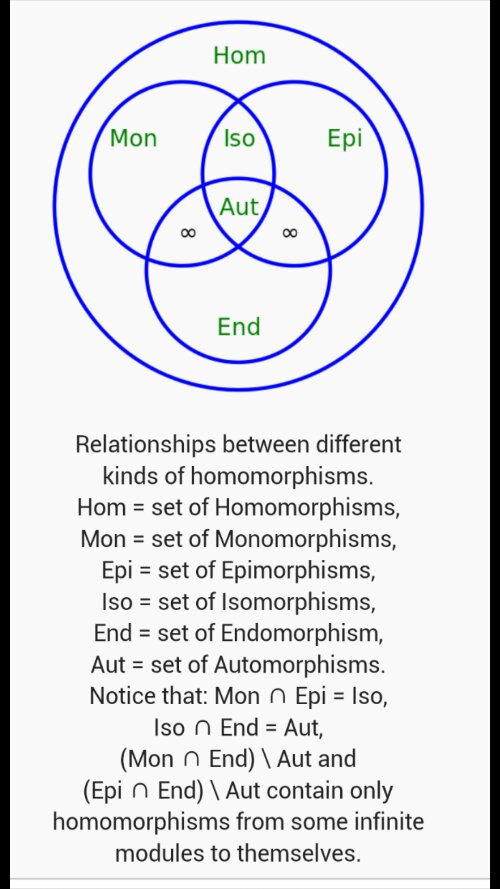
The more common morphisms are:

1. Homomorphism (Similarity between 2 different structures) 同态
Analogy: Similar triangles of 2 different triangles.

2. Isomorphism (Sameness between 2 different structures) 同构
Analogy: Congruence of 2 different triangles

Example: 2 objects are identical up to an isomorphism.

3. Endomorphism (Similar structure of self) = {Self + Homomorphism} 自同态
Analogy: A triangle and its image in a magnifying glass.

4. Automorphism (Sameness structure of self) = {Self + Isomorphism} 自同构
Analogy: A triangle and its image in a mirror; or
A triangle and its rotated (clock-wise or anti-clock-wise), or reflected (flip-over) self.

image

5. Monomorphism 单同态 = Injective + Homomorphism
image

6. Epimorphism 满同态 = Surjective + Homomorphism

View original post

Quora: Galois Field Automorphism for 15/16 year-old kids

tomcircle's avatarMath Online Tom Circle

3 common Fields: $latex mathbb{R, Q, C}$ with 4 operations : {+ – × ÷}

Automorphism = “self” isomorphism (Analogy: look into mirror of yourself, image is you <=> Automorphism of yourself).

The trivial Field Automorphism of : $latex mathbb{R, Q}$ is none other than Identity Automorphism (mirror image of itself).

Best example for Field Automorphism : : $latex mathbb{C}$ and its conjugate. (a+ib) conjugate with (a-ib)

Field automorphisms using terms a 15/16/ year oldwould understand? by David Joyce

What interesting results are there regardingautomorphisms of fields? by Henning Breede

View original post

Universal Property of Quotient Groups (Hungerford)

If f:G\to H is a homomorphism and N is a normal subgroup of G contained in the kernel of f, then f “factors through” the quotient G/N uniquely.Universal Property of Quotient

This can be used to prove the following proposition:
A chain map f_\bullet between chain complexes (A_\bullet, \partial_{A, \bullet}) and (B_\bullet, \partial_{B,\bullet}) induces homomorphisms between the homology groups of the two complexes.

Proof:
The relation \partial f=f\partial implies that f takes cycles to cycles since \partial\alpha=0 implies \partial(f\alpha)=f(\partial\alpha)=0. Also f takes boundaries to boundaries since f(\partial\beta)=\partial(f\beta). Hence f_\bullet induces a homomorphism (f_\bullet)_*: H_\bullet (A_\bullet)\to H_\bullet (B_\bullet), by universal property of quotient groups.

For \beta\in\text{Im} \partial_{A,n+1}, we have \pi_{B,n}f_n(\beta)=\text{Im}\partial_{B,n+1}. Therefore \text{Im}\partial_{A,n+1}\subseteq\ker(\pi_{B,n}\circ f_n).

RP^n Projective n-space

Define an equivalence relation on S^n\subset\mathbb{R}^{n+1} by writing v\sim w if and only if v=\pm w. The quotient space P^n=S^n/\sim is called projective n-space. (This is one of the ways that we defined the projective plane P^2.) The canonical projection \pi: S^n\to P^n is just \pi(v)=\{\pm v\}. Define U_i\subset P^n, 1\leq i\leq n+1, by setting \displaystyle U_i=\{\pi(x^1, \dots, x^{n+1})\mid x^i\neq 0\}.

Prove
1) U_i is open in P^n.
2) \{U_1, \dots, U_{n+1}\} covers P^n.
3) There is a homeomorphism \varphi_i: U_i\to\mathbb{R}^n.
4) P^n is compact, connected, and Hausdorff, hence is an n-manifold.

Proof:
1) \pi^{-1}U_i=\{(x^1, \dots, x^{n+1})\mid x^i\neq 0\} is open in S^n, so U_i is open in P^n.
2) Let y=\pi(x^1,\dots, x^{n+1})\in P^n. Then since (x^1,\dots, x^{n+1})\neq(0,\dots,0), so y\in\bigcup_{i=1}^{n+1}U_i. Hence P^n\subset\bigcup_{i=1}^{n+1}U_i.
3) Consider A=\{(x^1,\dots, x^{n+1})\mid x^i+1\}\cong\mathbb{R}^n. Define \displaystyle \varphi_i(\pi(x^1,\dots, x^{n+1}))=(\frac{x^1}{\|x^i\|},\dots,\frac{x^{i-1}}{\|x^i\|},1,\dots,\frac{x^{n+1}}{\|x^i\|}) for x^i>0. If x^i<0, then \varphi_i(\pi(x^1,\dots, x^{n+1}))=\varphi_i(\pi(-x^1,\dots, -x^{n+1})). Then \varphi_i is well-defined.

\displaystyle \varphi_i^{-1}(x^1,\dots,1,\dots,x^{n+1})=\pi(\frac{x^1}{\|v\|},\dots,\frac{1}{\|v\|},\dots,\frac{x^{n+1}}{\|v\|}), where v=(x^1,\dots, 1,\dots, x^{n+1}). Both \varphi_i and \varphi_i^{-1} are continuous, so \varphi_i: U_i\to A is a homeomorphism.
4) Since S^n is compact and connected, so is P^n=S^n/\sim. P^n is a CW-complex with one cell in each dimension, i.e.\ P^n=\bigcup_{i=0}^n e^n. Since CW-complexes are Hausdorff, so is P^n.

Introduction to Persistent Homology (Cech and Vietoris-Rips complex)

Motivation
Data is commonly represented as an unordered sequence of points in the Euclidean space \mathbb{R}^n. The global `shape’ of the data may provide important information about the underlying phenomena of the data.

For data points in \mathbb{R}^2, determining the global structure is not difficult, but for data in higher dimensions, a planar projection can be hard to decipher.
From point cloud data to simplicial complexes
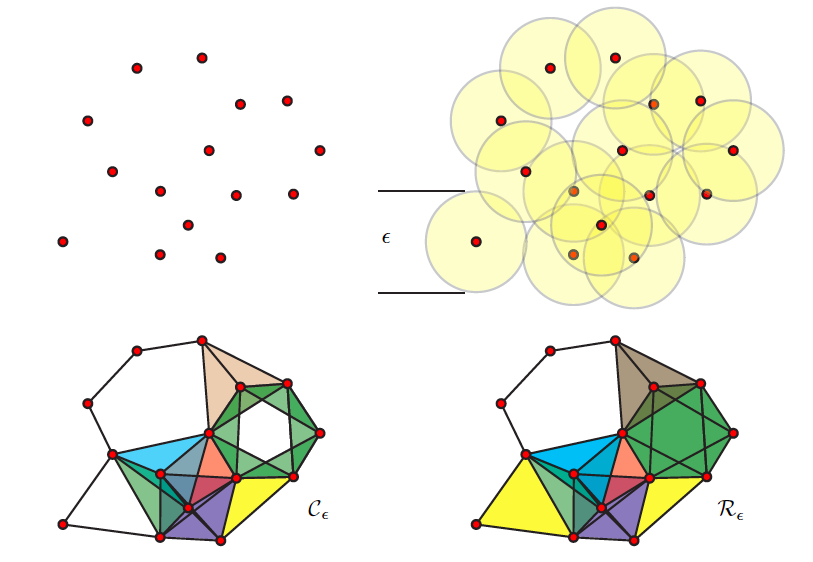
To convert a collection of points \{x_\alpha\} in a metric space into a global object, one can use the points as the vertices of a graph whose edges are determined by proximity (vertices within some chosen distance \epsilon). Then, one completes the graph to a simplicial complex. Two of the most natural methods for doing so are as follows:

Given a set of points \{x_\alpha\} in Euclidean space \mathbb{R}^n, the Cech complex (also known as the nerve), \mathcal{C}_\epsilon, is the abstract simplicial complex where a set of k+1 vertices spans a k-simplex whenever the k+1 corresponding closed \epsilon/2-ball neighborhoods have nonempty intersection.

Given a set of points \{x_\alpha\} in Euclidean space \mathbb{R}^n, the Vietoris-Rips complex, \mathcal{R}_\epsilon, is the abstract simplicial complex where a set S of k+1 vertices spans a k-simplex whenever the distance between any pair of points in S is at most \epsilon.

fig2

Top left: A fixed set of points. Top right: Closed balls of radius \epsilon/2 centered at the points. Bottom left: Cech complex has the homotopy type of the \epsilon/2 cover (S^1\vee S^1\vee S^1) Bottom right: Vietoris-Rips complex has a different homotopy type (S^1\vee S^2). Image from R. Ghrist, 2008, Barcodes: The Persistent Topology of Data.

Does Abstract Math belong to Elementary Math ? 

ChefCouscous's avatarMath Online Tom Circle

Yes.

Most pedagogy mistake made in Abstract Algebra teaching is in the wrong order (by historical chronological sequence of discovery):

[X ] Group -> Ring -> Field

It would be better, conceptual wise, to reverse the teaching order as:

Field -> Ring -> Group

or better still as (the author thinks):

Ring -> Field -> Group

  • Reason 1: Ring is the Integers, most familiar to 8~ 10-year-old kids in primary school arithmetic class involving only 3 operations: ” + – x”.
  • Reason 2: Field is the Real numbers familiar in calculators involving 4 operations: ” + – × ÷”, 1 extra division operation to Ring.
  • Reason 3: Group is “Symmetry”, although mistakenly viewed as ONLY 1 operation, but not as easily understandable like Ring and Field, because group operation can be non-numeric such as “rotation” of triangles, “permutation” of roots of equation, “composition” of functions, etc. The only familiar Group…

View original post 8 more words

In Search for Radical Roots of Polynomial Equations of degree n > 1

ChefCouscous's avatarMath Online Tom Circle

Take note: Find roots 根 to solve polynomial 多项式方程式equations, but find solutionto solve algebraic equations代数方程式.

Radical : (LatinRadix = root): $latex sqrt [n]{x} $

Quadratic equation (二次方程式) 有 “根式” 解:[最早发现者 : Babylon 和 三国时期的吴国 数学家 赵爽]

$latex {a.x^{2} + b.x + c = 0}&fg=aa0000&s=3$

$latex boxed{x= frac{-b pm sqrt{b^{2}-4ac} }{2a}}&fg=aa0000$

Cubic Equation: 16 CE Italians del Ferro, Tartaglia & Cardano
$latex {a.x^{3} = p.x + q }&fg=0000aa&s=3$

Cardano Formula (1545 《Ars Magna》):
$latex boxed {x = sqrt [3]{frac {q}{2} + sqrt{{ (frac {q}{2})}^{2} – { (frac {p}{3})}^{3}}}
+ sqrt [3]{frac {q}{2} -sqrt{ { (frac {q}{2})}^{2} – { (frac {p}{3})}^{3}}}}&fg=0000aa$

Quartic Equation: by Cardano’s student Ferrari
$latex {a.x^{4} + b.x^{3} + c.x^{2} + d.x + e = 0}&fg=00aa00&s=3$

Quintic Equation:
$latex {a.x^{5} + b.x^{4} + c.x^{3} + d.x^{2} + e.x + f = 0}&s=3$

No radical solution (Unsolvability) was suspected by Ruffini (1799)…

View original post 177 more words

Equivalence of C^infinity atlases

Equivalence of C^\infty atlases is an equivalence relation. Each C^\infty atlas on M is equivalent to a unique maximal C^\infty atlas on M.

Proof:

Reflexive: If A is a C^\infty atlas, then A\cup A=A is also a C^\infty atlas.

Symmetry: Let A and B be two C^\infty atlases such that A\cup B is also a C^\infty atlas. Then certainly B\cup A is also a C^\infty atlas.

Transitivity: Let A, B, C be C^\infty atlases, such that A\cup B and B\cup C are both C^\infty atlases.

Notation:
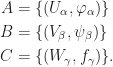
\begin{aligned}  A&=\{(U_\alpha,\varphi_\alpha)\}\\  B&=\{(V_\beta, \psi_\beta)\}\\  C&=\{(W_\gamma, f_\gamma)\}.  \end{aligned}

Then \displaystyle \varphi_\alpha\circ f_\gamma^{-1}=\varphi_\alpha\circ\psi_\beta^{-1}\circ\psi_\beta\circ f_\gamma^{-1}: f_\gamma(U_\alpha\cap W_\gamma)\to\varphi_\alpha(U_\alpha\cap W_\gamma) is a diffeomorphism since both \varphi_\alpha\circ\psi_\beta^{-1} and \psi_\beta\circ f_\gamma^{-1} are diffeomorphisms due to A\cup B and B\cup C being C^\infty atlases. Also, M=\bigcup U_\alpha, M=\bigcup W_\gamma implies M=(\bigcup U_\alpha)\cup(\bigcup W_\gamma) so A\cup C is also a C^\infty atlas.

Let A be a C^\infty atlas on M. Define B to be the union of all C^\infty atlases equivalent to A. Then B\sim A. If B'\sim A, then B'\subseteq B, so that B is the unique maximal C^\infty atlas equivalent to A.

代 数拓扑 Algebraic Topology

tomcircle's avatarMath Online Tom Circle

Excellent Advanced Math Lecture Series (Part 1 to 3) by齊震宇老師

(2012.09.10) Part I:

History: 1900 H. Poincaré invented Topologyfrom Euler Characteristic (V -E + R = 2)

Motivation of Algebraic Topology: Find Invariants[1]of various topological spaces (in higher dimension). 求拓扑空间的“不变量” eg.

  • Vector Space (to + – , × ÷ by multiplier Field scalars);
  • Ring (to + x), etc.

then apply algebra (Linear Algebra, Matrices) with computer to compute these invariants (homology, co-homology, etc).

A topological space can be formed by a “Big Data” Point Set, e.g. genes, tumors, drugs, images, graphics, etc. By finding (co)- / homology – hence the intuitive Chinese term (上) /同调 [2] – is to find “holes” in the Big Data in the 10,000 (e.g.) dimensional space the hidden information (co-relationship, patterns, etc).
Note: [1]…

View original post 88 more words

Natural Equivalence relating Suspension and Loop Space

Theorem:
If (X,x_0), (Y,y_0), (Z,z_0)\in\mathscr{PT}, X, Z Hausdorff and Z locally compact, then there is a natural equivalence \displaystyle A: [Z\wedge X, *; Y,y_0]\to [X, x_0; (Y,y_0)^{(Z,z_0)}, f_0] defined by A[f]=[\hat{f}], where if f:Z\wedge X\to Y is a map then \hat{f}: X\to Y^Z is given by (\hat{f}(x))(z)=f[z,x].

We need the following two propositions in order to prove the theorem.
Proposition
\label{prop13}
The exponential function E: Y^{Z\times X}\to (Y^Z)^X induces a continuous function \displaystyle E: (Y,y_0)^{(Z\times X, Z\vee X)}\to ((Y,y_0)^{(Z,z_0)}, f_0)^{(X,x_0)} which is a homeomorphism if Z and X are Hausdorff and Z is locally compact\footnote{every point of Z has a compact neighborhood}.

Proposition
\label{prop8}
If \alpha is an equivalence relation on a topological space X and F:X\times I\to Y is a homotopy such that each stage F_t factors through X/\alpha, i.e.\ x\alpha x'\implies F_t(x)=F_t(x'), then F induces a homotopy F':(X/\alpha)\times I\to Y such that F'\circ (p_\alpha\times 1)=F.

Proof of Theorem
i) A is surjective: Let f': (X,x_0)\to ((Y,y_0)^{(Z,z_0)},f_0). From Proposition \ref{prop13} we have that E: (Y,y_0)^{(Z\times X, Z\vee X)}\to ((Y,y_0)^{(Z,z_0)},f_0)^{(X,x_0)} is a homeomorphism. Hence the function \bar{f}: (Z\times X, Z\vee X)\to (Y,y_0) defined by \bar{f}(z,x)=(f'(x))(z) is continuous since (Ef'(x))(z)=f'(z,x) and thus \bar{f}=E^{-1}f'. By the universal property of the quotient, \bar{f} defines a map f:(Z\wedge X, *)\to (Y,y_0) such that f[z,x]=\bar{f}(z,x)=(f'(x))(z). Thus \hat{f}=f', so that A[f]=[f'].

ii) A is injective: Suppose f,g: (Z\wedge X, *)\to (Y,y_0) are two maps such that A[f]=A[g], i.e.\ \hat{f}\simeq\hat{g}. Let H': X\times I\to (Y,y_0)^{(Z,z_0)} be the homotopy rel x_0. By Proposition \ref{prop13} the function \bar{H}: Z\times X\times I\to Y defined by \bar{H}(z,x,t)=(H'(x,t))(z) is continuous. This is because \bar{H}(z,x,t)=(E\bar{H}(x,t))(z) so that E\bar{H}=H', thus \bar{H}=E^{-1}H' where E is a homeomorphism. For each t\in I we have \bar{H}((Z\vee X)\times\{t\})=y_0. This is because if (z,x)\in Z\vee X, then z=z_0 or x=x_0. If z=z_0, then (H'(x,t))(z_0)=y_0. If x=x_0, (H'(x_0,t))(z)=y_0 as H' is the homotopy rel x_0. Then by Proposition \ref{prop8} there is a homotopy H:(Z\wedge X)\times I\to Y rel * such that H([z,x],t)=\bar{H}(z,x,t)=(H'(x,t))(z). Thus H_0([z,x])=(H_0'(x))(z)=(\hat{f}(x))(z)=f[z,x] and similarly H_1([z,x])=(H_1'(x))(z)=(\hat{g}(x))(z)=g[z,x]. Thus [f]=[g] via the homotopy H.

Loop space
If (Y,y_0)\in\mathscr{PT}, we define the loop space (\Omega Y, \omega_0)\in\mathscr{PT} of Y to be the function space \displaystyle \Omega Y=(Y,y_0)^{(S^1,s_0)} with the constant loop \omega_0 (\omega_0(s)=y_0 for all s\in S^1) as base point.

Suspension
If (X,x_0)\in\mathscr{PT}, we define the suspension (SX,*)\in\mathscr{PT} of X to be the smash product (S^1\wedge X, *) of X with the 1-sphere.

Corollary (Natural Equivalence relating SX and \Omega Y)
If (X,x_0), (Y,y_0)\in\mathscr{PT} and X is Hausdorff, then there is a natural equivalence \displaystyle A: [SX, *; Y,y_0]\to [X, x_0; \Omega Y, \omega_0].

Russian Math Education

ChefCouscous's avatarMath Online Tom Circle

​In the world of Math education there are 3 big schools (门派) — in which the author had the good fortune to study under 3 different Math pedagogies:

“武当派” French (German) -> “少林派” Russian (China) -> “华山派” UK (USA).

( ) : derivative of its parent school. eg. China derived from Russian school in 1960s by Hua Luogeng.

Note:
武当派 : 内功, 以柔尅刚, 四两拨千斤 <=> “Soft” Math, Abstract, Theoretical, Generalized.

少林派: 拳脚硬功夫 <=> “Hard” Math, algorithmic.

华山派: 剑法轻灵 <=> Applied, Astute, Computer-aided.

The 3 schools’ pioneering grand masters (掌门人) since 16th century till 21st century, in between the 19th century (during the French Revolution) Modern Math (近代数学) is the critical milestone, the other (现代数学) is WW2 : –

France: Descartes / Fermat / Pascal (17 CE : Analytical Geometry, Number Theory, Probability), Cauchy / Lagrange / Fourier /Galois (19 CE, Modern Math : Analysis, Abstract Algebra),

View original post 189 more words

Fundamental Group of S^n is trivial if n>=2

\pi_1(S^n)=0 if n\geq 2
We need the following lemma:

If a space X is the union of a collection of path-connected open sets A_\alpha each containing the basepoint x_0\in X and if each intersection A_\alpha\cap A_\beta is path-connected, then every loop in X at x_0 is homotopic to a product of loops each of which is contained in a single A_\alpha.

Proof:
Take A_1 and A_2 to be the complements of two antipodal points in S^n. Then S^n=A_1\cup A_2 is the union of two open sets A_1 and A_2, each homeomorphic to \mathbb{R}^n such that A_1\cap A_2 is homeomorphic to S^{n-1}\times\mathbb{R}.

Choose a basepoint x_0 in A_1\cap A_2. If n\geq 2 then A_1\cap A_2 is path-connected. By the lemma, every loop in S^n based at x_0 is homotopic to a product of loops in A_1 or A_2. Both \pi_1(A_1) and \pi_1(A_2) are zero since A_1 and A_2 are homeomorphic to \mathbb{R}^n. Hence every loop in S^n is nullhomotopic.

Tangent Space is Vector Space

Prove that the operation of linear combination, as in Definition 2.2.7, makes T_p(U) into an n-dimensional vector space over \mathbb{R}. The zero vector is the infinitesimal curve represented by the constant p. If \langle s\rangle_p\in T_p(U), then -\langle s\rangle_p=\langle s^-\rangle_p where s^-(t)=s(-t), defined for all sufficiently small values of t.

Proof:

We verify the axioms of a vector space.

Multiplicative axioms:
1\langle s_1\rangle_p=\langle 1s_1+0-(1+0-1)p\rangle_p=\langle s_1\rangle_p
(ab)\langle s_1\rangle_p=\langle abs_1-(ab-1)p\rangle_p
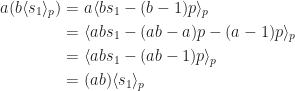
\begin{aligned}  a(b\langle s_1\rangle_p)&=a\langle bs_1-(b-1)p\rangle_p\\  &=\langle abs_1-(ab-a)p-(a-1)p\rangle_p\\  &=\langle abs_1-(ab-1)p\rangle_p\\  &=(ab)\langle s_1\rangle_p  \end{aligned}

Additive Axioms:
\langle s_1\rangle_p+\langle s_2\rangle_p=\langle s_2\rangle_p+\langle s_1\rangle_p=\langle s_1+s_2-p\rangle_p
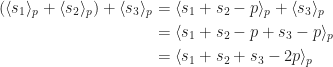
\begin{aligned}  (\langle s_1\rangle_p+\langle s_2\rangle_p)+\langle s_3\rangle_p&=\langle s_1+s_2-p\rangle_p+\langle s_3\rangle_p\\  &=\langle s_1+s_2-p+s_3-p\rangle_p\\  &=\langle s_1+s_2+s_3-2p\rangle_p  \end{aligned}
\begin{aligned}  \langle s_1\rangle_p+(\langle s_2\rangle_p+\langle s_3\rangle_p)&=\langle s_1\rangle_p+\langle s_2+s_3-p\rangle_p\\  &=\langle s_1+s_2+s_3-2p\rangle_p  \end{aligned}
\langle s\rangle_p+\langle s^-\rangle_p=\langle s+s^- -p\rangle_p

\frac{d}{dt}f(s(t)+s(-t)-p)|_{t=0}=0=\frac{d}{dt}f(p)|_{t=0}

Hence \langle s\rangle_p+\langle s^-\rangle_p=\langle p\rangle_p.
\langle s_1\rangle_p+\langle p\rangle_p=\langle s_1+p-p\rangle_p=\langle s_1\rangle_p

Distributive Axioms:
\begin{aligned}  a(\langle s_1\rangle_p+\langle s_2\rangle_p)&=a\langle s_1+s_2-p\rangle_p\\  &=\langle a(s_1+s_2-p)-(a-1)p\rangle_p  \end{aligned}
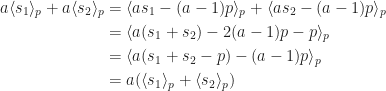
\begin{aligned}  a\langle s_1\rangle_p+a\langle s_2\rangle_p&=\langle as_1-(a-1)p\rangle_p+\langle as_2-(a-1)p\rangle_p\\  &=\langle a(s_1+s_2)-2(a-1)p-p\rangle_p\\  &=\langle a(s_1+s_2-p)-(a-1)p\rangle_p\\  &=a(\langle s_1\rangle_p+\langle s_2\rangle_p)  \end{aligned}
(a+b)\langle s_1\rangle_p=\langle (a+b)s_1-(a+b-1)p\rangle_p

a\langle s_1\rangle_p+b\langle s_1\rangle_p=\langle as_1+bs_1-(a+b-1)p\rangle_p=(a+b)\langle s_1\rangle_p

Hence T_p(U) is a vector space over \mathbb{R}. Since U\subseteq\mathbb{R}^n, T_p(U) is n-dimensional.

群论的哲学 Philosophical Group Theory

ChefCouscous's avatarMath Online Tom Circle

​在一个群体里, 每个会员互动中存在一种”运作” (binary operation)关系, 并遵守以下4个原则:

1) 肥水不流外人田: 任何互动的结果要回归 群体。(Closure) = C

2) 互动不分前后次序 (Associative) = A

(a.*b)*c = a*(b*c)

3) 群体有个”中立” 核心 (Neutral / Identity) = N (记号: e)

4) 和而不同: 每个人的意见都容许存在反面的意见 “逆元” (Inverse) = I (记号: a 的逆元 = $latex a^{-1}$)

Agree to disagree = Neutral

$latex a*a^{-1} = e $

具有这四个性质的群体才是

群体的 “美 : “对称”

如果没有 (3)&(4): 半群

如果没有 (4) 反对者: 么半群
以上是 Group (群 ) 数学的定义: “CAN I”

CA = Semi-Group 半群

CAN = Monoid 么半群

群是 19岁Evariste Galois 在法国革命时牢狱中发明的, 解决 300年来 Quintic Equations (5次以上的 方程式) 没有 “有理数” 的 解 (rational roots)。19世纪的 Modern Math (Abstract Algebra) 从此诞生, 群用来解释自然科学(物理, 化学, 生物)里 “对称”现象。Nobel Physicists (1958) 杨振宁/李政道 用群来证明物理 弱力 (Weak Force) 粒子(Particles) 的不对称 (Assymetry )。

View original post

Analysis: 97 marks not enough for Higher Chinese cut-off point for Pri 1 pupils

Quite tough to be a primary school kid nowadays, even 97 marks is not enough to be admitted for Higher Chinese classes.

From experience, the main underlying reasons behind this scenario could be:

  • Due to intensive tuition starting from preschool, students enter primary 1 already knowing primary 3 syllabus, so everyone is scoring 100/100. So top 25% percentile mark becomes 99/100.
  • Lack of manpower (Chinese teachers). It is well-known that Singaporeans are not very interested in general in pursuing the career of Mother Tongue teacher (look at the cut-off points of Chinese studies in universities). So only enough manpower for limited number of Higher Chinese classes.
  • Kiasu principals / HODs who want to “quality-control” those taking Higher Chinese to boost the distinction rate of the cohort (a common but unethical tactic to improve the cohort’s performance in national exams is to force those who are not doing well to drop the subject)
  • Lastly, it is not known if 97 is the overall mark, or just one of the marks in the continual assessment. It is possible to score 97 in one test, but the average can be much lower.

This is quite a serious issue as Chinese is no longer a minor/unimportant subject, like in the past it was. In fact, under the new PSLE scoring system, Chinese is one of the major game-changing core components, a severe Achilles’ heel for those in English-speaking families. Getting proficient in Chinese from an early age is a must for the new PSLE system, so no doubt many parents are anxious about Higher Chinese.


http://www.straitstimes.com/singapore/education/how-can-97-marks-be-not-good-enough

Parents of some children in a well-known primary school have complained about the selection process for Higher Chinese.

St Hilda’s Primary pupils are routed into Higher Chinese classes in Primary 2 based on continual assessment test results in Primary 1.

What upset the parents was that pupils who scored as high as 97 marks in Chinese last year were told that they had failed to make the cut for Higher Chinese.

Read more at: http://www.straitstimes.com/singapore/education/how-can-97-marks-be-not-good-enough

Functors, Homotopy Sets and Groups

Functors
Definition:
A functor F from a category \mathscr{C} to a category \mathscr{D} is a function which
– For each object X\in\mathscr{C}, we have an object F(X)\in\mathscr{D}.
– For each f\in\hom_\mathscr{C}(X,Y), we have a morphism \displaystyle F(f)\in\hom_\mathscr{D}(F(X),F(Y)).

Furthermore, F is required to satisfy the two axioms:
– For each object X\in\mathscr{C}, we have F(1_X)=1_{F(X)}. That is, F maps the identity morphism on X to the identity morphism on F(X).

– For f\in\hom_{\mathscr{C}}(X,Y), g\in\hom_\mathscr{C}(Y,Z) we have \displaystyle F(g\circ f)=F(g)\circ F(f)\in\hom_\mathscr{D}(F(X),F(Z)). That is, functors must preserve composition of morphisms.

Definition:
A cofunctor (also called contravariant functor) F^* from a category \mathscr{C} to a category \mathscr{D} is a function which
– For each object X\in\mathscr{C}, we have an object F^*(X)\in\mathscr{D}.
– For each f\in\hom_\mathscr{C}(X,Y) we have a morphism \displaystyle F^*(f)\in\hom_\mathscr{D}(F^*(Y),F^*(X)) satisfying the two axioms:
– For each object X\in\mathscr{C} we have F^*(1_X)=1_{F^*(X)}. That is, F^* preserves identity morphisms.
– For each f\in\hom_\mathscr{C}(X,Y) and g\in\hom_\mathscr{C}(Y,Z) we have \displaystyle F^*(g\circ f)=F^*(f)\circ F^*(g)\in\hom_\mathscr{D}(F^*(Z),F^*(X)). Note that cofunctors reverse the direction of composition.

Example

Given a fixed pointed space (K,k_0)\in\mathscr{PT}, we define a functor \displaystyle F_K:\mathscr{PT}\to\mathscr{PS} as follows: for each (X,x_0)\in\mathscr{PT} we assign F_K(X,x_0)=[K,k_0; X,x_0]\in\mathscr{PS}. Given f: (X,x_0)\to (Y,y_0) in \hom((X,x_0),(Y,y_0)) we define F_K(f)\in\hom([K,k_0; X,x_0],[K,k_0;Y,y_0]) by \displaystyle F_k(f)[g]=[f\circ g]\in[K,k_0; Y,y_0] for every [g]\in [K,k_0; X,x_0].

We can check the two axioms:
– F_k(1_X)[g]=[1_X\circ g]=[g] for every [g]\in[K,k_0; X, x_0].
– For f\in\hom((X,x_0),(Y,y_0)), h\in\hom((Y,y_0),(Z,z_0)) we have \displaystyle F_K(h\circ f)[g]=[h\circ f\circ g]=F_K(h)\circ F_K(f)[g]\in[K,k_0; Z,z_0] for every [g]\in[K,k_0; X,x_0].

Similarly, we can define a cofunctor F_K^* by taking F_K^*(X,x_0)=[X,x_0; K,k_0] and for f:(X,x_0)\to (Y,y_0) in \hom((X,x_0),(Y,y_0)) we define \displaystyle F_K(f)[g]=[g\circ f]\in[X,x_0; K,k_0] for every [g]\in[Y,y_0; K,k_0].

Note that if f\simeq f' rel x_0, then F_K(f)=F_K(f') and similarly F_K^*(f)=F_K^*(f'). Therefore F_K (resp.\ F_K^*) can also be regarded as defining a functor (resp.\ cofunctor) \mathscr{PT}'\to\mathscr{PS}.

Homotopy Sets and Groups
Theorem:
If (X,x_0), (Y,y_0), (Z,z_0)\in\mathscr{PT}, X, Z Hausdorff and Z locally compact, then there is a natural equivalence \displaystyle A: [Z\wedge X, *; Y,y_0]\to [X, x_0; (Y,y_0)^{(Z,z_0)}, f_0] defined by A[f]=[\hat{f}], where if f:Z\wedge X\to Y is a map then \hat{f}: X\to Y^Z is given by (\hat{f}(x))(z)=f[z,x].

We need the following two propositions in order to prove the theorem.

Proposition 1:
The exponential function E: Y^{Z\times X}\to (Y^Z)^X induces a continuous function \displaystyle E: (Y,y_0)^{(Z\times X, Z\vee X)}\to ((Y,y_0)^{(Z,z_0)}, f_0)^{(X,x_0)} which is a homeomorphism if Z and X are Hausdorff and Z is locally compact\footnote{every point of Z has a compact neighborhood}.

Proposition 2:
If \alpha is an equivalence relation on a topological space X and F:X\times I\to Y is a homotopy such that each stage F_t factors through X/\alpha, i.e.\ x\alpha x'\implies F_t(x)=F_t(x'), then F induces a homotopy F':(X/\alpha)\times I\to Y such that F'\circ (p_\alpha\times 1)=F.

H2 Maths Tuition by Ex-RI, NUS 1st Class Honours (Mathematics)

Junior College H2 Maths Tuition

About Tutor (Mr Wu): https://mathtuition88.com/singapore-math-tutor/
– Raffles Alumni
– NUS 1st Class Honours in Mathematics

Experience: More than 10 years experience, has taught students from RJC, NJC, ACJC and many other JCs.

Personality: Friendly, patient and good at explaining complicated concepts in a simple manner

Email: mathtuition88@gmail.com

Areas teaching (West / Central Singapore):

  • Clementi
  • Jurong East
  • Buona Vista
  • West Coast
  • Dover
  • Central Areas like Bishan/Toa Payoh/Marymount (near MRT)

viXra vs arXiv

viXra (http://vixra.org/) is the cousin of arXiv (http://arxiv.org/) which are electronic archives where researchers can submit their research before being published on a journal.

The difference is that viXra allows anyone to submit their article, whereas arXiv requires an academic affiliation to recommend before submitting. There are pros and cons to viXra, the pros being freedom of submission open to everyone on the world. The cons is that, naturally, there may be more crackpots who submit nonsense.

There are, however, some serious papers on viXra.

After submitting, the viXra admin will send an email something like this:

Thank you for your submission request to viXra.org

Your submission has now been uploaded and is available at

Please check and let us know is there are any errors. If everything is OK please do not reply to this mail.
If you do not see it on some of the listing pages this may be due to caching in your web browser, please clear the cache and reload
If you need to replace the document you should use the replacement form and enter the viXra number
If you need to make any changes on the abstract page without changing the PDf document (e.g. authors, title, comment, abstract), use the change web form.
Links to the forms are provided at http://vixra.org/submit
please note that viXra.org does not do cross-listings to other subject categories
The search feature on viXra is dependent on Google and will update with changes when they reindex. This may take a few days.

The details of the submission were as follows:

Thank you for using our service at viXra.org
Regards, the viXra admin


Featured book:

An Introduction to the Theory of Numbers

An Introduction to the Theory of Numbers by G. H. Hardy and E. M. Wright is found on the reading list of virtually all elementary number theory courses and is widely regarded as the primary and classic text in elementary number theory. Developed under the guidance of D. R. Heath-Brown, this Sixth Edition of An Introduction to the Theory of Numbers has been extensively revised and updated to guide today’s students through the key milestones and developments in number theory.

Prof ST Yau’s 邱成桐 Talk to Chinese Youth on Math Education 

ChefCouscous's avatarMath Online Tom Circle

Prof ST Yau邱成桐, Chinese/HK Harvard Math Dean, is the only 2 Mathematicians in history (the other person is Prof Pierre Deligne of Belgium) who won ALL 3 top math prizes: Fields Medal (at 27, proving Calabi Conjecture), Crafoord Prize(1994),Wolf Prize(2010).

Key Takeaways:

1. On Math Education:
◇ Compulsary Math training for reasoning skill applicable in Economy, Law, Medicine, etc.
◇ Study Math Tip: read the new topic notes 1 day before the lecture, then after it do the problems.
◇ Read Math topics even though you do not understand in first round, re-read few more times, then few days / months / years / decades later you will digest them. (做学问的程序).
◇ Do not consult students in WHAT to teach, because they don’t know what to learn.
◇ Love of Math beauty is the “pull-factor” for motivating students’ interest in Math.
◇ Parental…

View original post 106 more words

Algebraic Topology: Fundamental Group

Homotopy of paths
A homotopy of paths in a space X is a family f_t: I\to X, 0\leq t\leq 1, such that
(i) The endpoints f_t(0)=x_0 and f_t(1)=x_1 are independent of t.
(ii) The associated map F:I\times I\to X defined by F(s,t)=f_t(s) is continuous.

When two paths f_0 and f_1 are connected in this way by a homotopy f_t, they are said to be homotopic. The notation for this is f_0\simeq f_1.

Example: Linear Homotopies
Any two paths f_0 and f_1 in \mathbb{R}^n having the same endpoints x_0 and x_1 are homotopic via the homotopy \displaystyle f_t(s)=(1-t)f_0(s)+tf_1(s).

Simply-connected
A space is called simply-connected if it is path-connected and has trivial fundamental group.

A space X is simply-connected iff there is a unique homotopy class of paths connecting any two parts in X.
Path-connectedness is the existence of paths connecting every pair of points, so we need to be concerned only with the uniqueness of connecting paths.

(\implies) Suppose \pi_1(X)=0. If f and g are two paths from x_0 to x_1, then f\simeq f\cdot \bar{g}\cdot g\simeq g since the loops \bar{g}\cdot g and f\cdot\bar{g} are each homotopic to constant loops, due to \pi_1(X,x_0)=0.

(\impliedby) Conversely, if there is only one homotopy class of paths connecting a basepoint x_0 to itself, then all loops at x_0 are homotopic to the constant loop and \pi_1(X,x_0)=0.

\pi_1(X\times Y) is isomorphic to \pi_1(X)\times \pi_1(Y) if X and Y are path-connected.
A basic property of the product topology is that a map f:Z\to X\times Y is continuous iff the maps g:Z\to X and h:Z\to Y defined by f(z)=(g(z),h(z)) are both continuous.

Hence a loop f in X\times Y based at (x_0,y_0) is equivalent to a pair of loops g in X and h in Y based at x_0 and y_0 respectively.

Similarly, a homotopy f_t of a loop in X\times Y is equivalent to a pair of homotopies g_t and h_t of the corresponding loops in X and Y.

Thus we obtain a bijection \pi_1(X\times Y, (x_0,y_0))\approx \pi_1(X,x_0)\times \pi_1(Y,y_0), [f]\mapsto([g],[h]). This is clearly a group homomorphism, and hence an isomorphism.

Note: The condition that X and Y are path-connected implies that \pi_1(X,x_0)=\pi_1(X), \pi_1(Y,y_0)=\pi_1(Y),\pi_1(X\times Y,(x_0,y_0))=\pi_1(X\times Y).

Chinese Remainder Theorem

Any short-cut method ? Yes, by L.C.M…

ChefCouscous's avatarMath Online Tom Circle

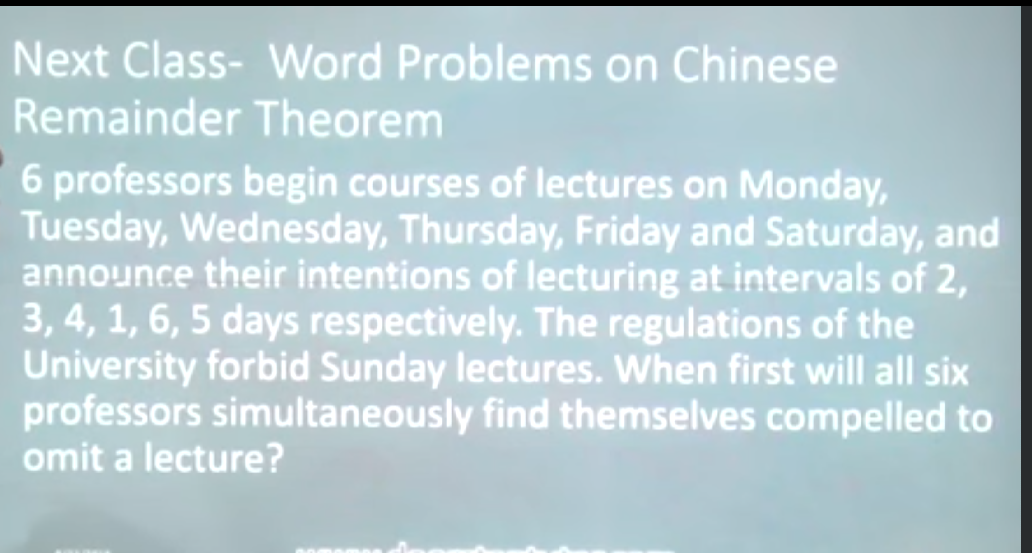
How to formulate this problem in CRT ?

Hint
: Sunday = 7 , Interval 2 days = mod 2, …

Let d = week days {1, 2, 3, 4, 5, 6, 7} for {Monday (Prof M), tuesday (Prof t), Wednesday (Prof W), Thursday (Prof T), Friday (Prof F), saturday (Prof s), Sunday (Prof S)}

d : 1 2 3 4 5 6 [7] 1 2 3 4 5 6 [7] 1 2
M: m 0 m 0 m 0 [m] ==> fell on 1st sunday
t: - t 0 0 t 0 [0 ] t 0 0 t 0 0 [t ] ==> fell on 2nd sunday
W: – - w 0 0 0 [w] 0 0 0 w 0 0 [0] ==> fell on 1st sunday
T: - - - T T T [T] ==> fell on 1st sunday (TRIVIAL CASE!)
F: - - - - f 0…

View original post 626 more words

Some Math Connotations Demystified 数学内涵解密

ChefCouscous's avatarMath Online Tom Circle

This Taiwanese Math Prof is very approachable in clarifying the doubts in an unconventional way different from the arcane textbook definitions. Below are his few key tips to breakthrough the “mystified”concepts :

1. “Dual Space“(对偶空间) : it is the evaluation of a “Vector Space”.

Example: A student studies few subjects {Math, Physics, English, Chemistry…}, these subjects form a “Subject Vector Space” (V), if we associate the subjects with weightages (加权) , say, Math 4, Physics 3, English 2, Chemistry 1, the “Weightage Dual Space” of V will be W= {4, 3, 2, 1}.

2. Vector: beyond the meaning of a physical vector with direction and value, it extends to any “object” which can be manipulated (抵消) by the 4 operations “+, – , x, / ” in a FieldF = {R or Z2 …}.

Eg. $latex alpha_{1}.v_{1} + alpha_{2}.v_{2} + alpha_{3}.v_{3}, forall alpha_{j} in…

View original post 111 more words