Math Blog

Best Rubik’s Cube (Cheap and Good) — The Dayan Zhanchi?

The Rubik’s Cube is a famous puzzle, that is related to Math and Group Theory. (See this free introduction by MIT on the The Mathematics of the Rubik’s Cube)

Recently, I am thinking of buying a new Rubik’s Cube, and searched on the internet on what is the best brand of Rubik’s Cube. For Rubik’s Cube, smoothness while turning is really important, because it will simply be easier to turn the edges if the cube is smooth.

After researching online, I came to a very surprising conclusion: The “made in China” brand Dayan Zhanchi is supposedly much better than the official Rubik’s brand (and also other “Western” brands)!


Dayan ® ZhanChi 3x3x3 Speed Cube 6-Color Stickerless

This amazing superhuman World Record is set using the Dayan Zhanchi! (2013, Mats Valk)

Other than the Dayan series, another alternative is the V-cube series:

V-CUBE 3 White Multicolor Cube

However, the reviews on Amazon seem to indicate that the Dayan is superior in both smoothness and price!

If you have any recommendations on which Rubik’s Cube is best, please write in the comments below!

I will be buying the Dayan Cube soon (hopefully in time for Christmas 2014), and will post new updates! I am most probably buying the stickerless version since I have past experience of stickers falling off from my previous cubes. (Note: Stickerless Rubik’s Cubes are banned from competitions for the ridiculous reason that it is possible to “see what colors are behind through the cracks”, see https://github.com/cubing/wca-documents/issues/177) So if your goal is to enter a competition, you may want to consider the sticker version of the Zhanchi.

For parents, buying a Rubik’s cube for your child is a great investment. Playing with the Rubik’s cube is a major intellectual challenge (it has 43 quintillion permutations, only 1 of which is correct), which will develop the child’s brain for logical thinking, which is especially useful for Math and Science. Most importantly, it is fun!


Dayan ® ZhanChi 3x3x3 Speed Cube 6-Color Stickerless

Special note for buying Dayan Zhanchi from Singapore:

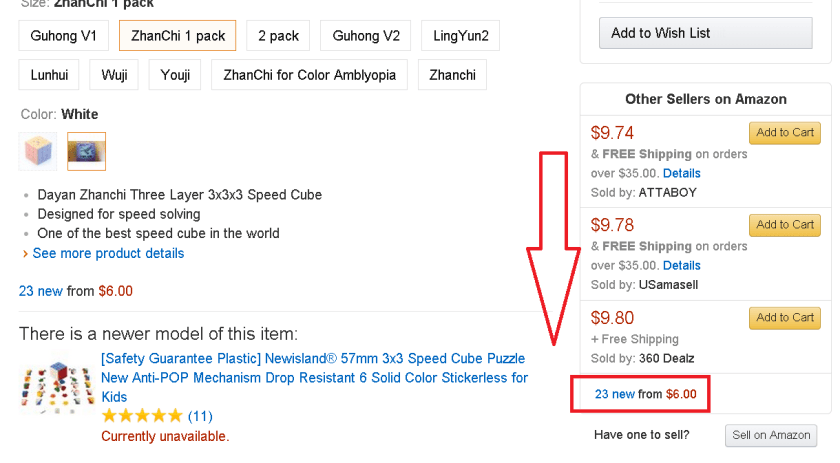
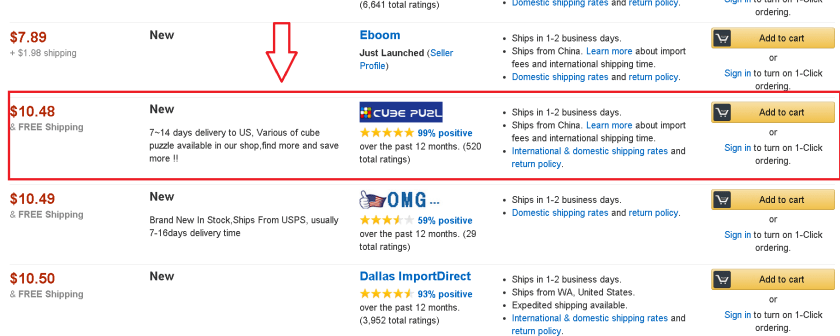
If you are buying the Dayan Zhanchi from Singapore, at first it seems like the Dayan ZhanChi does not ship to Singapore. It actually does! We just have to choose the correct seller, Cube Puzl, which ships to Singapore.

other sellers

cube puzl

Looking for a reliable Tuition Agency?

Looking for a reliable Tuition Agency?

Its the holiday period now, and many parents are looking to find a tutor for the next academic year. Please look no further, as Startutor is the best tuition agency in Singapore, winning hands down. I have worked with Startutor both as a tutor and an affiliate, and am impressed by their professional website (one of the best website designs around), and their professional attitude.

For other subjects besides Mathematics, request for a tutor at Startutor! Startutor is Singapore’s most popular online agency, providing tutors to your home. There are no extra costs for making a request. Tutors’ certificates are carefully vetted by Startutor. (Website: http://startutor.sg/request,wwcsmt)

Startutor is suitable for English Tuition, Social Studies Tuition, Geography Tuition, Physics Tuition, Chemistry Tuition, Biology Tuition, Chinese Tuition,Economics Tuition, GP Tuition, Piano Lessons and more!

Startutor: http://startutor.sg/request,wwcsmt

(Please use the full link above directly, thanks!)

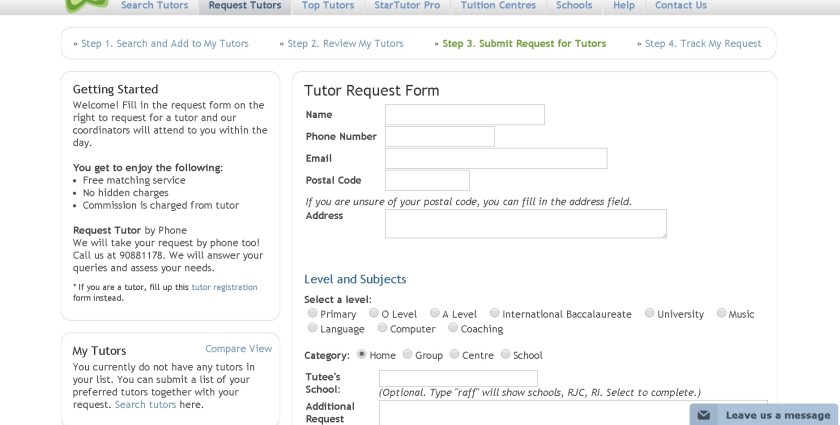
Screenshot:

startutor screenshot

Interesting articles about Grade Inflation and Math

Source: http://blogs.wsj.com/washwire/2014/10/23/a-broader-problem-than-uncs-scandal-grade-inflation/

The scandal at the University of North Carolina at Chapel Hill is principally about academic dishonesty. But it highlights an institutional failure at almost all American colleges that dissuades students from pursuing the best career possible. Some academic departments systematically inflate students’ grades. And many of those departments give students the least rigorous preparation for the labor market.

Part of college is learning what you’re good at. Students use freshman-year courses to gauge their interest and aptitude in different majors. A student who receives an A in writing and a B in calculus might conclude that she’s a better writer than mathematician. But what if she actually earned the average grade in both courses?

Plenty of students who start in difficult fields such as math decide to scale back their ambitions. That’s fine if it’s a personal choice–but not if they’re doing so because they got deceptive messages from their graders.

Source: http://www.nytimes.com/2011/11/06/education/edlife/why-science-majors-change-their-mind-its-just-so-darn-hard.html?_r=2&pagewanted=all&

The latest research also suggests that there could be more subtle problems at work, like the proliferation of grade inflation in the humanities and social sciences, which provides another incentive for students to leave STEM majors. It is no surprise that grades are lower in math and science, where the answers are clear-cut and there are no bonus points for flair. Professors also say they are strict because science and engineering courses build on one another, and a student who fails to absorb the key lessons in one class will flounder in the next.

After studying nearly a decade of transcripts at one college, Kevin Rask, then a professor at Wake Forest University, concluded last year that the grades in the introductory math and science classes were among the lowest on campus. The chemistry department gave the lowest grades over all, averaging 2.78 out of 4, followed by mathematics at 2.90. Education, language and English courses had the highest averages, ranging from 3.33 to 3.36.

Ben Ost, a doctoral student at Cornell, found in a similar study that STEM students are both “pulled away” by high grades in their courses in other fields and “pushed out” by lower grades in their majors.


Featured book:

Math Doesn’t Suck: How to Survive Middle School Math Without Losing Your Mind or Breaking a Nail


How to join 9 Dots using 4 Lines? (Advanced Version)

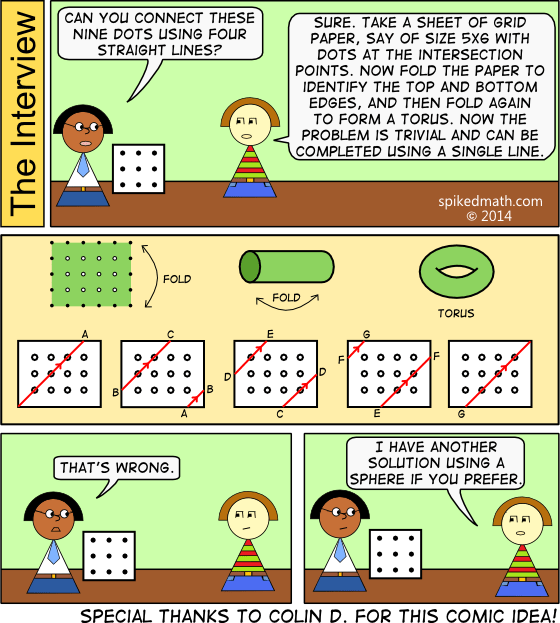
This is a humorous math comic based on the popular brainteaser: How do we join 9 dots using 4 lines?

(Hint: Think out of the box. See the solution here: Answer)

However, Spiked Math has added a new twist to the riddle. Enjoy the comic!

torus

Credit: http://spikedmath.com/


Featured book:

Comic-Strip Math: Problem Solving: 80 Reproducible Cartoons With Dozens and Dozens of Story Problems That Motivate Students and Build Essential Math Skills

Math + Comics = Learning That’s Fun! Help students build essential math skills and meet math standards with 80 laugh-out-loud comic strips and companion mini-story problems. Each reproducible comic and problem set reinforces a key math skill: multiplication, division, fractions, decimals, measurement, geometry, and more. Great to use for small-group or independent class work and for homework! For use with Grades 3-6.

Top 20 World’s Best Universities

tomcircle's avatarMath Online Tom Circle

http://finance.yahoo.com/news/harvard-tops-us-news-world-150403455.html

These 20 are purely anglophone universities — USA (16), UK(3), Canada (1).

The report is too biased. I am sure there are some non-anglophone universities in Europe, Australia and Asia which are equally good, if not better, than some of those in this list.

image

image

View original post

The Math of Ebola

Source: http://www.npr.org/blogs/goatsandsoda/2014/09/18/349341606/why-the-math-of-the-ebola-epidemic-is-so-scary

In the past week, world leaders have started using a mathematical term when they talk about the Ebola epidemic in West Africa.

“It’s spreading and growing exponentially,” President Obama said Tuesday. “This is a disease outbreak that is advancing in an exponential fashion,” said Dr. David Nabarro, who is heading the U.N.’s effort against Ebola.

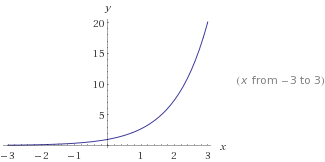
Students who have learnt how the exponential graph looks like will know that the exponential function grows extremely quickly. exponential graph

In fact, for large enough x, the exponential function e^x will be larger than any polynomial function, say x^{100}. For example, when x=700, e^{700}=1.01\times 10^{304}, while 700^{100}=3.23 \times 10^{284}.

Fortunately, there is some good news:

Before we all start panicking (which I have been working hard not to do, myself), the world did get some welcome news this week. On Tuesday, President Obama announced plans for the U.S. military to provide 1,700 hospital beds in West Africa. It will also help set up training facilities for health care workers.


Featured book:

An Introduction to Bioinformatics Algorithms (Computational Molecular Biology)

This introductory text offers a clear exposition of the algorithmic principles driving advances in bioinformatics. Accessible to students in both biology and computer science, it strikes a unique balance between rigorous mathematics and practical techniques, emphasizing the ideas underlying algorithms rather than offering a collection of apparently unrelated problems.The book introduces biological and algorithmic ideas together, linking issues in computer science to biology and thus capturing the interest of students in both subjects. It demonstrates that relatively few design techniques can be used to solve a large number of practical problems in biology, and presents this material intuitively.An Introduction to Bioinformatics Algorithms is one of the first books on bioinformatics that can be used by students at an undergraduate level. It includes a dual table of contents, organized by algorithmic idea and biological idea; discussions of biologically relevant problems, including a detailed problem formulation and one or more solutions for each; and brief biographical sketches of leading figures in the field. These interesting vignettes offer students a glimpse of the inspirations and motivations for real work in bioinformatics, making the concepts presented in the text more concrete and the techniques more approachable.PowerPoint presentations, practical bioinformatics problems, sample code, diagrams, demonstrations, and other materials can be found at the Author’s website.

The Making of a Mile of Pi – Numberphile

This guy (from the Youtube channel Numberphile) actually printed a million digits of Pi! Check out how long the piece of paper actually is!

Longer Version (30 minutes):


Featured book:

Math Bytes: Google Bombs, Chocolate-Covered Pi, and Other Cool Bits in Computing
This book provides a fun, hands-on approach to learning how mathematics and computing relate to the world around us and help us to better understand it. How can reposting on Twitter kill a movie’s opening weekend? How can you use mathematics to find your celebrity look-alike? What is Homer Simpson’s method for disproving Fermat’s Last Theorem? Each topic in this refreshingly inviting book illustrates a famous mathematical algorithm or result–such as Google’s PageRank and the traveling salesman problem–and the applications grow more challenging as you progress through the chapters. But don’t worry, helpful solutions are provided each step of the way.

Math Bytes shows you how to do calculus using a bag of chocolate chips, and how to prove the Euler characteristic simply by doodling. Generously illustrated in color throughout, this lively and entertaining book also explains how to create fractal landscapes with a roll of the dice, pick a competitive bracket for March Madness, decipher the math that makes it possible to resize a computer font or launch an Angry Bird–and much, much more. All of the applications are presented in an accessible and engaging way, enabling beginners and advanced readers alike to learn and explore at their own pace–a bit and a byte at a time.

Topics coming out for A Maths Paper 2

Recently, the A Maths Paper 2 just finished (today), and the A Maths Paper 2 is hot on its heels, coming tomorrow!

Usually, topics tested in Paper 1 will most likely not come out again in Paper 2, so students doing their last minute revision can use this fact to focus their revision.

Topics that came out in Paper 1:

  1. Binomial Theorem
  2. Trigonometry (Addition Formula, find exact value)
  3. Rate of change
  4. Partial Fractions
  5. Linear Law
  6. Prove Trigonometry
  7. Coordinate Geometry
  8. Integrate & Differentiate Trigonometric Functions
  9. Discriminant (b^2-4ac)
  10. Stationary Points
  11. Tangent/Normal
  12. Quadratic/Modulus

Topics likely to come out in Paper 2:

  1. Indices/Surds
  2. Polynomials
  3. Exponential / Logarithmic Equations
  4. R-formula
  5. Sketching of Trigonometric Graphs
  6. Circles
  7. Proofs in plane geometry
  8. Integration as the reverse of differentiation
  9. Area under curve
  10. Kinematics

All the best for those who are taking the A Maths Paper 2 exam tomorrow. 🙂

Sum of Cubes (A Maths Tuition)

What is tested for A Maths (Additional Maths) Exam

Just to share an A Maths question that is likely to come out for 2014 A Maths Exam. It is the brand new topic just added this year: Sum and difference of cubes.

\boxed{\alpha^3+\beta^3=(\alpha+\beta)(\alpha^2-\alpha\beta+\beta^2)}

\boxed{\alpha^3-\beta^3=(\alpha-\beta)(\alpha^2+\alpha\beta+\beta^2)}

Attached below is a practice question on Alpha Cube+Beta Cube question that may be likely to come out this year! After all, if it is just added in the syllabus it is highly likely that they will test it.

Alpha Beta Cube Question

Good luck for the exam!


Maths Tuition

For Mathematics Tuition, contact Mr Wu at:

Email: mathtuition88@gmail.com

Tutor profile: About Tutor


Featured book:

Math Doesn’t Suck: How to Survive Middle School Math Without Losing Your Mind or Breaking a Nail


Self-study Advanced Math

tomcircle's avatarMath Online Tom Circle

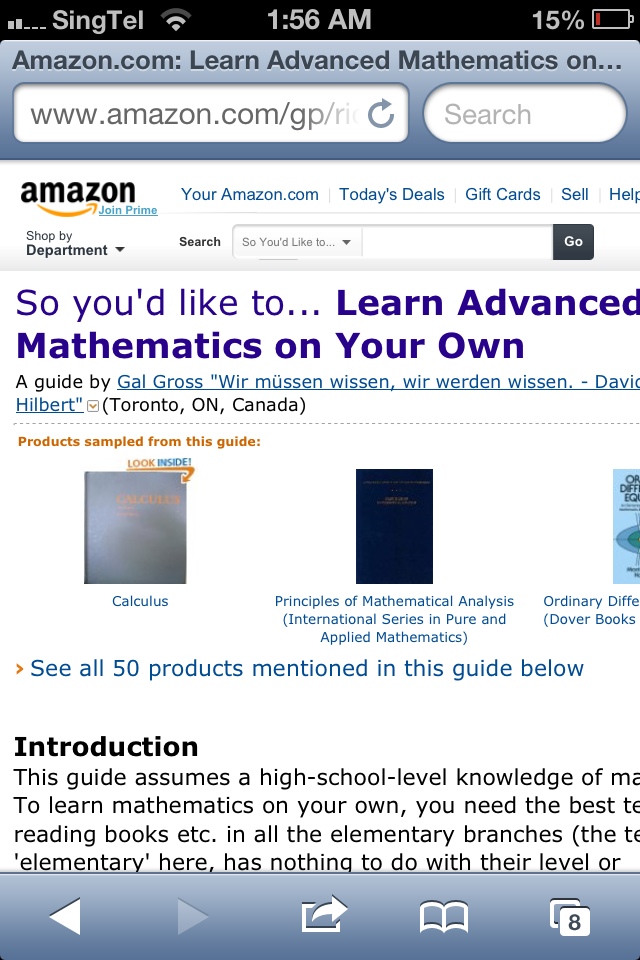
I came across this review at Amazon in 2007 on how to study Advanced Math on your own. Wonderful advice !

Give yourself 10-15 years, with passion, interest, dedicated commitment, disciplined, you could self-study Math to be a next Fermat, or Hua Luogen – both learned Math by themselves through self-learning from books.

http://www.amazon.com/gp/richpub/syltguides/fullview/R1GE1P236K3YSV/ref=cm_syt_dtpa_f_1_rdssss1/102-4263436-5550568?pf_rd_m=ATVPDKIKX0DER&pf_rd_s=sylt-center&pf_rd_r=00JK8KDA3S1T2JRNBCVC&pf_rd_t=201&pf_rd_p=253457301&pf_rd_i=0821839675

20130517-015726.jpg

View original post

Undergraduate Level Math Book Recommendations

Highly Recommended Math Books for University Self Study

Recently, a viewer of my website asked if I was able to suggest any undergraduate level university textbooks for self study that follows the university curriculum.

Self-study is challenging but not impossible. Choosing a good and appropriate book of the right level is of crucial importance. For instance, for beginners to Calculus, I wouldn’t recommend Principles of Mathematical Analysis (International Series in Pure and Applied Mathematics) by Rudin. It is simply too difficult for beginners or even intermediate students. Any book by Bourbaki is also not suitable for beginners, for instance.

Update: I recently found a book that is a better alternative to Rudin: Mathematical Analysis, Second Edition by Apostol! Many online sources have very positive reviews on Apostol’s Analysis book. I have read it and found it much more readable than Rudin.

I would like to suggest the following books (mainly for Pure Mathematics). Ideally, the motivated student is able to self study and obtain the knowledge equivalent to a 4 Year course at a university.

The recommendations are divided into Year 1, Year 2, Year 3 and Year 4.

If you have any other recommendations, please feel free to comment below!

Year 1

Introduction to Pure Math and Proofs:

How to Prove It: A Structured Approach

Calculus:

Thomas’ Calculus (12th Edition)

Linear Algebra:

Linear Algebra and Its Applications, 4th Edition

Multivariable Calculus:

Thomas’ Calculus, Multivariable (13th Edition)

Year 2

Linear Algebra II (Second Year Course):

Linear Algebra, 4th Edition

Analysis I: 

Introduction to Real Analysis

Abstract Algebra I:

A First Course in Abstract Algebra (3rd Edition)

This book will be an introduction to Group Theory.

Probability:

Introduction to Probability, 2nd Edition

Analysis II:

Calculus, 4th edition

(Note: Despite the title “Calculus”, this book is actually a rather rigorous book on Analysis, suitable as a second course textbook)

Complex Analysis I:

Complex Variables and Applications (Brown and Churchill)

Year 3

Analysis III:

Introductory Real Analysis (Dover Books on Mathematics)

ODE (Ordinary Differential Equations):

Ordinary Differential Equations (Dover Books on Mathematics)

Graph Theory:

A First Course in Graph Theory (Dover Books on Mathematics)

Algebra II:

Abstract Algebra, 3rd Edition

Algebra II will usually be a course on Rings, Modules.

(Note: You can use this book for learning Galois Theory too)

Differential Geometry:

Differential Geometry of Curves and Surfaces

Year 4 

Number Theory:

An Introduction to the Theory of Numbers

Galois Theory:

Abstract Algebra, 3rd Edition

(Note: Same textbook as for Algebra II)

PDE (Partial Differential Equations):

A First Course in Partial Differential Equations: with Complex Variables and Transform Methods (Dover Books on Mathematics)

Logic:

A Beginner’s Guide to Mathematical Logic (Dover Books on Mathematics)

Functional Analysis:

Introductory Functional Analysis with Applications

Topology:

Topology (2nd Edition)

(Note: See also my book review on Topology by Munkres)

Measure and Integration:

The Elements of Integration and Lebesgue Measure

Congratulations for reaching the bottom of this long list!

All the best for your studies in Mathematics. 🙂

Education News: Princeton University abolishes “Bell Curve” (O Level Bell Curve)

O Level Bell Curve Discussion

With the O Levels and A Levels coming up, a recent topic of talk is what the “Bell Curve” will be like. Some subjects, especially O Level E Maths, are notorious for having a extremely high bell curve. Students allegedly need more than 90 marks to secure an A1 for E Maths (Elementary Maths) at the O Levels.

Will the O Level abolish the “Bell Curve” system one day? Virtually nobody likes the “Bell Curve” system, other than those at the top of the curve. Some bad points about the “Bell Curve” system is that students can become quite competitve, as they know that the number of As is limited. Ideally, cooperation and discussion among students are needed to improve their knowledge. Students who help one another create a friendly and conducive environment for learning.

What do you think? Post your comments below!

Source: http://www.newsworks.org/index.php/new-jersey-more/item/73702-princeton-nixes-suggested-limit-on-a-grades

Princeton University's Blair Tower photographed from above (Alan Tu/WHYY)

Rest easy, Tigers. Princeton University is reversing its longstanding policy on “A” grades.

For the last 10 years, the school’s official grading policy has recommended that professors don’t award A’s to more than 35 percent of students in undergraduate classes.

It was meant to remedy the rampant grade inflation that had taken place on campus in the 1990s and early 2000s.

Since the policy took effect, the number of A’s awarded dropped and grade deflation began to set in.

But the policy had unintended side effects.

“Many students commented that the atmosphere on campus had become overly competitive,” said engineering professor Dr. Clancy Rowley. “They were intentionally not helping each other for fear that the other student would get the A grade at their expense.”

Read more at: http://www.newsworks.org/index.php/new-jersey-more/item/73702-princeton-nixes-suggested-limit-on-a-grades


Featured book:

Inequality by Design: Cracking the Bell Curve Myth

Universum Survey (Please help to do!)

Please try out this short survey. Your opinions are greatly appreciated.
Thanks for your help!

mathtuition88's avatarMathtuition88

Thanks for being a loyal reader of Mathtuition88.com!

Do you want to know which employer is the most suitable for you?

Please help to do this survey at:

Alternate URL: https://surveys.universumglobal.com/markets/singapore/distributions/ambWWCY

It is a Career Test by Universum. Participate to reveal your career type and discover the optimal employers for you!

Thanks for your help once again!

View original post

Python Math Programming

Recently, I am thinking of learning the Python language for Math programming.

An advantage for using Python for Math Programming (e.g. testing out some hypothesis about numbers), is that the Python programming language theoretically has no largest integer value that it can handle. It can handle integers as large as your computer memory can handle. (Read more at: http://userpages.umbc.edu/~rcampbel/Computers/Python/numbthy.html)

Other programming languages, for example Java, may have a maximum integer value beyond which the program starts to fail. Java integers can only have a maximum value of 2^{31}-1 \approx 2.15 \times 10^9, which is pretty limited if you are doing programming with large numbers (for example over a trillion). For instance, the seventh Fermat number is already 18446744073709551617. I was using Java personally until recently I needed to program larger integers to test out some hypothesis.

How to install Python (free):

Hope this is a good introduction for anyone interested in programming!


Featured book:

Learning Python, 5th Edition

Get a comprehensive, in-depth introduction to the core Python language with this hands-on book. Based on author Mark Lutz’s popular training course, this updated fifth edition will help you quickly write efficient, high-quality code with Python. It’s an ideal way to begin, whether you’re new to programming or a professional developer versed in other languages.

Complete with quizzes, exercises, and helpful illustrations, this easy-to-follow, self-paced tutorial gets you started with both Python 2.7 and 3.3— the latest releases in the 3.X and 2.X lines—plus all other releases in common use today. You’ll also learn some advanced language features that recently have become more common in Python code.

  • Explore Python’s major built-in object types such as numbers, lists, and dictionaries
  • Create and process objects with Python statements, and learn Python’s general syntax model
  • Use functions to avoid code redundancy and package code for reuse
  • Organize statements, functions, and other tools into larger components with modules
  • Dive into classes: Python’s object-oriented programming tool for structuring code
  • Write large programs with Python’s exception-handling model and development tools
  • Learn advanced Python tools, including decorators, descriptors, metaclasses, and Unicode processing

Pick’s Theorem Proof (Video)

This is an excellent video I found on Youtube by Professor Wildberger on the proof of Pick’s Theorem. It is easy enough for a high school student to understand!

Pick’s Theorem is a formula A=I+\frac{B}{2}-1 which gives the area of a simple polygon whose vertices lie on points with integer coordinates. Surprisingly, it is a relatively modern theorem, the result was first described by Georg Alexander Pick in 1899.

Using Pick’s Formula, the area of the above polygon is A=I+\frac{B}{2}-1=7+\frac{8}{2}-1=10. We can also see that it is the sum of two triangles A=\frac{1}{2}(4)(2)+\frac{1}{2}(4)(3)=10.

Amazing Formula!

Source: http://en.wikipedia.org/wiki/Pick’s_theorem


Featured book:

Math from Three to Seven: The Story of a Mathematical Circle for Preschoolers (MSRI Mathematical Circles Library)

A recent visitor to my website bought this book. Highly interesting and suitable for parents of young children. Three to seven is a critical period where the brain develops, hence learning about how to teach math to preschoolers is of great significance for young parents.

This book is a captivating account of a professional mathematician’s experiences conducting a math circle for preschoolers in his apartment in Moscow in the 1980s. As anyone who has taught or raised young children knows, mathematical education for little kids is a real mystery. What are they capable of? What should they learn first? How hard should they work? Should they even “work” at all? Should we push them, or just let them be? There are no correct answers to these questions, and the author deals with them in classic math-circle style: he doesn’t ask and then answer a question, but shows us a problem–be it mathematical or pedagogical–and describes to us what happened. His book is a narrative about what he did, what he tried, what worked, what failed, but most important, what the kids experienced. This book does not purport to show you how to create precocious high achievers. It is just one person’s story about things he tried with a half-dozen young children. Mathematicians, psychologists, educators, parents, and everybody interested in the intellectual development in young children will find this book to be an invaluable, inspiring resource. Titles in this series are co-published with the Mathematical Sciences Research Institute (MSRI).

French & German’s Secondary School Maths Comparison

tomcircle's avatarMath Online Tom Circle

A French math teacher’s insight in math classes in Germany (15 years old = Secondary 3) and France (16/17 years old in Sec 4 & Pre-U / JC 1):

The French Math is more theoretical while the German Math (like English Math) is applied. So the result is Germany produces excellent precision engineers with Applied Math, while France produces 1/3 of the World’s Fields Medalists in theoretical Pure Math.

Many English GCE A-level top Math students from Singapore studying in French Universitues face the same dilemma: while their French Math professors think they are “weak” in Math (i.e. French abstract Pure Math), yet they beat the French classmates in Applied Math.

View original post

Educational Math Cartoons at whyu.org

Are you looking for Educational Math Cartoon Videos?

Recently I came upon this site http://www.whyu.org/, which is funded by the Goldman Charitable Foundation in partnership with the University of Central Florida.

These videos are designed to be used as collateral material for mathematics courses on the K-12 and college levels, and to be a resource for informal independent study. Rather than focusing on procedural problem solving, the objective is to give insight into theconcepts on which the rules of mathematics are based. Once a student has gained a strong conceptual foundation, the material presented in math textbooks is much easier to digest and retain

An example of their Math cartoon on Infinite Series:

Hope you enjoy their videos!


Featured Book:

The Joy of x: A Guided Tour of Math, from One to Infinity

“Delightful . . . easily digestible chapters include plenty of helpful examples and illustrations. You’ll never forget the Pythagorean theorem again!”—Scientific American

Many people take math in high school and promptly forget much of it. But math plays a part in all of our lives all of the time, whether we know it or not. In The Joy of x, Steven Strogatz expands on his hit New York Times series to explain the big ideas of math gently and clearly, with wit, insight, and brilliant illustrations.

Whether he is illuminating how often you should flip your mattress to get the maximum lifespan from it, explaining just how Google searches the internet, or determining how many people you should date before settling down, Strogatz shows how math connects to every aspect of life. Discussing pop culture, medicine, law, philosophy, art, and business, Strogatz is the math teacher you wish you’d had. Whether you aced integral calculus or aren’t sure what an integer is, you’ll find profound wisdom and persistent delight in The Joy of x.

Math Olympiad Integer Sequence Question

Check out this interesting Math Olympiad Integer Sequence Question! (September 2014 Math Problem of the Month)

Main Page: http://www.fen.bilkent.edu.tr/~cvmath/Problem/problem.htm

Question: http://www.fen.bilkent.edu.tr/~cvmath/Problem/1408q.pdf

Solution: http://www.fen.bilkent.edu.tr/~cvmath/Problem/1409a.pdf


Featured book: 

Fifty Lectures for American Mathematics Competitions: Volume 2

While the books in this series are primarily designed for AMC competitors, they contain the most essential and indispensable concepts used throughout middle and high school mathematics. Some featured topics include key concepts such as equations, polynomials, exponential and logarithmic functions in Algebra, various synthetic and analytic methods used in Geometry, and important facts in Number Theory.

The topics are grouped in lessons focusing on fundamental concepts. Each lesson starts with a few solved examples followed by a problem set meant to illustrate the content presented. At the end, the solutions to the problems are discussed with many containing multiple methods of approach.

I recommend these books to not only contest participants, but also to young, aspiring mathletes in middle school who wish to consolidate their mathematical knowledge. I have personally used a few of the books in this collection to prepare some of my students for the AMC contests or to form a foundation for others.

By Dr. Titu Andreescu
US IMO Team Leader (1995 – 2002)
Director, MAA American Mathematics Competitions (1998 – 2003)
Director, Mathematical Olympiad Summer Program (1995 – 2002)
Coach of the US IMO Team (1993 – 2006)
Member of the IMO Advisory Board (2002 – 2006)
Chair of the USAMO Committee (1996 – 2004)

I love this book! I love the style, the selection of topics and the choice of problems to illustrate the ideas discussed. The topics are typical contest problem topics: divisors, absolute value, radical expressions, Veita’s Theorem, squares, divisibility, lots of geometry, and some trigonometry. And the problems are delicious.

Although the book is intended for high school students aiming to do well in national and state math contests like the American Mathematics Competitions, the problems are accessible to very strong middle school students.

The book is well-suited for the teacher-coach interested in sets of problems on a given topic. Each section begins with several substantial solved examples followed by a varied list of problems ranging from easily accessible to very challenging. Solutions are provided for all the problems. In many cases, several solutions are provided.

By Professor Harold Reiter
Chair of MATHCOUNTS Question Writing Committee.
Chair of SAT II Mathematics committee of the Educational Testing Service
Chair of the AMC 12 Committee (and AMC 10) 1993 to 2000.

We are on Facebook, Twitter, and Google+ !

Thanks for reading our blog Mathtuition88.com.

We are also on:

Facebookhttps://www.facebook.com/mathtuition88

Twitterhttps://twitter.com/mathtuition88

Google+: Mathtuition88

If you are a subscriber, thanks for your support! We will continue our mission of blogging interesting articles on Mathematics!


Featured book:

Coding the Matrix: Linear Algebra through Applications to Computer Science

Google’s signature ranking algorithm “PageRank” is heavily based on linear algebra! Read the above book to find out more!

An engaging introduction to vectors and matrices and the algorithms that operate on them, intended for the student who knows how to program. Mathematical concepts and computational problems are motivated by applications in computer science. The reader learns by doing, writing programs to implement the mathematical concepts and using them to carry out tasks and explore the applications. Examples include: error-correcting codes, transformations in graphics, face detection, encryption and secret-sharing, integer factoring, removing perspective from an image, PageRank (Google’s ranking algorithm), and cancer detection from cell features. A companion web site,

codingthematrix.com

provides data and support code. Most of the assignments can be auto-graded online. Over two hundred illustrations, including a selection of relevant xkcd comics.

Chapters: The Function, The Field, The Vector, The Vector Space, The Matrix, The Basis,Dimension, Gaussian Elimination, The Inner Product, Special Bases, The Singular Value Decomposition, The Eigenvector, The Linear Program

Gmail iOS update adds iPhone 6 support and a math joke

Just to share, interesting Math Joke by Google Gmail!

Source: http://www.techradar.com/news/software/applications/gmail-ios-update-adds-iphone-6-support-and-a-math-joke-1267982

Gmail iOS update adds iPhone 6 support and a math joke

You may need to brush up on your math if it seems odd to you that Google just updated the iOS Gmail app to version 3.1415926.

But Google is definitely not the type of company that turns down an opportunity to make a math joke, even when that joke is as simple as naming an app update after pi.

Besides that, the Gmail for iOS update has a single improvement: support for the iPhone 6 and iPhone 6 Plus.

Read more at: http://www.techradar.com/news/software/applications/gmail-ios-update-adds-iphone-6-support-and-a-math-joke-1267982


Featured:

You may want to buy this Spigen Tough Armor Case if you are buying the new “flexible” iPhone 6 / 6 plus!

iPhone 6 Plus Case, Spigen® [KICK-STAND] iPhone 6 Plus (5.5) Case Protective [Tough Armor] [Gunmetal] Dual Layer EXTREME Protection Cover Heavy Duty Kick-Stand Feature Case for iPhone 6 Plus (5.5) (2014) – Gunmetal (SGP11053)

  • TPU + Polycarbonate = Dual Protection
  • Advanced Shock Absorption Technology: Web Pattern TPU case
  • Drop Protection with AIR CUSHION Corners
  • Built in Kick-Stand for Hands-Free Viewing
  • Compatible with Apple iPhone 6 Plus (5.5″) Only – 2014

Lunes (Mathematics)

What are Lunes? Check out this absolutely interesting video:

The Lune of Hippocrates

Source: http://en.wikipedia.org/wiki/Hippocrates_of_Chios


Featured book:

A History of Greek Mathematics, Volume II: From Aristarchus to Diophantus (Dover Books on Mathematics)

“As it is, the book is indispensable; it has, indeed, no serious English rival.” — Times Literary Supplement
“Sir Thomas Heath, foremost English historian of the ancient exact sciences in the twentieth century.” — Prof. W. H. Stahl
“Indeed, seeing that so much of Greek is mathematics, it is arguable that, if one would understand the Greek genius fully, it would be a good plan to begin with their geometry.”

Education Info

Confused About What to Do After 12th Standard?

So, your +2 level exams are over, and you are looking forward to join a college, but you do not really know which stream to choose. You, inevitably, have different people in your life, suggesting different streams to you, leaving you even more confused. While one stream brings you more money, the other one gives you a much stress-free life. Do not worry. Here is a guide through the tricky path. Following are some fine points of the streams available for graduation.

Arts or Humanities

If you are someone who has completed your schooling with an Arts background, you need to choose a course that suits your talent profile. It does not matter if you choose an academic course or a professional one; you need to be sure about your career goals. The stream of Arts offers you a wide array of courses which must be analysed properly before taking admission in any one of them. These courses include plain and simple B.A. or Bachelor of Arts, Hotel Management, Event Management, Fashion Designing, Mass Communication, and many more. All these courses offer lucrative career opportunities in the best industries worldwide. Besides, you can also go for Foreign Language Courses; these are high in demand, and help you get a job in multinational companies. The most frequently opted for foreign language courses are Spanish, French, Russian, Korean and Japanese.

Science

Science happens to offer the widest number of courses after 12th. If you have had a science background at school, your first two preferences would likely be Medicine and Engineering. Besides these, you can also opt for B.Sc degree in Physics, Chemistry, Biology or Mathematics; a degree in Agriculture, Forensic Science, Bio Technology, Geology, etc.

As Medicine and Engineering happen to be popular choices, we are going to elaborate on these two courses. If you choose Medicine, you can opt for any one of the following- Bachelor of Medicine and Bachelor of Surgery (MBBS), Bachelor of Physiotherapy, Bachelor of Ayurveda Medicine and Surgery (BAMS), Bachelor of Science in Optometry, Bachelor of Dental Surgery (BDS) and Bachelor of Pharmacy.

As far as Engineering is concerned, there is wide array of options, which include Aeronautical Engineering, Automobile Engineering, Civil Engineering, Electrical and Electronics Engineering, Computer and Communication Engineering, Information Technology Engineering, Mechanical Engineering, Chemical Engineering, Biomedical Engineering, etc.

Commerce

In case you are a Commerce student, it is quite likely that ‘Chartered Accountancy’ is what strikes your head. However, you need to begin with graduation. Courses such as BCom, BBA, BBS, BMS, etc., are some of the options Commerce students choose for their graduation. Besides, you can also opt for a diploma or certificate course in Taxation, Accounting, Applied Managerial Economics, Micro Finance, Banking and Insurance, Stock Market, Micro Finance, etc. Specialising in Commerce makes you eligible for jobs like that of Account Analyst, Account Assistant, Accounting Coordinator, Financial Consultant, Accounting Coordinator, Financial Auditor, Accounting Clerk, etc.

Think before you choose

There is no harm in taking others’ suggestions, but the ultimate decision must be yours. Nobody, but you know what you are comfortable at. It does not matter how much your parents coax you to take up Engineering, if you find Literature more interesting, go for it. After all, it is you who have to study the subject for the next three or four years, and build a future on the same. So, nobody but you can decide which course is best for you.

Also keep in mind that the course you choose gives you a good scope as far as career options are concerned. What you choose now will decide the shape of your future. So, please choose wisely.

Author’s bio: Jeff Traven is a professor at a well-known university is California. During his spare time, he likes to blog on various kinds topics that help young students choose the right courses after 12th, so that they can have a bright and prosperous future.

Lucas Numbers

Check out this video on Lucas Numbers:

Lucas Numbers are an interesting generalization of the famous Fibonacci Numbers!


Featured book:

Blockhead: The Life of Fibonacci

Also, check out this book by Matt Parker, i.e. the guy in the video above!

Things to Make and Do in the Fourth Dimension: A Mathematician’s Journey Through Narcissistic Numbers, Optimal Dating Algorithms, at Least Two Kinds of Infinity, and More


Why do Exterior Angles add up to 360 degrees?

Source: http://www.fromquarkstoquasars.com/20-gifs-that-teach-you-science-concepts-better-than-your-teacher-probably-can/

Exterior-angles-of-polygons

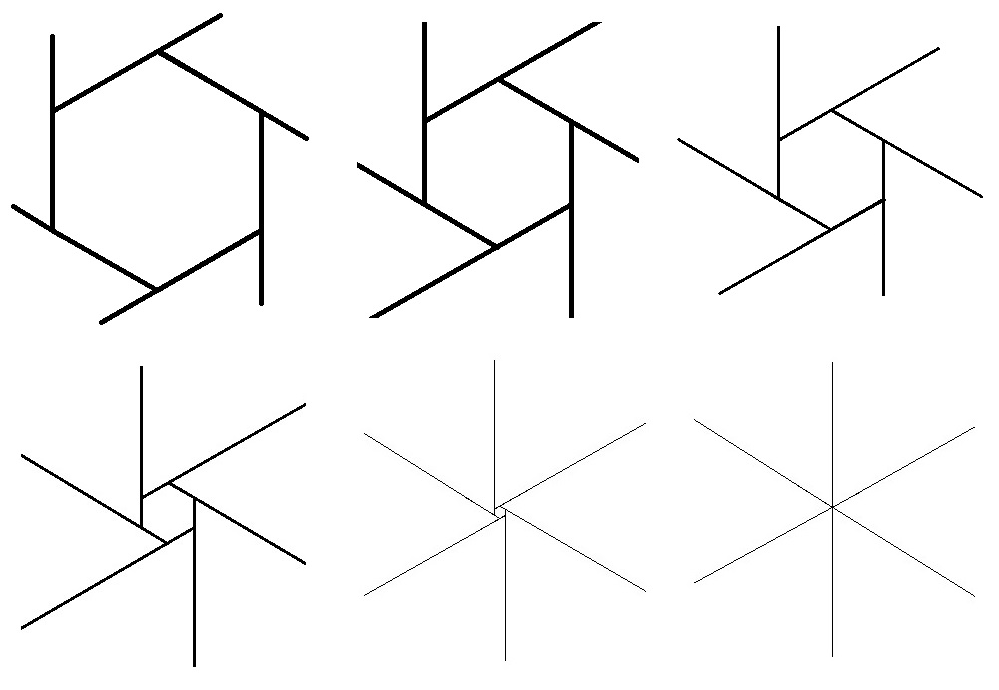
This is the real reason why exterior angles of a polygon add up to 360 degrees! If you shrink the polygon (which doesn’t affect the sum of exterior angles), the exterior angles eventually meet at a point, and the sum of angles at a point is 360 degrees.

This is some cool math to think about!


Featured book:

Math Appeal: Mind-Stretching Math Riddles

NEW YORK TIMES bestselling author Greg Tang challenges kids to solve problems creatively in this follow-up to MATH FOR ALL SEASONS.

In this book you’ll learn to see
How very clever you can be.


Universum Survey (Please help to do!)

Thanks for being a loyal reader of Mathtuition88.com!

Do you want to know which employer is the most suitable for you?

Please help to do this survey at:

Alternate URL: https://surveys.universumglobal.com/markets/singapore/distributions/ambWWCY

It is a Career Test by Universum. Participate to reveal your career type and discover the optimal employers for you!

Thanks for your help once again!

Einstein for Kids (Book)

Just to introduce a book that is based on an essay I wrote 10 years ago when I was a teenager. I decided to repackage it as a book published on Lulu.com:

Einstein, Relativity and Light for Kids

Einstein, Relativity and Light for Kids

(Lulu Paperback link)

Einstein, Relativity and Light for Kids: A book about Einstein, Relativity, and Light for Children. Includes an award-winning 2000 word Essay on “What happens if Light slows down”. Written when the author was 17 years old.

An Ebook version is also available here:

Einstein, Relativity and Light for Kids

Excerpt:

What happens if light slows down – A Beginner’s Guide to Relativity and Light

In the beginning God created the heavens and the earth. And God said, “Let there be light,” and there was light. Light is one of the most ubiquitous things that we see, and it is also one of the oldest – it existed since the beginning of mankind. However, light is also mysterious in that no one really understands what it is and how it is rectilinearly propagated. Nevertheless, the speed of light plays an important part in physics, and it is one of the more often quoted constant. What will happen then, if the speed of light suddenly changes from 300000000m/s to a fraction of its original self –3000 m/s? (It is theoretically possible to slow down light to such a speed, by shining a beam of light through a medium with a refractive index of 100,000.)

Hope this book will be useful to anyone trying to learn more about Einstein through a novel way! What will happen when light slows down? Read the book to find out! 🙂

Beautiful Map of Mathematics

Source: https://plus.google.com/114134834346472219368/posts/hs79fnxkjis?pid=6037478677752714706&oid=101584889282878921052

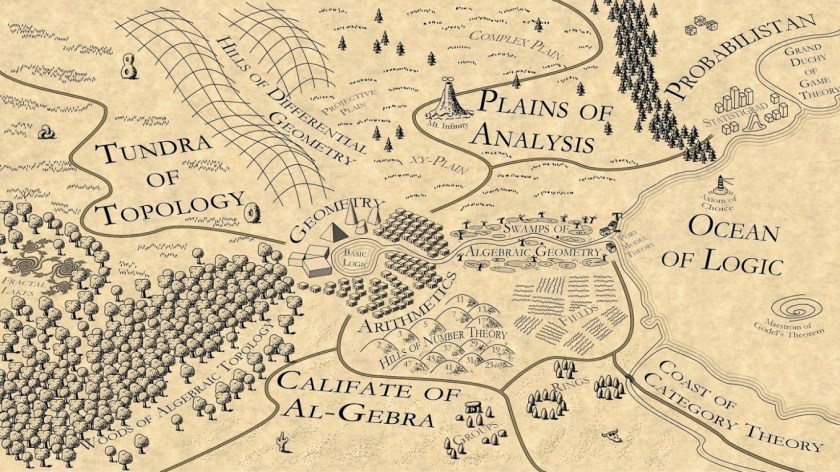
Mathematistan

This is a really beautiful Map of Mathematics (Mathematistan, a pun on Mathematics and Afghanistan), where one can see all the various branches of Maths, and how they combine together.

I also learnt a new word: Califate, which means an Islamic state led by a supreme religious and political leader known as a caliph – i.e. “successor” – to Muhammad.


Featured book:

Guide to LaTeX (4th Edition)

Published Nov 25, 2003 by Addison-Wesley Professional. Part of the Tools and Techniques for Computer Typesetting series. The series editor may be contacted at frank.mittelbach@latex-project.org. LaTeX is the text-preparation system of choice for scientists and academics, and is especially useful for typesetting technical materials. This popular book shows you how to begin using LaTeX to create high-quality documents. The book also serves as a handy reference for all LaTeX users. In this completely revised edition, the authors cover the LaTeX2ε standard and offer more details, examples, exercises, tips, and tricks. They go beyond the core installation to describe the key contributed packages that have become essential to LaTeX processing.

Inside, you will find:

  • Complete coverage of LaTeX fundamentals, including how to input text, symbols, and mathematics; how to produce lists and tables; how to include graphics and color; and how to organize and customize documents
  • Discussion of more advanced concepts such as bibliographical databases and BIBTeX, math extensions with AMS-LaTeX, drawing, slides, and letters
  • Helpful appendices on installation, error messages, creating packages, using LaTeX with HTML and XML, and fonts
  • An extensive alphabetized listing of commands and their uses

New to this edition:

  • More emphasis on LaTeX as a markup language that separates content and form–consistent with the essence of XML
  • Detailed discussions of contributed packages alongside relevant standard topics
  • In-depth information on PDF output, including extensive coverage of how to use the hyperref package to create links, bookmarks, and active buttons

As did the three best-selling editions that preceded it, Guide to LaTeX, Fourth Edition, will prove indispensable to anyone wishing to gain the benefits of LaTeX.

The accompanying CD-ROM is part of the TeX Live set distributed by TeX Users Groups, containing a full LaTeX installation for Windows, MacOSX, and Linux, as well as many extensions, including those discussed in the book.

Holder’s Inequality for Lp Spaces

These are two excellent videos explaining Holder’s Inequality for Lp Spaces:


Featured book:

Divine Proportions: Rational Trigonometry to Universal Geometry

This revolutionary book establishes new foundations for trigonometry and Euclidean geometry. It shows how to replace transcendental trig functions with high school arithmetic and algebra to dramatically simplify the subject, increase accuracy in practical problems, and allow metrical geometry to be systematically developed over a general field. This new theory brings together geometry, algebra and number theory and sets out new directions for algebraic geometry, combinatorics, special functions and computer graphics. The treatment is careful and precise, with over one hundred theorems and 170 diagrams, and is meant for a mathematically mature audience. Gifted high school students will find most of the material accessible, although a few chapters require calculus. Applications include surveying and engineering problems, Platonic solids, spherical and cylindrical coordinate systems, and selected physics problems, such as projectile motion and Snell’s law. Examples over finite fields are also included.


Love Math Graphs!

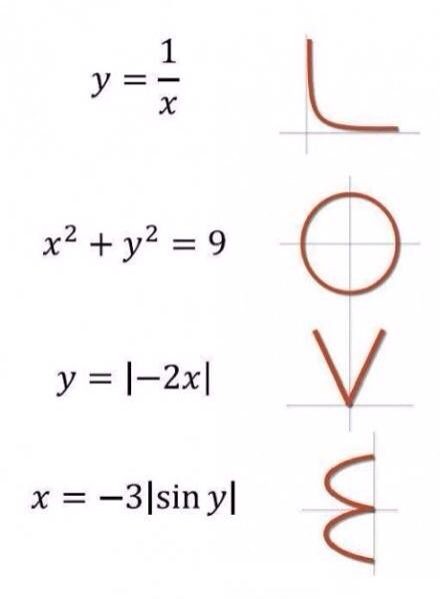
How to remember graphs?

Many students have a hard time remembering how graphs look like.

Here is a humorous cartoon (suitable for Valentine’s Day) on how some graphs look like!

Remember, Maths is not just about exams, homework, or getting A1/A2. Maths, above all, is about the LOVE of learning and thinking.

math graphs


Featured book:

Love and Math: The Heart of Hidden Reality

A New York Times Science Bestseller

What if you had to take an art class in which you were only taught how to paint a fence? What if you were never shown the paintings of van Gogh and Picasso, weren’t even told they existed? Alas, this is how math is taught, and so for most of us it becomes the intellectual equivalent of watching paint dry.

In Love and Math, renowned mathematician Edward Frenkel reveals a side of math we’ve never seen, suffused with all the beauty and elegance of a work of art. In this heartfelt and passionate book, Frenkel shows that mathematics, far from occupying a specialist niche, goes to the heart of all matter, uniting us across cultures, time, and space.

Love and Math tells two intertwined stories: of the wonders of mathematics and of one young man’s journey learning and living it. Having braved a discriminatory educational system to become one of the twenty-first century’s leading mathematicians, Frenkel now works on one of the biggest ideas to come out of math in the last 50 years: the Langlands Program. Considered by many to be a Grand Unified Theory of mathematics, the Langlands Program enables researchers to translate findings from one field to another so that they can solve problems, such as Fermat’s last theorem, that had seemed intractable before.

At its core, Love and Math is a story about accessing a new way of thinking, which can enrich our lives and empower us to better understand the world and our place in it. It is an invitation to discover the magic hidden universe of mathematics.


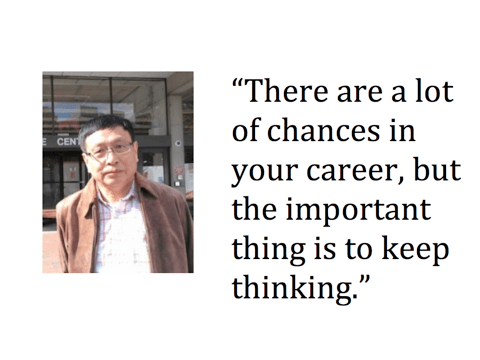
The important thing is to keep thinking

This is a really inspirational story to me. “The important thing is to keep thinking.”

keep thinking

Source: http://www.reigndesign.com/blog/doing-it-with-twins-the-twin-prime-conjecture/

Now, I want you to imagine for a moment that you live in the United States, to be exact: New Hampshire. You’re a recruiter at the University of New Hampshireand your job is to hire the best people to become professors and lecturers.

Now suppose one day you get an application from this guy, Zhang Yitang, a 50-something mathematician. Since getting his PhD from Purdue, he’s struggled to find an academic job, working as a motel clerk and a Subway sandwich maker. I wouldn’t blame you if you passed over him.

It turns out if you had skipped Zhang Yitang, you’d have been making a big mistake, because a few weeks ago this 57-year old Chinese mathematician made headlines around the world when he proved a result in number theory which has been challenging mathematicians for years.


Featured book:


How Not to Be Wrong: The Power of Mathematical Thinking

The Freakonomics of matha math-world superstar unveils the hidden beauty and logic of the world and puts its power in our hands

The math we learn in school can seem like a dull set of rules, laid down by the ancients and not to be questioned. In How Not to Be Wrong, Jordan Ellenberg shows us how terribly limiting this view is: Math isn’t confined to abstract incidents that never occur in real life, but rather touches everything we do–the whole world is shot through with it.

Math allows us to see the hidden structures underneath the messy and chaotic surface of our world. It’s a science of not being wrong, hammered out by centuries of hard work and argument. Armed with the tools of mathematics, we can see through to the true meaning of information we take for granted: How early should you get to the airport? What does “public opinion” really represent? Why do tall parents have shorter children? Who really won Florida in 2000? And how likely are you, really, to develop cancer?

How Not to Be Wrong presents the surprising revelations behind all of these questions and many more, using the mathematician’s method of analyzing life and exposing the hard-won insights of the academic community to the layman–minus the jargon. Ellenberg chases mathematical threads through a vast range of time and space, from the everyday to the cosmic, encountering, among other things, baseball, Reaganomics, daring lottery schemes, Voltaire, the replicability crisis in psychology, Italian Renaissance painting, artificial languages, the development of non-Euclidean geometry, the coming obesity apocalypse, Antonin Scalia’s views on crime and punishment, the psychology of slime molds, what Facebook can and can’t figure out about you, and the existence of God.

Ellenberg pulls from history as well as from the latest theoretical developments to provide those not trained in math with the knowledge they need. Math, as Ellenberg says, is “an atomic-powered prosthesis that you attach to your common sense, vastly multiplying its reach and strength.” With the tools of mathematics in hand, you can understand the world in a deeper, more meaningful way. How Not to Be Wrong will show you how.

The Three Square Geometry Problem – Numberphile

Watch this interesting video about the “Three Square Geometry Problem”!

Theoretically, a fifth-grader or P5/PSLE student can solve it! The featured solution is truly brilliant and requires one to “think out of the box”.


Featured book:

Tutor in a Book’s Geometry

Need help with Geometry? Designed to replicate the services of a skilled private tutor, the new and improved Tutor in a Book’s Geometry is at your service! TIB’s Geometry is an extremely thorough, teen tested and effective geometry tutorial.

TIB’s Geometry includes more than 500 of the right, well-illustrated, carefully worked out and explained proofs and problems. Throughout TIB’s Geometry, there is ongoing, specific guidance as to the most effective solution and test taking strategies. Recurring patterns, which provide solutions to proofs, are pointed out, explained and illustrated using the visual aids that students find so helpful. Also included are dozens of graphic organizers, which help students understand, remember and recognize the connections between concepts.

TIB’s author Jo Greig intended this book to level the playing field between the students who have tutors and those that don’t. As a long time, very successful private mathematics tutor and teacher, Jo Greig knew exactly how best to accomplish this! TIB’s Geometry 294 pages are packed with every explanation, drawing, hint and memory tool possible! Not only does it have examples of the right proofs and problems, it also manages to impart every bit of the enthusiasm that great tutors impart to their private tutoring students. Ms. Greig holds a bachelors’ degree in mathematics. Dr. J. Shiletto, the book’s mathematics editor, holds a Ph.D in mathematics.

Challenging O Level Trigonometry Question (A Maths)

A reader of our Mathtuition88.com blog asked the following Maths question:

Given that \sin x+\sin y=a and \cos x+\cos y=a, where a\neq 0, express \sin x+\cos x in terms of a.

This is a rather challenging question, since there are many options to start. Which formula(s) should we use? Factor formula? R-formula? Give it a try first if you want to have a challenge.

Solution:

It turns out we can write:

\sin y=a-\sin x

\cos y=a-\cos x

Then, use \sin^2 y+\cos ^2 y=1

(a-\sin x)^2+(a-\cos x)^2=1

Expanding,

a^2-2a\sin x+\sin^2 x+a^2-2a\cos x+\cos^2 x=1

Rearranging,

2a^2-2a(\sin x+\cos x)+1=1

2a(a-(\sin x+\cos x))=0

Since a\neq 0, we have a-(\sin x+\cos x)=0.

Thus, \boxed{\sin x+\cos x=a}.


Featured book:

Schaum’s Outline of Trigonometry, 5th Edition: 618 Solved Problems + 20 Videos (Schaum’s Outline Series)

Tough Test Questions? Missed Lectures? Not Enough Time?

Fortunately, there’s Schaum’s. This all-in-one-package includes more than 600 fully solved problems, examples, and practice exercises to sharpen your problem-solving skills. Plus, you will have access to 20 detailed videos featuring Math instructors who explain how to solve the most commonly tested problems–it’s just like having your own virtual tutor! You’ll find everything you need to build confidence, skills, and knowledge for the highest score possible.

More than 40 million students have trusted Schaum’s to help them succeed in the classroom and on exams. Schaum’s is the key to faster learning and higher grades in every subject. Each Outline presents all the essential course information in an easy-to-follow, topic-by-topic format. You also get hundreds of examples, solved problems, and practice exercises to test your skills.

This Schaum’s Outline gives you

  • 618 fully solved problems to reinforce knowledge
  • Concise explanations of all trigonometry concepts
  • Updates that reflect the latest course scope and sequences, with coverage of periodic functions and curve graphing.

Fully compatible with your classroom text, Schaum’s highlights all the important facts you need to know. Use Schaum’s to shorten your study time–and get your best test scores!

Schaum’s Outlines–Problem Solved.

Fire HD Kids Edition Tablet: Educational Review

Fire HD Kids Edition Tablet
Shop Amazon – Introducing Fire HD Kids Edition – Everything Kids Love. Everything Parents Want.

As an Amazon Affiliate, Mathtuition88 is proud to introduce the Fire HD Kids Edition:

All-new Fire HD tablet—with 1 year of Amazon FreeTime Unlimited, Kid-Proof Case, and a 2-year worry-free guarantee—up to $95 in savings
  • A real tablet, not a toy—A quad-core processor for great performance, a vivid HD display, front and rear-facing cameras, and Dolby Digital Audio
  • Built for even the toughest kids—Enjoy the peace of mind with an unprecedented 2-year worry-free guarantee—if they break it, we’ll replace it for free. No questions asked
  • Don’t worry about the bill—The Kids Edition includes a year of Amazon FreeTime Unlimited so kids get unlimited access to 5,000 books, movies, TV shows, educational apps, and games—at no additional cost.
  • Best-in-class parental controls—Create individual profiles for each of your children. Personalize screen time limits, educational goals, and age-appropriate content
  • Kid-Proof Case—Durable, lightweight case to protect against drops and bumps caused by kids at play.

This is a potential good alternative to the Ipad. Ipad is more for games, while the Fire HD Kids Edition Tablet is more educational, with a hand-curated subscription of over 5,000 kid-friendly books, movies, TV shows, educational apps, and games.

It will be out soon this October 2014! Pre-order now by clicking this link: Click here to Pre-order.

What are Friedman numbers?

What are Friedman numbers? Watch this video to find out!

Most amazing thing is that as numbers get bigger, the likelihood that they are Friedman numbers actually increase! (Friedman numbers have “density one”!)


Featured book:

First Steps for Math Olympians: Using the American Mathematics Competitions (Problem Books) (MAA Problem Book Series)

Any high school student preparing for the American Mathematics Competitions should get their hands on a copy of this book! A major aspect of mathematical training and its benefit to society is the ability to use logic to solve problems. The American Mathematics Competitions (AMC) have been given for more than fifty years to millions of high school students. This book considers the basic ideas behind the solutions to the majority of these problems, and presents examples and exercises from past exams to illustrate the concepts. Anyone taking the AMC exams or helping students prepare for them will find many useful ideas here. But people generally interested in logical problem solving should also find the problems and their solutions interesting. This book will promote interest in mathematics by providing students with the tools to attack problems that occur on mathematical problem-solving exams, and specifically to level the playing field for those who do not have access to the enrichment programs that are common at the top academic high schools. The book can be used either for self-study or to give people who want to help students prepare for mathematics exams easy access to topic-oriented material and samples of problems based on that material. This is useful for teachers who want to hold special sessions for students, but it is equally valuable for parents who have children with mathematical interest and ability. As students’ problem solving abilities improve, they will be able to comprehend more difficult concepts requiring greater mathematical ingenuity. They will be taking their first steps towards becoming math Olympians!

Carnival of Mathematics

Mathtuition88.com will be the host of the next Carnival of Mathematics! (Submission site: http://www.aperiodical.com/carnival-of-mathematics)

I will now be receiving submissions for Carnival 115.

Firstly, let’s have a discussion on what is so special about the number 115. David Brooks has kindly provided a PDF (Input for Carnival of Math) which the following information is sourced from.

The “Mathematical Association of America” (http://maanumberaday.blogspot.com/2009/11/115.html) notes that:

115 = 5 x 23.

115 = 23 x (2 + 3).

115 has a unique representation as a sum of three squares: 32 + 52 + 92 = 115.

115 is the smallest three-digit integer, abc, such that (abc)/(a*b*c) is prime: 115/5 = 23.

STS-115 was a space shuttle mission to the International Space Station flown by the space shuttle Atlantis on Sept. 9, 2006.

Some other interesting Trivia about 115 include:

115 is the emergency telephone number when calling in Iran. 🙂

115 is the number of cardinals who actually participated to vote for the 265th Pope succeeding the Pope John Paul II in April 2005, even though 117 cardinals were eligible.

Featured posts:

1) How Many Colored Tetrominoes?

Permalink URL:
http://mrburkemath.blogspot.com/2014/09/how-many-colored-tetrominoes.html

Title of post:
How Many Colored Tetrominoes?

Post Author:
Christopher J. Burke

This is a very interesting link about tetrominoes! If you are not sure what are tetrominoes, it is perfectly ok! Just go to the website link above and you will find out!

Question: How many different colored tetrominoes are there if we allow only four colors total?

Second question: What the heck is a tetromino?

Dominoes are a great game with rectangle tiles, composed of two adjacent squares with certain numbers of pips on them. A tetromino is a group of four adjacent squares, each sharing at least one side with at least one other square. In other words, those little falling shapes made popular in the game Tetris, and all of its knock-off variations, as seen below:
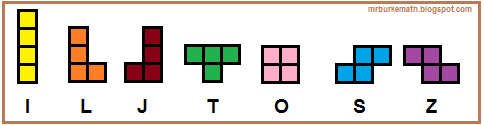
tetromino

2) Using expected frequencies when teaching probability

Summary: The use of the term ‘expected frequencies’ is novel and not widely known in mathematics education. The basic idea is very simple: instead of saying “the probability of X is 0.20 (or 20%)”, we would say “out of 100 situations like this, we would expect X to occur 20 times”.

To learn about this more intuitive and novel way of using expected frequencies to teach probability, visit the site at http://understandinguncertainty.org/using-expected-frequencies-when-teaching-probability.

3) Kettle and Cake Logic

Sigmund Freud tells the tale of a man accused of breaking his neighbour’s kettle. He mounts a three-stranded defence :

1. “I never borrowed it in the first place!”
2. “And anyway it was already broken when I did!”
3. “In any case, it was fine when I returned it!”

Freud used this as an example of the inconsistent logic of dreamland, although you won’t have to look too far afield in the waking world to find examples of similar reasoning[1].

Sounds interesting? View it at: https://plus.google.com/app/basic/stream/z13swvoqnzeyxtbep22fwvqoaxjlefohb04

4) Math Circle – Billiards

From Math Circle: The reason I picked billiards to feature at this particular moment is because twoof this year’s Fields Medalists study billiards: Maryam Mirzakhani and Artur Avila. To find out more about these amazing mathematicians, see our recent Math Munch post.

Visit http://ichoosemath.com/2014/09/14/math-circle-billiards/ to learn more!

5) The curious reluctance to define prime probability logically

The curious reluctance to define prime probability logically. The title says it all, except stress the point that we need to encourage more reasoning from first principles based on what we individually accept as self-evident, and not on what others believe to be self-evident.

6) Hailstone numbers shape a poem

By : One of my favorite mathy poets is Halifax mathematician Robert Dawson — his work is complex and inventive, and fun to puzzle over.  Dawson’s webpage at St Mary’s University lists his mathematical activity; his poetry and fiction are available in several issues of the Journal of Humanistic Mathematics and in several postings for this blog (15 April 201230 November 2013, 2 March 2014) and in various other locations findable by Google.
Can a poem be written by following a formula?  Despite the tendency of most of us to say NO to this question we also may admit to the fact that a formula applied to words can lead to arrangements and thoughts not possible for us who write from our own learning and experiences.  How else to be REALLY NEW but to try a new method? Set a chimpanzee at a typewriter or apply a mathematical formula.
Below we offer Dawson’s “Hailstone” and follow it with his explanation of how mathematics shaped the poem from its origin as a “found passage” from the beginning of Dickens’ Great Expectations.

Read more at: http://poetrywithmathematics.blogspot.co.uk/2014/09/hailstone-numbers-shape-poem.html?m=1

7) Approximating e using the digits 1–9

Read this article to learn how to approximate e using just the digitis 1-9! ((1 + 9^{–4^{7×6}})^{3^{2^{85}}}. ) Learn how it works and how remarkably accurate it is! The post is written by Richard Green.

Another closely related post is http://www.flyingcoloursmaths.co.uk/estimating-e/ by Flying Colours Maths Blog!

8)Sand Hill-bert Curve

IMG_20140917_190333

What is this about? It is a sand model of the Hilbert Curve, or Hilbert space-filling curve!

Check out http://blog.andreahawksley.com/sand-hill-bert-curve/ to learn more.

9)  Decending powers of x

I was in one of my colleagues lessons this week.and he was teaching the class to expand quadratic brackets. As the lesson went on he noticed that a number of pupils had been writing the X squared term, then the constant term then the X term so he pulled the class together to tell them that conventionally we write quadratic equations in decending powers of x. This is excellent practice and something we all should be encouraging, but it made me think “Why decending powers of x?”

Interesting question to ponder!

Read more at: http://cavmaths.wordpress.com/2014/09/26/decending-powers-of-x/

10) Extrapolation Gone Wrong: the Case of the Fermat Primes

Read more at: http://blogs.scientificamerican.com/roots-of-unity/2014/09/26/extrapolation-gone-wrong-the-case-of-the-fermat-primes/

11) Erica Klarreich Profiles an Award-Winning Mathematician

Erica Klarreich interviews a famous recent Fields Medallist Stanford University professor Maryam Mirzakhani at: http://www.theopennotebook.com/2014/09/30/erica-klarreich-profiles-an-award-winning-mathematician/

12) Will Rogers phenomenon

Check out the interesting Will Rogers phenomenon, with application to managing a football team! (http://mathsball.blogspot.com.es/2014/09/impossible-transfer-will-rogers-phenomenon.html)


Featured book:

Math Doesn’t Suck: How to Survive Middle School Math Without Losing Your Mind or Breaking a Nail

From a well-known actress, math genius and popular contestant on “Dancing With The Stars”—a groundbreaking guide to mathematics for middle school girls, their parents, and educators


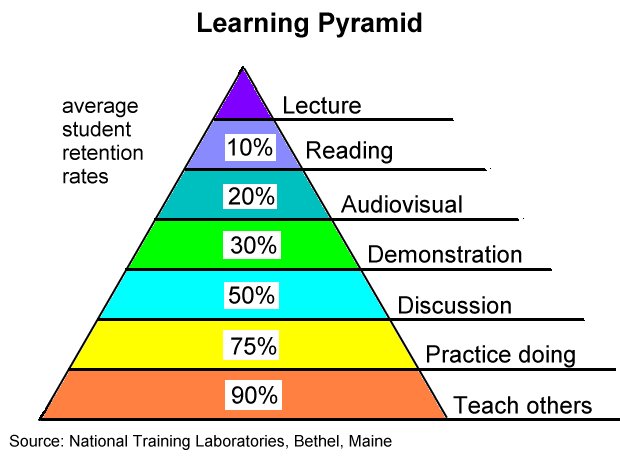
Learning Pyramid (How to Learn Maths)

learning_pyramid

The best way to learn maths is actually to teach others. The second best way to learn maths is to practice doing it!


Featured book:

Math Doesn’t Suck: How to Survive Middle School Math Without Losing Your Mind or Breaking a Nail

From a well-known actress, math genius and popular contestant on “Dancing With The Stars”—a groundbreaking guide to mathematics for middle school girls, their parents, and educators

As the math education crisis in this country continues to make headlines, research continues to prove that it is in middle school when math scores begin to drop—especially for girls—in large part due to the relentless social conditioning that tells girls they “can’t do” math, and that math is “uncool.” Young girls today need strong female role models to embrace the idea that it’s okay to be smart—in fact, it’s sexy to be smart!

It’s Danica McKellar’s mission to be this role model, and demonstrate on a large scale that math doesn’t suck. In this fun and accessible guide, McKellar—dubbed a “math superstar” by The New York Times—gives girls and their parents the tools they need to master the math concepts that confuse middle-schoolers most, including fractions, percentages, pre-algebra, and more. The book features hip, real-world examples, step-by-step instruction, and engaging stories of Danica’s own childhood struggles in math (and stardom). In addition, borrowing from the style of today’s teen magazines, it even includes a Math Horoscope section, Math Personality Quizzes, and Real-Life Testimonials—ultimately revealing why math is easier and cooler than readers think.


Inequality Olympiad Question and Solution

Let a, b, c be nonnegative real numbers satisfying a^2+b^2+c^2=1. Prove that

\sqrt{a+b}+\sqrt{b+c}+\sqrt{c+a}\geq\sqrt{7(a+b+c)-3}

Source: http://www.fen.bilkent.edu.tr/~cvmath/Problem/1408a.pdf


Featured book:

Inequalities: A Mathematical Olympiad Approach

This book is intended for the Mathematical Olympiad students who wish to prepare for the study of inequalities, a topic now of frequent use at various levels of mathematical competitions. In this volume we present both classic inequalities and the more useful inequalities for confronting and solving optimization problems. An important part of this book deals with geometric inequalities and this fact makes a big difference with respect to most of the books that deal with this topic in the mathematical olympiad. The book has been organized in four chapters which have each of them a different character. Chapter 1 is dedicated to present basic inequalities. Most of them are numerical inequalities generally lacking any geometric meaning. However, where it is possible to provide a geometric interpretation, we include it as we go along. We emphasize the importance of some of these inequalities, such as the inequality between the arithmetic mean and the geometric mean, the Cauchy-Schwarz inequality, the rearrangementinequality, the Jensen inequality, the Muirhead theorem, among others. For all these, besides giving the proof, we present several examples that show how to use them in mathematical olympiad problems. We also emphasize how the substitution strategy is used to deduce several inequalities.


A Journey of Mathematics 数学之旅

tomcircle's avatarMath Online Tom Circle

Excellent free course for non mathematicians.

This Philosophical Math course has started half way but past videos are still hosted on the site.

The course is taught by prof Wang of Shanghai Jiaotong Technology University上海交通大学 (SJT), the Alma Mata of former China President Jiang (江泽民), Prime minister Chu (朱镕基), and Prof Qian XueSheng (钱学森) “The Father of Chinese Space and Missile” (China exchanged his country home return with USA FBI for 4 American generals from Korean War prisoners of War) who sent Chinese Taikongnauts (太空人) to space. 

SJT was formed initially as the ‘Classe Préparatoire’ (Bachelor degree, post-High school Prep-college) for graduate engineering to MIT,  while Qing Hua 清华 University was a prep-college for graduate Science/ Math to Harvard, Chicago, Cornell,  etc.

Go to Lesson 3: He explains from a game of Go what is “Space” in maths: Geometrical n-dimensional Space, Linear space, vector space.. why study functional space (in  which…

View original post 281 more words

A Simple Brain Theory Endorsed By Bill Gates Claims To Help You Learn Anything

Source: http://www.businessinsider.sg/carol-dwecks-growth-mindset-theory-tweeted-by-bill-gates-2014-8/#.VAxnTPmSx8E

A small psychological change to how we approach challenges can drastically change how successful we are at these tasks.

That’s according to Carol Dweck, a psychology professor at Stanford University, who coined the term “growth mindset” in her 2007 book “Mindset: The New Psychology of Success.”

Microsoft magnate Bill Gates tweeted a video of Dweck explaining the growth mindset earlier this week:


Featured book:

Mindset: The New Psychology of Success

World-renowned Stanford University psychologist Carol Dweck, in decades of research on achievement and success, has discovered a truly groundbreaking idea–the power of our mindset.

Dweck explains why it’s not just our abilities and talent that bring us success–but whether we approach them with a fixed or growth mindset. She makes clear why praising intelligence and ability doesn’t foster self-esteem and lead to accomplishment, but may actually jeopardize success. With the right mindset, we can motivate our kids and help them to raise their grades, as well as reach our own goals–personal and professional. Dweck reveals what all great parents, teachers, CEOs, and athletes already know: how a simple idea about the brain can create a love of learning and a resilience that is the basis of great accomplishment in every area.

Stable Marriage Problem – Numberphile

This is an interesting problem in the topic of combinatorics and graph theory. It can be phrased in the context of arranging stable marriages.

Nice animation and clear explanation! Watch part 2 too for the mathematical explanation.


Featured book:

A Mind For Numbers: How to Excel at Math and Science (Even If You Flunked Algebra)

Whether you are a student struggling to fulfill a math or science requirement, or you are embarking on a career change that requires a higher level of math competency, A Mind for Numbers offers the tools you need to get a better grasp of that intimidating but inescapable field. Engineering professor Barbara Oakley knows firsthand how it feels to struggle with math. She flunked her way through high school math and science courses, before enlisting in the army immediately after graduation. When she saw how her lack of mathematical and technical savvy severely limited her options—both to rise in the military and to explore other careers—she returned to school with a newfound determination to re-tool her brain to master the very subjects that had given her so much trouble throughout her entire life.

In A Mind for Numbers, Dr. Oakley lets us in on the secrets to effectively learning math and science—secrets that even dedicated and successful students wish they’d known earlier. Contrary to popular belief, math requires creative, as well as analytical, thinking. Most people think that there’s only one way to do a problem, when in actuality, there are often a number of different solutions—you just need the creativity to see them. For example, there are more than three hundred different known proofs of the Pythagorean Theorem. In short, studying a problem in a laser-focused way until you reach a solution is not an effective way to learn math. Rather, it involves taking the time to step away from a problem and allow the more relaxed and creative part of the brain to take over. A Mind for Numbers shows us that we all have what it takes to excel in math, and learning it is not as painful as some might think!


How to subtract 12 from 32? (The Common Core Way)

This is an incredibly complicated way to evaluate 32-12.

One wonders if this is a step backward in education.

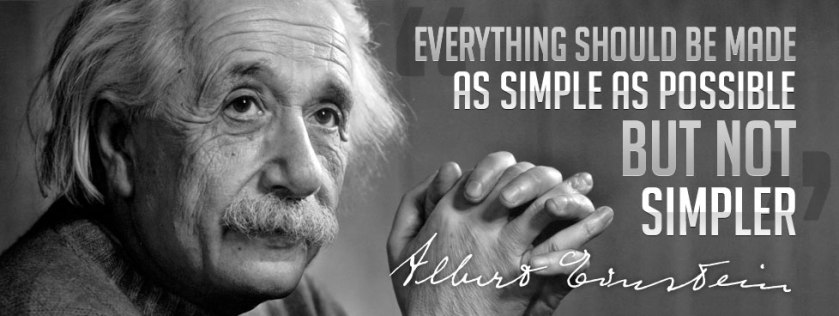
As Einstein said,  “Everything should be made as simple as possible, but not simpler”.

einstein quote


Featured book:

A Mind For Numbers: How to Excel at Math and Science (Even If You Flunked Algebra)

Whether you are a student struggling to fulfill a math or science requirement, or you are embarking on a career change that requires a higher level of math competency, A Mind for Numbers offers the tools you need to get a better grasp of that intimidating but inescapable field. Engineering professor Barbara Oakley knows firsthand how it feels to struggle with math. She flunked her way through high school math and science courses, before enlisting in the army immediately after graduation. When she saw how her lack of mathematical and technical savvy severely limited her options—both to rise in the military and to explore other careers—she returned to school with a newfound determination to re-tool her brain to master the very subjects that had given her so much trouble throughout her entire life.

In A Mind for Numbers, Dr. Oakley lets us in on the secrets to effectively learning math and science—secrets that even dedicated and successful students wish they’d known earlier. Contrary to popular belief, math requires creative, as well as analytical, thinking. Most people think that there’s only one way to do a problem, when in actuality, there are often a number of different solutions—you just need the creativity to see them. For example, there are more than three hundred different known proofs of the Pythagorean Theorem. In short, studying a problem in a laser-focused way until you reach a solution is not an effective way to learn math. Rather, it involves taking the time to step away from a problem and allow the more relaxed and creative part of the brain to take over. A Mind for Numbers shows us that we all have what it takes to excel in math, and learning it is not as painful as some might think!

A Basic Multiplication Question (Common Mistake)

Site: http://www.kiasuparents.com/kiasu/forum/viewtopic.php?f=29&t=71476&p=1377930#p1377930

HermioneGranger wrote:

Hi, a desperate question.In solutions of equation, when you multiply 2(2) by two, why is the answer 2(4) and not 4(4)?

TIA :)

Answer: 
Good question!

The theoretical reason is that if we multiply a product a(b) by two, we are actually having two copies of a(b).

Hence, 2 x a(b)= 2 times of a(b) = 2a(b) = a(2b)

For a concrete example, think about what would happen if we multiply 1(1)(1)(1)(1) by 2.

1(1)(1)(1)(1) is just 1, hence the answer should be 1(1)(1)(1)(2)=2, and not 2(2)(2)(2)(2) which is 32.


Featured book:

Math Doesn’t Suck: How to Survive Middle School Math Without Losing Your Mind or Breaking a Nail