Inner and Outer Approximation of Lebesgue Measurable Sets

Let E\subseteq\mathbb{R}. Then each of the following four assertions is equivalent to the measurability of E.

(Outer Approximation by Open Sets and G_\delta Sets)

(i) For each \epsilon>0, there is an open set G containing E for which m^*(G\setminus E)<\epsilon.

(ii) There is a G_\delta set G containing E for which m^*(G\setminus E)=0.

(Inner Approximation by Closed Sets and F_\sigma Sets)

(iii) For each \epsilon>0, there is a closed set F contained in E for which m^*(E\setminus F)<\epsilon.

(iv) There is an F_\sigma set F contained in E for which m^*(E\setminus F)=0.

Proof:
(E measurable implies (i)):

Assume E is measurable. Let \epsilon>0. First we consider the case where m^*(E)<\infty. By the definition of outer measure, there is a countable collection of open intervals \{I_k\}_{k=1}^\infty which covers E and satisfies \displaystyle \sum_{k=1}^\infty l(I_k)<m^*(E)+\epsilon.

Define G=\bigcup_{k=1}^\infty I_k. Then G is an open set containing E. By definition of the outer measure of G, \displaystyle m^*(G)\leq\sum_{k=1}^\infty l(I_k)<m^*(E)+\epsilon.

Since E is measureable and has finite outer measure, by the excision property, \displaystyle m^*(G\setminus E)=m^*(G)-m^*(E)<\epsilon.

Now consider the case that m^*(E)=\infty. Since \mathbb{R} is \sigma-finite, E may be expressed as the disjoint union of a countable collection \{E_k\}_{k=1}^\infty of measurable sets, each of which has finite outer measure.

By the finite measure case, for each k\in\mathbb{N}, there is an open set G_k containing E_k for which m^*(G_k\setminus E_k)<\epsilon/2^k. The set G=\bigcup_{k=1}^\infty G_k is open, it contains E and \displaystyle G\setminus E=(\bigcup_{k=1}^\infty G_k)\setminus E\subseteq\bigcup_{k=1}^\infty (G_k\setminus E_k).

Therefore
\begin{aligned}  m^*(G\setminus E)&\leq\sum_{k=1}^\infty m^*(G_k\setminus E_k)\\  &<\sum_{k=1}^\infty\epsilon/2^k\\  &=\epsilon.  \end{aligned}
Thus property (i) holds for E.

((i) implies (ii)):

Assume property (i) holds for E. For each k\in\mathbb{N}, choose an open set O_k that contains E such that m^*(O_k\setminus E)<1/k. Define G=\bigcap_{k=1}^\infty O_k. Then G is a G_\delta set that contains E. Note that for each k, \displaystyle G\setminus E\subseteq O_k\setminus E.

By monotonicity of outer measure, \displaystyle m^*(G\setminus E)\leq m^*(O_k\setminus E)<1/k.

Thus m^*(G\setminus E)=0 and hence (ii) holds.

((ii)\implies E is measurable):

Now assume property (ii) holds for E. Since a set of measure zero is measurable, G\setminus E is measurable. G is a G_\delta set and thus measurable. Since measurable sets form a \sigma-algebra, E=G\cap(G\setminus E)^c is measurable.

((i)\implies(iii)):

Assume condition (i) holds. Note that E^c is measurable iff E is measurable. Thus there exists an open set G\supseteq E^c such that m^*(G\setminus E^c)<\epsilon.

Define F=\mathbb{R}\setminus G which is closed. Note that F\subseteq E, and m^*(E\setminus F)=m^*(G\setminus E^c)<\epsilon.

((iii)\implies(i)):

Similar.

((ii)\iff(iv)):

Similar idea. Note that a set is G_\delta iff its complement is F_\sigma.

New PSLE Scoring System, AL1 to AL8 (Singapore)

Source: http://www.straitstimes.com/singapore/education/changes-to-the-psle-scoring-system-7-things-to-note-from-2021

The new, long awaited, PSLE scoring system is now out. Under the new scoring system, T-score is being replaced by Achievement Levels:

AL1: 90 and above
AL2: 85-89
AL3: 80-84
AL4: 75-79
AL5: 65-74
AL6: 45-64
AL7: 20-44
AL8: Below 20

Would this be effective at the target goal of “reducing stress and competition among pupils and parents?”.

Firstly, the good point about this new scoring system is that it is not as fine as the previous T-score system, where every mark matters. Thus, technically there is no difference between a 90 mark and a 100 mark, so there is no need to aim for perfection in a certain sense.

Some concerns of parents are listed out in this article.

Personally, I think that this scoring system is similar to the O Level System Grading of A1, A2, B3, etc. The change in scoring system per se is unlikely to be able to reduce the stress of students, especially those scoring below 90. Those scoring >90 but not close to 100 may breathe a sigh of relief that they don’t have to aim for 100. However, for the students scoring below 90, the stress level remains essentially unchanged.

Note that despite the “wider scoring band” label, the band is not that wide after all. In the higher AL’s the difference from one AL to the next is merely 5 marks, which may be just one problem sum in mathematics. In the previous PSLE it is “every mark counts”. In the new PSLE it is “every question counts”, which is not much of a difference.

For Primary students, the stress comes mostly from the kiasu parents, any superficial change in the scoring system will not have much effect.

Overall, nothing much has changed. It is like changing between Celsius to Fahrenheit, there is no difference in the underlying principle of PSLE, which is to serve as a entry criteria for secondary schools.

The main change, as some parents have noted, is that now all subjects are equally important. It is no longer possible to compensate for one weak subject (e.g. Mother Tongue) by scoring extremely well in other subjects. It can be said that the new system favours “all rounders” or “Jack of all trades” over “specialists” in one or two subjects.

The AL6: 45-64 band looks extremely dangerous to fall in (especially those weak in Mother Tongue) as it does not differentiate between a fail grade (45) and a much higher grade (64). Many English-speaking families should be quite worried now…

Another area of concern is that due to the “wider scoring band”, the importance of DSA (Direct School Admission) has increased tremendously. Due to inevitably many students achieving the perfect score of ‘4’, the top schools (like RGS/NYGH/RI/HCI) may have to resort to DSA/GAT tests to select their students. This will probably increase the stress of students, as other than PSLE, they have to worry about DSA/GAT/CCA and building a portfolio of achievements.

Do post your comments, if any, below!

Is the highest-ranked school the right one for your child? (Singapore)

Sometimes, the highest-ranked school may not be the right school for every child. This issue is also discussed in Malcolm Gladwell’s book David and Goliath: Underdogs, Misfits, and the Art of Battling Giants.

Source: http://www.straitstimes.com/opinion/is-the-highest-ranked-school-the-right-one-for-your-child

Q Is the highest-ranked school the right school for my child?

A As a Singaporean economist working on issues in education, I am often asked by parents to recommend the best school for their children. Invariably, what such parents were really asking me was to identify a highly ranked school that their child had a decent chance of getting into.

But this raises a dilemma – is a highly ranked school really the most suitable school for a child?

Adults may recall school environments as idyllic places, but we forget that classrooms have now become arenas where fierce competition takes place among classmates.

In today’s schools, students take part in academic tournaments where better test results, compared to those of their peers, bring greater opportunities for scholarships and allow access to better schools. Those who do not excel in these tournaments may lose their incentive to compete and ultimately drop out of the academic race altogether.

This is where my work provides some guidelines for parents weighing the pros and cons of being in a more competitive school.

Last year, a fellow researcher, Mr Yoshio Kamijo, and I conducted a two-day experiment where we first tested the maths ability of 132 Secondary 2 students in a school in Shandong, China, through maths pre-tests on the first day.

Afterwards, we categorised the performance of our students into four groups, based on those pre-tests: low maths ability, average maths ability, high maths ability and a mixed group with low-, average- and high-ability students in one class.

We were interested in comparing the performance of students in a mixed class with those in a class with similar-ability students.

Our experiment aimed to see how students in each class performed in another maths test given on the second day, under a competitive environment where winners received rewards and losers were given punishments.

The point of the exercise was to investigate whether being grouped with similar- or dissimilar-ability students mattered to students of different abilities.

Just like a scientific experiment, by controlling for their pre-ability, their performance in our competition captured how such students responded to the knowledge of competing against similar or weaker/stronger opponents.

Our final results were not that surprising. We compared the results of students in the mixed class with similar-ability peers.

We found that those in the mixed class had different reactions towards their competitors depending on their ability level: the low-ability students were discouraged and performed poorly, the middle-ability students were more motivated and did better in a mixed class than in a class with similar-ability students, while for the high-ability students, no real difference was seen.

The difference in performance was significant.

Read more at http://www.straitstimes.com/opinion/is-the-highest-ranked-school-the-right-one-for-your-child

小学生厌恶数学写诗:数学是死亡之源

Source: http://news.sina.com.cn/s/2015-02-08/031931495241.shtml

武汉的董女士前天在家帮女儿清理书包,从书包里搜出一张纸,上面赫然写着一首诗:数学是死亡之源,它像入地狱般痛苦。它让孩子想破脑汁,它让家长急得转圈。它让校园死气沉沉,它使生命慢慢离去。生命从数学中走去,一代代死得超快。那是生命的敌人,生命从数学中走去。珍惜宝贵的生命吧,一代代死得超快。数学是死亡之源。

读完这首诗,董女士惊呆了:“没想到她厌恶数学到了这般田地。”

董女士的女儿晶晶,今年10岁,读小学五年级,从进小学开始就特别不喜欢数学,尤其讨厌应用题,只要碰到追及问题和工程问题,晶晶那绝对是“一个脑袋两个大”。这次期末考试晶晶的数学考了70分,全班倒数第七。

在董女士的逼问下,晶晶终于交代,这首诗是和班上另外两个女生一起创作的。她们三个都对数学不感冒,联合创作了此诗,抒发忧伤。

网友们看到这首诗后,也表达了不同的观点。网友“@飞不动的咋咋鸟”说,“很有才的小学生,这搞不好以后是余秀华第二啊!”网友“@左边追寻”则说,“想用自己的血泪史告诉这位妹妹,学好数学很重要!”据《武汉晚报》

(原标题:小学生厌恶数学写诗:数学是死亡之源)

The Dangerous Math of Chinese Island Disputes

Source: http://www.wsj.com/articles/SB10001424052970203922804578082371509569896

China’s standoff with Japan over the rocky Senkaku (Diaoyu) Islands has entered its second month. The current confrontation, however, is more dangerous than is commonly believed. China’s past behavior in other territorial disputes demonstrates why the Senkaku standoff is primed to explode.

Since 1949, China has been involved in 23 territorial disputes with its neighbors on land and at sea. Seventeen of them have been settled, usually through compromise agreements. Nevertheless, China has used force, often more than once, in six of these disputes. And it’s these cases that most closely parallel the Senkaku impasse.

To start, China has usually only used force in territorial disputes with its most militarily capable neighbors. These include wars or major clashes with India, Russia and Vietnam (several times), as well as crises involving Taiwan. These states have had the greatest ability to check China’s territorial ambitions. In disputes with weaker states, such as Mongolia or Nepal, Beijing has eschewed force because it could negotiate from a position of strength. Japan is now China’s most powerful maritime neighbor, with a modern navy and a large coast guard.

Nick Vujicic’s Academic Advice to a Singaporean Mom

Time: 1.09:32

A Singaporean mother asks Nick Vujicic, “What would you say to a kid who has totally lost all interest in a subject?”.

Can see Nick is slightly caught off-guard by this very typical Singaporean question that is probably rarely asked in the US. His answer is slightly off-topic (talks about drugs, etc, which is not that relevant in Singaporean context) but nonetheless very inspirational!

Watch the video to hear about Nick Vujicic’s answer!

Nick Vujicic is one of the most inspirational motivational speakers ever. He also runs a nonprofit charity organization that help kids in poverty around the world. Do check out some of his books.


Life Without Limits: Inspiration for a Ridiculously Good Life

How to remember the Divergence Theorem

The Divergence Theorem:
\displaystyle \int_U\nabla\cdot\mathbf{F}\,dV_n=\oint_{\partial U}\mathbf{F}\cdot\mathbf{n}\,dS_{n-1}

is a rather formidable looking formula that is not so easy to memorise.

One trick is to remember it is to remember the simpler-looking General Stoke’s Theorem.

One can use the general Stoke’s Theorem (\int_{\Omega}d\omega=\int_{\partial\Omega}\omega) to equate the n-dimensional volume integral of the divergence of a vector field \mathbf{F} over a region U to the (n-1)-dimensional surface integral of \mathbf{F} over the boundary of U.

On Semidirect Products

Outer Semidirect Product

Given any two groups N and H and a group homomorphism \phi:H\to\text{Aut}(N), we can construct a new group N\rtimes_\phi H, called the (outer) semidirect product of N and H with respect to \phi, defined as follows.
(i) The underlying set is the Cartesian product N\times H.
(ii) The operation, \bullet, is determined by the homomorphism \phi:

\bullet: (N\rtimes_\phi H)\times (N\rtimes_\phi H)\to N\rtimes_\phi H

(n_1,h_1)\cdot(n_2,h_2)=(n_1\phi_{h_1}(n_2),h_1h_2)

for n_1,n_2\in N and h_1,h_2\in H.

This defines a group in which the identity element is (e_N, e_H) and the inverse of the element (n,h) is (\phi_{h^{-1}}(n^{-1}), h^{-1}).
Pairs (n, e_H) form a normal subgroup isomorphic to N, while pairs (e_N, h) form a subgroup isomorphic to H.

Inner Semidirect Product (Definition)

Given a group G with identity element e, a subgroup H, and a normal subgroup N\lhd G; then the following statements are equivalent:

(i) G is the product of subgroups, G=NH, where the subgroups have trivial intersection, N\cap H=\{e\}.
(ii) For every g\in G, there are unique n\in N and h\in H, such that g=nh.

If these statements hold, we define G to be the semidirect product of N and H, written G=N\rtimes H.

Inner Semidirect Product Implies Outer Semidirect Product

Suppose we have a group G with N\lhd G, H\leq G and every element g\in G can be written uniquely as g=nh where n\in N, h\in H.

Define \phi: H\to\text{Aut}(N) as the homomorphism given by \phi(h)=\phi_h, where \phi_h(n)=hnh^{-1} for all n\in N, h\in H.

Then G is isomorphic to the semidirect product N\rtimes_{\phi}H, and applying the isomorphism to the product, nh, gives the tuple, (n,h). In G, we have
\displaystyle (n_1h_1)(n_2h_2)=n_1h_1n_2(h_1^{-1}h_1)h_2=(n_1\phi_{h_1}(n_2))(h_1h_2)=(n_1,h_1)\cdot(n_2,h_2)
which shows that the above map is indeed an isomorphism.

Sylow Theorems

Sylow Theorems

Let G be a finite group.

Theorem 1

For every prime factor p with multiplicity n of the order of G, there exists a Sylow p-subgroup of G, of order p^n.

Theorem 2

All Sylow p-subgroups of G are conjugate to each other, i.e.\ if H and K are Sylow p-subgroups of G, then there exists an element g\in G with g^{-1}Hg=K.

Theorem 3

Let p be a prime such that |G|=p^nm, where p\nmid m. Let n_p be the number of Sylow p-subgroups of G. Then:
1) n_p\mid m, which is the index of the Sylow p-subgroup in G.
2) n_p\equiv 1\pmod p.

Theorem 3b (Proof)

We have n_p=[G:N_G(P)], where P is any Sylow p-subgroup of G and N_G denotes the normalizer.

Proof

Let P be a Sylow p-subgroup of G and let G act on \text{Syl}_p(G) by conjugation. We have |\text{Orb}(P)|=n_p, \text{Stab}(P)=\{g\in G:gPg^{-1}=P\}=N_G(P).

By the Orbit-Stabilizer Theorem, |\text{Orb}(P)|=[G:\text{Stab}(P)], thus n_p=[G:N_G(P)].

Orbit-Stabilizer Theorem

Let G be a group which acts on a finite set X. Then \displaystyle |\text{Orb}(x)|=[G:\text{Stab}(x)]=\frac{|G|}{|\text{Stab}(x)|}.

Flyers surface in Batam warning of bomb attacks targeting Singaporeans

This is indeed scary news. Just went to Batam not long ago.

On a side note, the flyers seem to be counter-intuitive, why on earth would the terrorists send a warning letter stating where they are going to bomb? More likely a scare tactic or a hoax, but better be safe than sorry.

Update: Outdated MFA advisory falsely linked to letters warning of attacks on Batam

Source: http://news.asiaone.com/news/singapore/flyers-surface-batam-warning-bomb-attacks-targeting-singaporeans?utm_campaign=Echobox&utm_medium=Social&utm_source=Twitter&link_time=1467873063#xtor=CS1-2

Flyers and letters warning that bomb attacks will be carried out at a number of locations in Batam and Bintan in the Riau archipelago have surfaced, an Indonesian news website has reported.

According to Batam Today, the flyers claim that attacks would occur at the Batam Center Ferry Terminal and Nagoya on the island of Batam, as well as the Bintan Telani Ferry Terminal and Tanjung Pinang on the island of Bintan.

– See more at: http://news.asiaone.com/news/singapore/flyers-surface-batam-warning-bomb-attacks-targeting-singaporeans?utm_campaign=Echobox&utm_medium=Social&utm_source=Twitter&link_time=1467873063#xtor=CS1-2

MIT Students Won $8 Million in the Massachusetts Lottery

Old but interesting news. Those students used math to successfully invest in lottery tickets!

Source: http://newsfeed.time.com/2012/08/07/how-mit-students-scammed-the-massachusetts-lottery-for-8-million/

Several years ago, while doing research for a school project, a group of MIT students realized that, for a few days every three months or so, the most reliably lucrative lottery game in the country was Massachusetts’ Cash WinFall, because of a quirk in the way a jackpot was broken down into smaller prizes if there was no big winner. The math whizzes quickly discovered that buying about $100,000 in Cash WinFall tickets on those days would virtually guarantee success. Buying $600,000 worth of tickets would bring a 15%–20% return on investment, according to the New York Daily News.

Critique on the Modern Axiomatic Approach of Mathematics

This video is a rare critique of the axiomatic approach of modern mathematics. Worth viewing, to gain an alternative viewpoint. Very interesting and well-argued!

Quote by Professor Wildberger (PhD Yale):

I believe it was by having a closer look and think about Euclid. What he is doing is so very different from what modern mathematics is up to, that it naturally leads one to suspicions. One can tell that Euclid really honestly meant to start a logical development. The current axiomatics are exactly the opposite–they were tacked on at the end of a long development when all else failed, and clearly are just a backward attempt to keep up a framework for which other more direct supports proved impossible. When in doubt, resort to wishful thinking.

Prime Minister Lee Hsien Loong’s Message to Youths

PM to youth: Go for your dreams, don’t be afraid to make mistakes

Source: http://www.straitstimes.com/politics/pm-to-youth-go-for-your-dreams-dont-be-afraid-to-make-mistakes

Prime Minister Lee Hsien Loong marked Youth Day by posting a jump shot on Facebook yesterday accompanied with a message to the “young and young at heart” to experiment and try things out, saying they should not be afraid of making mistakes.

FTFGAG: Fundamental Theorem of Finitely Generated Abelian Groups

Fundamental Theorem of Finitely Generated Abelian Groups

Primary decomposition

Every finitely generated abelian group G is isomorphic to a group of the form \displaystyle \mathbb{Z}^n\oplus\mathbb{Z}_{q_1}\oplus\dots\oplus\mathbb{Z}_{q_t} where n\geq 0 and q_1,\dots,q_t are powers of (not necessarily distinct) prime numbers. The values of n, q_1, \dots, q_t are (up to rearrangement) uniquely determined by G.

Invariant factor decomposition

We can also write G as a direct sum of the form \displaystyle \mathbb{Z}^n\oplus\mathbb{Z}_{k_1}\oplus\dots\oplus\mathbb{Z}_{k_u}, where k_1\mid k_2\mid k_3\mid\dots\mid k_u. Again the rank n and the invariant factors k_1,\dots,k_u are uniquely determined by G.

Amazon CPM Ads VS WordPress WordAds

I have implemented Amazon CPM Ads to my other site http://mathtuition88.blogspot.sg/ which is currently mainly used to host my Javascript Apps like:

Revenue wise, Amazon CPM Ads beats WordAds hands down. Amazon CPM Ads pays at least 3 times the amount WordAds pays, for the same amount of traffic. It can also be integrated with Amazon Associates via the “passback” ad, so that when the CPM Ad is not filled, it shows the Amazon Associates affiliate ad instead.

For WordPress.com, the only form of ad allowed is WordAds, which is still in the development phase.

Engineering matters for Singapore’s future, says PM Lee Hsien Loong

Source: http://www.straitstimes.com/politics/engineering-key-to-singapores-future-as-smart-nation-pm

Excerpt:

Singapore has boosted its water supply by recycling water and increased its physical size by reclaiming land – all feats of engineers.

Indeed, just as engineering helped transform Singapore into a modern state, it will continue to play a key role as the country strives to be a smart nation and overcome its lack of resources, said Prime Minister Lee Hsien Loong yesterday.

But it has since become harder to attract top students to study engineering and do engineering jobs, as many opt for the humanities, business and finance, he noted.

Engineering is among the major professions here with the most vacancies in the past few years.

Cauchy-Riemann Equations

Cauchy-Riemann Equations

Let f(x+iy)=u(x,y)+iv(x,y). The Cauchy-Riemann equations are:

\begin{aligned}  u_x&=v_y\\  u_y&=-v_x.  \end{aligned}

Alternative Form (Wirtinger Derivative)

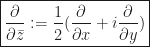
The Cauchy-Riemann equations can be written as a single equation \displaystyle \frac{\partial f}{\partial\bar z}=0 where \displaystyle \frac{\partial}{\partial\bar z}=\frac 12(\frac{\partial}{\partial x}+i\frac{\partial}{\partial y}) is the Wirtinger derivative with respect to the conjugate variable.

Goursat’s Theorem

Suppose f=u+iv is a complex-valued function which is differentiable as a function f:\mathbb{R}^2\to\mathbb{R}^2. Then f is analytic in an open complex domain \Omega iff it satisfies the Cauchy-Riemann equations in the domain.
dz and dz bar: How to derive the Wirtinger derivatives

Something interesting in Complex Analysis is the Wirtinger derivatives:

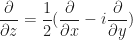
\displaystyle\boxed{\frac{\partial}{\partial z}:=\frac 12(\frac{\partial}{\partial x}-i\frac{\partial}{\partial y})}

\displaystyle\boxed{\frac{\partial}{\partial \bar z}:=\frac 12(\frac{\partial}{\partial x}+i\frac{\partial}{\partial y})}

They are often simply defined as such, but one would be curious how to derive them, at least heuristically.

How to derive Wirtinger derivatives

It turns out we can derive them as such. Any complex function f(z) can be viewed as a function f(x,y) by considering z=x+iy. Since x=\frac 12 (z+\bar z), y=-\frac 12 i(z-\bar z), we can also view f(x,y) as f(z,\bar z).

Then by the Chain Rule (for multivariable calculus), we have \displaystyle\frac{\partial}{\partial x}=\frac{\partial z}{\partial x}\frac{\partial}{\partial z}+\frac{\partial\bar z}{\partial x}\frac{\partial}{\partial\bar z}=\frac{\partial}{\partial z}+\frac{\partial}{\partial\bar z}.

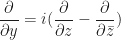
Similarly, we get \displaystyle\frac{\partial}{\partial y}=i(\frac{\partial}{\partial z}-\frac{\partial}{\partial\bar z}).

Then, solving the simultaneous equations we get the Wirtinger derivatives.

\displaystyle i\frac{\partial}{\partial x}+\frac{\partial}{\partial y}=2i\frac{\partial}{\partial z}. Thus, \displaystyle\frac{\partial}{\partial z}=\frac 12(\frac{\partial}{\partial x}-i\frac{\partial}{\partial y}).

Similarly, we can get that \displaystyle\boxed{\frac{\partial}{\partial \bar z}:=\frac 12(\frac{\partial}{\partial x}+i\frac{\partial}{\partial y})}.

Using Wirtinger derivatives, we can express the Cauchy-Riemann equations in a succinct manner: A function satisfies the Cauchy-Riemann equations iff \displaystyle\frac{\partial f}{\partial\bar z}=0.

Differences in New H2 Math Syllabus (9758)

H2 Math has undergone a revamp to the new syllabus (Subject Code 9758).

So what are the differences between the new syllabus and the old syllabus (Subject Code 9740)?

Main Differences:

  1. Removal of Mathematical Induction
  2. Removal of Recurrence relation
  3. Removal of Loci (Complex Numbers)
  4. Removal of Poisson distribution
  5. Removal of normal approximation to binomial distribution
  6. The new H2 Math Syllabus specifically mentions the importance of the modulus function in inequality.

Most of the changes are actually removal, which means the new syllabus covers less content than the previous syllabus. Many of the topics are being moved to Further Math.

Despite the removal of material, students are advised to study beyond the syllabus and keep an open mind since the concepts will be useful in further studies.

Switch to holistic assessment may add pressure on students

Government’s plan to change current methods of assessment to reduce emphasis on academic achievement may be undermined by the fact that Singaporeans will adapt to compete on whatever terms they are given

The winds of change are blowing hard against the Singaporean obsession with examination results that deprives the young of their childhood and propagates despair in society’s pressure-cooker environment.

In April, the Ministry of Education (MOE) announced that the aggregate score for the Primary School Leaving Examination (PSLE) will be scrapped, and replaced with wider scoring bands from 2021. This will be similar to grading at O and A levels.

The current system involves working out a child’s aggregate T-score based on component subject scores – English, Mother Tongue, mathematics and science – weighted against the range of scores within each cohort.

Most of all, I wonder how fair and meritocratic it is for an educational system to systematically reward those who have spent $50,000 pursuing music as a “talent” from age four, when the educational system itself offers students no violins, no violin teachers, and no access to the ABRSM (Associated Board of the Royal Schools of Music) grading certificates schools ask for.

Read more at: http://www.straitstimes.com/opinion/switch-to-holistic-assessment-may-add-pressure-on-students

Updated LaTeX to WordPress Converter

WordPress is notorious for not accepting \begin{align} … \end{align} as it is not in math mode.

I have updated the LaTeX to WordPress Converter to change \begin{align} … \end{align} to $l atex\begin{aligned} … \end{aligned}$ which works in WordPress.

Test Input:

Let $h=\chi_{[0,1]}$, the characteristic function of $[0,1]$. We have $\|\chi_{[0,1]}\|_\infty=1$, so $\chi_{[0,1]}\in L^\infty$. Then,
\begin{align*}
(Hh)(x)&=\frac{1}{\pi}\int_0^1\frac{1}{x-t}\ dt\\
&=\frac{1}{\pi}[-\ln|x-t|]_0^1\\
&=\frac{1}{\pi}\ln\frac{|x|}{|x-1|}.
\end{align*}
As $x\to 1$, $(Hh)(x)\to\infty$. Thus, $Hh$ is an unbounded function, so $H$ is not bounded as a map: $L^\infty\to L^\infty$.
\[\frac{a}{b}=c\]

Test Output:

Let h=\chi_{[0,1]}, the characteristic function of [0,1]. We have \|\chi_{[0,1]}\|_\infty=1, so \chi_{[0,1]}\in L^\infty. Then,
\begin{aligned}  (Hh)(x)&=\frac{1}{\pi}\int_0^1\frac{1}{x-t}\ dt\\  &=\frac{1}{\pi}[-\ln|x-t|]_0^1\\  &=\frac{1}{\pi}\ln\frac{|x|}{|x-1|}.  \end{aligned}
As x\to 1, (Hh)(x)\to\infty. Thus, Hh is an unbounded function, so H is not bounded as a map: L^\infty\to L^\infty.
\displaystyle \frac{a}{b}=c


Prelim vs A Level Results

Many students upon entering JC (Junior College) in Singapore are demoralised by their poor grades. Students used to scoring As in secondary schools may now be scoring D, E or even S (subpass), U (ungraded) in JCs.

However, prelim (or promo/block test) results are well known to be traditionally lower than the A level results.

Do speak to your teachers or seniors to get a feel of how to convert your prelim results to the predicted A level results.

A rule of thumb is that if you are in a top tier JC, scoring B’s or C’s in prelims is already commendable.

Quote:

I used to be a Hwachong student. Don’t be alarmed by bad grades during block tests, promo exams or even prelims….the school tends to mark stricter. I never got an A in my other subjects (lit, math, history) except for economics (once), most of the time if you get a B or C it’s pretty commendable. But by A levels many will score As for subjects they used to get Bs or Cs in. I got all As

Another rule of thumb is the percentile is more important than the actual grade for internal school exams. Check your school’s distinction rate. For instance, if your school’s H2 Maths distinction rate is 60%, and you are above 60%, then even if you are getting a D you have a good chance of scoring a distinction in the actual A levels.

A final rule of thumb is that the prelim grades is usually two band grades below the A level grade. E.g. If you score a C in prelims, your predicted A level grade is B or A.

Quote: “It is useful as an indicator about your performance respective to other students, but not about your absolute performance. The top schools deflate your grades by maybe one or two grade bands? Not so sure about the rest.”

Kids of pushy parents ‘face higher risk of depression’: NUS study

Recently there are two articles on “Tiger Moms” and “Kiasu (translated as “overly afraid of losing”) Parents” in Singapore. Interesting to read.

Parents in Singapore are indeed at a dilemma, overly pushing their child will lead to negative consequences (as mentioned in the articles), but not pushing their child may lead to falling behind academically.

This quote sums it up:

A housewife, who wanted to be known only as Mrs Lim, 43, said: “In Singapore, the pressure to do well starts early. Parents have no choice but to set high expectations of their kids’ performance.

“But I will be more mindful of the way I speak to my kids, so that they won’t feel bad about making mistakes in their work.”

The solution, ideally, is for children to be self-motivated rather than being pushed by parents. Check out some motivational educational books here.

The worst consequence of pushing children is that the child may lose the joy of learning.


Source: http://www.straitstimes.com/singapore/kids-of-pushy-parents-face-higher-risk-of-depression

Children with pushy parents are at a much higher risk of developing depression or anxiety symptoms, according to a local university study. The findings, according to researchers, are especially relevant to a society like Singapore’s, in which there is an emphasis on academic excellence.

Said the study’s head, Assistant Professor Ryan Hong: “Parents may set unrealistically high expectations for their children.

“As a result, a sizeable segment of children may become fearful of making mistakes.”


Source: http://www.straitstimes.com/singapore/intrusive-parents-may-lead-children-to-be-overly-self-critical-nus-study

SINGAPORE – Children with intrusive parents may become overly critical of themselves, and such tendencies – at high or increased levels – are reportedly linked to depression or anxiety.

Parents who have high expectations of their children’s academic performance may urge them to achieve good grades or over-react when they make mistakes, but such actions may lead to unintended consequences, a National University of Singapore (NUS) study has found.

The five-year study, conducted by researchers from the department of psychology at NUS, examined how maladaptive perfectionism – commonly known as the “bad” form of perfectionism – develops in primary school children in Singapore.

The maths formula that proves Brexit will be a disaster

Source: http://www.telegraph.co.uk/news/2016/04/18/the-maths-formula-that-proves-brexit-will-be-a-disaster-accordin/

Leaving the EU would be a disaster: the bods at the Treasury have done the sums. They really have. Today, journalists attending a George Osborne speech were each handed a thumping great 200-page wodge of Treasury bumph, containing the mathematical formulae they’d used. Here’s one from page 159.

1n(Tijt) = α ij  + Y t  + α₁ 1n(Y it  * Y jt ) + α₂ 1n(POP it  * POP jt ) + ε ijt

= α ij  + Y t  + αX ijt  + ε ijt

So now you know. Case closed. You can imagine the shockwaves this will send through the country. In pubs across the land they’ll be talking of little else.

“Don’t know about you, Baz, but I’m voting to leave. Get immigration down, take back our country, and stop this lot in Brussels pushing us around.”

“Come off it, Dave. Be realistic. What about 1n(Tijt)?”

“1n(Tijt)?”

“Yeah, 1n(Tijt).”

“What’s 1n(Tijt)?”

“Well, it’s equal to α ij  + Y t  + α₁ 1n(Y it  * Y jt ) + α₂ 1n(POP it  * POP jt ) + ε ijt .”

“God, that’s a point. I’d never looked at it like that before.”

“See, it all makes sense when you think about it.”

“Fair enough, got me bang to rights there. And there was me thinking 3x(Tijt) = α it ₁ * Y jt  + (X * Y it ) + 2X it ₃ – ε njt .”


At first I thought this was a joke. But apparently it is a real formula.

brexit

All-New Kindle—All book. No glare. Zero distractions.

Shop Amazon Devices – All New Kindle 6-inch

We would like to introduce you to the newest member of the Amazon device family. The all-new Kindle e-reader offers the following benefits and much more:

  • The all-new Kindle is 11% thinner and 16% lighter than the previous generation Kindle, making it easy and comfortable to hold in one hand.
  • Kindle uses actual ink particles and proprietary, hand-built fonts to create crisp text similar to what you see in a physical book. The blacks and whites on the screen are uniform, improving text and image quality.
  • No screen glare, even in bright sunlight, unlike tablets
  • Kindle doesn’t need power to maintain a page of text, allowing you to read for weeks on a single charge.
  • Unlike reflective tablet and smartphone screens, the high contrast touchscreen display eliminates glare in any setting—even direct sunlight.

Check out the new Kindle here: Shop Amazon Devices – All New Kindle 6-inch

kindle new

Free H2 Literature Website

“Unseen” (https://unseenthemagazine.wordpress.com/) is a new website set up by literature teachers and experts specially for H2 students studying literature.

Recently, they are also featured on Straits Times.

It is nice to see people passionate about literature setting up a website to benefit students. The purpose of studying literature (or any other subject) shouldn’t be solely about scoring in exams, but rather gaining knowledge and experiencing the joy of learning.

Do check out the website!

Updated LaTex Javascript Converter

I have updated the LaTeX to WordPress Converter to change \[ \] to $l atex\displaystyle and $ respectively.

Note that \[ … \] is preferable over $$ … $$.

Test code:

Input:

If $(X,\Sigma,\mu)$ is a measure space, $f$ is a non-negative measurable extended real-valued function, and $\epsilon>0$, then \[\mu(\{x\in X: f(x)\geq\epsilon\})\leq\frac{1}{\epsilon}\int_X f\,d\mu.\]

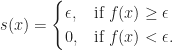
Define \[s(x)=\begin{cases}
\epsilon, &\text{if}\ f(x)\geq\epsilon\\
0, &\text{if}\ f(x)<\epsilon.
\end{cases}\]
Then $0\leq s(x)\leq f(x)$. Thus $\int_X f(x)\,d\mu\geq\int_X s(x)\,d\mu=\epsilon\mu(\{x\in X: f(x)\geq\epsilon\})$. Dividing both sides by $\epsilon>0$ gives the result.

Output:

If (X,\Sigma,\mu) is a measure space, f is a non-negative measurable extended real-valued function, and \epsilon>0, then \displaystyle \mu(\{x\in X: f(x)\geq\epsilon\})\leq\frac{1}{\epsilon}\int_X f\,d\mu.

Define \displaystyle s(x)=\begin{cases}  \epsilon, &\text{if}\ f(x)\geq\epsilon\\  0, &\text{if}\ f(x)<\epsilon.  \end{cases}
Then 0\leq s(x)\leq f(x). Thus \int_X f(x)\,d\mu\geq\int_X s(x)\,d\mu=\epsilon\mu(\{x\in X: f(x)\geq\epsilon\}). Dividing both sides by \epsilon>0 gives the result.

Markov’s Inequality: No more than 1/5 of the population can have more than 5 times the average income

One way to remember Markov’s Inequality (also called Chebyshev’s Inequality) is to remember this application: No more than 1/5 of the population can have more than 5 times the average income. For instance, if the average income of a certain country is USD $3000 per month, no more than 20% of the citizens can earn more than $15 000!

Brief Explanation

\mu(\{x\in X: f(x)\geq\epsilon\})\leq\frac{1}{\epsilon}\int_X f\,d\mu is Markov’s Inequality, where \mu is the probability measure. Taking \epsilon=5A to be 5 times the average income, the left hand side represents the probability of having more than 5 times the average income. The right hand side is \frac{1}{5A}\cdot A=\frac 15.

Chebyshev’s/Markov’s Inequality (Proof):
If (X,\Sigma,\mu) is a measure space, f is a non-negative measurable extended real-valued function, and \epsilon>0, then \displaystyle \mu(\{x\in X: f(x)\geq\epsilon\})\leq\frac{1}{\epsilon}\int_X f\,d\mu.

Proof:
Define \displaystyle s(x)=\begin{cases}  \epsilon, &\text{if}\ f(x)\geq\epsilon\\  0, &\text{if}\ f(x)<\epsilon.  \end{cases}
Then 0\leq s(x)\leq f(x). Thus \int_X f(x)\,d\mu\geq\int_X s(x)\,d\mu=\epsilon\mu(\{x\in X: f(x)\geq\epsilon\}). Dividing both sides by \epsilon>0 gives the result.

What holiday? More kids spending school break at tuition centres

Full article: http://www.tnp.sg/news/singapore-news/more-parents-sending-their-children-study-between-terms

Interesting article with some points to ponder. One quote seems true: “Force-feeding children to learn during their holidays might cause them to develop a resistance to it. This is why some children have low resiliency levels and they eventually don’t want to study.”

Self-motivation is very important for learning, otherwise the child may go for the tuition classes but end up daydreaming during lesson. Check out some motivational books which can motivate your child and improve English at the same time: https://mathtuition88.com/2014/11/16/motivational-books-for-the-student-educational/

Jack, 12, in his own words

We would always go on holidays in June and December, for as long as I can remember.

But in May, when I asked Mummy where we were going in June, I heard the bad news.

She said she was worried and stressed because I had done badly for my term one papers, getting only Bs and Cs.

“We’re not going anywhere,” she said. “You have to study.”

I feel her decision is unfair because I know how to manage my time.

She wants me to get in the school of her choice through Direct School Admission (DSA) – that is why she insisted that I must still continue with my piano and wushu lessons on Sundays.

I used to have tuition only for Mother Tongue and Maths. Now, plus all that, I have to go for intensive study sessions for Mother Tongue, Maths and English.

But Mummy does not know that having different teachers makes it more confusing for me.

I cannot focus and they both tell me different things, so I don’t know how to answer the questions best.

I wish we could travel as a family. I’m sad that we are not travelling this time.

Travelling could have been a fun time for me to recharge and then I can focus on the BIG PSLE.

I know Mummy has my welfare and well-being in mind, but it is also hard to pretend that I do not mind.

Just yesterday, I asked if I can have one day free before the holidays are over to go to Universal Studios Singapore (USS) and she said very angrily: “NO.”

She said that I do not know how to prioritise my needs. I feel she is unfair.

She keeps telling me it is “just for a few months”. But June is just one month, and it is the holidays.

Anyway, I hope I can get into DSA so my suffering can be lessened and Mummy will take me on a holiday after PSLE.

She told me I have to set a good example for Mei Mei (Mandarin for sister).

I hope I can.

– See more at: http://www.tnp.sg/news/singapore-news/more-parents-sending-their-children-study-between-terms#sthash.CgqYD8XP.dpuf

Fresh graduates face challenging job search ahead

Source: http://www.todayonline.com/singapore/fresh-graduates-face-challenging-job-search-ahead

SINGAPORE — They’ve sent 20 to 50 job applications but some graduating students are struggling to secure interviews, much less a job offer, amid the Republic’s slowing economy.

With the gross domestic product (GDP) projected to grow 1 to 3 per cent this year — last year’s growth was 2.1 per cent — human resource experts said they have seen a drop of at least 10 per cent in job vacancies open to fresh graduates from last year, with graduates finding it difficult to secure their ideal jobs.


Fatou’s Lemma

Fatou’s Lemma
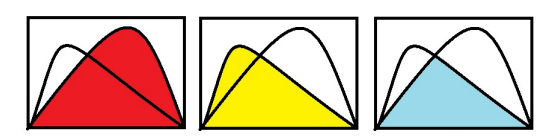
Let (f_n) be a sequence of nonnegative measurable functions, then \displaystyle\int\liminf_{n\to\infty}f_n\,d\mu\leq\liminf_{n\to\infty}\int f_n\,d\mu.

A brilliant graphical way to remember Fatou’s Lemma (taken from the site http://math.stackexchange.com/questions/242920/what-are-some-tricks-to-remember-fatous-lemma).

The first two are f1 and f2 respectively, but even the smaller of these is larger than the area in the third picture, which is inf fn.

2fJqz

Mathematics Enrichment Camp 2016

This camp (series of lectures) is suitable for Pre-University students (e.g. JC / NUS High) who are interested in mathematics!

Saturday, 13th August 2016 8.30am to 2.00pm @ Faculty of Science, NUS Lecture Theatre 25

Register by 1st August!

Tea break & lunch will be provided Prizes to be won!

URL: http://ww1.math.nus.edu.sg/events/MathEnrichmentCamp-2016-brochureregistration.pdf

Finite extension is Algebraic extension (Proof) + “Converse”

These two are useful lemmas in Galois/Field Theory.

Finite extension is Algebraic extension (Proof)
Let L/K be a finite field extension. Then L/K is an algebraic extension.
Proof:
Let L/K be a finite extension, where [L:K]=n. Let \alpha\in L. Consider \{1,\alpha,\alpha^2,\dots,\alpha^n\} which has to be linearly dependent over K since there are n+1 elements. Thus, there exists c_i\in K (not all zero) such that \sum_{i=0}^n c_i\alpha^i=0, so \alpha is algebraic over K.

Finitely Generated Algebraic Extension is Finite (Proof)
Let L/K be a finitely generated algebraic extension. Then L/K is a finite extension.

Proof:
Since L/K is finitely generated, L=K(\alpha_1,\dots,\alpha_n) for some \alpha_1,\dots,\alpha_n\in K. Since L/K is algebraic, each \alpha_i is algebraic over K. Denote L_i:=K(\alpha_1,\dots,\alpha_i) for 1\leq i\leq n. Then L_i=L_{i-1}(\alpha_i) for each i. Since \alpha_i is algebraic over K, it is also algebraic over L_{i-1}, so there exists a polynomial g_i with coefficients in L_{i-1} such that g_i(\alpha_i)=0. Thus [L_i:L_{i-1}]\leq\deg g_i<\infty. Similarly [L_1:K]<\infty. By Tower Law, [L:K]=[L_n:L_{n-1}][L_{n-1}:L_{n-2}]\dots[L_1:K]<\infty.

What About Tutoring Instead of Pills?

Just read this interesting article, which is also related to education. Personally, I am highly skeptical of doctors who prescribe expensive pills / surgery for ailments that require neither. Thankfully there is the internet nowadays so one can research personally instead of believing the doctor who may have his own interests in mind, i.e. maximum profit.

SPIEGEL Interview with Jerome Kagan: ‘What About Tutoring Instead of Pills?’

Harvard psychologist Jerome Kagan is one of the world’s leading experts in child development. In a SPIEGEL interview, he offers a scathing critique of the mental-health establishment and pharmaceutical companies, accusing them of incorrectly classifying millions as mentally ill out of self-interest and greed.

Kagan has been studying developmental psychology at Harvard University for his entire professional career. He has spent decades observing how babies and small children grow, measuring them, testing their reactions and, later, once they’ve learned to speak, questioning them over and over again. For him, the major questions are: How does personality emerge? What traits are we born with, and which ones develop over time? What determines whether someone will be happy or mentally ill over the course of his or her life?

Source: http://www.spiegel.de/international/world/child-psychologist-jerome-kagan-on-overprescibing-drugs-to-children-a-847500.html