NUS Cut Off Point
Check out our article about NUS Cut Off Point at https://mathtuition88.com/2013/11/13/a-level-marksgrade-required-to-enter-nus/

Check out our article about NUS Cut Off Point at https://mathtuition88.com/2013/11/13/a-level-marksgrade-required-to-enter-nus/
Choosing a JC is a big decision that would impact the next 2 years of a student’s life. It is important not to choose a JC based on JC Cut Off Points alone. Lower JC Cut Off Points just means that JC is popular and has many people wanting to enter it, it does not mean it is better. Our tutor attended RJC, one of the top JCs in Singapore, yet he can honestly say that in terms of teaching, RJC may not be significantly better than other JCs. Most of the effort and work put in needed to ace the exams depends on the student himself, no matter which JC you attend. A suitable tutor will be helpful in clarifying doubts and teaching tips and tricks not taught in school.
Limited time offer: FREE Amazon Audiobooks!
Try Audible and Get Two Free Audiobooks
Listen to Audiobooks while in the bus / MRT to boost your GP (General Paper) results!
The thing about elite top JCs is that they tend to teach extra material that is out of the syllabus. While this is good for general knowledge, it actually means that you are mostly on your own (rely either on self-study or tuition) to study the stuff that are actually examined in the A level syllabus, since it is less emphasized in school.
Do consider factors like the school environment, location, and your studying preferences when choosing a JC. Although Singapore is small, traveling across the island by public transport can take up to 4 hours a day (to and fro), which can be better used for study or even rest.
If you are looking for JC tuition (subjects other than Math, e.g. GP Tuition), check out this highly recommended tuition agency: StarTutor.
Discussion forums on which JC to choose:
1) http://sgforums.com/forums/2297/topics/387741?page=1/
2) http://www.kiasuparents.com/kiasu/forum/viewtopic.php?f=40&t=30903
Popular posts on JCs:
Featured Book:
A Is for Admission: The Insider’s Guide to Getting into the Ivy League and Other Top Colleges
This book is for those who aim to enter the Ivy League like Harvard, Princeton, or Yale after JC! Highly rated on Amazon. Even if not considering studies abroad, it may be a good read to learn about the mechanics for this type of school admissions.
Junior colleges (JC) (Source: http://en.wikipedia.org/wiki/List_of_schools_in_Singapore#Junior_colleges_.28JC.29)
These offer two-year courses leading to the GCE A-level examination.
| Code | Zone | College name | Established | Address | Type | Special programmes | ||
|---|---|---|---|---|---|---|---|---|
| English | Chinese | Abb. | ||||||
| 0705 | North | Anderson Junior College | 安德逊初级学院 | AJC | 1984 | 4500 Ang Mo Kio Avenue 6 | Government | |
| 7001 | West | Anglo-Chinese School (Independent) IB World School | 英华中学 (自主) | ACS(I)-IBDP | 2004 (IBDP) | 121 Dover Road | Independent | IP, MEP |
| 0803 | West | Anglo-Chinese Junior College | 英华初级学院 | ACJC | 1977 | 25 Dover Close East | Government-aided | MEP, DEP(TSD), LEP (EL) |
| 0802 | South | Catholic Junior College | 公教初级学院 | CJC | 1975 | 129 Whitley Road | Government-aided | LEP (EL) |
| 3101 | East | Dunman High School | 德明政府中学 | DHS | 2005 – IP | 10 Tanjong Rhu Road | Autonomous | IP, MEP, BSP, LEP (CL), AEP |
| 0806 | Central | Hwa Chong Institution | 华侨中学 | HCI | 1974 | 661 Bukit Timah Road | Independent | IP, HP, LEP (CL), AEP, BSP |
| 0713 | North | Innova Junior College | 星烁初级学院 | IJC | 2005 | 21 Champions Way | Government | LEP (ML) |
| 0703 | West | Jurong Junior College | 裕廊初级学院 | JJC | 1981 | 800 Corporation Road | Government | LEP (CL) |
| 0712 | East | Meridian Junior College | 美廉初级学院 | MJC | 2003 | 21 Pasir Ris Street 71 | Government | |
| 0908 | West | Millennia Institute | 励仁高级中学 | MI | 2004 | 60 Bukit Batok West Avenue 8 | Government | DTP |
| 0805 | North | Nanyang Junior College | 南洋初级学院 | NYJC | 1978 | 128 Serangoon Avenue 3 | Government-aided | LEP (CL), AEP |
| 0712 | Central | National Junior College | 国家初级学院 | NJC | 1969 | 37 Hillcrest Road | Government | IP, HP, AEP, MEP, STaR |
| 7801 | West | NUS High School of Mathematics and Science | 新加坡国立大学附属数理中学 | NUSHS | 2005 | 20 Clementi Ave 1 | Independent | IP, DIP |
| 0711 | West | Pioneer Junior College | 先驱初级学院 | PJC | 1999 | 21 Teck Whye Walk | Government | |
| 0704 | South | Raffles Institution | 莱佛士初级学院 | RI | 1826 | 10 Bishan Street 21 | Independent | IP, HP, LEP (JL), LEP (EL), MEP, TSD |
| 3103 | West | River Valley High School | 立化中学 | RVHS | 1956 2006 – IP | 6 Boon Lay Avenue | Autonomous | IP, BSP |
| 0710 | North | Serangoon Junior College | 实龙岗初级学院 | SRJC | 1988 | 1033 Upper Serangoon Road | Government | |
| 0804 | South | Saint Andrew’s Junior College | 圣安德烈初级学院 | SAJC | 1978 | 55 Potong Pasir Avenue 1 | Government-aided | |
| 0709 | East | Tampines Junior College | 淡滨尼初级学院 | TPJC | 1986 | 2 Tampines Avenue 9 | Government | LEP (ML), TSD |
| 0702 | East | Temasek Junior College | 淡马锡初级学院 | TJC | 1977 | 22 Bedok South Road | Government | IP, HP, LEP (CL), MEP |
| 0706 | East | Victoria Junior College | 维多利亚初级学院 | VJC | 1984 | 20 Marine Vista | Government | IP, HP, TSD, NAV |
| 0708 | North | Yishun Junior College | 义顺初级学院 | YJC | 1986 | 3 Yishun Ring Road | Government | |

Most Important SAT Book
The Official SAT Study Guide a.k.a. Blue Book, 2nd edition
The Official SAT Study Guide: Second Edition™ features 10 official SAT® practice tests created by the test maker.
SAT Strategy Book
SAT Prep Black Book: The Most Effective SAT Strategies Ever Published
The Black Book works best when used with the authentic SAT questions in the “Blue Book,” which is the College Board’s Official SAT Study Guide. The Black Book shows you how to beat the SAT, while the Blue Book gives you real SAT questions to practice with. Please buy College Board Blue Book to understand the strategies with questions from Blue Book.
SAT Math
Introductory SAT Math Book:
The New Math SAT Game Plan: The Strategic Way to Score Higher
A new edition, The New Math SAT Game Plan features updated strategy guides, more Algebra-II topics and all of those subversive tactics that have…
View original post 210 more words
SAT Blogs/Websites
Excellent blog for SAT Math Tips and Tricks.
The Critical Reader
Another Excellent blog for SAT Grammar and Reading Tips and Tricks.
SparkNotes Free SAT Online Book
Excellent Free SAT Online Book covering SAT Math, Critical Reading and Writing Section.
Silverturtle’s Guide to SAT and Admissions Success
Excellent strategy guide from a student covering SAT and College Admission. It also included an excellent SAT Grammar section study guide.
Websites
College Board SAT Biology E/M Practice Tests and Information Website
How to Study for the SAT Biology E/M Subject Test
Study Guides
Cracking the SAT Biology E/M Subject Test, 2013-2014 Edition
This book practice tests are more closer to real test.
Barron’s SAT Subject Test Biology E/M, 4th Edition
Barron Book has more details than Cracking the SAT Biology E/M Subject Test but questions are harder than real test.
Sparknotes Free Online SAT Biology E/M Subject Test Guide
Good introductory SAT Biology study guide
https://mathtuition88.com/group-tuition/ https://mathtuition88.com/
Maths Tuition @ Bishan starting in 2014.
Secondary 4 O Level E Maths and A Maths.
Patient and Dedicated Maths Tutor (NUS Maths Major 1st Class Honours, Dean’s List, RI Alumni)
Email: mathtuition88@gmail.com
Free Exam Papers: https://mathtuition88.com/free-exam-papers/
So there’s a whole lot of posts, including one from this very blog, which give intuitive explanations of why a negative times a negative is a positive.

I haven’t seen nearly as much material for a negative divided by a negative. One can certainly appeal to the inverse — since $latex 1 \times -1 = -1$, $latex \frac{-1}{-1} = 1$. Google searching leads to answers like that, but I’ve found nothing like the multiplication picture above.
Can anyone explain directly, at an intuitive level, why a negative divided by a negative is a positive? Or is the only way to do it to refer to multiplication?
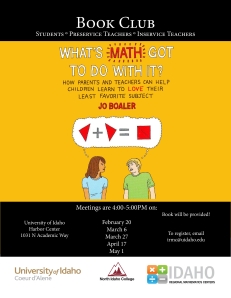
University of Idaho is offering a book club on What’s Math Got to Do with It?: How Parents and Teachers Can Help Children Learn to Love Their Least Favorite Subject by Jo Boaler.
The book club is free and includes a copy of the book! There is an option to participate for 1 credit offered through the University of Idaho for $60. Check out the flyer below and contact irmc@uidaho.edu to register.

American Mathematics Contest 10
The AMC 10 is a 25 question, 75 minute multiple choice examination in secondary school mathematics containing problems which can be understood and solved with algebra and geometry concepts.
American Mathematics Contest 12
The AMC 12 is a 25 question, 75 minute multiple choice examination in secondary school mathematics containing problems which can be understood and solved with pre-calculus concepts.
United States of America Mathematical Olympiad
The United States of America Mathematical Olympiad (USAMO) and the United States of America Junior Mathematical Olympiad (USAJMO) are six question, two day, 9 hour essay/proof examinations. All problems can be solved with pre-calculus methods. Approximately 270 of the top scoring AMC 12 participants (based on a weighted average of AMC 12 and AIME score) are invited to take the USAMO. Approximately 230 of the top scoring AMC 10 participants (based on a weighted average of AMC 10 and AIME…
View original post 158 more words
How to Remember Special Angles easily using Calculator
Step 1: Type the expression into calculator, eg. 
Step 2: You will get 0.8660254038. Square the Answer. (Ans^2)
Step 3: You will get 3/4. That means
Read more at: Funding cuts for top independent schools in Singapore
Chinese word of the day: 心静自然凉 (“When the mind is still, you will be calm, cool and collected.”)
Source: http://baike.soso.com/v4170229.htm
Check out our post on Free Exam Paper at https://mathtuition88.com/2013/05/21/free-exam-papers/
My college algebra course boasts one of the driest textbooks on the planet. It’s one of those versions that has exercises from 1 to 99 for each section…brutal. Can you relate?
The topics for college algebra are very standard and cover little more than what students should have encountered recently in their algebra 2 course. I therefore decided that this class would lend itself quite nicely testing out the theory that a high-level, rich question questioning can be facilitated from a traditional, drill-and-kill style textbook.
Previously, I recall that Operations on Functions was a particularly awful topic for both me and my students. The textbook presents this concept in exactly the way you might think:
f(x) = [expression involving x] and g(x) = [similar expression involving x]
Find f(x) + g(x), f(x) – g(x), f(g(x), f(x) *g(x), f(x)/g(x)…f(snoozefest)…you get the point. It’s boring, they’ve done it before, and there’s…
View original post 346 more words
Using this online javascript program (written by me a long time ago), we can convert a number to any base we desire.
Hope you have fun playing with this app!
For instance, let choose the number 88, and see what it is in different bases
In base 2: 1011000
Base 3: 10021
Base 4: 1120
Base 5: 323
Base 6: 224
Base 7: 154
Base 8: 130
Base 9: 107
Base 10: 88
Base 11: 80
Base 12: 74
Base 13: 6A
Base 14: 64
Base 15: 5D
Base 16: 58
Also, Learn how to convert bases manually
I found this discussion on reddit “How to avoid careless mathematical errors?“:
Hi //math.
I am a high school student who happens to be VERY good at math, but who consistently fails to get As on tests due to careless errors. Most of the time, they come from forgetting a 0 after a decimal place, multiplying instead of dividing, putting a decimal point in the wrong place, or just factoring wrong. I actually had to drop a Precalc Honors class because I got Ds on tests from the sheer number of stupid mistakes I made, despite understanding the material very well.
I assume that this occurs because I work quickly, but if I work slowly, I run out of time on the test. Additionally, my handwriting is horrible, but there’s really nothing I can do about that. And even when I check my answers after finishing, I still…
View original post 639 more words
數學世界並不如一般人想象中的理性、不可抗逆。相反,很多表面上合理的論証,卻會引申出非常荒謬的結論。
其中一個我十分喜愛的算式如下:

最先論証這個看似荒謬的算式的人是印度著名數學家斯里尼瓦瑟.拉馬努金 (Srinivasa Ramanujan)。他提出的論証中牽涉到冪級數 (Power Series) 的運用。因此,我將會用一個比較易懂的方法,嘗試去証明這條算式是正確的。
首先設以上三項算式為S1、S2及S。
S1的答案比較易懂,從算式中可見,S1必定為 或 1 這兩個可能答案:

我們取 及 1 的平均數 1/2 為S1的答案 (假如取其平均數這做法令你感到很不安的話,事實上我有另一個論証方法可以証明 1/2 是最合理並最接近的答案,容後分解)。
然後將S2乘 2 ,算式如下:

兩列算式的數字各自相加後得出的結果如下:

很眼熟吧?沒錯,從以上計算中可以歸納出 2 x S2 = S1
而由於S1 = 1/2,代入以上算式可以得出 S2 = 1/4
之後,我們進行 S – S2 這一操作,運算過程如下:

奇妙的事情就在這裡開始發生了。剛才我們証明了S2 = 1/4,因此
S – 1/4 = 4*S
3*S = -1/4
S = -1/12
亦即証明:
難以致信吧?假如你無法接受這個違反常識,卻又看似合理的論証結果,我可以很榮幸地告訴你,
你的質疑是非常合理。
因為上述所有推算過程中都犯下了一個數學世界的禁忌,就是嘗試對無限 (Infinity) 進行操作。
真相是,無限本身是一個概念,而不是一個數字。因此,假如一意孤行地對無限進行加減乘除等操作時,便會出現如上述般荒誕的結果,就像整個數學系統當機了一樣。
不過,並非所有無限都是不可操作的。例如收斂級數 (Convergent Series) 便是一個有求和答案的無窮數列。
(credit: Numberphile)
View original post 2 more words
 Kennesaw- Who says that Liberal Arts is dead? One day in 1637, a lawyer and amateur mathematician named Pierre de Fermat scribbled a curious note in his journal: “The equation xn+ yn = zn, where x, y, and z are positive integers, has no solution if n is greater than 2… I have discovered a most remarkable proof, but this margin is too narrow to contain it.”
In his spare time, Fermat studied languages, classical literature and natural science. He also discovered the fundamental principle of analytic geometry. His methods for finding tangents to curves and their maximum and minimum points led him to be regarded as the inventor of the differential calculus. Through his correspondence with Blaise Pascal he was a co-founder of the theory of probability.
It took mankind over 350 years to prove Fermat’s last theorem.
Spend time today encouraging…
View original post 45 more words

Six top independent schools in Singapore have had their funding cut and, along with other mission schools, have been told to moderate fund-raising activities for campus upgrading.
In addition, they will have to comply with a new directive urging all schools with air-conditioned classrooms to install fans and use air-conditioning only when necessary.
The six schools rank among the top in the Singapore education scene, comprising the Raffles secondary schools and its junior college, Hwa Chong Institution, Anglo-Chinese School (Independent) and NUS High School of Mathematics and Science.
They all run both the Integrated Programme (IP) and Gifted Education Programme (GEP). The IP provides a seamless secondary and junior college education with students bypassing the O levels. The GEP caters to students in the top 1 to 2 per cent of their cohort.
Continue reading at: http://www.straitstimes.com/breaking-news/singapore/story/funding-cuts-top-independent-schools-spore-20140203
Source: http://www.moe.gov.sg/media/press/2014/01/posting-results-2014-jae-and-jpsae.php
1The Ministry of Education (MOE) will release the posting results for the 2014 Joint Admissions Exercise (JAE) and the Joint Polytechnic Special Admissions Exercise (JPSAE) on Wednesday, 5 February 2014, at 8.00 am.Applicants can obtain their posting results via the following channels:
2JAE
3JPSAE
4Applicants posted to a Junior College (JC) or the Millennia Institute (MI) should report to these institutions on Thursday, 6 February 2014, at 7.30 am. Applicants posted to a Polytechnic or Institute of Technical Education (ITE) course will receive further instructions via an enrolment package from the respective institutions by mail.
5Appeals
6Applicants who wish to appeal for a transfer to another JC or the MI should approach the institution of their choice directly.
I have been doing a lot of thinking about place value lately. Yes, I need a life outside my standard state-issue gray cubicle. Nonetheless, I have become caught up in the beauty of the Hindu-Arabic number system. We also know it as the Base-Ten numeration system. It is beautiful and elegant. Let me elucidate (I love that word!)
One of the best t-shirts I have ever seen had this quote on the front, “There are only 10 kinds of people in the world; those who understand binary and those who don’t.” Some of you might be laughing right now while others are scratching their heads wondering what is wrong with me. Okay, here’s the joke. Binary is a base-2 numeration system. It has two digits – 0 and 1. Place value in binary is determined by powers of 2. So, in the units place you can have 0 and…
View original post 2,116 more words
Note: I originally published this entry on a Google Sites page in September 2013, but I have moved it hear as I hope to make better use of the $latex \LaTeX$ support offered by wordpress.com
I completed the first year of my maths degree in June 2013. I studied Analysis in all three terms (sequences and series in the first term, continuity and differentiability in the second, and Riemann integration in the third) and feel I have learnt a lot. Occasionally, amongst all this theory, I must admit to sometimes having lost touch with the original questions that provoked its development.
Consider the following naïve approach to infinite series. What is the answer if I add 1 and -1 alternately forever? That is
$latex \displaystyle{1+(-1)+1+(-1)+ … = ???}$
If I bracket the terms in pairs starting with the first and second terms, the answer appears to be 0:
$latex…
View original post 757 more words
Pi(Π) number is irrational and equal to 3.14159265… .
Let us draw a circle with radius ‘r’

$latex \int_0^{2\pi} r \mathrm{d}\theta = {2\pi} r &s=2$
So, circumference of the circle is equal to $latex {2\pi} r $
If the value of circumference is divided by value of diameter, the result is $latex \pi $
Area of quarter circle = $latex \frac{\pi r^2}{4}&s=2$

Area of the square = $latex {r^2}&s=2$
Probability of putting a dot on quarter circle is shown below.
$latex \frac{\frac{\pi r^2}{4}}{r^2} = \frac{\pi}{4}&s=3$
The area of circle is divided by total area.
In order to achieve $latex \pi $ value the result is multiplied by 4.
We can use Monte Carlo method for approximation $latex \pi $ value. For example, 10000 dots will be put on picture above. Each dot…
View original post 47 more words

This blog was my very first venture into blogging on the fabulous Primary English blog. I’m very grateful to them for publishing it last May which led to me thinking seriously about starting my own blog. Their site is well worth a visit and they also have some amazing pinterest boards on all sorts of themes.
Here is what I blogged back in May:
As a maths leader, I quite often have the privilege of doing planning trawls and looking at weekly and medium term planning from other teachers. I’m often very impressed by the thought and detail that goes into these. But there’s one section that seems very rarely to be given much thought. If your weekly or medium term planning format is anything like mine, there’s a small section headed ‘cross-curricular links’, and I hardly ever see it filled in, except perhaps with the suggestions…
View original post 654 more words
Link: https://www.coursera.org/course/mathematicalmethods
Coverage: the official description is thorough. The caveat is that all topics are discussed without going too much into subtleties.
Potential audience: people with moderate knowledge of multivariable calculus, linear algebra and a bit of R programming experience who want to see how this knowledge may be applied to finance.
Format:
Note that only quizzes are graded.
Workload: 2-3 hours assuming you know calculus & linear algebra. If you don’t, then it’s hard to say.
Misc:
To sum…
View original post 33 more words
Since I decided to call this blog martingalemeasure it seems only fitting that the first post should be about probability; martingales in particular. In my favorite introductory book on measure theoretical probability, “Probablity with Martingales” by David Williams, we find an exercise in Chapter 10, which I paraphrase here:
Suppose a monkey is typing randomly at a typewriter whose only keys are the capital letters $latex A$ through $latex Z$ of the english alphabet. What is the expected (average) time it will take for the monkey to type the word $latex ABRACADABRA$?
This is not an easy problem. In fact it’s not entirely obvious that the average time is even finte! Williams expects the reader to solve it using the beautiful theory of martingales and in particular Doob’s optional-stopping theorem. We will calculate the result below, but stop short of a proof. (There are many proofs of this result…
View original post 1,252 more words

Calculating the day of the week for historical date is impressive, but it isn’t as hard as it seems. Several methods have been shown to work and be performable by average humans. This is an improvement to one of the simplest methods.
Paraphrased from wikipedia:
The Doomsday rule or Doomsday algorithm is a relatively simple way to calculate the day of the week of a given date. It was devised by John Conway, drawing inspiration from Lewis Carroll’s work on a perpetual calendar algorithm. The algorithm takes advantage of the fact that several easy-to-remember dates fall on the same day each year; for example, 4/4, 6/6, 8/8, 10/10, 12/12, and the last day of February are all the same day of the week.
Conway’s original algorithm required dividing by 12 and 4, and remembering several intermediate values. It’s achievable, but not…
View original post 622 more words
When I first started teaching, I was always looking for the correct answer on a math problem. I would mark it wrong or right, there was no gray area. I began to change my thinking a bit when I noticed my students weren’t really growing. I knew that I needed to do something differently, so I began to start looking at the process of their thinking so that I could give direct feedback to help them get better.
If you think about it, we do the same thing in reading. We don’t expect students to become perfect readers overnight, so we give them reading strategies to become better. We look at their fluency, comprehension, how they monitor and self correct…we intervene and give feedback to help them.
With problem solving it can be the same way. We can take a look at the work a student writes down and see…
View original post 209 more words
A really interesting and creative video about Pythagoras and the Pythagorean Theorem. Showing us how maybe Pythagoras wasn’t as awesome as we thought he was.
An extremely well done and well thought out video, about math, history and beans.
Use a checklist to moniter my students’ understanding of fractions.
We have a unit test coming up at the end of the week on fractions. All throuout this week we will be working in small groups with students and I want to ensure that I am targeting my instruction to the concepts students need to review.
Reflection: I had some difficulties with this goal, but I definitely want to try this again another time. First, it was difficult for me to gauge the entire class in the short time I was using my checklist. For various reasons, I was only able to use it through portions of two lessons. The main problem I could see was that, since this was the end of the unit, I was not able to gather data on everything we had covered. Although, that is what I was trying to do with my ten item…
View original post 437 more words
Prime numbers are numbers can only be divided by itself and 1. They are greater than 0. In this text, we will see how to test whether a number is a prime number or not. Furthermore, we will find prime numbers up to N. ( N is a number entered by user. )
For example, 2 can be divided by 2 and 1. So it is a prime number.
Prime numbers: 2, 3, 5, 7, 11 ,13, 17, 19, …
How to test a number ?
“A” is a positive number greater than 1. Let X be a number different than number A and 1. If we can find such a number divide A with remainder 0, A is not a prime number.
A : 29 and Square root of A : 5.385164
View original post 80 more words
A signal processing snippet. Let $latex x(t)$ be a bandlimited signal restricted to the interval $latex [T_1, T_2]$, so that in particular
$latex x(t) = \displaystyle{\sum_{n=0}^{N-1} x(n \Delta t) \text{sinc}\left(\frac{t – n\Delta t}{\Delta t}\right)} 1_{T_1 \leq t \leq T_2}$
Here, as opposed to previous entries, we have defined $latex \text{sinc}(t) = \sin(\pi t)/(\pi t)$ (I have had a change of heart). Then the Fourier transform of $latex x(t)$ is
$latex X(f) = \displaystyle{\sum_{n=0}^{N-1}} x(n\Delta t) e^{-i 2\pi f n \Delta t} R(n \Delta t – T_2, n \Delta t – T_1, f – 1/2\Delta t, f + 1/2 \Delta t) \,\Delta t$
where we define
$latex R(t_1, t_2, f_1, f_2) = \dfrac{(\text{Ei}(i 2\pi f_2 t_2) – \text{Ei}(i 2\pi f_2 t_1)) – (\text{Ei}(i 2\pi f_1 t_2) – \text{Ei}(i 2\pi f_1 t_1))}{i 2\pi}$
and $latex \text{Ei}$ is the exponential integral, which for imaginary arguments is
$latex \text{Ei}(it) = i \dfrac{\pi}{2} -\displaystyle{\int_{t}^{\infty}} \dfrac{e^{i…
View original post 37 more words
Why is this called 2=1, one might ask. Here’s “proof” for something that’s wrong. If you’re able to appreciate these things, try finding the mistake.
a = b
a² = a b
a² + a² = a² + a b
2 a² = a² + a b
2 a² – 2 a b = a² + a b – 2 a b
2 a² – 2 a b = a² – a b
2 ( a² – a b ) = 1 ( a² – a b )
2 = 1
This will be the first and only geeky post, I promise.
Symbols and conventions are both ubiquitous and necessary in our every day life. They enable our culture, on the one hand. On the other hand, they limit our imagination and we need to challenge them sometimes. This is a conflict I find fascinating and would like to base…
View original post 9 more words

I absolutely love this idea. I’ve done two other worksheets with this same idea (click here and click here to see them) and I’ve found it to be really successful. It’s super important to get kids familiar with the hundreds chart. Hopefully children will be so familiar with it that they can make their own hundreds chart on a piece of scratch paper during a test (since kids don’t get a printed hundreds chart on their standardized tests).Click here to see my third 10 more that/10 less than hundreds chart worksheet: hundreds chart- more than- less than OWL
So a friend of mine got a little riled up about this video:
You know, I write and read poetry, and there’s this thing that happens when I talk about poetry, a thing that I know also happens all the time when people who write and read math talk about math. People say, “I don’t like poetry.” Or sometimes, more charitably, “I don’t understand poetry.” Sometimes — if they like me — they think my interest in poetry is adorable. But they don’t want to talk about it with me. And meanwhile, I’m thinking, what do you mean you don’t like poetry? Poetry is a big thing! It’s like saying you don’t like music! Or food! There’s so much of it, I’m sure we could find something you would like.
Well. That’s poetry. Because you know what my reaction was to my friend’s curiosity about that video up there?…
View original post 1,147 more words
… For most people anyway. Because I missed my video post yesterday, here’s a very short TED talk from Arthur Benjamin on why we should teach statistics before calculus.
Of course, calculus has it’s place and is extremely important, but statistics, probability, and data analysis are so much more useful in everyday life. It would be a tremendous leap forward in promoting scientific literacy in the US. After all, if more people knew what a p-value was or what a confidence interval actually is, society as a whole would be a lot better equipped to understand the numbers that are constantly thrown at us. Reporters might realize that if one study finds a statistically significant result which is unable to be replicated, most likely they made a type I error and the null was probably rejected by random chance error.
I hope that in my lifetime, all students will…
View original post 26 more words

This week Year 10 (UK age 14-15) have been exploring different graph types and also transformations and graphs.
For homework I asked them to draw just a small number of graphs by hand but wanted them to check their work and explore further graphs using the Desmos graphing calculator. Early in the week I made sure they could all use Desmos including the use of tables so in an IT room they used the slideshow here and created several graphs of their own.
Once all the students were confident to use Desmos to create various lines and curves I asked them to explore a series of graphs so that this coming week we can discuss transformations and graphs. Using Desmos allowed them to explore many graphs in a short space of time and several students chose to take screenshots and make notes for themselves.
Having used sliders they were able…
View original post 38 more words
http://www.math.niu.edu/%7Ebeachy/abstract_algebra/study_guide/contents.html

The Study Notes on 600 problems and solutions:
http://www.math.niu.edu/~beachy/abstract_algebra/guide/contents.html
Notes on Logarithm by NUS:
Quote:
Logarithms appear in all sorts of calculations in engineering and science, business and economics.
Before the days of calculators they were used to assist in the process of multiplication by replacing the operation of multiplication by addition. Similarly, they enabled the operation of division to be replaced by subtraction. They remain important in other ways, one of which is that they provide the underlying theory of the logarithm function. This has applications in many fields, for example, the decibel scale in acoustics.
In order to master the techniques explained here it is vital that you do plenty of practice exercises so that they become second nature.
Read more at: http://www.math.nus.edu.sg/~matngtb/Calculus/mathcentre/mathcentre_workbooks/web-logarithms-new-july03.pdf
https://mathtuition88.com/group-tuition/ https://mathtuition88.com/
Maths Tuition @ Bishan starting in 2014.
Secondary 4 O Level E Maths and A Maths.
Patient and Dedicated Maths Tutor (NUS Maths Major 1st Class Honours, Dean’s List, RI Alumni)
Email: mathtuition88@gmail.com


 Mathtuition88