Although the QZ8501 plane is now confirmed to be in the Java Sea, we still hope that there may be some survivors, who may have possibly swum to a nearby island. Hopefully, the rescuers may be able to rescue some of the passengers.
One special fact about 8, is that it is the only natural perfect power that is one less than another perfect power. (2^3=3^2-1) This is known as Catalan’s conjecture or Mihăilescu’s theorem.
A sane explanation of biblical numerology. Davis explains the conventional, rhetorical, symbolic, and mystical use of numbers in this fascinating study of the structure and syntax of biblical numbers.
Numbers are present throughout the Bible, and do have some meanings. Why did God create the world in seven days? (rest on the seventh day) Why did Jesus have 12 disciples, not more or not less? Read this book to find out!
The WordPress.com stats helper monkeys prepared a 2014 annual report for this blog.
Here’s an excerpt:
The Louvre Museum has 8.5 million visitors per year. This blog was viewed about 200,000 times in 2014. If it were an exhibit at the Louvre Museum, it would take about 9 days for that many people to see it.
This 4-year-old Chinese girl cried when her mother ‘tortured’ her to recite Multiplication table by rote learning. She always got stuck at 3 x 5= ?
She complained it is too difficult.
Most parents are teaching the kids Mathematics the wrong way! No wonder they grow up with hate and fear for Maths subject throughout the entire life.
Same in schools and universities, Maths are taught the wrong ways by incompetent Math educators.
We sincerely hope that Captain Iriyanto, the pilot of missing AirAsia flight QZ8501, and all other passengers survive and return safely. Hopefully the plane will be found soon.
Something mysterious about the recent missing airplanes is that their numbers add up to 8888, a mystical number in Chinese culture. MH17, MH370, QZ8501, 17+370+8501=8888.
We have calculated that it is not a common event at all, it is rarer than winning the top prize in 4D, a lottery in Singapore.
Probability of 3 random numbers (from 1 to 9999) adding to 8888: 0.0039497% , or around 1 in 25,000.
Probability of winning the First Prize in 4D: 0.01%, or 1 in 10,000.
An intuitive, yet precise introduction to probability theory, stochastic processes, and probabilistic models used in science, engineering, economics, and related fields. The 2nd edition is a substantial revision of the 1st edition, involving a reorganization of old material and the addition of new material. The length of the book has increased by about 25 percent. The main new feature of the 2nd edition is thorough introduction to Bayesian and classical statistics.
Mind, Brain And Education
1. Spaced Repetition
2. Retrieval Practice
Tool: Test
Not to assess what students know, but to reinforce it. Memory is like a storage tank, a test as a kind of dipstick that measure how much information we’ve put in there.
But that’s not how the brain works.
Every time we pull up a memory, we make it stronger and more lasting, so that testing doesn’t just measure, it changes learning.
Simply reading over materials to be learnt, or even taking notes and making outlines, as many homework assignments require, doesn’t have this effect.
Language learner: 80% retained.
Science: 50% retained.
Self-quizzing (focus less on input of knowledge by passive reading, focus more on output by calling out that same information from brain.)
Cognitive disfluency:
Tough topic, recall better.
Interleaved assignment: mix up different kinds of problems instead of grouping by type.
A recent survey in 44 OECD countries reveals for 15-year-old students an average of 5 hours / week of homework.
Country
Homework Hrs
Extra Hrs
PISA
Shanghai
14
Tuitions
1
Singapore
9.4
Tuitions
2
Hong Kong
6
Tuitions
3
Korea
2.7
Tuitions
4
Japan
3.8
Tuitions
5
Taipei
5.9
Tuitions
6
Finland
2.8
7
England
4.9
26
PISA 2012:
PISA is like the Army IPPT Test on physical fitness. A fit soldier and a weak soldier go to war, whether he can fight with courage under duress to win the battle, has nothing to do with his IPPT scores.
Same for PISA scores…that explains why Americans are poor in PISA but produce many entrepreneurs, Nobel prize / Fields scientists, whereas China, Singapore, Korea, HK have only few.
With the Star Wars Episode 7 coming up, all Star Wars fans are really excited. The trailer alone has reached 50 million views, barely a month after it was released.
Wait, can Star Wars be related to Math? Yes it can! Check out The Math of Star Wars which describes a Math related question related to Star Wars! As a Math Tutor, I try my best to relate anything and everything to Math! 😛
Christmas is ending soon, and hope everyone had a nice day, and happy new Year!
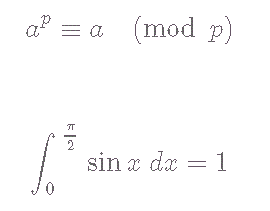
One of the pros of Blogger is that JavaScript is allowed, whereas for WordPress, JavaScript is not allowed for security reasons. JavaScript is a pretty cool add on to a website, it can do simple calculations.
Blogger uses MathJax for rendering the Math Formulas, which look like the ones shown above.
Let’s try the WordPress version and readers can judge for themselves which is better.
My personal opinion is: they look the same to be honest. However, the Blogger way of typing is much more convenient, just using $ and $$, as opposed to WordPress requiring “$latex” and “$latex\displaystyle”, which is more cumbersome especially for long texts. However, experts like Terence Tao have opted for WordPress, which shows that WordPress does probably have some advantages.
In O Level E Maths, students are required to memorize the prefixes: kilo-, mega-, and giga-. For today’s computer literate generation, that should be no problem since kilobytes, megabytes, and gigabytes are used so commonly.
A practical usage of this is Computer Memory, and how to solve the dreaded Blue Screen of Death.
I have recently discovered a truly remarkable method on how to solve the Blue Screen of Death, using a free tool called Glary Utilities. Read more about it here and hope it helps!
Calculus. For some of us, the word conjures up memories of ten-pound textbooks and visions of tedious abstract equations. And yet, in reality, calculus is fun, accessible, and surrounds us everywhere we go. In Everyday Calculus, Oscar Fernandez shows us how to see the math in our coffee, on the highway, and even in the night sky.
The most ubiquitous, and perhaps the most intriguing, number pattern in mathematics is the Fibonacci sequence. In this simple pattern beginning with two ones, each succeeding number is the sum of the two numbers immediately preceding it (1, 1, 2, 3, 5, 8, 13, 21, ad infinitum). Far from being just a curiosity, this sequence recurs in structures found throughout nature – from the arrangement of whorls on a pinecone to the branches of certain plant stems. All of which is astounding evidence for the deep mathematical basis of the natural world.
With admirable clarity, two veteran math educators take us on a fascinating tour of the many ramifications of the Fibonacci numbers. They begin with a brief history of a distinguished Italian discoverer, who, among other accomplishments, was responsible for popularizing the use of Arabic numerals in the West. Turning to botany, the authors demonstrate, through illustrative diagrams, the unbelievable connections between Fibonacci numbers and natural forms (pineapples, sunflowers, and daisies are just a few examples).
Check out this link by NUS Provost, Prof. Tan, who was also a Math Professor.
The Art of S/U:
Now, which grades should you keep?
If you obtained A or A+, well done and keep the grade!
If you obtained B+ or A-, I would generally encourage you to keep the grade as well. For those who may be thinking of exercising S/U on a B+ to qualify for the Dean’s List, do note that there will NOT be Dean’s Lists for the first two semesters.
If you obtained Bs and Cs, it is a little tricky. In theory, you should exercise S/U on your worst grades. However, the challenge is to do so without foresight of the grades that you will get for subsequent semesters. You should base your decisions on your academic goals and your self-assessment of your expected academic performance for the rest of your candidature. If you do not have a goal right now, your first semester CAP (before any S/U options are exercised) may be a good guide.
The S/U option is really a lifesaver for those at the borderlines, for example Borderline First Class Honours (CAP around 4.5), or Borderline Second Upper (Cap around 4.0). It makes a difference to your final grades.
The S/U option will apply to all Level 1000 modules (with or without pre-requisites) and Level 2000 modules without other NUS modules as pre-requisites, unless otherwise stipulated by the Faculties/Departments.
The ancient Greeks discovered them, but it wasn’t until the nineteenth century that irrational numbers were properly understood and rigorously defined, and even today not all their mysteries have been revealed. In The Irrationals, the first popular and comprehensive book on the subject, Julian Havil tells the story of irrational numbers and the mathematicians who have tackled their challenges, from antiquity to the twenty-first century. Along the way, he explains why irrational numbers are surprisingly difficult to define–and why so many questions still surround them. Fascinating and illuminating, this is a book for everyone who loves math and the history behind it.
Give a child gifts that will last a lifetime – self-esteem, tolerance, values, and inner strength. This book is filled with inspirational stories for children and their families to share, all about kids making good choices and doing the right thing.
The values that children learn today will stay with them for the rest of their lives. This collection gives kids positive role models to follow in its 101 stories about doing the right thing and making healthy choices. You and your child will enjoy discussing the stories, making it a family event. Great for teachers to share with students too.
从来没有状元的老师, 却能培养出状元学生。中国历史的状元, 都是在科举失败的穷秀才教导出来的。看今日的Fields Medalists / Nobel Prize winners, 他们的指导教授多数没拿过这大奖。
法国有两位世界级的数学大师Evariste Galois, Charles Hermite, 相隔15年,同是一位中学数学老师培养。Mr. Richard 是巴黎路易大帝中学(Lycée Louis Le Grand) 的数学老师, 他能创新课材, 加上他本身是”数学迷”, 对学生因材施教, 慧眼视英雄于微时。Galois13 岁前是由妈妈家教(home-schooling), 中一才上学校。Richard看出他有数学天才, 个别教他读当代数学大师的书, 其他科目的老师却视他为功课低劣学生。
My previous posts on Clash of Clans Math (on Mortar damage, and Gold mine) were fairly popular, so I have decided to write one more post! This shows that Math can be applied to almost everything, even games!
Giant VS Golem: Clash of Clans Math
Vs
Recently, players of COC will know that the Level 7 Giant has been released. For fans of the Giant (I am one of them), this is great news. The Giant is a cheap substitute for tanking vs the Golem, and can be used in many strategies for instance Giwipe (Golem, Wizard, Pekka), Garch (Giant archer), among many others.
In this post, I will use Math to concretely compare the Level 7 Giant and the Level 5 Golem. For fairness sake, we will compare 6 Giants with 1 Golem (since they take up 30 spaces). Sources are taken from http://clashofclans.wikia.com/.
Health
Level 5 Golem has 6300+2×1260=8820 HP (We have factored in the 2 golemites)
Six Level 7 Giants have 6×1100=6600 HP
Conclusion: Golem is around 30% better than Giants in term of HP.
Calculation: (8820-6600)/6600 x 100%=33.6%
For pure tanking, nothing beats a max level Golem.
Damage per second
Max Golem has 54 Damage per second + a 550 damage upon death. (We have ignored Golemites damage since it is really negligible)
6 Max Giants has 6×50=300 DPS
Conclusion: Giants are 450% better than Golems in terms of DPS!
This can be quite significant, for example, when using Giants in Giwipe, often one does not even need to use wallbreakers, since the giants can break through the walls on their own. This frees up more spaces for wizards/other troops.
Against Spring Traps
Spring Traps are the ultimate nemesis of Giants, since each Spring Trap can bounce 15 Housing spaces, or 3 Giants.
Golems are unaffected by Spring Traps. (1 Golemite can be bounced by each Spring trap though)
Each Spring Trap can bounce 3 Giants. Town hall 10 has 6 Spring Traps, potentially bouncing a whopping 18 Giants.
To avoid Spring Traps, place a few barbarians before sending out your giants. Hopefully the barbarians will activate (and waste) a few spring traps.
Conclusion: Golems are more resistant to Spring Traps.
Against Inferno Towers (Multi-mode)
A Level 3 Inferno Tower does just 42 DPS to a Golem
It does 42×6=252 DPS to 6 giants.
Conclusion: Superficially, it seems good that Golems take 80% less damage than giants from Multi-mode Infernos. However, a bit of thinking reveals that the inferno in multi-mode will be attacking your other troops (for example wizards) instead, together with the 1 Golem. Hence, in other words, Golems also tank 80% less damage than giants from Multi-mode Inferno towers.
Against Inferno Tower (Single Target)
This calculation gets a little complicated. The inferno (Level 3) has 36 DPS initially, then 140 DPS after 2 seconds, then a whopping 1400 DPS after 5 seconds.
To kill the initial Golem (6300 HP), the inferno tower needs to take around 9.1 seconds. The first two seconds will pump out 36×2=72 damage, next 3 seconds will pump out 140×3=420 damage, while the remaining 4.1 seconds will deal the bulk of 4.1×140=5740 damage.
To kill 1 single giant (1100 HP), the inferno tower needs around 5.5 seconds. (36×2+140×3+1400×0.5=1192) Hence to kill 6 giants, 5.5×6=33 seconds is needed.
Conclusion: Giants survive 260% longer than Golems under Inferno (Single Target) Fire!
Other last points to note are that everytime a giant dies, there is a switch of targets, potentially attacking weak but crucial units like wizards or witches. This is a downside of giants.
So, who do you think is better? Giants or Golems? Leave your comments below!
Billionaire Ronnie Chan rather be mathematician or scientist if he could live life over
Billionaire Ronnie Chan Chi-chung seems to have it all figured out. Were the Hang Lung Properties chairman to live his life over again, it would not be as a businessman — he’d be a mathematician or scientist instead.
Chan, who offered this little gem during a speech at the Hang Lung Mathematics Awards ceremony, said he may have more material wealth than famed mathematician Yau Shing-tung but much less intellectual wealth.
As co-founder of the awards, which were set to encourage secondary school students to pursue maths and sciences, Chan urged youngsters to go the extra mile and become mathematicians or scientists as they can contribute more to society than what a businessman can.
New Scientist
“It is a testimony to [Yau’s] careful prose (and no doubt to the skills of co-author Steve Nadis) that this book so compellingly captures the essence of what pushes string theorists forward in the face of formidable obstacles. It gives us a rare glimpse into a world as alien as the moons of Jupiter, and just as fascinating…. Yau and Nadis have produced a strangely mesmerizing account of geometry’s role in the universe.”
Nature
“Physicists investigate one cosmos, but mathematicians can explore all possible worlds. So marvels Fields medalist Shing-Tung Yau…. Relating how he solved a major theoretical problem in string theory in the 1970s, Yau explains how the geometries of the vibrating multidimensional strings that may characterize the Universe have implications across physics.”
Is tuition for toddlers necessary? Some food for thought.
As a tutor, I always try to value add and teach students something that is not taught in schools, for example tips or tricks in Math, or methods to check for careless mistakes.
Also certain key concepts may not be taught in school, even in elite schools. Many students, including students from the elite Nanyang Girls’ High School or ACS(I), have no idea initially that the discriminant has something to do with the quadratic formula . After my explanation though, they are enlightened, and finally can understand why means that the quadratic has no real roots! 🙂
A good tutor can help find out what the student does not know, and teach to fill in the gaps of knowledge. Without a tutor, often a student does not know what he/she does not know! (until the exam comes)
A Maths exam is not an IQ test! It is a test of knowledge and preparation, whoever is more prepared (whether through tuition or self-studying) will get more marks.
Tuition, in the right format and spirit, is actually something good. Aristotle, the philosopher, was a tutor to Alexander the Great, one of the greatest kings that ever lived.
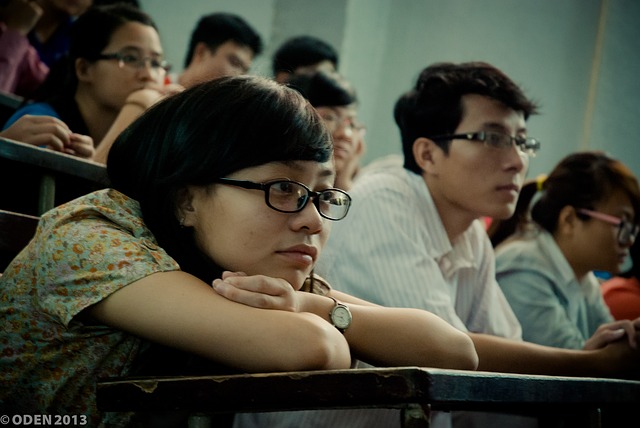
AFP News/AFP File Photo – File Photo of Children attending preschool/kindergarten
As his tutor flashed one flashcard after another to him, little Gabriel Tan glanced longingly towards the door.
A sharp look from his mother put him back in focus, and he obediently repeated the words on the flashcards.
“Can I go to the playground now, mummy?” asked the little boy hopefully.
“No, you have to do your memory exercises next,” said his tutor, pre-empting the mother’s reply, and the boy’s face fell again.
Gabriel is only three years old, but he has been receiving hour-long tuition lessons three times a week after his nursery classes so that he can “keep up” when his mother finally enrolls him at the coveted primary school she is an alumnus of – Nanyang Primary.
“I don’t think he is very smart, so to make up for that, he has extra tuition…
Watch this very inspirational video about learning.
When students encounter a difficult Math problem, there are two ways to approach it. Are you not smart enough to solve it … or have you just not solved it yet? The mindset the student adopts can make a huge difference in the learning effectiveness.
The key point is that there is great power of believing that you can improve. Adopting a growth mindset enables students to transcend their initial limitations and improve to a new level.
Mathematicians prove the Umbral Moonshine Conjecture
Date: December 15, 2014
Source: Emory University
Summary: Monstrous moonshine, a quirky pattern of the monster group in theoretical math, has a shadow — umbral moonshine. Mathematicians have now proved this insight, known as the Umbral Moonshine Conjecture, offering a formula with potential applications for everything from number theory to geometry to quantum physics.
“We’ve transformed the statement of the conjecture into something you could test, a finite calculation, and the conjecture proved to be true,” says Ken Ono, a mathematician at Emory University. “Umbral moonshine has created a lot of excitement in the world of math and physics.”
Co-authors of the proof include mathematicians John Duncan from Case Western University and Michael Griffin, an Emory graduate student.
“Sometimes a result is so stunningly beautiful that your mind does get blown a little,” Duncan says. Duncan co-wrote the statement for the Umbral Moonshine Conjecture with Miranda Cheng, a mathematician and physicist at the University of Amsterdam, and Jeff Harvey, a physicist at the University of Chicago.
Ono will present their work on January 11, 2015 at the Joint Mathematics Meetings in San Antonio, the largest mathematics meeting in the world. Ono is delivering one of the highlighted invited addresses.
“An excellent introduction to this area for anyone who is looking for an informal survey… written in a lively and readable style.”
R.E. Boucherds, University of California at Berkeley for the Bulletin of the AMS
“It is written in a breezy, informal style which eschews the familiar Lemma-Theorem-Remark style in favor of a more relaxed and continuous narrative which allows a wide range of material to be included. Gannon has written an attractive and fun introduction to what is an attractive and fun area of research.”
Geoffrey Mason, Mathematical Reviews
“Gannon wants to explain to us “what is really going on.” His book is like a conversation at the blackboard, with ideas being explained in informal terms, proofs being sketched, and unknowns being explored. Given the complexity and breadth of this material, this is exactly the right approach. The result is informal, inviting, and fascinating.”
Fernando Q. Gouvea, MAA Reviews
Sharpens math skills from whole-number operations through basic algebra and geometry
Builds problem-solving and critical-thinking skills
Includes teacher notes, concepts and skills covered, relevant Internet sites, and more
Galois’ Theory of Algebraic Equations gives a detailed account of the development of the theory of algebraic equations, from its origins in ancient times to its completion by Galois in the nineteenth century. The main emphasis is placed on equations of at least the third degree, i.e. on the developments during the period from the sixteenth to the nineteenth century. The appropriate parts of works by Cardano, Lagrange, Vandermonde, Gauss, Abel and Galois are reviewed and placed in their historical perspective, with the aim of conveying to the reader a sense of the way in which the theory of algebraic equations has evolved and has led to such basic mathematical notions as “group” and “field”. A brief discussion on the fundamental theorems of modern Galois theory is included. Complete proofs of the quoted results are provided, but the material has been organized in such a way that the most technical details can be skipped by readers who are interested primarily in a broad survey of the theory. This book will appeal to both undergraduate and graduate students in mathematics and the history of science, and also to teachers and mathematicians who wish to obtain a historical perspective of the field. The text has been designed to be self-contained, but some familiarity with basic mathematical structures and with some elementary notions of linear algebra is desirable for a good understanding of the technical discussions in the later chapters.
Liu Hong (Year 130~210) was an ancient Chinese Mathematician who studied astronomy and mathematics. He was the inventor of the art of abacus arithmetic, and hence was given the title of “Sage of Arithmetic”.
Recently, I was fortunate to visit a statue of Liu Hong at his birthplace (modern day Linyi).
(Me beside statue of Liu Hong at Linyi People’s Square, Shandong)
This book will teach you step-by-step how to perform addition, subtraction, division, multiplication, square roots and cube roots on a Chinese abacus. It also explains the ancient ‘extra bead’ method and the ‘suspended bead’ method. Great for both children and adults. Clearly explained with text and pictures throughout every stage of your calculation.
The discriminant of a quadratic polynomial () is a source of confusion for many students taking O Level A Maths. After explaining, students usually will understand the concept, but it remains really tricky. It is a really useful concept, and can be used here in this Math Olympiad Question:
Recently, I completed an excellent Coursera Course: An Introduction to Functional
Analysis, offered by École Centrale Paris.
Although challenging, it was a fun and interesting course, thanks to the effort by Professors John Cagnol and Anna Rozanova-Pierrat. Functional Analysis is a pretty difficult topic, and it was great to have two good professors explain it.
This course is actually more suitable for students who have some mathematical background, especially in mathematical analysis. New students may find it too hard to follow it from scratch. It is excellent as a review course for students who have taken functional analysis a few years ago but have forgotten some of it.
French Concours was influenced by Chinese Imperial Exams (科举ko-gu in ancient Chinese, today in Hokkien dialect) from 7AD till 1910. The French Jesuits working in China during the 16th -18th centuries were the culprits to bring them to France, and Napoleon copied it for the newly established Grande École “École Polytechnique” (a.k.a. X).
The “Bachelier” (or Baccalauréat from Latin-Arabic origin) is the Xiucai (秀才), only with this qualification can a person teach school kids.
With Licencié (ju-ren 举人) a qualification to teach higher education.
Concours was admired in France as meritocratic and fair social system for poor peasants’ children to climb up the upper social strata -” Just study hard to be the top Concours students”! As the old Chinese saying: “十年寒窗无人问, 一举成名天下知” (Unknown poor student in 10 years, overnight fame in whole China once top in Concours).Today, even in France, the top Concours student in École Polytechnique…
Here are some tips to organize your studying time!
How to Better Organize After School Studying?
The key to achieving success in every academic discipline is practice, practice and more practice. However, this is where many students struggle the most: finding the time and the right methods to study after school. If you want to help your child study better, here is a simple to-do list:
Find the best method for your kid
Children have their own individual studying patterns, some of them prefer to study by themselves, some kids learn more when they participate in study groups, while other children, especially students with learning difficulties, might require a help of a professional tutor. You have to first recognize your child’s needs, try different methods and evaluate the results. Remember that the key to successful studying is regularity: even the best tutor will not be able to help your child, if they meet sporadically. Schedule a time for after school studying every week and check if your child adheres to it.
Take regular breaks
It is good to have a strict studying schedule, but breaks are also important. Regular breaks help boost child’s creativity and approach the task at hand with more enthusiasm.
Intensify as the exam approaches
If the after school studying is meant as a preparation for the upcoming exam, remember to start studying early and intensify as the day of the exam approaches. For example, start from doing simple Singapore Math exercises a few weeks before the day of the exam and progress to more complex issues, while increasing the workload. Never let your child study overnight before the exam, it will only make him feel more tired and stressed out on the day of the exam, plus this kind of behavior supports bad studying habits and false convictions that everything can be mastered within a few hours and there is no need to learn on a day to day basis.
$latex text {Let } varepsilon >0$
$latex text{Choose N such that } forall n geq N, $
$latex displaystyle |(a_n) -3| = Bigr|frac{5n +10}{n^{2}-n-3}Bigr| < varepsilon$
“La fameuse ligne directe, quand vous recevez un coup de fil du dieu de la mathématique, et qu’une voix résonne dans votre tête. C’est très rare, il faut l’avouer!”
“The famous direct line, when you receive a ‘telephone call’ from the God of the Mathematic, and that a voice resonates in your head. It is very rare, one has to admit.”
1. We can choose to believe God exists, or we can choose not to so believe.
2. If we reject God and act accordingly, we risk everlasting agony and torment if He does exist (Type I error in Statistics lingo) but enjoy fleeting earthly delights if He doesn’t exist.
3. If we accept God and act accordingly, we risk little if He doesn’t exist (Type II error) but enjoy endless heavenly bliss if He does exist.
4. It’s in our self-interest to accept God’s existence.
5. Therefore God exists!
Mathematical Proof:
Pascal assumed
Probability of God exists = p
Probability God doesn’t exist = 1-p
You lead 2 lives, either Worldly (世俗) or Piously (虔,诚) , you get rewards X, Y, infinity or Z, as shown in table below.
In Worldly Life, the Expectation in probability is













 Vs
Vs 




 has something to do with the quadratic formula
 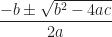 . After my explanation though, they are enlightened, and finally can understand why
  means that the quadratic has no real roots! 🙂
 AFP News/AFP File Photo – File Photo of Children attending preschool/kindergarten







 Mathtuition88