
The snooze button – one of life’s luxuries. But is it really helping you out, or making you more tired?
Tag: maths tuition
Maths Group Tuition at Bishan: E Maths and A Maths
https://mathtuition88.com/group-tuition/ https://mathtuition88.com/
Maths Tuition @ Bishan starting in 2014.
Secondary 4 O Level E Maths and A Maths.
Patient and Dedicated Maths Tutor (NUS Maths Major 1st Class Honours, Dean’s List, RI Alumni)
Email: mathtuition88@gmail.com
Free Exam Papers: https://mathtuition88.com/free-exam-papers/
Singapore Maths Group Tuition for O Level 2014
https://mathtuition88.com/group-tuition/ https://mathtuition88.com/
Maths Tuition @ Bishan starting in 2014.
Secondary 4 O Level E Maths and A Maths.
Patient and Dedicated Maths Tutor (NUS Maths Major 1st Class Honours, Dean’s List, RI Alumni)
Email: mathtuition88@gmail.com
Free Exam Papers: https://mathtuition88.com/free-exam-papers/
O Level E Maths and A Maths Tuition starting next year at Bishan
O Level E Maths and A Maths Tuition starting next year at Bishan
————————–
View Mr Wu’s GEP Testimonial at
https://mathtuition88.com/group-tuition/
Despite being in the Gifted Education Programme (GEP), Mr Wu is just an ordinary Singaporean. His secret to academic success is hard work and the Maths Techniques he has discovered by himself while navigating through the education system.
He would like to teach these techniques to students, hence choosing to become a full-time Mathematics tutor. Mr Wu has developed his own methods to check the answer, remember formulas (with understanding), which has helped a lot of students. Many Math questions can be checked easily, leading to the student being 100% confident of his or her answer even before the teacher marks his answer, and reducing the rates of careless mistakes.
Mr Wu’s friendly and humble nature makes him well-liked by students. Many of his students actually request for more tuition by themselves! (not the parents)
O Level E Maths and A Maths Tuition starting next year at Bishan, the best location in Central Singapore.
Timings are Monday 7-9pm, Thursday 7-9pm. Perfect for students who have CCA in the afternoon, or students who want to keep their weekends free.
Register with us now by email (mathtuition88@gmail.com). Vacancies will be allocated on a first-come-first-serve basis.
Thanks and wishing all a nice day.

2012 H2 Maths Prelim Solution: SRJC/II/8(iv)
8(iv)
Using the model 
First, we need to remove the outlier (40,6.6) as mentioned in part iii.
Then, performing linear regression with GC, (with variables 


Substituting 

Since we cannot have a negative fertility rate (the average number of children that would be born to a woman ), the estimate obtained for
Xinmin Secondary 2010 Prelim Paper I Q24 Solution (Challenging/Difficult Probability O Level Question)
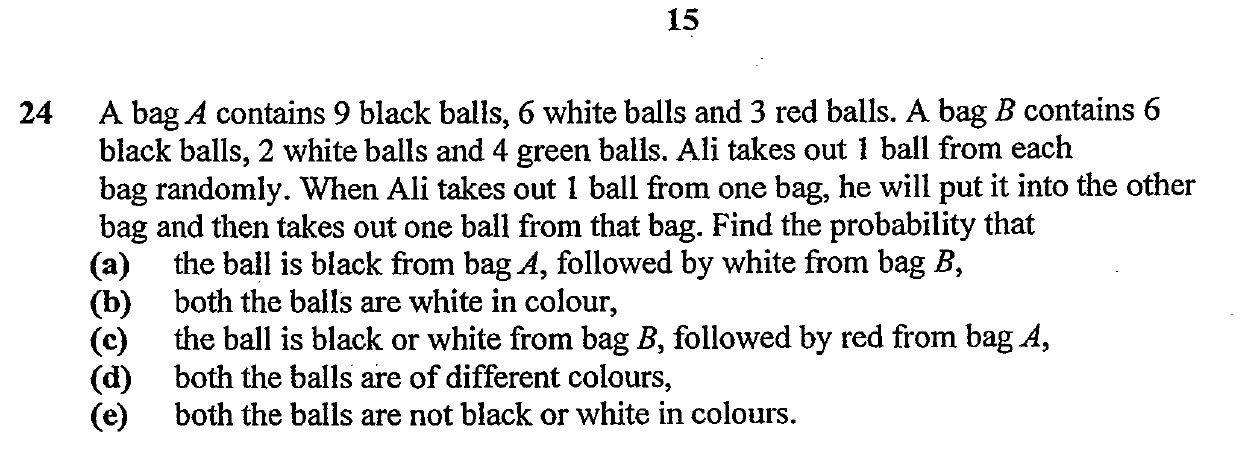
A bag A contains 9 black balls, 6 white balls and 3 red balls. A bag B contains 6 black balls, 2 white balls and 4 green balls. Ali takes out 1 ball from each bag randomly. When Ali takes out 1 ball from one bag, he will put it into the other bag and then takes out one ball from that bag. Find the probability that
(a) the ball is black from bag A, followed by white from bag B,
(b) both the balls are white in colour,
(c) the ball is black or white from bag B, followed by red from bag A,
(d) both the balls are of different colours,
(e) both the balls are not black or white in colours.
Solution:
(a)

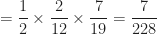
(b) Probability of white ball from bag A, followed by white ball from bag B=

Probability of white from B, followed by white from A=
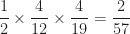
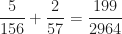
Total prob=
(c) Prob. of ball is black or white from bag B=


(d) Prob of both red = P(red from A, followed by red from B)=

P(both green)=P(green from B, followed by green from A)=

P(both black)=P(black from A, followed by black from B)+P(black from B, followed by black from A)=

P(both white)=

(e)
P(neither black nor white from A, followed by neither black nor white from B)=

P(neither black nor white from B, followed by neither black nor white from A)=
Multiplication Worksheet Generator for Grade 1 – Grade 3
Multiplication Worksheet Generator for Grade 1 – Grade 3

Generate hundreds of Multiplication Questions automatically, with answers!
Suitable for Grade 1 – Grade 3 (ages 7 to 9)
3D Trigonometry Maths Tuition

Solution:
(a) Draw a line to form a small right-angled triangle next to the angle

Then, you will see that


By sine rule,



(b) By Sine Rule,


(c)

By Cosine Rule,


(d)



angle of depression = 
(e)
Let X be the point where the man is at the shortest distance from D. Draw a right-angle triangle XDC.


Rectangle Maths Tuition
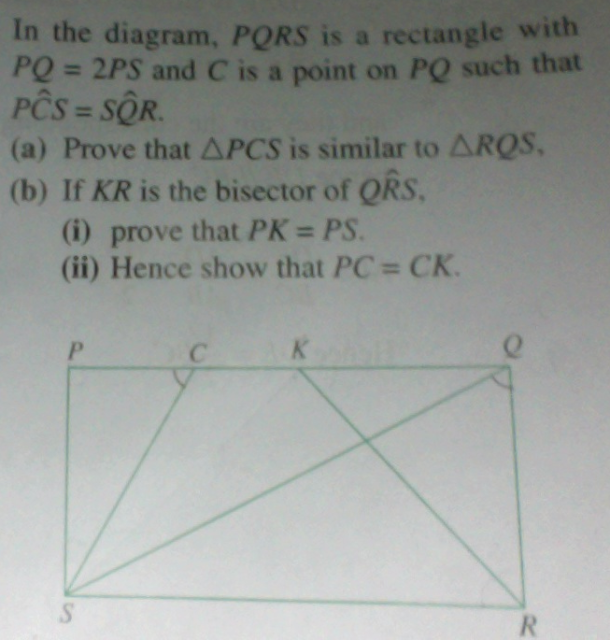
Solution:
(a)


Thus 

(b)(I)


Thus

Hence 
So

Hence,
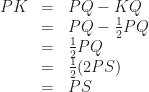
(shown)
(ii) By similar triangles,

Thus

Hence
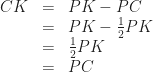
(shown)
Tips on attempting Geometrical Proof questions (E Maths Tuition)
Tips on attempting Geometrical Proof questions (O Levels E Maths/A Maths)
1) Draw extended lines and additional lines. (using pencil)
Drawing extended lines, especially parallel lines, will enable you to see alternate angles much easier (look for the “Z” shape). Also, some of the more challenging questions can only be solved if you draw an extra line.
2) Use pencil to draw lines, not pen
Many students draw lines with pen on the diagram. If there is any error, it will be hard to remove it.
3) Rotate the page.
Sometimes, rotating the page around will give you a fresh impression of the question. This may help you “see” the way to answer the question.
4) Do not assume angles are right angles, or lines are straight, or lines are parallel unless the question says so, or you have proved it.
For a rigorous proof, we are not allowed to assume anything unless the question explicitly says so. Often, exam setters may set a trap regarding this, making the angle look like a right angle when it is not.
5) Look at the marks of the question
If it is a 1 mark question, look for a short way to solve the problem. If the method is too long, you may be on the wrong track.
6) Be familiar with the basic theorems
The basic theorems are your tools to solve the question! Being familiar with them will help you a lot in solving the problems.
Hope it helps! And all the best for your journey in learning Geometry! Hope you have fun.
“There is no royal road to Geometry.” – Euclid

Solution 2 (Eigenvalue): Monkeys & Coconuts

Solution 2: Use Linear Algebra Eigenvalue equation: A.X = λ.X
A =S(x)= $Latex \frac{4}{5}(x-1)$ where x = coconuts
S(x)=λx
Since each iteration of the transformation caused the coconut status ‘unchanged’, which means λ = 1 (see remark below)
$Latex \frac{4}{5}(x-1)=x$
We get
x = – 4
S¹(x) = ⅘ (x-1)
S²(x) = ⅘( [⅘ (x-1)]-1)
= ⅘ (⅘ x -⅘ -1)
= (⅘)² x – (⅘)² – ⅘
Also by recursive, after the fifth monkey:
$Latex S^5 (x)$ = $Latex (\frac{4}{5})^5 (x-1)- (\frac{4}{5})^4-(\frac{4}{5})^3- (\frac{4}{5})^2- \frac{4}{5}$
$Latex S^5 (x)$ = $Latex (\frac{4}{5})^5 (x) – (\frac{4}{5})^5 – (\frac{4}{5})^4 – (\frac{4}{5})^3+(\frac{4}{5})^2 – \frac{4}{5}$
$Latex 5^5$ divides (x)
Minimum positive x= – 4 mod ($Latex 5^{5}$ )= $Latex 5^{5} – 4$= 3,121 [QED]
Note: The meaning of eigenvalue λ in linear transformation is the change by a scalar of λ factor (lengthening or shortening by λ) after the transformation. Here
λ = 1 because…
View original post 16 more words
Solution 1 (Sequence): Monkeys & Coconuts
Monkeys & Coconuts Problem
Solution 1 : iteration problem => Use sequence
$Latex U_{j} =\frac {4}{5} U_{j- 1} -1 $
(initial coconuts)
$Latex U_0 =k$
Let
$Latex f(x)=\frac{4}{5}(x-1)=\frac{4}{5}(x+4)-4$
$Latex U_1 =f(U_0)=f(k)= \frac{4}{5}(k+4)-4$
$Latex U_2 =f(U_1)=f(\frac{4}{5}(k+4)-4)= \frac{4}{5}((\frac{4}{5}(k+4)-4+4)-4$
$Latex U_2=(\frac{4}{5})^2 (k+4)-4$
$Latex U_3=(\frac{4}{5})^3 (k+4)-4$
$Latex U_4=(\frac{4}{5})^4 (k+4)-4$
$Latex U_5=(\frac{4}{5})^5 (k+4)-4$
Since
$Latex U_5$ is integer ,
$Latex 5^5 divides (k+4)$
k+4 ≡ 0 mod($Latex 5^5$)
k≡-4 mod($Latex 5^5$)
Minimum {k} = $Latex 5^5 -4$= 3121 [QED]
Note: The solution was given by Paul Richard Halmos (March 3, 1916 – October 2, 2006)
Monkeys & Coconuts Problem
5 monkeys found some coconuts at the beach.
1st monkey came, divided the coconuts into 5 groups, left 1 coconut which it threw to the sea, and took away 1 group of coconuts.
2nd monkey came, divided the remaining coconuts into 5 groups, left 1 coconut again thrown to the sea, and took away 1 group.
Same for 3rd , 4th and 5th monkeys.
Find: how many coconuts are there initially?
Note: This problem was created by Nobel Physicist Prof Paul Dirac (8 August 1902 – 20 October 1984). Prof Tsung-Dao Lee (李政道) (1926 ~) , Nobel Physicist, set it as a test for the young gifted students in the Chinese university of Science and Technology (中国科技大学-天才儿童班).

Reason for Maths Tuition
My take is that Maths tuition should not be forced. The child must be willing to go for Maths tuition in the first place, in order for Maths tuition to have any benefit. Also, the tuition must not add any additional stress to the student, as school is stressful enough. Rather Maths tuition should reduce the student’s stress by clearing his/her doubts and improving his/her confidence and interest in the subject. There is a quote “One important key to success is self-confidence. An important key to self-confidence is preparation.“. Tuition is one way to help the child with preparation.
Parallelogram Maths Tuition: Solution
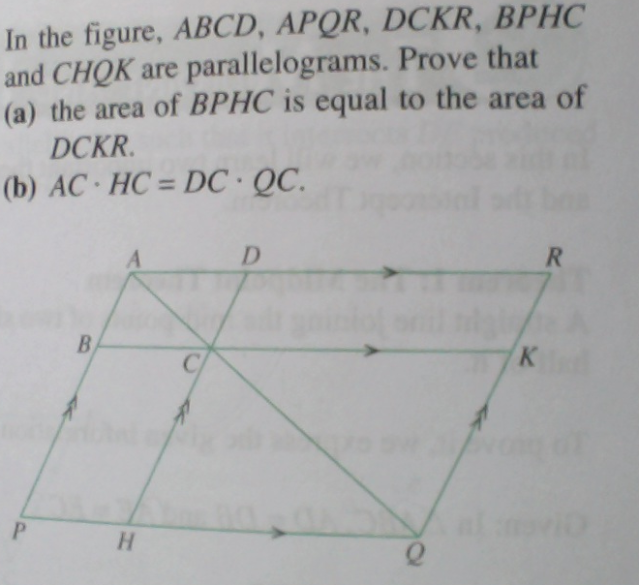
Solution:
(a) We have 


Thus, 
Similarly, 

Thus,

(proved)
(b)



Thus, 

Hence,

Thus,

(proved)
Congruent Triangles Geometry Maths Tuition: Solution
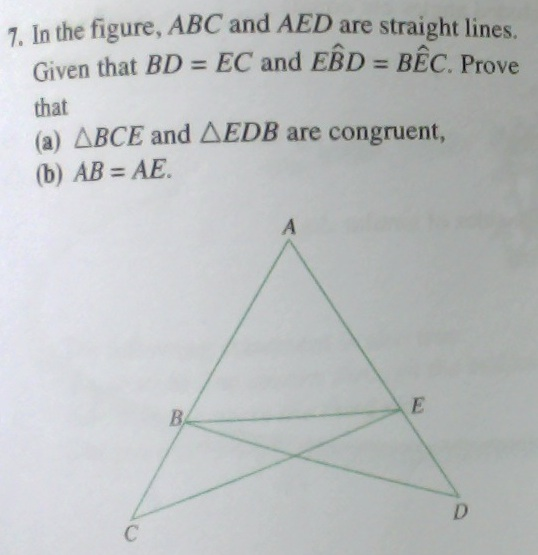
Solution:
(a) 
BE is a common side for both triangles 

BD=EC (given)
Therefore, 
(proved)
(b)
Since 

Thus,

Therefore, 
Thus,

(proved)
Congruent Triangles Maths Tuition: Solution

Solution:
BS=BE+ES=ST+ES=ET

BA=DT (given)
Thus, 

Hence

Thus DT//BA (alt. angles)
(Proved)
By Pythagoras’ Theorem, we have

Hence 

Hence

Thus DB//TA (alt. angles)
Therefore, ABDT is a parallelogram since it has two pairs of parallel sides.
(shown)
French Curve
The French method of drawing curves is very systematic:
“Pratique de l’etude d’une fonction”
Let f be the function represented by the curve C
Steps:
1. Simplify f(x). Determine the Domain of definition (D) of f;
2. Determine the sub-domain E of D, taking into account of the periodicity (eg. cos, sin, etc) and symmetry of f;
3. Study the Continuity of f;
4. Study the derivative of fand determine f'(x);
5. Find the limits of fwithin the boundary of the intervals in E;
6. Construct the Table of Variation;
7. Study the infinite branches;
8. Study the remarkable points: point of inflection, intersection points with the X and Y axes;
9. Draw the representative curve C.
Example:
$latex \displaystyle\text{f: } x \mapsto \frac{2x^{3}+27}{2x^2}$
Step 1: Determine the Domain of Definition D
D = R* = R –…
View original post 454 more words
Cut a cake 1/5
Visually cut a cake 1/5 portions of equal size:
1) divide into half:

2) divide 1/5 of the right half:

3) divide half, obtain 1/5 = right of (3)
$latex \frac{1}{5}= \frac{1}{2} (\frac{1}{2}(1- \frac{1}{5}))= \frac{1}{2} (\frac{1}{2} (\frac{4}{5}))=\frac{1}{2}(\frac{2}{5})$

4) By symmetry another 1/5 at (2)=(4)

5) divide left into 3 portions, each 1/5
$latex \frac{1}{5}= \frac{1}{3}(\frac{1}{2}+ \frac{1}{2}.\frac{1}{5}) = \frac{1}{3}.\frac{6}{10}$

Tuition That We May Have To Believe In
This insightful article makes a really good read.
Quotes from the article:
To be honest, the amount to be learnt at each level of education is constantly increasing, and tuition could just help you get that edge over others. After all, it was meant to be supplementary in nature.
The toughest part at the end of the day however, is probably this: getting the right tutor.

This commentary, “Tuition That We May Have To Believe In”, is a reply to a previous article on tuition by Howard Chiu (Mr.), “Tuition We Don’t Have To Believe In” (Read).
I must say Howard’s article had me on his side for a moment. He appealed to me emotively. Nothing like a mental picture of some kid attending hours and hours of tuition immediately after school when he could well be enjoying himself thoroughly with… an iPhone or iPad (I highly doubt kids these days still indulge their time at playgrounds). But the second time I read his article, I silenced the part of my brain which still prays the best for children, so do pardon me if I sound a tad too pragmatic at times.
The overarching assertion that Howard projects his points from is that there is “huge over consumption of this good”. Firstly, private tutoring…
View original post 1,472 more words
Generalized Analytic Geometry
Generalized Analytic Geometry
Find the equation of the circle which cuts the tangent 2x-y=0 at M(1,4), passing thru point A(4,-1).
Solution:
1st generalization:
Let the point circle be:
(x-1)² + (y-4)² =0
2nd generalization:
It cuts the tangent 2x-y=0
(x-1)² + (y-4)² +k(2x-y) =0 …(C)
Pass thru A(4,-1)
x=4, y= -1
=> k= -2
(C): (x-3)² + (y-1)² =…
[QED]
View original post 1 more word
Math Chants
Math Chants make learning Math formulas or Math properties fun and easy for memory . Some of them we learned in secondary school stay in the brain for whole life, even after leaving schools for decades.
Math chant is particularly easy in Chinese language because of its single syllable sound with 4 musical tones (like do-rei-mi-fa) – which may explain why Chinese students are good in Math, as shown in the International Math Olympiad championships frequently won by China and Singapore school students.
1. A crude example is the quadratic formula which people may remember as a little chant:
“ex equals minus bee plus or minus the square root of bee squared minus four ay see all over two ay.”
$latex \boxed{
x = \frac{-b \pm \sqrt{b^{2}-4ac}}
{2a}
}$
2. $latex \mathbb{NZQRC}$
Nine Zulu Queens Rule China
3. $latex \boxed {\cos 3A = 4\cos^{3}…
View original post 199 more words
What is “sin A”
What is “sin A” concretely ?
1. Draw a circle (diameter 1)
2. Connect any 3 points on the circle to form a triangle of angles A, B, C.
3. The length of sides opposite A, B, C are sin A, sin B, sin C, respectively.
Proof:
By Sine Rule:
$latex \frac{a}{sin A} = \frac{b}{sin B} =\frac{c}{sin C} = 2R = 1$
where sides a,b,c opposite angles A, B, C respectively.
a = sin A
b = sin B
c = sin C

成语数学
An alternative answer to Q1) 20 除 3 is “陆续不断”.
20除以3,因为它的答案接近于6.6666,所以这道题的答案是陆续不断,或者是六六大顺都行,百分之一就是百里挑一,9寸加1寸等于一尺即是得寸进尺,12345609,七零八落,1、3、5、7、9无双数所以叫做举世无双,或者你把它答出天下无双都行,如此小升初的难题您答对了吗?
Source: http://politics.people.com.cn/n/2013/0528/c70731-21638931.html
中国的小学离校考试 (PSLE) 「神题」: 猜成语
1) 20 除 3
2)1 除100
3)9寸+1寸=1尺
4)12345609
5)1,3,5,7,9
答案::
1) 20/3= 6.666 六六大顺
2)百中挑一
3)得寸進尺
4)七零八落
5)举世无双
O Level E Maths Tuition: Statistics Question

Solution:
From the graph,
Median = 50th percentile = $22,000 (approximately)
The mean is lower than $22000 because from the graph, there is a large number of people with income less than $22000, and fewer with income more than $22000. (From the wording of the question, calculation does not seem necessary)
Hence, the median is higher.
The mean is a better measure of central tendency, as it is a better representative of the gross annual income of the people. This is because more people have an income closer to the mean, rather than the median.
Secondary Maths Tuition: Kinematics Question
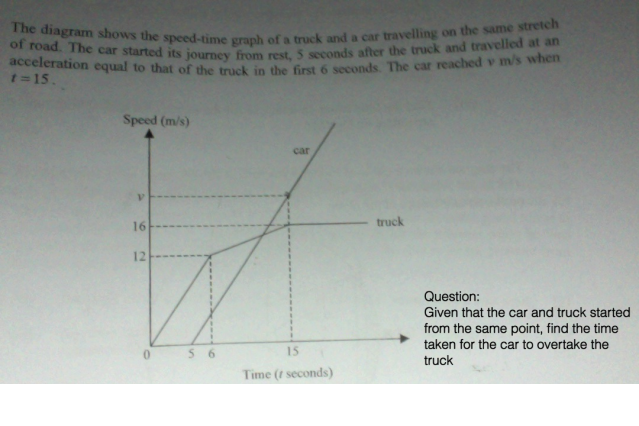
Solution:
acceleration of car



Let 
Total distance travelled by car at T seconds = area under graph =

(
Total distance travelled by truck at T seconds =

Equating the two distances will lead to a quadratic equation

Solving that gives 


Maths Resources available for sale!
Do check out our Maths Resources available for sale! All Maths notes and worksheets are priced affordably, starting from just $0.99!
All the resources are personally written by our principal tutor Mr Wu.
https://mathtuition88.com/maths-notes-worksheets-sale/

Maths Tuition Free Exam Papers (Primary, Secondary, O Levels, A Levels) Links
Maths Tuition Flyer
This is a Maths Tuition Flyer I created using the Maths software 
- Lorong Chuan
- Bishan
- Ang Mo Kio
- Toa Payoh
- Serangoon Gardens
PDF: Maths Tuition Flyer
 Mathtuition88