YouTube Video: Fibonacci Numbers and the Mysterious Golden Ratio

This is a YouTube Video, based on my earlier post on Fibonacci Numbers and the Mysterious Golden Ratio!

Thanks for watching! Remember to speed up the video when necessary!


Featured Book:

The Fabulous Fibonacci Numbers

The most ubiquitous, and perhaps the most intriguing, number pattern in mathematics is the Fibonacci sequence. In this simple pattern beginning with two ones, each succeeding number is the sum of the two numbers immediately preceding it (1, 1, 2, 3, 5, 8, 13, 21, ad infinitum). Far from being just a curiosity, this sequence recurs in structures found throughout nature – from the arrangement of whorls on a pinecone to the branches of certain plant stems. All of which is astounding evidence for the deep mathematical basis of the natural world.

With admirable clarity, two veteran math educators take us on a fascinating tour of the many ramifications of the Fibonacci numbers. They begin with a brief history of a distinguished Italian discoverer, who, among other accomplishments, was responsible for popularizing the use of Arabic numerals in the West. Turning to botany, the authors demonstrate, through illustrative diagrams, the unbelievable connections between Fibonacci numbers and natural forms (pineapples, sunflowers, and daisies are just a few examples).

Proof that Square Root of Two is Irrational [Rare Constructive Proof] (YouTube Video)

This is my second ever YouTube Video, and it is about a rarely seen proof (Constructive) that Square Root of Two is irrational.

The video is based on my earlier post on: Constructive Proof that Square Root of Two is irrational

Thanks for watching! Please speed up the video according to your preference! You can speed up either 2x or 1.5x for best effect.


Featured Book:

The Irrationals: A Story of the Numbers You Can’t Count On

The ancient Greeks discovered them, but it wasn’t until the nineteenth century that irrational numbers were properly understood and rigorously defined, and even today not all their mysteries have been revealed. In The Irrationals, the first popular and comprehensive book on the subject, Julian Havil tells the story of irrational numbers and the mathematicians who have tackled their challenges, from antiquity to the twenty-first century. Along the way, he explains why irrational numbers are surprisingly difficult to define–and why so many questions still surround them. Fascinating and illuminating, this is a book for everyone who loves math and the history behind it.

Intellectual wealth

An interesting news to share:

Source:http://www.thestandard.com.hk/news_detail.asp?we_cat=21&art_id=152297&sid=43527569&con_type=1&d_str=20141212&fc=8

Billionaire Ronnie Chan rather be mathematician or scientist if he could live life over

Billionaire Ronnie Chan Chi-chung seems to have it all figured out. Were the Hang Lung Properties chairman to live his life over again, it would not be as a businessman — he’d be a mathematician or scientist instead.

Chan, who offered this little gem during a speech at the Hang Lung Mathematics Awards ceremony, said he may have more material wealth than famed mathematician Yau Shing-tung but much less intellectual wealth.

As co-founder of the awards, which were set to encourage secondary school students to pursue maths and sciences, Chan urged youngsters to go the extra mile and become mathematicians or scientists as they can contribute more to society than what a businessman can.

Read more at: http://www.thestandard.com.hk/news_detail.asp?we_cat=21&art_id=152297&sid=43527569&con_type=1&d_str=20141212&fc=8

Hopefully this can encourage students currently studying Maths, be it O Level Maths, JC H1 or H2 Maths, or even University Maths!


Featured Book:

The Shape of Inner Space: String Theory and the Geometry of the Universe’s Hidden Dimensions

New Scientist
“It is a testimony to [Yau’s] careful prose (and no doubt to the skills of co-author Steve Nadis) that this book so compellingly captures the essence of what pushes string theorists forward in the face of formidable obstacles. It gives us a rare glimpse into a world as alien as the moons of Jupiter, and just as fascinating…. Yau and Nadis have produced a strangely mesmerizing account of geometry’s role in the universe.”

Nature
“Physicists investigate one cosmos, but mathematicians can explore all possible worlds. So marvels Fields medalist Shing-Tung Yau…. Relating how he solved a major theoretical problem in string theory in the 1970s, Yau explains how the geometries of the vibrating multidimensional strings that may characterize the Universe have implications across physics.”

Mathematicians prove the Umbral Moonshine Conjecture

Source: Science Daily

Mathematicians prove the Umbral Moonshine Conjecture

Date: December 15, 2014

Source: Emory University

Summary: Monstrous moonshine, a quirky pattern of the monster group in theoretical math, has a shadow — umbral moonshine. Mathematicians have now proved this insight, known as the Umbral Moonshine Conjecture, offering a formula with potential applications for everything from number theory to geometry to quantum physics.

“We’ve transformed the statement of the conjecture into something you could test, a finite calculation, and the conjecture proved to be true,” says Ken Ono, a mathematician at Emory University. “Umbral moonshine has created a lot of excitement in the world of math and physics.”

Co-authors of the proof include mathematicians John Duncan from Case Western University and Michael Griffin, an Emory graduate student.

“Sometimes a result is so stunningly beautiful that your mind does get blown a little,” Duncan says. Duncan co-wrote the statement for the Umbral Moonshine Conjecture with Miranda Cheng, a mathematician and physicist at the University of Amsterdam, and Jeff Harvey, a physicist at the University of Chicago.

Ono will present their work on January 11, 2015 at the Joint Mathematics Meetings in San Antonio, the largest mathematics meeting in the world. Ono is delivering one of the highlighted invited addresses.

Read more at: Science Daily


Featured Book:

Moonshine beyond the Monster: The Bridge Connecting Algebra, Modular Forms and Physics (Cambridge Monographs on Mathematical Physics)

Review

“An excellent introduction to this area for anyone who is looking for an informal survey… written in a lively and readable style.”
R.E. Boucherds, University of California at Berkeley for the Bulletin of the AMS

“It is written in a breezy, informal style which eschews the familiar Lemma-Theorem-Remark style in favor of a more relaxed and continuous narrative which allows a wide range of material to be included. Gannon has written an attractive and fun introduction to what is an attractive and fun area of research.”
Geoffrey Mason, Mathematical Reviews

“Gannon wants to explain to us “what is really going on.” His book is like a conversation at the blackboard, with ideas being explained in informal terms, proofs being sketched, and unknowns being explored. Given the complexity and breadth of this material, this is exactly the right approach. The result is informal, inviting, and fascinating.”
Fernando Q. Gouvea, MAA Reviews

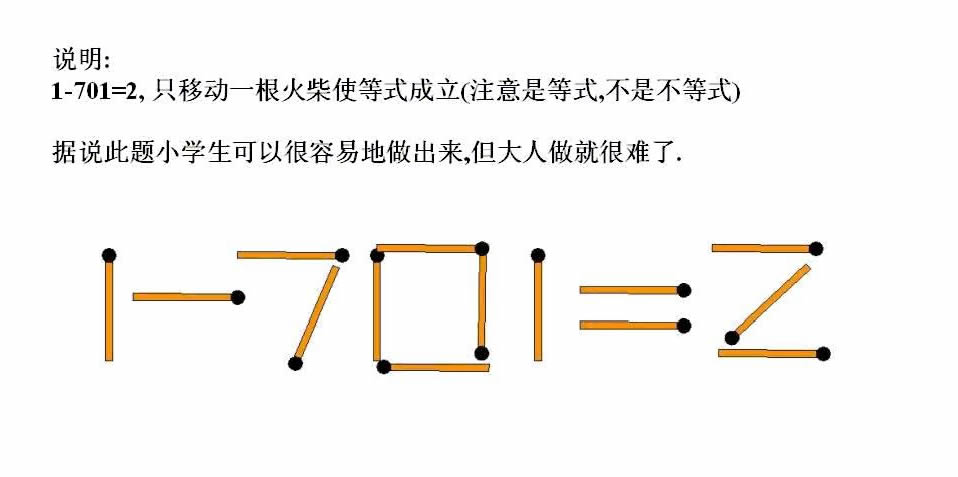
Matchstick Problem

matchstick quiz

Translation: How do we move only 1 matchstick to make the equation valid?

(“Not Equals” sign \neq is not allowed)

This is a really tricky question… Hint: Need to think in Chinese, this is a Chinese joke 😛


Featured Post:

Motivational Books for Students (Educational)

The Motivational Books recommended in the above post seems to be very popular with readers on this site. Many readers (presumably parents) have bought the books! Buy a Christmas present for yourself this Xmas. 🙂

Integration by Substitution (H2 Maths Tuition)

This is a 1 page article prepared by me for students to learn how to do Integration by Substitution, a very useful technique that can integrate many functions.

This is especially useful for students taking H2 Maths, as it is one of the two tools for integration. The other is Integration by Parts. SMU First Year Students also have to take a calculus course which includes Integration by Substitution too.

This is also my first time trying out embedding Scribd into WordPress, so that users can view the document on the website itself without downloading anything. 🙂

Print version: Integration by Substitution


Featured book:

Calculus: An Intuitive and Physical Approach (Second Edition) (Dover Books on Mathematics)

Application-oriented introduction relates the subject as closely as possible to science. In-depth explorations of the derivative, the differentiation and integration of the powers of x, and theorems on differentiation and antidifferentiation lead to a definition of the chain rule and examinations of trigonometric functions, logarithmic and exponential functions, techniques of integration, polar coordinates, much more. Clear-cut explanations, numerous drills, illustrative examples. 1967 edition. Solution guide available upon request.

College pays students for getting a ‘C’ in math

Interesting idea. Definitely a motivation for most students!

Source: http://www.campusreform.org/?ID=6058

  • Hillsborough Community College will pay up to $1,800 in cash to students who make a C or higher in three semesters of math classes.
  • Students also have the to win free textbooks.
  • HCC funds part of this experiment with additional funding coming from a George Soros organization.

Florida community college is trying to inspire students to finish their degree by doling out up to $1,800 in cash to students who make a C or higher in three semesters of math courses.

The program, called Mathematic Access Scholarship Program (MAPS), has run at Hillsborough Community College (HCC) for the past three years and is spearheaded by Manpower Demonstration Research Corporation (MDRC).

“We hoped the incentives would inspire behaviors that would lead to increased student success.”


Featured book:

Great Jobs for Math Majors, Second ed. (Great Jobs For… Series)

“What can I do with a degree in math?”

You’ve worked hard for that math degree. Now what? Sometimes, the choice of careers can seem endless. The most difficult part of a job search is starting it. This is where Great Jobs for Math Majors comes in. Designed to help you put your major to work, this handy guide covers the basics of a job search and provides detailed profiles of careers in math. From the worlds of finance and science to manufacturing and education, you’ll explore a variety of job options for math majors and determine the best fit for your personal, professional, and practical needs.

Do you want to be an actuary? Work in the banking industry? Program computers? In this updated edition, you’ll find:

  • Job-search basics such as crafting résumés and writing cover letters
  • Self-assessment exercises to help determine your professional fit
  • Investigative tools to help you find the perfect job
  • Networking tips to get your foot in the door before your résumé is even sent
  • True tales from practicing professionals about everyday life on the job
  • Current statistics on earnings, advancement, and the future of the profession
  • Resources for further information, including journals, professional associations, and online resources

Book donation drive to help low-income families (Singapore)

Do you have any old textbooks that you don’t need anymore? Check out a meaningful way to share a textbook by NTUC.

Source: NTUC Website

Photo: FairPrice Share-A-Textbook 2014 is officially launched! Show your support by donating your textbooks at any FairPrice stores (including Finest supermarkets, Xtra hypermarkets and FairPrice Xpress stores at Esso service stations). Collection closes 7 December 2014.

FairPrice Share-A-Textbook 2014 is officially launched! Show your support by donating your textbooks at any FairPrice stores (including Finest supermarkets, Xtra hypermarkets and FairPrice Xpress stores at Esso service stations). Collection closes 7 December 2014.


Featured book:

Math Doesn’t Suck: How to Survive Middle School Math Without Losing Your Mind or Breaking a Nail

From a well-known actress, math genius and popular contestant on “Dancing With The Stars”—a groundbreaking guide to mathematics for middle school girls, their parents, and educators

Exams are over! Book disproves evolution using Math!

Finally, after an arduous year, the exams are over (in Singapore). 🙂

It is now time for a period of rest and relaxation, to get ready for 2015, where everything starts again.

Students who are looking for an early headstart (a 1 month headstart is rather valuable) in subjects other than mathematics can check out Startutor: The best tuition agency in Singapore.

Recently, I chanced upon this book:

The Organized Universe: Exclusive Scientific Proof That Darwinism Is a Fraud

What strikes me is that the author is using a Mathematical Law (Benford’s Law) to prove that Darwinism is a fraud. It is pretty unique since other books usually rely on proofs based on physics, biology or chemistry.

The Theory of Darwinian Evolution is a Fraud! Finally, a long awaited secret of the Universe. For the first time, Man has scientific proof showing a pattern to all life. Can this be possible? In this ground breaking first book, veteran researcher and inventor/scientist Karl Dahlstrom and co-author C. Phillip Clegg have written an exceptionally readable, mind expanding and almost equation free account of how an accidental discovery of an obscure mathematical theorem came to overturn an established scientific paradigm. The best theories of the universe are beautiful, simple and profound just as Einstein’s famous formula, E=MC2. This book is elegant in its simplicity and yet complex in its scope of re-defining an ordered universe. This book zeros in on a 150 year old controversy of Darwinian Evolution and tears it apart with laser like precision such that the very core of that ‘theory’ is – to borrow a phrase from Descartes – “rent asunder”. There is nothing new under the sun. Since the Big Bang, an organizing principle of matter, embedded in the natural laws of physics, and eventually life itself, has manifested itself in a precise pattern such that it is found in literally everything – from the composition of meteorites to seawater, soil, and gasses here on earth as well as in tabulated data on everything from stock prices to river lengths. This discovery, called Benford’s Law, simply states that in any tabulated data set of natural numbers, the frequency of occurrence of the digits 1 through 9, as the first significant digit, will conform to a set pattern: 1 will occur 30.x% of the time; “2” will occur 17.x%, etc. with the frequency of each succeeding number being less than the preceding number. What does this scientific law of nature have to do with Darwin’s Evolution Theory?

I have read the preview on Amazon and it seems pretty interesting. 🙂

Also, just a reminder that the Free Career Analysis Quiz by renowned survey company Universum is still active for a limited time only! Do check it out before it ends.


Bishan-Ang Mo Kio area to get new JC in 2017

Source: http://news.asiaone.com/news/edvantage/bishan-ang-mo-kio-area-get-new-jc-2017

Bishan-Ang Mo Kio area to get new JC in 2017

The site for the new JC at the junction of Sin Ming Avenue and Marymount Road.
Lee Jian Xuan

Saturday, Jan 04, 2014

SINGAPORE – A new junior college that will open in 2017 for students from three Integrated Programme (IP) schools will likely be built on the site of the Asian Golf Academy near Bishan.

A statement on the Ministry of Education (MOE) website says the new campus will be at the junction of Sin Ming Avenue and Marymount Road, where the driving range is located.

The area is also zoned for an educational institution, according to the Urban Redevelopment Authority’s Draft Master Plan 2013.

Singapore’s 20th school to offer a JC programme will take in IP students from Catholic High School, CHIJ St Nicholas Girls’ School and the Singapore Chinese Girls’ School. It will also admit more than 100 students from other secondary schools who have completed their O levels.

It will be the newest JC since Innova JC in Woodlands was completed in 2005.

Read more at: http://news.asiaone.com/news/edvantage/bishan-ang-mo-kio-area-get-new-jc-2017

Undergraduate Study in Mathematics (NUS)

Maths Group Tuition to start in 2014!

If you are interested in Mathematics, do consider to study Mathematics at NUS!

Source: http://ww1.math.nus.edu.sg/undergrad.aspx

Quote:

Undergraduate Study in Mathematics (NUS)

Overview

The Department of Mathematics at NUS is the largest department in the Faculty of Science. We offer a wide range of modules catered to specialists contemplating careers in mathematical science research as well as to those interested in applications of advanced mathematics to science, technology and commerce. The curriculum strives to maintain a balance between mathematical rigour and applications to other disciplines.

We offer a variety of major and minor programmes, covering different areas of mathematical sciences, for students pursuing full-time undergraduate studies. Those keen in multidisciplinary studies would also find learning opportunities in special combinations such as double degree, double major and interdisciplinary programmes.

Honours graduates may further their studies with the Graduate Programme in Mathematics by Research leading to M.Sc. or Ph.D. degree, or with the M.Sc. Programme in Mathematics by Course Work.

Prime Minister Lee Hsien Loong Truly Outstanding Mathematics Student

Just to share an inspirational story about studying Mathematics, and our very own Prime Minister Lee Hsien Loong. 🙂

Source: http://www2.ims.nus.edu.sg/imprints/interviews/BelaBollobas.pdf

(page 8/8)

Interview of Professor Béla Bollobás, Professor and teacher of our Prime Minister Lee Hsien Loong

I: Interviewer Y.K. Leong

B: Professor Béla Bollobás

I: I understand that you have taught our present Prime
Minister Lee Hsien Loong.

B: I certainly taught him more than anybody else in
Cambridge. I can truthfully say that he was an exceptionally
good student. I’m not sure that this is really known in
Singapore. “Because he’s now the Prime Minister,” people
may say, “oh, you would say he was good.” No, he was truly
outstanding: he was head and shoulders above the rest of
the students. He was not only the first, but the gap between
him and the man who came second was huge.

I: I believe he did double honors in mathematics and computer science.

B: I think that he did computer science (after mathematics) mostly because his father didn’t want him to stay in pure mathematics. Loong was not only hardworking, conscientious and professional, but he was also very inventive. All the signs indicated that he would have been a world-class research mathematician. I’m sure his father never realized how exceptional Loong was. He thought Loong was very good. No, Loong was much better than that. When I tried to tell Lee Kuan Yew, “Look, your son is phenomenally good: you should encourage him to do mathematics,” then he implied that that was impossible, since as a top-flight professional mathematician Loong would leave Singapore for Princeton, Harvard or Cambridge, and that would send the wrong signal to the people in Singapore. And I have to agree that this was a very good point indeed. Now I am even more impressed by Lee Hsien Loong than I was all those years ago, and I am very proud that I taught him; he seems to be doing very well. I have come round to thinking that it was indeed good for him to go into politics; he can certainly make an awful lot of difference.

H2 Maths 2012 A Level Solution Paper 2 Q6; H2 Maths Group Tuition

6(i)

H_0: \mu=14.0 cm

H_1: \mu\neq 14.0 cm

(ii)

\bar{x}\sim N(14,\frac{3.8^2}{20})

For the null hypothesis not to be rejected,

Z_{2.5\%}<\frac{\bar{x}-14}{3.8/\sqrt{20}}<Z_{97.5\%}

-1.95996<\frac{\bar{x}-14}{3.8/\sqrt{20}}<1.95996 (use GC invNorm function!)

12.3<\bar{x}<15.7 (3 s.f.)

(iii) Since \bar{x}=15.8 is out of the set 12.3<\bar{x}<15.7, the null hypothesis would be rejected. There is sufficient evidence that the squirrels on the island do not have the same mean tail length as the species known to her.

(technique: put in words what H_1 says!)

H2 Maths A Level 2012 Solution, Paper 2 Q5; H2 Maths Tuition

5(i)(a)

P(\text{patient has the disease and test positive})=0.001(0.995)=9.95\times 10^{-4}

P(\text{patient does not have the disease and he tests positive})=(1-0.001)(1-0.995)=4.995\times 10^{-3}

P(\text{result of the test is positive})=9.95\times 10^{-4}+4.995\times 10^{-3}=5.99\times 10^{-3}

(b)

Let A=patient has disease

Let B=result of test is positive

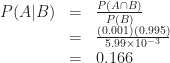
\displaystyle\begin{array}{rcl}P(A|B)&=&\frac{P(A\cap B)}{P(B)}\\    &=&\frac{(0.001)(0.995)}{5.99\times 10^{-3}}\\    &=&0.166    \end{array}

Note that the probability is surprisingly quite low! (This is called the False positive paradox, a statistical result where false positive tests are more probable than true positive tests, occurring when the overall population has a low incidence of a condition and the incidence rate is lower than the false positive rate. See http://en.wikipedia.org/wiki/False_positive_paradox)

(ii)

\displaystyle P(A|B)=\frac{(0.001)p}{(0.001)p+(1-0.001)(1-p)}=0.75

By GC, p=0.999666 (6 d.p.)

H2 Maths 2012 A Level Paper 2 Q4 Solution; H2 Maths Tuition

(i)

1 Jan 2001 –> $100

1 Feb 2001 —> $110

1 Mar 2001 –> $120

Notice that this is an AP with a=100d=10

\displaystyle\begin{array}{rcl}S_n&=&\frac{n}{2}(2a+(n-1)d)\\    &=&\frac{n}{2}(200+10(n-1))>5000    \end{array}

\frac{n}{2}(200+10(n-1))-5000>0

From GC, n>23.5

n=24 (months)

This is inclusive of 1 Jan 2001!!!

Thus, 1 Jan 2001 + 23 months —> 1 Dec 2002

(ii)

1 Jan 2001 –> 100

end of Jan 2001 –> 1.005(100)

1 Feb 2001 –> 1.005(100)+100

end of Feb 2001 –> 1.005[1.005(100)+100]=1.005^2 (100)+1.005(100)

From the pattern, we can see that

\displaystyle\begin{array}{rcl}S_n&=&1.005^n(100)+1.005^{n-1}(100)+\cdots+1.005(100)\\    &=&\frac{a(r^n-1)}{r-1}\\    &=&\frac{1.005(100)[1.005^n-1]}{1.005-1}\\    &=&\frac{100.5(1.005^n-1)}{0.005}\\    &=&20100(1.005^n-1)    \end{array}

$5000-$100=$4900

20100(1.005^n-1)>4900

20100(1.005^n-1)-4900>0

From GC, n>43.7

So n=44 months (inclusive of Jan 2001 !!!)

1 Jan 2001+36 months —> 1 Jan 2004

1 Jan 2004+7 months —> 1 Aug 2004

Then on 1 Sep 2004, Mr B will deposit another $100, making the amount greater than $5000.

Hence, answer is 1 Sep 2004.

(iii)

Let the interest rate be x %.

Note that from Jan 2001 to Nov 2003 is 35 months. (Jan 2001 to Dec 2001 is 12 months, Jan 2002 to Dec 2002 is 12 months, Jan 2003 to Nov 2003 is 11 months :))

$5000-$100=$4900

Modifying our formula in part ii, we get

\displaystyle S_n=\frac{(1+x/100)(100)[(1+x/100)^n-1]}{(1+x/100)-1}=4900

Setting n=35 and using GC, we get

x=1.80

Hence, the interest rate is 1.80%.

A Level H2 Maths 2012 Paper 2 Q3 Solution; H2 Maths Tuition

A Level H2 Maths 2012 Paper 2 Q3 Solution

(i)

cubic graph maths tuition

(The graph above is drawn using the Geogebra software 🙂 )

(ii)

x^3+x^2-2x-4=4

x^3+x^2-2x-8=0

By GC, x=2

By long division, x^3+x^2-2x-8=(x-2)(x^2+3x+4)

The discriminant of x^2+3x+4 is

D=b^2-4ac=3^2-4(1)(4)=-7<0

Hence, there are no other real solutions (proven).

(iii) x+3=2

x=-1

(iv)

cubic absolute graph maths tuition

(v)

|x^3+x^2-2x-4|=4

x^3+x^2-2x-4=4 or x^3+x^2-2x-4=-4

x^3+x^2-2x-8=0 or x^3+x^2-2x=0

x^3+x^2-2x-8=0 \implies x=2 (from part ii)

x^3+x^2-2x=x(x^2+x-2)=x(x-1)(x+2)=0

x=0,1,-2

In summary, the roots are -2,0,1,2

List of JCs in Singapore; H2 Maths Tuition

Source: http://en.wikipedia.org/wiki/List_of_schools_in_Singapore#Junior_Colleges_.28JC.29

Junior Colleges (JC)

These offer two-year courses leading to the GCE A-level examination.

Code Zone College Name Established Address Type Special Programmes
English Chinese Abb.
0705 North Anderson Junior College 安德逊初级学院 AJC 1984 4500 Ang Mo Kio Avenue 6 Government
7001 West Anglo-Chinese School (Independent) IB World School 英华中学 (自主) ACS(I)-IBDP 2004 (IBDP) 121 Dover Road Independent IP, MEP
0803 West Anglo-Chinese Junior College 英华初级学院 ACJC 1977 25 Dover Close East Government-Aided MEP, DEP(TSD), LEP (EL)
0802 South Catholic Junior College 公教初级学院 CJC 1975 129 Whitley Road Government-Aided LEP (EL)
3101 East Dunman High School 德明政府中学 DHS 2005 – IP 10 Tanjong Rhu Road Autonomous IP, MEP, BSP, LEP (CL), AEP
0806 Central Hwa Chong Institution 华侨中学 HCI 1974 661 Bukit Timah Road Independent IP, HP, LEP (CL), AEP, BSP
0713 North Innova Junior College 星烁初级学院 IJC 2005 21 Champions Way Government LEP (ML)
0703 West Jurong Junior College 裕廊初级学院 JJC 1981 800 Corporation Road Government LEP (CL)
0712 East Meridian Junior College 美廉初级学院 MJC 2003 21 Pasir Ris Street 71 Government
0908 West Millennia Institute 励仁高级中学 MI 2004 60 Bukit Batok West Avenue 8 Government DTP
0805 North Nanyang Junior College 南洋初级学院 NYJC 1978 128 Serangoon Avenue 3 Government-Aided LEP (CL), AEP
0712 Central National Junior College 国家初级学院 NJC 1969 37 Hillcrest Road Government IP, HP, AEP, MEP, STaR
7801 West NUS High School of Mathematics and Science 新加坡国立大学附属数理中学 NUSHS 2005 20 Clementi Ave 1 Independent IP, DIP
0711 West Pioneer Junior College 先驱初级学院 PJC 1999 21 Teck Whye Walk Government
0704 South Raffles Institution 莱佛士初级学院 RI 1826 10 Bishan Street 21 Independent IP, HP, LEP (JL), LEP (EL), MEP, TSD
3103 West River Valley High School 立化中学 RVHS 1956 2006 – IP 6 Boon Lay Avenue Autonomous IP, BSP
0710 North Serangoon Junior College 实龙岗初级学院 SRJC 1988 1033 Upper Serangoon Road Government
0804 South Saint Andrew’s Junior College 圣安德烈初级学院 SAJC 1978 55 Potong Pasir Avenue 1 Government-Aided
0709 East Tampines Junior College 淡滨尼初级学院 TPJC 1986 2 Tampines Avenue 9 Government LEP (ML), TSD
0702 East Temasek Junior College 淡马锡初级学院 TJC 1977 22 Bedok South Road Government IP, HP, LEP (CL), MEP
0706 East Victoria Junior College 维多利亚初级学院 VJC 1984 20 Marine Vista Government IP, HP, TSD, NAV
0708 North Yishun Junior College 义顺初级学院 YJC 1986 3 Yishun Ring Road Government

Centralised Institutes (CI)

The only centralised institute is Millennia Institute (MI), which offers a three-year course leading to the GCE A-level examination in arts, science, and commerce.[3]

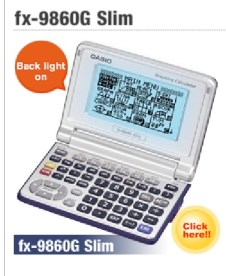
How to use tables in CASIO FX-9860G Slim (H2 Maths Tuition)

Tables in CASIO FX-9860G Slim

The most popular Graphical Calculator for H2 Maths is currently the TI-84 PLUS series, but some students do use Casio Graphical Calculators.

The manual for CASIO FX-9860G Slim is can be found here:

http://edu.casio.com/products/fx9860g2/data/fx-9860GII_Soft_E.pdf

The information about Tables and how to generate a table is on page 121.

Generating tables is useful to solve some questions in sequences and series, and also probability. It makes guess and check questions much faster to solve.

h2 tuition gc
Picture of the CASIO FX-9860G Slim Calculator

2012 H2 Maths Prelim Solution: SRJC/II/8(iv)

8(iv)

Using the model \displaystyle y=a+\frac{b}{x-2}, estimate the total fertility rate for a particular country Z when its GDP per capita is USD$1000, giving your answer to 1 decimal place and comment on the reliability of the estimate.

First, we need to remove the outlier (40,6.6) as mentioned in part iii.

Then, performing linear regression with GC, (with variables \frac{1}{x-2}y), we get:

a=0.974686

b=6.86442

Substituting x=1, we get \displaystyle y=a+\frac{b}{1-2}=-5.9 (1 d.p.)

Since we cannot have a negative fertility rate (the average number of children that would be born to a woman ), the estimate obtained for y is not reliable.

MI H2 Maths Prelim Solutions 2010 Paper 2 Q7 (P&C)

MI H2 Maths Prelim 2010 Paper 2 Q7 (P&C)

Question:
7) Two families are invited to a party. The first family consists of a man and both his parents while the second family consists of a woman and both her parents. The two families sit at a round table with two other men and two other women.
Find the number of possible arrangements if
(i) there is no restriction, [1]
(ii) the men and women are seated alternately, [2]
(iii) members of the same family are seated together and the two other women must be seated separately, [3]
(iv) members of the same family are seated together and the seats are numbered. [2]

Solution:

(i) (10-1)!=9!=362880

(ii) First fix the men’s sitting arrangement: (5-1)!

Then the remaining five women’s total number of arrangements are: 5!

Total=4! x 5!=2880

(iii) Fix the 2 families (as a group) and the 2 men: (4-1)! x 3! x 3!

(3! to permute each family)

By drawing a diagram, the two women have 4 slots to choose from, where order matters: ^4 P_2

Total = (4-1)! \times 3! \times 3! \times ^4 P_2 = 2592

(iv)

We first find the required number of ways by treating the seats as unnumbered: (6-1)!\times 3!\times 3! =4320

Since the seats are numbered, there are 10 choices for the point of reference, thus no. of ways = 4320 \times 10 =43200

H2 JC Maths Tuition Foot of Perpendicular 2007 Paper 1 Q8

One of my students asked me how to solve 2007 Paper 1 Q8 (iii) using Foot of Perpendicular method.

The answer given in the TYS uses a sine method, which is actually shorter in this case, since we have found the angle in part (ii).

Nevertheless, here is how we solve the question using Foot of Perpendicular method.

(Due to copyright issues, I cannot post the whole question here, so please refer to your Ten Year Series.)

Firstly, let F be the foot of the perpendicular.

Then, \vec{AF}=k\begin{pmatrix}3\\-1\\2\end{pmatrix} ——– Eqn (1)

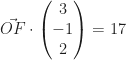
\vec{OF}\cdot\begin{pmatrix}3\\-1\\2\end{pmatrix}=17 ——– Eqn (2)

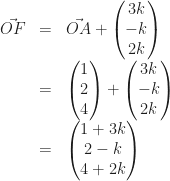
From Eqn (1), \vec{OF}-\vec{OA}=\begin{pmatrix}3k\\-k\\2k\end{pmatrix}

\begin{array}{rcl}\vec{OF}&=&\vec{OA}+\begin{pmatrix}3k\\-k\\2k\end{pmatrix}\\  &=&\begin{pmatrix}1\\2\\4\end{pmatrix}+\begin{pmatrix}3k\\-k\\2k\end{pmatrix}\\  &=&\begin{pmatrix}1+3k\\2-k\\4+2k\end{pmatrix}\end{array}

Substituting into Eqn (2),

\begin{pmatrix}1+3k\\2-k\\4+2k\end{pmatrix}\cdot\begin{pmatrix}3\\-1\\2\end{pmatrix}=17

14k+9=17

k=4/7

Substituting back into Eqn (1),

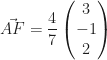
\displaystyle\vec{AF}=\frac{4}{7}\begin{pmatrix}3\\-1\\2\end{pmatrix}

\displaystyle|\vec{AF}|=\frac{4}{7}\sqrt{14}

Maths Tutor Singapore, H2 Maths, A Maths, E Maths

If you or a friend are looking for maths tuition: o level, a level, IB, IP, olympiad, GEP and any other form of mathematics you can think of

Experienced, qualified (Raffles GEP, Deans List, NUS Deans List, Olympiads etc) and most importantly patient even with the most mathematically challenged.

so if you are in need of the solution to your mathematical woes, drop me a message!

Tutor: Mr Wu

Email: mathtuition88@gmail.com

Website: https://mathtuition88.com/

H2 Maths Tuition: Complex Numbers Notes

H2 Maths: Complex Numbers 1 Page Notes

Modulus

Argument

Cartesian Form

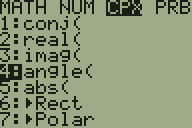
Draw diagram first, then find the appropriate quadrant and use

(can use GC to double check)

Polar Form

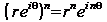
Exponential Form

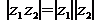
When question involvespowers, multiplication or division, it may be helpful toconvert to exponential form.

Please write Ƶ and 2 differently.

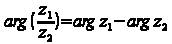
De Moivre’s Theorem

Equivalent to

Memory tip: Notice that arg behaves similarly to log.

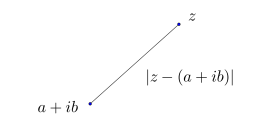
Locusof z is aset of pointssatisfying certain given conditions.

in English means:The distance between (the point representing)and (the point representing)

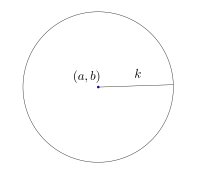
Means the distance offromis a constant,.

So this is acircular loci.

Centre:, radius =

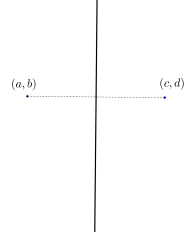
means that the distance offromis equal to its distance from

In other words, the locus is theperpendicular bisectorof the line segment joiningand.

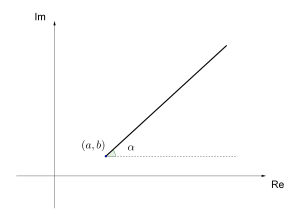
represents ahalf-linestarting frommaking an anglewith the positive Re-axis.

(Exclude the point (a,b) )

Common Errors

– Some candidates thought thatis the same asand thatis the same as.

– The “formula”for argumentsdoes not workfor points in the 2ndand 3rdquadrant.

– Very many candidates seem unaware that their calculators will work in radians mode and there were many unnecessary “manual” conversions from degrees to radians.

H2 Maths Tuition: Foot of Perpendicular (from point to plane) (Part II)

This is a continuation from H2 Maths Tuition: Foot of Perpendicular (from point to line) (Part I).

Foot of Perpendicular (from point to plane)

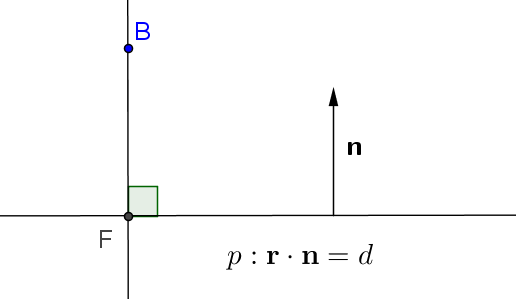
From point (B) to Plane ( p)

h2-vectors-tuition

Equation (I):

Where does F lie?

F lies on the plane  p.

\overrightarrow{\mathit{OF}}\cdot \mathbf{n}=d

Equation (II):

Perpendicular

\overrightarrow{\mathit{BF}}=k\mathbf{n}

\overrightarrow{\mathit{OF}}-\overrightarrow{\mathit{OB}}=k\mathbf{n}

\overrightarrow{\mathit{OF}}=k\mathbf{n}+\overrightarrow{OB}

Final Step

Substitute Equation (II) into Equation (I) and solve for k.

Example

[VJC 2010 P1Q8i]

The planes \Pi _{1} and \Pi _{2} have equations \mathbf{r\cdot(i+j-k)}=6 and \mathbf{r\cdot(2i-4j+k)}=-12 respectively. The point A  has position vector  \mathbf{{9i-7j+5k}} .

(i) Find the position vector of the foot of perpendicular from  A to \Pi _{2} .

Solution

Let the foot of perpendicular be F.

Equation (I)

\overrightarrow{\mathit{OF}}\cdot  \left(\begin{matrix}2\\-4\\1\end{matrix}\right)=-12

Equation (II)

\overrightarrow{\mathit{OF}}=k\left(\begin{matrix}2\\-4\\1\end{matrix}\right)+\left(\begin{matrix}9\\-7\\5\end{matrix}\right)=\left(\begin{matrix}2k+9\\-4k-7\\k+5\end{matrix}\right)

Subst. (II) into (I)

2(2k+9)-4(-4k-7)+(k+5)=-12

Solve for k,  k=-3 .

\overrightarrow{\mathit{OF}}=\left(\begin{matrix}3\\5\\2\end{matrix}\right)

H2 Maths Tuition

If you are looking for Maths Tuition, contact Mr Wu at:

Email: mathtuition88@gmail.com