Математика Групповые занятия класса, чтобы начать в следующем году, 2014 году.
Математика Обучение центр

Математика Обучение центр
Maths Tuition Centre
Maths Tuition Centre
ศูนย์คณิตศาสตร์เล่าเรียน
5(i)(a)
(b)
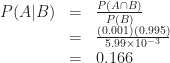
Let A=patient has disease
Let B=result of test is positive
Note that the probability is surprisingly quite low! (This is called the False positive paradox, a statistical result where false positive tests are more probable than true positive tests, occurring when the overall population has a low incidence of a condition and the incidence rate is lower than the false positive rate. See http://en.wikipedia.org/wiki/False_positive_paradox)
(ii)
By GC, 
(i)
1 Jan 2001 –> $100
1 Feb 2001 —> $110
1 Mar 2001 –> $120
Notice that this is an AP with 
From GC,

This is inclusive of 1 Jan 2001!!!
Thus, 1 Jan 2001 + 23 months —> 1 Dec 2002
(ii)
1 Jan 2001 –> 100
end of Jan 2001 –> 1.005(100)
1 Feb 2001 –> 1.005(100)+100
end of Feb 2001 –> 1.005[1.005(100)+100]=
From the pattern, we can see that
$5000-$100=$4900
From GC,
So 
1 Jan 2001+36 months —> 1 Jan 2004
1 Jan 2004+7 months —> 1 Aug 2004
Then on 1 Sep 2004, Mr B will deposit another $100, making the amount greater than $5000.
Hence, answer is 1 Sep 2004.
(iii)
Let the interest rate be x %.
Note that from Jan 2001 to Nov 2003 is 35 months. (Jan 2001 to Dec 2001 is 12 months, Jan 2002 to Dec 2002 is 12 months, Jan 2003 to Nov 2003 is 11 months :))
$5000-$100=$4900
Modifying our formula in part ii, we get
Setting 
Hence, the interest rate is 1.80%.
(i)

(The graph above is drawn using the Geogebra software 🙂 )
(ii)
By GC,
By long division,
The discriminant of 
Hence, there are no other real solutions (proven).
(iii)
(iv)

(v)



In summary, the roots are
Source: http://en.wikipedia.org/wiki/List_of_schools_in_Singapore#Junior_Colleges_.28JC.29
These offer two-year courses leading to the GCE A-level examination.
| Code | Zone | College Name | Established | Address | Type | Special Programmes | ||
|---|---|---|---|---|---|---|---|---|
| English | Chinese | Abb. | ||||||
| 0705 | North | Anderson Junior College | 安德逊初级学院 | AJC | 1984 | 4500 Ang Mo Kio Avenue 6 | Government | |
| 7001 | West | Anglo-Chinese School (Independent) IB World School | 英华中学 (自主) | ACS(I)-IBDP | 2004 (IBDP) | 121 Dover Road | Independent | IP, MEP |
| 0803 | West | Anglo-Chinese Junior College | 英华初级学院 | ACJC | 1977 | 25 Dover Close East | Government-Aided | MEP, DEP(TSD), LEP (EL) |
| 0802 | South | Catholic Junior College | 公教初级学院 | CJC | 1975 | 129 Whitley Road | Government-Aided | LEP (EL) |
| 3101 | East | Dunman High School | 德明政府中学 | DHS | 2005 – IP | 10 Tanjong Rhu Road | Autonomous | IP, MEP, BSP, LEP (CL), AEP |
| 0806 | Central | Hwa Chong Institution | 华侨中学 | HCI | 1974 | 661 Bukit Timah Road | Independent | IP, HP, LEP (CL), AEP, BSP |
| 0713 | North | Innova Junior College | 星烁初级学院 | IJC | 2005 | 21 Champions Way | Government | LEP (ML) |
| 0703 | West | Jurong Junior College | 裕廊初级学院 | JJC | 1981 | 800 Corporation Road | Government | LEP (CL) |
| 0712 | East | Meridian Junior College | 美廉初级学院 | MJC | 2003 | 21 Pasir Ris Street 71 | Government | |
| 0908 | West | Millennia Institute | 励仁高级中学 | MI | 2004 | 60 Bukit Batok West Avenue 8 | Government | DTP |
| 0805 | North | Nanyang Junior College | 南洋初级学院 | NYJC | 1978 | 128 Serangoon Avenue 3 | Government-Aided | LEP (CL), AEP |
| 0712 | Central | National Junior College | 国家初级学院 | NJC | 1969 | 37 Hillcrest Road | Government | IP, HP, AEP, MEP, STaR |
| 7801 | West | NUS High School of Mathematics and Science | 新加坡国立大学附属数理中学 | NUSHS | 2005 | 20 Clementi Ave 1 | Independent | IP, DIP |
| 0711 | West | Pioneer Junior College | 先驱初级学院 | PJC | 1999 | 21 Teck Whye Walk | Government | |
| 0704 | South | Raffles Institution | 莱佛士初级学院 | RI | 1826 | 10 Bishan Street 21 | Independent | IP, HP, LEP (JL), LEP (EL), MEP, TSD |
| 3103 | West | River Valley High School | 立化中学 | RVHS | 1956 2006 – IP | 6 Boon Lay Avenue | Autonomous | IP, BSP |
| 0710 | North | Serangoon Junior College | 实龙岗初级学院 | SRJC | 1988 | 1033 Upper Serangoon Road | Government | |
| 0804 | South | Saint Andrew’s Junior College | 圣安德烈初级学院 | SAJC | 1978 | 55 Potong Pasir Avenue 1 | Government-Aided | |
| 0709 | East | Tampines Junior College | 淡滨尼初级学院 | TPJC | 1986 | 2 Tampines Avenue 9 | Government | LEP (ML), TSD |
| 0702 | East | Temasek Junior College | 淡马锡初级学院 | TJC | 1977 | 22 Bedok South Road | Government | IP, HP, LEP (CL), MEP |
| 0706 | East | Victoria Junior College | 维多利亚初级学院 | VJC | 1984 | 20 Marine Vista | Government | IP, HP, TSD, NAV |
| 0708 | North | Yishun Junior College | 义顺初级学院 | YJC | 1986 | 3 Yishun Ring Road | Government | |
The only centralised institute is Millennia Institute (MI), which offers a three-year course leading to the GCE A-level examination in arts, science, and commerce.[3]
Source: http://en.wikipedia.org/wiki/List_of_secondary_schools_in_Singapore
Source: http://www.youtube.com/watch?v=Wx4yi5m8IfI
Uploaded on Mar 8, 2011
Japanese mathematics professor Kokichi Sugihara spends much of his time in a world where up is down and three dimensions are really only two. Professor Sugihara is one of the world’s leading exponents of optical illusion, a mathematical art-form that he says could have application in the real world.
For more news and videos visit ☛ http://ntd.tv Follow us on Twitter ☛ http://twitter.com/NTDTelevision Add us on Facebook ☛ http://on.fb.me/s5KV2C
Three sloped ramps are aligned along three of the four sides of a square. Each ramp appears to be sloped in the same direction but when a marble is placed at one end of the ramp it seems to defy gravity.
It’s called an “anti-gravity slide”. Only when the the entire structure is turned 180 degrees, is the illusion revealed.
Japanese mathematics professor Kokichi Sugihara from the Meiji Institute near Tokyo, has made a career of creating optical illusions. He’s devised and built more than a hundred of them, like this one called “Perches and a Ring”.
[Kokichi Sugihara, Meiji University Professor]: “Among these models, there are those which are reproductions of optical illusions, and others that seem like normal models, but when you add movement to them, they show movement that should be impossible in real life. This is done by using the same trick, and I call them ‘impossible motions’.”
Professor Sugihara’s “impossible motions” have been recognized around the world. He won first prize in an international competition last year with this one, called “Magnet-Like Slopes”.
Sugihara says the success of his illusions is tied to human perception. Because humans have the capacity to perceive two-dimensional objects as being three-dimensional, they can be fooled into believing that something “impossible” is taking place during the course of the illusion.
For Sugiraha the illusions aren’t just for amusement. He says they have real world application. For example, he says misjudgments made by drivers on steeply curved roads could be mitigated by changing their perceptions of the immediate environment.
[Kokichi Sugihara, Meiji University Professor]: “If we can find how drivers misjudge an incline, we would be able to construct roads where these incidents are less likely to happen. In other cases, we could also reorganize the surrounding environment so that drivers could more easily see the difference between an ascending and descending road, and it could lead to reducing traffic jams.”
Sugihara says says his dream is to create playground amusements – even buildings with his models. More immediately though he has plans for an “impossible object exhibition”, a venue to demonstrate that seeing really is believing.
Source: http://www.youtube.com/watch?v=q-53rIy7RGg
Published on Jul 9, 2012
SINGAPORE – Douglas Tan was only seven years old when he discovered a knack for solving mathematical problems, tackling sums meant for the upper primary and secondary levels.
He went on to join the Gifted Programme in Rosyth Primary School and, in 2006, enrolled in the National University of Singapore High School of Math and Science (NUSHS). At 15, he was offered a place at the National University of Singapore (NUS) Faculty of Science to study mathematics.
Tomorrow, the 19-year-old will be this year’s youngest graduate at NUS, receiving his Mathematics degree with a First Class Honours. This puts him almost six years ahead of those his age.
Douglas, who is currently serving his National Service (NS), said the thought of going to prestigious universities overseas never occurred to him. “I was just happy doing what I was doing – solving math problems,” he said.
In every class he took, Douglas was the youngest but it was neither “awkward nor tough to fit in”, he said. In fact, his age was a good conversation starter and his classmates, who were typically three to five years older, would take care of him.
Seeing that he could complete his degree before he entered NS, Douglas took on three modules a semester and completed the four-year course in just two and a half years.
The longest he had ever spent on a math problem was 10 hours over a few days. “I’m a perfectionist. When I do a problem, I try to do it with 100 per cent,” he noted.
Douglas aspires to be a mathematician and is looking into a Masters degree but he has yet to decide if he wants to do it here or overseas.
Another young outstanding graduate this year is 20-year-old Carmen Cheh, who received her degree in Computer Science last Friday with a First Class Honours and was on the dean’s list every academic year of the four-year course.
Offered a place at the NUS School of Computing after three and a half years in NUSHS, Carmen was then the youngest undergraduate of the programme at 16.
She was introduced to computer science and concept programming at 11 by her father, a doctor who also challenged her to solve puzzles he created. Her inability to solve them spurred her interest in the subject.
Carmen, who is from Perak in Malaysia, said she decided to study for her degree in Singapore as she wanted to study in a country she felt “comfortable” in. At the same time, she was awarded an ASEAN scholarship to study in the Republic.
Next month, Carmen will begin her doctoral programme in Computer Science with a research assistantship at the University of Illinois at Urbana-Champaign.
The youngest ever to enrol into the NUS undergraduate programme is Abigail Sin, who entered the Yong Siew Toh Conservatory of Music at 14. She graduated in 2010 at age 18 with First Class Honours. She also received the Lee Kuan Yew gold medal.
This week, NUS celebrates the graduation of 9,913 students, its largest cohort in six years.
http://www.todayonline.com/Singapore/EDC120709-0000039/Theyre-ahead-of-the-class
The famous Singapore Math for children in primary schools is based on visual models.
The Singapore Ministry of Education has published a new 2013 Math syllabus for primary and secondary schools, which will roll out in examinations within 4 to 6 years. Todate only Primary 1 and Secondary 1 Math syllabuses are published here:
http://www.moe.gov.sg/education/syllabuses/sciences
Who wins?
This comic video illustrates Singapore Math’s Arithmetics Polya-style problem solving process vs Algebra’s mechanical method.
The problem is as follow:
R is 3 times older than S two years ago. From now 2 years later, their total age is 32. How old is R now ?
See my previous blog (search “Monkey”) the Nobel Physicist Paul Dirac’s problem “The Monkeys and Coconuts“, 3 methods are used: 2 adanced modern math (by Sequence, eigenvector & eigenvalue), and the easiest & intuitive method (by Singapore Modelling Math). High-school Algebra method is impossible, if not cumbersome, to solve the Monkey problem !
Source: https://sites.google.com/a/moe.edu.sg/st-gabriel-s-secondary-school-maths-dept/syllabuses
“I hear, I forget. I see, I remember. I do, I understand.” (Chinese proverb that was a favorite of Moore’s. Quoted in Halmos, P.R. (1985) I want to be a mathematician: an automathography. Springer-Verlag: 258)
The Moore method is a deductive manner of instruction used in advanced mathematics courses. It is named after Robert Lee Moore, a famous topologist who first used a stronger version of the method at the University of Pennsylvania when he began teaching there in 1911.
Source: http://nanyangjc.org/index.php/staff/organisation-chart/mathematics-department/
H1 Mathematics
H1 Mathematics provides a foundation in mathematics for students who intend to enrol in university courses such as business, economics and social sciences. The syllabus aims to develop mathematical thinking and problem solving skills in students. A major focus of the syllabus will be the understanding and application of basic concepts and techniques of statistics. This will equip students with the skills to analyse and interpret data, and to make informed decisions. The use of graphic calculator is expected.
H2 Mathematics
H2 Mathematics prepares students adequately for university courses including mathematics, physics and engineering, where more mathematics content is required. The syllabus aims to develop mathematical thinking and problem solving skills in students. Students will learn to analyse, formulate and solve different types of problems. They will also learn to work with data and perform statistical analyses. The use of graphic calculator is expected.
This subject assumes the knowledge of O-Level Additional Mathematics.
Continue reading at http://nanyangjc.org/index.php/staff/organisation-chart/mathematics-department/
Source: http://en.wikipedia.org/wiki/Carl_Friedrich_Gauss
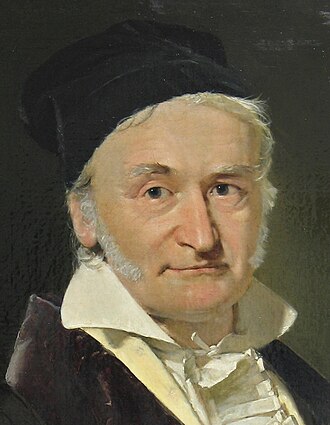
Johann Carl Friedrich Gauss (/ɡaʊs/; German: Gauß, pronounced [ɡaʊs] ( listen); Latin: Carolus Fridericus Gauss) (30 April 1777 – 23 February 1855) was a German mathematician and physical scientist who contributed significantly to many fields, including number theory, algebra, statistics, analysis, differential geometry, geodesy, geophysics, electrostatics, astronomy and optics.
Sometimes referred to as the Princeps mathematicorum[1] (Latin, “the Prince of Mathematicians” or “the foremost of mathematicians”) and “greatest mathematician since antiquity“, Gauss had a remarkable influence in many fields of mathematics and science and is ranked as one of history’s most influential mathematicians.[2]
Continue reading at http://en.wikipedia.org/wiki/Carl_Friedrich_Gauss
*Not Einstein!
Ferdinand Gotthold Max Eisenstein (16 April 1823 – 11 October 1852) was a German mathematician. He specialized in number theory and analysis, and proved several results that eluded even Gauss. Like Galois and Abel before him, Eisenstein died before the age of 30. He was born and died in Berlin, Prussia.
Gauss … in conversation once remarked that, there had been only three epoch-making mathematicians: Archimedes, Newton, and Eisenstein.
Source: http://en.wikipedia.org/wiki/Gotthold_Eisenstein

Source: http://www.artofproblemsolving.com/Resources/Papers/SatoNT.pdf
Excellent notes on Olympiad Number Theory!
Preface:
This set of notes on number theory was originally written in 1995 for students
at the IMO level. It covers the basic background material that an IMO
student should be familiar with. This text is meant to be a reference, and
not a replacement but rather a supplement to a number theory textbook;
several are given at the back. Proofs are given when appropriate, or when
they illustrate some insight or important idea. The problems are culled from
various sources, many from actual contests and olympiads, and in general
are very difficult. The author welcomes any corrections or suggestions.
I find Khan Linear Algebra video excellent. The founder / teacher Sal Khan has the genius to explain this not-so-easy topic in modular videos steps by steps, from 2-dimensional vectors to 3-dimensional, working with you by hand to compute eigenvalues and eigenvectors, and show you what they mean in graphic views.
If you are taking Linear Algebra course in university, or revising it, just go through all the Khan’s short (5-20 mins) videos on Linear Algebra here:
In 138 lessons sequence:
http://theopenacademy.com/content/linear-algebra-khan-academy
or random revision:
Source: http://www.math.union.edu/~dpvc/courses/advice/welcome.html
Over the years, I have collected some information that I hope will help students, particularly beginning math students, to improve their study and learning habits. An important part of what you learn at college is how to learn, so that you can carry that on for the rest of your life. Find out what works for you and what doesn’t.
These observations are centered around first-year calculus courses, so not everything may apply to you, but even more advanced students can benefit from some of them.
As you develop your own learning habits, please think carefully about the following topics:
Continue reading at http://www.math.union.edu/~dpvc/courses/advice/welcome.html
Keywords (for Google):
Singapore Maths Tuition Class
新加坡数学补习班
Singapore Matematik Kelas Tuisyen
சிங்கப்பூர் கணிதம் பயிற்சி வகுப்பு
Singapura Matematika Kelas Belajar
सिंगापुर मैथ्स ट्यूशन क्लास
싱가포르 수학 수업료 클래스
シンガポールの数学の授業クラス
Singapore matematika pagtuturo Class
Singapore Toán Học Lớp
Source: http://www.math.union.edu/~dpvc/courses/advice/perseverance.html
One source of confusion for students when they reach college and begin to do college-level mathematics is this: in high school, it is usually pretty apparent what formula or technique needs to be applied, as much of the material in high school is computational or procedural. In college, however, mathematics becomes more conceptual, and it is much harder to know what to do when you first start a problem. As a consequence of this, many students give up on a problem too early.
If you don’t immediately know how to attack a problem, this doesn’t mean you are stupid,
If you already know how to do it, it’s not really a problem.
or that you don’t understand what’s going on; that’s just how real problems work. After all, if you already know how to do it, it’s not really a problem, is it? You should expect to be confused at first. There’s no way you can know ahead of time how to solve every problem that you will face in life. You’re only hope, and therefore your goal as a student, is to get experience with working through hard problems on your own. That way, you will continue to be able to do so once you leave college.
One of the first steps in this is to realize that not knowing how, and the frustration that accompanies that, is part of the process. Then you have to start to figure out the questions that you can ask to help you to break down the problem, so that you can figure out how it really works. What’s really important in it? What is the central concept? What roles do the definitions play? How is this related to other things I know?
Continue reading at http://www.math.union.edu/~dpvc/courses/advice/perseverance.html
Relationship-Mapping-Inverse (RMI)
(invented by Prof Xu Lizhi 徐利治 中国数学家 http://baike.baidu.com/view/6383.htm)
Find Z = a*b
By RMI Technique:
Let f Homomorphism: f(a*b) = f(a)+f(b)
Let f = log
log: R+ –> R
=> log (a*b) = log a + log b
1. Calculate log a (=X), log b (=Y)
2. X+Y = log (a*b)
3. Find Inverse log (a*b)
4. ANSWER: Z = a*b
Prove:
$latex \sqrt{2}^{\sqrt{2}^{\sqrt{2}}}= 2$
1. Take f = log for Mapping:
$latex \log\sqrt{2}^{\sqrt{2}^{\sqrt{2}}} $
$latex = \sqrt{2}\log\sqrt{2}^{\sqrt{2}}$
$latex = \sqrt{2}\sqrt{2}\log\sqrt{2} $
$latex = 2\log\sqrt{2} $
$latex = \log (\sqrt{2})^2 $
$latex = \log 2$
2. Inverse of log (bijective):
$latex \log \sqrt{2}^{\sqrt{2}^{\sqrt{2}}}= \log 2$
$latex \sqrt{2}^{\sqrt{2}^{\sqrt{2}}}= 2$
This is a list of Famous Nonmathematicians who studied Mathematics, featuring Singapore’s Prime Minister, Lee Hsien Loong, with first class honours in mathematics from Trinity College, University of Cambridge.
Source: http://www.math.uh.edu/~tomforde/famous.html
We often tell our students that there are many things besides teaching and actuarial work that they can do with a degree in mathematics, but they often don’t believe us. Here is a list of well-known people who were math majors (or some equivalent in other countries and times), although not all of them completed their degrees.
THE PUBLIC REALM
•Ralph Abernathy, civil rights leader and Martin Luther King’s closest aide.
•Corazon Aquino, former President of the Philippines. She was a math minor at the College of Mt. St. Vincent.
•Harry Blackmun, Associate Justice of the US Supreme Court, AB summa cum laude in mathematics at Harvard.
•Simeon DeWitt, was the first math major at Rutgers. He became General George Washington’s Chief Geographer in the Revolutionary War. His maps of Yorktown helped win the final battle of that war. Afterwards (1784-1834) he was the Surveyor General for New York State; he helped to plan the Erie Canal, and to develop the grid system of streets and avenues in New York City, among other things.
•David Dinkins, Mayor of New York, BA in mathematics from Howard.
•Alberto Fujimori, President of Peru, MS in mathematics from the University of Wisconsin-Milwaukee.
•Ira Glasser, Executive Director of the American Civil Liberties Union, both a BS and an MA.
•Lee Hsien Loong, Deputy Prime Minister of Singapore, a Bachelor’s from Cambridge.
Read more at http://www.math.uh.edu/~tomforde/famous.html
Prof Su 苏步青, the founding pioneer Math professor of the China’s top universities (Zhejiang 浙江大学 and Fudan 复旦大学), was one of the few mathematicians who had longevity above 100 years old (the other was French Mathematician Hadammard).
http://en.m.wikipedia.org/wiki/Su_Buqing
Two men A and B are 100 km apart, walking towards each other, A at speed 6 km/hour and B at 4 km/hour.
A brings a dog which runs at 10 km/hour between them, starting from A towards B, upon reaching B it runs back to reach A, then back to B again, and so on…
Find total distance the dog has covered when A and B finally meet ?
Ancient Chinese Proverb
Source: http://www.liuxue86.com/a/1133118.html
美国留学打工 “学好数理化,走遍天下都不怕。”在美国一样适用
美国人口普查局的最新报告显示:同样是学士学位,按工作40年计算,工程专业的毕业生比教育学的毕业生多赚160万美元。真可谓是“男怕入错行,女怕嫁错郎。”
根据美国人口普查局最新发布的2011年社区调查报告,美国具有学士学位的大学毕业证全职工作的人每年中位薪资收入是64396美元,这些人既包括新毕业的大学生,也包括那也干的一辈子最高学位是学士的全职工作者。其中工程专业的薪资最高,平均每年高达91611美元,电脑与数学专业排第二位,年均80180美元,物理、化学、医学等自然科学专业薪水也不错,以80037美元排第三位。在另一个极端视觉和表演艺术专业薪水最低,平均一年只有50484美元,教育专业只有50902美元,心理学专业为55509美元,列倒数前三名,由此可以推算出来从事工程专业工作的人平均每年比从事表演艺术专业的人多挣4万美元,以一个人工作40年计算整个职业生涯收入平均相差160万美元,差距还是很惊人的。
[Note: the content of this post is standard number theoretic material that can be found in many textbooks (I am relying principally here on Iwaniec and Kowalski); I am not claiming any new progress on any version of the Riemann hypothesis here, but am simply arranging existing facts together.]
The Riemann hypothesis is arguably the most important and famous unsolved problem in number theory. It is usually phrased in terms of the Riemann zeta function $latex {\zeta}&fg=000000$, defined by
$latex \displaystyle \zeta(s) = \sum_{n=1}^\infty \frac{1}{n^s}&fg=000000$
for $latex {\hbox{Re}(s)>1}&fg=000000$ and extended meromorphically to other values of $latex {s}&fg=000000$, and asserts that the only zeroes of $latex {\zeta}&fg=000000$ in the critical strip $latex {\{ s: 0 \leq \hbox{Re}(s) \leq 1 \}}&fg=000000$ lie on the critical line $latex {\{ s: \hbox{Re}(s)=\frac{1}{2} \}}&fg=000000$.
One of the main reasons that the Riemann hypothesis is so important to number theory is that the zeroes of…
View original post 12,730 more words
Source: http://terrytao.wordpress.com/career-advice/does-one-have-to-be-a-genius-to-do-maths/
Better beware of notions like genius and inspiration; they are a sort of magic wand and should be used sparingly by anybody who wants to see things clearly. (José Ortega y Gasset, “Notes on the novel”)
Does one have to be a genius to do mathematics?
The answer is an emphatic NO. In order to make good and useful contributions to mathematics, one does need to work hard, learn one’s field well, learn other fields and tools, ask questions, talk to other mathematicians, and think about the “big picture”. And yes, a reasonable amount of intelligence, patience, and maturity is also required. But one does not need some sort of magic “genius gene” that spontaneously generates ex nihilo deep insights, unexpected solutions to problems, or other supernatural abilities.
Continue reading at http://terrytao.wordpress.com/career-advice/does-one-have-to-be-a-genius-to-do-maths/
When you have mastered numbers, you will in fact no longer be reading numbers, any more than you read words when reading books. You will be reading meanings. (W. E. B. Du Bois)
When learning mathematics as an undergraduate student, there is often a heavy emphasis on grade averages, and on exams which often emphasize memorisation of techniques and theory than on actual conceptual understanding, or on either intellectual or intuitive thought. There are good reasons for this; there is a certain amount of theory and technique that must be practiced before one can really get anywhere in mathematics (much as there is a certain amount of drill required before one can play a musical instrument well). It doesn’t matter how much innate mathematical talent and intuition you have; if you are unable to, say, compute a multidimensional integral, manipulate matrix equations, understand abstract definitions, or correctly set up a proof by induction, then it is unlikely that you will be able to work effectively with higher mathematics.
However, as you transition to graduate school you will see that there is a higher level of learning (and more importantly, doing) mathematics, which requires more of your intellectual faculties than merely the ability to memorise and study, or to copy an existing argument or worked example. This often necessitates that one discards (or at least revises) many undergraduate study habits; there is a much greater need for self-motivated study and experimentation to advance your own understanding, than to simply focus on artificial benchmarks such as examinations.
Continue reading at http://terrytao.wordpress.com/career-advice/there%E2%80%99s-more-to-mathematics-than-grades-and-exams-and-methods/

A collection of excellent free resources for demonstrating the various circle theorems:
Tim Devereux has created GeoGebra applets which allow exploration of the circle theorems. You can access each theorem from the menu on the left which includes a useful summary of all the theorems.


See alsothese excellent demonstrations.
View original post 35 more words
Top >10 Mathematics Websites remains a very popular post on this blog.
I have read various ‘Top (insert number here) Mathematics Websites’ posts and all of them have left me with the thought that so many excellent sites are missing from such lists. Any post claiming top 10 or >10 in my case is clearly the author’s top 10, notthe top 10! These are my top >10 because I really do use them – a lot – in the classroom! For my own list, I have decided to include some categories as well as individual sites which gives me the excuse to mention far more than 10! Note that every site mentioned here is free to use.

A quick quiz: which of the following four words doesn’t fit with the others??
Massive/Open/Online/Courses
We are going to muse about MOOCs today, a hot and highly debated topic in higher education circles. Are these ambitious new approaches to delivering free high quality education through online videos and interactive participation over the web going to put traditional universities out of business, or are they just one in a long historical line of hyped technologies that get everyone excited, and then fail to deliver the goods? (Think of the radio, TV, correspondence courses, movies, the tape recorder, the computer; all of which held out some promise for getting us to learn more and learn better, mostly to little avail, although the jury is still out on the computer.)
It’s fun to speculate on future trends, because of the potential—indeed likelihood—0f embarrassment for false predictions. Here is the summary of my argument today:…
View original post 1,031 more words
Just for curiosity, I went to research on the top keywords for Maths Tuition for Google search engine.
Keywords:
mathematics tuition singapore
a maths tuition singapore
maths tuition singapore
singapore maths tuition
a math tuition singapore
a level maths tuition
a maths tuition
a level maths tuition singapore
o level maths tuition singapore
maths tutors singapore
maths tuition in singapore
maths tutor singapore
maths tuition
a level maths tutoring
tuition maths
o level maths tuition
o level maths tutor
mathematics tuition
e math tuition
a level tuition singapore
maths a level tuition
tutor in maths
online mathematics tuition
maths tuition teacher singapore
a level maths tutor
singapore tutor
home maths tuition
best maths tuition singapore
online math tuition
a level mathematics tutors
ip maths tuition singapore
tuition for maths
a level tuition
maths tutor a level
online maths tuition
best math tuition singapore
ip math tuition
h2 maths tuition singapore
maths tutor
a level tutor
a level math tutor
math tuition online
o level tuition singapore
as maths tutor
mathematics tuition online
e maths tuition
tutor maths
maths tutor for a level
secondary maths tuition singapore
h2 math tuition singapore
tuition singapore
maths a level tutor
maths singapore
o level tutor
a maths tutor
tuition a level
primary maths tuition singapore
tutor singapore
maths tuition online
h2 maths tuition
teach tuition singapore
looking for tuition teacher singapore
ip maths tuition
singapore tuition
best maths tutor singapore
be a tutor singapore
maths in singapore
home maths tutor
primary maths tuition
o level a maths
maths for a level
maths tuition teacher
maths at a level
a levels maths
online tuition singapore
maths home tuition singapore
maths online tuition
maths tuition fees
tutor in singapore
secondary math tuition
tutor maths online
ib maths tuition
ib maths tuition singapore
singapore online tuition
home tutor for maths
singapore math
tuition home
tuition in singapore
tutor tuition
one to one maths tuition
o level math
that math tutor
advanced level maths
best maths tutor
secondary maths tuition
experienced maths tutor
chemistry tuition singapore
o level a math
maths tutor online
o level math questions
Maths Tuition centre at Bishan
Source: http://samuelcavazos.com/2013/07/12/mathematics-and-3d-printing/
Nice post on Mathematics and 3D printing!
3D printing is the latest advance in technology, that will possibly revolutionise the world!
Quote from source:
Below are some images of some of the mathematical structures he and Carlos Salinas have done using a MakerBot 3D printer. Most of these were first designed by using a software called Mathematica, which has the ability to handle complex surfaces and then create the file necessary to run on the MakerBot Software.
http://samuelcavazos.com/2013/07/12/mathematics-and-3d-printing/
How thousands of online students can get the effect of one-on-one tutoring
Educators have known for 30 years that students perform better when given one-on-one tutoring and mastery learning—working on a subject until it is mastered, not just until a test is scheduled. Success also requires motivation, whether from an inner drive or from parents, mentors or peers.
…
Online learning is a tool, just as the textbook is a tool. The way the teacher and the student use the tool is what really counts.
http://www.edvantage.com.sg/edvantage/videos/426310/Top_students_want_tuition.html
(Video)
“Tuition” is no longer a word that fills students with dread. In fact, these students volunteer themselves for tuition.
Excellent article on learning maths based on a growth mindset.
 As you can see from the picture, it was a packed house! After waiting in line for fifteen minutes, I was so lucky (and excited) to get a seat to hear Jo Boaler speak, even if my seat was in the next to last row.
Jo opened the presentation with Dweck’s research on mindsets. “In the fixed mindset, people believe that their talents and abilities are fixed traits. They have a certain amount and that’s that; nothing can be done to change it. In the growth mindset, people believe that their talents and abilities can be developed through passion, education, and persistence.”
Jo states that the fixed mindset contributes to one of the biggest myths in mathematics: being good at math is a gift. She referenced her book, The Elephant in the Classroom (added it to my reading list) and showed the audience various television/movie clips that continue to perpetuate…
View original post 760 more words
Source: http://www.huffingtonpost.com/brooks-mccorcle/the-key-to-career-success_b_3511254.html
“The essence of mathematics is not to make simple things complicated, but to make complicated things simple.” ~ Stan Gudder, Mathematician
Math, at its core, is about solving problems — about breaking a challenge into its basic elements to be investigated, tested, manipulated and understood. Math can give you the tools to find a winning formula. And, it can create the path to your career.
Math is the key to unlocking possibilities. It frees you up to think creatively about solutions and to focus your attention on what truly matters at the end of the day.
Finally, math empowers you to be a better leader and to remain open to new ideas. It sparks creativity and learning. It gives you confidence and conviction to say “YES!” when you’re asked to take on a new challenge. It helps you attract and energize the people you hire to help you. In a marketplace that’s moving so fast, it’s important to constantly listen, learn, analyze and formulate new ways to serve customers. Math provides the foundation for doing just that.
Want to succeed? It’s simple … math.
BBC Horizon programme. Simon Singh’s moving documentary of Andrew Wiles’ extraordinary search for the most elusive proof in number theory.
I will be attending this exciting online course by Stanford on Math Education. Do feel free to join it too, it is suitable for teachers and other helpers of math learners, such as parents.

(Source: https://class.stanford.edu/courses/Education/EDUC115N/How_to_Learn_Math/about)
In July 2013 a new course will be available on Stanford’s free on-line platform. The course is a short intervention designed to change students’ relationships with math. I have taught this intervention successfully in the past (in classrooms); it caused students to re-engage successfully with math, taking a new approach to the subject and their learning.
1. Knocking down the myths about math. Math is not about speed, memorization or learning lots of rules. There is no such thing as “math people” and non-math people. Girls are equally capable of the highest achievement. This session will include interviews with students.
2. Math and Mindset. Participants will be encouraged to develop a growth mindset, they will see evidence of how mindset changes students’ learning trajectories, and learn how it can be developed.
3. Mistakes, Challenges & Persistence. What is math persistence? Why are mistakes so important? How is math linked to creativity? This session will focus on the importance of mistakes, struggles and persistence.
4. Teaching Math for a Growth Mindset. This session will give strategies to teachers and parents for helping students develop a growth mindset and will include an interview with Carol Dweck.
5. Conceptual Learning. Part I. Number Sense. Math is a conceptual subject– we will see evidence of the importance of conceptual thinking and participants will be given number problems that can be solved in many ways and represented visually.
6. Conceptual Learning. Part II. Connections, Representations, Questions. In this session we will look at and solve math problems at many different grade levels and see the difference in approaching them procedurally and conceptually. Interviews with successful users of math in different, interesting jobs (film maker, inventor of self-driving cars etc) will show the importance of conceptual math.
7. Appreciating Algebra. Participants will learn some key research findings in the teaching and learning of algebra and learn about a case of algebra teaching.
8. Going From This Course to a New Mathematical Future. This session will review the ideas of the course and think about the way towards a new mathematical future.




![\displaystyle\begin{array}{rcl}S_n&=&1.005^n(100)+1.005^{n-1}(100)+\cdots+1.005(100)\\ &=&\frac{a(r^n-1)}{r-1}\\ &=&\frac{1.005(100)[1.005^n-1]}{1.005-1}\\ &=&\frac{100.5(1.005^n-1)}{0.005}\\ &=&20100(1.005^n-1) \end{array}](https://s0.wp.com/latex.php?latex=%5Cdisplaystyle%5Cbegin%7Barray%7D%7Brcl%7DS_n%26%3D%261.005%5En%28100%29%2B1.005%5E%7Bn-1%7D%28100%29%2B%5Ccdots%2B1.005%28100%29%5C%5C++++%26%3D%26%5Cfrac%7Ba%28r%5En-1%29%7D%7Br-1%7D%5C%5C++++%26%3D%26%5Cfrac%7B1.005%28100%29%5B1.005%5En-1%5D%7D%7B1.005-1%7D%5C%5C++++%26%3D%26%5Cfrac%7B100.5%281.005%5En-1%29%7D%7B0.005%7D%5C%5C++++%26%3D%2620100%281.005%5En-1%29++++%5Cend%7Barray%7D&bg=ffffff&fg=1a1a1a&s=0&c=20201002)


![\displaystyle S_n=\frac{(1+x/100)(100)[(1+x/100)^n-1]}{(1+x/100)-1}=4900](https://s0.wp.com/latex.php?latex=%5Cdisplaystyle+S_n%3D%5Cfrac%7B%281%2Bx%2F100%29%28100%29%5B%281%2Bx%2F100%29%5En-1%5D%7D%7B%281%2Bx%2F100%29-1%7D%3D4900&bg=ffffff&fg=1a1a1a&s=0&c=20201002)





 Mathtuition88