
Math Blog

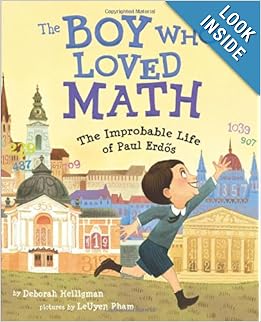
The Boy Who Loved Math

Alice's avatarNonfiction Monday

It’s likely that you’ve seen this book reviewed elsewhere. There has been a lot of buzz about it in the kid-lit world. And for good reason. The Boy Who Loved Math: The Improbable LIfe of Paul Erdos is a wonderful biography of a fascinating man. In case you’re ignorant like me, Paul Erdos was a Hungarian mathematician known for his work in number theory and for his eccentric personality.

Deborah Heligman strikes a perfect balance  in this book between the story of Erdos’ life and an explanation of the mathematical problems that so intrigued and consumed him.The main focus of the text is on the life of Erdos: from a childhood where he was kicked out of school for not following the rules; to his ability at the age of four to quickly tell a person how old they were in seconds once he knew their birthdate and time; to…

View original post 116 more words

The Mathematics of Chinese New Year (How to calculate its date)

Source: http://www.math.nus.edu.sg/aslaksen/calendar/chinese.shtml

If you are curious about the Mathematics behind the Chinese Calendar, do check out this website by Professor Helmer Aslaksen.

Excerpt: One rule of thumb is that Chinese New Year should be the new Moon closest to the beginning of spring (立春, lìchūn). This rule is correct most of the time, but it can fail if Lìchūn falls close to halfway between two new Moons. It failed in 1985 and will fail again in 2015. Since Lìchūn falls around February 4, this helps explain why Chinese New Year will always fall between January 21 and February 21. It also helps explain why Chinese New Year is called the spring festival. If you have a Western calendar that indicates the phases of the Moon, this will give you an approximation of the date of Chinese New Year. But notice that the Chinese calendar uses the time of new Moon in China.

As explained above, Chinese New Year will always fall between January 21 and February 21. The tropical (or solar) year is about 365.25 days, while a synodic (or lunar) month is about 29.5 days. Hence a lunar year consisting of 12 months will be about 12 x 29.5 = 354 days. So a lunar year is about 11 days shorter than a solar year.

The second rule of thumb is therefore that most of the time Chinese New Year will fall 11 (or sometimes 10 or 12) days earlier than the previous year, but if that would take us outside of the Chinese New Year range of January 21 to February 21, we must add a leap month, so Chinese New Year jumps 19 (or sometimes 18) days later. If this rule takes you close to January 21, you can end up being one month wrong, otherwise you will be at most one day off.

Read more at: http://www.math.nus.edu.sg/aslaksen/calendar/chinese.shtml#CNY

Singapore Tuition Agency Review: Startutor.sg

From a tutor’s point of view, my favourite tuition agency website is Startutor.sg (http://startutor.sg/)

Firstly, the website has a great design, the best I have ever seen. They even have dedicated queries regarding their design. (http://startutor.sg/design)

Secondly, they do check and verify all the tutor’s certificates. Hence, parents can be assured that the tutors do have the relevant certificates that they claim to have.

Thirdly, they do have SMS notifications for tutors, which is good since tutors may not check the website everyday.

I am listed as a tutor on Startutor.sg, however nowadays most of the students contact me through my website.

Overall, Startutor.sg is an excellent tuition agency, with good website interface, and stringent certification checking on tutors.

For other subjects besides Mathematics, request for a tutor at Startutor! Startutor is Singapore’s most popular online agency, providing tutors to your home. There are no extra costs for making a request. (Website: http://startutor.sg/request,wwcsmt)

Clash of Clans Mathematics: Arithmetic Progression & Geometric Progression

Clash of Clans Mathematics: Arithmetic Progression & Geometric Progression

CoC_titlescreen_2013

We can learn some mathematics from the popular game, Clash of Clans!

Lets look at the Building Cost and Production Rate of the Gold Mine.

Source: http://clashofclans.wikia.com/wiki/Gold_Mine

Gold Mine11clash of clans gold mine ap gp

We see that the Build cost actually follows a geometric progression(approximately) as each time, the build cost approximately doubles.

The formula for the n-th term of a geometric progression is \boxed{ar^{n-1}}, where a is the first term, and r is the common ratio.

The above formula works well for the first 2 terms, for example the second term is 300=150(2^{2-1}).

However, the Production Rate follows an arithmetic progression, as per level, the production rate increases by 200/hr.

The formula for the n-th term of an arithmetic progression is \boxed{a+(n-1)d}, where a is the first term, and d is the common difference. The formula works for all the 5 levels: for instance at level 5 the production rate is 1000=200+(5-1)(200).

Thanks for reading, and do “like” this post if you enjoy reading it! Hope you learnt some mathematics along the way.

MOOC: Udacity Online Free Course

tomcircle's avatarMath Online Tom Circle

https://www.udacity.com/courses#!/All

image

Read the review of MOOC challenges:

http://readwrite.com/2014/01/28/open-online-education-and-the-trend-towards-legitimacy#awesm=~ouoDz7h5ZAFTbR

The best MOOC (Massive Open Online Course) model will be free of exams / tests, only assignments / projects, forum discussions. 

The 2 current MOOC  – Coursera and Udacity –  are changing the ‘bottle’ (campus-based to online virtual campus),  but not the ‘wine’ (same old teaching methodology through quizzes, tests, exams, which are hated by students who are mostly working adults). 

A better example will be the Khan Academy by a MIT graduate Salman Khan teaching school kids in Math and Sciences. Bill Gates and Google founder sponsored him > $6 million. His successful model is “free +no exams“.

The Chinese sage Laozi 老子 said 3,000 years ago “Wu Wei(无为: Do something with no specific purpose) is actually “You Wei”(有为: With potential great achievement). Attending MOOC with no paper-chasing (and money making)…

View original post 86 more words

JC School Posting Results 2014

Source: http://www.moe.gov.sg/media/press/2014/01/posting-results-2014-jae-and-jpsae.php

Posting Results For The 2014 Joint Admissions Exercise (JAE) and Joint Polytechnic Special Admissions Exercise (JPSAE)

1The Ministry of Education (MOE) will release the posting results for the 2014 Joint Admissions Exercise (JAE) and the Joint Polytechnic Special Admissions Exercise (JPSAE) on Wednesday, 5 February 2014, at 8.00 am.Applicants can obtain their posting results via the following channels:

2JAE

  • The JAE-Internet System (JAE-IS) is accessible through the JAE website at http://www.moe.gov.sg/education/admissions/jae; and
  • Short Messaging System (SMS) text messages sent to the mobile phone number provided by the applicant during registration.

3JPSAE

4Applicants posted to a Junior College (JC) or the Millennia Institute (MI) should report to these institutions on Thursday, 6 February 2014, at 7.30 am. Applicants posted to a Polytechnic or Institute of Technical Education (ITE) course will receive further instructions via an enrolment package from the respective institutions by mail.

Read more at: http://www.moe.gov.sg/media/press/2014/01/posting-results-2014-jae-and-jpsae.php

Secrets of Mental Math: The Mathemagician’s Guide to Lightning Calculation and Amazing Math Tricks

Is there a mathematical reason why chocolate chip cookies have 37% (1/e) chocolate in them?

Source: http://math.stackexchange.com/questions/651823/is-there-a-mathematical-reason-why-chocolate-chip-cookies-have-37-1-e-chocola?newsletter=1&nlcode=97485%7cd140
Someone once briefly explained to me why it is that chocolate chip cookies have 37% chocolate in them. To the best of my memory it has to do with the way trying to place dots in a circle in a random and scattered way behave, which turns out to be 1/e or ≈37.
Chocolate Chip Cookie 37% 1/e

Interesting article for chocolate lovers!

Source: http://math.stackexchange.com/questions/651823/is-there-a-mathematical-reason-why-chocolate-chip-cookies-have-37-1-e-chocola?newsletter=1&nlcode=97485%7cd140

iPad Garden Problem

mathmindsblog's avatarMathMinds

The Garden Project:

Over the past couple of weeks, my 3rd graders have been working with our new set of iPads on a Garden Project. Since our school has put in learning gardens this year, I thought it would be an applicable project for them.

The premise of the problem: The school wanted to build a garden with the most space to plant our vegetables. Each group was given 18 feet of fencing (18 toothpicks) to use as their perimeter. They were to design each garden, record the dimensions, and take a picture to save in their photos. After they designed all possible rectangular gardens, they had to create a presentation in Numbers to show me which garden they wanted to build.

The instruction page looked like this (Since this was our first project, I put the app pic next to each direction to help them along the way):

2

I…

View original post 77 more words

Removing (“Unpacking”) Algebraic Terms from Parentheses

j rap's avatarMathChat

As you’re probably aware, I’m a big believer in using stories to bring math to life. Especially when you’re teaching tricky concepts, using a story can be the “magic switch” that flicks on the light of understanding. Armed with story-based understanding, students can recall how to perform difficult math processes. And since people naturally like stories and tend to recall them, skills based on story-based understanding really stick in the mind. I’ve seen this over and over in my tutoring.

Stories from My Tutoring Work

The kind of story I’m talking about uses an extended-metaphor, and this way of teaching  is particularly helpful when you’re teaching algebra. Ask yourself: what would you rather have? Students scratching their heads (or tearing out their hair) to grasp a process taught as a collection of abstract steps? Or students grasping  a story and quickly seeing how it guides them in doing the math? I think the answer is…

View original post 865 more words

Area and Perimeter of Squares – Student Noticings

mathmindsblog's avatarMathMinds

This will be a quick post because I have a student-posed math problem that I need some time to reason through!

Today, students found the area and perimeter of squares that increase in side length by one each time. Students used a variety of models when building their squares from Minecraft carpets, to Geoboards to graph paper. Here is the completed activity sheet from their work: IMG_3140I then gave them a few minutes to talk to their tablemates about things they notice in their work. Here are the answers they shared as a class and I recorded on the board:

“An even dimension by even dimension = an even area”

“An odd dimension by odd dimension = an odd area”

“The perimeter goes up by 4 every time the square gets bigger”

“The areas are square numbers.”

“The areas go up by odd skip counting: +3, +5, +7…”
I was…

View original post 322 more words

Math Fun Facts

Source: http://www.math.hmc.edu/funfacts/

Check out this website by Professor Francis Su!

Math Fun Facts are ideas and puzzles that will change the way you think.

This archive is designed as a resource for enriching your math courses and nurturing your interest and talent in mathematics! Each Math Fun Fact is a math puzzle or short article that contains a cool mathematics idea.  You’ll can learn about the mathematics of things like card shuffling to poker to computer  vision to fractals to music, just to name a few.  This makes great enrichment material for gifted math students or problem-solving groups.

http://www.math.hmc.edu/funfacts/

The Lesson of Grace in Teaching

Source: http://mathyawp.blogspot.sg/2013/01/the-lesson-of-grace-in-teaching.html

Excerpt:

The Lesson of Grace in Teaching           

From weakness to wholeness, the struggle and the hope

Francis Edward Su MAA Haimo Teaching Award Lecture Joint Math Meetings, January 11, 2013 An audio file is available: bit.ly/W4gyD0.

“We know truth, not only by reason, but also by the heart.” —Blaise Pascal

I’m honored but I’m also really humbled to be giving this talk to a room full of great teachers, because I know that each of you have a rich and unique perspective on teaching.  I had to ask myself: could I really tell YOU anything significant about teaching? So I decided instead to talk about something else, that at first may appear to have nothing to do with teaching, and yet it has everything to do with teaching. I want to talk about the biggest life lesson that I have learned, and that I continue to learn over and over again.  It is deep and profound.  It has changed the way I relate with people.  It has reshaped my academic life.  And it continually renovates the way I approach my students. And perhaps it will help you frame your own thoughts about teaching.  The beginning of that lesson is this:

Your accomplishments are NOT what make you a worthy human being.

It sounds easy for me to say, especially after having some measure of academic ‘success’ and winning this teaching award. But twenty years ago, I was a struggling grad student, seeking validation for my mathematical talent but flailing in my research, seeking my identity in my work but discouraged enough to quit.  My advisor had even said to me:

“You don’t have what it takes to be a successful mathematician.”

It was my lowest point.  Weak and weary, with my identity and my pride stripped away and my PhD nearly out of reach, I realized then that my identity and self-worth could NOT rest on whether I succeeded or failed to get my PhD.  So *IF* I were to continue in mathematics, I could not do it for any acclaim that I might receive or for the trappings of what the academic world would call success.  I should only do it because math is beautiful, and I feel drawn to it.  In my quiet moments, with no one watching, I still found math fun to think about.  So I was convinced it was my calling, despite the hurtful thing my advisor had said. So did I quit?  No.  I just changed advisors. This time, I chose differently.  Persi Diaconis was an inspiring teacher.  More than that, he had shown me a great kindness a couple of years before.  The semester I took a class from him, my mother died and I needed an extension on my work.  I’ll never forget his response: “I’m really sorry about your mother.  Let me take you to coffee.” I remember thinking: “I’m just some random student and he’s taking me to coffee?” But I really needed that talk.  We pondered life and its burdens, and he shared some of his own journey.  For me, in a challenging academic environment, with enormous family struggles, to connect with my professor on a deeper level was a great comfort.  Yes, Persi was an inspiring teacher, but this simple act of kindness—of authentic humanness—gave me a greater capacity and motivation to learn from him, because we had entered into authentic community with each other, as teacher and student, who were real people to each other.

Continue reading this inspirational article at: http://mathyawp.blogspot.sg/2013/01/the-lesson-of-grace-in-teaching.html

Recommended Maths Tuition Singapore

https://mathtuition88.com/group-tuition/ https://mathtuition88.com/

Maths Tuition @ Bishan starting in 2014.

Secondary 4 O Level E Maths and A Maths.

Patient and Dedicated Maths Tutor (NUS Maths Major 1st Class Honours, Dean’s List, RI Alumni)

Email: mathtuition88@gmail.com

What it’s like to tutor math

j rap's avatarMathChat

Today I realized something about being a tutor.

A big part of it — maybe as much as half it — involves nothing more than  …   being nice.

By that I mean being kind.

By which I mean that if someone looks at you, as a young man did today, shaking his head and saying, “It’s crazy … I don’t know what 3 x 6 is,” I don’t laugh or chuckle or say anything remotely mean or mocking. Instead I just say, “It’s o.k. Look, I tutor people every day who don’t know what 3 x 6 is. Who cares, really? Let’s just try to figure it out … or use a calculator, as long as your teacher doesn’t mind.”

Really. That is a lot of what being a math tutor is about. Being nice. Really nice. Really understanding. And being there to be accepting of people no matter…

View original post 400 more words

Maths Tuition @ Bishan starting in 2014

https://mathtuition88.com/group-tuition/ https://mathtuition88.com/

Maths Tuition @ Bishan starting in 2014.

Secondary 4 O Level E Maths and A Maths.

Patient and Dedicated Maths Tutor (NUS Maths Major 1st Class Honours, Dean’s List, RI Alumni)

Email: mathtuition88@gmail.com

Order with FREE AmazonGlobal Saver Shipping (Singapore)

Source: http://www.amazon.com/gp/help/customer/display.html/?ie=UTF8&camp=1789&creative=9325&linkCode=ur2&nodeId=201214770&tag=singmathtuit-20

Order with FREE AmazonGlobal Saver Shipping

If your order is $125 or over and being shipped to India, Singapore, or New Zealand, you may qualify for FREE AmazonGlobal Saver Shipping. With AmazonGlobal Saver Shipping, your order will be delivered 9-14 business days after all of your items are available to ship, including pre-order items.

Is the Universe Made of Math?

Source: http://www.scientificamerican.com/article.cfm?id=is-the-universe-made-of-math-excerpt


Our Mathematical Universe: My Quest for the Ultimate Nature of Reality

In this excerpt from his new book, Our Mathematical Universe, M.I.T. professor Max Tegmark explores the possibility that math does not just describe the universe, but makes the universe

By Max Tegmark

What’s the answer to the ultimate question of life, the universe, and everything? In Douglas Adams’ science-fiction spoof “The Hitchhiker’s Guide to the Galaxy”, the answer was found to be 42; the hardest part turned out to be finding the real question. I find it very appropriate that Douglas Adams joked about 42, because mathematics has played a striking role in our growing understanding of our Universe.

The Higgs Boson was predicted with the same tool as the planet Neptune and the radio wave: with mathematics. Galileo famously stated that our Universe is a “grand book” written in the language of mathematics. So why does our universe seem so mathematical, and what does it mean? In my new book “Our Mathematical Universe”, I argue that it means that our universe isn’t just described by math, but that it is math in the sense that we’re all parts of a giant mathematical object, which in turn is part of a multiverse so huge that it makes the other multiverses debated in recent years seem puny in comparison.

Math, math everywhere! But where’s all this math that we’re going on about? Isn’t math all about numbers? If you look around right now, you can probably spot a few numbers here and there, for example the page numbers in your latest copy of Scientific American, but these are just symbols invented and printed by people, so they can hardly be said to reflect our Universe being mathematical in any deep way.

Continue reading at: http://www.scientificamerican.com/article.cfm?id=is-the-universe-made-of-math-excerpt

O Level Tuition

https://mathtuition88.com/group-tuition/ https://mathtuition88.com/

Maths Tuition @ Bishan starting in 2014.

Secondary 4 O Level E Maths and A Maths.

Patient and Dedicated Maths Tutor (NUS Maths Major 1st Class Honours, Dean’s List, RI Alumni)

Email: mathtuition88@gmail.com

Recommended Algebra Books

Algebra Survival Guide: A Conversational Guide for the Thoroughly Befuddled

Description from Amazon:

If you think algebra has to be boring, confusing and unrelated to anything in the real world, think again! Written in a humorous, conversational style, this book gently nudges students toward success in pre-algebra and Algebra I. With its engaging question/answer format and helpful practice problems, glossary and index, it is ideal for homeschoolers, tutors and students striving for classroom excellence. It features funky icons and lively cartoons by award-winning Santa Fe artist Sally Blakemore, an Emergency Fact Sheet tear-out poster, and even an “Algebra Wilderness” board game guaranteed to help students steer clear of “Negatvieland”–and have fun.The Algebra Survival Guide is the winner of a Paretns’ Choice award, and it meets the Standards 2000 of the National Council of Teachers of Mathematics. Its 12 content chapters tackle all the trickiest topics: Properties, Sets of Numbers, Order of Operations, Absolute Value, Exponents, Radicals, Factoring, Cancelling, Solving Equations, the Coordinate Plane and yes even those dreaded word problems. The Guide is loaded with practice problems and answers, and its 288 pages give students the boost they need in a style they’ll enjoy to master the skills of algebra.

Also, check out the workbook:

Algebra Survival Guide Workbook: Thousands of Problems To Sharpen Skills and Enhance Understanding

The Clouds Part, and a Log Rule MAKES SENSE!

j rap's avatarMathChat

Have you ever been befuddled by the rules for logs?

More specifically, have you ever looked at this rule:

log (v w) = log v + log w

and thought: Now why in the world is that true?! What exactly is this saying? I know that I, myself, have had that thought. And for me the desire to understand this rule never went away. Till I got it some time ago.

[By the way, keep in mind that the v and the w in the parentheses are multiplying each other, so that v w actually means: v times w]

And the good news is: I think I can explain this rule in a way so that pretty much everyone who knows basic algebra can grasp it.

O.K., first, I knew that this log rule was related to another rule, the  exponent rule that says:

(a^b) x (a^c) = a^(b…

View original post 769 more words

Introduction to Cambridge IA Analysis I 2014

gowers's avatarGowers's Weblog

This term I shall be giving Cambridge’s course Analysis I, a standard first course in analysis, covering convergence, infinite sums, continuity, differentiation and integration. This post is aimed at people attending that course. I plan to write a few posts as I go along, in which I will attempt to provide further explanations of the new concepts that will be covered, as well as giving advice about how to solve routine problems in the area. (This advice will be heavily influenced by my experience in attempting to teach a computer, about which I have reported elsewhere on this blog.)

I cannot promise to follow the amazing example of Vicky Neale, my predecessor on this course, who posted after every single lecture. However, her posts are still available online, so in some ways you are better off than the people who took Analysis I last year, since you will have…

View original post 3,819 more words

E Maths Challenging Question (Workers, Rate and Proportion)

Sometimes, E Maths can seem more difficult than A Maths!

Nevertheless, exposure and practising E Maths questions will make it easier as the student gets used to the problem solving techniques required to solve “tricky” E Maths questions.

Can you solve the following E Maths Problem? 🙂

It takes 8 workers to complete a certain job. The job can be completed 2 days earlier if 8 more workers are added. How many workers are needed if the house has to be completed 3 days earlier?

E Maths Group Tuition at Bishan:

https://mathtuition88.com/group-tuition/

https://mathtuition88.com/

Cost of education in Singapore

Source: http://www.epigami.sg/blog/cost-of-education-in-singapore/

How much does it cost to educate a child in Singapore?

Answer: $80,940 or approximately 3 Round-the-World Trips!

Read more at: http://www.epigami.sg/blog/cost-of-education-in-singapore/

Release of O Level Results 2014

Sincerely wishing every student all the best for their O Level Results!

Meanwhile, all Secondary 3 to 4 students should start studying hard for their O Levels. 🙂

It has been many years since the release of my O Level Results. Sincerely wish my students to do well and even surpass me in their O Level Results.

maths-tutor-o-level-cert
Mr Wu’s O Level Certificate (with A1 for both Maths). Mr Wu sincerely wishes his students to surpass him and achieve their fullest potential.

O Level Maths Group Tuition at Bishan

Secondary 3 Students who want to learn Secondary 4 Maths in Advance

Calling all Secondary 3 Students who wish to study Secondary 4 E Maths and A Maths in advance, while revising Secondary 3 topics at the same time!

Join our group tuition at Bishan (https://mathtuition88.com/group-tuition/) !

Highly recommended for Secondary 3 students who are fast learners and wish to learn and get familiarised with Secondary 4 topics as soon as possible.

A typical lesson in our group tuition comprises of revising Secondary 3 topics (which is still important as it takes up almost 40% of the O Level questions), while learning Secondary 4 advanced topics. We will finish the school syllabus by June to start practising Ten Year Series and past year papers.

The best tip to not procrastinate (Maths Tuition at Bishan)

Source: http://www.thedutchphdcoach.com/time-management/the-best-tip-to-not-procrastinate/

The best tip to not procrastinate

It is incredibly easy, but as with anything, it takes a little practice. Try it now: Identify the most important thing you have to do today. Decide to do just the first little part of it — just the first minute, or even 30 seconds of it. Getting started is the only thing in the world that matters.

Get started, and the rest will flow.

– See more at: http://www.thedutchphdcoach.com/time-management/the-best-tip-to-not-procrastinate/#sthash.EqJDWUrJ.dpuf

Start Maths Revision Early for the Best Results!

O Level Group Tuition @ Bishan starting in 2014!

Maths is a subject that requires students to start revision / practice early!

It needs consistent practice and last minute studying is not going to work well!

Many students have the wrong concept that they can start practising questions one or two months before the O Levels. The problem is, without constant practice, the questions from the Ten Year Series would be too difficult for students to even begin attempting the questions! This is especially true for Additional Mathematics. This leads to panic and is not the desired study strategy. This is the main reason why it is possible to score very low (less than 20 marks out of 100) in Maths, if the student does not have solid foundation or has lack of practice. To avoid this scenario, start practicing and revising Maths now! Many students already start studying / learning in advance during the December holidays. January is still a good time to start! As the Chinese proverb states: “一年之计在于春一日之计在于晨”, the best time to begin planning for a task is in Spring.

Also, the current O Level Maths is not like the O Level of the past! Due to higher education standards nowadays, and competition from foreigners (especially China students whose pet subjects are Maths and Chinese), the bell curve for E Maths has shifted very very high. Rumours have it that 90 marks is necessary for a guaranteed A1 in E Maths.

On the bright side, it is very possible to improve in Maths with practice. Look at the Mathematics questions in O Levels, one long question is around 10 marks. Answering that one question correctly will already boost your score by 10 marks. (2 grades). Answering two long questions correctly will boost score by a whopping 20 marks!

Hesitate no longer! Start revising for your Maths now!

O Level Group Tuition @ Bishan starting in 2014!

Bishan-Ang Mo Kio area to get new JC in 2017

Source: http://news.asiaone.com/news/edvantage/bishan-ang-mo-kio-area-get-new-jc-2017

Bishan-Ang Mo Kio area to get new JC in 2017

The site for the new JC at the junction of Sin Ming Avenue and Marymount Road.
Lee Jian Xuan

Saturday, Jan 04, 2014

SINGAPORE – A new junior college that will open in 2017 for students from three Integrated Programme (IP) schools will likely be built on the site of the Asian Golf Academy near Bishan.

A statement on the Ministry of Education (MOE) website says the new campus will be at the junction of Sin Ming Avenue and Marymount Road, where the driving range is located.

The area is also zoned for an educational institution, according to the Urban Redevelopment Authority’s Draft Master Plan 2013.

Singapore’s 20th school to offer a JC programme will take in IP students from Catholic High School, CHIJ St Nicholas Girls’ School and the Singapore Chinese Girls’ School. It will also admit more than 100 students from other secondary schools who have completed their O levels.

It will be the newest JC since Innova JC in Woodlands was completed in 2005.

Read more at: http://news.asiaone.com/news/edvantage/bishan-ang-mo-kio-area-get-new-jc-2017

Maths Group Tuition starting in 2014!

https://mathtuition88.com/

Maths Group Tuition starting in 2014!

https://mathtuition88.com/group-tuition/

O Level Maths Tuition (E Maths & A Maths Tuition) at Bishan starting in 2014!

Location: Block 230 Bishan Street 23 #B1-35 S(570230)

Google Maps: http://goo.gl/maps/chjWB

Mr Wu’s O Level Certificate (with A1 for both Maths). Mr Wu sincerely wishes his students to surpass him and achieve their fullest potential.

Despite being in the Gifted Education Programme (GEP), Mr Wu is just an ordinary Singaporean. His secret to academic success is hard work and the Maths Techniques he has discovered by himself while navigating through the education system.

Directions to Bishan Tuition Centre:

A) Via BISHAN MRT (NS17/CC15)

(10 minutes by foot OR 2 bus stops from Junction 8. From J8, please take bus numbers, 52, 54 or 410 from interchange. The centre is just after Catholic High School, just beside Clover By-The-Park condominium.

Other landmarks are: the bus stop which students alight is in front of Blk 283, where Cheers minimart and Prime supermarket are.)

It’s one street away from Raffles Institution Junior College (RIJC), previously known as Raffles Junior College (RJC). It’s also very convenient for students of Catholic Junior College (CJC), Anderson Junior College (AJC), Yishun Junior College (YJC) and Innova Junior College (IJC).

Other secondary schools located near Bishan are Catholic High School, Kuo Chuan Presbyterian Secondary School, and Raffles Institution (Secondary).
Schedule
•Monday 7pm-9pm
•Thursday 7pm-9pm

(Perfect for students who have CCA in the afternoon, or students who want to keep their weekends free.)

A sporadic image resizing bug in WordPress LaTeX

Terence Tao's avatarWhat's new

I’m encountering a sporadic bug over the past few months with the way WordPress renders or displays its LaTeX images on this blog (and occasionally on other WordPress blogs).  On most computers, it seems to work fine, but on some computers, the sizes of images are occasionally way off, leading to extremely distorted and fairly unreadable versions of the images appearing in blog posts and comments.  A sample screenshot (with accompanying HTML source), supplied to me by a reader, can be found here (in which an image whose dimensions should be 321 x 59 are instead being displayed as 552 x 20).  Is anyone else encountering this issue?  The problem sometimes can be resolved by refreshing the page, but not always, so it is a bit unclear where the problem is coming from and how one might mitigate it.  (If nothing else, I can add it to the bug collection…

View original post 8 more words

Secondary 4 O Level E Maths and A Maths Group Tuition, Bishan

https://mathtuition88.com/group-tuition/
https://mathtuition88.com/

Maths Tuition @ Bishan starting in 2014.

Secondary 4 O Level E Maths and A Maths.

Patient and Dedicated Maths Tutor (NUS Maths Major 1st Class Honours, Dean’s List, RI Alumni)

Email: mathtuition88@gmail.com

The Smartest Notebook

Marko Pavlovic's avatarThe Mathist

The Leap Forward

We are very proud to present you the new MathistIt is a real sneak peak into the future, that allows you to easily solve and compute anything you write with a single click!

Here are some examples;

  • Simplify any expression to speed up problem solving,
  • Plot graphs,
  • Evaluate expressions and get approximate values,
  • Solve equations and inequalities (with visual representation),
  • Solve definite and indefinite integrals (with visual representation),
  • Crunch difficult logarithms,
  • Find derivatives and much more…

You can do all of this with just one button: solve-on

Why is this important?

Have you ever worked on a problem, that is easy to understand, but just requires too much number crunching?– So did we!

We understand that learning a million new things every day as a technology or a science student doesn’t leave too much time for crunching math. And yet in most cases you cannot solve…

View original post 49 more words

Maths Challenge

Hi, do feel free to try out our Maths Challenge (Secondary 4 / age 16 difficulty):

maths challenge

Source: Anderson E Maths Prelim 2011

If you have solved the problem, please email your solution to mathtuition88@gmail.com .

(Include your name and school if you wish to be listed in the hall of fame below.)

Students who answer correctly (with workings) will be listed in the hall of fame. 🙂

Hall of Fame (Correct Solutions):

1) Ex Moe Sec Sch Maths teacher Mr Paul Siew

2) Queenstown Secondary School, Maths teacher Mr Desmond Tay

3) Tay Yong Qiang (Waiting to enter University)

4) Ionut-Zaharia Chirila (Ex Lower Danube University, Romania)

The ideal Singapore JC subject combination for applying to Medicine

Why Additional Maths (A Maths) is important for entering Medicine:

Pathway: A Maths (O Level) –> H2 Maths (A Level) –> NUS Medicine

Source: http://sgforums.com/forums/2297/topics/439605

Quote: While NUS and NTU Medicine does not (officially) require H2 Maths (ie. ‘A’ level Maths), some other (overseas) Medical schools might. And not having H2 Maths might (unofficially) disadvantage your chances, even for NUS and NTU.

Therefore (assuming you intend to fight all the way for your ambition), your safest bet would be to (fight for the opportunity) to take both H2 Bio and H2 Math. The ideal Singapore JC subject combination for applying to Medicine (in any University) is :

H2 Chemistry, H2 Biology, H2 Mathematics

Source: http://www.kiasuparents.com/kiasu/forum/viewtopic.php?f=40&t=12228

Quote: pre-requisites for nus medicine will be H2 Chem and H2 bio or physics.

as for what’s best,
H2 math is almost a must since without it you’ll be ruling out a lot of ‘back-up courses’

Singapore O Level Group Tuition Bishan

O Level E Maths and A Maths Tuition starting next year at Bishan ————————– View Mr Wu’s GEP Testimonial at https://mathtuition88.com/group-tuition/

Despite being in the Gifted Education Programme (GEP), Mr Wu is just an ordinary Singaporean. His secret to academic success is hard work and the Maths Techniques he has discovered by himself while navigating through the education system.

He would like to teach these techniques to students, hence choosing to become a full-time Mathematics tutor. Mr Wu has developed his own methods to check the answer, remember formulas (with understanding), which has helped a lot of students. Many Math questions can be checked easily, leading to the student being 100% confident of his or her answer even before the teacher marks his answer, and reducing the rates of careless mistakes.

Mr Wu’s friendly and humble nature makes him well-liked by students. Many of his students actually request for tuition by themselves! (not the parents) His students also look forward to tuition, instead of dreading tuition.

O Level E Maths and A Maths Tuition starting next year at Bishan, the best location in Central Singapore.

Timings are Monday 7-9pm, Thursday 7-9pm. Perfect for students who have CCA in the afternoon, or students who want to keep their weekends free.

Register with us now by email (mathtuition88@gmail.com). Vacancies will be allocated on a first-come-first-serve basis.

Thanks and wishing all a nice day.

Singapore math

Source: http://en.wikipedia.org/wiki/Singapore_math

Singapore math (or Singapore maths in British English[1]) is a teaching method based on the national math curriculum used for kindergarten through sixth grade in Singapore.[2][3] It involves teaching students to learn and master fewer mathematical concepts at greater detail as well as having them learn these concepts using a three-step learning process.[2][3] The three steps are concrete, pictorial, and abstract. In the concrete step, students engage in hands-on learning experiences using concrete objects such as chips, dice, or paper clips.[4] This is followed by drawing pictorial representations of mathematical concepts. Students then solve mathematical problems in an abstract way by using numbers and symbols.[5]

The development of Singapore math began in the 1980s when the country’s Ministry of Education developed its own mathematics textbooks that focused on problem solving and heuristic model drawing.[3][6] Outside Singapore, these textbooks were adopted by several schools in the the United States (U.S.) and in other countries such as Canada, Israel, and the United Kingdom.[7][1][8] Early adopters of these textbooks in the U.S. included parents interested in homeschooling as well as a limited number of schools.[3] These textbooks became more popular since the release of scores from the Trends in International Mathematics and Science Study (TIMSS), which showed Singapore at the top of the world three times in fourth and eighth grade mathematics.[9] U.S. editions of these textbooks have since been adopted by a large number of school districts as well as charter and private schools.[3]

Read more at: http://en.wikipedia.org/wiki/Singapore_math

The bar model can be drawn as a comparison model to compare two bars of unequal lengths, which can then be used to solve a subtraction problem.


On the road to make math fun: An army major who quit to become a mathematics teacher

Source: http://www.telegraphindia.com/1120625/jsp/calcutta/story_15629755.jsp#.Uq7JOJVDGDk

On the road to make math fun

MITA MUKHERJEE
Madanlal Baldevraj Ghai during the city leg of his tour. Picture by Sayantan Ghosh

An army major who quit to become a mathematics teacher has embarked on a self-funded tour of the country to promote the subject.

Madanlal Baldevraj Ghai, 70, stayed in a dormitory at Howrah station to keep costs down during the three days he spent in Calcutta recently, meeting officials of the primary and secondary board and the school education department to offer suggestions on how to make the study of mathematics more interesting.

“India has produced brilliant mathematicians not just in the Vedic and medieval ages but also in modern times. Unfortunately, for quite a few years, not many students have been pursuing the subject at the higher level, which has resulted in a decline in the number of top-quality mathematicians,” the former teacher at PMN College in Rajpura, Punjab, told Metro.

“We, the elderly mathematics teachers, need to reach out to students and guardians in every corner of the country to dispel the misconception that mathematics is dry and boring,” added Ghai, who has an MPhil in the subject and is pursuing his PhD at Punjabi University, Patiala.

His 50-day tour was also prompted by the Prime Minister declaring 2012 as the year of mathematics as a tribute to Srinivasa Ramanujan, the autodidact mathematician who died in 1920 at the age of 32.

Read more at: http://www.telegraphindia.com/1120625/jsp/calcutta/story_15629755.jsp#.Uq7JOJVDGDk

Maths tutoring adds up for students: OECD study (Singapore PISA tuition effect)

Source: http://www.smh.com.au/data-point/maths-tutoring-adds-up-for-students-oecd-study-20131206-2ywop.html

Many of the world’s most mathematically gifted teenagers come from countries with the most lucrative tutoring industries.

Figures released this week show tutoring in Asia’s powerhouses is widespread, with participation rates more than double those  in Australia, though the extent to which their success is a result of a punishing study schedule is unclear.

In test results released by the OECD, 15-year-olds from Shanghai  topped the mathematics rankings, performing at a level equivalent to three years ahead of students in Australia.
Read more: http://www.smh.com.au/data-point/maths-tutoring-adds-up-for-students-oecd-study-20131206-2ywop.html#ixzz2nXVdY3h0

Math is at the heart of physics. (O Level Maths and Physics Tips)

Source: http://www.academictips.org/acad/physic/physics_study_skills.html

Studying and practising Mathematics is one of the most useful things an O level student can do.

Not only are the two Maths (E Maths and A Maths) highly intertwined, studying Maths can actually help the students’ Physics too. There are some topics like Vectors and Kinematics in Physics that are also present in Mathematics.

Math is at the heart of physics. So the better your math, the better you’ll do in physics.

A good working knowledge of algebra and trigonometry is needed for Physics.

Mnemosyne with a mathematical formula.
Mnemosyne with a mathematical formula. (Photo credit: Wikipedia)

Get to know The Mathist – The official FAQ

Marko Pavlovic's avatarThe Mathist

What is The Mathist?

TheMathist is a very unique social math note taking application. It works on every device, and is free for everyone. You can finally focus on the math, not the software.

Do I have to know TeX or similar syntax?

There is no need to learn TeX or save the notes as pictures, they will always be available to you as regular online documents that you can edit anywhere and anytime. We have built a revolutionary simple math editor, a lot of hours went research on this. Go ahead and give it a try!

Why should I use The Mathist?

Because it is simple and straightforward to use, a true breeze… Because you already take all your notes in digital form and save them in the cloud. Because it is fast and works on all devices. It does not require any software knowledge to start, and…

View original post 174 more words

Mathematics is not a spectator sport (How to study Maths for Humanities students)

Studying Mathematics is totally different from studying Humanities, this is the reason why humanities students often don’t do well in maths. But with the right studying techniques (i.e. practising doing mathematics), humanities students can be very good at maths. Together with their creativity and good memory, humanities students have the potential to achieve the top grades in maths exams.

I have taught Pure Literature students and found that they definitely have the potential to do well in Maths once they learn the correct method of mathematical studying and thinking, and how to approach solving Maths questions.

One of the top mathematical physicists, Edward Witten, majored in history and minored in linguistics! (http://en.wikipedia.org/wiki/Edward_Witten)

Mathematics is not a spectator sport

Source: http://www.math.umn.edu/~rogness/math1001/syllabus/node20.html

Even if you understand every word in lecture and in the textbook, the only way to really learn mathematics is by doing mathematics.  Sometimes this means doing even more than the assigned problems.  (See “time committment” above.)  This is how to avoid the common pitfall of “understanding everything in class but blanking out on the exams.

I realize this isn’t welcome advice, and I admit that I haven’t always followed it myself.  But in years of teaching (and 20+ years of learning) mathematics I haven’t found any shortcut.
