Prof Su Buqing Problem

tomcircle's avatarMath Online Tom Circle

Prof Su 苏步青, the founding pioneer Math professor of the China’s top universities (Zhejiang 浙江大学 and Fudan 复旦大学), was one of the few mathematicians who had longevity above 100 years old (the other was French Mathematician Hadammard).

http://en.m.wikipedia.org/wiki/Su_Buqing

Two men A and B are 100 km apart, walking towards each other, A at speed 6 km/hour and B at 4 km/hour.
A brings a dog which runs at 10 km/hour between them,  starting from A towards B, upon reaching B it runs back to reach A, then back to B again, and so on…

Find total distance the dog has covered when A and B finally meet ?

View original post

The Riemann hypothesis in various settings

Terence Tao's avatarWhat's new

[Note: the content of this post is standard number theoretic material that can be found in many textbooks (I am relying principally here on Iwaniec and Kowalski); I am not claiming any new progress on any version of the Riemann hypothesis here, but am simply arranging existing facts together.]

The Riemann hypothesis is arguably the most important and famous unsolved problem in number theory. It is usually phrased in terms of the Riemann zeta function $latex {\zeta}&fg=000000$, defined by

$latex \displaystyle \zeta(s) = \sum_{n=1}^\infty \frac{1}{n^s}&fg=000000$

for $latex {\hbox{Re}(s)>1}&fg=000000$ and extended meromorphically to other values of $latex {s}&fg=000000$, and asserts that the only zeroes of $latex {\zeta}&fg=000000$ in the critical strip $latex {\{ s: 0 \leq \hbox{Re}(s) \leq 1 \}}&fg=000000$ lie on the critical line $latex {\{ s: \hbox{Re}(s)=\frac{1}{2} \}}&fg=000000$.

One of the main reasons that the Riemann hypothesis is so important to number theory is that the zeroes of…

View original post 12,730 more words

Circle Theorems

Colleen Young's avatarMathematics, Learning and Technology

A collection of excellent free resources for demonstrating the various circle theorems:
Tim Devereux has created GeoGebra applets which allow exploration of the circle theorems. You can access each theorem from the menu on the left which includes a useful summary of all the theorems.


GeoGebra - Circle Theorems
GeoGebra – Circle Theorems

See alsothese excellent demonstrations.


View original post 35 more words

Top >10 Mathematics Websites

Colleen Young's avatarMathematics, Learning and Technology

Top >10 Mathematics Websites remains a very popular post on this blog.


I have read various ‘Top (insert number here) Mathematics Websites’ posts and all of them have left me with the thought that so many excellent sites are missing from such lists. Any post claiming top 10 or >10 in my case is clearly the author’s top 10, notthe top 10! These are my top >10 because I really do use them – a lot – in the classroom! For my own list, I have decided to include some categories as well as individual sites which gives me the excuse to mention far more than 10! Note that every site mentioned here is free to use.

View original post

MOOCs and TOOCs and the role of problem solving in maths education

njwildberger: tangential thoughts's avatarnjwildberger: tangential thoughts

A quick quiz: which of the following four words doesn’t fit with the others??

Massive/Open/Online/Courses

We are going to muse about MOOCs today, a hot and highly debated topic in higher education circles. Are these ambitious new approaches to delivering free high quality education through online videos and interactive participation over the web going to put traditional universities out of business, or are they just one in a long historical line of hyped technologies that get everyone excited, and then fail to deliver the goods? (Think of the radio, TV, correspondence courses, movies, the tape recorder, the computer; all of which held out some promise for getting us to learn more and learn better, mostly to little avail, although the jury is still out on the computer.)

It’s fun to speculate on future trends, because of the potential—indeed likelihood—0f embarrassment for false predictions. Here is the summary of my argument today:…

View original post 1,031 more words

NCSM-Jo Boaler-Promoting Equity Through Teaching For A Growth Mindset

Excellent article on learning maths based on a growth mindset.

mathmindsblog's avatarMathMinds

1As you can see from the picture, it was a packed house! After waiting in line for fifteen minutes, I was so lucky (and excited) to get a seat to hear Jo Boaler speak, even if my seat was in the next to last row.

Jo opened the presentation with Dweck’s research on mindsets. “In the fixed mindset, people believe that their talents and abilities are fixed traits. They have a certain amount and that’s that; nothing can be done to change it. In the growth mindset, people believe that their talents and abilities can be developed through passion, education, and persistence.”

Jo states that the fixed mindset contributes to one of the biggest myths in mathematics: being good at math is a gift. She referenced her book, The Elephant in the Classroom (added it to my reading list) and showed the audience various television/movie clips that continue to perpetuate…

View original post 760 more words

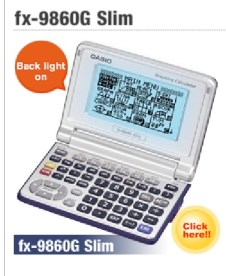
How to use tables in CASIO FX-9860G Slim (H2 Maths Tuition)

Tables in CASIO FX-9860G Slim

The most popular Graphical Calculator for H2 Maths is currently the TI-84 PLUS series, but some students do use Casio Graphical Calculators.

The manual for CASIO FX-9860G Slim is can be found here:

http://edu.casio.com/products/fx9860g2/data/fx-9860GII_Soft_E.pdf

The information about Tables and how to generate a table is on page 121.

Generating tables is useful to solve some questions in sequences and series, and also probability. It makes guess and check questions much faster to solve.

h2 tuition gc
Picture of the CASIO FX-9860G Slim Calculator

Checking Multiplication via Digit Sums

mzspivey's avatarA Narrow Margin

Last week a friend who is a fourth grade teacher came to me with a math problem.  The father of one of his students had showed him a trick for checking the result of a three-digit multiplication problem.  The father had learned the trick as a student himself, but he didn’t know why it worked.  My friend showed me the trick and asked if I had seen it before.  This post describes this check and explains why it works.

Suppose you want to multiply 231 $latex \times $ 243.  Working it out by hand, you get 56133.  Add the digits in the answer (5+6+1+3+3) to get 18.  Add the digits again to get 9.  Stop now that you have a single digit.

Alternatively, do this digit adding beforehand.  Adding the digits of 231 together, we get 6.  Adding the digits of 243 together, we get 9.  Multiply 6 $latex \times$ 9…

View original post 655 more words

How should logarithms be taught?

gowers's avatarGowers's Weblog

Having a blog gives me a chance to defend myself against a number of people who took issue with a passage in Mathematics, A Very Short Introduction, where I made the tentative suggestion that an abstract approach to mathematics could sometimes be better, pedagogically speaking, than a concrete one — even at school level. This was part of a general discussion about why many people come to hate mathematics.

The example I chose was logarithms and exponentials. The traditional method of teaching them, I would suggest, is to explain what they mean and then derive their properties from this basic meaning. So, for example, to justify the rule that xa+b=xaxb one would say something like that if you have a xs followed by b xs and you multiply them all together then you are multiplying a+b xs all together.

View original post 573 more words

Use of mathematics II

gowers's avatarGowers's Weblog

Today I had an experience that I have had many times before, and so, I imagine, has almost everybody (at least if they are old enough to be the kind of person who might conceivably read this blog post). I was in a queue in a chemist (=pharmacy=drugstore), and I knew that my particular item would be quick and easy to deal with. But I had to wait a while because in front of me was someone who had an item that was much more complicated and time-consuming. In this instance the complexity of the items was not due to their sizes, but a more common occurrence of the phenomenon is something that often happens to me in a local grocery: I want to buy just a pint of milk, say, and I find myself behind somebody who has a big basket of things, several of which have to be…

View original post 657 more words

On multiple choice questions in mathematics

Terence Tao's avatarWhat's new

Now that the project to upgrade my old multiple choice applet to a more modern and collaborative format is underway (see this server-side demo and this javascript/wiki demo, as well as the discussion here), I thought it would be a good time to collect my own personal opinions and thoughts regarding how multiple choice quizzes are currently used in teaching mathematics, and on the potential ways they could be used in the future.  The short version of my opinions is that multiple choice quizzes have significant limitations when used in the traditional classroom setting, but have a lot of interesting and underexplored potential when used as a self-assessment tool.

View original post 2,490 more words

2012 H2 Maths Prelim Solution: SRJC/II/8(iv)

8(iv)

Using the model \displaystyle y=a+\frac{b}{x-2}, estimate the total fertility rate for a particular country Z when its GDP per capita is USD$1000, giving your answer to 1 decimal place and comment on the reliability of the estimate.

First, we need to remove the outlier (40,6.6) as mentioned in part iii.

Then, performing linear regression with GC, (with variables \frac{1}{x-2}y), we get:

a=0.974686

b=6.86442

Substituting x=1, we get \displaystyle y=a+\frac{b}{1-2}=-5.9 (1 d.p.)

Since we cannot have a negative fertility rate (the average number of children that would be born to a woman ), the estimate obtained for y is not reliable.

Why aren’t all functions well-defined?

gowers's avatarGowers's Weblog

I’m in the happy state of just having finished marking exams for this year. There is very little of interest to say about the week that was removed from my life: it would be fun to talk about particularly bizarre mistakes, but I can’t really do that, especially as the results are not yet known (or even fully decided). However, one general theme emerged that made no difference to anybody’s marks. There seems to be a common misconception amongst many Cambridge undergraduates that I’d like to discuss here in the hope that I can clear things up for a few people. (It is an issue that I have discussed already on my web page, but rather than turning that into a blog post I’m starting again.)

The question where the misconception made itself felt was one about functions, injections, surjections, etc. I noticed that a lot of people wrote things…

View original post 1,761 more words

Article in the New York Times, and maths education

Terence Tao's avatarWhat's new

I’ve received quite a lot of inquiries regarding a recent article in the New York Times, so I am borrowing some space on this blog to respond to some of the more common of these, and also to initiate a discussion on maths education, which was briefly touched upon in the article.

Firstly, some links:

View original post 226 more words

Displaying maths online, II

Terence Tao's avatarWhat's new

As the previous discussion on displaying mathematics on the web has become quite lengthy, I am opening a fresh post to continue the topic.  I’m leaving the previous thread open for those who wish to respond directly to some specific comments in that thread, but otherwise it would be preferable to start afresh on this thread to make it easier to follow the discussion.

It’s not easy to summarise the discussion so far, but the comments have identified several existing formats for displaying (and marking up) mathematics on the web (mathMLjsMath, MathJaxOpenMath), as well as a surprisingly large number of tools for converting mathematics into web friendly formats (e.g.  LaTeX2HTMLLaTeXMathML, LaTeX2WPWindows 7 Math Inputitex2MMLRitexGellmumathTeXWP-LaTeXTeX4htblahtexplastexTtHWebEQtechexplorer

View original post 325 more words

Gamifying algebra?

Terence Tao's avatarWhat's new

High school algebra marks a key transition point in one’s early mathematical education, and is a common point at which students feel that mathematics becomes really difficult. One of the reasons for this is that the problem solving process for a high school algebra question is significantly more free-form than the mechanical algorithms one is taught for elementary arithmetic, and a certain amount of planning and strategy now comes into play. For instance, if one wants to, say, write $latex {\frac{1,572,342}{4,124}}&fg=000000$ as a mixed fraction, there is a clear (albeit lengthy) algorithm to do this: one simply sets up the long division problem, extracts the quotient and remainder, and organises these numbers into the desired mixed fraction. After a suitable amount of drill, this is a task that can be accomplished by a large fraction of students at the middle school level. But if, for instance, one has to solve…

View original post 1,054 more words

How should mathematics be taught to non-mathematicians?

gowers's avatarGowers's Weblog

Michael Gove, the UK’s Secretary of State for Education, has expressed a wish to see almost all school pupils studying mathematics in one form or another up to the age of 18. An obvious question follows. At the moment, there are large numbers of people who give up mathematics after GCSE (the exam that is usually taken at the age of 16) with great relief and go through the rest of their lives saying, without any obvious regret, how bad they were at it. What should such people study if mathematics becomes virtually compulsory for two more years?

A couple of years ago there was an attempt to create a new mathematics A-level called Use of Mathematics. I criticized it heavily in a blog post, and stand by those criticisms, though interestingly it isn’t so much the syllabus that bothers me as the awful exam questions. One might…

View original post 9,949 more words

Quiz

tomcircle's avatarMath Online Tom Circle

image

In the diagram, the circumference of the external large circle is
1) longer, or
2) shorter, or
3) equal to,
the sum of the circumferences of all inner circles centered on the common diameter, tangent to each other.

Answer: 3) equal

circumference = π. diameter

Let d be the diameter of the external large circle C
Let dj be the diameter of the inner circle Cj

$latex \displaystyle d = \sum_{j} d_j$
$latex \displaystyle \pi. d = \pi. \sum_{j} d_j= \sum_{j}\pi.d_j$

Circumference of the external circle
= sum of circumferences of all inner circles

View original post

MI H2 Maths Prelim Solutions 2010 Paper 2 Q7 (P&C)

MI H2 Maths Prelim 2010 Paper 2 Q7 (P&C)

Question:
7) Two families are invited to a party. The first family consists of a man and both his parents while the second family consists of a woman and both her parents. The two families sit at a round table with two other men and two other women.
Find the number of possible arrangements if
(i) there is no restriction, [1]
(ii) the men and women are seated alternately, [2]
(iii) members of the same family are seated together and the two other women must be seated separately, [3]
(iv) members of the same family are seated together and the seats are numbered. [2]

Solution:

(i) (10-1)!=9!=362880

(ii) First fix the men’s sitting arrangement: (5-1)!

Then the remaining five women’s total number of arrangements are: 5!

Total=4! x 5!=2880

(iii) Fix the 2 families (as a group) and the 2 men: (4-1)! x 3! x 3!

(3! to permute each family)

By drawing a diagram, the two women have 4 slots to choose from, where order matters: ^4 P_2

Total = (4-1)! \times 3! \times 3! \times ^4 P_2 = 2592

(iv)

We first find the required number of ways by treating the seats as unnumbered: (6-1)!\times 3!\times 3! =4320

Since the seats are numbered, there are 10 choices for the point of reference, thus no. of ways = 4320 \times 10 =43200

What maths A-level doesn’t necessarily give you

gowers's avatarGowers's Weblog

I had a mathematical conversation yesterday with a 17-year-old boy who is in his second year of doing maths A-level. Although a sample of size 1 should be treated with caution, I’m pretty sure that the boy in question, who is very intelligent and is expected to get at least an A grade, has been taught as well as the vast majority of A-level mathematicians. If this is right, then what I discovered from talking to him was quite worrying.

The purpose of the conversation was to help him catch up with some work that he had missed through illness. The particular topics he wanted me to cover were integrating $latex \log x$, or $latex \ln x$ as he called it, and integration by parts. (Actually, after I had explained integration by parts to him, he told me that that hadn’t been what he had meant, but I don’t think…

View original post 1,959 more words

Stratified sampling vs. quota sampling

Dan's avatarSOC 382: the blog

Shawn asked a good question in class yesterday about the differences between stratified sampling and quota sampling. In terms of sampling mechanism (i.e. the actual process by which cases are chosen from the population), it is clear that these two samples are different. Unclear, however, is why they would lead to different results.

Recall that stratified sampling is conducted by dividing a population into two or more strata by virtue of some characteristic, and taking random samples from each strata. This is done when a simple random sample of an entire population will likely not generate enough analyzable cases for a given group of particular interest.

Let’s say we want to study the income differences between blacks and whites in the United States. Unfortunately, we only have enough funding to distribute 500 questionnaires. Given that 10% of the population is black (made up, but reasonably approximate), a simple random…

View original post 698 more words

H2 JC Maths Tuition Foot of Perpendicular 2007 Paper 1 Q8

One of my students asked me how to solve 2007 Paper 1 Q8 (iii) using Foot of Perpendicular method.

The answer given in the TYS uses a sine method, which is actually shorter in this case, since we have found the angle in part (ii).

Nevertheless, here is how we solve the question using Foot of Perpendicular method.

(Due to copyright issues, I cannot post the whole question here, so please refer to your Ten Year Series.)

Firstly, let F be the foot of the perpendicular.

Then, \vec{AF}=k\begin{pmatrix}3\\-1\\2\end{pmatrix} ——– Eqn (1)

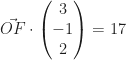
\vec{OF}\cdot\begin{pmatrix}3\\-1\\2\end{pmatrix}=17 ——– Eqn (2)

From Eqn (1), \vec{OF}-\vec{OA}=\begin{pmatrix}3k\\-k\\2k\end{pmatrix}

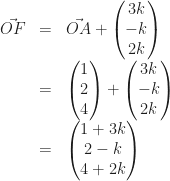
\begin{array}{rcl}\vec{OF}&=&\vec{OA}+\begin{pmatrix}3k\\-k\\2k\end{pmatrix}\\  &=&\begin{pmatrix}1\\2\\4\end{pmatrix}+\begin{pmatrix}3k\\-k\\2k\end{pmatrix}\\  &=&\begin{pmatrix}1+3k\\2-k\\4+2k\end{pmatrix}\end{array}

Substituting into Eqn (2),

\begin{pmatrix}1+3k\\2-k\\4+2k\end{pmatrix}\cdot\begin{pmatrix}3\\-1\\2\end{pmatrix}=17

14k+9=17

k=4/7

Substituting back into Eqn (1),

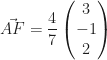
\displaystyle\vec{AF}=\frac{4}{7}\begin{pmatrix}3\\-1\\2\end{pmatrix}

\displaystyle|\vec{AF}|=\frac{4}{7}\sqrt{14}

JC Junior College H2 Maths Tuition

If you or a friend are looking for Maths tuitionO level, A level H2 JC (Junior College) Maths Tuition, IB, IP, Olympiad, GEP and any other form of mathematics you can think of.

Experienced, qualified (Raffles GEP, NUS Maths 1st Class Honours, NUS Deans List) and most importantly patient even with the most mathematically challenged.

So if you are in need of the solution to your mathematical woes, drop me a message!

Tutor: Mr Wu

Email: mathtuition88@gmail.com

Website: Singapore Maths Tuition | Patient and Dedicated Maths Tutor in Singapore

Landau’s Beautiful Proofs

tomcircle's avatarMath Online Tom Circle

Landau’s beautiful proofs:
1= cos 0 = cos (x-x)

Opening cos (x-x):
1 = cos x.cos (-x) – sin x.sin (-x)
=> 1= cos² x + sin² x
[QED]

Let cos x= b/c, sin x = a/c
1= (b/c)² + (a/c)²
c² = b² + a²
=> Pythagoras Theorem
[QED]

Landau (1877-1938) was the successor of Minkowski at the Gottingen University (Math) before WW II.

View original post

Open Cubic Root

tomcircle's avatarMath Online Tom Circle

Mental Trick

It was discovered by the Martial Art writer Liang Yusheng 武侠小说家 梁羽生 (《白发魔女传》作者), who met Hua Luogeng (华罗庚) @1979 in England:
2³= [8]
8³= 51[2]
3³= 2[7]
7³= 34[3]

The last digit pairs :
[2 <->8] , [3 <-> 7]
Others unchanged.

Example:

$latex \sqrt[3]{658503} = N$
Last three digits 503 <-> …[7]
First three digits 658:
 (8³ =512)< 658 < (729 = 9³)
=>  8
Answer : $latex \sqrt[3]{658503} = N$= 87
Note: Similar trick for opening $latex \sqrt[23] {200 digits}$ by an indian lady Ms Shakuntala (83) dubbed “Human computer”.

View original post

Solution 2 (Eigenvalue): Monkeys & Coconuts

tomcircle's avatarMath Online Tom Circle

Solution 2: Use Linear Algebra Eigenvalue equation: A.X = λ.X

A =S(x)= $Latex \frac{4}{5}(x-1)$ where x = coconuts

S(x)=λx

Since each iteration of the transformation caused the coconut status ‘unchanged’, which means λ = 1 (see remark below)

$Latex \frac{4}{5}(x-1)=x$
We get
x = – 4

S¹(x) = ⅘ (x-1)

S²(x) = ⅘( [⅘ (x-1)]-1)

= ⅘ (⅘ x -⅘ -1)

= (⅘)² x – (⅘)² – ⅘

Also by recursive, after the fifth monkey:

$Latex S^5 (x)$ = $Latex (\frac{4}{5})^5 (x-1)- (\frac{4}{5})^4-(\frac{4}{5})^3- (\frac{4}{5})^2- \frac{4}{5}$

$Latex S^5 (x)$ = $Latex (\frac{4}{5})^5 (x) – (\frac{4}{5})^5 – (\frac{4}{5})^4 – (\frac{4}{5})^3+(\frac{4}{5})^2 – \frac{4}{5}$

$Latex 5^5$ divides (x)

Minimum positive x= – 4 mod ($Latex 5^{5}$ )= $Latex 5^{5} – 4$= 3,121 [QED]

Note: The meaning of eigenvalue λ in linear transformation is the change by a scalar of λ factor (lengthening or shortening by λ) after the transformation. Here
λ = 1 because…

View original post 16 more words

Solution 1 (Sequence): Monkeys & Coconuts

tomcircle's avatarMath Online Tom Circle

Monkeys & Coconuts Problem

Solution 1 : iteration problem => Use sequence
$Latex U_{j} =\frac {4}{5} U_{j- 1} -1 $

(initial coconuts)
$Latex U_0 =k$
Let
$Latex f(x)=\frac{4}{5}(x-1)=\frac{4}{5}(x+4)-4$
$Latex U_1 =f(U_0)=f(k)= \frac{4}{5}(k+4)-4$

$Latex U_2 =f(U_1)=f(\frac{4}{5}(k+4)-4)= \frac{4}{5}((\frac{4}{5}(k+4)-4+4)-4$

$Latex U_2=(\frac{4}{5})^2 (k+4)-4$

$Latex U_3=(\frac{4}{5})^3 (k+4)-4$

$Latex U_4=(\frac{4}{5})^4 (k+4)-4$

$Latex U_5=(\frac{4}{5})^5 (k+4)-4$

Since
$Latex U_5$ is integer  ,
$Latex 5^5 divides (k+4)$
k+4 ≡ 0 mod($Latex 5^5$)
k≡-4 mod($Latex 5^5$)
Minimum {k} = $Latex 5^5 -4$= 3121 [QED]

Note: The solution was given by Paul Richard Halmos (March 3, 1916 – October 2, 2006)

View original post

Monkeys & Coconuts Problem

tomcircle's avatarMath Online Tom Circle

5 monkeys found some coconuts at the beach.

1st monkey came, divided the coconuts into 5 groups, left 1 coconut which it threw to the sea, and took away 1 group of coconuts.
2nd monkey came, divided the remaining coconuts into 5 groups, left 1 coconut again thrown to the sea, and took away 1 group.
Same for 3rd , 4th and 5th monkeys.

Find: how many coconuts are there initially?

Note: This problem was created by Nobel Physicist Prof Paul Dirac (8 August 1902 – 20 October 1984). Prof Tsung-Dao Lee (李政道) (1926 ~) , Nobel Physicist, set it as a test for the young gifted students in the Chinese university of Science and Technology (中国科技大学-天才儿童班).

View original post

French Curve

tomcircle's avatarMath Online Tom Circle

The French method of drawing curves is very systematic:

“Pratique de l’etude d’une fonction”

Let f be the function represented by the curve C

Steps:

1. Simplify f(x). Determine the Domain of definition (D) of f;
2. Determine the sub-domain E of D, taking into account of the periodicity (eg. cos, sin, etc) and symmetry of f;
3. Study the Continuity of f;
4. Study the derivative of fand determine f'(x);
5. Find the limits of fwithin the boundary of the intervals in E;
6. Construct the Table of Variation;
7. Study the infinite branches;
8. Study the remarkable points: point of inflection, intersection points with the X and Y axes;
9. Draw the representative curve C.

Example:

$latex \displaystyle\text{f: } x \mapsto \frac{2x^{3}+27}{2x^2}$
Step 1: Determine the Domain of Definition D
D = R* = R –…

View original post 454 more words

Cut a cake 1/5

tomcircle's avatarMath Online Tom Circle

Visually cut a cake 1/5 portions of equal size:

1) divide into half:

20130513-111010.jpg

2) divide 1/5 of the right half:

20130513-133441.jpg

3) divide half, obtain 1/5 = right of (3)

$latex \frac{1}{5}= \frac{1}{2} (\frac{1}{2}(1- \frac{1}{5}))= \frac{1}{2} (\frac{1}{2} (\frac{4}{5}))=\frac{1}{2}(\frac{2}{5})$

20130513-171052.jpg

4) By symmetry another 1/5 at (2)=(4)

20130513-174541.jpg

5) divide left into 3 portions, each 1/5

$latex \frac{1}{5}= \frac{1}{3}(\frac{1}{2}+ \frac{1}{2}.\frac{1}{5}) = \frac{1}{3}.\frac{6}{10}$

20130513-174742.jpg

View original post

Tuition That We May Have To Believe In

This insightful article makes a really good read.

Quotes from the article:

To be honest, the amount to be learnt at each level of education is constantly increasing, and tuition could just help you get that edge over others. After all, it was meant to be supplementary in nature.

The toughest part at the end of the day however, is probably this: getting the right tutor.

guanyinmiao's avatarguanyinmiao's musings (Archived: July 2009 to July 2019)

This commentary, “Tuition That We May Have To Believe In”, is a reply to a previous article on tuition by Howard Chiu (Mr.), “Tuition We Don’t Have To Believe In” (Read).

I must say Howard’s article had me on his side for a moment. He appealed to me emotively. Nothing like a mental picture of some kid attending hours and hours of tuition immediately after school when he could well be enjoying himself thoroughly with… an iPhone or iPad (I highly doubt kids these days still indulge their time at playgrounds). But the second time I read his article, I silenced the part of my brain which still prays the best for children, so do pardon me if I sound a tad too pragmatic at times.

The overarching assertion that Howard projects his points from is that there is “huge over consumption of this good”. Firstly, private tutoring…

View original post 1,472 more words

Generalized Analytic Geometry

tomcircle's avatarMath Online Tom Circle

Generalized Analytic Geometry

Find the equation of the circle which cuts the tangent 2x-y=0 at M(1,4), passing thru point A(4,-1).

Solution:

1st generalization:
Let the point circle be:
(x-1)² + (y-4)² =0

2nd generalization:
It cuts the tangent 2x-y=0
(x-1)² + (y-4)² +k(2x-y) =0 …(C)

Pass thru A(4,-1)
x=4, y= -1
=> k= -2
(C): (x-3)² + (y-1)² =…
[QED]

View original post 1 more word

Math Chants

tomcircle's avatarMath Online Tom Circle

Math Chants make learning Math formulas or Math properties fun and easy for memory . Some of them we learned in secondary school stay in the brain for whole life, even after leaving schools for decades.

Math chant is particularly easy in Chinese language because of its single syllable sound with 4 musical tones (like do-rei-mi-fa) – which may explain why Chinese students are good in Math, as shown in the International Math Olympiad championships frequently won by China and Singapore school students.

1. A crude example is the quadratic formula which people may remember as a little chant:
ex equals minus bee plus or minus the square root of bee squared minus four ay see all over two ay.”

$latex \boxed{
x = \frac{-b \pm \sqrt{b^{2}-4ac}}
{2a}
}$

2. $latex \mathbb{NZQRC}$
Nine Zulu Queens Rule China

3. $latex \boxed {\cos 3A = 4\cos^{3}…

View original post 199 more words

What is “sin A”

tomcircle's avatarMath Online Tom Circle

What is “sin A” concretely ?

1. Draw a circle (diameter 1)
2. Connect any 3 points on the circle to form a triangle of angles A, B, C.
3. The length of sides opposite A, B, C are sin A, sin B, sin C, respectively.

Proof:
By Sine Rule:

$latex \frac{a}{sin A} = \frac{b}{sin B} =\frac{c}{sin C} = 2R = 1$
where sides a,b,c opposite angles A, B, C respectively.
a = sin A
b = sin B
c = sin C

20130421-193110.jpg

View original post

Tip: Using Google “filetype” filter to search for Free Exam Papers

This is a handy tip to search for Free Exam Papers on Google.

(Note: Google is very powerful, but it can only search for exam papers that are already online in the first place)

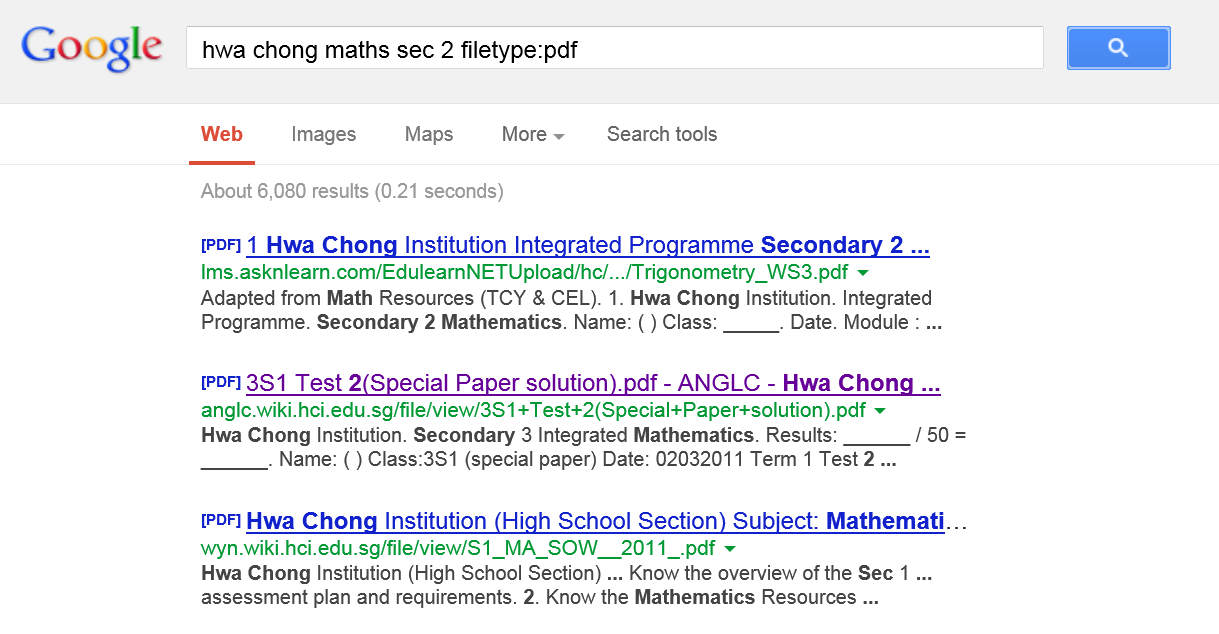
Since most exam papers are in PDF format, we can restrict our search to PDF files by adding the phrase “filetype:pdf” to the Google search.

For example, searching “hwa chong maths sec 2” in Google does not yield many exam papers.

Searching “hwa chong maths sec 2 filetype:pdf” returns a much better result, including some worksheets and test papers.

Screenshot:

google-hwa-chong-maths-tuition

O Level 2007 E Maths Paper 2 Q3 Solution (Geometry Question)

(a)
\angle DAB=\angle DCB
(opposite angles of parallelogram)

\displaystyle\angle PAD=\frac{1}{2}\angle DAB=\frac{1}{2}\angle DCB=\angle RCB
(shown)

(b)
AD=BC

\angle PAD=\angle RCB
(from part a)

\angle ADC=\angle ABC
(opposite angles of parallelogram)

\displaystyle\angle ADP=\frac{1}{2}\angle ADC=\frac{1}{2} ABC=\angle RBC

Thus, triangles ADP and CBR are congruent (ASA).

(c)(i)
\angle ADC+\angle DAB=180^\circ
\angle DAP+\angle ADP=90^\circ

Considering the triangle ADP,
\angle DPA=180^\circ-90^\circ=90^\circ
(shown)

(ii)
\angle DAB+\angle ABC=180^\circ

\angle BAQ+\angle ABQ=90^\circ

Considering the triangle ABQ,
\angle PQR=180^\circ-90^\circ=90^\circ
(shown)

Maths Tutor Singapore, H2 Maths, A Maths, E Maths

If you or a friend are looking for maths tuition: o level, a level, IB, IP, olympiad, GEP and any other form of mathematics you can think of

Experienced, qualified (Raffles GEP, Deans List, NUS Deans List, Olympiads etc) and most importantly patient even with the most mathematically challenged.

so if you are in need of the solution to your mathematical woes, drop me a message!

Tutor: Mr Wu

Email: mathtuition88@gmail.com

Website: https://mathtuition88.com/

Sec 3 Hwa Chong Institution Maths Test Papers and Resources

Site: http://anglc.wiki.hci.edu.sg/space/content

Description: Includes Sec 3 Hwa Chong Institution Maths Test Papers and Resources


Please visit our site https://mathtuition88.com/free-exam-papers for updates on more Free Exam Papers and Maths Tips.

H2 Maths Tuition: Complex Numbers Notes

H2 Maths: Complex Numbers 1 Page Notes

Modulus

Argument

Cartesian Form

Draw diagram first, then find the appropriate quadrant and use

(can use GC to double check)

Polar Form

Exponential Form

When question involvespowers, multiplication or division, it may be helpful toconvert to exponential form.

Please write Ƶ and 2 differently.

De Moivre’s Theorem

Equivalent to

Memory tip: Notice that arg behaves similarly to log.

Locusof z is aset of pointssatisfying certain given conditions.

in English means:The distance between (the point representing)and (the point representing)

Means the distance offromis a constant,.

So this is acircular loci.

Centre:, radius =

means that the distance offromis equal to its distance from

In other words, the locus is theperpendicular bisectorof the line segment joiningand.

represents ahalf-linestarting frommaking an anglewith the positive Re-axis.

(Exclude the point (a,b) )

Common Errors

– Some candidates thought thatis the same asand thatis the same as.

– The “formula”for argumentsdoes not workfor points in the 2ndand 3rdquadrant.

– Very many candidates seem unaware that their calculators will work in radians mode and there were many unnecessary “manual” conversions from degrees to radians.

积少成多: How can doing at least one Maths question per day help you improve! (Maths Tuition Revision Strategy)

We all know the saying “an apple a day keeps the doctor away“. Many essential activities, like eating, exercising, sleeping, needs to be done on a daily basis.

Mathematics is no different!

Here is a surprising fact of how much students can achieve if they do at least one Maths question per day. (the question must be substantial and worth at least 5 marks)

This study plan is based on the concept of 积少成多, or “Many little things add up“. Also, this method prevents students from getting rusty in older topics, or totally forgetting the earlier topics. Also, this method makes use of the fact that the human brain learns during sleep, so if you do mathematics everyday, you are letting your brain learn during sleep everyday.

Let’s take the example of Additional Mathematics.

Exam is on 24/25 October 2013.

Let’s say the student starts the “One Question per day” Strategy on 20 May 2013

Days till exam: 157 days  (22 weeks or 5 months, 4 days)

So, 157 days = 157 questions (or more!)

Each paper in Ten Year Series has around 25 questions (Paper 1 & Paper 2), so 157 questions translates to more than 6 years worth of practice papers! And all that is achieved by just doing at least one Maths question per day!

A sample daily revision plan can look like this. (I create a customized revision plan for each of my students, based on their weaknesses).

Suggested daily revision (Additional Mathematics):

Topic

Monday

Algebra

Tuesday

Geometry and Trigonometry

Wednesday

Calculus

Thursday

Algebra

Friday

Geometry and Trigonometry

Saturday

Calculus

Sunday

Geometry and Trigonometry

(Calculus means anything that involves differentiation, integration)

(Geometry and Trigonometry means anything that involves diagrams, sin, cos, tan, etc. )

(Algebra is everything else, eg. Polynomials, Indices, Partial Fractions)

By following this method, using a TYS, the student can cover all topics, up to 6 years worth of papers!

Usually, students may accumulate a lot of questions if they are stuck. This is where a tutor comes in. The tutor can go through all the questions during the tuition time. This method makes full use of the tuition time, and is highly efficient.

Personally, I used this method of studying and found it very effective. This method is suitable for disciplined students who are aiming to improve, whether from fail to pass or from B/C to A. The earlier you start the better, for this strategy. For students really aiming for A, you can modify this strategy to do at least 2 to 3 Maths questions per day. From experience, my best students practice Maths everyday. Practicing Ten Year Series (TYS) is the best, as everyone knows that school prelims/exams often copy TYS questions exactly, or just modify them a bit.

The role of the parent is to remind the child to practice maths everyday. From experience, my best students usually have proactive parents who pay close attention to their child’s revision, and play an active role in their child’s education.

This study strategy is very flexible, you can modify it based on your own situation. But the most important thing is, practice Maths everyday! (For Maths, practicing is twice as important as studying notes.) And fully understand each question you practice, not just memorizing the answer. Also, doing a TYS question twice (or more) is perfectly acceptable, it helps to reinforce your technique for answering that question.

If you truly follow this strategy, and practice Maths everyday, you will definitely improve!

Mathematics homework

Hardwork \times 100% = Success! (^_^)

There is no substitute for hard work.” – Thomas Edison

Challenging Geometry E Maths Question — St Andrew’s Sec 3 Maths Tuition Question

Question:

ABCD is a rectangle. M and N are points on AB and DC respectively. MC and BN meet at X. M is the midpoint of AB.

recommended maths tuition geometry

(a) Prove that \Delta CXN and \Delta MXB are similar.

(b) Given that area of \triangle CXN: area of \triangle MXB=9:4, find the ratio of,

(i) DN: NC

(ii) area of rectangle ABCD: area of \triangle XBC. (Challenging)

[Answer Key] (b) (i) 1:3

(ii) 20:3

Suggested Solutions:

(a)
\angle MXB=\angle NXC (vert. opp. angles)

\angle MBX = \angle XNC (alt. angles)

\angle BMX = \angle XCN (alt. angles)

Therefore, \Delta CXN and \Delta MXB are similar (AAA).

(b) (i) \displaystyle\frac{NC}{BM}=\sqrt{\frac{9}{4}}=\frac{3}{2}

Let BM=2u and NC=3u

Then DC=2\times 2u=4u

So DN=4u-3u=u

Thus, DN:NC=1u:3u=1:3

(ii)

We now have a shorter solution, thanks to a visitor to our site! (see comments below)

From part (a), since \Delta CXN and \Delta MXB are similar, we have MX:XC=2:3

This means  that MC:XC=5:3

Thus \triangle MBC:\triangle XBC=5:3 (the two triangles share a common height)

Now, note that \displaystyle\frac{\text{area of }ABCD}{\triangle MBC}=\frac{BC\times AB}{0.5 \times BC \times MB}=\frac{AB}{0.5MB}=\frac{2MB}{0.5MB}=4

Hence area of ABCD=4\times\triangle MBC

We conclude that area of rectangle ABCD: area of \triangle XBC=4(5):3=20:3

Here is a longer solution, for those who are interested:

Let area of \triangle XBC =S

Let area of \triangle MXB=4u

Let area of \triangle CXN=9u

We have \displaystyle\frac{S+9u}{S+4u}=\frac{3}{2} since \triangle NCB and \triangle CMB have the same base BC and their heights have ratio 3:2.

Cross-multiplying, we get 2S+18u=3S+12u

So \boxed{S=6u}

\displaystyle\frac{\triangle BCN}{\triangle BDC}=\frac{3}{4} since \triangle BCN and \triangle BDC have the same base BC and their heights have ratio 3:4.

Hence,

\begin{array}{rcl}    \triangle BDC &=& \frac{4}{3} \triangle BCN\\    &=& \frac{4}{3} (9u+6u)\\    &=& 20u    \end{array}

Thus, area of ABCD=2 \triangle BDC=40u

area of rectangle ABCD: area of \triangle XBC=40:6=20:3

H2 Maths Tuition: Foot of Perpendicular (from point to plane) (Part II)

This is a continuation from H2 Maths Tuition: Foot of Perpendicular (from point to line) (Part I).

Foot of Perpendicular (from point to plane)

From point (B) to Plane ( p)

h2-vectors-tuition

Equation (I):

Where does F lie?

F lies on the plane  p.

\overrightarrow{\mathit{OF}}\cdot \mathbf{n}=d

Equation (II):

Perpendicular

\overrightarrow{\mathit{BF}}=k\mathbf{n}

\overrightarrow{\mathit{OF}}-\overrightarrow{\mathit{OB}}=k\mathbf{n}

\overrightarrow{\mathit{OF}}=k\mathbf{n}+\overrightarrow{OB}

Final Step

Substitute Equation (II) into Equation (I) and solve for k.

Example

[VJC 2010 P1Q8i]

The planes \Pi _{1} and \Pi _{2} have equations \mathbf{r\cdot(i+j-k)}=6 and \mathbf{r\cdot(2i-4j+k)}=-12 respectively. The point A  has position vector  \mathbf{{9i-7j+5k}} .

(i) Find the position vector of the foot of perpendicular from  A to \Pi _{2} .

Solution

Let the foot of perpendicular be F.

Equation (I)

\overrightarrow{\mathit{OF}}\cdot  \left(\begin{matrix}2\\-4\\1\end{matrix}\right)=-12

Equation (II)

\overrightarrow{\mathit{OF}}=k\left(\begin{matrix}2\\-4\\1\end{matrix}\right)+\left(\begin{matrix}9\\-7\\5\end{matrix}\right)=\left(\begin{matrix}2k+9\\-4k-7\\k+5\end{matrix}\right)

Subst. (II) into (I)

2(2k+9)-4(-4k-7)+(k+5)=-12

Solve for k,  k=-3 .

\overrightarrow{\mathit{OF}}=\left(\begin{matrix}3\\5\\2\end{matrix}\right)

H2 Maths Tuition

If you are looking for Maths Tuition, contact Mr Wu at:

Email: mathtuition88@gmail.com

How to avoid Careless Mistakes for Maths?

Many parents have feedback to me that their child often makes careless mistakes in Maths, at all levels, from Primary, Secondary, to JC Level. I truly empathize with them, as it often leads to marks being lost unnecessarily. Not to mention, it is discouraging for the child.

Also, making careless mistakes is most common in the subject of mathematics, it is rare to hear of students making careless mistakes in say, History or English.
Fortunately, it is possible to prevent careless mistakes for mathematics, or at least reduce the rates of careless mistakes.

From experience, the ways to prevent careless mistakes for mathematics can be classified into 3 categories, Common Sense, Psychological, and Math Tips.

Common Sense

  1. Firstly, write as neatly as possible. Often, students write their “5” like “6”. Mathematics in Singapore is highly computational in nature, such errors may lead to loss of marks. Also, for Algebra, it is recommended that students write l (for length) in a cursive manner, like \ell to prevent confusion with 1. Also, in Complex Numbers in H2 Math, write z with a line in the middle, like Ƶ, to avoid confusion with 2.
  2. Leave some time for checking. This is easier said than done, as speed requires practice. But leaving some time, at least 5-10 minutes to check the entire paper is a good strategy. It can spot obvious errors, like leaving out an entire question.

Psychological

  1. Look at the number of marks. If the question is 5 marks, and your solution is very short, something may be wrong. Also if the question is just 1 mark, and it took a long time to solve it, that may ring a bell.
  2. See if the final answer is a “nice number“. For questions that are about whole numbers, like number of apples, the answer should clearly be a whole number. At higher levels, especially with questions that require answers in 3 significant figures, the number may not be so nice though. However, from experience, some questions even in A Levels, like vectors where one is suppose to solve for a constant \lambda, it turns out that the constant is a “nice number”.

Mathematical Tips

Mathematical Tips are harder to apply, unlike the above which are straightforward. Usually students will have to be taught and guided by a teacher or tutor.

  1. Substitute back the final answer into the equations. For example, when solving simultaneous equations like x+y=3, x+2y=4, after getting the solution x=2, y=1, you should substitute back into the original two equations to check it.
  2. Substitute in certain values. For example, after finding the partial fraction \displaystyle\frac{1}{x^2-1} = \frac{1}{2 (x-1)}-\frac{1}{2 (x+1)}, you should substitute back a certain value for x, like x=2. Then check if both the left-hand-side and right-hand-side gives the same answer. (LHS=1/3, RHS=1/2-1/6=1/3) This usually gives a very high chance that you are correct.

Thanks for reading this long article! Hope it helps! 🙂

I will add more tips in the future.

Recommended Maths Book:

Math Doesn’t Suck: How to Survive Middle School Math Without Losing Your Mind or Breaking a Nail

This book is a New York Times Bestseller by actress Danica McKellar, who is also an internationally recognized mathematician and advocate for math education. It should be available in the library. Hope it can inspire all to like Maths!