Math: U of I Book Club-What’s Math Got to Do with It?

Kelly West's avatarCurriculum & Technology

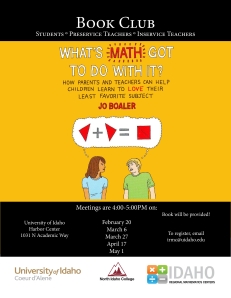
University of Idaho is offering a book club on What’s Math Got to Do with It?: How Parents and Teachers Can Help Children Learn to Love Their Least Favorite Subject by Jo Boaler.

The book club is free and includes a copy of the book! There is an option to participate for 1 credit offered through the University of Idaho for $60. Check out the flyer below and contact irmc@uidaho.edu to register.

Book club

Kelly Signature

View original post

Math Competition

ironide55's avatarGetting In: Blog for High School Students

American Mathematics Contest 10
The AMC 10 is a 25 question, 75 minute multiple choice examination in secondary school mathematics containing problems which can be understood and solved with algebra and geometry concepts.

American Mathematics Contest 12
The AMC 12 is a 25 question, 75 minute multiple choice examination in secondary school mathematics containing problems which can be understood and solved with pre-calculus concepts.

United States of America Mathematical Olympiad
The United States of America Mathematical Olympiad (USAMO) and the United States of America Junior Mathematical Olympiad (USAJMO) are six question, two day, 9 hour essay/proof examinations. All problems can be solved with pre-calculus methods. Approximately 270 of the top scoring AMC 12 participants (based on a weighted average of AMC 12 and AIME score) are invited to take the USAMO. Approximately 230 of the top scoring AMC 10 participants (based on a weighted average of AMC 10 and AIME…

View original post 158 more words

Surgery for Function Operations

Megan Schmidt's avatarNumber Loving Beagle

My college algebra course boasts one of the driest textbooks on the planet. It’s one of those versions that has exercises from 1 to 99 for each section…brutal.   Can you relate?
The topics for college algebra are very standard and cover little more than what students should have encountered recently in their algebra 2 course. I therefore decided that this class would lend itself quite nicely testing out the theory that a high-level, rich question questioning can be facilitated from a traditional, drill-and-kill style textbook.

Previously, I recall that Operations on Functions was a particularly awful topic for both me and my students.  The textbook presents this concept in exactly the way you might think:

f(x) = [expression involving x]  and g(x) = [similar expression involving x]

Find f(x) + g(x), f(x) – g(x), f(g(x), f(x) *g(x), f(x)/g(x)…f(snoozefest)…you get the point.  It’s boring, they’ve done it before, and there’s…

View original post 346 more words

How to avoid careless mathematical errors?

paviavio's avatarPaviavio          

I found this discussion on reddit “How to avoid careless mathematical errors?“:

Hi //math.

I am a high school student who happens to be VERY good at math, but who consistently fails to get As on tests due to careless errors. Most of the time, they come from forgetting a 0 after a decimal place, multiplying instead of dividing, putting a decimal point in the wrong place, or just factoring wrong. I actually had to drop a Precalc Honors class because I got Ds on tests from the sheer number of stupid mistakes I made, despite understanding the material very well.

I assume that this occurs because I work quickly, but if I work slowly, I run out of time on the test. Additionally, my handwriting is horrible, but there’s really nothing I can do about that. And even when I check my answers after finishing, I still…

View original post 639 more words

1+2+3+4+…= -1/12!?

sciencevilleblog's avatarScienceville

數學世界並不如一般人想象中的理性、不可抗逆。相反,很多表面上合理的論証,卻會引申出非常荒謬的結論。

其中一個我十分喜愛的算式如下:

itoinfinity

最先論証這個看似荒謬的算式的人是印度著名數學家斯里尼瓦瑟.拉馬努金 (Srinivasa Ramanujan)。他提出的論証中牽涉到冪級數 (Power Series) 的運用。因此,我將會用一個比較易懂的方法,嘗試去証明這條算式是正確的。
s1ands2

首先設以上三項算式為S1、S2及S。

S1的答案比較易懂,從算式中可見,S1必定為 1 這兩個可能答案:

s1

我們取 1 的平均數 1/2 為S1的答案 (假如取其平均數這做法令你感到很不安的話,事實上我有另一個論証方法可以証明 1/2 是最合理並最接近的答案,容後分解)。

然後將S2乘 2 ,算式如下:

s2times2

兩列算式的數字各自相加後得出的結果如下:

2s2equals1

很眼熟吧?沒錯,從以上計算中可以歸納出 2 x S2 = S1

而由於S1 = 1/2,代入以上算式可以得出 S2 = 1/4

之後,我們進行 S – S2 這一操作,運算過程如下:

sminuss2

奇妙的事情就在這裡開始發生了。剛才我們証明了S2 = 1/4,因此

S – 1/4 = 4*S

3*S = -1/4

S = -1/12

亦即証明:

itoinfinity

難以致信吧?假如你無法接受這個違反常識,卻又看似合理的論証結果,我可以很榮幸地告訴你,

你的質疑是非常合理。

因為上述所有推算過程中都犯下了一個數學世界的禁忌,就是嘗試對無限 (Infinity) 進行操作。

真相是,無限本身是一個概念,而不是一個數字。因此,假如一意孤行地對無限進行加減乘除等操作時,便會出現如上述般荒誕的結果,就像整個數學系統當機了一樣。

不過,並非所有無限都是不可操作的。例如收斂級數 (Convergent Series) 便是一個有求和答案的無窮數列。

(credit: Numberphile)

View original post 2 more words

Liberal Arts is Not Dead

Bryan E Wilson's avatarBryan E. Wilson

Pierre de FermatKennesaw- Who says that Liberal Arts is dead?  One day in 1637, a lawyer and amateur mathematician named Pierre de Fermat scribbled a curious note in his journal: “The equation xn+ yn = zn, where x, y, and z are positive integers, has no solution if n is greater than 2… I have discovered a most remarkable proof, but this margin is too narrow to contain it.”

In his spare time, Fermat studied languages, classical literature and natural science.  He also discovered the fundamental principle of analytic geometry. His methods for finding tangents to curves and their maximum and minimum points led him to be regarded as the inventor of the differential calculus. Through his correspondence with Blaise Pascal he was a co-founder of the theory of probability.

It took mankind over 350 years to prove Fermat’s last theorem.

Spend time today encouraging…

View original post 45 more words

Place Value, or Thank You Hindus and Arabs, or The Beauty of the Base-Ten Numeration System

MathDavidUtah's avatarUtah Elementary Mathematics

I have been doing a lot of thinking about place value lately. Yes, I need a life outside my standard state-issue gray cubicle. Nonetheless, I have become caught up in the beauty of the Hindu-Arabic number system. We also know it as the Base-Ten numeration system. It is beautiful and elegant. Let me elucidate (I love that word!)

One of the best t-shirts I have ever seen had this quote on the front, “There are only 10 kinds of people in the world; those who understand binary and those who don’t.” Some of you might be laughing right now while others are scratching their heads wondering what is wrong with me. Okay, here’s the joke. Binary is a base-2 numeration system. It has two digits – 0 and 1. Place value in binary is determined by powers of 2. So, in the units place you can have 0 and…

View original post 2,116 more words

A couple of notes on convergent series

ajmacarthur1's avatarA J Macarthur

Note: I originally published this entry on a Google Sites page in September 2013, but I have moved it hear as I hope to make better use of the $latex \LaTeX$ support offered by wordpress.com


I completed the first year of my maths degree in June 2013. I studied Analysis in all three terms (sequences and series in the first term, continuity and differentiability in the second, and Riemann integration in the third) and feel I have learnt a lot. Occasionally, amongst all this theory, I must admit to sometimes having lost touch with the original questions that provoked its development.

Consider the following naïve approach to infinite series. What is the answer if I add 1 and -1 alternately forever? That is

$latex \displaystyle{1+(-1)+1+(-1)+ … = ???}$

If I bracket the terms in pairs starting with the first and second terms, the answer appears to be 0:
$latex…

View original post 757 more words

Pi Number Approximation With Monte Carlo Method

ebdundar's avatarBraincycle

Pi(Π) number is irrational and equal to 3.14159265… .                                    

Let us draw a circle with radius ‘r’

circles_dtheta

$latex \int_0^{2\pi} r \mathrm{d}\theta = {2\pi} r &s=2$

So, circumference of the circle is equal to $latex {2\pi} r $

If the value of circumference is divided by value of diameter, the result is $latex \pi $

Area of quarter circle = $latex \frac{\pi r^2}{4}&s=2$

circle_square

Area of the square = $latex {r^2}&s=2$

Probability of putting a dot on quarter circle is shown below.

$latex \frac{\frac{\pi r^2}{4}}{r^2} = \frac{\pi}{4}&s=3$

The area of circle is divided by total area.

In order to achieve $latex \pi $ value the result is multiplied by 4.

We can use Monte Carlo method for approximation $latex \pi $ value. For example, 10000 dots will be put on picture above. Each dot…

View original post 47 more words

Read All About It – Using Story and Picture Books in Maths Lessons

supportingmaths's avatarsupportingmaths

million


This blog was my very first venture into blogging on the fabulous Primary English blog.   I’m very grateful to them for publishing it last May which led to me thinking seriously about starting my own blog.  Their site is well worth a visit and they also have some amazing pinterest boards on all sorts of themes.

Here is what I blogged back in May:

As a maths leader, I quite often have the privilege of doing planning trawls and looking at weekly and medium term planning from other teachers.  I’m often very impressed by the thought and detail that goes into these.  But there’s one section that seems very rarely to be given much thought.  If your weekly or medium term planning format is anything like mine, there’s a small section headed ‘cross-curricular links’, and I hardly ever see it filled in, except perhaps with the suggestions…

View original post 654 more words

Mathematical Methods for Quantitative Finance

econ901's avatarECON 901

Link: https://www.coursera.org/course/mathematicalmethods

Coverage: the official description is thorough. The caveat is that all topics are discussed without going too much into subtleties.

Potential audience: people with moderate knowledge of multivariable calculus, linear algebra and a bit of R programming experience who want to see how this knowledge may be applied to finance.

Format:

  • a lecture; slides of lectures can be downloaded
  • in-video questions
  • a problem set; answers are provided for most problems
  • a quiz; usually, it’s easier than the problem set

Note that only quizzes are graded.

Workload: 2-3 hours assuming you know calculus & linear algebra. If you don’t, then it’s hard to say.

Misc:

  1. there is no Statement of Accomplishment
  2. there is no course staff to help you, i.e. you should rely only on the assistance from your fellow courserians
  3. there are some misprints in materials. Hope Dr.Konis will have them fixed before the next session.

To sum…

View original post 33 more words

Monkey typing ABRACADABRA

jeffreyrosenbluth's avatarmartingalemeasure

Since I decided to call this blog martingalemeasure it seems only fitting that the first post should be about probability; martingales in particular. In my favorite introductory book on measure theoretical probability, “Probablity with Martingales” by David Williams, we find an exercise in Chapter 10, which I paraphrase here:

Suppose a monkey is typing randomly at a typewriter whose only keys are the capital letters $latex A$ through $latex Z$ of the english alphabet. What is the expected (average) time it will take for the monkey to type the word $latex ABRACADABRA$?

This is not an easy problem. In fact it’s not entirely obvious that the average time is even finte! Williams expects the reader to solve it using the beautiful theory of martingales and in particular Doob’s optional-stopping theorem. We will calculate the result below, but stop short of a proof. (There are many proofs of this result…

View original post 1,252 more words

A better way to calculate the day of the week

gcanyon's avatarGeoff Canyon's Appeal to Authority

Look Like a Genius

Calculating the day of the week for historical date is impressive, but it isn’t as hard as it seems. Several methods have been shown to work and be performable by average humans. This is an improvement to one of the simplest methods.

The Doomsday Rule

Paraphrased from wikipedia:

The Doomsday rule or Doomsday algorithm is a relatively simple way to calculate the day of the week of a given date. It was devised by John Conway, drawing inspiration from Lewis Carroll’s work on a perpetual calendar algorithm. The algorithm takes advantage of the fact that several easy-to-remember dates fall on the same day each year; for example, 4/4, 6/6, 8/8, 10/10, 12/12, and the last day of February are all the same day of the week.

Conway’s original algorithm required dividing by 12 and 4, and remembering several intermediate values. It’s achievable, but not…

View original post 622 more words

It’s About the Process: Not the Answer

Beyond Traditional Math's avatarBeyond Traditional Math

When I first started teaching, I was always looking for the correct answer on a math problem. I would mark it wrong or right, there was no gray area.  I began to change my thinking a bit when I noticed my students weren’t really growing.  I knew that I needed to do something differently, so I began to start looking at the process of their thinking so that I could give direct feedback to help them get better.

If you think about it, we do the same thing in reading.  We don’t expect students to become perfect readers overnight, so we give them reading strategies to become better. We look at their fluency, comprehension, how they monitor and self correct…we intervene and give feedback to help them.

With problem solving it can be the same way.  We can take a look at the work a student writes down and see…

View original post 209 more words

Math goal 3

savannahdresch's avatarIntelligence Having Fun

Use a checklist to moniter my students’ understanding of fractions.

We have a unit test coming up at the end of the week on fractions. All throuout this week we will be working in small groups with students and I want to ensure that I am targeting my instruction to the concepts students need to review.

Reflection: I had some difficulties with this goal, but I definitely want to try this again another time. First, it was difficult for me to gauge the entire class in the short time I was using my checklist. For various reasons, I was only able to use it through portions of two lessons. The main problem I could see was that, since this was the end of the unit, I was not able to gather data on everything we had covered. Although, that is what I was trying to do with my ten item…

View original post 437 more words

Testing and Finding Prime Numbers

ebdundar's avatarBraincycle

Prime numbers are numbers can only be divided by itself and 1.  They are greater than 0. In this text, we will see how to test whether a number is a prime number or not. Furthermore, we will find prime numbers up to N. ( N is a number entered by user. )

For example,  2 can be divided by 2 and 1. So it is a prime number.

Prime numbers: 2, 3, 5, 7, 11 ,13, 17, 19, …

How to test a number ?

“A” is a positive number greater than 1. Let X be a number different than number A and 1. If we can find such a number divide A with remainder 0, A is not a prime number.

  • X can be preferred prime numbers less than square root of A. This make our program slightly faster.

A : 29 and Square root of A : 5.385164

View original post 80 more words

Spectrum of a time-limited signal

jw's avatarJeff's math journal

A signal processing snippet.  Let $latex x(t)$ be a bandlimited signal restricted to the interval $latex [T_1, T_2]$, so that in particular

$latex x(t) = \displaystyle{\sum_{n=0}^{N-1} x(n \Delta t) \text{sinc}\left(\frac{t – n\Delta t}{\Delta t}\right)} 1_{T_1 \leq t \leq T_2}$

Here, as opposed to previous entries, we have defined $latex \text{sinc}(t) = \sin(\pi t)/(\pi t)$ (I have had a change of heart). Then the Fourier transform of $latex x(t)$ is

$latex X(f) = \displaystyle{\sum_{n=0}^{N-1}} x(n\Delta t) e^{-i 2\pi f n \Delta t} R(n \Delta t – T_2, n \Delta t – T_1, f – 1/2\Delta t, f + 1/2 \Delta t) \,\Delta t$

where we define

$latex R(t_1, t_2, f_1, f_2) = \dfrac{(\text{Ei}(i 2\pi f_2 t_2) – \text{Ei}(i 2\pi f_2 t_1)) – (\text{Ei}(i 2\pi f_1 t_2) – \text{Ei}(i 2\pi f_1 t_1))}{i 2\pi}$

and $latex \text{Ei}$ is the exponential integral, which for imaginary arguments is

$latex \text{Ei}(it) = i \dfrac{\pi}{2} -\displaystyle{\int_{t}^{\infty}} \dfrac{e^{i…

View original post 37 more words

Does two actually equal one?

twoequalsonecom's avatarArchitecture and Thinking

Why is this called 2=1, one might ask. Here’s “proof” for something that’s wrong. If you’re able to appreciate these things, try finding the mistake.

a  =  b

a²  =  a b

a² + a²  =  a² + a b

2 a²  =  a² + a b

2 a² – 2 a b  =  a² + a b – 2 a b

2 a² – 2 a b  =  a² – a b

2 ( a² – a b )  =  1 ( a² – a b )

2  =  1

This will be the first and only geeky post, I promise.

Symbols and conventions are both ubiquitous and necessary in our every day life.  They enable our culture, on the one hand. On the other hand, they limit our imagination and we need to challenge them sometimes. This is a conflict I find fascinating and would like to base…

View original post 9 more words

Hundreds Chart Worksheet: 10 More Than/10 Less Than

Squarehead Teachers's avatarSquarehead Teachers

hundreds chart- more than- less than OWL sticker

I absolutely love this idea. I’ve done two other worksheets with this same idea (click here and click here to see them) and I’ve found it to be really successful. It’s super important to get kids familiar with the hundreds chart. Hopefully children will be so familiar with it that they can make their own hundreds chart on a piece of scratch paper during a test (since kids don’t get a printed hundreds chart on their standardized tests).Click here to see my third 10 more that/10 less than hundreds chart worksheet: hundreds chart- more than- less than OWL

View original post

The Sum of Infinite Series (When You Don’t Do Math)

dontbuyit's avatarThe Golden Circlet

So a friend of mine got a little riled up about this video:

You know, I write and read poetry, and there’s this thing that happens when I talk about poetry, a thing that I know also happens all the time when people who write and read math talk about math. People say, “I don’t like poetry.” Or sometimes, more charitably, “I don’t understand poetry.” Sometimes — if they like me — they think my interest in poetry is adorable. But they don’t want to talk about it with me. And meanwhile, I’m thinking, what do you mean you don’t like poetry? Poetry is a big thing! It’s like saying you don’t like music! Or food! There’s so much of it, I’m sure we could find something you would like.

Well. That’s poetry. Because you know what my reaction was to my friend’s curiosity about that video up there?…

View original post 1,147 more words

Statistics > Calculus

StatGuy's avatarThe Life of David

… For most people anyway. Because I missed my video post yesterday, here’s a very short TED talk from Arthur Benjamin on why we should teach statistics before calculus.

Of course, calculus has it’s place and is extremely important, but statistics, probability, and data analysis are so much more useful in everyday life. It would be a tremendous leap forward in promoting scientific literacy in the US. After all, if more people knew what a p-value was or what a confidence interval actually is, society as a whole would be a lot better equipped to understand the numbers that are constantly thrown at us. Reporters might realize that if one study finds a statistically significant result which is unable to be replicated, most likely they made a type I error and the null was probably rejected by random chance error.

I hope that in my lifetime, all students will…

View original post 26 more words

Transformations with the Desmos Graphing Calculator

Colleen Young's avatarMathematics, Learning and Technology

This week Year 10 (UK age 14-15) have been exploring different graph types and also transformations and graphs.

For homework I asked them to draw just a small number of graphs by hand but wanted them to check their work and explore further graphs using the Desmos graphing calculator. Early in the week I made sure they could all use Desmos including the use of tables so in an IT room they used the slideshow here and created several graphs of their own.

Once all the students were confident to use Desmos to create various lines and curves I asked them to explore a series of graphs so that this coming week we can discuss transformations and graphs. Using Desmos allowed them to explore many graphs in a short space of time and several students chose to take screenshots and make notes for themselves.


Having used sliders they were able…

View original post 38 more words

The Boy Who Loved Math

Alice's avatarNonfiction Monday

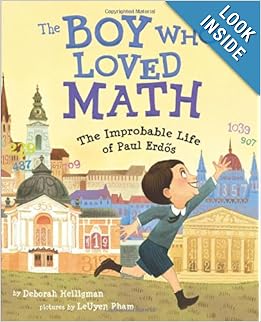
It’s likely that you’ve seen this book reviewed elsewhere. There has been a lot of buzz about it in the kid-lit world. And for good reason. The Boy Who Loved Math: The Improbable LIfe of Paul Erdos is a wonderful biography of a fascinating man. In case you’re ignorant like me, Paul Erdos was a Hungarian mathematician known for his work in number theory and for his eccentric personality.

Deborah Heligman strikes a perfect balance  in this book between the story of Erdos’ life and an explanation of the mathematical problems that so intrigued and consumed him.The main focus of the text is on the life of Erdos: from a childhood where he was kicked out of school for not following the rules; to his ability at the age of four to quickly tell a person how old they were in seconds once he knew their birthdate and time; to…

View original post 116 more words

MOOC: Udacity Online Free Course

tomcircle's avatarMath Online Tom Circle

https://www.udacity.com/courses#!/All

image

Read the review of MOOC challenges:

http://readwrite.com/2014/01/28/open-online-education-and-the-trend-towards-legitimacy#awesm=~ouoDz7h5ZAFTbR

The best MOOC (Massive Open Online Course) model will be free of exams / tests, only assignments / projects, forum discussions. 

The 2 current MOOC  – Coursera and Udacity –  are changing the ‘bottle’ (campus-based to online virtual campus),  but not the ‘wine’ (same old teaching methodology through quizzes, tests, exams, which are hated by students who are mostly working adults). 

A better example will be the Khan Academy by a MIT graduate Salman Khan teaching school kids in Math and Sciences. Bill Gates and Google founder sponsored him > $6 million. His successful model is “free +no exams“.

The Chinese sage Laozi 老子 said 3,000 years ago “Wu Wei(无为: Do something with no specific purpose) is actually “You Wei”(有为: With potential great achievement). Attending MOOC with no paper-chasing (and money making)…

View original post 86 more words

iPad Garden Problem

mathmindsblog's avatarMathMinds

The Garden Project:

Over the past couple of weeks, my 3rd graders have been working with our new set of iPads on a Garden Project. Since our school has put in learning gardens this year, I thought it would be an applicable project for them.

The premise of the problem: The school wanted to build a garden with the most space to plant our vegetables. Each group was given 18 feet of fencing (18 toothpicks) to use as their perimeter. They were to design each garden, record the dimensions, and take a picture to save in their photos. After they designed all possible rectangular gardens, they had to create a presentation in Numbers to show me which garden they wanted to build.

The instruction page looked like this (Since this was our first project, I put the app pic next to each direction to help them along the way):

2

I…

View original post 77 more words

Removing (“Unpacking”) Algebraic Terms from Parentheses

j rap's avatarMathChat

As you’re probably aware, I’m a big believer in using stories to bring math to life. Especially when you’re teaching tricky concepts, using a story can be the “magic switch” that flicks on the light of understanding. Armed with story-based understanding, students can recall how to perform difficult math processes. And since people naturally like stories and tend to recall them, skills based on story-based understanding really stick in the mind. I’ve seen this over and over in my tutoring.

Stories from My Tutoring Work

The kind of story I’m talking about uses an extended-metaphor, and this way of teaching  is particularly helpful when you’re teaching algebra. Ask yourself: what would you rather have? Students scratching their heads (or tearing out their hair) to grasp a process taught as a collection of abstract steps? Or students grasping  a story and quickly seeing how it guides them in doing the math? I think the answer is…

View original post 865 more words

Area and Perimeter of Squares – Student Noticings

mathmindsblog's avatarMathMinds

This will be a quick post because I have a student-posed math problem that I need some time to reason through!

Today, students found the area and perimeter of squares that increase in side length by one each time. Students used a variety of models when building their squares from Minecraft carpets, to Geoboards to graph paper. Here is the completed activity sheet from their work: IMG_3140I then gave them a few minutes to talk to their tablemates about things they notice in their work. Here are the answers they shared as a class and I recorded on the board:

“An even dimension by even dimension = an even area”

“An odd dimension by odd dimension = an odd area”

“The perimeter goes up by 4 every time the square gets bigger”

“The areas are square numbers.”

“The areas go up by odd skip counting: +3, +5, +7…”
I was…

View original post 322 more words

What it’s like to tutor math

j rap's avatarMathChat

Today I realized something about being a tutor.

A big part of it — maybe as much as half it — involves nothing more than  …   being nice.

By that I mean being kind.

By which I mean that if someone looks at you, as a young man did today, shaking his head and saying, “It’s crazy … I don’t know what 3 x 6 is,” I don’t laugh or chuckle or say anything remotely mean or mocking. Instead I just say, “It’s o.k. Look, I tutor people every day who don’t know what 3 x 6 is. Who cares, really? Let’s just try to figure it out … or use a calculator, as long as your teacher doesn’t mind.”

Really. That is a lot of what being a math tutor is about. Being nice. Really nice. Really understanding. And being there to be accepting of people no matter…

View original post 400 more words

Is the Universe Made of Math?

Source: http://www.scientificamerican.com/article.cfm?id=is-the-universe-made-of-math-excerpt


Our Mathematical Universe: My Quest for the Ultimate Nature of Reality

In this excerpt from his new book, Our Mathematical Universe, M.I.T. professor Max Tegmark explores the possibility that math does not just describe the universe, but makes the universe

By Max Tegmark

What’s the answer to the ultimate question of life, the universe, and everything? In Douglas Adams’ science-fiction spoof “The Hitchhiker’s Guide to the Galaxy”, the answer was found to be 42; the hardest part turned out to be finding the real question. I find it very appropriate that Douglas Adams joked about 42, because mathematics has played a striking role in our growing understanding of our Universe.

The Higgs Boson was predicted with the same tool as the planet Neptune and the radio wave: with mathematics. Galileo famously stated that our Universe is a “grand book” written in the language of mathematics. So why does our universe seem so mathematical, and what does it mean? In my new book “Our Mathematical Universe”, I argue that it means that our universe isn’t just described by math, but that it is math in the sense that we’re all parts of a giant mathematical object, which in turn is part of a multiverse so huge that it makes the other multiverses debated in recent years seem puny in comparison.

Math, math everywhere! But where’s all this math that we’re going on about? Isn’t math all about numbers? If you look around right now, you can probably spot a few numbers here and there, for example the page numbers in your latest copy of Scientific American, but these are just symbols invented and printed by people, so they can hardly be said to reflect our Universe being mathematical in any deep way.

Continue reading at: http://www.scientificamerican.com/article.cfm?id=is-the-universe-made-of-math-excerpt

The Clouds Part, and a Log Rule MAKES SENSE!

j rap's avatarMathChat

Have you ever been befuddled by the rules for logs?

More specifically, have you ever looked at this rule:

log (v w) = log v + log w

and thought: Now why in the world is that true?! What exactly is this saying? I know that I, myself, have had that thought. And for me the desire to understand this rule never went away. Till I got it some time ago.

[By the way, keep in mind that the v and the w in the parentheses are multiplying each other, so that v w actually means: v times w]

And the good news is: I think I can explain this rule in a way so that pretty much everyone who knows basic algebra can grasp it.

O.K., first, I knew that this log rule was related to another rule, the  exponent rule that says:

(a^b) x (a^c) = a^(b…

View original post 769 more words

Introduction to Cambridge IA Analysis I 2014

gowers's avatarGowers's Weblog

This term I shall be giving Cambridge’s course Analysis I, a standard first course in analysis, covering convergence, infinite sums, continuity, differentiation and integration. This post is aimed at people attending that course. I plan to write a few posts as I go along, in which I will attempt to provide further explanations of the new concepts that will be covered, as well as giving advice about how to solve routine problems in the area. (This advice will be heavily influenced by my experience in attempting to teach a computer, about which I have reported elsewhere on this blog.)

I cannot promise to follow the amazing example of Vicky Neale, my predecessor on this course, who posted after every single lecture. However, her posts are still available online, so in some ways you are better off than the people who took Analysis I last year, since you will have…

View original post 3,819 more words

A sporadic image resizing bug in WordPress LaTeX

Terence Tao's avatarWhat's new

I’m encountering a sporadic bug over the past few months with the way WordPress renders or displays its LaTeX images on this blog (and occasionally on other WordPress blogs).  On most computers, it seems to work fine, but on some computers, the sizes of images are occasionally way off, leading to extremely distorted and fairly unreadable versions of the images appearing in blog posts and comments.  A sample screenshot (with accompanying HTML source), supplied to me by a reader, can be found here (in which an image whose dimensions should be 321 x 59 are instead being displayed as 552 x 20).  Is anyone else encountering this issue?  The problem sometimes can be resolved by refreshing the page, but not always, so it is a bit unclear where the problem is coming from and how one might mitigate it.  (If nothing else, I can add it to the bug collection…

View original post 8 more words

The Smartest Notebook

Marko Pavlovic's avatarThe Mathist

The Leap Forward

We are very proud to present you the new MathistIt is a real sneak peak into the future, that allows you to easily solve and compute anything you write with a single click!

Here are some examples;

  • Simplify any expression to speed up problem solving,
  • Plot graphs,
  • Evaluate expressions and get approximate values,
  • Solve equations and inequalities (with visual representation),
  • Solve definite and indefinite integrals (with visual representation),
  • Crunch difficult logarithms,
  • Find derivatives and much more…

You can do all of this with just one button: solve-on

Why is this important?

Have you ever worked on a problem, that is easy to understand, but just requires too much number crunching?– So did we!

We understand that learning a million new things every day as a technology or a science student doesn’t leave too much time for crunching math. And yet in most cases you cannot solve…

View original post 49 more words

Get to know The Mathist – The official FAQ

Marko Pavlovic's avatarThe Mathist

What is The Mathist?

TheMathist is a very unique social math note taking application. It works on every device, and is free for everyone. You can finally focus on the math, not the software.

Do I have to know TeX or similar syntax?

There is no need to learn TeX or save the notes as pictures, they will always be available to you as regular online documents that you can edit anywhere and anytime. We have built a revolutionary simple math editor, a lot of hours went research on this. Go ahead and give it a try!

Why should I use The Mathist?

Because it is simple and straightforward to use, a true breeze… Because you already take all your notes in digital form and save them in the cloud. Because it is fast and works on all devices. It does not require any software knowledge to start, and…

View original post 174 more words

Math & Minecraft Day 1

Math & Minecraft

mathmindsblog's avatarMathMinds

After many days of discovering my HUGE learning curve with Minecraft, I am finally starting to feel relatively comfortable in Creative mode…I can build a house without flooding it, planted a few trees and I no longer have random blocks floating in the sky around my world!  My class has been staying with me during recess to teach me how to play and I am amazed at how fast and detail-oriented they are in their designs, such as putting lava rocks under the water blocks to form a hot tub and putting glass windows in their new greenhouses. I just kept thinking that I would love for them to use this same precision and perseverance in math class.

I must have Minecraft on the brain, because I as I was planning this weekend for the upcoming week (multiplying fractions w/arrays), all of the scenarios were about planting on an acre…

View original post 411 more words