In this excerpt from his new book, Our Mathematical Universe, M.I.T. professor Max Tegmark explores the possibility that math does not just describe the universe, but makes the universe
What’s the answer to the ultimate question of life, the universe, and everything? In Douglas Adams’ science-fiction spoof “The Hitchhiker’s Guide to the Galaxy”, the answer was found to be 42; the hardest part turned out to be finding the real question. I find it very appropriate that Douglas Adams joked about 42, because mathematics has played a striking role in our growing understanding of our Universe.
The Higgs Boson was predicted with the same tool as the planet Neptune and the radio wave: with mathematics. Galileo famously stated that our Universe is a “grand book” written in the language of mathematics. So why does our universe seem so mathematical, and what does it mean? In my new book “Our Mathematical Universe”, I argue that it means that our universe isn’t just described by math, but that it is math in the sense that we’re all parts of a giant mathematical object, which in turn is part of a multiverse so huge that it makes the other multiverses debated in recent years seem puny in comparison.
Math, math everywhere! But where’s all this math that we’re going on about? Isn’t math all about numbers? If you look around right now, you can probably spot a few numbers here and there, for example the page numbers in your latest copy of Scientific American, but these are just symbols invented and printed by people, so they can hardly be said to reflect our Universe being mathematical in any deep way.
Have you ever been befuddled by the rules for logs?
More specifically, have you ever looked at this rule:
log (v w) = log v + log w
and thought: Now why in the world is that true?! What exactly is this saying? I know that I, myself, have had that thought. And for me the desire to understand this rule never went away. Till I got it some time ago.
[By the way, keep in mind that the v and the w in the parentheses are multiplying each other, so that v w actually means: v times w]
And the good news is: I think I can explain this rule in a way so that pretty much everyone who knows basic algebra can grasp it.
O.K., first, I knew that this log rule was related to another rule, the exponent rule that says:
This term I shall be giving Cambridge’s course Analysis I, a standard first course in analysis, covering convergence, infinite sums, continuity, differentiation and integration. This post is aimed at people attending that course. I plan to write a few posts as I go along, in which I will attempt to provide further explanations of the new concepts that will be covered, as well as giving advice about how to solve routine problems in the area. (This advice will be heavily influenced by my experience in attempting to teach a computer, about which I have reported elsewhere on this blog.)
I cannot promise to follow the amazing example of Vicky Neale, my predecessor on this course, who posted after every single lecture. However, her posts are still available online, so in some ways you are better off than the people who took Analysis I last year, since you will have…
I’m encountering a sporadic bug over the past few months with the way WordPress renders or displays its LaTeX images on this blog (and occasionally on other WordPress blogs). On most computers, it seems to work fine, but on some computers, the sizes of images are occasionally way off, leading to extremely distorted and fairly unreadable versions of the images appearing in blog posts and comments. A sample screenshot (with accompanying HTML source), supplied to me by a reader, can be found here (in which an image whose dimensions should be 321 x 59 are instead being displayed as 552 x 20). Is anyone else encountering this issue? The problem sometimes can be resolved by refreshing the page, but not always, so it is a bit unclear where the problem is coming from and how one might mitigate it. (If nothing else, I can add it to the bug collection…
We are very proud to present you the new Mathist. It is a real sneak peak into the future, that allows you to easily solve and compute anything you write with a single click!
Here are some examples;
Simplify any expression to speed up problem solving,
Plot graphs,
Evaluate expressions and get approximate values,
Solve equations and inequalities (with visual representation),
Solve definite and indefinite integrals (with visual representation),
Crunch difficult logarithms,
Find derivatives and much more…
You can do all of this with just one button:
Why is this important?
Have you ever worked on a problem, that is easy to understand, but just requires too much number crunching?– So did we!
We understand that learning a million new things every day as a technology or a science student doesn’t leave too much time for crunching math. And yet in most cases you cannot solve…
TheMathist is a very unique social math note taking application. It works on every device, and is free for everyone. You can finally focus on the math, not the software.
Do I have to know TeX or similar syntax?
There is no need to learn TeX or save the notes as pictures, they will always be available to you as regular online documents that you can edit anywhere and anytime. We have built a revolutionary simple math editor, a lot of hours went research on this. Go ahead and give it a try!
Why should I use The Mathist?
Because it is simple and straightforward to use, a true breeze… Because you already take all your notes in digital form and save them in the cloud. Because it is fast and works on all devices. It does not require any software knowledge to start, and…
After many days of discovering my HUGE learning curve with Minecraft, I am finally starting to feel relatively comfortable in Creative mode…I can build a house without flooding it, planted a few trees and I no longer have random blocks floating in the sky around my world! My class has been staying with me during recess to teach me how to play and I am amazed at how fast and detail-oriented they are in their designs, such as putting lava rocks under the water blocks to form a hot tub and putting glass windows in their new greenhouses. I just kept thinking that I would love for them to use this same precision and perseverance in math class.
I must have Minecraft on the brain, because I as I was planning this weekend for the upcoming week (multiplying fractions w/arrays), all of the scenarios were about planting on an acre…
Synopsis: Some have seen philosophy embedded in episodes of The Simpsons; others have detected elements of psychology and religion. Simon Singh, bestselling author of Fermat’s Last Theorem, The Code Book and The Big Bang, instead makes the compelling case that what The Simpsons’ writers are most passionate about is mathematics. He reveals how the writers have drip-fed morsels of number theory into the series over the last twenty-five years; indeed, there are so many mathematical references in The Simpsons, and in its sister program, Futurama, that they could form the basis of an entire university course. Using specific episodes as jumping off points – from ‘Bart the Genius’ to ‘Treehouse of Horror VI’ – Simon Singh brings to life the most intriguing and meaningful mathematical concepts, ranging from pi and the paradox of infinity to the origins of numbers and the most profound outstanding problems that haunt…
Quote: “Math, art, English, science, history, sports, music, plumbing, dancing in the rain all have one thing in common: to do it well you need to practice, practice, practice.”
Math, art, English, science, history, sports, music, plumbing, dancing in the rain all have one thing in common: to do it well you need to practice, practice, practice.
Most people think that ‘cramming’ and ‘nap osmosis’ are the best ways to study. Just cause you sit at Starbucks or the library or go to tutoring for x hours a day does not equal success. Here are some tips:
Here is a website from MIT’s Center for Excellence on how best to study: http://web.mit.edu/uaap/learning/study/breaks.html. MIT, they know what they are talking about. If you don’t know, MIT is one of the top universities on Earth- perhaps even in the universe…
Hi, I am an ex-GEP student, who wish to share some tips about what books to read to prepare for GEP, or even for kids who are already in GEP. I strongly believe that IQ is not static, i.e. it is possible to increase IQ (to a certain extent of course) by reading books. (The Einstein Factor: A Proven New Method for Increasing Your Intelligence contains research that shows that IQ can be increased.)
The GEP test has 3 main sections: Logic, Math, English. This article will introduce books suitable for preparing for these 3 main sections.
Kids nowadays love electronic devices. However iPhone / iPad have too many games and thus are not ideal for educational purposes. The ideal electronic device is Amazon Kindle Ebook reader. Read more with Amazon!
WWW.QOO10.SG
I used to read a book by Mensa when I was a kid (just for interest, not for preparing for any tests), and found it to be interesting and challenging. The exact book is probably out of print already, but here are some bestsellers by Mensa on Amazon. Hope the recommendations are helpful! This list is not exhaustive, you may purchase other books you find on Amazon, they are equally likely to be as helpful.
GEP Logic Books
(Click on the image links to go to the Amazon.com page for more details)
These books are really helpful for the “Logic” part of the GEP selection test, which is not taught anywhere in the MOE syllabus and hence one of the most challenging to prepare for.
GEP Logic Sample Question
The above Logic Books are highly recommended by Amazon (4/5 stars and above)!
The following Puzzle Adventure books are also very useful for developing logical thinking and also English. Not to mention they are really fun to read for children. I have personally read the “2nd Puzzle Adventure Omnibus” book many times and enjoyed it very much. These kinds of books train both Logic and English skills.
Another good choice of books are encyclopedias. Although Encyclopedias like Britannica are almost extinct thanks to the internet, it is good to have a children’s Encyclopedia like The New Children’s Encyclopedia to have an all-round knowledge of the world and science.
Finally, you can check out the list of Recommended Math Books, which contains books useful for Math students.
Tips on How to Get Into GEP:
Based on my experience as a student, getting into GEP requires knowing and possessing skills more advanced than the age group. I.e., at the age of 9 (Primary 3), the student who gets into GEP is probably already at the level of Primary 4 and above in terms of Math and English. True genius is neither necessary nor sufficient to get into GEP, and it is not true that GEP students are smarter than others. There is a famous IMO World Number 1 in Singapore who wasn’t from the GEP. IMO (International Math Olympiad) is definitely harder than GEP Math. One can read this book 104 Number Theory Problems: From the Training of the USA IMO Team to get an idea of the IMO (International Math Olympiad).
To be honest, it is probably currently harder to get into GEP now than in the past (1990s). During my time, a Primary 6 student who knows the Gauss trick for adding a sum of an arithmetic progression (1+2+3+…+99+100) is really at the top of his/her cohort. During the 2000 PSLE, this question came out and few people could solve it. Nowadays (2015), an average Primary 3 student would know and be familiar with this technique. Hence the bar is set much higher nowadays. Math Olympiad is the way to go to get one’s Math skills honed at the highest level.
Singapore (and Asian in general) students are very academically smart. Even the average Singapore student is likely to be 2 to 3 years ahead of their American/UK/Australian counterparts in terms of Math and Science. And to get in the GEP, it is common sense that one has to perform better than the average Singapore student in the GEP selection test at least. Hence, it is not an easy task. However, one weakness of Singaporean students is that they are not a big fan of reading, to the extent that even Borders bookstore (and others) can close down in Singapore. Hence, if your child even read a few extra books you have an advantage over the rest. Check out this book by Moshe Kai Cavelin, a truly gifted kid who entered college at 8.
Ideally, only students who are genuinely interested in learning should be prepped for GEP. As the Chinese proverb 拔苗助长 tells us, there is no point pushing a child artificially beyond what he/she wishes to learn. But for those children who have curiosity to learn, books like Match Wits With Mensa: The Complete Quiz Book will be a good brainteaser for them. If one is looking for books to help prepare for GEP, the average assessment books sold in bookstores would not be of much help since they are catered to the mass market, not gifted children.
Amazon actually has a long list of books for gifted children and their parents: Books for Gifted Children. Gifted children are like raw unpolished diamonds. As the Chinese proverb 玉不琢,不成器 goes, even jade needs to be polished and cut before it can become a piece of jewellery, hence even gifted children need guidance to unlock their full potential. There is no single book that after reading it can get into the GEP. The GEP tests for a wide range of knowledge in the Math and English subjects and hence students need to read widely to acquire a broad spectrum of knowledge.
The above 3 GEP English Literature books are fun to read, and contain a lot of useful and advanced vocabulary and idioms. It is a good idea to read these books to get a hang of what GEP English is about (very different from normal mainstream English). One important technique to improve English by reading is to highlight any new words, and then record it in a notebook, followed by copying down the dictionary definition. From time to time, revise the notebook to refresh your memory. Soon, as the notebook grows, so will your vocabulary.
Remember to use the above technique of using the dictionary and recording in a notebook; simply skimming and flipping the pages is not likely to improve English! As Singapore follows British English, it is important to get a British English dictionary like Paperback Oxford English Dictionary. Try not to use Webster / Google as those are American English, which can be quite different.
Gifted students have the potential to learn material earlier and faster, to handle more complexity and abstraction, and to solve complex problems better. This potential, however, needs stimulating experiences from home and school or it will not unfold. These books are designed to help teachers provide the stimulating curricula that will nurture this potential in school. The units presented in this series are based on research into how these students actually think differently from their peers and how they use their learning styles and potential not merely to develop intellectual expertise, but to move beyond expertise to the production of new ideas.
The Math book includes units that ask students to develop a financial portfolio that includes high- and low-risk stocks, options and margins, AAA and junk bonds, mutual funds, and money markets; use math, science, engineering, technology, and art to design and build a miniature golf course; develop games based on probability; and run a real-life small business.
Grades 6–8
GEP Psychology Book
Mindset is the key to success. I highly recommend this book Mindset: The New Psychology of Success to students and parents. A psychologist has written this book, and it has many new insights. For instance, praising your child “intelligence and ability doesn’t foster self-esteem and lead to accomplishment, but may actually jeopardize success.” This is new psychological research supported by evidence. The correct way is actually to praise the child’s effort. Find out more tips and stories by reading this book.
Rubik’s Cube (Dayan Zhanchi)
For parents, buying a Rubik’s cube for your child is a great investment. Playing with the Rubik’s cube is a major intellectual challenge (it has 43 quintillion permutations, only 1 of which is correct), which will develop the child’s brain for logical thinking, which is especially useful for Math and Science. Most importantly, it is fun!
Special note for buying Dayan Zhanchi from Singapore:
If you are buying the Dayan Zhanchi from Singapore, at first it seems like the Dayan ZhanChi does not ship to Singapore. It actually does! We just have to choose the correct seller, Cube Puzl, which ships to Singapore.
Even though the GEP Screening/Selection Test does not test science, it is a good idea to get acquainted with science from a young age since the Sciences (Chemistry, Physics, Biology) form the bulk of the Singapore education system from upper primary school onwards till university. For example in Junior College, 3 out of 4 subjects will be sciences, for those in the Science Stream.
As you may already know, Danica McKellar, the actress and UCLA mathematics alumnus, has recently launched her book “Math Doesn’t Suck“, which is aimed at pre-teenage girls and is a friendly introduction to middle-school mathematics, such as the arithmetic of fractions. The book has received quite a bit of publicity, most of it rather favourable, and is selling quite well; at one point, it even made the Amazon top 20 bestseller list, which is a remarkable achievement for a mathematics book. (The current Amazon rank can be viewed in the product details of the Amazon page for this book.)
I’m very happy that the book is successful for a number of reasons. Firstly, I got to know Danica for a few months (she took my Introduction to Topology class way back in 1997, and in fact was the second-best student there; the class web…
Firstly, apologies for the long gap. Very far from being Theorem of the Week, I know. Here’s another theorem for now, and I’ll do what I can to revert to a weekly post.
So, to this week’s theorem. I have previously promised to write about Fermat‘s Little Theorem, and I think it’s time to keep that promise. In that post (Theorem 10, about Lagrange’s theorem in group theory), I introduced the theorem, so I’m going to state it straightaway. If you haven’t seen the statement before, I suggest you look back at that post to see an example.
Theorem (Fermat’s Little Theorem) Let $latex p$ be a prime, and let $latex a$ be an integer not divisible by $latex p$. Then $latex a^{p-1} \equiv 1\mod{p}$.
If you aren’t comfortable with the notation of modular arithmetic, you might like to phrase the conclusion of the theorem as saying that $latex…
Senior Wrangler is the First position in the Math Tripos in Cambridge. Singapore Prime Minister Lee Hsien Loong was the Senior Wrangler in 1973, the first Singaporean student with such great honors, among other senior wranglers like Arthur Cayley (Group Theory), J.J. Sylvester (Inventor of Matrix, private tuitor of the “inventor of Nursing” Florence Nightingale), J.E. Littlewood (partnered in a twin research team with G.H. Hardy), Frank Ramsey (Ramsey’s Theorem), Stokes, Pell, etc.
Some great mathematicians like Bertrand Russell (Logician, Nobel Litterature Prize) , G.H. Hardy (20th century greatest Pure Mathematician, mentored 2 geniuses: Indian Ramanujian and Chinese Hua Luogeng 华罗庚*) were not Senior Wrangler. Prof Hardy hated Math Tripos syllabus (revealed in his autobiography: “A Mathematician’s Apology“).
1914 Brian Charles Molony
1923 Frank Ramsey
1928 Donald Coxeter
1930 Jacob Bronowski
1939 James Wilkinson
1940 Hermann Bondi
1952 John Polkinghorne
1953 Crispin Nash-Williams
1959 Jayant Narlikar 1970 Derek…
Attached below are the Formula Lists for E Maths and A Maths (O Level)
Do be familiar with all the formulas for Elementary Maths and Additional Maths inside, so that you know where to find it when needed!
Wishing everyone reading this all the best for their exams. 🙂
Synopsis: ‘I have a truly marvellous demonstration of this proposition which this margin is too narrow to contain.’
It was with these words, written in the 1630s, that Pierre de Fermat intrigued and infuriated the mathematics community. For over 350 years, proving Fermat’s Last Theorem was the most notorious unsolved mathematical problem, a puzzle whose basics most children could grasp but whose solution eluded the greatest minds in the world. In 1993, after years of secret toil, Englishman Andrew Wiles announced to an astounded audience that he had cracked Fermat’s Last Theorem. He had no idea of the nightmare that lay ahead.
In ‘Fermat’s Last Theorem’ Simon Singh has crafted a remarkable tale of intellectual endeavour spanning three centuries, and a moving testament to the obsession, sacrifice and extraordinary determination of Andrew Wiles: one man against all the odds.
First Published: 1997, Reissued: 2002| ISBN-13: 978-1841157917
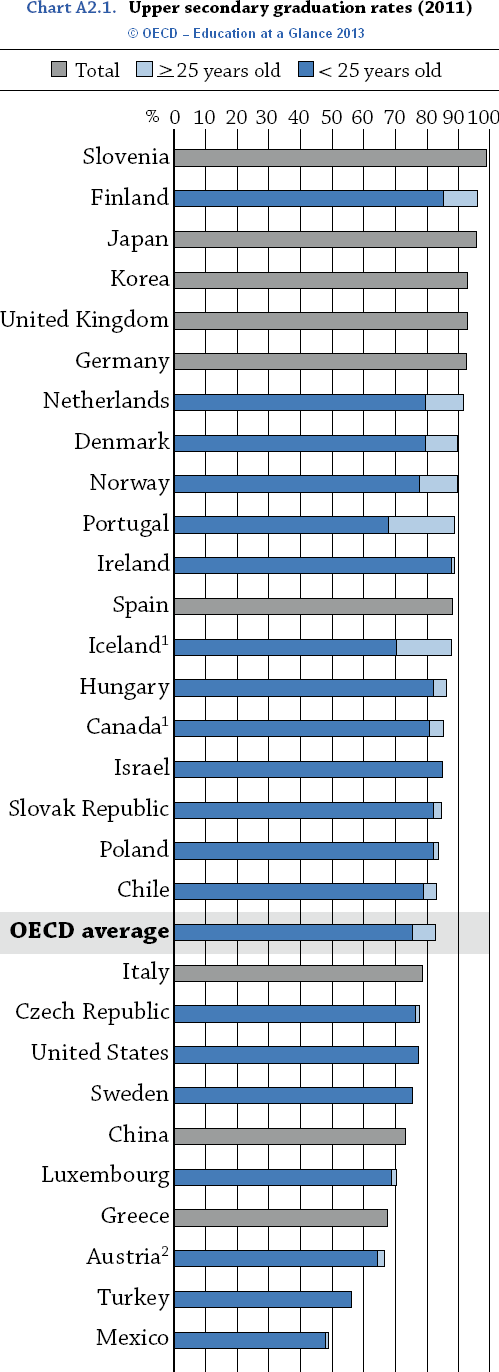
Countries which belong to the Organization for Economic Cooperation and Development (OECD) produce two-thirds of the world’s goods and services. The organization publishes reports on economic and social factors in the member states. School performance league tables are presented in the OECD report, Education at a Glance. It includes comparison tables of educational performance, class sizes, teachers’ salaries, tertiary education and more. The report can be downloaded as a PDF document.
Chart A2·1 [ page 42] ranks countries, in descending order, according to the percentage of adults who have completed an upper secondary education (the most recent data in the 2013 report is from 2011).
Chart A1·2 footnotes:
1. Year of reference 2010.
2. Some programmes not included. *China has a large rural / urban disparity in its education system.
Singapore Math emphasizes the development of strong number sense, excellent mental-math skills, and a deep understanding of place value.
The curriculum is based on a progression from concrete experience—using manipulatives—to a pictorial stage and finally to the abstract level or algorithm. This sequence gives students a solid understanding of basic mathematical concepts and relationships before they start working at the abstract level.
Singapore Math includes a strong emphasis on model drawing, a visual approach to solving word problems that helps students organize information and solve problems in a step-by-step manner.
Concepts are taught to mastery, then later revisited but not re-taught. It is said the U.S. curriculum is a mile wide and an inch deep, whereas Singapore’s math curriculum is said to be just the opposite.
The Singapore approach focuses on developing students who are problem solvers.
I suppose every reader of this ‘ere blog will know Heron’s formula for the area $latex K$ of a triangle with sides $latex a,b,c$:
$latex K = \sqrt{s(s-a)(s-b)(s-c)}$
where $latex s$ is the “semi-perimeter”:
$latex \displaystyle{s=\frac{a+b+c}{2}.}$
The formula is not at all hard to prove: see the Wikipedia page for two elementary proofs.
However, I have only recently become aware of Brahmagupta’s formula for the area of a cyclic quadrilateral. A cyclic quadrilateral, if you didn’t know, is a (convex) quadrilateral all of whose points lie on a circle:
And if the edges have lengths $latex a,b,c,d$ as shown, then the formula states that the area is given by
$latex K = \sqrt{(s-a)(s-b)(s-c)(s-d)}$
where as above $latex s$ is the semi-perimeter:
$latex \displaystyle{s=\frac{a+b+c+d}{2}.}$
This can be seen to be a generalization of Heron’s formula. Although the formula is named for Brahmagupta (598 – 670), who does indeed seem to…
Recently, in The Conversation, the Vice Chancellor of Monash University, wrote an article discussing MOOCs. He made some criticisms about the nature of assessment and grading that MOOCs offer. However, my attention was grabbed by two sentences:
The other major problem the MOOCs haven’t solved is assessment. They work very well for subjects like maths, which have objectively right and wrong answers, and can therefore be pretty easily marked by computers.
Now, here we have the Vice Chancellor of one of Australia’s leading universities – and indeed, one of the world’s leading universities (and incidently the University where I did both my Masters and my PhD) demonstrating an extraordinary lack of understanding about the fundamental nature of mathematics. He seems to think that mathematics is all about teaching students (in the fine words of John Power from Leeds University) about “finding ‘x'”. I suppose he thinks this…
WordPress.com supports LaTeX, a document markup language for the TeX typesetting system, which is used widely in academia as a way to format mathematical formulas and equations. LaTeX makes it easier for math and computer science bloggers and other academics in our community to publish their work and write about topics they care about.
If you’re a math genius — many of you are! — and you’ve blogged about equations you’ve worked on, you’ve probably used LaTeX before. If you’re just starting out (or simply curious to see how it all works), we’ve gathered a few examples of great math and computing blogs on WordPress.com that will inspire you.
In general, to display formulas and equations, you place LaTeX code in between $latex and $, like this:
$latex YOUR LATEX CODE HERE$
So for example, inserting this when you’re creating a post . . .
$latex \displaystyle
\left(\frac{3411}{3457} \right)=
\left(\frac{9}{3457} \right).\left(\frac{379}{3457} \right)=
\left(\frac{379}{3457} \right)
$
since
$latex \displaystyle\left(\frac{9}{3457} \right)=1 $
because 9 is a perfect square, 3457 is prime.
2. By Quadratic Reciprocity,
$latex \displaystyle
\boxed{
\text{If p or q or both are } \equiv 1 \mod 4 \implies
\left(\frac{p}{q} \right)=
\left(\frac{q}{p} \right)}
$
The famous Singapore Math for children in primary schools is based on visual models.
The Singapore Ministry of Education has published a new 2013 Math syllabus for primary and secondary schools, which will roll out in examinations within 4 to 6 years. Todate only Primary 1 and Secondary 1 Math syllabuses are published here:
This comic video illustrates Singapore Math’s Arithmetics Polya-style problem solving process vs Algebra’s mechanical method.
The problem is as follow:
R is 3 times older than S two years ago. From now 2 years later, their total age is 32. How old is R now ?
See my previous blog (search “Monkey”) the Nobel Physicist Paul Dirac’s problem “The Monkeys and Coconuts“, 3 methods are used: 2 adanced modern math (by Sequence, eigenvector & eigenvalue), and the easiest & intuitive method (by Singapore Modelling Math). High-school Algebra method is impossible, if not cumbersome, to solve the Monkey problem !
I find Khan Linear Algebra video excellent. The founder / teacher Sal Khan has the genius to explain this not-so-easy topic in modular videos steps by steps, from 2-dimensional vectors to 3-dimensional, working with you by hand to compute eigenvalues and eigenvectors, and show you what they mean in graphic views.
If you are taking Linear Algebra course in university, or revising it, just go through all the Khan’s short (5-20 mins) videos on Linear Algebra here:
Prof Su 苏步青, the founding pioneer Math professor of the China’s top universities (Zhejiang 浙江大学 and Fudan 复旦大学), was one of the few mathematicians who had longevity above 100 years old (the other was French Mathematician Hadammard).
Two men A and B are 100 km apart, walking towards each other, A at speed 6 km/hour and B at 4 km/hour.
A brings a dog which runs at 10 km/hour between them, starting from A towards B, upon reaching B it runs back to reach A, then back to B again, and so on…
Find total distance the dog has covered when A and B finally meet ?
[Note: the content of this post is standard number theoretic material that can be found in many textbooks (I am relying principally here on Iwaniec and Kowalski); I am not claiming any new progress on any version of the Riemann hypothesis here, but am simply arranging existing facts together.]
The Riemann hypothesis is arguably the most important and famous unsolved problem in number theory. It is usually phrased in terms of the Riemann zeta function $latex {\zeta}&fg=000000$, defined by
for $latex {\hbox{Re}(s)>1}&fg=000000$ and extended meromorphically to other values of $latex {s}&fg=000000$, and asserts that the only zeroes of $latex {\zeta}&fg=000000$ in the critical strip $latex {\{ s: 0 \leq \hbox{Re}(s) \leq 1 \}}&fg=000000$ lie on the critical line $latex {\{ s: \hbox{Re}(s)=\frac{1}{2} \}}&fg=000000$.
One of the main reasons that the Riemann hypothesis is so important to number theory is that the zeroes of…
A collection of excellent free resources for demonstrating the various circle theorems: Tim Devereux has created GeoGebra applets which allow exploration of the circle theorems. You can access each theorem from the menu on the left which includes a useful summary of all the theorems.
I have read various ‘Top (insert number here) Mathematics Websites’ posts and all of them have left me with the thought that so many excellent sites are missing from such lists. Any post claiming top 10 or >10 in my case is clearly the author’s top 10, notthe top 10! These are my top >10 because I really do use them – a lot – in the classroom! For my own list, I have decided to include some categories as well as individual sites which gives me the excuse to mention far more than 10! Note that every site mentioned here is free to use.
A quick quiz: which of the following four words doesn’t fit with the others??
Massive/Open/Online/Courses
We are going to muse about MOOCs today, a hot and highly debated topic in higher education circles. Are these ambitious new approaches to delivering free high quality education through online videos and interactive participation over the web going to put traditional universities out of business, or are they just one in a long historical line of hyped technologies that get everyone excited, and then fail to deliver the goods? (Think of the radio, TV, correspondence courses, movies, the tape recorder, the computer; all of which held out some promise for getting us to learn more and learn better, mostly to little avail, although the jury is still out on the computer.)
It’s fun to speculate on future trends, because of the potential—indeed likelihood—0f embarrassment for false predictions. Here is the summary of my argument today:…
As you can see from the picture, it was a packed house! After waiting in line for fifteen minutes, I was so lucky (and excited) to get a seat to hear Jo Boaler speak, even if my seat was in the next to last row.
Jo opened the presentation with Dweck’s research on mindsets. “In the fixed mindset, people believe that their talents and abilities are fixed traits. They have a certain amount and that’s that; nothing can be done to change it. In the growth mindset, people believe that their talents and abilities can be developed through passion, education, and persistence.”
Jo states that the fixed mindset contributes to one of the biggest myths in mathematics: being good at math is a gift. She referenced her book, The Elephant in the Classroom (added it to my reading list) and showed the audience various television/movie clips that continue to perpetuate…
The information about Tables and how to generate a table is on page 121.
Generating tables is useful to solve some questions in sequences and series, and also probability. It makes guess and check questions much faster to solve.
Last week a friend who is a fourth grade teacher came to me with a math problem. The father of one of his students had showed him a trick for checking the result of a three-digit multiplication problem. The father had learned the trick as a student himself, but he didn’t know why it worked. My friend showed me the trick and asked if I had seen it before. This post describes this check and explains why it works.
Suppose you want to multiply 231 $latex \times $ 243. Working it out by hand, you get 56133. Add the digits in the answer (5+6+1+3+3) to get 18. Add the digits again to get 9. Stop now that you have a single digit.
Alternatively, do this digit adding beforehand. Adding the digits of 231 together, we get 6. Adding the digits of 243 together, we get 9. Multiply 6 $latex \times$ 9…
Having a blog gives me a chance to defend myself against a number of people who took issue with a passage in Mathematics, A Very Short Introduction, where I made the tentative suggestion that an abstract approach to mathematics could sometimes be better, pedagogically speaking, than a concrete one — even at school level. This was part of a general discussion about why many people come to hate mathematics.
The example I chose was logarithms and exponentials. The traditional method of teaching them, I would suggest, is to explain what they mean and then derive their properties from this basic meaning. So, for example, to justify the rule that xa+b=xaxb one would say something like that if you have a xs followed by b xs and you multiply them all together then you are multiplying a+b xs all together.
Today I had an experience that I have had many times before, and so, I imagine, has almost everybody (at least if they are old enough to be the kind of person who might conceivably read this blog post). I was in a queue in a chemist (=pharmacy=drugstore), and I knew that my particular item would be quick and easy to deal with. But I had to wait a while because in front of me was someone who had an item that was much more complicated and time-consuming. In this instance the complexity of the items was not due to their sizes, but a more common occurrence of the phenomenon is something that often happens to me in a local grocery: I want to buy just a pint of milk, say, and I find myself behind somebody who has a big basket of things, several of which have to be…
Now that the project to upgrade my old multiple choice applet to a more modern and collaborative format is underway (see this server-side demo and this javascript/wiki demo, as well as the discussion here), I thought it would be a good time to collect my own personal opinions and thoughts regarding how multiple choice quizzes are currently used in teaching mathematics, and on the potential ways they could be used in the future. The short version of my opinions is that multiple choice quizzes have significant limitations when used in the traditional classroom setting, but have a lot of interesting and underexplored potential when used as a self-assessment tool.
Using the model , estimate the total fertility rate for a particular country Z when its GDP per capita is USD$1000, giving your answer to 1 decimal place and comment on the reliability of the estimate.
First, we need to remove the outlier (40,6.6) as mentioned in part iii.
Then, performing linear regression with GC, (with variables , ), we get:
Substituting , we get (1 d.p.)
Since we cannot have a negative fertility rate (the average number of children that would be born to a woman ), the estimate obtained for is not reliable.
I’m in the happy state of just having finished marking exams for this year. There is very little of interest to say about the week that was removed from my life: it would be fun to talk about particularly bizarre mistakes, but I can’t really do that, especially as the results are not yet known (or even fully decided). However, one general theme emerged that made no difference to anybody’s marks. There seems to be a common misconception amongst many Cambridge undergraduates that I’d like to discuss here in the hope that I can clear things up for a few people. (It is an issue that I have discussed already on my web page, but rather than turning that into a blog post I’m starting again.)
The question where the misconception made itself felt was one about functions, injections, surjections, etc. I noticed that a lot of people wrote things…
I’ve received quite a lot of inquiries regarding a recent article in the New York Times, so I am borrowing some space on this blog to respond to some of the more common of these, and also to initiate a discussion on maths education, which was briefly touched upon in the article.
I don’t have any specific advice regarding gifted education, though some articles on my own experiences can be found here. I do however have some thoughts on career advice at the undergraduate level and beyond.
I have some responses to several other common queries (e.g. regarding books…
As the previous discussion on displaying mathematics on the web has become quite lengthy, I am opening a fresh post to continue the topic. I’m leaving the previous thread open for those who wish to respond directly to some specific comments in that thread, but otherwise it would be preferable to start afresh on this thread to make it easier to follow the discussion.



 contains research that shows that IQ can be increased.)
 page for more details)


 to have an all-round knowledge of the world and science.

 to get an idea of the IMO (International Math Olympiad).


 (Past Official P4 GEP Literature Book)
 (P5 GEP Literature Book)
 (P6 GEP Literature Book)


 . Try not to use Webster / Google as those are American English, which can be quite different.


 to students and parents. A psychologist has written this book, and it has many new insights. For instance, praising your child “intelligence and ability doesn’t foster self-esteem and lead to accomplishment, but may actually jeopardize success.” This is new psychological research supported by evidence. The correct way is actually to praise the child’s effort. Find out more tips and stories by reading this book.







 , in descending powers of
  , the seventh term is independent of
  and the value of this term.
 since it is the seventh term (recall
  )
) (independent of

 (Ans)
(Ans)




 is
is




 (from part ii)



 , estimate the total fertility rate for a particular country Z when its GDP per capita is USD$1000, giving your answer to 1 decimal place and comment on the reliability of the estimate.
 ,
,  ), we get:

 , we get
  (1 d.p.)


