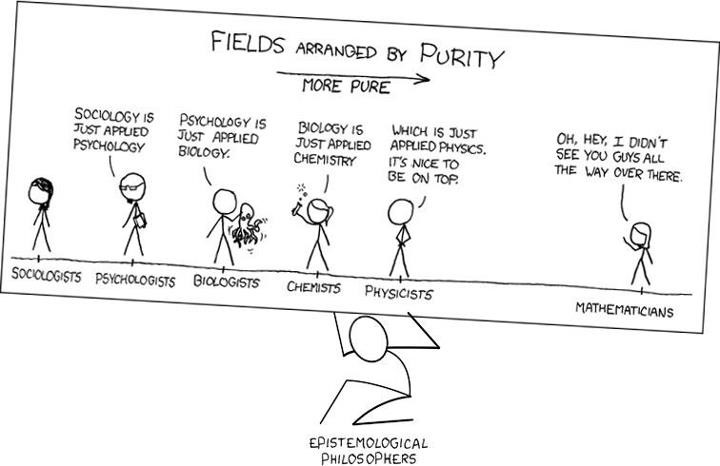
Math Joke (Fields Arranged by Purity)

Click here for free Career Quiz: https://career-test.com/s/sgamb?reid=210


I came across this joke on another blog: http://phdlife.warwick.ac.uk/

Quite true! A Math student will understand this at the university level and beyond, where Math has no more numbers and is full of symbols and jargon! Although even the most abstract Math has applications, the applications are only discovered years later, hence Pure Math is indeed one of the most pure subjects around.

math joke

Fail H2 Maths Promos or Prelims

For H2 (or H1) Maths students who are getting low marks for internal school exams, do not be overly discouraged. The current trend for schools is to set very tough internal exams (i.e. Promos and Prelims) to spur students to study hard, and (hopefully) ace the eventual final A level exams. If you look at the actual A Level Ten Year Series, you will find that the standard of questions is much easier than Prelim level.

A rule of thumb is that the eventual A level grade is 2 grades above the internal school grade. E.g., in internal exams a student getting D for H2 Maths is most likely equivalent to a B in the final A levels, provided the student continues to study hard.

Jumping from E to A grade has been done by many seniors. Do not give up, continue to believe in yourself, and keep calm while constantly revising.

Do check out this highly condensed H2 Math Notes (comes with free exam papers). The key thing to do before exams is to remember Math formulas (many students forget the AP/GP formulae for instance, and lost some free marks). Constant practice and exposure to questions is also a must.

Here are some sources of true stories:

1) https://www.facebook.com/RJConfessions/posts/220752441406251

To all the J1 and J2 kids who are struggling with math, let me share with you my personal experience. I took H2 math by the way, and refused to drop to H1 when people started dropping.

J1 CT 1: Math: U
J1 promos: Math: S
J2 CT1: Math S
J2 CT2: Math S
J2 Prelims: Math E
A levels: Math A.

The moral of the story is simple: It can be done. My math teacher used to motivate us with stories of seniors who have also flunked their way through math in the 2 years and clinched an A at the end. I didnt really believed it could happen, but I guess I chose to believe it anyways.

2) https://www.reddit.com/r/singapore/comments/3nkq4t/jc_prelims_alevels_correlation/

H2 Math: E A

H2 Chem: D B

H2 Econs: D D

H1 Physics: U A

H1 GP: B A

The grades on the left were prelims and right were my actual results. Of course it depends on your school and how hard they set the prelim papers

Fermat’s Two Squares Theorem (Gaussian Integers approach)

Today we will discuss Fermat’s Two Squares Theorem using the approach of Gaussian Integers, the set of numbers of the form a+bi, where a, b are integers. This theorem is also called Fermat’s Christmas Theorem, presumably because it is proven during Christmas.

Have you ever wondered why 5=1^2+2^2, 13=2^2+3^2 can be expressed as a sum of two squares, while not every prime can be? This is no coincidence, as we will learn from the theorem below.

Theorem: An odd prime p is the sum of two squares, i.e. p=a^2+b^2 where a, b are integers if and only if p\equiv 1 \pmod 4.

(=>) The forward direction is the easier one. Note that a^2\equiv 0\pmod 4 if a is even, and a^2\equiv 1\pmod 4 if a is odd. Similar for b. Hence p=a^2+b^2 can only be congruent to 0, 1 or 2 (mod 4). Since p is odd, this means p\equiv 1\pmod 4.

(<=) Conversely, assume p\equiv 1\pmod 4, where p is a prime. p=4k+1 for some integer k.

First we prove a lemma called Lagrange’s Lemma: If p\equiv 1\pmod 4 is prime, then p\mid (n^2+1) for some integer n.

Proof: By Wilson’s Theorem, (p-1)!=(4k)!\equiv -1\pmod p. (4k)!\equiv [(2k)!]^2\equiv -1\pmod p. We may see this by observing that 4k\equiv p-1\equiv -1\pmod p, 4k-1\equiv -2\pmod p, …, 4k-(2k-1)=2k+1\equiv -2k\pmod p. Thus [(2k)!]^2+1\equiv 0\pmod p and hence p\mid n^2+1, where n=(2k)!.

Then p\mid (n+i)(n-i). However p\nmid (n+i) since p\nmid n=(2k)!. Similarly, p\nmid (n-i). Therefore p is not a Gaussian prime, and it is thus not irreducible.

p=\alpha\beta with N(\alpha)>1 and N(\beta)>1. N(p)=N(\alpha)N(\beta), which means p^2=N(\alpha)N(\beta). Thus we may conclude N(\alpha)=p, N(\beta)=p.

Let \alpha=a+bi. Then p=a^2+b^2 and we are done.

This proof is pretty amazing, and shows the connection between number theory and ring theory.

Abstract Algebra 抽象代数 (石生明教授)

tomcircle's avatarMath Online Tom Circle

这位石教授的”抽象代数”很棒, 一来是他退休前的最后一课, 二来他总结为何老师教不好, 学生上完课好像听到3个大头”鬼” (群group, 环ring, 域field), 但没实际摸过。

他的第一和第二课很好, 与众不同的花时间讲 “动机”: Motivation – Why study Abstract Algebra ?

抽象代数01: Motivation

https://youtu.be/AGd1TZ-IKr0

抽象代数02: 复数扩域 C
$latex
x^{2} +1=0
$

扩域 (Extended Field)数学思维 = 人解决问题的思维
例: 国内不可行的问题, 跳出国门, 扩大到世界领域, 就找到可行的方法。
马云的Alibaba国内不看好, 跑去美国上市, 让他马上成为中国首富的亿万富翁。

View original post

张益唐: 速食店员竟然是数学天才

tomcircle's avatarMath Online Tom Circle

【台湾壹週刊】

速食店员竟然是数学天才

张益唐 (1955 – ) : 北京大学 – 美国数学博士。因为执着数学理论的真理, 得罪美国大学台湾籍论文教授, 毕业后找不到大学教职, 在朋友的 Subway 速食店做会计8年, 潜心业余思考世界数学大难题: Twin Primes Gap, 终于攻破。

他的下一个目标是Riemann Hypothesis, 困扰数学家百年的难题: “素数 (Prime numbers)的分布”都集中在 Zeta function complex plane的 实轴(real = 1/2) 上。大数学家David Hilbert说如果五百年后复活, 第一件事会急着问 “Riemann Hypothesis” 证明了吗?

View original post

James H. Simons,  the mathematician who cracked Wallstreet

tomcircle's avatarMath Online Tom Circle

James H. Simons,  the Jewish mathematician who made $14 billion using Math modelling for Hedge Fund.

[Watch from 31:00 mins to 35 mins].  He told the Nobel Physicist Frank Yang (杨振宁) that the Math “Gauge Theory on Fiber Bundles(纤维丛)” which Yang was developing already existed 30 yrs ago in “Differential Geometry” by SS Chern (陈省身) from Berkeley.

“James H. Simons: Mathematics, Common Sense and Good Luck”

[Video 54:00 mins]
After being billionaire, at old age Simons went back to Math in 2004 to take refuge of sadness of the loss of a son.
He beat the German mathematicians in Differential Co-homology (Topology).

5 Guiding Principles of Success:
1) Don’t run with the pack – be original
2) Choose wonderful partner(s) in research, business…
3) Guided by Beauty
4) Don’t give up !
5) Have good luck.

Jim Simons | TED Talks
“A Rare Interview with the Mathematician Who…

View original post 3 more words

245A, Notes 4: Modes of convergence

Terence Tao's avatarWhat's new

If one has a sequence $latex {x_1, x_2, x_3, ldots in {bf R}}&fg=000000$ of real numbers $latex {x_n}&fg=000000$, it is unambiguous what it means for that sequence to converge to a limit $latex {x in {bf R}}&fg=000000$: it means that for every $latex {epsilon > 0}&fg=000000$, there exists an $latex {N}&fg=000000$ such that $latex {|x_n-x| leq epsilon}&fg=000000$ for all $latex {n > N}&fg=000000$. Similarly for a sequence $latex {z_1, z_2, z_3, ldots in {bf C}}&fg=000000$ of complex numbers $latex {z_n}&fg=000000$ converging to a limit $latex {z in {bf C}}&fg=000000$.

More generally, if one has a sequence $latex {v_1, v_2, v_3, ldots}&fg=000000$ of $latex {d}&fg=000000$-dimensional vectors $latex {v_n}&fg=000000$ in a real vector space $latex {{bf R}^d}&fg=000000$ or complex vector space $latex {{bf C}^d}&fg=000000$, it is also unambiguous what it means for that sequence to converge to a limit $latex {v in {bf R}^d}&fg=000000$ or $latex {v in {bf C}^d}&fg=000000$; it means…

View original post 6,079 more words

Measure that is absolutely continuous with respect to mu

Interesting Career Personality Test (Free): https://mathtuition88.com/free-career-quiz/


Let (X,\mathcal{M},\mu) be a measure space, and let f:X\to [0,\infty] be a measurable function. Define the map \lambda:\mathcal{M}\to[0,\infty], \lambda(E):=\int_X \chi_E f d\mu, where \chi_E denotes the characteristic function of E.

(a) Show that \lambda is a measure and that it is absolutely continuous with respect to \mu.

(b) Show that for any measurable function g:X\to[0,\infty], one has \int_X g d\lambda=\int_X gf d\mu in [0,\infty].

Proof: For part (a), we routinely check that \lambda is indeed a measure.

\lambda(\emptyset)=\int_X \chi_\emptyset f d\mu=\int_X 0 d\mu=0. Let E_i be mutually disjoiint measurable sets.

\begin{aligned}    \lambda(\cup_{i=1}^\infty E_i)&=\int_X \chi_{\cup_{i=1}^\infty E_i} f d\mu\\    &=\int_X (\sum_{i=1}^\infty \chi_{E_i}) f d\mu\\    &=\sum_{i=1}^\infty \int_X \chi_{E_i} f d\mu\\    &=\sum_{i=1}^\infty \lambda (E_i)    \end{aligned}

If \mu (E)=0, then \chi_{E} f=0 a.e., thus \lambda (E)=0. Therefore \lambda\ll\mu.

(b) We note that when g is a characteristic function, i.e. g=\chi_E,

\begin{aligned}    \int_X g d\lambda&=\int_X \chi_E d\lambda\\    &=\lambda (E)\\    &=\int_X \chi_E f d\mu\\    &=\int_X gf d\mu    \end{aligned}

Hence the equation holds. By linearity, we can see that the equation holds for all simple functions. Let (\psi_n) be a sequence of simple functions such that \psi_n\uparrow g. Then by the Monotone Convergence Theorem, \lim_{n\to\infty} \int \psi_n d\lambda=\int g d\lambda.

Note that \psi_n f\uparrow gf, thus by MCT, \lim_{n\to\infty}\int\psi_n f d\mu=\int g f d\mu. Note that \int \psi_n d\lambda=\int \psi_n f d\mu. Hence, \int g d\lambda=\int gf d\mu, and we are done.

Calculus: Difficult Integration

tomcircle's avatarMath Online Tom Circle

Question on @Quora:

image

In the French Classe Préparatoire 1st year “Mathematiques Supérieures”,  we wanted to test our admired Math Prof whom we think was a “super know-all” mathematician. We asked him the above question. He immediately scolded us in the unique French mathematics rigor:

“L’intégration n’a pas de sense!
Quelle-est la domaine de définition?”

(The integration has no meaning! What is the domain of definition ?)

He was right! Under the British Math education, we lack the rigor of mathematics. We are skillful in applying many tricks to integrate whatever functions, but it is meaningless without specifying the domain (interval) in which the function is defined ! Bear in mind Integration of a function f (curve) is to calculate the Area under the curve f within an interval (or Domain, D). If f is not defined in D, then it is meaningless to integrate f because there won’t be…

View original post 3 more words

Visual Math

tomcircle's avatarMath Online Tom Circle

image

99% of my friends get it wrong,  except a 13-year-old boy who can ‘see’ it.

Wrong answer : 25

Answer (below):
Try before you scroll down.

.
.
.
.
.
.
.
.
.
.
.
.
.
.
.
.
.
.
.
.
.
.
.
.
.
.
.
.
.
.
.
.
.
.
.
.
.
.
..
.
.
.
.
.
.
.
.
.
.
.
.
.
.
.
.
.
.
.
.
.
.
.
.
.
.
.
.
.
.
.
.
.
.
.
.
.
..
.
.
.
.
.
.
.
.
.
.
.
.
.
.
.
.
.
.
..
.
.
.
.
.
.
.
.
.
.
.
.
.
.
.
.
.
.
.
.
.
.
.
.
.
.
.
.

View original post 58 more words

Singapore PSLE 2015 Math

tomcircle's avatarMath Online Tom Circle

image

PSLE is “Primary School Leaving Exams” for 11~12 year-old children sitting at the end of 6-year primary education. The result is used as selection criteria to enter the secondary school of choice.

image

Hint: Without seeing or feeling the weight of the $1 coin, you still can guess the answer. This is the essence of “Singapore Math” — using “Guesstimation“.

Answer (below):
Try before you scroll down.
If wrong answer, please go back to primary school 🙂
.
.
.
.
.
.
.
.
.
.
.
.
.
.
.
.
.
.
.
.
.
.
.
.
.
.
.
.
.
.
.
.
.
.
.
.
.
.
..
.
.
.
.
.
.
.
.
.
.
.
.
.
.
.
.
.
.
.
.
.
.
.
.
.
.
.
.
.
.
.
.

View original post 118 more words

Markov Inequality + PSLE One Dollar Question

Many people have feedback to me that the Career Quiz Personality Test is surprisingly accurate. E.g. people with peaceful personality ended up as Harmonizer, those who are business-minded ended up as Entrepreneur. Do give it a try at https://mathtuition88.com/free-career-quiz/. Please help to do, thanks a lot!

Also, some recent news regarding PSLE Maths is that a certain question involving weight of $1 coins appeared. It is very interesting, and really tests the common sense and logical thinking skills of kids.


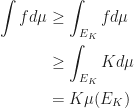
Markov inequality is a useful inequality that gives a rough upper bound of the measure of a set in terms of an integral. The precise statement is: Let f be a nonnegative measurable function on \Omega. The Markov inequality states that for all K>0, \displaystyle \mu\{x\in\Omega:f(x)\geq K\}\leq\frac{1}{K}\int fd\mu.

The proof is rather neat and short. Let E_K:=\{x\in\Omega: f(x)\geq K\} Then,

\begin{aligned}    \int f d\mu &\geq \int_{E_K} fd\mu\\    &\geq \int_{E_K}K d\mu\\    &=K \mu(E_K)    \end{aligned}

Therefore, \mu(E_K)\leq\frac{1}{K}\int fd\mu.

Free Career Personality Quiz (Please help to do!)

Facebook Profile Picture 03

URL: https://career-test.com/s/sgamb?reid=210

The results of this Personality Test is quite surprisingly accurate, do give it a try to see if you are a Careerist, Entrepreneur, Harmonizer, Idealist, Hunter, Internationalist or Leader?

Do try out this Free Career Guidance Personality Test at https://career-test.com/s/sgamb?reid=210 while it is still available!

Benefits of doing the (Free) Career Test:

  • Get familiar with the top companies in Singapore
  • There are seven distinct career types based on career preferences, goals and personality. Get to know yours! (My result: Harmonizer)
  • Take part in the annual Universum survey and win prizes!

Necessary and Sufficient Condition for Integrability in finite measure space

Facebook Profile Picture 03

URL: https://career-test.com/s/sgamb?reid=210

The results of this Personality Test is quite surprisingly accurate, do give it a try to see if you are a Careerist, Entrepreneur, Harmonizer, Idealist, Hunter, Internationalist or Leader?

Do try out this Free Career Guidance Personality Test at https://career-test.com/s/sgamb?reid=210 while it is still available!

Benefits of doing the (Free) Career Test:

  • Get familiar with the top companies in Singapore
  • There are seven distinct career types based on career preferences, goals and personality. Get to know yours! (My result: Harmonizer)
  • Take part in the annual Universum survey and win prizes!

Let (\Omega, \Sigma, \mu) be a finite measure space. Suppose that f\geq 0 is a measurable function on \Omega. Let E_n:=\{\omega\in\Omega:f(\omega)\geq n\} for each n\in \mathbb{N}\cup\{0\}. Show that f is integrable if and only if \sum_{n=0}^\infty \mu(E_n)<\infty.

This proof has a cute solution that is potentially very short. We will elaborate more on this proof. Other approaches include using Markov’s Inequality / Chebyshev’s inequality.

Proof: Consider g=\sum_{n=1}^\infty I_{E_n}.

Note that for each n\geq 0, n\in\mathbb{N} on E_n\setminus E_{n+1}, g=n, while n\leq f<n+1. Therefore g\leq f<g+1 on \Omega.

Integrating with respect to \mu, we get \int_{\Omega} gd\mu\leq\int_{\Omega} fd\mu<\int_{\Omega} g+1d\mu.

\displaystyle\boxed{\sum_{n=1}^\infty \mu (E_n)\leq \int_\Omega f d\mu<\sum_{n=1}^\infty\mu(E_n)+\mu(\Omega)}

(=>) Now assuming f is integrable, i.e. \int fd\mu<\infty, we have \sum_{n=1}^\infty \mu(E_n)<\infty. \mu(E_0)=\mu(\Omega)<\infty. Therefore \sum_{n=0}^\infty\mu(E_n)<\infty.

(<=) Conversely, if \sum_{n=0}^\infty\mu(E_n)=\sum_{n=1}^\infty \mu(E_n)+\mu(\Omega)<\infty, then \int_\Omega f d\mu<\infty.

We are done.

Note: For a more rigorous proof of \int gd\mu=\sum_{n=1}^\infty \mu (E_n) we can use MCT (Monotone Convergence Theorem).

Let g_k=\sum_{n=1}^k I_{E_n}. Then g_k\uparrow g. By MCT, \int gd\mu=\lim_{k\to\infty} \int g_k d\mu=\lim_{k\to\infty} \sum_{n=1}^k \mu (E_n)=\sum_{n=1}^\infty \mu(E_n).

εδ Confusion in Limit & Continuity

tomcircle's avatarMath Online Tom Circle

1. Basic:
|y|= 0 or > 0 for all y

2. Limit: $latex displaystylelim_{xto a}f(x) = L$ ; x≠a
|x-a|≠0 and always >0
hence
$latex displaystylelim_{xto a}f(x) = L$
$latex iff $
For all ε >0, there exists δ >0 such that
$latex boxed{0<|x-a|<delta}$
$latex implies |f(x)-L|< epsilon$

3. Continuity: f(x) continuous at x=a
Case x=a: |x-a|=0
=> |f(a)-f(a)|= 0 <ε (automatically)
So by default we can remove (x=a) case.

Also from 1) it is understood: |x-a|>0
Hence suffice to write only:
$latex |x-a|<delta$

f(x) is continuous at point x = a
$latex iff $
For all ε >0, there exists δ >0 such that
$latex boxed{|x-a|<delta}$
$latex implies |f(x)-f(a)|< epsilon$

View original post

Newtonian Calculus not rigorous !

tomcircle's avatarMath Online Tom Circle

Why Newton’s Calculus Not Rigorous?

$latex f(x ) = frac {x(x^2+ 5)} { x}$ …[1]

cancel x (≠0)from upper and below => $latex f(x )=x^2 +5 $

$latex mathop {lim }limits_{x to 0} f(x) =x^2 +5= L=5 $ …[2]

In [1]: we assume x ≠ 0, so cancel upper & lower x
But In [2]: assume x=0 to get L=5
[1] (x ≠ 0) contradicts with [2] (x =…)

This is the weakness of Newtonian Calculus, made rigorous later by Cauchy’s ε-δ ‘Analysis’.

View original post 1 more word

Rigorous Calculus: ε-δ Analysis

tomcircle's avatarMath Online Tom Circle

Rigorous Analysis epsilon-delta (ε-δ)
Cauchy gave epsilon-delta the rigor to Analysis, Weierstrass ‘arithmatized‘ it to become the standard language of modern analysis.

1) Limit was first defined by Cauchy in “Analyse Algébrique” (1821)

2) Cauchy repeatedly used ‘Limit’ in the book Chapter 3 “Résumé des Leçons sur le Calcul infinitésimal” (1823) for ‘derivative’ of f as the limit of

$latex frac{f(x+i)-f(x)}{i}$  when i ->…

3) He introduced ε-δ in Chapter 7 to prove ‘Mean Value Theorem‘: Denote by (ε , δ) 2 small numbers, such that 0< i ≤ δ , and for all x between (x+i) and x,

f ‘(x)- ε < $latex frac{f(x+i)-f(x)}{i}$ < f'(x)+ ε

4) These ε-δ Cauchy’s proof method became the standard definition of Limit of Function in Analysis.

5) They are notorious for causing widespread discomfort among future math students. In fact, when it…

View original post 92 more words

German Terms

German before WW2 was the World’center of Science (Einstein etc) and Modern Math (Gauss, Klein, Hilbert etc), that’s why we inherit some letter symbols eg. Z (Zahl, Integer) …

tomcircle's avatarMath Online Tom Circle

1. The electron orbits: first 4 orbits from atom

s, p, d, f
s = Sharfe (Sharp)
p =prinzipielle (principle)
d = diffusiv (diffuse)
f= fundamentale (fundamental)
2. eigen (special)
eigenvector
eigenvalue
eigenfunction
eigenfrequency
3. Math:
e = neutral element (I=Identity)
K=Korps (Fields)
Z = Zahl (Integer)
4. Physics:
F-center = Color Center  (F=Farbe=color)
Umklapp process = reverse process
Aufbau principle (quantum chemistry) = Building (bau) Up (Auf)  principle

View original post

Abstract Math discomforts

Abstract Algebra is the killer Math subject for university-bound Singaporean A-level students educated in the British GCE syllabus. Except a fews who are born with the gift, most of them get lost in the first year of university. Yet Abstract Algebra is important math “language” of science and technology : IT, Chemistry, Physics, Advanced Math… if you want to describe a complex structure (quantum physics, crystallography), algorithm (search), method (encryption), you use this precise and concise language “Abstract Algebra” (such as Group, Vector Space, …). Countries like China and USA havevmade Abstract Algebra a compulsory subject for 1st year undergrads in Science, Engineering, IT students beside Math majors …

tomcircle's avatarMath Online Tom Circle

3 Wide Discomforts For Abstract Math Students

1. Group : Coset, Quotient group, morphism…
2. Limit ε-δ: Cauchy
3. Bourbaki Sets: Function f: A-> B is subset of Cartesian Product AxB.

Students should learn from their historical genesis rather than the formal abstract definitions

<a href=”http://http://en.wikipedia.org/wiki/Wu_Wenjun“>Wu Wenjun (吳文俊) on Learning Abstract Math

“…It is more important to understand the ‘Principles’ 原理 behind, à la Physics (eg. Newton’s 3 Laws of Motion), and not blinded by its abstract ‘Axioms’ 公理.”

Prof I.Herstein http://en.wikipedia.org/wiki/Israel_Nathan_Herstein

“… Seeing Abstract Math for the first time, there seems to be a common feeling of being adrift, of not having something solid to hang on to.

Do not be discouraged. Stick with it! The best road is to look at examples. Try to understand what a given concept says, most importantly, look at particular, concrete examples of the concept.

View original post 47 more words

Probability by 2 Great Friends

tomcircle's avatarMath Online Tom Circle

Today Probability is a “money” Math, used in Actuarial Science, Derivatives (Options) in Black-Scholes Formula.

In the beginning it was “A Priori” Probability by Pascal (1623-1662), then Fermat (1601-1665) invented today’s “A Posteriori” Probability.

“A Priori” assumes every thing is naturally “like that”: eg. Each coin has 1/2 chance for head, 1/2 for tail. Each dice has 1/6 equal chance for each face (1-6).

“A Posteriori” by Fermat, then later the exile Protestant French mathematician De Moivre (who discovered Normal Distribution), is based on observation of “already happened” statistic data.

Cardano (1501-1576) born 150 years earlier than Pascal and Fermat, himself a weird genius in Medicine, Math and an addictive gambler, found the rule of + and x for chances (he did not know the name ‘Probability’ then ):

Addition + Rule: throw a dice, chance to get a “1 and 2” faces:
1/6 +1/6 = 2/6 = 1/3

View original post 193 more words

Galois Theory Simplified

tomcircle's avatarMath Online Tom Circle

Galois discovered Quintic Equation has no radical (expressed with +,-,*,/, nth root) solutions, but his new Math “Group Theory” also explains:
$latex x^{5} – 1 = 0 text { has radical solution}$
but
$latex x^{5} -x -1 = 0 text{ has no radical solution}$

Why ?

$latex x^{5} – 1 = 0 text { has 5 solutions: } displaystyle x = e^{frac{ikpi}{5}}$
$latex text{where k } in {0,1,2,3,4}$
which can be expressed in
$latex x= cos frac{kpi}{5} + i.sin frac{kpi}{5} $
hence in {+,-,*,/, √ }
ie
$latex x_0 = e^{frac{i.0pi}{5}}=1$
$latex x_1 = e^{frac{ipi}{5}}$
$latex x_2 = e^{frac{2ipi}{5}}$
$latex x_3 = e^{frac{3ipi}{5}}$
$latex x_4 = e^{frac{4ipi}{5}}$
$latex x_5 = e^{frac{5ipi}{5}}=1=x_0$

=>
$latex text {Permutation of solutions }{x_j} text { forms a Cyclic Group: }
{x_0,x_1,x_2,x_3,x_4} $

Theorem: All Cyclic Groups are Solvable
=>
$latex x^{5} -1 = 0 text { has radical solutions.}$

However,
$latex x^{5} -x -1 =…

View original post 41 more words

The Arrival of New Era of “Knowledge Sharing”

tomcircle's avatarMath Online Tom Circle

2010 Steve Jobs declared Post-PC era has arrived with iPhone/iPad,  little did he know that he had accidentally also brought the Post-TV & Post-Publication (books, Newspapers) on iPhone/iPad platform for YouTube, ebooks.
Today,  you don’t have to sit on sofa at scheduled time to watch TV programmes,  buy/loan/housekeep books, subscribe to political-biased  newspapers.

The advent of Web 2.0 and Internet of Things (IoT) will open up the new era of freedom of “Knowledge Sharing”:
1. Instead of reading 100 books to understand a complex economic/politics/history/science topic, you can go YouTube to attend free seminars by TED, MOOC (Cousera, Khan Academy…), or follow YouTube series by book expert reviewers (罗辑思维, 袁腾飞, 百家论坛, 宋鸿兵货币战争)…
2. You can ask any questions on “Quora”. Anybody with the expertise will volunteer to teach you.
3. You can keep your reading notes in text, video and hyperlink to the vast internet resources (wikipedia, ..) and shared…

View original post 9 more words

A solvable group that has a composition series is necessarily finite

Facebook Profile Picture 03

Do try out this Free Career Guidance Personality Test at https://career-test.com/s/sgamb?reid=210 while it is still available!

Benefits of doing the (Free) Career Test:

  • Get familiar with the top companies in Singapore
  • There are seven distinct career types based on career preferences, goals and personality. Get to know yours! (My result: Harmonizer)
  • Take part in the annual Universum survey and win prizes!

Let G be a solvable group. We prove that if G has a composition series, then G has to be finite. (Note that this is sort of a converse to “A finite group has a composition series.”)

Let G=G_0\geq G_1\geq \dots\geq G_n=1 be a composition series of G, where each factor G_i/G_{i+1} is simple.

Since G_i and G_{i+1} are solvable (every subgroup of a solvable group is solvable), the quotient G_i/G_{i+1} is also solvable.

We can prove that G_i/G_{i+1} is abelian. Since (G_i/G_{i+1})'\trianglelefteq G_i/G_{i+1}, by the fact that the factor is simple, we have (G_i/G_{i+1})'=1 or G_i/G_{i+1}.

If (G_i/G_{i+1})'=G_i/G_{i+1}, then this contradicts the fact that G_i/G_{i+1} is solvable. Thus (G_i/G_{i+1})'=1 and G_i/G_{i+1} is abelian.

Key step: G_i/G_{i+1} is simple and abelian, G_i/G_{i+1}\cong\mathbb{Z}_{p_i} for some prime p_i.

Since |G_{n-1}|=p_{n-1}, so we have that |G_{n-2}|=|G_{n-2}/G_{n-1}||G_{n-1}|=p_{n-2}p_{n-1}. By induction, |G_i|=p_i p_{i+1}\dots p_{n-1}.

|G|=|G_0|=p_0p_1\dots p_{n-1}. Thus G is finite.


Group of order 56 is not simple + Affordable Air Purifier

Haze strikes Singapore again, this time it is quite serious as the PSI is often above 300. For those seeking an affordable air purifier, do consider this air purifier which is one of the few that costs below $100. It is definitely reusable next year as the haze problem is not going to be solved in the near future.

[S$89.90][Clean Air]2015 Air Purifier Singapore brand and 1 year warranty with HEPA Activated Carbon UV-C germicidal killer lamp silent operation and high efficiency etc

WWW.QOO10.SG

Let G be a group of order 56. Show that G is not simple.

Proof:

We will use Sylow’s Theorem to show that either the 2-Sylow subgroup or 7-Sylow subgroup is normal.

|G|=2^3\cdot 7

By Sylow’s Theorem n_2\mid 7, n_2\equiv 1\pmod 2. Thus n_2=1,7.

Also, n_7\mid 8, n_7\equiv 1\pmod 7. Therefore n_7=1, 8.

If n_2=1 or n_7=1, we are done, as one of the Sylow subgroups is normal.

Suppose to the contrary n_2=7 and n_7=8.

Number of elements of order 7 = 8 x (7-1)=48

Remaining elements = 56-48=8. This is just enough for one 2-Sylow subgroup, thus n_2=1. This is a contradiction.

Therefore, a group of order 56 is simple.


Intersection of Center of p-group and nontrivial normal subgroup is nontrivial

Let G be a p-group and H a nontrivial normal subgroup. Prove that H\cap Z(G) is nontrivial.

Let G act on H by conjugation. Since H is a normal subgroup, this is a well-defined group action since ghg^{-1}\in H for all g\in G.

Let H_0=\{h\in H:ghg^{-1}=h\ \ \ \forall g\in G\}.

h\in H_0 \iff O(h)=\{h\}.

Therefore we have H=H_0+O(h_1)+O(h_2)+\dots+O(h_n) where |O(h_i)|>1.

By the Orbit-Stabilizer Theorem,

|H|=|H_0|+\sum_{i=1}^k |O(h_i)|=|H_0|+\sum_{i=1}^k[G:G_{h_i}]

Let |G|=p^n. By Lagrange’s Theorem, p^n=|G|=[G:G_{h_i}]|G_{h_i}|. Since |G_{h_i}|\neq p^n, therefore p\mid [G:G_{h_i}].

Hence, |H|\equiv |H_0|\pmod p.

Note that

\begin{aligned}    h\in H_0\subseteq H &\iff ghg^{-1}=h\ \ \ \forall g\in G\\    &\iff gh=hg\ \ \ \forall g\in G\\    &\iff h\in Z(G)\cap H    \end{aligned}

Therefore |H\cap Z(G)|\equiv |H|\equiv 0\pmod p. Since 1\in H\cap Z(G), this implies that p \mid |H\cap Z(G)| \neq 0. Therefore |H\cap Z(G)|\geq p.

Do check out some of our recommended Singapore Math books here!

Group of order 432 is not simple

Recently, a viewer of my blog found that my recommended books for gifted children was helpful. You may want to check those books out too.

Quote (from comment found on home page): Thanks a lot for the blog. I have a P1 girl whose hobby is to do assessment books but doesn’t like reading story books. She has completed P2 assessment books and doing P3 assessment books. With advises from her school principal, I decided not to let her progress with assessment books and I am really lost as to what to do with her. I shall try out the books that you recommended.

For this blog post, we shall show that a group of order 432=2^4\cdot 3^3 is not simple. We will be using several previous posts as lemmas to prove this nontrivial result.

Suppose to the contrary G is simple. By Sylow’s Third Theorem, n_3\equiv 1\pmod 3, n_3\mid 16. This means that n_3 is 1, 4 or 16.

We recall that if n_3=1, then the Sylow 3-subgroup is normal.

Let Q_1 and Q_2 be two distinct Sylow 3-subgroups of G such that |Q_1\cap Q_2| is maximum.

Using our previous lemma regarding index of intersection of Sylow subgroups, we split our analysis into three cases, the hardest of which is Case 3.

Case 1) If |Q_1\cap Q_2|=1, [Q_1:Q_1\cap Q_2]=3^3. Thus n_3=1\pmod {27}, which allows us to conclude n_3=1.

Case 2) If |Q_1\cap Q_2|=3, [Q_1:Q_1\cap Q_2]=3^2. Thus n_3=1 \pmod 9. Similarly, we can conclude n_3=1 and we are done.

Case 3) If |Q_1\cap Q_2|=9, then [Q_1:Q_1\cap Q_2]=3.

By another previous lemma regarding index of least prime divisor, Q_1\cap Q_2\trianglelefteq Q_1. Thus, Q_1\leq N_G(Q_1\cap Q_2). Thus |N_G(Q_1\cap Q_2)|=3^3\cdot 2, 3^3\cdot 2^2, 3^3\cdot 2^3,\text{or }3^3\cdot 2^4.

If N_G(Q_1\cap Q_2)=G, then Q_1\cap Q_2\trianglelefteq G which is a contradiction. Hence we suppose N_G(Q_1\cap Q_2)\neq G. Let [G:N_G(Q_1\cap Q_2)]=k. The possible values of k are k=2, 2^2, 2^3, 2^4.

Next, we use the fact that if G is a simple group and H is a subgroup of index k, then |G| divides k!.

Thus, 432\mid k!, which forces k=16.

But then Q_1=N_G(Q_1\cap Q_2) and similarly Q_2=N_G(Q_1\cap Q_2). Thus Q_1=Q_2. This is a contradiction to |Q_1\cap Q_2|=9.

Therefore all cases lead to contradiction and thus G is not simple.

First-Class Function is Homomorphism

tomcircle's avatarMath Online Tom Circle

We know a Program is a math procedure. 

“A Program without Math is like Sex without Love.”

Do you know in Programming a First-Class Function is a Homomorphism in Abstract Algebra ?

In Functional / Dynamic Programming Language like Lisp, it supports First-Class Function.

Eg.
Map (sqr {1 2 5 4 7})
=> {1 4 25 16 49} 

A First-Class Function like ‘Map’ is a Function call which  accepts  another function ‘sqr’ as argument.

Map means “Apply to All”.
Map applies ‘sqr’ to all members of the list  {1 2 5 4 7}.

In abstract algebra, Map (eg. Linear Map) is a homomorphism !

http://en.m.wikipedia.org/wiki/Map_(higher-order_function)

View original post

Sylow subgroup intersection of a certain index + F1 Trespasser

Today, I read the news online, the latest news is that a man was strolling along the F1 track while the race was ongoing. Really unbelievable.

Also, recently our recommended books from Amazon for GAT/DSA preparation have been very popular with parents seeking preparation. Do check it out if your child is going for DSA soon.

Back to our topic on Sylow theory…

Let G be a finite group, where q is a prime divisor of G. Suppose that whenever Q_1 and Q_2 are two distinct Sylow q-subgroups of G, Q_1\cap Q_2 is a subgroup of Q_1 of index at least q^a. Prove that the number n_q of Sylow q-subgroups of G satisfies n_q\equiv 1\pmod {q^a}.

Proof: Let \Omega=\{Q_1,Q_2\dots,Q_n\} be the set of all Sylow q-subgroups of G. Fix P=Q_k\in \Omega. Consider the group action of P acting on \Omega by conjugation.

\phi:P\times\Omega\to\Omega, \phi_x(Q_i)=xQ_i x^{-1}

By Orbit-Stabilizer Theorem, |O(Q_i)|=|P|/|N_p(Q_i)|.

We claim that N_p(Q_i)=Q_i\cap P, since any element x outside of Q_i cannot normalise Q_i, since otherwise if x \neq Q_i, xQx^{-1}=Q_i, then \langle Q_i, x\rangle will be a larger q-subgroup of G than Q_i.

Thus, |O(Q_i)|=|P|/|Q_i\cap P|\geq q^a, i.e. q^a\mid |O(Q_i)|.

|O(P)|=1.

The orbits form a partition of \Omega, thus |\Omega|=1+\sum{|O(Q_i)|}, where the sum runs over all orbits other than O(P).

Thus, n_q\equiv 1\pmod {q^a}.


Weierstrass M Test and Lebesgue’s Dominated Convergence Theorem

Previously, we wrote a blog post about Weierstrass M Test. It turns out Weierstrass M Test is a special case of Lebesgue’s Dominated Convergence Theorem, a very powerful theorem in Measure Theory, where the measure is taken to be the counting measure.

Lebesgue Dominated Convergence Theorem: Let (f_n) be a sequence of integrable functions which converges a.e. to a real-valued measurable function f. Suppose that there exists an integrable function g such that |f_n|\leq g for all n. Then, f is integrable and \displaystyle \int f d\mu=\lim_n \int f_n d\mu.

Thanks to one of our readers who purchased Canon EF-S 55-250mm F4-5.6 IS STM Lens for Canon SLR Cameras through our website! Photography fans may want to check it out.

Singapore Haze & Subgroup of Smallest Prime Index

Recently, the Singapore Haze is getting quite bad, crossing the 200 PSI Mark on several occasions. Do consider purchasing a Air Purifier, or some N95 Masks, as the haze problem is probably staying for at least a month. Personally, I use Nasal Irrigation (Neilmed Sinus Rinse), which has tremendously helped my nose during this haze period. It can help clear out dust and mucus trapped in the nose.

[S$89.90][Clean Air]2015 Air Purifier Singapore brand and 1 year warranty with HEPA Activated Carbon UV-C germicidal killer lamp silent operation and high efficiency etc

WWW.QOO10.SG

[S$19.90]Haze Prevention~ Nasal Rinse™- Flush out mucous~germs~bacteria~and dirt internally. Clear blocked nose and very soothing.

WWW.QOO10.SG

Previously, we proved that any subgroup of index 2 is normal. It turns out that there is a generalisation of this theorem. Let p be the smallest prime divisor of a group G. Then, any subgroup H\leq G of index p is normal in G.

Proof: Let H be a subgroup of G of index p. Let G act on the left cosets of H by left multiplication: \forall x\in G, x\cdot gH=xgH.

This group action induces a group homomorphism \phi:G\to S_p.

Let K=\ker \phi. If x\in K, then xgH=gH for all g\in G. In particular when g=1, xH=H, i.e. x\in H.

Thus K\subseteq H. In particular, K\trianglelefteq H, since \ker\phi is a normal subgroup of G.

We have G/K\cong \phi(G)\leq S_p. Thus |G/K|\mid p!.

Also note that |G|=|G/K||K|. Note that |G/K|\neq 1 since |G/K|=[G:H][H:K]=p[H:K]\geq p.

Let q be a prime divisor of |G/K|. Then q\leq p since |G/K|\mid p!. Also, q\mid |G|. Since p is the smallest prime divisor of |G|, p\leq q. Therefore, p=q, i.e. |G/K|=p.

Then p=p[H:K] \implies [H:K]=1, i.e. H=K. Thus, H is normal in G.

Proof of Wilson’s Theorem using Sylow’s Theorem

Wilson’s theorem (p-1)!\equiv -1 \pmod p is a useful theorem in Number Theory, and may be proved in several different ways. One of the interesting proofs is to prove it using Sylow’s Third Theorem.

Let G=S_p, the symmetric group on p elements, where p is a prime.

|G|=p!=p(p-1)!

By Sylow’s Third Theorem, we have n_p\equiv 1\pmod p. The Sylow p-subgroups of S_p have p-1 p-cycles each.

There are a total of (p-1)! different p-cycles (cyclic permutations of p elements).

Thus, we have n_p (p-1)=(p-1)!, which implies that n_p=(p-2)!

Thus (p-2)!\equiv 1\pmod p, and multiplying by p-1 gives us (p-1)!\equiv p-1\equiv -1\pmod p which is precisely Wilson’s Theorem. 🙂

If you are interested in reading some Math textbooks, do check out our recommended list of Math texts for undergraduates.

You may also want to check out Match Wits With Mensa: The Complete Quiz Book, which is our most popular recommended book on this website.

Tips to write the start of composition (argumentative essay) 议论文的开头如何入手(一)

chinesetuition88's avatarChinese Tuition Singapore

写议论文有个“万能公式”,我们称为“三段论”。就是把文章分为三个部分:开头(提出论点),中间(将论点分为几个部分加以概括并运用论据进行阐述),结尾(总结,进一步深化论点)。

都说“良好的开头是成功的一半”,所以一篇作文写出一个好的开头是十分有必要的。

有学生很苦恼,不知道该怎么写议论文的开头。如果套用“三段论”,他们往往在开头用一句话就结束了。其实议论文的开头有很多种写法。

我们以“怎样才算是一个幸福的家庭”这个题目来探讨议论文开头的写法。

这个题目的意思就是让学生阐述构成幸福家庭的条件。有一个学生认为,幸福家庭的必备条件是“父母爱护孩子,孩子孝顺父母,兄弟姐妹之间互相关心”。那我们就利用这个观点来写。

本文先介绍比较常用的几种开头方式:

1. 开门见山式。come straight to the point

这种方式的特点是在开头就将文章的论点摆出开,直截了当,一看便知文章的主旨。

例:人从一出生开始首先面对的“小社会”便是家庭。家庭的幸福与否关系到一个人的幸福与否。当然,一个幸福的家庭是需要每个家庭成员来共同努力维护的。父母爱护孩子,孩子孝顺父母,兄弟姐妹之间互相关心,这样才算是一个幸福的家庭。
2. 设问句式。(rhetorical question)

就议论的问题提出疑问,在回答问题的过程中提出自己的观点。

例:家庭与每个人的成长和生活是密不可分的。家庭环境甚至可以影响一个人的人生。人人都希望生活在幸福的家庭中,那么什么样的家庭才算是幸福的呢?幸福的家庭是需要家庭成员之间互相关怀照顾的。父母爱护孩子,孩子孝顺父母,兄弟姐妹之间互相关心,这样的家庭才会幸福。

View original post

Life Algebra

tomcircle's avatarMath Online Tom Circle

image

How to solve this ‘Life’ Algebra ?

The simultatneous inequality equation with 3 unknowns (t, e, m).

It has no solution but we can get the BEST approximation :
Retire after 55 before 60, then you get optimized {e, t, m} — still have good energy (e) with plenty of time (t) and sufficient pension money (m) in CPF & investment saving.

Beyond 60 if continuing to work, the solution of {e, t, m} -> {0, 0, 0}.

View original post

Tiger Mom Amy Chua Sets Up Tuition Center in Singapore

Source: http://www.cnbc.com/2015/08/20/queen-of-the-tiger-moms-takes-on-singapore.html

“Tiger Mom” Amy Chua has started a Tuition Center in Singapore. Amy Chua is the famous author of Battle Hymn of the Tiger Mother, which is an interesting book which has both supporters and critics.

The Tuition Centre is called Keys Academy, located in North Bridge Road, Singapore.

Do check it out, and more importantly do read the book Battle Hymn of the Tiger Mother to see if you agree with the author! Amy Chua does have some good points to be made, as many of the top students in Western countries are Asians. Do check out her book to read about her method.


Some other books written by Amy Chua are:

The Triple Package: How Three Unlikely Traits Explain the Rise and Fall of Cultural Groups in America

Day of Empire: How Hyperpowers Rise to Global Dominance–and Why They Fall

World on Fire: How Exporting Free Market Democracy Breeds Ethnic Hatred and Global Instability

“偷得浮生半日闲”诗句分析—出现于中三课文《乌敏岛》

chinesetuition88's avatarChinese Tuition Singapore

在中三下华文课本中,有一篇题目为《乌敏岛》的课文。课文介绍了乌敏岛的自然风光和纯朴的人文环境。在文章的最后,作者写道“如果能’偷得浮生半日闲’,何不暂时摆脱现实的束缚,和三五好友到乌敏岛游玩呢?”。

“偷得浮生半日闲”出自于唐代诗人李涉的七言绝句《题鹤林寺僧舍》。全文如下:

终日昏昏醉梦间,忽闻春尽强登山。

因过竹院逢僧话,偷得浮生半日闲。

大意是:作者整日昏昏沉沉处于醉梦之中,消磨人生。忽然有一天才意识到春天就要过去了,于是勉强去爬山。在游览寺院的时候碰到一位高僧,便与其闲聊,难得在这纷纷扰扰的世事中获得片刻的清闲。

这首诗的创作背景是李涉官途不顺,被皇帝贬官后又流放到南方,所以其情绪消极终日昏昏沉沉。而在一次偶然机会,登山之时偶遇高僧,闲聊之中,不料解开了苦闷的心结,化解了世俗的烦扰,使得自己心情得以放松。

再回到课文《乌敏岛》,从课文的开始,作者就强调“踏上乌敏岛,映入眼帘的是一幅和繁忙市区截然不同的景象”。市区的人们熙熙攘攘,为生活而忙于奔走,有很多世事的烦扰。而乌敏岛却是一个别样的世界,这里没有喧嚣,人们的生活简单平静而又质朴。来到这里,看看美不胜收的风景,体验淳朴宁静的生活,相信你也会暂时忘记现实生活的烦恼和忧愁。

“偷得浮生半日闲”,人生漂浮不定,难得半日的清闲。

View original post

Is Z[x] a Principal Ideal Domain?

In the previous post, we showed that a Euclidean domain is a Principal Ideal Domain (PID).

Consider the Polynomial Ring \mathbb{Z}[x]. We can show that it is not a PID and hence also not a Euclidean domain.

Proof: Consider the ideal <2,x>=\{ 2f(x)+xg(x)\vert f(x), g(x) \in \mathbb{Z} [x]\}.

Suppose to the contrary <2,x>=<p(x)>=\{ f(x)p(x)\vert f(x)\in \mathbb{Z}[x]\}.

Note that 2\in <2,x>, hence 2\in <p(x)>.

2=f(x)p(x)

p(x)=2 or -2.

<p(x)>=<2>

However, x\in <2,x> but x\notin <2>. (contradiction!)


Check out this page for Recommended Singapore Math books!


Proof that a Euclidean Domain is a PID (Principal Ideal Domain)

Previously, we defined what is a Euclidean Domain and what is a PID. Now, we will prove that in fact a Euclidean Domain is always a PID (Principal Ideal Domain). This proof will be elaborated, it can be shortened if necessary.

Proof:

Let R be a Euclidean domain.

Let I be a nonzero ideal of R. (If I is a zero ideal, then I=(0) )

Choose b\in I, b\neq 0 such that d(b)=\min \{ d(i): i\in I\}, where d is the Euclidean function. By the well-ordering principle, every non-empty set of positive integers contains a least element, hence b exists.

Let a\in I be any element in I. \exists q,r \in R such that a=bq+r, with either r=0, or d(r)<d(b). (This is the property of Euclidean domain.)

We can’t have d(r)<d(b) as that will contradict minimality of d(b). Thus, r=0, and a=bq. Hence every element in the ideal is a multiple of b, i.e. I=(b). Thus R is a PID (Principal Ideal Domain).


Check out other pages on our blog:


Proof that any subgroup of index 2 is normal

Let H\leq G be a subgroup of index 2.

Let g\in G and h\in H.

If g\in H, then gH=H, and Hg=H, hence left coset equals to right coset.

If g\notin H, then gH=G\setminus H (set minus), and also Hg=G\setminus H, thus left coset also equals to right coset.

Tip: For this question, using the equivalent definition of ghg^{-1}\in H to prove will be quite tricky and convoluted, as seen here.

Recommended Page: Check out the following Recommended Math Books for Undergrads!

Aut(Z_n): Automorphism Group of Z_n

Do check out our list of Recommended Undergraduate Math Books!

We prove that Aut(\mathbb{Z}_n)\cong (\mathbb{Z}/n\mathbb{Z})^*, also known as U(n) (easier to type).

Define \Psi: Aut(\mathbb{Z}_n)\to U(n) by \Psi(\phi)=\phi (1).

First we show that it is a homomorphism:

\begin{aligned}\Psi(\phi_1 \circ \phi_2)&=\phi_1(\phi_2(1))\\    &=\phi_1 (1+1+\cdots +1)\ \ \ (\phi_2 (1) \text{ times})\\    &=\phi_1 (1)+\phi_1 (1)+\cdots +\phi_1 (1)\ \ \ (\phi_2 (1) \text{ times})\\    &=\phi_2 (1) \cdot \phi_1 (1)\\    &=\Psi (\phi_2)\cdot \Psi (\phi_1)\\    &=\Psi (\phi_1) \cdot \Psi (\phi_2)\ \ \ \text{since} (\mathbb{Z}/n\mathbb{Z})^* \text{ is abelian.}    \end{aligned}

Next we show that it is injective:

\Psi (\phi) =1

Thus, \phi (1)=1.

Let x\in \mathbb{Z}_n.

\phi (x)=x\phi (1)=x\cdot 1=x.

Thus, the only automorphism that maps to 1 is the identity.

Thus, \ker \Psi is trivial.

Finally, we show that it is surjective.

Let x\in (\mathbb{Z}/n\mathbb{Z})^*. Consider \phi such that \phi (0)=0, \phi (1)=x, \phi (i)=ix, …, \phi (n-1)=(n-1)x.

We claim that \phi is an automorphism of \mathbb{Z}_n.

Firstly, we need to show that \{0,1,2,\cdots, n-1\}=x\{0, 1, 2, \cdots, n-1\}. This is because \gcd (x,n)=1. Hence if q is the order of x, i.e. qx\equiv 0 \pmod n, then n\vert qx, which implies that n\vert q which implies that q is at least n. Since the order of x is also at most n, q=n.

Finally, we have \phi(a+b)=(a+b)x=ax+bx=\phi (a)+\phi (b) and thus we may take \phi as the preimage of x.

Hence \Psi is surjective.

This is a detailed explanation of the proof, it can be made more concise to fit in a few paragraphs!

Related posts: Recommended Books for Math Students

Egg Mathematics

tomcircle's avatarMath Online Tom Circle

I highly recommend this Harvard Online Course “Science & Cooking” for food and Math lover:

http://online-learning.harvard.edu/course/science-and-cooking

Example of the Course :

How much boiled water you need to cook a perfect egg ?

By conservation of heat (energy), the heat (Q) of boiled water is transferred to the egg (assume no loss of heat to the environment: container, air, etc).

Secondary school Physics :

Q = m.C. (T’-T)
m = mass
C=Specific Heat
T’= Final Température
T= Initial Temperature

image

Chef’s tip: a perfect egg cooked at around 64 C.

image

View original post

Chinese Tuition (West Side of Singapore)

If you live near the West side of Singapore (e.g. Buona Vista, Dover, Clementi, Jurong), and are looking for a patient and dedicated Chinese Tutor, do check out:

ChineseTuition88.com

Chinese Tuition Singapore

新加坡华文补习老师

Tutor: Ms Gao (高老师)

Ms Gao is a patient tutor, and also effectively bilingual in both Chinese and English.

A native speaker of Mandarin, she speaks clearly with perfect accent and pronunciation. She is also well-versed in Chinese history, idioms and proverbs.

Ms Gao is able to teach Chinese at the Primary and Secondary school level. She will teach in an exam-oriented style, but will also try her best to make the lesson interesting for the student.

Ms Gao graduated from Huaqiao University from Fujian, China.

Contact:

Email: chinesetuition88@gmail.com

(Preferably looking for students staying in the West side of Singapore)