The Future of World Economy: Technologies

tomcircle's avatarMath Online Tom Circle

An excellent article on the Future of world economy.  A view from Stanford University….

3 Keywords: Clean Energy, Robotics,  3D-Printing

Governments, businesses, and economists have all been caught off guard by the geopolitical shifts that happened with the crash of oil prices and the slowdown of China’s economy. Most believe that the price of oil will recover and that China will continue its rise. They are mistaken. Instead of worrying about the rise of China, we need to fear its fall; and while oil prices may oscillate over the next four or five years, the fossil-fuel industry is headed the way of the dinosaur. The global balance of power will shift as a result.

LED light bulbs, improved heating and cooling systems, and software systems in automobiles have gradually been increasing fuel efficiency over the past decades. But the big shock to the energy industry came with

View original post 986 more words

Category Theory by Steven Roman

tomcircle's avatarMath Online Tom Circle

Excellent Category Theory lectures by retired Prof Steven Roman  from Uni. California: he used pen and A4 – paper with iPhone camera. Simple & good. (Only lighting could be brighter.)

Category Theory is one level higher abstraction, above the Abstract Algebra (Group, Ring, Field, Vector Space, Set…). It is the “Math of Math”, to make difficult math easy by studying the ‘relationship’ (or Morphism).

View original post

Why Anything Multiplying by 0 Gives 0 ?

tomcircle's avatarMath Online Tom Circle

This is the correct way to teach Math to children, but it makes parents crazy ! 🙂

Why anything multiplying by 0 gives 0 ?

Proof:

0.x + 0.x = (0 + 0).x [distribution law]
                 = .x       [definition of 0]

Subtracting 0.x from both sides,
0.x + 0.x = 0.x
we get
$latex boxed{0.{x} = 0 }$ [QED]

Parents teach children the intuitive way:
“nothing times anything is nothing”
but this is not rigorous.

Later in life, the children would learn that when doing “zero times” of any thing (eg. bad behaviors: fighting, stealing…) produces “something” (good) 🙂

In the USA and UK, many parents grow up feeling great antipathy towards Math, whereas in Asia like China, Japan, Korea, HK, Singapore, and Europe (eg. France), we grow up fearing Math, probably because of how Math was taught in school. I remember during schools (and…

View original post 19 more words

Install Common Lisp on Mac

I am intending to install Common Lisp on Mac. Installing Lisp is quite troublesome, for normal users who are used to installing everything in one click.

Clozure CL (App for Mac) seems to be the easiest option. However, I have been faced with Clozure CL App error: “Unknown Error” message, followed by “We Could not complete your request”. This error appears when I click on install the app.

The next method I am trying is http://www.jonathanfischer.net/modern-common-lisp-on-osx/. Currently at the step of installing Aquamacs, everything seems to be going smoothly so far.

Update: The above website’s method is not as easy as it looks. http://www.yellosoft.us/installing-common-lisp may be another easier option.

Some interesting Lisp books:


ANSI Common LISP

GEP / DSA Pattern Recognition Book


Visual Discrimination, Grades 2 – 8

Some readers of my blog has bought this book on Amazon. Upon closer inspection, I realised this is actually an excellent book for preparing for pattern recognition (visual discrimination) which is tested in GEP / DSA under the logic portion.

Screen Shot 2016-02-10 at 6.09.39 PM

The above is a sample of what the book teaches. If you are familiar with the GEP / DSA test, this is exactly what the logic part of the test is about. Not just the GEP / DSA tests use this, basically any IQ test worldwide will test something like this.

Getting familiar with such tests will obviously be an advantage. No harm giving it some practice rather than seeing such tests the first time in the GEP / DSA test.

Pattern recognition is a skill that can be learnt, and one can argue that many intellectual activities like chess / math are just advanced forms of pattern recognition!

Further Maths Versus H2 Maths

Source: http://www.seab.gov.sg/content/syllabus/alevel/2017Syllabus/9649_2017.pdf

Related posts: What is the difference between H1, H2, H3 Maths

From the syllabus, it looks like Further Maths has some overlap with H2 Maths. This is a good thing, since students can reinforce their knowledge by learning it twice. It is also like killing two birds with one stone!

Some new things in Further Math:

  • Conic sections in Polar Form
  • Arc length of curves
  • Integrating factor (Differential Equations)
  • Second order recurrence relations
  • Matrices and Linear Spaces (This in my opinion is one of the biggest difference between Further Maths and H2 Maths)
  • Numerical methods
  • Geometric Distribution
  • Uniform and exponential distribution
  • Non-parametric tests

Further Math is a good subject to take for those intending to enter physical science or engineering in university, since it will cover many of the topics learnt in the first year of university.

Overall, there are quite a lot of advanced topics crammed into Further Math, so I doubt the teachers have time to teach everything in depth in two years. Matrices and Linear Spaces (Linear Algebra) alone will take half a year to teach it properly. Most likely it will be a touch-and-go event and students will get to see the tip of the iceberg. Students wishing to learn more can read up some undergraduate math books listed here.

Minimal Simplicial Sets

Let X be a space. We can have a fibrant simplicial set, namely the singular simplicial set S_*(X), where S_n(x) is the set of all continuous maps from the n-simplex to X. However S_*(X) seems too large as there are uncountably many elements in each S_n(X). On the other hand, we need the fibrant assumption to have simplicial homotopy groups. This means that the simplicial model for a given space cannot be too small. We wish to have a smallest fibrant simplicial set which will be the idea behind minimal simplicial sets.

Let X be a fibrant simplicial set. For x,y\in X_n we say that x\simeq y if the representing maps f_x and f_y are homotopic relative to \partial\Delta[n].

A fibrant simplicial set is said to be minimal if it has the property that x\simeq y implies x=y.

Let X be a fibrant simplicial set. X is minimal iff for any 0\leq k\leq n+1, v,w\in X_{n+1} such that d_iv=d_iw for all i\neq k implies d_kv=d_kw.

In other words, it means that a fibrant simplicial set is minimal iff for any two elements with all faces but one the same, then the missed face must be the same.

Higher Homotopy Groups

We can generalise the idea to higher homotopy groups as follows.

Let X be a pointed fibrant simplicial set. The fundamental group \pi_n(X) is the quotient set of the spherical elements in X_n subject to the relation generated by x\sim x' if there exists w\in X_{n+1} such that d_0w=x, d_1w=x' and d_jw=* for j>1.

The product structure in \pi_n(X) is given by: [x]+[x']=[d_1w], where w\in X_{n+1} such that d_0w=x', d_2w=x and d_jw=* for j>2. Furthermore, the map |\cdot|:\pi_n(X)\to\pi_n(|X|) preserves the product structure.

Simplicial objects and higher categories, part I

Very nice!

Sanath Devalapurkar's avatarErdosNinth

Hi all! Today I’ll introduce simplicial sets, and talk about how they relate to higher categories. Simplicial sets are basically combinatorial models for topological things; in fact, a particular kind of simplicial set (a Kan complex) is essentially equivalent to a topological space! So more general kinds of simplicial sets should model something more general than a topological space. Exploring this will be the topic of this post. The reader should note that these are directly from the (rather terse) notes I took while preparing for the Intel International Science and Engineering Fair last year (so this blog post is currently also serving as the notes for preparing for the Intel Science Talent Institute), so there may be small errors.

We will begin by talking about some combinatorial constructions. Let $latex [n]&s=1$ denote the set $latex {0,…,n}&s=1$ equipped with the linear ordering. Define $latex mathbf{Delta}&s=1$ to be the category whose objects are the sets $latex…

View original post 1,357 more words

Is it safe to say that anyone with a doctorate in math was probably a math prodigy when he/she was growing up?

Read more at: https://www.quora.com/Is-it-safe-to-say-that-anyone-with-a-doctorate-in-math-was-probably-a-math-prodigy-when-he-she-was-growing-up/answer/Senia-Sheydvasser

My second grade teacher was convinced that I had a learning disability. Now I am in my third year at Yale, working on a PhD degree in mathematics (I’m into analytic number theory, if you are curious).

“Prodigy” describes neither me nor anyone that I know. I think that it is a word that is far too overused, abused, and misused. My experience tells me that (with possibly a few, singular exceptions that we don’t yet understand well enough to properly gauge) people don’t become experts in something by being innately good at it, but by putting in the 10,000 hours necessary to make the subject an inherent part of their make-up.

I have told this to students before—there is no shame in not studying higher math because you think your time would be better used elsewhere. But for the love of God, don’t quit just because you feel like you aren’t good enough.

Think You Stink at Math? Amazon Wants to Change That.

Read more at: http://recode.net/2016/02/02/think-you-stink-at-math-amazon-wants-to-change-that/

“I stink at math.”

If you have kids, you’ve probably heard that phrase — or maybe you’ve even uttered some variant of it yourself. But in a world where good jobs increasingly require good math skills, that mind-set should no longer be acceptable, according to Rohit Agarwal, general manager of Amazon’s Education business unit.

“We believe that the attitude that it’s okay not to be good at math is just becoming too common,” Agarwal said in an interview. “Developing good math skills is essential to success at life.”

Motivational: The Bible tells us that there is no use in avoiding failure because we have already failed!

Soure: http://www.christiantoday.com/article/the.bible.says.that.youre.going.to.fail/78603.htm

Interesting perspective on faith!

We look at society and the things around us and it’s obvious that most of the things around us teach us to be afraid of failure. We were taught not to get “F’s” in school because it’s a bad thing to fail. We try not to look clumsy and fail socially because people would laugh at us. We were told maybe once or twice by our parents not to make a fuss because we’ll embarrass them (and if you’re a parent who’s done that, don’t worry, I’ve done it too!)

Psychologists claim that every human being has a certain amount of fear towards failure. As a result of this fear of failure that we have adopted, we try to avoid it as much as we can. However, the Bible tells us that there is no use in avoiding failure because we have already failed.

Romans 3:23 puts it this way: “for all have sinned and fall short of the glory of God.” We have all failed God, and as a result we have failed so miserably at the one thing we were created to do, which is to bring glory and honour to God. There’s not one person except Jesus who has succeeded at living life the way it should be lived, and everyone else has just failed.

And here’s the thing, we’re going to continue to fail. We’ll try and try and sometimes we may do one or two things right, but sooner or later everything is just going to go south on us. It’s a given for us to fail.

However, there is good news. Even when we fail, we’re still going to win because God has already won the battle for us. It’s like we’re in a game of basketball and we’re shooting 0 out of 100 baskets and it doesn’t matter because God is scoring where we’re failing. Psalm 73:26 tells us, “My flesh and my heart may fail, but God is the strength of my heart and my portion forever.”

The 7 Habits of Highly Effective People

Highly recommend parents to consider letting their child read this book, especially those going for interviews like scholarship, Medicine, Law interviews. Inside this book describe 7 habits that, if followed, will make one a highly effective person. This book is especially good for those who want to learn leadership and interpersonal skills, which will be essential for scholarship interviews and in competitive interviews like Medicine / Law where the interview is the only thing that separates one from the rest of the perfect scorers with 4As!


The 7 Habits of Highly Effective People: Powerful Lessons in Personal Change

Younger students can consider reading the equally good “teen” version:


The 7 Habits of Highly Effective Teens

Associativity and Path Inverse for Fundamental Groupoids

Continued from Path product and fundamental groupoids

(Associativity). Let X be a fibrant simplicial set and let \lambda_1, \lambda_2 and \lambda_3 be paths in X such that \lambda_1(1)=\lambda_2(0) and \lambda_2(1)=\lambda_3(0). Then (\lambda_1*\lambda_2)*\lambda_3\simeq\lambda_1*(\lambda_2*\lambda_3)\ \text{rel}\ \partial\Delta[1]

Let y\in Y_0 be a point. Denote \epsilon_y:X\to Y as the constant simplicial map \epsilon(x)=s_0^n(y) for x\in X_n.

(Path Inverse). Let X be a fibrant simplicial set and let \lambda be a path in X. Then there exists a path \lambda^{-1} such that \lambda*\lambda^{-1}\simeq\epsilon_{\lambda(0)}\ \text{rel}\ \partial\Delta[1].

Evaluation of Improper Integral via Complex Analysis

We are following the notation in Complex Variables and Applications (Brown and Churchill).

The method of using complex analysis to evaluate integrals is to consider a very large semicircular region’s boundary, which consists of the segment of the real axis from z=-R to z=R and the top half of the circle |z|=R positively oriented is denoted by C_R.

\int_{-R}^R f(x)\,dx+\int_{C_R}f(z)\,dz=2\pi i\sum_{k=1}^n\text{Res}_{z=z_k}f(z). If \lim_{R\to\infty}\int_{C_R}f(z)\,dz=0, then P.V.\int_{-\infty}^\infty f(x)\,dx=2\pi i\sum_{k=1}^n\text{Res}_{z=z_k}f(z). Furthermore if f is even, then \int_0^\infty f(x)\,dx=\pi i\sum_{k=1}^n\text{Res}_{z=z_k}f(z).

Useful Theorem

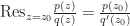
Let two functions p and q be analytic at a point z_0. If p(z_0)\neq 0, q(z_0)=0, and q'(z_0)\neq 0, then z_0 is a simple pole of the quotient p(z)/q(z) and \text{Res}_{z=z_0}\frac{p(z)}{q(z)}=\frac{p(z_0)}{q'(z_0)}.

Homotopy Groups

Let X be a pointed fibrant simplicial set. The homotopy group \pi_n(X), as a set, is defined by \pi_n(X)=[S^n,X], i.e.  the set of the pointed homotopy classes of all pointed simplicial maps from S^n to X. \pi_n(X)=\pi_n(|X|) as sets.

An element x\in X_n is said to be spherical if d_i x=* for all 0\leq i\leq n.

Given a spherical element x\in X_n, then its representing map f_x:\Delta[n]\to X factors through the simplicial quotient set S^n=\Delta[n]/\partial\Delta[n]. Conversely, any simplicial map f:S^n\to X gives a spherical element f(\sigma_n)\in X_n, where \sigma_n is the nondegenerate element in S^n_n. This gives a one-to-one correspondence from the set of spherical elements in X_n to the set of simplicial maps S^n\to X.

Path product and fundamental groupoids
Let \sigma_1=(0,1)\in\Delta[1]_1. A path is a simplicial map \lambda:\Delta[1]\to X.

Mindset: The New Psychology of Success

In my spare time, I am intending to read this psychology book: Mindset: The New Psychology of Success. This book has rocketed to one of the top books on Amazon, and it must have a good reason. Parents and educators should read this groundbreaking book. The book asserts that a subtle change in mindset can have a great difference.

Dweck explains why it’s not just our abilities and talent that bring us success—but whether we approach them with a fixed or growth mindset. She makes clear why praising intelligence and ability doesn’t foster self-esteem and lead to accomplishment, but may actually jeopardize success. With the right mindset, we can motivate our kids and help them to raise their grades, as well as reach our own goals—personal and professional. Dweck reveals what all great parents, teachers, CEOs, and athletes already know: how a simple idea about the brain can create a love of learning and a resilience that is the basis of great accomplishment in every area.

Wedderburn’s Structure Theorem

In abstract algebra, the Artin–Wedderburn theorem is a classification theorem for semisimple rings and semisimple algebras. The theorem states that an (Artinian) [1] semisimple ring R is isomorphic to a product of finitely many ni-by-ni matrix rings over division rings Di, for some integers ni, both of which are uniquely determined up to permutation of the index i. In particular, any simple left or right Artinian ring is isomorphic to an n-by-nmatrix ring over a division ring D, where both n and D are uniquely determined. (Wikipedia)

This is quite a powerful theorem, as it allows semisimple rings/algebras to be “represented” by a finite direct sum of matrix rings over division rings. This is in the spirit of Representation theory, which tries to convert algebraic objects into objects in linear algebra, which is relatively well understood.

Wedderburn’s Structure Theorem

Let A be a semisimple R-algebra.

(i) A\cong M_{n_1}(D_1)\oplus\dots\oplus M_{n_r}(D_r) for some natural numbers n_1,\dots,n_r and R-division algebras D_1,\dots,D_r.

(ii) The pair (n_i,D_i) is unique up to isomorphism and order of arrangement.

(iii) Conversely, suppose A=M_{n_1}(D_1)\oplus\dots\oplus M_{n_r}(D_r), then A is a right (and left) semisimple R-algebra.

Some Notes

The definition of a semisimple R-algebra is: An R-algebra A is semisimple if A is semisimple as a right A-module.

Example: R=\mathbb{R} and A=M_2(\mathbb{R})\oplus M_2(\mathbb{R}). Then A is semisimple by Wedderburn’s theorem.

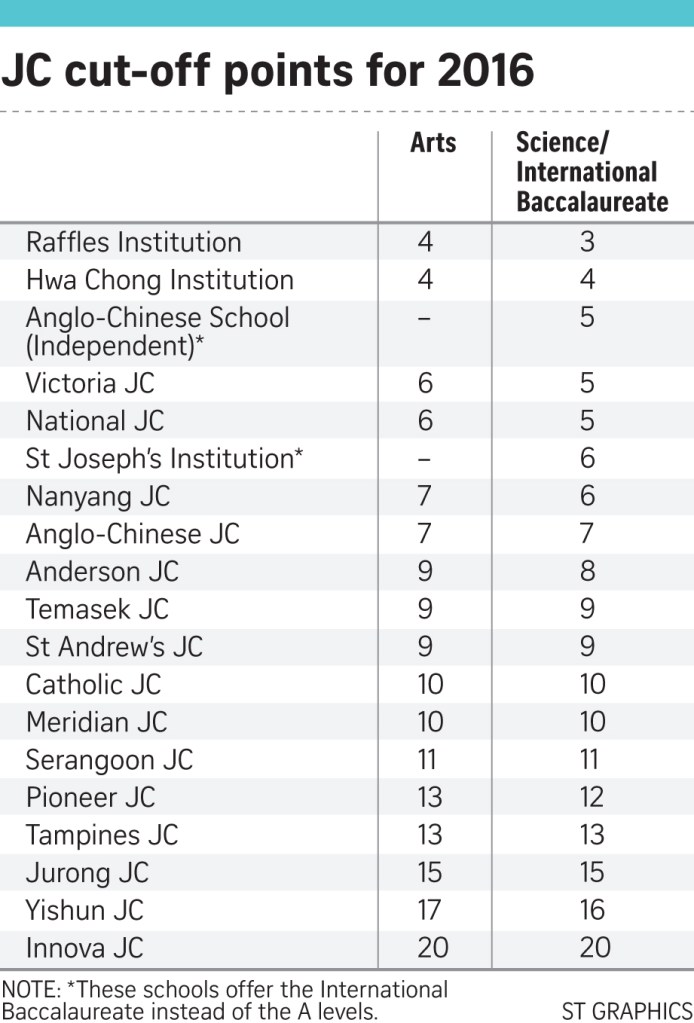
JC Cut Off Points

Source: http://www.straitstimes.com/singapore/education/little-change-in-junior-college-entry-scores-this-year

Despite the latest O-level results being the best in decades, there was little change in the minimum entry requirements for most junior colleges this year.

Students (future batches) thinking of which JC to enter should read this book by Malcolm Gladwell: David and Goliath: Underdogs, Misfits, and the Art of Battling Giants

In it he discusses whether it is better to be a big fish in a small pond or small fish in big pond at early stage of life. Also read: http://news.bitofnews.com/malcom-gladwells-mindblowing-theory-on-why-its-better-to-be-a-big-fish-in-a-small-pond/. This is very true, as entering an elite JC can be quite demoralizing, not to mention not a good fit as the lectures progress too fast, leading to students requiring either tuition or very intensive self-revision at home. The final result may be that the student may do better in ‘A’ levels in a mid-tier JC than in the elite JC’s like RI or HCI.

Hence, students and parents who are undecided and asking the question “Should I go to X JC” should read the above book. If you decide to go to the elite JCs, do not be demoralised if you are not at the top of the cohort. In fact, even if you are in the bottom half of the cohort, you do still have a good chance in doing well in the ‘A’ levels. It is all about the mindset, which is discussed in the above excellent book. The bottomline is that it may not be the best idea to enter the JC with the “lowest” cut-off point, some decision may be required.

st_20160129_amcutoff29_2027059

USA “Common Core” Math

tomcircle's avatarMath Online Tom Circle

To the outsiders of the USA,  we can understand the “Common Core Math Program” is good for American children education, which is supported by Bill Gates with generous $6-billion donation.

The American parents who resist and oppose the ‘Common Core’ Math were like the Singaporean parents who opposed the “Singapore Math Program” in the 1980s. The Singapore parents had to go through remedial classes before they could coach their kids in the ‘new way’. Result proved that after 20 years, Singapore is ranked 2nd in the PISA Test World Ranking in Math (after Shanghai of China).

All good medicines are bitter to swallow.
良药苦口 !

Here are 4 methods of subtraction:

1st : Traditional (aka Abacus) “Carry” Method
2nd: Mental Calculation
3rd : “Singapore Math” (no Carry)
4th: Common Core: “Count Up” (French Method), with which French supermart cashiers usually perform changes at counter — much…

View original post 108 more words

Geometrical Meaning of Matching Faces

Let X be a simplicial set. The elements x_0,\dots,x_{i-1},x_{i+1},\dots,x_n\in X_{n-1} are said to be matching faces with respect to i if d_jx_k=d_kx_{j+1} for j\geq k and k,j+1\neq i.

Geometrically, matching faces are faces that “match” along lower-dimensional faces. In other words, they are “adjacent”.
2-simplex
In the 2-simplex, let x_0=v_1v_2, x_1=v_0v_2, x_2=v_0v_1. Then x_0, x_2 are matching faces with respect to 1, since d_1x_0=v_1=d_0x_2.
3-simplex
In the 3-simplex, let x_0=v_1v_2v_3, x_1=v_0v_1v_2, x_2=v_0v_1v_3, x_3=v_0v_1v_2. Then x_0, x_2, x_3 are matching faces with respect to 1, since the following hold:
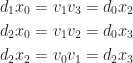
\begin{aligned}  d_1x_0&=v_1v_3=d_0x_2\\  d_2x_0&=v_1v_2=d_0x_3\\  d_2x_2&=v_0v_1=d_2x_3  \end{aligned}

Fibrant Simplicial Set

Let X be a simplicial set. Then X is fibrant if and only if every simplicial map f:\Lambda^i[n]\to X has an extension for each i.

Assume that X is fibrant. Let f:\Lambda^i[n]\to X. The elements f(d_0\sigma_n),f(d_1\sigma_n),\dots,f(d_{i-1}\sigma_n),f(d_{i+1}\sigma_n),\dots,f(d_n\sigma_n) are matching faces with respect to i. This is because for j\geq k and k,j+1\neq i,

\begin{aligned}  d_jf(d_k\sigma_n)&=f(d_jd_k\sigma_n)\\  &=f(d_kd_{j+1}\sigma_n)\\  &=d_kf(d_{j+1}\sigma_n)  \end{aligned}
Thus, since X is fibrant, there exists an element w\in X_n such that d_jw=f(d_j\sigma_n) for j\neq i. Then, the representing map g=f_w:\Delta[n]\to X, f_w(\sigma_n)=w, is an extension of f.

Conversely let x_0,\dots,x_{i-1},x_{i+1},\dots,x_n\in X_{n-1} be any elements that are matching faces with respect to i. Then the representing maps f_{x_j}:\Delta[n-1]\to X for j\neq i defines a simplicial map f:\Lambda^i [n]\to X such that the diagram

Screen Shot 2016-01-26 at 11.21.11 PM
commutes for each j.

By the assumption, there exists an extension g:\Delta[n]\to X such that g|_{\Lambda^i[n]}=f. Let w=g(\sigma_n). Then d_jw=d_jg(\sigma_n)=g(d_j\sigma_n)=f(d_j\sigma_n)=x_j for j\neq i. Thus X is fibrant.

Motivation of Simplicial Sets

A simplicial set is a purely algebraic model representing topological spaces that can be built up from simplices and their incidence relations. This is similar to the method of CW complexes to modeling topological spaces, with the critical difference that simplicial sets are purely algebraic and do not carry any actual topology.

To return back to topological spaces, there is a geometric realization functor which turns simplicial sets into compactly generated Hausdorff spaces. A topological space X is said to be compactly generated if it satisfies the condition: A subspace A is closed in X if and only if A\cap K is closed in K for all compact subspaces K\subseteq X. A compactly generated Hausdorff space is a compactly generated space which is also Hausdorff.

Tips on giving (Math) Talks

Here are some tips on how to give (Math) Talks. Talks on other scientific topics should be similar.

Source 1: http://www.math.wisc.edu/~ellenber/mntcg/TalkTipSheet.pdf

One tip I found very useful is this: For long talks (1 hour) and above, it is better to use the whiteboard / blackboard. As this will give you “the flexibility to add or omit material as you see fit, and it forces you not to go to fast.”

For shorter talks, it is better to use slides. “A good rule of thumb: you should allow between 30 seconds and 1 minute per slide.” So if you are preparing for a 30 minute talk, around 30-60 slides would be ideal.

Source 2: https://faculty.washington.edu/heagerty/Courses/b572/public/HalmosHowToTalk.pdf

This is advice by the legendary Paul Halmos. His first advice is to “Make it simple, and you won’t go wrong.”

Evaluating Integrals using Complex Analysis

Our next few posts on complex analysis will focus on evaluating real integrals like \displaystyle\int_0^\infty \frac{1}{x^2+1}\,dx using residue theory from Complex Analysis. This is something amazing about Complex Analysis, it can be used to solve integrals in real numbers, something which is not immediately obvious.

To calculate those real integrals, the first step is to study the theory of residues and poles. This can be found in Chapter 6 of Churchill’s book Complex Variables and Applications (Brown and Churchill).

The extremely powerful theorem that one first needs to know is called Cauchy’s Residue Theorem:

Let C be a simple closed positively oriented contour. If a function f is analytic inside and on C except for a finite number of singular points z_k (k=1,2,\dots,n) inside C, then \displaystyle \int_Cf(z)\,dz=2\pi i\sum_{k=1}^n\text{Res}_{z=z_k}\,f(z).

A Summary of the 3 types of Isolated Singular Points:

  1. Pole of order m. The coefficients b_n of the Laurent series contain a finite (nonzero) number of nonzero terms, i.e. b_n eventually becomes zero after a certain number. i.e. \displaystyle f(z)=\sum_{n=0}^\infty a_n(z-z_0)^n+\frac{b_1}{z-z_0}+\frac{b_2}{(z-z_0)^n}+\dots+\frac{b_m}{(z-z_0)^m}.

  2. Removable singular point. Every b_n is zero.
  3. Essential singular point. An infinite number of the coefficients b_n in the principal part are nonzero.

Shortcut for calculating Residues at Poles

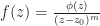
Theorem: An isolated singular point z_0 of a function f is a pole of order m if and only if f(z) can be written in the form f(z)=\frac{\phi(z)}{(z-z_0)^m} where \phi(z) is analytic and nonzero at z_0. Moreover \text{Res}_{z=z_0}f(z)=\phi(z_0) if m=1 and \text{Res}_{z=z_0}f(z)=\frac{\phi^(m-1)(z_0)}{(m-1)!}. if m\geq 2.

This is a very short crash course on the theorems needed. The next blog post on complex analysis will go into calculating some actual integrals.

Excellent Math Books for General Audience

Reading Math “General Audience” books can be a really enlightening experience. Not as dense as Math textbooks, they tell the story behind the great discoveries of Mathematicians. It is an excellent choice for parents who want to inspire and motivate their child about the beauty of Math, which is not just about exams / doing endless exercises.

Recently two books on the Poincare conjecture on Amazon caught my eye. This is the famous conjecture solved recently by Grigori Perelman, who is the first person ever to reject the Fields Medal. Definitely looking forward to read these two books.


The Poincare Conjecture: In Search of the Shape of the Universe


Poincare’s Prize: The Hundred-Year Quest to Solve One of Math’s Greatest Puzzles

Semisimple Modules Equivalent Conditions

Proposition:  For a right A-module M, the following are equivalent:

(i) M is semisimple.

(ii) M=\sum\{N\in S(M): N\ \text{is simple}\}.

(iii) S(M) is a complemented lattice, that is, every submodule of M has a complement in S(M).

We are following Pierce’s book’s Associative Algebras (Graduate Texts in Mathematics) notation, where S(M) is the set of all submodules of M.

This proposition is can be used to prove two useful Corollaries:

Corollary 1) If M is semisimple and P is a submodule of M, then both P and M/P are semisimple. In words, this means that submodules and quotients of a semisimple module is again semisimple.

Proof: Since M is semisimple, by (iii) we have M\cong P\oplus P', where P'\cong M/P. Let N be a submodule of P\leq M. Then N has a complement N' in S(M): M=N\oplus N'.

P=P\cap(N\oplus N')=N\oplus (N'\cap P) with N'\cap P\in S(P). Thus, we have that P is semisimple by condition (iii). Similarly, M/P\cong P' is semisimple.

Corollary 2) A direct sum of semisimple modules is semisimple.

Proof: This is quite clear from the definition of semisimple modules being direct sum of simple modules. A direct sum of (direct sum of simple modules) is again a direct sum of simple modules.

Free Gift by Giant (Singapore only)

http://www.giantsingapore.com.sg/cny2016/subscribe-to-newsletter/

Just to share a good deal with readers of my blog.

Once you subscribe to their newsletter, you will receive an email something like this. I have not claimed the prize yet, but heard it is a pair of USB speakers.

*The disclaimer is “Limited Stocks only”, and free things do run out quickly in Singapore!

Thank you for subscribing with us.

We are giving you a gift as a token of appreciation!

You may redeem the free gift at the Customer Service Counter of these 2 Hypermarkets only:

1. Tampines Hypermarket (21 Tampines North Drive 2 #03 -01 Singapore 528765)
2. IMM Hypermarket (2 Jurong East St 21 #01 -100 Singapore 609601)

Please print out this email and present it to customer service to redeem the free gift.
Please bring your Identification Card for verification purposes.

Terms & Conditions:
1. Redemption is valid from 15 Jan – 25 Jan or while stocks last. Limited Stocks only!
2. Only the hard copy of this email will be accepted.
3. Limited to 1 redemption per email address per name.
4. Giant reserves the right to change the free gift at its own discretion without prior notice.

Closure is linear subspace

Let X be normed linear space, Y a subspace of X. The closure of Y, \bar{Y}, is a linear subspace of X.

Proof:
We use the “sequential” equivalent definition of closure, rather than the one using open balls: \bar Y is the set of all limits of all convergent sequences of points in Y. Let z_1,z_2\in \bar{Y}, \alpha\in\mathbb{R}. There is a sequence (a_n) in Y such that a_n\to z_1. Similarly there is a sequence (b_n) in Y which converges to z_2.

Then (a_n+b_n) is a sequence in Y that converges to z_1+z_2. (\alpha a_n) is a sequence in Y that converges to \alpha z_1.

Mathematical Story Book (Flatland + Flatterland)

Parents who are looking for a book that can improve a child’s English / Math / logic skills simultaneously can consider Flatland & its sequel Flatterland. Many good reviews on Amazon, and it is considered a classic literature book.

This edition of Flatland is recommended, as it contains annotations by Ian Stewart, a famous mathematician author.


The Annotated Flatland: A Romance of Many Dimensions


Flatterland: Like Flatland, Only More So

Homotopy Theory on Simplicial Sets

Let f,g:X\to Y be simplicial maps. We say that f is homotopic to g (denoted by f\simeq g) if there exists a simplicial map F:X\times I\to Y such that F(x,0)=f(x) and F(x,1)=g(x) for all x\in X. If A is a simplicial subset of X and f,g:X\to Y are simplicial maps such that f|_A=g|_A, we say that f\simeq g\ \text{rel}\ A if there is a homotopy F:X\times I\to Y such that F(x,0)=f(x), F(x,1)=g(x) and F(a,t)=f(a) for all x\in X, a\in A, t\in I.

Let X be a simplicial set. The elements x_0,\dots,x_{i-1},x_{i+1},\dots,x_n\in X_{n-1} are said to be matching faces with respect to i if d_jx_k=d_kx_{j+1} for j\geq k and k,j+1\neq i.

A simplicial set X is said to be fibrant (or Kan complex) if it satisfies the following homotopy extension condition for each i:

Let x_0,\dots,x_{i-1},x_{i+1},\dots,x_n\in X_{n-1} be any elements that are matching faces with respect to i. Then there exists an element w\in X_n such that d_jw=x_j for j\neq i.

We define \Lambda^i[n] as the simplicial subset of \Delta[n] generated by all d_j\sigma_n for j\neq i, where \sigma_n=(0,1,\dots\,n)\in\Delta[n]_n is the nondegenerate element.

Proposition: Let X be a simplicial set. Then X is fibrant if and only if every simplicial map f:\Lambda^i[n]\to X has an extension for each i.

麦片虾 Cereal Prawn

Cereal Prawn cooked by my wife 🙂

chinesetuition88's avatarChinese Tuition Singapore

Recently, I found a recipe of cereal prawn on the internet. I tried it.


It is not bad, even though I used cornflakes instead of cereal, and green onion leaf instead of curry leaf.
The recipe is like this:


It is an easy way to cook cereal prawn.

Ingredients: prawns, cereal, curry leaf, butter, salt.
1. Clean prawns.

2. Pour some cooking oil into the pan, and deep fry the prawns.

3. Melt the butter with low heat. Put in the curry leaf, stir fry. Then put in the cereal.

4. When the cereal is fried evenly, put in the prawns. Stir fry a little and ladle out.

View original post

Cauchy’s Theorem

Cauchy’s Theorem:

Let R be the closed region consisting of all points interior to and on the simple closed contour C.

If f is analytic in R and f' is continuous in R,

\int_C f(z)\,dz=0

(This is the precursor of Cauchy-Goursat Theorem, which allows us to drop the condition that f' is continuous.)

Proof Using Green’s Theorem:

Let C denote a positively oriented simple closed contour z=z(t), a\leq t\leq b.

\int_C f(z)\,d(z)=\int_a^b f[z(t)]z'(t)\,dt where f(z)=u(x,y)+iv(x,y) and z(t)=x(t)+iy(t). Thus

\begin{aligned} \int_C f(z)\,dz&=\int_a^b (u+iv)(x'+iy')\,dt\\    &=\int_a^b (ux'-vy')\,dt+i\int_a^b (vx'+uy')\,dt\\    &=\int_C u\,dx-v\,dy+i\int_C v\,dx+u\,dy    \end{aligned}

Next, we need Green’s Theorem:

\int_C P\,dx+Q\,dy=\iint_R (Q_x-P_y)\,dA

By assumption f' is continuous in R, thus the first-order partial derivatives of u and v are also continous. This is exactly what we need for Green’s Theorem.

Continuing from above, we get \int_C f(z)\,dz=\iint_R (-v_x-u_y)\,dA+i\iint_R(u_x-v_y)\,dA which is exactly zero in view of the Cauchy-Riemann equations u_x=v_y, u_y=-v_x!

Schur’s Lemma

Schur’s Lemma is a useful theorem in algebra that is surprisingly easy to prove.

Schur’s Lemma: Let M and N be right A-modules and let \phi: M\to N be a nonzero A-module homomorphism.

(i) If M is simple, then \phi is injective.

(ii) If N is simple, then \phi is surjective.

(iii) If both M and N are simple then \phi is an isomorphism.

(iv) If M is a simple module, then \text{End}_A(M) is a division R-algebra.

Proof:

(i) \ker\phi is a submodule of M. Since \phi is nonzero, \ker\phi\neq M, which means \ker\phi=0.

(ii) \text{Im}\,\phi is a submodule of N. Since \text{Im}\,\phi\neq 0, \text{Im}\,\phi=N.

(iii) Combine (i) and (ii) to get \phi a bijective homomorphism.

(iv) \text{End}_A(M):=\text{Hom}_A(M,M) is an R-algebra. Let \phi:M\to M be an element in \text{Hom}_A(M,M). Since \phi is an isomorphism, its inverse \phi^{-1} exists. Then \phi\circ\phi^{-1}=\text{id}_M=\phi^{-1}\circ\phi. Thus \text{End}_A(M) is an division R-algebra.

RI’s O Level Scores: Only 1 student out of 10 made it to JC

Source: http://themiddleground.sg/2016/01/18/32412/

This is indeed very surprising news. One wonders what exactly has gone wrong in the system. One can’t help but feel sorry for the sportsmen who have trained hard and won awards for the school, but were dropped out of the IP track and were inadequately prepared for the O Level track.

The most telling phrase from the article is “He wondered if the school lost out because teachers were unfamiliar with the ‘O’ level syllabus: “When we were doing the paper, we all knew that something was wrong.””

Discussion on this topic can be found at:

https://www.reddit.com/r/singapore/comments/41jalb/ris_o_level_scores_only_one_in_class_of_10/

http://www.kiasuparents.com/kiasu/forum/viewtopic.php?f=1&t=85290&p=1630906&sid=9cff42ac3d643115c79f4b426a68ff40#p1630906

N is a simple nonzero right A-module (Equivalent Conditions)

Let N be a nonzero right A-module. Then the following are equivalent:

(i) N is simple.

(ii) uA=N for all u\in N\setminus\{0\}

(iii) N\cong A/M for some maximal right ideal M of A.

Proof: (i)=>(ii) Let u\in N\setminus \{0\}. uA is a submodule of N. (Let ua\in uA and a'\in A, then ua\cdot a'\in uA, ua_1+ua_2=u(a_1+a_2)\in uA). Since N is simple, uA\neq 0 implies uA=N.

(ii)=>(i) Condition (ii) implies that N is the only nonzero submodule of N, thus N is simple.

(ii)=>(iii) Let \psi:A\to N=uA, \psi(a)=ua. \psi is an A-linear map that is surjective, thus A/\ker\psi\cong N. M:=\ker\psi is a right ideal of A. Since (ii) implies (i), N is a simple module. Thus by Correspondence Theorem, M is a maximal right ideal.

(iii)=>(i) Follows from the Correspondence Theorem: The map S\mapsto S/M is a bijection from the set of submodules of A containing M and the submodules of A/M. Thus if M is maximal, the only submodules containing M are M and A, thus the only submodules of N\cong A/M are M/M\cong 0 and A/M\cong N, i.e. N is simple.

Norm of Cartesian Product

If we have two normed linear spaces Z and U, their Cartesian product Z\oplus U can also be normed, such as by setting |(z,u)|=|z|+|u|, |(z,u)|'=\max\{|z|,|u|\}, or |(z,u)|''=(|z|^2+|u|^2)^{1/2}. Note that we are following Lax’s Functional Analysis, where a norm is denoted as |\cdot |, rather than \|\cdot\| which is clearer but more cumbersome to write.

It is routine to check that all the above 3 are norms, satisfying the positivity, subadditivity, and homogeneity axioms. Minkowski’s inequality is useful to prove the subadditivity of the last norm.

We may check that all of the above 3 norms are equivalent. This follows from the inequalities \frac{1}{2}(|z|+|u|)\leq\max\{|z|,|u|\}\leq |z|+|u|, and M=(M^2)^{1/2}\leq (|z|^2+|u|^2)^{1/2}\leq (2M^2)^{1/2}=\sqrt 2 M, where M:=\max\{ |z|,|u|\}. In general, we have that all norms are equivalent in finite dimensional spaces.

{p(x)<1} is a Convex Set

This theorem can be considered a converse of a previous theorem.

Theorem: Let p denote a positive homogenous, subadditive function defined on a linear space X over the reals.

(i) The set of points x satisfying p(x)<1 is a convex subset of X, and 0 is an interior point of it.

(ii) The set of points x satisfying p(x)\leq 1 is a convex subset of X.

Proof: (i) Let K=\{x\in X\mid p(x)<1\}. Let x_1,x_2\in K. For 0\leq\alpha\leq 1,

\begin{aligned}p(\alpha x_1+(1-\alpha)x_2)&\leq \alpha p(x_1)+(1-\alpha)p(x_2)\\    &<\alpha+(1-\alpha)\\    &=1    \end{aligned}

Therefore K is convex. We also have p(0)=0\in K.

The proof of (ii) is similar.

Push-out

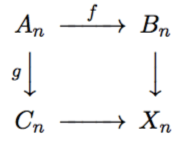
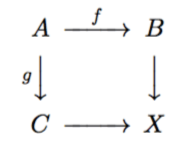
Let f:A\to B and g:A\to C be simplicial maps. We define X_n to be the push-out in the diagram
Screen Shot 2016-01-17 at 4.46.49 PM
i.e. X_n=B_n\coprod C_n/\sim, where \sim is the equivalence relation such that f(a)\sim g(a) for a\in A_n. Then X=\{X_n\}_{n\geq 0} with faces and degeneracies induced from that in B and C forms a simplicial set with a push-out diagram of simplicial sets
Screen Shot 2016-01-17 at 4.47.03 PM
For example, let \partial\Delta[n]=\langle d_i(0,1,\dots,n)\mid 0\leq i\leq n\rangle\subseteq \Delta[n] be the simplicial subset of \Delta[n] generated by all of the faces of the n-simplex \sigma_n=(0,1,\dots,n). Then
Screen Shot 2016-01-17 at 4.47.10 PM
is a push-out diagram, where f is the inclusion map and S^n=\Delta[n]/\partial\Delta[n].