Pokemon Go Singapore Dominated by CP >1000 Pokemon

Pokemon Go has finally arrived in Singapore! Good to see that the company Niantic did not forget about Singapore.

Upon starting the game, however, one would be in for a surprise. The gyms are all dominated by high level Pokemon, just merely hours after the release. (It is humanly impossible to have reached such a level in such a short time.)

For instance, the gyms near my neighbourhood has Gyarados (arguably the best Water Pokemon), Hypnos and Nidoqueen respectively. (See screenshot)

IMG_9686 IMG_9685 IMG_9684

How did these guys get these Pokemon is a good question. The possibilities are either GPS Spoof (E.g. by using VPN to access Pokemon Europe or USA), or that they really caught the Pokemon overseas. Either way, they would have had a headstart since Pokemon Go was released much earlier in USA/Europe/Australia.

Overall, Pokemon Go is a fun and unique game in the sense that it involves walking around in real environments. However, one letdown is that it is not very skill-based (unless one counts flicking Pokeballs as a skill). There is not much strategy involved (both catching or battling) for Pokemon Go.

There is one mathematical part of Pokemon Go: Determining which Pokemon to evolve based on IV (Initial Values). Some websites to help are: Pokeassistant, or TheSilphRoad. The difference between a bad or perfect Pokemon is only 10% though, so it will only make a difference in very close battles.


Pokémon Clip ‘N’ Carry Poké Ball Belt, Styles May Vary

(For those really into the game, may want to check these out while you hunt for Pokemon!)


Flyme Pokemon Go Cap ,Team Valor Team Mystic Team Instinct Baseball Cap Hat (Red)

Toddlers prepare for their first big interview

Source: BBC

Getting into good schools or universities is tough in many parts of the world, but in Hong Kong the pressure begins earlier. Often parents try to get children into a good kindergarten – and before that, into a good nursery. So there are now classes preparing toddlers for that all-important nursery interview.

Yoyo Chan is preparing for an important interview that could help her succeed in life. She is one-and-a-half years old.

At two she will start nursery, but competition is fierce in Hong Kong, and some of the most prestigious nurseries are selective. Her parents want her to be well-prepared for her first big test in life.

The best nurseries and kindergartens are seen as a gateway into the best primary schools – which in turn, parents believe, pave the way to the best secondary schools and universities.

So the most renowned of them can receive more than 1,000 applications for just a few dozen places. As a result, enterprising tuition companies are now offering interview training for toddlers.

Reliable Tuition Agency Singapore

Reliable Tuition Agency:

Startutor is Singapore’s most popular online agency, providing tutors to your home. There are no extra costs for making a request. The tutors’ certificates are carefully checked by Startutor.

(Website: http://startutor.sg/request,wwcsmt)

There are many excellent tutors from RI, Hwa Chong, etc. at Startutor, teaching various subjects at all levels.

High calibre scholars from NUS/overseas universities like Stanford are also tutoring at Startutor.

(Website: http://startutor.sg/request,wwcsmt)

(Please use the full link above directly, thanks!)

Fill in the request form in the link above to request for a tutor and our coordinators will attend to you within the day.

You get to enjoy the following:

  • Free matching service
  • No hidden charges
  • Commission is charged from tutor

Super All-rounder

Source: http://qz.com/603267/an-nfl-player-was-just-accepted-to-the-math-phd-program-at-mit/

This guy is the ultimate definition of “All rounded”. Good at both sports and studies. His motivation to play football is a little creepy though: “I play because I love the game. I love hitting people.” Note: American football is the “Upsized” version of the rugby in Singapore schools. Protective helmet and gear are needed.

The National Football League offseason is supposed to be a time for players to relax, recover from the brutality of the prior season, and prepare for the next one.

Not for Baltimore Ravens player John Urschel. The 6’3”, 305-pound offensive lineman will begin a PhD in mathematics at the Massachusetts Institute of Technology this year. The Hulk-like math geek, who graduated from Penn State with a 4.0 grade point average,will study spectral graph theory, numerical linear algebra, and machine learning.

Thallium Poisoning Mystery: Zhu Ling

This is a very old case, but the mystery of Thallium poisoning endures till today. The murderer is still walking scot-free to this day! Do spread this news, as the name “Zhu Ling” is in danger of being forgotten after more than 20 years. Zhu Ling was a very talented student in chemistry, music (she plays the ancient instrument Guqin) and literature.

To learn more or to donate, visit: http://www.helpzhuling.org/english.aspx

From late 1994 to early 1995, 21-year old Zhu Ling 朱令 was poisoned at Tsinghua, Beijing, one of the most prestigious universities in China. Globally, physicians reviewed her symptoms, which were sent to the Internet through a Usenet group after no correct diagnostics availed themselves for months. This world first ever large scale tele-medicine trial suggested thallium poisoning, which was subsequently proven, and its treatment. Her life was ultimately saved, but she suffered serious neurological damage and permanent physical impairment.

Who poisoned this promising and multi-talented young college girl? One of her dormitory roommates with strong political connections was the prime suspect. Yet the police closed the case in 1998 without a definitive conclusion, claimed due to evidences being stolen.

After 19 years, the murderer is still at large. And it may be someone around you, with a changed identity.

Image of Vertical Strip under Inversion

This is a slight generalisation of Example 3 in Churchill’s Complex Variables and Applications.

Consider the infinite vertical strip c_1<x<c_2, under the transformation w=1/z, where c_1, c_2 are of the same sign.

When x=c_1, note that by arguments similar to earlier analysis, we have x=\frac{u}{u^2+v^2}.

u^2+v^2=\frac{1}{c_1}u, upon completing the square, becomes

(u-\frac{1}{2c_1})^2+v^2=(\frac{1}{2c_1})^2 — Circle 1

Similarly the line x=c_2 is transformed into:

(u-\frac{1}{2c_2})^2+v^2=(\frac{1}{2c_2})^2 — Circle 2

Note that as x gets larger, the radius of the resultant circle gets smaller.

Thus, the resultant image is the (open) region between the two circles.

The converse holds too, i.e. the region between two circles will be mapped back to the vertical strip by inversion.

Example

Find an analytic isomorphism from the open region between the two circles |z|=1 and |z-\frac{1}{2}|=\frac{1}{2} to the vertical strip 0<\text{Re}(z)<1.

First, we “shift” the circles to the left by 1 unit via the map w=z-1. Now we are in the situation of our above analysis, thus inversion w=1/z maps the region to the vertical strip -1<x<-1/2. The map w=-z (reflection), followed by w=z-\frac{1}{2}, finally finishing up with a scaling of factor 2 brings us to the vertical strip desired.

Composition of all the above functions leads us to the desired transformation f(z)=2(\frac{-1}{z-1}-\frac 12)=\frac{-1-z}{z-1} to the very nice strip 0<\text{Re}(x)<1.

We will mention an analytic isomorphism of this vertical strip to the upper half plane \text{Im} z>0 in a subsequent blog post.

Clash of Clans Math – Using Linear Inequalities to Save Elixir

This is quite a nice video on Clash of Clans and Math. Only got 70 views so far, but it is definitely a well prepared video.

Another video:

Farming in Clash of Clans has just gotten harder, due to nerf on Town Hall not granting shield, and very powerful defenses for TH10 and TH11. Watch these videos and you may gain some idea on a better way to farm.

Definition of Tensor Product: M Tensor N

Let R be a commutative ring with 1 and let M and N be R-modules. This blog post will be about what is the R-module M\otimes_R N. The source of the material will primarily come from Abstract Algebra, 3rd Edition (by Dummit and Foote) which is a highly recommended Algebra book for undergraduates.

Motivation

The tensor product is a construction that, roughly speaking, allows us to take “products” mn of elements m\in M and n\in N.

Definition

(Following Dummit; there is another equivalent definition using “universal property”, see Wikipedia)

M\otimes_R N is the quotient of the free \mathbb{Z}-module over M\times N (also called module of the formal linear combinations of elements of M\times N) by the subgroup generated by elements of the form:

(m_1+m_2,n)-(m_1,n)-(m_2,n)

(m,n_1+n_2)-(m,n_1)-(m,n_2)

(mr,n)-(m,rn)

The outcome of the above definition is that the following nice properties hold:

(m_1+m_2)\otimes n=m_1\otimes n+m_2\otimes n

m\otimes (n_1+n_2)=m\otimes n_1+m\otimes n_2

mr\otimes n=m\otimes rn


Motivational: Kung Fu Panda 3 Song

The new Kung Fu Panda 3 song lyrics is out!

Very motivational lyrics. The title itself <Try> is very motivational.

“Only those who dare to fail greatly can ever achieve greatly.” ― Robert F. Kennedy

The full lyrics are as follows (includes some Chinese):

Try – 派伟俊/周杰伦
(《功夫熊猫3》电影全球主题曲)
中文词:方文山
英文词:冼佩瑾
曲:派伟俊
小派:You always have to do something
Just to show the world that you exist
So you try
You hope they’ll see
If on this brand new day you’ll look
On the bright side of the same old street
You will see
What you deserve
Jay:Let’s go
我说几华里我送别了过去
他们说人生的结局非常的戏剧
塞外羌笛孤城马蹄
在武侠的世界里谁与谁来为敌
合:La la la la la la la la la
黄沙里用竹笔写下的字叫勇气
Jay:You just have to try
To be who you are
And you ought to fly
Step into the light
小派:And soon you will find
Be yourself
Somewhere deep inside
There’s a universe right there waiting to be unlocked
The key lies in looking into yourself
Jay:Oh Try try try try
Just do what is right
You’ll fly so high
Let go of the brakes
Be who you are
Be yourself ’cause your power is on
合: When you believe in what you’ve got
You know you’re perfect just be who you are
小派:So they don’t see what you’re made of
But I like you and I know they’re wrong
Now it’s time
To show them what you got
Let the blue skies cheer you on
Embrace the wind we’ll ride along
You’re perfect when you’re who you are
Jay:这世界有些事有些人凭感觉
别管他旌旗密布遍野狼烟霜雪
那故事在穿越而我也在翻页
一行行做好准备敏锐而直接
合:La la la la la la la la la
爱不灭真实的一切废话全收回
小派:You just have to try
To be who you are
Jay:And you ought to fly
Step into the light
小派:And soon you will find
Be yourself
Somewhere deep inside
There’s a universe right there waiting to be unlocked
The key lies in looking into yourself
Jay:Oh Try try try try
Just do what is right
You’ll fly so high
Let go of the brakes
合: Be who you are
Be yourself ’cause your power is on
When you believe in what you’ve got
You know you’re perfect just be who you are
小派:You just have to try
To be who you are
Jay:And you ought to fly
Step into the light
小派:And soon you will find
Be yourself
Somewhere deep inside
There’s a universe right there waiting to be unlocked
The key lies in looking into yourself
Jay:Oh Try try try try
Just do what is right
You’ll fly so high
Let go of the brakes

合: Be who you are
Be yourself ’cause your power is on
When you believe in what you’ve got

Chinese Tuition

Chinese Tuition: http://chinesetuition88.com/

Chinese Tuition Singapore

新加坡华文补习老师

Tutor: Ms Gao (高老师)

Ms Gao is a patient tutor, and also effectively bilingual in both Chinese and English.

A native speaker of Mandarin, she speaks clearly with perfect accent and pronunciation. She is also well-versed in Chinese history, idioms and proverbs.

Ms Gao is able to teach Chinese at the Primary and Secondary school level. She will teach in an exam-oriented style, but will also try her best to make the lesson interesting for the student.

Ms Gao graduated from Huaqiao University, which is founded by late Chinese premier Zhou Enlai.

Contact:

Email: chinesetuition88@gmail.com

Website: http://chinesetuition88.com/

(Preferably looking for students staying in the West side of Singapore, e.g. Clementi / Dover / Jurong East / Boon Lay / Queenstown)

CW Approximation

A weak homotopy equivalence is a map f:X\to Y that induces isomorphisms \pi_n(X,x_0)\to\pi_n(Y,f(x_o)) for all n\geq 0 and all choices of basepoint x_0.

In other words, Whitehead’s theorem says that a weak homotopy equivalence between CW complexes is a homotopy equivalence. Just to recap, a map f:X\to Y is said to be a homotopy equivalence if there exists a map g:Y\to X such that fg\cong id_Y and gf\cong id_X. The spaces X and Y are called homotopy equivalent.

It turns out that for any space X there exists a CW complex Z and a weak homotopy equivalence f:Z\to X. This map f:Z\to X is called a CW approximation to X.

Excision for Homotopy Groups

According to Hatcher (Chapter 4.2), the main difficulty of computing homotopy groups (versus homology groups) is the failure of the excision property. However, under certain conditions, excision does hold for homotopy groups:

Theorem (4.23): Let X be a CW complex decomposed as the union of subcomplexes A and B with nonempty connected intersection C=A\cap B. If (A,C) is m-connected and (B,C) is n-connected, m,n\geq 0, then the map \pi_i(A,C)\to\pi_i(X,B) induced by inclusion is an isomorphism for i<m+n and a surjection for i=m+n.

Miscellaneous Definitions

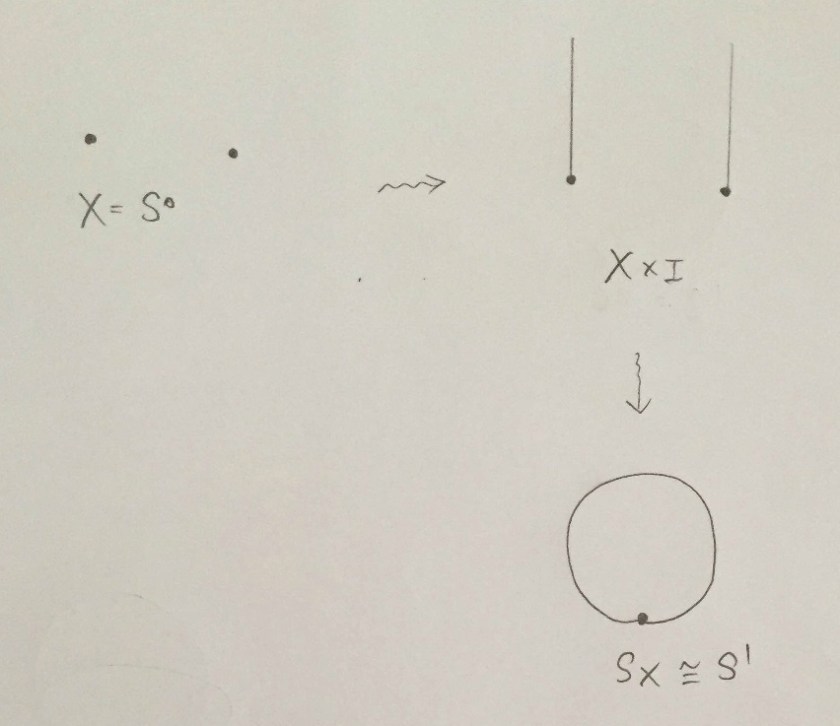
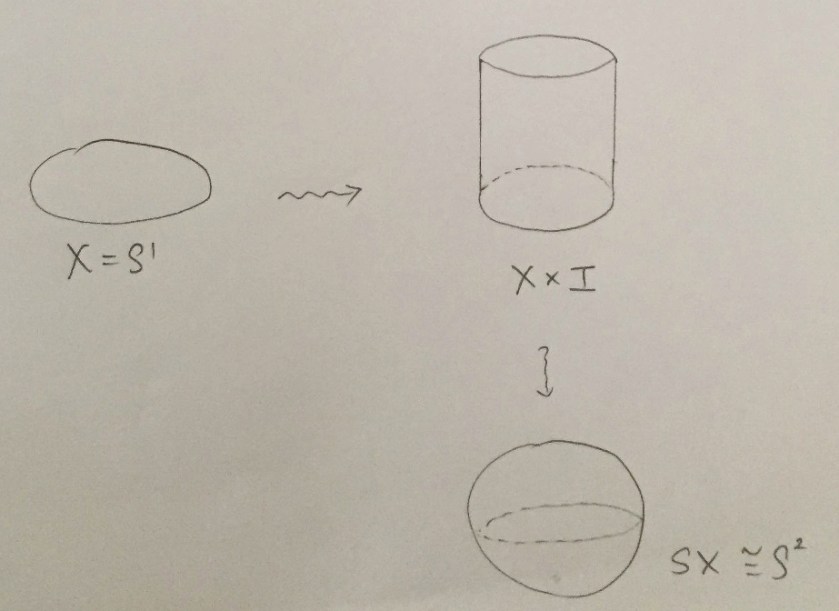
Suspension: Let X be a space. The suspension SX is the quotient of X\times I obtained by collapsing X\times\{0\} to one point and X\times\{1\} to another point.

The definition of suspension is similar to that of the cone in the following way. The cone CX is the union of all line segments joining points of X to one external vertex. The suspension SX is the union of all line segments joining points of X to two external vertices.

The classical example is X=S^n, when SX=S^{n+1} with the two “suspension points” at the north and south poles of S^{n+1}, the points (0,\dots,0,\pm 1).

Here are some graphical sketches of the case where X is the 0-sphere and the 1 sphere respectively.

s0

s1

Linear Fractional Transformation (Mobius Transformation)

The transformation w=\frac{az+b}{cz+d}, with ad-bc\neq 0, and a,b,c,d are complex constants, is called a linear fractional transformation, or Mobius transformation.

One key property of linear fractional transformations is that it transforms circles and lines into circles and lines.

Let us find the linear fractional transformation that maps the points z_1=2, z_2=i, z_3=-2 onto the points w_1=1, w_2=i, w_3=-1. (Question taken from Complex Variables and Applications (Brown and Churchill))

Solution: w=\frac{3z+2i}{iz+6}

What we have to do is basically solve the three simultaneous equations arising from w=\frac{az+b}{cz+d}, namely 1=\frac{2a+b}{2c+d}, i=\frac{ia+b}{ic+d} and -1=\frac{-2a+b}{-2c+d}.

Eventually we can have all the variables in terms of c: a=-3ic, b=2c, d=-6ic. Substituting back into the Mobius Transformation gives us the answer.

Donate to Singapore Charity @ Giving.sg

URL: https://www.giving.sg/

Just to introduce this website to readers who haven’t heard of it. Donations above $50 are tax deductible, and it also features ways to volunteer for the charity organisations. Do check it out!

Q: What is Giving.sg? (taken from their FAQ page)

A: Giving.sg is Singapore’s very own one-stop portal for empowering all of us on our Giving Journey, whether we are looking to help local non-profit organisations (NPOs) by giving our TIME, by general volunteering; our TALENT, by skills volunteering; or [our] TREASURE, by donations.

Giving.sg brings together its predecessors sggives.org and sgcares.org, both of which have helped raise over S$51 million for more than 350 [local] non-profits, as well as seen over 40,000 volunteers generously gift their time to these [local] non-profits.

News article featuring Giving.sg: http://www.straitstimes.com/singapore/online-platform-among-initiatives-to-promote-giving-in-singapore

Interesting Blog Post on Mathematical Conversations

Source: http://www.theliberatedmathematician.com/2015/12/why-i-do-not-talk-about-math/

A honest opinion on the nature of mathematical conversations, by this blog post author Piper Harron. (Also see our previous blog post on her interesting PhD Thesis) Very interesting read, for those who are in the mathematical community.

Cellular Approximation for Pairs

(This is Example 4.11 in Hatcher’s book).

Cellular Approximation for Pairs: Every map f:(X,A)\to (Y,B) of CW pairs can be deformed through maps (X,A)\to (Y,B) to a cellular map g:(X,A)\to (Y,B).

What “map of CW pairs” mean, is that f is a map from X to Y, and the image of A\subseteq X under f is contained in BCW pair (X,A) means that X is a cell complex, and A is a subcomplex.

First, we use the ordinary Cellular Approximation Theorem to deform the restriction f:A\to B to be cellular. We then use the Homotopy Extension Property to extend this to a homotopy of f on all of X. Then, use Cellular Approximation Theorem again to deform the resulting map to be cellular staying stationary on A.

We use this to prove a corollary: A CW pair (X,A) is n-connected if all the cells in X-A have dimension greater than n. In particular the pair (X,X^n) is n-connected, hence the inclusion X^n\hookrightarrow X induces isomorphisms on \pi_i for i<n and a surjection on \pi_n.

First we note that being n-connected means that the space is non-empty, path-connected, and the first n homotopy groups are trivial, i.e. \pi_i(X)\cong 0 for 1\leq i\leq n.

Proof: First, we apply cellular approximation to maps (D^i,\partial D^i)\to (X,A) with i\leq n, thus the map is homotopic to a cellular map of pairs g. Since all the cells in X-A have dimension greater than n, the n-skeleton of X must be inside A. Therefore g is homotopic to a map whose image is in A, and thus it is 0 in the relative homotopy group \pi_i(X,A). This proves that the CW pair (X,A) is n-connected. Note that 0-connected means path-connected.

Consider the long exact sequence of the pair (X,X^n):

\dots\to\pi_n(X^n,x_0)\xrightarrow{i_*}\pi_n(X,x_0)\xrightarrow{j_*}\pi_n(X,X^n,x_0)\xrightarrow{\partial}\pi_{n-1}(X^n,x_0)\to\dots\to\pi_0(X,x_0)

Since it is an exact sequence, the image of any map equals the kernel of the next. Thus, \text{Im}(i_*)=\ker j_*=\pi_n(X,x_0) (since \pi_n(X,X^n,x_0)=0). Thus i_* is surjective. Since \pi_n(X,X^n,x_0)=0, the later terms in the long exact sequence are also 0, thus, the inclusion X^n\hookrightarrow X induces isomorphisms on \pi_i for i<n, since the first n homotopy groups all vanish.

Star Wars Ball Droid: How is the head attached to the body?

Just watched Star Wars: The Force Awakens, here is my review on it. Overall a good movie, enjoyed watching it. The storyline and lightsaber duels are a bit weak in my opinion. How Rey, an untrained person holding a lightsaber for the first time, managed to defeat Kylo Ren with his crossguard lightsaber remains a mystery to me. My favorite episode remains Episode 1: The Phantom Menace.

Many mysteries remain unanswered, like the identities of Rey and Snoke. Looking forward to the next episode.

Something I find very interesting is the Ball Droid BB-8. Something even more interesting about the droid is that it is not CGI effects, it is a real prop. How the head of BB-8 is being attached to the body seems to be via strong magnets.

The toy-version of BB-8 is being sold on Amazon, a possible gift idea for those who are Star Wars fans. Sphero BB-8 App-Enabled Droid

Cellular Approximation Theorem and Homotopy Groups of Spheres

First we will state another theorem, Whitehead’s Theorem: If a map f:X\to Y between connected CW complexes induces isomorphisms f_*:\pi_n(X)\to\pi_n(Y) for all n, then f is a homotopy equivalence. If f is the inclusion of a subcomplex X\to Y, we have an even stronger conclusion: X is a deformation retract of Y.

The main theorem discussed in this post is the Cellular Approximation Theorem: Every map f:X\to Y of CW complexes is homotopic to a cellular map. If f is already cellular on a subcomplex A\subset X, the homotopy may be taken to be stationary on A. This theorem can be viewed as the CW complex analogue of the Simplicial Approximation Theorem.

Corollary: If n<k, then \pi_n(S^k)=0.

Proof: Consider S^n and S^k with their canonical CW-structure, with one 0-cell each, and with one n-cell for S^n and one k-cell for S^k. Let [f]\in\pi_n(S^k), where f:S^n\to S^k is a base-point preserving map. By the Cellular Approximation Theorem, f is homotopic to a cellular map g, where cells map to cells of same or lower dimension.

Since n<k, the n-cell S^n can only map to the 0-cell in S^k. The 0-cell in S^n (the basepoint) is also mapped to the 0-cell in S^k. Thus g is the constant map, hence \pi_n(S^k)=0.

Merry Christmas

Wishing all readers a Merry Christmas and Happy New Year!

For parents looking for an ideal Christmas gift for their child, do consider buying an enrichment book from Recommend Math Books. As a quote goes, “A book is a gift you can open again and again.” – Garrison Keillor

Some other excellent educational books for Christmas gifts are:

Another popular gift idea is the
All-New Kindle Paperwhite, 6″ High-Resolution Display (300 ppi) with Built-in Light, Wi-Fi – Includes Special Offers

Advanced Method for Proving Normal Subgroup

For beginners in Group Theory, the basic method to prove that a subgroup H is normal in a group G is to show that “left coset = right coset”, i.e. gH=Hg for all g\in G. Variations of this method include showing that ghg^{-1}\in H, gHg^{-1}=H, and so on.

This basic method is good for proving basic questions, for example a subgroup of index two is always normal. However, for more advanced questions, the basic method unfortunately seldom works.

A more sophisticated advanced approach to showing that a group is normal, is to show that it is a kernel of a homomorphism, and thus normal. Thus one often has to construct a certain homomorphism and show that the kernel is the desired subgroup.

Example: Let H be a subgroup of a finite group G and [G:H]=p, where p is the smallest prime divisor of |G|. Show that H is normal in G.

The result above is sometimes called “Strong Cayley Theorem”.

Proof: Let G act on G/H by left translation.

G\times G/H\to G/H, (g,xH)\to gxH.

This is a group action since 1\cdot xH=xH, and g_1(g_2\cdot xH)=g_1g_2xH=(g_1g_2)\cdot xH.

This action induces a homomorphism \sigma:G\to S_{G/H}\cong S_p. Let g\in\ker\sigma. \sigma(g)(xH)=xH for all xH\in G/H, i.e. gxH=xH for all x\in G. In particular when x=1, gH=H. This means that g\in H. So we have \ker\sigma\subseteq H.

Suppose to the contrary \ker\sigma\neq H, i.e. [H:\ker\sigma]>1. Let q be a prime divisor of [H:\ker\sigma].

We also have

[G:\ker\sigma]=[G:H][H:\ker\sigma]=p[H:\ker\sigma]

By the First Isomorphism Theorem, G/ker\sigma\cong\text{Im}\ \sigma\leq S_p. By Lagrange’s Theorem, [G:\ker\sigma]\mid p!, i.e. p[H:\ker\sigma]\mid p!. This implies [H:\ker\sigma]\mid(p-1)!. Finally, q\mid(p-1)! implies q\leq p-1<p.

However, q\mid [H:\ker\sigma] implies q\mid[G:\ker\sigma]=\frac{|G|}{|\ker\sigma|} which implies q\mid|G|.

This is a contradiction that p is the smallest prime divisor of |G|. Thus, H=\ker\sigma and therefore H is a normal subgroup.

This proof is pretty amazing, and hard to think of without any hints.

How to calculate Homology Groups (Klein Bottle)

This post will be a guide on how to calculate Homology Groups, focusing on the example of the Klein Bottle. Homology groups can be quite difficult to grasp (it took me quite a while to understand it). Hope this post will help readers to get the idea of Homology. Our reference book will be Hatcher’s Algebraic Topology (Chapter 2: Homology). I will elaborate further on the Hatcher’s excellent exposition on Homology.

This is also Exercise 5 in Chapter 2, Section 2.1 of Hatcher.

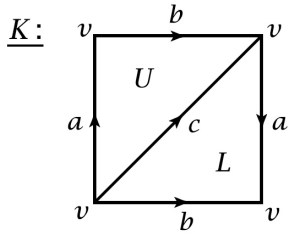
The first step to compute Homology Groups is to construct a \Delta-complex of the Klein Bottle.

klein bottle

One thing to note for \Delta-complexes, is that the vertices cannot be ordered cyclically, as that would violate one of the requirements which is to preserve the order of the vertices.

The key formula for Homology is: \boxed{H_n=\ker\partial_n/\text{Im}\ \partial_{n+1}}.

We have \ker\partial_0=\langle v\rangle, the free group generated by the vertex v, because there is only one vertex!

Next, we have \partial_1(a)=\partial_1(b)=\partial_1(c)=v-v=0. Thus \text{Im}\ \partial_1=0.

Therefore H_0=\ker\partial_0/\text{Im}\ \partial_1=\langle v\rangle /0\cong\mathbb{Z}.

Next, we have \ker\partial_1=\langle a,b,c\rangle. \partial_2U=a+b-c, \partial_2L=c+a-b. To learn more about calculating \partial_2, check out the diagram on page 105 of Hatcher.

We then have \text{Im}\ \partial_2=\langle a+b-c, c+a-b\rangle=\langle a+b-c, 2a\rangle, where we got 2a from adding the two previous generators (a+b-c)+(c+a-b).

Thus H_1=\ker\partial_1/\text{Im}\ \partial_2=\langle a,b,c\rangle/\langle a+b-c, 2a\rangle=\mathbb{Z}/2\mathbb{Z}\oplus\mathbb{Z}.

To intuitively understand the above working, we need to use the idea that elements in the quotient are “zero”. Hence a+b-c=0, implies that c=a+b, thus c can be expressed as a linear combination of a, b, thus is not a generator of H_1. 2a=0 implies that a+a=0, which gives us the \mathbb{Z}/2\mathbb{Z} part.

Finally we note that \ker\partial_2=0, and also for n\geq 3, \ker\partial_n=0 since there are no simplices of dimension greater than or equal to 3. Thus, the second homology group onwards are all zero.

In conclusion, we have H_k(K)=\begin{cases}\mathbb{Z}&k=0\\    \mathbb{Z}/2\mathbb{Z}\oplus\mathbb{Z}&k=1\\    0&\text{otherwise}    \end{cases}

Every non-empty open set in R is disjoint union of countable collection of open intervals

Question: Prove that every non-empty open set in \mathbb{R} is the disjoint union of a countable collection of open intervals.

The key things to prove are the disjointness and the countability of such open intervals. Otherwise, if disjointness and countability are not required, we may simply take a small open interval centered at each point in the open set, and their union will be the open set.

Elementary Proof: Let U be a non-empty open set in \mathbb{R}.

Let x\in U. There exists an open interval I\subseteq U containing x. Let I_x be the maximal open interval in U containing x, i.e. for any open interval I\subseteq U containing x, I\subseteq I_x. (The existence of I_x is guaranteed, we can take it to be the union of all open intervals I\subseteq U containing x.)

We note that such maximal intervals are equal or disjoint: Suppose I_x\cap I_y\neq\emptyset and I_x\neq I_y then I_x\cup I_y is an open interval in U containing x, contradicting the maximality of I_x.

Each of the maximal open intervals contain a rational number, thus we may write \displaystyle U=\bigcup_{q\in U\cap\mathbb{Q}}I_q. Upon discarding the “repeated” intervals in the union above, we get that U is the disjoint union of a countable collection of open intervals.

There are many other good proofs of this found here (http://math.stackexchange.com/questions/318299/any-open-subset-of-bbb-r-is-a-at-most-countable-union-of-disjoint-open-interv), though some can be quite deep for this simple result.


Useful Theorem in Introductory Ring Theory

Something interesting I realised in my studies in Math is that certain theorems are more “useful” than others. Certain theorems’ sole purpose seem to be an intermediate step to prove another theorem and are never used again. Other theorems seem to be so useful and their usage is everywhere.

One of the most “useful” theorems in basic Ring theory is the following:

Let R be a commutative ring with 1 and I an ideal of R. Then

(i) I is prime iff R/I is an integral domain.

(ii) I is maximal iff R/I is a field.

With this theorem, the following question is solved effortlessly:

Let R be a commutative ring with 1 and let I and J be ideals of R such that I\subseteq J.

(i) Show that J is a prime ideal of R iff J/I is a prime ideal of R/I.

(ii) Show that J is a maximal ideal of R iff J/I is a maximal ideal of R/I.

Sketch of Proof of (i):

J is a prime ideal of R iff R/J is an integral domain. (R/J\cong \frac{R/I}{J/I} by the Third Isomorphism Theorem. )\iff J/I is a prime ideal of R/I.

(ii) is proved similarly.


Live your Dream (Motivational Video) 夢想.激勵人心的演說

Just to share a very inspiring motivational video from YouTube. Not sure which movie it is from. (any readers know, please comment below as I would be interested)

Highly suitable for students (and their parents) who have just completed their PSLE, whether their PSLE 2015 results are good or not, it is now a good time to reflect on their dreams and the next step to take in the next year 2016.

|HK|=|H||K|/|H intersect K|

Finally, the LaTeX path not specified problem has been solved by WordPress!

This post is about how to prove that |HK|=\frac{|H||K|}{|H\cap K|}, where H and K are finite subgroups of a group G.

A tempting thing to do is to use the “Second Isomorphism Theorem”, HK/H\cong K/(H\cap K). However that would be a serious mistake since the conditions for the Second Isomorphism Theorem are not met. In fact HK may not even be a group.

The correct way is to note that HK=\bigcup_{h\in H}hK.

Therefore |HK|=|K|\times |\{hK:h\in H\}|. For h_1,h_2\in H, we have:

\begin{aligned}h_1K=h_2K&\iff h_1h_2^{-1}\in K\\    &\iff h_1h_2^{-1}\in H\cap K\\    &\iff h_1(H\cap K)=h_2(H\cap K)    \end{aligned}

Therefore |\{hK:h\in H\}|=|\{h(H\cap K):h\in H\}|, i.e. the number of distinct cosets h(H\cap K). Since H\cap K is a subgroup of H, applying Lagrange’s Theorem gives the number of distinct cosets h(H\cap K) to be \frac{|H|}{|H\cap K|}.

Thus, we have |HK|=\frac{|H|}{|H\cap K|}\cdot |K|.


Undergraduate Math Books


“latex path not specified” WordPress LaTeX Bug

Recently, there is a “latex path not specified” WordPress LaTeX bug, it is very weird. Some LaTeX expressions will get rendered and some will not. Will have to postpone my math blogging till it is fixed. Worst case scenario is I have to abandon this blog and move to Blogger (http://mathtuition88.blogspot.com) if the issue remains unfixed.

Testing: x, y, z, e^{i\pi}+1=0.

Hope this bug gets fixed soon. If anyone knows the solution to solve this bug, please inform me in the comments below!

Note: Thanks to Professor Terence Tao who has replied in the comments below and shown us a link where there is ongoing discussion about the highly mysterious “latex path not specified” issue.

Interesting Measure and Integration Question

Let (\Omega,\mathcal{A},\mu) be a measure space. Let f\in L^p and \epsilon>0. Prove that there exists a set E\in\mathcal{A} with \mu(E)<\infty, such that \int_{E^c} |f|^p<\epsilon.

Solution:

The solution strategy is to use simple functions (common tactic for measure theory questions).

Let 0\leq\phi\leq |f|^p be a simple function such that \int_\Omega (|f|^p-\phi)\ d\mu<\epsilon.

Consider the set E=\{\phi>0\}. Note that \int_\Omega \phi\ d\mu\leq\int_\Omega |f|^p\ d\mu<\infty. Hence each nonzero value of \phi can only be on a set of finite measure. Since \phi has only finitely many values, \mu(E)<\infty.

Then,

\begin{aligned} \int_{E^c}|f|^p\ d\mu&=\int_{E^c} (|f|^p-\phi)\ d\mu +\int_{E^c}\phi\ d\mu\\    &\leq \int_\Omega (|f|^p-\phi)\ d\mu+0\\    &<\epsilon    \end{aligned}

Order of a^k (Group Theory)

Sincere thanks to readers who have completed the Free Personality Quiz!


Today we will revise some basic Group Theory. Let G be a group and a\in G. Assume that a has finite order n. Find the order of a^k where k is an integer.

Answer: \displaystyle|a^k|=\frac{n}{(n,k)}, where (n,k)=\gcd(n,k).

Proof:

Our strategy is to prove that m=\frac{n}{(n,k)} is the least smallest integer such that (a^k)^m=1.

Now, we have \displaystyle a^{k\cdot\frac{n}{(n,k)}}=(a^n)^{\frac{k}{(n,k)}}=1. Note that k/(n,k) is an integer and thus a valid power.

Suppose to the contrary there exists c<\frac{n}{(n,k)} such that a^{kc}=1.

Since a has finite order n, we have n\mid kc, which leads to \displaystyle\frac{n}{(n,k)}\mid\frac{k}{(n,k)}\cdot c. Note that \frac{n}{(n,k)} and \frac{k}{(n,k)} are relatively prime.

Thus \frac{n}{(n,k)}\mid c, which implies that \frac{n}{(n,k)}\leq c which is a contradiction. This proves our result. 🙂

Students in Singapore going for ‘ad-hoc’ tuition in specific topics

http://www.straitstimes.com/singapore/education/students-going-for-ad-hoc-tuition?&utm_source=google_gmail&utm_medium=social-media&utm_campaign=addtoany

Instead of committing to regular tuition sessions throughout the year, some students who need academic help are choosing to attend such classes on an “ad-hoc” basis.. Read more at straitstimes.com.

Video on Computing Homology Groups

Just watched this again. I can truely say that this is the most clear explanation of Homology on the entire internet!

mathtuition88's avatarMathtuition88

This video follows after the previous video on Simplicial Complexes.

If you are looking for quality Math textbooks to study from (including Linear Algebra and Calculus, the two most popular Math courses), check out my page on Recommended Math Books for students!

View original post

Curious Inequality: 2^p(|a|^p+|b|^p)>=|a+b|^p

Try out the Personality Quiz!

This inequality often appears in Analysis: 2^p(|a|^p+|b|^p)\geq |a+b|^p, for p\geq 1, and a,b\in\mathbb{R}. It does seem quite tricky to prove, and using Binomial Theorem leads to a mess and doesn’t work!

It turns out that the key is to use convexity, and we can even prove a stronger version of the above, namely 2^{p-1}(|a|^p+|b|^p)\geq |a+b|^p.

Proof: Consider f(x)=|x|^p which is convex on \mathbb{R}. Let a,b\in\mathbb{R}. By convexity, we have \displaystyle\boxed{f(ta+(1-t)b)\leq tf(a)+(1-t)f(b)} for 0\leq t\leq 1.

Choose t=1/2. Then we have f(\frac{1}{2}a +\frac 12 b)\leq \frac 12 f(a)+\frac 12 f(b), which implies |\frac{a+b}{2}|^p\leq\frac{1}{2}|a|^p+\frac{1}{2}|b|^p.

Thus,

\begin{aligned}|a+b|^p&\leq 2^{p-1}|a|^p+2^{p-1}|b|^p\\    &\leq 2^p|a|^p+2^p|b|^p\\    &=2^p(|a|^p+|b|^p)    \end{aligned}

Mathematician’s life begins at 40

André Weil, the French mathematician, when still a student in University at Ecole Normale Superieur before WW 2, started the “Bourbaki” Club with the intention to change all Math Teaching using modern math from Set Theory.

Shimura was the Japanese mathematician, together with Taniyama, discovered the conjecture upon which Fermat’s Last Theorem was finally proved by Andrew Wiles in 1993/4.

tomcircle's avatarMath Online Tom Circle

André Weil told the Japanese professor Goro Shimura that Prof GH Hardy talked nonsense, mathematics is not necessary for young men below 35.

Recent math breakthroughs are accomplished by men above 40, because Math needs “Logic as well as Intuition” – both take lengthy research, perseverance and team efforts by other pioneers, as illustrated below:

http://m.scmp.com/lifestyle/technology/article/1256542/zhang-yitang-proof-mathematicians-life-begins-40

View original post

Twin Prime Hero

tomcircle's avatarMath Online Tom Circle

http://simonsfoundation.org/features/science-news/unheralded-mathematician-bridges-the-prime-gap/

On April 17, 2013, a paper arrived in the inbox of Annals of Mathematics, one of the discipline’s preeminent journals. Written by a mathematician virtually unknown to the experts in his field — a 50-something lecturer at the University of New Hampshire named Yitang Zhang — the paper claimed to have taken a huge step forward in understanding one of mathematics’ oldest problems, the twin primes conjecture.

Editors of prominent mathematics journals are used to fielding grandiose claims from obscure authors, but this paper was different. Written with crystalline clarity and a total command of the topic’s current state of the art, it was evidently a serious piece of work, and the Annals editors decided to put it on the fast track.

Yitang Zhang (Photo: University of New Hampshire)

Just three weeks later — a blink of an eye compared to the usual pace of mathematics journals — Zhang…

View original post 232 more words

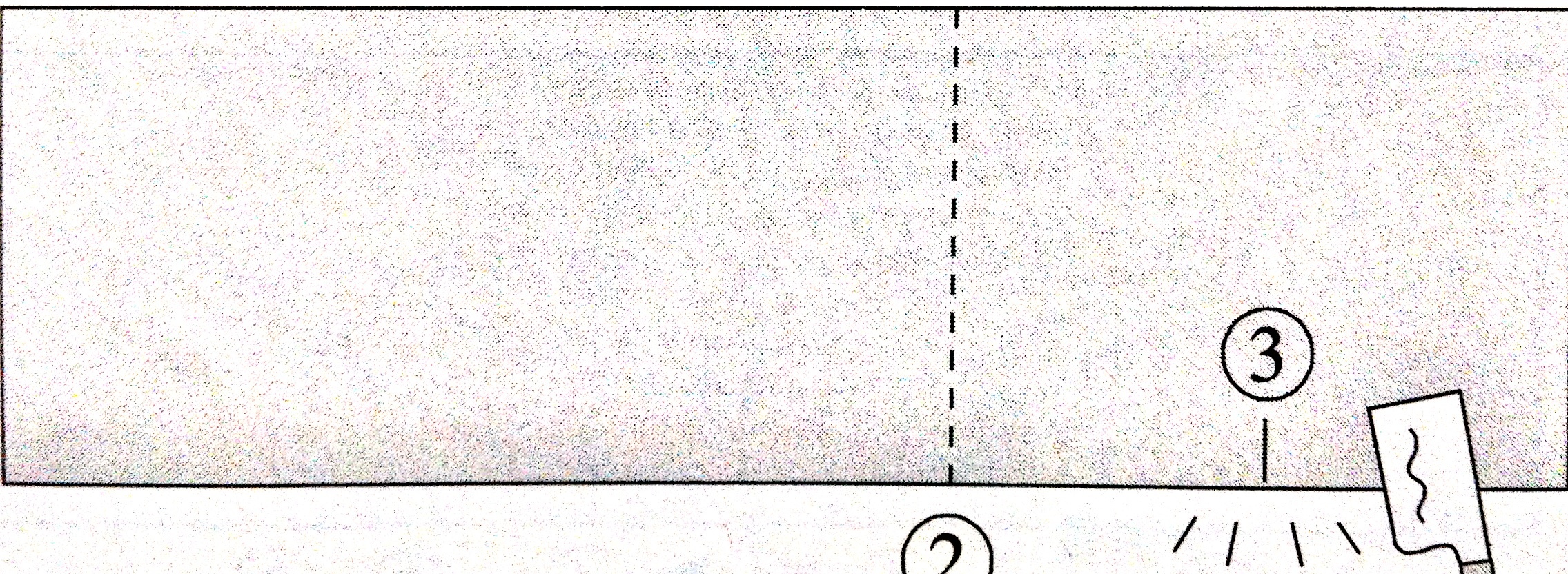
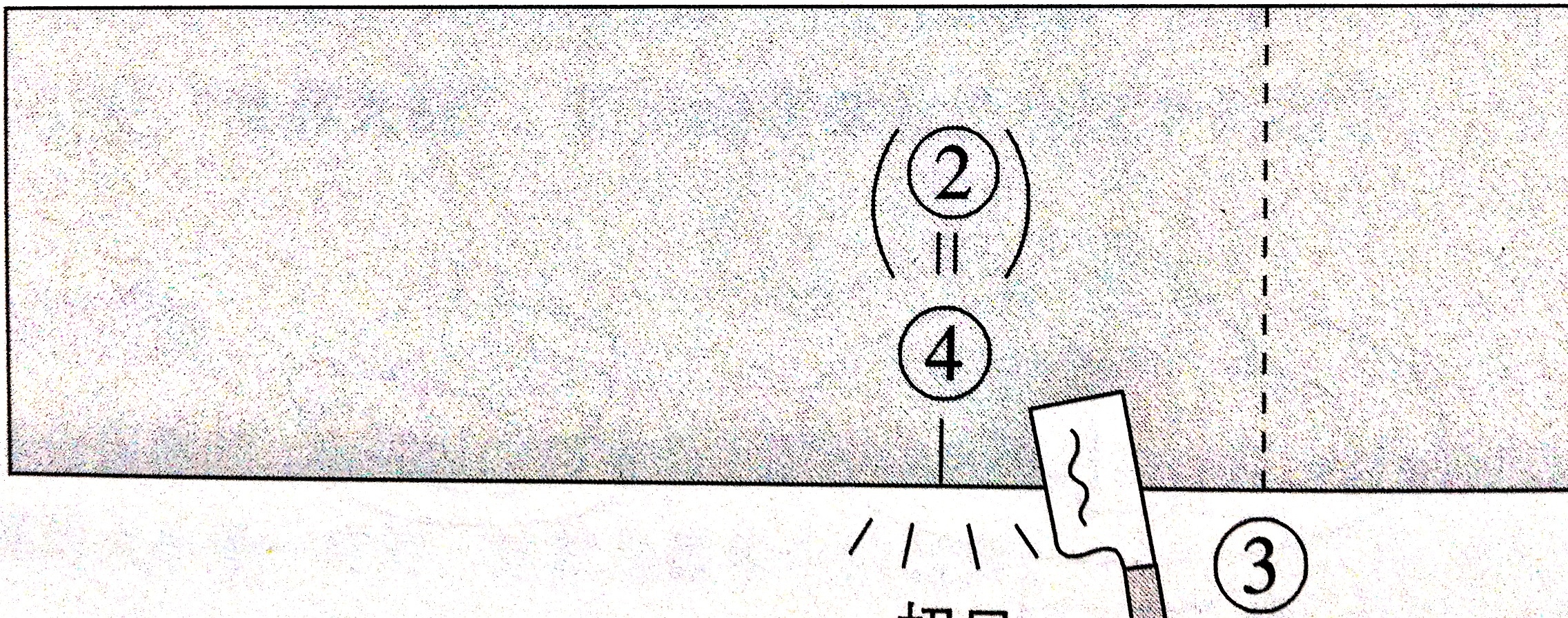
Cut a cake 1/5

tomcircle's avatarMath Online Tom Circle

Visually cut a cake 1/5 portions of equal size:

1) divide into half:

20130513-111010.jpg

2) divide 1/5 of the right half:

20130513-133441.jpg

3) divide half, obtain 1/5 = right of (3)

$latex frac{1}{5}= frac{1}{2} (frac{1}{2}(1- frac{1}{5}))= frac{1}{2} (frac{1}{2} (frac{4}{5}))=frac{1}{2}(frac{2}{5})$

20130513-171052.jpg

4) By symmetry another 1/5 at (2)=(4)

20130513-174541.jpg

5) divide left into 3 portions, each 1/5

$latex frac{1}{5}= frac{1}{3}(frac{1}{2}+ frac{1}{2}.frac{1}{5}) = frac{1}{3}.frac{6}{10}$

20130513-174742.jpg

View original post

Introducing WordAds 2.0

WordAds 2.0 is out. Hope it is good news for international WordPress blogs, who are getting much lower ad revenue compared to the US and Europe.

James Huff's avatarWordAds

Today, we’re excited to introduce you to a new WordAds. On the front end, it’s a simpler and more streamlined experience like never before. On the back-end we have launched a real-time bidding platform to maximize earnings and ad creative control. Say hello to WordAds 2.0!

WordAds 2.0 is now fully integrated where you control the rest of your blog, in WordPress.com’s main Settings interface. You can also view your Earnings reports here and manage your payout information.

Screen Shot

Existing WordAds users aren’t the only ones to benefit from the changes in WordAds 2.0. For new users, we have done away with the separate application process. Any family friendly WordPress.com blog with minimal page views will be considered for immediate admission to WordAds.

Bigger changes are now live in our real time bidding environment. We have dozens of ad agencies and buyers bidding in real time on each of our global…

View original post 92 more words

Projective Space Explicit Homotopy (RP1 to RP2)

Free Career Personality Quiz

The above video describes the real projective plane (\mathbb{R}P^2).

The projective space \mathbb{R}P^n can be defined as the quotient space of S^n by the equivalence relation x\sim -x for x\in S^n.

Notation: For x=(x_1,\dots, x_{n+1})\in S^n, we write [x_1, x_2,\dots, x_{n+1}] for the corresponding point in \mathbb{R}P^n. Let f,g: \mathbb{R}P^1\to\mathbb{R}P^2 be the maps defined by f[x,y]=[x,y,0] and g[x,y]=[x,-y,0].

How do we construct an explicit homotopy between f and g? A common mistake is to try  the “straight-homotopy”, e.g. F([x,y],t)=[x,(1-2t)y,0]. This is a mistake as it passes through the point [0,0,0] which is not part of the projective plane.

A better approach is to consider F:\mathbb{R}P^1\times I\to\mathbb{R}P^2, defined by \boxed{F([x,y],t)=[x,(\cos\pi t)y, (\sin\pi t)y]}.

Note that if x^2+y^2=1, then x^2+[(\cos\pi t)y]^2+[(\sin\pi t)y]^2=x^2+y^2=1.

F([x,y],0)=[x,y,0]

F([x,y],1)=[x,-y,0]

Calculus World Cup

Just to share this news: 

The National Taiwan University is holding the first ever Calculus World Cup (CWC) in February 2016. It’s the first time students from global top universities will be able to compete over Calculus in e-sports. The competition will be held on PaGamO – a social online gaming platform for education. The top 12 teams will be invited to Taiwan for the final round, and great prizes with a value of over $70,000 await the finalists! 
Official website: http://cwc.pagamo.com.tw

Registration: https://pagamo.com.tw/calculus_cup

Facebook: https://www.facebook.com/PaGamo.glo