https://mathtuition88.com/group-tuition/
Maths Tuition @ Bishan starting in 2014.
Secondary 4 O Level E Maths and A Maths.
Patient and Dedicated Maths Tutor (NUS Maths Major 1st Class Honours, Dean’s List, RI Alumni)
Email: mathtuition88@gmail.com

https://mathtuition88.com/group-tuition/
Maths Tuition @ Bishan starting in 2014.
Secondary 4 O Level E Maths and A Maths.
Patient and Dedicated Maths Tutor (NUS Maths Major 1st Class Honours, Dean’s List, RI Alumni)
Email: mathtuition88@gmail.com
https://mathtuition88.com/group-tuition/
Maths Tuition @ Bishan starting in 2014.
O Level E Maths and A Maths.
Patient and Dedicated Maths Tutor (NUS Maths Major 1st Class Honours, Dean’s List, RI Alumni)
Email: mathtuition88@gmail.com

Source: http://www.channelnewsasia.com/news/singapore/teachers-have-profound/803528.html
Education Minister Heng Swee Keat said teachers “grow knowledge, instill beliefs, inculcate values, nurture passion, and in so doing, they shape the future” of students.
 File photo: Minister for Education Heng Swee Keat
SINGAPORE: Education Minister Heng Swee Keat said on Thursday “teachers affect all of us more deeply” than one can know.
In a Facebook post ahead of Teachers’ Day on Friday, Mr Heng sent his warmest thoughts and admiration to all teachers who dedicate themselves to bringing out the best in children.
In the tribute to all teachers, Mr Heng said they “grow knowledge, instill beliefs, inculcate values, nurture passion, and in so doing, they shape the future” of their students.
He added that every child who grows up confident and compassionate has been affected by a caring teacher in some way.
Mr Heng said in order to give every child a profound educational experience, every teacher must be a caring educator.
Continue reading at http://www.channelnewsasia.com/news/singapore/teachers-have-profound/803528.html
Firstly, apologies for the long gap. Very far from being Theorem of the Week, I know. Here’s another theorem for now, and I’ll do what I can to revert to a weekly post.
So, to this week’s theorem. I have previously promised to write about Fermat‘s Little Theorem, and I think it’s time to keep that promise. In that post (Theorem 10, about Lagrange’s theorem in group theory), I introduced the theorem, so I’m going to state it straightaway. If you haven’t seen the statement before, I suggest you look back at that post to see an example.
Theorem (Fermat’s Little Theorem) Let $latex p$ be a prime, and let $latex a$ be an integer not divisible by $latex p$. Then $latex a^{p-1} \equiv 1\mod{p}$.
If you aren’t comfortable with the notation of modular arithmetic, you might like to phrase the conclusion of the theorem as saying that $latex…
View original post 1,073 more words
Senior Wrangler is the First position in the Math Tripos in Cambridge. Singapore Prime Minister Lee Hsien Loong was the Senior Wrangler in 1973, the first Singaporean student with such great honors, among other senior wranglers like Arthur Cayley (Group Theory), J.J. Sylvester (Inventor of Matrix, private tuitor of the “inventor of Nursing” Florence Nightingale), J.E. Littlewood (partnered in a twin research team with G.H. Hardy), Frank Ramsey (Ramsey’s Theorem), Stokes, Pell, etc.
Some great mathematicians like Bertrand Russell (Logician, Nobel Litterature Prize) , G.H. Hardy (20th century greatest Pure Mathematician, mentored 2 geniuses: Indian Ramanujian and Chinese Hua Luogeng 华罗庚*) were not Senior Wrangler. Prof Hardy hated Math Tripos syllabus (revealed in his autobiography: “A Mathematician’s Apology“).
1914 Brian Charles Molony
1923 Frank Ramsey
1928 Donald Coxeter
1930 Jacob Bronowski
1939 James Wilkinson
1940 Hermann Bondi
1952 John Polkinghorne
1953 Crispin Nash-Williams
1959 Jayant Narlikar
1970 Derek…
View original post 193 more words
Forty years ago, in a paper in American Scientist, Herbert Simon and William Chase drew one of the most famous conclusions in the study of expertise:
There are no instant experts in chess—certainly no instant masters or grandmasters. There appears not to be on record any case (including Bobby Fischer) where a person reached grandmaster level with less than about a decade’s intense preoccupation with the game. We would estimate, very roughly, that a master has spent perhaps 10,000 to 50,000 hours staring at chess positions…
In the years that followed, an entire field within psychology grew up devoted to elaborating on Simon and Chase’s observation—and researchers, time and again, reached the same conclusion: it takes a lot of practice to be good at complex tasks. After Simon and Chase’s paper, for example, the psychologist John Hayes looked at seventy-six famous classical composers and found that, in almost every case, those composers did not create their greatest work until they had been composing for at least ten years. (The sole exceptions: Shostakovich and Paganini, who took nine years, and Erik Satie, who took eight.)
This is the scholarly tradition I was referring to in my book “Outliers,” when I wrote about the “ten-thousand-hour rule.” No one succeeds at a high level without innate talent, I wrote: “achievement is talent plus preparation.” But the ten-thousand-hour research reminds us that “the closer psychologists look at the careers of the gifted, the smaller the role innate talent seems to play and the bigger the role preparation seems to play.” In cognitively demanding fields, there are no naturals. Nobody walks into an operating room, straight out of a surgical rotation, and does world-class neurosurgery. And second—and more crucially for the theme of Outliers—the amount of practice necessary for exceptional performance is so extensive that people who end up on top need help. They invariably have access to lucky breaks or privileges or conditions that make all those years of practice possible. As examples, I focussed on the countless hours the Beatles spent playing strip clubs in Hamburg and the privileged, early access Bill Gates and Bill Joy got to computers in the nineteen-seventies. “He has talent by the truckload,” I wrote of Joy. “But that’s not the only consideration. It never is.”
Continue reading at http://www.newyorker.com/online/blogs/sportingscene/2013/08/psychology-ten-thousand-hour-rule-complexity.html
Attached below are the Formula Lists for E Maths and A Maths (O Level)
Do be familiar with all the formulas for Elementary Maths and Additional Maths inside, so that you know where to find it when needed!
Wishing everyone reading this all the best for their exams. 🙂
For Mathematics Tuition, contact Mr Wu at:
Email: mathtuition88@gmail.com
Tutor profile: About Tutor
Subscribe to our free newsletter, for updates on Math, Education and other General Knowledge topics!

Secrets of Mental Math: The Mathemagician’s Guide to Lightning Calculation and Amazing Math Tricks

By Simon Singh
Synopsis: ‘I have a truly marvellous demonstration of this proposition which this margin is too narrow to contain.’
It was with these words, written in the 1630s, that Pierre de Fermat intrigued and infuriated the mathematics community. For over 350 years, proving Fermat’s Last Theorem was the most notorious unsolved mathematical problem, a puzzle whose basics most children could grasp but whose solution eluded the greatest minds in the world. In 1993, after years of secret toil, Englishman Andrew Wiles announced to an astounded audience that he had cracked Fermat’s Last Theorem. He had no idea of the nightmare that lay ahead.
In ‘Fermat’s Last Theorem’ Simon Singh has crafted a remarkable tale of intellectual endeavour spanning three centuries, and a moving testament to the obsession, sacrifice and extraordinary determination of Andrew Wiles: one man against all the odds.
First Published: 1997, Reissued: 2002| ISBN-13: 978-1841157917
Author’s…
View original post 51 more words
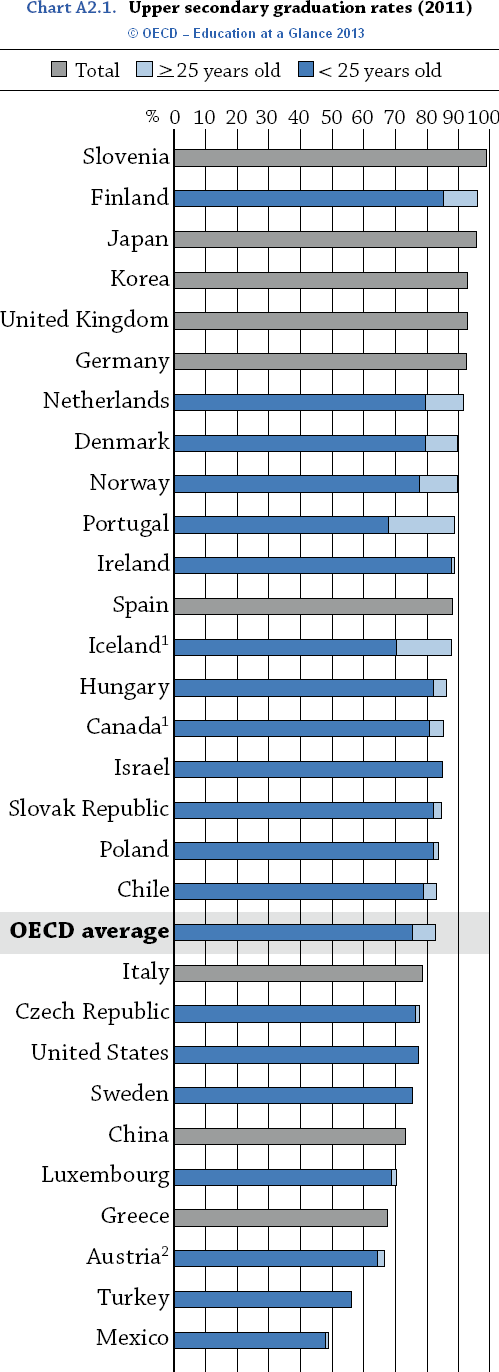
► See the top performers in reading, mathematics and science (on this page).
Chart A2·1 [ page 42] ranks countries, in descending order, according to the percentage of adults who have completed an upper secondary education (the most recent data in the 2013 report is from 2011).
View original post 765 more words

I suppose every reader of this ‘ere blog will know Heron’s formula for the area $latex K$ of a triangle with sides $latex a,b,c$:
$latex K = \sqrt{s(s-a)(s-b)(s-c)}$
where $latex s$ is the “semi-perimeter”:
$latex \displaystyle{s=\frac{a+b+c}{2}.}$
The formula is not at all hard to prove: see the Wikipedia page for two elementary proofs.
However, I have only recently become aware of Brahmagupta’s formula for the area of a cyclic quadrilateral. A cyclic quadrilateral, if you didn’t know, is a (convex) quadrilateral all of whose points lie on a circle:

And if the edges have lengths $latex a,b,c,d$ as shown, then the formula states that the area is given by
$latex K = \sqrt{(s-a)(s-b)(s-c)(s-d)}$
where as above $latex s$ is the semi-perimeter:
$latex \displaystyle{s=\frac{a+b+c+d}{2}.}$
This can be seen to be a generalization of Heron’s formula. Although the formula is named for Brahmagupta (598 – 670), who does indeed seem to…
View original post 182 more words
Recently, in The Conversation, the Vice Chancellor of Monash University, wrote an article discussing MOOCs. He made some criticisms about the nature of assessment and grading that MOOCs offer. However, my attention was grabbed by two sentences:
The other major problem the MOOCs haven’t solved is assessment. They work very well for subjects like maths, which have objectively right and wrong answers, and can therefore be pretty easily marked by computers.
Now, here we have the Vice Chancellor of one of Australia’s leading universities – and indeed, one of the world’s leading universities (and incidently the University where I did both my Masters and my PhD) demonstrating an extraordinary lack of understanding about the fundamental nature of mathematics. He seems to think that mathematics is all about teaching students (in the fine words of John Power from Leeds University) about “finding ‘x'”. I suppose he thinks this…
View original post 662 more words
WordPress.com supports LaTeX, a document markup language for the TeX typesetting system, which is used widely in academia as a way to format mathematical formulas and equations. LaTeX makes it easier for math and computer science bloggers and other academics in our community to publish their work and write about topics they care about.
If you’re a math genius — many of you are! — and you’ve blogged about equations you’ve worked on, you’ve probably used LaTeX before. If you’re just starting out (or simply curious to see how it all works), we’ve gathered a few examples of great math and computing blogs on WordPress.com that will inspire you.
In general, to display formulas and equations, you place LaTeX code in between $latex and $, like this:
$latex YOUR LATEX CODE HERE$
So for example, inserting this when you’re creating a post . . .
$latex i\hbar\frac{\partial}{\partial…
View original post 801 more words
A tutor is an instructor who gives private lessons. The most famous example of a tutor is Aristotle, who tutored Alexander the Great.

Source: http://en.wikipedia.org/wiki/Aristotle
Aristotle (Ancient Greek: Ἀριστοτέλης [aristotélɛːs], Aristotélēs) (384 BC – 322 BC)[1] was a Greek philosopher and polymath, a student of Plato and teacher of Alexander the Great. His writings cover many subjects, including physics, metaphysics, poetry, theater, music, logic, rhetoric, linguistics, politics, government, ethics, biology, and zoology. Together with Plato and Socrates (Plato’s teacher), Aristotle is one of the most important founding figures in Western philosophy. Aristotle’s writings were the first to create a comprehensive system of Western philosophy, encompassing ethics, aesthetics, logic, science, politics, and metaphysics.
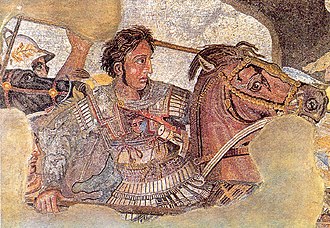
Source: http://en.wikipedia.org/wiki/Alexander_the_Great
Alexander III of Macedon (20/21 July 356 – 10/11 June 323 BC), commonly known as Alexander the Great (Greek: Ἀλέξανδρος ὁ Μέγας, Aléxandros ho Mégasiii[›] from the Greek ἀλέξω alexo “to defend, help” + ἀνήρ aner “man”), was a king of Macedon, a state in northern ancient Greece. Born in Pella in 356 BC, Alexander was tutored by Aristotle until the age of 16. By the age of thirty, he had created one of the largest empires of the ancient world, stretching from the Ionian Sea to the Himalayas.[1] He was undefeated in battle and is considered one of history’s most successful commanders.[2]
https://mathtuition88.com/group-tuition/
明年2014数学补习班将会在碧山开始。
教O Level E Maths 和 A Maths.
想报名的学生请联络mathtuition88@gmail.com.
谢谢。
O Level E Maths and A Maths Tuition starting next year at Bishan
————————–
View Mr Wu’s GEP Testimonial at
https://mathtuition88.com/group-tuition/
Despite being in the Gifted Education Programme (GEP), Mr Wu is just an ordinary Singaporean. His secret to academic success is hard work and the Maths Techniques he has discovered by himself while navigating through the education system.
He would like to teach these techniques to students, hence choosing to become a full-time Mathematics tutor. Mr Wu has developed his own methods to check the answer, remember formulas (with understanding), which has helped a lot of students. Many Math questions can be checked easily, leading to the student being 100% confident of his or her answer even before the teacher marks his answer, and reducing the rates of careless mistakes.
Mr Wu’s friendly and humble nature makes him well-liked by students. Many of his students actually request for more tuition by themselves! (not the parents)
O Level E Maths and A Maths Tuition starting next year at Bishan, the best location in Central Singapore.
Timings are Monday 7-9pm, Thursday 7-9pm. Perfect for students who have CCA in the afternoon, or students who want to keep their weekends free.
Register with us now by email (mathtuition88@gmail.com). Vacancies will be allocated on a first-come-first-serve basis.
Thanks and wishing all a nice day.


Q5) The speed of a boat in still water is 60 km/h.
On a particular day, the speed of the current is 
(a) Find an expression for the speed of the boat
(I) against the current, [1]
Against the current, the boat would travel slower! This is related to the Chinese proverb, 逆水行舟,不进则退, which means “Like a boat sailing against the current, we must forge ahead or be swept downstream.”
Hence, the speed of the boat is 
(ii) with the current. [1]

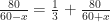
(b) Find an expression for the time required to travel a distance of 80km
(I) against the current, [1]
Recall that
Hence, the time required is 
(ii) with the current. [1]

(c) If the boat takes 20 minutes longer to travel against the current than it takes to travel with the current, write down an equation in 
Note: We must change 20 minutes into 1/3 hours!
There are many ways to proceed from here, one way is to change the Right Hand Side into common denominator, and then cross-multiply.
Cross-multiply,
(d) Solve this equation, giving your answers correct to 2 decimal places. [2]
Using the quadratic formula,
Answer to 2 d.p. is
(e) Hence, find the time taken, in hours, by the boat to complete a journey of 500 km against the current. [2]
Now we know that the speed of the current is 7.386 km/h.
Hence, the time taken is 
Secondary to JC Classes for Maths Group Tuition starting in 2014!
Google Map: http://goo.gl/maps/chjWB
Directions to Bishan Tuition Centre:
A) Via BISHAN MRT (NS17/CC15)
(10 minutes by foot OR 2 bus stops from Junction 8. From J8, please take bus numbers, 52, 54 or 410 from interchange. The centre is just after Catholic High School, just beside Clover By-The-Park condominium.
Other landmarks are: the bus stop which students alight is in front of Blk 283, where Cheers minimart and Prime supermarket are.)
It’s one street away from Raffles Institution Junior College (RIJC), previously known as Raffles Junior College (RJC). It’s also very convenient for students of Catholic Junior College (CJC), Anderson Junior College (AJC), Yishun Junior College (YJC) and Innova Junior College (IJC).
Other secondary schools located near Bishan are Catholic High School, Kuo Chuan Presbyterian Secondary School, and Raffles Institution (Secondary).
Source: http://www.youtube.com/watch?v=BVsIAa2XNKc
Source: http://en.wikipedia.org/wiki/M%C3%B6bius_strip
The Mobius Strip is a really interesting mathematical surface with just one side. It is easy to make, and cutting it produces many surprising effects! 🙂
The Möbius strip or Möbius band (UK /ˈmɜrbiəs/ or US /ˈmoʊbiəs/; German: [ˈmøːbi̯ʊs]), also Mobius or Moebius, is a surface with only one side and only one boundary component. The Möbius strip has the mathematical property of being non-orientable. It can be realized as a ruled surface. It was discovered independently by the German mathematicians August Ferdinand Möbius and Johann Benedict Listing in 1858.[1][2][3]
A model can easily be created by taking a paper strip and giving it a half-twist, and then joining the ends of the strip together to form a loop. In Euclidean space there are two types of Möbius strips depending on the direction of the half-twist: clockwise and counterclockwise. That is to say, it is a chiral object with “handedness” (right-handed or left-handed).
The Möbius band (equally known as the Möbius strip) is not a surface of only one geometry (i.e., of only one exact size and shape), such as the half-twisted paper strip depicted in the illustration to the right. Rather, mathematicians refer to the (closed) Möbius band as any surface that is homeomorphic to this strip. Its boundary is a simple closed curve, i.e., homeomorphic to a circle. This allows for a very wide variety of geometric versions of the Möbius band as surfaces each having a definite size and shape. For example, any closed rectangle with length L and width W can be glued to itself (by identifying one edge with the opposite edge after a reversal of orientation) to make a Möbius band. Some of these can be smoothly modeled in 3-dimensional space, and others cannot (see section Fattest rectangular Möbius strip in 3-space below). Yet another example is the complete open Möbius band (see section Open Möbius band below). Topologically, this is slightly different from the more usual — closed — Möbius band, in that any open Möbius band has no boundary.
It is straightforward to find algebraic equations the solutions of which have the topology of a Möbius strip, but in general these equations do not describe the same geometric shape that one gets from the twisted paper model described above. In particular, the twisted paper model is a developable surface (it has zero Gaussian curvature). A system of differential-algebraic equations that describes models of this type was published in 2007 together with its numerical solution.[4]
The Euler characteristic of the Möbius strip is zero.
Really glad to hear good news from one of my students.
From failing Additional Maths all the way, he is now the top in his entire class.
Really huge improvement, and I am really happy for him. 🙂
To other students who may be reading this, remember not to give up! As long as you persevere, it is always possible to improve.
Source: http://betterexplained.com/articles/understanding-the-birthday-paradox/
23 people. In a room of just 23 people there’s a 50-50 chance of two people having the same birthday. In a room of 75 there’s a 99.9% chance of two people matching.
Put down the calculator and pitchfork, I don’t speak heresy. The birthday paradox is strange, counter-intuitive, and completely true. It’s only a “paradox” because our brains can’t handle the compounding power of exponents. We expect probabilities to be linear and only consider the scenarios we’re involved in (both faulty assumptions, by the way).
Let’s see why the paradox happens and how it works.
Continue reading at http://betterexplained.com/articles/understanding-the-birthday-paradox/
The Monty Hall Problem!
Source: http://www.youtube.com/watch?v=mhlc7peGlGg&feature=player_embedded
Maths can be fun too!
Build up interest in Mathematics by trying out some of these interesting Maths Riddles.
Source: http://en.wikipedia.org/wiki/Missing_dollar_riddle
Three guests check into a hotel room. The clerk says the bill is $30, so each guest pays $10. Later the clerk realizes the bill should only be $25. To rectify this, he gives the bellhop $5 to return to the guests. On the way to the room, the bellhop realizes that he cannot divide the money equally. As the guests didn’t know the total of the revised bill, the bellhop decides to just give each guest $1 and keep $2 for himself. Each guest got $1 back: so now each guest only paid $9; bringing the total paid to $27. The bellhop has $2. And $27 + $2 = $29 so, if the guests originally handed over $30, what happened to the remaining $1?
Try it out before looking at the answer!
Dr Yeo Sze Ling is sincerely a good example of perseverance for all Maths students, including myself!
(Go to 01h18m50s)
Source: http://www.youtube.com/watch?v=06PdmOSrboU#t=01h18m50s
Quote: http://sg.news.yahoo.com/pm-lee-tears-up-at-emotional-national-day-rally-with–heart–160531376.html
But perhaps the most memorable moment of all was when Lee became visibly emotional after sharing the heartwarming success story of visually handicapped A-star researcher Dr Yeo Sze Ling.
“Sze Ling proves that you can do well if you try hard, no matter what your circumstances, and that is also how we can contribute back to society, to keep the system fair for all,” said Lee, who then visibly teared and choked up, but quickly composed himself.
PM Lee was emphasising the importance of meritocracy in Singapore’s education system, which he acknowledged needed more changes — for example, it can be more holistic and less competitive.
Source: http://news.asiaone.com/news/edvantage/5-awarded-prestigious-presidents-scholarship-istana-ceremony
SINGAPORE – Five government scholarship recipients, including a missionaries’ child who grew up in Papua New Guinea and a Youth Olympic Games triathlete, have been awarded the prestigious President’s Scholarships this year, at a ceremony at the Istana on Friday evening.
 Get the full story from The Straits Times.
Here is the full speech by President Tony Tan:
Deputy Prime Minister Teo Chee Hean and Mrs Teo
Minister for Education Heng Swee Keat
Excellencies
Chairman and Members of the Public Service Commission
Ladies and Gentlemen
Good evening.
Each year, the Public Service Commission awards scholarships to outstanding young men and women who want to serve Singapore and Singaporeans through a career in the Public Service. The most prestigious undergraduate scholarship awarded by the Commission is the President’s Scholarship.
It is awarded to young Singaporeans who have the integrity and commitment to work for Singapore’s continued success. To be awarded a President’s Scholarship, one must demonstrate more than just excellence in academic and non-academic pursuits. One must also show a strong ethos for public service, impeccable character, remarkable leadership and dedication towards improving the lives of Singaporeans.
2013 President’s Scholars This evening, the President’s Scholarship is awarded to five exceptional young individuals who have distinguished themselves based on their leadership capabilities and calibre, and their passion to bring the nation forward.
Continue reading at http://news.asiaone.com/news/edvantage/5-awarded-prestigious-presidents-scholarship-istana-ceremony
Question: (Broadrick Sec Prelim Add Math Paper 1 2010, Q8b)
In the expansion of 

Solution:


1,248 words 24 May 2005 Digital Life English (c) 2005 Singapore Press Holdings Limited
You can reach for the stars with Jaws, Braille and determination, mathematics whiz Yeo Sze Ling tells HELLEN TAN
Given that multiple degrees are common today, the fact that Miss Yeo Sze Ling has two degrees in mathematics, and is working on her doctorate in the same field, is probably not news.
Until you find out that she is blind.
The 27-year-old who earned her Bachelor’s degree (Honours) and a Master’s degree from National University of Singapore (NUS) is now into research on coding mathematics theories and cryptography.
These are used in computing algorithms to protect passwords or data from being stolen when they are zipped from computer to computer.
The field is an interest she shares with John Nash Jr, a mathematical genius who won a Nobel Prize, portrayed in the Oscar-winning movie, A Beautiful Mind.
Certainly, like Nash, her achievements should mean a lot.
He was a schizophrenic who thought he was doing secret cryptography work for the American government.
She has been blind from the age of about four when glaucoma struck. Glaucoma is a condition that increases pressure within the eyeball causing sight loss.
Technology has come in handy.
On campus, she totes a laptop.
At home in a four-room HDB flat in Bishan, her desktop Compaq PC holds today’s tech staples – e-mail and MSN Messenger for exchanging notes with friends.
The Internet is her source for research as well as for online newspapers or electronic books like A Beautiful Mind.
…
Continue reading at http://ww1.math.nus.edu.sg/News%20Archive/2005,%2024%20May%20-%20Counting%20on%20her%20mind%20-%20Yeo%20Sze%20Ling.htm
Source: http://www.channelnewsasia.com/news/singapore/rote-learning-has-to-make/779680.html
Education Minister Heng Swee Keat has said that with information readily available, rote learning has to make way for digital literacy.
SINGAPORE: Education Minister Heng Swee Keat has said that with information readily available, rote learning has to make way for digital literacy.
Speaking at the Second International Summit of the Book on Friday, Mr Heng said there is a need to place greater emphasis on critical and inventive thinking.
Whether it is a papyrus, print or the iPad, it seems that books are here to stay.
Professor Tommy Koh, chairman of the Organising Committee of the Second International Summit of the Book, and Ambassador-at-Large, said: “I think the book will endure to the end of time.
“But the form of the book has changed and will change. The container will change, the platform on which we read the book will also change.
“My children, for example, prefer to read the book either on the computer, on the iPad, on the tablet and other electronic forms. I still prefer the printed book. But in one form or another, the book will endure. There can be no human civilisation without books.”
But the question is whether readers are able to discern truths from untruths, especially in an era that is inundated with information.
Mr Heng said: “Some fear that the technologically sophisticated books of the future will dull the mind, as we no longer bother to use our imagination to render words into sounds and images.
“They worry too that we will forget to think for ourselves after we close the book because social media offers such an array of ready-made opinions that we will just pick one off the virtual shelf rather than form our own.
“We need to place greater emphasis on critical and inventive thinking, so that we may go on to imagine and create new insights.
“At the workplace, as the information revolution transforms the nature of work, our ability to move from theory to practice, to apply learning imaginatively in different contexts, and to create new knowledge, will become increasing valuable.”
Continue reading at http://www.channelnewsasia.com/news/singapore/rote-learning-has-to-make/779680.html
Source: http://www.channelnewsasia.com/news/singapore/psle-could-move-away-from/777972.html
The head of the Government Parliamentary Committee (GPC) for Education, Member of Parliament Lim Biow Chuan, said that the Primary School Leaving Examination could do with less focus on aggregate scores.
SINGAPORE: The head of the Government Parliamentary Committee (GPC) for Education, Member of Parliament Lim Biow Chuan, said that the Primary School Leaving Examination (PSLE) could do with less focus on aggregate scores.
He said that this would take away the stress associated with the examination.
Education Minister Heng Swee Keat said recently that changes to the PSLE will be announced at the National Day Rally on Sunday.
It is an annual affair that sends the nation’s parents, students and teachers into a frenzy — for many in Singapore, the PSLE has become a high-stakes examination.
Roger Cheong, a parent, said: “Maybe there should not be so much emphasis on PSLE at such a young age… Maybe as a gauge, but there shouldn’t be so so much weightage on it.
The Education Ministry has acknowledged this and embarked on a year-long review sometime in 2012.
Ahead of the announcements of possible changes, some have suggested going back to basics.
Mr Lim said: “I never knew what was my PSLE score. We selected a few schools that we chose and from there, MOE would post us to those schools, based on our performance. So you don’t have to go down to those minute details as to whether you score 270 or 265 or 275.
“You get broad-based results, and from there, you are allocated schools of your choice. It may not be the exact school of your choice, but it may be a group of schools that you choose and all of them are in the same category.”
Mr Lim also hoped to see more places set aside for the Direct School Admission (DSA) exercise, where students apply to secondary schools based on their achievements and talents before the release of their PSLE results.
Continue reading at http://www.channelnewsasia.com/news/singapore/psle-could-move-away-from/777972.html
Source: http://en.wikipedia.org/wiki/Sergey_Brin
Sergey Mikhaylovich Brin (Russian: Сергей Михайлович Брин; born August 21, 1973) is an American computer scientist and Internet entrepreneur who, with Larry Page, co-founded Google, one of the most profitable Internet companies.[4] As of 2013, his personal wealth was estimated to be $22.8billion.[2] Together, Brin and Page own about 16 percent of the company.
Brin immigrated to the United States with his family from the Soviet Union at the age of six. He earned his undergraduate degree at the University of Maryland, following in his father’s and grandfather’s footsteps by studying mathematics, as well as computer science. After graduation, he moved to Stanford University to acquire a Ph.D. in computer science. There he met Larry Page, with whom he later became friends. They crammed their dormitory room with inexpensive computers and applied Brin’s data mining system to build a superior search engine. The program became popular at Stanford and they suspended their PhD studies to start up Google in a rented garage.
The Economist newspaper referred to Brin as an “Enlightenment Man“, and someone who believes that “knowledge is always good, and certainly always better than ignorance”, a philosophy that is summed up by Google’s motto “Organize the world’s information and make it universally accessible and useful”[5][6] and “Don’t be evil“.
Brin attended grade school at Paint Branch Montessori School in Adelphi, Maryland, but he received further education at home; his father, a professor in the department of mathematics at the University of Maryland, encouraged him to learn mathematics and his family helped him retain his Russian-language skills. In September 1990 Brin enrolled in the University of Maryland to study computer science and mathematics, where he received his Bachelor of Science in May 1993 with honors.[14]

If you are interested in Mathematics, do consider to study Mathematics at NUS!
Source: http://ww1.math.nus.edu.sg/undergrad.aspx
Quote:
The Department of Mathematics at NUS is the largest department in the Faculty of Science. We offer a wide range of modules catered to specialists contemplating careers in mathematical science research as well as to those interested in applications of advanced mathematics to science, technology and commerce. The curriculum strives to maintain a balance between mathematical rigour and applications to other disciplines.
We offer a variety of major and minor programmes, covering different areas of mathematical sciences, for students pursuing full-time undergraduate studies. Those keen in multidisciplinary studies would also find learning opportunities in special combinations such as double degree, double major and interdisciplinary programmes.
Honours graduates may further their studies with the Graduate Programme in Mathematics by Research leading to M.Sc. or Ph.D. degree, or with the M.Sc. Programme in Mathematics by Course Work.
Source: http://ww1.math.nus.edu.sg/
The history of the Department of Mathematics at NUS traces back to 1929, when science education began in Singapore with the opening of Raffles College with less than five students enrolled in mathematics. Today it is one of the largest departments in NUS, with about 70 faculty members and teaching staff supported by 13 administrative and IT staff. The Department offers a wide selection of courses (called modules) covering wide areas of mathematical sciences with about 6,000 students enrolling in each semester. Apart from offering B.Sc. programmes in Mathematics, Applied Mathematics and Quantitative Finance, the Department also participates actively in major interdisciplinary programs, including the double degree programme in Mathematics/Applied Mathematics and Computer Science, the double major programmes in Mathematics and Economics as well as with other subjects, and the Computational Biology programme. Another example of the Department’s student centric educational philosophy is the Special Programme in Mathematics (SPM), which is specially designed for a select group of students who have a strong passion and aptitude for mathematics. The aim is to enable these students to build a solid foundation for a future career in mathematical research or state-of-the-art applications of mathematics in industry.
The Department is ranked among the best in Asia in mathematical research. It offers a diverse and vibrant program in graduate studies, in fundamental as well as applied mathematics. It promotes interdisciplinary applications of mathematics in science, engineering and commerce. Faculty members’ research covers all major areas of contemporary mathematics. For more information, please see research overview, selected publications, and research awards.
Source: http://en.wikipedia.org/wiki/Academic_grading_in_Singapore
Singapore‘s grading system in schools is differentiated by the existence of many types of institutions with different education foci and systems. The grading systems that are used at Primary, Secondary, and Junior College levels are the most fundamental to the local system used.
Featured book:
“If you’ve ever said ‘I’m no good at numbers,’ this book can change your life.” (Gloria Steinem)
The GPA table for Raffles Girls’ School and Raffles Institution (Secondary) is as below:
| Grade | Percentage | Grade point |
|---|---|---|
| A+ | 80-100 | 4.0 |
| A | 70-79 | 3.6 |
| B+ | 65-69 | 3.2 |
| B | 60-64 | 2.8 |
| C+ | 55-59 | 2.4 |
| C | 50-54 | 2.0 |
| D | 45-49 | 1.6 |
| E | 40-44 | 1.2 |
| F | <40 | 0.8 |
The GPA table differs from school to school, with schools like Dunman High School excluding the grades “C+” and “B+”(meaning grades 50-59 is counted a C, vice-versa) However, in other secondary schools like Hwa Chong Institution and Victoria School, there is also a system called MSG (mean subject grade) which is similar to GPA that is used.
| Grade | Percentage | Grade point |
|---|---|---|
| A1 | 75-100 | 1 |
| A2 | 70-74 | 2 |
| B3 | 65-69 | 3 |
| B4 | 60-64 | 4 |
| C5 | 55-59 | 5 |
| C6 | 50-54 | 6 |
| D7 | 45-49 | 7 |
| E8 | 40-44 | 8 |
| F9 | <40 | 9 |
The mean subject grade is calculated by adding the points together, then divided by the number of subjects. For example, if a student got A1 for math and B3 for English, his MSG would be (1+3)/2 = 2.
The results also depends on the bell curve.

Source: http://en.wikipedia.org/wiki/Shing-Tung_Yau
Shing-Tung Yau (Chinese: 丘成桐; pinyin: Qiū Chéngtóng; Cantonese Yale: Yāu Sìngtùng; born April 4, 1949) is a Chinese-born American mathematician. He won the Fields Medal in 1982.
Yau’s work is mainly in differential geometry, especially in geometric analysis. His contributions have had an influence on both physics and mathematics and he has been active at the interface between geometry and theoretical physics. His proof of the positive energy theorem in general relativity demonstrated—sixty years after its discovery—that Einstein‘s theory is consistent and stable. His proof of the Calabi conjecture allowed physicists—using Calabi–Yau compactification—to show that string theory is a viable candidate for a unified theory of nature. Calabi–Yau manifolds are among the ‘standard toolkit’ for string theorists today.
Yau was born in Shantou, Guangdong Province, China with an ancestry in Jiaoling (also in Guangdong) in a family of eight children. When he was only a few months old, his family emigrated to Hong Kong, where they lived first in Yuen Long and then 5 years later in Shatin. When Yau was fourteen, his father Chiou Chenying, a philosophy professor, died.
After graduating from Pui Ching Middle School, he studied mathematics at the Chinese University of Hong Kong from 1966 to 1969. Yau went to the University of California, Berkeley in the fall of 1969. At the age of 22, Yau was awarded the Ph.D. degree under the supervision of Shiing-Shen Chern at Berkeley in two years. He spent a year as a member of the Institute for Advanced Study, Princeton, New Jersey, and two years at the State University of New York at Stony Brook. Then he went to Stanford University.
Since 1987, he has been at Harvard University,[1] where he has had numerous Ph.D. students. He is also involved in the activities of research institutes in Hong Kong and China. He takes an interest in the state of K-12 mathematics education in China, and his criticisms of the Chinese education system, corruption in the academic world in China, and the quality of mathematical research and education, have been widely publicized.

Source: Taken from Research by Stanford, Education: EDUC115N How to Learn Math
This word cloud was generated on August 9th based on 850 responses to the prompt “Please submit a word that, in your opinion, describes the most important aspect of a student’s ideal relationship with mathematics.”

Just to share an inspirational story about studying Mathematics, and our very own Prime Minister Lee Hsien Loong. 🙂
Source: http://www2.ims.nus.edu.sg/imprints/interviews/BelaBollobas.pdf
(page 8/8)
Interview of Professor Béla Bollobás, Professor and teacher of our Prime Minister Lee Hsien Loong
I: Interviewer Y.K. Leong
B: Professor Béla Bollobás
I: I understand that you have taught our present Prime
Minister Lee Hsien Loong.
B: I certainly taught him more than anybody else in
Cambridge. I can truthfully say that he was an exceptionally
good student. I’m not sure that this is really known in
Singapore. “Because he’s now the Prime Minister,” people
may say, “oh, you would say he was good.” No, he was truly
outstanding: he was head and shoulders above the rest of
the students. He was not only the first, but the gap between
him and the man who came second was huge.
I: I believe he did double honors in mathematics and computer science.
B: I think that he did computer science (after mathematics) mostly because his father didn’t want him to stay in pure mathematics. Loong was not only hardworking, conscientious and professional, but he was also very inventive. All the signs indicated that he would have been a world-class research mathematician. I’m sure his father never realized how exceptional Loong was. He thought Loong was very good. No, Loong was much better than that. When I tried to tell Lee Kuan Yew, “Look, your son is phenomenally good: you should encourage him to do mathematics,” then he implied that that was impossible, since as a top-flight professional mathematician Loong would leave Singapore for Princeton, Harvard or Cambridge, and that would send the wrong signal to the people in Singapore. And I have to agree that this was a very good point indeed. Now I am even more impressed by Lee Hsien Loong than I was all those years ago, and I am very proud that I taught him; he seems to be doing very well. I have come round to thinking that it was indeed good for him to go into politics; he can certainly make an awful lot of difference.
6(i)
(ii)
For the null hypothesis not to be rejected,


(iii) Since 
(technique: put in words what 
Source: http://www.mathopenref.com/euclid.html
At age forty, Abraham Lincoln studied Euclid for training in reasoning, and as a traveling lawyer on horseback, kept a copy of Euclid’s Elements in his saddlebag. In his biography of Lincoln, his law partner Billy Herndon tells how late at night Lincoln would lie on the floor studying Euclid’s geometry by lamplight. Lincoln’s logical speeches and some of his phrases such as “dedicated to the proposition” in the Gettysburg address are attributed to his reading of Euclid.
Lincoln explains why he was motivated to read Euclid:

Source: http://www.youtube.com/watch?v=bZoMz1Cy1T4
Synthetic Division – This video shows how you can use synthetic division to divide a polynomial by a linear expression. It also shows how synthetic division can be used to evaluate polynomials!
Source: http://newshub.nus.edu.sg/headlines/1305/qs_08May13.php
NUS is the best-performing university in Asia in the 2013 QS World University Rankings by Subject. With 12 subjects ranked top 10, NUS has secured the 8th position among universities globally in this subject ranking.
On the results, NUS Deputy President (Academic Affairs) and Provost Professor Tan Eng Chye said: “This is a strong international recognition of NUS’ strengths in humanities and languages, engineering and technology, sciences, medicine and social sciences.”
Prof Tan noted that the rankings served as an acknowledgement of the exceptional work carried out by faculty and staff in education and research.
NUS fared well, ranking among the world’s top 10 universities for 12 subjects namely Statistics, Mathematics, Material Sciences, Pharmacy & Pharmacology, Communication & Media Studies, Geography, Politics & International Studies, Modern Languages, Computer Science & Information Systems and Engineering (mechanical, aeronautical, manufacturing, electrical & electronic, chemical).
Continue reading at: http://newshub.nus.edu.sg/headlines/1305/qs_08May13.php
Prove
$latex x^{2} \equiv 3411 \mod 3457 $
has no solution?
Legendre Symbol:
$latex \displaystyle
x^{2} \equiv a \mod p
\iff
\boxed{
\left( \frac {a}{p} \right)
= \begin{cases}
-1, & \text{if 0 solution} \\
0 , & \text{if 1 solution} \\
1, & \text{if 2 solutions} \\
\end{cases}
}
$
Hint: prove $latex \left( \frac{3411}{3457} \right) = -1$
Using the Law of Quadratic Reciprocity, without computations, we can prove there is no solution for this equation.
Solution:
1.
3411 = 3 x 3 x 379 = 9 x 379
$Latex \displaystyle
\boxed{
\left(\frac{a}{p}\right)
\left(\frac{b}{p} \right)=
\left(\frac{ab}{p}\right)
}
$
$latex \displaystyle
\left(\frac{3411}{3457} \right)=
\left(\frac{9}{3457} \right).\left(\frac{379}{3457} \right)=
\left(\frac{379}{3457} \right)
$
since
$latex \displaystyle\left(\frac{9}{3457} \right)=1 $
because 9 is a perfect square, 3457 is prime.
2. By Quadratic Reciprocity,
$latex \displaystyle
\boxed{
\text{If p or q or both are } \equiv 1 \mod 4 \implies
\left(\frac{p}{q} \right)=
\left(\frac{q}{p} \right)}
$
Since
$latex…
View original post 212 more words
Kami penuh waktu Matematika guru, Mr Wu (Citizen Singapura), memiliki pengalaman yang luas (lebih dari 7 tahun) di les matematika. Mr Wu telah mengajar matematika sejak tahun 2006.
Mr Wu adalah pasien dengan siswa, dan akan menjelaskan konsep jelas kepada mereka. Dia mendorong untuk siswa lemah, sedangkan siswa yang lebih kuat tidak akan merasa bosan karena Mr Wu akan memberikan latihan yang cukup menantang bagi mereka untuk belajar lebih banyak. Singkatnya, setiap siswa harus mengalami perbaikan setelah kuliah.
Mr Wu lulus dengan B.Sc. (First Class Honours) dengan Mayor di Matematika (National University of Singapore).
Kami sangat percaya bahwa kepribadian dan karakter guru adalah sama pentingnya dengan kualifikasi akademik. Untuk Matematika Tutor, kesabaran ketika menjelaskan kepada siswa mutlak diperlukan.
Tutor Kualifikasi:
NUS: B.Sc. (First Class Honours) dengan Mayor di Matematika, Daftar Dean (Top 5% dari seluruh Fakultas Ilmu)
A Level: Matematika (A), Fisika (A), Kimia (A), Biologi (A), General Paper (A1)
O Tingkat: (Raffles Institution)
Bahasa Inggris (A1), Gabungan Humaniora (A1), Geografi (A1), Matematika (A1), Matematika Tambahan (A1), Fisika (A1), Kimia (A1), Biologi (A1), Bahasa Cina lebih tinggi (A2)
PSLE: (Nanyang Primer) 281, Lee Hsien Loong Excellence Award
Bahasa Inggris (A *), Bahasa Cina (A *), Matematika (A *), Sains (A *), Bahasa Cina Tinggi (Distinction), Ilmu Sosial (Distinction)
Apakah dalam Program PMP dari Pratama ke tingkat sekunder.
Terdaftar dengan MOE sebagai Guru Bantuan
(Orang tua yang ingin melihat sertifikat Mr Wu silahkan email kami. Orang tua juga dapat melihat profil StarTutor Mr Wu pada http://startutor.sg/23561, dengan sertifikat diverifikasi.)
Meskipun kualifikasi akademik Mr Wu, ia tetap seorang guru yang rendah hati dan sabar. Juga, orang tua dapat yakin bahwa Mr Wu mengajar pada tingkat yang siswa dapat sepenuhnya mengerti. Untuk A Level, kami akan mencoba untuk mengajarkannya dengan cara yang jelas dan sederhana sehingga bahkan Sec 3/4 siswa dapat mengerti. Untuk O Levels, kita akan mengajarkannya sedemikian rupa sehingga bahkan Sec 1/2 siswa dapat memahami, dan sebagainya.
Mr Wu hanyalah orang biasa yang telah menguasai keterampilan dan teknik yang diperlukan untuk unggul dalam matematika di Singapura. Dia ingin mengajarkan teknik ini untuk siswa, maka memilih untuk menjadi Matematika penuh waktu guru. Mr Wu telah mengembangkan metode sendiri untuk memeriksa jawaban, mengingat rumus (dengan pemahaman), yang telah membantu banyak siswa. Banyak pertanyaan Math dapat diperiksa dengan mudah, menyebabkan siswa menjadi 100% yakin nya atau jawabannya bahkan sebelum guru menandai jawabannya, dan mengurangi tingkat kesalahan ceroboh.
Mr Wu juga kakak dari dua mahasiswa kedokteran. Adiknya sedang belajar Kedokteran di Universitas Monash, dan adiknya sedang belajar Kedokteran di Yong Loo Lin School of Medicine, NUS.
Tujuan Pengajaran:
Tujuan pengajaran adalah untuk memungkinkan siswa untuk memahami konsep-konsep dalam silabus, meningkatkan minat pada pelajaran, dan untuk menjelaskan dengan jelas metode untuk memecahkan masalah matematika. Matematika adalah subjek yang sangat kumulatif, dasar yang kuat diperlukan untuk maju ke tingkat berikutnya. Kami sangat berharap dapat membantu lebih banyak siswa membangun fondasi yang kuat di Matematika.
Untuk Matematika, kami percaya bahwa cara terbaik untuk maju adalah melalui praktek dan pemahaman. Teknik untuk memeriksa jawaban dan metode singkat untuk menjawab pertanyaan lebih cepat berguna. Ketekunan sangat penting dalam Matematika, yang penting adalah untuk tidak menyerah, dan terus mencoba!
Untuk individu Matematika kuliah, tutor dapat melakukan perjalanan ke rumah siswa.
“Didiklah anak di jalan yang patut baginya: dan ketika dia sudah tua, dia tidak akan menyimpang dari itu.”
– Amsal 22:6
Математика Обучение центр
Maths Tuition Centre
Maths Tuition Centre
ศูนย์คณิตศาสตร์เล่าเรียน







 Mathtuition88