Math Blog

Professor Writing Math Equations Suspected for being Terrorist

This is quite hilarious.

Sample of what the professor Guido Menzio was scribbling.

Source: http://www.dailymail.co.uk/news/article-3578751/Italian-Ivy-League-economist-pulled-flight-seatmate-suspected-terrorist.html

Italian Ivy League economist pulled off flight and interrogated for ‘mysterious’ scribblings flagged up by another passenger… which turned out to be MATH

  • Guido Menzio, 40, was on a flight from Philadelphia to Syacuse 
  • The UPenn professor was solving a differential equation during boarding
  • His seatmate told an American Airlines attendant she was too ill to travel
  • But after she was escorted off the plane, she revealed her suspicious 
  • Menzio was questioned about his ‘cryptic’ notes before he was allowed to get back on the plane, delayed by two hours  
  • While one traveller thought he looked like a terrorist, another person in an airport mistook him for Sean Lennon and asked for an autograph

Read more: http://www.dailymail.co.uk/news/article-3578751/Italian-Ivy-League-economist-pulled-flight-seatmate-suspected-terrorist.html#ixzz488tlHREM
Follow us: @MailOnline on Twitter | DailyMail on Facebook

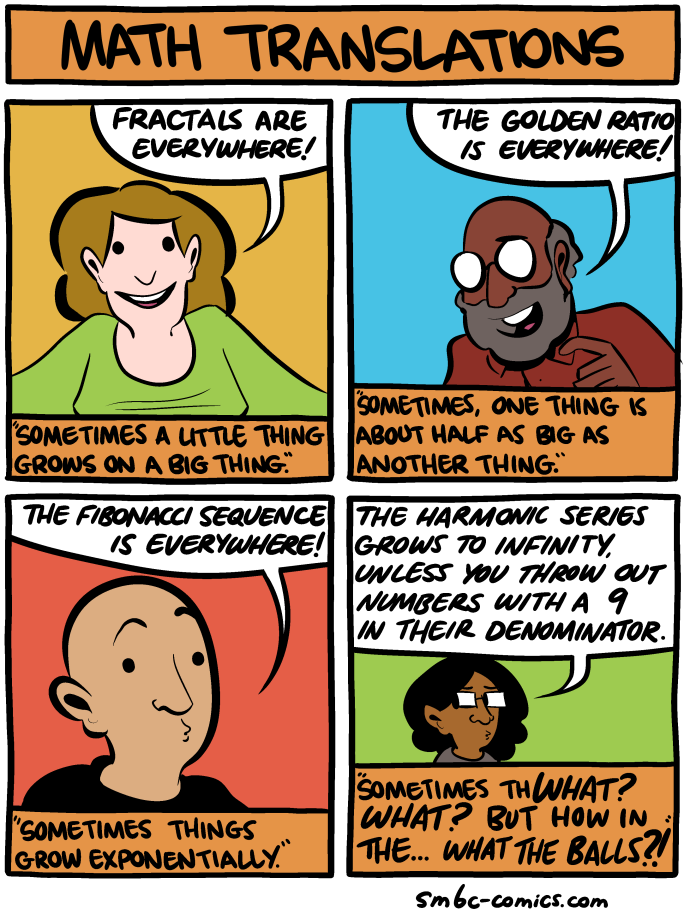
Harmonic Series minus terms with “9” Converges!

harmonic series

Something interesting I saw on: http://blogs.scientificamerican.com/roots-of-unity/what-the-prime-number-tweetbot-taught-me-about-infinite-sums/?WT.mc_id=SA_WR_20160504

The harmonic series is the infinite sum 1+1/2+1/3+1/4+…, the sum of the reciprocals of every positive integer. Even though the terms get closer and closer to 0, the series goes to infinity, meaning it eventuallygets bigger than any number you can throw at it. (The question is fun to think about, so I won’t spoil it for you, but Wikipedia has an explanation.)

It seems baffling that if we take away 1/9, 1/19, 1/29, and so on, the series converges instead. In fact, it’s less than 90, which is frankly pitiful compared to the infinitude of the harmonic series.

Functional Analysis List of Theorems

This is a list of miscellaneous theorems from Functional Analysis.

Hahn-Banach: Let p be a real-valued function on a normed linear space X with

(i) Positive homogeneity

(ii) Subadditivity

Let Y denote a linear subspace of X on which l(y)\leq p(y) for all y\in Y. Then l can be extended to all of X: l(x)\leq p(x) for all x\in X.

Geometric Hahn-Banach / Hyperplane Separation Theorem: Let K be a nonempty convex subset, K=int(K). Let y be a point outside K. Then there exists a linear functional l (depending on y) such that l(x)<c for all x\in K; l(y)=c.

Riesz Representation Theorem: Let l(x) be a linear functional on a Hilbert space H that is bounded: |l(x)|\leq c\|x\|. Then l(x)=\langle x,y\rangle for some unique y\in H.

Principle of Uniform Boundedness: A weakly convergent sequence \{x_n\} is uniformly bounded in norm.

Open Mapping Principle/Theorem:  Let X, U be Banach spaces. Let M:X\to U be a bounded linear map onto all of U. Then M maps open sets onto open sets.

Closed Graph Theorem: Let X,U be Banach spaces, M:X\to U be a closed linear map. Then M is continuous.

Confucius Quote Chinese Translation (with Poster)

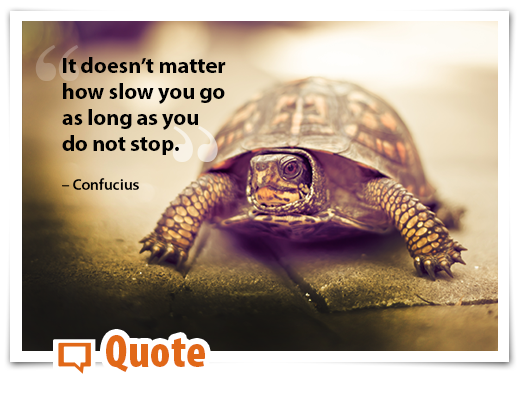
turtle do not stop
“It doesn’t matter how slow you go as long as you do not stop” – Confucius

The actual quote is “譬如为山,未成一篑,止,吾止也。譬如平地,虽覆一篑,进,吾往也。”

The meaning is “孔子说:“做学问好比积土成山一样,只差一筐土而没有堆成山,停止了,是我自己停止的;好比平整土地一样,即使只倒下一筐土,前进了,也是我自己前进的。” (Source: http://www.bjhrwm.gov.cn/ctwhjy/yryj/t20110805_401107.htm)

In English, it means that studying (gaining wisdom) is like piling soil to make a mountain. If one stops short of one basket of soil to make a mountain, it is a pity to stop. It is also like filling a deep hole with soil, every basket of soil you pour in is progress.

The Lesson of Grace in Teaching

Nice post by Professor Francis Su:

http://mathyawp.blogspot.sg/2013/01/the-lesson-of-grace-in-teaching.html

Excerpt:

And perhaps it will help you frame your own thoughts about teaching.  The beginning of that lesson is this:

Your accomplishments are NOT what make you a worthy human being.

It sounds easy for me to say, especially after having some measure of academic ‘success’ and winning this teaching award.

But twenty years ago, I was a struggling grad student, seeking validation for my mathematical talent but flailing in my research, seeking my identity in my work but discouraged enough to quit.  My advisor had even said to me:

“You don’t have what it takes to be a successful mathematician.”

It was my lowest point.  Weak and weary, with my identity and my pride stripped away and my PhD nearly out of reach, I realized then that my identity and self-worth could NOT rest on whether I succeeded or failed to get my PhD.  So *IF* I were to continue in mathematics, I could not do it for any acclaim that I might receive or for the trappings of what the academic world would call success.  I should only do it because math is beautiful, and I feel drawn to it.  In my quiet moments, with no one watching, I still found math fun to think about.  So I was convinced it was my calling, despite the hurtful thing my advisor had said.

So did I quit?  No.  I just changed advisors.

This time, I chose differently.  Persi Diaconis was an inspiring teacher.  More than that, he had shown me a great kindness a couple of years before.  The semester I took a class from him, my mother died and I needed an extension on my work.  I’ll never forget his response: “I’m really sorry about your mother.  Let me take you to coffee.”

I remember thinking: “I’m just some random student and he’s taking me to coffee?” But I really needed that talk.  We pondered life and its burdens, and he shared some of his own journey.  For me, in a challenging academic environment, with enormous family struggles, to connect with my professor on a deeper level was a great comfort.  Yes, Persi was an inspiring teacher, but this simple act of kindness—of authentic humanness—gave me a greater capacity and motivation to learn from him, because we had entered into authentic community with each other, as teacher and student, who were real people to each other.

So when the time came to change advisors, I decided to work with Persi, even though it meant completely starting over in a new area.  Only in hindsight did I realize why I had gravitated to him.  It’s because he showed me grace.

GRACE: good things you didn’t earn or deserve, but you’re getting them anyway.

By taking me to coffee, he had shown me he valued me as a human being, independent of my academic record.  And having my worthiness separated from my performance gave me great freedom! I could truly enjoy learning again.  Whether I succeeded or failed would not affect my worthiness as a human being.  Because even if I failed, I knew: I am still worth having coffee with!

Knowing my new advisor had grace for me meant that he could give me honest feedback on my dissertation work, even if it was hard to do, without completely destroying my identity.  Because, as I was learning, my worthiness does NOT come from my accomplishments.  I call this

The Lesson of GRACE:

  •      Your accomplishments are NOT what make you a worthy human being.
  •      You learn this lesson when someone shows you GRACE: good things you didn’t earn or deserve, but you’re getting them anyway.

Weak* convergent sequence uniformly bounded

Theorem 11 (Lax Functional Analysis): A weak* convergent sequence \{u_n\} of points in a Banach space U=X' is uniformly bounded.

We will need a previous Theorem 3: X is a Banach space, \{l_v\} a collection of bounded linear functionals such that at every point x of X, |l_v(x)|\leq M(x) for all l_v. Then there is a constant c such that |l_v|\leq c for all l_v.

Sketch of proof:

Weak* convergence means \lim u_n(x)=u(x), thus there exists N such that for all n\geq N, we have |u_n(x)-u(x)|<1, which in turns means |u_n(x)|<1+|u(x)| via the triangle inequality. We have managed to bound the terms greater than equals to N.

For those terms less than N, we have |u_n(x)|\leq\|u_n\|\|x\|.

Thus, we may take M(x)=\max\{\|u_1\|\|x\|,\dots,\|u_{N-1}\|\|x\|,1+|u(x)|\}. The crucial thing is that M(x) depends only on x, not n.

Then, use Theorem 3, we can conclude that \|u_n\|\leq c for all n.

Desiderata – An Amazing Poem

Go placidly amid the noise and the haste, and remember what peace there may be in silence. As far as possible, without surrender, be on good terms with all persons.

Speak your truth quietly and clearly; and listen to others, even to the dull and the ignorant; they too have their story.

Avoid loud and aggressive persons; they are vexatious to the spirit. If you compare yourself with others, you may become vain or bitter, for always there will be greater and lesser persons than yourself.

Enjoy your achievements as well as your plans. Keep interested in your own career, however humble; it is a real possession in the changing fortunes of time.

Exercise caution in your business affairs, for the world is full of trickery. But let this not blind you to what virtue there is; many persons strive for high ideals, and everywhere life is full of heroism.

Be yourself. Especially, do not feign affection. Neither be cynical about love; for in the face of all aridity and disenchantment it is as perennial as the grass.

Take kindly the counsel of the years, gracefully surrendering the things of youth.

Nurture strength of spirit to shield you in sudden misfortune. But do not distress yourself with dark imaginings. Many fears are born of fatigue and loneliness.

Beyond a wholesome discipline, be gentle with yourself. You are a child of the universe no less than the trees and the stars; you have a right to be here.

And whether or not it is clear to you, no doubt the universe is unfolding as it should. Therefore be at peace with God, whatever you conceive Him to be.

And whatever your labors and aspirations, in the noisy confusion of life, keep peace in your soul. With all its sham, drudgery and broken dreams, it is still a beautiful world. Be cheerful. Strive to be happy.

Max Ehrmann, “Desiderata

Printable version: http://www.stpaulsbaltimore.org/wp-content/uploads/2015/02/desiderata-pamphlet.pdf

Deck Transformations

Consider a covering space p:\widetilde{X}\to X. The isomorphisms \widetilde{X}\to\widetilde{X} are called deck transformations, and they form a group G(\widetilde{X}) under composition.

For the covering space p:\mathbb{R}\to S^1 projecting a vertical helix onto a circle, the deck transformations are the vertical translations mapping the helix onto itself, so G(\widetilde{X})\cong\mathbb{Z}, where a vertical translate of n “steps” upwards/downwards corresponds to the integer \pm n respectively.

Endomorphism ring of Q is a division algebra

We show that Q is not semisimple nor simple, but \text{End}_\mathbb{Z}(\mathbb{Q}) is a division algebra.

Consider A=\mathbb{Z} (as a \mathbb{Z}-algebra). Consider M=\mathbb{Q} as a right \mathbb{Z}-module.
Lemma:
\mathbb{Q} is not semisimple nor simple.

Suppose to the contrary \mathbb{Q}=\bigoplus_{i\in I}N_i, where N_i are simple \mathbb{Z}-modules (i.e. N_i\cong\mathbb{Z}/p_i\mathbb{Z}). Then there exists nonzero x\in\mathbb{Q} such that x has finite order (product of primes). This is impossible in \mathbb{Q}.
Lemma:
\text{End}_\mathbb{Z}(\mathbb{Q})\cong\mathbb{Q} as \mathbb{Z}-algebras.

Define \Psi:\mathbb{Q}\to\text{End}_\mathbb{Z}(\mathbb{Q}) where q\in\mathbb{Q} is mapped to \lambda_q\in\text{End}_\mathbb{Z}(\mathbb{Q}), where \lambda_q(x)=qx. Let k\in\mathbb{Z}, q,q_1,q_2\in\mathbb{Q}.

We can check that \Psi is a \mathbb{Z}-algebra homomorphism.

Let q\in\ker\Psi. Then \Psi(q)=\lambda_q=0, \lambda_q(x)=qx=0 for all x\in\mathbb{Q}. This implies q=q\cdot 1=0. Hence \Psi is injective.

Let \phi\in\text{End}_\mathbb{Z}(\mathbb{Q}). Let x=\frac{a}{b}\in\mathbb{Q}, where a,b\in\mathbb{Z}. \phi(x)=a\phi(\frac 1b)=\frac ab\cdot b\phi(\frac 1b)=\frac ab\cdot\phi(1)=\phi(1)\cdot x=\lambda_{\phi(1)}(x). Hence \Psi is surjective.

Thus \text{End}_\mathbb{Z}(\mathbb{Q})\cong\mathbb{Q} is a division algebra, but \mathbb{Q} is not simple.

How Does a Mathematician’s Brain Differ from That of a Mere Mortal?

Source: http://www.scientificamerican.com/article/how-does-a-mathematician-s-brain-differ-from-that-of-a-mere-mortal/?WT.mc_id=SA_WR_20160420

Interesting article!

The main question I am curious is, how do the differences in brain structure come about? Is it cause or effect, i.e. does difference in brain lead to becoming a mathematician, or does working on mathematics lead to a change in brain structure?

Also read: How I Learned the Art of Math [Excerpt]

Covering map is an open map

We prove a lemma that the covering map p:\tilde{X}\to X is an open map.

Let U be open in \tilde{X}. Let y\in p(U), then y has an evenly covered open neighborhood V, such that p^{-1}(V)=\coprod A_i, where the A_i are disjoint open sets in \tilde{X}, and p|_{A_i}:A_i\to V is a homeomorphism. A_i\cap U is open in \tilde{X}, and open in A_i, so p(A_i\cap U) is open in U, thus open in X.

There exists x\in U such that y=p(x). Thus x\in p^{-1}(y)\subseteq p^{-1}(V) so x\in A_i for some i. Thus x\in A_i\cap U and thus y\in p(A_i\cap U)\subseteq p(U). This shows y is an interior point of p(U). Hence p(U) is open, thus p is an open map.

Coping with maths anxiety

Source: http://www.straitstimes.com/singapore/coping-with-maths-anxiety

This is an article on the Straits Times on children who experience difficulty learning mathematics.

The highlight of the article are the words of Dr Mighton, who is an expert on math learning and has a PhD in Mathematics from the University of Toronto.

This is a highly recommended book that he wrote:

The Myth of Ability: Nurturing Mathematical Talent in Every Child

The following is from the Straits Times (see link above):

I knew we were in trouble when my son looked uncomprehendingly at me, then nodded slowly.

I had been trying for several futile minutes to explain, in growing decibels, the solution to a maths problem sum. Finally, I snapped in frustration: “So do you get it or not?”

He obviously did not, but was scared of admitting it lest it fuelled my irritation.

The most reassuring words come from Dr John Mighton, a former maths tutor in Toronto who went on to develop Jump (Junior Undiscovered Math Prodigies) Math as a charity in 2001. Its website offers free teaching guides and lesson plans for educators and parents.

Everyone, he says, can learn maths at a very high level, to the point where they can do university-level maths courses.

His Jump Math curriculum, based on breaking things down into minute steps to slowly build confidence, bears this out. It has yielded impressive results in some Canadian and British schools, which adopted the programme for students who struggled the most with maths.

Dr Mighton, who is also a playwright and author, designed Jump Math based on his own experience. He nearly failed his first-year calculus course, but trained himself to break down complicated tasks and practise them until he got the hang of things. He went on to do a PhD in mathematics at the University of Toronto.

Changes to PSLE: Less stress for students but don’t dumb down education system

Source: http://www.straitstimes.com/singapore/education/changes-to-psle-less-stress-for-students-but-dont-dumb-down-education-system

Latest Straits Times article on the PSLE.

The Ministry of Education’s move is laudable. In effect, though, kiasu parents will still find a way to put the screws on their children. Mark my words. No system is perfect. But the problem of stress lies largely with parents who cannot accept that their children are anything less than the best.

See also my previous blog post about the change in PSLE.

Topology Puzzle

Assume you are a superman who is very elastic, after making linked rings with your index fingers and thumbs, could you move your hands apart without separating the joined fingertips?

Screen Shot 2016-04-07 at 6.14.36 PM

In other words, is it possible to go from (a) to (b) without “breaking” the figure above?

Figure taken from Intuitive Topology (Mathematical World, Vol 4).

The answer is yes!

This is an animation of the solution: https://vk.com/video-9666747_142799479

A Chinese-English Mathematics Primer

Link: http://maths.anu.edu.au/research/cma-proceedings/chinese-english-mathematics-primer

Interesting book on how to read mathematical texts in Chinese. Even students fluent in Chinese everyday language may have difficulty translating the mathematical terms from Chinese to English (and vice versa), hence this book is a very useful one.

My own interest in the work of Chinese mathematicans arises from their significant contributions to the qualitative theory of ordinary differential equations and, in particular, of plane quadratic systems. However, Chinese mathematics covers a very wide range. This is hardly surprising, since a quarter of the world’s population is Chinese. It is predictable that during the next quarter century the importance of Chinese mathematics will increase greatly.

How to prepare for Changes to PSLE grading

Source: http://www.straitstimes.com/singapore/education/changes-to-psle-grading-what-could-be-in-store

The latest update is that the Primary School Leaving Examination (PSLE) aggregate score is soon going to be scrapped and replaced with simple grade bands such as A, B and C. What effects will there be and how to prepare in advance for it?

Do leave your comments below!

My opinion is that there will be a few crucial changes that parents would have to prepare for as soon as possible:

Chinese (or Mother Tongue) is a top priority. In the past, many students from English-speaking families can get low marks for Chinese, high marks for Math/Science/English and still get a very good PSLE score (e.g. >250). This is unfortunately not possible anymore in the new system. A low Chinese grade will drag down the entire performance. Also read more about the benefits of studying Chinese.

DSA (Direct School Admission) GAT (General Ability Test) and CCA becomes more important. The effect of simple grade bands is that many students will get the perfect score of all As. However, the top schools have limited vacancies and thus will have to use other criteria like DSA and CCA to differentiate students. Check out this previous post on DSA.

The new system benefits all-rounders who are good (but not necessarily excellent) at all subjects, including CCA. All-rounders will manage to get ‘A’s in all subjects. However, the new system is unfortunately not good for those who are excellent in one single subject, but average in others.

This quote from the article is very good:

“The focus should not be on how one performs relative to others, but how well the person himself performs in the exam.”

DR TIMOTHY CHAN, director of SIM Global Education’s academic division, on the use of grade-banding to reflect pupils’ abilities.

Limit 极限

tomcircle's avatarMath Online Tom Circle

Mathematical Rigour:

“Domain of Definition” MUST be always considered first prior to tackling :
1) Continuity 连续性
2) Differentiability 可微性
3) Integrability 可积性
4) Limit 极限

Mathematics is linked to Philiosophy! In this life (Domain of Definition ) we have a limit of lifespan (120 years = 2 x 60 years = 2个甲子).

In this same “Domain of Definition” our life is Continuous unless interrupted by unforseen circumstances (accident, diseases, war, …). At certain junctures of life we Differentiate ourselves by having sharp turns of event (eg. graduation from schools and university, National Service in military, marriage, children, jobs, honours/promotions, as well as failures …). It is only in this life you can Integrate these fruits of labor. Beyond this “Domain of Definition” life is meaniningless because we shall return to soil with nothing ….

https://frankliou.wordpress.com/2013/04/25/微積分極限的一個概念/

View original post

一位台大数学教授和学生的对话

tomcircle's avatarMath Online Tom Circle

https://frankliou.wordpress.com/2013/04/25/轉錄-陳金次老師訪談/ (click here):

1. 读书要以兴趣为导向, 决定未来的方向:

◇ 有兴趣不怕慢开窍。很多大数学家都是进大学后才发觉数学兴趣, 尤其美国学生, 特别用功, 勤能补拙。
高中前是吸收学问; 大学时是追求学问
丘成桐 (华人第一个Fields Medalist)不能考进名校”香港大学”, 入”中文大学”, 反而在那里遇”贵人”美国籍教授, 推荐他去美国 Berkeley University 跟随世界第一流大师 陈省身 (SS Chern) 读博士。

丘成桐講的話是很有境界的,他說:「我對數學就是對宇宙真理的探求」,你們讀書要有這樣的氣概。

周华健是台大数学系的, 因兴趣而改行唱歌, 闯出名堂!

2. 爱情观: 「物以羣分,芳以類聚

3. 大学生的社团活动: “君子以务为本, 本立而道生” , 应该以不影响学业为前提 …

4. 读 “Time & Space Invariant” 不朽的经典书 : 圣经, 论语, 孟子, 佛经, 都是哲理相通, 给人智慧, 培养你的”Value System”, 就不会被世俗污秽所诱惑。

5. 人生的读书”黄金时期“: 30岁以前!

台大陈金次教授:

Note:
高等微积分 ( Advanced Calculus), 就是美国 / 法国 更准确的名称 “Analysis” (分析), 是数学二大学派分嶺之一, 探讨”微观”(Micro)概念 eg. Differential Equation, Calculus, Topology,..。另一学派是代数 (Algebra), 研究”宏观”(Macro) eg. Abstract Algebra, Algebraic Structures, Category, …。近几十年来, 数学两派已混为一体, “你中有我, 我中有你” (eg. Algebraic Topology, Arithmetic Analysis, …)。所以 Mathematic (Math) 是单数 (singular)!

View original post

Mathematicians prove the triviality of english?

tomcircle's avatarMath Online Tom Circle

All languages with Homophones (同音词, same sound but different words) can be  reduced to 1.
Eg. A = 1, B= 1, C = 1, …., Z = 1

mathematicians-prove-the-triviality-of-english? :

https://www.theguardian.com/science/alexs-adventures-in-numberland/2015/oct/29/mathematicians-prove-the-triviality-of-english?CMP=fb_gu

View original post

New Math Recommended Book: Mathematics without Apologies: Portrait of a Problematic Vocation (Science Essentials)

Mathematics without Apologies: Portrait of a Problematic Vocation (Science Essentials)

What do pure mathematicians do, and why do they do it? Looking beyond the conventional answers–for the sake of truth, beauty, and practical applications–this book offers an eclectic panorama of the lives and values and hopes and fears of mathematicians in the twenty-first century, assembling material from a startlingly diverse assortment of scholarly, journalistic, and pop culture sources.

Drawing on his personal experiences and obsessions as well as the thoughts and opinions of mathematicians from Archimedes and Omar Khayyám to such contemporary giants as Alexander Grothendieck and Robert Langlands, Michael Harris reveals the charisma and romance of mathematics as well as its darker side. In this portrait of mathematics as a community united around a set of common intellectual, ethical, and existential challenges, he touches on a wide variety of questions, such as: Are mathematicians to blame for the 2008 financial crisis? How can we talk about the ideas we were born too soon to understand? And how should you react if you are asked to explain number theory at a dinner party?

Disarmingly candid, relentlessly intelligent, and richly entertaining,Mathematics without Apologies takes readers on an unapologetic guided tour of the mathematical life, from the philosophy and sociology of mathematics to its reflections in film and popular music, with detours through the mathematical and mystical traditions of Russia, India, medieval Islam, the Bronx, and beyond.

Hahn-Banach Theorem: Crown Jewel of Functional Analysis

Hahn-Banach Theorem is called the Crown Jewel of Functional Analysis, and has many different versions.

There is a Chinese quote “实变函数学十遍,泛函分析心犯寒”, which means one needs to study real function theory ten times before understanding, and the heart can go cold when studying functional analysis, which shows how deep is this subject.

The following is one version of Hahn-Banach Theorem that I find quite useful:

(Hahn-Banach, Version) If V is a normal vector space with linear subspace U (not necessarily closed) and if z is an element of V not in the closure of U, then there exists a continuous linear map \psi:V\to K with \psi(x)=0 for all x\in U, \psi(z)=1, and \|\psi\|=\text{dist}(z,U)^{-1}.

Brief sketch of proof: Define \phi:U+\text{span}\{z\}\to K, \phi(u+\lambda z)=\lambda, and use the Hahn-Banach (Extension version).

Effective Homotopy Method

The main idea of the effective homotopy method is the following: given some Kan simplicial sets K_1,\dots,K_n, a topological constructor \Phi produces a new simplicial set K. If solutions for the homotopical problems of the spaces K_1,\dots,K_n are known, then one should be able to build a solution for the homotopical problem of K, and this construction would allow us to compute the homotopy groups \pi_*(K).

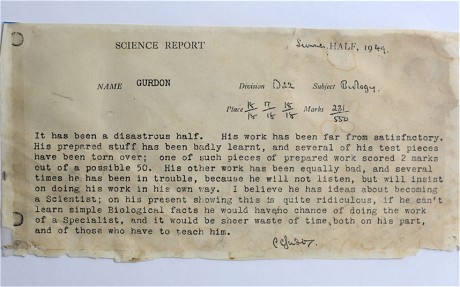
Inspirational Story of Sir John Gurdon, Nobel Prize winner

Source: http://www.telegraph.co.uk/news/science/science-news/9594351/Sir-John-Gurdon-Nobel-Prize-winner-was-too-stupid-for-science-at-school.html

A British scientist whose schoolmasters told him he was too stupid to study the subject has been awarded the Nobel Prize in medicine or physiology for his pioneering work on cloning.

At the age of 15, Prof Sir John Gurdon ranked last out of the 250 boys in his Eton year group at biology, and was in the bottom set in every other science subject. Sixty-four years later he has been recognised as one of the finest minds of his generation after being awarded the £750,000 annual prize, which he shares with Japanese stem cell researcher Shinya Yamanaka. Speaking after learning of his award in London on Monday, Sir John revealed that his school report still sits above his desk at the Gurdon Institute in Cambridge, which is named in his honour.

nobel-gurdon_2363595c

Moral of the story: Teachers may not be always right!

Congrats to Professor Andrew Wiles

http://www.telegraph.co.uk/news/science/science-news/12195189/Oxford-professor-wins-500000-for-solving-300-year-old-mathematical-mystery.html

Oxford professor wins £500,000 for solving 300-year-old mathematical mystery

Sir Andrew Wiles’ proof of Fermat’s Last Theorem has been described as ‘an epochal moment for mathematics’

An Oxford University professor has won a £500,000 prize for solving a three-century-old mathematical mystery that was described as an “epochal moment” for academics.

Sir Andrew Wiles, 62, has been awarded the Abel Prize by the Norwegian Academy of Science and Letters – and almost half a million pounds – for his proof of Fermat’s Last Theorem, which he published in 1994.

Linear Algebra – A Good Primer

tomcircle's avatarMath Online Tom Circle

Linear Algebra – A Primer

Linear transformations are intuitively those maps of everyday space which preserve “linear” things. Specifically, they send lines to lines, planes to planes, etc., and they preserve the origin.
(One which does not preserve the origin is very similar but has a different name; see Affine Transformation)

View original post

Ivy League University Myths

tomcircle's avatarMath Online Tom Circle

Excellent Talk:
Where you go is not where you’ll be “

This is the universal anxiety for all parents and students in Asian countries where there are limited university places: 2,500+ universities for 7 million Chinese high school students, 5 universities for 13,582 (@2015) Singaporean A-level students, …

Even the USA reputed with world-class university education, the American parents too face the same stress when sending 17-year-old kids to Ivy league universities !

The Myths:
◇ 60% Cornell students (2nd and 3rd year) lamenting not getting into Harvard or Yale !

◇ Those admitted into top universities take things for granted by “coasting” in lectures.

Majority 2/3 of Top Fortune 100 CEOs did not go to Ivy league universities.

Key Points:
It is not which elite university you go to, it is how you explore these opportunities in any university :
Diversity: people from…

View original post 182 more words

Ultimate Mathematician

tomcircle's avatarMath Online Tom Circle

引用巴拿赫Banach的名言,体现举一反三的境界:

A mathematician is a person who can find analogies between theorems;

A better mathematician is one who can see analogies between proofs

and

The best mathematician can notice analogies between theories.

One can imagine that the ultimate mathematician is one who can see analogies between analogies.

View original post

Google PageRanking Algorithm

tomcircle's avatarMath Online Tom Circle

Google Illustration:

The following WebPages (1) to (n=6) are linked in a network below:
eg.
Page (1) points to (4),
(2) & (3) points to (1)…

image

Let
$latex a_{ij} $ = Probability (PageRank *) from Page ( i ) linked to Page (j).

(*) PageRank: a measure of how relevant the page’s content to the topic of your query. This value is computed by the proprietary formula designed by the 2 Google Founders Larry Page & Sergey Brin, whose Stanford Math Thesis mentor was Prof Tony Chan (who knows the ‘secret ‘ to put his name always on Google 1st search list.)

The Markov Transition Matrix (A) is :

$latex A =
begin{pmatrix}
a_{11} & a_{12}& ldots & a_{1n}
a_{21} & a_{22} & ldots & a_{2n}
vdots & vdots & ddots & vdots
a_{n1} & a_{n2} &ldots & a_{nn}
end{pmatrix}
$

Assume we start surfing from Page…

View original post 418 more words

Do your best without comparing yourself to others and without fear or failure

Recently, the A Level results just came out, 93.1% score at least 3 H2 passes, best results since curriculum change in 2006. However, as most students know, 3 H2 passes (low pass e.g. 3 C’s) is far from enough to enter the 3 local universities. For those looking for a rank point calculator, check out my post on how to calculate JC Rank Points.

Just to share some motivational advice for those who may not have done as well for A levels. Source: http://www.kuenselonline.com/do-your-best-without-comparing-yourself-to-others-and-without-fear-or-failure/

In reality, the purpose of education should be to open your mind, gain life skills and help you develop your human qualities. It should not merely be considered as a gateway to a job.

Even if your main reason for studying is motivated by your future career, you still need to first consider what you really want to do before proceeding with your education plans. If, for example, you have a passion for cooking, then it might be better to enter a chef training programme rather than spend two more years in school. On the other hand, if you want to be a teacher then class 12 will be your route to achieve your goal.

Anyway, whatever you do, you should do it to the best of your ability. At the same time, you should have no expectations about the result.

Maybe this example will be helpful: Think of the seeds of a sunflower and a violet. A sunflower seed will produce a large, bright yellow flower, while the seed of a violet will produce a small, dark purple bloom. A violet seed can never produce a sunflower blossom no matter how hard it tries. Likewise, a sunflower seed cannot produce the flower of a violet. Neither flower is better or worse than the other. They are just different. However, it is important that the flowers open fully and are not ashamed whether they are small or large, bright or dark.

In the same way, you might discover that you are great at studies or you might find that you are not so great. Like the seeds, you cannot change your natural inclinations, but like the flowers you have to open fully. This means that you try your very best in every situation.

Practically, to do your best means that whatever assignment you are given, you aim to do it beautifully – not to get high grades, but for your own satisfaction. If you have to compose an essay, for example, write each letter and word clearly and in a way that is easy for others to read. Do the same with a math or science or any other assignment. Make each page of your notebook a work of art.

Most importantly is to have tried your very best. Very nice article!

Tough at home but teen perseveres and scores at A-level exams

Source: http://www.straitstimes.com/singapore/tough-at-home-but-teen-perseveres-and-scores-at-a-level-exams

Very inspirational!

Excerpt:

Richmond Tan does not have a study table in the one-room rental flat that he shares with his father, grandfather and brother.

There were times when he did not even have a roof over his head, after his family was temporarily chased out of the Queenstown flat as a result of spats between his father and the landlord.

Richmond had to sleep in void decks or at Changi Airport.

He said what motivated him to do well in his studies was his role model, Han Xin, one of the heroes of the early Han dynasty in China.

He learnt of Han after reading The Art Of War by Sun Tzu, which inspired him to take China Studies for his A levels.

“Han Xin was so poor he had to beg for food. His circumstances were even worse than mine, but he studied hard and became a capable minister,” he added.

Han Xin was also a mathematician, and one of the earliest to discover the secret of the Chinese Remainder Theorem, a key result in Number Theory. According to legend, he used it to calculate the number of soldiers in his army. See this post for more details: http://chinesetuition88.com/2015/04/25/chinese-remainder-theorem-history-%E9%9F%A9%E4%BF%A1%E7%82%B9%E5%85%B5/

Interview of Michael Atiyah (aged 86!)

Source: https://www.quantamagazine.org/20160303-michael-atiyahs-mathematical-dreams/

Inspirational interview by Michael Atiyah, winner of both Fields Medal and Abel Prize, currently age 86!

Excerpt from the interview:

Is there one big question that has always guided you? 

I always want to try to understand why things work. I’m not interested in getting a formula without knowing what it means. I always try to dig behind the scenes, so if I have a formula, I understand why it’s there. And understanding is a very difficult notion.

People think mathematics begins when you write down a theorem followed by a proof. That’s not the beginning, that’s the end. For me the creative place in mathematics comes before you start to put things down on paper, before you try to write a formula. You picture various things, you turn them over in your mind. You’re trying to create, just as a musician is trying to create music, or a poet. There are no rules laid down. You have to do it your own way. But at the end, just as a composer has to put it down on paper, you have to write things down. But the most important stage is understanding. A proof by itself doesn’t give you understanding. You can have a long proof and no idea at the end of why it works. But to understand why it works, you have to have a kind of gut reaction to the thing. You’ve got to feel it.

Interesting comment that “A proof by itself doesn’t give you understanding. You can have a long proof and no idea at the end of why it works.”. Sometimes, intuitive understanding is needed, along with formal proof.

One example in high school mathematics is proving \displaystyle \sum_{i=1}^n i^2=\frac 16n(n+1)(2n+1). It is possible to prove it by induction without actually understanding how the formula comes about!

Artin-Whaples Theorem

There seems to be another version of Artin-Whaples Theorem, called the Artin-Whaples Approximation theorem.

The theorem stated here is Artin-Whaples Theorem for central simple algebras.

Artin-Whaples Theorem: Let A be a central simple algebra over a field F. Let a_1,\dots,a_n\in A be linearly independent over F and let b_1,\dots,b_n be any elements in A. Then there exists a_i',a_i''\in A for i=1,\dots,m such that the F-linear map f:A\to A defined by f(x)=\sum_{r=1}^m a_r'xa_r'' satisfies f(a_j)=b_j for all j=1,\dots,n.

Very nice and useful theorem.

Simple Algebra does not imply Semisimple Algebra

The terminology “semisimple” algebra suggests a generalization of simple algebras, but in fact not all simple algebras are semisimple! (Exercises 1 & 5 in Richard Pierce’s book contain examples)

A simple module is a semisimple module is true though.

Proposition: For a simple algebra A, the following conditions are equivalent:

(i) A is semisimple;

(ii) A is right Artinian;

(iii) A has a minimal right ideal.

Thus to find a algebra that is simple but not semisimple, one can look for an example that is not right Artinian.

Amazon Associates / Affiliates Payment Options (Outside US)

For those using Amazon Associates (or other US based affiliate programs) but are outside USA, there is now an option to transfer the earnings directly to your bank account. Works in Singapore, and most other countries.

The way to do it is through Payoneer. (Direct link: https://share.payoneer.com/nav/FdReUzoZLHa355a95CrNv8uVU528u1dPTojBD2lcYbYvHYFDYT0WxkdmgqlJSsjRs75isVLfZi9fhax47Braxw2)

The other option of receiving cheque from Amazon is bad since the administrative fees are quite expensive (around 20 USD if I remember correctly).

Amazon Associates is quite a good affiliate program. If your blog has just around 100 visits per day, it can already translate to around $20 USD or more per month earnings depending on what you are promoting. This will most likely to cover the cost of hosting your blog. People with extremely popular blogs (see here) have earned more than half a million USD from Amazon Associates.

For those thinking of signing up Payoneer please sign up using the link above. It is a special “Refer a Friend” program where both you and I will get $25 USD upon you signing up. (* After your friend signs up and receives a total of $100, you both earn a $25 reward.)

Shimura Memoire on André Weil

tomcircle's avatarMath Online Tom Circle

Goro Shimura (志村 五郎 born 23 February 1930) is a Japanese mathematician, and currently a professor emeritus of mathematics (former Michael Henry Strater Chair) at Princeton University

Shimura is known to a wider public through the important Modularity Theorem (previously known as the Taniyama-Shimura conjecture before being proven in the 1990s); Kenneth Ribet has shown that the famous Fermat’s Last Theorem (FLT) follows from a special case of this theorem. Shimura dryly commented that his first reaction on hearing of 1994 Andrew Wiles’s proof of the semi-stable case of the FLT theorem was ‘I told you so’.

Shimura’s mémoire on the 20th century great French mathematician André Weil (Fields Medal, Founder of Bourbaki):

1. Weil advised us not to stick to a wrong idea too long. “At some point you must be able to tell whether your idea is right or wrong; then you must have the guts…

View original post 442 more words