This is a great introduction to LaTeX, a mathematical typesetting language that can be used to write Math equations. LaTeX can be used on WordPress too!
It’s a numbers song for children and adults. Count from 0 to 100 and from a hundred to a trillion.
This song was written and performed by A.J. Jenkins. Video by KidsTV123.
A catchy and educational song for kids to count big numbers.
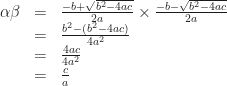
Given a quadratic equation with roots and , we have:
How do we prove this? It is actually due to the quadratic formula!
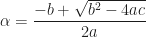
Recall that the quadratic formula gives the roots of the quadratic equation as:
Now, we can let
Hence,
In the above proof, we made use of the identity
The above formulas are also known as Vieta’s formulas (for quadratic). There we have it, this is how we prove the formula for the sum and product of roots!
If we were to choose only 3 greatest scientists in the entire human history, who excelled in every field of science and mathematics, they are:
1) Archimedes
2) Issac Newton
3) Carl Friedrich Gauss
Let’s see how Gauss became a great scientist in his formative years in the university, it would give us a clue by knowing what kind of books did he read ?
Carl Friedrich Gauss was awarded a 3-year ‘overseas’ scholarship to study in Göttingen University (located in the neighboring state Hanover) by his own state sponsor the Duke of Brunswick.
Gauss chose Göttingen University because of its rich collection of books.
During the 3 years, he read very widely on average 8 books in a month.
Below was his student days’ library records:
1795-1796 (1st semister): total 35 books
Math (M) :1 ,
Astrology (A):2,
History/Philosophy (H): 1,
Literature/ Language (L): 15,
Science Journal (S): 16
Recent years, there are more newly created “Nobel” Prizes with much bigger prize amounts than the Nobel prize:
BREAKTHROUGH PRIZE IN LIFE SCIENCE (2013)
Donated by: Yuri Milner (Russian Internet Billionaire)
Mark Zuckerberg (Facebook Founder)
Sergey Brin (Google co-founder)
US$ 3 million
Award Frequency: Every year
Status: 9 scientists had been awarded
FUNDAMENTAL PHYSCIS PRIZE (2012)
Donated by Yuri Milner
US$ 3 million
TANG PRIZE 唐奨 (2013)
Donated by Samual Yin 尹衍梁 (Taiwan Property Tycoon) for Asian countries.
US$ 1.675 million
Frequency: Every 2 years
QUEEN ELIZABETH ENGINEERING PRIZE (2013)
US$ 1.5 million
NOBEL PRIZE (1901)
US$ 1.2 million
SHAW PRIZE 邵逸夫奨 (2004)
Donated by Run Run Shaw (Hong Kong Movie Producer Billionaire)
US$ 1 million
LASKER AWARD (1946)
US$ 250,000
BLAVATNIK YOUNG SCIENTIST AWARD (2013)
Donated by Len Blavatnik (Billionaire Investor)
US$ 250,000
I find Khan Linear Algebra video excellent. The founder / teacher Sal Khan has the genius to explain this not-so-easy topic in modular videos steps by steps, from 2-dimensional vectors to 3-dimensional, working with you by hand to compute eigenvalues and eigenvectors, and show you what they mean in graphic views.
If you are taking Linear Algebra course in university, or revising it, just go through all the Khan’s short (5-20 mins) videos on Linear Algebra here:
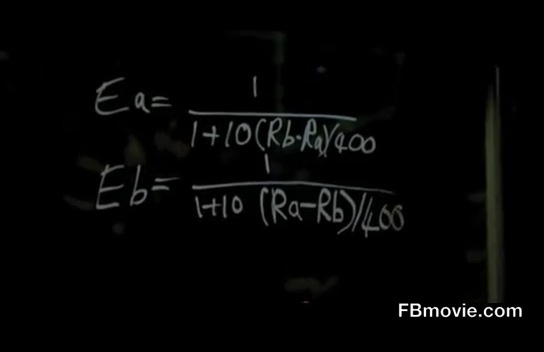
Eduardo Saverin (now a Singaporean billionaire investor) gave the wrong Elo formula to his Facebook co-founder Mark Zuckerburg, both of them became ‘accidental’ billionaire. Watch the video clip in the movie “Social Network”:
The Elo formula is based on the theory of Normal Distribution with Logarithm function, from base of exponential e to base of 10.
The correct Elo Formula should be :
$Latex boxed
{
E_a =frac{1}
{1+ frac{1}{400}.Huge 10^{(R_b – R_a)}
}
}$
Math Chants make learning Math formulas or Math properties fun and easy for memory . Some of them we learned in secondary school stay in the brain for whole life, even after leaving schools for decades.
Math chant is particularly easy in Chinese language because of its single syllable sound with 4 musical tones (like do-rei-mi-fa) – which may explain why Chinese students are good in Math, as shown in the International Math Olympiad championships frequently won by China and Singapore school students.
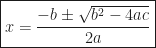
1. A crude example is the quadratic formula which people may remember as a little chant:
“ex equals minus bee plus or minus the square root of bee squared minus four ay see all over two ay.”
$latex boxed{
x = frac{-b pm sqrt{b^{2}-4ac}}
{2a}
}$
2. $latex mathbb{NZQRC}$ Nine Zulu Queens Rule China
Check out the following interesting comic books explaining Math (Calculus, Linear Algebra, and Statistics) in a fun and enjoyable way.
In The Manga Guide to Calculus, you’ll follow along with Noriko as she learns that calculus is more than just a class designed to weed out would-be science majors. You’ll see that calculus is a useful way to understand the patterns in physics, economics, and the world around us, with help from real-world examples like probability, supply and demand curves, the economics of pollution, and the density of Shochu (a Japanese liquor).
Mr. Seki teaches Noriko how to:
Use differentiation to understand a function’s rate of change
Apply the fundamental theorem of calculus, and grasp the relationship between a function’s derivative and its integral
Integrate and differentiate trigonometric and other complicated functions
Use multivariate calculus and partial differentiation to deal with tricky functions
Use Taylor Expansions to accurately imitate difficult functions with polynomials
Whether you’re struggling through a calculus course for the first time or you just need a painless refresher, you’ll find what you’re looking for in The Manga Guide to Calculus.
Follow along in The Manga Guide to Linear Algebra as Reiji takes Misa from the absolute basics of this tricky subject through mind-bending operations like performing linear transformations, calculating determinants, and finding eigenvectors and eigenvalues. With memorable examples like miniature golf games and karate tournaments, Reiji transforms abstract concepts into something concrete, understandable, and even fun.
As you follow Misa through her linear algebra crash course, you’ll learn about:
Basic vector and matrix operations such as addition, subtraction, and multiplication
Linear dependence, independence, and bases
Using Gaussian elimination to calculate inverse matrices
Subspaces, dimension, and linear span
Practical applications of linear algebra in fields like computer graphics, cryptography, and engineering
But Misa’s brother may get more than he bargained for as sparks start to fly between student and tutor. Will Reiji end up with the girl—or just a pummeling from her oversized brother? Real math, real romance, and real action come together like never before in The Manga Guide to Linear Algebra.
The Manga Guide to Statistics
This manga textbook is written for those interested in understanding principles of statistics. Each of the seven chapters is organized into four sections: a cartoon, a text explanation to supplement the cartoon, an exercise that includes the answer, and a summary. Readers can learn much about the subject by just reading the cartoon, but they will gain a more thorough understanding by working through the other three sections in each chapter. Yamamoto provides Rui with easy-to-understand examples and graphic illustrations, making the subject less intimidating.
Axiom
(
Greek
): meant
request
. The reader is requested to accept the axioms unquestioningly as the rules of the game.
Euclid’s “Element” built the whole Geometry with only 5 axioms.
The 5th axiom “Parallel line” was not challenged for 3,000 years until 19th CE Gauss & Riemann developed the Non-Euclidian Geometry.
What it means a curve (function) is :
1. Continuous = not broken curve
2. Differentiable = no pointed ‘V’ or ‘W’ shape curve
3. Integrable: can compute the area under the (unbroken) curve.
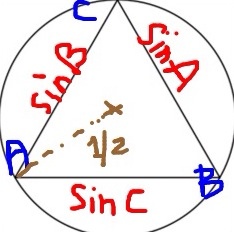
1. Draw a circle (diameter 1)
2. Connect any 3 points on the circle to form a triangle of angles A, B, C.
3. The length of sides opposite A, B, C are sin A, sin B, sin C, respectively.
Proof:
By Sine Rule:
$latex frac{a}{sin A} = frac{b}{sin B} =frac{c}{sin C} = 2R = 1$
where sides a,b,c opposite angles A, B, C respectively.
a = sin A
b = sin B
c = sin C
1. No complexity of Analytical Geometry
2. Remove the astute dotted (helping) line in Geometry
3. No need diagram: Use only 2 vector properties: Head- to-Tail:
$latex vec{AC}=vec{AB}+vec {BC}$ Closed Loop:
$latex vec{DE}+vec{EF}+vec{FD}=0$
4. Enable Computer automated proof of Geometry via Algebra.
Example: 任意四边形 Quadrilateral ABCD with M,N midpoints of AB, CD, resp.
Prove: MN=1/2(BC+AD)
Proof: (by vector):
Consider MBCN:
MN=MB+ BC+ CN..(1)
Consider MADN:
MN=MA+ AD+ DN..(2)
(1) +(2):
2MN=(MB +MA) +
(BC +AD) +(CN +DN)
but (MB +MA) =0,
(CN +DN) =0 [same magnitude but different direction cancelled out ]
=> MN=1/2 (BC +AD)
Special cases:
1. A = B (=M)
=> triangle ACD
AN = 1/2 (AC +AD)
2. BC // AD
=> Trapezium ABCD
MN=1/2 (BC +AD)
=> MN // BC // AD
Bharati Krishna Tirthaji @ early 19xx, a former Indian child prodigy graduating in Sanskrit, Philosophy, English, Math, History & Science at age 20.
16 sutras (aphorisms):
1. By one more than the one before
2. All from 9 and the last from 10
3. Vertically and cross-wise
4. Transpose and Apply
5. If the Samuccaya is the same it is Zero
6. If One is in Ratio the Other is Zero
7. By + and by –
8. By the Completion or Non-Completion
9. Differential Calculus
10. By the Deficiency
11. Specific and General
12. The Remainders by the Last Digit
13. The Ultimate and Twice the Penultimate
14. By One Less than the One Before
15. The Product of the Sum
16. All the Multipliers
Solve
$latex (x+7)^4+(x+5)^4=706$
Let y = x + 6 = average of (x+5, x+7)
$latex (y+1)^4+(y-1)^4=706$
Cancel terms y, y³:
$latex 2y^4+12y^2+2=706$
$latex y^4+6y^2-352=0$
$latex y^2=16$ or
$latex y^2=-22$
y= ±4 or ±$latex sqrt{-22}$
y=x+6
x=-2, -10, ± $latex sqrt{-22}-6$
1. Amateur is at liberty to study only those things he likes.
2. Professional must also study what he doesn’t like.
3. Conclusion: Most famous theorems are found by Amateurs.
An old man had 11 horses. When he died, his will stated the following distribution to his 3 sons:
1/2 gives to the eldest son,
1/4 for 2nd son,
1/6 for 3rd son.
Find: how many horses each son gets ?
There are 2 methods to solve: first using simple arithmetic trick without knowing the theory behind; the second method will explain the first method “from an advanced standpoint” – Number Theory (Felix Klein’s Vision )
1) Arithmetic trick:
11 is odd, not divisible by 2, 4 and 6.
Loan 1 horse to the old man:
11+1 = 12
1st son gets: 12/2 = 6 horses
2nd son gets:12/4 = 3 horses
3rd son gets: 12/6 = 2 horses
Total = 6+3+2=11 horses
Up to you if you want the old man to return the 1 loan horse 🙂
The French method of drawing curves is very systematic:
“Pratique de l’etude d’une fonction”
Let f be the function represented by the curve C
Steps:
1. Simplify f(x). Determine the Domain of definition (D) of f;
2. Determine the sub-domain E of D, taking into account of the periodicity (eg. cos, sin, etc) and symmetry of f;
3. Study the Continuity of f;
4. Study the derivative of fand determine f'(x);
5. Find the limits of fwithin the boundary of the intervals in E;
6. Construct the Table of Variation;
7. Study the infinite branches;
8. Study the remarkable points: point of inflection, intersection points with the X and Y axes;
9. Draw the representative curve C.
Example:
$latex displaystyletext{f: } x mapsto frac{2x^{3}+27}{2x^2}$ Step 1: Determine the Domain of Definition D D = R* = R –…
Donald Knuth (Great Computer Mathematician, Stanford University, LaTex inventor) noted the Bible uses a phrase like:
“as my Father is to me, I am to you”
=> F= Father = line AB
I (or me) = AC
U = You = CB
=> F/I = I/U = Φ
Note: Φ = 1.61803 = – 2 sin 666°
Related Links: Find sites that are similar to the site you are visiting.
Wayback: See how a site looked in the past.
Hot Pages & Searches: See what’s popular on the web right now.
Alexa Internet, Inc. is a California-based subsidiary company of Amazon.com which provides commercial web traffic data. Founded as an independent company in 1996, Alexa was acquired by Amazon in 1999. Its toolbar collects data on browsing behavior and transmits it to the Alexa website, where it is stored and analyzed, forming the basis for the company’s web traffic reporting. As of 2013, Alexa provides traffic data, global rankings and other information on 30 million websites,[3] and its website is visited by over 8.5 million people monthly. (Wikipedia)
This post is a review on Right brain training, and also a list of resources that one can research on regarding to the popular method of Right brain training.
When it comes to New Year’s resolutions, getting your body in shape often tops the list. But what about your brain?
Top Seller on Amazon.com on Right brain training
If your left or right brain is feeling a little flabby, there’s a wide range of books, teaching programs, and even a Nintendo DS game, purporting to train your left and/or right brain. Indeed, if you Google “right brain training”, you’ll score 53,900,000 hits.
These products are based on the belief that the left and right hemispheres are polar opposites. The left brain is often characterised as your intelligent side: rational, logical and analytic. In contrast the right brain is stereotyped as the “touchy-feely” hemisphere, viewed as artistic, creative, and emotive.
Such left and right brain stereotypes have led theorists to suggest that people can be classified according to their “hemisphericity”. If you’re a logical, rational scientist, for instance, you’re left-brained. But creative types, from artists to writers, are right-brained.
Based on my teaching experience, I do find that left-handers (right-brained) students tend to be very creative and usually excel at arts and humanities. However, their math skills can be good too, especially with practice. This shows that the human brain is like a muscle, it gets better with practice and use.
Did you know our Prime Minister Lee Hsien Loong is left-handed too? Barack Obama is also left-handed. Prime Minister Lee Hsien Loong is very good at math, so this should dispel any myths that left-handed students are not good at math.
Understanding the Myth of Left Brain and Right Brain Dominance
The Right Brain
According to the left-brain, right-brain dominance theory, the right side of the brain is best at expressive and creative tasks. Some of the abilities that are popularly associated with the right side of the brain include:
Recognizing faces
Expressing emotions
Music
Reading emotions
Color
Images
Intuition
Creativity
The Left Brain
The left-side of the brain is considered to be adept at tasks that involve logic, language and analytical thinking. The left-brain is often described as being better at:
Language
Logic
Critical thinking
Numbers
Reasoning
Also, check out the above Youtube video to check if you are a right-brained or left-brained person!
The Right Brain vs Left Brain test … do you see the dancer turning clockwise or anti-clockwise?
If clockwise, then you use more of the right side of the brain and vice versa.
Most of us would see the dancer turning anti-clockwise though you can try to focus and change the direction; see if you can do it.
LEFT BRAIN FUNCTIONS
uses logic
detail oriented
facts rule
words and language
present and past
math and science
can comprehend
knowing
acknowledges
order/pattern perception
knows object name
reality based
forms strategies
practical
safe
RIGHT BRAIN FUNCTIONS
uses feeling
“big picture” oriented
imagination rules
symbols and images
present and future
philosophy & religion
can “get it” (i.e. meaning)
believes
appreciates
spatial perception
knows object function
fantasy based
presents possibilities
impetuous
risk taking
Right Brain Training Test
Take the test to see if you are right-brained or left-brained!
Any comments or websites about Right brain training to share? Leave your comments below!
Right Brain Training Video
Watch this free brain training video and follow the instructions to increase your brain power. This is an online “game” that really works to improve brain function. You can actually feel it work!
Brain Training can increase your brain power just like weight training can increase your strength. Use this exercise to work out your brain. Bookmark this video and come back and practice with variations on the basics as discussed in the video.
$Latex i^{i } = 0.207879576…$
$latex i = sqrt{-1}$
If a is algebraic and b is algebraic but irrational then $latex a^b $ is transcendental. (Gelfond-Schneider Theorem)
Since i is algebraic but irrational, the theorem applies.
1. We know
$latex e^{ix}= cos x + i sin x$
Let $latex x = pi/2 $
2. $latex e^{i pi/2} = cos pi/2 + i sin pi/2 $
$latex cos pi/2 = cos 90^circ = 0 $
$latex sin 90^circ = 1 $
$latex i sin 90^circ = (i)*(1) = i $
3. Therefore
$latex e^{ipi/2} = i$
4. Take the ith power of both sides, the right side being $latex i^i $ and the left side =
$latex (e^{ipi/2})^{i}= e^{-pi/2} $
5. Therefore
$latex i^{i} = e^{-pi/2} = .207879576…$
A Maths Paper 2:
29/10/2014 (Wednesday)
08:00-10:30
The schedule for the first few weeks seems to be quite tight, for instance on 28/10/2014 students would have to handle A Maths Paper 1, and Chemistry Paper 2. (A Maths Paper 1 would be quite exhausting for students on its own)
After the major papers are over, students will have plenty of time to study for their Science Paper 1 (MCQ), with Biology Paper 1 being one of the last papers on 13/11/2014.
Just can’t imagine how strange a plane MH370 could just disappear in the air, no explosion, no terrorists (?) although 2 Iranian passengers with stolen passports from an Italian and an Austrain.
Malaysian Flight: MH 370
Departure : Passengers, among them the majority are 153 Chinese, boarded on 3.7 (March 7) around 11 PM at Kuala Lumpur International Airport, disappeared 1 hour later in the air.
A lot of mystery numbers have such behaviors when decompose the digit, then each powered by 3, sum them up, you get back the mystery number itself.
Bible Math: 153 St. Peter Fish
[John 21:3-11]
3 So they went out and got into the boat, but that night they caught nothing. 6 He said, ”Throw your net on the right side of the boat and you will find some.” When…
Bayes’ Theorem helped researchers locate Air France Flight 447’s black box in 2011
(Video: How Bayesian Search found the USS Scorpion)
Days after a Malaysian airliner with 239 people aboard went missing en route to Beijing, searchers are still struggling to find any confirmed sign of the plane. Authorities have acknowledged that they didn’t even know what direction it was heading when it disappeared.
As frustrations mount over the failures of the latest technology in the hunt for Malaysia Airlines Flight MH370, some scientists say an 18th-century mathematical equation – used in a previous search for an Air France jetliner’s black box recorder – could help pinpoint the location of the Malaysian plane.
Indonesian Air Force officers examine a map of the Malacca Strait during a briefing following a search operation for the missing Malaysia Airlines Boeing 777, at Suwondo air base in North Sumatra, Indonesia, on Wednesday.
In 2009, Air France Flight 447 en route to Paris from Rio de Janeiro vanished over the Atlantic Ocean, triggering the most expensive and exhaustive search effort ever conducted for a plane. After two years, officials could only narrow the location of the plane’s black box down to an area the size of Switzerland.
But Flight 447’s black box was found in just five days after authorities contacted scientific consultants who applied a centuries-old equation called Bayes’ Theorem.
Mathematically, Bayes’ theorem gives the relationship between the probabilities of A and B, P(A) and P(B), and the conditional probabilities of A given B and B given A, P(A|B) and P(B|A). In its most common form, it is: (Wikipedia)
Proof of Bayes’ theorem (Theorem useful for finding MH370 plane)
The proof of Bayes’ theorem is actually relatively simple, the only requirement is to know the formula for conditional probability (Learnt in H1/H2 Maths):
From this, we have
Similarly,
But since , we have . Dividing throughout by gives Bayes’ Formula:
Sincerely wishing that the MH370 plane will be found soon, and hopefully the passengers are still alive.
Also see: Bayesian search theory (Bayesian search theory is the application of Bayesian statistics to the search for lost objects. It has been used several times to find lost sea vessels, for example the USS Scorpion. It also played a key role in the recovery of the flight recorders in the Air France Flight 447 disaster of 2009.)
We are glad to have Mr Henry Thompson write a Math article on our blog. 🙂
Guest post by Henry Thompson of DegreeJungle.com:
One significant obstacle that students face when trying to understanding mathematics is that they devote a great deal of their energy to NOT enjoying themselves. Think about it; reading literature is satisfying, if the story is carefully chosen. Holding a conversation about up-to-date events in History, while studying critical analysis, is enjoyable. But, even for math teachers, working out a complex algebraic equation is simply not exciting.
Students rely on their professors to make mathematics convenient and more effortlessly appreciated. Thus, it makes good sense for educators to insert some sort of enjoyment into their math lessons as frequently as possible; particularly, if the diversion includes a little academic theory.
Today’s professors feel that great math education objectives should not only “address the program of study,” but should also present learners with new ways to discover life through the aperture of mathematics.
For this reason, groundbreaking educators around the globe have altered their approach to math education by leaving behind unimportant and boring learning objectives and implementing applicable and appealing math learning inside the classroom.
Yesteryear’s Math Programs Are Uninspiring
If teachers recall their pedagogic theories from college, they’ll remember that many lesson plans contained mathematical calculations at the hub of their programs.
Additionally, the framework in most old-school math textbooks contains terribly-fashioned word problems. It appears that a few textbook publishers hold fundamental challenges in developing math problems that are linked to real life.
Outdated textbooks only pay attention to computational formats as well, leaving out the reasoning that is produced behind the scenes, which is needed to solve math problems.
The folks at Degree Jungle recently talked to some math educators, who located their teaching credential programs through the infamous search engine, to find out what instructors in the twenty-first century should look for when analyzing conventionally-structured math programs.
A Brand-New Strategy for Teaching
A large number of math educators, today, recommend professors seek math learning-systems that guarantee relevancy, instead of those which put math calculations at the center of study; lessons that contain “real-life” relevance will most certainly motivate students to engage more.
The planet contains plenty of fascinating mathematic applications. A tree’s design is a consequence of fractional limb patterns. A tiny shellfish’s cask coils in an exquisite and attractive mathematical design. Profound mathematics dwells in the massive framework of the cosmos. Moreover, all things that folks explore throughout the day contain some sort of mathematical design.
Easy Tips for Applying Mathematics to the Real-World
Below are a handful of tips that educators can work with to help put real-world situations inside their educational math programs:
Although adding real-world scenarios to math problems plays a vital part in ensuring an entertaining lesson, it is not the only unique educational approach for teaching math. There are countless mathematical strategies short of “real-life” applicability that are, nevertheless, exceptionally appealing.
Projecteuler.net delivers a collection of serious mathematical-CIS problems that will demand much more than just mathematical awareness to solve.
Fullerton IV Elementary School’s, Integers Across Disciplines, proposes another strategy. Educators there have developed tasks that force students to visit challenging mathematical problems and to discover that math demands practice and patience.
Euler’s graph theory using geography assists students in building mathematical tolerance and in discovering ways to conquer frustration. As an included reward, learners will understand that not all math problems have solutions.
This will be my final post associated with the Analysis I course, for which the last lecture was yesterday. It’s possible that I’ll write further relevant posts in the nearish future, but it’s also possible that I won’t. This one is a short one to draw attention to other material that can be found on the web that may help you to learn the course material. It will be an incomplete list: further suggestions would be welcome in the comments below.
A good way to test your basic knowledge of (some of) the course would be to do a short multiple-choice quiz devised by Vicky Neale. If you don’t get the right answer first time for every question, then it will give you an idea of the areas of the course that need attention.
Terence Tao has also created a number of multiple-choice quizzes, some of which are relevant…
Who knew? Danica McKellar AKA Winnie Cooper on the television hit the Wonder Years, is a published author and mathematician. She showed up on WGN Noon News the other day promoting her latest book, Kiss My Math. Just goes to show brains and beauty CAN go together.
Here is the complete list of Books by Danica McKellar (Top Sellers)
Bitcoin is a peer-to-peer payment system and digital currency introduced as open source software in 2009 by developer Satoshi Nakamoto. It is a cryptocurrency, so-called because it uses cryptography to control the creation and transfer of money.[5] Conventionally, the capitalized word “Bitcoin” refers to the technology and network, whereas lowercase “bitcoin” refers to the currency itself.[6] (Wikipedia)
Adding transactions to the block chain and updating a local copy of the block chain is part of a process called mining. At the same time that miners (nodes in the network) are doing the important work of processing and recording transactions, they are also competing in a race. They are racing to “complete the current block” in order to win bitcoins.
Mining is a serious competition nowadays and it consumes large computing resources. Although it’s possible to mine on a laptop, the math problems have become hard enough that a laptop’s CPU will likely never complete a block on its own. The cost of the electricity needed to run the mining software would exceed the return for mining. Macs and PC are certainly capable of computing hash functions, but are too slow compared to specialized mining hardware that is now available.
Bitcoin mining serves 2 purposes, it creates the general ledger of Bitcoin transaction and provides security. The miners compile the transactions together into a “block” and add it to the “Bitcoin blockchain.” If there was a central authority this would need to be done once and verified by that central authority. However, there is no central authority in Bitcoin and these blocks need to verified in some way. Many Bitcoin Miners all over the world are compiling these transactions. At the end of the compilation they essentially print a lottery number at the bottom. Each miner is doing this millions or billions of times per second. (Source: http://cointext.com/bitcoin-mining-whats-it-all-about/)
One of the hardest questions for many math teachers to answer in a way that is relevant to students is: “why do I need to know this?” “For the next course you take”, the easiest answer in many cases, does not answer the question that was usually being asked.
My answers to this question obviously depend on the topic being studied at moment, and I don’t have “good” answers for all topics… but here is my list of key quantitative life skills I learned directly or indirectly from math class, with
At age two, Jake Barnett was diagnosed with autism and his future was unclear. Now at age 13, Jake is a college sophomore and a math and science prodigy. Jake says his autism is key to his success. Morley Safer reports. The Spark: A Mother’s Story of Nurturing, Genius, and Autism (Book by Jake’s mother)
“It seems that for success in science or art a dash of autism is essential.” – Hans Asperger




 with roots
  and
and  , we have:







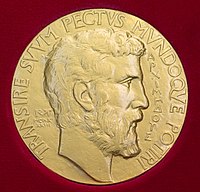
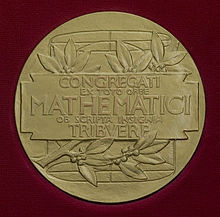

 Alexa Traffic Rank: See how popular a website is.
 Related Links: Find sites that are similar to the site you are visiting.
 Wayback: See how a site looked in the past.
 Hot Pages & Searches: See what’s popular on the web right now.


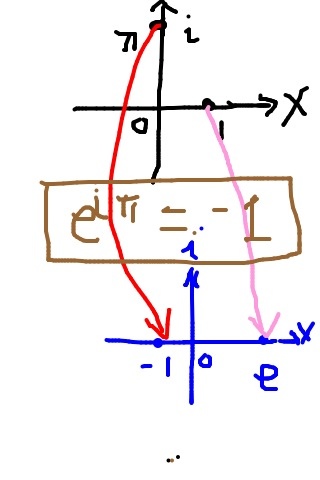
 , you have entered the mysterious world of complex numbers.
 is a real number! Let us explain it here:
 . This has been voted as the most beautiful equation in mathematics by many people.





 , we have
  . Dividing throughout by
  gives Bayes’ Formula:


 Mathtuition88