Number Theory (1) | Curves over Finite Fields (2) | Riemann Surfaces (3)
Weil wanted to link up these 3 distinct Maths, as in the Langands Program.
Langrands’ original idea on the Left Column (1) Number Theory & the Middle Column (2):
1. He related : representations of the Galois groups of number fields (objects studied in number theory)
to: automorphic functions (objects in harmonic analysis).
2. The middle column (2):
Galois group relevant to curves over finite fields.
Also there exists a branch of harmonic analysis for automorphic functions.
3. How to translate column (3) Riemann Surfaces ?
We have to find geometric analogues of the Galois groups and automorphic functions in the theory of Riemann surfaces.
Next we have to find suitable analogues of the automorphic functions ?
It was a mystery until 1980 solved by the Russian Vladimir Drinfeld (Fields medalist for…
Langland wrote to André Weil in 1967:
Analysis & Algebra linked up by L-function, which converts algebraic data from Galois theory into Analytic functions in complex numbers.
He goes beyong Modular Form to the Automorphic Forms (complex functions whose symmetries are described by larger matrices).
Key concepts on Algebra marry up with those from Analysis.
Just to share with my Singaporean readers on 5 ways to save money while shopping!
1) Universal Studios Ticket
This is a very good bargain, Qoo10 is selling the Universal Studios Singapore Ticket at half the retail price. Normal price is $74. If you haven’t visited USS yet, this June holidays is a good time.
[S$35.99][Holiday Special]Universal Studio Singapore Ticket USS One day Pass 新加坡环球影城 / Christmas Celebration.Best Price Guaranteed! / RESORTS WORLD SENTOSA
WWW.QOO10.SG
2) Cheap and good iPhone Cable
Everyone knows that the official Apple cable is very expensive, overpriced in fact. Most people just need a basic iPhone cable that can charge and connect to computer. I personally bought this cable, at $3.70 it is extreme value for money. So far so good, it charges and transfer data well. I don’t think you can find another place with such low price for a cable.
At $99, it is one of the cheapest electronic items out there (as compared to iPhone, iPad, etc.) Also, Kindle is ideal as a gift to students as it is very education oriented, and has less games than the iPad (a upside for children).
[S$99.00][Kindle]★Amazon Kindle 2015 with Free eBooks! (2015 KINDLE 7th Gen/ Kindle Paperwhite 2015)- 7000 eBooks Free with Cover or Slip Case Purchased! Best Amazon Kindle Paperwhite Voyage Reader Tablet! ★
WWW.QOO10.SG
4) Cheapest Computer in Singapore
This notebook (from HP) would be a good choice if you need a basic laptop for school work. There are other brands (Asus, Lenovo) at similar prices at Qoo10. Very few physical shops have computers at this price.
[S$299.00][HP]*** GSS Special Price *** HP 250 14inch Dual Core Notebook / Intel N2840 Processor / 2GB Ram / 500GB HDD / Windows 8.1 / Intel HD Graphics / Only 1.9Kg / 1 Year Limited International HP Warranty
WWW.QOO10.SG
5) Cat6 Ethernet Cable
Many households (including myself, until recently) are still using Cat5 / Cat5e old cables which would impact your internet speed. No point subscribing to the best internet plan, and have it all slowed down by an outdated Cat5 cable. This Cat6 Ethernet Cable may be what you need to boost your internet connection.
[S$3.90]Cat6 Ethernet Network Patch Cable – UTP BCC Stranded FLUKE® Tested | 0.5m to 3m | UTP BCC | Blue
In layman’s terms, “measures” are functions that are intended to represent ideas of length, area, mass, etc. The inputs for the measure functions would be sets, and the output would be a real value, possibly including infinity.
It would be desirable to attach the value 0 to the empty set and measures should be additive over disjoint sets in X.
Definition (from Bartle): A measure is an extended real-valued function defined on a -algebra X of subsets of X such that
(i)
(ii) for all
(iii) is countably additive in the sense that if is any disjoint sequence () of sets in X, then
.
If a measure does not take on , we say it is finite. More generally, if there exists a sequence of sets in X with and such that for all n, then we say that is -finite. We see that if a measure is finite implies it is -finite, but not necessarily the other way around.
Examples of measures
(a) Let X be any nonempty set and let X be the -algebra of all subsets of X. Let be definied on X by , for all . We can see that is finite and thus also -finite.
Let be defined by , if . is an example of a measure that is neither finite nor -finite.
The most famous measure is definitely the Lebesgue measure. If X=R, and X=B, the Borel algebra, then (shown in Bartle’s Chapter 9) there exists a unique measure defined on B which coincides with length on open intervals. I.e. if E is the nonempty interval (a,b), then . This measure is usually called Lebesgue measure (or sometimes Borel measure). It is not a finite measure since . But it is -finite since any interval can be broken down into a sequence of sets () such that for all n.
Today’s world is Big Data, with explosive unstructured data from Internet, Mobile phones, tablets, soon the IoT (Internet of Things), ie devices such as car, fridge, oven, washing machines…equipped with wireless Wi-Fi connectivity to Internet…
Top Mathematicians will be the global elites of the D.T. (Data Technology) Age — as the Alibaba.com Chairman Jack Ma predicts.
CN Yang (杨振宁) Yang-Mills Equation in Quantum Physics and ‘Fibre Bundle’ in Differential Geometryby SS Chern (陈省身) are equivalent, however both men worked independently for 30 years!
1962 two American economists David Gale & Lloyd Shipley designed The “Stable Marriage Problem” aka “The Match“.
Note: ‘Stable’ means nobody would be unhappy or breakup after the match.
Applications:
1. Matching couples
2. Matching hospitals & doctor graduates
3. Match schools to students
4. Match HDB house to families
5. …
Scenario: An island with 4 men (m1, m2, m3, m4) and 4 women (w1, w2, w3, w4). You are to match 4 couples of opposite sex.
Each man would propose to a woman. However both men and women could list down their preferences with ranking, the higher ranked person would be given the choice.
The book above is a nice introductory book on Topology, which includes a section of introductory Algebraic Topology.
Definition: If f and f’ are continuous maps of the space X into the space Y, we say that f is homotopic to f’ if there is a continuous F: X x I -> Y such that
F(x, 0)=f(x) and F(x,1) = f'(x)
for each x. The map F is called a homotopy between f and f’. If f is homotopic to f’, we write .
If f and f’ are two paths in X, there is a stronger relation, called path homotopy, which requires that the end points of the path remain fixed during the deformation. We write if f and f’ are path homotopic.
Next, we will prove that the relations and are equivalence relations.
If f is a path, we shall denote its path-homotopy equivalence class by [f].
Proof: We shall verify the properties of an equivalence relation, namely reflexivity, symmetry and transitivity.
Reflexivity:
Given f, it is rather easy to see that . The map F(x,t) is the required homotopy.
F(x,0)=f(x) and F(x,1)=f(x) is clearly satisfied.
If f is a path, then F is certainly a path homotopy, since f and f itself has the same initial point and final point.
Symmetry:
Next we shall show that given , we have . Let F be a homotopy between f and f’. We can then verify that G(x,t) = F(x, 1-t) is a homotopy between f’ and f.
G(x,0) = F(x, 1)=f’ (x)
G(x,1) = F(x, 0) = f(x)
Furthermore, if F is a path homotopy, so is G.
G(0,t)=F(0, 1-t) =
G(1,t)=F(1,1-t) =
Transitivity:
Next, suppose that and , we show that . Let F be a homotopy between f and f’, and let F’ be a homotopy between f’ and f”. This time, we need to define a slightly more complicated homotopy G: X x I -> Y by the equation
First, we need to check if the map G is well defined at t=1/2. When t=1/2, we have F(x,2t) = F(x,1)=f'(x) = F'(x,2t-1).
Because G is continuous on the two closed subsets X x [0, 1/2] and X x [1/2, 1] of XxI, it is continuous on all of X x I, by the pasting lemma.
Thus, we may see that G is the required homotopy between f and f”.
G(x,0)=F(x,0) = f(x)
G(x,1) = F’ (x, 1) = f”(x)
We can also check that if F and F’ are path homotopies, so is G.
We mentioned Augustin Louis Cauchy in the tragic stories of Galois and Abel. Had Cauchy been more generous and kind enough to submit the two young mathematicians’ papers to the French Academy of Sciences, their fates would have been different and they would not have died so young.
Cauchy was excellent in language. He was the 2nd most prolific writer (of Math papers) after Euler in history. When he was a math prodigy, his neighbor — the great French mathematician and scientist Pierre-Simon Laplace — advised Cauchy’s father to focus the boy on language before touching mathematics. (Teachers / Parents take note of the importance of language in Math education.)
Big data is a broad term for data sets so large or complex that traditional data processing applications are inadequate. Challenges include analysis, capture, data curation, search, sharing, storage, transfer, visualization, and information privacy. The term often refers simply to the use of predictive analytics or other certain advanced methods to extract value from data, and seldom to a particular size of data set. Accuracy in big data may lead to more confident decision making. And better decisions can mean greater operational efficiency, cost reductions and reduced risk. (Wikipedia)
Big Data is said to be the next biggest scientific advance since the internet. Algebraic Topology is one branch of Mathematics that is directly related to Big Data.
Topological data analysis (TDA) is a new area of study aimed at having applications in areas such as data mining and computer vision. The main problems are:
how one infers high-dimensional structure from low-dimensional representations; and
how one assembles discrete points into global structure.
The human brain can easily extract global structure from representations in a strictly lower dimension, e.g. we infer a 3D environment from a 2D image from each eye. The inference of global structure also occurs when converting discrete data into continuous images, e.g. dot-matrix printers and televisions communicate images via arrays of discrete points.
The main method used by topological data analysis is:
Replace a set of data points with a family of simplicial complexes, indexed by a proximity parameter.
Encode the persistent homology of a data set in the form of a parameterized version of a Betti number which is called a persistence diagram or barcode.[1]
In the previous chapters, Bartle showed that that if f is in M(X,X), then the functions are also in M(X,X).
The case of the measurability of the product fg when f, g belong to M(X,X) is a little bit more tricky. If , let be the “truncation of f” defined by
Let be defined similarly. We will work out the proof that and are measurable (Bartle left it as Exercise 2.K).
Proof:
Each is a function on to .
All of the above sets are in X.
Thus, we may use an earlier Lemma 2.6 to show that the product is measurable.
We also have , and using an earlier corollary that says that if a sequence is in M(X,X) converges to f on X, then f is also in M(X,X), we have that belongs to M(X,X).
Finally, (fg)(x)=f(x)g(x)=, and hence fg also belongs to M(X,X).
This is a very powerful result of Lebesgue integration, since we can see that the theory includes extended real-valued functions, and prepares us to integrate functions that can reach infinite values!
This is a continuation of the study of the book The Elements of Integration and Lebesgue Measure by Bartle, listing a few examples of functions that are measurable. Bartle is a very good author, he tries his very best to make this difficult subject accessible to undergraduates.
Example:
If X is the set R of real numbers, and X is the Borel algebra B, then any monotone function is Borel measurable.
Proof:
Suppose that f is monotone increasing, i.e. implies .
Then, consists of a half-line which is either of the form or the form . (We will show later that both cases can occur.) Thus, the set will belong to the Borel algebra B which is the -algebra generated by all open intervals (a,b) in R.
Both cases can indeed occur. For example, if f(x)=x, then the set will be of the form . More interestingly, if the set is the step function , then when , the set will be .
Lemma: An extended real-valued function f is measurable if and only if the sets , belong to X and the real-valued function defined by is measurable.
This lemma is often useful when dealing with extended real-valued functions.
Proof: If f is in M(X,X), it is proven earlier in the book by Bartle that A and B belong to X. Let and , then we have that which is in X since it is the complement of the union of A and .
If , then , which is a union of two sets in X and hence also in X.
Hence, is measurable.
Conversely, if and is measurable, then when , and when , due to a similar reason as above. Therefore f is measurable!
Nobel Prize-winning US mathematician John Nash, who inspired the film “A Beautiful Mind,” was killed with his wife in a New Jersey car crash.
Nash, 86, and his 82-year-old wife Alicia were riding in a taxi on Saturday when the accident took place, State Police Sergeant Gregory Williams told AFP.
“The taxi passengers were ejected,” Williams said, adding that they were both killed.
The Princeton University and Massachusetts Institute of Technology (MIT) mathematician is best known for his contribution to game theory — the study of decision-making — which won him the Nobel economics prize in 1994.
His life story formed the basis of the Oscar-winning 2001 film “A Beautiful Mind” in which actor Russell Crowe played the genius, who struggled with mental illness.
“Stunned… my heart goes out to John & Alicia & family. An amazing partnership. Beautiful minds, beautiful hearts,” Crowe said on Twitter. A Beautiful Mind
Synopsis: “HOW COULD YOU, A MATHEMATICIAN, BELIEVE THAT EXTRATERRESTRIALS WERE SENDING YOU MESSAGES?” the visitor from Harvard asked the West Virginian with the movie-star looks and Olympian manner. “Because the ideas I had about supernatural beings came to me the same way my mathematical ideas did,” came the answer. “So I took them seriously.”
Thus begins the true story of John Nash, the mathematical genius who was a legend by age thirty when he slipped into madness, and who—thanks to the selflessness of a beautiful woman and the loyalty of the mathematics community—emerged after decades of ghostlike existence to win a Nobel Prize for triggering the game theory revolution. The inspiration for an Academy Award–winning movie, Sylvia Nasar’s now-classic biography is a drama about the mystery of the human mind, triumph over adversity, and the healing power of love.
The new book is The Elements of Integration and Lebesgue Measure, an advanced text on the theory of integration. At the high school level, students are exposed to integration, but merely the rules of integration. At university, students learn the Riemann theory of integration (Riemann sums), which is a good theory, but not the best. There are some functions which we would like to integrate, but do not fit nicely into the theory of Riemann Integration.
I am personally reading this book as well, as I didn’t manage to study it in university, but it is a key component for graduate level analysis. Students interested in advanced Probability (see this post on Coursera Probability course) would be needing Lebesgue theory too!
Do you wish there is a method to improve your grades? How do you improve your grades after failing a Common Test for Secondary School or JC?
The Four Quadrant Method is an ideal method for students (especially higher level students like O Level or A Level students) to plan their study schedule and revision time table.
Many students do ok in primary school, but start to falter and fail in secondary school or JC. This may be due to many factors, some of which can be remedied using effective time management.
According to this model, which comes from the book First Things First by Stephen Covey (Highly recommended to read), there are four types of activities:
Quadrant 1) Important and Urgent (crises, deadline-driven projects) Quadrant 2) Important, Not Urgent (preparation, prevention, planning, relationships)
Quadrant 3) Urgent, Not Important (interruptions, many pressing matters)
Quadrant 4) Not Urgent, Not Important (trivia, time wasters)
The key to doing well in school and exams is actually Quadrant 2! It is highly related to human psychology. Most people would think Quadrant 1 is more important, but actually Quadrant 2 is the most important type of activity for students.
Quadrant 1 activities (in the Singapore context) are activities like assignment due next day, test next day, exam the next day, and so on. They are important and also urgent. The thing is, these things are usually done by most people since there is a time pressure factor to it. Most students will actually do and complete Quadrant 1 activities. However, as you would know by now, just doing the homework the teacher assigns is not enough to do well for the test / exam under the Singapore syllabus. Firstly, the work that the teacher assigns may be basic material, while in Singapore, the school tests and exams all contain advanced and challenging material.
Quadrant 2 activities are long-ranged planning and strategies, like preparing for a test that is 3 months later, preparing for the Promo Exam that is half a year later. Since these activities are not urgent, most people skip them altogether. However, it is highly important to do Quadrant 2 activities everyday. Stephen R. Covey is a genius for discovering that Quadrant 2 is the secret to time management. Students should set aside some time everyday to do long-ranged preparation, e.g. preparing for a test that is a few months into the future.
Quadrant 3 activities are things that are urgent but not important. Examples are checking Email, checking Whatsapp for class group notifications. Yes, checking email and Whatsapp is compulsory nowadays, but it is not considered an important activity in the grand scheme of things. One should set a minimum amount of them for these activities. CCA may also be classified under this category. This Quadrant is highly deceptive, and a huge time sink, but in the end the activities in Quadrant 3 rank very low in importance.
Quadrant 4 activities are things that are not urgent and not important. Examples are checking Facebook, playing computer games, and so on. These activities should be kept to a bare minimum, and only during scheduled breaks for destressing.
The Four Quadrant technique can be coupled with the Pomodoro Technique which is another good technique for time management.
Hope it helps! This method is for parents to teach their child about Time Management, provided their child is motivated and wishes to improve. For children that are not motivated to study / not interested in learning, parents should check out these Motivational books to motivate students instead.
Startutor is Singapore’s most popular online agency, providing tutors to your home. There are no extra costs for making a request. The tutors’ certificates are carefully checked by Startutor.
There are many excellent tutors from RI, Hwa Chong, etc. at Startutor, teaching various subjects at all levels.
High calibre scholars from NUS/overseas universities are also tutoring at Startutor.
I recently discovered a way to post (automatically) from WordPress to Sina Weibo 微博(China’s version of twitter, which has more than half a billion users!)
The trick is to use IFTTT.com (If this then that).
Steps:
1) Setup up publicize for WordPress to Twitter. (WordPress.com can do this automatically).
2) Go to IFTTT.com, and set up a recipe from Twitter to Weibo. (There is a premade template for that, takes less than 5 minutes to sign up)
Done!
There may be a way for WordPress –> Weibo direct posting, I am still researching on that. (Update: Yes, there is a recipe for direct WordPress –> Weibo too!) It depends on whether you want a short summary, in which case WordPress –> Twitter –> Weibo may suit you better. If you want a full text, then WordPress –> Weibo is great. Or, you can use both!
Just to introduce a few books that can simultaneously improve your child’s Math and Science knowledge, and Chinese at the same time!
The latest news is that China is building the Kra Canal, a news that would mark the beginning of the increased dominance of China in Southeast Asia, hence having a good grasp of Mandarin is no longer optional, but 100% compulsory if you want to have a slice of the pie of the jobs and benefits generated by China.
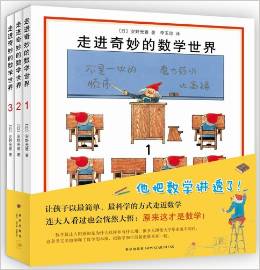
Into the world of Mathematics! 《走进奇妙的数学世界1-3(套装共3册)》内容简介:数学最让人困惑的是为什么这样和有什么用,很多人即使大学毕业也不明白,这套书完美地阐释了数学的 本质,把数学和生活紧密联系在一起。13种基本数学思想,层层深入,完美阐释数学的本质。以两个小矮人贯穿全文,图文并茂,讲故事、出谜题、做游戏,游戏 背后蕴藏数学概念让孩子以最简单、最科学的方式走近数学,爱上数学!不仅仅讲算术,更重在启发从不同角度看待事物、解决问题的思考方式,培养孩子的逻辑思 维能力,提高综合素质。
Finally, for readers of my blog who are new to Chinese, and wish to learn this 5000 year old language, I would recommend some books to learn Chinese for beginners here:
Just completed the Coursera Probability Course by UPenn (University of Pennsylvania), lectured by Professor Santosh S. Venkatesh who is the author of the highly recommended book: The Theory of Probability: Explorations and Applications.
Coursera Review
The course isn’t very hard, it is very suitable for undergraduates and even high school students should be able to understand majority of the content. It actually overlaps with the A level syllabus in Singapore, and hence I would say that a 17-18 year old student would be able to grasp most of the concepts in this course.
The lecturer is very good at words, and his lectures are full of imagery and vivid descriptions. The homework is a little tricky, and hence would require some thought, even though the concepts tested are elementary (elementary in the sense that it doesn’t require calculus).
A sample of a tricky question is the “Six Saucer Question”: Six cups and saucers come in pairs: there are two cups and saucers that are red, white, and blue. If the cups are placed randomly onto the saucers (one each), find the probability that no cup is upon a saucer of the same color.
It is very tricky and to get it correct on the first try is a major accomplishment.
Overall, this Coursera Course is highly recommended, and students should try to take it the next time it comes out!
There are 158,962,555,217,826,360,000 possibilities of codes in the German Enigma Machine:
Flaw cracked by the genius Mathematician Alan Turing (Father of Artificial Intelligence) :
“A key can never be itself” — this is ‘the straw that breaks the camel’s back’, a critical clue to break the 158,962,555,217,826,360,000 possible codes !
I have written a guest post on https://chinesetuition88.wordpress.com on the very fascinating Chinese Remainder Theorem and its History (韩信点兵). Do check it out, you will be amazed at the genius of Chinese General Han Xin.
In Ancient China, there was a General named Han Xin, who led an army of 1500 soldiers in a battle. An estimated 400-500 soldiers died in the battle. When the soldiers stood 3 in a row, there were 2 soldiers left over. When they lined up 5 in a row, there were 4 soldiers left over. When they lined up 7 in a row, there were 6 soldiers left over. Han Xin immediately said, “There are 1049 soldiers.”
Amazing! How did Han Xin do that?
Han Xin was not only a brilliant mathematician and general, he was also a very magnanimous guy full of wisdom.
Once, when he was suffering from hunger, he met a woman who provided him with food. He promised to repay her for her kindness after he had made great achievements in life, but it was rebuffed by her…
Intriguing review (Chinese) of FLT by a non-mathematician. He aims to convey the beauty of Mathematics to students, who unfortunately treat Math as a tool to pass exams from PSLE, O and A level, university math course, then ditch Math upon graduation. Math is the beauty of the universe.
With humor and charm, mathematician Eduardo Sáenz de Cabezón answers a question that’s wracked the brains of bored students the world over: What is math for? He shows the beauty of math as the backbone of science — and shows that theorems, not diamonds, are forever. In Spanish, with English subtitles.
Yes, indeed, 1000 years from now, students will still be learning Pythagoras’ Theorem, while other fragments of human knowledge would have faded away.
Check out also this book: Arithmetic and Algebra Again: Leaving Math Anxiety Behind Forever, suitable for students who really need some encouragement and motivation to overcome fear of math! Albert Einstein once said, “You never fail until you stop trying.” Hence, even if you have not done well in math for the past years, there is still hope, don’t give up!
Check out this really funny video on a April Fools Prank during a Math Class!
The teacher played a trick on his math class for April Fool’s Day. In this one, he’s showing a “homework help” video that gets some trigonometry wrong.
I find extremely pleasure when I discovered his brilliant lecture notes in “Generating Function” – a Discrete Math technique for computing sequencing using function, and the application in complex Combinatorics. Download here:
A magic trick based on the “Perfect Shuffle”. Featuring Professor Federico Ardila. I watched his videos on Hopf Algebras while learning the background material for my honours project on Quantum Groups.
Mathemagician Persi Diaconis discusses which is the best way to shuffle: Overhand shuffle, Riffle Shuffle, or “Smoosh” Shuffle? Watch the video to find out!
Recently, after taking the Coursera course on Cryptography, I had a better appreciation of mathematics and the role of cryptography in our modern society.
The quantum computer, though not yet invented, is widely believed to be available soon in the next few years. In the hands of hackers, the quantum computer would be a formidable weapon as current cryptographic methods are extremely vulnerable to the quantum computer as it can factor numbers extremely quickly, leading to number theoretic codes being broken.
What would happen if a Quantum Computer is built
Quantum computers are near
Quantum computers operate on the subatomic level and theoretically provide processing power that is millions, if not billions of times faster than silicon-based computers. Several companies are in the race to develop quantum computers including Google.
Internet security is no match for a quantum computer, said Nathan Hamlin, instructor and director of the WSU Math Learning Center. That could spell future trouble for online transactions ranging from buying a book on Amazon to simply sending an email.
Hamlin said quantum computers would have no trouble breaking present security codes, which rely on public key encryption to protect the exchanges.
In a nutshell, public key code uses one public “key” for encryption and a second private “key” for decoding. The system is based on the factoring of impossibly large numbers and, so far, has done a good job keeping computers safe from hackers.
Quantum computers, however, can factor these large numbers very quickly, Hamlin said. But problems like the knapsack code slow them down.
Fortunately, many of the large data breaches in recent years are the result of employee carelessness or bribes and not of cracking the public key encryption code, he said.
Hence, when many people say mathematics is useless, they are actually extremely wrong, as mathematics permeates every aspect of life! Even though maths like calculus is not directly used in everyday life, it is part of our phone, computer, and every part of the modern lifestyle.
Kudos to the mathematicians who have averted a world disaster, before quantum computers are even invented!
Written by a renowned quantum physicist closely involved in the U.S. government’s development of quantum information science, Schrödinger’s Killer App: Race to Build the World’s First Quantum Computer presents an inside look at the government’s quest to build a quantum computer capable of solving complex mathematical problems and hacking the public-key encryption codes used to secure the Internet. The “killer application” refers to Shor’s quantum factoring algorithm, which would unveil the encrypted communications of the entire Internet if a quantum computer could be built to run the algorithm. Schrödinger’s notion of quantum entanglement—and his infamous cat—is at the heart of it all.
Most people don’t encounter Tensors (the higher level advanced version of Matrices) until they reach senior undergraduate, or even graduate level.
What is a Tensor?
The best explanation I have ever seen, comes from this video by the author of A Student’s Guide to Vectors and Tensors, Daniel A. Fleisch. Using children’s blocks and laymen language, he explains what is a tensor clearly and succinctly in a way that is unbelievably crystal clear.
This YouTube video is watched over 200,000 times, a very commendable achievement for a math video!
Official Definition by Wikipedia
Tensors are geometric objects that describe linear relations between vectors, scalars, and other tensors. Elementary examples of such relations include the dot product, the cross product, and linear maps. Vectors and scalars themselves are also tensors. A tensor can be represented as a multi-dimensional array of numerical values. The order (also degree) of a tensor is the dimensionality of the array needed to represent it, or equivalently, the number of indices needed to label a component of that array. For example, a linear map can be represented by a matrix (a 2-dimensional array) and therefore is a 2nd-order tensor. A vector can be represented as a 1-dimensional array and is a 1st-order tensor. Scalars are single numbers and are thus 0th-order tensors. The dimensionality of the array should not be confused with the dimension of the underlying vector space.
Cauchy stress tensor, a second-order tensor.
If you have some programming knowledge, you may view tensors as a type of multidimensional array. A more mathematical abstract way can be achieved by defining tensors in terms of elements of tensor products of vector spaces, which in turn are defined through a universal property.
Cool? The word “tensor” really strikes me as a word that is really sophisticated and complicated!
We will continue our series on GEP Questions. To learn more about Recommended Books for GEP, to practice GEP Questions, visit the link here.
Today, we will discuss the quintessential GEP Question: The Gauss Trick. This GEP question illustrates the fact that giftedness can be trained to a large extent.
Question:
Find the sum of 1+3+5+7+…+95+97+99.
Solution will be below after this text, scroll down after you are ready to see the answer!
If a 9 year child can solve this on his/her first attempt (i.e. see the question for the very first time), then the child is actually at the level of Carl Friedrich Gauss, the legendary mathematician! When Gauss was a young kid, his teacher set the class a difficult question, 1+2+3+…+99+100, hoping to keep the children quiet and busy while he could have some time to relax. Little did he expect Gauss to come up with the right answer minutes later.
Most 9 year old kids would not be able to solve this on their first try. I wouldn’t be able to solve it correctly even if given an hour when I was a kid! If the children have seen it before and practiced, that is a different story, as it becomes so easy even for a 7 year old kid.Hence, practicing GEP Questions actually leads to an indirect boost of IQ in this manner! The transition from ignorance to knowledge, leading to increased intelligence, can be accomplished by practice! To practice more of these GEP Questions, check out the Math Olympiad Recommended Books page. As a tutor, I know that this Gauss Trick is a “must-know” question for students aiming high for school Math / GEP Selection Test, since almost every kid knows this nowadays, and it is highly popular in tests.
In fact, this technique (Gauss Trick) commonly tested in GEP Questions can be used all the way to JC and beyond! In JC it is covered under the topic of AP/GP (Arithmetic Progression and Geometric Progression).
Solution:
Now, for the solution. This sum is the famous arithmetic progression, where each term differs from the next by a fixed constant. In this case, the constant is 2.
Some solutions use a number pair matching, which can be problematic to explain when the number of terms is odd, but still works nevertheless. We can use another method of writing the sum backwards.
First we note that there are 50 terms in this series. We can know that either by noting that they are the odd numbers from 1 to 100, and half of the numbers are odd, hence there are 100/2=50 terms. Alternatively, we can note that 1=2(1)-1, 3=2(2)-1, 5=2(3)-1, …, 99=2(50)-1, where the number in the brackets acting like a counter.
1+3+5+7+…+95+97+99
99+97+95+…+5+3+1
Note that each pair, 1+99, 3+97, 5+95 actually add up to the same thing, i.e. 100.
Adding up the two expressions above, we get 100×50=5000.
Dividing that by two (since we double counted), we will get 5000/2=2500.
Gauss is a true Math genius, and you can read more about his life in this interesting biography! This historical narrative will inspire young readers and even curious adults with its touching story of personal achievement.
The Tap Question is another one of those questions that only involve fractions and whole numbers, and hence technically within the grasp of a 9 year old kid sitting for the GEP Screening Test.
However, looks are highly deceiving, and whoever tries the Tap Question for the very first time is highly likely to get stuck. (I was one of them years ago!) The Tap Question is highly popular as a challenging question, due to its psychological nature it is a hard question to grasp. This is a question you wouldn’t want to meet for the first time in the GEP Screening Test. However, if you know how to solve it, it is easy as a piece of cake, and you will be able to solve it during the GEP Screening Test no matter how they twist the question.
GEP Screening Test Sample Math Question (The Tap Question):
A fish tank is connected to three taps.
Tap A can fill the tank in 2 hours.
Tap B can fill the tank in 3 hours.
Tap C can drain the tank in 6 hours.
If all three taps are turned on at the same time, how long would it take to fill the empty fish tank?
Do try out the question before looking at the answer below!
There is a huge difference solving a question for the first time, and solving a question that one has seen before. To familiarize yourself with GEP Screening Test questions that can come out, do check out our Recommended GEP Books. Reading one of those books would increase your child’s repertoire of questions, and hence boost your child’s IQ indirectly. Also, do check out Math Olympiad books, as it is well known that GEP Screening Test Math questions do incorporate some Math Olympiad questions.
By the way, for my foreign readers who are curious what is GEP Screening Test, it is a test conducted in Singapore for entry to the GEP (Gifted Education Programme). The screening and selection tests are conducted at the end of Primary 3, equivalent to Grade 3 or age 9. The official website on GEP Screening Test is available at: http://www.moe.gov.sg/education/programmes/gifted-education-programme/faq/general/
The GEP Screening Math questions can be viewed as the epitome of the Singapore Math system, as it features highly challenging Math questions that are technically in syllabus but few students know how to solve!
Are you looking for a short, summarized notes for H2 Vectors, H2 Complex Numbers, or even H2 Statistics? Do you remember the formula for the sum of a Geometric Progression?
Purchase this Highly Condensed H2 Maths Notes to quickly review and get ready for your exam!
Free Exam Papers included:
Numerous H2 Maths (Prelim) Free Exam Papers in PDF Format, with Solutions. Schools include ACJC, AJC, HCI, NJC, all the way to YJC, and more.
Note: The set of notes is 9 pages long (2 columns per page, total of 18 columns), i.e. highly condensed and summarized short notes.
Here is a type of a typical GEP Exam Question that can come out. Technically, this question is in syllabus since it only involves Whole Numbers. However, in practice, this is an extremely tough GEP Exam question for students who have not seen the Worker Question before.
GEP Test Question Sample (Worker Question):
6 men working 8 hours a day can paint a house in 2 days. In how many more days will 4 men, working 3 hours a day at the same rate, complete the same job?
Before you scroll down to check the answer, do give it a try! From personal experience as a tutor, even a 16 year old typical Secondary 4 student cannot solve this question if it is the first time they see it. However, once I explain the solution to them, it is extremely easy and students will get it immediately, even for primary school kids. Someone who has seen these types of questions before can solve it under a minute!
This shows the immense advantage one has if he/she has been exposed to certain types of questions. This is same for the GEP General Ability Test (GAT), a type of “IQ test”, which is basically pattern recognition. If a child has been exposed to books like Match Wits With Mensa: The Complete Quiz Book, words cannot describe the huge advantage he/she has over someone who has not seen a logic pattern puzzle before.
Solution to GEP Sample Question (Worker Question):
There are many types of solutions to this question, but my favorite is using the man-days concept. Man-days is a unit for the amount of work that is needed for something. E.g. If building a house needs 10 man-days, it can be accomplished by either 1 man x 10 days = 10 man-days, or 5 men x 2 days = 10 man-days, etc.
For this question, we will use the unit of man-hours instead.
6x8x2=96 man-hours are needed to paint the entire house.
4 men working 3 hours a day would lead to 12 man-hours a day. Hence 96/12=8 days are needed.
Warning: This is where they trap the careless students! The question asks for how many more days. Hence, the answer is 8-2=6 more days.
Ans: 6 days
Do also check out the Chicken and Rabbit GEP Math Question, which is another type of popular GEP Selection Test and Screening Test question, and can be practiced beforehand as a GEP Mock Test.
Probability is becoming a really important branch of mathematics. One of the most famous Singaporean mathematicians is Professor Louis Chen Hsiao Yun who has a theorem named after him! (Stein-Chen method of Poisson approximation) Professor Chen researches on Probability.
To begin your journey in Probabilty, Introduction to Probability, 2nd Edition is a good book to start learning from. An intuitive, yet precise introduction to probability theory, stochastic processes, and probabilistic models used in science, engineering, economics, and related fields. You may also wish to refer to our comprehensive list of Recommended Undergraduate Books.
(One of the best books to begin your journey in studying the mysterious topic of Probability)
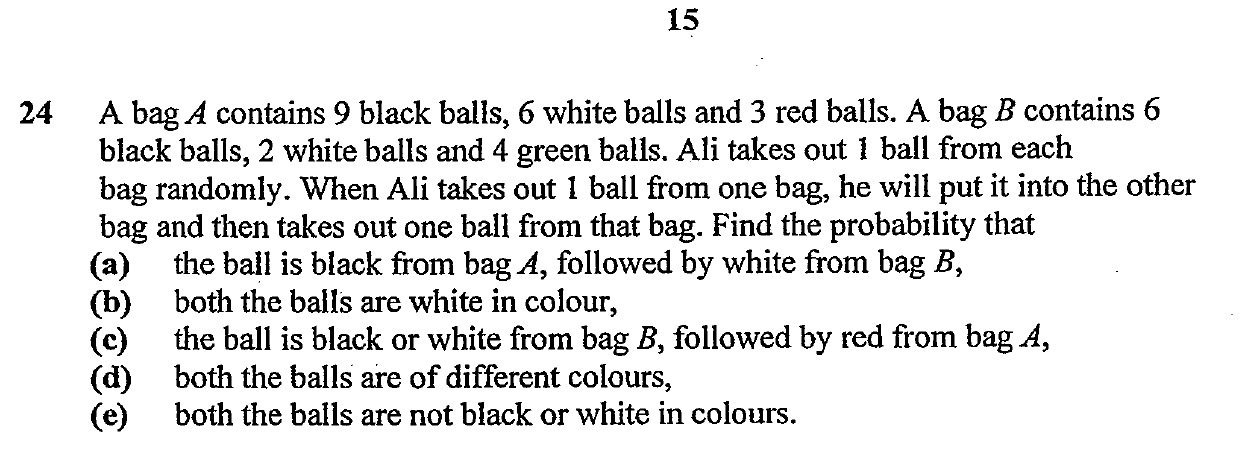
A bag A contains 9 black balls, 6 white balls and 3 red balls. A bag B contains 6 black balls, 2 white balls and 4 green balls. Ali takes out 1 ball from each bag randomly. When Ali takes out 1 ball from one bag, he will put it into the other bag and then takes out one ball from that bag. Find the probability that
(a) the ball is black from bag A, followed by white from bag B,
(b) both the balls are white in colour,
(c) the ball is black or white from bag B, followed by red from bag A,
(d) both the balls are of different colours,
(e) both the balls are not black or white in colours.
(b) Probability of white ball from bag A, followed by white ball from bag B=$latex displaystyle=frac{1}{2}timesfrac{6}{18}timesfrac{3}{13}=frac{1}{26}$
Firstly, do check out our GEP Recommended Books if you are interested in books that will help boost your chances of entering GEP.
A typical sample GEP Exam Paper Question (Math) is the Chicken and Rabbit Question. This test is highly popular in the GEP Screening / GEP Selection Test, Round 1 or even extremely difficult Round 2.
A sample question would go like this:
A farmer has 36 chickens and rabbits in total. He counted 124 legs altogether. How many chickens and how many rabbits are there?
This is a highly typical GEP Exam paper question that may come out in the GEP test.
How do we solve it? One way is the trial and error or Guess and Check method. However, this method may not work for high numbers. What if the farmer had 10000 sheep?
The GEP Exam Paper has limited time, hence, we would need to solve it in an efficient way.
There is one method called the Assumption method, where students can remember the acronym ASSD!
Steps of ASSD to solve GEP Exam Paper “Chicken and Rabbit” Question:
Step 1 (A): Assume) Let’s assume all the 36 animals are chickens.
Then, there would be 36×2=72 legs in total.
Step 2 (S): Subtract) Clearly, 72 legs is too few.
In reality, there are 124-72=52 legs more.
Step 3 (S): Subtract) 4-2=2
Each rabbit has 2 more legs than a chicken.
Step 4 (D): Divide)
The extra 52 legs must be due to the rabbits, and each rabbit contributes 2 more legs.
Hence, there are 52/2=26 rabbits!
There must be 36-26=10 chickens then.
Check
During the GEP Exam Paper, checking is essential to avoid careless mistakes. 26×4+10×2=124, which tallies! Hence, we are right!
To practice more Chicken and Rabbit questions, which is highly likely to come out in the GEP Exam Papers, check out our Chicken and Rabbit Worksheet Generator.
Lastly, do check out our GEP Recommended Books which may be the most useful books on the market (not found in Singapore since most major bookstores like Borders have closed down).
Scientists have proven that IQ can be increased, and hence reading a book like Match Wits With Mensa: The Complete Quiz Book would increase your score in the GEP Exam Paper (Logic) section during the GEP Screening / Selection Test.



 and measures should be additive over disjoint sets in X.
 defined on a
  -algebra X of subsets of X such that
 for all
 is any disjoint sequence (
 ) of sets in X, then
 .
. , we say it is finite. More generally, if there exists a sequence
  and such that
  for all n, then we say that
  be definied on X by
  , for all
  . We can see that
  be defined by
  ,
,  if
if  .
.  defined on B which coincides with length on open intervals. I.e. if E is the nonempty interval (a,b), then
  . This measure is usually called Lebesgue measure (or sometimes Borel measure). It is not a finite measure since
  . But it is
  ) such that
  for all n.


 .
. if f and f’ are path homotopic.
 and
and  are equivalence relations.
 . The map F(x,t) is the required homotopy.
 . Let F be a homotopy between f and f’. We can then verify that G(x,t) = F(x, 1-t) is a homotopy between f’ and f.

 , we show that
  . Let F be a homotopy between f and f’, and let F’ be a homotopy between f’ and f”. This time, we need to define a slightly more complicated homotopy G: X x I -> Y by the equation
![G(x,t) = \begin{cases} F(x,2t) &\text{for }t\in [0,\frac{1}{2}],\\ F'(x, 2t-1) &\text{for } t\in [\frac{1}{2}, 1].\end{cases}](https://s0.wp.com/latex.php?latex=G%28x%2Ct%29+%3D+%5Cbegin%7Bcases%7D+F%28x%2C2t%29+%26%5Ctext%7Bfor+%7Dt%5Cin+%5B0%2C%5Cfrac%7B1%7D%7B2%7D%5D%2C%5C%5C+F%27%28x%2C+2t-1%29+%26%5Ctext%7Bfor+%7D+t%5Cin+%5B%5Cfrac%7B1%7D%7B2%7D%2C+1%5D.%5Cend%7Bcases%7D&bg=ffffff&fg=1a1a1a&s=0&c=20201002)


 are also in M(X,X).
 , let
, let  be the “truncation of f” defined by
 be defined similarly. We will work out the proof that
  to
to  .
.
 is measurable.
 , and using an earlier corollary that says that if a sequence
  is in M(X,X) converges to f on X, then f is also in M(X,X), we have that
  belongs to M(X,X).
 , and hence fg also belongs to M(X,X).
 implies
  .
. consists of a half-line which is either of the form
  or the form
  . (We will show later that both cases can occur.) Thus, the set will belong to the Borel algebra B which is the
  , then when
  , the set will be
  .
. ,
,  belong to X and the real-valued function
  defined by
  is measurable.
 and
and  , then we have that
  which is in X since it is the complement of the union of A and
  .
. , then
  , which is a union of two sets in X and hence also in X.
 and
and  when
when  , and
, and  when
when  , due to a similar reason as above. Therefore f is measurable!


 by Stephen Covey (Highly recommended to read), there are four types of activities:









 .
.


 , suitable for students who really need some encouragement and motivation to overcome fear of math! Albert Einstein once said, “You never fail until you stop trying.” Hence, even if you have not done well in math for the past years, there is still hope, don’t give up!


 is an interesting book by Professor Diaconis, featuring Magic Tricks that have a mathematical background! This book is a great idea for a gift for students, teachers, or friends!
 .
.
 , Daniel A. Fleisch. Using children’s blocks and laymen language, he explains what is a tensor clearly and succinctly in a way that is unbelievably crystal clear.

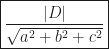
 , how do we find the (shortest) distance of a plane to the origin?
 must be perpendicular to the plane, i.e. parallel to the normal vector
  .
.

 ,
,  is either 0 or 180 degrees, hence
  is either 1 or -1.
 .
.



 would be suitable for children training for GEP Screening Test and Math Olympiad simultaneously at the same time.
 of the tank can be filled in 1 hour.
 , words cannot describe the huge advantage he/she has over someone who has not seen a logic pattern puzzle before.
 is a good book to start learning from. An intuitive, yet precise introduction to probability theory, stochastic processes, and probabilistic models used in science, engineering, economics, and related fields. You may also wish to refer to our comprehensive list of