H2 Maths Tuition: Complex Numbers Notes

H2 Maths: Complex Numbers 1 Page Notes

Modulus

Argument

Cartesian Form

Draw diagram first, then find the appropriate quadrant and use

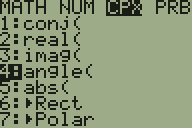
(can use GC to double check)

Polar Form

Exponential Form

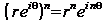
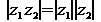
When question involvespowers, multiplication or division, it may be helpful toconvert to exponential form.

Please write Ƶ and 2 differently.

De Moivre’s Theorem

Equivalent to

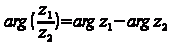
Memory tip: Notice that arg behaves similarly to log.

Locusof z is aset of pointssatisfying certain given conditions.

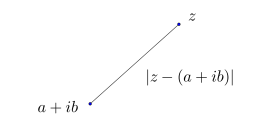
in English means:The distance between (the point representing)and (the point representing)

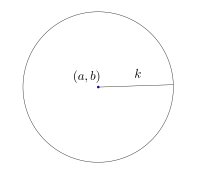
Means the distance offromis a constant,.

So this is acircular loci.

Centre:, radius =

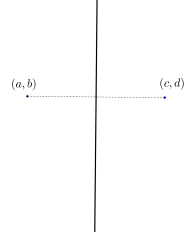
means that the distance offromis equal to its distance from

In other words, the locus is theperpendicular bisectorof the line segment joiningand.

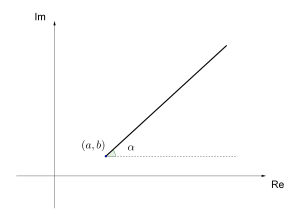
represents ahalf-linestarting frommaking an anglewith the positive Re-axis.

(Exclude the point (a,b) )

Common Errors

– Some candidates thought thatis the same asand thatis the same as.

– The “formula”for argumentsdoes not workfor points in the 2ndand 3rdquadrant.

– Very many candidates seem unaware that their calculators will work in radians mode and there were many unnecessary “manual” conversions from degrees to radians.

积少成多: How can doing at least one Maths question per day help you improve! (Maths Tuition Revision Strategy)

We all know the saying “an apple a day keeps the doctor away“. Many essential activities, like eating, exercising, sleeping, needs to be done on a daily basis.

Mathematics is no different!

Here is a surprising fact of how much students can achieve if they do at least one Maths question per day. (the question must be substantial and worth at least 5 marks)

This study plan is based on the concept of 积少成多, or “Many little things add up“. Also, this method prevents students from getting rusty in older topics, or totally forgetting the earlier topics. Also, this method makes use of the fact that the human brain learns during sleep, so if you do mathematics everyday, you are letting your brain learn during sleep everyday.

Let’s take the example of Additional Mathematics.

Exam is on 24/25 October 2013.

Let’s say the student starts the “One Question per day” Strategy on 20 May 2013

Days till exam: 157 days  (22 weeks or 5 months, 4 days)

So, 157 days = 157 questions (or more!)

Each paper in Ten Year Series has around 25 questions (Paper 1 & Paper 2), so 157 questions translates to more than 6 years worth of practice papers! And all that is achieved by just doing at least one Maths question per day!

A sample daily revision plan can look like this. (I create a customized revision plan for each of my students, based on their weaknesses).

Suggested daily revision (Additional Mathematics):

Topic

Monday

Algebra

Tuesday

Geometry and Trigonometry

Wednesday

Calculus

Thursday

Algebra

Friday

Geometry and Trigonometry

Saturday

Calculus

Sunday

Geometry and Trigonometry

(Calculus means anything that involves differentiation, integration)

(Geometry and Trigonometry means anything that involves diagrams, sin, cos, tan, etc. )

(Algebra is everything else, eg. Polynomials, Indices, Partial Fractions)

By following this method, using a TYS, the student can cover all topics, up to 6 years worth of papers!

Usually, students may accumulate a lot of questions if they are stuck. This is where a tutor comes in. The tutor can go through all the questions during the tuition time. This method makes full use of the tuition time, and is highly efficient.

Personally, I used this method of studying and found it very effective. This method is suitable for disciplined students who are aiming to improve, whether from fail to pass or from B/C to A. The earlier you start the better, for this strategy. For students really aiming for A, you can modify this strategy to do at least 2 to 3 Maths questions per day. From experience, my best students practice Maths everyday. Practicing Ten Year Series (TYS) is the best, as everyone knows that school prelims/exams often copy TYS questions exactly, or just modify them a bit.

The role of the parent is to remind the child to practice maths everyday. From experience, my best students usually have proactive parents who pay close attention to their child’s revision, and play an active role in their child’s education.

This study strategy is very flexible, you can modify it based on your own situation. But the most important thing is, practice Maths everyday! (For Maths, practicing is twice as important as studying notes.) And fully understand each question you practice, not just memorizing the answer. Also, doing a TYS question twice (or more) is perfectly acceptable, it helps to reinforce your technique for answering that question.

If you truly follow this strategy, and practice Maths everyday, you will definitely improve!

Mathematics homework

Hardwork \times 100% = Success! (^_^)

There is no substitute for hard work.” – Thomas Edison

Challenging Geometry E Maths Question — St Andrew’s Sec 3 Maths Tuition Question
Question:

ABCD is a rectangle. M and N are points on AB and DC respectively. MC and BN meet at X. M is the midpoint of AB.

recommended maths tuition geometry

(a) Prove that \Delta CXN and \Delta MXB are similar.

(b) Given that area of \triangle CXN: area of \triangle MXB=9:4, find the ratio of,

(i) DN: NC

(ii) area of rectangle ABCD: area of \triangle XBC. (Challenging)

[Answer Key] (b) (i) 1:3

(ii) 20:3

Suggested Solutions:

(a)
\angle MXB=\angle NXC (vert. opp. angles)

\angle MBX = \angle XNC (alt. angles)

\angle BMX = \angle XCN (alt. angles)

Therefore, \Delta CXN and \Delta MXB are similar (AAA).

(b) (i) \displaystyle\frac{NC}{BM}=\sqrt{\frac{9}{4}}=\frac{3}{2}

Let BM=2u and NC=3u

Then DC=2\times 2u=4u

So DN=4u-3u=u

Thus, DN:NC=1u:3u=1:3

(ii)

We now have a shorter solution, thanks to a visitor to our site! (see comments below)

From part (a), since \Delta CXN and \Delta MXB are similar, we have MX:XC=2:3

This means  that MC:XC=5:3

Thus \triangle MBC:\triangle XBC=5:3 (the two triangles share a common height)

Now, note that \displaystyle\frac{\text{area of }ABCD}{\triangle MBC}=\frac{BC\times AB}{0.5 \times BC \times MB}=\frac{AB}{0.5MB}=\frac{2MB}{0.5MB}=4

Hence area of ABCD=4\times\triangle MBC

We conclude that area of rectangle ABCD: area of \triangle XBC=4(5):3=20:3

Here is a longer solution, for those who are interested:

Let area of \triangle XBC =S

Let area of \triangle MXB=4u

Let area of \triangle CXN=9u

We have \displaystyle\frac{S+9u}{S+4u}=\frac{3}{2} since \triangle NCB and \triangle CMB have the same base BC and their heights have ratio 3:2.

Cross-multiplying, we get 2S+18u=3S+12u

So \boxed{S=6u}

\displaystyle\frac{\triangle BCN}{\triangle BDC}=\frac{3}{4} since \triangle BCN and \triangle BDC have the same base BC and their heights have ratio 3:4.
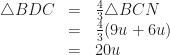
Hence,

\begin{array}{rcl}    \triangle BDC &=& \frac{4}{3} \triangle BCN\\    &=& \frac{4}{3} (9u+6u)\\    &=& 20u    \end{array}

Thus, area of ABCD=2 \triangle BDC=40u

area of rectangle ABCD: area of \triangle XBC=40:6=20:3

H2 Maths Tuition: Foot of Perpendicular (from point to plane) (Part II)

This is a continuation from H2 Maths Tuition: Foot of Perpendicular (from point to line) (Part I).

Foot of Perpendicular (from point to plane)

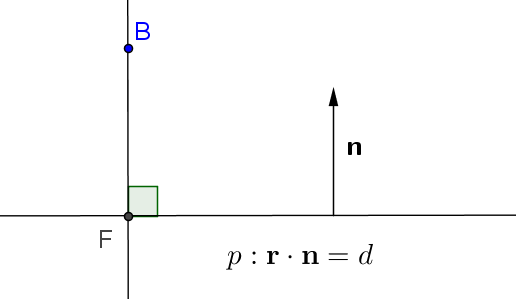
From point (B) to Plane ( p)

h2-vectors-tuition

Equation (I):

Where does F lie?

F lies on the plane  p.

\overrightarrow{\mathit{OF}}\cdot \mathbf{n}=d

Equation (II):

Perpendicular

\overrightarrow{\mathit{BF}}=k\mathbf{n}

\overrightarrow{\mathit{OF}}-\overrightarrow{\mathit{OB}}=k\mathbf{n}

\overrightarrow{\mathit{OF}}=k\mathbf{n}+\overrightarrow{OB}

Final Step

Substitute Equation (II) into Equation (I) and solve for k.

Example

[VJC 2010 P1Q8i]

The planes \Pi _{1} and \Pi _{2} have equations \mathbf{r\cdot(i+j-k)}=6 and \mathbf{r\cdot(2i-4j+k)}=-12 respectively. The point A  has position vector  \mathbf{{9i-7j+5k}} .

(i) Find the position vector of the foot of perpendicular from  A to \Pi _{2} .

Solution

Let the foot of perpendicular be F.

Equation (I)

\overrightarrow{\mathit{OF}}\cdot  \left(\begin{matrix}2\\-4\\1\end{matrix}\right)=-12

Equation (II)

\overrightarrow{\mathit{OF}}=k\left(\begin{matrix}2\\-4\\1\end{matrix}\right)+\left(\begin{matrix}9\\-7\\5\end{matrix}\right)=\left(\begin{matrix}2k+9\\-4k-7\\k+5\end{matrix}\right)

Subst. (II) into (I)

2(2k+9)-4(-4k-7)+(k+5)=-12

Solve for k,  k=-3 .

\overrightarrow{\mathit{OF}}=\left(\begin{matrix}3\\5\\2\end{matrix}\right)

H2 Maths Tuition

If you are looking for Maths Tuition, contact Mr Wu at:

Email: mathtuition88@gmail.com

How to avoid Careless Mistakes for Maths?

Many parents have feedback to me that their child often makes careless mistakes in Maths, at all levels, from Primary, Secondary, to JC Level. I truly empathize with them, as it often leads to marks being lost unnecessarily. Not to mention, it is discouraging for the child.

Also, making careless mistakes is most common in the subject of mathematics, it is rare to hear of students making careless mistakes in say, History or English.
Fortunately, it is possible to prevent careless mistakes for mathematics, or at least reduce the rates of careless mistakes.

From experience, the ways to prevent careless mistakes for mathematics can be classified into 3 categories, Common Sense, Psychological, and Math Tips.

Common Sense

  1. Firstly, write as neatly as possible. Often, students write their “5” like “6”. Mathematics in Singapore is highly computational in nature, such errors may lead to loss of marks. Also, for Algebra, it is recommended that students write l (for length) in a cursive manner, like \ell to prevent confusion with 1. Also, in Complex Numbers in H2 Math, write z with a line in the middle, like Ƶ, to avoid confusion with 2.
  2. Leave some time for checking. This is easier said than done, as speed requires practice. But leaving some time, at least 5-10 minutes to check the entire paper is a good strategy. It can spot obvious errors, like leaving out an entire question.

Psychological

  1. Look at the number of marks. If the question is 5 marks, and your solution is very short, something may be wrong. Also if the question is just 1 mark, and it took a long time to solve it, that may ring a bell.
  2. See if the final answer is a “nice number“. For questions that are about whole numbers, like number of apples, the answer should clearly be a whole number. At higher levels, especially with questions that require answers in 3 significant figures, the number may not be so nice though. However, from experience, some questions even in A Levels, like vectors where one is suppose to solve for a constant \lambda, it turns out that the constant is a “nice number”.

Mathematical Tips

Mathematical Tips are harder to apply, unlike the above which are straightforward. Usually students will have to be taught and guided by a teacher or tutor.

  1. Substitute back the final answer into the equations. For example, when solving simultaneous equations like x+y=3, x+2y=4, after getting the solution x=2, y=1, you should substitute back into the original two equations to check it.
  2. Substitute in certain values. For example, after finding the partial fraction \displaystyle\frac{1}{x^2-1} = \frac{1}{2 (x-1)}-\frac{1}{2 (x+1)}, you should substitute back a certain value for x, like x=2. Then check if both the left-hand-side and right-hand-side gives the same answer. (LHS=1/3, RHS=1/2-1/6=1/3) This usually gives a very high chance that you are correct.

Thanks for reading this long article! Hope it helps! 🙂

I will add more tips in the future.

Recommended Maths Book:

Math Doesn’t Suck: How to Survive Middle School Math Without Losing Your Mind or Breaking a Nail

This book is a New York Times Bestseller by actress Danica McKellar, who is also an internationally recognized mathematician and advocate for math education. It should be available in the library. Hope it can inspire all to like Maths!