Best way to study abstract math is to use concrete examples, visualizable 2- or 3- dimensional mathematical ‘objects’.
Groups:
(Do not need to search too far…) Best example is the Integer Group (Z) with + operation, denoted as {Z, +}. (Note: Easy to verify it satisfies the group 4 properties: CAN I“.
It has infinite elements (infinite group)
It is a Discrete Group, because it jumps from one integer to another (1,2,3…, in digital sense).
The group of rotation of a round table, which consists of all points on a circle, is an infinite group. We can change the angle of rotation continously between 0 and 360 degrees, rotating around a geometrical shape – a circle. Such shapes are called Manifolds (流形).
All points of a manifold forms a Lie group.
Example: The group of rotations of a sphere around a central…
If you are wondering which tuition agency is the best, look no further. The best tuition agency in Singapore is without a doubt Startutor.
Startutor is highly recommended by our tutor Mr Wu, and he himself is listed there.
For other subjects besides Mathematics, request for a tutor at Startutor! Startutor is Singapore’s most popular online agency, providing tutors to your home. There are no extra costs for making a request. Tutors’ certificates are carefully vetted by Startutor. (Website: http://startutor.sg/request,wwcsmt)
Startutor is suitable for English Tuition, Social Studies Tuition, Geography Tuition, Physics Tuition, Chemistry Tuition, Biology Tuition, Chinese Tuition, Economics Tuition, GP Tuition, Piano Lessons and more!
Just to reblog this earlier post on Recommended Singapore Math Books. Ideal for parents living outside Singapore who wish to teach their child the Singapore Math curriculum!
We have compiled a list of Top 5 Best selling and Top rated Singapore Math Books on Amazon. This list is more targeted towards parents and students living outside Singapore, like in the United States. Students in Singapore are already breathing and living Singapore Math!
Hope this list will help you in finding the Best Singapore Math Books for your child. The reviews are from actual customers on Amazon. 1)
This math practice book contains wonderful teaching strategies from the Singapore math program including number bonds and counting on. This would be a good book for homeschooling. We use it as an enrichment tool when we have a little extra time during vacations or on weekends.
I would recommend it to parents who would like to teach their struggling kids math, because it tells you how to teach these concepts.
The dimension of a hypersphere inside a n-dimensional space
= $latex boxed {n – 1}$
Examples:
Dim (Circle) in 2-dim plane = 1
As we approach near the neighborhood of the tangential point on the circle, the curvature of the circle disappears, there is no difference between the circle and the tangent line (dim = 1).
Hence, Dim (Circle) = 1
A point on a circle is determined by one independent variable only, which is the polar angle.
Note:
The dimension of the ambient space (2-dim plane) is not relevant to the dimension of the circle itself.
Dim (Sphere) in 3-dim Space = 2
The 2 variables (longitude, latitude) determine a position on the globe. Therefore dimension of a sphere is 2.
Interesting note: Four Dimension Space (x, y, z, t): what we get if the 4th dimension time is fixed (frozen in time) ? We get a…
Shimura and Tanyama are two Japanese mathematicians first put up the conjecture in 1955, later the French mathematician André Weil re-discovered it in 1967.
The British Andrew Wiles proved the conjecture and used this theorem to prove the 380-year-old Fermat’s Last Theorem (FLT) in 1994.
It is concerning the study of these strange curves called Elliptic Curve with 2 variables cubic equation:
Past Year Paper is an established Singapore Home Tuition Agency that brings to you quality private tutors and free exam papers for primary, secondary school to junior college level students.
http://www.ted.com In a lively show, mathemagician Arthur Benjamin races a team of calculators to figure out 3-digit squares, solves another massive mental equation and guesses a few birthdays. How does he do it? He’ll tell you.
TEDTalks is a daily video podcast of the best talks and performances from the TED Conference, where the world’s leading thinkers and doers are invited to give the talk of their lives in 18 minutes — including speakers such as Jill Bolte Taylor, Sir Ken Robinson, Hans Rosling, Al Gore and Arthur Benjamin. TED stands for Technology, Entertainment, and Design, and TEDTalks cover these topics as well as science, business, politics and the arts. Watch the Top 10 TEDTalks on TED.com, at http://www.ted.com/index.php/talks/top10
Secrets of Mental Math: The Mathemagician’s Guide to Lightning Calculation and Amazing Math Tricks
These simple math secrets and tricks will forever change how you look at the world of numbers.
Secrets of Mental Math will have you thinking like a math genius in no time. Get ready to amaze your friends—and yourself—with incredible calculations you never thought you could master, as renowned “mathemagician” Arthur Benjamin shares his techniques for lightning-quick calculations and amazing number tricks. This book will teach you to do math in your head faster than you ever thought possible, dramatically improve your memory for numbers, and—maybe for the first time—make mathematics fun.
Yes, even you can learn to do seemingly complex equations in your head; all you need to learn are a few tricks. You’ll be able to quickly multiply and divide triple digits, compute with fractions, and determine squares, cubes, and roots without blinking an eye. No matter what your age or current math ability, Secrets of Mental Math will allow you to perform fantastic feats of the mind effortlessly. This is the math they never taught you in school.
Help the Gorilla find bananas by adding the numbers correctly!
Suitable for ages 5 and above.
More games: Math Memo – click on cards to match the correct pairs Star alphabet – press letters on the keyboard to hear their names Star numbers – press digits
There are many free or affordable Kindle Math Books online for download/purchase. Other than Math books, the Kindle can also be used for reading other books, and also for playing games and using apps. It is a decent alternative to the Ipad, if you are not a fan of Apple.
The object of Math BINGO is to practice math facts while playing BINGO!
Features:
-Choose from 5 games: Addition, Subtraction, Multiplication, Division and Mixed
-Choose from 3 different levels of difficulty: Easy, Medium and Hard
-Create up to 5 player profiles
-Choose from 8 different fun cartoon avatars
-Keep track of number of games played by player profile
-The Scoreboard keeps track of scores for each game and level
-Collect and play with BINGO Bugs when you earn a high score!
-Fun bonus game: BINGO Bug Bungee
“I used to think that the iPad was the king of the tablets, but not any more. It’s time to whip the crown away from Apple and give it to its rightful holder – Amazon’s Kindle Fire HDX.”
Look no further! In this post I will recommend the Top 5 Math Games for kids, on Amazon.com. Amazon is one of the biggest companies in the world, and is a highly trusted and respected online retailer. Sometimes, it is hard to find Math Games in the local area, the internet provides a convenient and hassle-free way to buy Fun Math Games.
Without further ado, these are the Top 5 Math Games for children:
The Math teaching from primary schools to secondary / high schools should begin from the journey of Symmetry.
After all, the Universe is about Symmetry, from flowers to butterflies to our body, and the celestial body of planets. Mathematics is the language of the Universe, hence Math = Symmetry
It was discovered by the 19th century French tragic genius Evariste Galois who, until the eve of his fatal death at 21, wrote about his Mathematical study of ambiguities.
Another French genius of the 20th century, Henri Poincaré, re-discovered this ambiguity which is Symmetry : Group, Differential Equation, etc.
Only in university we study the Group Theory to explore the Symmetry.
Israel Gelfand, the student of Kolmogorov (the Russian equivalent of
Gauss), created in 1964 the famous VZMSh, a national Math Correspondence School.
He wrote: “4 important traits which are common to Math, Music, and
other arts and sciences:
1st Beauty
2nd Simplicity
3rd Precision
4th Crazy ideas.
”
The Russian mathematicians also built special Math-Physics schools:
Moscow School #7, #2, #57 (one of the best high school in the world, http://www.sch57.msk.ru) Leningrad Schools #30, #38, #239 (Perelman studied here)
Rukshin at 15 was a troubled russian kid with drink and violence, then a miracle happened: He fell in love with Math and turned all his creative, aggressive, and competitive energies toward it.
He tried to compete in Math olympiads, but outmatched by peers. Still he believed he knew how to win; he just could not do it himself.
He formed a team of schoolchildren a year younger than he and trained them.
At 19 he became an IMO coach who produced Perelman (Gold IMO & Fields/Clay Poincare Conjecture). In the decades since, his students took 70 IMO, include > 40 Golds.
Rukshin’s thoughts on IMO:
1. IMO is more like a sport. It has its coaches, clubs, practice sessions, competitions.
2. Natural ability is necessary but NOT sufficientfor success: The talented kid needs to have the right coach, the right team, the right kind of family…
2048 is a highly popular Math/Puzzle game that can be played on the computer or on mobile devices. The game is about adding two tiles together until you get the number 2048.
Like most fun games, the concept of 2048 is deceptively simple, even a 5 year old kid could play it. However, it is hard to master it, and getting the coveted “2048” could prove quite tricky. Do not despair, for after reading this strategy guide, you have a much higher chance of winning the game!
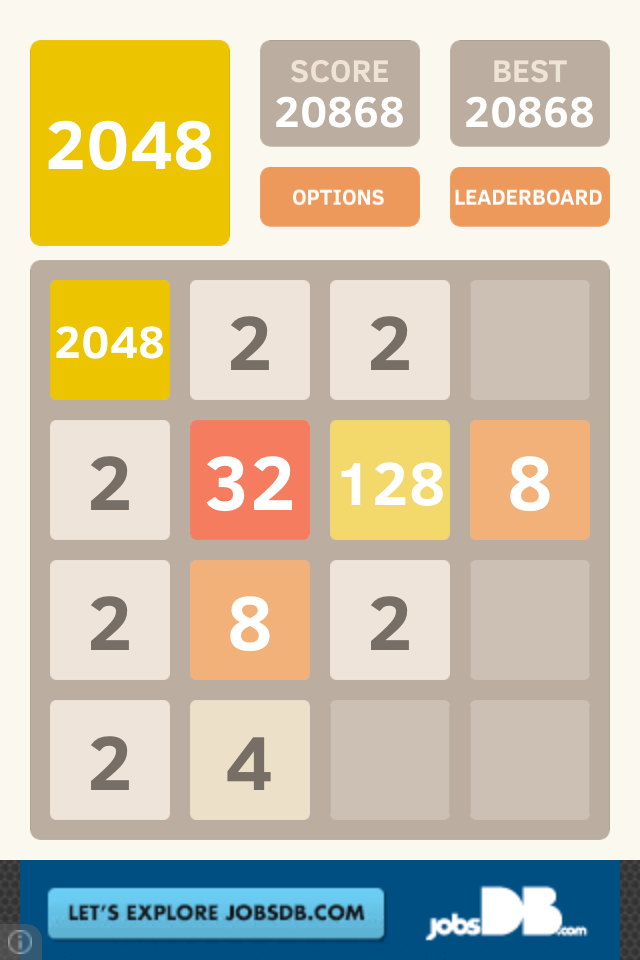
Finally…!!! This is a screenshot of my personal game
Strategy Guide / Walkthrough / FAQ
The 3 Top Priorities for 2048 game:
1) Keep your highest tile in the top left corner of the grid. This is your top priority.
2) Do not let low tiles, especially 2’s or 4’s, clog up the upper two rows. This is your second priority.
3) Keep your top row in the following order, from left to right, . An example would be, 512, 256, 128, 64.
The reason for Priority 1 is that this immensely increases your chances of successful merges of two higher numbers into 1. It synergises with Priority 3 to create a chain-effect. For example, imagine you have 512, 256, 128, 64 on the top row. After merging another 64 with the 64 on the top row, you will have 512, 256, 128, 128. The two 128’s can merge together, making 512, 256, 256. The two 256’s can merge together, making 512, 512. And then, we have a 1024!
The reason for Priority 2 is that letting 2 or 4’s clog up the top rows is very bad. It greatly reduces your mobility (the top 2 rows clogged up with even a single ‘2’ is hard to move). The 2 or 4’s up there have little to no chance to get merged since most of the numbers at the top are high numbers.
Top 3 Guidelines for 2048 game:
1) Press up and left arrows only. Only press right when the upper row is full. Press down only when you have utterly no other choice.
2) Keep the top row filled up, as far as possible.
3) Your general aim is to target the lowest tile on the upper row, to set up the chain effect described above.
Reason for Guideline 1: Pressing right when the upper row is not full has the chance of introducing a new tile on the upper left corner, so now your highest tile is no longer on the upper left corner. This is not good. (Violates Priority 1)
Reason for Guideline 2: Keeping the top row filled up enables you to press “right” without fear of introducing a new tile on the upper left corner.
Reason for Guideline 3: After reaching the late game, we need to think a few steps in advance, and think of which is the best move in accordance to the Top 3 Priorities, and also can target the lowest tile on the upper row to set up a chain effect.
Top 3 Time Saving Quick and Fast Tips for 2048 game
1) The first few steps do not require thinking. Just spam up and left until you get a moderately high number like 128 or 256. There is no harm done about this as the board is uncluttered and there is little chance of losing. You only need to start thinking deeper during the later part of the game, when your highest tile is 512 or more.
2) If Priority 1 is violated, i.e. your highest tile is no longer in the top left corner of the grid, try a few steps to see if you can salvage the situation and get it back to the top left corner. If no, it is better to quit and start a new game to save time. Same for Priority 2, if there is a 2 or 4 clogging the upper row, try a few more steps to see if you can salvage the situation, by merging to make a higher number. If no, we can restart to save time. Priority 3 is less crucial, if the numbers in the top row do not form , no need to restart. But keep it in mind and keep trying your best to achieve the ideal order.
3) When there is only one possible move, make that move without thinking to save time. (No other choice anyway)
This is the best video on youtube about 2048 Strategy. (Note: They put the highest tile on the bottom right instead. Should be no difference due to the symmetry of the board)
Note: Even the expert maker of this video only has a 30% winning rate! 2048 has some element of luck (the tiles arrive randomly). Personally, I took quite some time to beat the game too.
This is the list of Top Weekly Math News around the world. To view more Math News, you can scroll down to the bottom of this website, and there will be more Free Math News for your viewing.
Math Academy expands program in county Shelby Star
The summer program that serves Cleveland County Schools students to enhance their math skills is planning to have a permanent location in Kings …
“People think they don’t understand math, but it’s all about how you explain it to them.
If you ask a drunkard what number is larger , 2/3 or 3/5, he won’t be able to tell you. But if you rephrase the question:
What is better, 2 bottles of vodka for 3 people or 3 bottles of vodka for 5 people, he will tell you right away: 2 bottles for 3 people, of course.”
The Basel Problem is:
$latex displaystyle sum_{k=1}^{infty} frac {1}{k^2} = frac {{pi}^2}{6}$
Euler was 28 years old when he proved that it converged.
The Basel Problem is also called the Riemann Zeta function: ζ(2).
He studied the function sin x which has zeroes,
i.e. sin x= 0 for
$latex x=npi, n = 0,pm1,pm 2, pm 3…$
In other words, we can factor sin x this way:
$latex sin x = x.(1+frac {x}{pi}) .(1-frac {x}{pi}).(1+frac {x}{2pi}). (1-frac {x}{2pi}).(1+frac {x}{3pi}). (1-frac {x}{3pi})…
&s=3$
Note: the right side any factor = 0 when
$latex x=npi, n = 0,pm1,pm 2, pm 3…$
1. Spot the odd magic cube
2. “Drain man” Arithmetics
3. The mental Hanzi (汉字笔画) strokes
4. The ‘Breathing and Smelling’ (气息触觉) cognitive power of a blind.
I found (3) fantastic but the judge Dr. Wei disqualified her for being an “Asperger’s Syndrome” rather than a skill.
Ah Beng was asked to make a sentence using 1, 2, 3, 4, 5, 6, 7, 8, 9,10.
Not only did he do it 1 to 10, he did it again from 10 back to 1. This is what he came up with…..
1 day I go 2 climb a 3 outside a house to peep. But the couple saw me, so I panic and 4 down. The man rushed out and wanted to 5 with me. I ran until I fell 6 and threw up. So I go into 7-eleven and grabbed some 8 to throw at him. Then I took a 9 and try to stab at him. 10 God he run away.
10 I put the 9 back and pay for the 8 and left 7-eleven. Next day I called my boss and told him I was 6. He said 5 , tomorrow also no need to…
Math isn’t hard. Love is.
Currently in its eighteenth printing in Japan, this best-selling novel is available in English at last. Combining mathematical rigor with light romance, Math Girls is a unique introduction to advanced mathematics, delivered through the eyes of three students as they learn to deal with problems seldom found in textbooks. Math Girls has something for everyone, from advanced high school students to math majors and educators.
Praise for Math Girls!
“…the type of book that might inspire teens to realize how much interesting mathematics there is in the world—not just the material that is forced upon them for some standardized test.” “Recommended”
—CHOICE: Current Reviews for Academic Libraries
“Imagine the improbable: high-school students getting together on their own — not in a Math Club or Math Circle, not in preparation for any Math Olympiad or “regular” test, not on the advice of any of their teachers, not as part of any organized program — to talk about pure math, math more interesting than the math found in their textbooks. The three students in this book do that for the sheer love of it. That to me is the beauty and fascination of this novel for young people, mostly young people interested in math.”
—Marion Cohen, Arcadia University, MAA Reviews
“Sometimes the math goes over your head—or at least my head. But that hardly matters. The focus here is the joy of learning, which the book conveys with aplomb.”
—Daniel Pink, NYT and WSJ best-selling author of Drive and A Whole New Mind
“if you have a…teenager who’s really into math, this is a really interesting choice”
—Carol Zall, Public Radio International, The World
“Math Girls provides a fun and engaging way to learn and review mathematical concepts…the characters’ joy as they explore and discover new and old ideas is infectious.” —review, “Experiments in Manga” blog
Reviews from amazon.co.jp
“As a physics major, math has always been a painful tool to use and nothing more. But Math Girls changed the way I look at mathematics. Now I actually find it interesting!”
— “Au”
“Math Girls is a fun read, but I was surprised to find that it’s also a serious math book chock full of careful explanations. I hope that people who think they don’t like math will read it. Even when the formulas go over your head, just following the story gives you a great feel for how fun math can be.”
— “Nyanta”
“I got hooked on this book during summer vacation, and had a great time reading it by the pool. It was so good that I read it twice, the second time while working out the problems on the hotel stationary.”
— “Kei0210”
“Advanced math, explained in a playful way. But it’s not just a textbook, with dry solutions to problems. It’s a bittersweet story, with mathematics telling part of the tale. A brilliant comparison between the uncertainties of youth and the absolute proofs of symbols and numbers.”
— Shiori Oguchi
Another proof of infinite primes by Reiman Zeta function. I like this more ‘frontal attack’ of proof than by ‘Reductio ad absurdum’ (by contrdiction) from Euclid and Erdős.
Paul Erdos’ Proof that there are Infinite Primes (with Examples)
Every integer can be uniquely written as , where is square-free (not divisible by any square numbers). For instance, 6 is square-free but 18 is not, since 18 can be divided by .
We can do this by letting to be the largest square number that divides , and then let . For instance, if , is the largest square number that divides 108, so we let .
Now, suppose to the contrary that a finite number k of prime numbers exists. We fix a positive integer , and try to over-estimate the number of integers between 1 and . Using our previous argument, each of these numbers can be written as , where is square-free and and are both less than .
By the fundamental theorem of arithmetic, there are only square free numbers. (The number of subsets of a set with k elements is 2k) Since , we have .
Hence, the number of integers less than N is at most . ( choices for and choices for )
i.e. , for all N.
This inequality does not hold for sufficiently large. For instance, we can let , then .
Hence, this is a contradiction, and there are infinitely many primes!
An example of how the above argument works: Suppose the only prime numbers are 2, 3, 5. (k=3)
Then, there are only square-free numbers, namely, 1, 2, 3, 5, 2×3=6, 2×5=10, 3×5=15, 2x3x5=30.
There is a common proverb in my Chinese dialect Fujian spoken today in China Fujian province, Taiwan, Singapore and Malaysia, which says
“A nephew is like his maternal uncle” 外甥像母舅
In modern Biology we know mother passes some genes to her children. Some disease like colorblind is carried by mother down to her sons, the mother herself is immune but her brothers are colorblind as the nephews.
Interesting behavior, intelligence are also similarly inherited from mother and maternal uncles.
Two greatest mathematicians in the history, Newton and Gauss, were the lucky nephews from their maternal uncles who were highly educated to spot the nephew’s genius, although the boys’ parents were uneducated.
Newton’s father died early, mother Hannah Ayscough had a brother William Ayscough educated in Cambridge. William convinced Hannah to send the talented boy Newton to Cambridge.
Gauss’s father was a bricklayer, mother Dorothy Benz had a younger brother Friedrich…
Newton on how he made his discoveries:
“I keep the subject constantly before me and wait until the first dawnings open little by little into the full light.”
Newton was Lucasian prof of math at Cambridge. It was not obvious to
his students that he would become the greatest scientist in history.
His students wrote:
“… So few went to hear him, and fewer yet understood him, that
oftimes he did in a manner, for want of Hearers, read to ye Walls. ”
“He always kept close to his studies, very rarely went a visiting, &
had as few visitors… I never knew him take any Recreation or
Pastime, either in Riding out to take ye Air, Walking, Bowling, or any
other Exercise whatever, thinking all Hours lost, that was not spent
in his studies… He very rarely went to Dine in ye Hall…& then, if He has not been minded, would…
First discovered by the Chinese Mathematician Minggatu 明安图 (清 康熙, 1730), later by the French (né Belgian) Ecole Polytechnique mathematicianEugène Charles Catalan (1814 – 1894).
Donald Knuth, et al
:
“The most powerful way to deal with sequences of numbers, …, is to manipulate infinite series that generate those sequences.” – “Concrete Mathematics
”
“…to discover the equation in the first place, using the important method of generating functions, which is a valuable technique for solving so many problems.” – “The Art of Computer Programming Volume I”
Chapter 3 on Rotation is excellent ! He combines Analytic Geometry, Linear Algebra (Matrix) , and Physics (Rotation) into “one same thing” to show the beauty of Mathematics:
The following matrix represents a rotation $latex rho (theta)$ by an angle $latex theta$:
$latex begin{pmatrix}
cos {theta} & -sin {theta}
sin {theta} & cos {theta}
end{pmatrix}
$
Rotate by $latex 2theta $ will be:
$latex begin{pmatrix}
cos {2theta} & -sin {2theta}
sin {2theta} & cos {2theta}
end{pmatrix}
$
Which is equivalent to rotate 2 successive angle of $latex theta $:
$latex rho (theta) .rho (theta) = rho^2 (theta) $:
$latex begin{pmatrix}
cos {theta} & -sin {theta}
sin {theta} & cos {theta}
end{pmatrix}^2
$
= $latex begin{pmatrix}
cos {theta} & -sin {theta}
sin {theta} & cos {theta}
end{pmatrix} $ $latex begin{pmatrix}
cos {theta} & -sin {theta}
sin {theta} & cos {theta}
end{pmatrix}$
= $latex begin{pmatrix} cos ^2 {theta} – sin ^2 {theta…
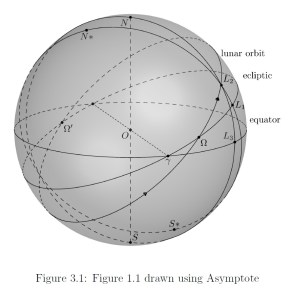
This is a school project on using 3D Computer Graphics. It explores a phenomenon whereby a sundial can actually go backwards in the tropics!
Abstract:
Understanding spherical astronomy requires good spatial visualization. Unfortunately, it is very hard to make good three dimensional (3D) illustrations and many illustrations from standard textbooks are in fact incorrect. There are many programs that can be used to create illustrations, but in this report we have focused on TEX-friendly, free programs. We have compared MetaPost, PSTricks, Asymptote and Sketch by creating a series of illustrations related to the problem of why sundials sometimes go backwards in the tropics.
In it, the Hezekiah Phenomenon is being discussed.
Quote: First, we would like to explain where the name Hezekiah Phenomenon comes from. In the Bible there is a story about God making the shadow of the sundial move backward as a sign for King Hezekiah.
The Bible gives two versions of the story of King Hezekiah and the sundial. First in 2 Kings, Chapter 20.
8 And Hezekiah said unto Isaiah, What [shall be] the sign that the LORD will heal me, and that I shall go up into the house of the LORD the third day? 9 And Isaiah said, This sign shalt thou have of the LORD, that the LORD will do the thing that he hath spoken: shall the shadow go forward ten degrees, or go back ten degrees? 10 And Hezekiah answered, It is a light thing for the shadow to go down ten degrees: nay, but let the shadow return backward ten degrees. 11 And Isaiah the prophet cried unto the LORD: and he brought the shadow ten degrees backward, by which it had gone down in the dial of Ahaz. (2 Kings 20: 8–11, King James Version)
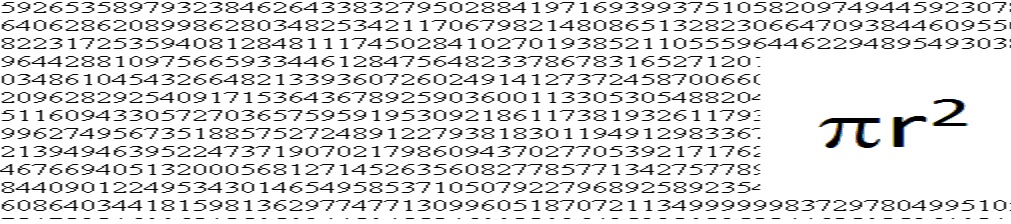
I was taught how to find area of a circle when in school. The teacher wrote down the formulae on the blackboard and I accepted it as absolute truth.
Later in my life I used integral calculas to derive the formulae for the area of a circle, but I never found a way to explain it to a 11 year old, till recently.
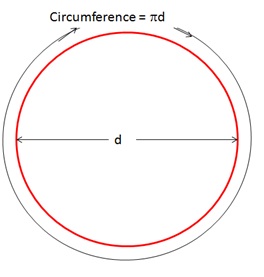
At my son’s primary school , the maths teacher explained why the area of a circle is pr2 by cutting a pair of cardboard discs. Apparently it was first derived by Archimedes. I was amazed at the beauty and the simplicity of the proof . Why didn’t they teach it in our schools ?
This is a very interesting video on the Infinite Hotel Paradox from Youtube. One of the best videos on the mysterious Infinity that I have ever watched. Do check it out!
The Infinite Hotel, a thought experiment created by German mathematician David Hilbert, is a hotel with an infinite number of rooms. Easy to comprehend, right? Wrong. What if it’s completely booked but one person wants to check in? What about 40? Or an infinitely full bus of people? Jeff Dekofsky solves these heady lodging issues using Hilbert’s paradox.
Lesson by Jeff Dekofsky, animation by The Moving Company Animation Studio.
Many people take math in high school and promptly forget much of it. But math plays a part in all of our lives all of the time, whether we know it or not. In The Joy of x, Steven Strogatz expands on his hit New York Times series to explain the big ideas of math gently and clearly, with wit, insight, and brilliant illustrations.

















 ,
, .
.

 , we get
 exists for the time being, and prove it later)
 .
. , we get:


 which is the Golden Ratio!
 converges. This is a bit tricky and requires some algebra.


 . An example would be, 512, 256, 128, 64.


 , where
  is square-free (not divisible by any square numbers). For instance, 6 is square-free but 18 is not, since 18 can be divided by
  .
. to be the largest square number that divides
  , and then let
  . For instance, if
  ,
,  is the largest square number that divides 108, so we let
  .
. , and try to over-estimate the number of integers between 1 and
  square free numbers. (The number of subsets of a set with k elements is 2
 , we have
  .
. . (
. ( choices for
  )
) , for all N.
 , then
  .
. square-free numbers, namely, 1, 2, 3, 5, 2×3=6, 2×5=10, 3×5=15, 2x3x5=30.
 ,
,  .
. , which is a contradiction.







 Mathtuition88