Galois Group (Example)

This post is about the Galois group of K over \mathbb{Q}, where K is the splitting field of f(x)=x^p-2, where p is an odd prime.

First we show that the polynomial f(x)=x^p-2 is irreducible over \mathbb{Q}. This follows immediately by Eisenstein’s Criterion, since 2\mid (-2), 2\nmid 1 and 2^2\nmid (-2).

Next, we show that the splitting field K of f(x) in \mathbb{C} is Q(\sqrt[p]{2},\omega), where \omega=e^{2\pi i/p} is a primitive p-th root of unity. The roots of f are \sqrt[p]2, \sqrt[p]2\omega, \sqrt[p]2\omega^2, \dots, \sqrt[p]2\omega^{p-1}.

The splitting field K contains \sqrt[p]2 and \omega=\frac{\sqrt[p]2\omega^2}{\sqrt[p]2\omega}. Thus \mathbb{Q}(\sqrt[p]2,\omega)\subseteq K.

On the other hand, \mathbb{Q}(\sqrt[p]2,\omega) contains all the roots of f, hence f splits in \mathbb{Q}(\sqrt[p]2, \omega). Thus K\subseteq\mathbb{Q}(\sqrt[p]2,\omega), since K is the smallest field that contains \mathbb{Q} and all the roots of f. All in all, we have that the splitting field K=\mathbb{Q}(\sqrt[p]2, \omega).

The next part involves determining the Galois group of K over \mathbb{Q}. We have |Gal(K/\mathbb{Q})|=[K:\mathbb{Q}]. Since [\mathbb{Q}(\sqrt[p]2):\mathbb{Q}]=p (minimal polynomial x^p-2), and [\mathbb{Q}(\omega):\mathbb{Q}]=p-1 (minimal polynomial the cyclotomic polynomial 1+x+x^2+\dots+x^{p-1}), thus |Gal(K/\mathbb{Q})|=p(p-1). Here we have used the lemma that suppose [F(\alpha):F]=m and [F(\beta):F]=n with \gcd(m,n)=1, then [F(\alpha,\beta):F]=mn.

What the Galois group does is it permutes the roots of f. Let \sigma be an element of the Galois group. \sigma(\sqrt[p]2) can possibly be \sqrt[p]2, \sqrt[p]\omega, \dots, \sqrt[p]2\omega^{p-1}, a total of p choices. Similarly, \sigma(\omega)=\omega, \omega^2, \dots,\omega^{p-1}, a total of p-1 choices. All these total up to p(p-1) elements, which is exactly the size of the Galois group.

The above Galois group Gal(K/\mathbb{Q}) is described by how its elements act on the generators. For a more concrete representation, we can actually prove that the Galois group above is isomorphic to the group of matrices \begin{pmatrix}a&b\\0&1\end{pmatrix}, where a,b\in\mathbb{F}_p, a\neq 0. We denote the group of matrices as M.

To show the isomorphism, we define a map \phi: Gal(K/\mathbb{Q})\to M, mapping \sigma_{a,b} to \begin{pmatrix}a&b\\0&1\end{pmatrix}.

Notation: \sigma_{a,b} is defined on the generators as follows, \sigma_{a,b}(\sqrt[p]2)=\sqrt[p]2\omega^b, \sigma_{a,b}(\omega)=\omega^a.

We can clearly see that the map \phi is bijective. To see it is a homomorphism, we compute \phi(\sigma_{a,b}\circ\sigma_{c,d})=\begin{pmatrix}ac&a+bd\\0&1\end{pmatrix}=\phi(\sigma_{a,b})\phi(\sigma_{c,d}).

Cellular Approximation Theorem and Homotopy Groups of Spheres

First we will state another theorem, Whitehead’s Theorem: If a map f:X\to Y between connected CW complexes induces isomorphisms f_*:\pi_n(X)\to\pi_n(Y) for all n, then f is a homotopy equivalence. If f is the inclusion of a subcomplex X\to Y, we have an even stronger conclusion: X is a deformation retract of Y.

The main theorem discussed in this post is the Cellular Approximation Theorem: Every map f:X\to Y of CW complexes is homotopic to a cellular map. If f is already cellular on a subcomplex A\subset X, the homotopy may be taken to be stationary on A. This theorem can be viewed as the CW complex analogue of the Simplicial Approximation Theorem.

Corollary: If n<k, then \pi_n(S^k)=0.

Proof: Consider S^n and S^k with their canonical CW-structure, with one 0-cell each, and with one n-cell for S^n and one k-cell for S^k. Let [f]\in\pi_n(S^k), where f:S^n\to S^k is a base-point preserving map. By the Cellular Approximation Theorem, f is homotopic to a cellular map g, where cells map to cells of same or lower dimension.

Since n<k, the n-cell S^n can only map to the 0-cell in S^k. The 0-cell in S^n (the basepoint) is also mapped to the 0-cell in S^k. Thus g is the constant map, hence \pi_n(S^k)=0.

Arzela-Ascoli Theorem and Applications

The Arzela-Ascoli Theorem is a rather formidable-sounding theorem that gives a necessary and sufficient condition for a sequence of real-valued continuous functions on a closed and bounded interval to have a uniformly convergent subsequence.

Statement: Let (f_n) be a uniformly bounded and equicontinuous sequence of real-valued continuous functions defined on a closed and bounded interval [a,b]. Then there exists a subsequence (f_{n_k}) that converges uniformly.

The converse of the Arzela-Ascoli Theorem is also true, in the sense that if every subsequence of (f_n) has a uniformly convergent subsequence, then (f_n) is uniformly bounded and equicontinuous.

Explanation of terms used: A sequence (f_n) of functions on [a,b] is uniformly bounded if there is a number M such that |f_n(x)|\leq M for all f_n and all x\in [a,b]. The sequence is equicontinous if, for all \epsilon>0, there exists \delta>0 such that |f_n(x)-f_n(y)|<\epsilon whenever |x-y|<\delta for all functions f_n in the sequence. The key point here is that a single \delta (depending solely on \epsilon) works for the entire family of functions.

Application

Let g:[0,1]\times [0,1]\to [0,1] be a continuous function and let \{f_n\} be a sequence of functions such that f_n(x)=\begin{cases}0,&0\leq x\leq 1/n\\    \int_0^{x-\frac{1}{n}}g(t,f_n(t))\ dt,&1/n\leq x\leq 1\end{cases}

Prove that there exists a continuous function f:[0,1]\to\mathbb{R} such that f(x)=\int_0^x g(t,f(t))\ dt for all x\in [0,1].

The idea is to use Arzela-Ascoli Theorem. Hence, we need to show that (f_n) is uniformly bounded and equicontinuous.

We have

\begin{aligned}|f_n(x)|&\leq |\int_0^{x-\frac{1}{n}} 1\ dt|\\    &=|x-\frac{1}{n}|\\    &\leq |x|+|\frac{1}{n}|\\    &\leq 1+1\\    &=2    \end{aligned}

This shows that the sequence is uniformly bounded.

If 0\leq x\leq 1/n,

\begin{aligned}|f_n(x)-f_n(y)|&=|0-f_n(y)|\\    &=|\int_0^{y-\frac{1}{n}} g(t,f_n(t))\ dt|\\    &\leq |\int_0^{y-\frac{1}{n}} 1\ dt|\\    &=|y-\frac{1}{n}|\\    &\leq |y-x|    \end{aligned}

Similarly if 0\leq y\leq 1/n, |f_n(x)-f_n(y)|\leq |x-y|.

If 1/n\leq x\leq 1 and 1/n\leq y\leq 1,

\begin{aligned}|f_n(x)-f_n(y)|&=|\int_0^{x-1/n} g(t,f_n(t))\ dt-\int_0^{y-1/n}g(t,f_n(t))\ dt|\\    &=|\int_{y-1/n}^{x-1/n}g(t,f_n(t))\ dt|\\    &\leq |\int_{y-1/n}^{x-1/n} 1\ dt|\\    &=|(x-1/n)-(y-1/n)|\\    &=|x-y|    \end{aligned}

Therefore we may choose \delta=\epsilon, then whenever |x-y|<\delta, |f_n(x)-f_n(y)|\leq |x-y|<\epsilon. Thus the sequence is indeed equicontinuous.

By Arzela-Ascoli Theorem, there exists a subsequence (f_{n_k}) that is uniformly convergent.

f_{n_k}(x)\to f(x)=\int_0^x g(t,f(t))\ dt.

By the Uniform Limit Theorem, f:[0,1]\to\mathbb{R} is continuous since each f_n is continuous.

Merry Christmas

Wishing all readers a Merry Christmas and Happy New Year!

For parents looking for an ideal Christmas gift for their child, do consider buying an enrichment book from Recommend Math Books. As a quote goes, “A book is a gift you can open again and again.” – Garrison Keillor

Some other excellent educational books for Christmas gifts are:

Another popular gift idea is the
All-New Kindle Paperwhite, 6″ High-Resolution Display (300 ppi) with Built-in Light, Wi-Fi – Includes Special Offers

Quotient Ring of the Gaussian Integers is Finite

The Gaussian Integers \mathbb{Z}[i] are the set of complex numbers of the form a+bi, with a,b integers. Originally discovered and studied by Gauss, the Gaussian Integers are useful in number theory, for instance they can be used to prove that a prime is expressible as a sum of two squares iff it is congruent to 1 modulo 4.

This blog post will prove that every (proper) quotient ring of the Gaussian Integers is finite. I.e. if I is any nonzero ideal in \mathbb{Z}[i], then \mathbb{Z}[i]/I is finite.

We will need to use the fact that \mathbb{Z}[i] is an Euclidean domain, and thus also a Principal Ideal Domain (PID).

Thus I=(\alpha) for some nonzero \alpha\in\mathbb{Z}[i]. Let \beta\in\mathbb{Z}[i].

By the division algorithm, \beta=\alpha q+r with r=0 or N(r)<N(\alpha). We also note that \beta+I=r+I.

Thus,

\begin{aligned}\mathbb{Z}[i]/I&=\{\beta+I\mid\beta\in\mathbb{Z}[i]\}\\    &=\{r+I\mid r\in\mathbb{Z}[i],N(r)<N(\alpha)\}    \end{aligned}.

Since there are only finitely many elements r\in\mathbb{Z}[i] with N(r)<N(\alpha), thus \mathbb{Z}[i]/I is finite.

Behavior of Homotopy Groups with respect to Products

This blog post is on the behavior of homotopy groups with respect to products. Proposition 4.2 of Hatcher:

For a product \prod_\alpha X_\alpha of an arbitrary collection of path-connected spaces X_\alpha there are isomorphisms \pi_n(\prod_\alpha X_\alpha)\cong\prod_\alpha \pi_n(X_\alpha) for all n.

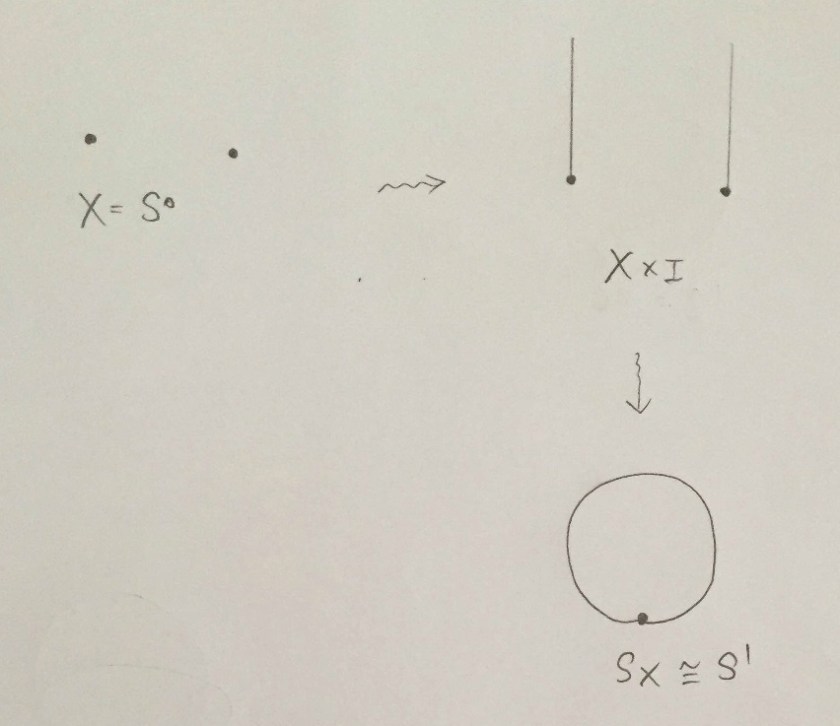
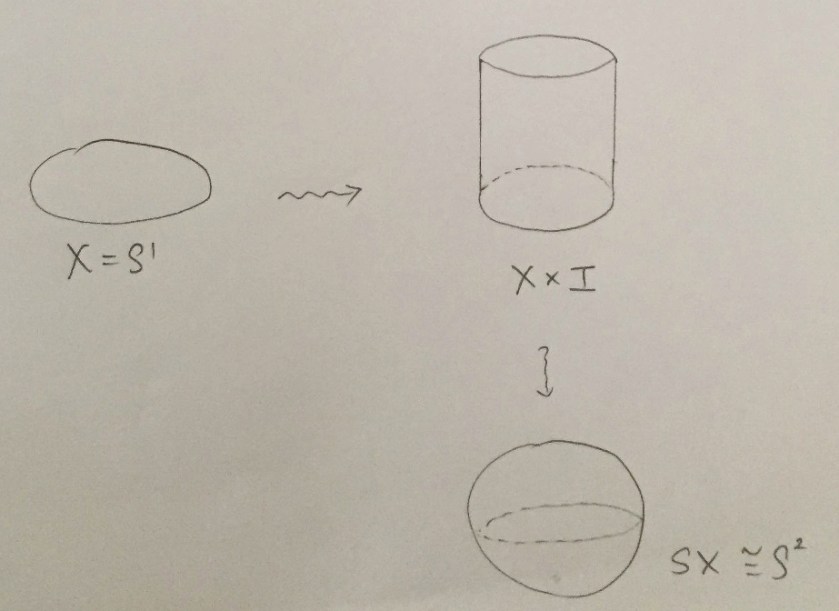
The proof given in Hatcher is a short one: A map f:Y\to \prod_\alpha X_\alpha is the same thing as a collection of maps f_\alpha: Y\to X_\alpha. Taking Y to be S^n and S^n\times I gives the result.

A possible alternative proof is to first prove that \pi_n(X_1\times X_2)\cong\pi_n(X_1)\times\pi_n(X_2), which is the result for a product of two spaces. The general result then follows by induction.

We construct a map \psi:\pi_n(X_1\times X_2)\to\pi_n(X_1)\times\pi_n(X_2), \psi([f])=([f_1],[f_2]).

Notation: f:S^n\to X_1\times X_2, f_1=p_1\circ f:S^n\to X_1, f_2=p_2\circ f:S^n\to X_2 where p_i:X_1\times X_2\to X_i are the projection maps.

We can show that \psi ([f]+[g])=\psi([f])+\psi([g]), thus \psi is a homomorphism.

We can also show that \psi is bijective by constructing an explicit inverse, namely \phi:\pi_n(X_1)\times\pi_n(X_2)\to\pi_n(X_1\times X_2), \phi([g_1],[g_2])=[g] where g:S^n\to X_1\times X_2, g(x)=(g_1(x),g_2(x)).

Thus \psi is an isomorphism.

Graph of measurable function is measurable (and has measure zero)

Let f be a finite real valued measurable function on a measurable set E\subseteq\mathbb{R}. Show that the set \{(x,f(x)):x\in E\} is measurable.

We define \Gamma(f,E):=\{(x,f(x)):x\in E\}. This is popularly known as the graph of a function. Without loss of generality, we may assume that f is nonnegative. This is because we can write f=f^+ - f^-, where we split the function into two nonnegative parts.

The proof here can also be found in Wheedon’s Analysis book, Chapter 5.

The strategy for proving this question is to approximate the graph of the function with arbitrarily thin rectangular strips. Let \epsilon>0. Define E_k=\{x\in E\mid \epsilon k\leq f(x)<\epsilon (k+1)\}, k=0,1,2,\dots.

We have |\Gamma (f,E_k)|_e\leq\epsilon |E_k|, where |\cdot|_e indicates outer measure.

Also, \Gamma(f,E)=\cup\Gamma(f,E_k), where \Gamma(f,E_k) are disjoint.

\begin{aligned}|\Gamma(f,E)|_e&\leq\sum_{k=1}^\infty|\Gamma(f,E_k)|_e\\    &\leq\epsilon(\sum_{k=1}^\infty|E_k|)\\    &=\epsilon|E|    \end{aligned}

If |E|<\infty, we can conclude |\Gamma(f,E)|_e=0 and thus \Gamma(f,E) is measurable (and has measure zero).

If |E|=\infty, we partition E into countable union of sets F_k each with finite measure. By the same analysis, each \Gamma(f,F_k) is measurable (and has measure zero). Thus \Gamma(f,E)=\bigcup_{k=1}^\infty\Gamma(f,F_k) is a countable union of measurable sets and thus is measurable (has measure zero).

Advanced Method for Proving Normal Subgroup

For beginners in Group Theory, the basic method to prove that a subgroup H is normal in a group G is to show that “left coset = right coset”, i.e. gH=Hg for all g\in G. Variations of this method include showing that ghg^{-1}\in H, gHg^{-1}=H, and so on.

This basic method is good for proving basic questions, for example a subgroup of index two is always normal. However, for more advanced questions, the basic method unfortunately seldom works.

A more sophisticated advanced approach to showing that a group is normal, is to show that it is a kernel of a homomorphism, and thus normal. Thus one often has to construct a certain homomorphism and show that the kernel is the desired subgroup.

Example: Let H be a subgroup of a finite group G and [G:H]=p, where p is the smallest prime divisor of |G|. Show that H is normal in G.

The result above is sometimes called “Strong Cayley Theorem”.

Proof: Let G act on G/H by left translation.

G\times G/H\to G/H, (g,xH)\to gxH.

This is a group action since 1\cdot xH=xH, and g_1(g_2\cdot xH)=g_1g_2xH=(g_1g_2)\cdot xH.

This action induces a homomorphism \sigma:G\to S_{G/H}\cong S_p. Let g\in\ker\sigma. \sigma(g)(xH)=xH for all xH\in G/H, i.e. gxH=xH for all x\in G. In particular when x=1, gH=H. This means that g\in H. So we have \ker\sigma\subseteq H.

Suppose to the contrary \ker\sigma\neq H, i.e. [H:\ker\sigma]>1. Let q be a prime divisor of [H:\ker\sigma].

We also have

[G:\ker\sigma]=[G:H][H:\ker\sigma]=p[H:\ker\sigma]

By the First Isomorphism Theorem, G/ker\sigma\cong\text{Im}\ \sigma\leq S_p. By Lagrange’s Theorem, [G:\ker\sigma]\mid p!, i.e. p[H:\ker\sigma]\mid p!. This implies [H:\ker\sigma]\mid(p-1)!. Finally, q\mid(p-1)! implies q\leq p-1<p.

However, q\mid [H:\ker\sigma] implies q\mid[G:\ker\sigma]=\frac{|G|}{|\ker\sigma|} which implies q\mid|G|.

This is a contradiction that p is the smallest prime divisor of |G|. Thus, H=\ker\sigma and therefore H is a normal subgroup.

This proof is pretty amazing, and hard to think of without any hints.

LaTeX to WordPress Converter

Just created a LaTeX to WordPress Converter: http://mathtuition88.blogspot.sg/2015/12/latex-to-wordpress-converter.html

Currently it is a very basic converter, just changes “$abc$” to “$ latex abc$”. To change back from WordPress to LaTeX, a simple text editor will do the job, with replace “$ latex ” with “$”.

Test code:

LaTeX: From the above inequality $|z^n|>|a_1z^{n-1}+\ldots+a_n|$ we can conclude that the polynomial $p_t(z)=z^n+t(a_1z^{n-1}+\ldots+a_n)$ has no roots on the circle $|z|=r$ when $0\leq t\leq 1$.

WordPress: From the above inequality |z^n|>|a_1z^{n-1}+\ldots+a_n| we can conclude that the polynomial p_t(z)=z^n+t(a_1z^{n-1}+\ldots+a_n) has no roots on the circle |z|=r when 0\leq t\leq 1.

Covering space projection induces isomorphisms

Proposition 4.1 (from Hatcher): A covering space projection p:(\tilde{X},\tilde{x}_0)\to (X,x_0) induces isomorphisms p_*:\pi_n(\tilde{X},\tilde{x}_0)\to\pi_n(X,x_0) for all n\geq 2.

We will elaborate more on this proposition in this blog post. Basically, we will need to show that p_* is a homomorphism and also bijective (surjective and injective).

Homomorphism

p_*([f]):=[pf]

p_*([f]+[g])=[p(f+g)]

p(f+g)(s_1,s_2,\dots,s_n)=\begin{cases}pf(2s_1,s_2,\dots,s_n)&s_1\in[0,\frac 12]\\    pg(2s_1-1,s_2,\dots,s_n)&s_1\in[\frac 12,1]    \end{cases}

p_*[f]+p_*[g]=[pf]+[pg]

(pf+pg)(s_1,s_2,\dots,s_n)=    \begin{cases}pf(2s_1,s_2,\dots,s_n)&s_1\in[0,\frac 12]\\    pg(2s_1-1,s_2,\dots,s_n)&s_1\in[\frac 12,1]    \end{cases}, which we can see is the same.

Thus, p_* is a homomorphism.

Surjective

For surjectivity, we need to use a certain Proposition 1.33: Suppose given a covering space p:(\tilde{X},\tilde{x}_0)\to (X,x_0) and a map f:(Y,y_0)\to (X,x_0) with Y path-connected and locally path-connected. Then a lift \tilde{f}:(Y,y_0)\to (\tilde{X},\tilde{x}_0) of f exists iff f_*(\pi_1(Y,y_0))\subset p_*(\pi_1(\tilde{X},\tilde{x}_0)).

Let [f]\in\pi_n(X,x_0), where f:(S_n,s_0)\to(X,x_0), n\geq 2. Since S^n is simply connected for n\geq 2, \pi_1(S_n,s_0)=0. Thus f_*(\pi_1(S_n,s_0))=0\subset p_*(\pi_1(\tilde{X},\tilde{x}_0)). By Proposition 1.33, a lift \tilde{f}:(S_n,s_0)\to (\tilde{X},\tilde{x}_0) of f exists, where p\tilde{f}=f.

i.e. we have \boxed{p_*[\tilde{f}]=[p\tilde{f}]=[f]}. Hence p_* is surjective.

Injective

Let [\tilde{f}_0]\in\ker p_*, where \tilde{f}_0:I^n\to \tilde{X} with a homotopy f_t:I^n\to X of f_0=p\tilde{f}_0 to the trivial loop f_1.

By the covering homotopy property (homotopy lifting property), there exists a unique homotopy \tilde{f}_t:I^n\to \tilde{X} of \tilde{f}_0 that lifts f_t, i.e. p\tilde{f}_t=f_t. There is a lifted homotopy of loops \tilde{f}_t starting with \tilde{f}_0 and ending with a constant loop. Hence [\tilde{f}_0]=0 in \pi_n(\tilde{X},\tilde{x}_0) and thus p_* is injective.

How to calculate Homology Groups (Klein Bottle)

This post will be a guide on how to calculate Homology Groups, focusing on the example of the Klein Bottle. Homology groups can be quite difficult to grasp (it took me quite a while to understand it). Hope this post will help readers to get the idea of Homology. Our reference book will be Hatcher’s Algebraic Topology (Chapter 2: Homology). I will elaborate further on the Hatcher’s excellent exposition on Homology.

This is also Exercise 5 in Chapter 2, Section 2.1 of Hatcher.

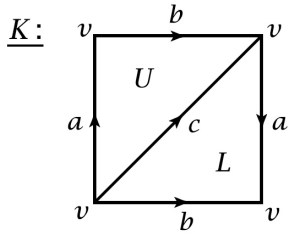
The first step to compute Homology Groups is to construct a \Delta-complex of the Klein Bottle.

klein bottle

One thing to note for \Delta-complexes, is that the vertices cannot be ordered cyclically, as that would violate one of the requirements which is to preserve the order of the vertices.

The key formula for Homology is: \boxed{H_n=\ker\partial_n/\text{Im}\ \partial_{n+1}}.

We have \ker\partial_0=\langle v\rangle, the free group generated by the vertex v, because there is only one vertex!

Next, we have \partial_1(a)=\partial_1(b)=\partial_1(c)=v-v=0. Thus \text{Im}\ \partial_1=0.

Therefore H_0=\ker\partial_0/\text{Im}\ \partial_1=\langle v\rangle /0\cong\mathbb{Z}.

Next, we have \ker\partial_1=\langle a,b,c\rangle. \partial_2U=a+b-c, \partial_2L=c+a-b. To learn more about calculating \partial_2, check out the diagram on page 105 of Hatcher.

We then have \text{Im}\ \partial_2=\langle a+b-c, c+a-b\rangle=\langle a+b-c, 2a\rangle, where we got 2a from adding the two previous generators (a+b-c)+(c+a-b).

Thus H_1=\ker\partial_1/\text{Im}\ \partial_2=\langle a,b,c\rangle/\langle a+b-c, 2a\rangle=\mathbb{Z}/2\mathbb{Z}\oplus\mathbb{Z}.

To intuitively understand the above working, we need to use the idea that elements in the quotient are “zero”. Hence a+b-c=0, implies that c=a+b, thus c can be expressed as a linear combination of a, b, thus is not a generator of H_1. 2a=0 implies that a+a=0, which gives us the \mathbb{Z}/2\mathbb{Z} part.

Finally we note that \ker\partial_2=0, and also for n\geq 3, \ker\partial_n=0 since there are no simplices of dimension greater than or equal to 3. Thus, the second homology group onwards are all zero.

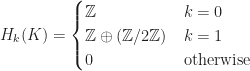
In conclusion, we have H_k(K)=\begin{cases}\mathbb{Z}&k=0\\    \mathbb{Z}/2\mathbb{Z}\oplus\mathbb{Z}&k=1\\    0&\text{otherwise}    \end{cases}

Mean Value Theorem for Higher Dimensions

Let f be differentiable on a connected set E\subseteq \mathbb{R}^n, then for any x,y\in E, there exists z\in E such that f(x)-f(y)=\nabla f(z)\cdot (x-y).

Proof: The trick is to use the Mean Value Theorem for 1 dimension via the following construction:

Define g:[0,1]\to\mathbb{R}, g(t)=f(tx+(1-t)y). By the Mean Value Theorem for one variable, there exists c\in (0,1) such that g'(c)=\frac{g(1)-g(0)}{1-0}, i.e.

\nabla f(cx+(1-c)y)\cdot (x-y)=f(x)-f(y). Here we are using the chain rule for multivariable calculus to get: g'(c)=\nabla f(cx+(1-c)y)\cdot (x-y).

Let z=cx+(1-c)y, then \nabla f(z)\cdot (x-y)=f(x)-f(y) as required.

Function of Bounded Variation that is not continuous

This is a basic example of a function of bounded variation on [0,1] but not continuous on [0,1].

The key Theorem regarding functions of bounded variation is Jordan’s Theorem: A function is of bounded variation on the closed bounded interval [a,b] iff it is the difference of two increasing functions on [a,b].

Consider g(x)=\begin{cases}0&\text{if}\ 0\leq x<1\\  1&\text{if}\ x=1  \end{cases}

h(x)\equiv 0

Both g and h are increasing functions on [0,1]. Thus by Jordan’s Theorem, f(x)=g(x)-h(x)=g(x) is a function of bounded variation, but it is certainly not continuous on [0,1]!

Please help to do Survey

URL: https://career-test.com/s/sgamb?reid=210

The results of this Personality Test is quite surprisingly accurate, do give it a try to see if you are a Careerist, Entrepreneur, Harmonizer, Idealist, Hunter, Internationalist or Leader?

Do try out this Free Career Guidance Personality Test at https://career-test.com/s/sgamb?reid=210 while it is still available!

Benefits of doing the (Free) Career Test:

  • Get familiar with the top companies in Singapore
  • There are seven distinct career types based on career preferences, goals and personality. Get to know yours! (My result: Harmonizer)
  • Take part in the annual Universum survey and win prizes!

List of Fundamental Group, Homology Group (integral), and Covering Spaces

Just to compile a list of Fundamental groups, Homology Groups, and Covering Spaces for common spaces like the Circle, n-sphere (S^n), torus (T), real projective plane (\mathbb{R}P^2), and the Klein bottle (K).

Fundamental Group

Circle: \pi_1(S^1)=\mathbb{Z}

n-Sphere: \pi_1(S^n)=0, for n>1

n-Torus: \pi_1(T^n)=\mathbb{Z}^n (Here n-Torus refers to the n-dimensional torus, not the Torus with n holes)

\pi_1(T^2)=\mathbb{Z}^2 (usual torus with one hole in 2 dimensions)

Real projective plane: \pi_1(\mathbb{R}P^2)=\mathbb{Z}_2

Klein bottle K: \pi_1(K)=(\mathbb{Z}\amalg\mathbb{Z})/\langle aba^{-1}b\rangle

Homology Group (Integral)

H_0(S^1)=H_1(S^1)=\mathbb{Z}. Higher homology groups are zero.

H_k(S^n)=\begin{cases}\mathbb{Z}&k=0,n\\    0&\text{otherwise}    \end{cases}

H_k(T)=\begin{cases}\mathbb{Z}\ \ \ &k=0,2\\    \mathbb{Z}\times\mathbb{Z}\ \ \ &k=1\\    0\ \ \ &\text{otherwise}    \end{cases}

H_k(\mathbb{R}P^2)=\begin{cases}\mathbb{Z}\ \ \ &k=0\\    \mathbb{Z}_2\ \ \ &k=1\\    0\ \ \ &\text{otherwise}    \end{cases}

Klein bottle, K: H_k(K)=\begin{cases}\mathbb{Z}&k=0\\    \mathbb{Z}\oplus(\mathbb{Z}/2\mathbb{Z})&k=1\\    0&\text{otherwise}    \end{cases}

Covering Spaces

A universal cover of a connected topological space X is a simply connected space Y with a map f:Y\to X that is a covering map. Since there are many covering spaces, we will list the universal cover instead.

\mathbb{R} is the universal cover of the unit circle S^1

S^n is its own universal cover for n>1. (General result: If X is simply connected, i.e. has a trivial fundamental group, then it is its own universal cover.)

\mathbb{R}^2 is the universal cover of T.

S^2 is universal cover of real projective plane RP^2.

\mathbb{R}^2 is universal cover of Klein bottle K.

Every non-empty open set in R is disjoint union of countable collection of open intervals

Question: Prove that every non-empty open set in \mathbb{R} is the disjoint union of a countable collection of open intervals.

The key things to prove are the disjointness and the countability of such open intervals. Otherwise, if disjointness and countability are not required, we may simply take a small open interval centered at each point in the open set, and their union will be the open set.

Elementary Proof: Let U be a non-empty open set in \mathbb{R}.

Let x\in U. There exists an open interval I\subseteq U containing x. Let I_x be the maximal open interval in U containing x, i.e. for any open interval I\subseteq U containing x, I\subseteq I_x. (The existence of I_x is guaranteed, we can take it to be the union of all open intervals I\subseteq U containing x.)

We note that such maximal intervals are equal or disjoint: Suppose I_x\cap I_y\neq\emptyset and I_x\neq I_y then I_x\cup I_y is an open interval in U containing x, contradicting the maximality of I_x.

Each of the maximal open intervals contain a rational number, thus we may write \displaystyle U=\bigcup_{q\in U\cap\mathbb{Q}}I_q. Upon discarding the “repeated” intervals in the union above, we get that U is the disjoint union of a countable collection of open intervals.

There are many other good proofs of this found here (http://math.stackexchange.com/questions/318299/any-open-subset-of-bbb-r-is-a-at-most-countable-union-of-disjoint-open-interv), though some can be quite deep for this simple result.


Useful Theorem in Introductory Ring Theory

Something interesting I realised in my studies in Math is that certain theorems are more “useful” than others. Certain theorems’ sole purpose seem to be an intermediate step to prove another theorem and are never used again. Other theorems seem to be so useful and their usage is everywhere.

One of the most “useful” theorems in basic Ring theory is the following:

Let R be a commutative ring with 1 and I an ideal of R. Then

(i) I is prime iff R/I is an integral domain.

(ii) I is maximal iff R/I is a field.

With this theorem, the following question is solved effortlessly:

Let R be a commutative ring with 1 and let I and J be ideals of R such that I\subseteq J.

(i) Show that J is a prime ideal of R iff J/I is a prime ideal of R/I.

(ii) Show that J is a maximal ideal of R iff J/I is a maximal ideal of R/I.

Sketch of Proof of (i):

J is a prime ideal of R iff R/J is an integral domain. (R/J\cong \frac{R/I}{J/I} by the Third Isomorphism Theorem. )\iff J/I is a prime ideal of R/I.

(ii) is proved similarly.


Live your Dream (Motivational Video) 夢想.激勵人心的演說

Just to share a very inspiring motivational video from YouTube. Not sure which movie it is from. (any readers know, please comment below as I would be interested)

Highly suitable for students (and their parents) who have just completed their PSLE, whether their PSLE 2015 results are good or not, it is now a good time to reflect on their dreams and the next step to take in the next year 2016.

Fundamental Group of Torus (van Kampen method)

There are various methods of computing fundamental groups, for example one method using maximal trees of a simplicial complex (considered a slow method). There is one “trick” using van Kampen’s Theorem that makes it relatively fast to compute the fundamental group.

This “trick” doesn’t seem to be explicitly written in books, I had to search online to learn about it.

Fundamental Group of Torus

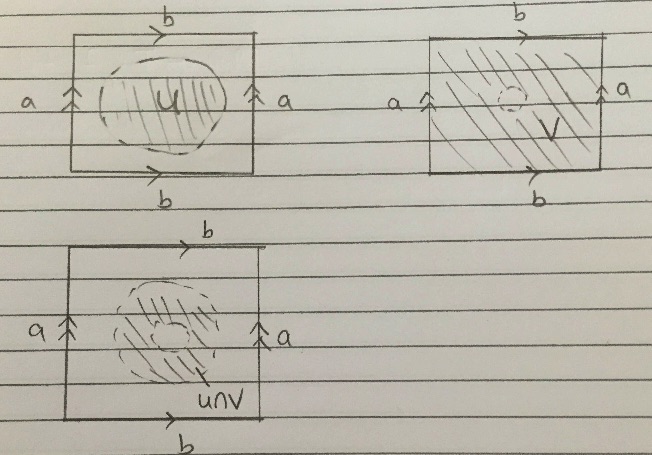
First we let U and V be open subsets of the torus  (denoted as X)as shown in the diagram below. U is an open disk, while V is the entire space with a small punctured hole. We are using the fundamental polygon representation of the torus. This trick can work for many spaces, not just the torus.

U is contractible, thus \pi_1(U)=0. U\cap V has S^1 as a deformation retract, thus \pi_1(U\cap V)=\mathbb{Z}. We note that X=U\cup V and U\cap V is path-connected. These are the necessary conditions to apply van Kampen’s Theorem.

Then, by Seifert-van Kampen Theorem, \displaystyle\boxed{\pi_1(X)=\pi_1(U)\coprod_{\pi_1(U\cap V)}\pi_1(V)}, the free product of \pi_1(U) and \pi_1(V) with amalgamation.

Let h be the generator in U\cap V. We have j_{1*}(h)=1 and j_{2*}(h)=aba^{-1}b^{-1}. (j_1:U\cap V\to U and j_2:U\cap V\to V are the inclusions. )

Therefore

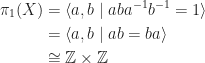
\begin{aligned}    \pi_1(X)&=\langle a,b\mid aba^{-1}b^{-1}=1\rangle\\    &=\langle a,b\mid ab=ba\rangle\\    &\cong\mathbb{Z}\times\mathbb{Z}    \end{aligned}

vankampen_torus


Free Math Newsletter


Interpolation Technique in Analysis

Question: Let f belong to both L^{p_1} and L^{p_2}, with 1\leq p_1<p_2<\infty. Show that f\in L^p for all p_1\leq p\leq p_2.

There is a pretty neat trick to do this question, known as the “interpolation technique”. The proof is as follows.

For p_1<p<p_2, there exists 0<\alpha<1 such that \displaystyle\boxed{p=\alpha p_1+(1-\alpha)p_2}. This is the key “interpolation step”. Once we have this, everything flows smoothly with the help of Holder’s inequality.

\displaystyle\begin{aligned}    \int |f|^p\ d\mu&=\int (|f|^{\alpha p_1}\cdot |f|^{(1-\alpha)p_2})\ d\mu\\    &\leq\||f|^{\alpha p_1}\|_\frac{1}{\alpha}\||f|^{(1-\alpha)p_2}\|_\frac{1}{1-\alpha}\\    &=(\int |f|^{p_1}\ d\mu)^\alpha\cdot (\int |f|^{p_2}\ d\mu)^{1-\alpha}\\    &<\infty    \end{aligned}

Thus f\in L^p.

Note that the magical thing about the interpolation technique is that p=\frac{1}{\alpha} and q=\frac{1}{1-\alpha} are Holder conjugates, since \frac{1}{p}+\frac{1}{q}=1 is easily verified.


Undergraduate Math Books


|HK|=|H||K|/|H intersect K|

Finally, the LaTeX path not specified problem has been solved by WordPress!

This post is about how to prove that |HK|=\frac{|H||K|}{|H\cap K|}, where H and K are finite subgroups of a group G.

A tempting thing to do is to use the “Second Isomorphism Theorem”, HK/H\cong K/(H\cap K). However that would be a serious mistake since the conditions for the Second Isomorphism Theorem are not met. In fact HK may not even be a group.

The correct way is to note that HK=\bigcup_{h\in H}hK.

Therefore |HK|=|K|\times |\{hK:h\in H\}|. For h_1,h_2\in H, we have:

\begin{aligned}h_1K=h_2K&\iff h_1h_2^{-1}\in K\\    &\iff h_1h_2^{-1}\in H\cap K\\    &\iff h_1(H\cap K)=h_2(H\cap K)    \end{aligned}

Therefore |\{hK:h\in H\}|=|\{h(H\cap K):h\in H\}|, i.e. the number of distinct cosets h(H\cap K). Since H\cap K is a subgroup of H, applying Lagrange’s Theorem gives the number of distinct cosets h(H\cap K) to be \frac{|H|}{|H\cap K|}.

Thus, we have |HK|=\frac{|H|}{|H\cap K|}\cdot |K|.


Undergraduate Math Books


“latex path not specified” WordPress LaTeX Bug

Recently, there is a “latex path not specified” WordPress LaTeX bug, it is very weird. Some LaTeX expressions will get rendered and some will not. Will have to postpone my math blogging till it is fixed. Worst case scenario is I have to abandon this blog and move to Blogger (http://mathtuition88.blogspot.com) if the issue remains unfixed.

Testing: x, y, z, e^{i\pi}+1=0.

Hope this bug gets fixed soon. If anyone knows the solution to solve this bug, please inform me in the comments below!

Note: Thanks to Professor Terence Tao who has replied in the comments below and shown us a link where there is ongoing discussion about the highly mysterious “latex path not specified” issue.

Interesting Measure and Integration Question

Let (\Omega,\mathcal{A},\mu) be a measure space. Let f\in L^p and \epsilon>0. Prove that there exists a set E\in\mathcal{A} with \mu(E)<\infty, such that \int_{E^c} |f|^p<\epsilon.

Solution:

The solution strategy is to use simple functions (common tactic for measure theory questions).

Let 0\leq\phi\leq |f|^p be a simple function such that \int_\Omega (|f|^p-\phi)\ d\mu<\epsilon.

Consider the set E=\{\phi>0\}. Note that \int_\Omega \phi\ d\mu\leq\int_\Omega |f|^p\ d\mu<\infty. Hence each nonzero value of \phi can only be on a set of finite measure. Since \phi has only finitely many values, \mu(E)<\infty.

Then,

\begin{aligned} \int_{E^c}|f|^p\ d\mu&=\int_{E^c} (|f|^p-\phi)\ d\mu +\int_{E^c}\phi\ d\mu\\    &\leq \int_\Omega (|f|^p-\phi)\ d\mu+0\\    &<\epsilon    \end{aligned}

Order of a^k (Group Theory)

Sincere thanks to readers who have completed the Free Personality Quiz!


Today we will revise some basic Group Theory. Let G be a group and a\in G. Assume that a has finite order n. Find the order of a^k where k is an integer.

Answer: \displaystyle|a^k|=\frac{n}{(n,k)}, where (n,k)=\gcd(n,k).

Proof:

Our strategy is to prove that m=\frac{n}{(n,k)} is the least smallest integer such that (a^k)^m=1.

Now, we have \displaystyle a^{k\cdot\frac{n}{(n,k)}}=(a^n)^{\frac{k}{(n,k)}}=1. Note that k/(n,k) is an integer and thus a valid power.

Suppose to the contrary there exists c<\frac{n}{(n,k)} such that a^{kc}=1.

Since a has finite order n, we have n\mid kc, which leads to \displaystyle\frac{n}{(n,k)}\mid\frac{k}{(n,k)}\cdot c. Note that \frac{n}{(n,k)} and \frac{k}{(n,k)} are relatively prime.

Thus \frac{n}{(n,k)}\mid c, which implies that \frac{n}{(n,k)}\leq c which is a contradiction. This proves our result. 🙂

Students in Singapore going for ‘ad-hoc’ tuition in specific topics

http://www.straitstimes.com/singapore/education/students-going-for-ad-hoc-tuition?&utm_source=google_gmail&utm_medium=social-media&utm_campaign=addtoany

Instead of committing to regular tuition sessions throughout the year, some students who need academic help are choosing to attend such classes on an “ad-hoc” basis.. Read more at straitstimes.com.

SAJC Retain Rate (JC 1)

SAJC Retain / Retention Rate (Estimate)

Just heard from a reliable source (cousin who is in the school) that SAJC’s tentative retention rate for 2015 is around 10%. On average, for a class of 25, around 2 or 3 are retained, after the Promos (Promotional Exams) in JC 1.

This is an estimate, intended to give information to those seeking it, hope it helps. By today’ s standards, 10% retention rate is considered “moderate”, considering official statistics from MOE shows that “The two JCs with the highest retention rates at JC1 averaged around 15% over the past three years.”

Side note: Some of those “retained” in SAJC are given a second chance to take another exam, upon passing they can be promoted. Hence the actual retain rate will be less than 10%, which is considered quite ok (compared to other JCs).

Success consists of going from failure to failure without loss of enthusiasm.

Winston Churchill

For those who are retained, do not despair, check out my motivational page for motivational quotes and stories.

Actually JC life is difficult for students, they have to wake up at 6am everyday, and go home at around 6-7 pm or later (due to CCA). After reaching home, it is just the beginning and they have to revise / do homework / go for tuition. It is much tougher than even the typical adult’s job of 8-5pm work. And JC students have to repeat the schedule daily for two years. The problem is that too much stuff is being crammed into two years.

Apparently, the retain rate / retention rate of JCs is a source of concern for many. Some official statistics has been released by MOE. The statistics given are “over the last three years, approximately 6% of first year JC students in each cohort failed some subjects in their promotional exams and were retained.” “The two JCs with the highest retention rates at JC1 averaged around 15% over the past three years.”

As a student who has gone through the system, rumours of JCs like MJC having 50% retain rate (most likely exaggerated, but having some basis of truth, since there is no smoke without fire) do cause some concern. Currently the JC system works by setting extremely tough internal exams, including promos and prelims (compared to the A levels), such that a D or E in the prelims in top JCs (e.g. RI/HCI/NJC) is very likely equivalent to an A in the eventual A levels. This works for some students to spur them to study harder, but may be overly demoralising for many students. For retention rate, common sense and logic would tell that a high retention rate would boost the school’s eventual A level results (one extra year of study is a lot), however that is at the expense of the student spending one extra year in JC. Since the retention rate is entirely up to the school’s decision (i.e. not regulated by MOE), each JC has different retain rate.

Students choosing a JC should check out their retention rate from reliable seniors / relatives / teachers (there is no official source released online for individual retention rate for JCs).


For students looking for tuition, do check out a highly recommended tuition agency.

Video on Computing Homology Groups

Just watched this again. I can truely say that this is the most clear explanation of Homology on the entire internet!

mathtuition88's avatarMathtuition88

This video follows after the previous video on Simplicial Complexes.

If you are looking for quality Math textbooks to study from (including Linear Algebra and Calculus, the two most popular Math courses), check out my page on Recommended Math Books for students!

View original post

Motivational Quotes and Stories (for students)

Motivational Quotes and Stories (Life / Education / Math)

Just to share some motivational quotes and stories, including those that are relevant to life, education and math. Do also check out Motivational Books for the Student (Educational).

If you have any other quotes / stories that you like, do post it in the comments! 🙂


1) “Success consists of going from failure to failure without loss of enthusiasm.”

Winston Churchill

This applies especially to students in higher education (e.g. Junior Colleges in Singapore), where it is quite common to “fail” an exam by getting below 50%. Do not despair, and continue to study hard, and you will achieve success eventually.

2) 

“There is nothing noble in being superior to your fellow man; true nobility is being superior to your former self.”
Ernest Hemingway

Do not compare yourself with your classmates, everyone is unique. Focus on improving yourself day by day.

3) 

Kirby tried his qualifying exam again, on the same two topics. “This time, they said, ‘You passed,’” he says. “They didn’t say it with any enthusiasm, but they said, ‘You passed.’” His committee recommended that Kirby move into some other field than topology.

But Kirby was not one to be deterred by discouragement from his teachers. He waited until their backs were turned, so to speak, and identified a topologist — Eldon Dyer — who had been away when Kirby took his qualifying exam. Kirby kept going to Dyer with questions, and “at some point it sort of became obvious that I was his student,” Kirby says. “And he told somebody later on that he realized at some point or other he was stuck with me.”

(https://www.simonsfoundation.org/science_lives_video/robion-kirby/)

Inspirational story from Rob Kirby (famous mathematician) on how to ignore discouragement, even from teachers. This is applicable to students in Singapore who are sometimes told by teachers / school to drop certain subjects (e.g. drop Higher Chinese / drop A Maths), where the motive may not be purely in the student’s interest. Sometimes the reason that the school wants the student to drop the subject is to protect the school’s ranking in the exams / boost principal’s KPI etc. In this case, the student should follow his own judgement on whether to drop the subject.

4) 

“Everyone is No. 1” Motivational Song by Andy Lau.

Beautiful Lyrics (Chinese):
我的路不是你的路
我的苦不是你的苦
每个人都有潜在的能力
把一切去征服

我的泪不是你的泪
我的痛不是你的痛
一样的天空不同的光荣
有一样的感动

不需要自怨自艾的惶恐
只需要沉着
只要向前冲
告诉自己天生我才必有用

Everyone is NO.1
只要你凡事不问能不能
用一口气交换你一生
要迎接未来不必等

Everyone is NO.1
成功的秘诀在你肯不肯
流最热的汗
拥最真的心
第一名属于每个人

我的手不是你的手
我的口不是你的口
只要一条心
暴风和暴雨
都变成好朋友

不需要自怨自艾的惶恐
只需要沉着
只要向前冲
告诉自己天生我才必有用

不害怕路上有多冷
直到还有一点余温
我也会努力狂奔

Everyone is NO.1
只要你凡事不问能不能
用一口气交换你一生
要迎接未来不必等

Everyone is NO.1
成功的秘诀在你肯不肯
流最热的汗
拥最真的心
第一名属于每个人
5)

Success is not final, failure is not fatal: it is the courage to continue that counts.

Winston Churchill

6)

Galatians 6:4-6Easy-to-Read Version (ERV)

Don’t compare yourself with others. Just look at your own work to see if you have done anything to be proud of. You must each accept the responsibilities that are yours.

Curious Inequality: 2^p(|a|^p+|b|^p)>=|a+b|^p

Try out the Personality Quiz!

This inequality often appears in Analysis: 2^p(|a|^p+|b|^p)\geq |a+b|^p, for p\geq 1, and a,b\in\mathbb{R}. It does seem quite tricky to prove, and using Binomial Theorem leads to a mess and doesn’t work!

It turns out that the key is to use convexity, and we can even prove a stronger version of the above, namely 2^{p-1}(|a|^p+|b|^p)\geq |a+b|^p.

Proof: Consider f(x)=|x|^p which is convex on \mathbb{R}. Let a,b\in\mathbb{R}. By convexity, we have \displaystyle\boxed{f(ta+(1-t)b)\leq tf(a)+(1-t)f(b)} for 0\leq t\leq 1.

Choose t=1/2. Then we have f(\frac{1}{2}a +\frac 12 b)\leq \frac 12 f(a)+\frac 12 f(b), which implies |\frac{a+b}{2}|^p\leq\frac{1}{2}|a|^p+\frac{1}{2}|b|^p.

Thus,

\begin{aligned}|a+b|^p&\leq 2^{p-1}|a|^p+2^{p-1}|b|^p\\    &\leq 2^p|a|^p+2^p|b|^p\\    &=2^p(|a|^p+|b|^p)    \end{aligned}

Z(D_2n), Center of Dihedral Group D_2n

Click here for Free Personality Test

Question: What is Z(D_{2n}), the center of the dihedral group D_{2n}?

Algebraically, the dihedral group may be viewed as a group with two generators a and b, i.e. \boxed{D_{2n}=\{1,a,a^2,\dots,a^{n-1},b,ab,a^2b,\dots,a^{n-1}b\}} with a^n=b^2=1, bab=a^{-1}.

Answer: Z(D_2)=D_2

Z(D_4)=D_4.

For n\geq 3, Z(D_{2n})=\begin{cases}1&,\ n\ \text{is odd}\\    \{1,a^{n/2}\}&,\ n\ \text{is even}    \end{cases}

Proof: For n=1, D_2=\{1, b\}\cong\mathbb{Z}_2 which is abelian. Thus, Z(D_2)=D_2.

For n=2, D_4=\{1,a,b,ab\}\cong V, the Klein four-group, which is also abelian. Thus, Z(D_4)=D_4.

Let A=\{1,a,a^2,\dots,a^{n-1}\}, B=\{b,ab,a^2b,\dots,a^{n-1}b\}. Clearly elements in A commute with each other.

Let a^k be an element in A. (0\leq k\leq n-1). Let a^lb be an element in B. (0\leq l\leq n-1)

\begin{aligned}a^k(a^lb)=(a^lb)a^k&\iff a^kb=ba^k\\    &\iff a^kba^{-k}b^{-1}=1\\    &\iff a^kb(bab)^kb=1\ (\text{here we used}\ bab=a^{-1})\\    &\iff a^kb(ba^kb)b=1\\    &\iff a^{2k}=1\\    &\iff k=0\ \text{or}\ n/2    \end{aligned}

I.e. the only element in A (other than 1) that is in the center is a^{n/2}, which is only possible if n is even.

Let a^kb, a^lb be two distinct elements in B. (0\leq k< l\leq n-1)

\begin{aligned}(a^kb)(a^lb)=(a^lb)(a^kb)&\iff ba^l=a^{l-k}ba^k\\    &\iff ba^{l-k}=a^{l-k}b    \end{aligned}

By earlier analysis, this is true iff l-k=n/2. Each a^kb\ (0\leq k\leq n-2) is not in the center since we may consider l=k+1, i.e. a^{k+1}b. Then l-k=1<n/2. (since n\geq 3). a^{n-1}b also does not commute with a^{n-2}b for the same reason.

Therefore,

For n\geq 3, Z(D_{2n})=\begin{cases}1&,\ n\ \text{is odd}\\    \{1,a^{n/2}\}&,\ n\ \text{is even}    \end{cases}

Hardest JC Maths Paper (Prelims/Promos)

Just heard from some sources that AJC (Anderson Junior College) Math papers are considered the most difficult of all JCs, beating RI/HCI in terms of difficulty.

Do check out this page on how to calculate JC Ranking points.

Quotes:

AJC might have the most challenging Math papers, but that doesn’t equate to having the best math results. Other schools do better (RI/HCI)

From: http://forums.sgclub.com/singapore/ajc_good_jc_386546.html

H2 Maths this year was quite easy for both paper 1 & 2. It is definitely no where of the standard of AJC Maths Exam Papers, which are famously known for very challenging questions.

From: http://doggy94-in-air.blogspot.sg/

Introducing WordAds 2.0

WordAds 2.0 is out. Hope it is good news for international WordPress blogs, who are getting much lower ad revenue compared to the US and Europe.

James Huff's avatarWordAds

Today, we’re excited to introduce you to a new WordAds. On the front end, it’s a simpler and more streamlined experience like never before. On the back-end we have launched a real-time bidding platform to maximize earnings and ad creative control. Say hello to WordAds 2.0!

WordAds 2.0 is now fully integrated where you control the rest of your blog, in WordPress.com’s main Settings interface. You can also view your Earnings reports here and manage your payout information.

Screen Shot

Existing WordAds users aren’t the only ones to benefit from the changes in WordAds 2.0. For new users, we have done away with the separate application process. Any family friendly WordPress.com blog with minimal page views will be considered for immediate admission to WordAds.

Bigger changes are now live in our real time bidding environment. We have dozens of ad agencies and buyers bidding in real time on each of our global…

View original post 92 more words

Projective Space Explicit Homotopy (RP1 to RP2)

Free Career Personality Quiz

The above video describes the real projective plane (\mathbb{R}P^2).

The projective space \mathbb{R}P^n can be defined as the quotient space of S^n by the equivalence relation x\sim -x for x\in S^n.

Notation: For x=(x_1,\dots, x_{n+1})\in S^n, we write [x_1, x_2,\dots, x_{n+1}] for the corresponding point in \mathbb{R}P^n. Let f,g: \mathbb{R}P^1\to\mathbb{R}P^2 be the maps defined by f[x,y]=[x,y,0] and g[x,y]=[x,-y,0].

How do we construct an explicit homotopy between f and g? A common mistake is to try  the “straight-homotopy”, e.g. F([x,y],t)=[x,(1-2t)y,0]. This is a mistake as it passes through the point [0,0,0] which is not part of the projective plane.

A better approach is to consider F:\mathbb{R}P^1\times I\to\mathbb{R}P^2, defined by \boxed{F([x,y],t)=[x,(\cos\pi t)y, (\sin\pi t)y]}.

Note that if x^2+y^2=1, then x^2+[(\cos\pi t)y]^2+[(\sin\pi t)y]^2=x^2+y^2=1.

F([x,y],0)=[x,y,0]

F([x,y],1)=[x,-y,0]

Calculus World Cup

Just to share this news: 

The National Taiwan University is holding the first ever Calculus World Cup (CWC) in February 2016. It’s the first time students from global top universities will be able to compete over Calculus in e-sports. The competition will be held on PaGamO – a social online gaming platform for education. The top 12 teams will be invited to Taiwan for the final round, and great prizes with a value of over $70,000 await the finalists! 
Official website: http://cwc.pagamo.com.tw

Registration: https://pagamo.com.tw/calculus_cup

Facebook: https://www.facebook.com/PaGamo.glo

Contractible space as Codomain implies any two maps Homotopic

Click here for: Free Personality Quiz

Recall that a space Y is contractible if the identity map \text{id}_Y is homotopic to a constant map. Let Y be contractible space and let X be any space. Then, for any maps f,g: X\to Y, f\simeq g.

Proof: Let Y be a contractible space and let X be any space. \text{id}_Y\simeq c, where c is a constant map. There exists a map F: Y\times [0,1]\to Y such that F(y,0)=\text{id}_Y(y)=y, for y\in Y. F(y,1)=c(y)=b for some point b\in Y.

Let f,g: X\to Y be any two maps. Consider G:X\times [0,1]\to Y where G(x,t)=\begin{cases}    F(f(x),2t),&\ \ \ \text{for}\ 0\leq t\leq 1/2\\    F(g(x),-2t+2),&\ \ \ \text{for}\ \frac 12<t\leq 1    \end{cases}

When t=\frac 12, F(f(x),1)=b, F(g(x),1)=b. Therefore G is cts.

G(x,0)=F(f(x),0)=f(x),

G(x,1)=F(g(x),0)=g(x).

Therefore f\simeq g.

Outer measure of Symmetric Difference Zero implies Measurability

Free Career Quiz: Please help to do!

Just came across this neat beginner’s Lebesgue Theory question. As students of analysis know, just to show a set is measurable is no easy feat. The usual way is to use the Caratheodory definition, where  a set E is said to be measurable if for any set A, m^*(A)=m^*(A\cap E)+m^*(A\cap E^c). This can be quite tedious.

Question: Suppose E is a Lebesgue measurable set and let F be any subset of \mathbb{R} such that m^*(E\Delta F)=0 (Symmetric Difference is Zero). Show that F is measurable.

The short way to do this is to note that m^*(E\Delta F)=0 implies m^*(E\setminus F)=0, and m^*(F\setminus E)=0. This in turn (using a lemma that any set with outer measure zero is measurable) implies the measurability of E\setminus F and \setminus F\setminus E.

Next comes the critical observation: \boxed{E\cap F=E\setminus (E\setminus F)=E\cap (E\setminus F)^c}. Using the fact that the collection of measurable sets is a \sigma-algebra, we can conclude E\cap F is measurable.

Thus F=(E\cap F)\cup (F\setminus E) is the union of two measurable sets and thus is measurable.

Interesting indeed!


Math Joke (Fields Arranged by Purity)

Click here for free Career Quiz: https://career-test.com/s/sgamb?reid=210


I came across this joke on another blog: http://phdlife.warwick.ac.uk/

Quite true! A Math student will understand this at the university level and beyond, where Math has no more numbers and is full of symbols and jargon! Although even the most abstract Math has applications, the applications are only discovered years later, hence Pure Math is indeed one of the most pure subjects around.

math joke

Fail H2 Maths Promos or Prelims

For H2 (or H1) Maths students who are getting low marks for internal school exams, do not be overly discouraged. The current trend for schools is to set very tough internal exams (i.e. Promos and Prelims) to spur students to study hard, and (hopefully) ace the eventual final A level exams. If you look at the actual A Level Ten Year Series, you will find that the standard of questions is much easier than Prelim level.

A rule of thumb is that the eventual A level grade is 2 grades above the internal school grade. E.g., in internal exams a student getting D for H2 Maths is most likely equivalent to a B in the final A levels, provided the student continues to study hard.

Jumping from E to A grade has been done by many seniors. Do not give up, continue to believe in yourself, and keep calm while constantly revising.

Do check out this highly condensed H2 Math Notes (comes with free exam papers). The key thing to do before exams is to remember Math formulas (many students forget the AP/GP formulae for instance, and lost some free marks). Constant practice and exposure to questions is also a must.

Here are some sources of true stories:

1) https://www.facebook.com/RJConfessions/posts/220752441406251

To all the J1 and J2 kids who are struggling with math, let me share with you my personal experience. I took H2 math by the way, and refused to drop to H1 when people started dropping.

J1 CT 1: Math: U
J1 promos: Math: S
J2 CT1: Math S
J2 CT2: Math S
J2 Prelims: Math E
A levels: Math A.

The moral of the story is simple: It can be done. My math teacher used to motivate us with stories of seniors who have also flunked their way through math in the 2 years and clinched an A at the end. I didnt really believed it could happen, but I guess I chose to believe it anyways.

2) https://www.reddit.com/r/singapore/comments/3nkq4t/jc_prelims_alevels_correlation/

H2 Math: E A

H2 Chem: D B

H2 Econs: D D

H1 Physics: U A

H1 GP: B A

The grades on the left were prelims and right were my actual results. Of course it depends on your school and how hard they set the prelim papers

Fermat’s Two Squares Theorem (Gaussian Integers approach)

Today we will discuss Fermat’s Two Squares Theorem using the approach of Gaussian Integers, the set of numbers of the form a+bi, where a, b are integers. This theorem is also called Fermat’s Christmas Theorem, presumably because it is proven during Christmas.

Have you ever wondered why 5=1^2+2^2, 13=2^2+3^2 can be expressed as a sum of two squares, while not every prime can be? This is no coincidence, as we will learn from the theorem below.

Theorem: An odd prime p is the sum of two squares, i.e. p=a^2+b^2 where a, b are integers if and only if p\equiv 1 \pmod 4.

(=>) The forward direction is the easier one. Note that a^2\equiv 0\pmod 4 if a is even, and a^2\equiv 1\pmod 4 if a is odd. Similar for b. Hence p=a^2+b^2 can only be congruent to 0, 1 or 2 (mod 4). Since p is odd, this means p\equiv 1\pmod 4.

(<=) Conversely, assume p\equiv 1\pmod 4, where p is a prime. p=4k+1 for some integer k.

First we prove a lemma called Lagrange’s Lemma: If p\equiv 1\pmod 4 is prime, then p\mid (n^2+1) for some integer n.

Proof: By Wilson’s Theorem, (p-1)!=(4k)!\equiv -1\pmod p. (4k)!\equiv [(2k)!]^2\equiv -1\pmod p. We may see this by observing that 4k\equiv p-1\equiv -1\pmod p, 4k-1\equiv -2\pmod p, …, 4k-(2k-1)=2k+1\equiv -2k\pmod p. Thus [(2k)!]^2+1\equiv 0\pmod p and hence p\mid n^2+1, where n=(2k)!.

Then p\mid (n+i)(n-i). However p\nmid (n+i) since p\nmid n=(2k)!. Similarly, p\nmid (n-i). Therefore p is not a Gaussian prime, and it is thus not irreducible.

p=\alpha\beta with N(\alpha)>1 and N(\beta)>1. N(p)=N(\alpha)N(\beta), which means p^2=N(\alpha)N(\beta). Thus we may conclude N(\alpha)=p, N(\beta)=p.

Let \alpha=a+bi. Then p=a^2+b^2 and we are done.

This proof is pretty amazing, and shows the connection between number theory and ring theory.

245A, Notes 4: Modes of convergence

Terence Tao's avatarWhat's new

If one has a sequence $latex {x_1, x_2, x_3, ldots in {bf R}}&fg=000000$ of real numbers $latex {x_n}&fg=000000$, it is unambiguous what it means for that sequence to converge to a limit $latex {x in {bf R}}&fg=000000$: it means that for every $latex {epsilon > 0}&fg=000000$, there exists an $latex {N}&fg=000000$ such that $latex {|x_n-x| leq epsilon}&fg=000000$ for all $latex {n > N}&fg=000000$. Similarly for a sequence $latex {z_1, z_2, z_3, ldots in {bf C}}&fg=000000$ of complex numbers $latex {z_n}&fg=000000$ converging to a limit $latex {z in {bf C}}&fg=000000$.

More generally, if one has a sequence $latex {v_1, v_2, v_3, ldots}&fg=000000$ of $latex {d}&fg=000000$-dimensional vectors $latex {v_n}&fg=000000$ in a real vector space $latex {{bf R}^d}&fg=000000$ or complex vector space $latex {{bf C}^d}&fg=000000$, it is also unambiguous what it means for that sequence to converge to a limit $latex {v in {bf R}^d}&fg=000000$ or $latex {v in {bf C}^d}&fg=000000$; it means…

View original post 6,079 more words

mu is countably additive if and only if it satisfies the Axiom of Continuity

Free Career Personality Quiz (Hundreds of people have tried it!)

Let \mu be a finite, non-negative, finitely additive set function on a measurable space (\Omega, \mathcal{A}). Show that \mu is countably additive if and only if it satisfies the Axiom of Continuity: For E_n\in\mathcal{A}, E_n\downarrow\emptyset \implies \mu(E_n)\to 0.

(=>) Assume \mu is countably additive. Let E_n\in\mathcal{A}, E_n\downarrow\emptyset. Then,

\displaystyle \lim_n \mu (E_n)=\mu (\cap_{n=1}^\infty E_n)=\mu (\emptyset).

Suppose \mu(\emptyset)=c. Then \mu(\emptyset)=\mu(\cup_{n=1}^\infty \emptyset)=\sum_{n=1}^\infty c implies c=0.

(<=) Assume \mu satisfies Axiom of Continuity. Let A_n\in\mathcal{A} be mutually disjoint sets. Define E_n=\cup_{i=1}^\infty A_i\setminus \cup_{i=1}^n A_i.

Then E_n\downarrow\emptyset. \lim_n \mu(E_n)=0, \lim_n \mu(\cup_{i=1}^\infty A_i)-\mu (\cup_{i=1}^n A_i)=0. \lim_n \mu(\cup_{i=1}^n A_i)=\mu (\cup_{i=1}^\infty A_i).

Therefore

\begin{aligned}\mu(\cup_{i=1}^\infty A_i)&=\lim_n \mu(\cup_{i=1}^n A_i)\\    &=\lim_n \sum_{i=1}^n \mu (A_i)\\    &=\sum_{i=1}^\infty \mu(A_i)    \end{aligned}

Measure that is absolutely continuous with respect to mu

Interesting Career Personality Test (Free): https://mathtuition88.com/free-career-quiz/


Let (X,\mathcal{M},\mu) be a measure space, and let f:X\to [0,\infty] be a measurable function. Define the map \lambda:\mathcal{M}\to[0,\infty], \lambda(E):=\int_X \chi_E f d\mu, where \chi_E denotes the characteristic function of E.

(a) Show that \lambda is a measure and that it is absolutely continuous with respect to \mu.

(b) Show that for any measurable function g:X\to[0,\infty], one has \int_X g d\lambda=\int_X gf d\mu in [0,\infty].

Proof: For part (a), we routinely check that \lambda is indeed a measure.

\lambda(\emptyset)=\int_X \chi_\emptyset f d\mu=\int_X 0 d\mu=0. Let E_i be mutually disjoiint measurable sets.

\begin{aligned}    \lambda(\cup_{i=1}^\infty E_i)&=\int_X \chi_{\cup_{i=1}^\infty E_i} f d\mu\\    &=\int_X (\sum_{i=1}^\infty \chi_{E_i}) f d\mu\\    &=\sum_{i=1}^\infty \int_X \chi_{E_i} f d\mu\\    &=\sum_{i=1}^\infty \lambda (E_i)    \end{aligned}

If \mu (E)=0, then \chi_{E} f=0 a.e., thus \lambda (E)=0. Therefore \lambda\ll\mu.

(b) We note that when g is a characteristic function, i.e. g=\chi_E,

\begin{aligned}    \int_X g d\lambda&=\int_X \chi_E d\lambda\\    &=\lambda (E)\\    &=\int_X \chi_E f d\mu\\    &=\int_X gf d\mu    \end{aligned}

Hence the equation holds. By linearity, we can see that the equation holds for all simple functions. Let (\psi_n) be a sequence of simple functions such that \psi_n\uparrow g. Then by the Monotone Convergence Theorem, \lim_{n\to\infty} \int \psi_n d\lambda=\int g d\lambda.

Note that \psi_n f\uparrow gf, thus by MCT, \lim_{n\to\infty}\int\psi_n f d\mu=\int g f d\mu. Note that \int \psi_n d\lambda=\int \psi_n f d\mu. Hence, \int g d\lambda=\int gf d\mu, and we are done.

f integrable implies set where f is infinite is measure zero

Let (X,\mathcal{M},\mu) be a measure space. Let f:X\to [0,\infty] be a measurable function. Suppose that \int_X f d\mu<\infty.

(a) Show that the set \{x\in X:f(x)=\infty\}\subseteq X is of \mu-measure 0. (Intuitively, this is quite obvious, but we need to prove it rigorously.)

(b) Show that the set \{x\in X:f(x)\neq 0\}\subseteq X is \sigma-finite with respect to \mu. i.e. it is a countable union of measurable sets of finite \mu-measure.

We may use Markov’s inequality, which turns out to be very useful in this question.

Proof: (a) Let E_k=\{x\in X:f(x)\geq k\}, where k\in\mathbb{N}. Denote E_\infty=\{x\in X:f(x)=\infty\}.

E_K \downarrow E_\infty, and \mu (E_1)\leq\frac{1}{1}\int_X f d\mu<\infty. (Markov Inequality!)

Then

\begin{aligned}\mu(E_\infty)&=\lim_{k\to\infty}\mu (E_k)\\    &\leq\lim_{k\to\infty}\frac{1}{k}\int f d\mu\ \ \ \text{(Markov Inequality)}\\    &=0    \end{aligned}

Therefore, \mu(E_\infty)=0.

(b) Let S_k=\{x\in X:f(x)\geq\frac{1}{k}\}, k\in\mathbb{N}.

\{x\in X:f(x)\neq 0\}=\cup_{k=1}^\infty S_k

Therefore, \mu(S_k)\leq k\int f d\mu<\infty, and we have expressed the set as a countable union of measurable sets of finite measure.


Once again, do check out the Free Career Quiz!


Markov Inequality + PSLE One Dollar Question

Many people have feedback to me that the Career Quiz Personality Test is surprisingly accurate. E.g. people with peaceful personality ended up as Harmonizer, those who are business-minded ended up as Entrepreneur. Do give it a try at https://mathtuition88.com/free-career-quiz/. Please help to do, thanks a lot!

Also, some recent news regarding PSLE Maths is that a certain question involving weight of $1 coins appeared. It is very interesting, and really tests the common sense and logical thinking skills of kids.


Markov inequality is a useful inequality that gives a rough upper bound of the measure of a set in terms of an integral. The precise statement is: Let f be a nonnegative measurable function on \Omega. The Markov inequality states that for all K>0, \displaystyle \mu\{x\in\Omega:f(x)\geq K\}\leq\frac{1}{K}\int fd\mu.

The proof is rather neat and short. Let E_K:=\{x\in\Omega: f(x)\geq K\} Then,

\begin{aligned}    \int f d\mu &\geq \int_{E_K} fd\mu\\    &\geq \int_{E_K}K d\mu\\    &=K \mu(E_K)    \end{aligned}

Therefore, \mu(E_K)\leq\frac{1}{K}\int fd\mu.