Recommended IB Math Books

The IB programme is gaining popularity throughout the world. In Singapore, some schools offer the IB Programme instead of the A Levels, most notably being ACS (International).

The IB Mathematics definitely has some interesting topics, including Number Theory, Graph Theory, and even Group Theory. These interesting topics are usually not learnt in JC.

Here are some Recommended IB Math Books from Amazon.com:

Most popular IB Math Books

1) 

IB Mathematics Standard Level (Oxford IB Diploma Programme)

2)

Barron’s IB Math SL

3)


IB Mathematics Higher Level Course Book: Oxford IB Diploma Program (International Baccalaureate)

4)

Workbook – IB Diploma Math SL part 1: This is a math workbook for students doing their IB diploma programme in math SL.

5)

Barron’s IB Math Studies

Best Rubik’s Cube (Cheap and Good) — The Dayan Zhanchi?

The Rubik’s Cube is a famous puzzle, that is related to Math and Group Theory. (See this free introduction by MIT on the The Mathematics of the Rubik’s Cube)

Recently, I am thinking of buying a new Rubik’s Cube, and searched on the internet on what is the best brand of Rubik’s Cube. For Rubik’s Cube, smoothness while turning is really important, because it will simply be easier to turn the edges if the cube is smooth.

After researching online, I came to a very surprising conclusion: The “made in China” brand Dayan Zhanchi is supposedly much better than the official Rubik’s brand (and also other “Western” brands)!


Dayan ® ZhanChi 3x3x3 Speed Cube 6-Color Stickerless

This amazing superhuman World Record is set using the Dayan Zhanchi! (2013, Mats Valk)

Other than the Dayan series, another alternative is the V-cube series:

V-CUBE 3 White Multicolor Cube

However, the reviews on Amazon seem to indicate that the Dayan is superior in both smoothness and price!

If you have any recommendations on which Rubik’s Cube is best, please write in the comments below!

I will be buying the Dayan Cube soon (hopefully in time for Christmas 2014), and will post new updates! I am most probably buying the stickerless version since I have past experience of stickers falling off from my previous cubes. (Note: Stickerless Rubik’s Cubes are banned from competitions for the ridiculous reason that it is possible to “see what colors are behind through the cracks”, see https://github.com/cubing/wca-documents/issues/177) So if your goal is to enter a competition, you may want to consider the sticker version of the Zhanchi.

For parents, buying a Rubik’s cube for your child is a great investment. Playing with the Rubik’s cube is a major intellectual challenge (it has 43 quintillion permutations, only 1 of which is correct), which will develop the child’s brain for logical thinking, which is especially useful for Math and Science. Most importantly, it is fun!


Dayan ® ZhanChi 3x3x3 Speed Cube 6-Color Stickerless

Special note for buying Dayan Zhanchi from Singapore:

If you are buying the Dayan Zhanchi from Singapore, at first it seems like the Dayan ZhanChi does not ship to Singapore. It actually does! We just have to choose the correct seller, Cube Puzl, which ships to Singapore.

other sellers

cube puzl

Looking for a reliable Tuition Agency?

Looking for a reliable Tuition Agency?

Its the holiday period now, and many parents are looking to find a tutor for the next academic year. Please look no further, as Startutor is the best tuition agency in Singapore, winning hands down. I have worked with Startutor both as a tutor and an affiliate, and am impressed by their professional website (one of the best website designs around), and their professional attitude.

For other subjects besides Mathematics, request for a tutor at Startutor! Startutor is Singapore’s most popular online agency, providing tutors to your home. There are no extra costs for making a request. Tutors’ certificates are carefully vetted by Startutor. (Website: http://startutor.sg/request,wwcsmt)

Startutor is suitable for English Tuition, Social Studies Tuition, Geography Tuition, Physics Tuition, Chemistry Tuition, Biology Tuition, Chinese Tuition,Economics Tuition, GP Tuition, Piano Lessons and more!

Startutor: http://startutor.sg/request,wwcsmt

(Please use the full link above directly, thanks!)

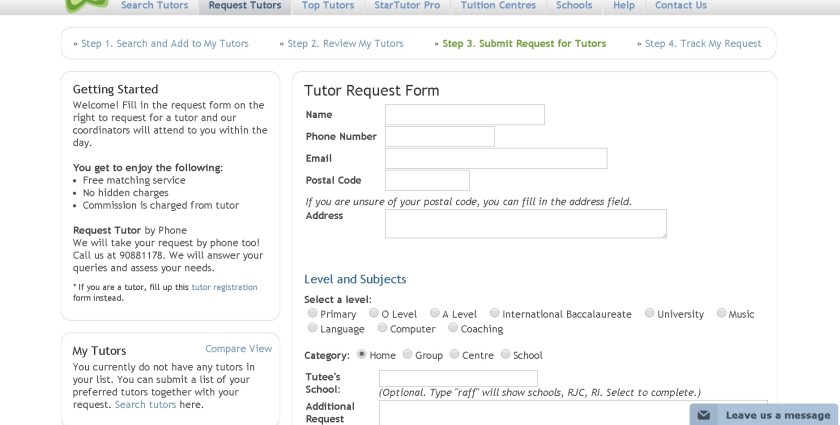
Screenshot:

startutor screenshot

Top 20 World’s Best Universities

tomcircle's avatarMath Online Tom Circle

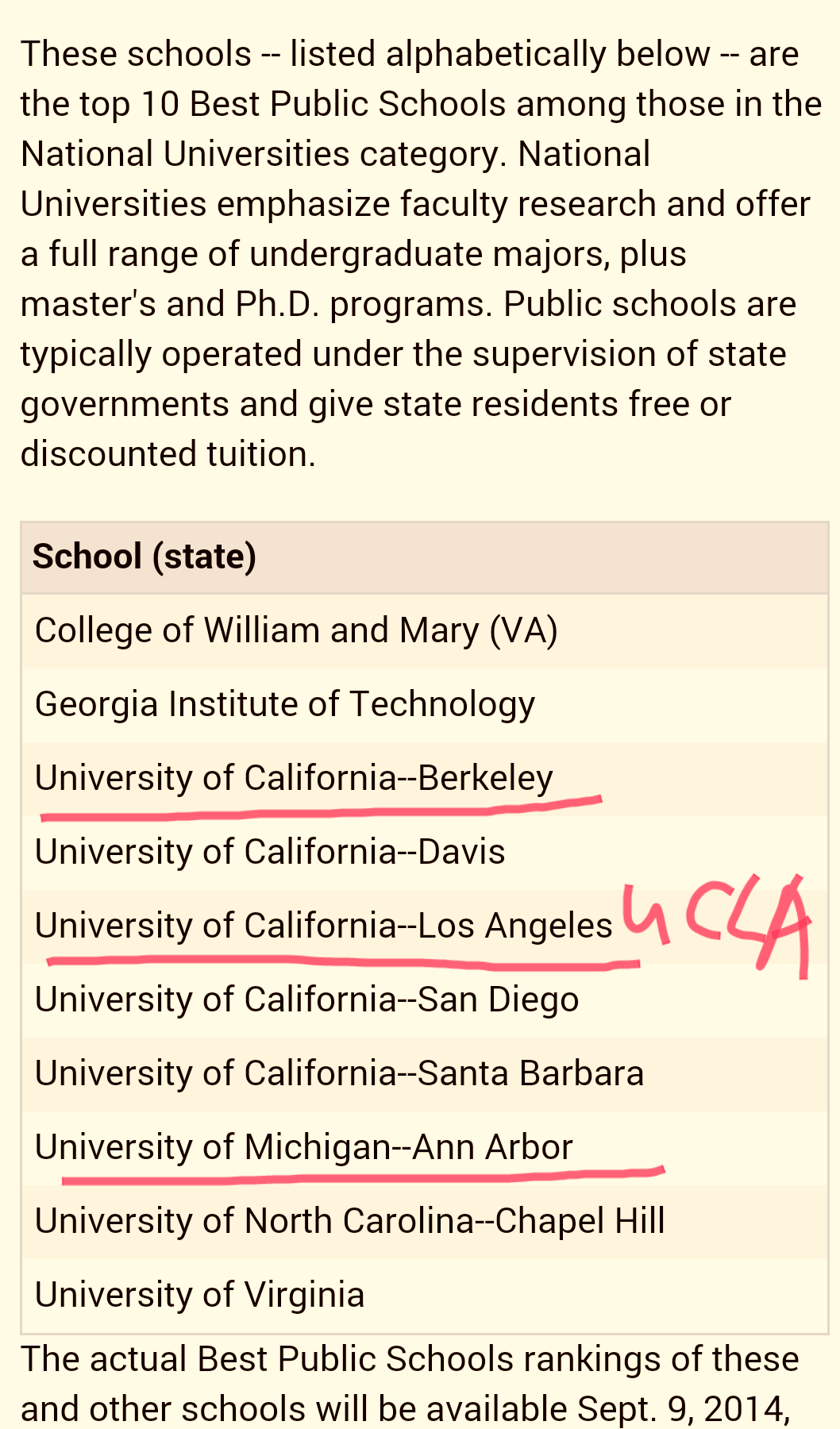
http://finance.yahoo.com/news/harvard-tops-us-news-world-150403455.html

These 20 are purely anglophone universities — USA (16), UK(3), Canada (1).

The report is too biased. I am sure there are some non-anglophone universities in Europe, Australia and Asia which are equally good, if not better, than some of those in this list.

image

image

View original post

Self-study Advanced Math

tomcircle's avatarMath Online Tom Circle

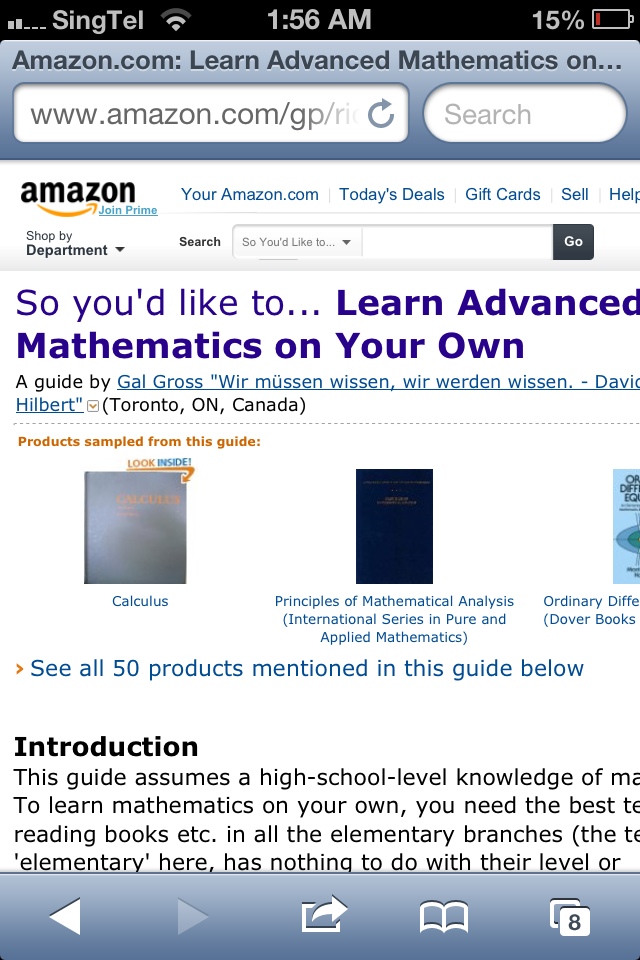
I came across this review at Amazon in 2007 on how to study Advanced Math on your own. Wonderful advice !

Give yourself 10-15 years, with passion, interest, dedicated commitment, disciplined, you could self-study Math to be a next Fermat, or Hua Luogen – both learned Math by themselves through self-learning from books.

http://www.amazon.com/gp/richpub/syltguides/fullview/R1GE1P236K3YSV/ref=cm_syt_dtpa_f_1_rdssss1/102-4263436-5550568?pf_rd_m=ATVPDKIKX0DER&pf_rd_s=sylt-center&pf_rd_r=00JK8KDA3S1T2JRNBCVC&pf_rd_t=201&pf_rd_p=253457301&pf_rd_i=0821839675

20130517-015726.jpg

View original post

Universum Survey (Please help to do!)

Please try out this short survey. Your opinions are greatly appreciated.
Thanks for your help!

mathtuition88's avatarMathtuition88

Thanks for being a loyal reader of Mathtuition88.com!

Do you want to know which employer is the most suitable for you?

Please help to do this survey at:

Alternate URL: https://surveys.universumglobal.com/markets/singapore/distributions/ambWWCY

It is a Career Test by Universum. Participate to reveal your career type and discover the optimal employers for you!

Thanks for your help once again!

View original post

French & German’s Secondary School Maths Comparison

tomcircle's avatarMath Online Tom Circle

A French math teacher’s insight in math classes in Germany (15 years old = Secondary 3) and France (16/17 years old in Sec 4 & Pre-U / JC 1):

The French Math is more theoretical while the German Math (like English Math) is applied. So the result is Germany produces excellent precision engineers with Applied Math, while France produces 1/3 of the World’s Fields Medalists in theoretical Pure Math.

Many English GCE A-level top Math students from Singapore studying in French Universitues face the same dilemma: while their French Math professors think they are “weak” in Math (i.e. French abstract Pure Math), yet they beat the French classmates in Applied Math.

View original post

Einstein for Kids (Book)

Just to introduce a book that is based on an essay I wrote 10 years ago when I was a teenager. I decided to repackage it as a book published on Lulu.com:

Einstein, Relativity and Light for Kids

Einstein, Relativity and Light for Kids

(Lulu Paperback link)

Einstein, Relativity and Light for Kids: A book about Einstein, Relativity, and Light for Children. Includes an award-winning 2000 word Essay on “What happens if Light slows down”. Written when the author was 17 years old.

An Ebook version is also available here:

Einstein, Relativity and Light for Kids

Excerpt:

What happens if light slows down – A Beginner’s Guide to Relativity and Light

In the beginning God created the heavens and the earth. And God said, “Let there be light,” and there was light. Light is one of the most ubiquitous things that we see, and it is also one of the oldest – it existed since the beginning of mankind. However, light is also mysterious in that no one really understands what it is and how it is rectilinearly propagated. Nevertheless, the speed of light plays an important part in physics, and it is one of the more often quoted constant. What will happen then, if the speed of light suddenly changes from 300000000m/s to a fraction of its original self –3000 m/s? (It is theoretically possible to slow down light to such a speed, by shining a beam of light through a medium with a refractive index of 100,000.)

Hope this book will be useful to anyone trying to learn more about Einstein through a novel way! What will happen when light slows down? Read the book to find out! 🙂

A Journey of Mathematics 数学之旅

tomcircle's avatarMath Online Tom Circle

Excellent free course for non mathematicians.

This Philosophical Math course has started half way but past videos are still hosted on the site.

The course is taught by prof Wang of Shanghai Jiaotong Technology University上海交通大学 (SJT), the Alma Mata of former China President Jiang (江泽民), Prime minister Chu (朱镕基), and Prof Qian XueSheng (钱学森) “The Father of Chinese Space and Missile” (China exchanged his country home return with USA FBI for 4 American generals from Korean War prisoners of War) who sent Chinese Taikongnauts (太空人) to space. 

SJT was formed initially as the ‘Classe Préparatoire’ (Bachelor degree, post-High school Prep-college) for graduate engineering to MIT,  while Qing Hua 清华 University was a prep-college for graduate Science/ Math to Harvard, Chicago, Cornell,  etc.

Go to Lesson 3: He explains from a game of Go what is “Space” in maths: Geometrical n-dimensional Space, Linear space, vector space.. why study functional space (in  which…

View original post 281 more words

A Mind For Numbers: How to Excel at Math and Science (Even If You Flunked Algebra)

Featured book:

A Mind For Numbers: How to Excel at Math and Science (Even If You Flunked Algebra)

Whether you are a student struggling to fulfill a math or science requirement, or you are embarking on a career change that requires a higher level of math competency, A Mind for Numbers offers the tools you need to get a better grasp of that intimidating but inescapable field. Engineering professor Barbara Oakley knows firsthand how it feels to struggle with math. She flunked her way through high school math and science courses, before enlisting in the army immediately after graduation. When she saw how her lack of mathematical and technical savvy severely limited her options—both to rise in the military and to explore other careers—she returned to school with a newfound determination to re-tool her brain to master the very subjects that had given her so much trouble throughout her entire life.

In A Mind for Numbers, Dr. Oakley lets us in on the secrets to effectively learning math and science—secrets that even dedicated and successful students wish they’d known earlier. Contrary to popular belief, math requires creative, as well as analytical, thinking. Most people think that there’s only one way to do a problem, when in actuality, there are often a number of different solutions—you just need the creativity to see them. For example, there are more than three hundred different known proofs of the Pythagorean Theorem. In short, studying a problem in a laser-focused way until you reach a solution is not an effective way to learn math. Rather, it involves taking the time to step away from a problem and allow the more relaxed and creative part of the brain to take over. A Mind for Numbers shows us that we all have what it takes to excel in math, and learning it is not as painful as some might think!

Mathematician’s Job: High Pay but Lowest Stress

One good reason to study Mathematics – high pay Mathematician job and lowest stress, comparing with other high-pay-high-stress professionals.

tomcircle's avatarMath Online Tom Circle

image

High pay high stress ?

Not really true … among the top 17 high-paying jobs (yearly earning above US $100,000) in the USA, Mathematician’s job has the lowest stress below 60 (in the scale from 0 no stress to highest stress at 100).

image
image

Source:
http://www.businessinsider.sg/high-paying-low-stress-jobs-2014-7/9/#.VAYQrYEZ7qA

View original post

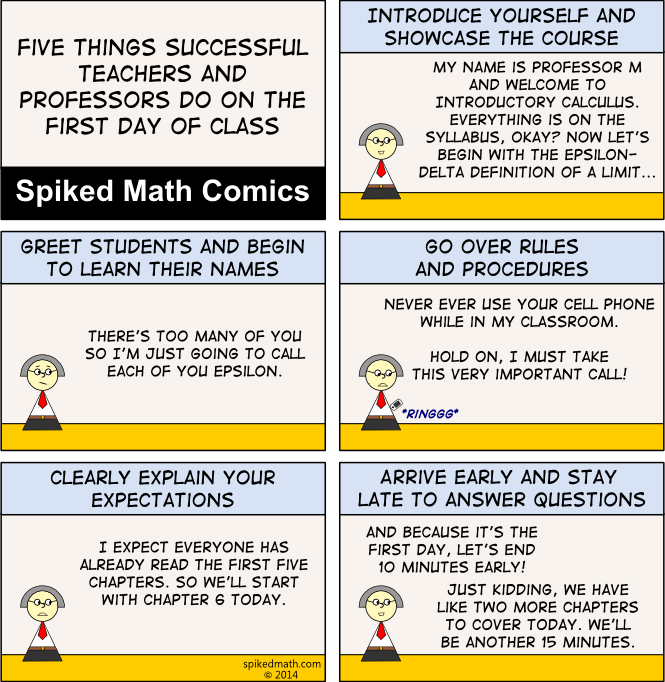
Five things successful teachers do on the first day of class

math joke


Featured book:

Comic-Strip Math: Problem Solving: 80 Reproducible Cartoons With Dozens and Dozens of Story Problems That Motivate Students and Build Essential Math Skills

Math + Comics = Learning That’s Fun! Help students build essential math skills and meet math standards with 80 laugh-out-loud comic strips and companion mini-story problems. Each reproducible comic and problem set reinforces a key math skill: multiplication, division, fractions, decimals, measurement, geometry, and more. Great to use for small-group or independent class work and for homework! For use with Grades 3-6.


ICM2014 Fields Medalist Manjul Bhargava

Correction (Thanks to Prof. Leong, see comments below):

“Manjul Bhargava’s PhD advisor is Andrew Wiles of Princeton University, not Benedict Gross. However, Bhargava is an undergraduate student of Gross in Harvard University.”

tomcircle's avatarMath Online Tom Circle

ICM2014 VideoSeries PL9: Manjul Bhargava:

(Part 1 of video – difficult part ): His PhD supervisor Benedict Gross (Harvard Math Dean) gave the laudation speech.

(Part 2 of video: Excellent and Understandable presentation) by the Fields medal 2014  receipient: the Canadian/American Indian Prof Manjul Bargarva.

View original post

Education News: School Starts Too Early?

Source: http://www.scientificamerican.com/article/school-starts-too-early/?&WT.mc_id=SA_WR_20140827

School Starts Too Early

The later high school classes start in the morning, the more academic performance improves
 

Parents, students and teachers often argue, with little evidence, about whether U.S. high schools begin too early in the morning. In the past three years, however, scientific studies have piled up, and they all lead to the same conclusion: a later start time improves learning. And the later the start, the better.Biological research shows that circadian rhythms shift during the teen years, pushing boys and girls to stay up later at night and sleep later into the morning. The phase shift, driven by a change in melatonin in the brain, begins around age 13, gets stronger by ages 15 and 16, and peaks at ages 17, 18 or 19.

Does that affect learning? It does, according to Kyla Wahlstrom, director of the Center for Applied Research and Educational Improvement at the University of Minnesota. She published a large study in February that tracked more than 9,000 students in eight public high schools in Minnesota, Colorado and Wyoming. After one semester, when school began at 8:35 a.m. or later, grades earned in math, English, science and social studies typically rose a quarter step—for example, up halfway from B to B+.

Read more at: http://www.scientificamerican.com/article/school-starts-too-early/?&WT.mc_id=SA_WR_20140827

You are welcome to leave your comments below!


Featured book:

How Children Succeed: Grit, Curiosity, and the Hidden Power of Character

New Pedagogy: Math Without Word

tomcircle's avatarMath Online Tom Circle

When teaching Quadratic equation in Algebra class using the conventional math pedagogy, this is what you get …

image

Teaching Math without word, especially for autistic and dyslexic kids, using pictures, video games… look how easy is to explain difficult concepts – even for adults – why (-2)x (-3) = + 6 ?

image

http://www.transum.org/software/SW/YouTube/Video.asp?Movie=7odhYT8yzUM

View original post

Euler on Math Education

Today all school maths subjects are taught separately as: Arithmetic, Geometry, Trigonometry and Algebra, influenced by Euler in 1727.
Since 18th century Maths has evolved rapidly with the biggest revolution of Modern (Abstract) Maths in 19th century from the French prodigy Galois in Group Theory.

The 20th and 21st centuries Maths continues to expand from Galois Abstract Maths to a chaotic state where no single mathematician can claim to know all aspects of Maths like Newton, Euler, Gauss…did.
It is time to re-look at Euler’s outdated Maths pedagogy of 4 distinct disciplines… Can these 4 subjects be taught as ONE combined ‘Math’ (americans spell as singular) subject ?

tomcircle's avatarMath Online Tom Circle

Euler was invited by Peter I of Russia in 1727 to work in the
Petersburg Academy of Sciences. He introduced the fundamental math
disciplines in school math education:
1. Arithmetic
2. Geometry
3. Trigonometry
4. Algebra
these 4 are taught as separate and specific subjects, versus 19 duplicated disciplines in Europe.

Euler influenced not only in Russia schools, but in schools worldwide today.

Source: Russian Mathematics Education
Vol 1: History and world significance
Vol 2: Programs and practices
(Publisher: World Scientific)

View original post

Rational Trigonometry

tomcircle's avatarMath Online Tom Circle

UHG39: Rational trigonometry: an overview:

(Rational number only)

This is a revolutionary approach (2005) to teach Secondary / High school Trigonometry by using purely algebra, no geometry and no picture, no sine, cosine, tangent, etc.

New concepts:
Vector as an order pair (x, y)
Quadrance = magnitude of vector
Perpendicular of 2 vectors
Parallel
Spread (angle between 2 vectors)

Amazon Book by the Dr. NJ Wildburger:

image

View original post

The Best Universities in 35 Countries

tomcircle's avatarMath Online Tom Circle

http://www.businessinsider.sg/the-best-universities-in-every-country-2014-7/#.U9pB58kZ7qA

image

Australia: University of Sydney
Canada: University of Toronto
China: 北京大学
Japan: Tokyo University
Hong Kong: 香港大学
France:  Ecole Normale Supérieure,  Paris
India: Indian Institute of Technology, Delhi
Taiwan: 国立台湾大学
UK: Cambridge University
USA: Harvard University

View original post

Sum and Difference of Two Cubes

Students taking A Maths (Additional Maths) in 2014 should watch this: It may come out in the exam!

This is the newest addition to the new syllabus.


Featured book:

Practical Algebra: A Self-Teaching Guide, Second Edition


The Mandelbrot Set

Check out this video on the very interesting Mandelbrot Set:

Famously beautiful, the Mandelbrot Set is all about complex numbers. Featuring Dr Holly Krieger from MIT.


Featured book:

The Fractal Geometry of Nature

Clouds are not spheres, mountains are not cones, and lightening does not travel in a straight line. The complexity of nature’s shapes differs in kind, not merely degree, from that of the shapes of ordinary geometry, the geometry of fractal shapes.

Now that the field has expanded greatly with many active researchers, Mandelbrot presents the definitive overview of the origins of his ideas and their new applications. The Fractal Geometry of Nature is based on his highly acclaimed earlier work, but has much broader and deeper coverage and more extensive illustrations.


Mini-monomath

Excellent and educational post by famous Mathematician Timothy Gowers on how to solve Math (Olympiad) problems.

(Post is at the bottom of this article)

Many students often give up immediately when facing a difficult maths problem. However, if students persist on for some time, usually they can come up with a solution or at least an idea on how to solve the problem. That is a great achievement already!

Never give up, even when your Maths question looks like this!

Quote: What I wrote gives some kind of illustration of the twists and turns, many of them fruitless, that people typically take when solving a problem. If I were to draw a moral from it, it would be this: when trying to solve a problem, it is a mistake to expect to take a direct route to the solution. Instead, one formulates subquestions and gradually builds up a useful bank of observations until the direct route becomes clear. Given that we’ve just had the football world cup, I’ll draw an analogy that I find not too bad (though not perfect either): a team plays better if it patiently builds up to an attack on goal than if it hoofs the ball up the pitch or takes shots from a distance. Germany gave an extraordinary illustration of this in their 7-1 defeat of Brazil.


Featured book (by Timothy Gowers):


The Princeton Companion to Mathematics

This is a one-of-a-kind reference for anyone with a serious interest in mathematics. Edited by Timothy Gowers, a recipient of the Fields Medal, it presents nearly two hundred entries, written especially for this book by some of the world’s leading mathematicians, that introduce basic mathematical tools and vocabulary; trace the development of modern mathematics; explain essential terms and concepts; examine core ideas in major areas of mathematics; describe the achievements of scores of famous mathematicians; explore the impact of mathematics on other disciplines such as biology, finance, and music–and much, much more.

Unparalleled in its depth of coverage, The Princeton Companion to Mathematics surveys the most active and exciting branches of pure mathematics, providing the context and broad perspective that are vital at a time of increasing specialization in the field. Packed with information and presented in an accessible style, this is an indispensable resource for undergraduate and graduate students in mathematics as well as for researchers and scholars seeking to understand areas outside their specialties.

  • Features nearly 200 entries, organized thematically and written by an international team of distinguished contributors
  • Presents major ideas and branches of pure mathematics in a clear, accessible style
  • Defines and explains important mathematical concepts, methods, theorems, and open problems
  • Introduces the language of mathematics and the goals of mathematical research
  • Covers number theory, algebra, analysis, geometry, logic, probability, and more
  • Traces the history and development of modern mathematics
  • Profiles more than ninety-five mathematicians who influenced those working today
  • Explores the influence of mathematics on other disciplines
  • Includes bibliographies, cross-references, and a comprehensive index

Contributors incude:

Graham Allan, Noga Alon, George Andrews, Tom Archibald, Sir Michael Atiyah, David Aubin, Joan Bagaria, Keith Ball, June Barrow-Green, Alan Beardon, David D. Ben-Zvi, Vitaly Bergelson, Nicholas Bingham, Béla Bollobás, Henk Bos, Bodil Branner, Martin R. Bridson, John P. Burgess, Kevin Buzzard, Peter J. Cameron, Jean-Luc Chabert, Eugenia Cheng, Clifford C. Cocks, Alain Connes, Leo Corry, Wolfgang Coy, Tony Crilly, Serafina Cuomo, Mihalis Dafermos, Partha Dasgupta, Ingrid Daubechies, Joseph W. Dauben, John W. Dawson Jr., Francois de Gandt, Persi Diaconis, Jordan S. Ellenberg, Lawrence C. Evans, Florence Fasanelli, Anita Burdman Feferman, Solomon Feferman, Charles Fefferman, Della Fenster, José Ferreirós, David Fisher, Terry Gannon, A. Gardiner, Charles C. Gillispie, Oded Goldreich, Catherine Goldstein, Fernando Q. Gouvêa, Timothy Gowers, Andrew Granville, Ivor Grattan-Guinness, Jeremy Gray, Ben Green, Ian Grojnowski, Niccolò Guicciardini, Michael Harris, Ulf Hashagen, Nigel Higson, Andrew Hodges, F. E. A. Johnson, Mark Joshi, Kiran S. Kedlaya, Frank Kelly, Sergiu Klainerman, Jon Kleinberg, Israel Kleiner, Jacek Klinowski, Eberhard Knobloch, János Kollár, T. W. Körner, Michael Krivelevich, Peter D. Lax, Imre Leader, Jean-François Le Gall, W. B. R. Lickorish, Martin W. Liebeck, Jesper Lützen, Des MacHale, Alan L. Mackay, Shahn Majid, Lech Maligranda, David Marker, Jean Mawhin, Barry Mazur, Dusa McDuff, Colin McLarty, Bojan Mohar, Peter M. Neumann, Catherine Nolan, James Norris, Brian Osserman, Richard S. Palais, Marco Panza, Karen Hunger Parshall, Gabriel P. Paternain, Jeanne Peiffer, Carl Pomerance, Helmut Pulte, Bruce Reed, Michael C. Reed, Adrian Rice, Eleanor Robson, Igor Rodnianski, John Roe, Mark Ronan, Edward Sandifer, Tilman Sauer, Norbert Schappacher, Andrzej Schinzel, Erhard Scholz, Reinhard Siegmund-Schultze, Gordon Slade, David J. Spiegelhalter, Jacqueline Stedall, Arild Stubhaug, Madhu Sudan, Terence Tao, Jamie Tappenden, C. H. Taubes, Rüdiger Thiele, Burt Totaro, Lloyd N. Trefethen, Dirk van Dalen, Richard Weber, Dominic Welsh, Avi Wigderson, Herbert Wilf, David Wilkins, B. Yandell, Eric Zaslow, Doron Zeilberger

gowers's avatarGowers's Weblog

The title of this post is a nod to Terry Tao’s four mini-polymath discussions, in which IMO questions were solved collaboratively online. As the beginning of what I hope will be a long exercise in gathering data about how humans solve these kinds of problems, I decided to have a go at one of this year’s IMO problems, with the idea of writing down my thoughts as I went along. Because I was doing that (and doing it directly into a LaTeX file rather than using paper and pen), I took quite a long time to solve the problem: it was the first question, and therefore intended to be one of the easier ones, so in a competition one would hope to solve it quickly and move on to the more challenging questions 2 and 3 (particularly 3). You get an average of an hour and a half per…

View original post 1,613 more words

紫禁城里的外国数学家 Foreign Mathematicians in Ancient China

tomcircle's avatarMath Online Tom Circle

《国宝档案》 20140407 紫禁城里的外国人—— 利玛窦 Matteo Ricci, Italian Jesuit: 中国”几何”之父。

《国宝档案》 20140408 紫禁城里的外国人——汤若望, German Jesuit

《国宝档案》 20140409 紫禁城里的外国人——南怀仁, Belgian Jesuit

《国宝档案》 20140411 紫禁城里的外国人——蒋友仁, French Jesuit

Discoverer of 易经 Yijing = Binary Mathematics 白晋 French Jesuit “The Louis 14 King’s Mathematician”

View original post

Math and Music

tomcircle's avatarMath Online Tom Circle

image

If you want your kids to grow up with Math talent, start young in Music, be it playing simple drum or flute, later at age 4 or 5 progressing to piano or violin, along the way pick up musical theory…

Notice that great mathematicians (or Physicists the close cousins of Math) are often music talents, but the converse not true! Einstein performed violin with an orchestra formed by a group of Nobel Prize Physicists; never heard Mozart or any great musicians proofed any Math Conjectures.

image

http://www.thecrimson.com/article/1988/11/30/music-math-a-common-equation/?page=3

View original post

Standard Form Resources

A nice post about Standard Form!

Colleen Young's avatarMathematics, Learning and Technology

Coming across You’re Getting Old, it struck me that the numbers generated by the site would be perfect for standard form exercises; put in a student’s date of birth and even the young ones will have some big numbers reported! For example, for a 12 year old, the following figures are generated, some updated while you watch.

You're getting old You’re getting old!

Some other resources for standard form:

I have been interested in Astronomy since discovering Patrick Moore’s books in the library as a child so enjoyed Richard Byrne’s post on resources to help students understand the size of the universeI particularly like 100,000 Stars, a visualization of the 100,000 stars closest to Earth. All those lovely big numbers in Astronomy are excellent for teaching Standard Form; I wrote some time ago on the excellent mathematics resources available from NASA, see this on Scientific notation for example.

From…

View original post 169 more words

Landau’s Beautiful Proofs

tomcircle's avatarMath Online Tom Circle

Landau’s beautiful proofs:
1= cos 0 = cos (x-x)

Opening cos (x-x):
1 = cos x.cos (-x) – sin x.sin (-x)
=> 1= cos² x + sin² x
[QED]

Let cos x= b/c, sin x = a/c
1= (b/c)² + (a/c)²
c² = b² + a²
=> Pythagoras Theorem
[QED]

Landau (1877-1938) was the successor of Minkowski at the Gottingen University (Math) before WW II.

View original post

4-level MathThinking

tomcircle's avatarMath Online Tom Circle

4 Levels:

L1. S&T (See & Touch) Concrete: 1 apple, 2 oranges…
e.g. Math Modeling: visualise the problem [Primary School]

L2. S~T (See, no Touch but can guess):
e.g. Guess x,y for 2x+3y=8 ? [Secondary School]
e.g. Chimpanzees can guess where you hide the banana.

L3. ~S~T&I (no See, no Touch but Imagine):
e.g. Complex i = [Junior College].

L4. ~S~T~I (no See, no Touch, no imagine)
e.g. Abstract Math: Galois Group, ε-δ Analysis, Ring, Field, etc. [University]

View original post

Language & Math

tomcircle's avatarMath Online Tom Circle

1. Galois’s mother home-schooling him Latin & other languages before entering Lycée Louis-Le-Grand.

2. William Hamilton: knew 15 languages include Chinese before discovered Quarternions (1,i,j,k) on Monday 16 Oct 1843 walking along Brougham Bridge, Ireland.

3. Pascal, Descartes are philosopher good in writing.

4. Gauss learnt even at old age Russian to read Lobatschefsky’s Non-Euclidean Geometry

5. Cauchy’s father heeded the advice of his neighbour Laplace to teach young Cauchy language before mathematics.

View original post

China ‘Gauss’: 秦九韶 Qin Jiushao

tomcircle's avatarMath Online Tom Circle

秦九韶 Qin Jiushao(1202-1261 AD): http://en.wikipedia.org/wiki/Qin_Jiushao

A Southern Song dynasty (南宋) officer. During his 3-yr leaves when his mother died, he generalised 孙子算经 (4th century)’s “Chinese Remainder Theorem” in ‘大衍求一术’. After leaves, he went back to chase money & women, produced no more Maths.

Note: ‘求一’: solve a.X ≡ 1 (mod b); a < b

View original post