This Philosophical Math course has started half way but past videos are still hosted on the site.
The course is taught by prof Wang of Shanghai Jiaotong Technology University上海交通大学 (SJT), the Alma Mata of former China President Jiang (江泽民), Prime minister Chu (朱镕基), and Prof Qian XueSheng (钱学森) “The Father of Chinese Space and Missile” (China exchanged his country home return with USA FBI for 4 American generals from Korean War prisoners of War) who sent Chinese Taikongnauts (太空人) to space.
SJT was formed initially as the ‘Classe Préparatoire’ (Bachelor degree, post-High school Prep-college) for graduate engineering to MIT, while Qing Hua 清华 University was a prep-college for graduate Science/ Math to Harvard, Chicago, Cornell, etc.
Go to Lesson 3: He explains from a game of Go what is “Space” in maths: Geometrical n-dimensional Space, Linear space, vector space.. why study functional space (in which…
A small psychological change to how we approach challenges can drastically change how successful we are at these tasks.
That’s according to Carol Dweck, a psychology professor at Stanford University, who coined the term “growth mindset” in her 2007 book “Mindset: The New Psychology of Success.”
Microsoft magnate Bill Gates tweeted a video of Dweck explaining the growth mindset earlier this week:
World-renowned Stanford University psychologist Carol Dweck, in decades of research on achievement and success, has discovered a truly groundbreaking idea–the power of our mindset.
Dweck explains why it’s not just our abilities and talent that bring us success–but whether we approach them with a fixed or growth mindset. She makes clear why praising intelligence and ability doesn’t foster self-esteem and lead to accomplishment, but may actually jeopardize success. With the right mindset, we can motivate our kids and help them to raise their grades, as well as reach our own goals–personal and professional. Dweck reveals what all great parents, teachers, CEOs, and athletes already know: how a simple idea about the brain can create a love of learning and a resilience that is the basis of great accomplishment in every area.
Whether you are a student struggling to fulfill a math or science requirement, or you are embarking on a career change that requires a higher level of math competency, A Mind for Numbers offers the tools you need to get a better grasp of that intimidating but inescapable field. Engineering professor Barbara Oakley knows firsthand how it feels to struggle with math. She flunked her way through high school math and science courses, before enlisting in the army immediately after graduation. When she saw how her lack of mathematical and technical savvy severely limited her options—both to rise in the military and to explore other careers—she returned to school with a newfound determination to re-tool her brain to master the very subjects that had given her so much trouble throughout her entire life.
In A Mind for Numbers, Dr. Oakley lets us in on the secrets to effectively learning math and science—secrets that even dedicated and successful students wish they’d known earlier. Contrary to popular belief, math requires creative, as well as analytical, thinking. Most people think that there’s only one way to do a problem, when in actuality, there are often a number of different solutions—you just need the creativity to see them. For example, there are more than three hundred different known proofs of the Pythagorean Theorem. In short, studying a problem in a laser-focused way until you reach a solution is not an effective way to learn math. Rather, it involves taking the time to step away from a problem and allow the more relaxed and creative part of the brain to take over. A Mind for Numbers shows us that we all have what it takes to excel in math, and learning it is not as painful as some might think!
Whether you are a student struggling to fulfill a math or science requirement, or you are embarking on a career change that requires a higher level of math competency, A Mind for Numbers offers the tools you need to get a better grasp of that intimidating but inescapable field. Engineering professor Barbara Oakley knows firsthand how it feels to struggle with math. She flunked her way through high school math and science courses, before enlisting in the army immediately after graduation. When she saw how her lack of mathematical and technical savvy severely limited her options—both to rise in the military and to explore other careers—she returned to school with a newfound determination to re-tool her brain to master the very subjects that had given her so much trouble throughout her entire life.
In A Mind for Numbers, Dr. Oakley lets us in on the secrets to effectively learning math and science—secrets that even dedicated and successful students wish they’d known earlier. Contrary to popular belief, math requires creative, as well as analytical, thinking. Most people think that there’s only one way to do a problem, when in actuality, there are often a number of different solutions—you just need the creativity to see them. For example, there are more than three hundred different known proofs of the Pythagorean Theorem. In short, studying a problem in a laser-focused way until you reach a solution is not an effective way to learn math. Rather, it involves taking the time to step away from a problem and allow the more relaxed and creative part of the brain to take over. A Mind for Numbers shows us that we all have what it takes to excel in math, and learning it is not as painful as some might think!
There is an interesting upcoming course at Coursera, suitable for undergraduates! (Starting 12 September 2014) Join the class if interested, it is free! Functional Analysis is actually a third year course for Math Majors at university. There are some powerful and deep theorems in functional analysis, like the Riesz representation theorem.
About the Course
Functional analysis is the branch of mathematics dealing with spaces of functions. It is a valuable tool in theoretical mathematics as well as engineering. It is at the very core of numerical simulation.
In this class, I will explain the concepts of convergence and talk about topology. You will understand the difference between strong convergence and weak convergence. You will also see how these two concepts can be used.
You will learn about different types of spaces including metric spaces, Banach Spaces, Hilbert Spaces and what property can be expected. You will see beautiful lemmas and theorems such as Riesz and Lax-Milgram and I will also describe Lp spaces, Sobolev spaces and provide a few details about PDEs, or Partial Differential Equations.
Course Syllabus
Week 1: Topology; continuity and convergence of a sequence in a topological space.
Week 2: Metric and normed spaces; completeness
Week 3: Banach spaces; linear continuous functions; weak topology
Week 4: Hilbert spaces; The Riesz representation theorem
Week 5: The Lax-Milgram Lemma
Week 6: Properties of the Lp spaces
Week 7: Distributions and Sobolev Spaces
Week 8: Application: simulating a membrane
Recommended Background
The course is mostly self-contained; however, you need to be familiar with functions, derivatives and integrals. You need to know what A ∩ B means and to know what a proof is. You should be fine if you have taken Calculus II and Algebra II. Students in Europe who have taken 120 ECTS in science should be fine as well.
Because this is an online class, having advanced and non-advanced students in a class will not be a problem; on the contrary we expect a wide range of interesting interactions. However, non-advanced students may have to work a bit more.
Course Format
The class will consist of a series of lecture videos, usually between five and twelve minutes in length. There will be approximately one hour worth of video content per week. Some of the videos contain integrated quiz questions. There will also be standalone quizzes that are not part of the video lectures; you will be asked to solve some problems and evaluate the solutions proposed by your fellow classmates. There will be a final exam.
There will be some additional contents in the form of PDF files.
FAQ
Will I get a Statement of Accomplishment after completing this class?
Yes. Students who successfully complete the class will receive a Statement of Accomplishment signed by the instructor.
What resources will I need for this class?
For this course, all you need is an Internet connection and the time to view the videos, understand the material, discuss the material with fellow classmates, take the quizzes and solve the problems.
What pedagogy will be used?
This MOOC is in English but the math will be taught with a “French Touch”.
What does “teaching math with a French touch” mean?
France has a long-standing tradition where math is addressed from a theoretical standpoint and studied for its implicit value throughout high school and preparatory school for the high-level entrance exams. This leads to a mindset based on proofs and abstraction. This mindset has consequences on problem solving that is sometimes referred to as the “French Engineer”. In contrast, other countries have a tradition where math is addressed as a computation tool.
Does it mean it will abstract and complicated?
The approach will be rather abstract but I will be sure to emphasize the concepts over the technicalities. Above all, my aim is to help you understand the material and the beauty behind it.
Whether you are a student struggling to fulfill a math or science requirement, or you are embarking on a career change that requires a higher level of math competency, A Mind for Numbers offers the tools you need to get a better grasp of that intimidating but inescapable field. Engineering professor Barbara Oakley knows firsthand how it feels to struggle with math. She flunked her way through high school math and science courses, before enlisting in the army immediately after graduation. When she saw how her lack of mathematical and technical savvy severely limited her options—both to rise in the military and to explore other careers—she returned to school with a newfound determination to re-tool her brain to master the very subjects that had given her so much trouble throughout her entire life.
In A Mind for Numbers, Dr. Oakley lets us in on the secrets to effectively learning math and science—secrets that even dedicated and successful students wish they’d known earlier. Contrary to popular belief, math requires creative, as well as analytical, thinking. Most people think that there’s only one way to do a problem, when in actuality, there are often a number of different solutions—you just need the creativity to see them. For example, there are more than three hundred different known proofs of the Pythagorean Theorem. In short, studying a problem in a laser-focused way until you reach a solution is not an effective way to learn math. Rather, it involves taking the time to step away from a problem and allow the more relaxed and creative part of the brain to take over. A Mind for Numbers shows us that we all have what it takes to excel in math, and learning it is not as painful as some might think!
Whether you are a student struggling to fulfill a math or science requirement, or you are embarking on a career change that requires a higher level of math competency, A Mind for Numbers offers the tools you need to get a better grasp of that intimidating but inescapable field. Engineering professor Barbara Oakley knows firsthand how it feels to struggle with math. She flunked her way through high school math and science courses, before enlisting in the army immediately after graduation. When she saw how her lack of mathematical and technical savvy severely limited her options—both to rise in the military and to explore other careers—she returned to school with a newfound determination to re-tool her brain to master the very subjects that had given her so much trouble throughout her entire life.
In A Mind for Numbers, Dr. Oakley lets us in on the secrets to effectively learning math and science—secrets that even dedicated and successful students wish they’d known earlier. Contrary to popular belief, math requires creative, as well as analytical, thinking. Most people think that there’s only one way to do a problem, when in actuality, there are often a number of different solutions—you just need the creativity to see them. For example, there are more than three hundred different known proofs of the Pythagorean Theorem. In short, studying a problem in a laser-focused way until you reach a solution is not an effective way to learn math. Rather, it involves taking the time to step away from a problem and allow the more relaxed and creative part of the brain to take over. A Mind for Numbers shows us that we all have what it takes to excel in math, and learning it is not as painful as some might think!
Not really true … among the top 17 high-paying jobs (yearly earning above US $100,000) in the USA, Mathematician’s job has the lowest stress below 60 (in the scale from 0 no stress to highest stress at 100).
Math + Comics = Learning That’s Fun! Help students build essential math skills and meet math standards with 80 laugh-out-loud comic strips and companion mini-story problems. Each reproducible comic and problem set reinforces a key math skill: multiplication, division, fractions, decimals, measurement, geometry, and more. Great to use for small-group or independent class work and for homework! For use with Grades 3-6.
Who says math can’t be funny? In Math Jokes 4 Mathy Folks, Patrick Vennebush dispels the myth of the humorless mathematician. His quick wit comes through in this incredible compilation of jokes and stories. Intended for all math types, Math Jokes 4 Mathy Folks provides a comprehensive collection of math humor, containing over 400 jokes. It’s a book that all teachers from elementary school through college should have in their library. But the humor isn’t just for the classroom-it also appeals to engineers, statisticians, and other math professionals searching for some good, clean, numerical fun. From basic facts (Why is 6 afraid of 7?) to trigonometry (Mathematical puns are the first sine of dementia) and algebra (Graphing rational functions is a pain in the asymptote), no topic is safe. As Professor Jim Rubillo notes, Math Jokes 4 Math Folks is an absolute gem for anyone dedicated to seeing mathematical ideas through puns, double meanings, and blatant bad jokes. Such perspectives help to see concepts and ideas in different and creative ways.
Correction (Thanks to Prof. Leong, see comments below):
“Manjul Bhargava’s PhD advisor is Andrew Wiles of Princeton University, not Benedict Gross. However, Bhargava is an undergraduate student of Gross in Harvard University.”
Parents, students and teachers often argue, with little evidence, about whether U.S. high schools begin too early in the morning. In the past three years, however, scientific studies have piled up, and they all lead to the same conclusion: a later start time improves learning. And the later the start, the better.Biological research shows that circadian rhythms shift during the teen years, pushing boys and girls to stay up later at night and sleep later into the morning. The phase shift, driven by a change in melatonin in the brain, begins around age 13, gets stronger by ages 15 and 16, and peaks at ages 17, 18 or 19.
Does that affect learning? It does, according to Kyla Wahlstrom, director of the Center for Applied Research and Educational Improvement at the University of Minnesota. She published a large study in February that tracked more than 9,000 students in eight public high schools in Minnesota, Colorado and Wyoming. After one semester, when school began at 8:35 a.m. or later, grades earned in math, English, science and social studies typically rose a quarter step—for example, up halfway from B to B+.
Read more at: http://www.scientificamerican.com/article/school-starts-too-early/?&WT.mc_id=SA_WR_20140827
Featured book: Linear Algebra and Its Applications, 4th Edition
Linear algebra is relatively easy for students during the early stages of the course, when the material is presented in a familiar, concrete setting. But when abstract concepts are introduced, students often hit a brick wall. Instructors seem to agree that certain concepts (such as linear independence, spanning, subspace, vector space, and linear transformations), are not easily understood, and require time to assimilate. Since they are fundamental to the study of linear algebra, students’ understanding of these concepts is vital to their mastery of the subject. David Lay introduces these concepts early in a familiar, concrete Rnsetting, develops them gradually, and returns to them again and again throughout the text so that when discussed in the abstract, these concepts are more accessible.
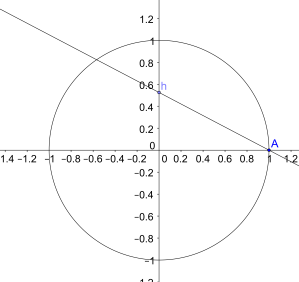
Today, we discuss an interesting topic rarely taught in school: The rational parametrization of a unit circle. That is, how to find the x coordinates and y coordinates of a circle expressed as a rational function? The usual parametrization of a circle is (cos t, sin t).
We consider the straight line (l), passing through the point A(1,0) and the point (0,h).
The gradient of this line is .
The y-intercept of this line is .
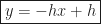
Hence the equation of line l is .
We know the equation of the unit circle is .
By solving the two simultaneous equations (boxed), we get a quadratic formula:
Solving the above using the quadratic formula gives us .
Using , we get .
Hence, is a parametrization of the unit circle.
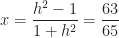
We can use this to generate Pythagorean triples! Simply choose a value of h, say, .
Then .
.
Substituting into , and multiplying by the denominator, we get the Pythagorean Triple . Interesting?
This revolutionary book establishes new foundations for trigonometry and Euclidean geometry. It shows how to replace transcendental trig functions with high school arithmetic and algebra to dramatically simplify the subject, increase accuracy in practical problems, and allow metrical geometry to be systematically developed over a general field. This new theory brings together geometry, algebra and number theory and sets out new directions for algebraic geometry, combinatorics, special functions and computer graphics. The treatment is careful and precise, with over one hundred theorems and 170 diagrams, and is meant for a mathematically mature audience. Gifted high school students will find most of the material accessible, although a few chapters require calculus. Applications include surveying and engineering problems, Platonic solids, spherical and cylindrical coordinate systems, and selected physics problems, such as projectile motion and Snell’s law. Examples over finite fields are also included.
When teaching Quadratic equation in Algebra class using the conventional math pedagogy, this is what you get …
Teaching Math without word, especially for autistic and dyslexic kids, using pictures, video games… look how easy is to explain difficult concepts – even for adults – why (-2)x (-3) = + 6 ?
Today all school maths subjects are taught separately as: Arithmetic, Geometry, Trigonometry and Algebra, influenced by Euler in 1727.
Since 18th century Maths has evolved rapidly with the biggest revolution of Modern (Abstract) Maths in 19th century from the French prodigy Galois in Group Theory.
The 20th and 21st centuries Maths continues to expand from Galois Abstract Maths to a chaotic state where no single mathematician can claim to know all aspects of Maths like Newton, Euler, Gauss…did.
It is time to re-look at Euler’s outdated Maths pedagogy of 4 distinct disciplines… Can these 4 subjects be taught as ONE combined ‘Math’ (americans spell as singular) subject ?
Euler was invited by Peter I of Russia in 1727 to work in the
Petersburg Academy of Sciences. He introduced the fundamental math
disciplines in school math education:
1. Arithmetic
2. Geometry
3. Trigonometry
4. Algebra
these 4 are taught as separate and specific subjects, versus 19 duplicated disciplines in Europe.
Euler influenced not only in Russia schools, but in schools worldwide today.
Source: Russian Mathematics Education
Vol 1: History and world significance
Vol 2: Programs and practices
(Publisher: World Scientific)
This is a revolutionary approach (2005) to teach Secondary / High school Trigonometry by using purely algebra, no geometry and no picture, no sine, cosine, tangent, etc.
New concepts:
Vector as an order pair (x, y)
Quadrance = magnitude of vector
Perpendicular of 2 vectors
Parallel
Spread (angle between 2 vectors)
Fix your wobbly table with just a small tweak – but why does this work?
Reddit discussion: http://www.reddit.com/r/BradyHaran/co…
Featuring Matthias Kreck from the University of Bonn.
This is a one-of-a-kind reference for anyone with a serious interest in mathematics. Edited by Timothy Gowers, a recipient of the Fields Medal, it presents nearly two hundred entries, written especially for this book by some of the world’s leading mathematicians, that introduce basic mathematical tools and vocabulary; trace the development of modern mathematics; explain essential terms and concepts; examine core ideas in major areas of mathematics; describe the achievements of scores of famous mathematicians; explore the impact of mathematics on other disciplines such as biology, finance, and music–and much, much more.
Unparalleled in its depth of coverage, The Princeton Companion to Mathematics surveys the most active and exciting branches of pure mathematics, providing the context and broad perspective that are vital at a time of increasing specialization in the field. Packed with information and presented in an accessible style, this is an indispensable resource for undergraduate and graduate students in mathematics as well as for researchers and scholars seeking to understand areas outside their specialties.
This small book demonstrates the evolution of certain areas of modern mathematics by examining the work of past winners of the Fields Medal, the “Nobel Prize” of mathematics. Foreword by Freeman Dyson.
I’d forgotten just how full the first day of an ICM is. First, you need to turn up early for the opening ceremony, so you end up sitting around for an hour and half or so before it even starts. Then there’s the ceremony itself, which lasts a couple of hours. Then in the afternoon you have talks about the four Fields Medallists and the Nevanlinna Prize winner, with virtually no breaks. Then after a massive ten minutes, the Nevanlinna Prize winner talks about his (in this case) own work, about which you have just heard, but in a bit more detail. That took us to 5:45pm. And just to round things off, Jim Simons is giving a public lecture at 8pm, which I suppose I could skip but I think I’m not going to. (The result is that most of this post will be written after it, but right…
Currently we are available to tutor private candidates on weekday mornings.
Contact our friendly tutor Mr Wu: email at mathtuition88@gmail.com
Ad hoc O Level Maths Tuition
Nowadays students are often so busy that regular weekly tuition may not be an option. (Due to stay back in school, extra lessons etc.)
We offer Ad hoc O Level Maths Tuition at our tuition centre at Bishan. Students can come for tuition when they need to ask questions or clarify concepts.
Fees will be charged per lesson; this will fit the students’ busy schedule perfectly.
This is a continuation of the series of Algebraic Topology videos. Previous post was AlgTop 0.
Professor Wildberger is an interesting speaker. He holds some unorthodox views, for instance he doesn’t believe in “real numbers” or “infinite sets”. Nevertheless, his videos are excellent and educational. Highly recommended to watch!
The basic topological objects, the line and the circle are viewed in a new light. This is the full first lecture of this beginner’s course in Algebraic Topology, given by N J Wildberger at UNSW. Here we begin to introduce basic one dimensional objects, namely the line and the circle. However each can appear in rather a remarkable variety of different ways.
This revolutionary book establishes new foundations for trigonometry and Euclidean geometry. It shows how to replace transcendental trig functions with high school arithmetic and algebra to dramatically simplify the subject, increase accuracy in practical problems, and allow metrical geometry to be systematically developed over a general field. This new theory brings together geometry, algebra and number theory and sets out new directions for algebraic geometry, combinatorics, special functions and computer graphics. The treatment is careful and precise, with over one hundred theorems and 170 diagrams, and is meant for a mathematically mature audience. Gifted high school students will find most of the material accessible, although a few chapters require calculus. Applications include surveying and engineering problems, Platonic solids, spherical and cylindrical coordinate systems, and selected physics problems, such as projectile motion and Snell’s law. Examples over finite fields are also included.
This is the Introductory lecture to a beginner’s course in Algebraic Topology given by N J Wildberger of the School of Mathematics and Statistics at UNSW in 2010.
This first lecture introduces some of the topics of the course and three problems.
If you are curious about how to make the interesting flap of paper (Problem 1), the solution can be found here. 🙂
This revolutionary book establishes new foundations for trigonometry and Euclidean geometry. It shows how to replace transcendental trig functions with high school arithmetic and algebra to dramatically simplify the subject, increase accuracy in practical problems, and allow metrical geometry to be systematically developed over a general field. This new theory brings together geometry, algebra and number theory and sets out new directions for algebraic geometry, combinatorics, special functions and computer graphics. The treatment is careful and precise, with over one hundred theorems and 170 diagrams, and is meant for a mathematically mature audience. Gifted high school students will find most of the material accessible, although a few chapters require calculus. Applications include surveying and engineering problems, Platonic solids, spherical and cylindrical coordinate systems, and selected physics problems, such as projectile motion and Snell’s law. Examples over finite fields are also included.
Secrets of Mental Math will have you thinking like a math genius in no time. Get ready to amaze your friends—and yourself—with incredible calculations you never thought you could master, as renowned “mathemagician” Arthur Benjamin shares his techniques for lightning-quick calculations and amazing number tricks. This book will teach you to do math in your head faster than you ever thought possible, dramatically improve your memory for numbers, and—maybe for the first time—make mathematics fun.
Yes, even you can learn to do seemingly complex equations in your head; all you need to learn are a few tricks. You’ll be able to quickly multiply and divide triple digits, compute with fractions, and determine squares, cubes, and roots without blinking an eye. No matter what your age or current math ability, Secrets of Mental Math will allow you to perform fantastic feats of the mind effortlessly. This is the math they never taught you in school.
Reviews:
“The clearest, simplest, most entertaining, and best book yet on the art of calculating in your head.” —Martin Gardner, author of Mathematical Magic Show and Mathematical Carnival
Check out this video of a Filipino street kid, who can calculate square roots without a calculator, and even knows the concepts of perfect squares and imaginary numbers!
Compare and contrast with this video:
No matter whether you are good or not so good at Math, it is never too late to learn! It is always possible to improve in Math.
Magical Mathematics reveals the secrets of amazing, fun-to-perform card tricks–and the profound mathematical ideas behind them–that will astound even the most accomplished magician. Persi Diaconis and Ron Graham provide easy, step-by-step instructions for each trick, explaining how to set up the effect and offering tips on what to say and do while performing it. Each card trick introduces a new mathematical idea, and varying the tricks in turn takes readers to the very threshold of today’s mathematical knowledge. For example, the Gilbreath Principle–a fantastic effect where the cards remain in control despite being shuffled–is found to share an intimate connection with the Mandelbrot set. Other card tricks link to the mathematical secrets of combinatorics, graph theory, number theory, topology, the Riemann hypothesis, and even Fermat’s last theorem.
Diaconis and Graham are mathematicians as well as skilled performers with decades of professional experience between them. In this book they share a wealth of conjuring lore, including some closely guarded secrets of legendary magicians. Magical Mathematics covers the mathematics of juggling and shows how the I Ching connects to the history of probability and magic tricks both old and new. It tells the stories–and reveals the best tricks–of the eccentric and brilliant inventors of mathematical magic.Magical Mathematics exposes old gambling secrets through the mathematics of shuffling cards, explains the classic street-gambling scam of three-card monte, traces the history of mathematical magic back to the thirteenth century and the oldest mathematical trick–and much more.
Australia: University of Sydney
Canada: University of Toronto
China: 北京大学
Japan: Tokyo University
Hong Kong: 香港大学
France: Ecole Normale Supérieure, Paris
India: Indian Institute of Technology, Delhi
Taiwan: 国立台湾大学
UK: Cambridge University
USA: Harvard University
Clouds are not spheres, mountains are not cones, and lightening does not travel in a straight line. The complexity of nature’s shapes differs in kind, not merely degree, from that of the shapes of ordinary geometry, the geometry of fractal shapes.
Now that the field has expanded greatly with many active researchers, Mandelbrot presents the definitive overview of the origins of his ideas and their new applications. The Fractal Geometry of Nature is based on his highly acclaimed earlier work, but has much broader and deeper coverage and more extensive illustrations.
From search engines to big data and cloud services, math plays a key role in IT applications. Read on to know more about the opportunities math has to offer.
In this increasingly digital world, mathematics is everywhere. It is wise to keep track of the myriad opportunities that would be laid open by mathematics education.
“The advancement and perfection of mathematics are intimately connected with the prosperity of the state,” said Napolean Bonaparte. While there may be several opinions regarding Napolean as a leader, this statement holds indisputably true even today.
Read more at: http://www.thehindu.com/features/education/careers/stay-ahead-with-math/article6252546.ece
More than 80 or 90 per cent of students on four-year direct honours programmes at publicly-funded universities here graduate with honours or the equivalent. But only 60 per cent of those in the three-year arts and social sciences, business and science degree courses at the National University of Singapore (NUS) qualify for the fourth year of study, which allows them to graduate with honours.
To close the gap, NUS is lowering the grade to qualify for the honours year in these three schools, which are among the larger faculties in the university and take in some 3,600 students a year. This means another 10 to 15 per cent – 400 to 500 students- from these three faculties can move on to the fourth year to study for their honours.
Previously, students in the three faculties require a Cumulative Average Point (CAP) of 3.5 and above to qualify for honours study. With the change, they need only 3.2. NUS, though, will stick to its policy of keeping the the three plus one structure. Students who fail to notch up a score of at least 3.2 will have to exit the course.
NUS Provost Tan Eng Chye said the university decided to lower the requirement as the quality of students has gone up over the years. Students need As and Bs to enter most of the courses now. Last year, for example, students needed a ABB to enter the arts and social sciences course and those entering business needed triple As.
With more than five million copies in print all around the world, The 7 Habits of Highly Effective Teens is the ultimate teenage success guide—now updated for the digital age.
Imagine you had a roadmap—a step-by-step guide to help you get from where you are now, to where you want to be in the future. Your goals, your dreams, your plans…they are all within reach. You just need the tools to help you get there.
That’s what Sean Covey’s landmark book, The 7 Habits of Highly Effective Teens, has been to millions of teens: a handbook to self-esteem and success. Now updated for the digital age, this classic book applies the timeless principles of the 7 Habits to the tough issues and life-changing decisions teens face. In an entertaining style, Covey provides a simple approach to help teens improve self-image, build friendships, resist peer pressure, achieve their goals, and get along with their parents, as well as tackle the new challenges of our time, like cyberbullying and social media. In addition, this book is stuffed with cartoons, clever ideas, great quotes, and incredible stories about real teens from all over the world.
An indispensable book for teens, as well as parents, teachers, counselors, or any adult who works with teens, The 7 Habits of Highly Effective Teenshas become the last word on surviving and thriving as a teen and beyond.
“If The 7 Habits of Highly Effective Teens doesn’t help you, then you must have a perfect life already.”–Jordan McLaughlin, Age 17
Prodded by several comments, I have finally decided to write up some my thoughts on time management here. I actually have been drafting something about this subject for a while, but I soon realised that my own experience with time management is still very much a work in progress (you should see my backlog of papers that need writing up) and I don’t yet have a coherent or definitive philosophy on this topic (other than my advice on writing papers, for instance my page on rapid prototyping). Also, I can only talk about my own personal experiences, which probably do not generalise to all personality types or work situations, though perhaps readers may wish to contribute their own thoughts, experiences, or suggestions in the comments here. [I should also add that I don’t always follow my own advice on these matters, often to my own regret.]
Excellent and educational post by famous Mathematician Timothy Gowers on how to solve Math (Olympiad) problems.
(Post is at the bottom of this article)
Many students often give up immediately when facing a difficult maths problem. However, if students persist on for some time, usually they can come up with a solution or at least an idea on how to solve the problem. That is a great achievement already!
Never give up, even when your Maths question looks like this!
Quote: What I wrote gives some kind of illustration of the twists and turns, many of them fruitless, that people typically take when solving a problem. If I were to draw a moral from it, it would be this: when trying to solve a problem, it is a mistake to expect to take a direct route to the solution. Instead, one formulates subquestions and gradually builds up a useful bank of observations until the direct route becomes clear. Given that we’ve just had the football world cup, I’ll draw an analogy that I find not too bad (though not perfect either): a team plays better if it patiently builds up to an attack on goal than if it hoofs the ball up the pitch or takes shots from a distance. Germany gave an extraordinary illustration of this in their 7-1 defeat of Brazil.
This is a one-of-a-kind reference for anyone with a serious interest in mathematics. Edited by Timothy Gowers, a recipient of the Fields Medal, it presents nearly two hundred entries, written especially for this book by some of the world’s leading mathematicians, that introduce basic mathematical tools and vocabulary; trace the development of modern mathematics; explain essential terms and concepts; examine core ideas in major areas of mathematics; describe the achievements of scores of famous mathematicians; explore the impact of mathematics on other disciplines such as biology, finance, and music–and much, much more.
Unparalleled in its depth of coverage, The Princeton Companion to Mathematics surveys the most active and exciting branches of pure mathematics, providing the context and broad perspective that are vital at a time of increasing specialization in the field. Packed with information and presented in an accessible style, this is an indispensable resource for undergraduate and graduate students in mathematics as well as for researchers and scholars seeking to understand areas outside their specialties.
Features nearly 200 entries, organized thematically and written by an international team of distinguished contributors
Presents major ideas and branches of pure mathematics in a clear, accessible style
Defines and explains important mathematical concepts, methods, theorems, and open problems
Introduces the language of mathematics and the goals of mathematical research
Covers number theory, algebra, analysis, geometry, logic, probability, and more
Traces the history and development of modern mathematics
Profiles more than ninety-five mathematicians who influenced those working today
Explores the influence of mathematics on other disciplines
Includes bibliographies, cross-references, and a comprehensive index
Contributors incude:
Graham Allan, Noga Alon, George Andrews, Tom Archibald, Sir Michael Atiyah, David Aubin, Joan Bagaria, Keith Ball, June Barrow-Green, Alan Beardon, David D. Ben-Zvi, Vitaly Bergelson, Nicholas Bingham, Béla Bollobás, Henk Bos, Bodil Branner, Martin R. Bridson, John P. Burgess, Kevin Buzzard, Peter J. Cameron, Jean-Luc Chabert, Eugenia Cheng, Clifford C. Cocks, Alain Connes, Leo Corry, Wolfgang Coy, Tony Crilly, Serafina Cuomo, Mihalis Dafermos, Partha Dasgupta, Ingrid Daubechies, Joseph W. Dauben, John W. Dawson Jr., Francois de Gandt, Persi Diaconis, Jordan S. Ellenberg, Lawrence C. Evans, Florence Fasanelli, Anita Burdman Feferman, Solomon Feferman, Charles Fefferman, Della Fenster, José Ferreirós, David Fisher, Terry Gannon, A. Gardiner, Charles C. Gillispie, Oded Goldreich, Catherine Goldstein, Fernando Q. Gouvêa, Timothy Gowers, Andrew Granville, Ivor Grattan-Guinness, Jeremy Gray, Ben Green, Ian Grojnowski, Niccolò Guicciardini, Michael Harris, Ulf Hashagen, Nigel Higson, Andrew Hodges, F. E. A. Johnson, Mark Joshi, Kiran S. Kedlaya, Frank Kelly, Sergiu Klainerman, Jon Kleinberg, Israel Kleiner, Jacek Klinowski, Eberhard Knobloch, János Kollár, T. W. Körner, Michael Krivelevich, Peter D. Lax, Imre Leader, Jean-François Le Gall, W. B. R. Lickorish, Martin W. Liebeck, Jesper Lützen, Des MacHale, Alan L. Mackay, Shahn Majid, Lech Maligranda, David Marker, Jean Mawhin, Barry Mazur, Dusa McDuff, Colin McLarty, Bojan Mohar, Peter M. Neumann, Catherine Nolan, James Norris, Brian Osserman, Richard S. Palais, Marco Panza, Karen Hunger Parshall, Gabriel P. Paternain, Jeanne Peiffer, Carl Pomerance, Helmut Pulte, Bruce Reed, Michael C. Reed, Adrian Rice, Eleanor Robson, Igor Rodnianski, John Roe, Mark Ronan, Edward Sandifer, Tilman Sauer, Norbert Schappacher, Andrzej Schinzel, Erhard Scholz, Reinhard Siegmund-Schultze, Gordon Slade, David J. Spiegelhalter, Jacqueline Stedall, Arild Stubhaug, Madhu Sudan, Terence Tao, Jamie Tappenden, C. H. Taubes, Rüdiger Thiele, Burt Totaro, Lloyd N. Trefethen, Dirk van Dalen, Richard Weber, Dominic Welsh, Avi Wigderson, Herbert Wilf, David Wilkins, B. Yandell, Eric Zaslow, Doron Zeilberger
The title of this post is a nod to Terry Tao’s four mini-polymath discussions, in which IMO questions were solved collaboratively online. As the beginning of what I hope will be a long exercise in gathering data about how humans solve these kinds of problems, I decided to have a go at one of this year’s IMO problems, with the idea of writing down my thoughts as I went along. Because I was doing that (and doing it directly into a LaTeX file rather than using paper and pen), I took quite a long time to solve the problem: it was the first question, and therefore intended to be one of the easier ones, so in a competition one would hope to solve it quickly and move on to the more challenging questions 2 and 3 (particularly 3). You get an average of an hour and a half per…
Professor David Eisenbud gives an excellent explanation of the Fundamental Theorem of Algebra!
In high school, we learnt that some quadratic equations (e.g. ) do not have real roots. However, by the Fundamental Theorem of Algebra, every polynomial equation of degree d has d complex roots! (counting multiplicity)
Learn about the boy who – could read and add numbers when he was three years old, – thwarted his teacher by finding a quick and easy way to sum the numbers 1-100, – attracted the attention of a Duke with his genius, and became the man who… – predicted the reappearance of a lost planet, – discovered basic properties of magnetic forces, – invented a surveying tool used by professionals until the invention of lasers. Based on extensive research of original and secondary sources, this historical narrative will inspire young readers and even curious adults with its touching story of personal achievement.
Most students taking science related courses like Engineering or Physics need to study at least one semester of Calculus. Calculus can be a rather difficult subject, and having a good textbook to learn from is half the battle won! 🙂
We review 3 of the Top Calculus Textbooks on Amazon.com:
The Larson CALCULUS program has a long history of innovation in the calculus market. It has been widely praised by a generation of students and professors for its solid and effective pedagogy that addresses the needs of a broad range of teaching and learning styles and environments. Each title is just one component in a comprehensive calculus course program that carefully integrates and coordinates print, media, and technology products for successful teaching and learning.
This book by Michael Spivak is strongly recommended for Math Majors, or for students interested in learning the theory behind calculus. Includes the theory of epsilon-delta analysis.
3) Thomas’ Calculus (13th Edition)
Thomas’ Calculus, Thirteenth Edition, introduces readers to the intrinsic beauty of calculus and the power of its applications. For more than half a century, this text has been revered for its clear and precise explanations, thoughtfully chosen examples, superior figures, and time-tested exercise sets. With this new edition, the exercises were refined, updated, and expanded–always with the goal of developing technical competence while furthering readers’ appreciation of the subject. Co-authors Hass and Weir have made it their passion to improve the text in keeping with the shifts in both the preparation and ambitions of today’s learners.
This text is designed for a three-semester or four-quarter calculus course (math, engineering, and science majors).





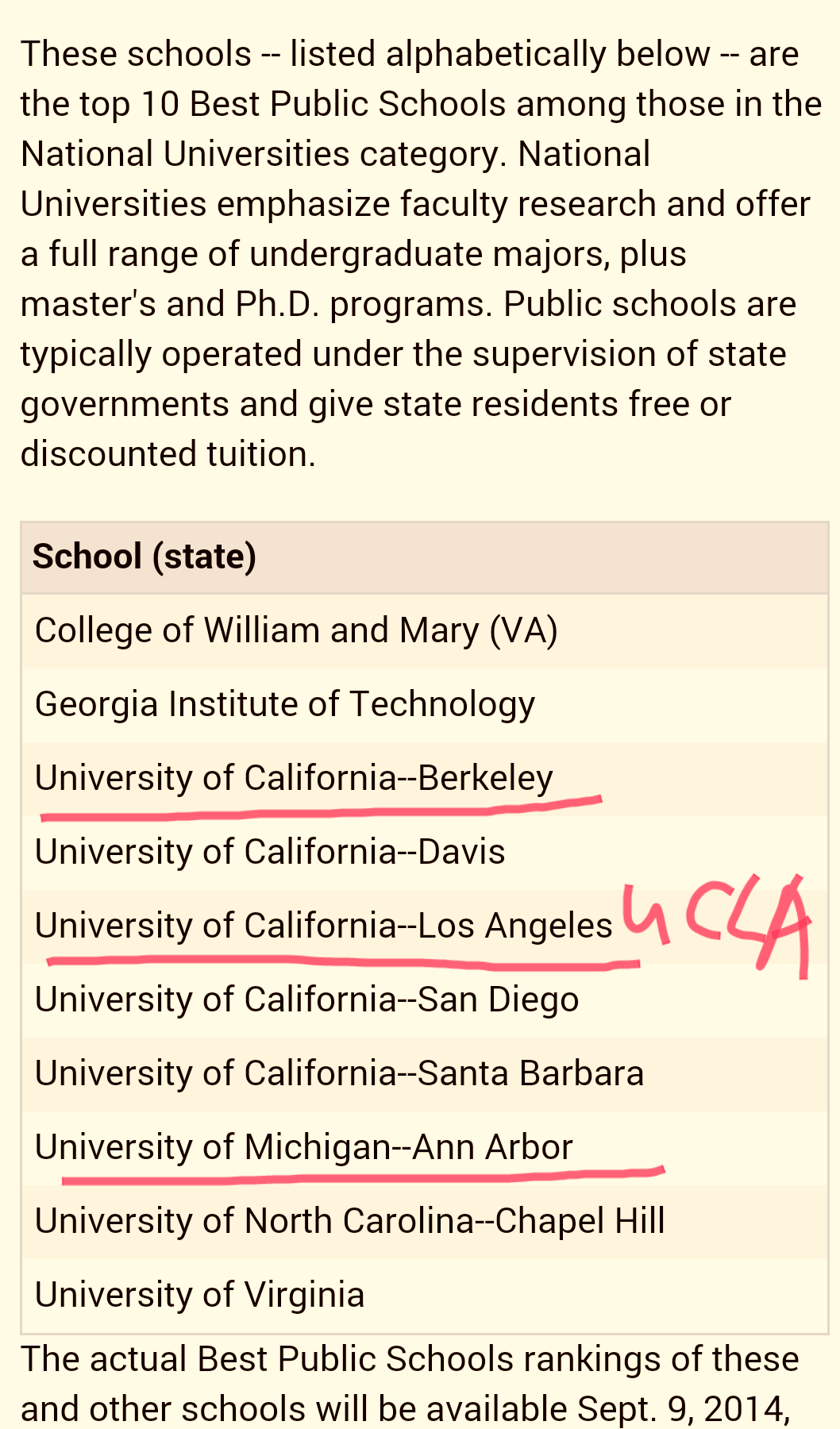


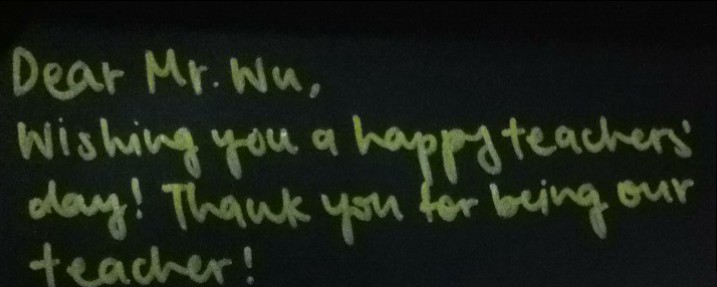 Wishing all teachers a happy Teacher’s Day this Friday, and also wishing students all the best for their upcoming exams.


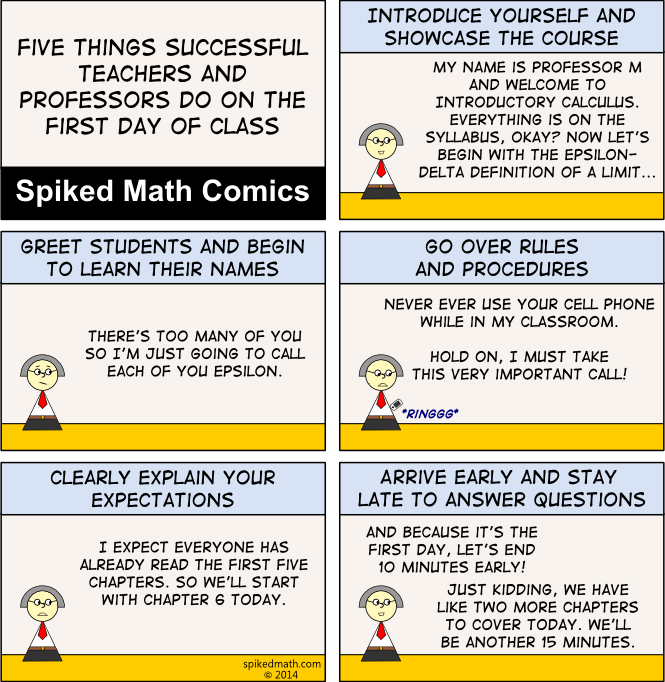


 .
. .
. .
. .
.
 .
. .
. is a parametrization of the unit circle.
 .
. .
. .
. . Interesting?












 ) do not have real roots. However, by the Fundamental Theorem of Algebra, every polynomial equation of degree d has d complex roots! (counting multiplicity)



 Mathtuition88