

There has been a drastic WordAds revenue drop recently. For those using WordPress, check out this post, which is the most comprehensive post on WordAds on the internet. Hope the situation gets better once WordAds 2.0 stabilises.
Math Blog
Excellent Math Books for General Audience
Reading Math “General Audience” books can be a really enlightening experience. Not as dense as Math textbooks, they tell the story behind the great discoveries of Mathematicians. It is an excellent choice for parents who want to inspire and motivate their child about the beauty of Math, which is not just about exams / doing endless exercises.
Recently two books on the Poincare conjecture on Amazon caught my eye. This is the famous conjecture solved recently by Grigori Perelman, who is the first person ever to reject the Fields Medal. Definitely looking forward to read these two books.
The Poincare Conjecture: In Search of the Shape of the Universe


Poincare’s Prize: The Hundred-Year Quest to Solve One of Math’s Greatest Puzzles


Semisimple Modules Equivalent Conditions
Proposition: For a right 

(i)
(ii) 
(iii) 
We are following Pierce’s book’s Associative Algebras (Graduate Texts in Mathematics)
This proposition is can be used to prove two useful Corollaries:
Corollary 1) If 

Proof: Since 


Corollary 2) A direct sum of semisimple modules is semisimple.
Proof: This is quite clear from the definition of semisimple modules being direct sum of simple modules. A direct sum of (direct sum of simple modules) is again a direct sum of simple modules.
Free Gift by Giant (Singapore only)
http://www.giantsingapore.com.sg/cny2016/subscribe-to-newsletter/
Just to share a good deal with readers of my blog.
Once you subscribe to their newsletter, you will receive an email something like this. I have not claimed the prize yet, but heard it is a pair of USB speakers.
*The disclaimer is “Limited Stocks only”, and free things do run out quickly in Singapore!
Thank you for subscribing with us.
We are giving you a gift as a token of appreciation!
You may redeem the free gift at the Customer Service Counter of these 2 Hypermarkets only:
1. Tampines Hypermarket (21 Tampines North Drive 2 #03 -01 Singapore 528765)
2. IMM Hypermarket (2 Jurong East St 21 #01 -100 Singapore 609601)
Please print out this email and present it to customer service to redeem the free gift.
Please bring your Identification Card for verification purposes.
Terms & Conditions:
1. Redemption is valid from 15 Jan – 25 Jan or while stocks last. Limited Stocks only!
2. Only the hard copy of this email will be accepted.
3. Limited to 1 redemption per email address per name.
4. Giant reserves the right to change the free gift at its own discretion without prior notice.
Closure is linear subspace
Let 


Proof:
We use the “sequential” equivalent definition of closure, rather than the one using open balls: 


Then 


Mathematical Story Book (Flatland + Flatterland)
Parents who are looking for a book that can improve a child’s English / Math / logic skills simultaneously can consider Flatland & its sequel Flatterland. Many good reviews on Amazon, and it is considered a classic literature book.
This edition of Flatland is recommended, as it contains annotations by Ian Stewart, a famous mathematician author.


Homotopy Theory on Simplicial Sets
Let 





Let 


A simplicial set
Let 


We define ![\Lambda^i[n]](https://s0.wp.com/latex.php?latex=%5CLambda%5Ei%5Bn%5D&bg=ffffff&fg=1a1a1a&s=0&c=20201002)
![\Delta[n]](https://s0.wp.com/latex.php?latex=%5CDelta%5Bn%5D&bg=ffffff&fg=1a1a1a&s=0&c=20201002)

![\sigma_n=(0,1,\dots\,n)\in\Delta[n]_n](https://s0.wp.com/latex.php?latex=%5Csigma_n%3D%280%2C1%2C%5Cdots%5C%2Cn%29%5Cin%5CDelta%5Bn%5D_n&bg=ffffff&fg=1a1a1a&s=0&c=20201002)
Proposition: Let ![f:\Lambda^i[n]\to X](https://s0.wp.com/latex.php?latex=f%3A%5CLambda%5Ei%5Bn%5D%5Cto+X&bg=ffffff&fg=1a1a1a&s=0&c=20201002)
Life is Like a Cup of Coffee
麦片虾 Cereal Prawn
Cereal Prawn cooked by my wife 🙂

Recently, I found a recipe of cereal prawn on the internet. I tried it.

It is not bad, even though I used cornflakes instead of cereal, and green onion leaf instead of curry leaf.
The recipe is like this:
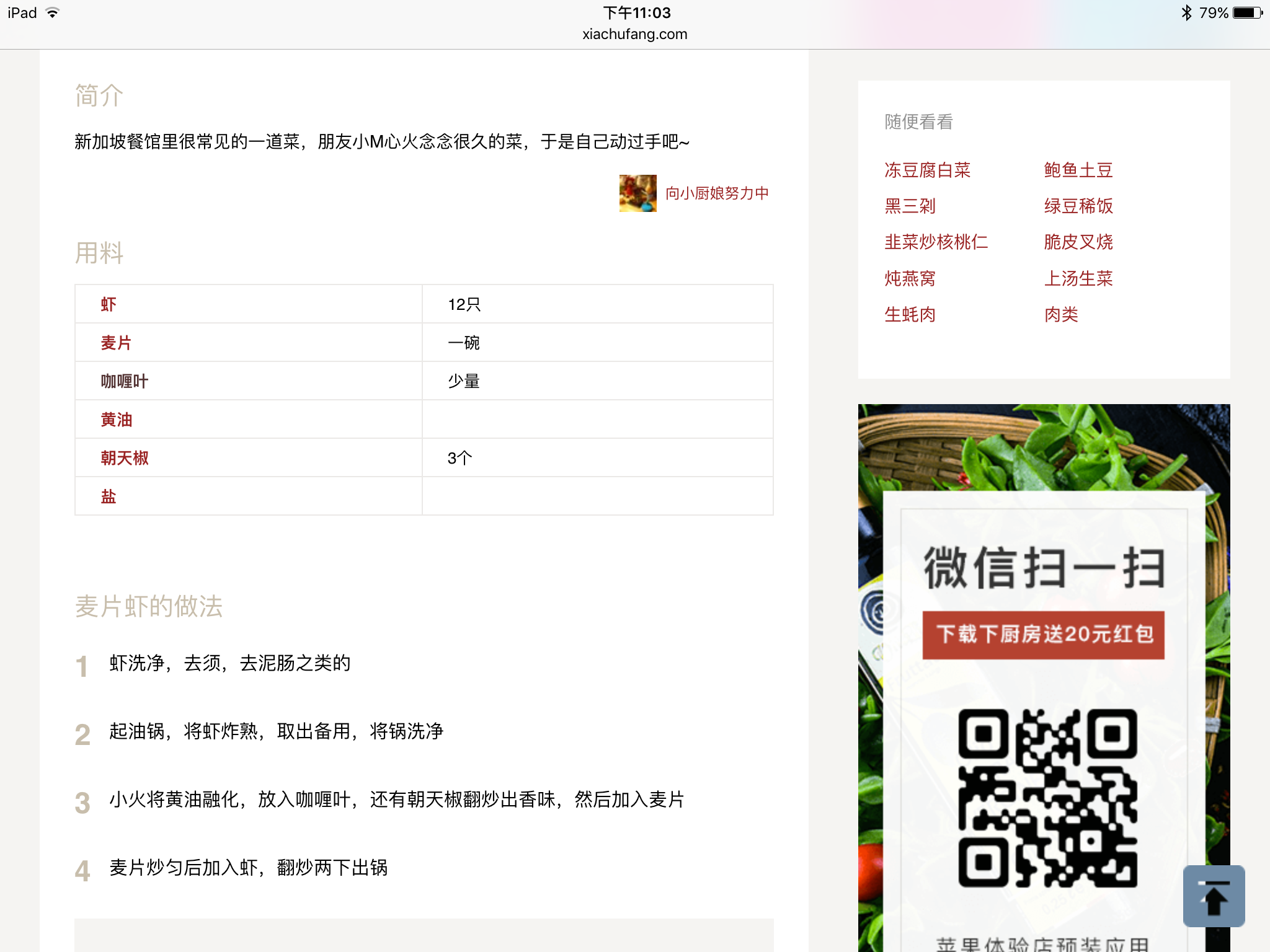
It is an easy way to cook cereal prawn.
Ingredients: prawns, cereal, curry leaf, butter, salt.
1. Clean prawns.
2. Pour some cooking oil into the pan, and deep fry the prawns.
3. Melt the butter with low heat. Put in the curry leaf, stir fry. Then put in the cereal.
4. When the cereal is fried evenly, put in the prawns. Stir fry a little and ladle out.
Cauchy’s Theorem
Cauchy’s Theorem:
Let 

If 

(This is the precursor of Cauchy-Goursat Theorem, which allows us to drop the condition that
Proof Using Green’s Theorem:
Let 

![\int_C f(z)\,d(z)=\int_a^b f[z(t)]z'(t)\,dt](https://s0.wp.com/latex.php?latex=%5Cint_C+f%28z%29%5C%2Cd%28z%29%3D%5Cint_a%5Eb+f%5Bz%28t%29%5Dz%27%28t%29%5C%2Cdt&bg=ffffff&fg=1a1a1a&s=0&c=20201002)



Next, we need Green’s Theorem:

By assumption 

Continuing from above, we get 


Schur’s Lemma
Schur’s Lemma is a useful theorem in algebra that is surprisingly easy to prove.
Schur’s Lemma: Let 
(i) If 
(ii) If
(iii) If both
(iv) If 
Proof:
(i) 


(ii) 


(iii) Combine (i) and (ii) to get
(iv) 


RI’s O Level Scores: Only 1 student out of 10 made it to JC
Source: http://themiddleground.sg/2016/01/18/32412/
This is indeed very surprising news. One wonders what exactly has gone wrong in the system. One can’t help but feel sorry for the sportsmen who have trained hard and won awards for the school, but were dropped out of the IP track and were inadequately prepared for the O Level track.
The most telling phrase from the article is “He wondered if the school lost out because teachers were unfamiliar with the ‘O’ level syllabus: “When we were doing the paper, we all knew that something was wrong.””
Discussion on this topic can be found at:
https://www.reddit.com/r/singapore/comments/41jalb/ris_o_level_scores_only_one_in_class_of_10/
N is a simple nonzero right A-module (Equivalent Conditions)
Let
(i)
(ii) 

(iii) 
Proof: (i)=>(ii) Let 


(ii)=>(i) Condition (ii) implies that
(ii)=>(iii) Let 


(iii)=>(i) Follows from the Correspondence Theorem: The map 


Norm of Cartesian Product
If we have two normed linear spaces 


It is routine to check that all the above 3 are norms, satisfying the positivity, subadditivity, and homogeneity axioms. Minkowski’s inequality is useful to prove the subadditivity of the last norm.
We may check that all of the above 3 norms are equivalent. This follows from the inequalities 


{p(x)<1} is a Convex Set
This theorem can be considered a converse of a previous theorem.
Theorem: Let 
(i) The set of points 

(ii) The set of points 
Proof: (i) Let 


Therefore 

The proof of (ii) is similar.
Wedge and Smash Products
Let 


The smash product 

Push-out
Let 


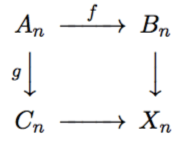
i.e. 


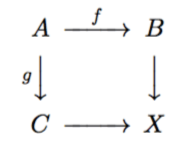
For example, let ![\partial\Delta[n]=\langle d_i(0,1,\dots,n)\mid 0\leq i\leq n\rangle\subseteq \Delta[n]](https://s0.wp.com/latex.php?latex=%5Cpartial%5CDelta%5Bn%5D%3D%5Clangle+d_i%280%2C1%2C%5Cdots%2Cn%29%5Cmid+0%5Cleq+i%5Cleq+n%5Crangle%5Csubseteq+%5CDelta%5Bn%5D&bg=ffffff&fg=1a1a1a&s=0&c=20201002)


is a push-out diagram, where ![S^n=\Delta[n]/\partial\Delta[n]](https://s0.wp.com/latex.php?latex=S%5En%3D%5CDelta%5Bn%5D%2F%5Cpartial%5CDelta%5Bn%5D&bg=ffffff&fg=1a1a1a&s=0&c=20201002)
Complex Integrals
According to Churchill’s book Complex Variables and Applications
Integrals are extremely important in the study of functions of a complex variable. The theory of integration, to be developed in this chapter, is noted for its mathematical elegance. The theorems are generally concise and powerful, and many of the proofs are short.
Basic Contour Integrals
The basic way of computing contour integrals is to use the definition. There are more advanced and very powerful methods of computing contour integrals, which we will mention in later posts.
The summarised definition is as follows: ![\int_C f(z)\ dz=\int_a^b f[z(t)]z'(t)\,dt](https://s0.wp.com/latex.php?latex=%5Cint_C+f%28z%29%5C+dz%3D%5Cint_a%5Eb+f%5Bz%28t%29%5Dz%27%28t%29%5C%2Cdt&bg=ffffff&fg=1a1a1a&s=0&c=20201002)

Basic Example 1: 


Using the definition, we have

Opposite Algebra
Let 


Bilinearity comes from the following computations:


Associativity is true from

The unity element is the same unity element 


Center of Matrix Algebra / Matrix Ring is Scalar Matrices
We will prove that the center 
One direction is pretty clear. Let 


The other direction will require the use of 
Let 


Plugging in some convenient values like 


Plug in 


Thus 

Observing that 


Gauge (Minkowski functional) of Convex Set
Theorem: Let
(i) 

(ii) 
We need the following definition: 

Proof:
(i) If 


(ii) We first prove the “only if” part. Assume 


We then have 


Conversely, if 

We have 

Then we have 


Simplicial Map and n-simplex
A simplicial map 


The
where 
The face ![d_j:\Delta[n]_k\to\Delta[n]_{k-1}](https://s0.wp.com/latex.php?latex=d_j%3A%5CDelta%5Bn%5D_k%5Cto%5CDelta%5Bn%5D_%7Bk-1%7D&bg=ffffff&fg=1a1a1a&s=0&c=20201002)


![s_j:\Delta[n]_k\to\Delta[n]_{k+1}](https://s0.wp.com/latex.php?latex=s_j%3A%5CDelta%5Bn%5D_k%5Cto%5CDelta%5Bn%5D_%7Bk%2B1%7D&bg=ffffff&fg=1a1a1a&s=0&c=20201002)

![\sigma_n=(0,1,\dots,n)\in\Delta[n]_n](https://s0.wp.com/latex.php?latex=%5Csigma_n%3D%280%2C1%2C%5Cdots%2Cn%29%5Cin%5CDelta%5Bn%5D_n&bg=ffffff&fg=1a1a1a&s=0&c=20201002)

![\Delta[n]_k:=\{(i_0,i_1,\dots,i_k)\mid 0\leq i_0\leq i_1\leq\dots\leq i_k\leq n\}](https://s0.wp.com/latex.php?latex=%5CDelta%5Bn%5D_k%3A%3D%5C%7B%28i_0%2Ci_1%2C%5Cdots%2Ci_k%29%5Cmid+0%5Cleq+i_0%5Cleq+i_1%5Cleq%5Cdots%5Cleq+i_k%5Cleq+n%5C%7D&bg=ffffff&fg=1a1a1a&s=0&c=20201002)
Simplicial Sets
A simplicial set 

for each 

We can use deleting-doubling for remembering simplicial identities:

议论文论据素材的积累 Where to Collect Material for Argumentative Composition
议论文中的论据是用来证明论点的理由和根据。主要有事实论据和道理论据。
一般可以用来作为论据的有很多,如名人名言,俗语谚语,名人轶事,甚至广告词,歌词,身边的事情都可以作为论据。
写作素材的积累需要学生增加阅读量,无论是课外书(小说,诗歌,散文),或是报纸,或者杂志,甚至看一些中文电视节目,这些都是积累的途径。读书破万卷,下笔如有神,读的多了,写文章自然会变成一件容易的事情。
读报纸,可以阅读一些社会热点,并且学习记者在报道新闻和评论新闻的思维,这对口试也是有帮助的。尤其是中学的口试需要对一些社会时事发表自己的观点,多看这类报章,会帮助学生开拓思维。在口试的时候,才会知道该怎么回答,从哪些方面来回答。
看中文电视节目,对学生的作文和口试都有帮助。推荐一档中国的电视节目:
「百家讲坛」这档中国CCTV的科教节目涉及人文科学,自然科学,哲学等。通过看这档节目可以学到很多中国历史典故和国学常识,而且很多名家讲课的内容非常有趣生动。当我还是高中生的时候,课间休息时间,全班学生经常一起看这个节目。比较著名的是 (王立群读史记,易中天品三国,于丹 论语 心得,刘心武揭秘红楼梦,孔庆东看武侠小说,纪连海说清朝二十四臣,等)这些主讲嘉宾,既有著名大学教授,也有作家,还有高中教师。如果对中国文化,历史,文学感兴趣,这是一个很好的节目。
当然如果学生不适合这类比较深的节目,可以尝试一些比较轻松综艺性节目,比如说中国最近有一档节目叫「世界青年说」,这个节目邀请了十多个国家的青年代表(他们来自美,德,英,意,澳等国家),他们每一期节目都会围绕一个议题展开讨论。有一些议题和学生的口试题目非常接近,比如养老,环保,文化差异等等。虽然这些青年代表都是外国人,可是他们的中文水平都不错,对当下中国的流行文化也非常了解。他们在讨论的过程中,会涉及到大量的不同国家的文化风俗,会给观众科普很多典故及历史,这些都是很好的写作素材。而且在他们讨论的过程中也是可以学习他们对某一问题如何发表看法,并且如何论证自己的观点。因为嘉宾都是来自不同的国家和地区,所以在讨论过程中会产生思维碰撞,也可以打开学生的思维,让他们学会从不同的角度去看待同一个问题。
很多家长对成语情有独钟。一些家长会明确要求我给他们的孩子多教成语。我比较推荐学生通过读成语故事的方式来学习成语。因为成语故事本身要么是史实典故,要么是传说,无论是哪种,都是社会普遍认同的,所以故事来当论据是很有分量的。写成语故事还有一个好处,就是凑字数。有些学生会为自己写的作文字数太少而头疼不已。成语故事肯定比只是成语单单这几个字要长的多。
很多学生不喜欢读中文读物,也不喜欢看中文电视节目怎么办?
这种情况下,课本和阅读理解以及阅读问答也可以转变成素材的来源。其实课文中就有很多成语,俗语等。而且课文的写作思路也可以成为借鉴的材料。比如中三的课本中有”老吾老以及人之老””少年莫笑白头翁,人人都有夕阳红””百善孝为先”等可以积累的名语。所以不爱读课外读物的学生,可以把课文内容掌握好,这也算一种方法。
除了课本之外,学生往往也会忽视阅读题目的另外一个作用,就是它也可以当作写作素材。很多阅读题目会选一些名人故事当作材料,这些故事都可以作为论据,而且一个故事可以多用。比如说,有一个理解问答是关于爱因斯坦的。爱因斯坦发表了”相对论”,瑞典皇家科学院很多评委凭借这个理论提名爱因斯坦诺贝尔奖。但是有一个评委反对,因为”相对论”没有经过验证。所以爱因斯坦就没能得到诺贝尔奖。之后一次又一次,爱因斯坦被提名,却被这个评委用同样的借口拒绝。后来有一个叫奥森的年轻人,用”光电效应理论”提名爱因斯坦。这次爱因斯坦终于拿到诺贝尔奖。这个故事涉及到三个人物,而这三个人物刚好是理解这个故事的三个角度。爱因斯坦是著名的科学家,而他拿诺贝尔奖之路漫长又坎坷。开始虽然一次又一次失败,但是他也没有因此沮丧或者气馁,最终他还是拿到了诺贝尔奖,虽然不是凭借”相对论”。从爱因斯坦这个角度,至少可以提炼出两个论点:1,遇到挫折,困难,不可以放弃,要坚持。2,上帝在关闭一扇门的同时,也会打开一扇窗。天无绝人之路。如果从奥森这个角度来讲,也可以提炼出一个论点:换个角度看问题,或者遇事要灵活。如果从投反对票的评委来讲可以从两个方面进行分析:1,坚持原则,刚正不阿,不会因为舆论导向而放弃自己的准则。2,墨守成规,做事呆板,才导致没能给”相对论”应有的荣耀。
所以同一个故事可以从不同的方面去解读,那么学生再遇到与此有关的作文题目,无论是关于坚持,不放弃,又或者换个角度看问题等主题,都可以用这同一个故事当作论据。学生在平时做阅读题目时,要做个有心人。遇到一些名句俗语,或者有深刻含义的故事,都可以记在心里。说不定写作文的时候会派上用场!
The disk quota for wordpress.com is full
Strangely, I received an error notification that “The disk quota for mathtuition88.wordpress.com is full”, even though I have barely used 5% of my 3 GB storage space under the free plan.
Anyone experienced this?

Seems everything is alright, I can still post. Very strange.
Mapping of Infinite Vertical Strip by the Exponential Function
This post is continued from a previous post on how to map an open region between two circles to a vertical strip. We wish to map the infinite vertical strip 
First, we need to map the vertical strip onto the horizontal strip 


Let us consider the exponential mapping 


In conclusion, the map 


Let A be a simple R-algebra, then M_n(A) is simple
We let 


Reference: Associative Algebras (Graduate Texts in Mathematics)
We will split our proof into 2 Lemmas.
Lemma 1: If 

Proof: Let 


Lemma 2 (Tricky part, takes some time to digest): If 

A technical thing we need to know is the 

The key idea here is that 


Let us begin the proof to first show 


Therefore 


Next part is to show 


Therefore 


Final Conclusion
Since
1000 Posts
Finally, reached 1000 posts!
Better To Try And Fail Than Never To Try At All – Poem by William F. O’Brien
Source: http://www.poemhunter.com/poem/better-to-try-and-fail-than-never-to-try-at-all/
Some say risk nothing, try only for the sure thing,
Others say nothing gambled nothing gained,
Go all out for your dream.
Life can be lived either way, but for me,
I’d rather try and fail, than never try at all, you see.
Some say “Don’t ever fall in love,
Play the game of life wide open,
Burn your candle at both ends.”
But I say “No! It’s better to have loved and lost,
Than never to have loved at all, my friend.”
When many moons have gone by,
And you are alone with your dreams of yesteryear,
All your memories will bring you cheer.
You’ll be satisfied, succeed or fail, win or lose,
Knowing the right path you did choose.
Recommended Functional Analysis Book (Graduate Level)
Functional Analysis is a subject that combines Linear Algebra with Analysis. I researched online, and it seems one of the best Functional Analysis Book for Graduate level is Functional Analysis
This is Theorem 5 in the book: Let
The following 9 properties hold:
- The empty set is convex.
- A subset consisting of a single point is convex.
- Every linear subspace of
- The sum of two convex subsets is convex.
- If
.
- The intersection of an arbitrary collection of convex sets is convex.
- Let
be a collection of convex subsets that is totally ordered by inclusion. Then their union
is convex.
- The image of a convex set under a linear map is convex.
- The inverse image of a convex set under a linear map is convex.
Brief sketch of proofs:
We give a brief sketch of the idea behind the proofs.
We are using the definition of convex as follows: 

Property 1 is vacuously true.
Property 2 is true because of 
Property 3 is true because
Property 4) Let 


![\begin{aligned} a(x_1+y_1)+(1-a)(x_2+y_2)&=ax_1+ay_1+x_2+y_2-ax_2-ay_2\\ &=[ax_1+(1-a)x_2]+[ay_1+(1-a)y_2]\\ &\in C_1+C_2 \end{aligned}](https://s0.wp.com/latex.php?latex=%5Cbegin%7Baligned%7D++++a%28x_1%2By_1%29%2B%281-a%29%28x_2%2By_2%29%26%3Dax_1%2Bay_1%2Bx_2%2By_2-ax_2-ay_2%5C%5C++++%26%3D%5Bax_1%2B%281-a%29x_2%5D%2B%5Bay_1%2B%281-a%29y_2%5D%5C%5C++++%26%5Cin+C_1%2BC_2++++%5Cend%7Baligned%7D&bg=ffffff&fg=1a1a1a&s=0&c=20201002)
Property 5) We just need to know that 

Property 6) Let 


Property 7) Let 


Property 8) Observe that 
Property 9) The only tricky thing about this part is that we cannot assume that the inverse 
Let 


We have 
Thus 
The End!
Image of Vertical Strip under Inversion
This is a slight generalisation of Example 3 in Churchill’s Complex Variables and Applications
Consider the infinite vertical strip 


When 



Similarly the line 

Note that as
Thus, the resultant image is the (open) region between the two circles.
The converse holds too, i.e. the region between two circles will be mapped back to the vertical strip by inversion.
Example
Find an analytic isomorphism from the open region between the two circles 

First, we “shift” the circles to the left by 1 unit via the map 


Composition of all the above functions leads us to the desired transformation 

We will mention an analytic isomorphism of this vertical strip to the upper half plane 
Ultimate Tic-Tac-Toe
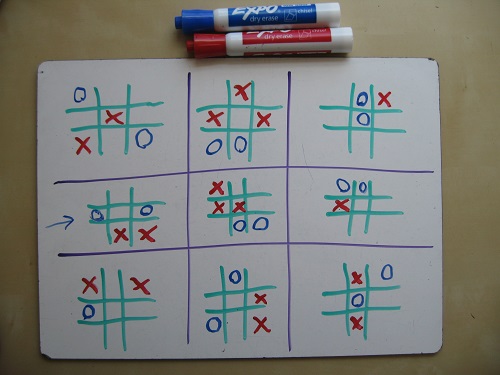

Updated 7/16/2013 – See Original Here
Once at a picnic, I saw mathematicians crowding around the last game I would have expected: Tic-tac-toe.
As you may have discovered yourself, tic-tac-toe is terminally dull. There’s no room for creativity or insight. Good players always tie. Games inevitably go something like this:
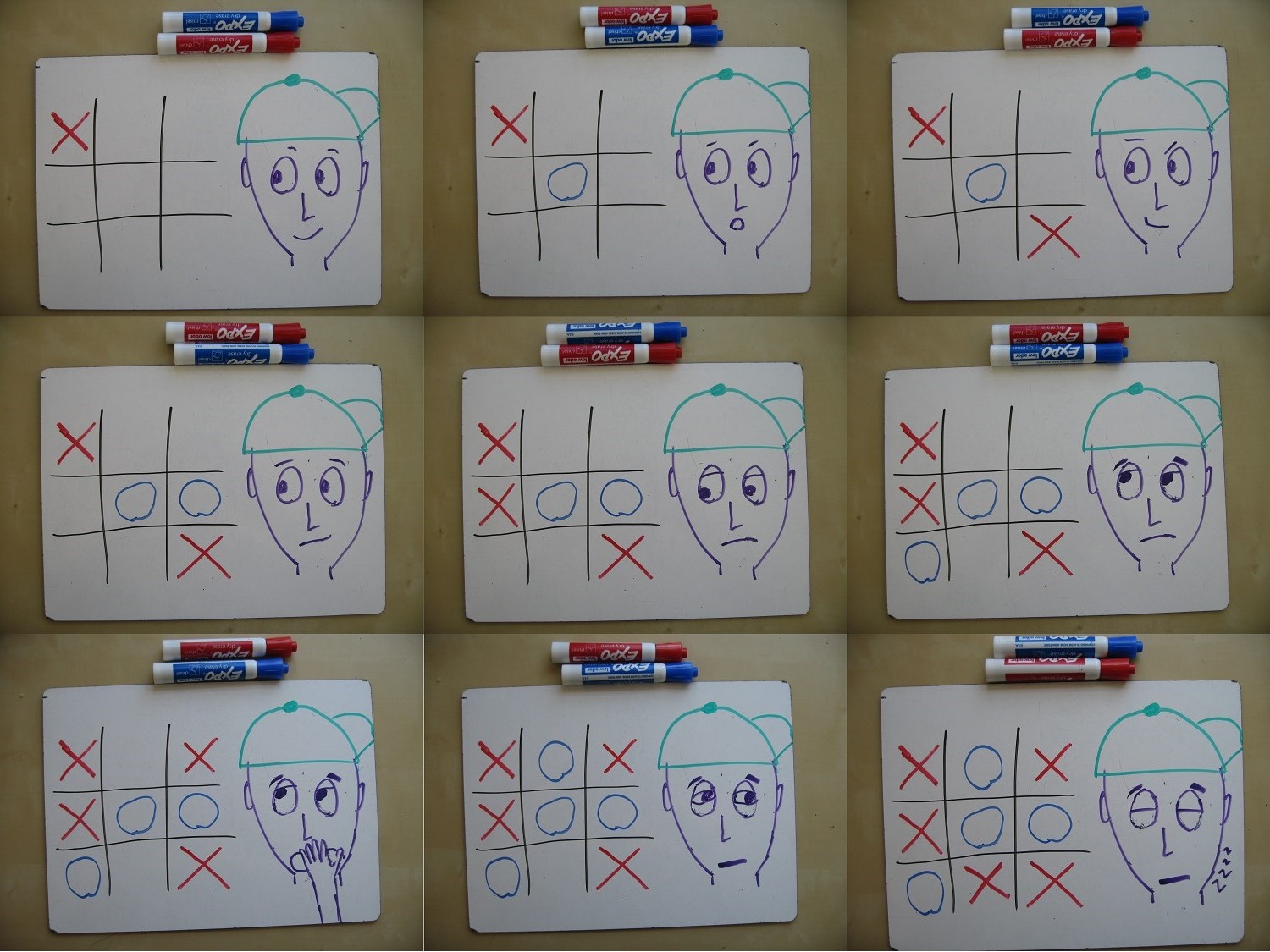
But the mathematicians at the picnic played a more sophisticated version. In each square of their tic-tac-toe board, they’d drawn a smaller board:
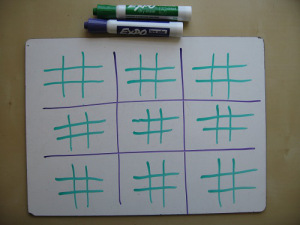
As I watched, the basic rules emerged quickly.
View original post 434 more words
Clash of Clans Math – Using Linear Inequalities to Save Elixir
This is quite a nice video on Clash of Clans and Math. Only got 70 views so far, but it is definitely a well prepared video.
Another video:
Farming in Clash of Clans has just gotten harder, due to nerf on Town Hall not granting shield, and very powerful defenses for TH10 and TH11. Watch these videos and you may gain some idea on a better way to farm.
Definition of Tensor Product: M Tensor N
Let 

Motivation
The tensor product is a construction that, roughly speaking, allows us to take “products” 


Definition
(Following Dummit; there is another equivalent definition using “universal property”, see Wikipedia)


The outcome of the above definition is that the following nice properties hold:


Recent News about MOE (Ministry of Education)
The following are some interesting news on Singapore’s MOE Ministry of Education. Readers interested may want to check them out:
Motivational: Kung Fu Panda 3 Song
The new Kung Fu Panda 3 song lyrics is out!
Very motivational lyrics. The title itself <Try> is very motivational.
“Only those who dare to fail greatly can ever achieve greatly.” ― Robert F. Kennedy
The full lyrics are as follows (includes some Chinese):
Try – 派伟俊/周杰伦
(《功夫熊猫3》电影全球主题曲)
中文词:方文山
英文词:冼佩瑾
曲:派伟俊
小派:You always have to do something
Just to show the world that you exist
So you try
You hope they’ll see
If on this brand new day you’ll look
On the bright side of the same old street
You will see
What you deserve
Jay:Let’s go
我说几华里我送别了过去
他们说人生的结局非常的戏剧
塞外羌笛孤城马蹄
在武侠的世界里谁与谁来为敌
合:La la la la la la la la la
黄沙里用竹笔写下的字叫勇气
Jay:You just have to try
To be who you are
And you ought to fly
Step into the light
小派:And soon you will find
Be yourself
Somewhere deep inside
There’s a universe right there waiting to be unlocked
The key lies in looking into yourself
Jay:Oh Try try try try
Just do what is right
You’ll fly so high
Let go of the brakes
Be who you are
Be yourself ’cause your power is on
合: When you believe in what you’ve got
You know you’re perfect just be who you are
小派:So they don’t see what you’re made of
But I like you and I know they’re wrong
Now it’s time
To show them what you got
Let the blue skies cheer you on
Embrace the wind we’ll ride along
You’re perfect when you’re who you are
Jay:这世界有些事有些人凭感觉
别管他旌旗密布遍野狼烟霜雪
那故事在穿越而我也在翻页
一行行做好准备敏锐而直接
合:La la la la la la la la la
爱不灭真实的一切废话全收回
小派:You just have to try
To be who you are
Jay:And you ought to fly
Step into the light
小派:And soon you will find
Be yourself
Somewhere deep inside
There’s a universe right there waiting to be unlocked
The key lies in looking into yourself
Jay:Oh Try try try try
Just do what is right
You’ll fly so high
Let go of the brakes
合: Be who you are
Be yourself ’cause your power is on
When you believe in what you’ve got
You know you’re perfect just be who you are
小派:You just have to try
To be who you are
Jay:And you ought to fly
Step into the light
小派:And soon you will find
Be yourself
Somewhere deep inside
There’s a universe right there waiting to be unlocked
The key lies in looking into yourself
Jay:Oh Try try try try
Just do what is right
You’ll fly so high
Let go of the brakes
合: Be who you are
Be yourself ’cause your power is on
When you believe in what you’ve got
Chinese Tuition
Chinese Tuition: http://chinesetuition88.com/
Chinese Tuition Singapore
新加坡华文补习老师
Tutor: Ms Gao (高老师)
Ms Gao is a patient tutor, and also effectively bilingual in both Chinese and English.
A native speaker of Mandarin, she speaks clearly with perfect accent and pronunciation. She is also well-versed in Chinese history, idioms and proverbs.
Ms Gao is able to teach Chinese at the Primary and Secondary school level. She will teach in an exam-oriented style, but will also try her best to make the lesson interesting for the student.
Ms Gao graduated from Huaqiao University, which is founded by late Chinese premier Zhou Enlai.
Contact:
Email: chinesetuition88@gmail.com
Website: http://chinesetuition88.com/
(Preferably looking for students staying in the West side of Singapore, e.g. Clementi / Dover / Jurong East / Boon Lay / Queenstown)
Image of Infinite Strip under Transformation w=1/z
Q: Find the image of the infinite strip 
(This question is taken from Complex Variables and Applications (Brown and Churchill)
Answer: 

Solution:
We are using the standard notation 


With some algebra and completing the square, one can obtain 


Thus, the image of the strip is
The Shape of Space
Just came across this book: The Shape of Space (Chapman & Hall/CRC Pure and Applied Mathematics)
It will be useful to students who want to learn more about topology. This book can be read casually, it is not like a textbook, yet it has substantial mathematical content.

Example of an illustration in the book:

CW Approximation
A weak homotopy equivalence is a map 


In other words, Whitehead’s theorem says that a weak homotopy equivalence between CW complexes is a homotopy equivalence. Just to recap, a map 


It turns out that for any space 
Excision for Homotopy Groups
According to Hatcher (Chapter 4.2), the main difficulty of computing homotopy groups (versus homology groups) is the failure of the excision property. However, under certain conditions, excision does hold for homotopy groups:
Theorem (4.23): Let 





Miscellaneous Definitions
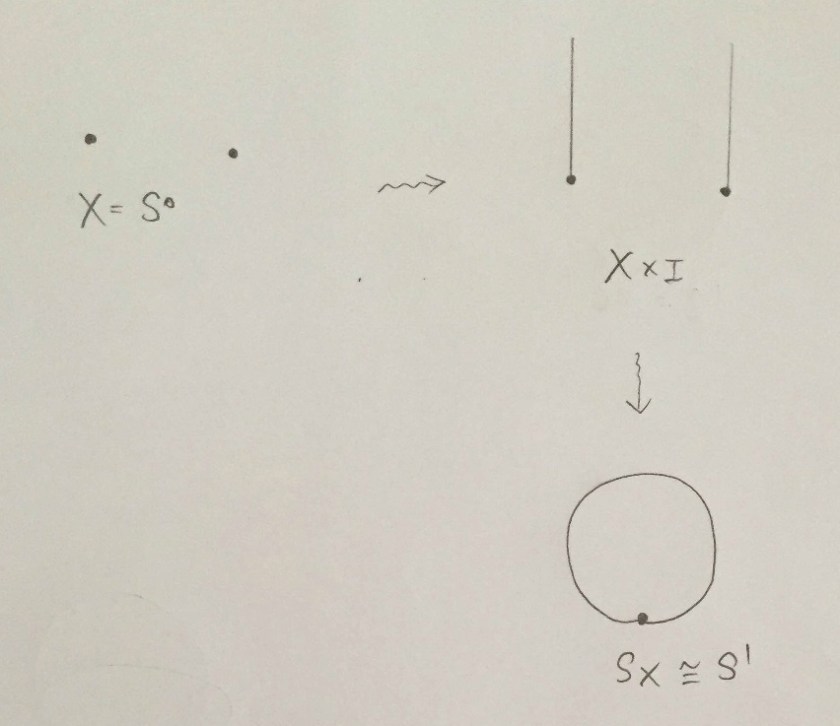
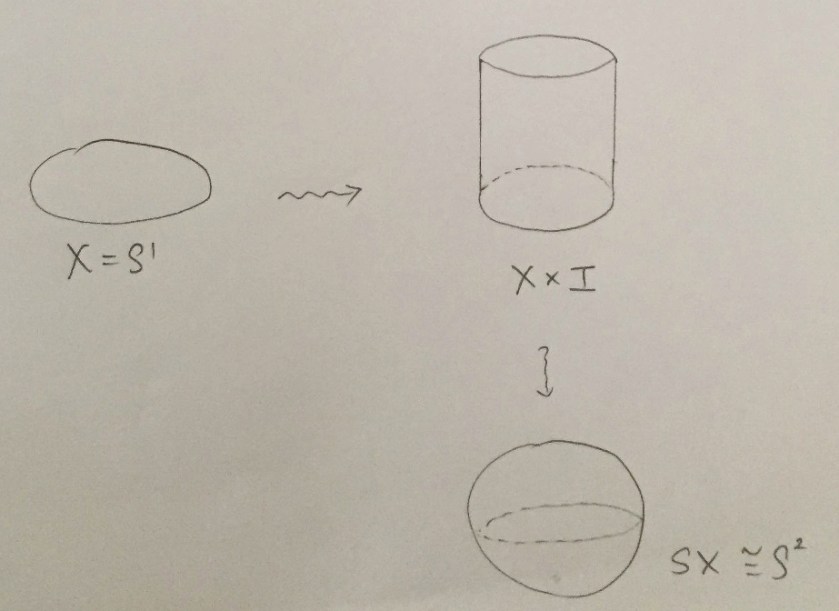
Suspension: Let 


The definition of suspension is similar to that of the cone in the following way. The cone 
The classical example is 


Here are some graphical sketches of the case where
Linear Fractional Transformation (Mobius Transformation)
The transformation 


One key property of linear fractional transformations is that it transforms circles and lines into circles and lines.
Let us find the linear fractional transformation that maps the points 


Solution:

What we have to do is basically solve the three simultaneous equations arising from 


Eventually we can have all the variables in terms of 


Donate to Singapore Charity @ Giving.sg
Just to introduce this website to readers who haven’t heard of it. Donations above $50 are tax deductible, and it also features ways to volunteer for the charity organisations. Do check it out!
Q: What is Giving.sg? (taken from their FAQ page)
A: Giving.sg is Singapore’s very own one-stop portal for empowering all of us on our Giving Journey, whether we are looking to help local non-profit organisations (NPOs) by giving our TIME, by general volunteering; our TALENT, by skills volunteering; or [our] TREASURE, by donations.
Giving.sg brings together its predecessors sggives.org and sgcares.org, both of which have helped raise over S$51 million for more than 350 [local] non-profits, as well as seen over 40,000 volunteers generously gift their time to these [local] non-profits.
News article featuring Giving.sg: http://www.straitstimes.com/singapore/online-platform-among-initiatives-to-promote-giving-in-singapore
Analytic Isomorphism (Complex Analysis)
An analytic isomorphism 


Interesting Blog Post on Mathematical Conversations
Source: http://www.theliberatedmathematician.com/2015/12/why-i-do-not-talk-about-math/
A honest opinion on the nature of mathematical conversations, by this blog post author Piper Harron. (Also see our previous blog post on her interesting PhD Thesis) Very interesting read, for those who are in the mathematical community.
Secondary Chinese Tuition
For those interested in Secondary Level (O Level) Chinese Tuition, do check out http://chinesetuition88.com/.
The tutor (Ms Gao) will be taking in a few more students in 2016 for Chinese Tuition. Do check out http://chinesetuition88.com/ for more info!
(1/2)! = (√π)/2

Richard Feynman (Nobel Physicist) proved it in high school using a funny Calculus: “Differentiating under Integral” — is it legitimate to do so ? Of course it is by “The Fundamental Theorem of Calculus”
Note: We were thought in high school the “HOW” of calculating (such as integration and differentiation), but not the “WHY” (the Theorem behind). Richard Feynman was unique in exploring the WHY since high school, it helped later he was assigned by President Reagan to investigate the 1986 ‘Challenger’ disaster ?

Cellular Approximation for Pairs
(This is Example 4.11 in Hatcher’s book).
Cellular Approximation for Pairs: Every map 


What “map of CW pairs” mean, is that 

First, we use the ordinary Cellular Approximation Theorem to deform the restriction
We use this to prove a corollary: A CW pair 


First we note that being n-connected means that the space is non-empty, path-connected, and the first n homotopy groups are trivial, i.e. 

Proof: First, we apply cellular approximation to maps 


Consider the long exact sequence of the pair

Since it is an exact sequence, the image of any map equals the kernel of the next. Thus, 


Piper Harron discusses her artistic and wonderful math Ph.D. thesis
This is the most “unique” PhD thesis I have ever seen. Very special, and humorous to read, and coming from the most elite institution Princeton, under the guidance of Fields Medalist Manjul Bhargava.

Piper Harron is a mathematician who is very happy to be here, and yes, is having a great time, despite the fact that she is standing alone awkwardly by the food table hoping nobody will talk to her.
Piper, would you care to write a mathbabe post describing your thesis, and yourself, and anything else you’d care to mention?
When Cathy (Cathy? mathbabe?) asked if I would like to write a mathbabe post describing my thesis, and myself, and anything else I’d care to mention, I said “sure!” because that is objectively the right answer. I then immediately plunged into despair.
Describe my thesis? My thesis is this thing that was initially going to be a grenade launched at my ex-prison, for better or for worse, and instead turned into some kind of positive seed bomb where flowers have sprouted beside the foundations I thought I wanted to crumble…
View original post 649 more words
2015 in review
The WordPress.com stats helper monkeys prepared a 2015 annual report for this blog.

Here’s an excerpt:
The Louvre Museum has 8.5 million visitors per year. This blog was viewed about 170,000 times in 2015. If it were an exhibit at the Louvre Museum, it would take about 7 days for that many people to see it.
Rouche’s Theorem and Applications
This blog post is on Rouche’s Theorem and some applications, namely counting the number of zeroes in an annulus, and the fundamental theorem of algebra.
Rouche’s Theorem: Let 


Rouche’s Theorem is useful for scenarios like this: Determine the number of zeroes, counting multiplicities, of the polynomial 

Solution:
Let 

on
Since 
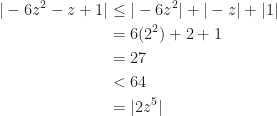
Let 

on
Therefore
We do a computer check using Wolfram Alpha (http://www.wolframalpha.com/input/?i=2z%5E5-6z%5E2-z%2B1%3D0). The moduli of the five roots are (to 3 significant figures): 0.489, 0.335, 1.46, 1.45, 1.45. This confirms that 3 of the zeroes are in the given annulus.
Fundamental Theorem of Algebra Using Rouche’s Theorem
Rouche’s Theorem provides a rather short proof of the Fundamental Theorem of Algebra: Every degree n polynomial with complex coefficients has exactly n roots, counting multiplicities.
Proof: Let 


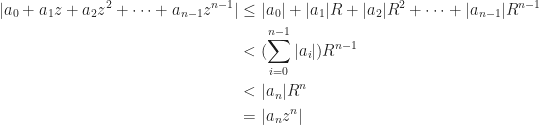
Since 
 Mathtuition88