Ring Memorize Trick

tomcircle's avatarMath Online Tom Circle

Memorize Trick For Ring:

1. Ring (R) is for Marriage with 2 operations: + (addition of kids), * (multiply asset).

2. (R , +) is Commutative Group
Analogy: your kids are also your wife’s kids, vice versa.

3. (R ,*) is Semi-Group (only closure & associative)
Analogy: your asset to multiply (*) is semi (50%) owned by your wife.

4. Fair distributive law for * with respect to +
=> distribute your asset (a) to your kids (k) & wife (w):
a*(k+w) = a*k + a*w

5. No division (/) operation => Ring can’t be broken.

View original post

Do you need a maths degree to teach maths?

Excellent post on teaching Maths.
The basic requirements for teaching Maths are:
1: You must like maths.
2: You must have a good knowledge of maths.

srcav's avatarcavmaths

A few weeks ago I wrote a post in shock at the fact that a number of schools in the locality had been teaching rounding wrongly. By this I don’t mean I took issue with their pedagogical approach, but rather that the method of rounding they were teaching was wrong and would result in the wrong answer in some instances. This post received the following comment from Old Andrew (@andrewolduk):

“Is anybody going to raise the obvious issue here that a lot of maths teachers don’t have maths degrees? In recent years the rise of “conversion courses” means that many have a background that isn’t in the least mathematical.”

This stirred up some quite strong feelings on both sides. Sophie Skinner (@miss_skinner) wrote this excellent piece stating her views, and Dave Gale (@reflectivemaths) wrote this piece reflecting his view. Twitter has been buzzing with conversation on the matter, and…

View original post 954 more words

Sushi Monster – delicious math practice!

Free Math Game App!

jwu2713's avatarEducational Apps for Elementary Teachers & Students

Image

Description: *FREE app at time of post *  Sushi Monster is a ridiculously cute and engaging way to practice math fact fluency (addition and multiplication)!  Students must use their critical thinking and reasoning skills to strategically decide which sushi pieces (each has a number above it) to add/multiply together to feed the monster the total he desires.  Within each round, students see all the upcoming totals in the top left-hand corner so they can plan ahead.  Next to this bar is a Number Sentence bar that builds the addition/multiplication sentence as the student chooses sushi.  If it’s wrong, the monster throws a fit and tosses the sushi plates back!  (What a picky monster…)  Levels within this app are sequenced so that they become progressively more difficult as the student completes them.

Compatible with the following device(s): iPad, iPod Touch, and iPhone

Implementation in classroom:

– Activity idea:  This is a…

View original post 307 more words

Math Jokes

This is the ultimate source of Math Jokes on the Internet: http://www.math.utah.edu/~cherk/mathjokes.html

Know any other funny Math Jokes? Post it in the comments below! 🙂

Top 5 Math Jokes:

  1. A mathematician, a physicist, and an engineer were traveling through Scotland when they saw a black sheep through the window of the train.
    “Aha,” says the engineer, “I see that Scottish sheep are black.”
    “Hmm,” says the physicist, “You mean that some Scottish sheep are black.”
    “No,” says the mathematician, “All we know is that there is at least one sheep in Scotland, and that at least one side of that one sheep is black!”
  2. The physicist and the engineer are in a hot-air balloon. Soon, they find themselves lost in a canyon somewhere. They yell out for help: “Helllloooooo! Where are we?”
    15 minutes later, they hear an echoing voice: “Helllloooooo! You’re in a hot-air balloon!!”
    The physicist says, “That must have been a mathematician.”
    The engineer asks, “Why do you say that?”
    The physicist replied: “The answer was absolutely correct, and it was utterly useless.”
  3. There are three kinds of people in the world; those who can count and those who can’t.
  4. Salary Theorem The less you know, the more you make. Proof:
    Postulate 1: Knowledge is Power
    Postulate 2: Time is Money

    As every engineer knows: Power = Work / Time And since Knowledge = Power and Time = Money It is therefore true that Knowledge = Work / Money . Solving for Money, we get: Money = Work / Knowledge Thus, as Knowledge approaches zero, Money approaches infinity, regardless of the amount of Work done.

  5. An insane mathematician gets on a bus and starts threatening everybody: “I’ll integrate you! I’ll differentiate you!!!” Everybody gets scared and runs away. Only one lady stays. The guy comes up to her and says: “Aren’t you scared, I’ll integrate you, I’ll differentiate you!!!” The lady calmly answers: “No, I am not scared, I am e^x .”

Math Quotes

Famous Math Quotes

  1. If people do not believe that mathematics is simple, it is only because they do not realize how complicated life is.  ~John Louis von Neumann
  2. Pure mathematics is, in its way, the poetry of logical ideas.  ~Albert Einstein
  3. A mathematician is a device for turning coffee into theorems. ~Paul Erdos
  4. Give me a place to stand, and I will move the earth. ~ Archimedes
  5. Mathematics is the door and key to the sciences. ~ Roger Bacon
  6. The essence of mathematics is its freedom. ~ Cantor
  7. A youth who had begun to read geometry with Euclid, when he had learnt the first proposition, inquired, “What do I get by learning these things?” So Euclid called a slave and said “Give him threepence, since he must make a gain out of what he learns.” ~ Euclid
  8. Mathematics is the queen of the sciences and number theory is the queen of mathematics. ~ Gauss
  9. Mathematics knows no races or geographic boundaries; for mathematics, the cultural world is one country. ~ Hilbert
  10. When you can measure what you are talking about and express it in numbers, you know something about it. ~ Kelvin


Randomly Generated Math Research Papers

Randomly Generated Math Research Papers

Want to write your own randomly generated Math Research Papers that look professional but is actually full of Math humour (aka Abstract Nonsense)?

Check out: http://thatsmathematics.com/mathgen/

Sample paper generated: Random Math Paper


Singapore Math by The Khan Academy

Singapore Math by The Khan Academy

Site: https://www.udemy.com/singapore-math/

We will (eventually) do all of the lectures in the Singapore Math curriculum (which we like). You can follow along through the workbooks available at singaporemath.com.

Check out their website for more details!

Our Daily Story #12: The Vagabond Mathematician Paul Erdős

tomcircle's avatarMath Online Tom Circle

http://en.m.wikipedia.org/wiki/Paul_Erd%C5%91s

What is Erdős Number ?

image

Amazon Book: “My Brain Is Open

Paul Erdős (er-dish) was one of the greatest mathematicians in 21st Century, a Jewish Hungarian, single and no home. He traveled around the world in one small suitcase containing his mathematical papers. He would knock at the door of his former students or math collaborator impromptu, started working and published the papers, then moved on to next destination the moment his overstay became unwelcome by the host’s wife. In this way he published 1,500 articles in his lifetime.

image

Example:

Einstein had the Erdős Number 2 , through his assistant who co-wrote a paper with Paul Erdős.

Ref:

http://tomcircle.wordpress.com/2013/03/30/paul-erdos/

View original post

Harvard Online Course: Abstract Algebra

For Junior College students after getting your A-level result this month, if you want to further study Math (or Science, Engineering) in the top universities overseas after your National Service, e.g. USA (Harvard, MIT, Stanford, Princeton, …), or France (where their modern math standard in French Baccalaureate – not the Singapore IB – is much higher than the GCE A level).
Attend this video up to the first 15 lectures will prepare you a good Modeen Math foundation, which is seriously lacking in our Singapore JC Math syllabus (regardless whether you get distinction in GCE A level Math)

tomcircle's avatarMath Online Tom Circle

Prof Benedict Gross is one of the best Algebra professors I have seen – he can explain so well the abstract concepts, without injecting fear and confusion to the students.

As Prof Gross had brilliantly said in the beginning of this Lecture 1:

Algebra is the language of Math.

Since Math is the language of science,
therefore any serious Science needs to speak in Algebra language.

Today, if you read a research paper on any math (or Computer Science, Mathematical Physics…) topic, hardly you can avoid these “basic” algebraic lingoes: Group, Ring, Field, Vector Spaces, Quotient Group, Ideal, …

I strongly recommend to anyone who likes to study Modern Algebra but afraid of the abstractness, this is the course (free) for you. I can guarantee you by the halfway (15th lecture) you will have a solid foundation, and by the last lecture you will be able to follow high-level…

View original post 65 more words

Fun Math Games for Kids

Fun Math Games for Kids

Math Board Games

Site: http://0b4b4eghj3ow8u1ctvk2o9ns5l.hop.clickbank.net/?tid=SEAEAGLEMATHGAME

Dear Friend,

Let’s face it, math can be fun but not all kids think it is. Kids are used to being entertained and expect everything that you want them to do, to be just as entertaining as their favorite pastimes.

What worked in the past, doesn’t necessarily work today. Many kids don’t want to learn math or practice math, they’d rather be watching DVD’s or playing with computer games.

No wonder you feel frustrated!

You know that math skills will be vital to every child’s future. It helps them in school… at work… in social situations… in all areas of life. You simply cannot get along without it. But many kids struggle with math and don’t enjoy it at all.

But it doesn’t have to be like this!

Imagine being able to get kids so engaged with math that they don’t even want to stop even when you ask them to. Wouldn’t that be great?

Read more at: http://0b4b4eghj3ow8u1ctvk2o9ns5l.hop.clickbank.net/?tid=SEAEAGLEMATHGAME


Our Daily Story #11: The Anonymous Mathematician “Nicolas Bourbaki”

tomcircle's avatarMath Online Tom Circle

The romantic gallic Frenchmen like to joke and give pranks. We have already seen the Number 1 Mathematical ‘prank’ in Our Daily Story #1 (The Fermat’s Last Theorem), here is another 20th century Math prank “Nicolas Bourbaki” – the anonymous French mathematician who did not exist, but like Fermat, changed the scene of Modern Math after WW II.

http://en.m.wikipedia.org/wiki/Nicolas_Bourbaki

image

André Weil (not to confuse with Andrew Wiles of FLT in Story #2 ) and his university classmates from the Ecole Normale Supérieure (Évariste Galois‘s alma mater which expelled him for involvement in the French Revolution), wanting to do something on the outdated French university Math textbooks, formed an underground ‘clan’ in a Parisian Café near Jardin du Luxembourg. They met often to brainstorm and debate on the most advanced Math topics du jour. Finally they decided to totally re-write the foundation of Math based on Set…

View original post 123 more words

Math vs Zombies – zapping zombies one equation at a time!

Finished playing Plants vs Zombies?
Try out this game “Math vs Zombies” to improve your Math skills!

jwu2713's avatarEducational Apps for Elementary Teachers & Students

Image

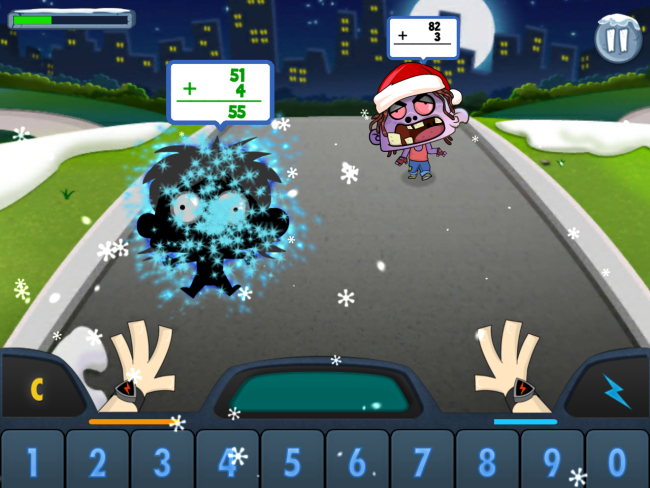
Description: *FREE app*  Although Math vs Zombies is probably meant for children, I found this app to be really fun, especially if there were watching me play and screaming in anxiety!  Basically, cute/quirky zombies are coming to get you, and the only way to change them back into humans (and save yourself) is to solve math equations correctly.  There’s nothing like a little urgency to get those brain juices flowing! Students using this app can choose from four basic operations: addition, subtraction, multiplication, and division.  Within each Operation Level, there are six mini levels and a boss level to beat, and the equations become progressively more difficult between mini levels.  Also, the difficulty level can be set to easy, medium, or hard by clicking on the gear in the bottom left-hand corner of the main menu.

Compatible with the following device(s): iPad, iPod Touch, and iPhone

Implementation in classroom:

–…

View original post 390 more words

How to Offer Encouragement to Someone Who Has Failed an Exam or Test

Source: http://www.wikihow.com/Offer-Encouragement-to-Someone-Who-Has-Failed-an-Exam-or-Test

Read this post to learn how to offer encouragement to someone who has failed an exam or test. Remember, the most important thing is to learn from failure, and use their failures as a stepping stone to success. 失败乃成功之母, failure is the mother of success.

Help the student to create stirring visions for his or her future. Success breeds success and once the student has a good handle on how to study successfully, this habit becomes part of his or her entire educational cycle. Ultimately, learning how to handle failed exams helps the learning process about failure in general; this leads to a better quality life and most importantly gives the person dignity and independence as an individual.

Offer Encouragement to Someone Who Has Failed an Exam or Test Step 1.jpg

In Conversation with Steve Ballmer at Oxford (4 Mar 2014)

tomcircle's avatarMath Online Tom Circle

The 3 valuable  takeaways from this 1- hour interview with Steve Ballmer, who co-founded Microsoft with the richest man in the world Bill Gates:

1. Have a great idea before startup.
– The financial,  talent, etc come later.

2. Great company does (at least) one trick well.
– Microsoft has 2.5 tricks: PC operating system (Windows); Microprocessors in data center (Winservers); the half trick is X box game console. 

– Apple also has 2 tricks: Mac; Mobile computing in iPhone/iPAD/Appstore

– Facebook (Social Network) and Google (Search Engine)  have 1 trick.

– Sony has 1 trick : Audio TV

– HP has 1 trick: Tester Equipment (now in Agilent)

– IBM has 1 trick: Entreprise Data Centre

– Samsung has 1 trick: hardware manufacturer (LCD flat panel, Smartphone…)

– Amazon has 1 trick: online bookshop

– Alibaba.com has 1 trick: eCommerce

Many great companies degenerate into smallness or extinction, because…

View original post 97 more words

Puzzle No. 491 : Killer Sudoku [Daily League]

Sudoku Math

Prasanna Seshadri's avatarPS's puzzles +

Remember that you can solve the puzzles from the League online on the Sudokucup Guest League page with a 24h delay (though I’m not certain whether this is too late to be put up today).

I’m sorry dearest readers, I think I’ll have to skip an explanation of why I’m inactive on my blog right now for later. There’s just too many plans right now, that all seem to end around May, and if it all goes as planned, you’ll see at least some of the reasons why I’ve been too busy to post here.

Anyway, here’s a Killer Sudoku that was used for the Polish Sudoku Championship qualifiers. These qualifiers were open to International solvers online, so I think many solvers would have seen this already. I still think it’s nice enough to put it up for those of you who haven’t.

Rules – Follow Classic Sudoku rules.
Additionally…

View original post 29 more words

When Math Doesn’t Add Up

Christian Math post

Donna's avatarEvident Grace

Here are some amazing spiritual math and science facts:

1 + 1 + 1 = 3 when it’s the Trinity. God is three in one! No, we can’t figure it out but God is not limited by the math He invented for us to make sense of our little world. I delight in worshiping a God who is great beyond my understanding Smile.

2 wrongs don’t make 1 right. It’s not like multiplying two negative numbers which gives us a positive.
For example, 1 unintended pregnancy + 1 abortion does NOT equal one “right.” (No one has the “right” to kill a baby—including his/her mother!)

Gravity (physical law) always pulls us down. But glory lifts us upward. Our body is temporal; it has to stay on this earth whether we’re alive or dead. Our spirit can receive God’s never-ending life that give us supernatural power during this life and eternal…

View original post 114 more words

Methodology for Checking for Careless Mistakes

Checking for careless mistakes using the Substitution Method

  • Normal method of checking (i.e. check your working from front to back again), may or may not find the error
  • Using Substitution Method of checking guarantees that your answer is correct, and will find an error if there is one.
  • Use  Substitution Method of checking for all algebra/solving/simplify questions worth 2 marks or more. You will be able to save many many marks using this method!
  • Only takes 10 seconds with practice. (use calculator)

Example (using substitution method)

Express \displaystyle\frac{2x-3}{x^2+4x+3}-\frac{1}{x+3} as a single fraction in its simplest form. [2 marks]

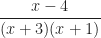
After getting your answer (\displaystyle\frac{x-4}{(x+3)(x+1)}), you can substitute in the value \boxed{x=9}.

When, x=9, \displaystyle\frac{2x-3}{x^2+4x+3}-\frac{1}{x+3}=\frac{1}{24}, and \displaystyle\frac{x-4}{(x+3)(x+1)}=\frac{1}{24}

Since both expressions give the same value, you have just checked that your answer is correct!

Humorous cartoon featuring Jackie Chan.
Sincerely wishing all students to reduce their careless mistakes to as low as possible!

Our Daily Story #7: Algebraic Equation Owed to the Mathematical Thief

tomcircle's avatarMath Online Tom Circle

From the previous O.D.S. stories (#3, #4) on Quintic equations (degree 5) by Galois and Abel in the 19th century, we now trace back to the first breakthrough in the 16th century of the Cubic (degree 3) & Quartic (degree 4) equations with radical solution, i.e. expressed by 4 operations (+ – × /) and radicalroots {$latex sqrt{x} , : sqrt [n]{x} $ }.

Example: Since Babylonian time, and in 220 AD China’s Three Kingdoms Period by 趙爽 Zhao Shuang of the state of Wu 吳, we knew the radical solution of Quadratic equations of degree 2 :
$latex ax^2 + bx + c = 0 $

can be expressed in radical form with the coefficients a, b, c:

$latex boxed{x= frac{-b pm sqrt{b^{2}-4ac} }{2a}}$

Are there radical solutions for Cubic equation (degree 3) and Quartic equations (degree 4) ? We had to wait till the European Renaissance…
View original post 138 more words

Our Daily Story #6: A Subway Sandwich Mathematician Zhang Yitang 张益唐

tomcircle's avatarMath Online Tom Circle

Zhang is the typical demonstration of pure perseverance of traditional Chinese mathematicians: knock harder and harder until the truth is finally cracked.

His work is based on the prior half-way proof by 3 other mathematicians “GPY”:

image

Gap between Primes:

Let p1 and p2 be two adjacent primes separated by gaps of 2N:

p1 – p2 = 2 (twin primes)
eg. (3, 5), (5, 7)… (11, 13) and the highest twin primes found so far (the pair below: +1 and -1)
image

p1 – p2 = 4 (cousin primes)
eg. (7, 11)

p1 – p2 = 6 (sexy primes)
eg. (23, 29)

p1 – p2 = 2N

Euclid proved 2,500 years ago there are infinite many primes, but until today nobody knows are these primes bounded by a gap (2N) ?

Zhang, while working as a sandwich delivery man in a Subway shop…

View original post 97 more words

Our Daily Story #5: The Prince of Math

tomcircle's avatarMath Online Tom Circle

Carl Friedrich Gauss is named the “Prince of Math” for his great contributions in almost every branch of Math.

As a child of a bricklayer father, Gauss used to follow his father to construction site to help counting the bricks. He learned how to stack the bricks in a pile of ten, add them up to obtain the total. If a pile has only 3, for example, he would top up 7 to make it 10 in a pile. Then 15 piles of 10 bricks would give a total of 150 bricks.

One day in school, his teacher wanted to occupy the 9-year-old children from talking in class, made them add the sum:
1 + 2 + 3+ ….+ 98 + 99 + 100 = ?

Gauss was the first child to submit the sum within few seconds = 5,050.

He used his brick piling technique: add

1 + 100…

View original post 82 more words

Our Daily Story #3: The Math Genius Who Failed Math Exams Twice

tomcircle's avatarMath Online Tom Circle

To prove the FLT, Prof Andrews Wiles used all the math tools developed from the past centuries till today. One of the key tool is the Galois Group,  invented by a 19-year-old French boy in 19th century, Evariste Galois. His story is a tragedy – thanks to the 2 ‘incompetent’ examiners of the Ecole Polytechnique (a.k.a. “X”), the Math genius failed in the Concours (Entrance Exams) not only once, but twice in consecutive years.
Rejected by universities and the ugly French politics and academic world, Galois suffered set back one after another, finally ended his life in a ‘meaningless’ duel at 20.

He wrote down his Math findings the eve before he died – “Je n’ai pas le temps” (I have no more time) – begged his friend to send them to two foreigners (Gauss and Jacobi) for review of its importance. “Group Theory”…

View original post 24 more words

Our Daily Story #9: The Indian Clerk Mathematician

tomcircle's avatarMath Online Tom Circle

The story of Ramanujian:

http://en.m.wikipedia.org/wiki/Srinivasa_Ramanujan

image

image
http://mathworld.wolfram.com/Hardy-RamanujanNumber.html

We have seen how two 19th century greatest mathematicians Cauchy and Gauss who were not helpful to two young unknown mathematicians Galois and Abel, now let’s see an opposite example — the discovery of an unknown math genius Ramanujian by the greatest Pure Mathematician in 20th century Prof G.H. Hardy.

References:
1.
http://tomcircle.wordpress.com/2013/11/27/163-and-ramanujan-constant/

2.
http://tomcircle.wordpress.com/2013/07/04/ramanujian/

View original post

Our Daily Story #10: A Shop Assistant Math Professor

tomcircle's avatarMath Online Tom Circle

In the previous story (#9) we mentioned Ramanujan having the luck of being spotted by Prof G.H. Hardy as the treasure of mathematics, another Chinese Hua Luogeng 华罗庚, 20 years younger than Ramanujan,  was also coached by Prof Hardy, although Prof Hardy did not realize Hua’s potential later to the modern mathematics in China.

Hua dropped out of secondary school due to poverty, he worked in his father’s little grocery shop as the shop assistant. His talent was spotted by the French-educated mathematician Prof Xiong Qinlai ( 熊庆来) in Tsinghua University 清华大学 from a paper the young boy published – on Quantic Equation Solvability error made by a Math Professor Su. Hua was admitted to Tsinghua University as assistant math lecturer on exception. Later he was sent to Cambridge on 庚子赔款 Boxer Indemnity scholarship.

When Prof Hardy met Hua, he let Hua choose between:
1) Work on a PhD…

View original post 168 more words

Are Math competitions good?

Are Math competitions good?

Source: http://www.dnaindia.com/academy/report-do-math-competitions-inspire-students-to-gain-proficiency-in-the-subject-1966588

Check out the above website to see the pros and cons of Math competitions, and whether they inspire students to be better at Math.

The most important is to enjoy doing Math, as Math is fun!


Math Olympiad Contest Problems for Elementary and Middle Schools, Vol. 1

Our Daily Story #8: The Rigorous Mathematician with epsilon-delta

The story of Cauchy and mathematical analysis

tomcircle's avatarMath Online Tom Circle

image

http://en.m.wikipedia.org/wiki/Augustin-Louis_Cauchy

We mentioned Augustin Louis Cauchy in the tragic stories of Galois and Abel. Had Cauchy been more generous and kind enough to submit the two young mathematicians’ papers to the French Academy of Sciences, their fates would have been different and they would not have died so young.

Cauchy was excellent in language. He was the 2nd most prolific writer (of Math papers) after Euler in history. When he was a math prodigy, his neighbor — the great French mathematician and scientist Pierre-Simon Laplace — advised Cauchy’s father to focus the boy on language before touching mathematics. (Teachers / Parents take note of the importance of language in Math education.)

Cauchy’s language education made him very rigorous in micro-details. This was the man who developed the most rigorous epsilon-delta Advanced Calculus (called Analysis) after Newton / Lebniz had invented the non-rigorous Calculus (why?).

Rigorous epsilon-delta…

View original post 172 more words

RE:FRAMED: How do I get homework done?

Motivational post on “How to get homework done”
Useful for students taking O Levels

aboveandbeyondtheworld's avatarBeyond the Status Quo

We all know how terrible homework is and how long it takes and how you could be doing SOOO many other things that are not homework. Like nothing productive. That kind of stuff. And once we actually get started, it’s so difficult to keep on track. Sometimes we hit a brick wall and so we just stop and do something else. And then there are those moments where you have so much work to do that you take a nap. Or the infamous “due tomorrow do tomorrow” mentality. When teachers assign a certain portion of reading you think, “Sweet! No homework!” just because you don’t get credit for actually reading it. This affects almost every single person and extends beyond schooling and even into your real life work. What should you do? Well I can’t tell you, but I can confide in the type of mentality I have and what…

View original post 511 more words

Singapore starting salary

Singapore starting salary (Education News)

The ‘A’ Levels results have just been released! Thinking of what course to pursue in university? Check out this list of Singapore starting salaries organised by faculty.

However, do not base your choice based on salary alone, do consider where your interest and passion lies! Also check out this post on NUS Cut Off Points for various faculties.

Source: http://www.moe.gov.sg/education/post-secondary/files/ges-nus.pdf

GRADUATE EMPLOYMENT SURVEY

If the table doesn’t display properly on your browser, check out the source above for clearer details!

NUS: 2013 GES Employment Rates1 and Salaries of Graduates by Bachelor Degree Degree Overall Employment Rate


2

(%)


Full-time Permanent Employment Rate


3

(%)


Basic Monthly Salary


4

($)


Gross Monthly Salary


5

($)


Mean


Median


Mean


Median


25


th Percentile


75


th Percentile


Faculty of Arts & Social Sciences


Bachelor of Arts


84.8


70.1


2,741


2,730


2,888


2,800


2,500


3,080


Bachelor of Arts (Hons)


86.6


74.6


3,057


3,200


3,154


3,200


2,800


3,500


Bachelor of Social Sciences


88.1


76.8


3,098


3,100


3,210


3,200


2,800


3,500


NUS Business School


Bachelor of Business Administration


88.7


81.7


2,960


2,868


3,062


3,000


2,700


3,370


Bachelor of Business Administration (Hons)


94.6


90.3


3,404


3,050


3,512


3,200


2,800


3,800


Bachelor of Business Administration (Accountancy)


93.3


88.9


2,740


2,700


2,922


2,700


2,700


3,018


Bachelor of Business Administration (Accountancy) (Hons)


97.2


94.4


3,065


2,800


3,143


2,800


2,700


3,200


School of Computing


Bachelor of Computing (Communications and Media)


88.9


77.8


3,350


3,000


3,377


3,050


2,825


3,425


Bachelor of Computing (Computational Biology)**


N.A.


N.A.


N.A.


N.A.


N.A.


N.A.


N.A.


N.A.


Bachelor of Computing (Computer Engineering)**


N.A.


N.A.


N.A.


N.A.


N.A.


N.A.


N.A.


N.A.


Bachelor of Computing (Computer Science)


92.4


83.3


3,933


3,400


3,953


3,425


3,000


4,000


Bachelor of Computing (Electronic Commerce)


88.9


83.3


3,277


3,050


3,320


3,080


2,800


3,553


Bachelor of Computing (Information Systems)


89.2


83.9


3,266


3,000


3,322


3,005


3,000


3,800


Faculty of Dentistry


Bachelor of Dental Surgery


100.0


100.0


4,106


4,000


4,106


4,000


4,000


4,400


School of Design & Environment


Bachelor of Arts (Architecture)**6


N.A.


N.A.


N.A.


N.A.


N.A.


N.A.


N.A.


N.A.


Bachelor of Arts (Industrial Design)


82.1


53.6


3,007


2,650


3,023


2,650


2,400


3,000


Bachelor of Science (Project and Facilities Management)


96.8


96.8


2,961


2,980


3,025


3,000


2,800


3,200


Bachelor of Science (Real Estate)


89.2


89.2


2,839


2,800


2,988


2,900


2,600


3,179


Faculty of Engineering


Bachelor of Engineering (Bioengineering)


74.0


60.0


2,823


3,000


3,068


3,000


2,720


3,250


Bachelor of Engineering (Chemical Engineering)


93.2


90.0


3,245


3,000


3,359


3,175


3,000


3,644


Bachelor of Engineering (Civil Engineering)


96.1


94.1


3,140


3,000


3,154


3,050


3,000


3,300


Bachelor of Engineering (Computer Engineering)


88.9


85.6


3,592


3,200


3,653


3,200


3,000


3,970


Bachelor of Engineering (Electrical Engineering)


88.5


88.0


3,286


3,100


3,334


3,200


3,000


3,600


Bachelor of Engineering (Engineering Science)


86.2


75.9


2,940


3,000


2,960


3,000


2,800


3,150


Bachelor of Engineering (Environmental Engineering)


93.8


87.5


3,153


3,100


3,208


3,110


3,000


3,500


Bachelor of Engineering (Industrial and Systems Engineering)


93.9


92.4


3,330


3,200


3,397


3,200


3,000


3,800


Bachelor of Engineering (Materials Science and Engineering)


90.9


87.9


3,036


3,000


3,169


3,000


3,000


3,260


Bachelor of Engineering (Mechanical Engineering)


89.1


87.2


3,155


3,000


3,319


3,225


3,000


3,500


Faculty of Law


Bachelor of Laws (LLB) (Hons)6


98.8


98.2


4,922


4,800


5,099


5,000


4,500


5,800


YLL School of Medicine


Bachelor of Medicine and Bachelor of Surgery (MBBS)6


100.0


100.0


4,406


4,500


4,741


4,500


4,500


5,200


Bachelor of Science (Nursing)


97.5


97.5


2,687


2,750


2,886


2,950


2,700


3,050


Bachelor of Science (Nursing) (Hons)


100.0


100.0


2,896


3,000


3,042


3,025


3,000


3,200


Yong Siew Toh Conservatory of Music


Bachelor of Music**


N.A.


N.A.


N.A.


N.A.


N.A.


N.A.


N.A.


N.A.


Faculty of Science


Bachelor of Applied Science**


N.A.


N.A.


N.A.


N.A.


N.A.


N.A.


N.A.


N.A.


Bachelor of Applied Science (Hons)


97.3


97.3


2,850


2,750


2,925


2,900


2,600


3,255


Bachelor of Science


80.9


65.1


2,726


2,700


2,804


2,800


2,600


3,000


Bachelor of Science (Hons)


83.6


74.0


3,101


3,000


3,217


3,100


2,868


3,500


Bachelor of Science (Computational Biology)**


N.A.


N.A.


N.A.


N.A.


N.A.


N.A.


N.A.


N.A.


Bachelor of Science (Pharmacy) (Hons)6


96.4


96.4


3,473


3,500


3,540


3,500


3,350


3,750


How do the power-series definitions of sin and cos relate to their geometrical interpretations?

gowers's avatarGowers's Weblog

I hope that most of you have either asked yourselves this question explicitly, or at least felt a vague sense of unease about how the definitions I gave in lectures, namely

$latex displaystyle cos x = 1 – frac{x^2}{2!}+frac{x^4}{4!}-dots$

and

$latex displaystyle sin x = x – frac{x^3}{3!}+frac{x^5}{5!}-dots,$

relate to things like the opposite, adjacent and hypotenuse. Using the power-series definitions, we proved several facts about trigonometric functions, such as the addition formulae, their derivatives, and the fact that they are periodic. But we didn’t quite get to the stage of proving that if $latex x^2+y^2=1$ and $latex theta$ is the angle that the line from $latex (0,0)$ to $latex (x,y)$ makes with the line from $latex (0,0)$ to $latex (1,0)$, then $latex x=costheta$ and $latex y=sintheta$. So how does one establish that? How does one even define the angle? In this post, I will give one possible answer to…

View original post 2,166 more words

Astronomy Talk by Henry Lin

Source: http://www.ted.com/talks/henry_lin_what_we_can_learn_from_galaxies_far_far_away.html?utm_source=newsletter_weekly_2014-03-01&utm_campaign=newsletter_weekly&utm_medium=email&utm_content=talk_of_the_week_button

In a fun, exciting talk, teenager Henry Lin looks at something unexpected in the sky: distant galaxy clusters. By studying the properties of the universe’s largest pieces, says the Intel Science Fair award winner, we can learn quite a lot about scientific mysteries in our own world and galaxy.


[Math is Fun] Why 0 cannot be divisor?

zkchong's avatarZan-Kai

I remember my secondary teacher told me that 1 cannot be divided by 0.

Why 0 cannot be divisor?

“Because it is just not permitted in arithmetic”, he said.

Well. It is not permitted because it is not permitted. A kid shouldn’t ask much…

Throughout my N years of learning and teaching, I know that 0 cannot be a divisor because if it does, something will go wrong in mathematics. But how things can go wrong other than the calculator showing some error messages?

Here is a simple example.

Let say

  1 / 0 = SOMETHING,

is valid.

If so, I can multiply both left hand and right hand sides by 0.  And, it becomes

1 = SOMETHING * 0.
1 = 0.

Oops, something is wrong with the arithmetic. That’s why we can’t have 0 as the divisor.

Well. Perhaps you are not yet convinced and ask “how about…

View original post 83 more words

When is PSLE 2014

When is PSLE?

Please double confirm with the source at: http://www.seab.gov.sg/examTimeTable/2014PSLEExamTimetable.pdf

PSLE Exam Dates/Schedule/Timetable

A. Oral Examination

Date Paper Time
Thursday, 14 August&Friday, 15 August


English Language / Foundation EnglishChinese / Malay / TamilFoundation Chinese / Foundation Malay / Foundation Tamil


0800 – 1300 h
Friday, 15 August Bengali / Gujarati / Hindi / Panjabi / UrduFoundation Bengali / Foundation Gujarati / Foundation Hindi / Foundation Panjabi / Foundation Urdu 0800 – 1300 h
C. Written Examination Date


Paper


Time


Duration


Thursday,

25 September


English Language Paper 1

English Language Paper 2

Foundation English Paper 1

Foundation English Paper 2


0815 – 0925 h

1030 – 1220 h

0815 – 0925 h

1030 – 1150 h


1 h 10 min

1 h 50 min

1 h 10 min

1 h 20 min


Friday,

26 September


Mathematics Paper 1

Mathematics Paper 2

Foundation Mathematics Paper 1

Foundation Mathematics Paper 2


0815 – 0905 h

1015 – 1155 h

0815 – 0915 h

1015 – 1130 h


50 min

1 h 40 min

1 h

1 h 15 min


Monday,

29 September


Chinese / Malay / Tamil

Bengali / Gujarati / Hindi / Panjabi / Urdu

Paper 1

Chinese / Malay / Tamil

Bengali / Gujarati / Hindi / Panjabi / Urdu

Paper 2

Foundation Chinese/ Foundation Malay/ Foundation Tamil Paper 1


0815 – 0905 h

1015 – 1155 h

0815– 0845 h


50 min

1 h 40 min

30 min


Tuesday,

30 September


Science

Foundation Science


0815 – 1000 h

0815 – 0930 h


1 h 45 min

1 h 15 min


Wednesday,

1 October


Higher Chinese / Higher Malay / Higher Tamil Paper 1

Higher Chinese / Higher Malay / Higher Tamil Paper 2


0815 – 0905 h

1015 – 1135 h


50 min

1 h 20 min


Our Daily Story #4: Niels Henrik Abel, a poor Math genius

tomcircle's avatarMath Online Tom Circle

Galois and Abel had many things in common: both worked on the Quintic equation (of degree 5). Abel first proved there was NO radical solution; Galois, who was 9 years younger, went one step further to explain WHY no solution (with Group theory).

Both were young Math genius not recognized by the world of mathematics. Their fates were ruined by the same French mathematician Cauchy, who hid their Math papers from the recognition of the French Academy of Science.

Both died young: Abel at 26,  Galois 20.
Abel was poor and weak in health. His dream job of professorship came 2 days (too late) after his death.

Ironically, today the top Math award in monetary term (US$ 1 million) for the world’s top mathematician is named after this extremely poor mathematician – the Abel Prize.

http://scienceworld.wolfram.com/biography/Abel.html

(Go to YouTube “Niels Henrik Abel” to read the English sub-title)

View original post

A series of tubes…uh….numbers

danielg421's avatarMathematically Inclined

Image


If you want to feel comfortable with math, you have to understand that the world exists through a series of complex patterns. Admittedly, we can’t say this for sure. The universe is so infinitely large (and by the time you finish reading this blog post it will have already grown by an immeasurable amount), and our grasp on math is so tentative as humans that it’s impossible to notice or even understand the pattern at work on a large scale. However, the belief in patterns can be thought of more as a philosophy rather than an explanation for the world.


One of the most fundamental patterns in Algebra and number theory is the Fibonacci sequence. Now, this can get pretty dense, so bear with me.


The Fibonacci sequence was first introduced in 1202 by an (you guessed it) Italian mathematician Leonardo Fibonacci. Though, as we’ll soon see…

View original post 324 more words

Our Daily Story #2: The man who cracked FLT

tomcircle's avatarMath Online Tom Circle

Follow up with the story #1 on FLT (Fermat’s Last Theorem),  it was finally cracked 358 years later in 1994 by a British mathematician Professor Andrew Wiles in Cambridge.
The proof of FLT is itself another exciting story, a 7-year lonely task on the attic top of his Cambridge house, nobody in the world knew anything about it, until the very day when Prof Wiles gave a seemingly unrelated lecture which ended with his announcement: FLT is finally proved. The whole world was shocked!

http://en.m.wikipedia.org/wiki/Wiles%27_proof_of_Fermat%27s_Last_Theorem

Part 1/5 Andrew Wiles and FLT Proof:

(Part 2 – 5 to follow from YouTube)

Speech at IMO by Andrew Wiles:

View original post